Nazareth, Netzer, and Matthew 2:23: The Failed Christian Defense Refuted
He Will Be Called a Nazarene: A False Prophecy or a Lost Text?
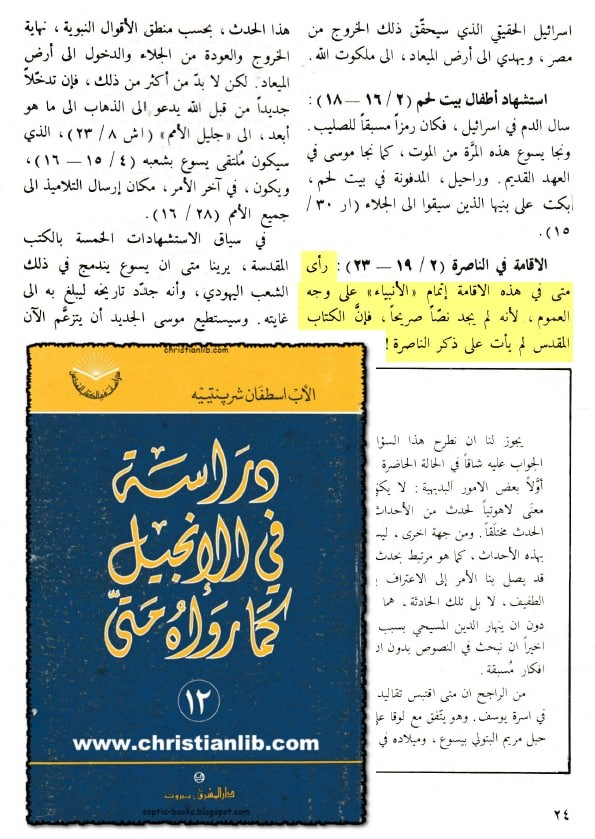
“And he came and dwelt in a city called Nazareth, that it might be fulfilled which was spoken by the prophets, ‘He shall be called a Nazarene.’”
It is true that we know that Matthew was trying — with all his ability to lie and deceive — to prove to the Jews that Jesus is the awaited Messiah and King of the Jews, and that there are prophecies about him spread throughout the Old Testament.
Source mentioned:
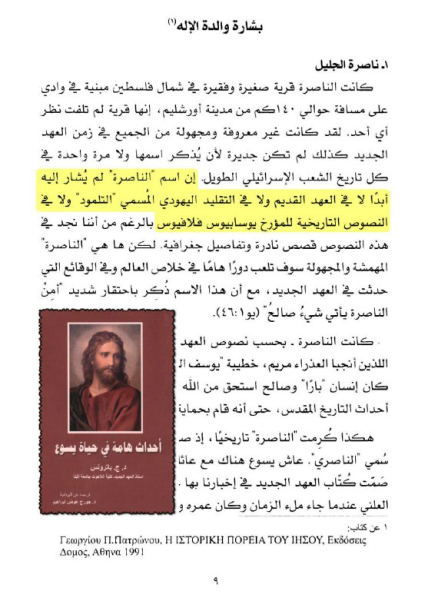
Anba Youannis — The Christian Church in the Age of the Apostles — p. 368
Table of Contents
- Matthew 2:23 and the Alleged Nazarene Prophecy
- The Problem: There Is No Such Prophecy
- Christian Commentators Admit the Problem
- Nazareth Is Not Mentioned in Ancient Jewish Sources
- John Chrysostom and the Lost-Book Escape
- Nazareth Has No Early Source Presence
- The Branch Argument
- Problem 1: Phonetic Similarity Is Not Evidence
- The Mecca/Bakkah Counter-Example
- Problem 2: Nazareth and Netzer Do Not Match Linguistically
- The Septuagint Problem
- Problem 3: Isaiah 11 Does Not Fit Jesus
- Problem 4: Jeremiah and Zechariah Use a Different Hebrew Word
- Problem 5: The Branch Fits Zerubbabel, Not Jesus
- The Nazarite Vow Argument
- The Catholic Encyclopedia Admits the Problem
- Final Conclusion
Matthew 2:23 and the Alleged Nazarene Prophecy
“And he came and dwelt in a city called Nazareth, that it might be fulfilled which was spoken by the prophets, ‘He shall be called a Nazarene.’”
“He shall be called a Nazarene.”
The problem is simple: where is this prophecy in the Old Testament?
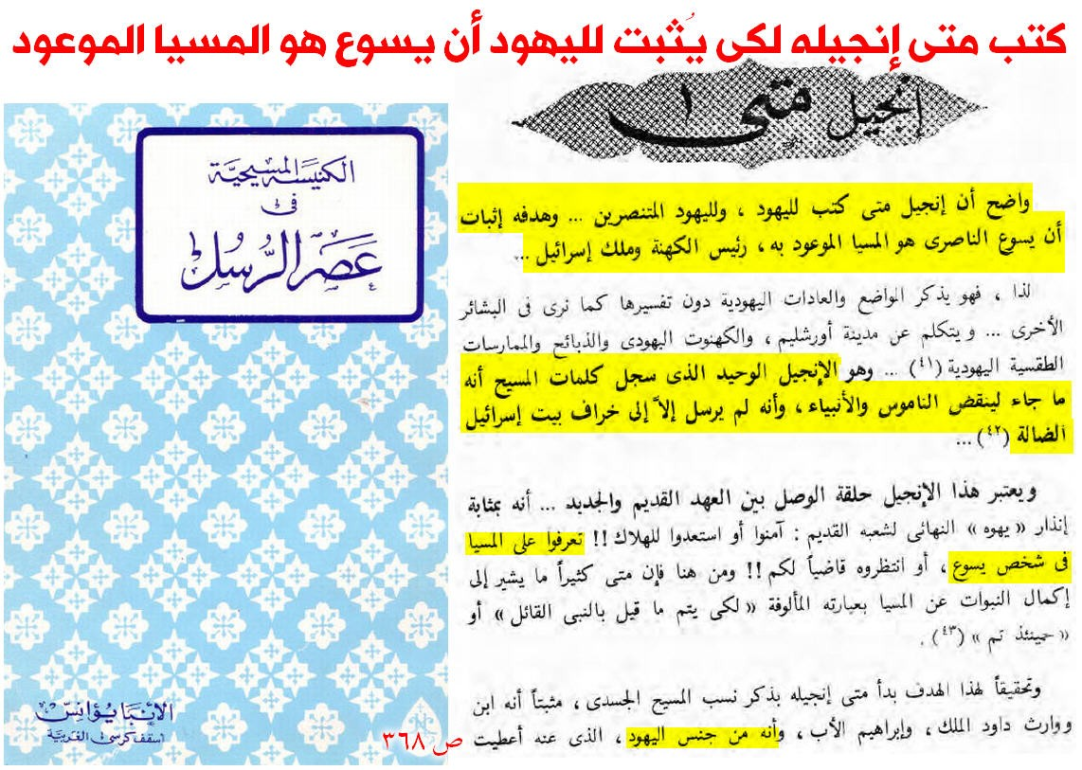
The page explains that Matthew’s method was to connect events in Jesus’ life to Old Testament prophecies. This matters because Matthew 2:23 is presented as one of these fulfillment claims. If Matthew says Jesus living in Nazareth fulfilled something spoken by the prophets, then the prophecy should be traceable in the prophetic books. The problem is that this exact prophecy does not appear in the Old Testament.
The Problem: There Is No Such Prophecy
So where did Matthew quote this text from?
How can there be a prophecy about a country that was never mentioned in:
- the Old Testament,
- the Talmud,
- or even the Apocrypha?
If we review the words of the commentators, we will find something strange: in their words there is an implicit admission of the distortion of this text, and that its writer is ignorant and did not know that the city of Nazareth did not exist with this name in the Old Testament.
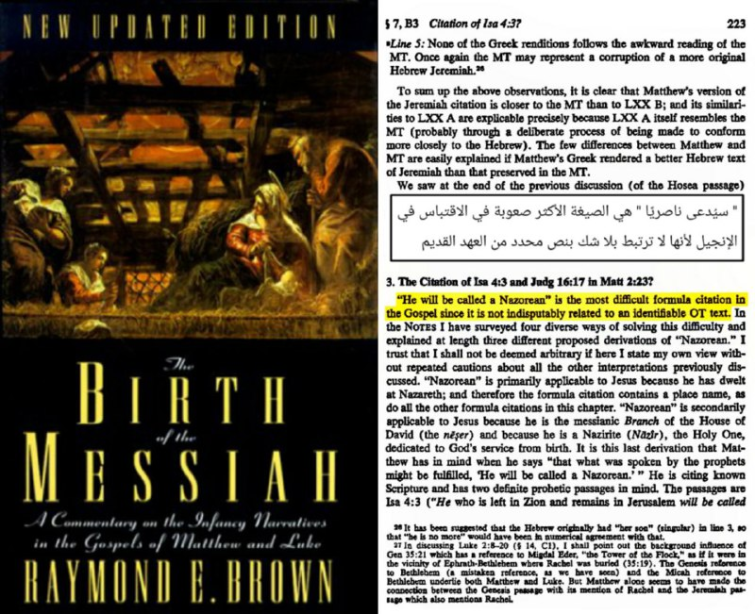
Christian Commentators Admit the Problem
Modern Interpretation of the Holy Bible
The phrase is not in the Old Testament.
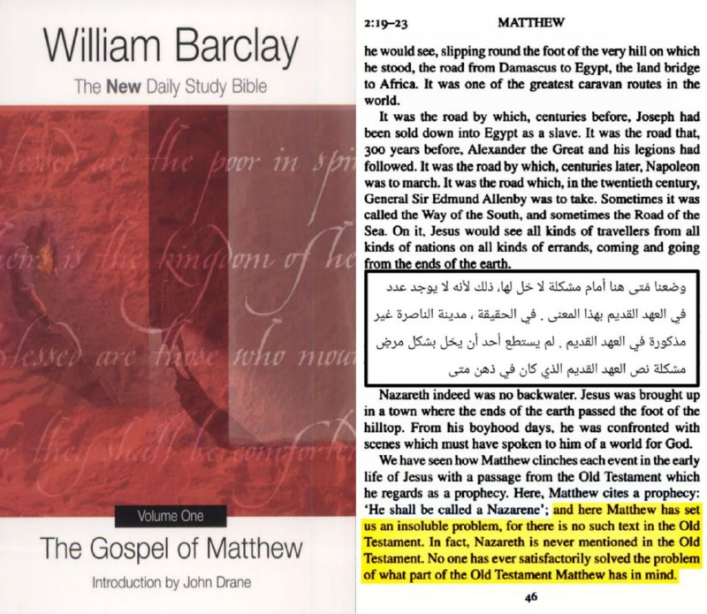
William Barclay’s Interpretation
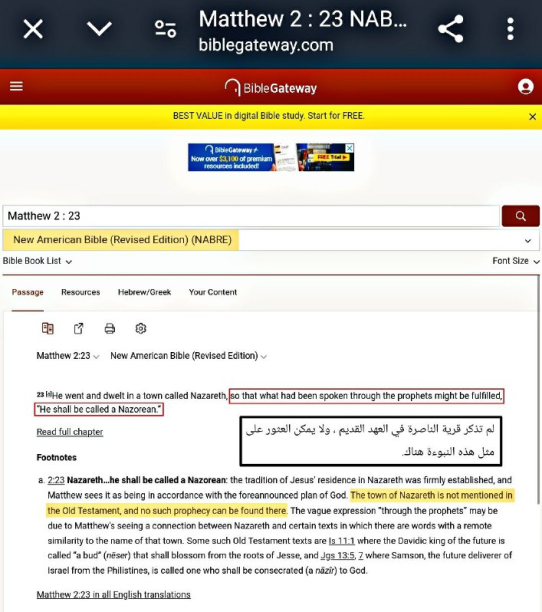
There is no number in the Old Testament, and even the city of Nazareth is not mentioned in the Old Testament.
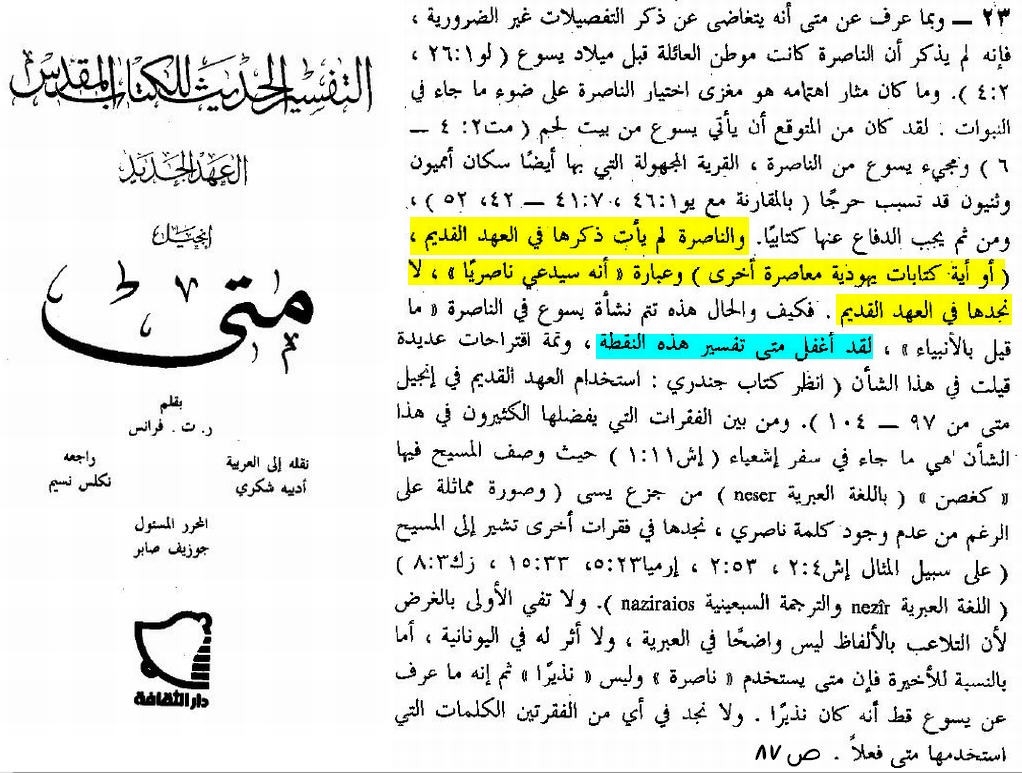
The page explains that Matthew says Jesus settled in Nazareth so that what was spoken by the prophets would be fulfilled. But the problem is that the exact wording Matthew gives does not exist in the written Old Testament. The page therefore acknowledges the core difficulty: Matthew presents this as prophecy, yet the Old Testament contains no such direct prophetic statement.
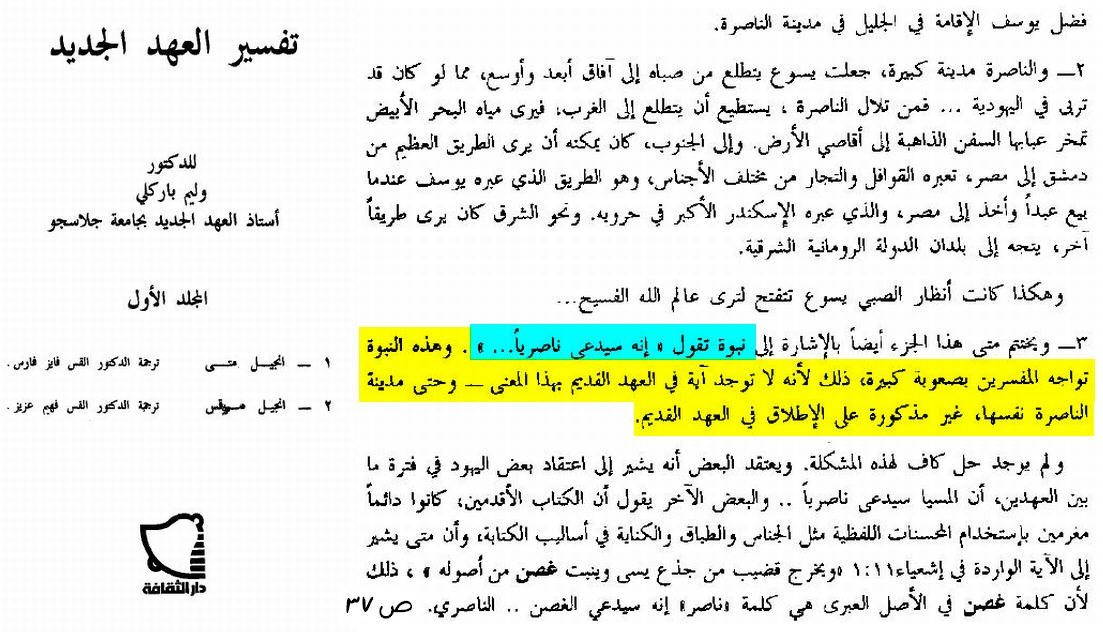
The page also notes a second problem: even the city of Nazareth itself is not mentioned in the Old Testament. This makes Matthew’s statement harder to defend because he connects the alleged prophecy directly to Jesus dwelling in a city called Nazareth. In simple terms, Barclay admits that both the phrase and the city are absent from the Old Testament record.
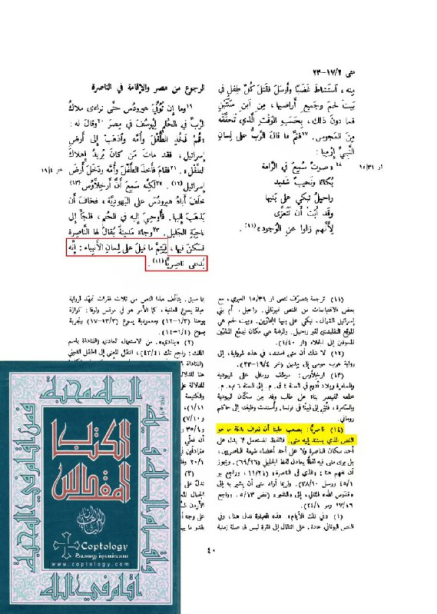
Jesuit Monastic Edition
It is difficult to know the text that Matthew is relying on.
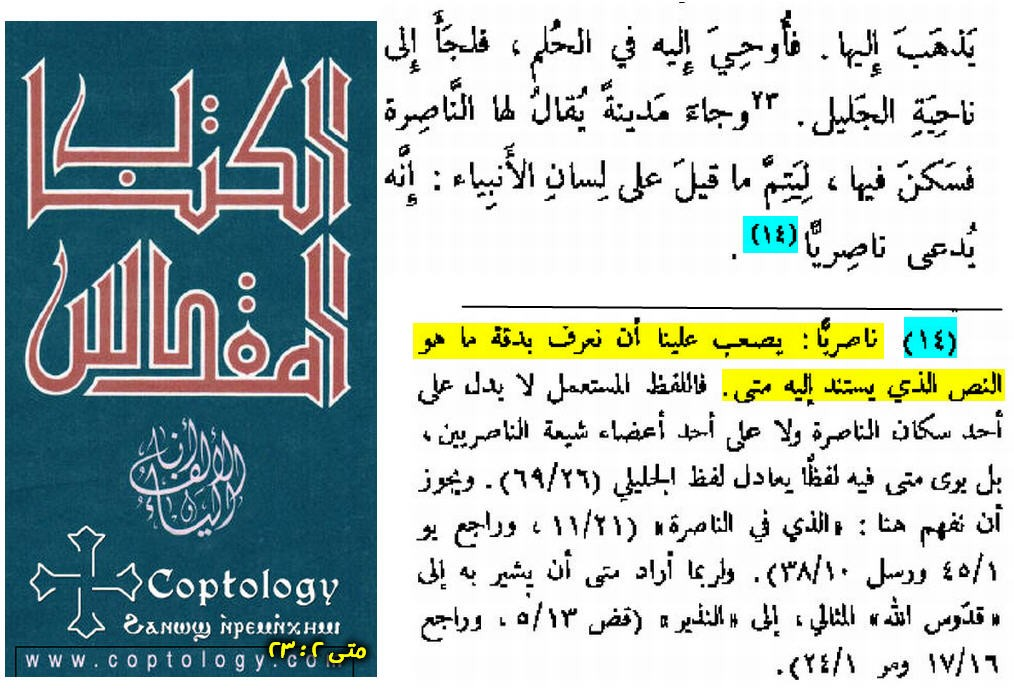
The page is admitting that Matthew’s statement cannot be easily matched with a known Old Testament passage. This means the source of Matthew’s alleged prophecy is uncertain. The note does not produce a clear verse from the prophets; instead, it acknowledges the difficulty of identifying Matthew’s source.
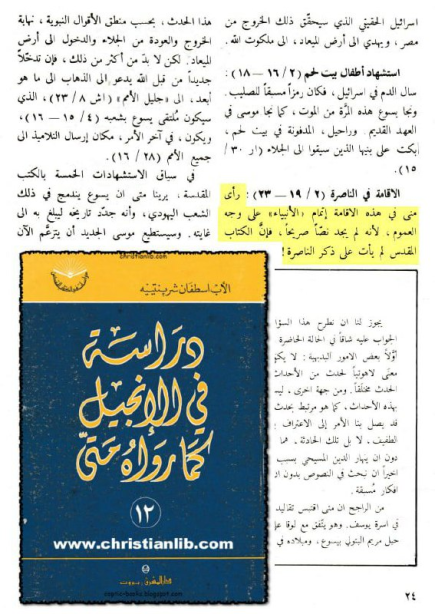
The Synoptic Gospels of Paul Al-Feghali
This text is not mentioned in the known prophets, and we do not know where Matthew got it from.
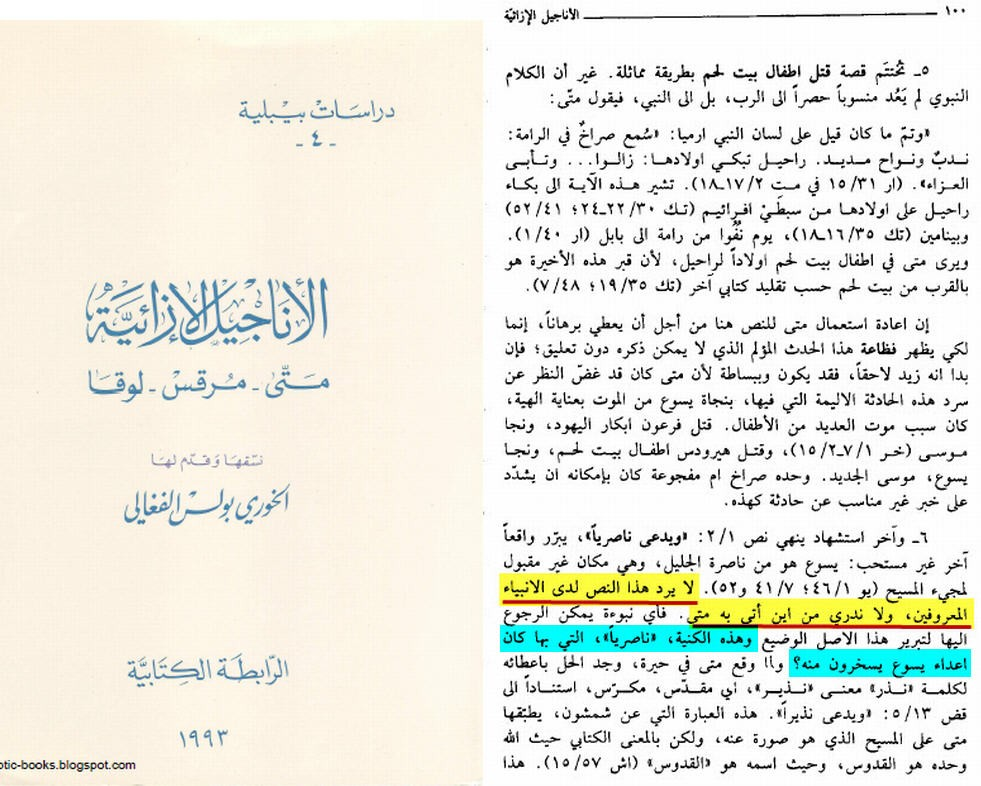
The page also states that we do not know where Matthew got this text from. This is a direct admission that the prophecy Matthew cites is not identifiable in the known prophetic books. The page therefore confirms the central problem: Matthew claims prophetic fulfillment, but the source of the prophecy is unknown.
The Bible Encyclopedia
It is:
- not found at all in the Old Testament,
- not found at all in the Talmud,
- not found at all in the Apocrypha,
- not found at all in the writings of Josephus, the Jewish historian.
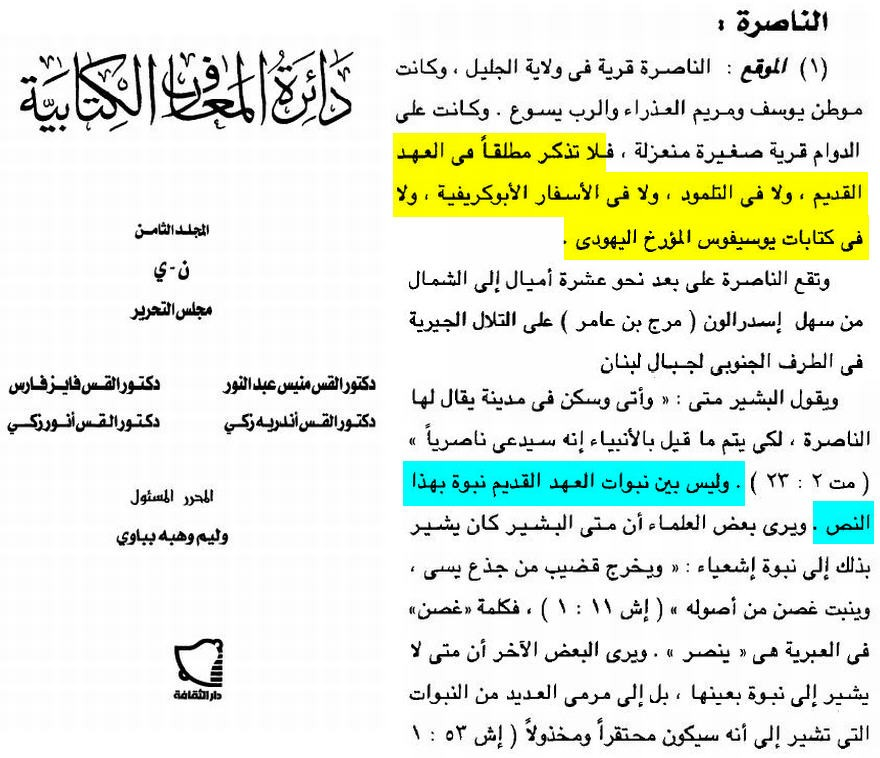
The page also says Nazareth is not mentioned in the Talmud, not mentioned in the Apocrypha, and not mentioned by Josephus, the Jewish historian. This is important because Matthew 2:23 connects the alleged prophecy to Jesus living in Nazareth. If Nazareth itself is absent from these Jewish and pre-Christian sources, then the claim that the prophets foretold someone being called a Nazarene becomes extremely difficult to support.
John MacArthur
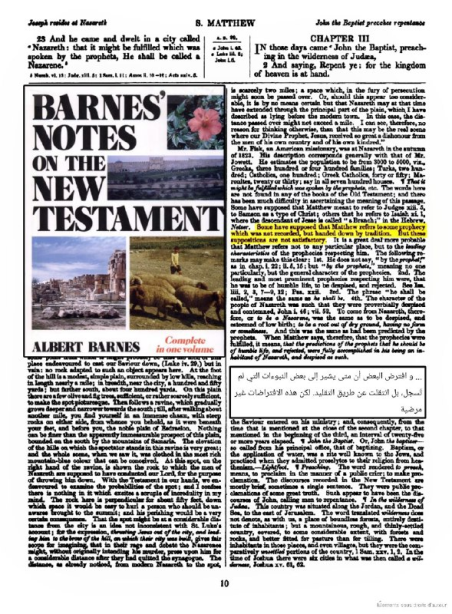
It may be a reference to oral prophecies that were not recorded anywhere in the Old Testament.
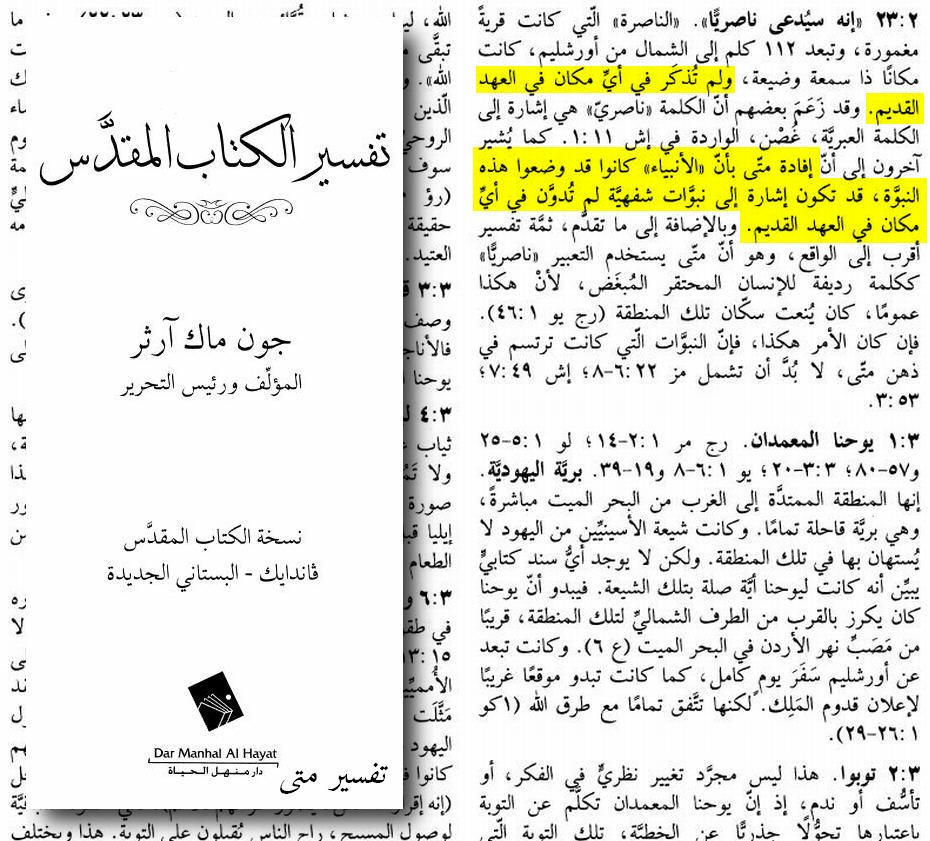
MacArthur then suggests that Matthew may have been referring to oral prophecies that were not recorded in the Old Testament. This means he does not provide a written Old Testament verse for Matthew’s claim. Instead, he moves to the possibility of an unrecorded prophecy. The problem is that an unrecorded prophecy cannot be verified from scripture, even though Matthew presents the statement as something spoken by the prophets.
Nazareth Is Not Mentioned in Ancient Jewish Sources
Jewish Encyclopedia
Nazareth was not mentioned in non-Christian sources until the third or fourth century AD.
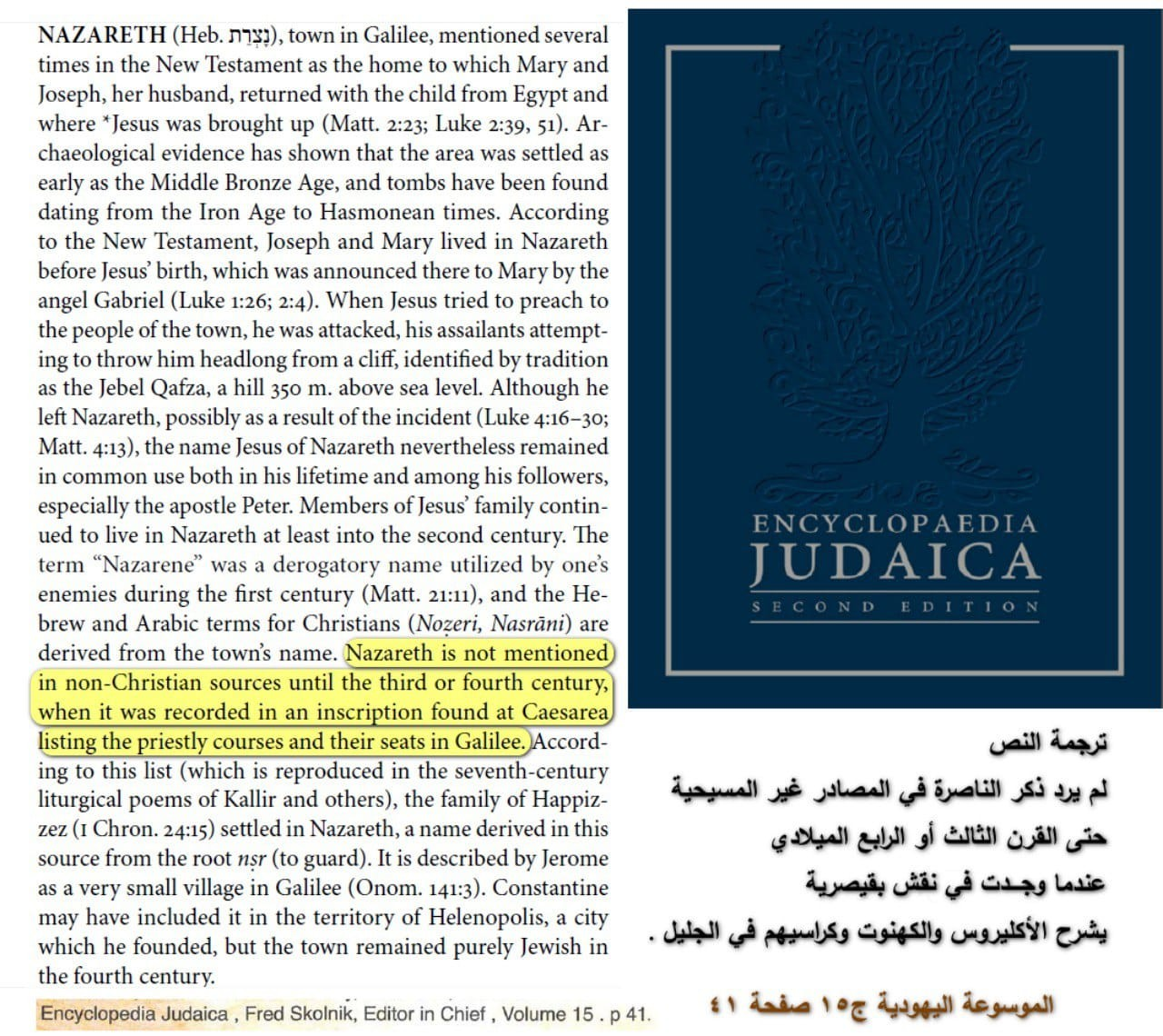
This means that Nazareth lacks early non-Christian literary attestation. The page therefore adds another difficulty to Matthew 2:23. If Nazareth is absent from the Old Testament and also absent from early non-Christian Jewish sources, then the claim that the prophets had already spoken of the Messiah being called a Nazarene becomes even more problematic.
John Chrysostom and the Lost-Book Escape
John Chrysostom admitted that this prophecy is not found in the Old Testament and that it may belong to one of the lost books.
John Chrysostom — Homilies on the Gospel of Matthew, Chapter IX, P. 91
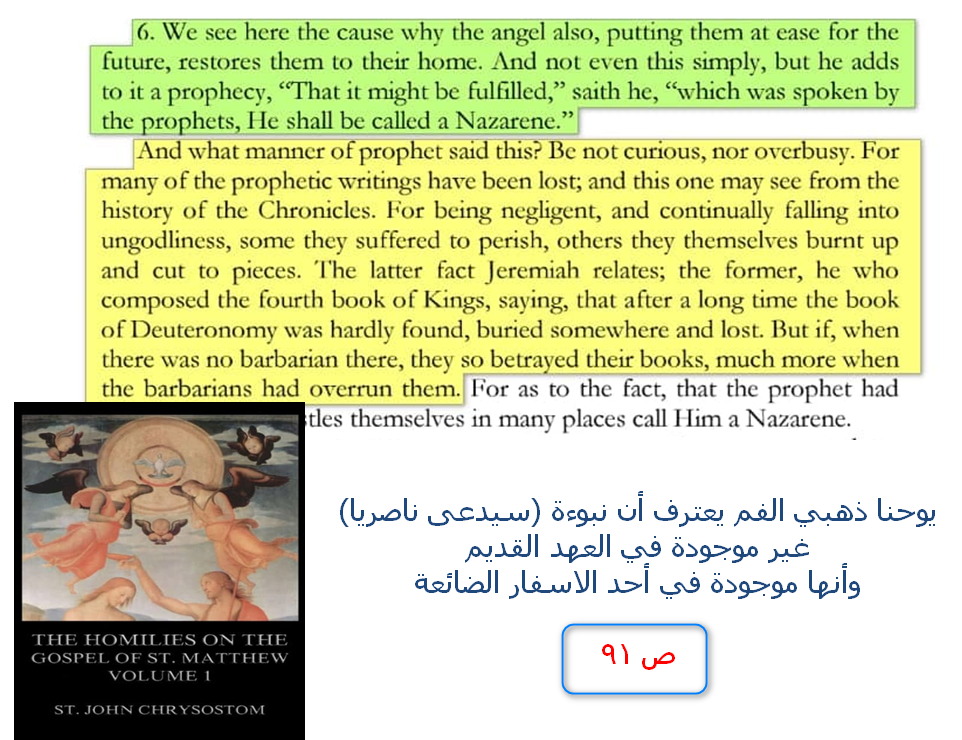
Chrysostom’s explanation admits the main problem indirectly: the prophecy is not available in the existing Old Testament books. His solution is that the prophecy may have belonged to writings that are no longer extant. But that creates a serious dilemma: either Matthew cited a lost inspired text, meaning scripture has lost prophetic material, or Matthew cited something that cannot be verified.
John Chrysostom — Sermons, P. 66
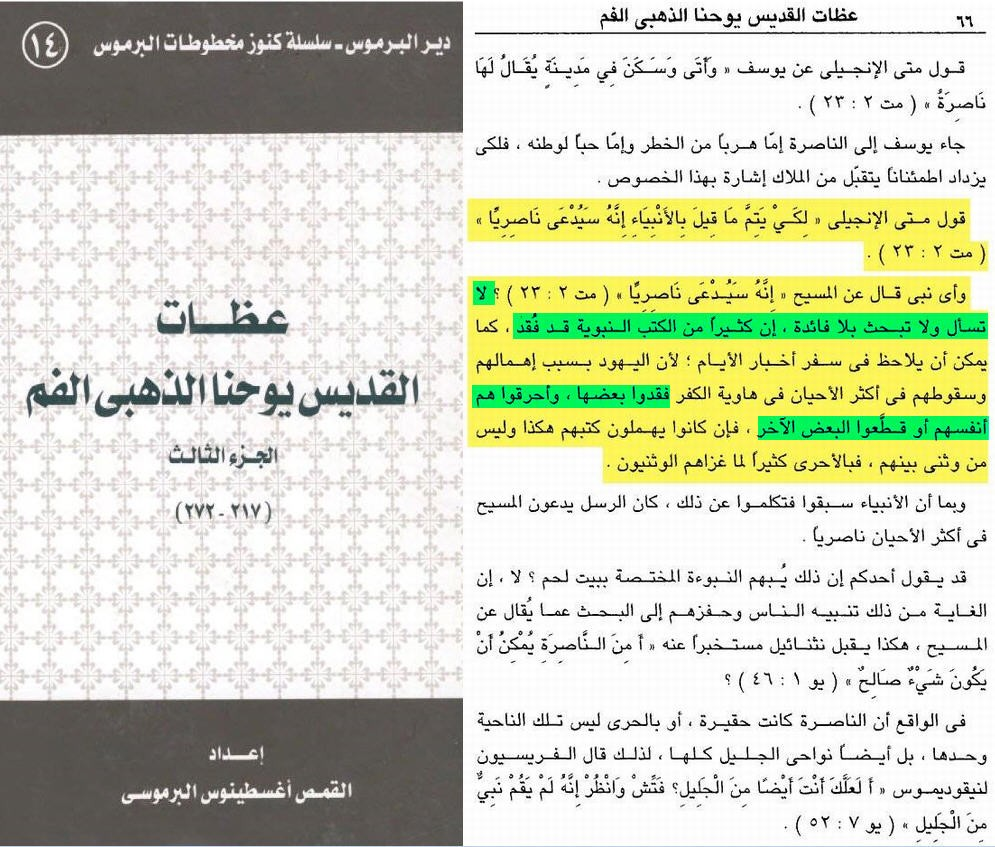
The page therefore confirms that early Christian interpreters did not have a clear written Old Testament passage to point to. Instead, they had to appeal to the possibility of lost prophetic material. This explanation may protect Matthew temporarily, but it damages the claim that the Biblical prophetic record is complete and preserved.
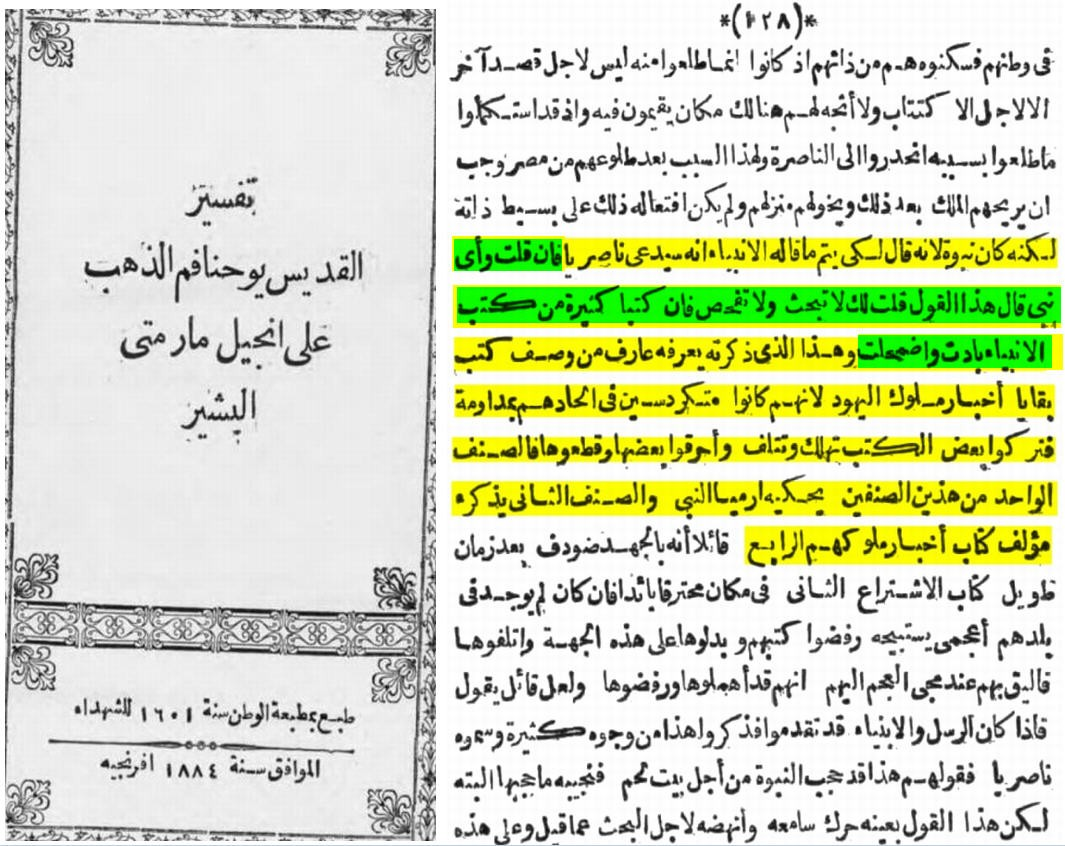
The explanation depends on the idea that some prophetic books or sayings once existed but were later lost. In plain terms, this means Christians are forced into a dilemma: either Matthew quoted a lost prophecy, which means part of the prophetic record disappeared, or Matthew made a fulfillment claim without a real written source.
Nazareth Has No Early Source Presence
Philo, the Jewish philosopher of Alexandria, did not mention it, nor did the Jewish historian Josephus — both of whom were contemporaries of Christ — know anything about it.
Nor do we find any presence of it in any of Paul’s letters, and the rest of the books of the New Testament that were written before the time of writing the Gospels.
The Talmud did not know anything about it.
The page also says Philo of Alexandria does not mention it, Josephus does not mention it, Paul’s letters do not mention it, and earlier New Testament writings before the Gospels do not mention it. The point is that Nazareth has no clear early textual presence in the major Jewish and historical sources where one might expect it to appear if it were connected to a known messianic prophecy.
The Branch Argument
They said:
The word “Nazareth” is from which the title “Nasara” was derived; in Hebrew it is Natzar and means branch, and from it the Arabic word “Nadir”, and the Lord Christ was called the branch in more than one prophecy in the Old Testament.
“And he came and dwelt in a city called Nazareth, that what was spoken by the prophets might be fulfilled, ‘He shall be called a Nazarene.’”
נֵצֶר nêtser, nay’-tser; from H5341 in the sense of greenness as a striking color; a shoot; figuratively, a descendant: branch.
Their interpretation is nothing but a desperate attempt to correct a clear and blatant error in the text of their “holy” book.
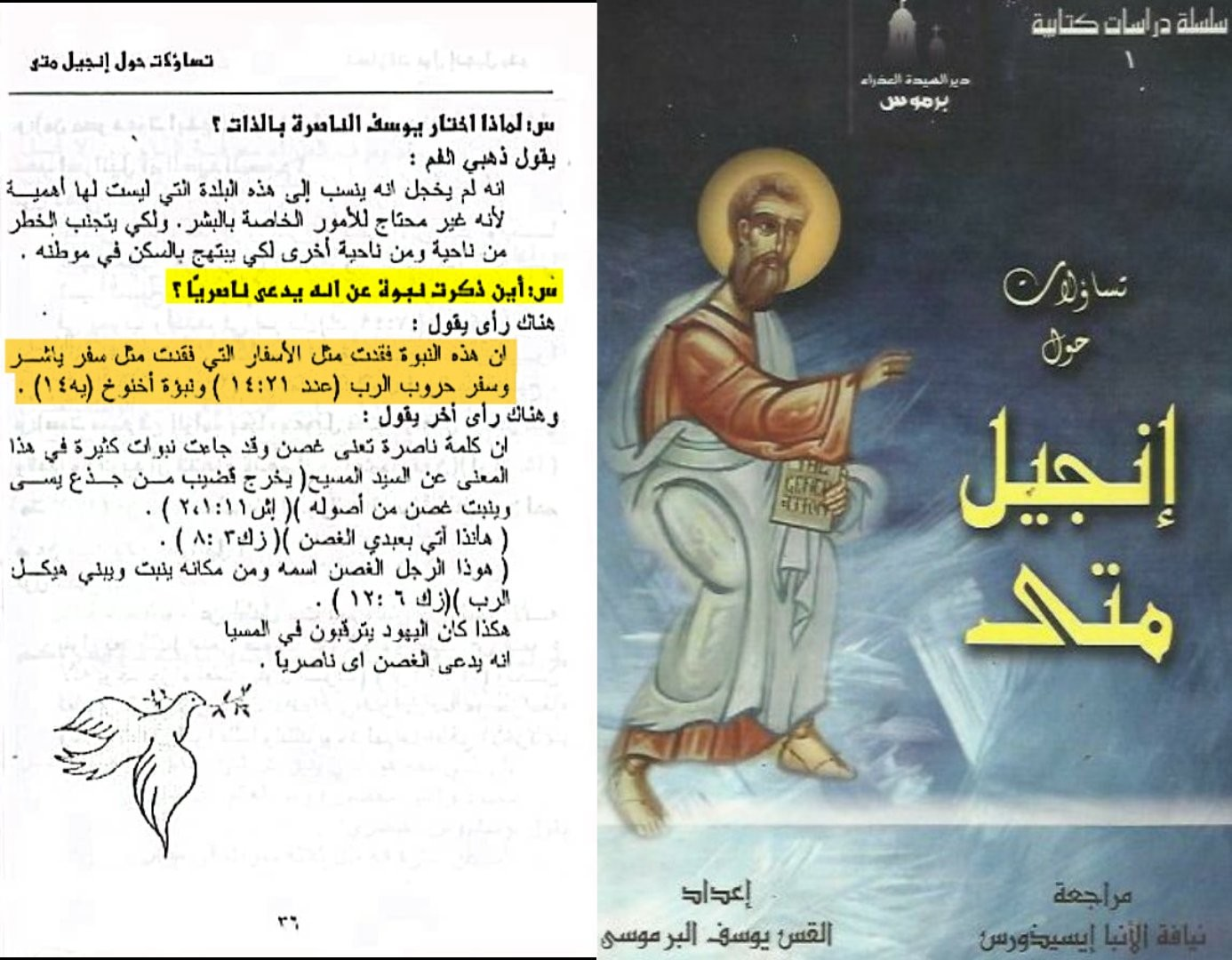
The important point is that the word is nêtser, not “Nazareth” itself. Christian apologists try to connect this Hebrew word to Matthew’s phrase “Nazarene,” but the page only establishes the meaning of the Hebrew word “branch.” It does not prove that Matthew’s city of Nazareth is the same thing as this word.
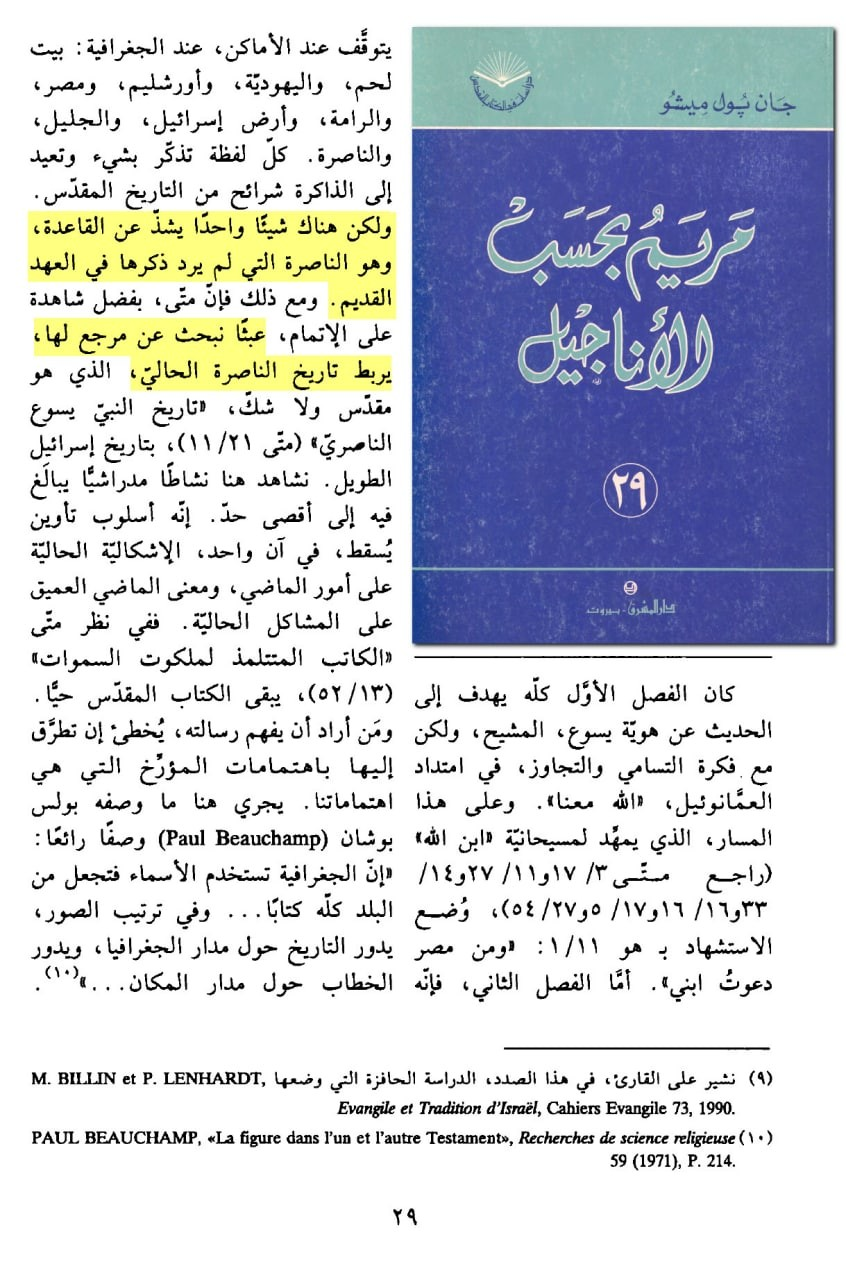
The page helps clarify what the Hebrew word actually means. But it also exposes the weakness of the Christian argument: proving that nêtser means “branch” does not prove that Matthew’s phrase “He shall be called a Nazarene” comes from Isaiah 11:1. Matthew’s wording is about residence in a city called Nazareth, not merely about being symbolically called a branch.
Problem 1: Phonetic Similarity Is Not Evidence
נֵצֶר [Nizer]
and the word Nazareth.
This is found in Isaiah 11:1:
وَيَخْرُجُ قَضِيبٌ مِنْ جِذْعِ يَسَّى، وَيَنْبُتُ غُصْنٌ مِنْ أُصُولِهِ،
The prophecy cannot be interpreted as meaning that Christ was born in Nazareth to be called a branch.
Source:
Biblical Commentary on the New Testament by Dr. Hermann Olshausen, v. 1, p. 195.
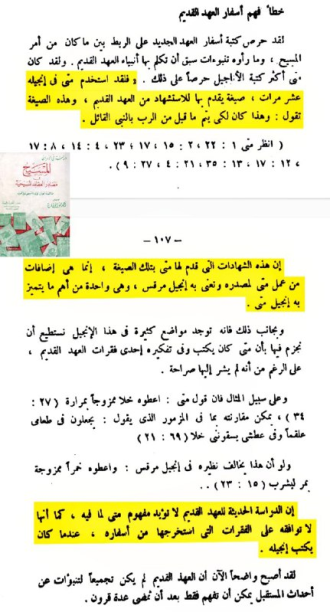
The highlighted paragraph says there is no proper connection between the word netzer and Jesus living in Nazareth. Olshausen rejects the idea that Matthew’s statement can be solved simply by appealing to a similarity between “Nazareth” and the Hebrew word for branch. In plain terms, he is saying the branch explanation does not naturally fit Matthew’s wording.
The Mecca/Bakkah Counter-Example
“Enter through the narrow gate. For wide is the gate and broad is the road that leads to destruction, and many enter through it.”
Matthew 7:13 — Van Dyke translation.
Originally, Mecca was called Bakkah — the narrow one.
Source mentioned:
The New Encyclopedia of Islam, Cyril Glassé, p. 302.
By the same standard as the Christians, we can say that Christ was prophesying the Prophet Muhammad’s ﷺ departure from Mecca and commanding the Christians to convert to Islam and perform the Hajj in Mecca.
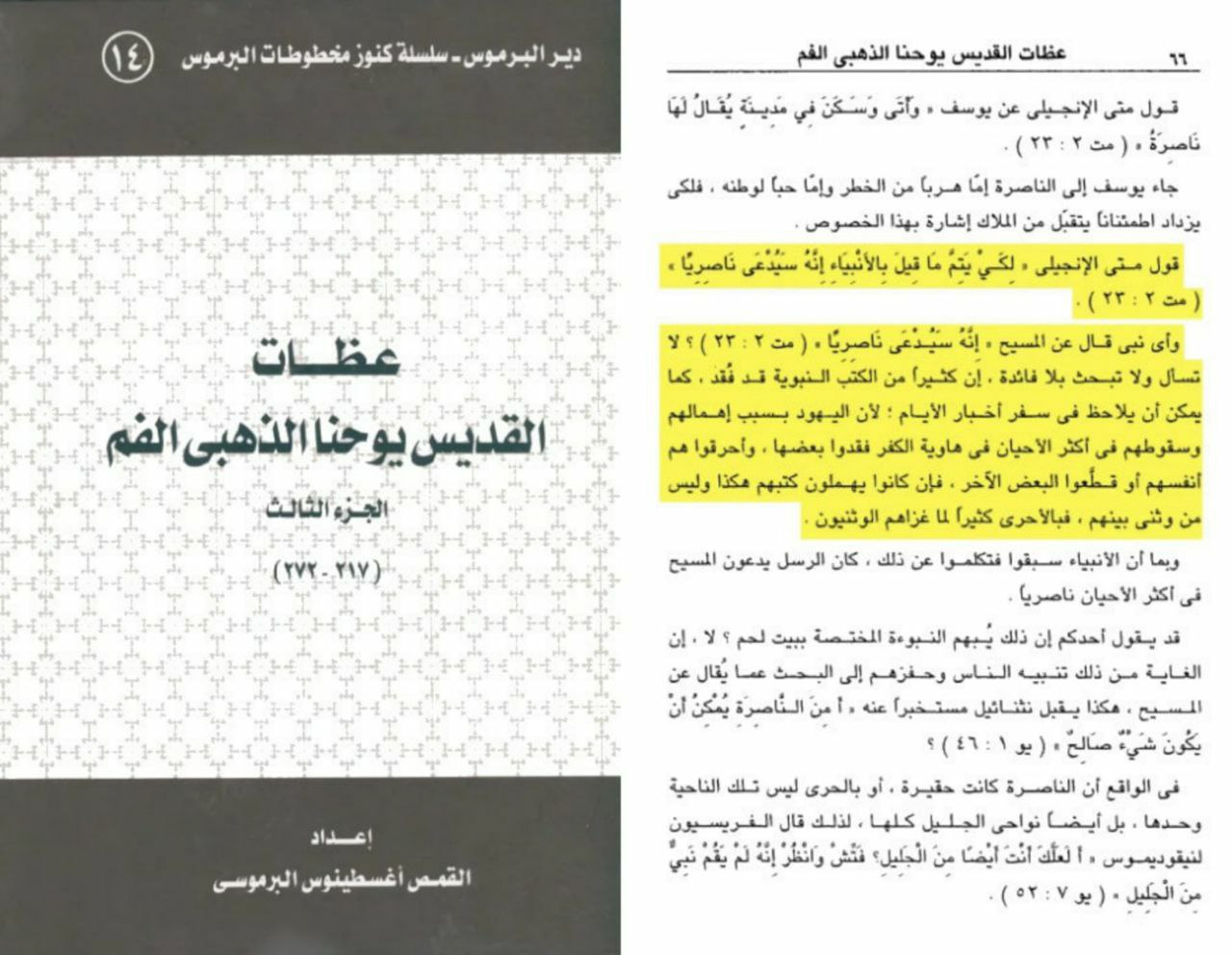
The relevance is methodological. If Christians are allowed to force a prophecy out of loose similarity between “Nazareth” and netzer, then the same loose method could be applied elsewhere. One could connect Matthew’s “narrow gate” to Bakkah/Mecca because Bakkah is associated with narrowness. This shows how weak and arbitrary the Christian wordplay method is.
Problem 2: Nazareth and Netzer Do Not Match Linguistically
Ναζαρέτ
with the letter ζ — Greek zeta.
But the word for “branch” uses the Hebrew letter:
צ — Tzadi.
Source:
Biblical Commentary on the New Testament by Dr. Hermann Olshausen, vol. 1, p. 195.
Olshausen explains that Greek zeta corresponds more naturally to the Hebrew letter ז / zayin, not צ / tsadi, which appears in נֵצֶר / netzer. This means the alleged connection between Nazareth and netzer is not only contextually weak but also linguistically defective.
The Septuagint Problem
Church Fathers such as Cyril, Ambrose, and Jerome saw the flower and the rod as a symbolic representation of Christ and his mother, peace be upon them — a symbolic interpretation.
It is well known that the Gospel writers relied primarily on the Septuagint translation.
So, what evidence do Christians have that Matthew relied on the Hebrew text for this quotation, which is not found in the Old Testament?
The page also notes that some Church Fathers interpreted the rod and flower symbolically, often connecting them to Christ and Mary. The key problem is that Matthew’s Gospel generally relies heavily on the Septuagint, yet the Nazareth/netzer argument depends on appealing to the Hebrew wording. This creates a selective and unstable argument: Christians appeal to Hebrew wordplay here because the actual prophecy is missing.
Problem 3: Isaiah 11 Does Not Fit Jesus
3 His delight is in the fear of the Lord; he will not judge by what his eyes see, nor decide by what his ears hear.
4 But with righteousness he will judge the poor, and with equity he will decide for the needy of the earth; he will strike the earth with the rod of his mouth, and with the breath of his lips he will slay the wicked.
Was Christ a judge?
14 Jesus replied, “Man, who appointed me a judge or arbitrator over you?”
Did Christ rule on earth?
36 Jesus answered, “My kingdom is not of this world.”
47. If anyone hears my words and does not believe them, I do not judge that person; for I did not come to judge the world, but to save the world.
11 And it shall come to pass in that day that the Lord shall reach out his hand a second time to gain the remnant of his people, that which was left, from Assyria, and from Egypt, and from Pathros, and from Cush, and from Elam, and from Shinar, and from Hamath, and from the islands of the sea.
12 He will raise a banner for the nations and gather the exiles of Israel; he will assemble the scattered people of Judah from the four corners of the earth.
Did Christ gather the exiles of Israel and unite the scattered people of Judah in his time?
The same chapter also speaks about gathering the remnant of Israel from Assyria, Egypt, Pathros, Cush, Elam, Shinar, Hamath, and the islands of the sea. The page shows that Isaiah 11 is not merely about a “branch” word. It describes a ruler, judge, and restorer of Israel. This creates a problem for applying the passage to Jesus’ first coming, because the Gospel texts themselves present Jesus as saying his kingdom is not of this world and that he did not come to judge.
Problem 4: Jeremiah and Zechariah Use a Different Hebrew Word
They also said that the branch is mentioned in the books of Jeremiah and Zechariah and prophesies their Jesus.
16 In those days Judah will be saved, and Jerusalem will dwell in safety; and this is what it will be called: The Lord is our Righteousness.”
17 For thus says the Lord: “David shall never lack a man to sit on the throne of the house of Israel,
18 nor shall the Levitical priests ever lack a man before me to offer a burnt offering and to burn a grain offering and to prepare a sacrifice continually.”
Listen, Joshua, high priest, you and your companions who sit before you, for they are men of signs. Behold, I am bringing my servant, the Branch.
13 He is the one who will build the temple of the Lord and be crowned with glory, and he will be both king and priest. He will sit and rule on his throne, and through the counsel of his two offices, he will bring peace to his people.”
- The Hebrew origin of the branch in Jeremiah and Zechariah is not the same as in Isaiah. In Jeremiah and Zechariah it is צמח, while in Isaiah it is נֵצֶר.
- The context of the text undermines the Christians’ efforts once again.
Did their Christ rule justly?
Did he build the temple?
Did he spread peace among his people?
This is not the same Hebrew word as נֵצֶר / netzer in Isaiah 11:1. Therefore, Jeremiah and Zechariah cannot be used to support the specific Nazareth/netzer wordplay. The page shows that Christians are gathering different “branch” passages together, even though the Hebrew terms are not identical.
The page also belongs to a context about building the temple, ruling, and restoring peace. That context matters because Zechariah speaks about a figure who builds the temple of the Lord and sits in royal-priestly authority. This does not solve Matthew 2:23 because the wording and context are different from the Nazareth claim.
Problem 5: The Branch Fits Zerubbabel, Not Jesus
It is Zerubbabel.
Zerubbabel, along with Joshua son of Jozadak and his fellow priests, built the altar for burnt offerings and organized worship (Ezra 3:1-9).
He was a descendant of David (Matthew 1:12; Luke 3:13).
He received the sacred vessels from Cyrus that were returned to Jerusalem.
He was then appointed governor and laid the foundation of the temple (Zechariah 4:6-10).
He played a major role in restoring the people’s regular religious practices.
He loved his people and worked to rebuild the holy temple, which had been abandoned by the people who worshipped the God of their ancestors.
The temple became known as the Temple of Zerubbabel, and its construction was completed in 515 BC.
He was the one who brought back the first group of Jews from the Babylonian captivity and rebuilt the Second Temple.
Even the context of the texts supports this.
The page also says Zerubbabel became governor and played a major role in rebuilding the temple, which was completed in 515 BC and became known as the Temple of Zerubbabel. This description fits the temple-building language found in Zechariah far more naturally than applying it to Jesus. The highlighted material therefore supports the point that the “Branch” context belongs to restoration and temple-building, especially around Zerubbabel.
The Nazarite Vow Argument
The book in question is Numbers 6.
2 “Speak to the Israelites and tell them: When a man or woman sets aside a vow, let them make a vow to the Lord.
3 They must abstain from wine and strong drink. They must not drink vinegar made from wine or strong drink, nor drink any wine-based beverage, nor eat grapes, whether fresh or dried.
4 During all the days of his vow, he shall not eat anything he prepares.”
Furthermore, Jesus Christ was not dedicated to the Lord; there is nothing in his life to indicate this.
19 “The Son of Man came eating and drinking, and they say, ‘Look at a glutton and a drunkard, a friend of tax collectors and sinners!’ Yet wisdom is justified by her children.”
However, primarily, the character of the Savior does not fit with a comparison to the Jewish Nazirite, because his life was not, like that of John the Baptist, characterized by strict adherence to legalistic rituals.
Source:
Biblical Commentary on the New Testament by Dr. Hermann Olshausen, v. 1, p. 195.
Olshausen rejects it because Jesus’ life does not match the character of a Jewish Nazirite. A Nazirite was associated with strict ritual abstinence, while the Gospel tradition contrasts Jesus with John the Baptist and describes Jesus as eating and drinking. The page therefore shows that the Nazirite explanation does not fit Matthew 2:23.
The Catholic Encyclopedia Admits the Problem
The Catholic Encyclopedia acknowledged that all these interpretations, which have already been refuted, are far from correct.
There is no explicit prophecy of this kind in the recorded Old Testament prophecies, and various theories have been proposed to explain the reference.
Some connect the passage to the netzer in Isaiah 11:1; others to the netzer in Isaiah 49:6, but these interpretations seem improbable, not to mention the other difficulties.
The reference to the attribute of “nazarite” mentioned by the evangelist is rejected because Christ was not a nazarite, and the theory that the reference here is to a lost prophecy or simply a traditional one is not supported by any positive evidence.
We found no more plausible explanation than that given by St. Jerome in his Commentary on the Gospel of St. Matthew, which is that the mention of “the prophets” in the plural prevents reference to any single passage, and instead refers to the general predictions that Christ will be despised (see John 1:46).
Source:
The Catholic Encyclopedia, Vol. 10. New York: Robert Appleton Company, 1911.
See:
We have already shown that the claim that Nazarene is a sign of contempt and rejection is also unacceptable.
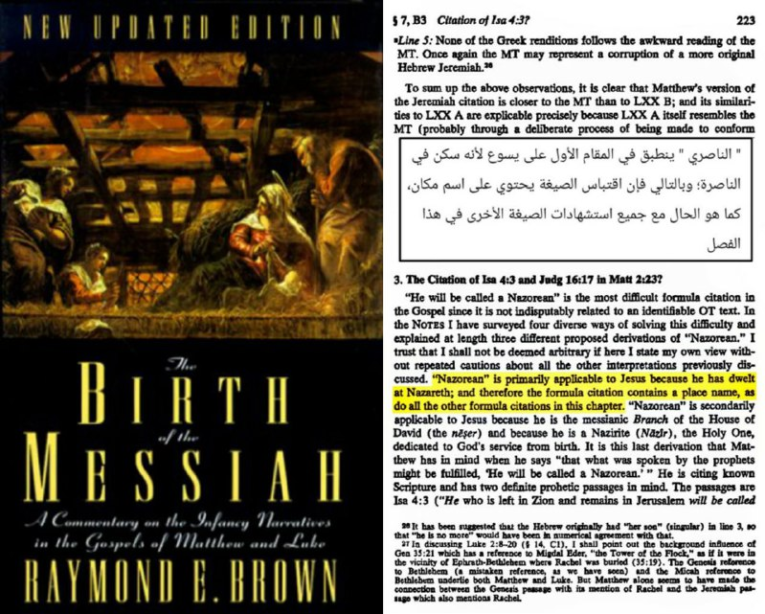
The page then reviews several attempted explanations. Some connect the phrase to netzer in Isaiah 11:1 or Isaiah 49:6, but the encyclopedia says these interpretations are improbable and face other difficulties. It also rejects the Nazirite-vow explanation because Christ was not a Nazirite. It says the lost-prophecy or traditional-prophecy explanation is not supported by positive evidence.
The page finally prefers Jerome’s explanation: because Matthew says “prophets” in the plural, perhaps he is not referring to one specific text, but to a general theme that the Messiah would be despised. But this still does not remove the difficulty, because Matthew’s own wording connects the fulfillment to Jesus living in a city called Nazareth.
Final Conclusion
He is clear in what he wrote:
Christ fulfilled the alleged prophecy, which is not found in the Old Testament, because he lived in Nazareth, a place not mentioned in the Old Testament.
This, from the outset, precludes the validity of the hypotheses such as:
- the vow to the Lord,
- the branch,
- contempt,
- rejection.
Furthermore, Nathanael’s words preclude the possibility that these were transmitted orally, because it is inconceivable that one of the most important titles or attributes of the awaited Messiah would be unknown.
They are divided; whenever one of them proposes a hypothesis, another refutes it, and they have not agreed upon a single acceptable interpretation.
All praise is due to God.
Did Matthew lie and claim and fabricate this prophecy about Christ — as he usually does — from himself and put it in the Holy Book?
Or was there actually a prophecy with the same text in the Old Testament, and it was lost from the Holy Book?
The answer to the question in all cases will lead to the destruction of the belief in the infallibility and holiness of this distorted, senile book; whether the prophecy was lost or Matthew made a mistake and added the text from his own effort.
So farewell to the holiness of this book forever.
Mecca in the Bible: The Hidden Prophecy of Psalm 84 & Bakkah