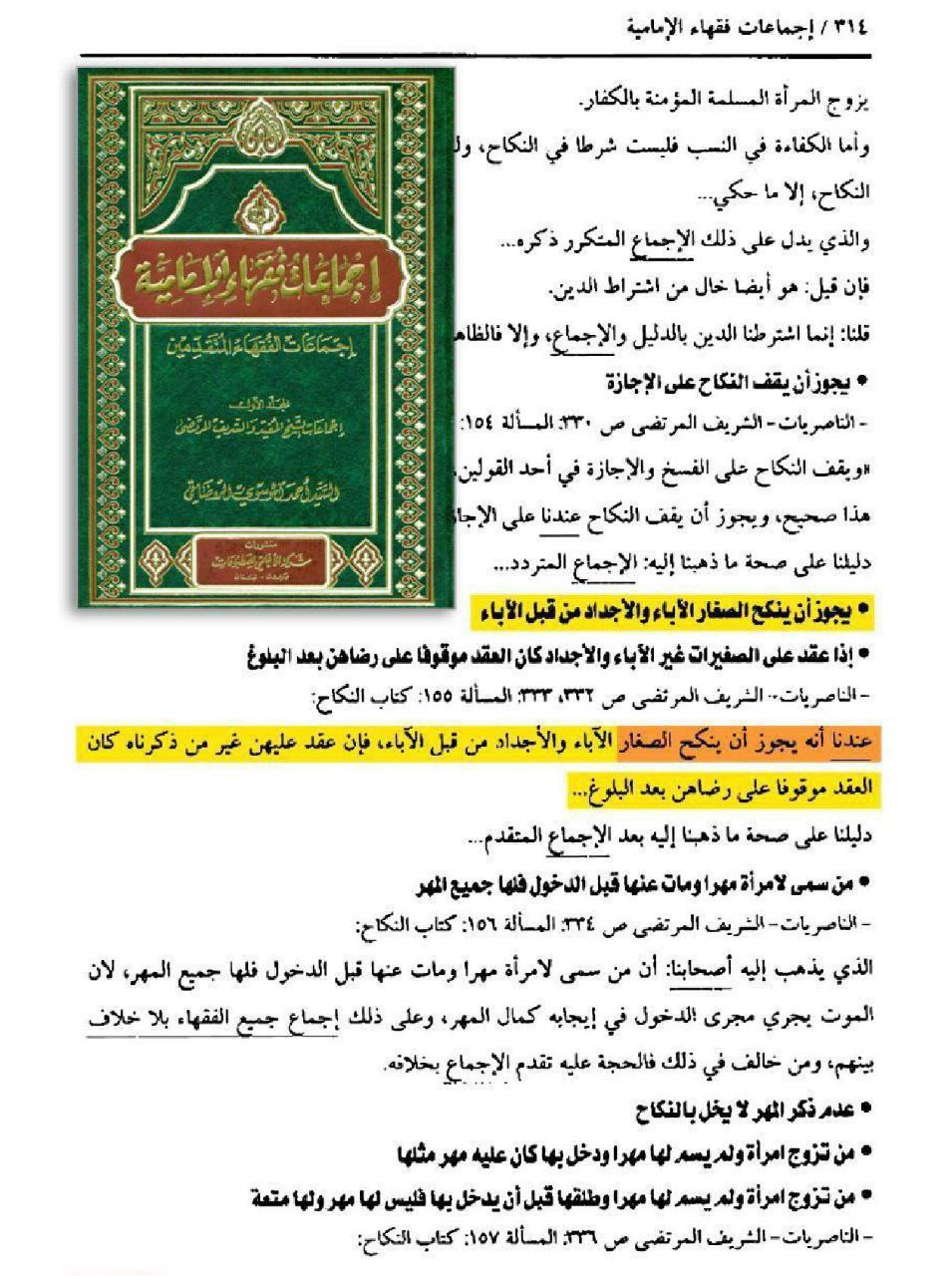
Doubt Being Addressed Critics of Islam allege that Islamic law permits the marriage and sexual consummation with prepubescent girls, citing classical jurisprudence and certain Quranic verses — in particular Surah al-Talaq 65:4. This article addresses that claim systematically through primary sources in Islamic law, Quranic grammar, and classical exegesis.
The most important legal distinction this article establishes is between a marriage contract (aqd) and the physical handover (taslim) of the wife to the husband. These are two entirely separate legal acts in Islamic jurisprudence. A contract alone grants no right to physical access. The condition that must be met before handover is physical capability — not a fixed numerical age, and certainly not the mere existence of a signed contract. This position is unanimous across all four major schools of Islamic law.
The Four Madhabs: Capability as the Condition for Handover
Core Legal Principle Across All Four Schools Whether Hanafi, Shafi’i, Maliki, or Hanbali — every classical school of Islamic jurisprudence agrees that a young wife is not handed over to her husband until she is physically capable of bearing marital relations. The marriage contract and the physical handover are legally distinct, and capability is the controlling condition for the latter.
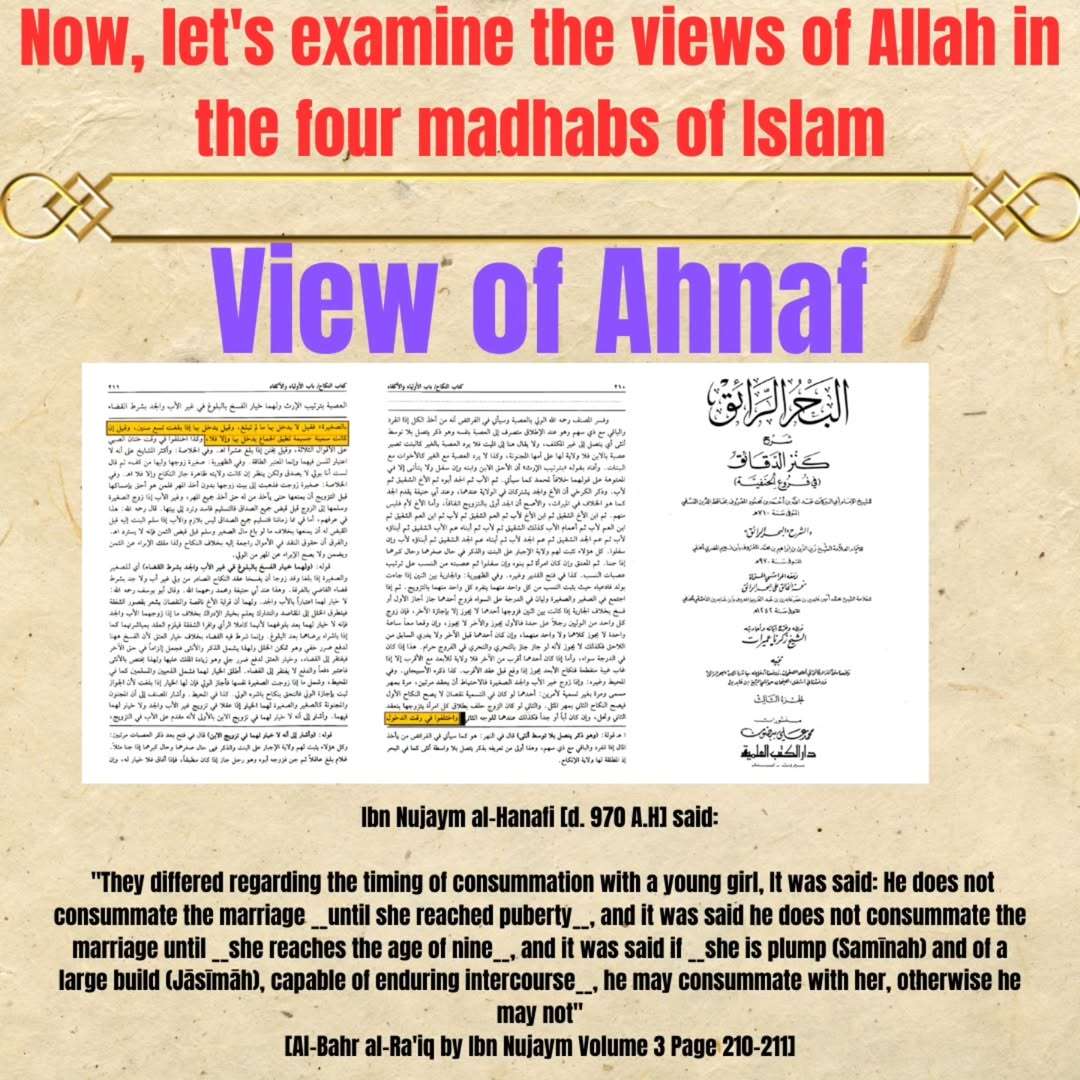
Hanafi Position
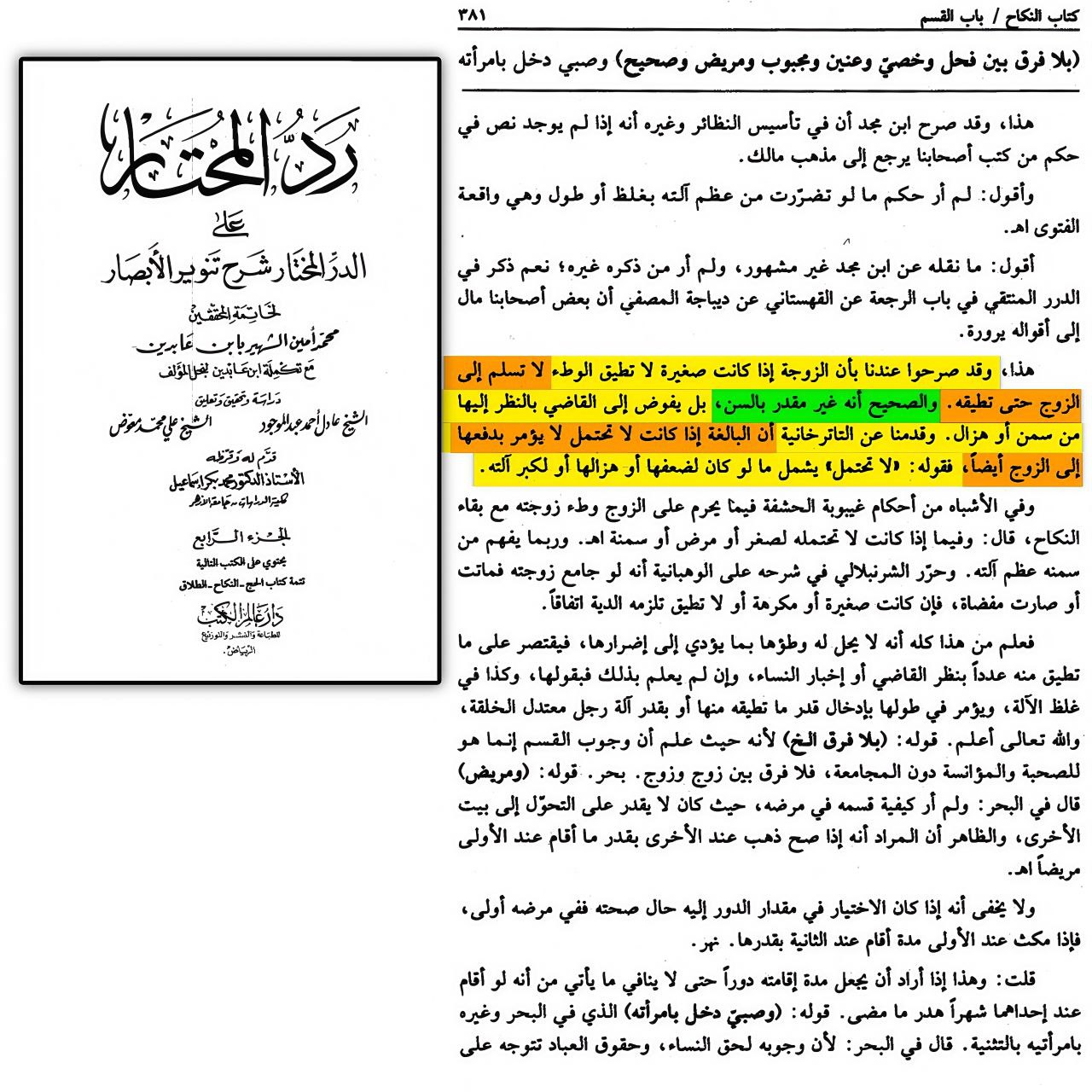
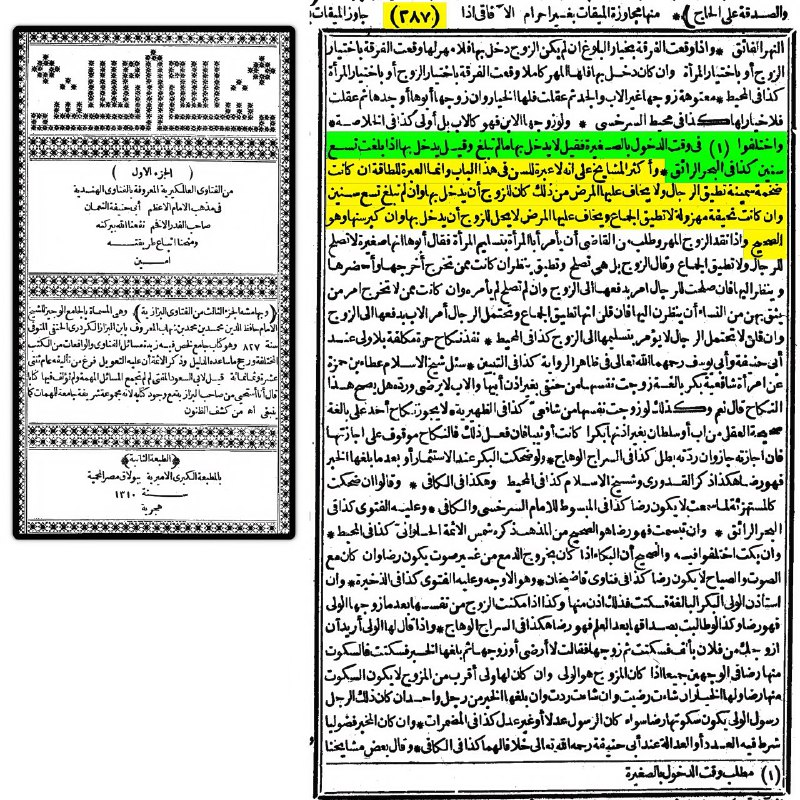
FBZL2hVWYAEXNL6 23f7b378fb47689a
Source: Hashiyat Ibn ‘Abidin This scan is from Hashiyat Ibn ‘Abidin. The highlighted part says that if the wife is still young in the sense that she is not physically fit for men, she is not to be handed over to the husband until she becomes fit. The surrounding page is discussing the legal consequences of delivery to the husband, so the point being used here is not merely the marriage contract, but the condition for actual handover and physical access.
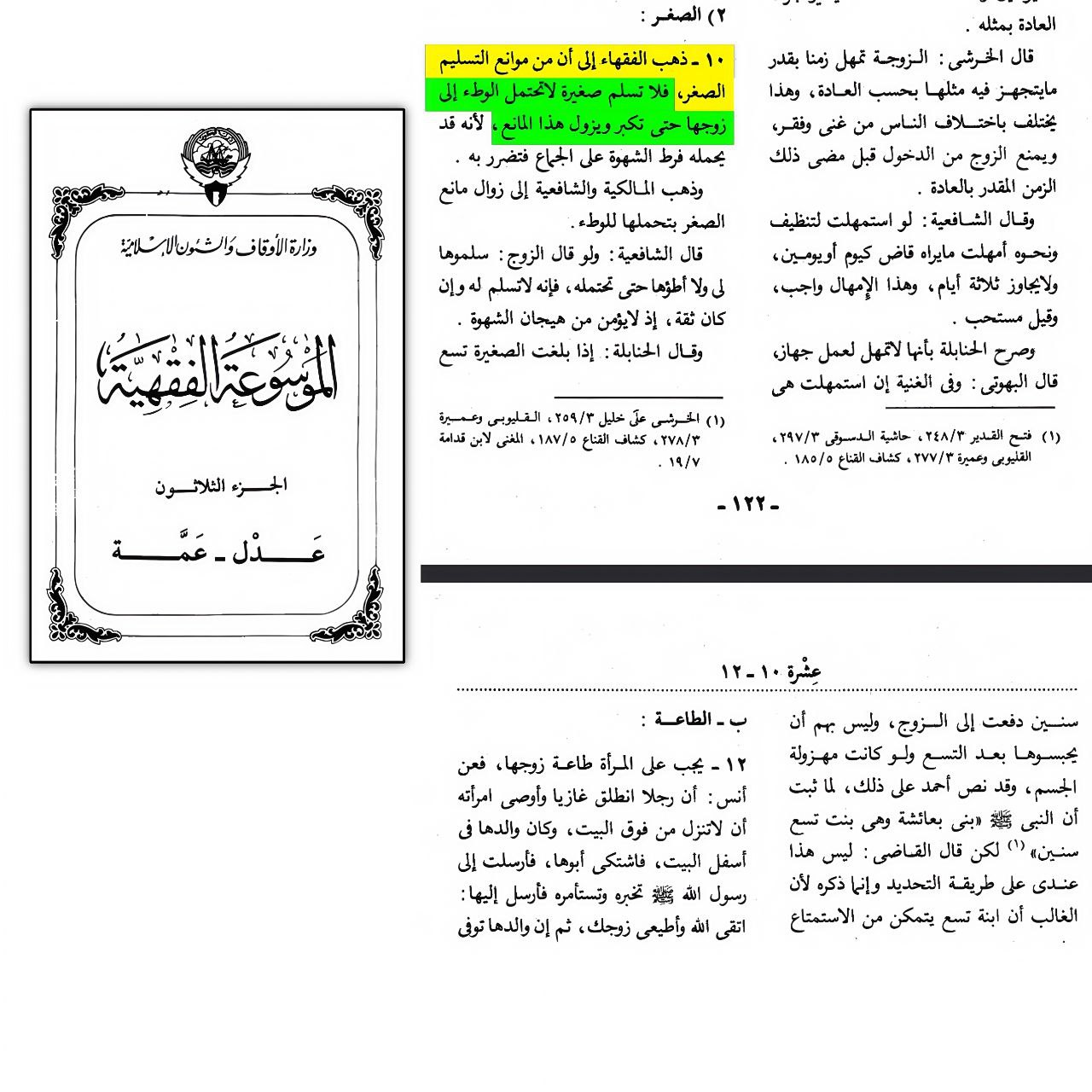
In Hanafi jurisprudence, a minor girl cannot be taken into the husband’s custody until she is legally competent for marital relations. The criterion is not age, but rather ability and other relevant conditions.
Source: Encyclopedia of Islamic Jurisprudence — Hanafi This scan presents the Hanafi position. The highlighted part says that a minor wife is not taken into the husband’s custody until she is legally fit for marital relations, and that the standard depends on capability and related conditions, not age alone. The page therefore supports the distinction that handover is conditional.
Abu Hanifa grounds this ruling explicitly in ability and attributes, not in a bare numerical age. The Encyclopedia of Islamic Jurisprudence records the same position: it is not permissible to hand over a young girl to a husband until she is legally eligible for consummation of the marriage.
Source: Encyclopedia of Islamic Jurisprudence This scan is from the Encyclopedia of Islamic Jurisprudence. The highlighted passage states that a young girl is not handed over to the husband until she is legally eligible for consummation. The surrounding page is a juristic summary, so it functions as a broader fiqh reference rather than one isolated opinion.
Shafi’i Position
FBZL3AoXIAIt7MY 2963fea8dade3ccb
Source: I’anat al-Talibin This scan is from I’anat al-Talibin. The highlighted passage discusses a young wife and says the issue turns on whether she is physically able to bear marital relations. The page distinguishes between merely having a contract and being actually fit for handover; if she is not capable, the husband is not given that right.
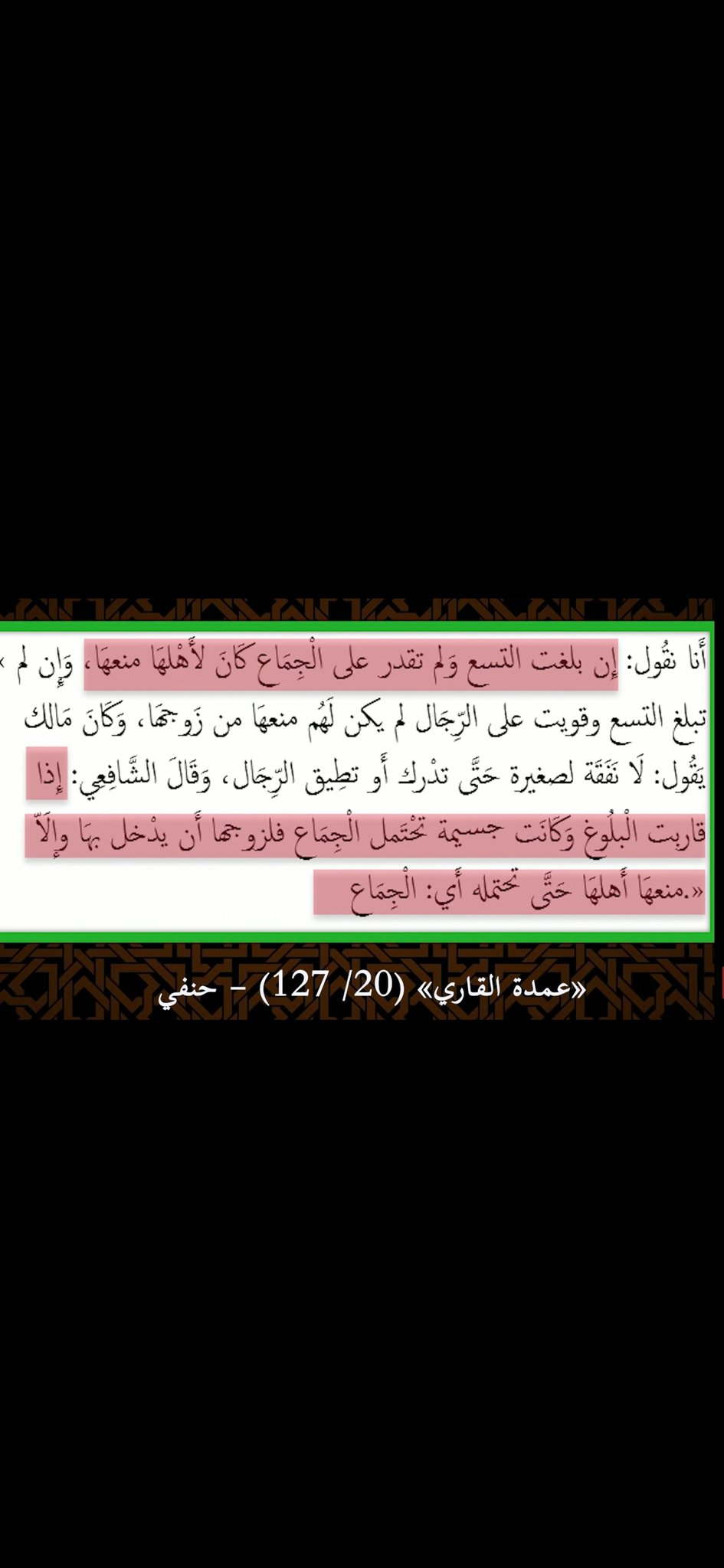
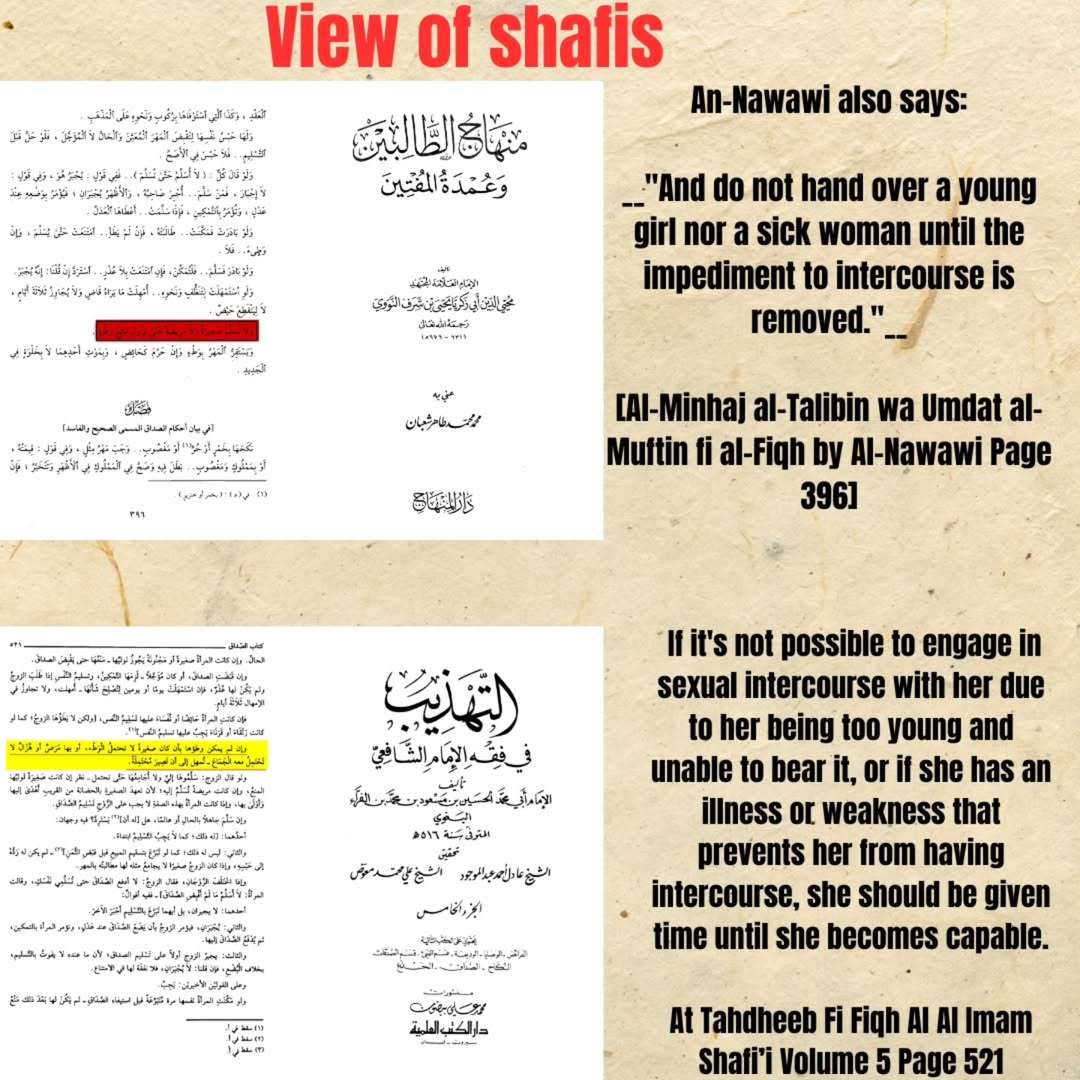
In Shafi’i jurisprudence, it is not permissible to take custody of a young girl until she is eligible to enter into the marriage physically. Al-Shafi’i himself states that ability is the determining factor — not age.
Source: Shafi’i Jurisprudence — Eligibility for Handover This scan is from Shafi’i jurisprudence. The highlighted part states that the husband does not take custody/handover of a young wife until she is eligible for marital entry. The page supports the distinction between contract and actual delivery to the husband.
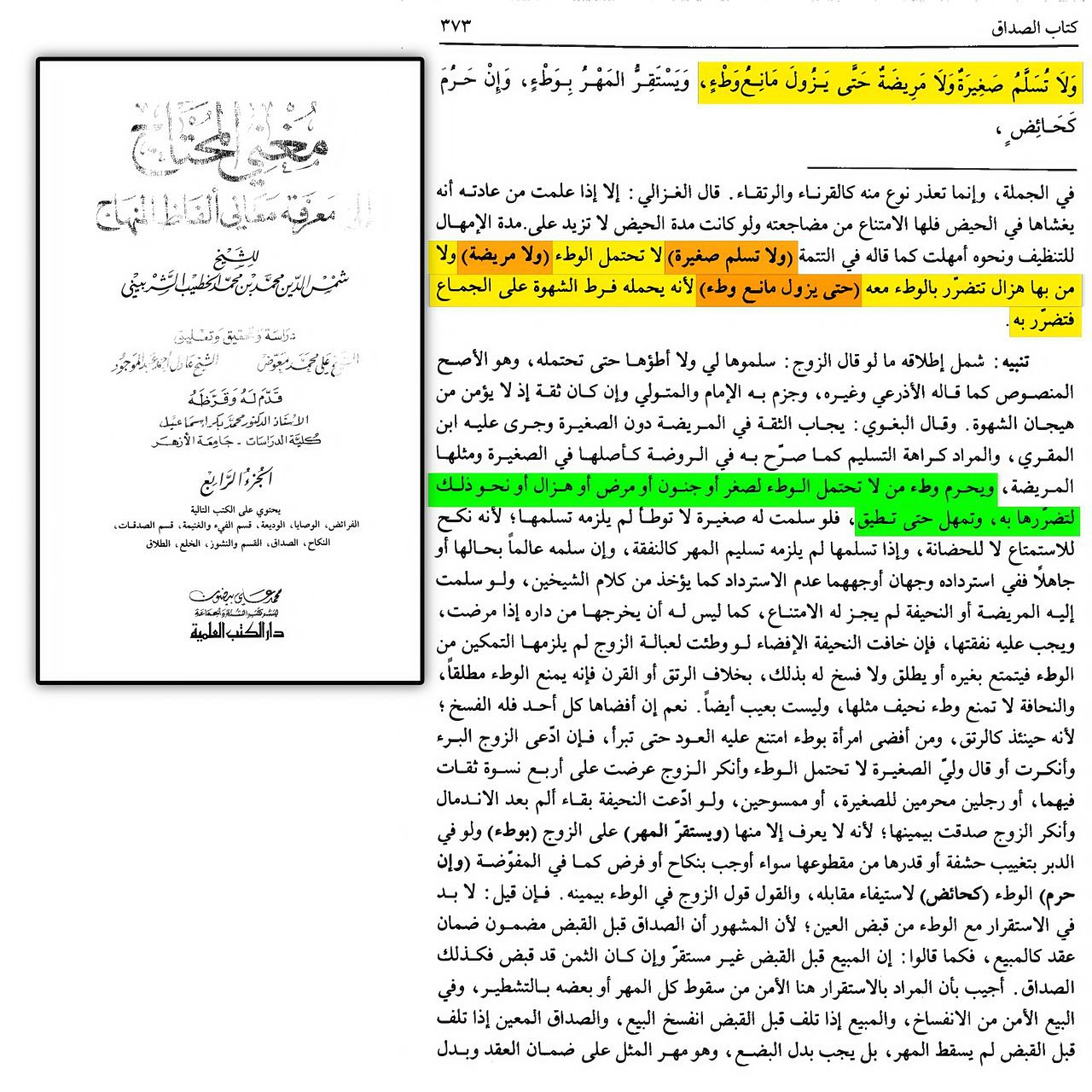
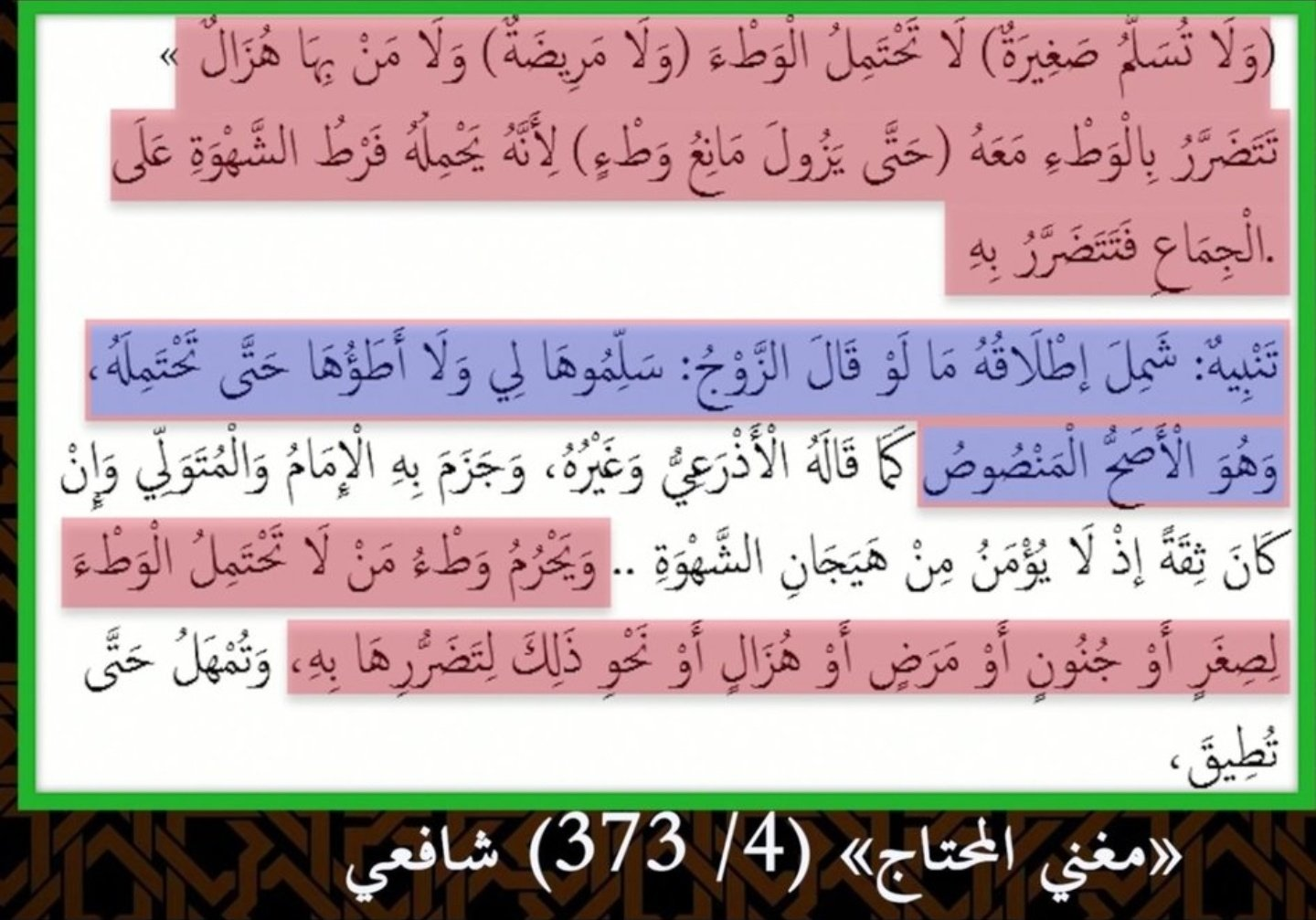
FGwdZaSXoAoB 9P 8c9027d27259cd15
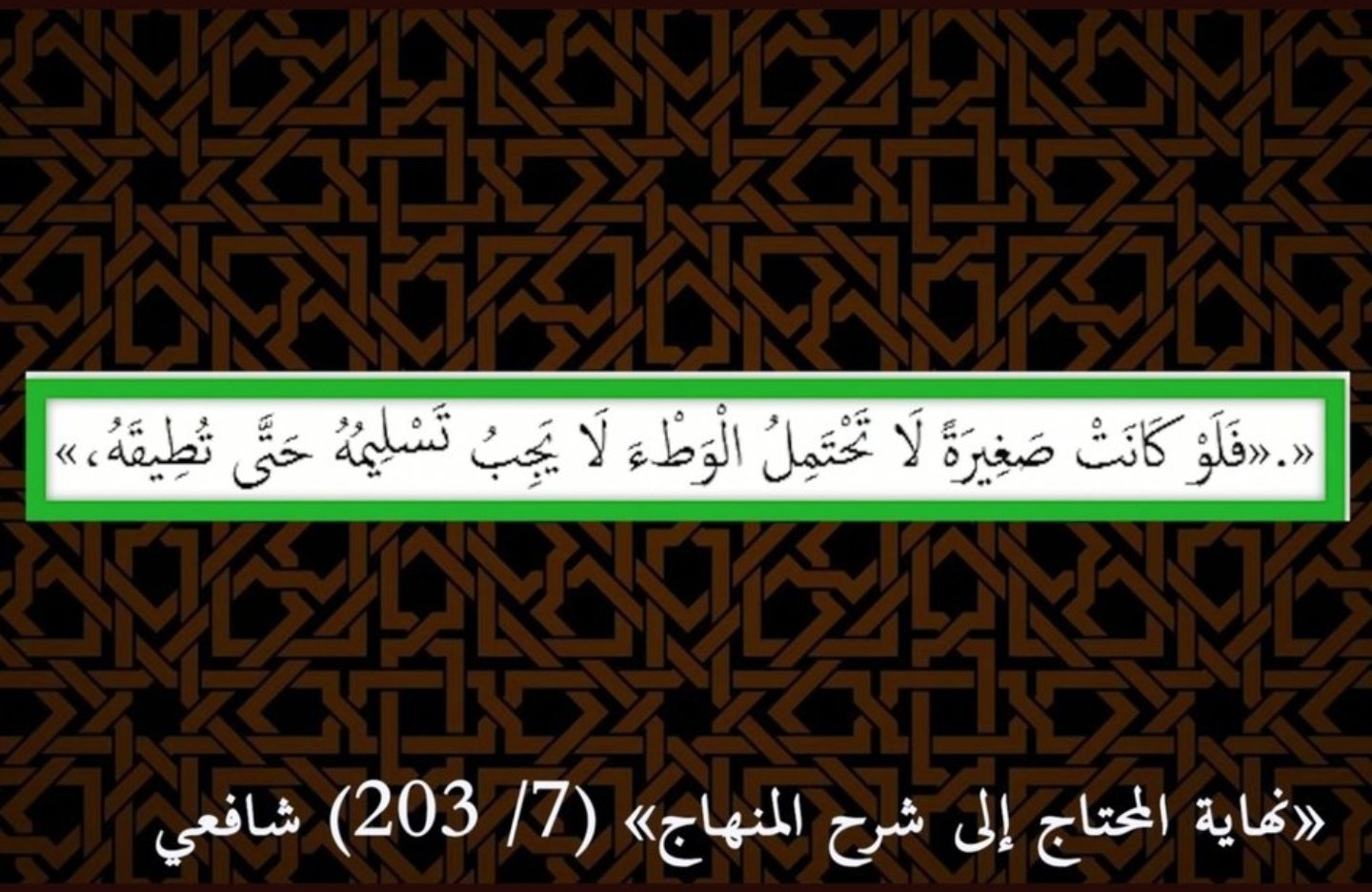
Source: Mughni al-Muhtaj This scan is from Mughni al-Muhtaj. The highlighted part says a wife is not handed over if she is too young, ill, thin, or otherwise unable to bear marital relations. The page explicitly makes physical capability — not age — the condition for handover.
Maliki Position
FBZL3bVXEAAJex c3b5f8400348abf2
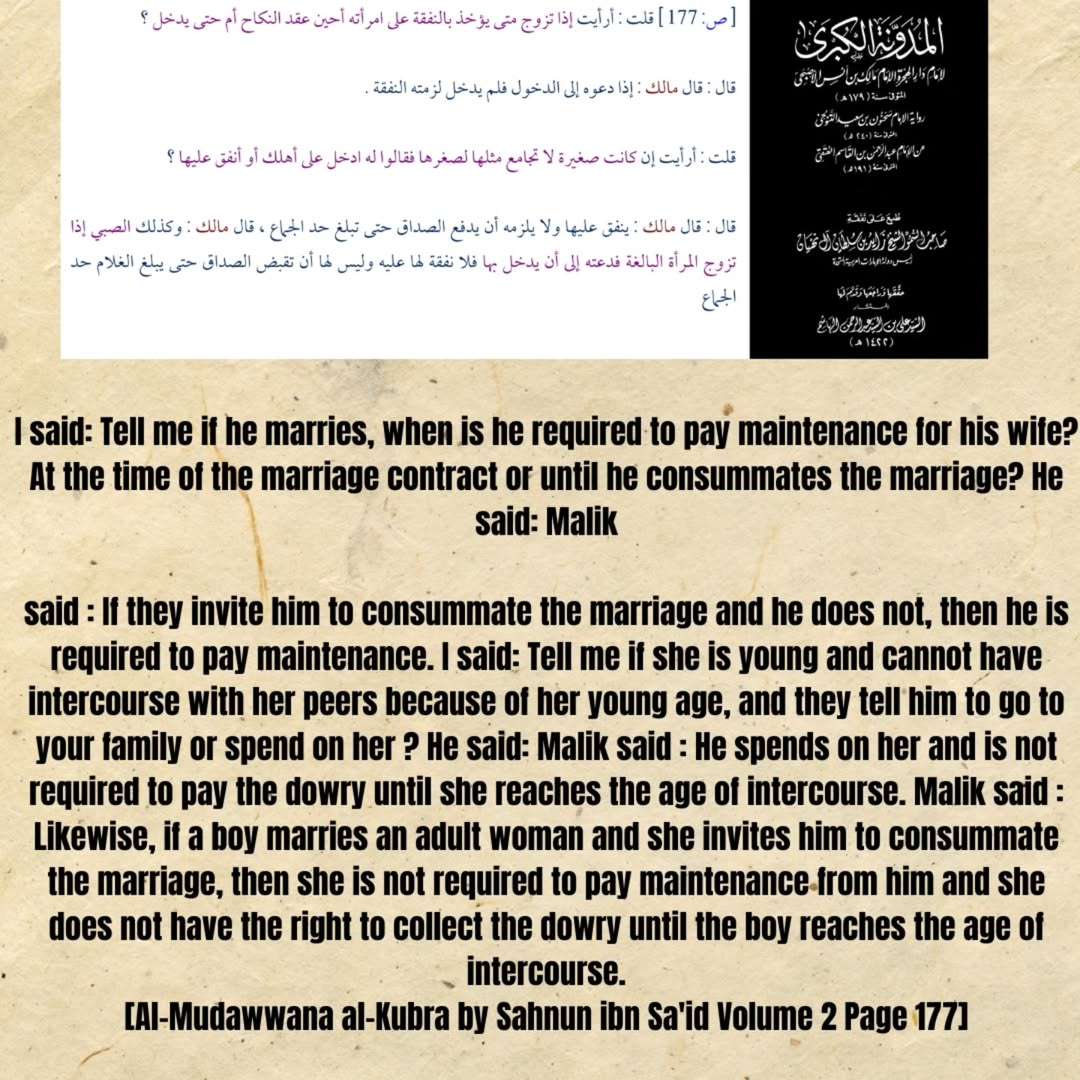
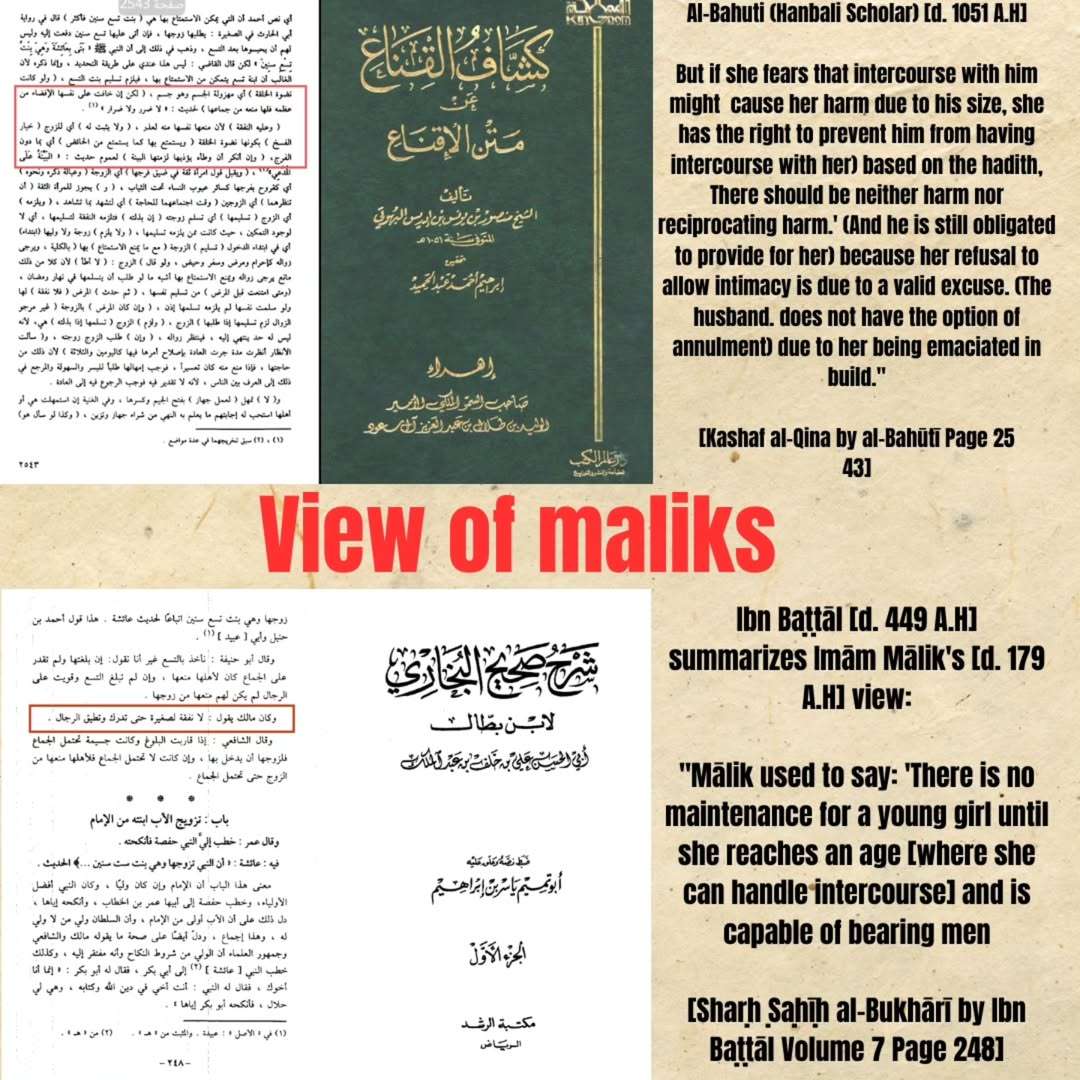
Source: Mawahib al-Jalil fi Sharh Mukhtasar Khalil This scan is from Mawahib al-Jalil fi Sharh Mukhtasar Khalil. The highlighted line states that there is no physical marital access to a wife who cannot bear it. The page is being used as a Maliki legal proof that capability is a condition, and that the contract alone does not make harmful physical access lawful.
The Maliki school is equally clear: a wife who is incapable of bearing marital relations is not handed over, and no such access is lawful regardless of whether a contract has been concluded.
Hanbali Position
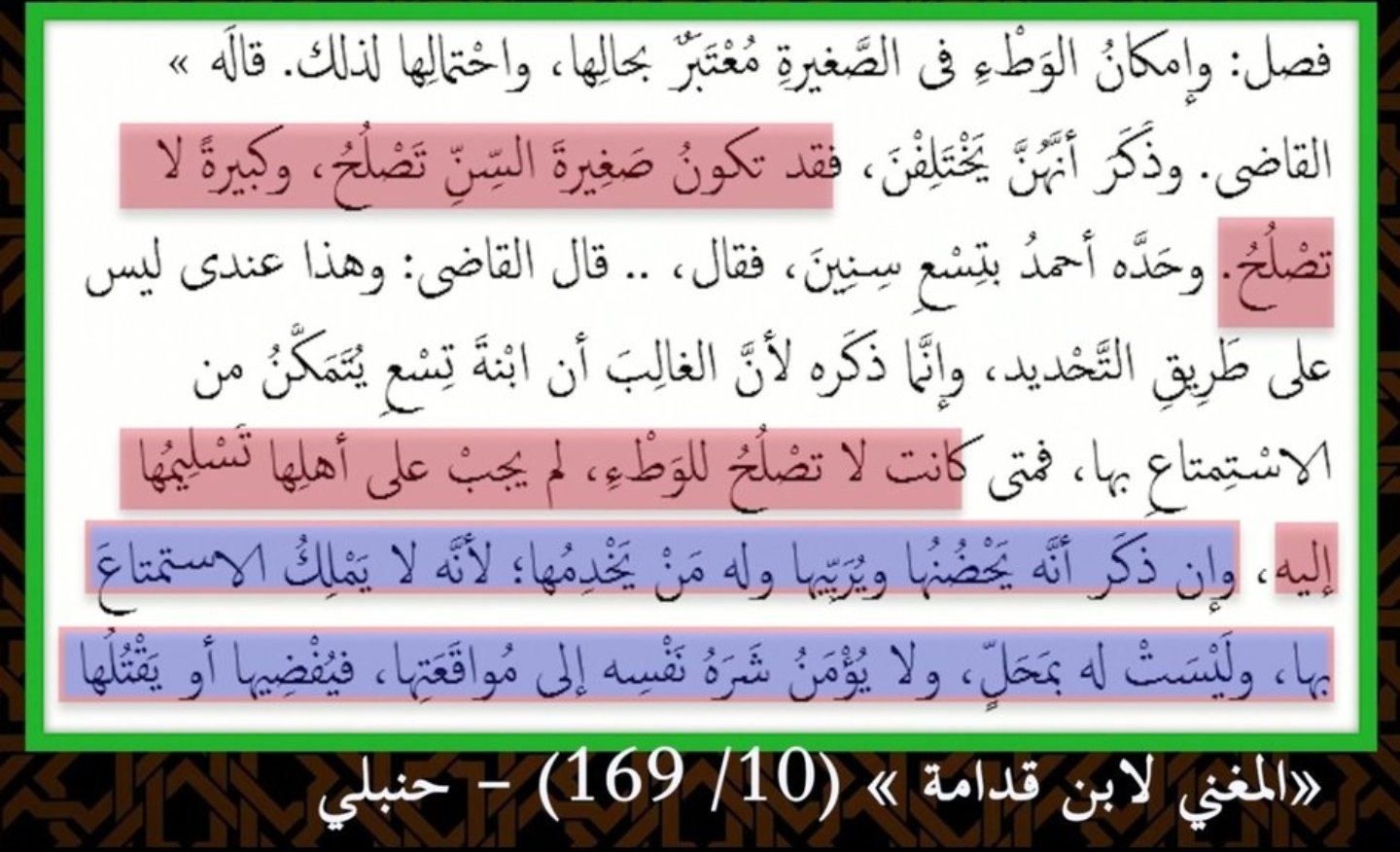
FGwdYj7X0AIvSrP 0e20b14b30eac6c7
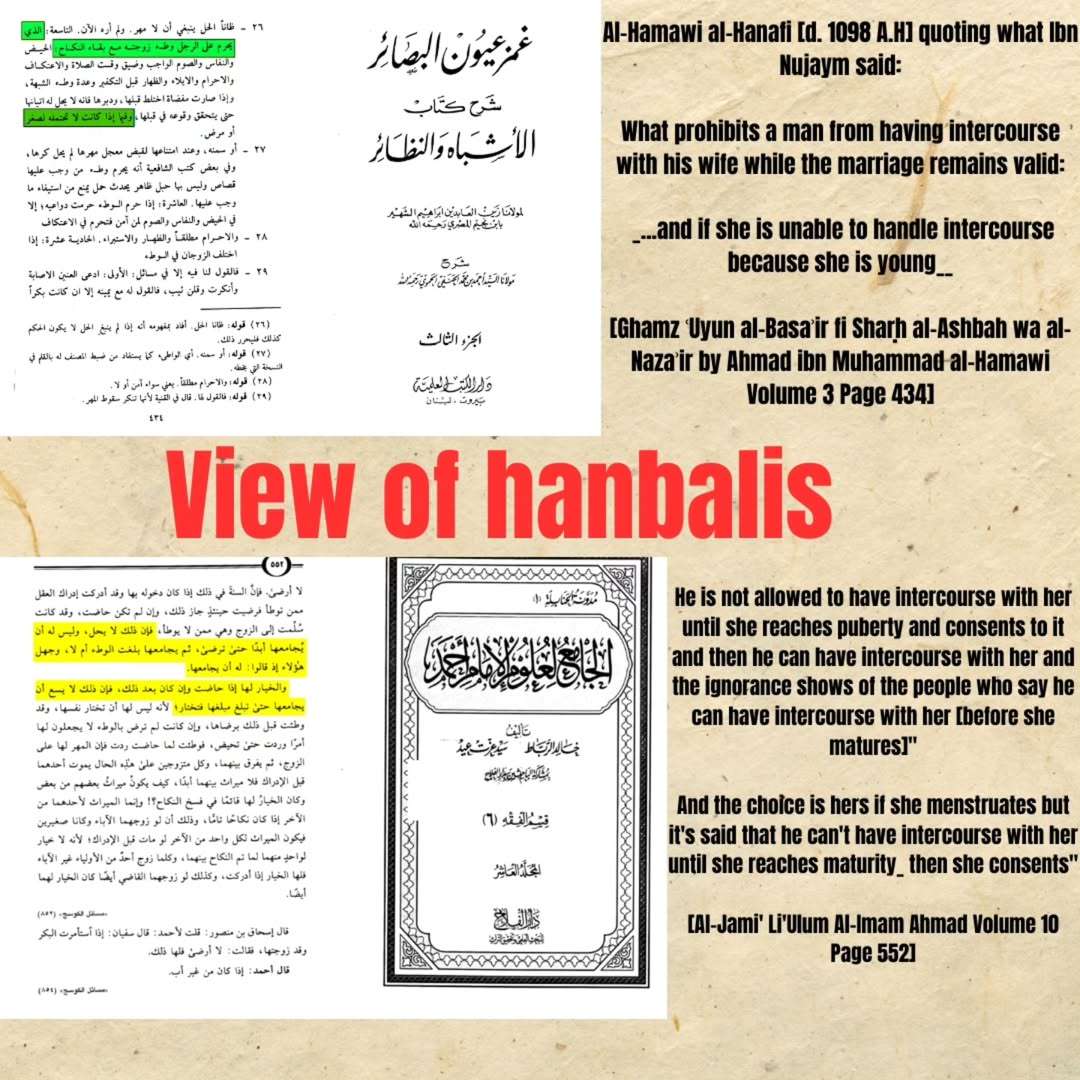
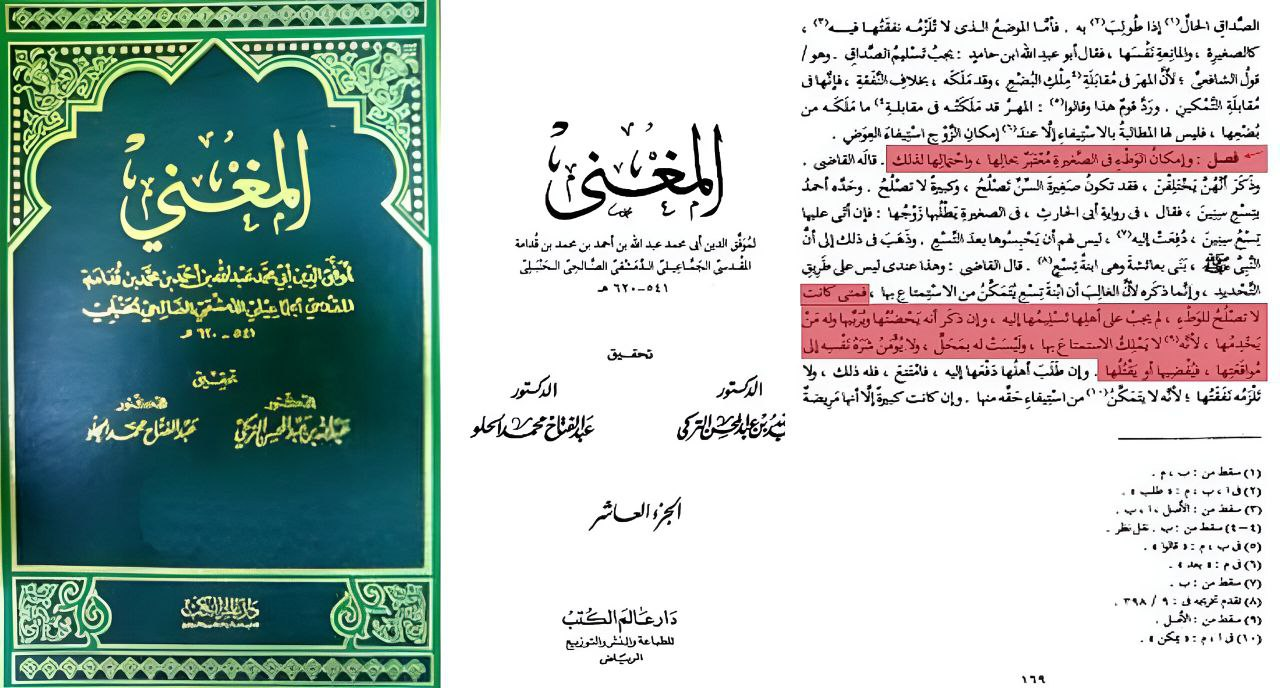
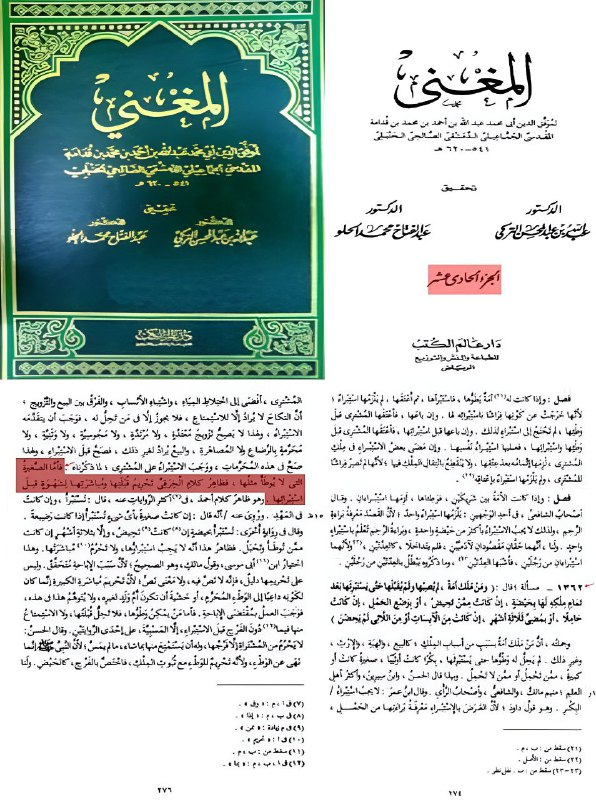
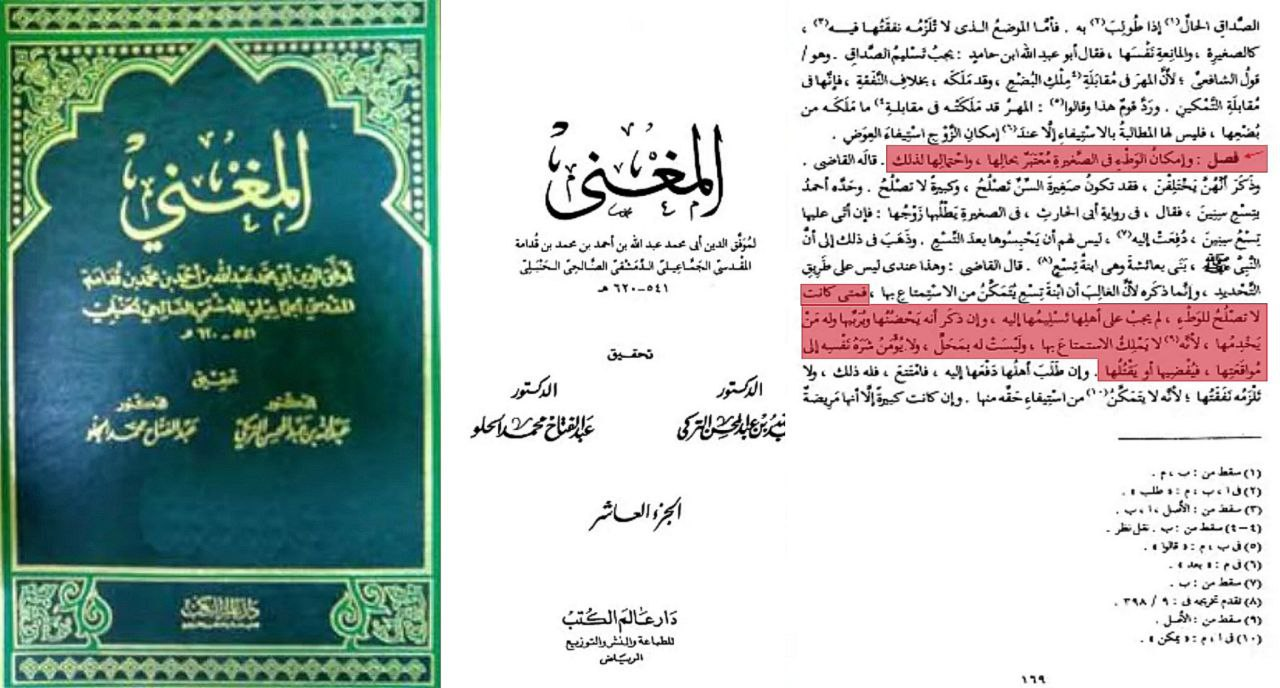
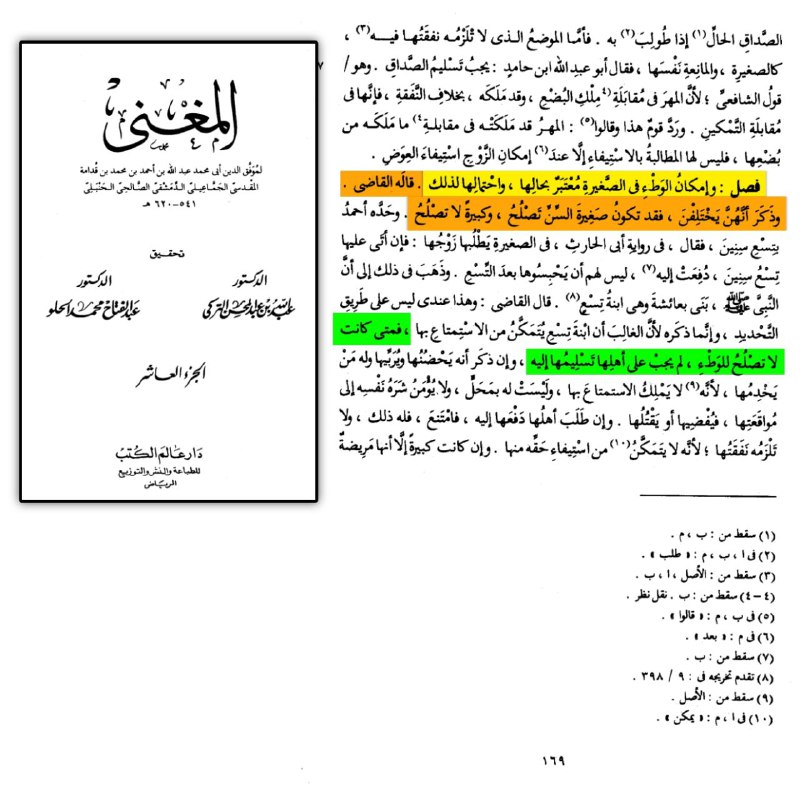
Source: al-Mughni by Ibn Qudamah This scan is from al-Mughni by Ibn Qudamah. The highlighted section says that a young girl who cannot bear marital relations is not handed over, because physical access would amount to harm and the husband has no right to that. The page is important because it frames the issue through legal entitlement and prevention of harm, not through age alone.
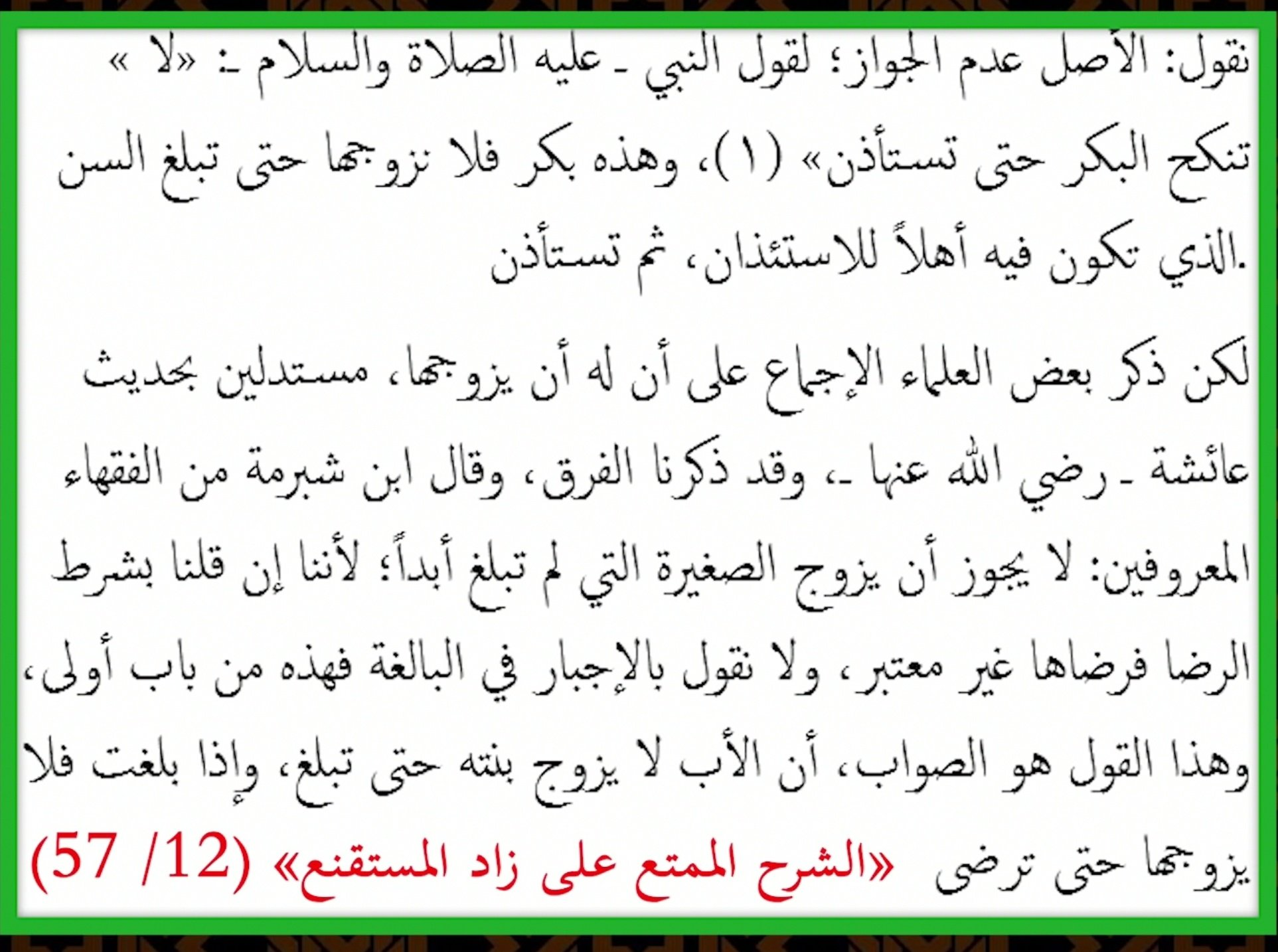
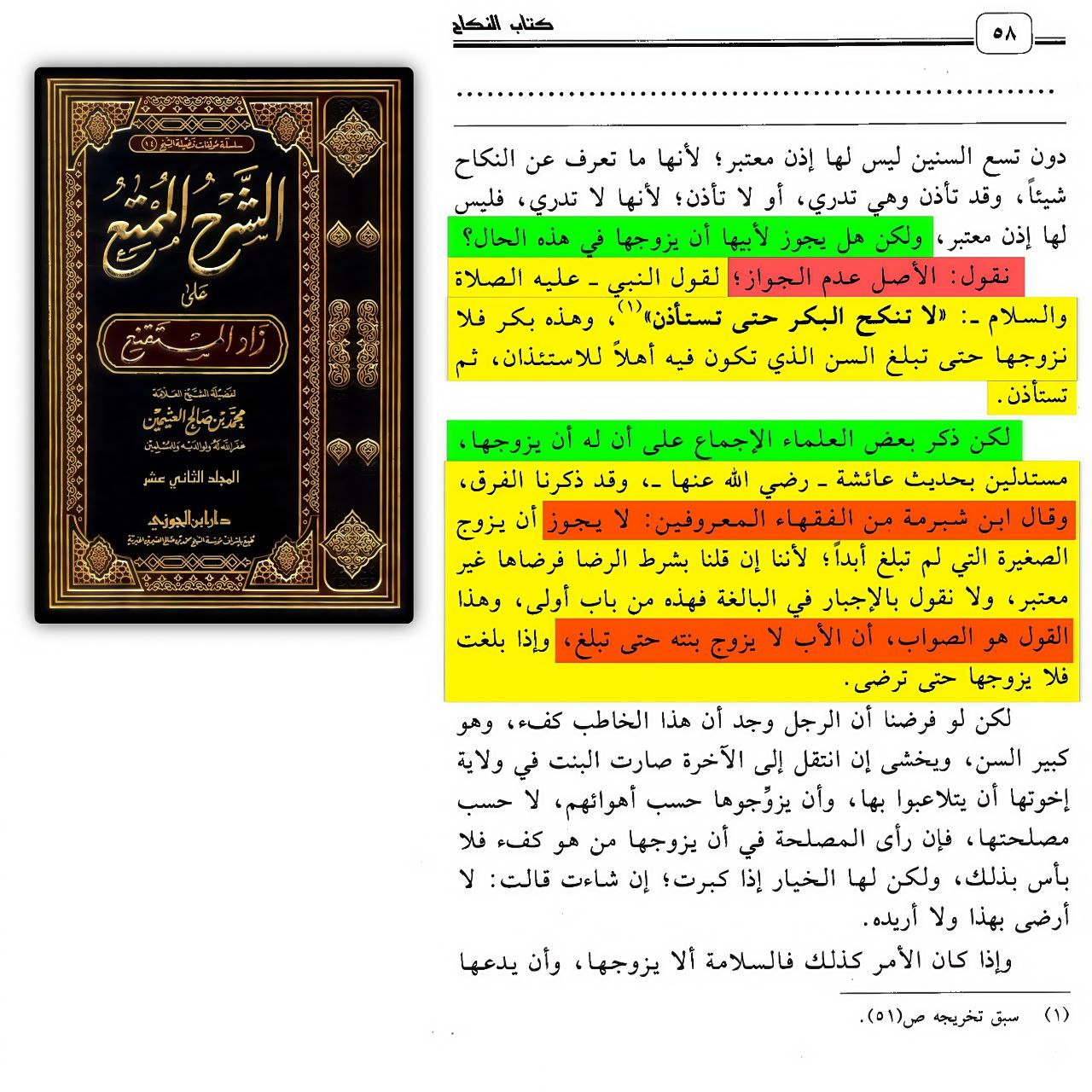
FGwdZ2VWQA8bY27 77ed271f54a0dd53
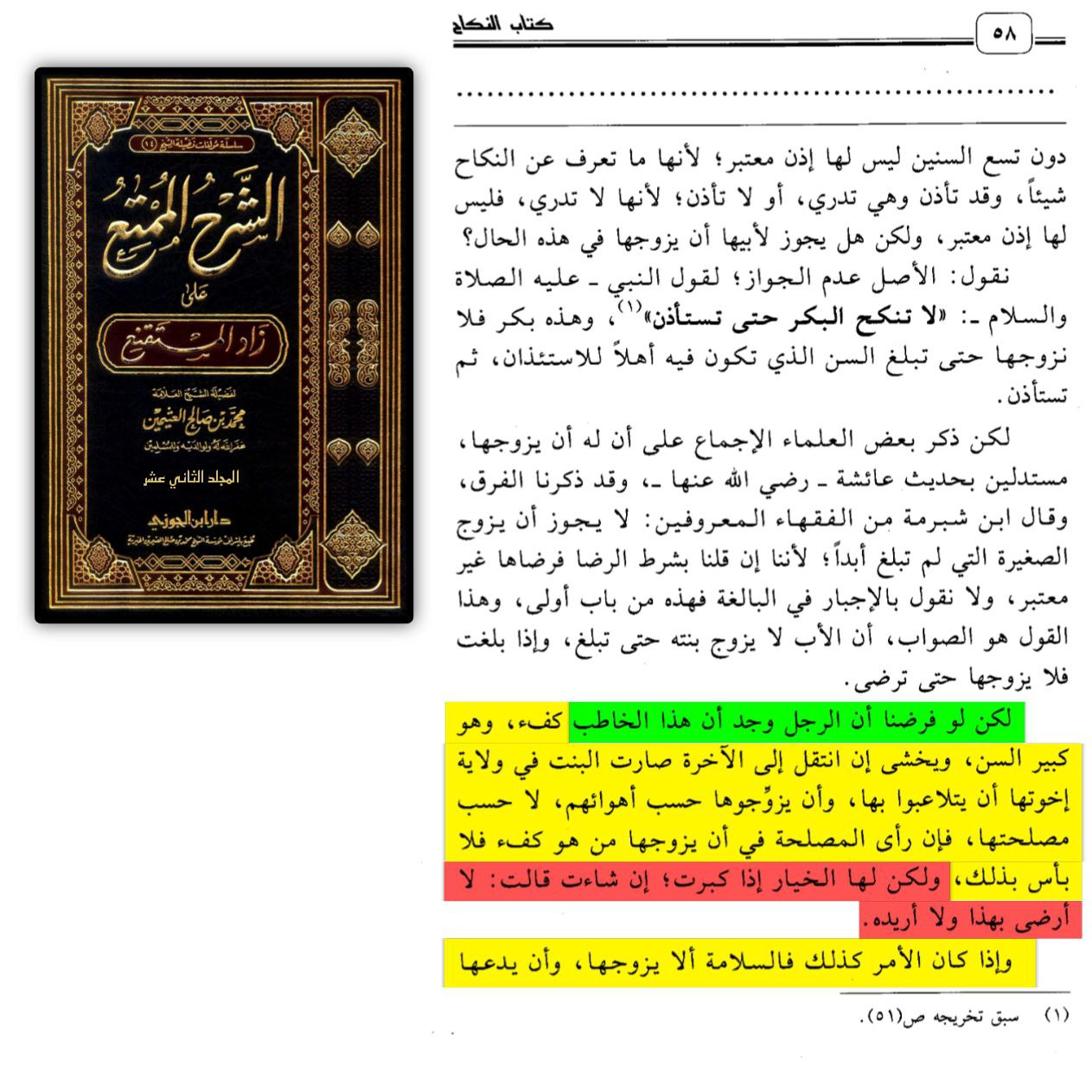
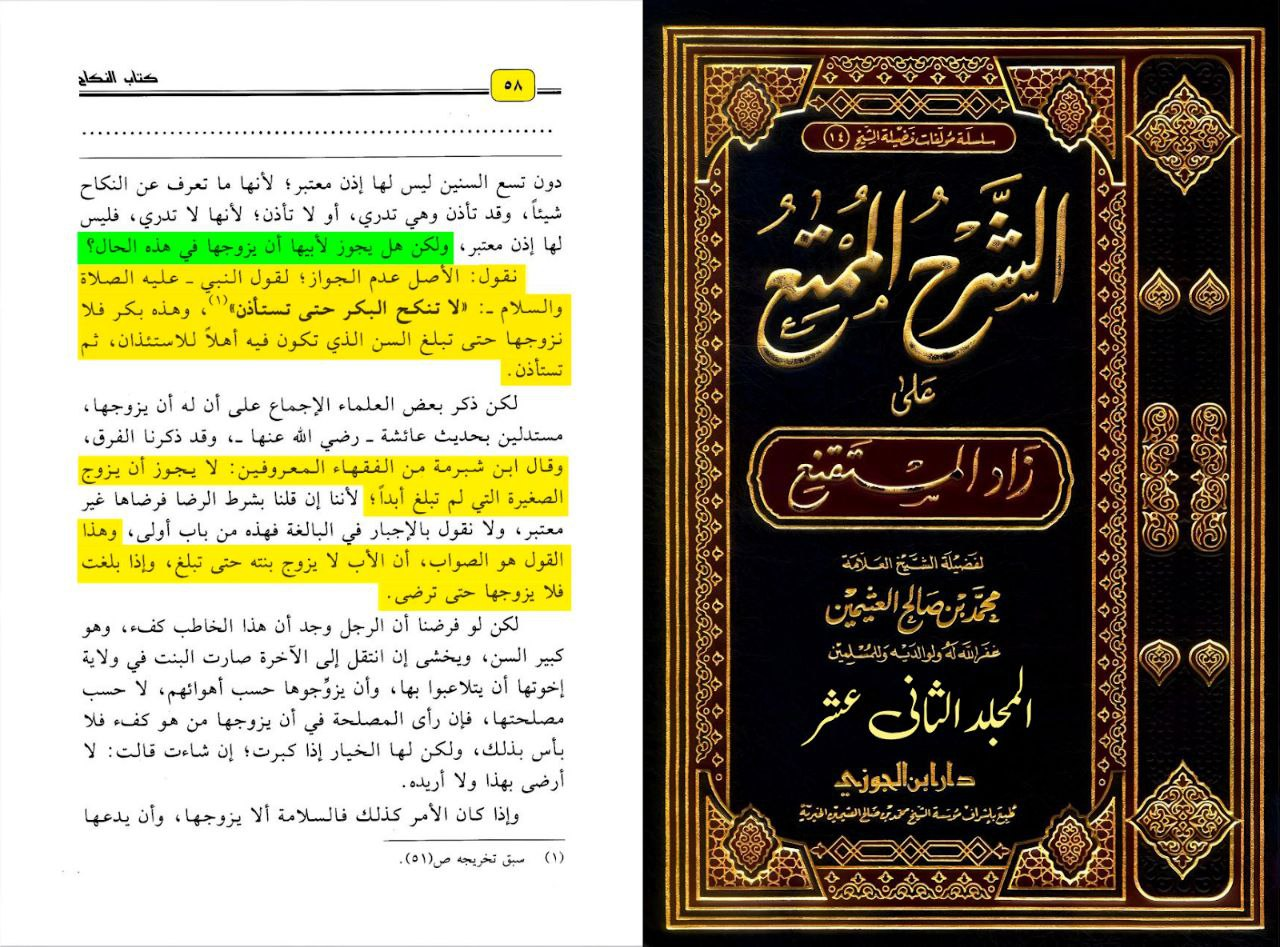
Source: al-Sharh al-Mumti’ ‘ala Zad al-Mustaqni’ by Ibn Uthaymeen This scan is from al-Sharh al-Mumti’ ‘ala Zad al-Mustaqni’. The highlighted passage argues that the stronger view is that a prepubescent girl should not be married off by the father until she reaches puberty and her permission is sought. The page is being used to show a modern Hanbali juristic rejection of treating such a contract as automatically binding or physically actionable.
Consensus Across the Schools
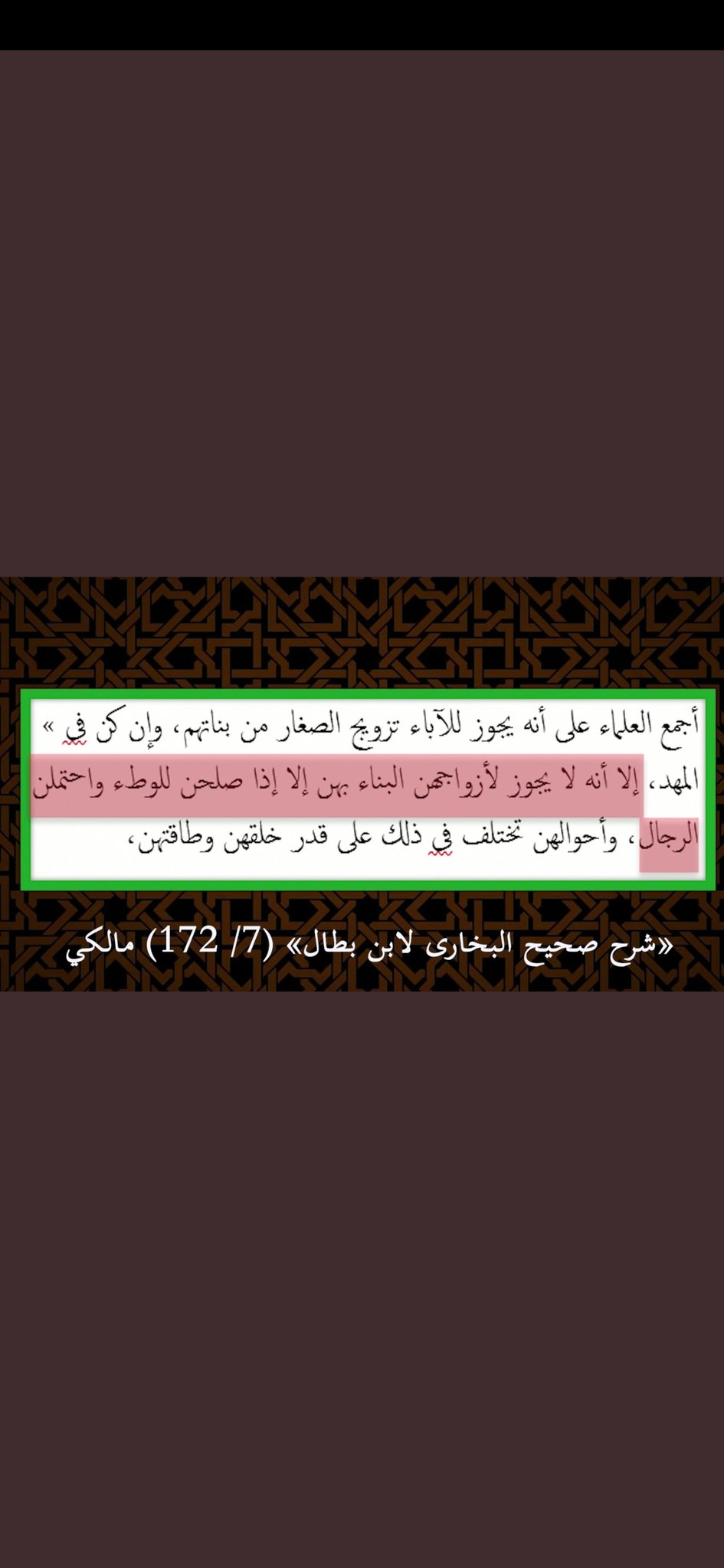
FBZL375XsAAPUQf f37525d5c9e6112b
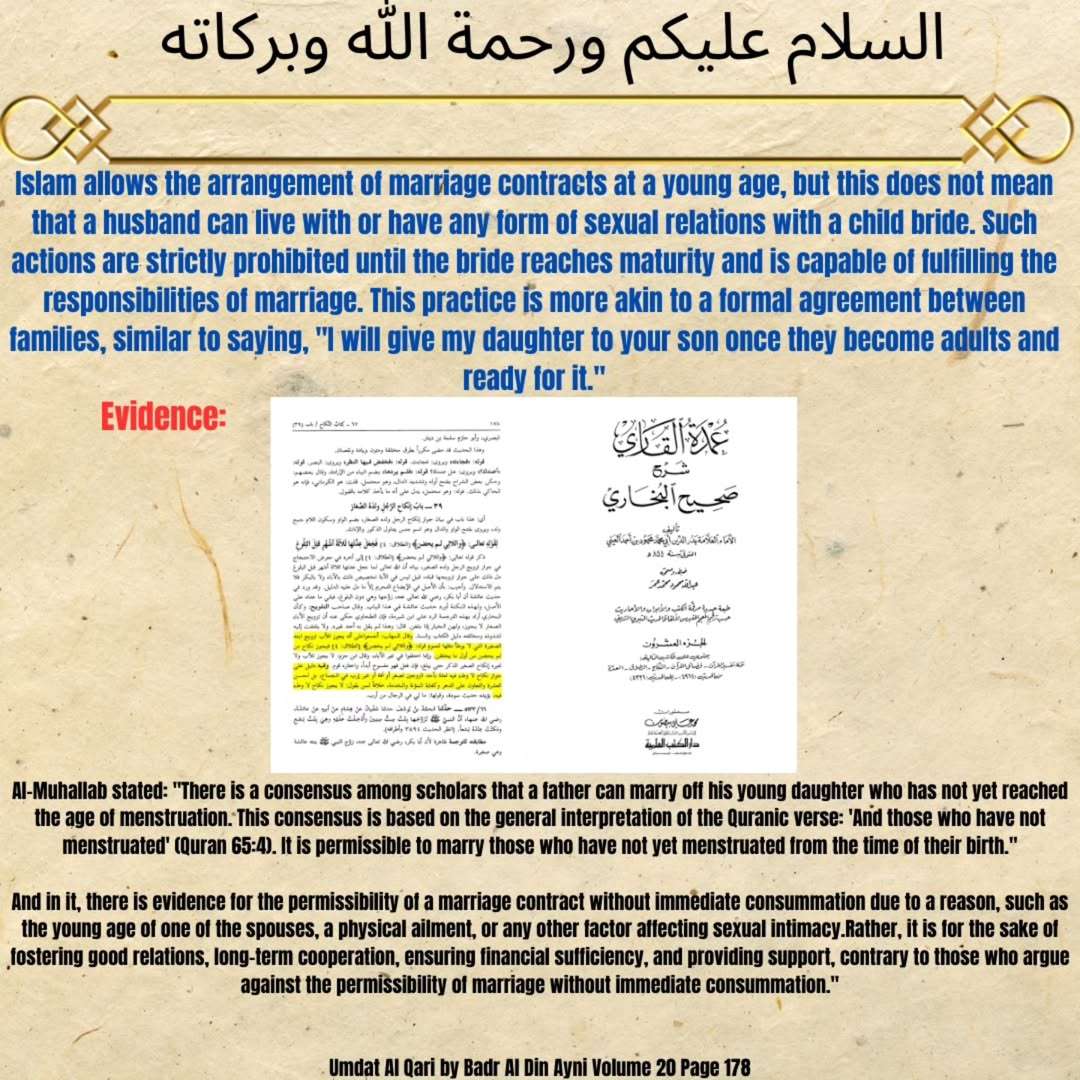
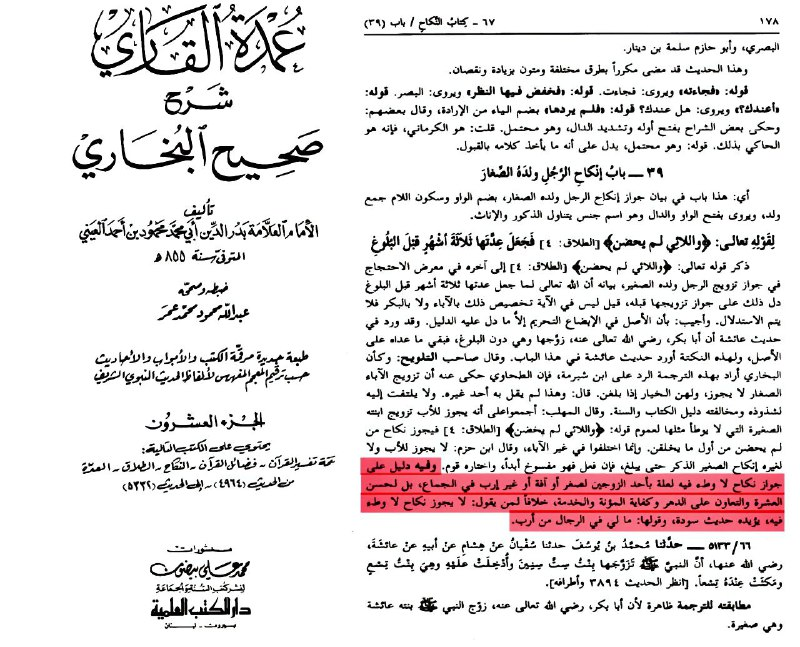
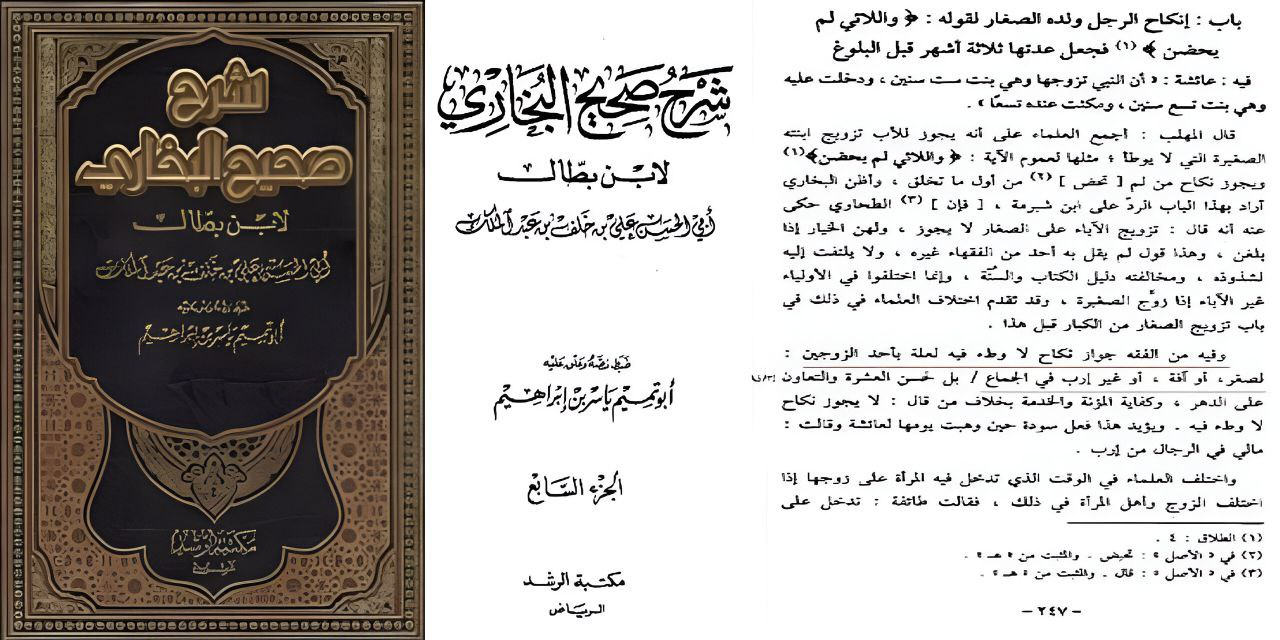
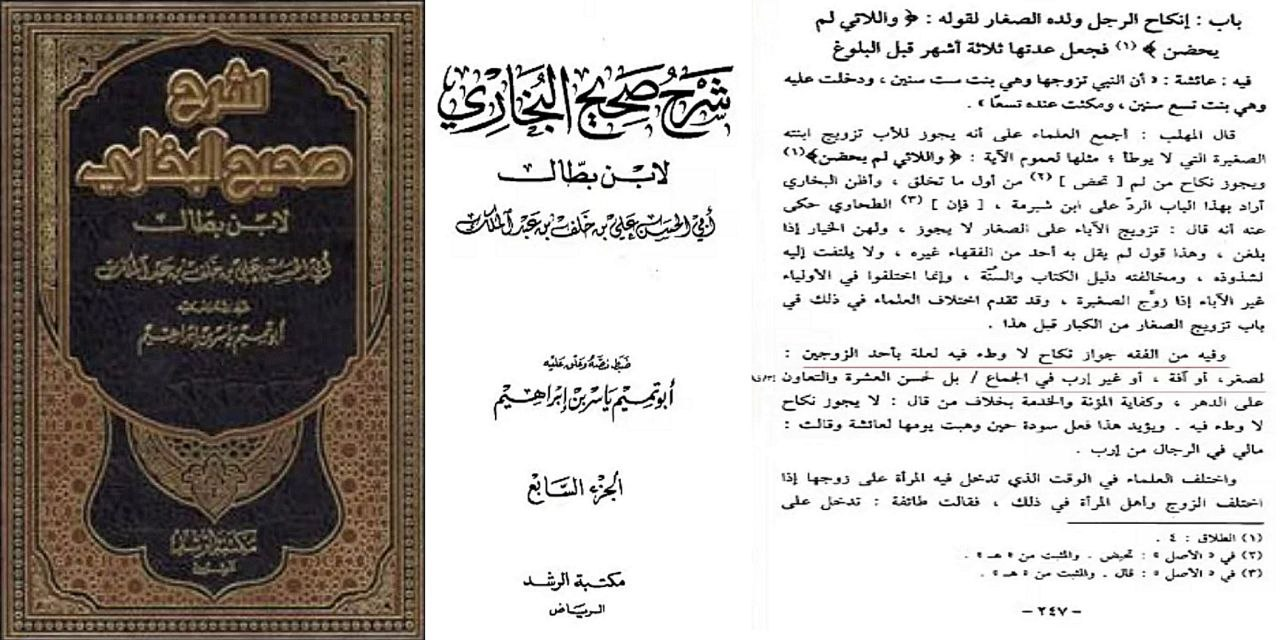
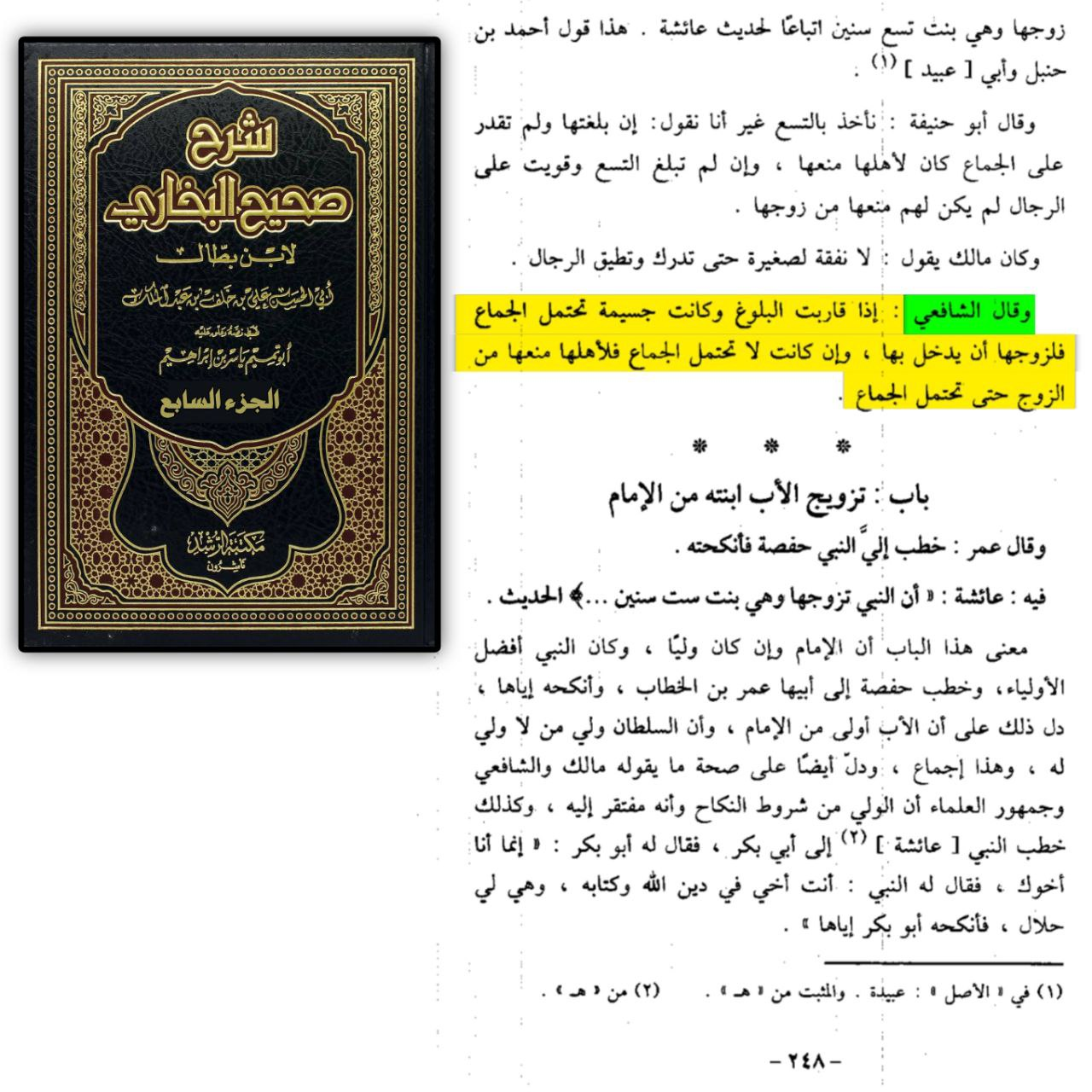
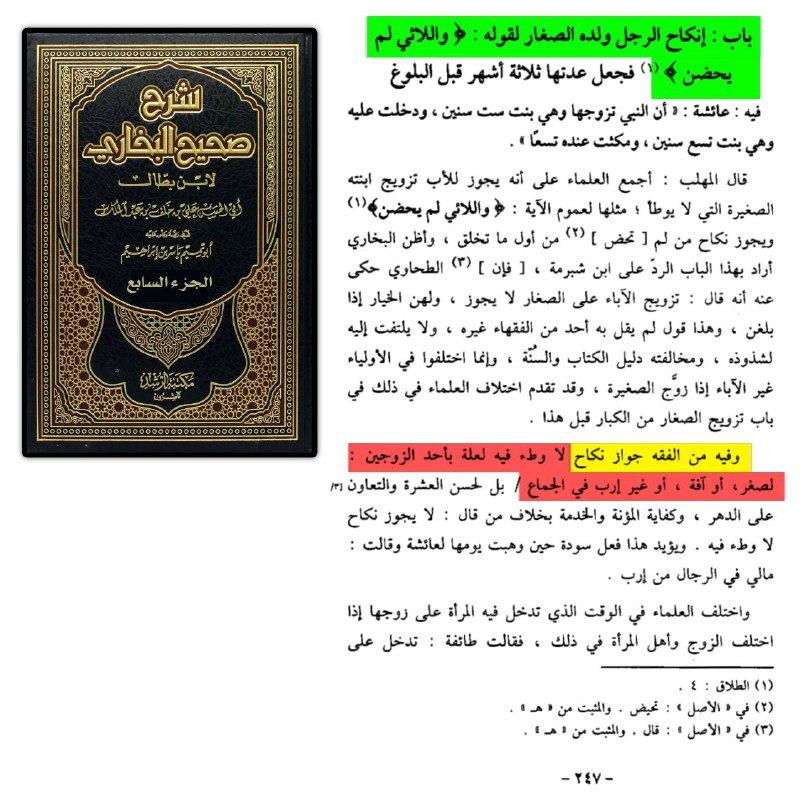
Source: Sharh Sahih al-Bukhari by Ibn Battal This scan is from Sharh Sahih al-Bukhari by Ibn Battal. The highlighted passage reports agreement that fathers may contract marriages for minors, but that consummation is not allowed unless the girl is fit and capable. The surrounding page therefore separates a marriage contract from handover and makes physical capacity the controlling condition.
FGwdZAUXIAcwS6n 222464ca7a8b7c0f
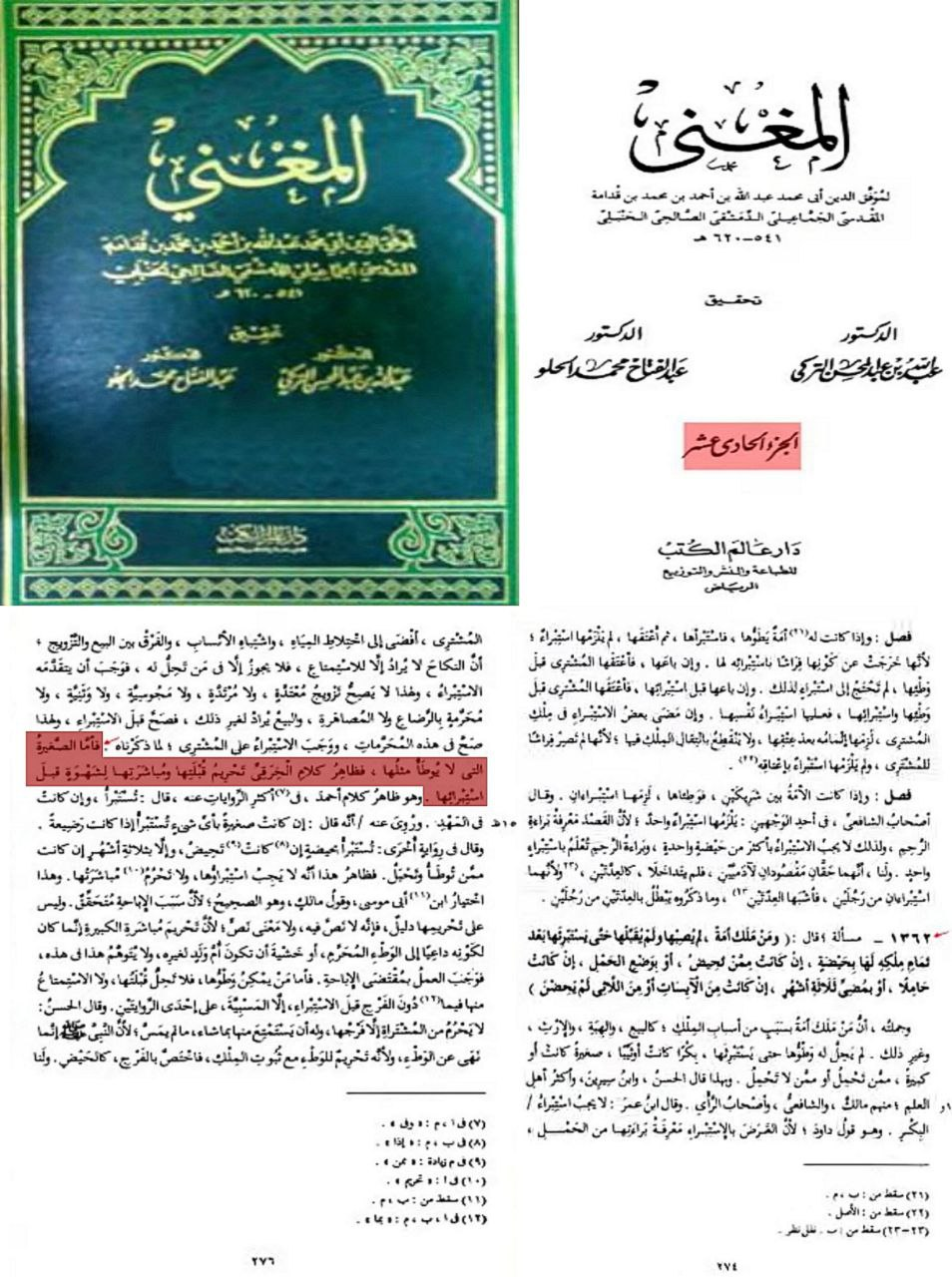
Source: Shafi’i Legal Text — Handover as a Separate Legal Act This scan is from a Shafi’i legal text. The highlighted statement says that a young girl is not handed over until she can bear marital relations. The surrounding discussion treats handover as a separate legal question from the contract itself.
Conclusion of the Jurisprudential Survey The position of all four schools of Islamic law is settled: a marriage contract does not entitle a husband to physical access. It is not permissible to hand over a young girl until she reaches puberty or is physically capable, whichever the school uses as its measure. No school treats the contract alone as sufficient. The controlling condition in every madhab is physical capability, and harm is legally impermissible.
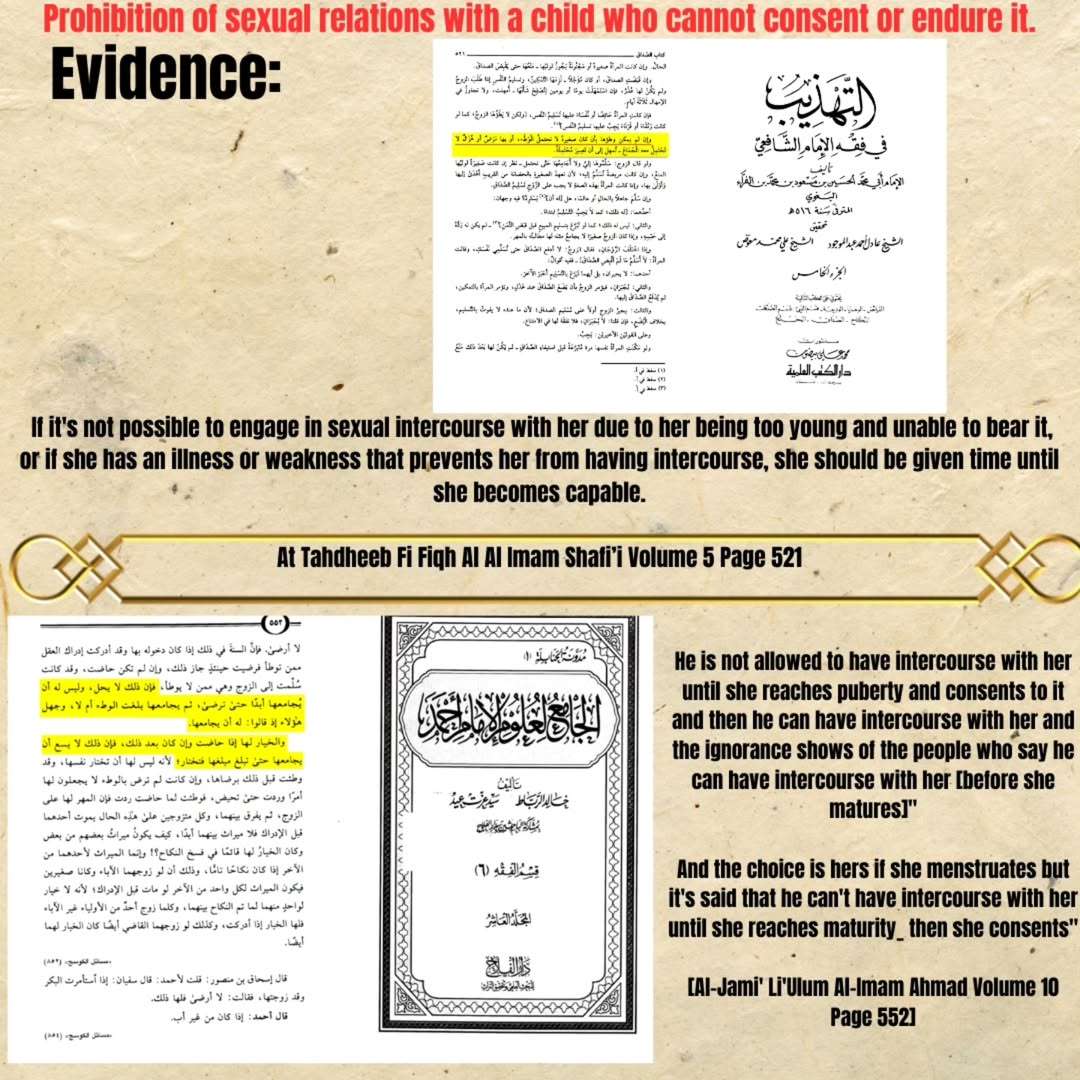
The rule that intercourse with a young married girl is impermissible until she is capable is not merely a minor juristic position — it is a foundational legal norm recorded across the classical corpus. The same rule extends to lesser physical acts: even kissing and related contact is not permitted when it may lead to or constitute harm.
Classical Juristic Rule Intercourse with a young girl who has been married does not take place until she is capable of doing so, and even kissing and so on is not permissible.
The following scans from across the classical fiqh literature document this principle:
sawt alhaqiqa 14040125 145708344 9025186faffa3324
Supporting Arabic Scan — Capability as Condition This contextual Arabic scan is part of the same evidence set on the condition of capability before handover or marital physical access. The highlighted/legal material supports the rule that a contract alone is not enough: the girl must be capable, and harm is not permitted. It is included here as supporting documentation for the surrounding claim, not as a mere cover or title page.
sawt alhaqiqa 14040125 145708358 d73ecd7e4d8bf44c
Supporting Arabic Scan — Capability as Condition This contextual Arabic scan is part of the same evidence set on the condition of capability before handover or marital physical access. The highlighted/legal material supports the rule that a contract alone is not enough: the girl must be capable, and harm is not permitted. It is included here as supporting documentation for the surrounding claim, not as a mere cover or title page.
sawt alhaqiqa 14040125 145708355 76ae11f37573cb6d
Supporting Arabic Scan — Capability as Condition This contextual Arabic scan is part of the same evidence set on the condition of capability before handover or marital physical access. The highlighted/legal material supports the rule that a contract alone is not enough: the girl must be capable, and harm is not permitted. It is included here as supporting documentation for the surrounding claim, not as a mere cover or title page.
sawt alhaqiqa 14040125 145708350 e122e89da9dd8142
Supporting Arabic Scan — Capability as Condition This contextual Arabic scan is part of the same evidence set on the condition of capability before handover or marital physical access. The highlighted/legal material supports the rule that a contract alone is not enough: the girl must be capable, and harm is not permitted. It is included here as supporting documentation for the surrounding claim, not as a mere cover or title page.
sawt alhaqiqa 14040125 145708347 412732877aad8350
Supporting Arabic Scan — Capability as Condition This contextual Arabic scan is part of the same evidence set on the condition of capability before handover or marital physical access. The highlighted/legal material supports the rule that a contract alone is not enough: the girl must be capable, and harm is not permitted. It is included here as supporting documentation for the surrounding claim, not as a mere cover or title page.
sawt alhaqiqa 14040125 145708366 71c780c0861ed5ae
Supporting Arabic Scan — Capability as Condition This contextual Arabic scan is part of the same evidence set on the condition of capability before handover or marital physical access. The highlighted/legal material supports the rule that a contract alone is not enough: the girl must be capable, and harm is not permitted. It is included here as supporting documentation for the surrounding claim, not as a mere cover or title page.
sawt alhaqiqa 14040125 145708362 fa273b76d121b9a8
Supporting Arabic Scan — Capability as Condition This contextual Arabic scan is part of the same evidence set on the condition of capability before handover or marital physical access. The highlighted/legal material supports the rule that a contract alone is not enough: the girl must be capable, and harm is not permitted. It is included here as supporting documentation for the surrounding claim, not as a mere cover or title page.
sawt alhaqiqa 14040125 145708360 0876db1ebd5ed04f
Supporting Arabic Scan — Capability as Condition This contextual Arabic scan is part of the same evidence set on the condition of capability before handover or marital physical access. The highlighted/legal material supports the rule that a contract alone is not enough: the girl must be capable, and harm is not permitted. It is included here as supporting documentation for the surrounding claim, not as a mere cover or title page.
Classical Juristic Rule — Reiterated Intercourse with a young girl is not permissible until she is capable of it, and even kissing and so on are not allowed.
Supporting Fiqh Scan — Physical Capability This scan belongs to the supporting fiqh material on physical capability. The highlighted point is that marital physical access to a young wife is not permitted until she is capable, and even lesser physical acts are restricted when they would lead to harm or unlawful access. The surrounding page is used to separate a contract from actual consummation.
Supporting Fiqh Scan — Physical Capability This scan belongs to the supporting fiqh material on physical capability. The highlighted point is that marital physical access to a young wife is not permitted until she is capable, and even lesser physical acts are restricted when they would lead to harm or unlawful access. The surrounding page is used to separate a contract from actual consummation.
Supporting Fiqh Scan — Physical Capability This scan belongs to the supporting fiqh material on physical capability. The highlighted point is that marital physical access to a young wife is not permitted until she is capable, and even lesser physical acts are restricted when they would lead to harm or unlawful access. The surrounding page is used to separate a contract from actual consummation.
Supporting Fiqh Scan — Physical Capability This scan belongs to the supporting fiqh material on physical capability. The highlighted point is that marital physical access to a young wife is not permitted until she is capable, and even lesser physical acts are restricted when they would lead to harm or unlawful access. The surrounding page is used to separate a contract from actual consummation.
Supporting Fiqh Scan — Physical Capability This scan belongs to the supporting fiqh material on physical capability. The highlighted point is that marital physical access to a young wife is not permitted until she is capable, and even lesser physical acts are restricted when they would lead to harm or unlawful access. The surrounding page is used to separate a contract from actual consummation.
Supporting Fiqh Scan — Physical Capability This scan belongs to the supporting fiqh material on physical capability. The highlighted point is that marital physical access to a young wife is not permitted until she is capable, and even lesser physical acts are restricted when they would lead to harm or unlawful access. The surrounding page is used to separate a contract from actual consummation.
Additional supporting scans on the conditions of handover and physical eligibility:
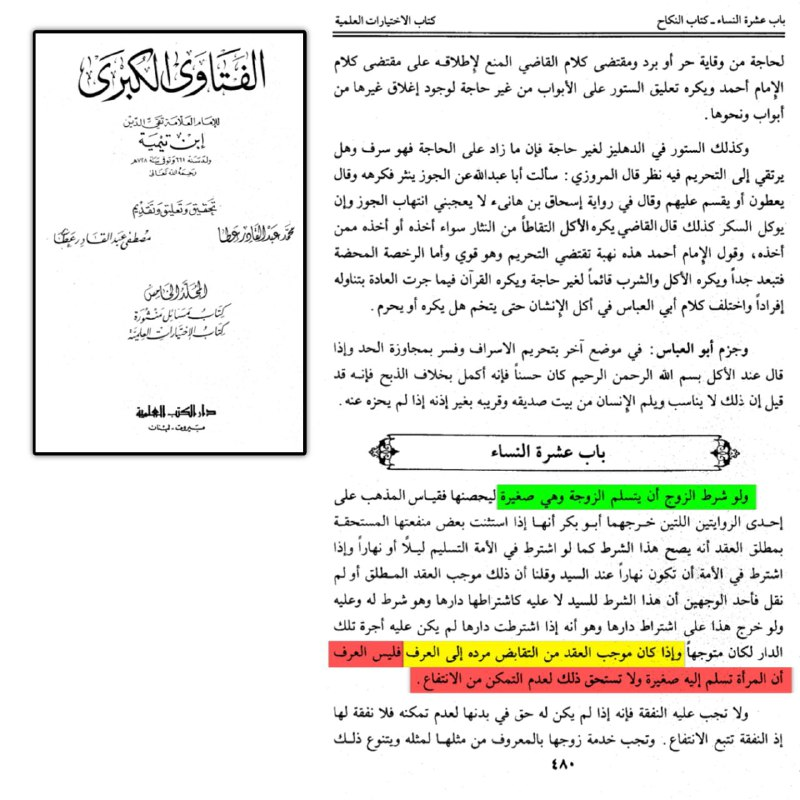
Source: Handover Conditional on Physical Eligibility This scan supports the rule that a young wife is not handed over merely because a contract exists. The highlighted material makes the condition physical eligibility and safety, not a fixed numerical age by itself. The surrounding page is dealing with custody/handover and the legal limits placed before consummation.
Source: Handover Conditional on Physical Eligibility This scan supports the rule that a young wife is not handed over merely because a contract exists. The highlighted material makes the condition physical eligibility and safety, not a fixed numerical age by itself. The surrounding page is dealing with custody/handover and the legal limits placed before consummation.
Source: Handover Conditional on Physical Eligibility This scan supports the rule that a young wife is not handed over merely because a contract exists. The highlighted material makes the condition physical eligibility and safety, not a fixed numerical age by itself. The surrounding page is dealing with custody/handover and the legal limits placed before consummation.
Source: Handover Conditional on Physical Eligibility This scan supports the rule that a young wife is not handed over merely because a contract exists. The highlighted material makes the condition physical eligibility and safety, not a fixed numerical age by itself. The surrounding page is dealing with custody/handover and the legal limits placed before consummation.
Summary of the Juridical Norm It is not permissible to hand over a young girl until she reaches puberty, and the correct view is that it is not age but ability that determines when handover is lawful.
Source: Al-Shafi’i on the Criterion This scan cites al-Shafi’i. The highlighted point is that ability is the determining factor, not a bare age number. The page is being used to show that legal permissibility depends on actual physical capacity and absence of harm.
Al-Shafi’i’s Position Al-Shafi’i says that ability is the determining factor, not age.
Source: Capability as the Original Juristic Criterion This scan states the same principle in its original juristic sense: the criterion is capability, not age alone. The highlighted material says a young wife is not given to the husband until she is ready and fit for marriage in the relevant legal sense.
In the original juristic sense, the determining factor is ability, not age, and a young girl should not be given to a husband until she is ready for marriage.
Source: Abu Hanifa’s Position This scan quotes Abu Hanifa’s position that the issue is judged by capability and relevant attributes. The highlighted part supports the point that legal capacity is not reduced to a single age number.
Abu Hanifa’s Position Abu Hanifa says that the basis is ability and attributes.
Ibn Qudamah: Prevention of Harm
Ibn Qudamah in al-Mughni frames the rule through the lens of legal entitlement and harm prevention rather than age. A husband has no legal right to physical access that would constitute harm, and the girl’s physical incapacity places her outside the scope of lawful handover — full stop. The relevant scan for al-Mughni appears above in the Hanbali section.
Source: The Principle of No Harm in Marriage This scan supports the principle of no harm. The highlighted material ties marriage and marital rights to the rule that harm is not allowed; if physical harm would result, the act is impermissible. The page strengthens the article’s legal argument by grounding it in the general juristic maxim of preventing harm.
The Juristic Maxim Applied to Marriage Marriage is based on the principle of no harm; if there is harm, then it is not permissible.
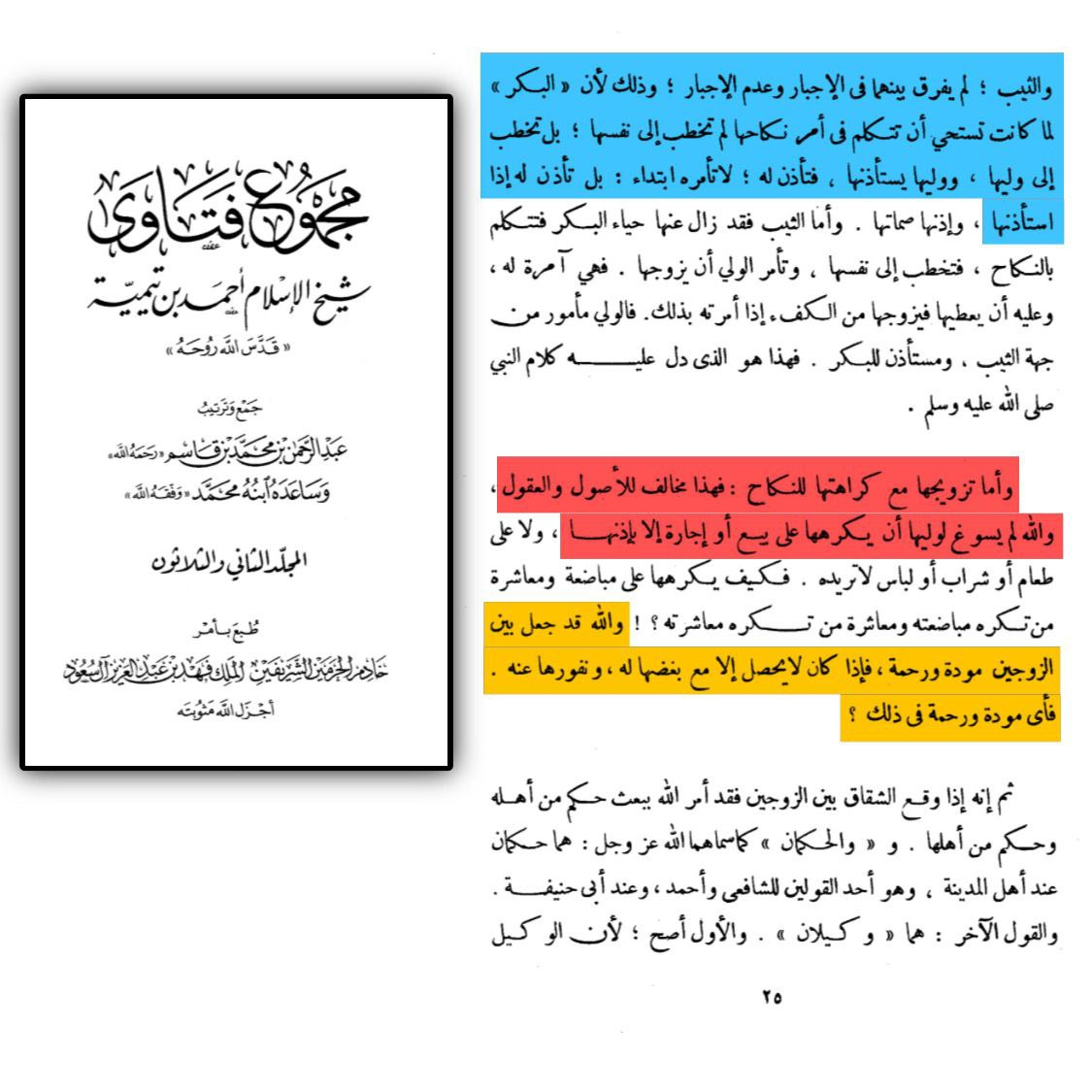
Source: Ibn Taymiyyah on Customary Practice This scan quotes Ibn Taymiyyah. The highlighted passage states that customarily people do not arrange such marriages while the girl is very young, and that this is the normal practice. The page is used to show that the juristic discussion does not mean such cases were encouraged as ordinary behavior.
Ibn Taymiyyah’s Statement Ibn Taymiyyah says that it is customary not to arrange a marriage when she is young, and this is the norm.
This is a significant point: the juristic discussion of such marriages is not a license or encouragement. Ibn Taymiyyah makes clear that early marriage of young girls was not the norm even within the historical Muslim world.
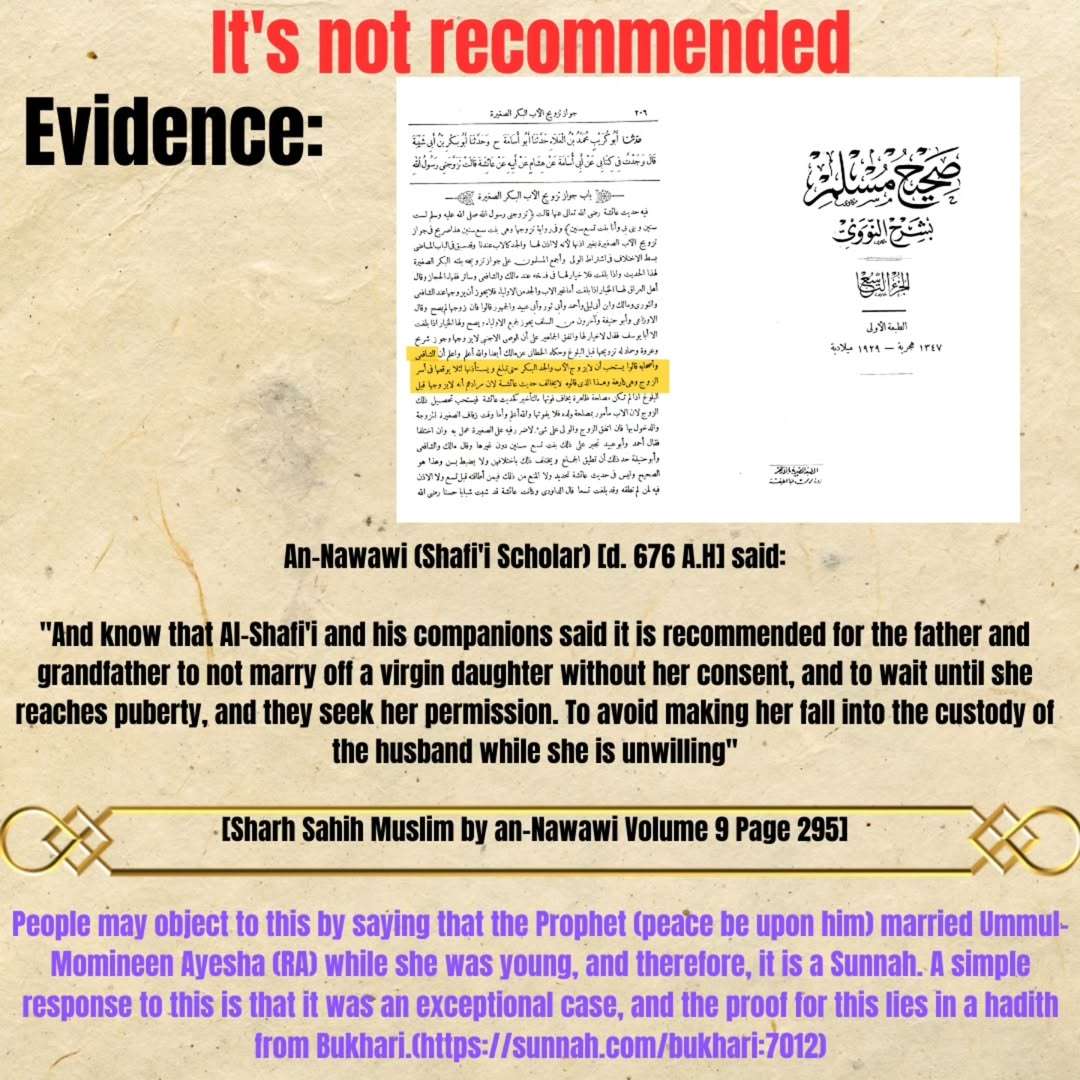
Source: Ibn Uthaymeen on Consent This scan quotes Ibn ‘Uthaymeen. The highlighted portion says the basic rule is that a girl should not be married off until her permission is obtained. The surrounding page uses the hadith principle of seeking consent, so the scan supports the argument against forced marriage.
Ibn Uthaymeen — First Statement The basic principle is that a girl should not be married off until she gives her permission.
Source: Ibn Uthaymeen on Puberty and the Right to Refuse This scan also quotes Ibn ‘Uthaymeen. The highlighted section says the normal rule is that a girl should not be married off until puberty; even in an exceptional case where a father contracts a marriage due to necessity, she has the right to refuse after puberty and she is not handed over before that. The page therefore treats such a case as a contract only, not consummation or delivery.
Ibn Uthaymeen — Second Statement The general rule is that a girl should not be married until she reaches puberty. However, if the father is compelled to do so — such as if he is about to die — then he may marry his daughter off. But she has the right to refuse once she reaches puberty, and it is not permissible to hand her over to him. This is merely a contract without consummation.
Consent in Islamic Law
The Prohibition of Forcing a Girl into Marriage
The prohibition of forced marriage is not a peripheral matter in Islamic jurisprudence — it is a condition that affects the validity and enforceability of the marriage itself. A guardian’s authority is not absolute where it overrides the woman’s choice.
Source: Prohibition of Forced Marriage This scan states that a girl may not be forced into marriage. The highlighted part is used to show that consent is not a cosmetic issue in the law, but a condition that affects the validity or enforceability of the marriage.
Source: Prohibition of Forced Marriage (Continued) This scan continues the same point: a girl may not be forced into marriage. The page supports the argument by presenting the juristic rule that coercion is not treated as valid consent.
Source: Prohibition of Forced Marriage (Continued) This scan is another supporting page on the prohibition of forcing a girl into marriage. The highlighted material is being used to establish that a guardian’s authority is not absolute when it violates the woman’s choice.
Source: Prohibition of Forced Marriage (Continued) This scan again supports the rule that a girl may not be forced into marriage. The surrounding page is relevant because it treats consent as a legal matter, not merely a personal preference.
Juristic Ruling — Repeated Across Sources A girl may not be forced into marriage.
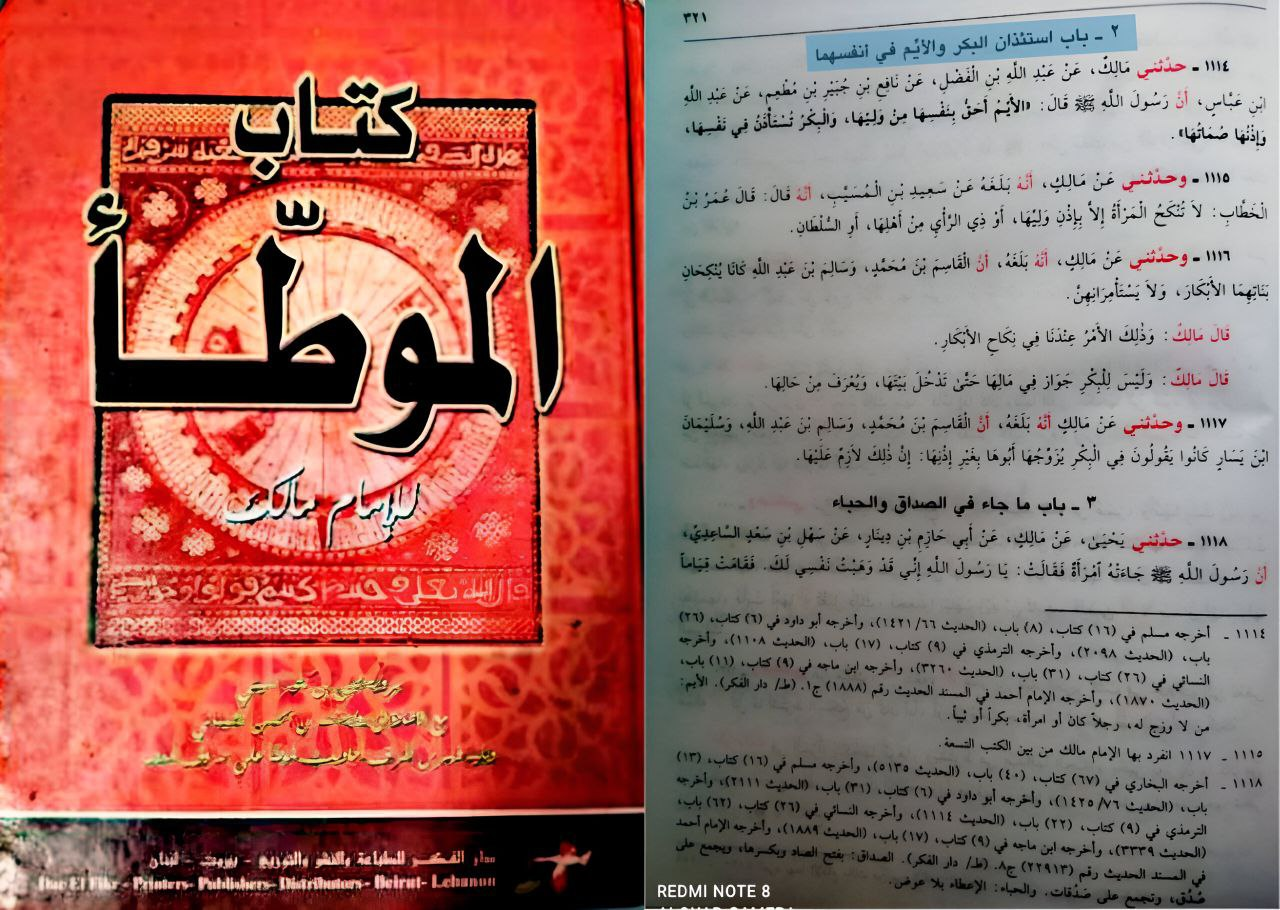
Source: Hadith on Consent This scan cites the hadith principle that a virgin is not married until her permission is sought. The highlighted material supports the article’s consent argument: marriage is not validly imposed while ignoring the woman’s permission.
Prophetic Hadith A virgin should not be married until she gives her permission, according to the hadith of the Prophet, peace and blessings be upon him.
The Right to Refuse After Puberty
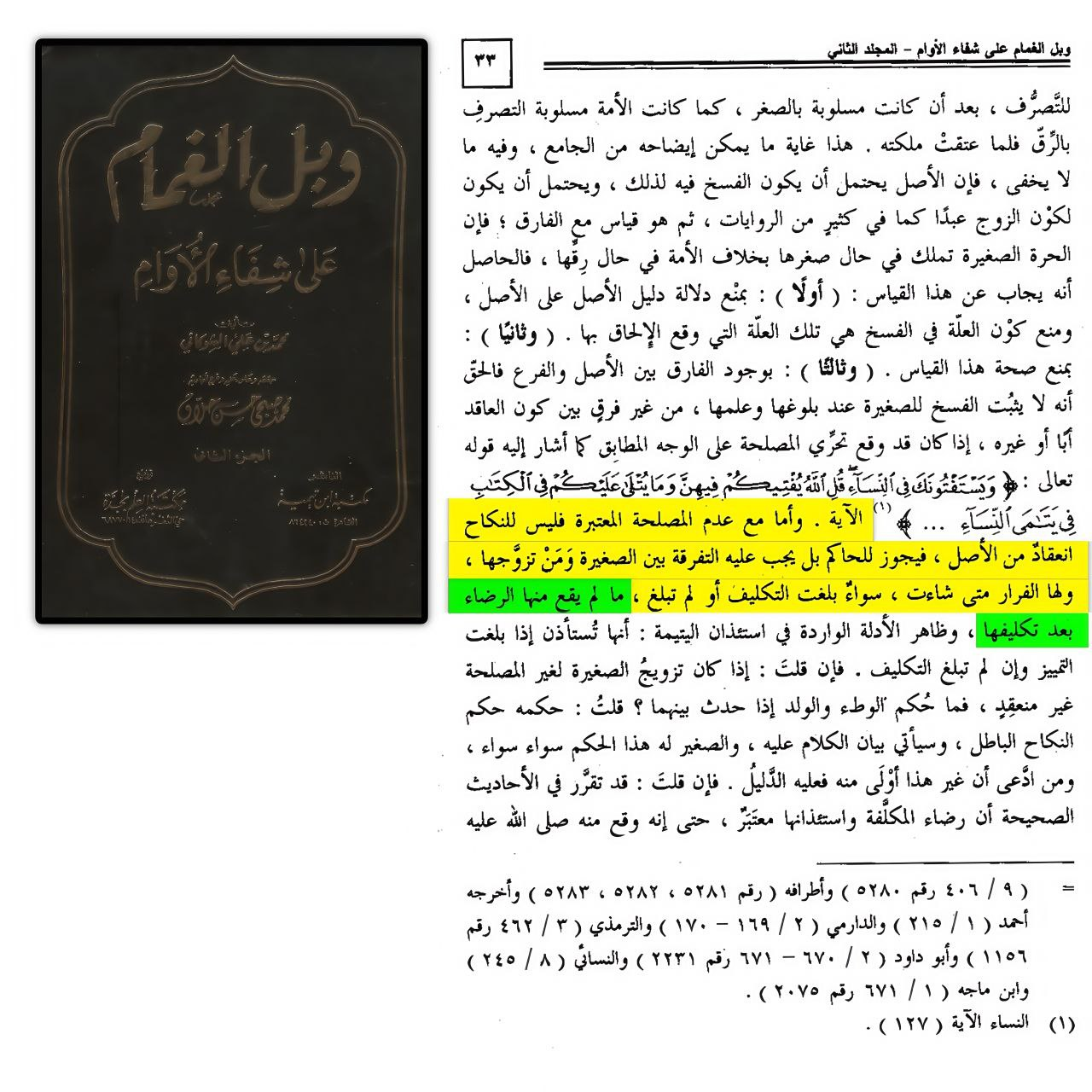
If a father does contract a marriage for a minor daughter without her consent, this is not an irreversible act that bypasses her will permanently. Islamic law grants her the right to refuse after she reaches maturity, and in such a case separation is required if she withholds her agreement.
Source: Right to Refuse After Maturity This scan says that if a father marries his daughter off without her consent, separation occurs if she does not agree after reaching maturity. The highlighted passage is used to show that the woman’s later consent or refusal has legal effect.
Juristic Rule on Post-Puberty Refusal If the father marries her off without her consent, they must be separated if she does not agree after reaching the age of majority.
Sahih al-Bukhari: The Case of Khansa’ Bint Khidam
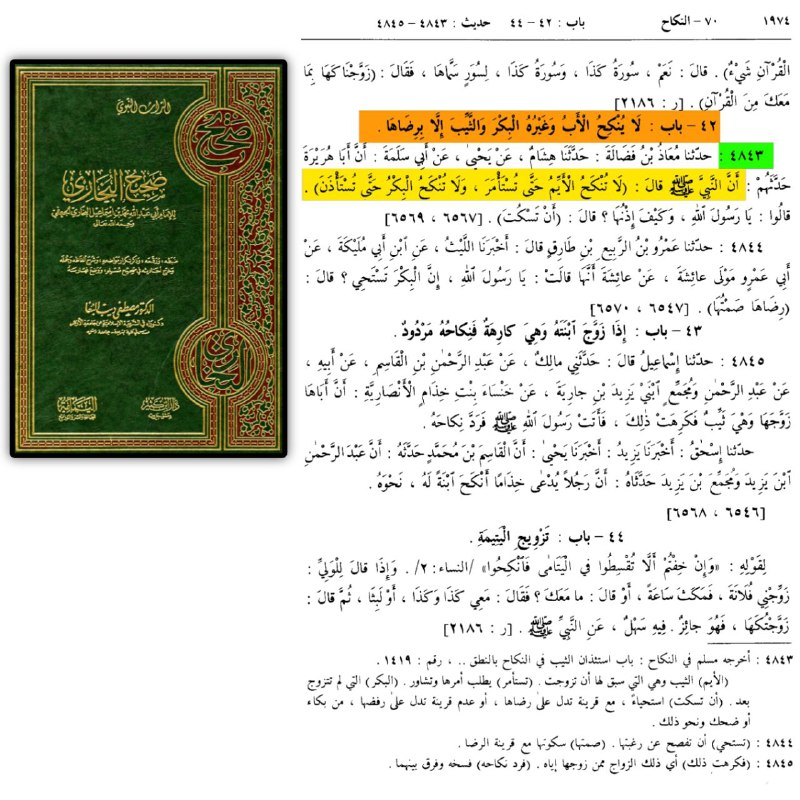
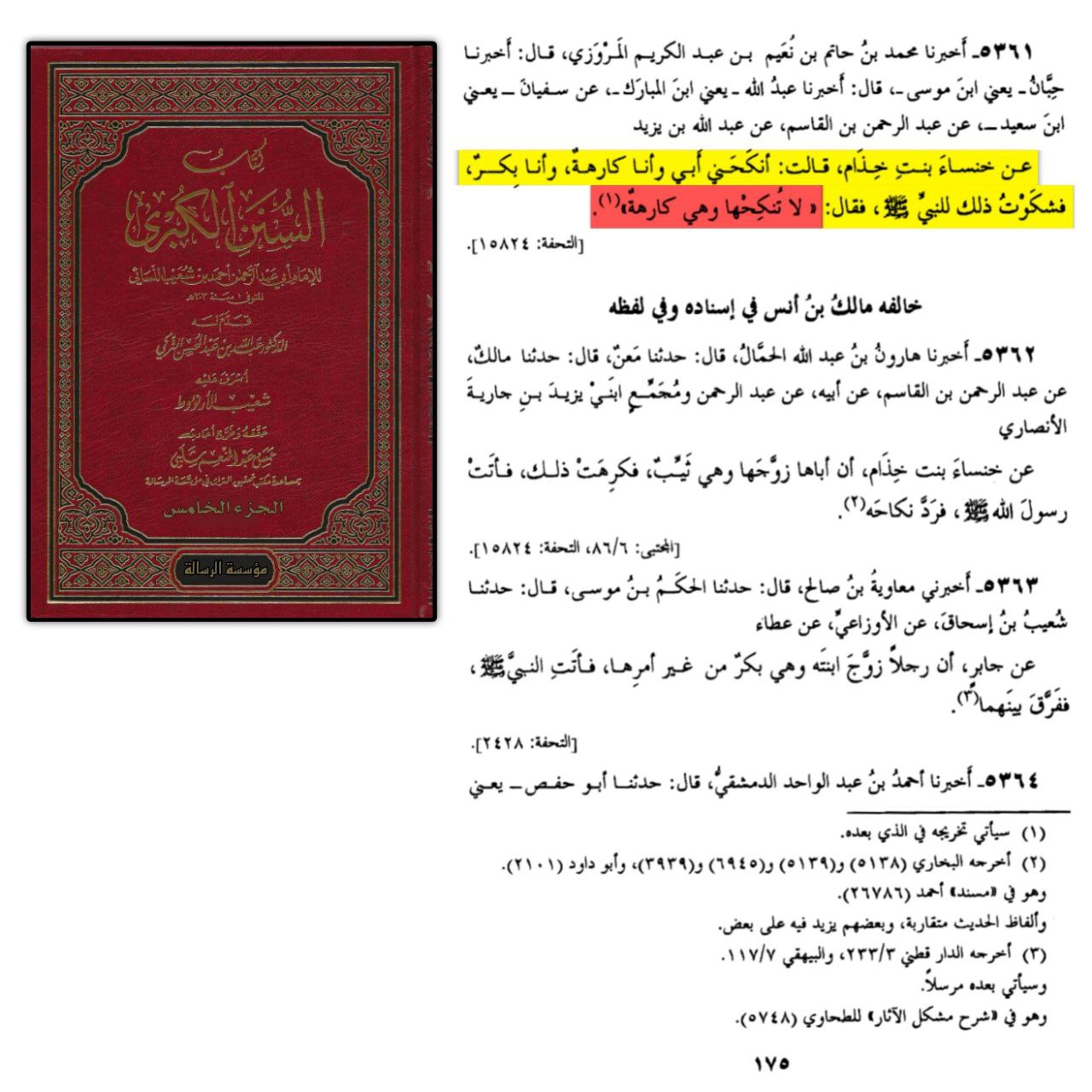
The most decisive proof from the prophetic tradition is the case recorded in Sahih al-Bukhari. The Prophet ﷺ himself annulled a marriage contracted without the woman’s consent, establishing that such a marriage has no binding force against the woman’s will.
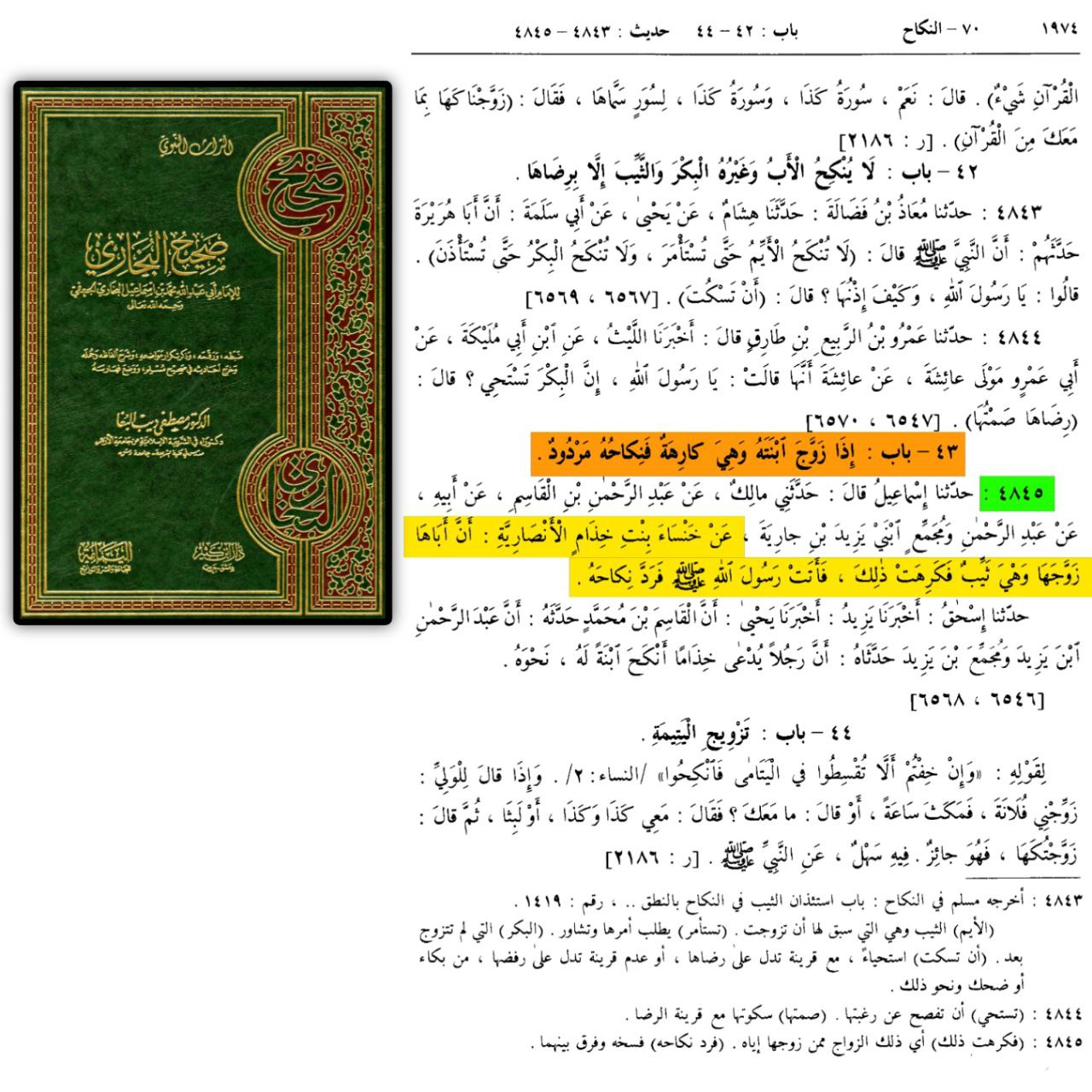
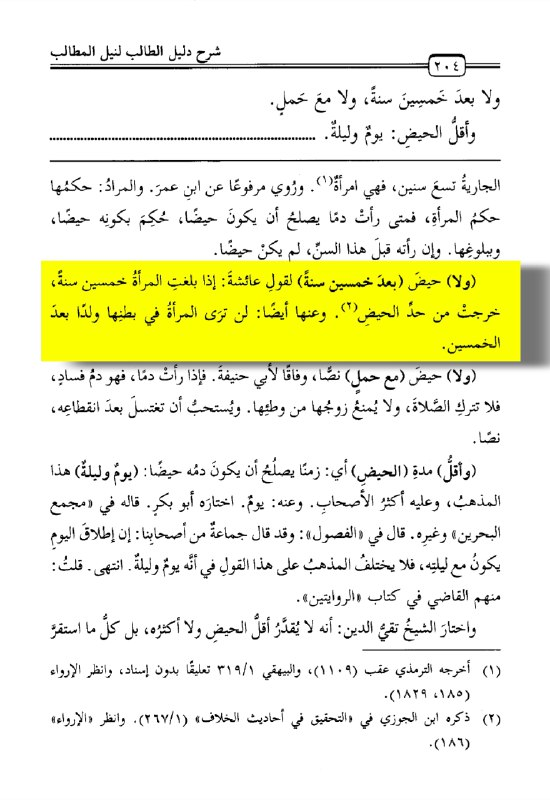
scholars opinions 50
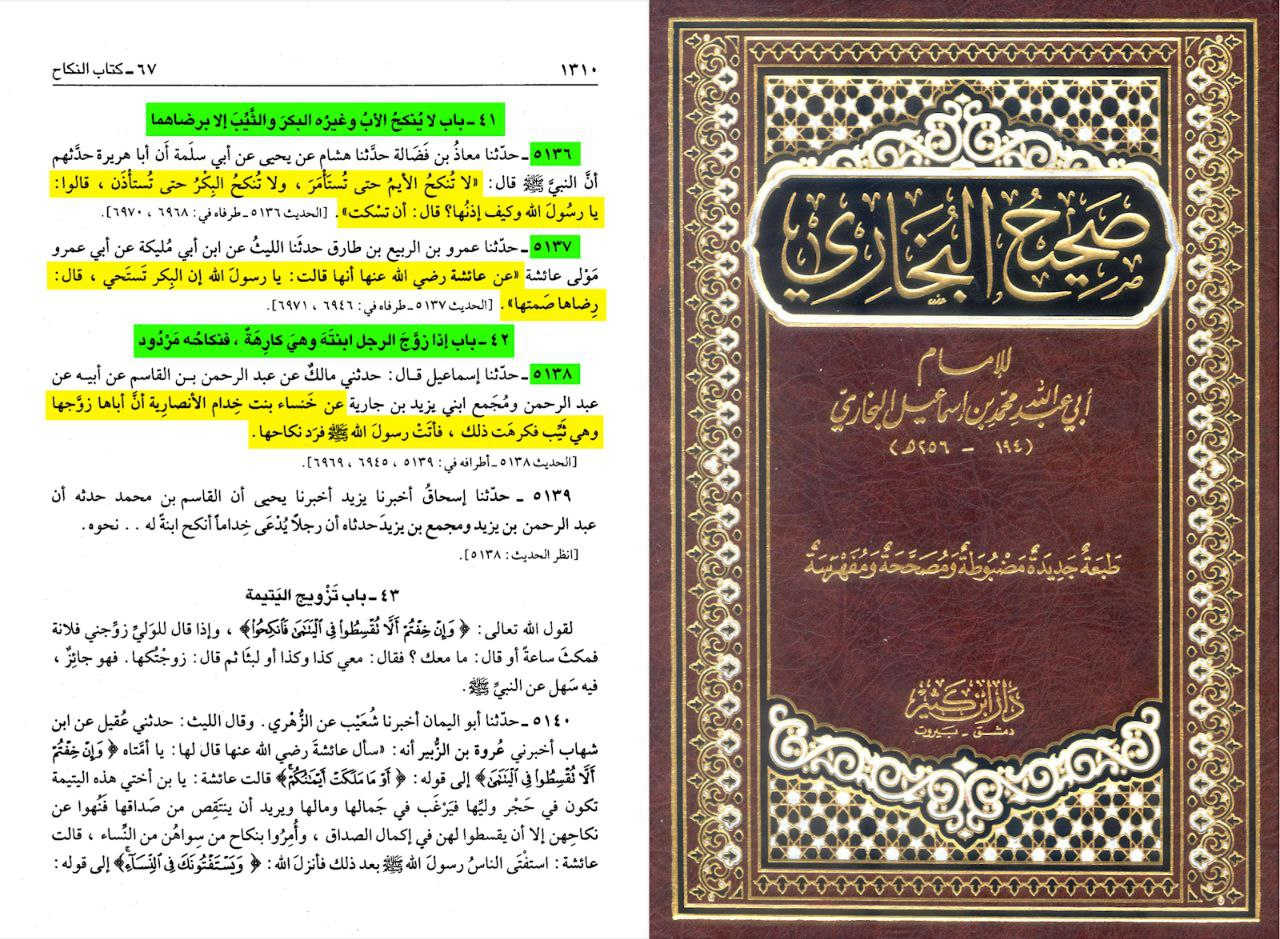
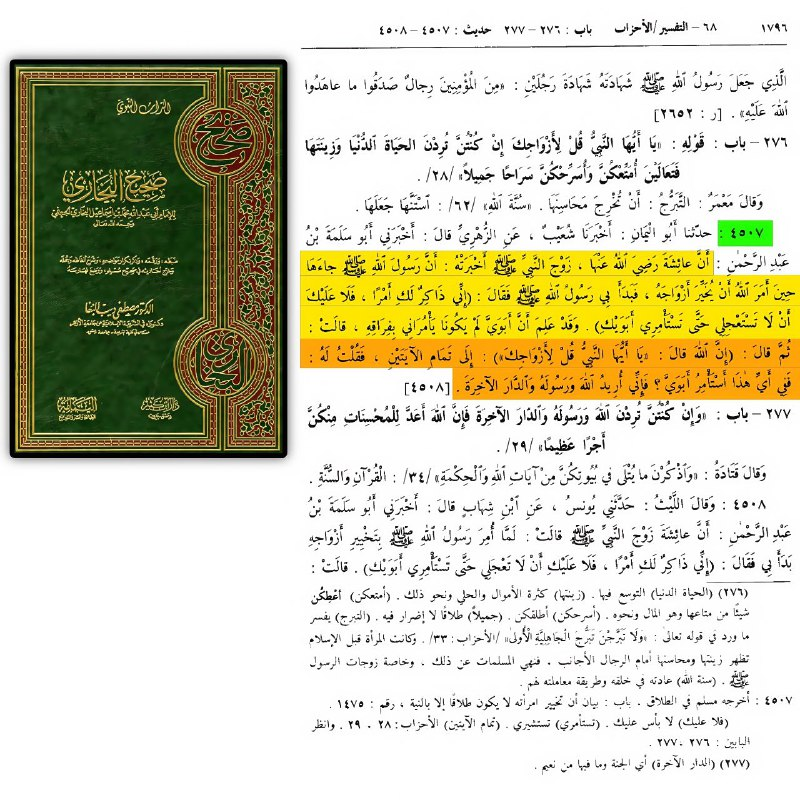
Source: Sahih al-Bukhari — Chapter on Marrying Off a Daughter Against Her Will This scan cites Sahih al-Bukhari’s chapter on the one who marries off his daughter while she dislikes it. The highlighted material narrates that Khansa’ bint Khidam was married by her father while she disliked it, and the Prophet annulled the marriage. The page supports the article’s final point that coerced marriage is invalid or annulled.
From Sahih al-Bukhari It is narrated on the authority of Khansa bint Khidam al-Ansariyyah that her father married her off while she was a widow, and she disliked it. So she went to the Messenger of God ﷺ, and he annulled her marriage.
Sahih al-Bukhari contains an entire chapter dedicated to the one who married off his daughter against her will — and the ruling is that the marriage is invalid. Other sources affirm the same conclusion.
Conclusion on Consent The consent of the woman is not a formality in Islamic law. It is a condition that bears on the validity of the marriage itself. A contract imposed without consent is subject to annulment, as the Prophet ﷺ himself demonstrated. This is the position of the hadith, the fiqh of all four schools, and the explicit statements of major scholars including Ibn Uthaymeen.
Quranic Analysis of Surah al-Talaq 65:4
The Doubt Based on This Verse Critics allege that the verse, “And those of your women who have despaired of menstruation, if you have any doubt, then their waiting period is three months, and those who have not menstruated” — permits marriage and consummation with prepubescent girls, treating “those who have not menstruated” as referring to children. This section refutes that reading through linguistic, grammatical, and exegetical evidence.
The Verse in Its Waiting-Period Context
The verse in question (Surah al-Talaq 65:4) is not a verse about marriage permission at all. It is a verse about waiting periods (‘iddah) after divorce. The context is the legal question of how long a divorced woman must wait before she may remarry. This framing is critical: the verse discusses categories of women and their waiting periods — it does not grant any new permission for marriage or consummation.
Critical Legal Distinction The verse, “and those who have not menstruated,” is evidence that such a woman has a waiting period of three months — not that marrying or consummating with an incapable girl is permitted. The Quranic verse governs the duration of a waiting period after divorce, not the permissibility of consummation. These are entirely different legal questions.
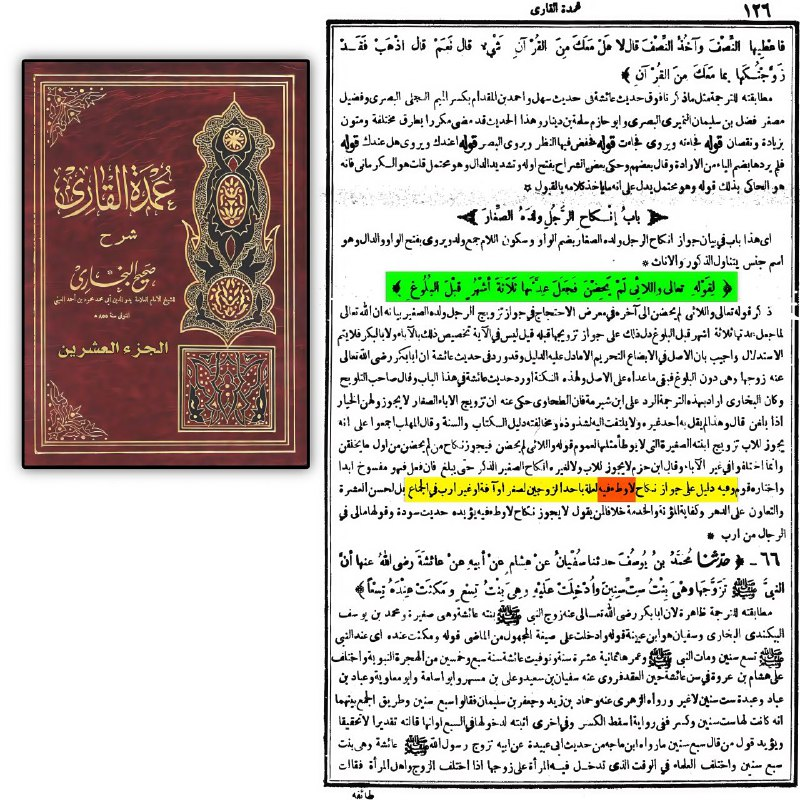
Source: Contract vs. Submission — A Key Distinction This scan discusses the verse, “and those who have not menstruated.” The highlighted part says the verse may indicate the possibility of a marriage contract, but it does not prove handing over a minor before puberty or capacity. The page is important because it blocks the leap from waiting-period discussion to physical access.
Source: Marriage Contract vs. Delivery — Distinct Legal Acts This scan makes the same distinction more directly: the verse is evidence for marriage in a legal sense, not for delivery or consummation. The highlighted point is that contract and handover are separate categories.
Key Juristic Conclusion from the Verse His statement, may He be exalted, “and those who have not yet menstruated,” is evidence of marriage, not submission.
His statement, “And those who have not yet menstruated,” is evidence of marriage, but there is no handing over of a minor until she reaches puberty.
Linguistic Analysis: Nisa’ Means Adult Women
The word used in the verse is nisa’ — “your women.” Understanding its precise Arabic meaning is the first step in correctly interpreting who “those who have not menstruated” refers to.
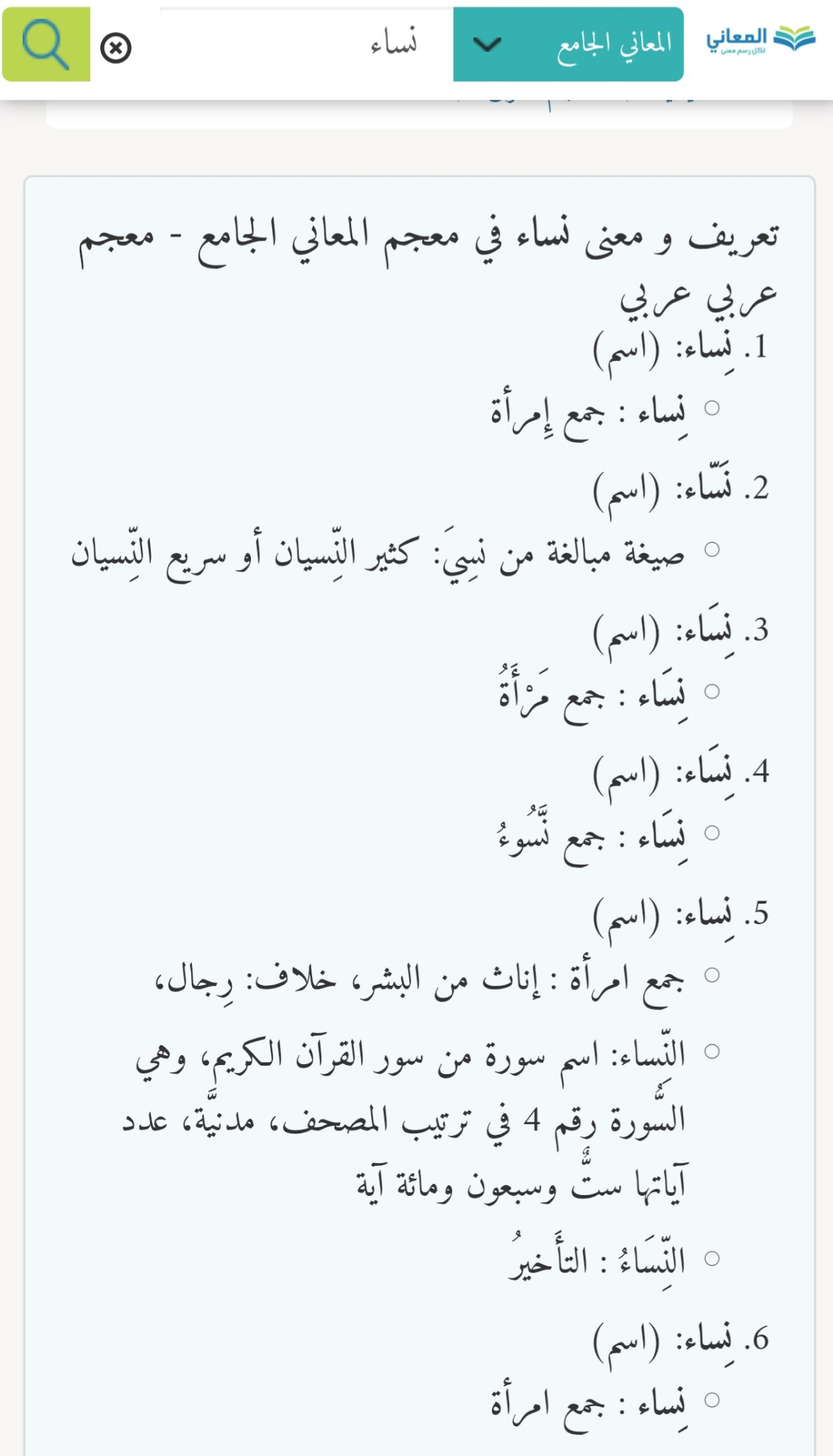
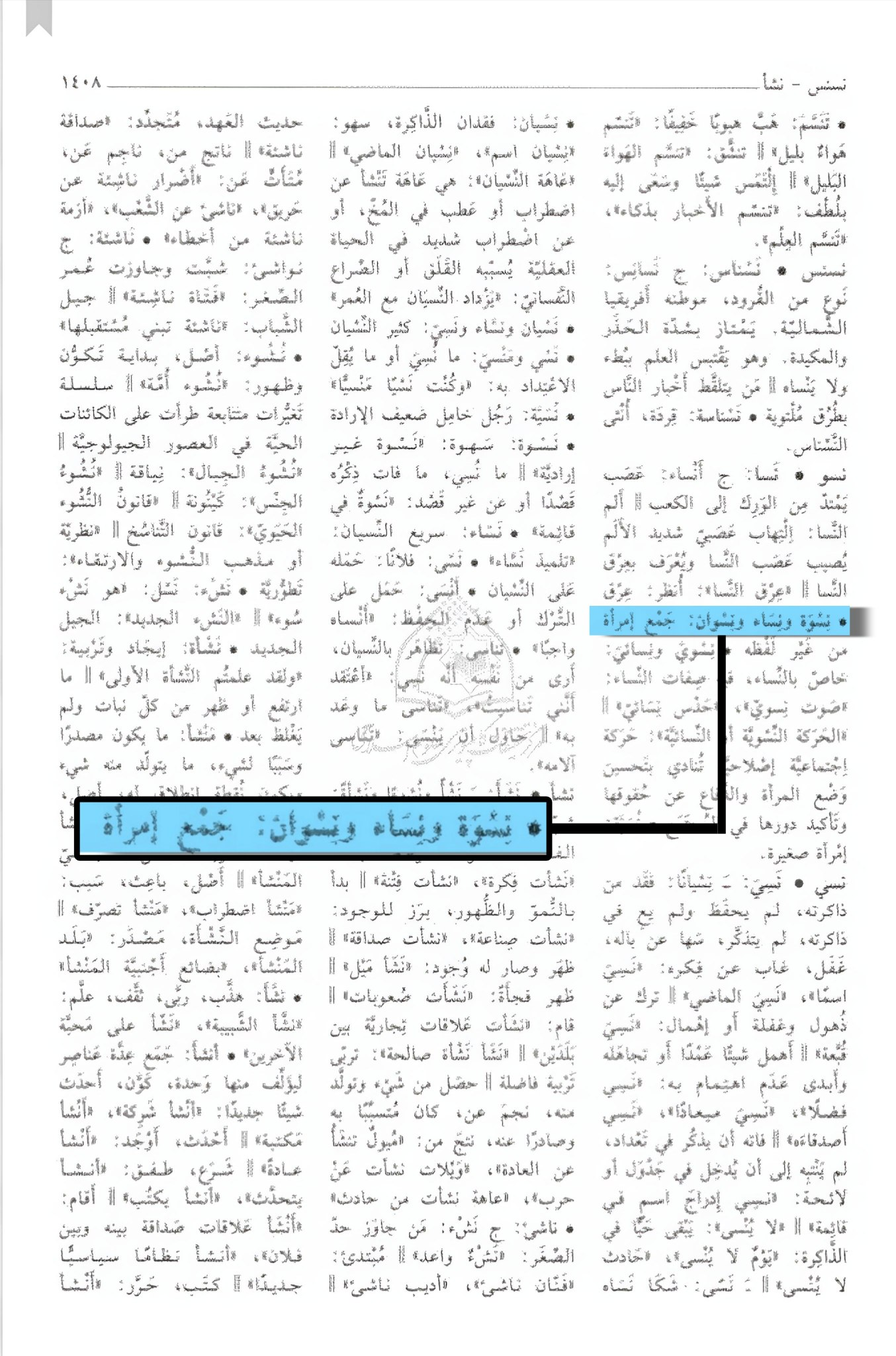
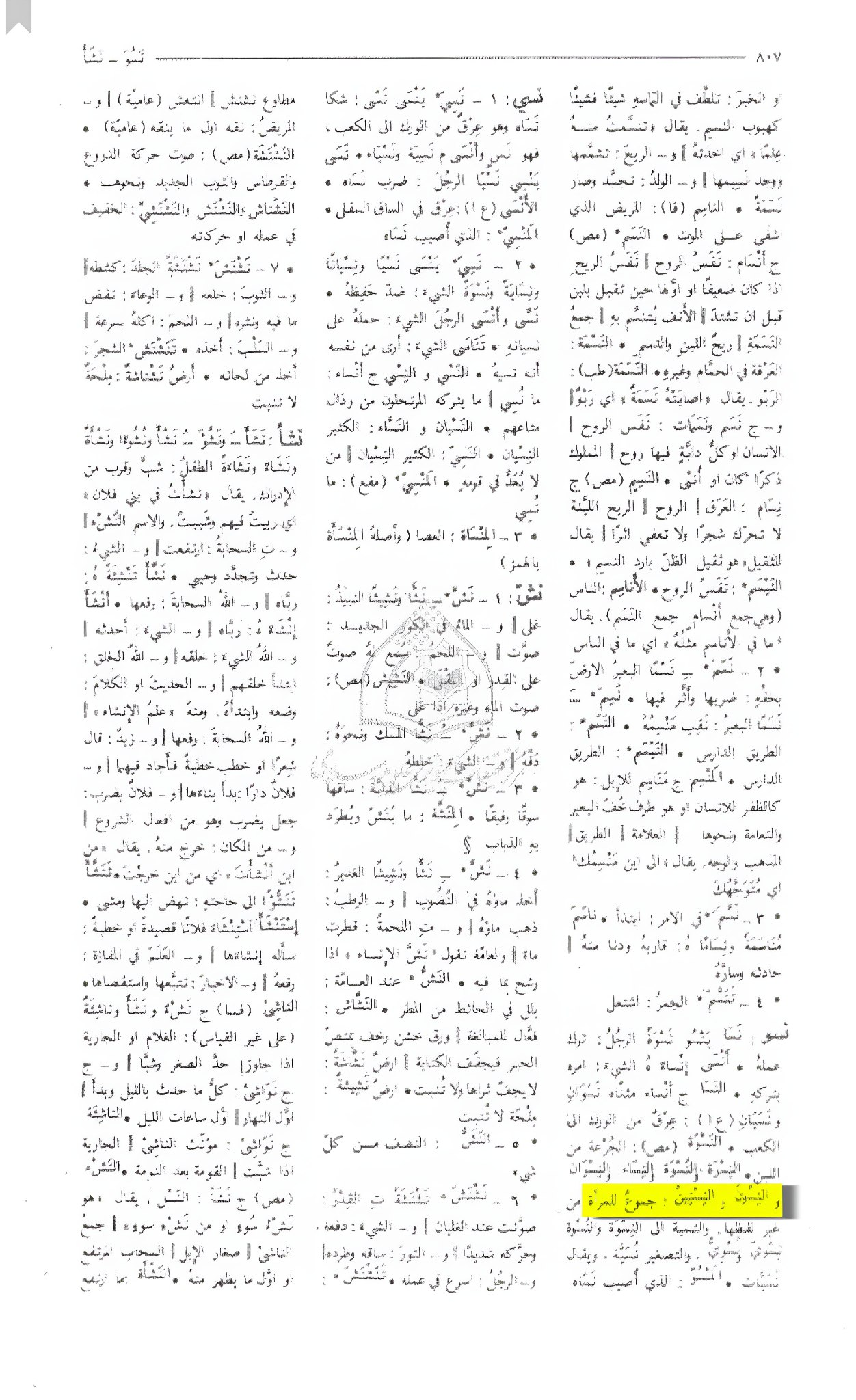
Linguistic Foundation: The Meaning of Nisa’ Firstly: “women” (nisa’), as we read, means the plural of “woman” (imra’ah). The Arabic word imra’ah refers specifically to an adult woman — the feminine counterpart to rajul (man). It is a name for an adult woman, not for a child. Therefore the word nisa’ as it appears at the start of the verse refers to adult women.
اولا النساء كما نقرأ يعني جمع امرأة
scholars opinions 8
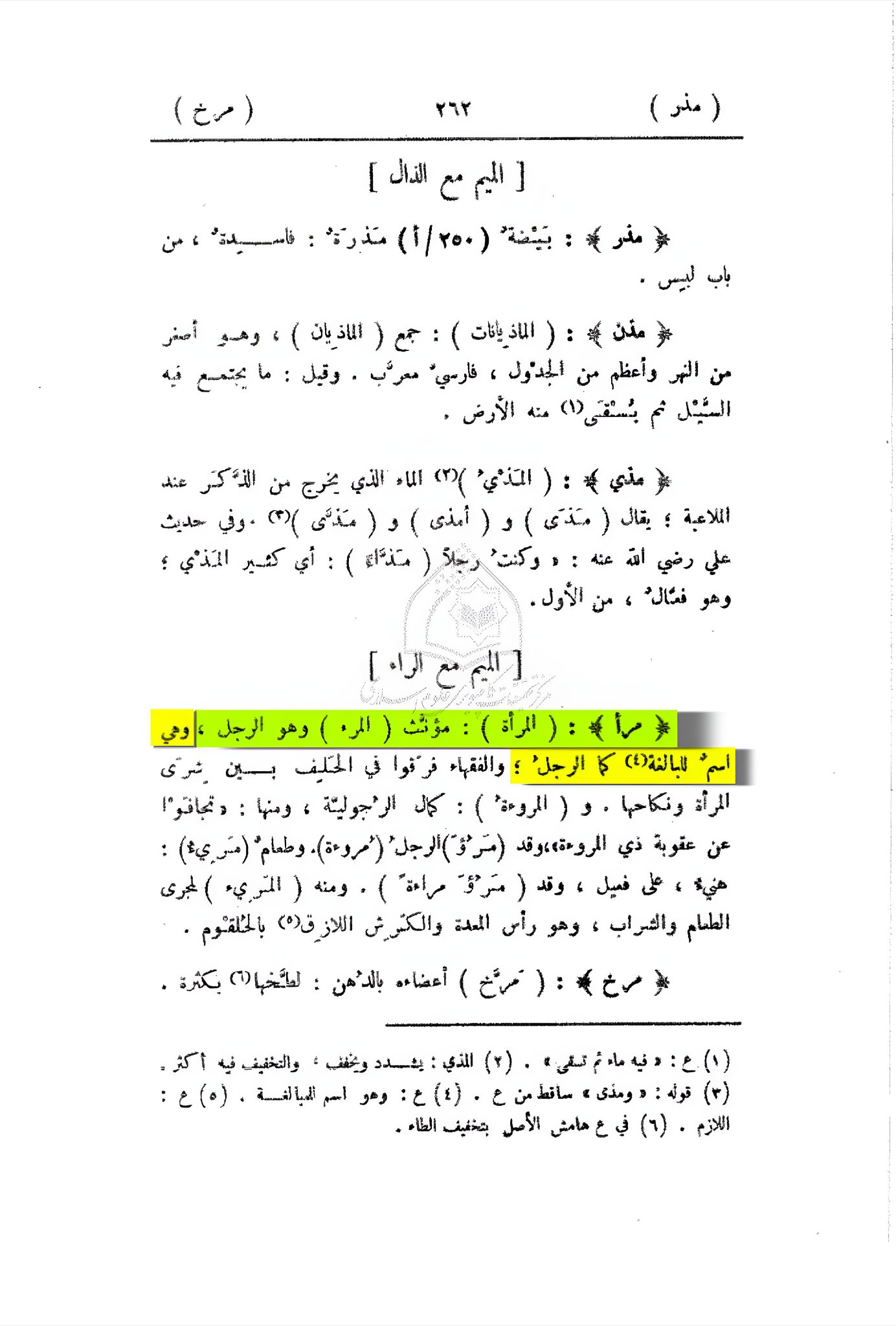
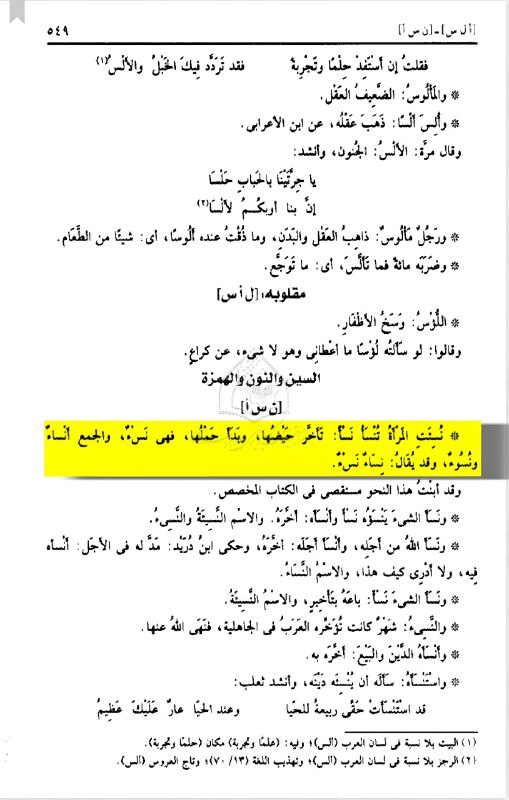
Source: Arabic Dictionary Entry for Nisa’ This scan is from an Arabic dictionary entry for nisa’. The highlighted/visible definition states that nisa’ is the plural of imra’ah — woman. The page is used linguistically to argue that the verse’s wording is connected to women, not to an undefined category detached from adult female terminology.
scholars opinions 10scholars opinions 9
Source: Dictionary Entry for Nisa’ and Niswan This contextual dictionary page explains related entries for nisa’ and niswan. The highlighted material identifies nisa’ as women/females and connects the term to the ordinary Arabic category of women. The scan supports the linguistic argument that the Qur’anic phrase remains attached to “your women.”
scholars opinions 11
Source: Dictionary Entry for Mar’ah/Imra’ah This scan is from the dictionary page for mar’ah/imra’ah. The highlighted part defines the word as woman and, in the relevant lexical usage, as an adult female. The page is used to reinforce that nisa’ as the plural of imra’ah carries the meaning of women, not merely children.
scholars opinions 12
Source: Confirming the Grammatical Connection This scan supports the first linguistic step: nisa’ is the plural of imra’ah. The surrounding page is relevant because the argument depends on the grammatical connection between “those who have not menstruated” and the earlier phrase “your women.”
scholars opinions 13
Source: Meaning of “Woman” — Adult Female This scan continues the lexical argument by focusing on the meaning of “woman.” The highlighted content supports the claim that the relevant term points to an adult female category, which affects how the later phrase in the verse should be read.
If we look at the meaning of “woman,” we read that it is the feminine form of “man” and a name for an adult woman.
Those Who Have Not Menstruated: Connected to Women
The phrase “and those who have not menstruated” (wa-l-la’i lam yahidna) is connected grammatically to the phrase “your women” (nisa’ikum) that opens the verse. This means it does not introduce a new and separate category — it describes a subset of women, i.e., adult women whose menstruation has not occurred or has not yet begun.
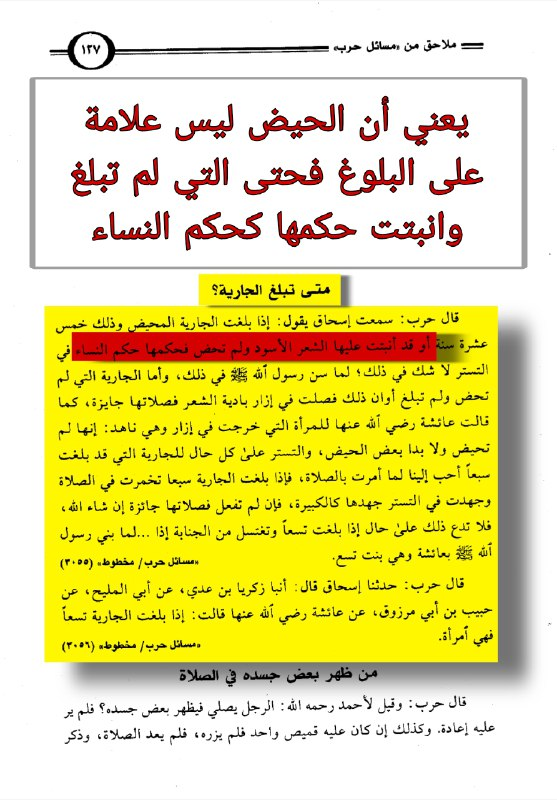
Absence of menstruation does not exclusively describe children. It can equally describe an adult woman whose menstruation is delayed, irregular, or who has reached maturity by other signs without yet menstruating. The Quran and the fuqaha’ both recognized that menstruation alone is not the only sign of puberty — hair growth and other physical markers are also accepted signs of maturity.
scholars opinions 14
Source: Women Whose Menstruation Is Delayed or Absent This scan discusses women whose menstruation is delayed or absent. The highlighted part is used to show that absence of menstruation can describe a woman who has reached maturity but has not menstruated, not only a child. The page helps frame the verse as dealing with categories of women and their waiting periods.
scholars opinions 15
Source: Delayed Menstruation — Not Exclusive to Children This scan continues the same point about delayed menstruation. The page supports the argument that menstruation was known as a legal sign but not the only sign of maturity, so a woman may be legally adult even before menstruating.
Here we read that the woman who is considered “forgotten” (al-mansiyyah) is the one whose menstruation is delayed. Any delay in a woman’s menstruation was known to them, and the proof is that it is mentioned at the beginning of the verse: “And those who have despaired of menstruation.”
scholars opinions 16
Source: Aisha on the Age of Fifty and Menstruation This scan refers to the statement attributed to Aisha that when a woman reaches fifty, she is no longer counted among menstruating women. The highlighted context supports the discussion of women who have despaired of menstruation and shows that the verse is dealing with menstrual status categories.
scholars opinions 17
Source: Aisha’s Statement Continued This scan completes the point drawn from Aisha’s statement: the verse can be read as addressing women who have passed menstruation and women whose menstruation is delayed. The broader page helps the article argue that menstruation alone is not the only legal marker of adulthood.
We also read and understand from the words of Aisha that if a woman reaches fifty years of age, she is no longer menstruating. We can conclude that the verse speaks of two categories of women: the first is the woman who has passed the age of menstruation, or more accurately, who has given up hope of it; and the second is the woman whose menstruation is delayed, or who has reached puberty but has not yet menstruated.
As mentioned earlier, menstruation alone is not the only sign of puberty — there are many other signs, such as hair growth. If a woman has reached puberty by another sign but has not yet menstruated, she is considered an adult.
Linguistically, the waw (“and”) in “wa-l-la’i lam yahidna” (and those who have not menstruated) is a conjunction referring back to “women” (nisa’), and the meaning of “women” in Arabic — as established — is adult women. The evidence for this interpretation and explanation is also found in al-Sa’di’s commentary.
scholars opinions 18
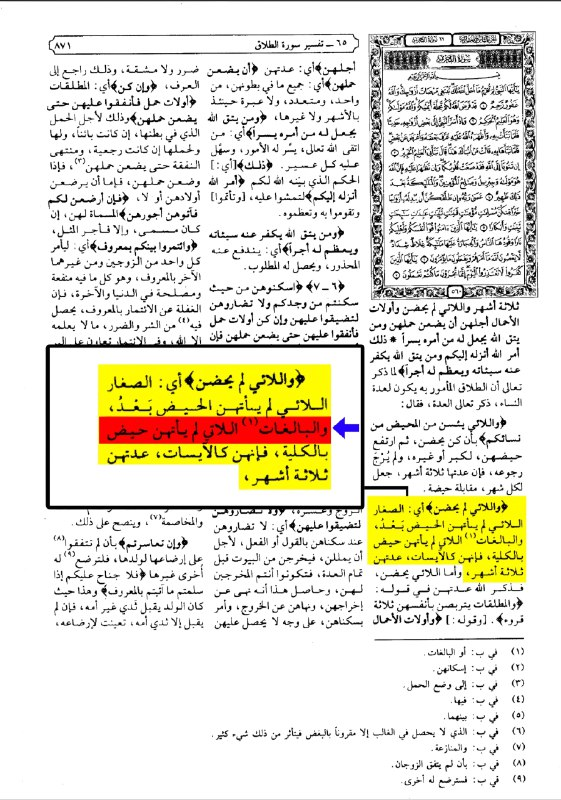
Source: Tafsir al-Sa’di This scan is from al-Sa’di’s commentary. The highlighted/used point is that the verse speaks about women in different menstrual conditions, including those whose menstruation has not occurred. The page is cited to support the interpretation that the wording remains tied to “women.”
scholars opinions 19
Source: Tafsir al-Sa’di (Continued) This scan continues the Tafsir al-Sa’di evidence. The relevant context treats the phrase as part of the same legal ruling on waiting periods for women, not as a separate permission for harmful handover.
Grammatical (I’rab) Analysis from Classical Sources
A convergence of classical Arabic grammatical works confirms that the phrase “and those who have not menstruated” is grammatically connected back to “your women,” and that its predicate (“their waiting period is three months”) is omitted but understood from the preceding clause. This means the verse is syntactically about women and their waiting periods — not an independent legal category permitting anything beyond that.
As also stated in al-Tabari’s interpretation:
scholars opinions 20
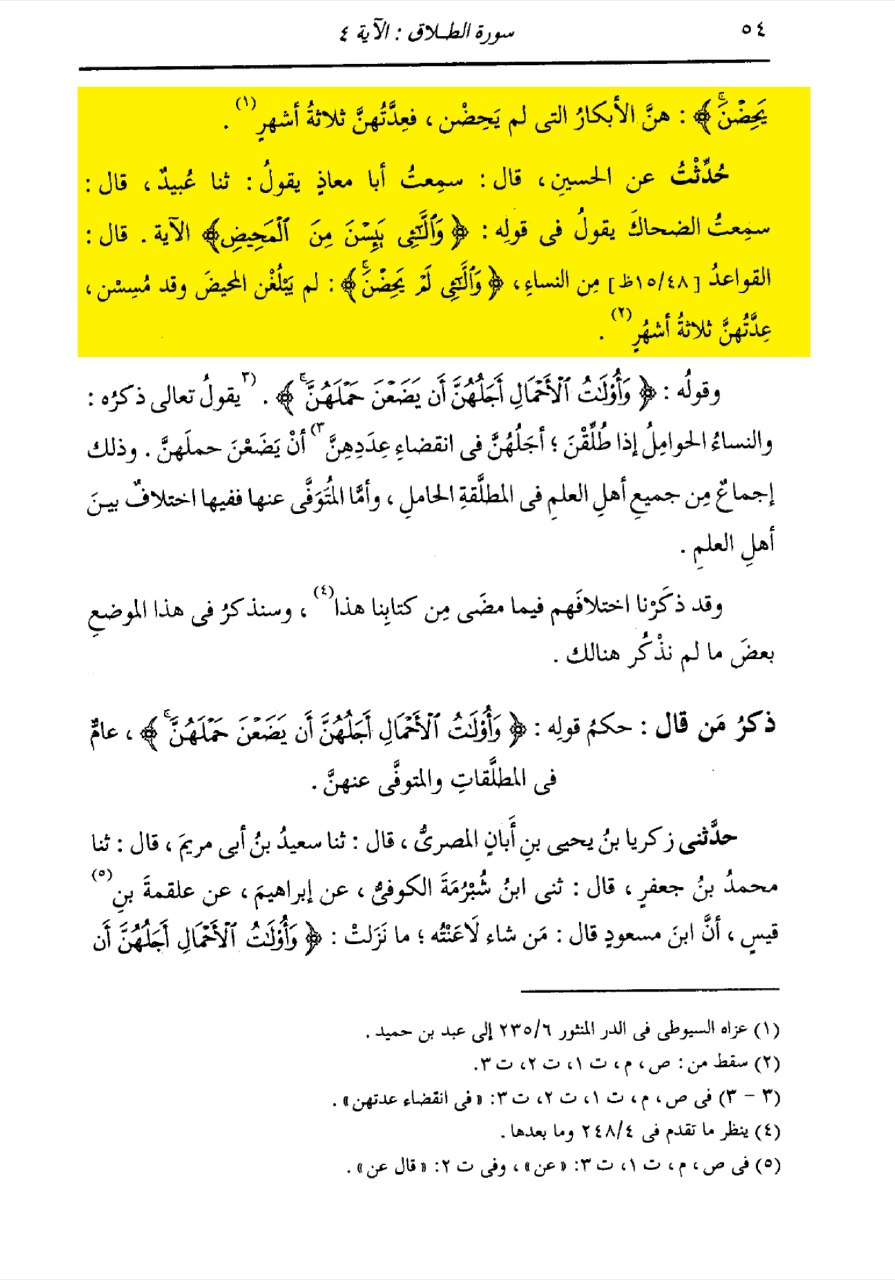
Source: Tafsir al-Tabari This scan is from al-Tabari’s tafsir. The highlighted part discusses “those who have not menstruated” as a category within the verse’s waiting-period ruling. The page is used as evidence for the wording and the juristic discussion around menstruation and maturity.
scholars opinions 21
Source: Tafsir al-Tabari (Continued) This scan continues the al-Tabari tafsir material. The relevant passage is being used to show how earlier exegetes discussed the phrase while the article then qualifies the issue through capability, puberty signs, and legal handover.
He says that those who have not yet menstruated are women who have not reached puberty and have been touched — meaning they have been married or physically approached. This is further evidence that puberty is not solely dependent on menstruation. Another interpretation was given: “The weakness of virgins who have not yet menstruated.”
scholars opinions 22
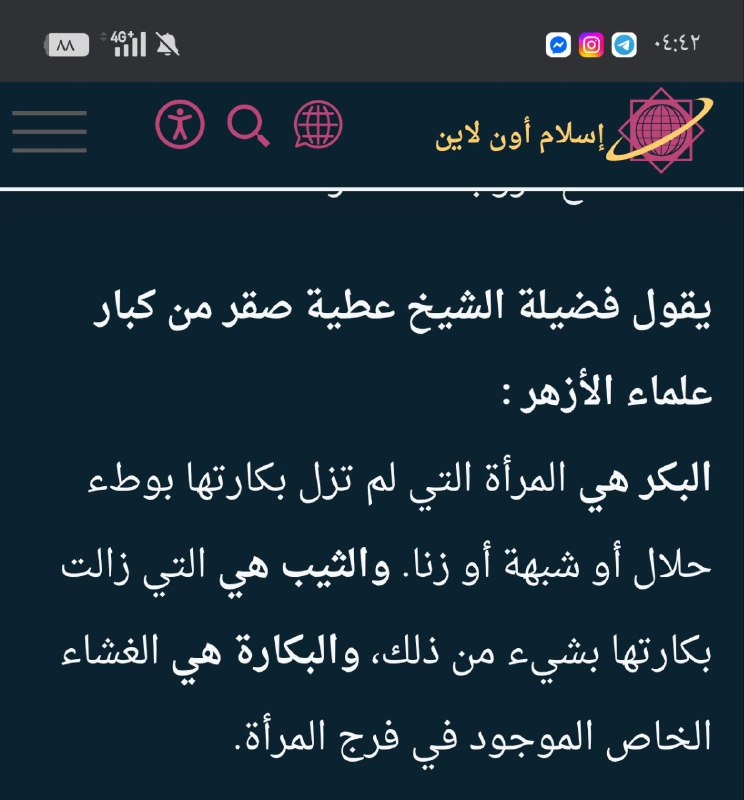
Source: Dictionary Definition of Bikr (Virgin) This scan defines the word bikr — virgin. The highlighted definition says it refers to a woman whose virginity has not been removed through lawful intercourse, doubtful intercourse, or fornication. The page supports the linguistic point that terms used in the discussion may refer to women in a legal status, not simply to children.
The word “virgin” (bikr) means a woman whose virginity has not been lost through lawful intercourse, suspected intercourse, or adultery — reinforcing that the legal terminology in this discussion is about women, not exclusively children.
Meaning of “Small” in the Grammatical Literature:
scholars opinions 24
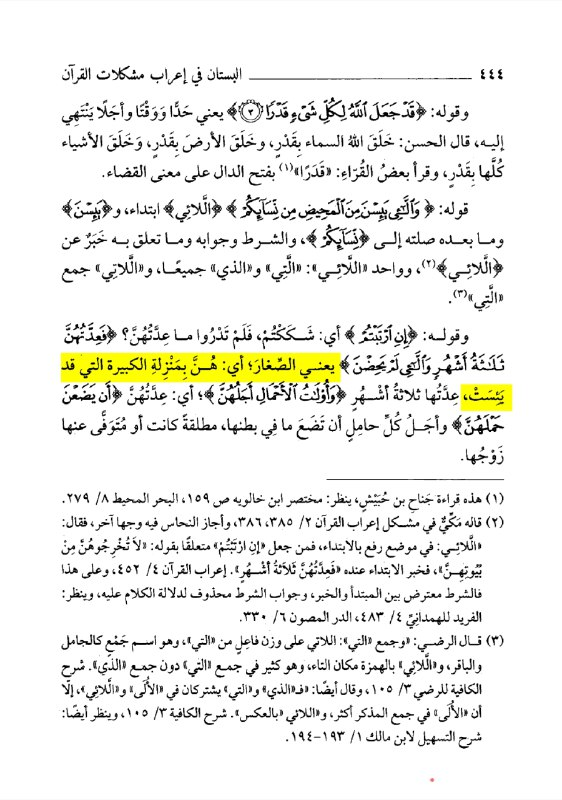
Source: I’rab Mushkilat al-Qur’an This scan discusses the word translated as “small” in a grammatical/Qur’anic analysis context. The highlighted point says it may be understood comparatively — like a large woman who has passed the age of menopause — meaning she has left the age of menstruation, rather than automatically meaning an incapable child. The page supports the article’s linguistic challenge to a simplistic reading.
As for the meaning of “small” (saghira) as stated in the book I’rab Mushkilat al-Qur’an (Grammatical Analysis of the Difficulties of the Qur’an), it is like a large woman who has passed the age of menopause, meaning she has left the age of menstruation. The proof of this is also found in the book al-Farid fi I’rab al-Qur’an al-Majid:
scholars opinions 25scholars opinions 26
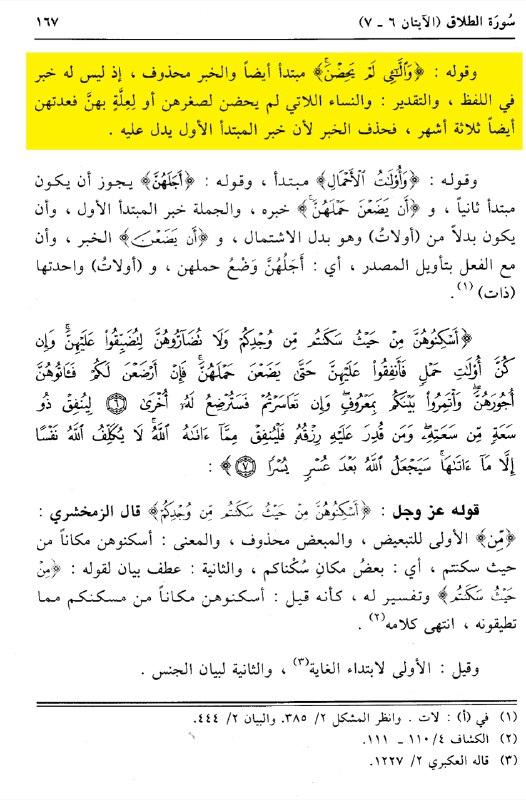
Source: al-Farid fi I’rab al-Qur’an al-Majid This contextual scan is from al-Farid fi I’rab al-Qur’an al-Majid. The highlighted passage explains the grammatical construction around “those who have not menstruated” and treats omitted elements as understood from the previous wording. The point is that the phrase is grammatically connected to women and their waiting period.
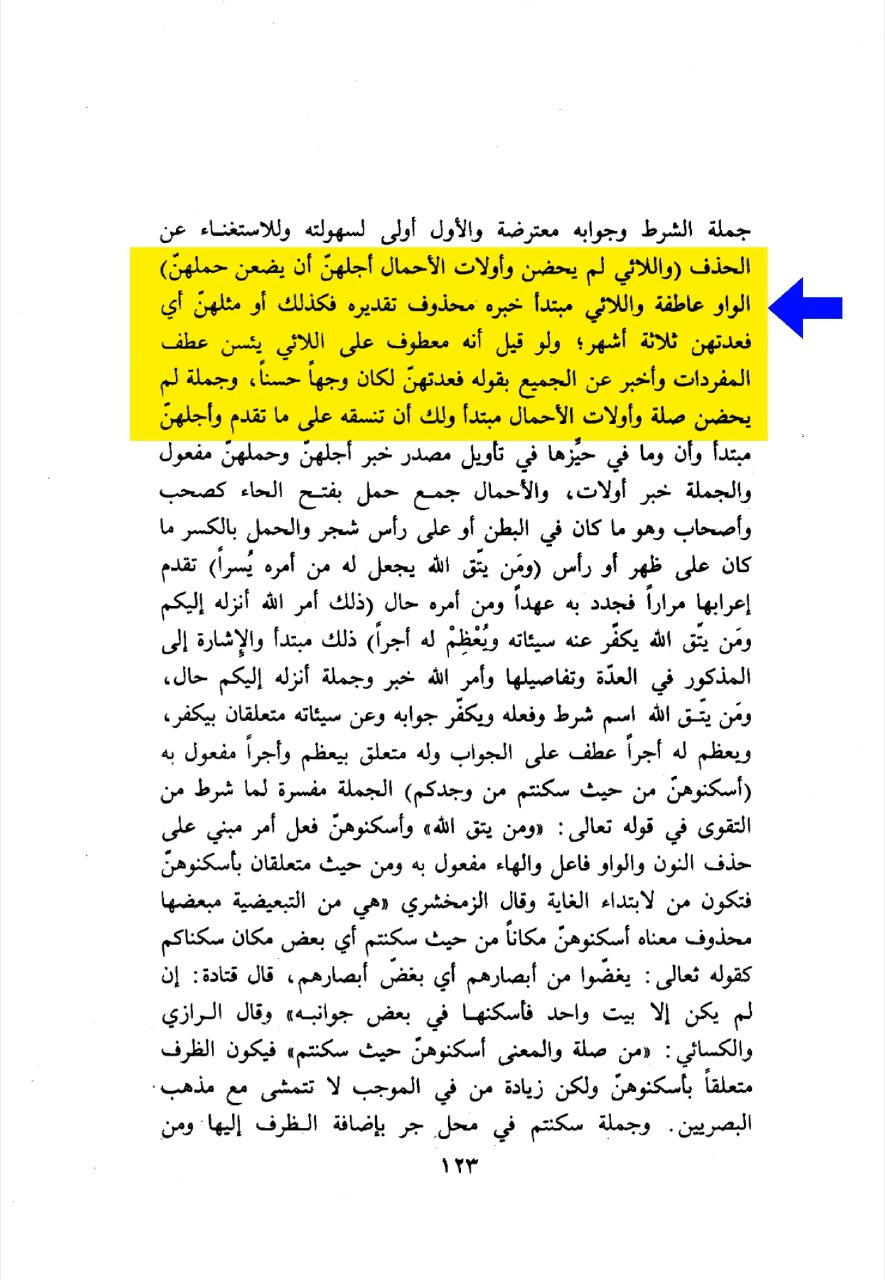
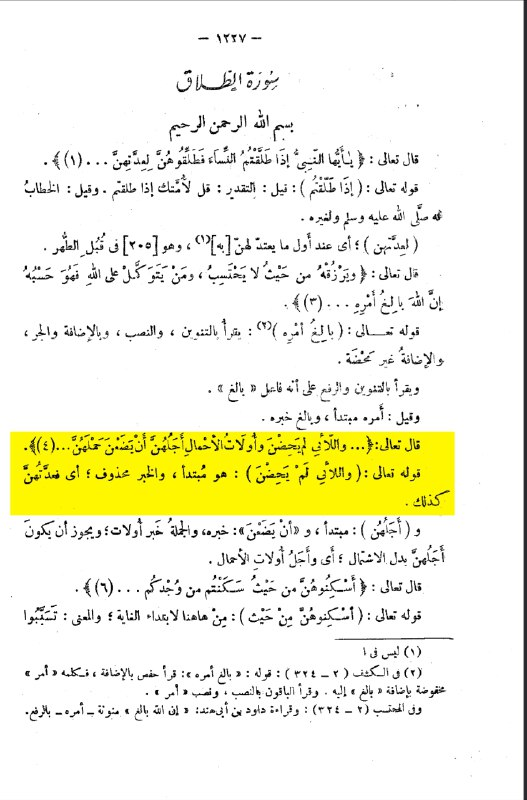
Similarly, as mentioned in the book I’rab al-Qur’an wa Bayanuhu, the letter waw is a conjunction connecting the phrase to “women.” But the subject and predicate were omitted — the subject is “women” and the predicate is “their waiting period is three months.”
scholars opinions 27scholars opinions 28
Source: I’rab al-Qur’an wa Bayanuhu This scan is from I’rab al-Qur’an wa Bayanuhu. The highlighted part says the phrase is easier to understand by assuming omitted subject/predicate elements: “those women who have not menstruated, their waiting period is three months.” The page supports the argument that the wording is grammatically tied back to women.
scholars opinions 29
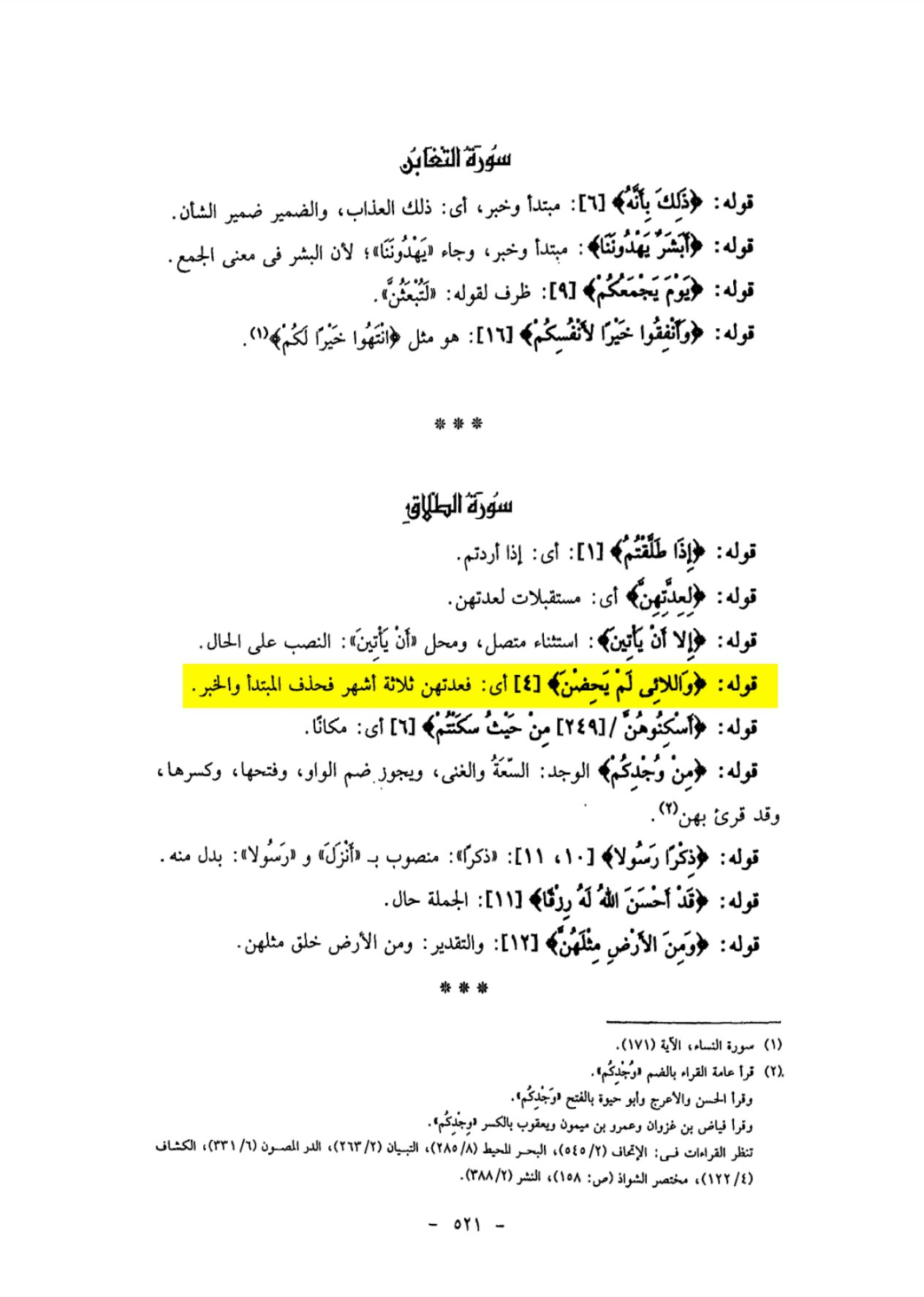
Source: Grammatical Discussion of Surat al-Talaq This scan from the grammatical discussion of Surat al-Talaq highlights that the phrase is connected back to “your women.” The surrounding page analyzes the grammar of the verse, so it is being used to show the syntactic relationship rather than to create a separate legal category.
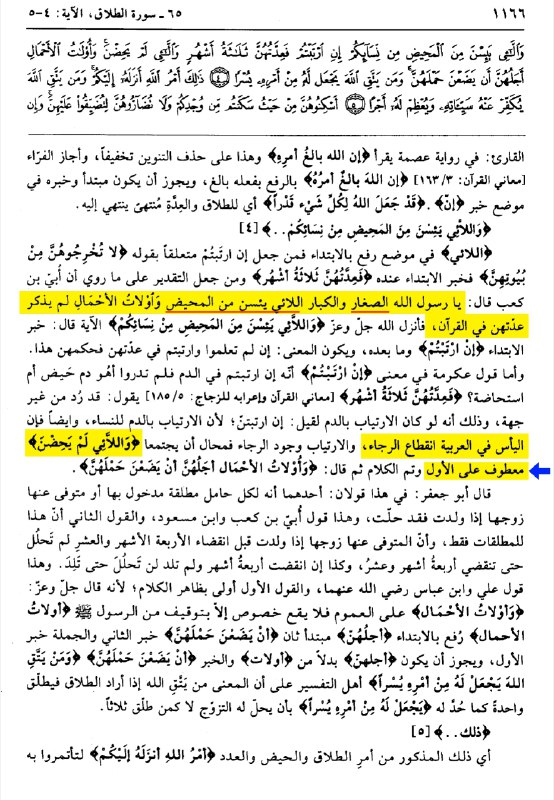
Similarly, in his book I’rab al-Qur’an, Abu Ja’far ibn Muhammad ibn Isma’il al-Nahhas states two important points. The first is that even a young woman, whose meaning we have already explained, can cease menstruating — in Arabic, ya’s (despair) means the loss of hope, and so a woman whose menstrual cycle has ended is not limited to elderly women. The second point is that the conjunction waw here connects the phrase back to the word nisa’ (women).
scholars opinions 30
Source: Abu Ja’far al-Nahhas — I’rab al-Qur’an This scan is from Abu Ja’far al-Nahhas’s I’rab al-Qur’an. The highlighted material makes two points: the wording about despair of menstruation can apply to cessation/loss of hope of menstruation, and the conjunction connects the later phrase back to “women.” The page supports both the linguistic and legal reading in the article.
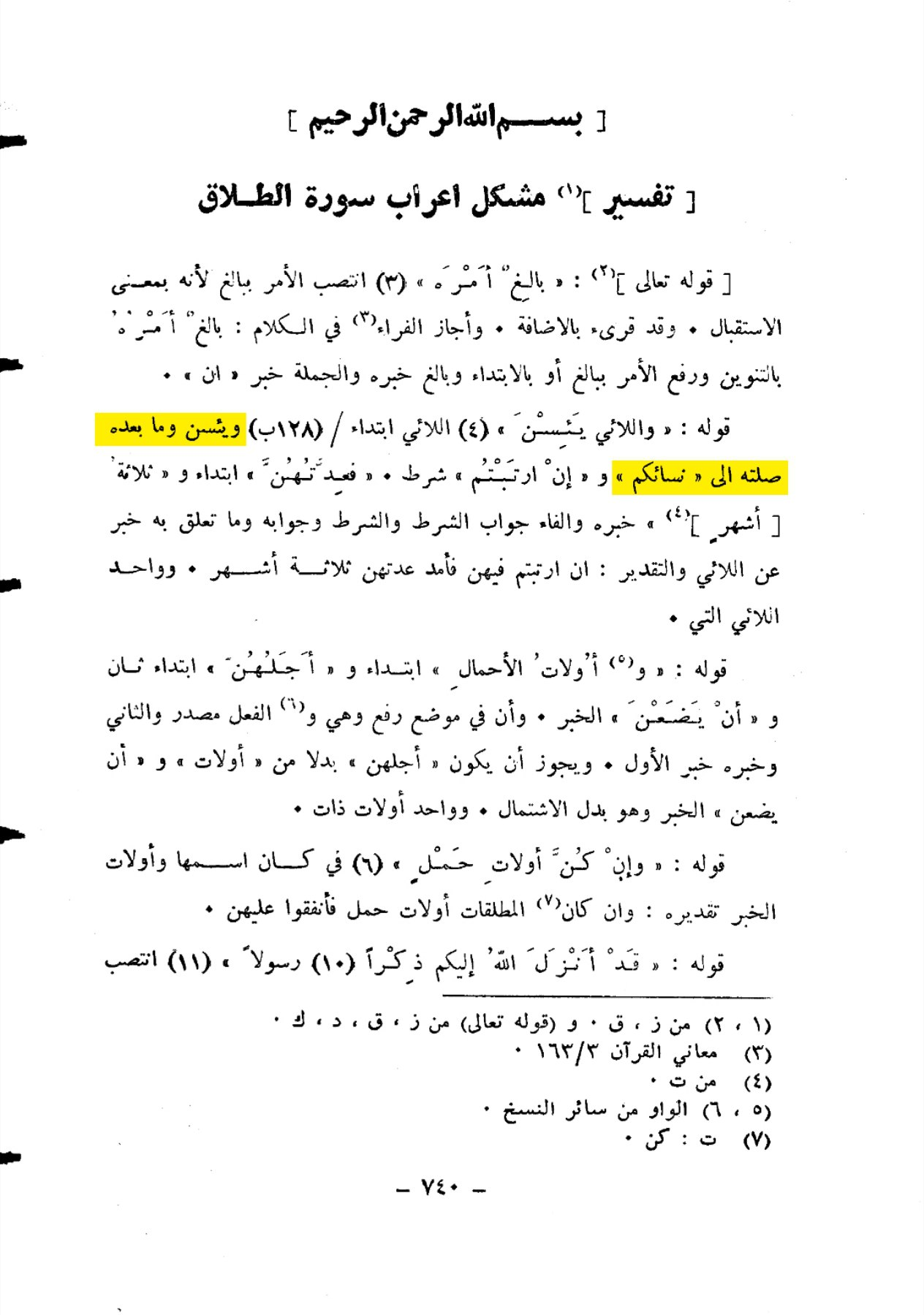
Also mentioned in the book Mushkil I’rab al-Qur’an is something very important: the phrase “those who have despaired” and everything that follows it is connected to “your women” — meaning that even “those who have not menstruated” is connected to “your women.”
scholars opinions 31scholars opinions 32
Source: Mushkil I’rab al-Qur’an This scan is from Mushkil I’rab al-Qur’an. The highlighted part says that “those who have despaired” and what follows are connected to “your women.” This directly supports the claim that even “those who have not menstruated” remains grammatically linked to the category of women.
Similarly, in the book I’rab al-Qur’an by Isma’il ibn Muhammad ibn al-Fadl al-Qurashi al-Isfahani, the predicate of the phrase “those who have not menstruated” is treated as omitted — meaning the full sense is: “Those women who have not menstruated, their waiting period is three months,” with the predicate supplied from what precedes it.
scholars opinions 33scholars opinions 34
Source: I’rab al-Qur’an by al-Isfahani This scan is from I’rab al-Qur’an by Isma’il ibn Muhammad ibn al-Fadl al-Qurashi al-Isfahani. The highlighted passage explains that the predicate of “those who have not menstruated” is omitted and understood from the previous clause: their waiting period is three months. The page supports the ellipsis argument.
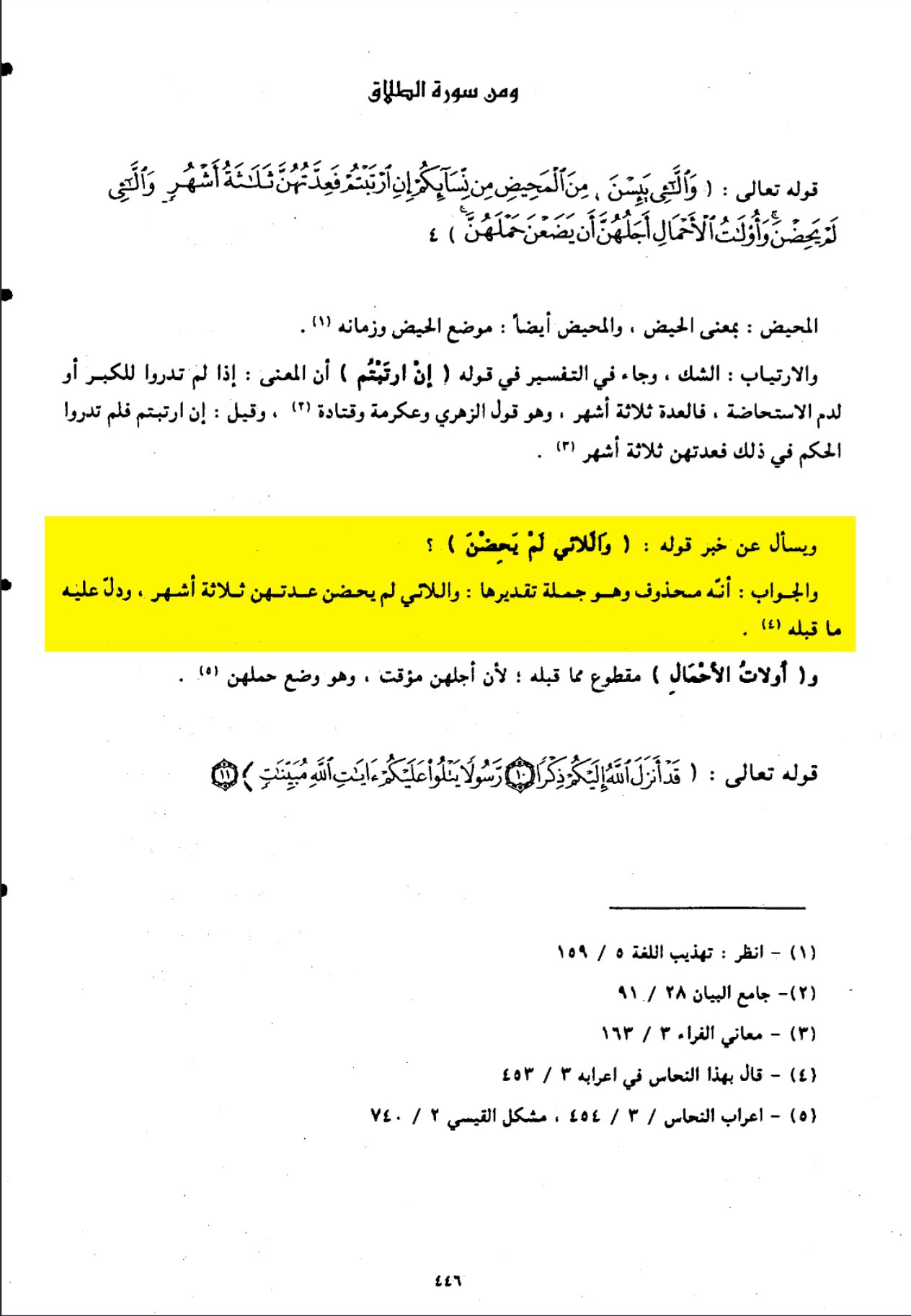
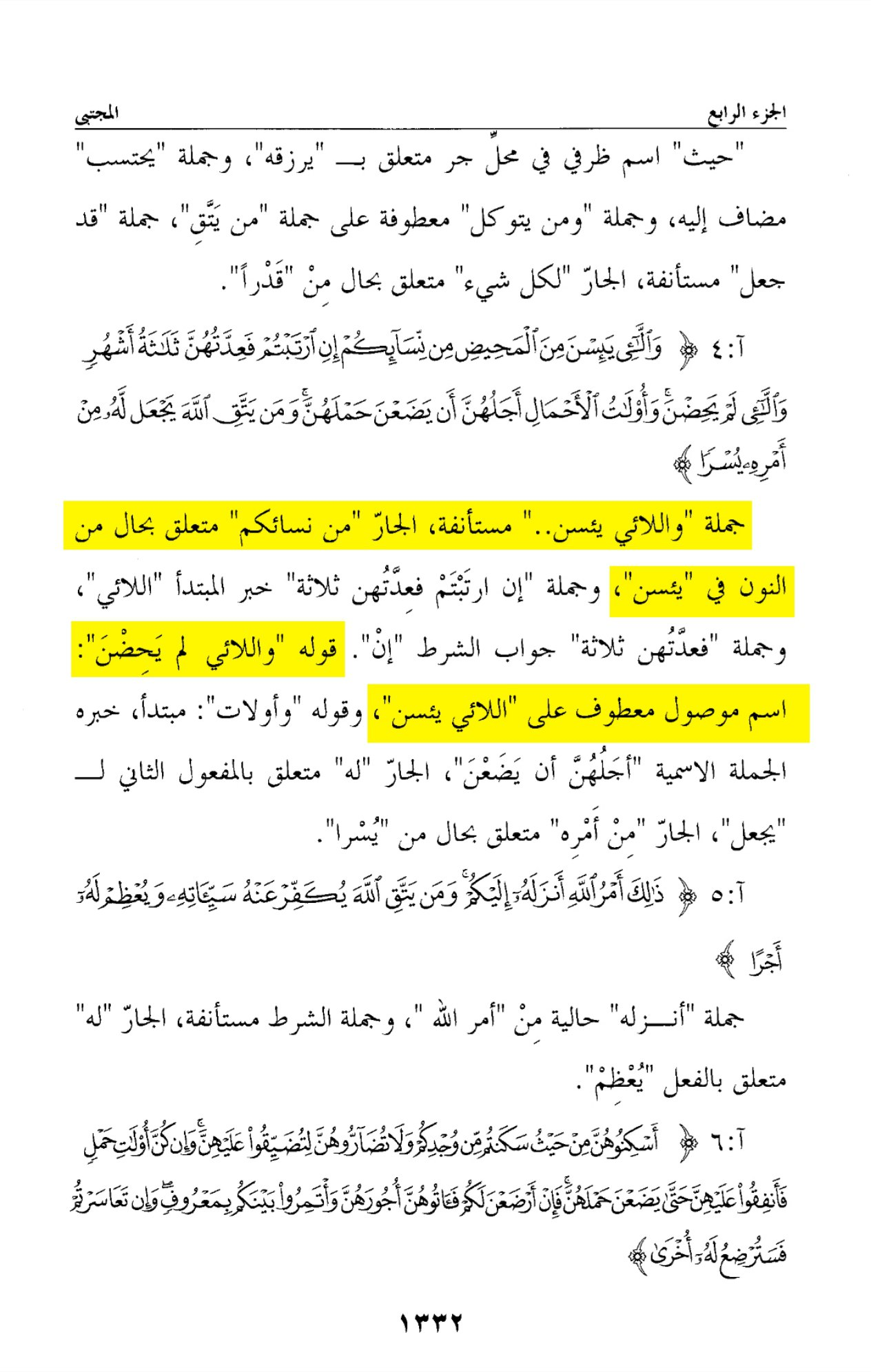
Similarly, in the book al-Mujtaba min Mushkil I’rab al-Qur’an al-Karim, it states that the phrase “And those who have despaired…” is a new sentence, the prepositional phrase “of your women” is related to its state, and the waw connects “those who have despaired” to “women.” On the same page it confirms that the waw is a conjunction connecting “those who have not menstruated” to “women” as well.
scholars opinions 35scholars opinions 36
Source: al-Mujtaba min Mushkil I’rab al-Qur’an al-Karim This scan is from al-Mujtaba min Mushkil I’rab al-Qur’an al-Karim. The highlighted part explains that the phrase “and those who have despaired” is connected to “your women” and that the conjunction links the clauses together. The page is used to show the grammar keeps the discussion within the same category of women.
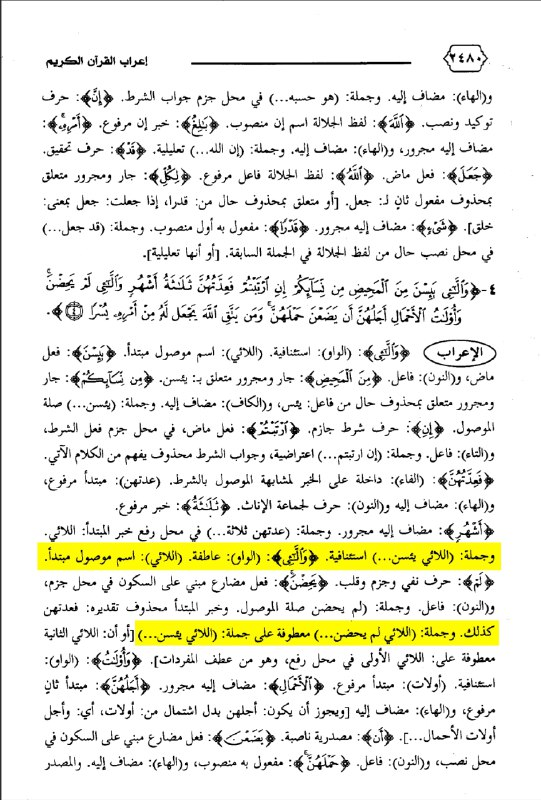
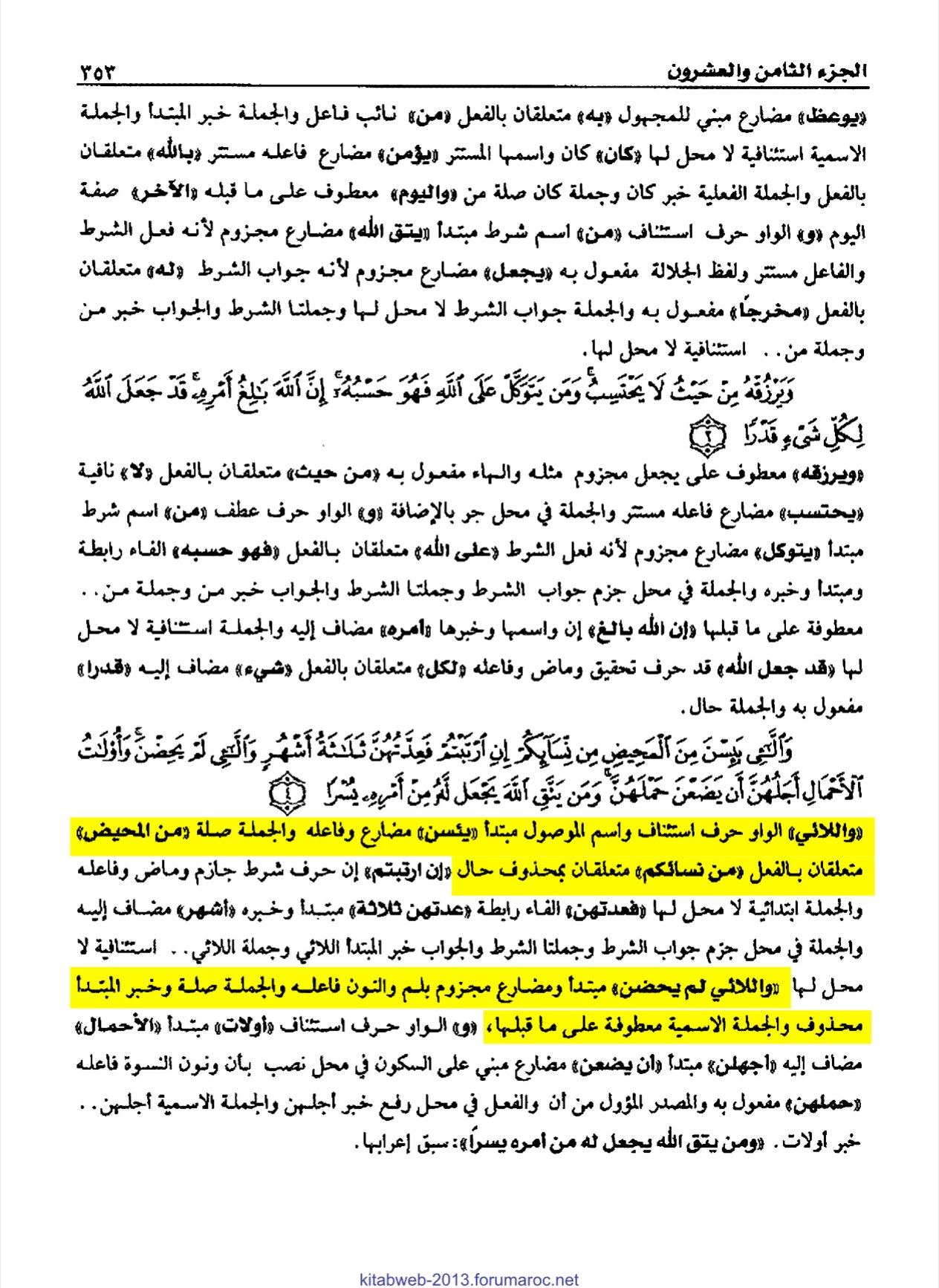
In the book I’rab al-Qur’an al-Karim by a group of scholars, it is stated that the phrase “And those who have despaired” is a new sentence whose waw connects it to “women.” The phrase “And those who have not menstruated” is then connected to “And those who have despaired,” which itself is connected to “women.” Therefore, the waw in “And those who have not menstruated” is also a conjunction, and the entire context is about women.
scholars opinions 37scholars opinions 38
Source: I’rab al-Qur’an al-Karim by a Group of Scholars This scan is from I’rab al-Qur’an al-Karim by a group of scholars. The highlighted passage says the conjunction links the clauses and that “those who have not menstruated” is connected to the preceding phrase. This supports the argument that the verse is grammatically about women and their waiting periods.
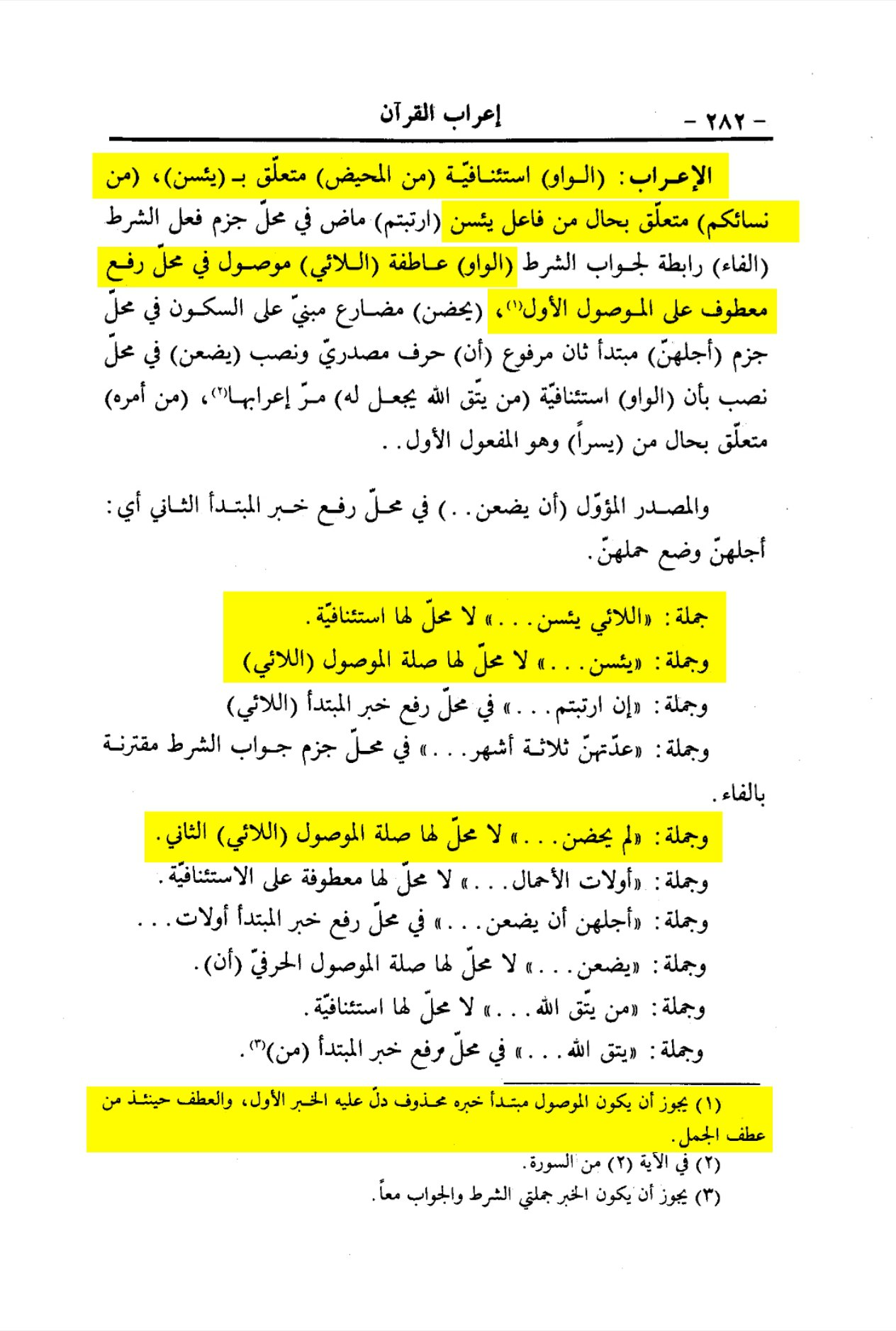
A similar example is found in the book al-Jadwal fi I’rab al-Qur’an, Sarfah wa Bayanuhu, ma’a Fawa’id Nahawiyah Muhamiyah:
scholars opinions 39scholars opinions 40
Source: al-Jadwal fi I’rab al-Qur’an This scan is from al-Jadwal fi I’rab al-Qur’an. The highlighted material provides a similar grammatical analysis of the verse, showing how the conjunction and omitted elements operate. The page is used to strengthen the cumulative linguistic case.
In a master’s thesis titled The Grammatical Analysis of the Glorious Qur’an, attributed to Sheikh al-Islam Zakariya al-Ansari, it is stated that the words “And those who have not menstruated, their waiting period is three months” imply the omission of both subject and predicate. The subject is “al-nisa’” and the predicate is “their waiting period is three months” — meaning: women who have not menstruated have a waiting period of three months.
scholars opinions 41scholars opinions 42
Source: Master’s Thesis on Qur’anic Grammar — Zakariya al-Ansari This scan is from a master’s thesis on Qur’anic grammatical analysis attributed to Zakariya al-Ansari. The highlighted part explains that the words “and those who have not menstruated” imply omitted subject and predicate elements, with the understood meaning that those women have a three-month waiting period. The page supports the same ellipsis reading.
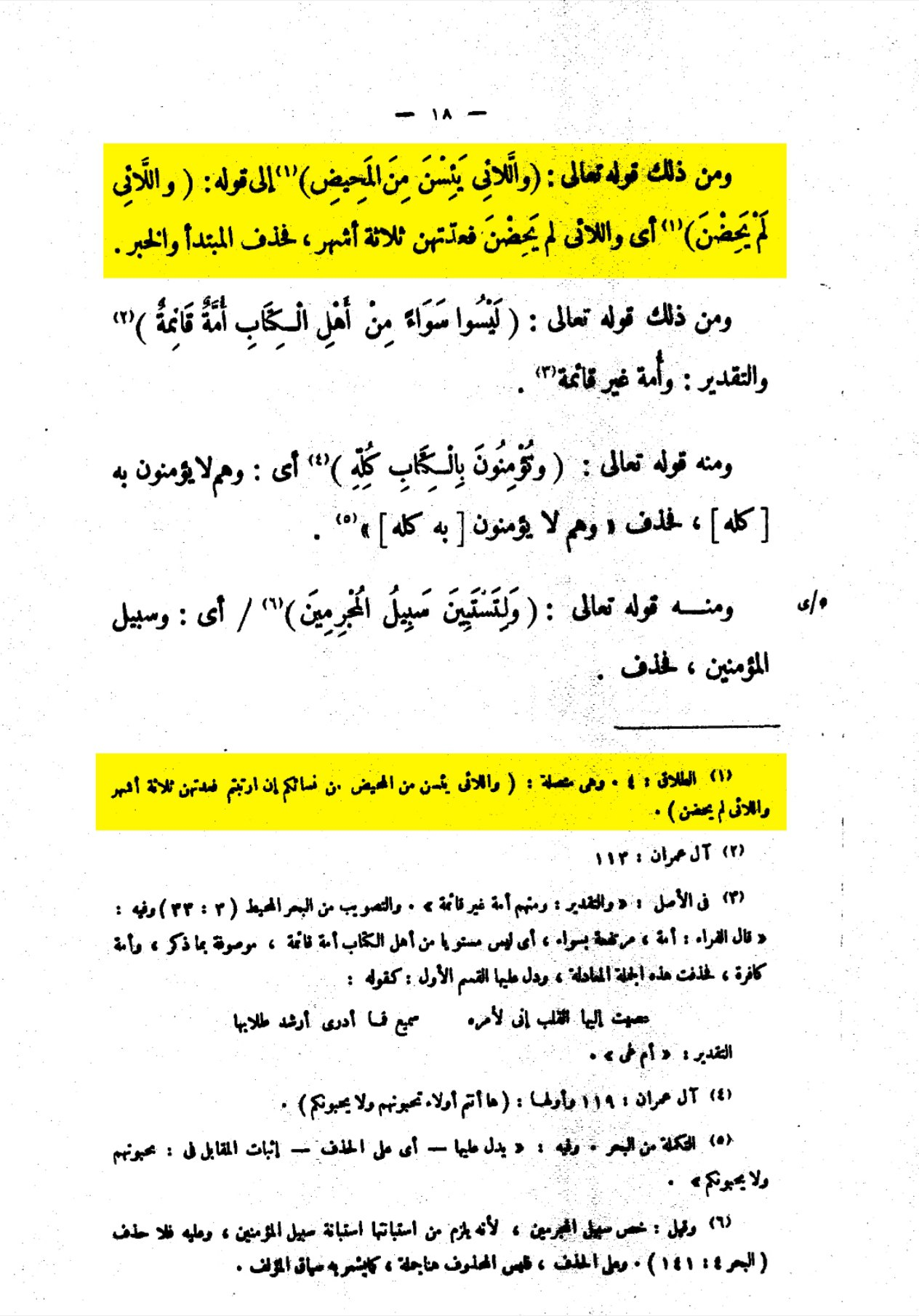
The same is stated in the book I’rab al-Qur’an attributed to al-Zajjaj:
scholars opinions 43scholars opinions 44
Source: I’rab al-Qur’an attributed to al-Zajjaj This scan is from I’rab al-Qur’an attributed to al-Zajjaj. The highlighted passage gives the same grammatical treatment: the omitted meaning is supplied from the previous clause, so the phrase remains tied to women and their waiting period.
A similar statement is found in the book al-Tibyan fi I’rab al-Qur’an:
scholars opinions 45scholars opinions 46
Source: al-Tibyan fi I’rab al-Qur’an This scan is from al-Tibyan fi I’rab al-Qur’an. The highlighted material repeats the grammatical point that the later phrase is understood through what came before it. The page is used as another independent grammar source for the same reading.
Similarly, in the book I’rab al-Qur’an al-Karim by al-Da’as, it is stated that the predicate — “their waiting period is three months” — is omitted, and additionally that the nominal sentence in “And those women who have not menstruated” is connected to what precedes it: “And those of your women who have despaired of menstruation.” This means it is connected to “your women” — i.e., the adult woman.
scholars opinions 47scholars opinions 48
Source: I’rab al-Qur’an al-Karim by al-Da’as This scan is from I’rab al-Qur’an al-Karim by al-Da’as. The highlighted point says the predicate is omitted, and adds that the nominal sentence concerning women who have not menstruated is connected to the previous phrase about “your women.” This is one of the clearest grammar scans for the argument.
Grammatical Conclusion The cumulative testimony of classical Arabic grammatical scholarship — across al-Nahhas, al-Zajjaj, al-Tibyan, al-Da’as, Zakariya al-Ansari, al-Isfahani, al-Jadwal, Mushkil I’rab, and multiple other works — is unanimous: the phrase “and those who have not menstruated” is grammatically tied back to “your women,” with an omitted predicate supplied from the preceding clause. The verse is about waiting periods for different categories of women. It does not constitute independent permission for consummation with incapable girls.
Al-Tabari’s Tafsir and Its Correct Reading
The scans from al-Tabari’s tafsir on the relevant verse and categories are presented above. It is important to note that al-Tabari — as he himself explains in his introduction — often transmits reports without independently endorsing each one or deriving a final legal ruling from every narration. The methodological note on this is addressed in a dedicated section below.
Categories of Women in the Verse
We can conclude from the evidence above that Surah al-Talaq 65:4 addresses the following categories of women and their respective waiting periods:
The first category is the woman who has passed the age of menstruation — one who has given up hope of it. The second category is the woman whose menstruation is delayed, or who has reached puberty by other signs but has not yet menstruated. Both categories are subsets of “women” (nisa’) as established by the linguistic and grammatical analysis.
The Concession Argument
Even granting the opponent’s reading — that the verse refers to underage girls — this concession does not help their position. Ibn Uthaymeen explicitly addressed this:
scholars opinions 49
Source: Ibn Uthaymeen — Even on the Opponent’s Reading This scan quotes Ibn ‘Uthaymeen in al-Sharh al-Mumti’ ‘ala Zad al-Mustaqni’. The highlighted section says that even if one assumes the verse refers to underage girls, the correct view is that a Muslim should not marry off a young girl before puberty; rather, her permission should be sought. The page is used as a concession argument: even on the opponent’s reading, consent and puberty remain decisive.
Fourthly, let us concede to your point and assume that the verse refers to underage girls. Even so, in his book al-Sharh al-Mumti’ ‘ala Zad al-Mustaqni’, Ibn Uthaymeen states that it is not permissible for a Muslim to marry a young girl who has not yet reached puberty. This is the correct view: a father should not marry off his daughter until she reaches puberty, but rather he should seek her permission and see if she will agree or not, as the Prophet ﷺ said: “A virgin should not be married off until she gives her permission.”
Conclusion of the Concession Argument Even accepting the opponent’s premise — that the verse references prepubescent girls — the juristic ruling of Ibn Uthaymeen and the prophetic hadith still prohibit marrying off such a girl without her consent and without waiting for puberty. The opponent’s reading of the verse does not establish what they claim it does.
Addressing Specific Doubts
Abu Ishaq al-Shirazi: “Young” Does Not Mean Incapable
The Doubt Critics raise the objection that the Prophet’s marriage to Aisha proves that Islam permits marriage to young incapable girls. This is addressed through both the linguistic meaning of “young” and the specific circumstances of Aisha’s case.
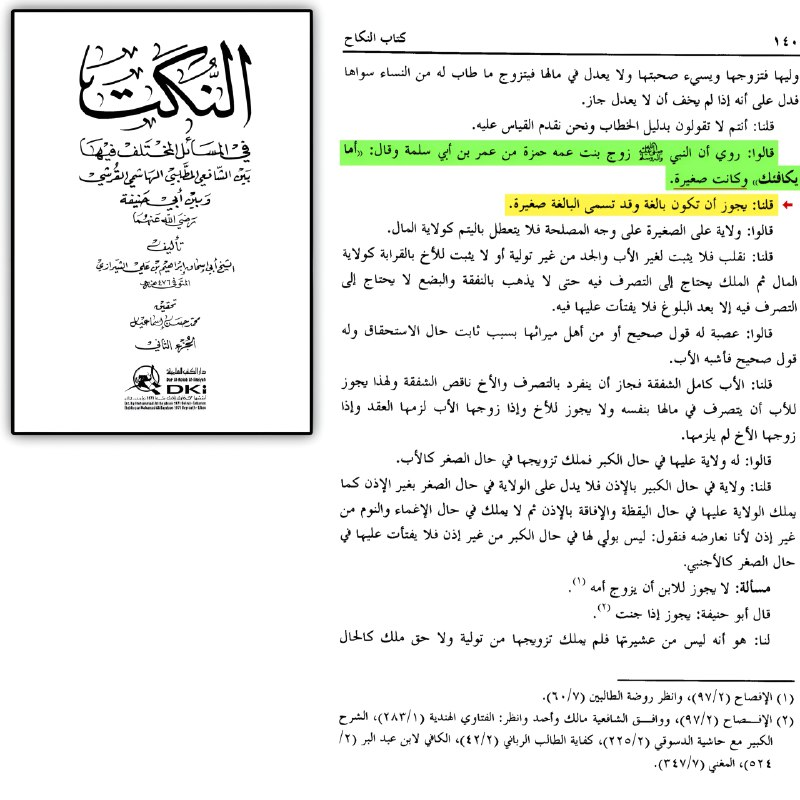
This is a common misconception raised by those who question the Prophet’s marriage to Aisha ﷺ on the grounds that she was young. The word “young” (saghira) in Arabic does not automatically mean physically incapable of puberty. An adult woman may still be described as young. Abu Ishaq al-Shirazi, may God have mercy on him, addressed this directly:
scholars opinions
Source: Abu Ishaq al-Shirazi on the Meaning of “Young” This scan introduces the objection about the word “young” and cites Abu Ishaq al-Shirazi. The highlighted point is that calling someone “young” does not necessarily mean she is incapable of puberty or physical maturity; an adult may still be described as young. The surrounding page uses this to answer the claim that every use of “young girl” must mean an incapable child.
Abu Ishaq al-Shirazi’s Response They said: It is narrated that the Prophet ﷺ married his cousin Hamza’s daughter to Umar ibn Abi Salama, saying, “Is she not suitable for you?” She was young at the time. We say: It is possible that she was of age, and an adult may still be called young. Therefore, it is not a requirement that a young girl be incapable of reaching puberty; she may be of age but still be called young.
This is the case with Aisha: she grew up well and became physically mature and capable. The word “young” describing her does not establish incapacity. This argument also functions as a general response to the doubt raised by critics regarding the Almighty’s saying about “those who have not menstruated” — for the same reason, describing a woman as not yet having menstruated does not exclude her from being an adult or near-adult in other senses.
The Case of Qudamah Ibn Maz’un: A Weak Narration
The Doubt Some critics cite a narration about Qudamah ibn Maz’un marrying the daughter of al-Zubayr when she was newborn, using it as evidence that early Islam endorsed marriage to infant girls.
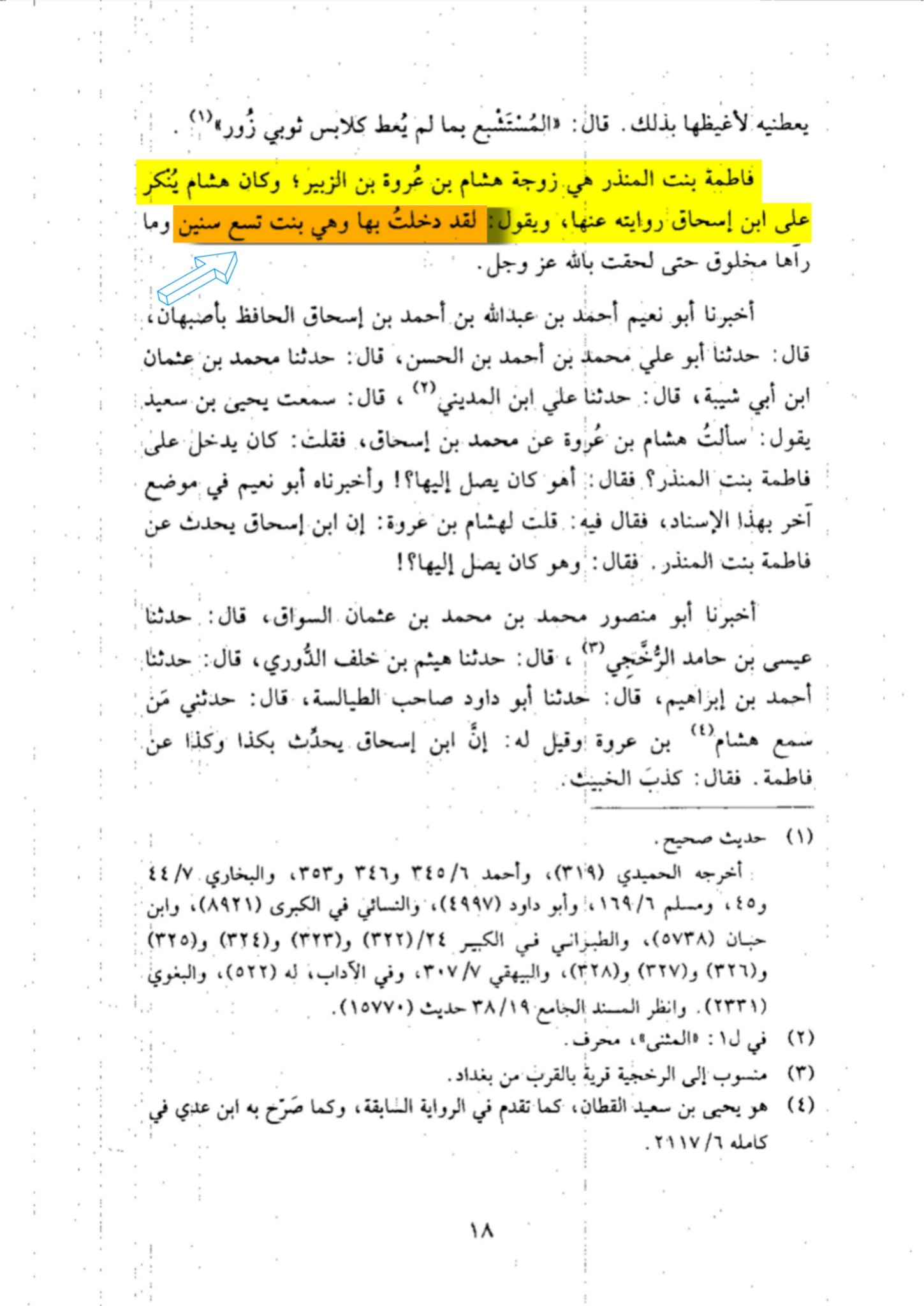
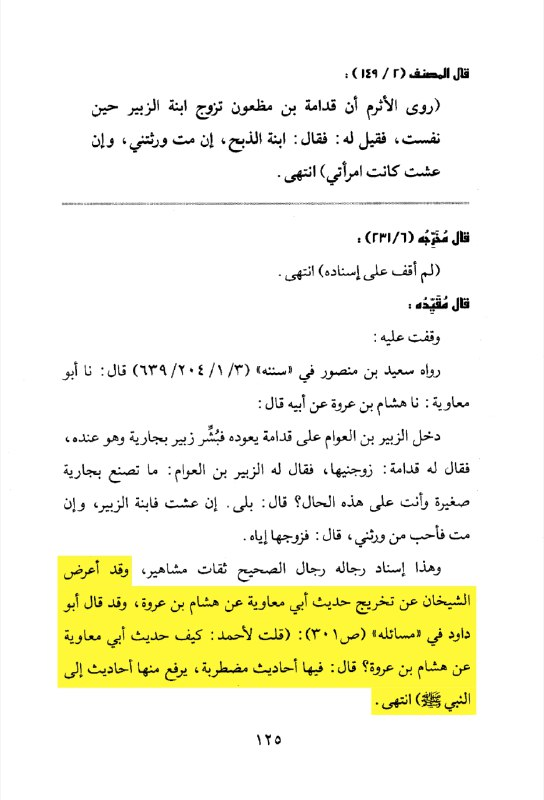
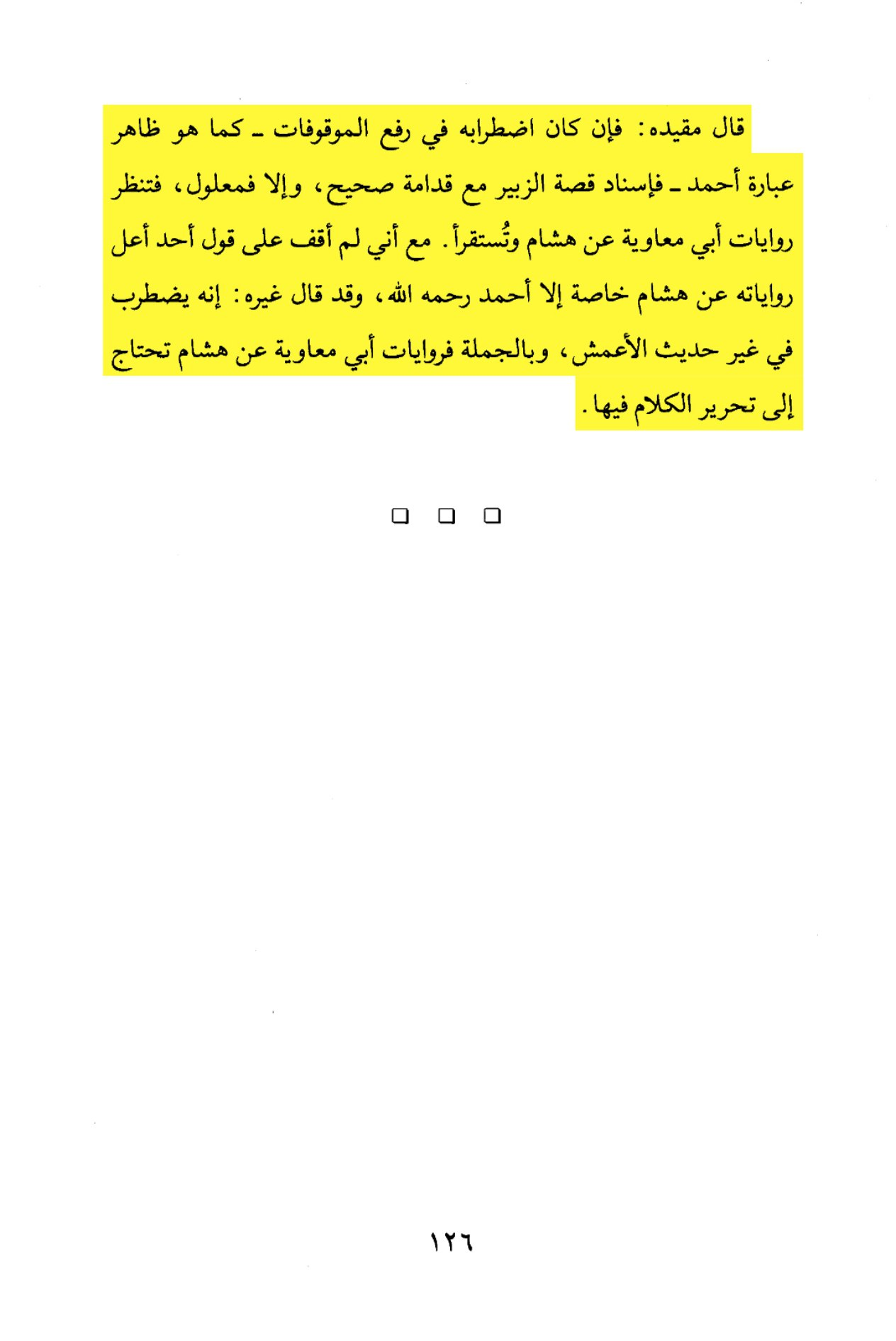
As for Qudamah ibn Maz’un’s reported marriage to the daughter of al-Zubayr when she was born, this narration has two problems. First, the narration is flawed due to Abu Mu’awiyah al-Darir, as his narrations from sources other than al-A’mash are unreliable — as previously demonstrated in the response to the claim that the Mother of the Believers said “the writer erred.”
Second, even if the wording “married her” were accepted, it is irrelevant, because it is well-known that a girl is not given in marriage to a man until she is physically capable. The narration, even on its own terms, speaks only of a contract — not of handover or consummation.
scholars opinions 1
Source: Discussion of the Qudamah ibn Maz’un Narration These scans discuss the report about Qudamah ibn Maz’un and the daughter of al-Zubayr. The highlighted argument is that the narration is flawed because of Abu Mu’awiyah al-Darir when narrating from other than al-A’mash, and that the wording about marriage does not prove handover or consummation. The page is used to prevent a weak or ambiguous report from being treated as evidence for physical access to an incapable girl.
scholars opinions 2
Source: Discussion of the Qudamah ibn Maz’un Narration (Continued) These scans discuss the report about Qudamah ibn Maz’un and the daughter of al-Zubayr. The highlighted argument is that the narration is flawed because of Abu Mu’awiyah al-Darir when narrating from other than al-A’mash, and that the wording about marriage does not prove handover or consummation. The page is used to prevent a weak or ambiguous report from being treated as evidence for physical access to an incapable girl.
scholars opinions 3
Source: Discussion of the Qudamah ibn Maz’un Narration (Continued) These scans discuss the report about Qudamah ibn Maz’un and the daughter of al-Zubayr. The highlighted argument is that the narration is flawed because of Abu Mu’awiyah al-Darir when narrating from other than al-A’mash, and that the wording about marriage does not prove handover or consummation. The page is used to prevent a weak or ambiguous report from being treated as evidence for physical access to an incapable girl.
Conclusion on the Weak Narration The narration about Qudamah ibn Maz’un is chain-weak due to Abu Mu’awiyah al-Darir’s unreliability outside of al-A’mash. And even if it were accepted at face value, it speaks only of a contract — not of handover, not of consummation. It cannot be used as evidence for physical access to an incapable girl.
Historical Context: Pre-Islamic Practices
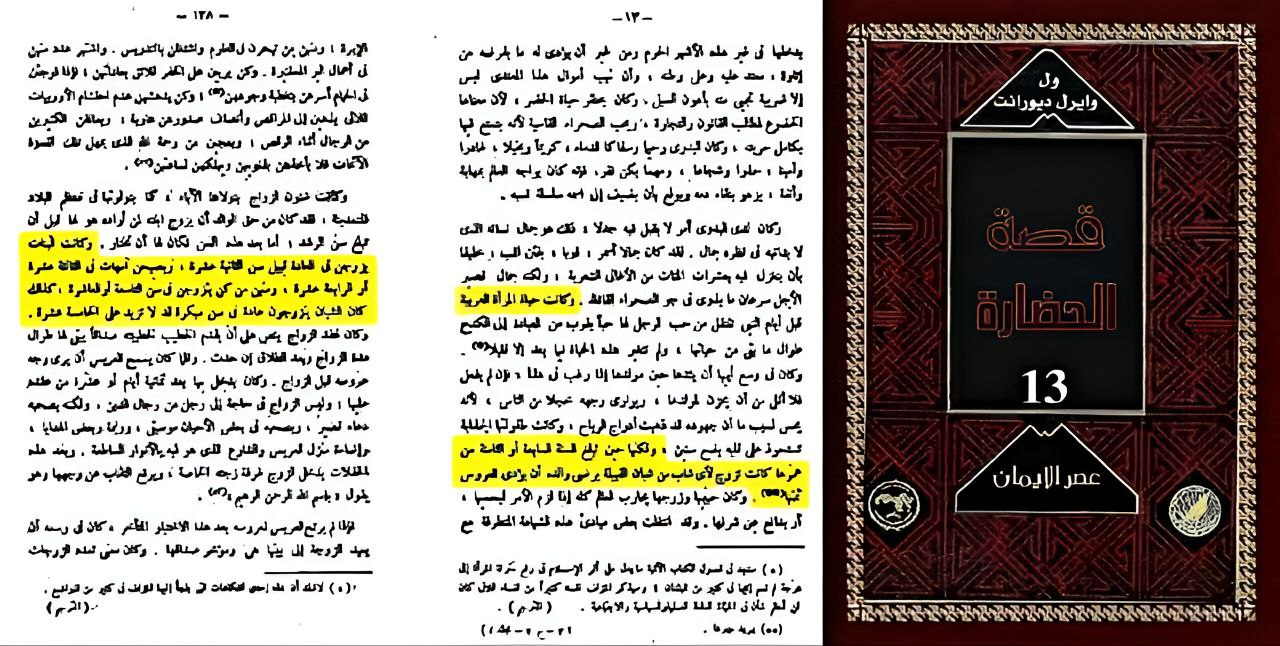
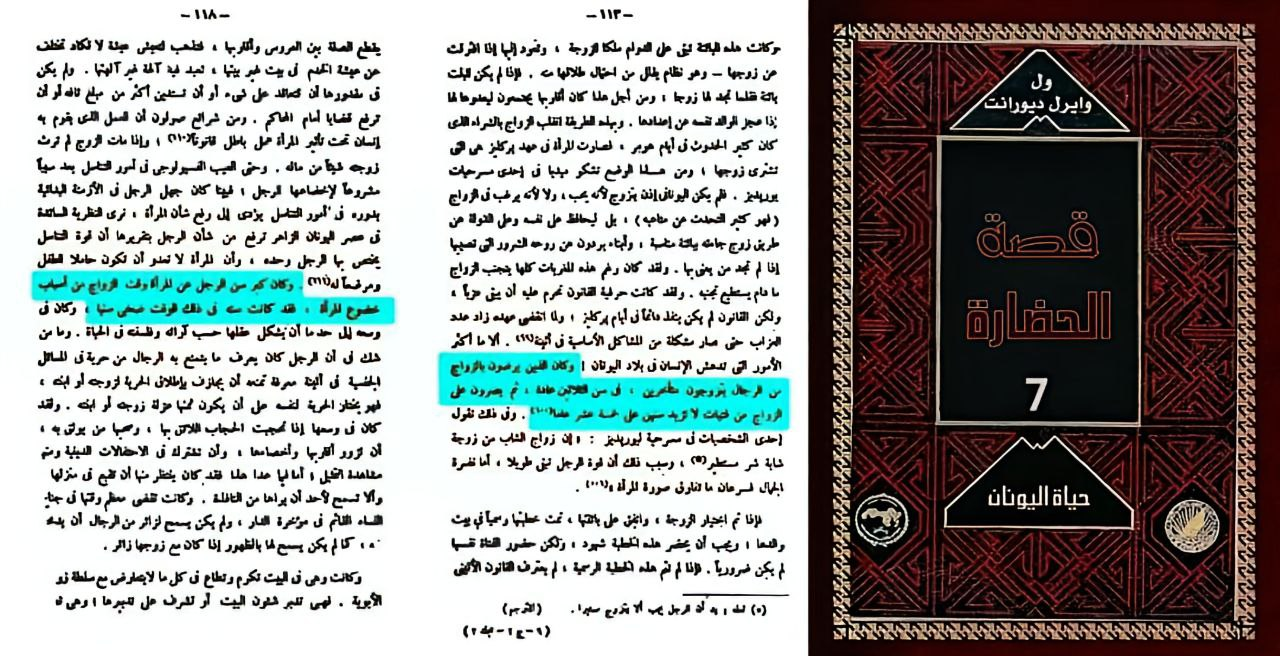
It is also useful to place this discussion in its historical context. Historians confirm that early marriage was a widespread norm across many pre-Islamic and non-Islamic cultures — not something Islam introduced or uniquely endorsed.
Will Durant, the non-Muslim Western historian, recorded:
scholars opinions 4
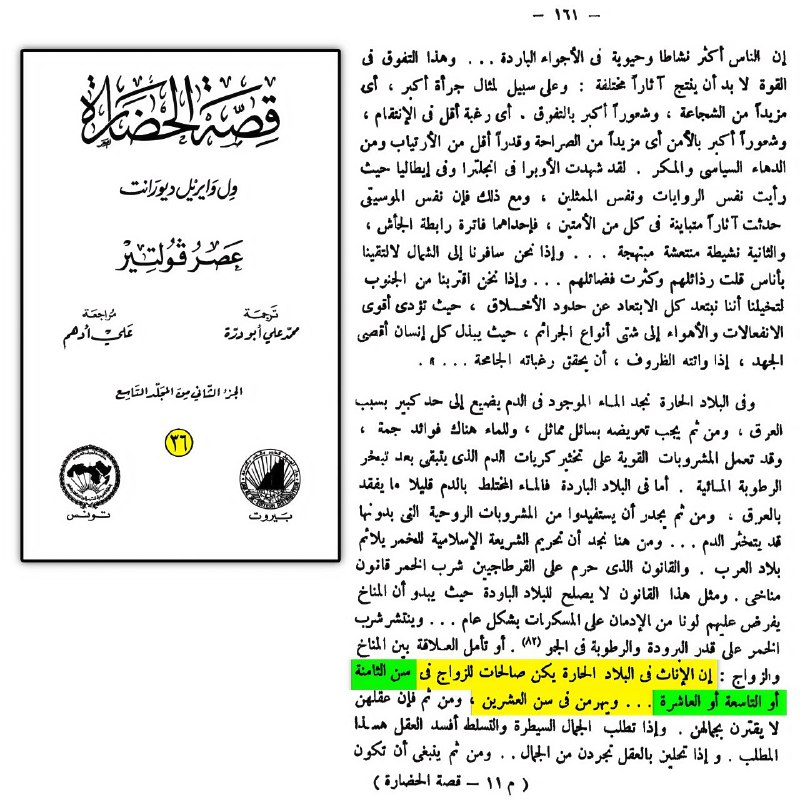
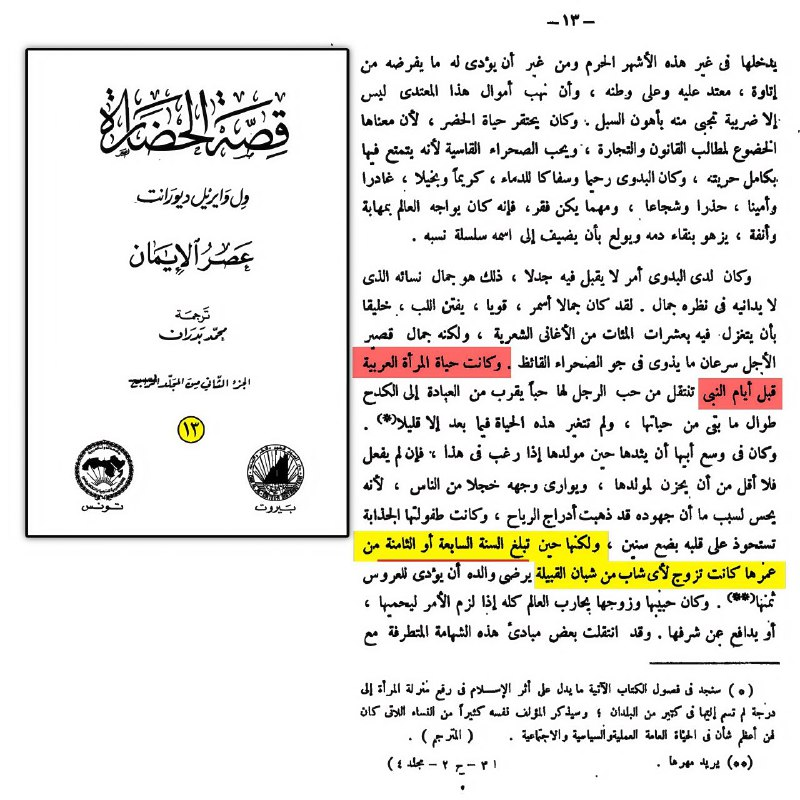
Will Durant — Pre-Islamic Arab Women Before Islam, an Arab woman, upon reaching the age of seven or eight, would be married to any young man from the tribe whose father was willing to pay the bride’s dowry. Girls were usually married before the age of twelve and became mothers at thirteen or fourteen.
Will Durant — On Greek and Other Practices Some were flogged, and in Greece, men who agreed to marry usually did so late in life, around thirty, and then insisted on marrying girls no younger than fifteen.
Will Durant — Arab Women Before the Prophet Will Durant says that Arab women before the Prophet married at the age of 7 or 8.
Historical Significance The point of this historical evidence is not to justify early marriage but to demonstrate that this was a universal cultural norm in the ancient and pre-Islamic world. Islam did not introduce early marriage — it came to regulate and place legal protections around it, including the protections documented throughout this article: the prohibition on harmful consummation, the requirement of capability, the right of consent, and the right to refuse at puberty.
Al-Tabari’s Methodology: Transmission Without Endorsement
A significant amount of material circulated online uses narrations found in al-Tabari’s works to imply that al-Tabari endorsed problematic positions. This reflects a misunderstanding of his methodology, which he explains explicitly in his own introduction.
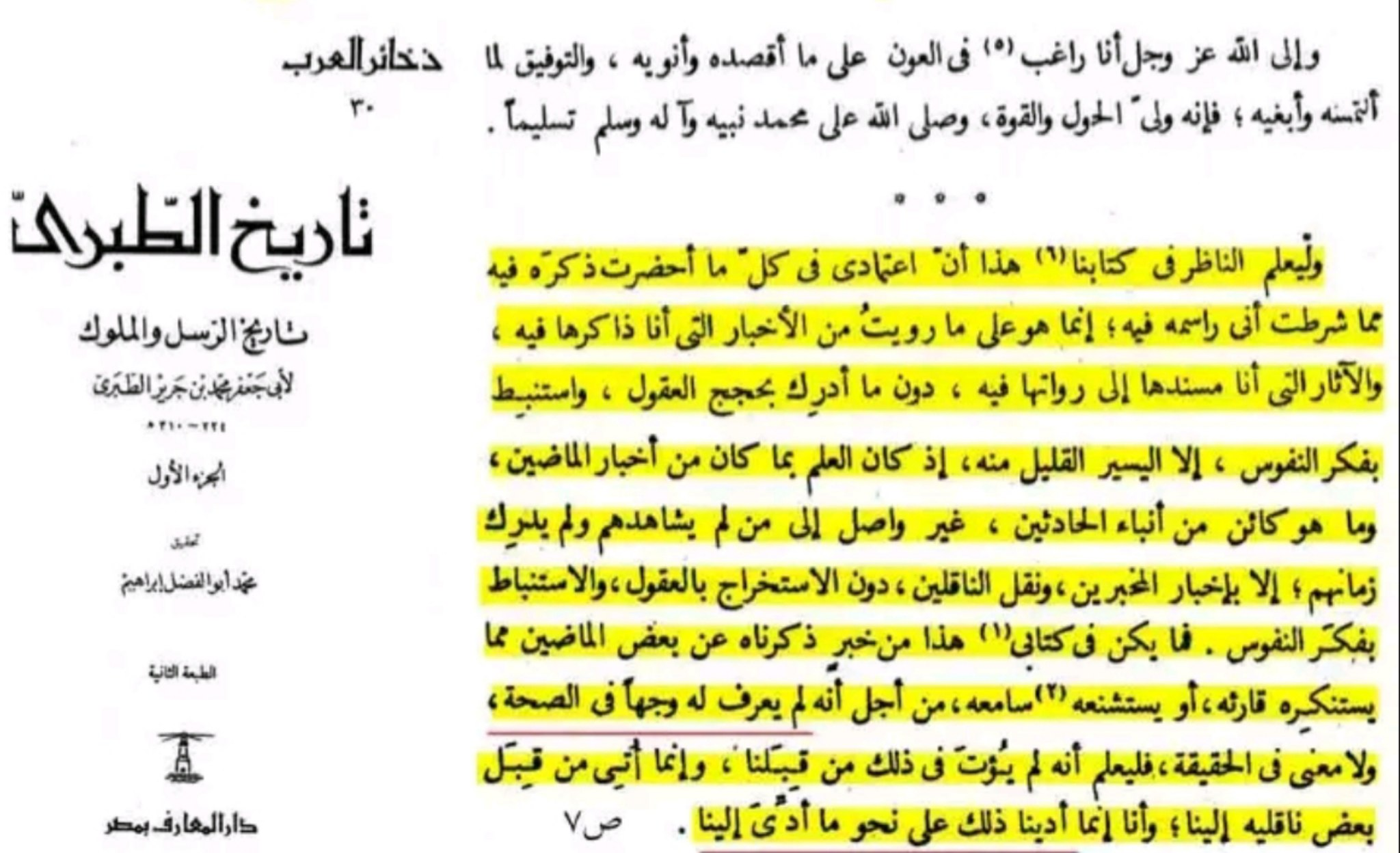
Imam al-Tabari, may God have mercy on him, said concisely that he transmitted his narrations without deriving conclusions or reflecting upon them. Therefore, anything that a reader might find objectionable or a listener might find reprehensible simply because they cannot discern its authenticity or true meaning should be understood not as an error on his part, but rather on the part of those who transmitted the narrations. He merely relayed them after hearing them.
Source: Al-Tabari’s Introduction — His Methodology This scan is from al-Tabari’s introduction/methodological discussion. The highlighted material explains that al-Tabari often transmits reports with their chains without independently endorsing every report or deriving a final ruling from each narration. This matters because objectionable or weak transmitted material in his works should be assessed through its transmitters and meaning, not automatically attributed to al-Tabari as his own approved conclusion.
Source: Al-Tabari’s Introduction — His Methodology (Continued) This scan is from al-Tabari’s introduction/methodological discussion. The highlighted material explains that al-Tabari often transmits reports with their chains without independently endorsing every report or deriving a final ruling from each narration. This matters because objectionable or weak transmitted material in his works should be assessed through its transmitters and meaning, not automatically attributed to al-Tabari as his own approved conclusion.
Source: Al-Tabari’s Introduction — His Methodology (Continued) This scan is from al-Tabari’s introduction/methodological discussion. The highlighted material explains that al-Tabari often transmits reports with their chains without independently endorsing every report or deriving a final ruling from each narration. This matters because objectionable or weak transmitted material in his works should be assessed through its transmitters and meaning, not automatically attributed to al-Tabari as his own approved conclusion.
Source: Al-Tabari’s Introduction — His Methodology (Continued) This scan is from al-Tabari’s introduction/methodological discussion. The highlighted material explains that al-Tabari often transmits reports with their chains without independently endorsing every report or deriving a final ruling from each narration. This matters because objectionable or weak transmitted material in his works should be assessed through its transmitters and meaning, not automatically attributed to al-Tabari as his own approved conclusion.
Key Point on Al-Tabari Al-Tabari also returns to this methodological principle later in his tafsir:
Imam al-Tabari, may God have mercy on him, said concisely that he transmitted his narrations without deriving conclusions or reflecting upon them. Therefore, anything that a reader might find objectionable or a listener might find reprehensible simply because they cannot discern its authenticity or true meaning should be understood not as an error on his part, but rather on the part of those who transmitted the narrations. He merely relayed them after hearing them.
scholars opinions 23
Source: Al-Tabari’s Methodological Note — Repeated in Tafsir This scan returns to al-Tabari’s methodological note. The highlighted content explains that transmitted reports in his works are not all presented as his final legal judgement; reports must be weighed by their chains and meanings.
Conclusion on Al-Tabari Weak, problematic, or objectionable narrations transmitted by al-Tabari are the responsibility of their narrators — not of al-Tabari himself. His methodology of transmission with chains, without independent endorsement of every report, is established from his own preface. Critics who cite his works without acknowledging this methodological framework are misrepresenting his scholarship.
The Case of Aisha, Mother of the Believers
The marriage of Aisha, may God be pleased with her, to the Prophet ﷺ is among the most frequently raised objections. Several points must be kept in mind.
First, as established by Abu Ishaq al-Shirazi above, the word “young” used to describe Aisha does not mean she was incapable of puberty or physical maturity. An adult may still be called young. Aisha grew up well and became physically mature and capable.
Second, the Mother of the Believers was content with her marriage to the Prophet ﷺ.
Source: Aisha’s Contentment with Her Marriage This scan states that the Mother of the Believers was content with her marriage to the Prophet. The highlighted material is being used to answer the consent objection by arguing that the marriage was not treated by her as coercive or harmful.
Third, the verse “and those who have not yet menstruated” — as demonstrated through linguistics, grammar, and tafsir — is not evidence for consummation with incapable girls. It is evidence about waiting periods for categories of women. The verse does not prove handing over a minor before puberty or physical capacity, as the relevant scan from Ibn Battal and the juristic consensus confirm.
Final Conclusion on Aisha’s Case The marriage of Aisha ﷺ was one of consent, physical readiness, and a custom that was normal in the historical and cultural context of seventh-century Arabia — a context documented even by non-Muslim historians. The rules of Islamic jurisprudence that protected girls from harmful consummation applied in her case as in every other: the determining factor was physical capability, not age, and the marriage was consummated only when she was ready.
Conclusion
Summary of the Refutation The claim that Islamic law permits marriage to and consummation with incapable minor girls is comprehensively refuted by the primary sources of Islamic jurisprudence, Quranic linguistics, classical Arabic grammar, and prophetic tradition. The evidence can be summarized as follows.
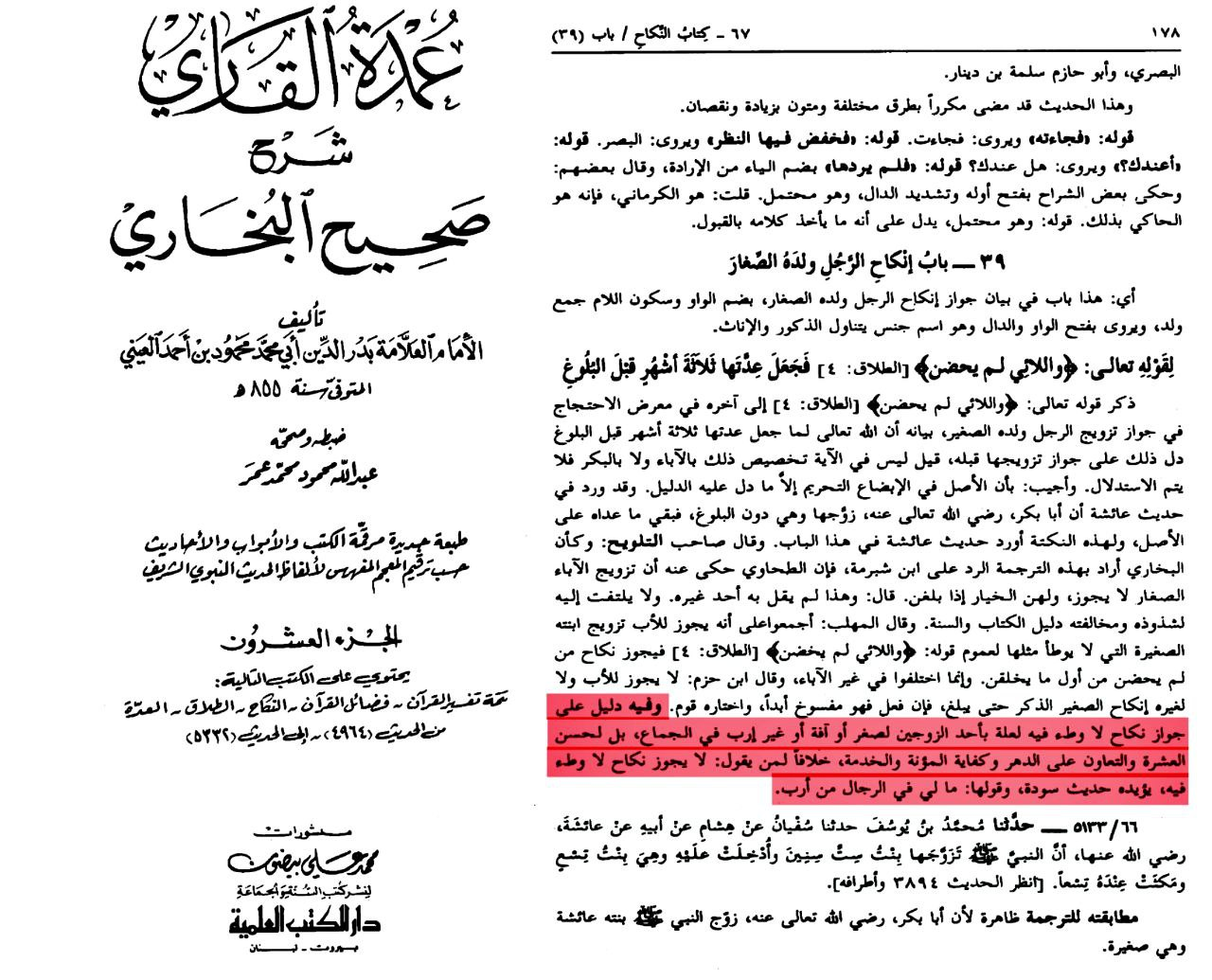
All four classical schools of Islamic law — Hanafi, Shafi’i, Maliki, and Hanbali — unanimously hold that a marriage contract and physical handover are two separate legal acts. The controlling condition for handover is physical capability (taqah), not age, and causing harm is categorically impermissible. This is documented in Hashiyat Ibn ‘Abidin, I’anat al-Talibin, Mawahib al-Jalil, al-Mughni, Mughni al-Muhtaj, al-Sharh al-Mumti’, the Encyclopedia of Islamic Jurisprudence, and Sahih al-Bukhari’s own commentary by Ibn Battal.
Major scholars including al-Shafi’i, Abu Hanifa, Ibn Qudamah, Ibn Taymiyyah, and Ibn Uthaymeen are explicit: ability and absence of harm are the juristic standards, not bare age. Consent is a legal condition with real consequences: a coerced marriage is subject to annulment, as the Prophet ﷺ demonstrated in the case of Khansa’ bint Khidam.
The Quranic verse of Surah al-Talaq 65:4 concerns waiting periods, not consummation permissions. Linguistically, nisa’ means adult women. Grammatically, “those who have not menstruated” is tied back to “your women” with an omitted predicate — a point confirmed across more than ten classical Arabic grammatical works. Absence of menstruation can describe a mature woman, not only a child. And even granting the opponent’s reading of the verse, Ibn Uthaymeen’s ruling remains: a girl should not be married before puberty, and her permission must be sought.
The narration about Qudamah ibn Maz’un is chain-weak and in any case proves only a contract — not handover. Al-Tabari’s transmitted reports are not all his personal legal endorsements, as he himself states. And the word “young” in Arabic does not establish physical incapacity, as Abu Ishaq al-Shirazi demonstrates.
The law of Islam, as preserved in its jurisprudential tradition, protects girls from harm. The critics’ claim is not supported by the sources they cite — and the sources they ignore refute it entirely.