

John 5:3-4 Angel Stirring the Water — A Scribal Addition Absent from Every Major Manuscript and Rejected by All Critical Editions
The Passage Under Study
The disputed portion — the addition of the end of verse 3 plus the entirety of verse 4 — is marked in brackets in the Greek:
ἐν ταύταις ἀσθενούντων, τυφλῶν, χωλῶν, ξηρῶν, {ἐκδεχομένων τοῦ ὕδατος κίνησιν. καιρὸν κατέβαινεν ἐν τᾖ κολυμβήθρᾳ, καὶ ἐτάρασσε τὸ ὕδωρ· ὁ οὖν πρῶτος ἐμβὰς μετὰ τὴν ταραχὴν τοῦ ὕδατος ὑγιὴς ἐγίνετο, ᾧ δήποτε κατειχετο νοσήματι}.
Everything inside the braces { } is the addition. It does not appear in the oldest and best manuscripts.
Summary of Findings
The end of verse 3 and the entirety of verse 4 are not original phrases and were not written by John the Gospel writer. The evidence for this is overwhelming and unanimously agreed upon across every branch of textual scholarship:
- The disputed portion is absent from the oldest and best manuscripts: Papyrus 66, Papyrus 75, Sinaiticus, Vaticanus, Ephraimite (original hand), and Beza.
- These paragraphs originated as marginal interpretations and explanations that were later introduced into the main text.
- The addition was inserted in two stages: first, the end of verse 3 was added to explain why the sick people were gathered at the pool; then verse 4 was added to explain the “moving of the water” mentioned in verse 7.
- All critical editions delete this addition — UBS5, NA28, Westcott-Hort, Tischendorf, Tregelles, and Holmes.
- All modern translations based on the critical text omit it or place it in brackets.
- There is complete consensus among textual criticism scholars that this addition is non-original.
- Where the addition does appear in later manuscripts such as the Alexandrian and Ephraimite, it was not in their original text — it was added later by correctors.
- The deletion is supported by the rules of the oldest witness, the better witness, the shorter reading, the more difficult reading, and geographical diversity across all text families.
Arabic Versions
Traditional Text — Van Dyke (contains the addition)
Common Arabic Version (critical text — brackets the addition)
The Common Arabic Version places the addition between brackets to indicate that it is not found in the oldest and best manuscripts:
“And there was a group of sick people in the porches, some blind, some lame, and some paralyzed, [waiting for the moving of the water, because an angel of the Lord would go down at times into the pool and stir up the water. So whoever first stepped down after the stirring of the water was healed of whatever disease he had].”
Jesuit (Catholic) Arabic Version (critical text — deletes the addition entirely)
The Jesuit translation deletes the addition completely, moving directly from verse 3 to verse 5:
“3 There lie a multitude of sick people, some blind, some lame, some paralyzed. 5 And there was a man there who had been sick for thirty-eight years.”
Verse 4 does not appear at all.
English Versions
Traditional Text — KJV (contains the addition)
Everything in braces is deleted from all critical versions.
Critical Text Versions (delete the addition)
ASV:
“3 In these lay a multitude of them that were sick, blind, halt, withered. 5 And a certain man was there, who had been thirty and eight years in his infirmity.”
ESV:
“In these lay a multitude of invalids — blind, lame, and paralyzed. One man was there who had been an invalid for thirty-eight years.”
GNB:
“A large crowd of sick people were lying in the porches — the blind, the lame, and the paralysed. A man was there who had been ill for 38 years.”
NET Bible:
“A great number of sick, blind, lame, and paralyzed people were lying in these walkways. Now a man was there who had been disabled for thirty-eight years.”
In every critical translation, verse 4 is absent and the end of verse 3 (“waiting for the moving of the water…”) is omitted. The text moves directly from the description of the sick to the individual man who had been ill for thirty-eight years.
Greek Critical Editions
UBS5 — Grade A for Both Deletions
The United Bible Societies 5th edition deletes both the end of verse 3 and the entirety of verse 4, giving both decisions its highest confidence grade of {A}:
3 ἐν ξηρῶν 5 ἔχων ἐν
From the critical apparatus of UBS5:
On the deletion of the end of verse 3:
{A} ξηρῶν — 𝔓66, 75 א A* B C* L T
The committee gave the deletion reading a grade of A — meaning absolute certainty — because the addition is not present in any of the following manuscripts: P66, P75, Sinaiticus, Alexandrian (original hand), Vaticanus, Ephraimite (original hand), Regius, and Borgianus.
On the deletion of verse 4 entirely:
{A} omit verse 4 — 𝔓66, 75 א B C* D T
The committee again assigned grade A, confirming that the entire verse is absent from P66, P75, Sinaiticus, Vaticanus, Ephraimite (original hand), Beza, and Borgianus.
Nestle-Aland NA28
The NA28 deletes the end of verse 3 and the entirety of verse 4:
3 ἐν ταύταις κατέκειτο πλῆθος ⸆ τῶν ἀσθενούντων, τυφλῶν, χωλῶν ⸇. ⸆1 5 ἦν δὲ ⸂τις ἄνθρωπος ἐκεῖ⸃ ⸄τριάκοντα [καὶ] ὀκτὼ ἔτη⸅ ἔχων ἐν τῇ ἀσθενείᾳ αὐτοῦ·
Westcott-Hort
3 εν ταυταις τυφλων χωλων ξηρων 5 ην δε τις εκει τριακοντα [και] οκτω ετη εχων αυτου.
The Westcott-Hort text — one of the most influential critical editions in history — deletes both the end of verse 3 and verse 4 entirely.
Tischendorf
Tischendorf’s critical edition likewise deletes the addition.
Samuel Tregelles
3 ἐν ταύταις ἀσθενούντων χωλῶν, ξηρῶν. 5 (continues directly)
Michael Holmes
3 ἐν ξηρῶν. 5 (continues directly)
Every critical edition of the Greek New Testament — without exception — deletes the disputed addition.
The Oldest Manuscripts — The Addition Is Absent
The addition does not appear in any of the following manuscripts:
Greek Manuscripts:
- Papyrus 66 (𝔓66) — late 2nd century
- Papyrus 75 (𝔓75) — late 2nd / early 3rd century
- Codex Sinaiticus (א) — 4th century
- Codex Vaticanus (B) — 4th century
- Codex Ephraimite (C*, original hand) — 5th century
- Codex Bezae (D) — 5th century
- Codex Washingtonianus (W) — 4th–5th century
- Codex Regius (L) — 8th century
- Codex Borgianus (T) — 5th century
- Manuscript 33
Ancient Versions:
- Old Syriac
- Early Coptic versions (Sahidic and Bohairic)
Sinaiticus — The Oldest Complete New Testament Manuscript
The Sinaiticus manuscript reads:
“εν ην”
The text moves directly without the addition. There is no angel, no stirring of the water, no whoever steps in first.
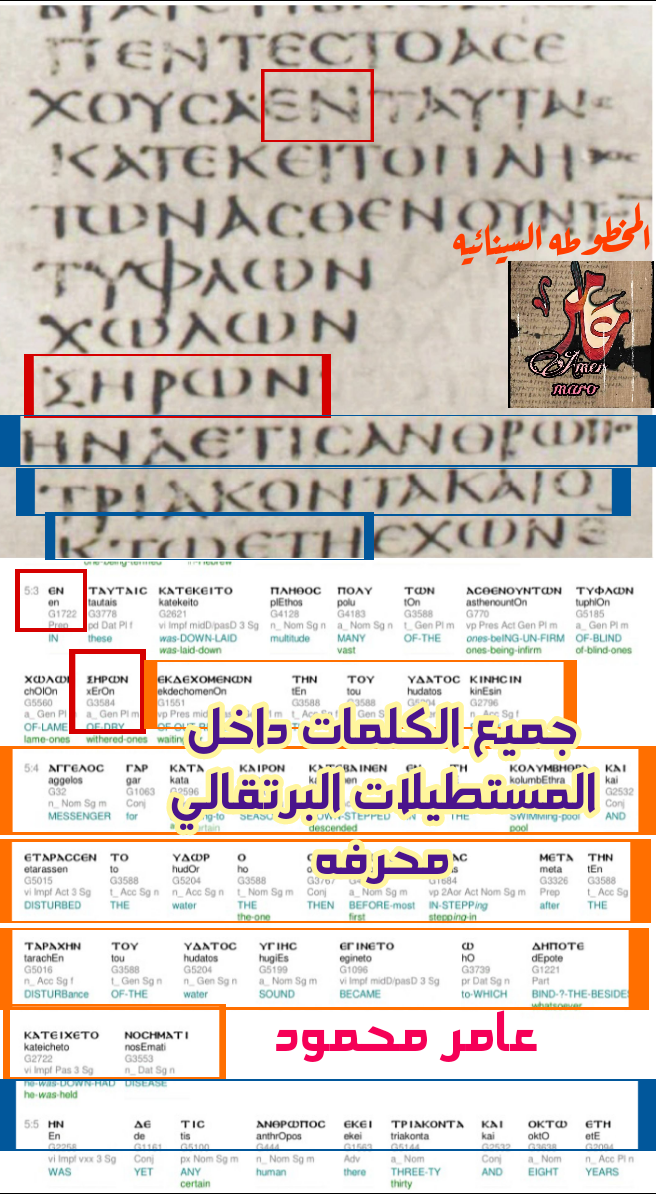
The scan above shows the Sinaiticus text of John 5, confirming the absence of the addition in the oldest complete New Testament manuscript.
Codex Vaticanus
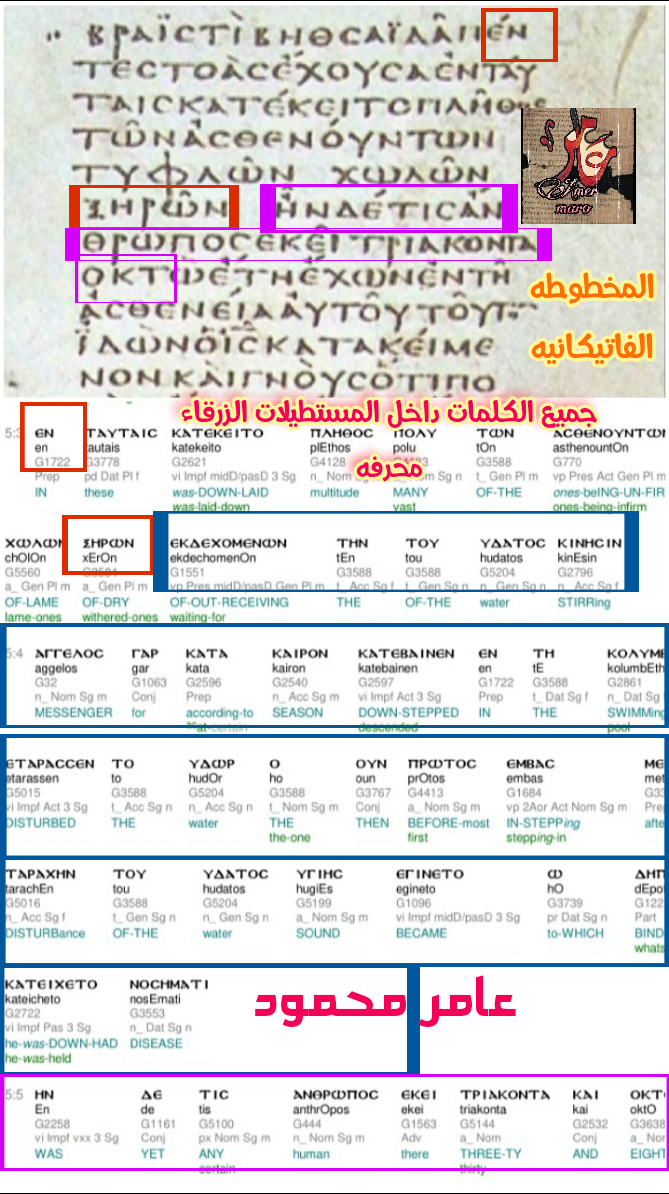
The Vatican Codex reads:
“εν τη αϲθενεια αυτου”
Again the text moves from the list of sick people directly to the man who had been ill for thirty-eight years, with no angel, no pool stirring, and no verse 4.
Codex Ephraimite (Original Hand)
“εκεν ξηρων * ην δε τιϲ τη αϲθενεια αυτου”
The asterisk (*) notation in later manuscripts that do include the addition is itself evidence that those scribes knew the text was suspect — they marked it as non-original even while including it.
Pisa Manuscript (Codex Borgianus)
“εν ταυταιϲ ουν κατεκειντο πληθοϲ των ξηρων παραλυτικων εκδεχομενων την του υδατοϲ κινηϲιν”
Note that even this later manuscript, which does include part of the addition, shows a form different from other manuscripts — demonstrating the “wide diversity of diverse forms” that Metzger identified as a marker of inauthenticity.
What the Scholars Said
Philip Comfort
Bruce Metzger
Verse 4 is an addition to the original text, and its secondary character is evident from: (1) its absence in the oldest and best manuscript witnesses, (2) the presence of an asterisk or other distinguishing mark to mark words as non-original in more than twenty Greek manuscript witnesses, (3) the presence of non-Johannine words and expressions — κατὰ καιρόν, ἐμβαίνω (of going into the water), ἐκδέχομαι, κατέχομαι, κίνησις, ταραχή, δήποτε, and νόσημα — the last four words only here in the entire New Testament, (4) the rather wide diversity of diverse forms in which the verse was transmitted.”
The four criteria Metzger lists are the standard tests of inauthenticity in textual criticism: missing from old witnesses, flagged even by later copyists, contains vocabulary foreign to the author’s style, and transmitted in wildly varying forms. John 5:4 fails all four.
J.H. Bernard
Bernard confirms the deletion across all text families — Alexandrian (Sinaiticus, Vaticanus), Western (Bezae, Washington), and the ancient versions (Old Syriac, Coptic). The absence is not limited to one geographical tradition; it is universal among the oldest witnesses.
Daniel Wallace
Daniel Wallace — one of the most prominent conservative New Testament textual scholars — uses the phrase “few textual scholars today would accept the authenticity of any portion.” This is not a disputed matter in scholarship. It is settled.
Wieland Willker
Wieland Willker then concludes:
Rating: 2 (NA clearly original)
“Nestle-Aland’s decision to delete these passages as non-genuine and not from the original Gospel of John was certainly correct.”
Consensus Statement
Conclusion
This is tahrifArabic: تحريف — scribal alteration of the biblical text. Here the addition occurred in two documented stages, beginning as a marginal gloss and entering the main text after the 4th century. in its most transparent form: a marginal explanatory note, written by an unknown hand, which migrated into the text of the Gospel and was copied as Scripture for centuries — until manuscript study exposed it.
سُبْحَانَ الَّذِي لَمْ يَتَّخِذْ وَلَدًا وَلَمْ يَكُن لَّهُ شَرِيكٌ فِي الْمُلْكِ وَلَمْ يَكُن لَّهُ وَلِيٌّ مِّنَ الذُّلِّ وَكَبِّرْهُ تَكْبِيرًا
وَآخِرُ دَعْوَانَا أَنِ الْحَمْدُ لِلَّهِ رَبِّ الْعَالَمِينَ
...ns|Distortion of the Text of Luke 2334 “Father, Forgive Them, for They Do Not Know What They Do]]