

Matthew 5:44 Love Your Enemies — Three Phrases Added from Luke 6:27-28 Are Absent from Sinaiticus, Vaticanus, and All Critical Editions
The Verse Under Study — Five Competing Forms
This text has five different forms in the manuscript tradition. Each form differs in which of the additional clauses is present:
Form 1 — The correct short reading (critical text):
“But I say to you, love your enemies and pray for those who persecute you.” (προσεύχεσθε ὑπὲρ τῶν διωκόντων ὑμᾶς)
Form 2:
“But I say to you, love your enemies, bless those who curse you, pray for those who persecute you.” (ἐγὼ δὲ λέγω ὑμῖν, εὐλογεῖτε καωκόντων ὑμᾶς)
Form 3:
“But I say to you, love your enemies, bless those who curse you, pray for those who spitefully use you and persecute you.” (ἐγὼ δὲ λέγω ὑμῖν, εὐλογεῖτε ὑμᾶς ὑμᾶς ὑμᾶς ὑμᾶς ὑμᾶς ὑμᾶς καὶ διωκόντων ὑμᾶς)
Form 4:
“But I say to you, love your enemies, do good to those who hate you, pray for those who spitefully use you and persecute you.” (ἐγὼ δὲ λέγω ὑμῖν ἀγαπᾶτε τοὺς ἐχθροὺς καλῶς ποιεῖτε τοὺς καὶ προσεύχεσθε καὶ διωκόντων ὑμᾶς)
Form 5 — The current common/traditional text:
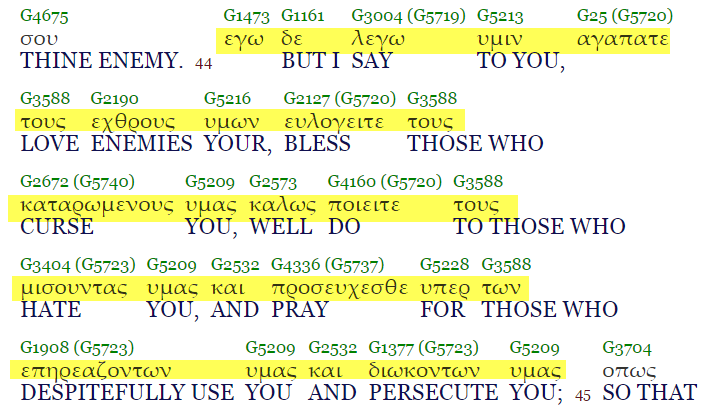
“But I say to you, love your enemies, bless those who curse you, do good to those who hate you, pray for those who despitefully use you and persecute you.” (ἐγὼ δὲ λέγω ὑμῖν ἀγαπᾶτε τοὺς ἐχθροὺς ὑμῶν εὐλογειτε τοὺς ὑμᾶς καλῶς ποιεῖτε τοὺς μισοῦντας ὑμᾶς, ὑπὲρ τῶν ἐπηρεαζόντων ὑμᾶς, καὶ διωκόντων ὑμᾶς)
The fifth form is the most common form used by Christians in their Bible today, but the correct text is the first form — the shorter reading.
The first reading is attested by the oldest Greek manuscripts from the 4th century, the oldest Latin manuscripts from the 4th century, and the oldest Syriac manuscripts from the 4th century. The long reading is attested by manuscripts from the 5th century onwards — a full century later.
Translation of each clause in the long reading:
- ἐγὼ δὲ λέγω ὑμῖν = but I tell you
- ἀγαπᾶτε τοὺς ἐχθροὺς ὑμῶν = Love your enemies
- εὐλογεῖτε τοὺς καταρωμένους ὑμᾶς = Bless those who curse you
- καλῶς ποιεῖτε τοῖς μισοῦσιν ὑμᾶς = Be good to those who hate you
- ὑπὲρ τῶν ἐπηρεαζόντων ὑμᾶς = Pray for those who wrong you
- καὶ διωκόντων ὑμᾶς = And who persecute you
Why This Research Matters
The significance of distortions proven by textual criticism is that the book did not protect itself from deliberate changes despite five centuries of its dissemination. If corruption occurred in the fifth century during the time of dissemination, then destruction could have occurred during the time of early composition — when the book was a local, endemic text with no widespread dissemination to protect it. The occurrence of corruption in the fifth century, during the time of dissemination, means the occurrence of destruction during the time of early composition.
The science of textual criticism has also forced Christians — especially Eastern ones — to change their definition of tahrifArabic: تحريف — distortion or alteration of scripture. Under pressure from textual criticism, Christians have revised the definition from “deliberate change” to “removal of an important doctrine with all its evidence from the Bible.” This redefinition overlooks the occurrence of deliberate changes and diminishes their importance.. The definition of distortion is no longer that the text is deliberately changed. Rather, distortion for Christians has become: the removal of an important doctrine with all its evidence from the Bible, or the introduction of an important doctrine with all its evidence into it. But when you discover a distortion of a text in the fifth century, this means that the book is fragile and weak — regardless of the definition.
Three Reasons the Shorter Reading Is Correct
1. The consensus of all critical editions on the inauthenticity of the extra passages.
2. The agreement of all scholarly critical commentaries on the same result.
3. Strong external evidence as well as internal evidence supporting the shorter reading:
- External: The first reading is attested by the oldest Greek manuscripts (4th century), the oldest Latin manuscripts (4th century), and the oldest Syriac manuscripts (4th century). The long reading is attested only from the 5th century onwards.
- Internal: The copyist probability ruleAlso called the rule of scribal motivation: the reading that best explains the emergence of all other readings is preferred. If the original reading was the long reading, what justification would make a Christian copyist delete these parts? There is none. If the original was the short reading, copyists would have added parts to harmonize the passage with the parallel in Luke 6:27-28 — a well-documented scribal tendency. strongly favors the short reading. If the original was the long reading, there is no motive for any copyist to delete “bless those who curse you” or “do good to those who hate you.” But if the original was the short reading, the motive for adding these phrases is clear: to bring Matthew 5:44 into alignment with the parallel text in Luke 6:27-28, which contains all five elements. Scribes are well known for harmonizing similar passages in the Gospels.
Arabic Versions Compared
Links to browse Arabic translations: https://albishara.net/
The Van Dyke translation and the Al-Hayat interpretive translation both give the full long text. Six other Arabic translations mention the text in its short form:
Long reading (Van Dyke / Al-Hayat):
“But I say to you, love your enemies, bless those who curse you, do good to those who hate you, and pray for those who despitefully use you and persecute you.”
Short reading — 6 translations:
- Common Arabic: “But I say to you: Love your enemies and pray for those who persecute you.”
- Simplified: “But I say to you: Love your enemies and pray for those who persecute you.”
- Jesuit: “But I say to you: Love your enemies and pray for those who persecute you.”
- Sarah: “But I say to you: Love your enemies and pray for those who persecute you.”
- Sharif: “But I say to you: Love your enemies and pray for those who persecute you.”
- Paulian: “But I say to you: Love your enemies and pray for those who persecute you.”
Paul Al-Feghali’s interlinear Greek-Arabic translation:
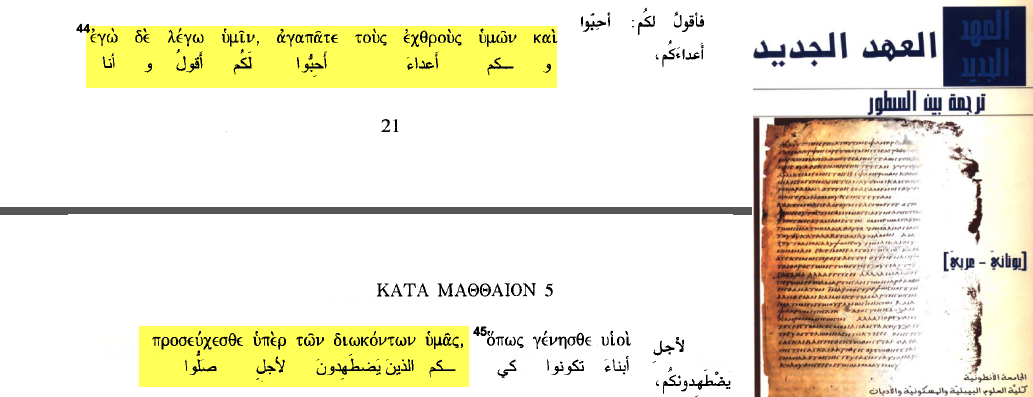
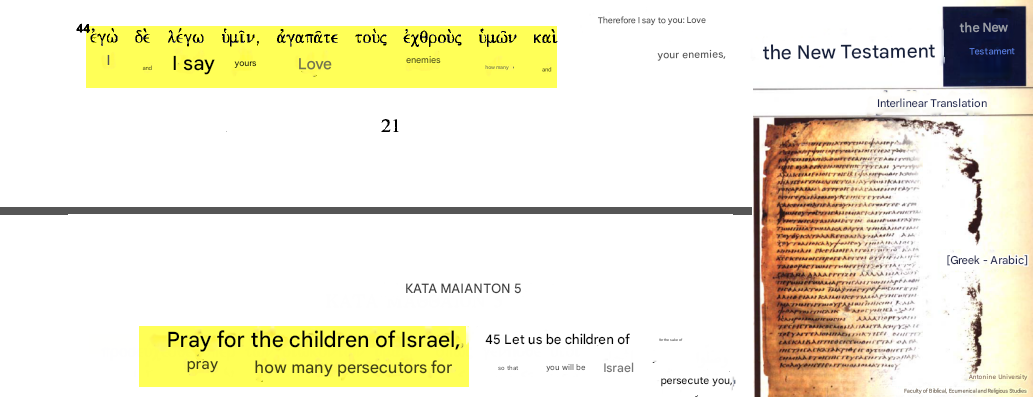
English Versions Compared
Links to browse English translations: https://www.biblegateway.com/ · http://www.biblestudytools.com/wyc/
Number of translations that mention the missing additions: 26
Number of translations that mention the full long text: 12
26 Translations with the Short Reading
ASV Matthew 5:44 — But I say unto you, love your enemies, and pray for them that persecute you;
BBE Matthew 5:44 — But I say to you, Have love for those who are against you, and make prayer for those who are cruel to you;
CEB Matthew 5:44 — But I say to you, love your enemies and pray for those who harass you.
CJB Matthew 5:44 — But I tell you, love your enemies! Pray for those who persecute you.
CSB Matthew 5:44 — But I tell you, love your enemies and pray for those who persecute you.
CSBO Matthew 5:44 — But I tell you, love your enemies and pray for those who persecute you.
ERV Matthew 5:44 — but I say unto you, Love your enemies, and pray for them that persecute you;
ESV Matthew 5:44 — But I say to you, Love your enemies and pray for those who persecute you,

GWN Matthew 5:44 — But I tell you this: Love your enemies, and pray for those who persecute you.
LEW Matthew 5:44 — But I say unto you, Love your enemies, and pray for them who persecute you,
MIT Matthew 5:44 — But I say to you: Love your enemies, and pray for those who put pressure on you.
NABO Matthew 5:44 — But I say to you, love your enemies, and pray for those who persecute you,
NAS Matthew 5:44 — “But I say to you, love your enemies, and pray for those who persecute you.
NAU Matthew 5:44 — “But I say to you, love your enemies and pray for those who persecute you,
NET Matthew 5:44 — But I say to you, love your enemy and pray for those who persecute you,
NIB Matthew 5:44 — But I tell you: Love your enemies and pray for those who persecute you,
NIRV Matthew 5:44 — But here is what I tell you. Love your enemies. Pray for those who hurt you.
NIV Matthew 5:44 — But I tell you, love your enemies and pray for those who persecute you,
NJB Matthew 5:44 — But I say this to you, love your enemies and pray for those who persecute you;
NAB Matthew 5:44 — But I say to you, love your enemies, and pray for those who persecute you,
NLT Matthew 5:44 — But I say, love your enemies! Pray for those who persecute you!
NRS Matthew 5:44 — But I say to you, Love your enemies and pray for those who persecute you,
RSV Matthew 5:44 — But I say to you, Love your enemies and pray for those who persecute you,
TNIV Matthew 5:44 — But I tell you, love your enemies and pray for those who persecute you,
(And additional short-reading versions.)
12 Translations with the Long Reading
DRA Matthew 5:44 — But I say to you, Love your enemies: do good to them that hate you: and pray for them that persecute and calumniate you:
DBY Matthew 5:44 — But I say unto you, Love your enemies, bless those who curse you, do good to those who hate you, and pray for those who insult you and persecute you,
ETH Matthew 5:44 — But I say unto you, Love your enemies; bless them who execrate you; do that which is good to him who hates you; And pray for them who lead you with a chain, and persecute you.
GNV Matthew 5:44 — But I say to you, Loue your enemies: bless them that curse you: do good to them that hate you, and pray for them which hurt you, and persecute you,
KJG Matthew 5:44 — But I say unto you, Love your enemies, bless them that curse you, do good to them that hate you, and pray for them which despitefully use you, and persecute you;
KJV Matthew 5:44 — But I say unto you, Love your enemies, bless them that curse you, do good to them that hate you, and pray for them which despitefully use you, and persecute you;
MGI Matthew 5:44 — But I say to you, love your enemies and bless those who curse you and do that which is pleasing to him who hates you and pray for those who take you by force and persecute you,
MRD Matthew 5:44 — But I say to you: Love your enemies; and bless him that curseth you; and do good to him that hates you; And pray for them that leads you in bonds, and that persecutes you:
NKJ Matthew 5:44 — “But I say to you, love your enemies, bless those who curse you, do good to those who hate you, and pray for those who spitefully use you and persecute you,
PNT Matthew 5:44 — But I say vnto you, loue your enemies, bless them that curse you, do good to them that hate you, pray for the which hurt you, and persecute you:
RWB Matthew 5:44 — But I say to you, Love your enemies, bless them that curse you, do good to them that hate you, and pray for them who despitefully use you, and persecute you;
TNT Matthew 5:44 — But I say vnto you love your enimies. Please this course you. Do good to them that hate you. Praye for them which do you wronge and persecute you.
WEB Matthew 5:44 — But I say to you, Love your enemies, bless them that curse you, do good to them that hate you, and pray for them who despitefully use you, and persecute you;
YLT Matthew 5:44 — but I — I say to you, Love your enemies, bless those cursing you, do good to those hating you, and pray for those accusing you falsely, and persecuting you,
Greek Critical Editions — All Choose the Short Reading
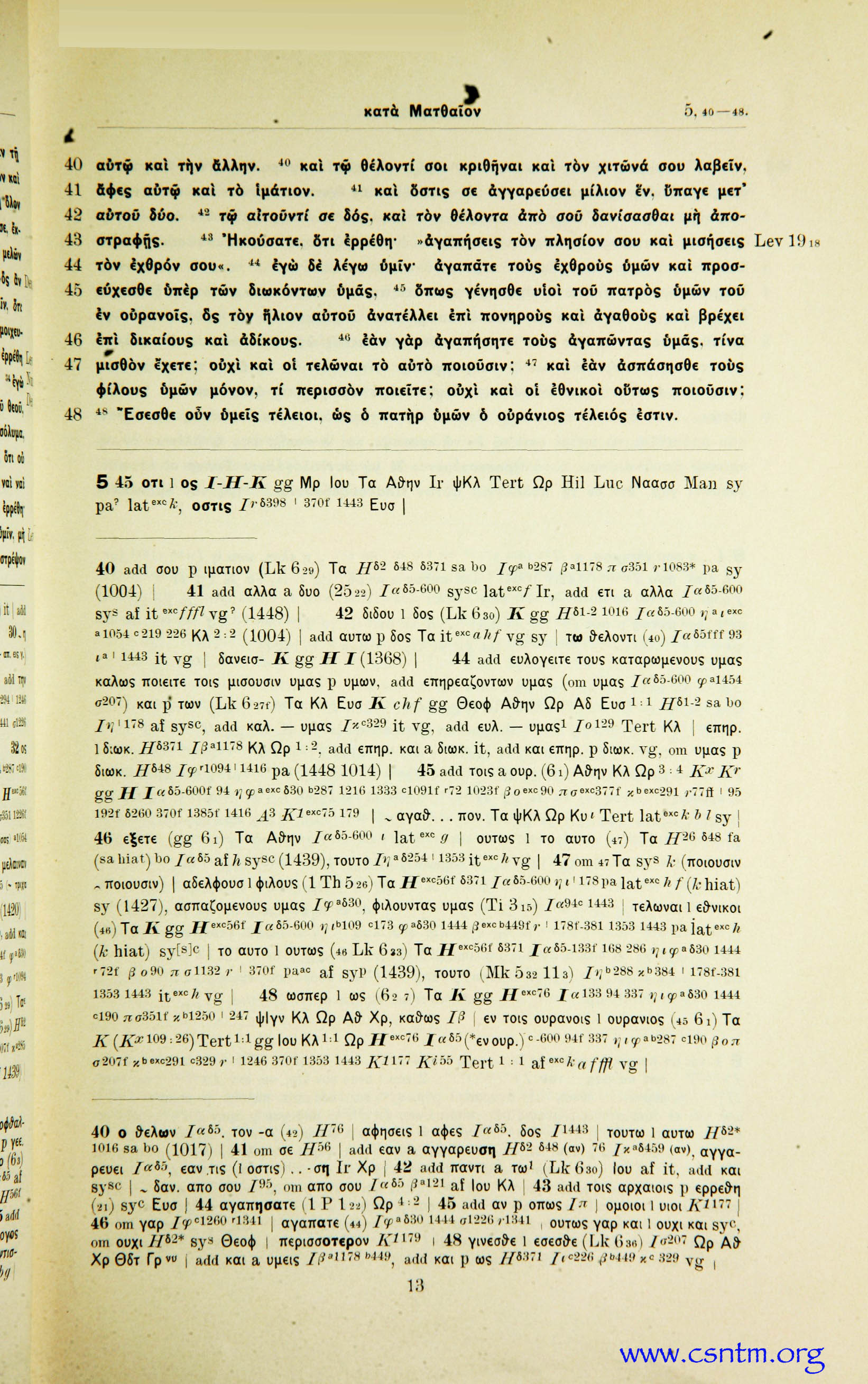
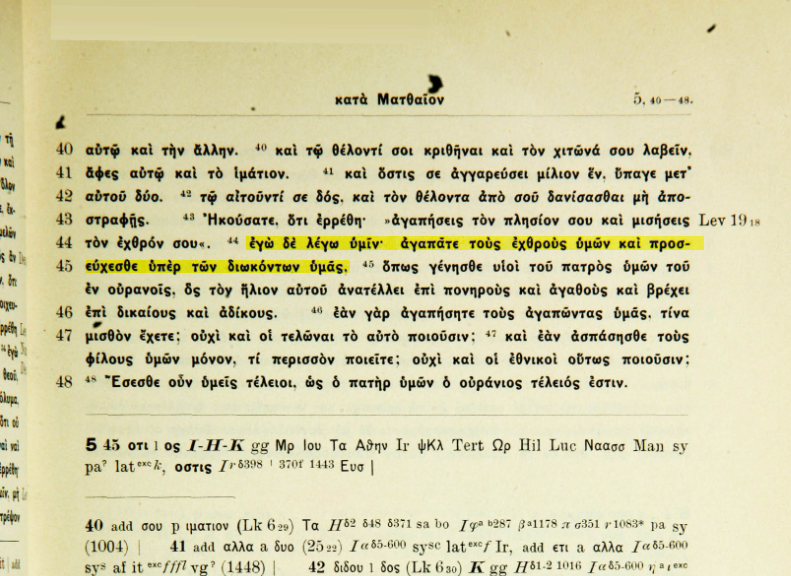
All critical editions of the Greek New Testament mention the text in its short form:
(1) Nestle-Aland NA27: https://www.academic-bible.com/en/online-bibles/novum-testamentum-graece-na-28/read-the-bible-text/
(44 προσεύχεσθε ὑπὲρ τῶν διωκόντων ὑμᾶς)
(2) UBS GNT 5th: https://www.academic-bible.com/en/online-bibles/greek-new-testament-ubs5/
(44) προσεύχεσθε ὑπὲρ τῶν διωκόντων ὑμᾶς,
(3) Westcott and Hort (WH):
(44) προσεύχεσθε ὑπὲρ τῶν διωκόντων ὑμᾶς
(4) Tischendorf:
(44) προσεύχεσθε ὑπὲρ τῶν διωκόντων ὑμᾶς
(5) Von Soden:
(44) προσεύχεσθε ὑπὲρ τῶν διωκόντων ὑμᾶς
Traditional Greek Versions — All Include the Long Reading
All traditional Greek versions based on the Textus Receptus quote the entire long passage:
(1) RP Byzantine Majority Text 2005:
ἐγὼ δὲ λέγω ὑμῖν, εὐλογεῖτε ὑμᾶς ὑμᾶς ὑμᾶς ποιεῖτε τοῖς καὶ διωκόντων ὑμᾶς
(2) Greek Orthodox Church 1904:
ἐγὼ δὲ λέγω ὑμῖν, ἀγαπᾶτε τοὺς ἐχθροὺς ὑμῶν, εὐλογεῖτε καταρωμένους ὑμᾶς ὑπὲρ τῶν ἐπηρεαζόντων ὑμᾶς καὶ διωκόντων ὑμᾶς,
(3) Scrivener’s Textus Receptus 1894:
ἐγὼ δὲ λέγω ὑμῖν, ἀγαπᾶτε τοὺς ἐχθροὺς ὑμῶν, εὐλογειτε ὑμᾶς ὑμᾶς ὑμᾶς ποιεῖτε τοὺς ὑμᾶς καὶ διωκόντων ὑμᾶς
(4) Stephanus Textus Receptus 1550:
ἐγὼ δὲ λέγω ὑμῖν ἀγαπᾶτε τοὺς ἐχθροὺς ὑμᾶς καλῶς ποιεῖτε τοὺς μισοῦντας ὑμᾶς, καὶ διωκόντων ὑμᾶς,
The Interlinear and Uncial Text
The interlinear Greek-English text of Matthew 5:44 (http://studybible.info/IGNT/Matthew%205):
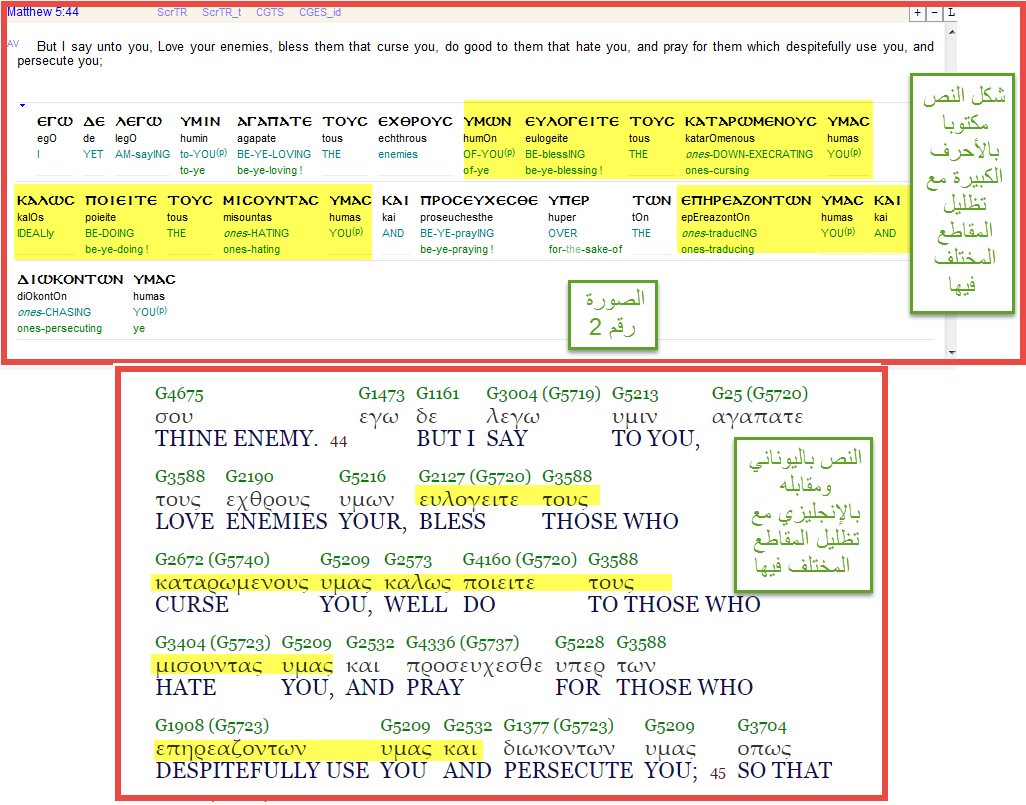
The text in capital letters (uncial script) — the form in which early Greek manuscripts are written:
Sinaiticus — 4th Century — Shorter Reading
The Sinaiticus is the oldest New Testament manuscript ever to contain verse 44, chapter 5 of the Gospel of Matthew. It witnesses the shorter reading:
“But I say to you, love your enemies and pray for those who persecute you.”
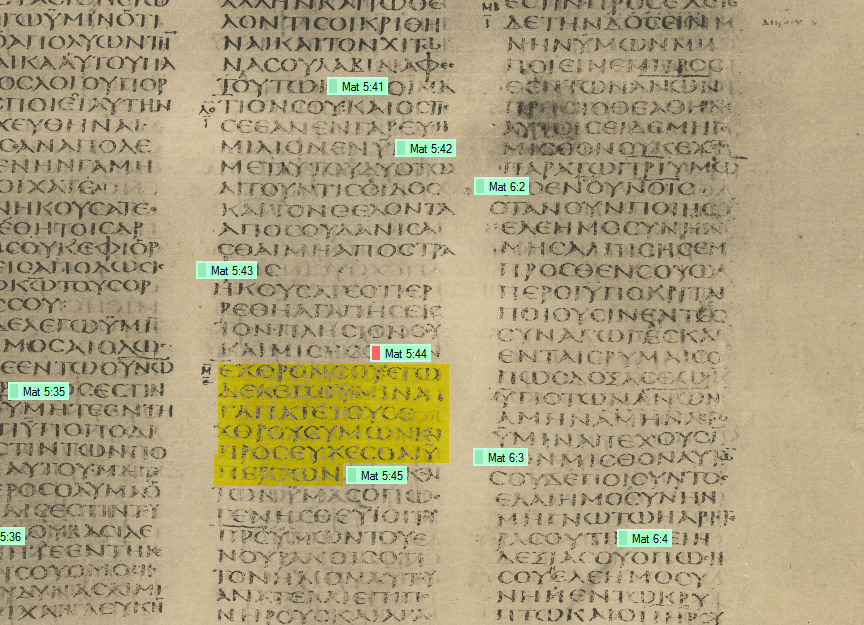
Enlarged image of the text in detail:
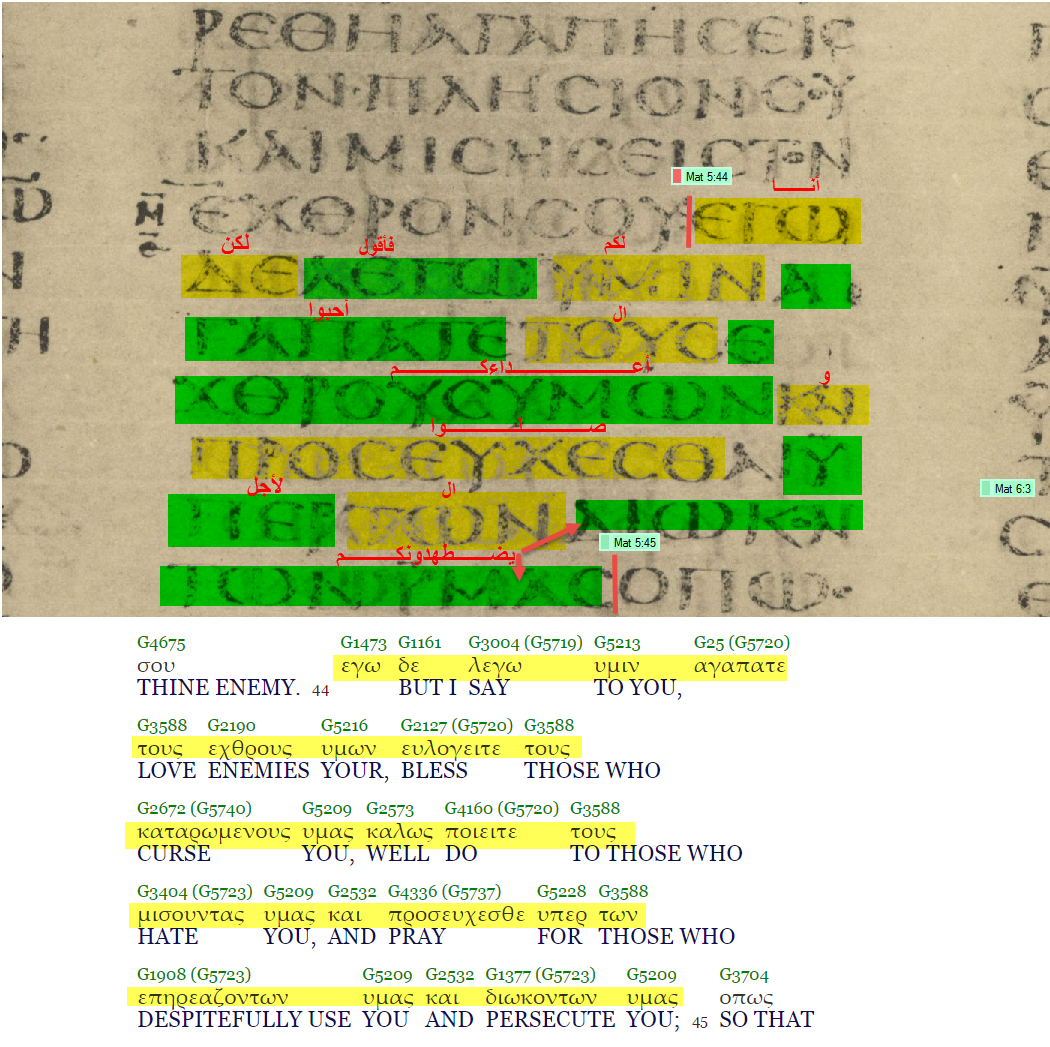
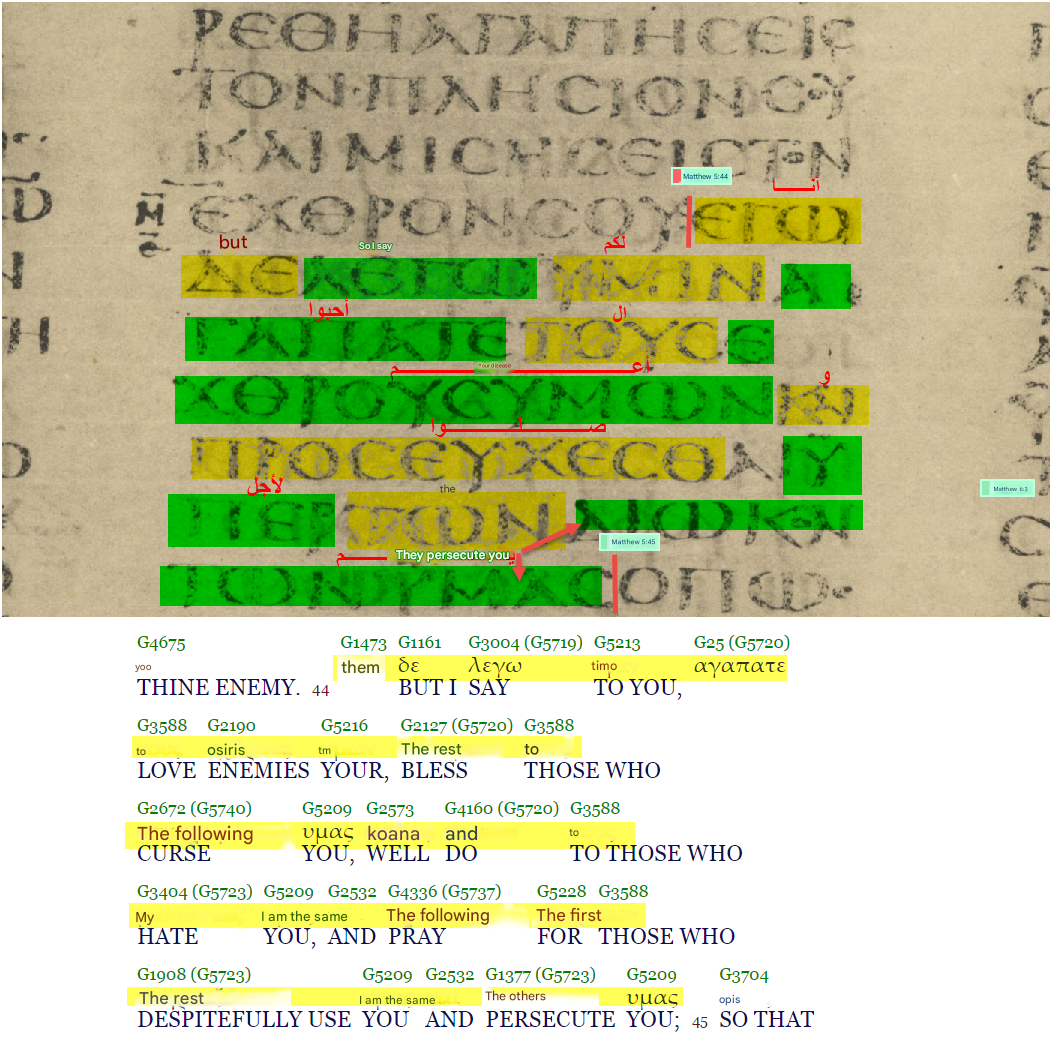
Official website: http://www.codexsinaiticus.org/en/
Vatican Manuscript — 4th Century — Shorter Reading
The Vatican Codex, along with the Sinaiticus, is one of the two oldest witnesses of Matthew 5:44. It witnesses the shorter reading:
“But I say to you, love your enemies and pray for those who persecute you.”
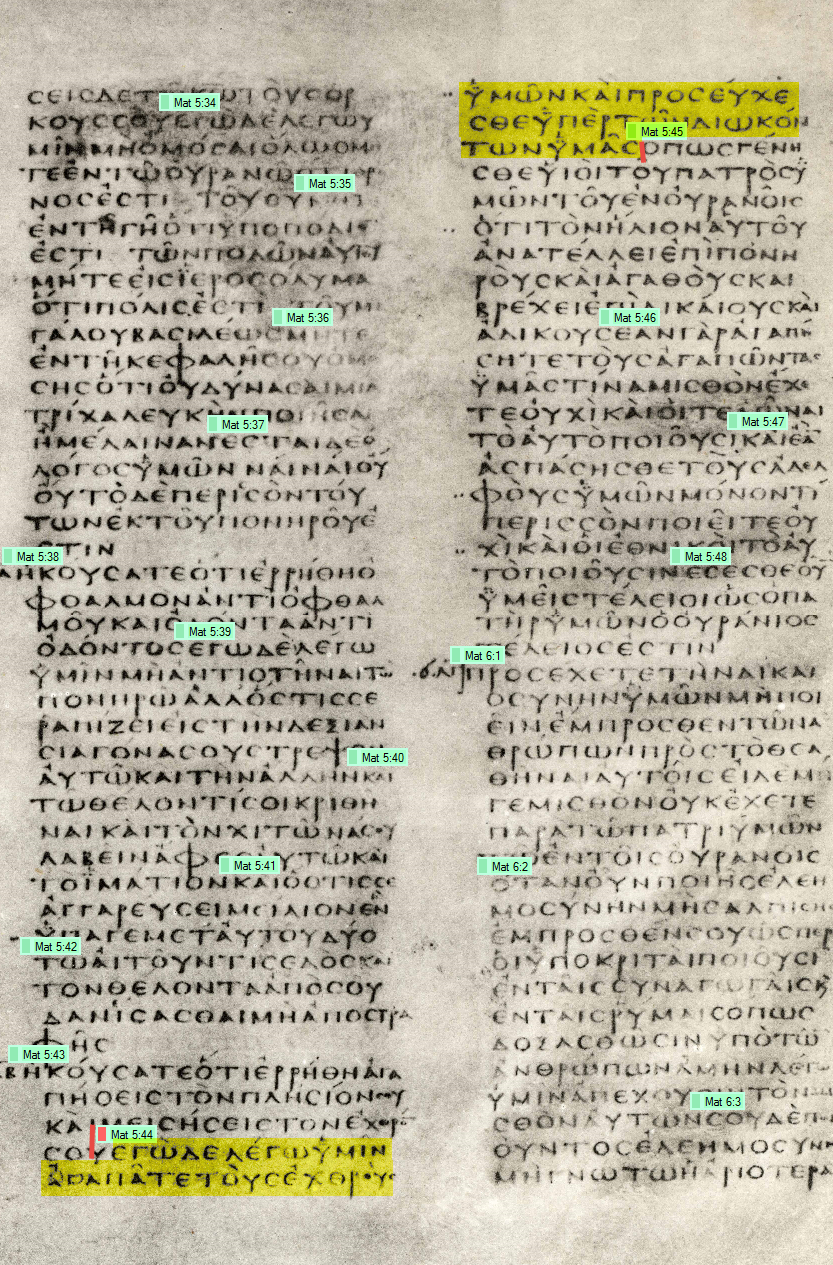
Official link: http://www.csntm.org/Manuscript/View/GA_03
Syriac Sinaiticus and Curitonianus — Shorter Reading
Syriac Sinaiticus from the 4th century, and Syriac Curitonianus from the 5th century both witness the shorter reading. Image from The Syriac of the Sinaitic Palimpsest by Agnes Smith:
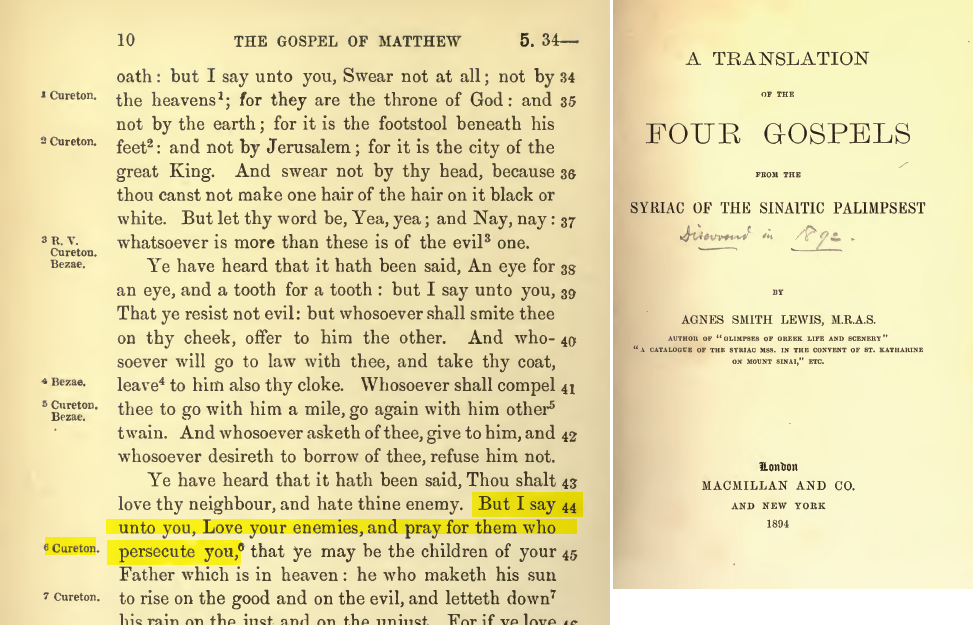
Direct link to the two manuscripts: http://www.dukhrana.com/peshitta/index.php
Coptic Manuscripts — Shorter Reading
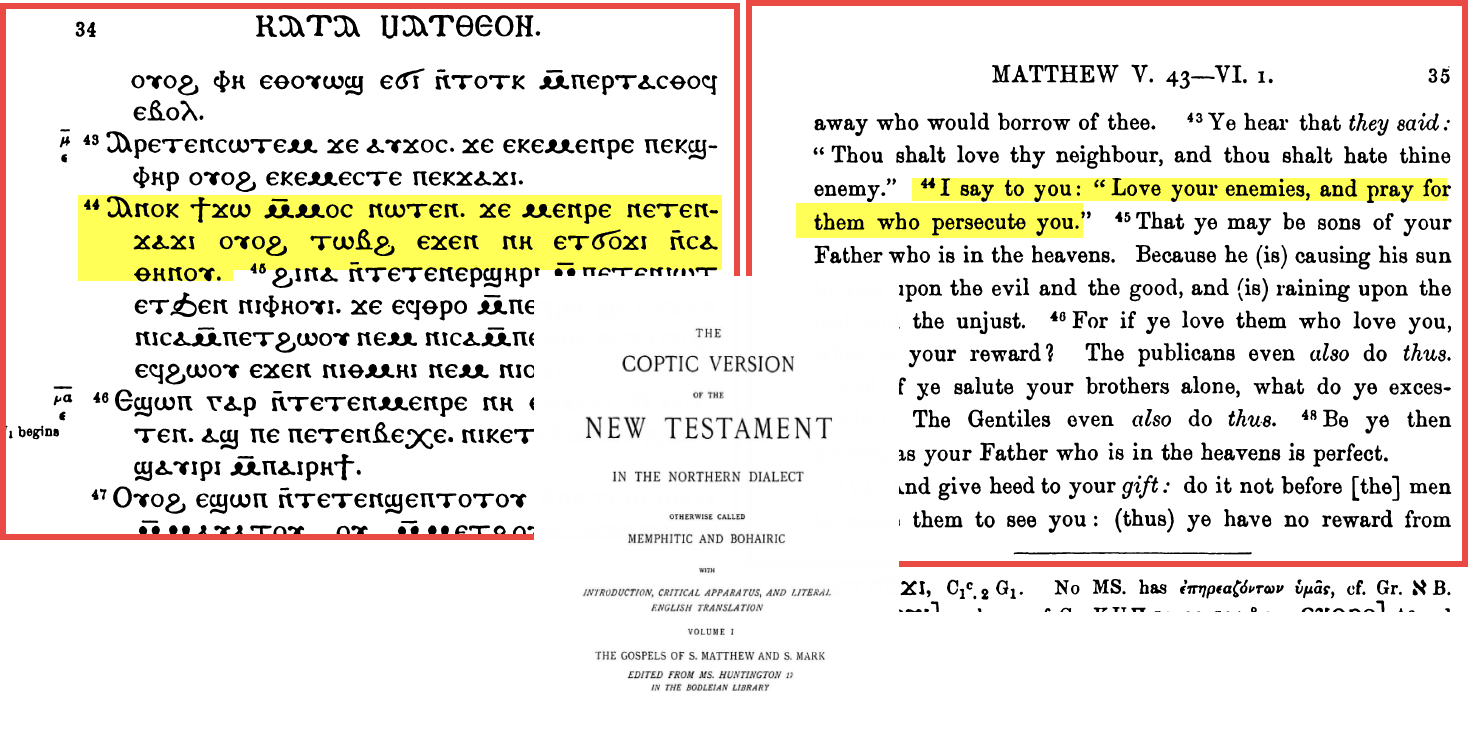
Bohairic Coptic (The Coptic Version of the New Testament in the Northern Dialect):
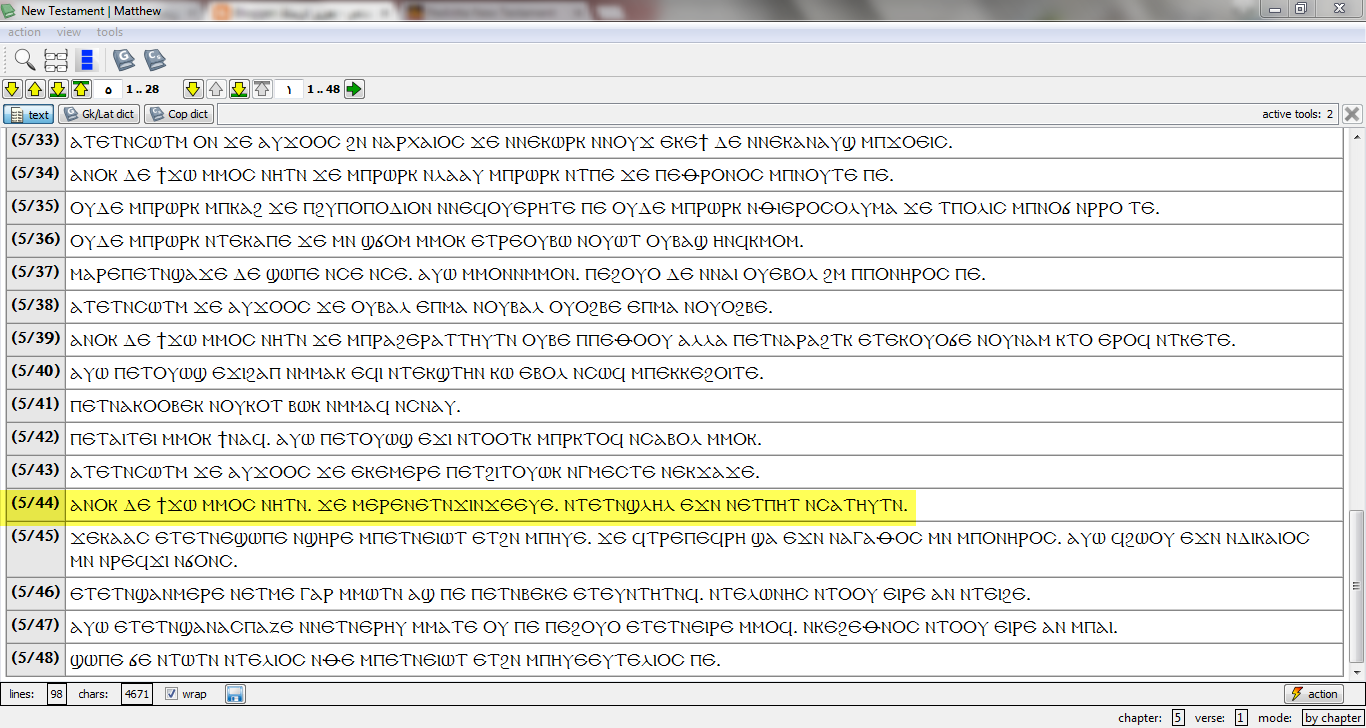
Sahidic (Upper Egyptian) Coptic (image from Marcion program):
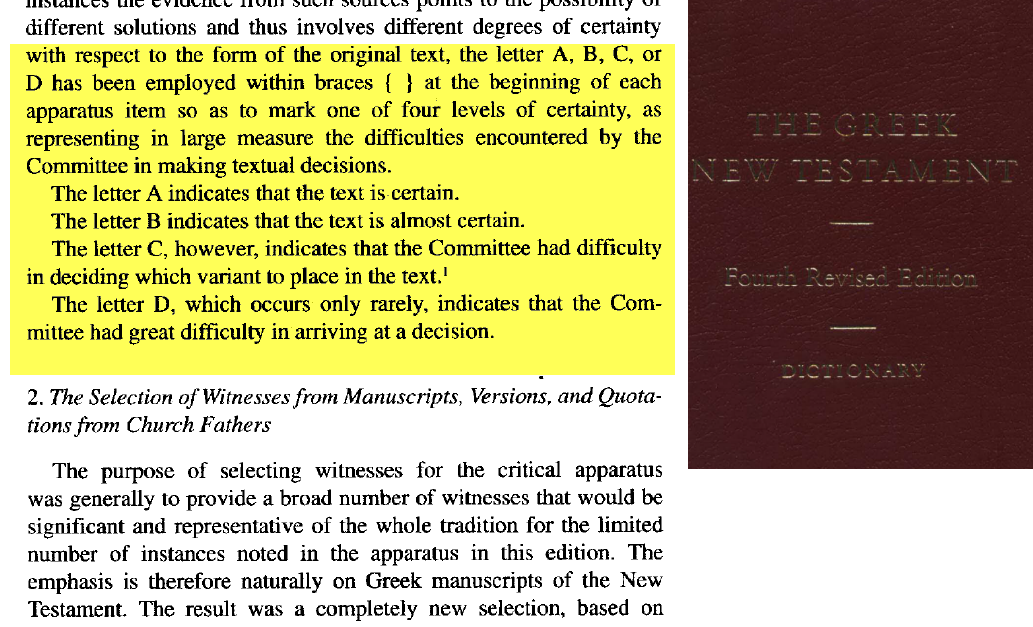
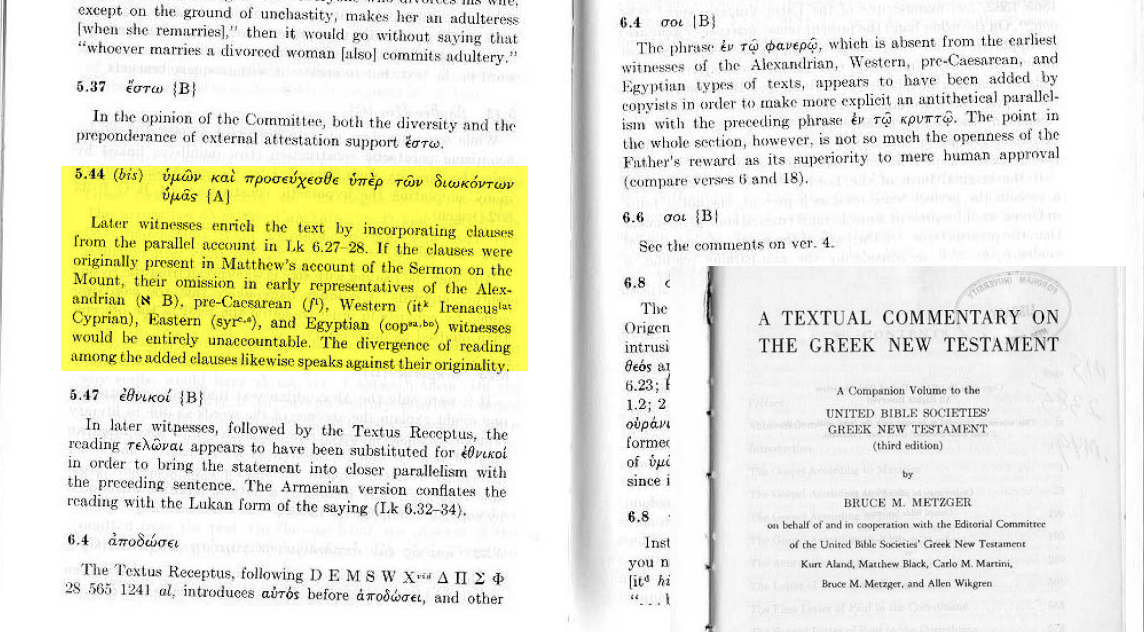
UBS Committee Decision — Grade A for Short Reading
The Committee’s Grade A Decision
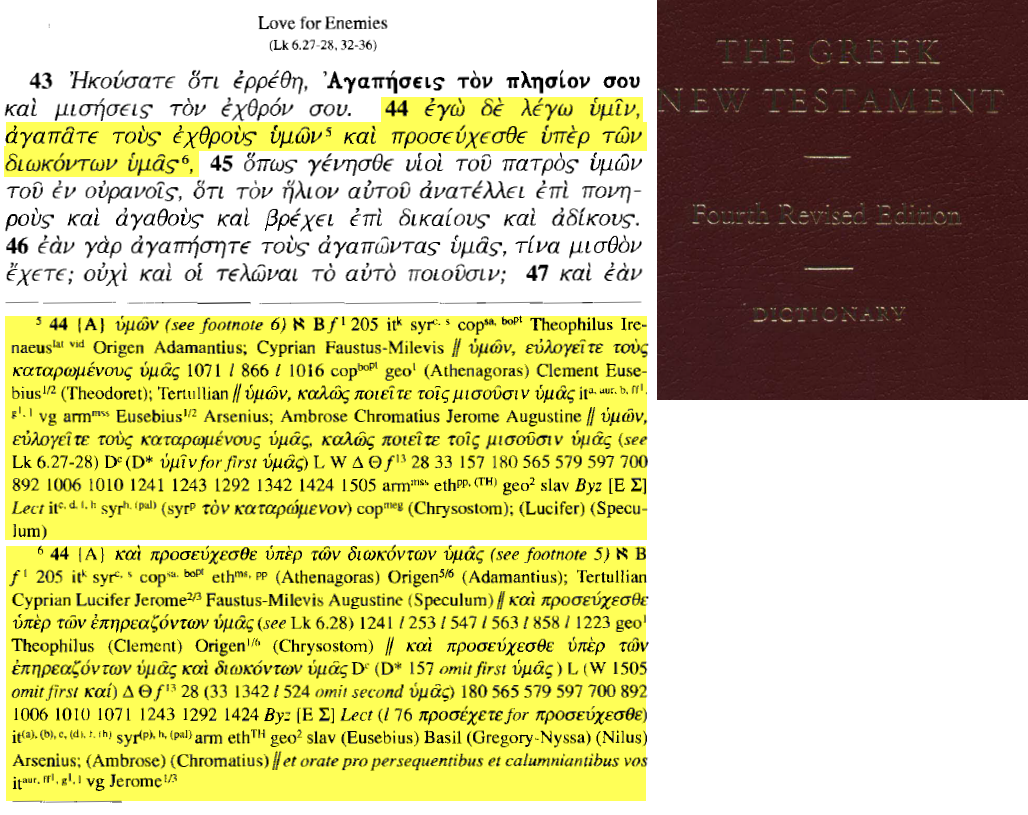
The Union Bible Societies chose to read “Love your enemies, pray for those who persecute you” with a grade of A — meaning they are certain their choice is correct.
Full Witness Lists
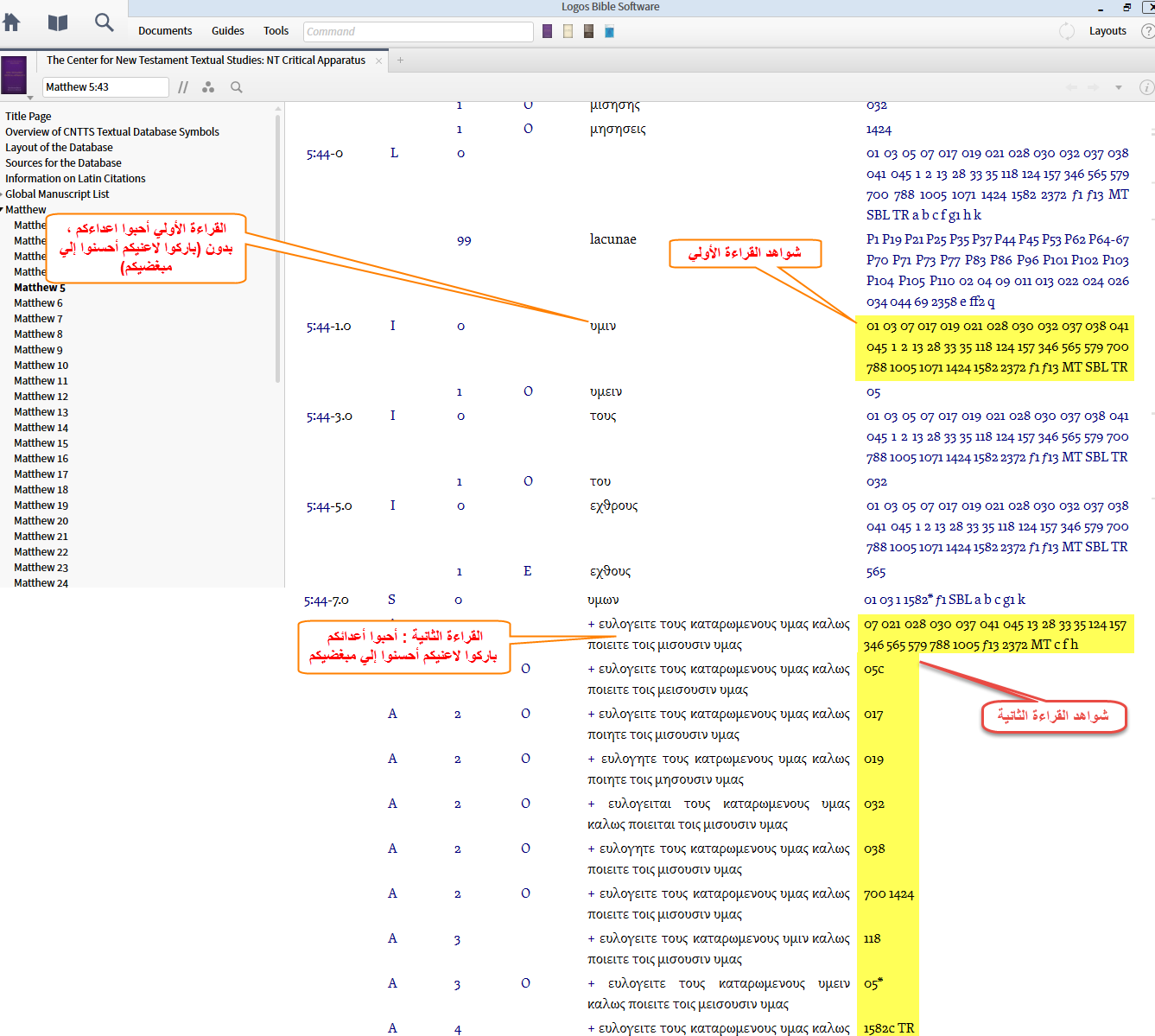
The committee divided the text into two sections — the “love your enemies” clause and the “pray for…” clause — and documented the differences separately.
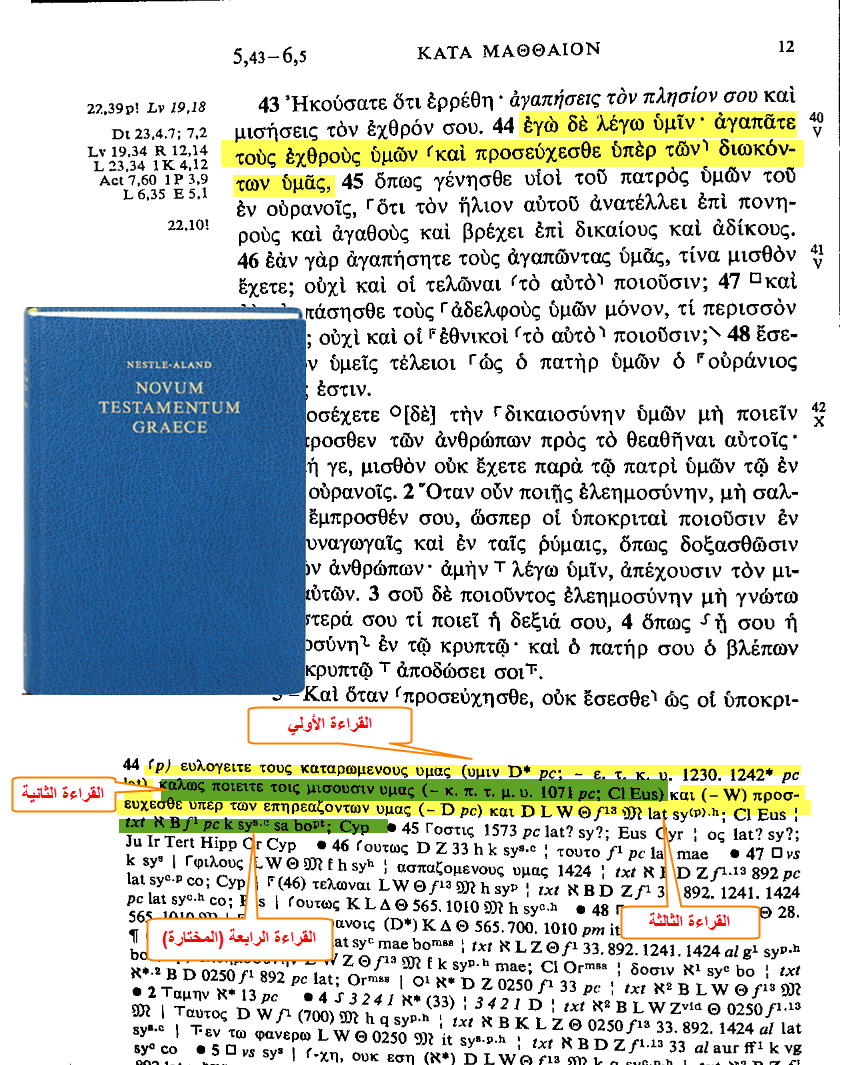
Section 1 — “Love your enemies” — Four forms in the manuscripts:
First reading (correct, Grade A):
“But I say to you, love your enemies.” (Bless those who curse you, do good to those who hate you — absent)
Witnesses: Sinaiticus Q4 · Vaticanus Q4 · Family manuscripts No. 1 · Manuscript 205 · Old Latin manuscript K (end of 4th century) · Sahidic Coptic · Bohairic Coptic · Several Fathers
Second reading:
ἐγὼ δὲ λέγω ὑμῖν ἀγαπᾶτε εὐλογεῖτε τοὺς καταρωμένους ὑμᾶς “But I say, love your enemies, bless those who curse you.” (Do good to those who hate you — absent)
Witnesses: Late manuscripts 1071 · Manuscript 866 · 1016 · Bohairic Coptic manuscript · Georgian manuscript · Several Fathers
Third reading:
ἐγὼ δὲ λέγω ὑμῖν ἀγαπᾶτε τοὺς ἐχθροὺς ὑμᾶς τοῖς μισοῦσιν ὑμᾶς “But I say, love your enemies, do good to those who hate you.” (Bless those who curse you — absent)
Witnesses: Old Latin a (4th–5th c.) · Old Latin b (5th–6th c.) · Old Latin aur (6th–8th c.) · Old Latin ff1 (8th–11th c.) · Old Latin g1 (7th–10th c.) · Late Armenian manuscript · Several Fathers
Fourth reading (similar to current widespread text):
ἐγὼ δὲ λέγω ὑμῖν, ἀγαπᾶτε τοὺς ἐχθροὺς ὑμῶν, εὐλογεῖτε ὑμᾶς ὑμᾶς ὑμᾶς ὑμᾶς ὑμᾶς “But I say to you, love your enemies, bless those who curse you, do good to those who hate you.”
Witnesses: Washingtonianus (5th c.) · Late manuscripts L, Theta, Delta, and 19 other Greek manuscripts from the 9th century · Armenian manuscript · Georgian manuscript · Syriac Heraclian (7th c.) · Peshitta (5th c.) · John Chrysostom
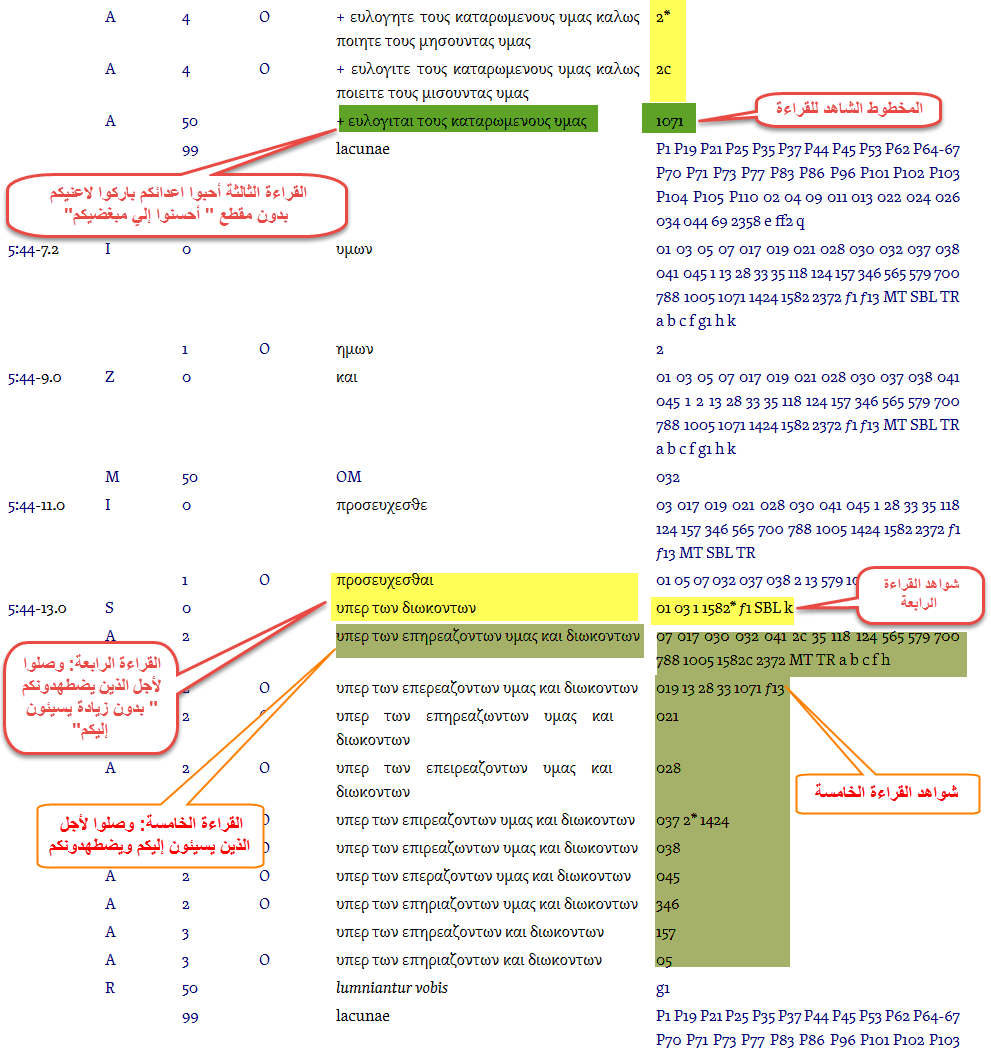
Section 2 — “Pray for…” — Three forms in the manuscripts:
First reading (correct, Grade A):
ὑπὲρ τῶν διωκόντων ὑμᾶς “Pray for those who persecute you.” (Pray for those who mistreat you — absent)
Witnesses: Latin k · Sinaitic Syriac · Curitonianus Syriac · Sahidic Coptic · Bohairic Coptic · Ethiopian manuscript · Several Fathers
Second reading:
ὑπὲρ τῶν ἐπηρεαζόντων ὑμᾶς “Pray for those who wrong you.” (Pray for those who persecute you — absent)
Witnesses: Late Greek manuscript 1241 · Five late ecclesiastical manuscripts · Georgian manuscript · Several Fathers
Third reading (like the current widespread text):
ὑπὲρ τῶν ἐπηρεαζόντων ὑμᾶς καὶ διωκόντων ὑμᾶς “Pray for those who mistreat and persecute you.”
Witnesses: Codex Bezae (5th c.) · Washingtonianus (5th c.) · Over 20 later Greek manuscripts beginning in the 8th century · Latin manuscripts a, b, c, h · Syriac Peshitta (5th c.) · Heraclian Syriac (7th c.) · Armenian, Ethiopian, Georgian, and Slavonic manuscripts · Several Fathers
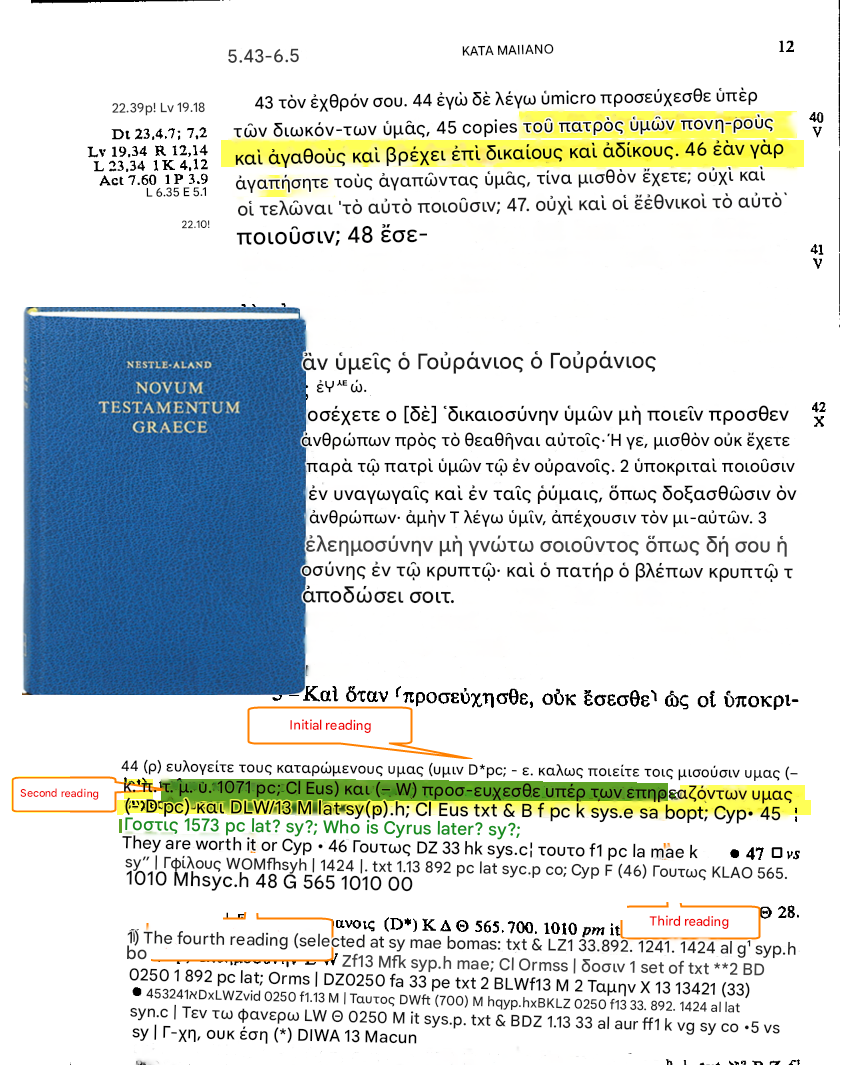
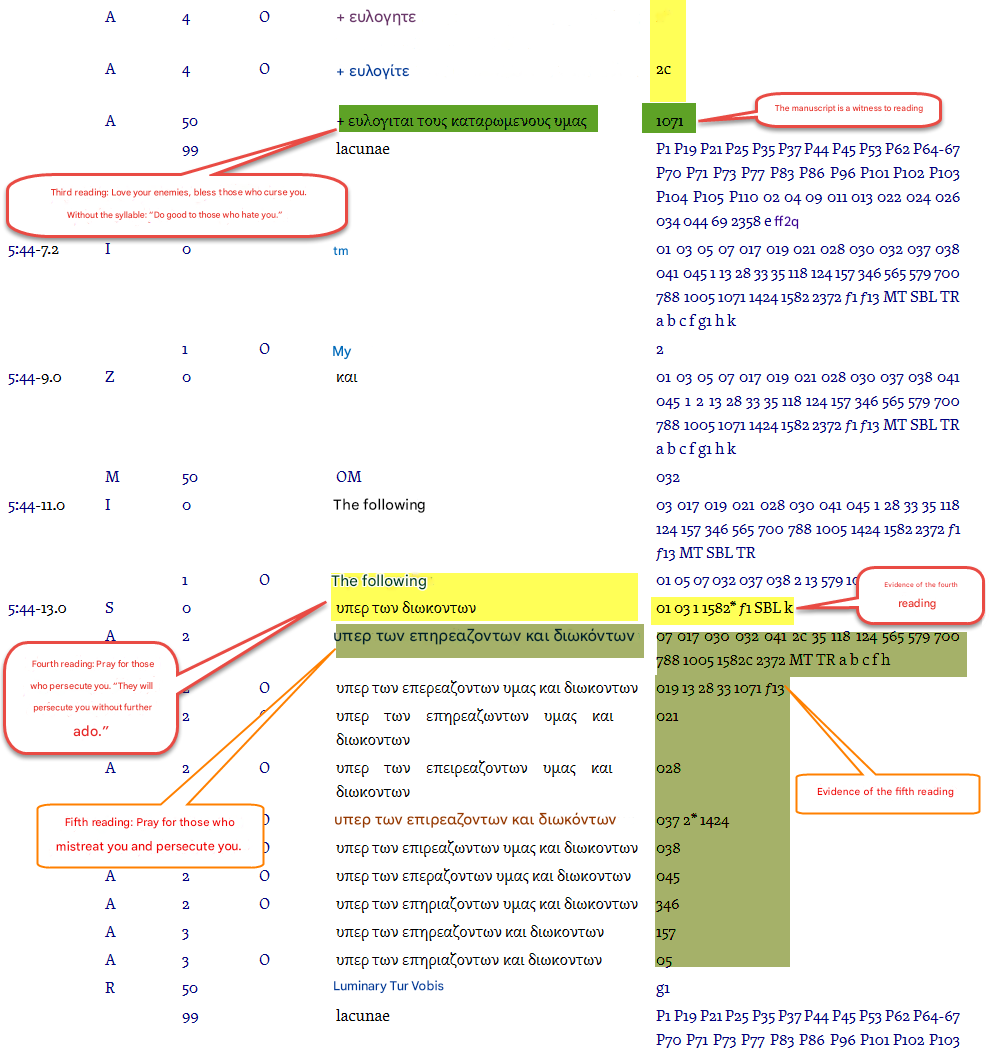
NA26 — Four Readings Documented
The Nestle-Aland NA26 edition mentioned four different readings of the text, documented the evidence for each reading in the manuscripts, and chose the deletion reading as the most correct.
What the Scholars Said
Bruce Metzger
A Textual Commentary on the Greek New Testament
Wieland Willker
Direct link: http://www-user.uni-bremen.de/wie/TCG/TC-Matthew.pdf
Willker mentioned the evidence that testifies to the Byzantine reading and to the critical reading, then said: “There is no justification for deleting these parts.”
“Harmonization to Lk (so Weiss). There is no reason for an omission.”
He indicates that the rule of copyist probability is in favor of the deletion reading. The copyist probability rule: the reading that is most difficult for the copyist is preferred, and the reading that explains the reason for the appearance of the other readings is preferred. There is no explanation for deleting these clauses if they were original. However, there is a clear reason for adding them: to bring Matthew into alignment with the parallel text in Luke 6:27-28. The phenomenon of harmonization between similar paragraphs in the Gospels is well-documented.
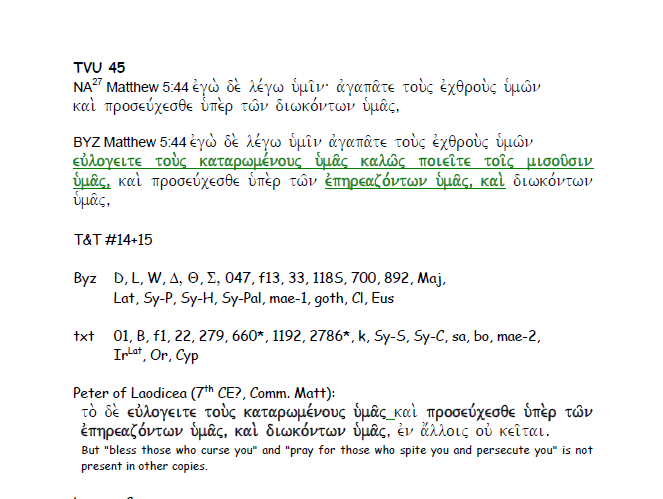
Willker’s full critical and Byzantine text comparison:
Reading the Byzantine text: ἐγὼ δὲ λέγω ὑμῖν, Ἀγαπᾶτε τοὺς ἐχθροὺς ὑμῶν, εὐλογεῖτε ὑμᾶς ὑμᾶς ὑμᾶς ποιεῖτε τοῖς καὶ διωκόντων ὑμᾶς But I say to you, love your enemies, bless those who curse you, do good to those who hate you, and pray for those who despitefully use you and persecute you.
The reading of the Byzantine text is attested to by: D, L, W, D, Q, S, 047, f13, 33, 118S, 700, 892, Maj, Lat, Sy-P, Sy-H, Sy-Pal, mae-1, goth, Cl, Eus.
The critical text reading is attested to by: txt 01, B, f1, 22, 279, 660*, 1192, 2786*, k, Sy-S, Sy-C, sa, bo, mae-2, IrLat, Or, Cyp.”
Philip Comfort
New Testament Text and Translation Commentary, Philip W. Comfort
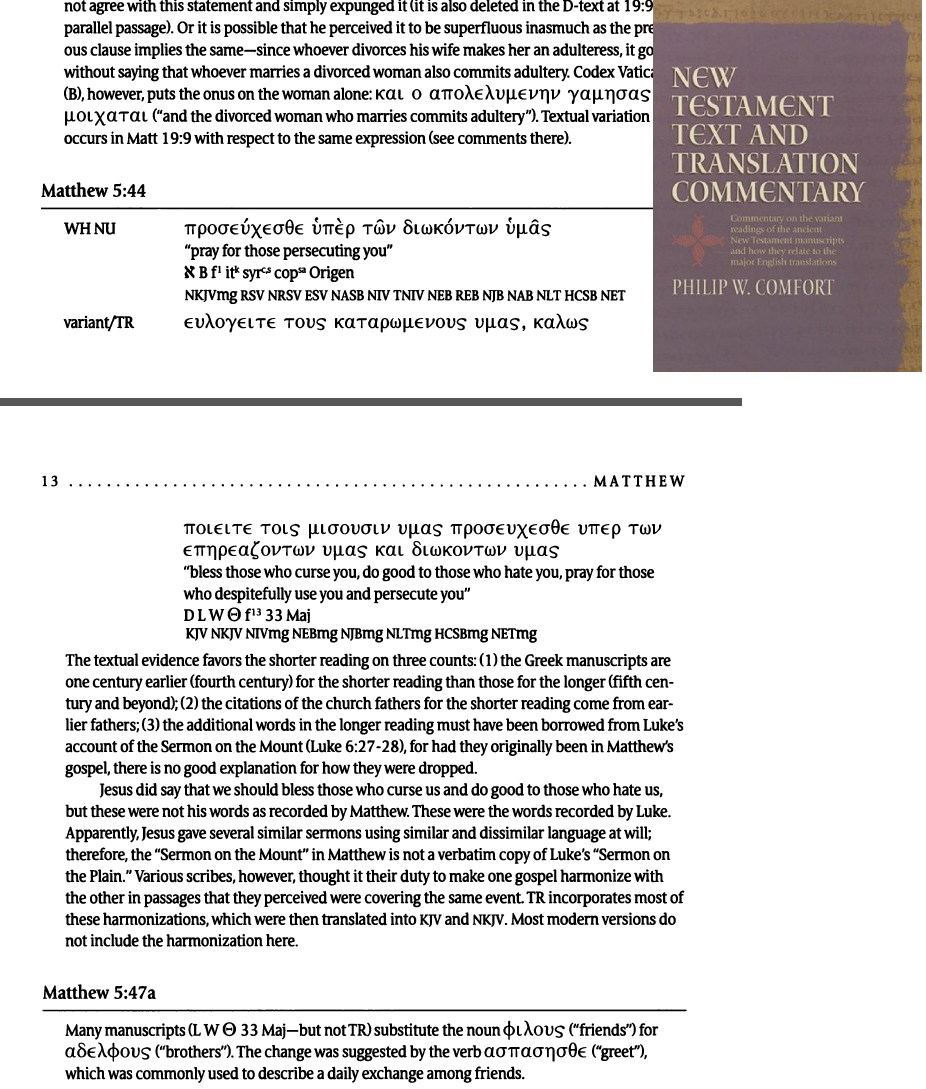
- The Greek manuscripts that testify to the short reading date back to the fourth century, while the Greek evidence for the long reading dates back a full century to the fifth century.
- The patristic evidence in favor of the shorter reading is earlier than that of the longer reading.
- The added parts are certainly taken from Luke 6:27-28. So, if the long reading is the correct one, there is no justification for omitting them.
Jesus actually said, ‘Bless those who curse you, do good to those who hate you,’ but not in the Gospel of Matthew.”
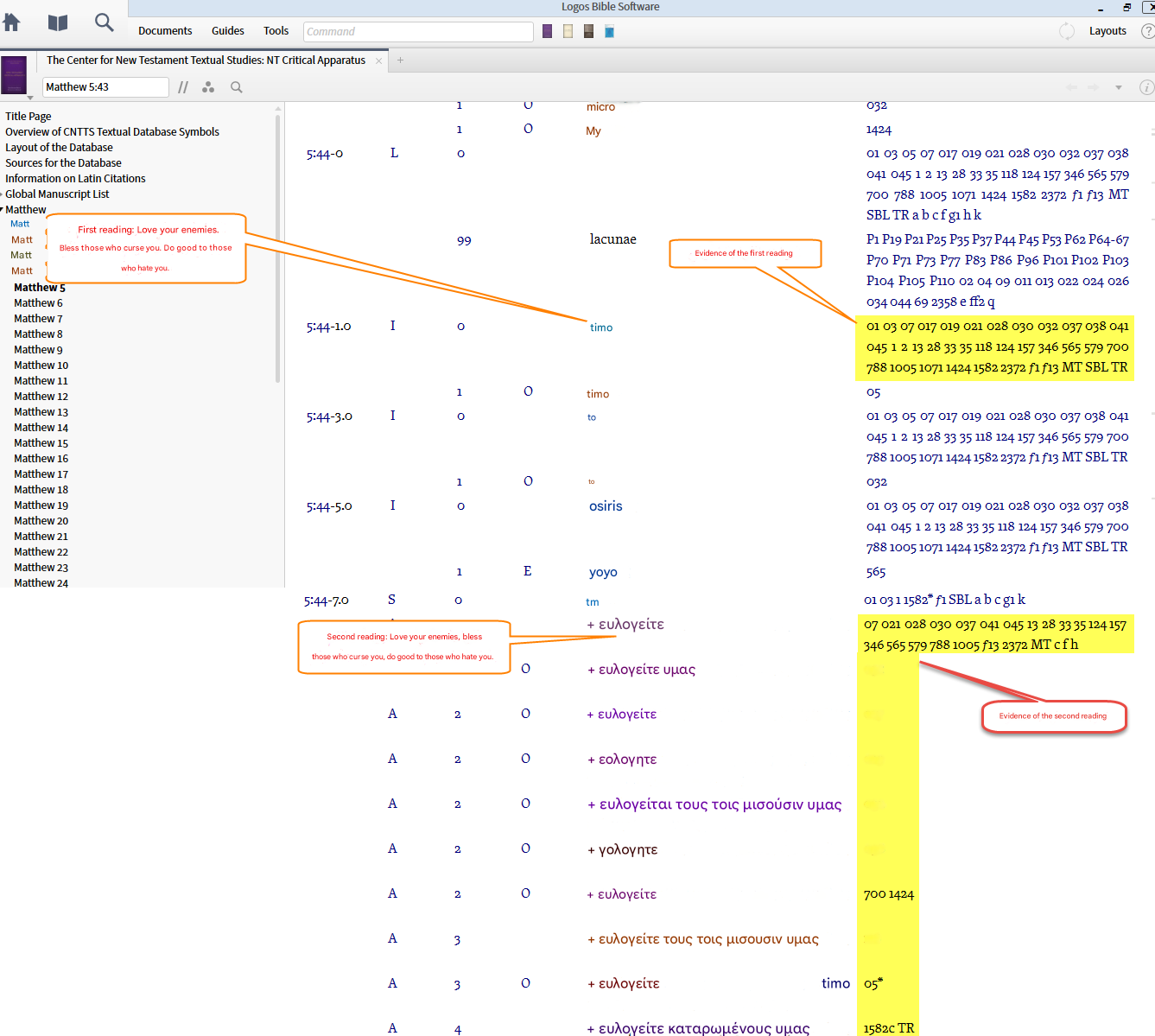
CNTTS Critical Apparatus
H. Milton Haggard Center for New Testament Textual Studies. (2010). NT Critical Apparatus (Mt 5:44). New Orleans Baptist Theological Seminary.
Three Questions for Christians
-
Does a Christian have a single critical edition that testifies in favor of reading the addition? — No. Every critical edition — NA27, UBS GNT5, Westcott-Hort, Tischendorf, Von Soden — chooses the short reading.
-
Does a Christian have a critical commentary by a textual critic who has testified in favor of the longer reading? — No. Metzger, Willker, and Comfort are unanimous in rejecting the additions.
-
Does a Christian have a manuscript older than the Sinaiticus and Vaticanus for Matthew 5:44? — No. The Sinaiticus and Vaticanus are the oldest witnesses to this verse, and both give the short reading. (The Christian must rely on dates approved by textual criticism scholars — not invented dates.)
There are no manuscripts older than the Sinaiticus and Vaticanus that attest to this verse, and they give the deletion. They are supported by evidence from the oldest Syriac, Latin, and Coptic traditions.
The additions “bless those who curse you, do good to those who hate you, pray for those who spitefully use you” were taken from Luke 6:27-28 and inserted into Matthew 5:44 by later scribes who wished to harmonize the two Gospel accounts — the same scribal tendency documented across the entire New Testament textual tradition.
Conclusion
The existence of five competing textual forms — each with different combinations of clauses — proves tahrif, regardless of which form is original. A text that claims to be the word of God cannot have five simultaneous competing forms across its manuscript tradition. The occurrence of this corruption in the fifth century, during the time of dissemination, raises the question: what occurred in the first century, during the dark early period when the text was a local endemic document with no widespread dissemination to protect it?
...rtion|John 5:4 Is Not in the Bible: Manuscript Evidence Exposes a Major New Testament Distortion]]