

Matthew 17:21 Prayer and Fasting — Entire Verse Absent from Sinaiticus, Vaticanus, and All Major Critical Editions
Context — Four Fasting Texts in the New Testament
- Mark 9:29 — the word “fasting” is omitted from the best Greek and Latin witnesses.
- Matthew 17:21 — the entire verse is omitted from the best ancient evidence (this note).
- Luke 2:37 — the word “fasting” is omitted from the best evidence.
- 1 Corinthians 7:5 — the word is omitted from the best evidence.
The pattern is consistent: scribes added fasting-related content to multiple Gospel and epistle passages in a documented effort to promote ascetic practice.
The Verse Under Study
In Greek (Byzantine text):
BYZ Matthew 17:21 νηστείᾳ. (τοῦτο δὲ τὸ γένος οὐκ ἐκπορεύεται εἰ μὴ ἐν προσευχῇ καὶ νηστείᾳ.)
The entire verse is absent from the oldest manuscripts of the New Testament across every language. It was added by later copyists from the parallel passage in Mark 9:29, where the same saying appears in a different context.
The Oldest Manuscripts — The Verse Is Absent
The verse is deleted from the oldest witnesses across four languages:
Greek manuscripts:
- Sinaiticus (4th century) — deleted from the original text; added in the margin by a late copyist
- Vaticanus (4th century) — deleted
- Theta manuscript (9th century) — deleted
- Four additional late Greek manuscripts — deleted
Latin manuscripts:
- Manuscript e (Platinus) — late 4th century — deleted
- Manuscript ff1 — 8th to 11th century — deleted
Syriac manuscripts:
- Sinaitic Syriac — 4th century — deleted
- Curitonianus Syriac — 5th century — deleted
Coptic manuscripts:
- Sahidic (Upper Egyptian) Coptic — deleted
- Bohairic Coptic — deleted
Other versions:
- Ethiopian manuscripts — deleted
- Georgian manuscripts — deleted
The Interlinear and Uncial Text
The interlinear Greek-Arabic text of Matthew 17:21:
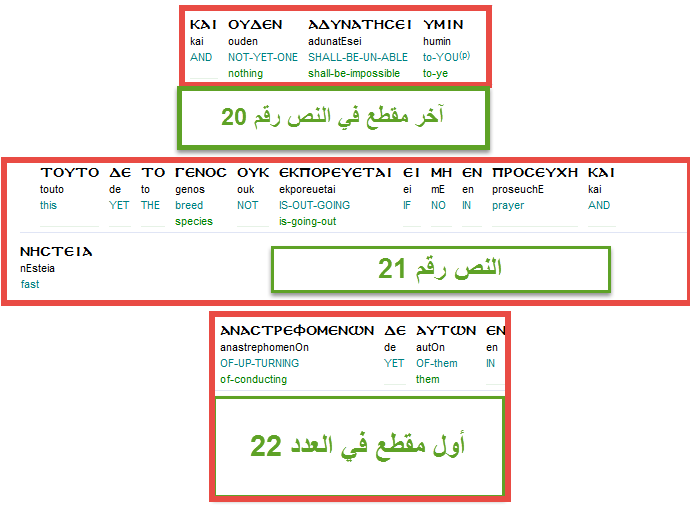
The text in capital letters (uncial script) — the form in which early Greek manuscripts are written:
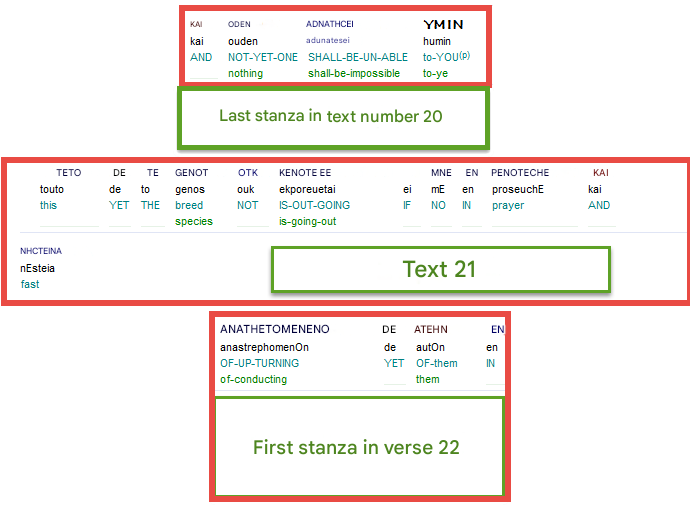
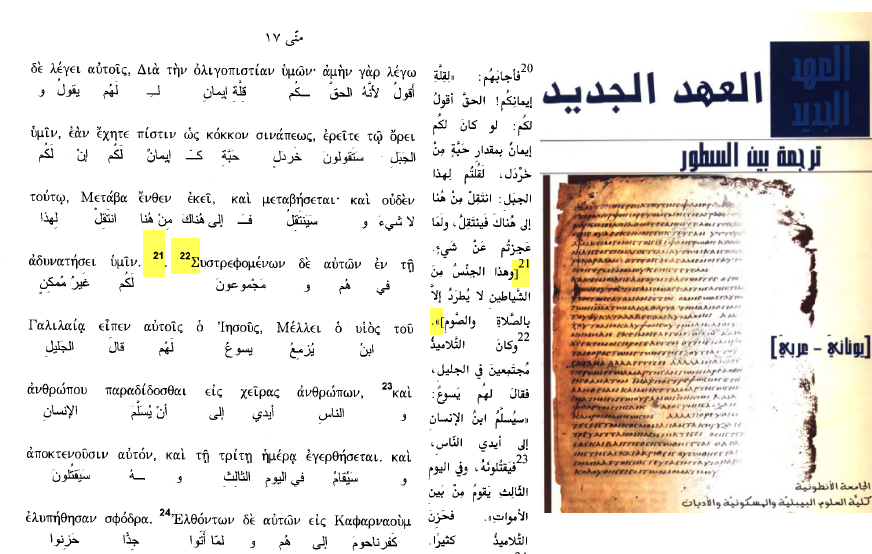
The Paul Al-Feghali Greek-Arabic interlinear translation also confirms the deletion reading as the base text:
Sinaiticus — Deleted from the Original, Added in the Margin by a Later Copyist
The Sinaiticus manuscript is particularly instructive: the original scribe did not include Matthew 17:21. A late copyist — what textual critics call a “corrector” — subsequently added the verse in the margin of the manuscript.
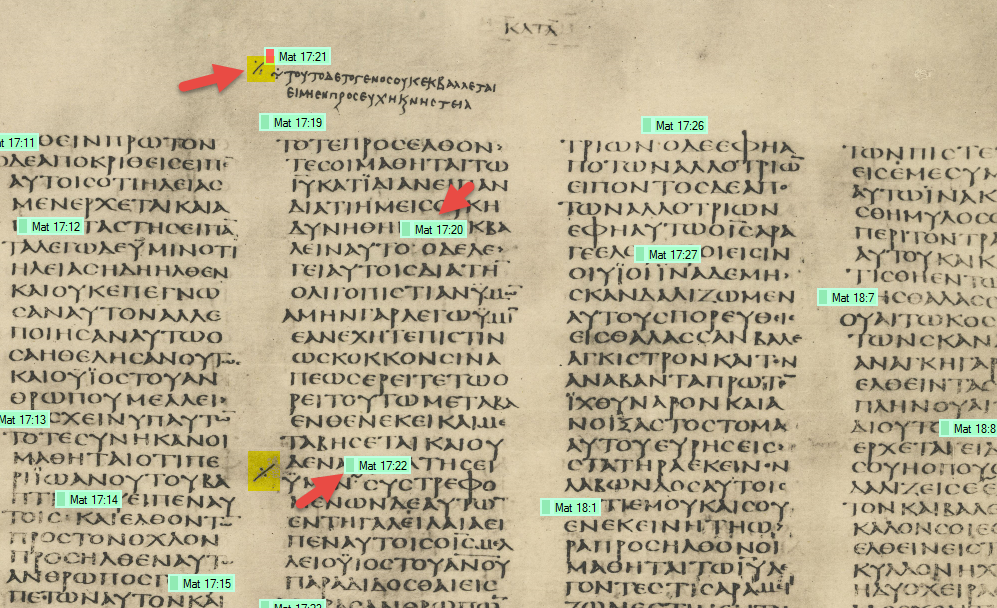
The UBS committee’s notation system distinguishes the original reading of a manuscript (marked with *) from readings introduced by later correctors (marked with superscript numbers 1, 2, or 3 according to the date of correction). Therefore:
- א* (Sinaiticus original hand) = deletion reading — the verse is absent
- א² (Sinaiticus corrector) = addition reading — the verse was added later in the margin
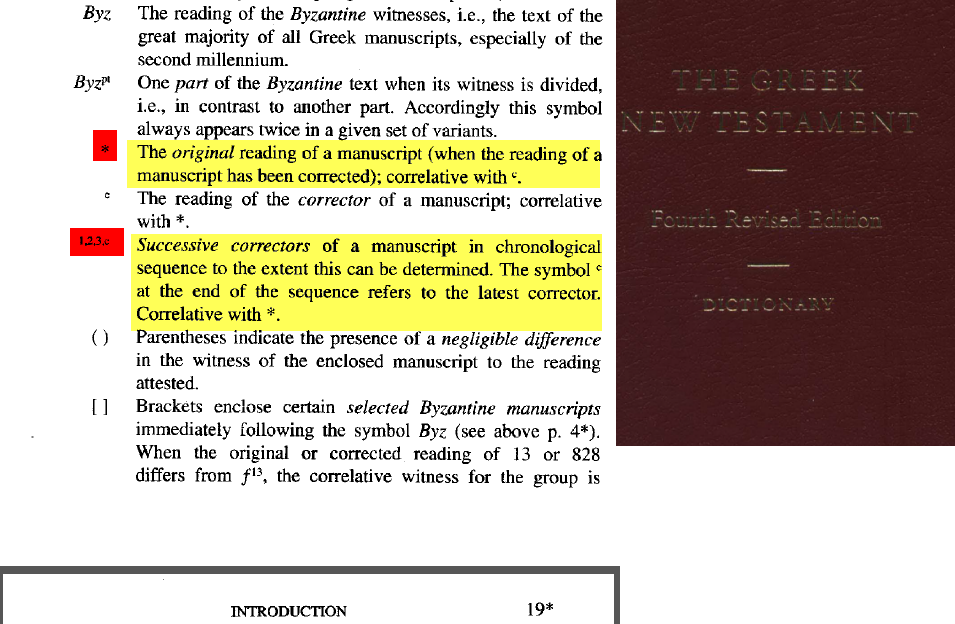
The fact that the corrector added the verse in the margin — not in the main text — shows that even the corrector recognized it as supplementary material, not as restoring an accidentally omitted original.
Vatican Manuscript — The Verse Is Deleted
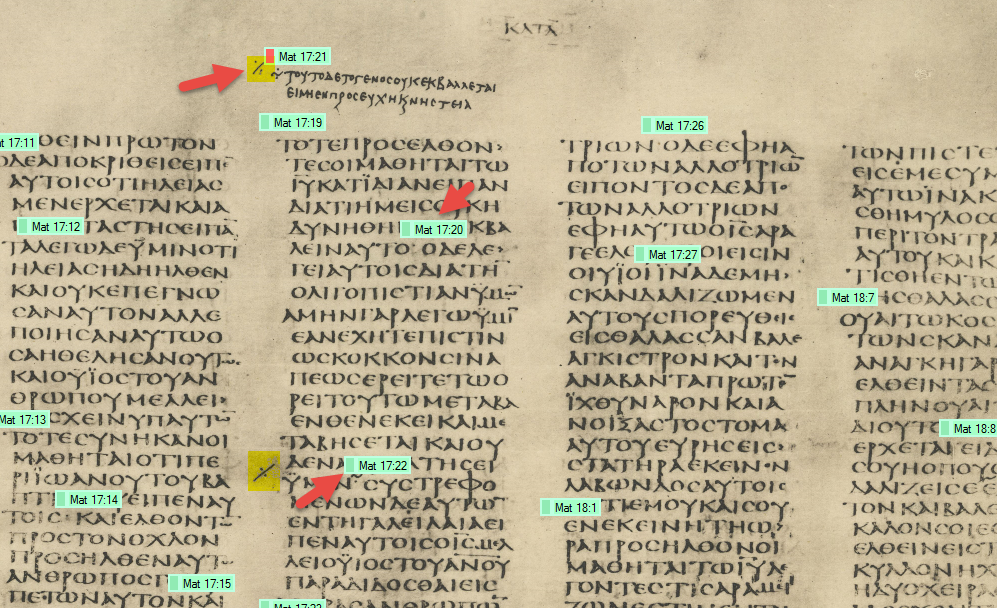
The Vatican Codex — the other of the two most important Greek manuscripts of the New Testament — does not contain Matthew 17:21. The text moves directly from verse 20 to verse 22.
Upper Egyptian Coptic — Deleted
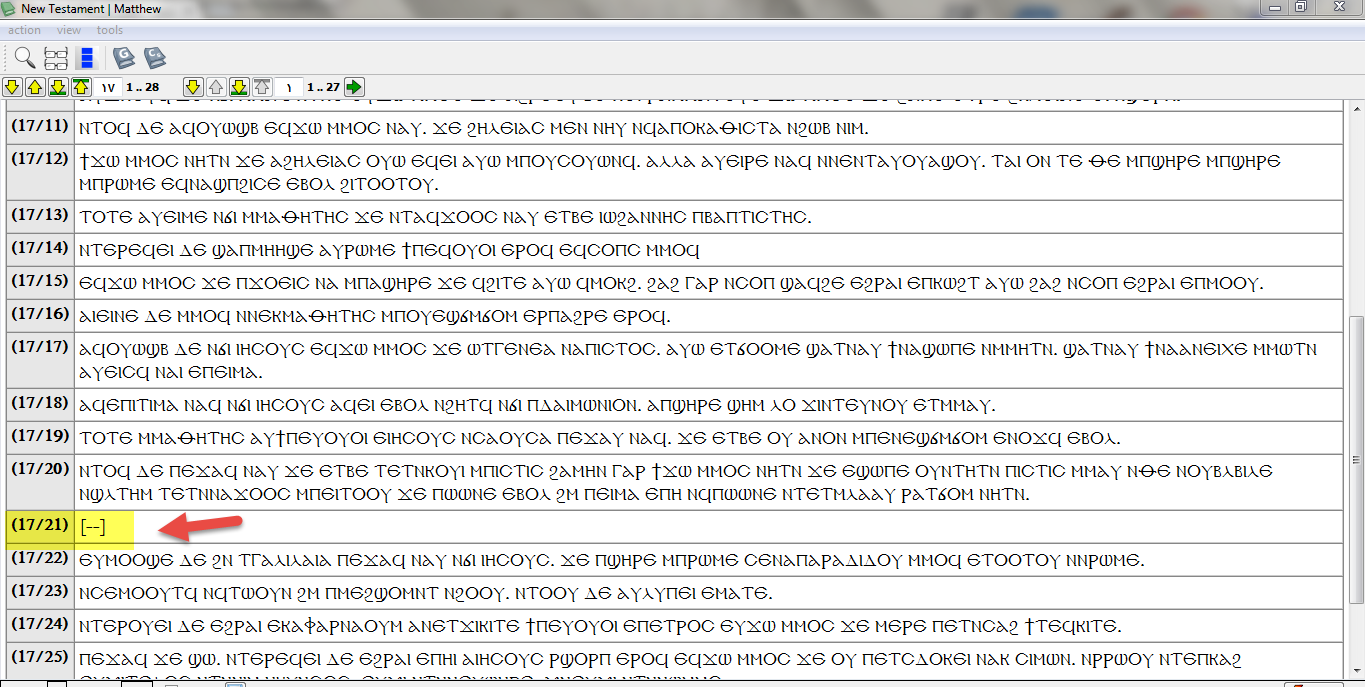
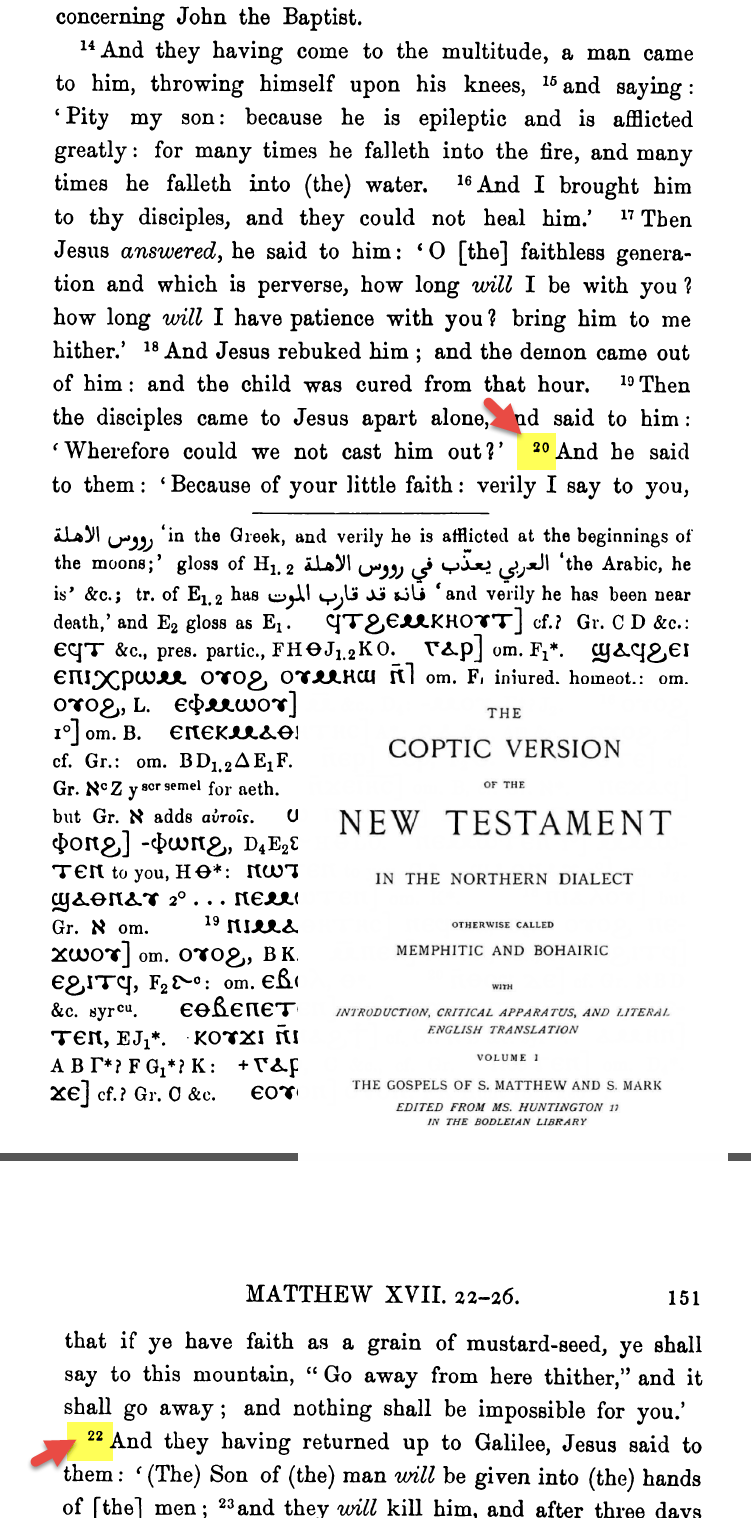
Bohairic Coptic — Deleted
The Coptic Version of the New Testament in the Northern Dialect:
Syriac Sinaiticus and Syriac Curitonianus — Deleted
Transcription of the two manuscripts (browse at http://www.dukhrana.com/peshitta/index.php):
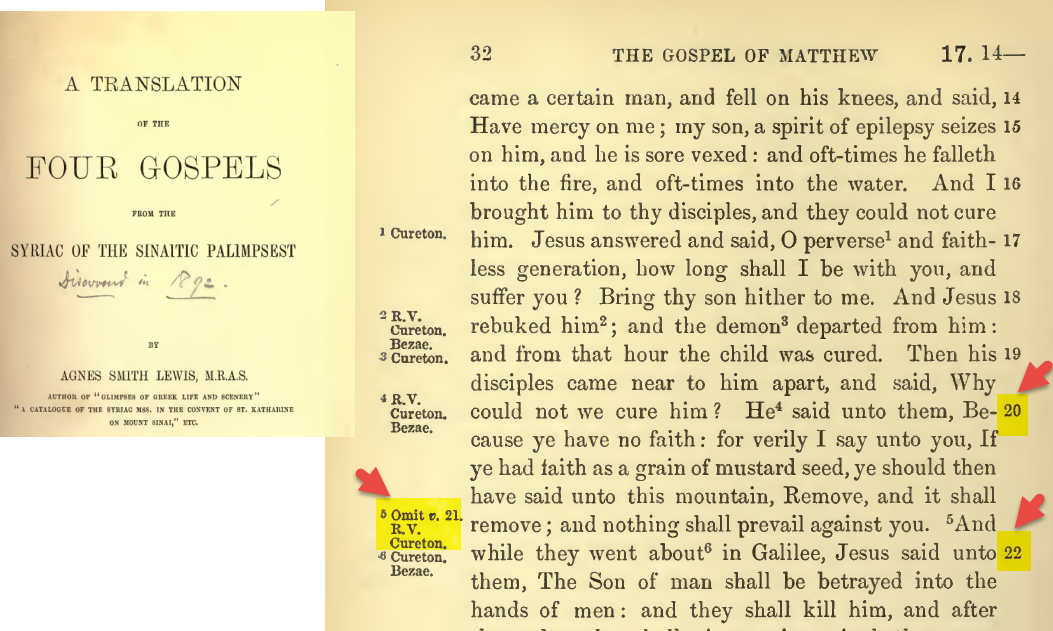
Arabic Versions Compared
Link to browse Arabic translations: http://www.albishara.org/page.php?view=arabiccomper
Arabic translations that include the verse:
- Van Dyke: “But this kind does not go out except by prayer and fasting.”
- Simplified: “But this type can only be removed by prayer and fasting.”
- Jesus Translation: “This kind of devil can only go out by prayer and fasting.”
- Catholic: “This kind of devil does not go out except by prayer and fasting.”
Arabic translations that place the verse in brackets (indicating inauthenticity):
- Common Arabic: “This kind of demons cannot be expelled except by prayer and fasting.”
The Common Arabic Translation’s footnote states: “This verse is not found in most ancient manuscripts.”


The commentary of the joint Arabic translation:

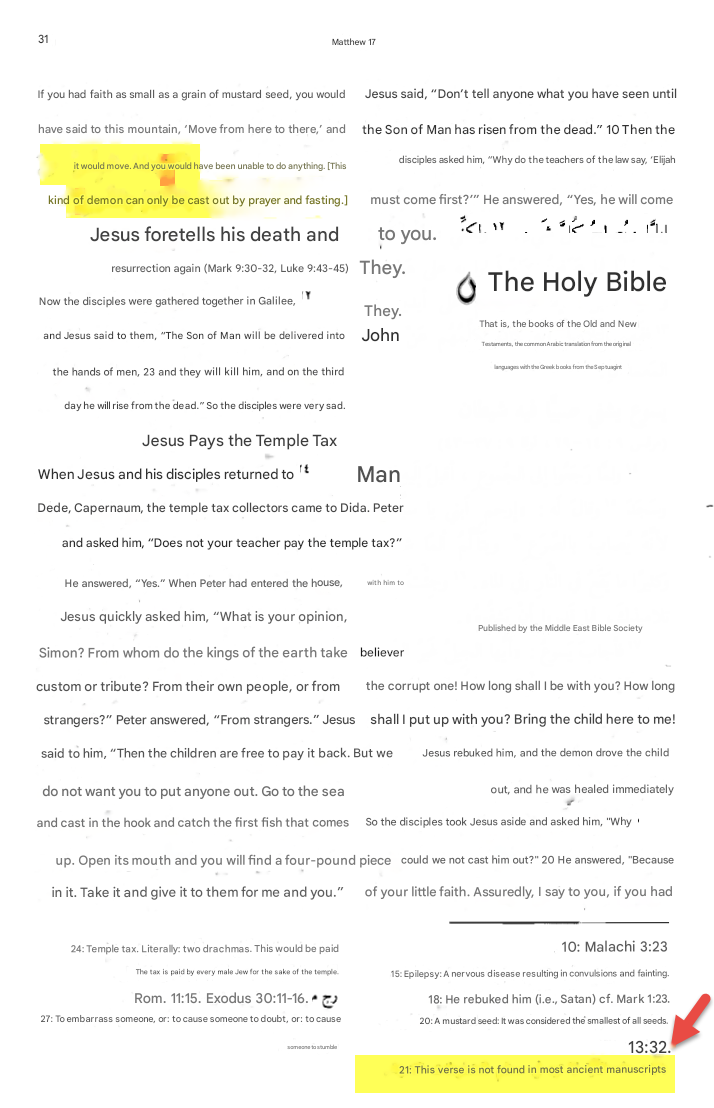
English Versions Compared
20 translations delete the verse entirely (the verse number does not appear):
BBE, CEB, CJB, ERV, LEW, NAB, NABO, NIB, NIRV, NIV, NJB, MIT, RSV, NLT, NET, NRS, TNIV — and several others.
17 translations include the verse:
ASV Matthew 17:21 — But this kind goeth not out saved by prayer and fasting.
DBY Matthew 17:21 — But this kind does not go out but by prayer and fasting.
DRA Matthew 17:20 — But this kind is not cast out but by prayer and fasting.
ETH Matthew 17:21 — But this kind goes not forth but by fasting and by prayer.
GNV Matthew 17:21 — Howbeit this kind goeth not out, but by prayer and fasting.
KJG Matthew 17:21 — Howbeit this kind goeth not out but by prayer and fasting.
KJV Matthew 17:21 — Howbeit this kind goeth not out but by prayer and fasting.
MGI Matthew 17:21 — But this kind does not go out, except by fasting and by prayer.
MRD Matthew 17:21 — But this kind goeseth not out, except by fasting and prayer.
YLT Matthew 17:21 — and this kind doth not go forth except in prayer and fasting.
(And others including NKJ, RWB, PNT, WEB, TNT, etc.)
2 translations place the verse in brackets:
- CSB Matthew 17:21 — [However, this kind does not come out except by prayer and fasting.]
- CSBO Matthew 17:21 — [However, this kind does not come out except by prayer and fasting.]
BibleGateway and Bible Study Tools browsing links:


Greek Critical Editions
Link to browse critical editions: https://www.academic-bible.com/en/home/scholarly-editions/greek-new-testament/greek-new-testament/
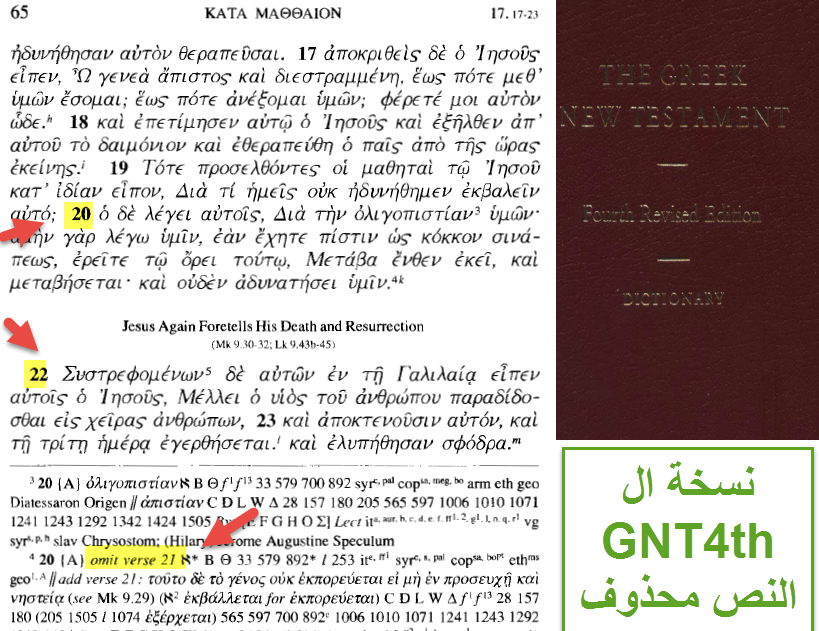
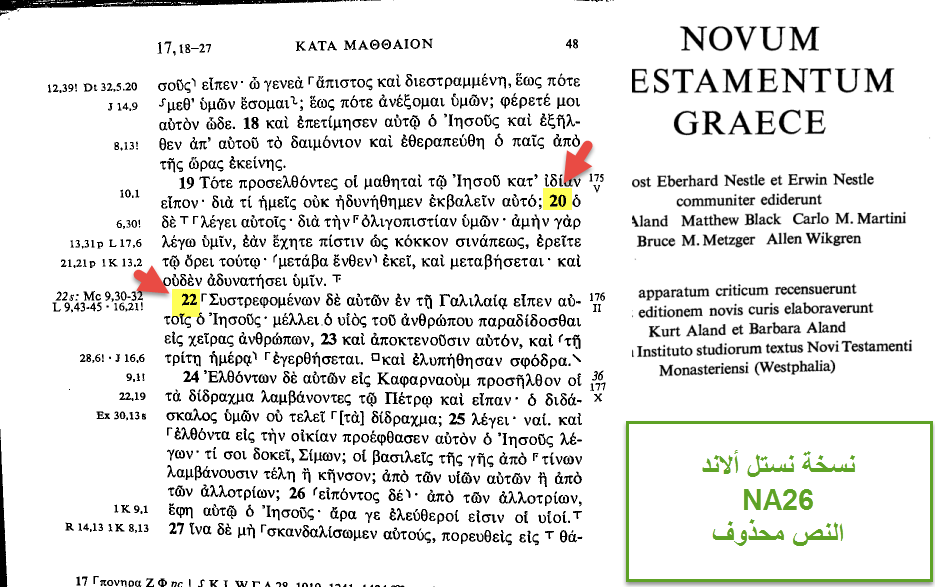
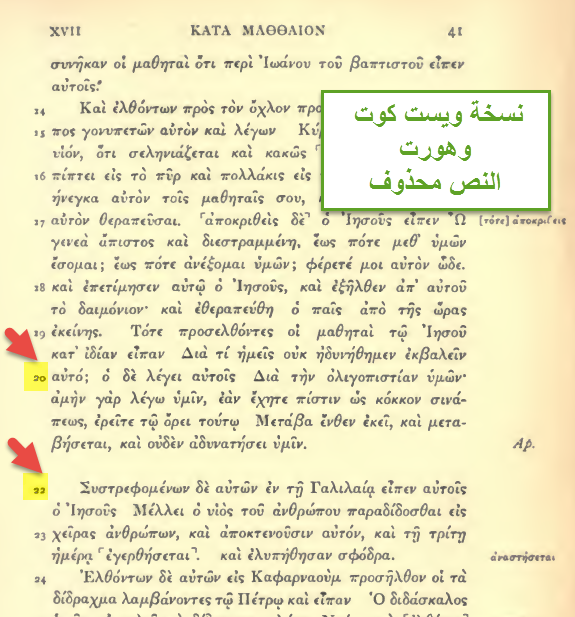
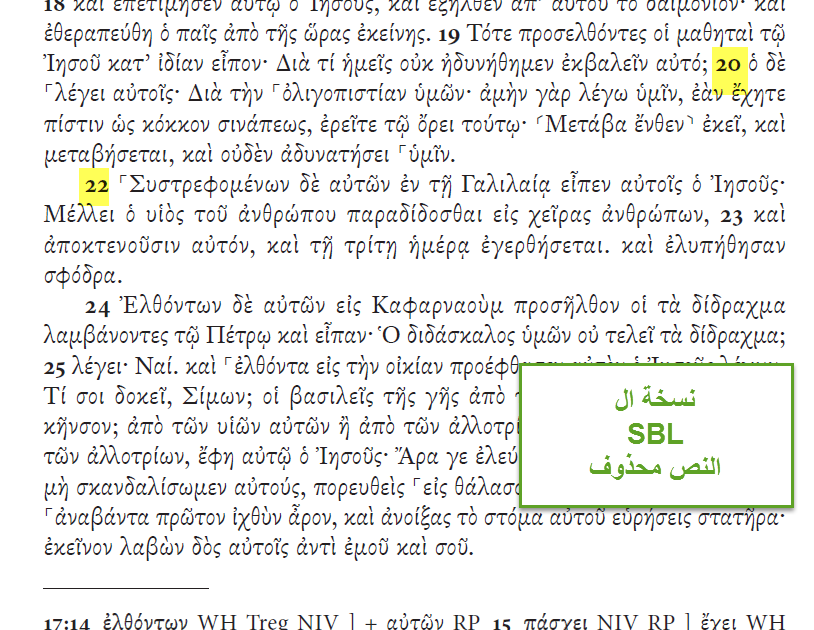
The verse is deleted from all critical editions:
- UBS GNT 4th edition
- Nestle-Aland NA28
- Samuel Tregelles
- Westcott and Hort
- Tischendorf (Chandrov)
- Von Soden
- SBL version
1. GNT 4th edition:
2. Nestle-Aland NA28:
3. Samuel Tregelles:
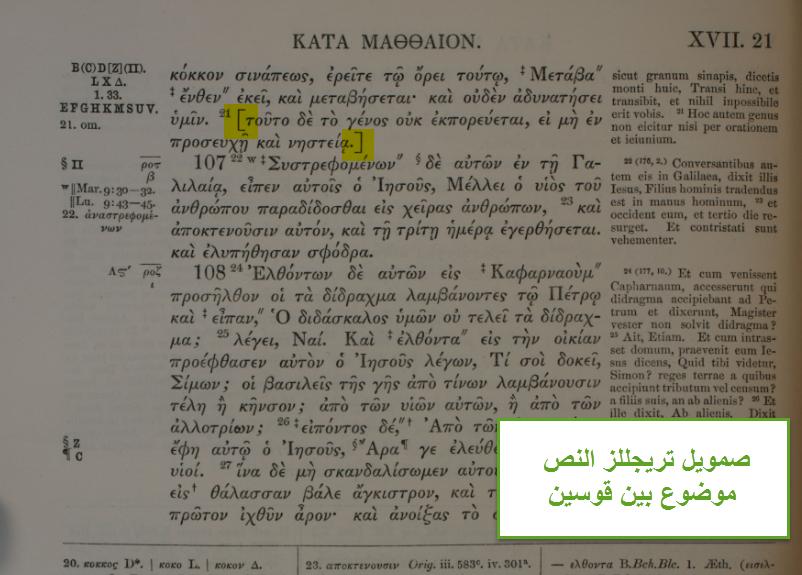
4. Westcott and Hort:
5. SBL version:
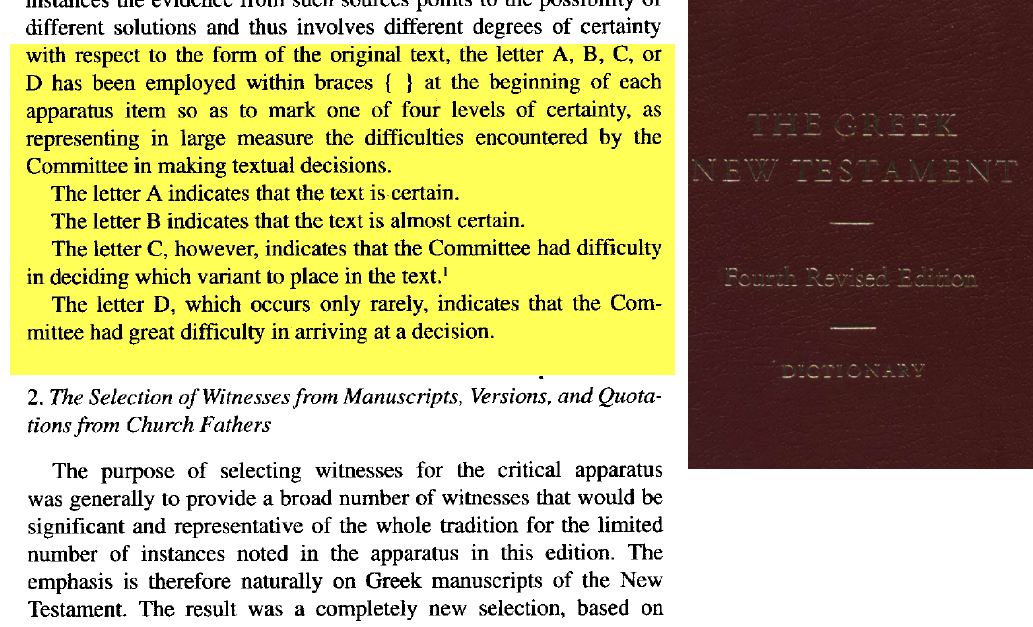
UBS Committee Decision — Grade A Deletion
The UBS committee image showing the full apparatus for Matthew 17:21:
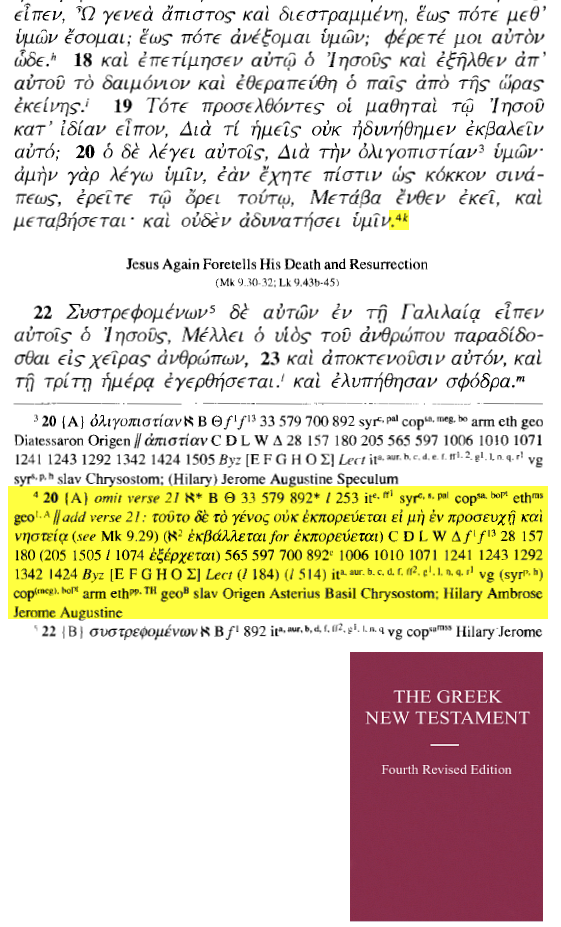
The committee chose to read the deletion with a grade of {A} — meaning they are absolutely certain their choice is correct.
Manuscripts testifying to the deletion reading:
- Sinaiticus (original hand, א*) — 4th century
- Vaticanus — 4th century
- Theta manuscript — 9th century
- Four late Greek manuscripts
- Latin manuscript e (Platinus) — late 4th century
- Latin manuscript ff1 — 8th to 11th century
- Syriac Sinaiticus — 4th century
- Syriac Curitonianus — 5th century
- Upper Egyptian Coptic (Sahidic)
- Bohairic Coptic
- Ethiopian manuscripts
- Georgian manuscripts
Manuscripts testifying to the addition reading:
- Sinaiticus corrector (א²) — a later copyist added the text in the margin of the original
- Ephraimite Codex — 5th century
- Washingtonianus — late 4th / early 5th century
- Bezae Codex — 5th century
- Several other late Greek manuscripts
- Latin manuscript a — late 4th century
- Other Latin manuscripts from after the 5th century
- A late Middle Egyptian Coptic manuscript
- Several patristic citations
The UBS committee image with the Sinaiticus corrector notation:


What the Scholars Said
Bruce Metzger
A Textual Commentary on the Greek New Testament
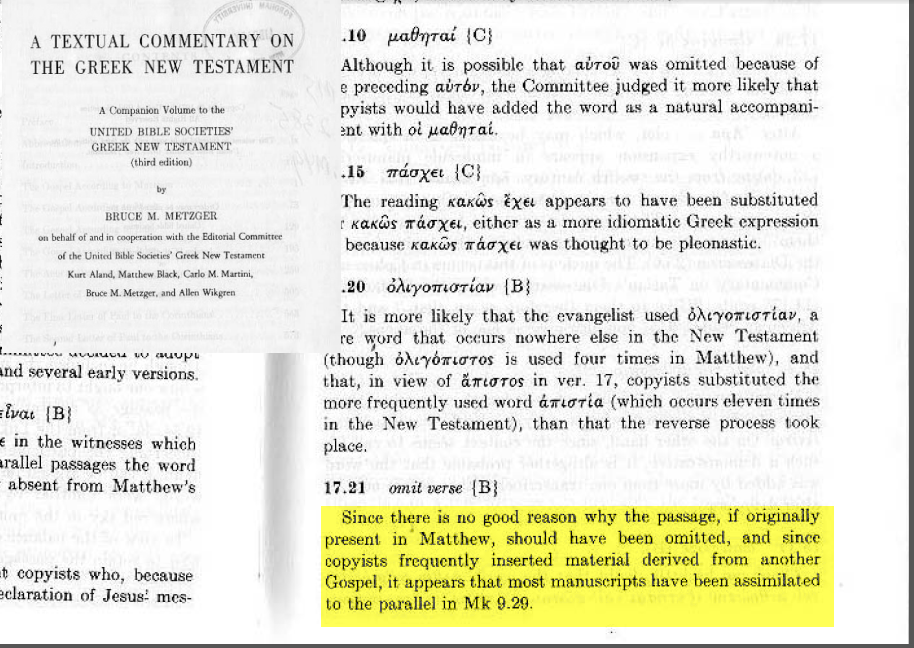
NET Bible
NRSV Marginal Note
The New Revised Standard Version at Matthew 17:20 states:
“Other ancient authorities add verse 21: But this kind does not come out except by prayer and fasting.”
The NRSV places the entire verse as a marginal note — not in the main text — confirming it is not considered original.
NIV Marginal Note
The New International Version at Matthew 17:21 states:
“Some manuscripts include here words similar to Mark 9:29.”
NABRE Marginal Note (New American Bible Revised Edition)
“Some manuscripts add, ‘But this kind does not come out except by prayer and fasting’; this is a variant of the better reading of Mk 9:29.”
Wieland Willker
Willker began his comment on the problem with the phrase “a difficult problem” — then presented the evidence in full.
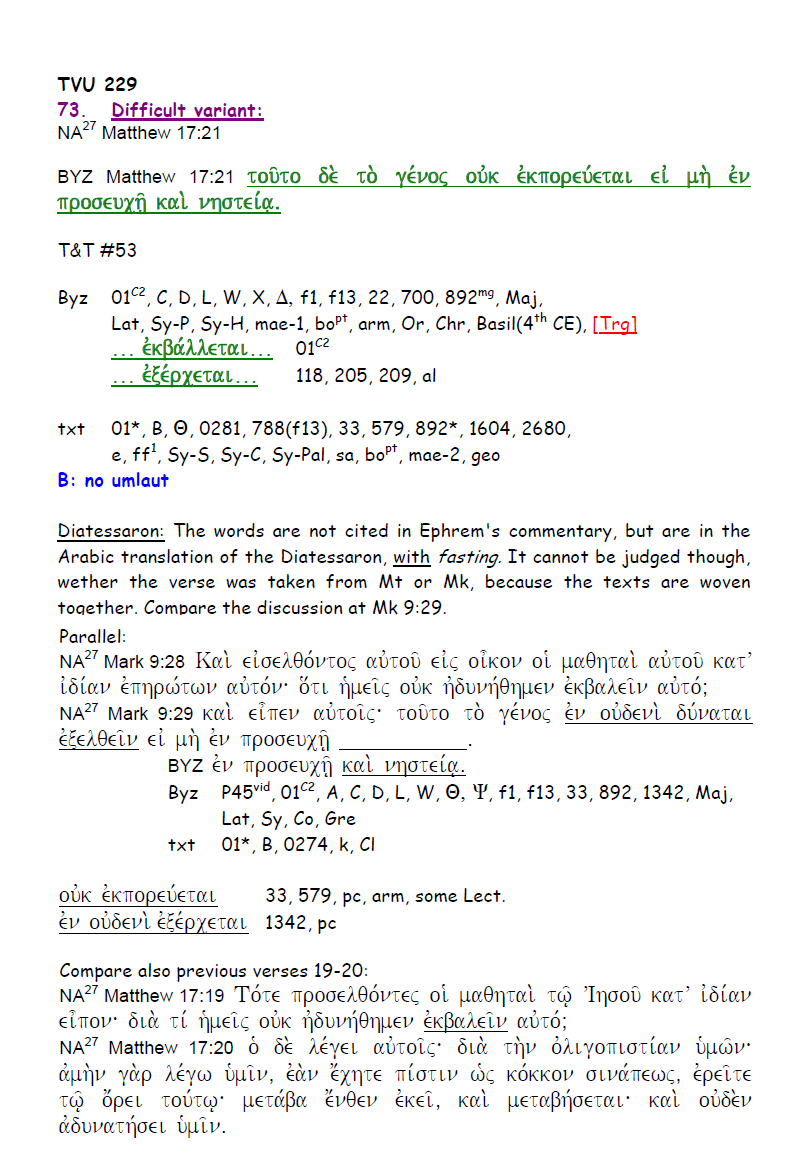
Willker noted that the oldest evidence for the critical text is from the fourth century at all levels — Sinaiticus Greek, Vaticanus, Sinaitic Syriac, and Latin e — as well as the Sahidic Coptic. The oldest Byzantine evidence is Washingtonianus from the late fourth and early fifth centuries, and the Syriac and additional Coptic evidence is later.
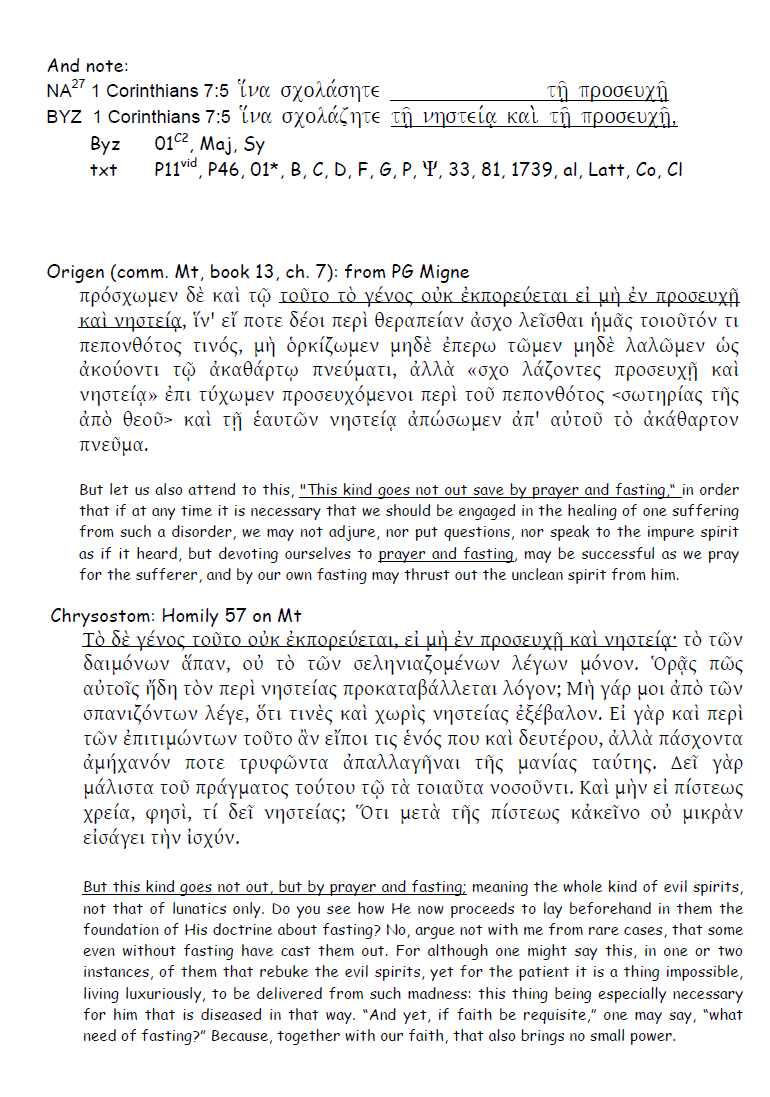
Willker commented on the Diatessaron evidence:
“This text was not mentioned by Ephraim the Syrian in his commentary, but the Arabic translation of the Diatessaron says ‘with fasting.’ However, we cannot know whether this text or Mark 9:29 is meant.”
Willker then noted that Origen uses the phrase “This kind can only go out through prayer and fasting” — but it is clear Origen is speaking of Mark 9:29, where the “unclean spirit” is mentioned, and this context is not present in Matthew 17:21. The same applies to John Chrysostom.
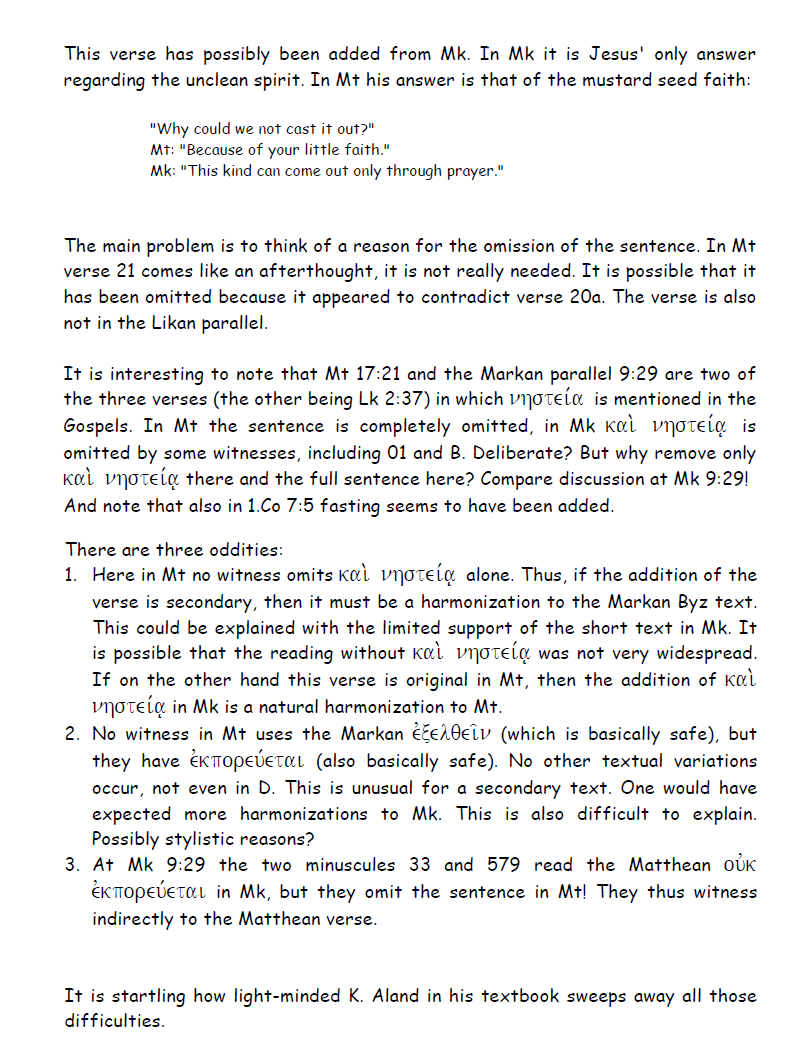
Willker then noted three unusual features:
-
The textual evidence in Matthew does not use the Greek word εξελθειν (goes out) that Mark’s text uses, but rather the word εκπορευεται (goes out). There are no other textual differences, not even in the Beza manuscript, and this is something unusual for a forged reading, as we would have expected more attempts at homogenization with Mark. It is difficult to interpret this matter.
-
There are two manuscripts (33) and (579) that write the text of Mark 9:29 using the Matthean word εκπορευεται (goes out), and they delete the text of Matthew 17:21. Thus, they are an indirect witness to the text.
This text may have been added from Mark. The main problem is: What is the reason for deleting the text from Matthew? In Matthew, verse 21 appears to be an unnecessary addendum. It may have been deleted on the basis that it contradicted verse 20.
It is surprising that the word ‘and fasting’ was repeated in the Gospels three times — once here, once in Mark 9:29, and also the text of Luke 2:37. In Matthew the entire text is deleted, in Luke the word ‘fasting’ is omitted from some manuscripts such as the Sinaiticus and Vaticanus. There is also a problem with the text of 1 Corinthians 7:5.”
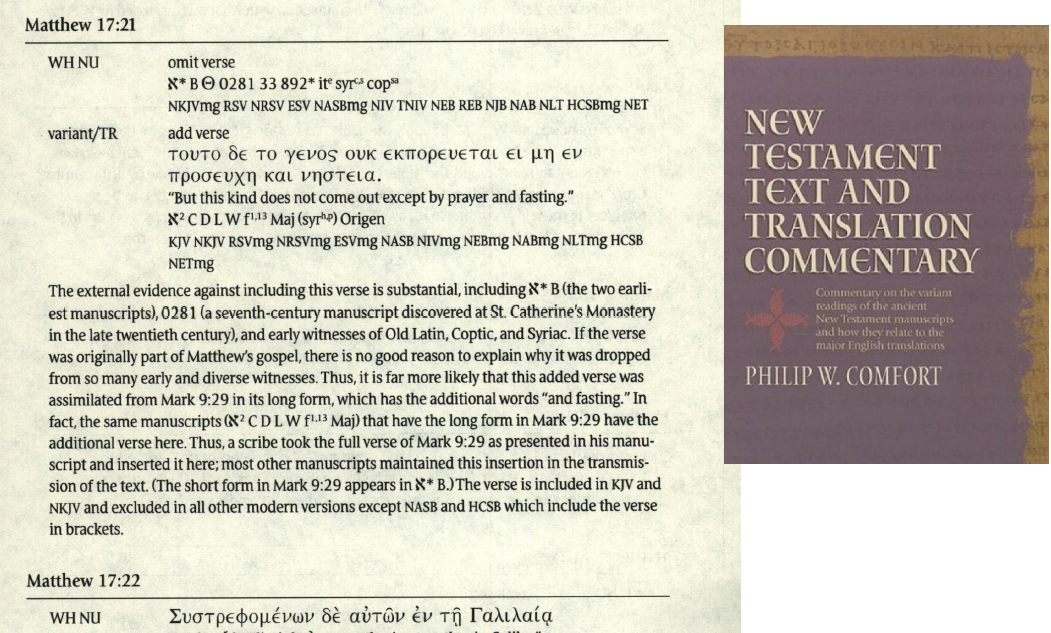
Philip Comfort
New Testament Text and Translation Commentary, Philip W. Comfort
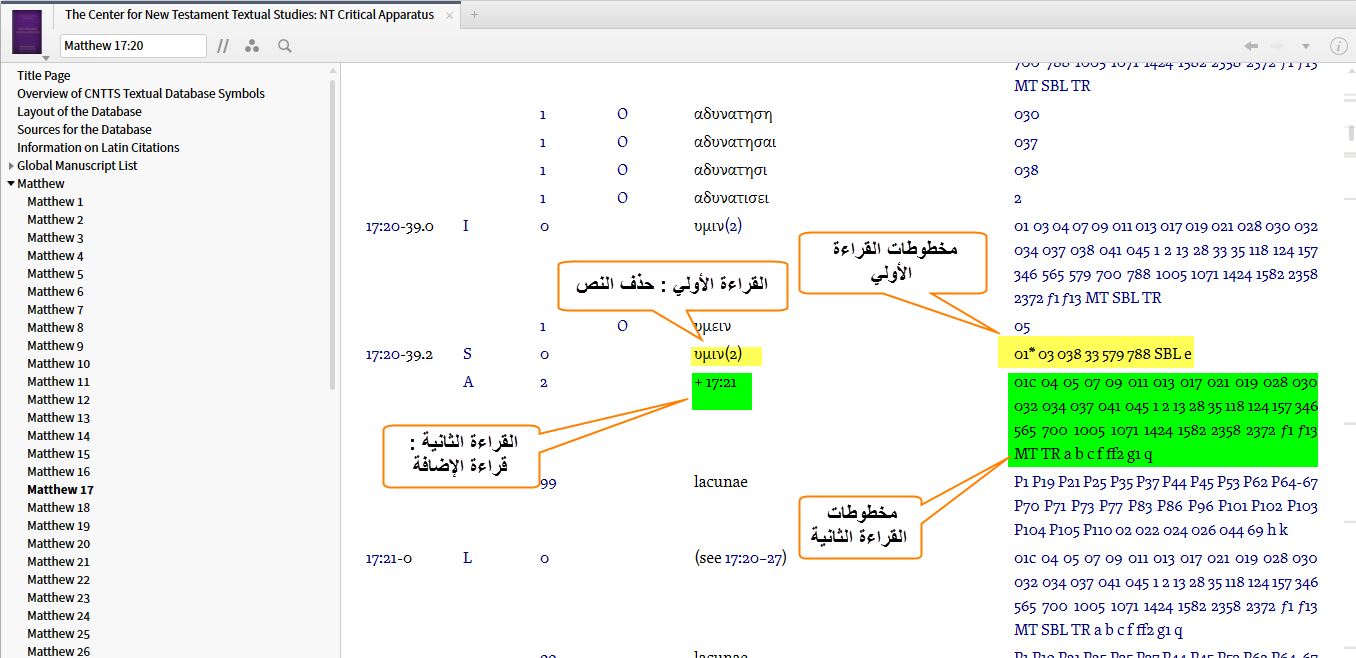
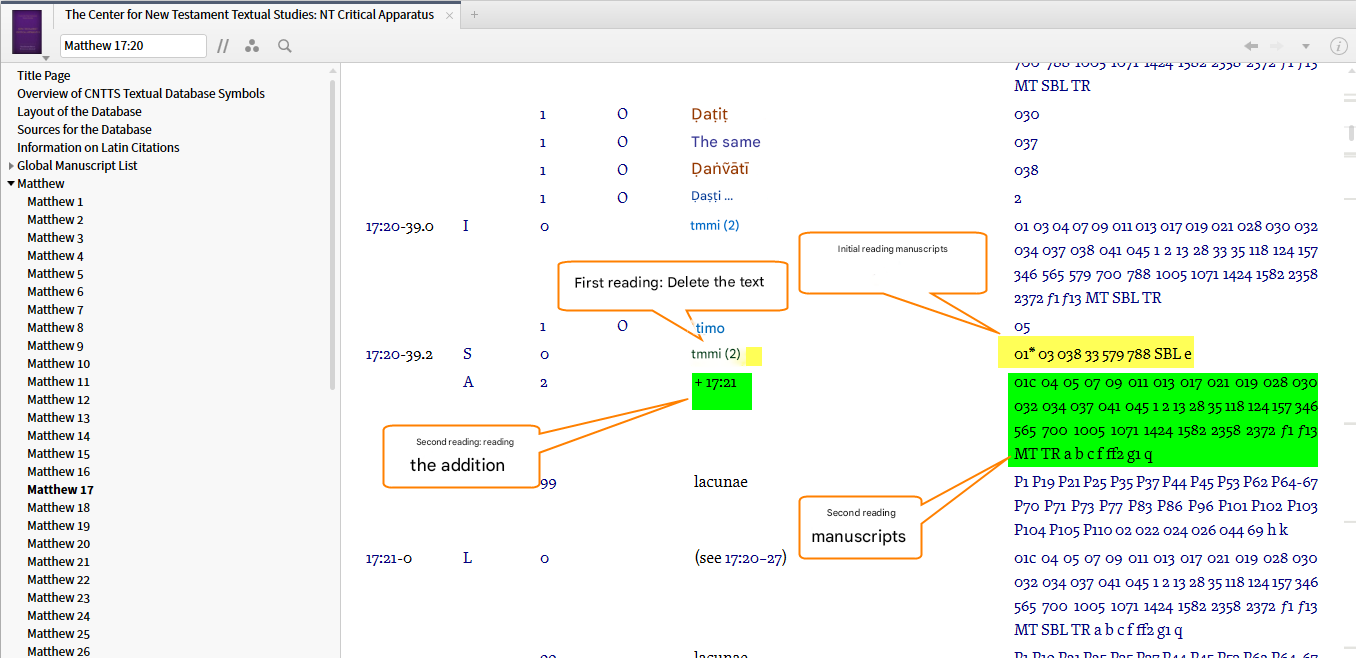
CNTTS Critical Apparatus
H. Milton Haggard Center for New Testament Textual Studies (2010). NT Critical Apparatus (Mt 17:20). New Orleans Baptist Theological Seminary.
Three Questions for Christians
-
Does a Christian have a manuscript from before the fourth century that contains Matthew 17:21? — No.
-
Does a Christian have a critical edition that attests to the authenticity of the text? — No. Every critical edition deletes it with Grade A certainty.
-
Does a Christian have a justification for why the verse would have been deliberately deleted from Sinaiticus, Vaticanus, the Sinaitic Syriac, the Coptic traditions, the Latin e, the Georgian, and the Ethiopian — all independently — if it were original? — No. Metzger, Comfort, and Willker are unanimous: there is no satisfactory explanation for its omission if original.
Conclusion
The source is identified by all scholars: the verse was taken from the parallel passage in Mark 9:29 and inserted into Matthew by scribes who wished to harmonize the two accounts and to promote the ascetic practice of fasting. The same manuscripts that contain the long form of Mark 9:29 (with the word “fasting”) are precisely the manuscripts that contain Matthew 17:21 — confirming the direction of copying.
سُبْحَانَ الَّذِي لَمْ يَتَّخِذْ وَلَدًا وَلَمْ يَكُن لَّهُ شَرِيكٌ فِي الْمُلْكِ وَلَمْ يَكُن لَّهُ وَلِيٌّ مِّنَ الذُّلِّ وَكَبِّرْهُ تَكْبِيرًا
وَآخِرُ دَعْوَانَا أَنِ الْحَمْدُ لِلَّهِ رَبِّ الْعَالَمِينَ
...eaven-a-divinity-proof-text-absent-from-the-two-oldest-papyri-sinaiticus-and-vaticanus|John 3_13]]