

Luke 23:34 Father Forgive Them — Absent from Oldest Manuscripts and Bracketed by All Critical Editions
The Verse Under Study
The Greek text of the disputed portion:
Ὁ δὲ Ἰησοῦς ἔλεγεν “Πάτερ, ἄφες αὐτοῖς· οὐ γὰρ οἴδασιν τί ποιοῦσιν.”
This prayer of Jesus for the forgiveness of those who crucified him places Christians in a critical theological dilemma — one that the copyists themselves recognised and attempted to resolve by deleting the text from the manuscripts entirely.
The Theological Trilemma
The prayer creates a problem on two levels simultaneously: textual and theological.
The Textual Problem: This passage is absent from the oldest and best Greek manuscripts. It appears in some later manuscripts, leading critical scholars to classify it as a later addition.
The Theological Problem: If the text is accepted as original, it generates an immediate contradiction:
- Jesus (as God the Son) prays to God the Father to forgive the Jews who crucified him.
- The Gospels themselves record Jesus threatening the Jews with destruction — and that destruction occurred in 70 CE when Jerusalem and the Temple were razed by the Romans.
- John 11:22 and 11:41–42 affirm that the Father always answers the Son’s prayers: “Father, I thank you that you have heard me. And I knew that you always hear me.”
So the question becomes: did God the Father respond to the prayer of God the Son — or not?
The applied commentary on the Holy Bible states:
“The Lord Jesus asked forgiveness from God the Father for those who crucified him, for the Jewish leaders, the Roman rulers, the soldiers, and the audience. And God answered this prayer by opening a way for salvation even for the killers and crucifiers of Christ.”
But if God answered this prayer — why was Jerusalem destroyed in 70 CE? Why did the very people Jesus prayed for face what Christians themselves call divine punishment?
Manuscript Evidence — The Verse Is Absent from the Oldest Witnesses
By referring to the manuscripts of the Bible, this text is absent from the following papyri and ancient manuscripts:
- 𝔓75 — Papyrus 75 (late 2nd / early 3rd century) — one of the oldest manuscripts we possess
- B (Codex Vaticanus) — 4th century
- D (Codex Bezae, original hand)* — 5th century
- W (Codex Washingtonianus) — 4th–5th century
- Θ (Codex Koridethi) — 9th century
- 070
- 01C1 (Sinaiticus corrector)
- Manuscripts 579, 1241
- Several minuscules (pc)
- Latin manuscript (a)
- Latin manuscript (bC)
- Latin manuscript (d)
- Syriac Sinaiticus (Sy-S)
- Sahidic Coptic (sa)
- Bohairic Coptic (bo)
Jesus’ prayer for forgiveness is absent from Papyrus 75 — the oldest manuscript we have — and from the Vatican and Washington codices.
The prayer is present in some manuscripts — including Sinaiticus (א) in its original hand and the Alexandrian Codex (A) — but these are not the oldest witnesses. The rule of textual criticism is clear: when a reading is absent from the oldest and best manuscripts and present only in later ones, it is to be regarded as a later addition.
The table above, from the critical apparatus, shows the manuscript distribution. The weight of the oldest witnesses is against the prayer’s authenticity.
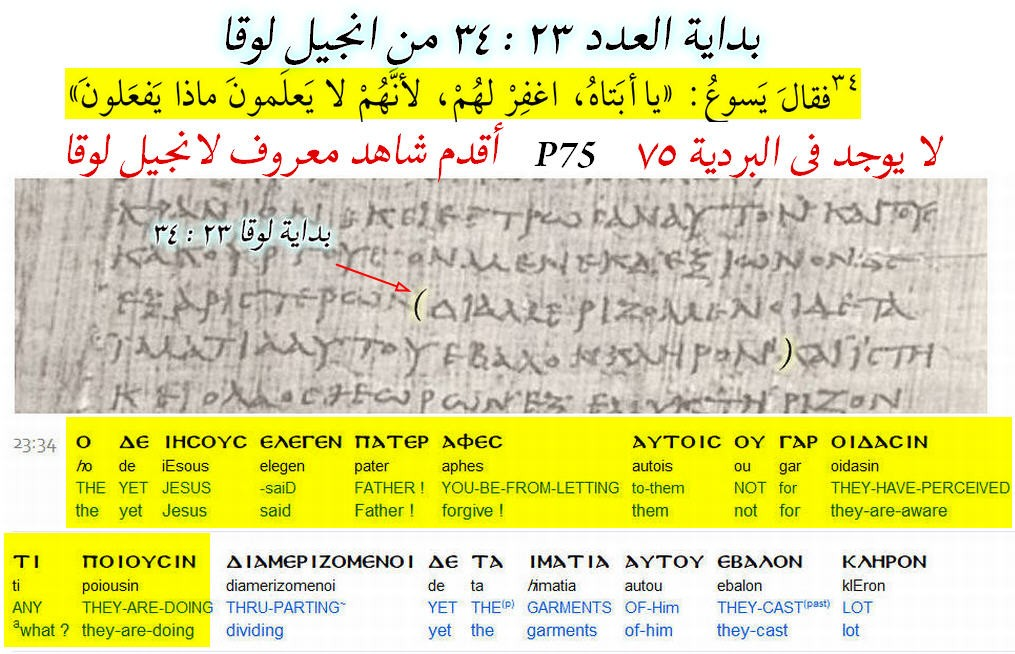
The apparatus shows the prayer absent from P75 and Vaticanus — the two most important manuscript witnesses for the Gospel of Luke.
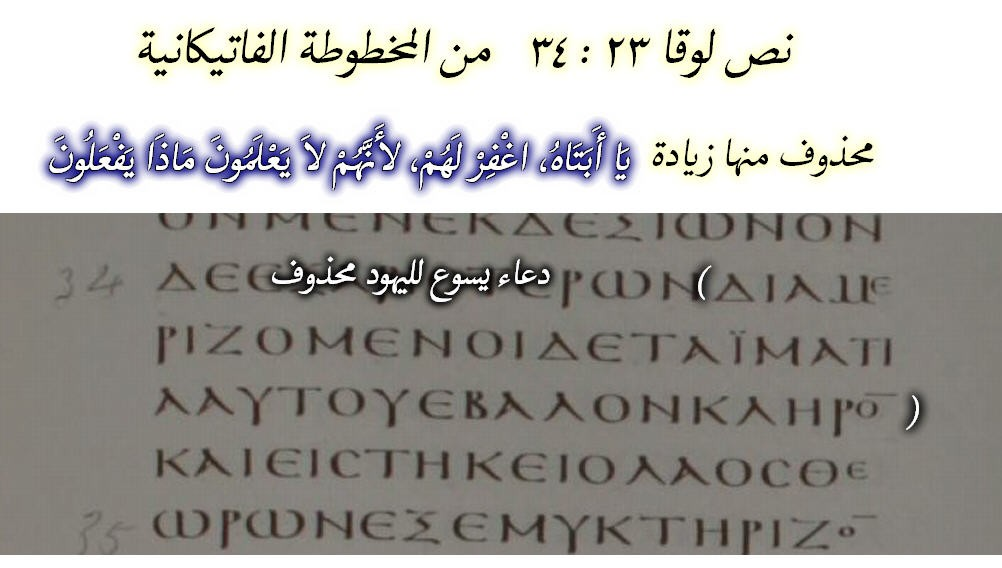
The absence is not a lacuna or damage — the text simply moves from the crucifixion narrative to the dividing of garments without the prayer.
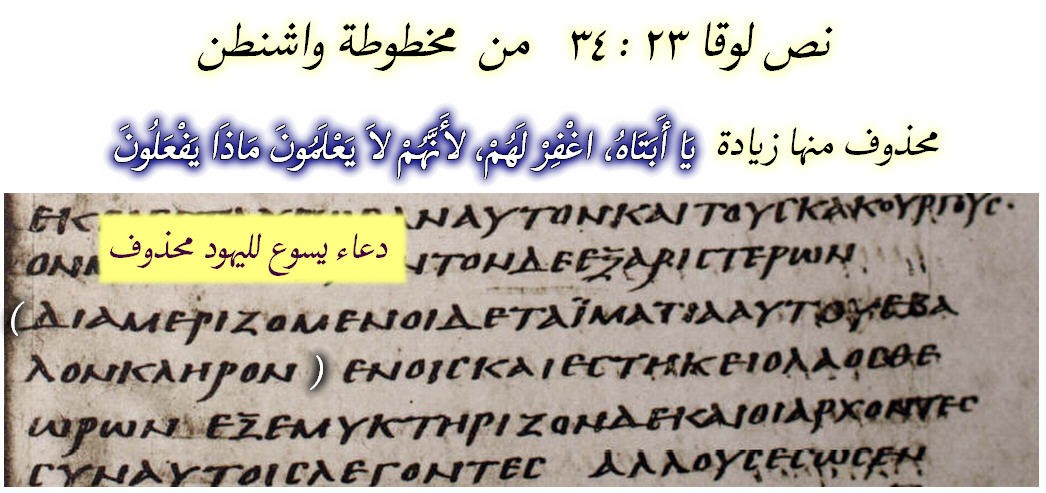
If a Christian cites the presence of the prayer in Sinaiticus or Alexandrian as evidence of authenticity, the response is straightforward: why is it absent from manuscripts older than Sinaiticus, such as Papyrus 75 and the Vatican Codex? As long as the text exists in some later manuscripts and is absent from the older ones, the rules of textual criticism demand that it be classified as a non-original addition.
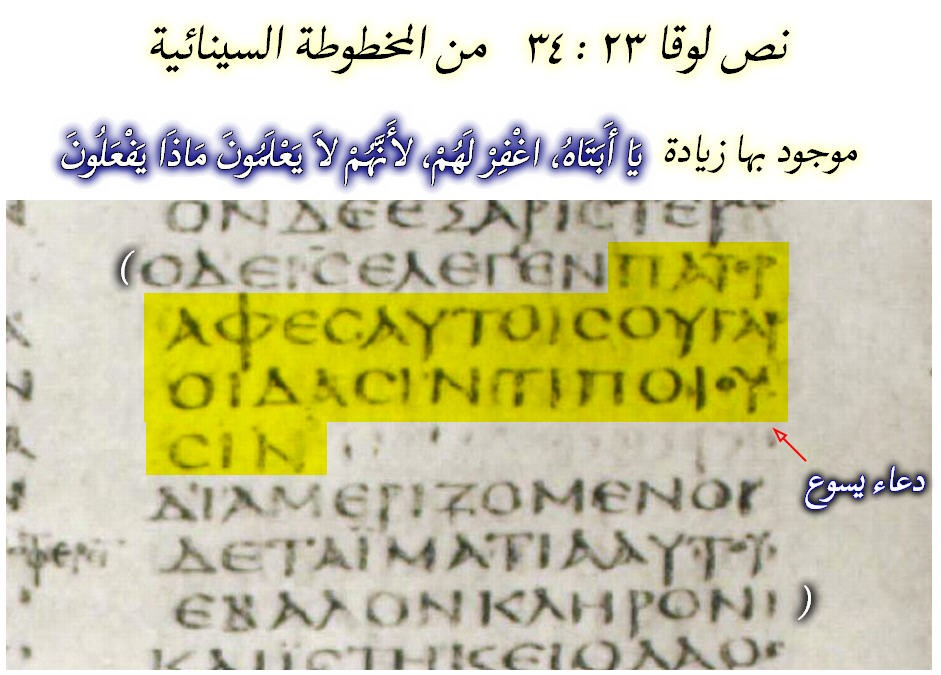
The presence in Sinaiticus does not override the absence in Papyrus 75 — the older manuscript takes precedence.
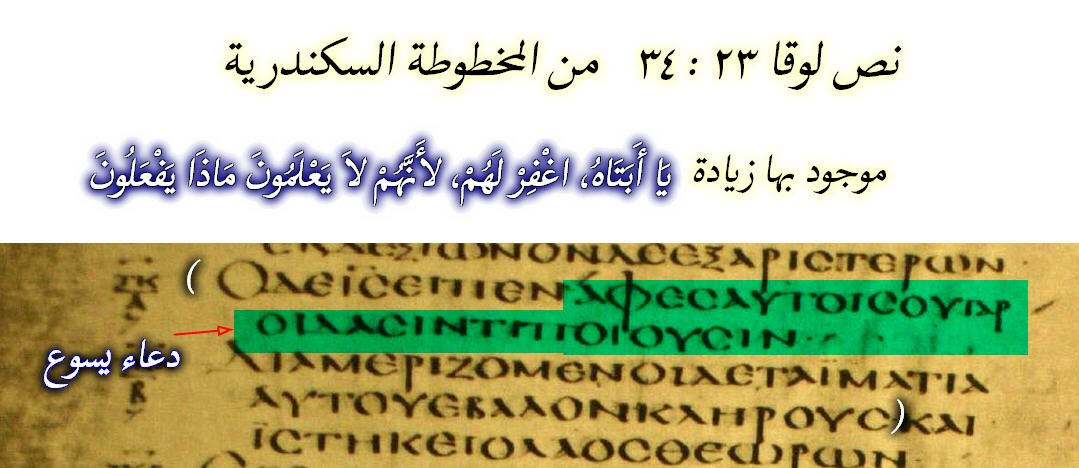
Critical Editions — The Text Is Bracketed
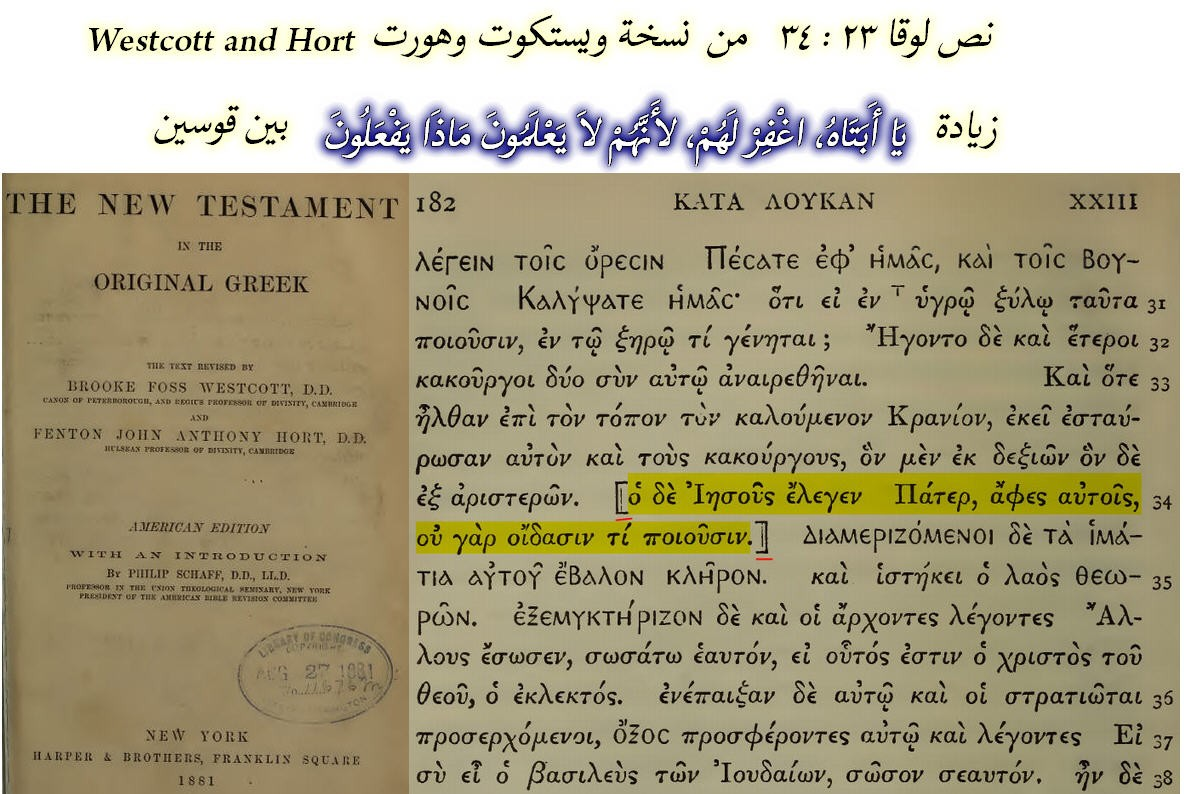
Upon reviewing the critical printed editions of the Greek New Testament, the majority place this text in brackets — the standard notation used to signal that a reading is not considered original:
- Nestle-Aland (NA)
- Westcott-Hort (WH)
- United Bible Societies (UBS)
- Samuel Tregelles
The Nestle 1904 edition reads:
ΚΑΤΑ ΛΟΥΚΑΝ 23:34 Greek NT: Nestle 1904 [ ὁ δὲ Ἰησοῦς ἔλεγεν Πάτερ, ἄφες αὐτοῖς· οὐ γὰρ οἴδασιν τί ποιοῦσιν. ] διαμεριζόμενοι δὲ τὰ ἱμάτια αὐτοῦ ἔβαλον λήρους.
The square brackets [ ] around the entire prayer indicate that the critical editors do not consider it part of the original text of Luke.
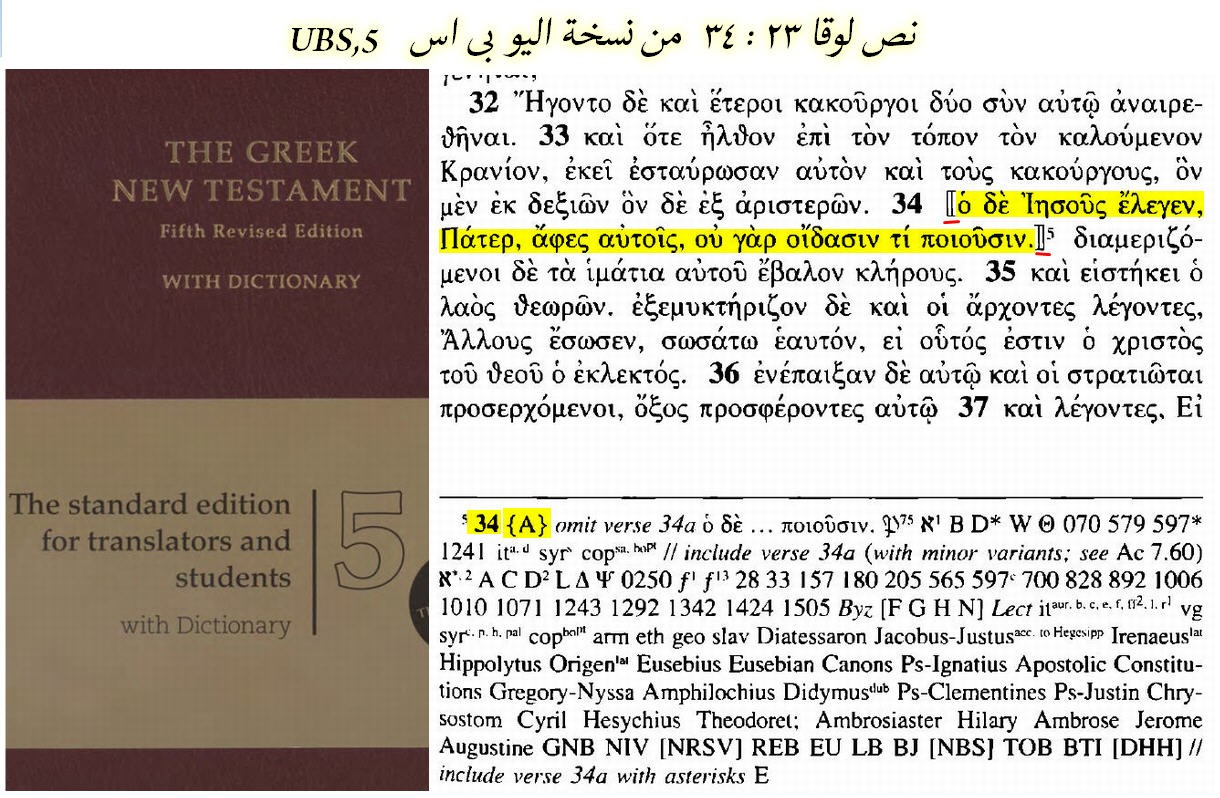
The brackets appear across all major critical editions that base their text on the oldest and best manuscripts.
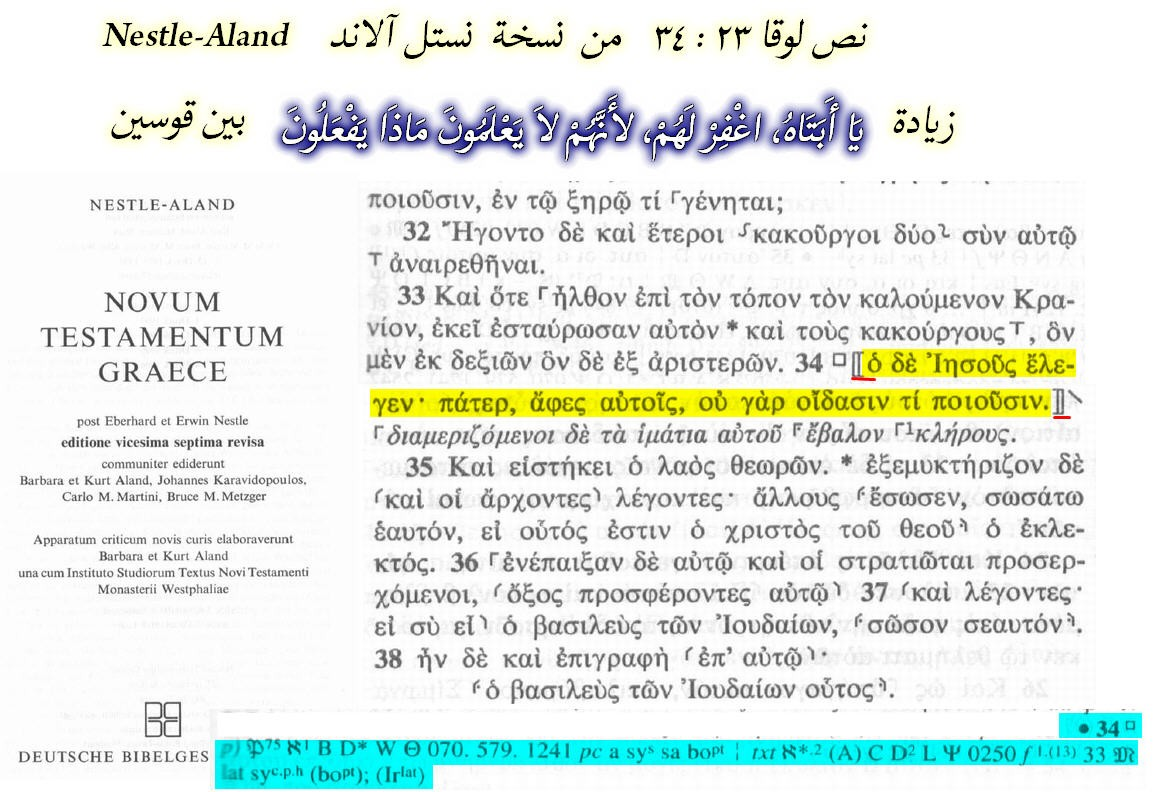
What the Scholars Said
Bruce Metzger
Bruce Metzger gives this text a deletion grade of {A} — his highest level of confidence that the reading is not original:
23.34 omit verse 34a [ὁ δὲ Ἰησοῦς ἔλεγεν, Πάτερ, ἄφες αὐτοῖς, οὐ γὰρ οἴδασιν τί ποιοῦσιν.] {A}
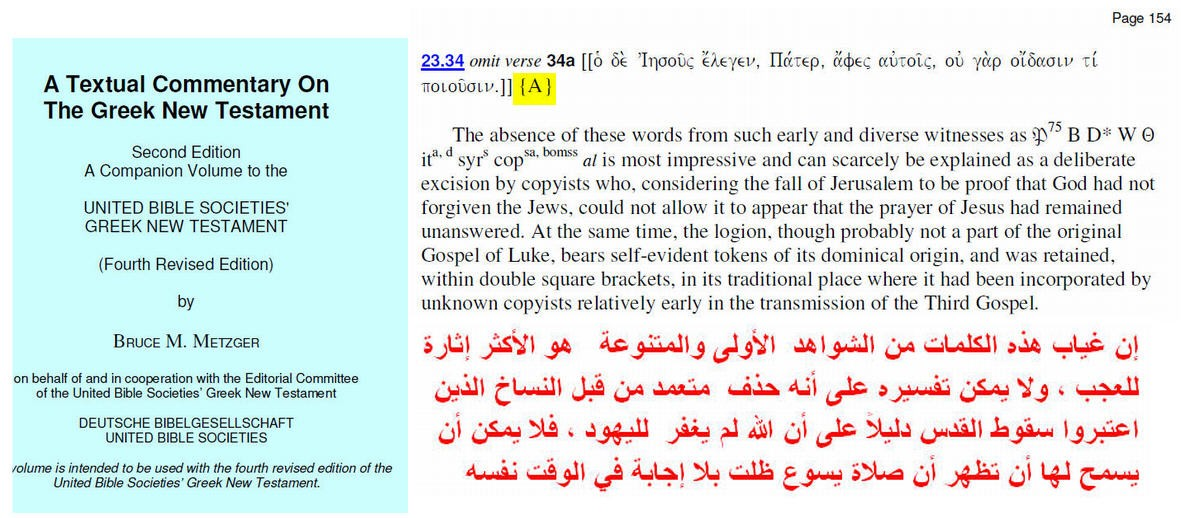
Metzger’s reasoning is significant: he acknowledges that if the prayer were original, it would be very difficult to explain why the oldest manuscripts omit it. He notes that scribes who did include it were motivated by the desire to show Jesus forgiving his killers; scribes who omitted it understood that the destruction of Jerusalem made the prayer appear unanswered.
Bart Ehrman
Bart Ehrman identifies the anti-Jewish sentiment among early Christian scribes as the second motive for deletion: by the 2nd century, the dominant Christian view was that the destruction of Jerusalem in 70 CE was God’s punishment of the Jews. A text showing Jesus praying for their forgiveness was therefore theologically inconvenient — it implied either that the prayer went unanswered, or that the destruction was not a punishment.
Philip Comfort
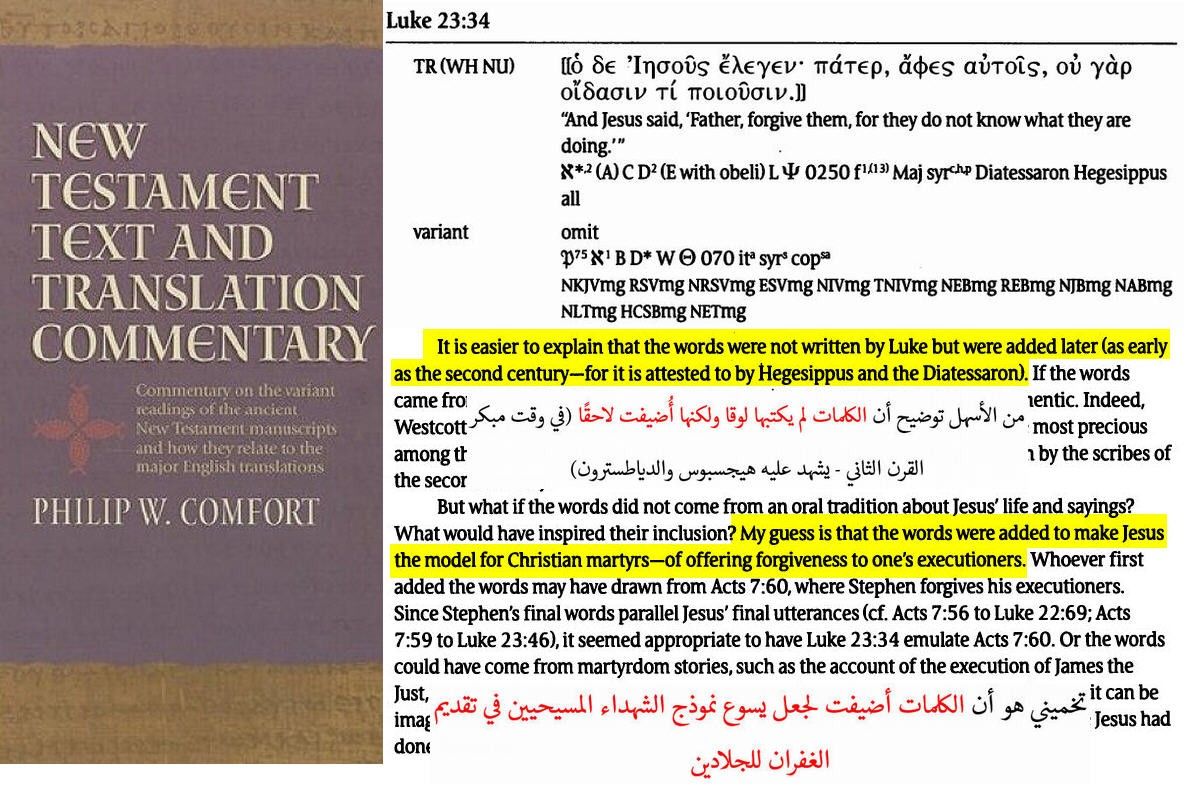
Philip Comfort concludes that the prayer was not original to Luke but was added — possibly as early as the 2nd century — to establish Jesus as a theological model for Christian martyrs facing death. This is a scribal addition for devotional and hagiographical purposes, not a preservation of original text.
The Jesuit Fathers’ Translation — An Internal Admission
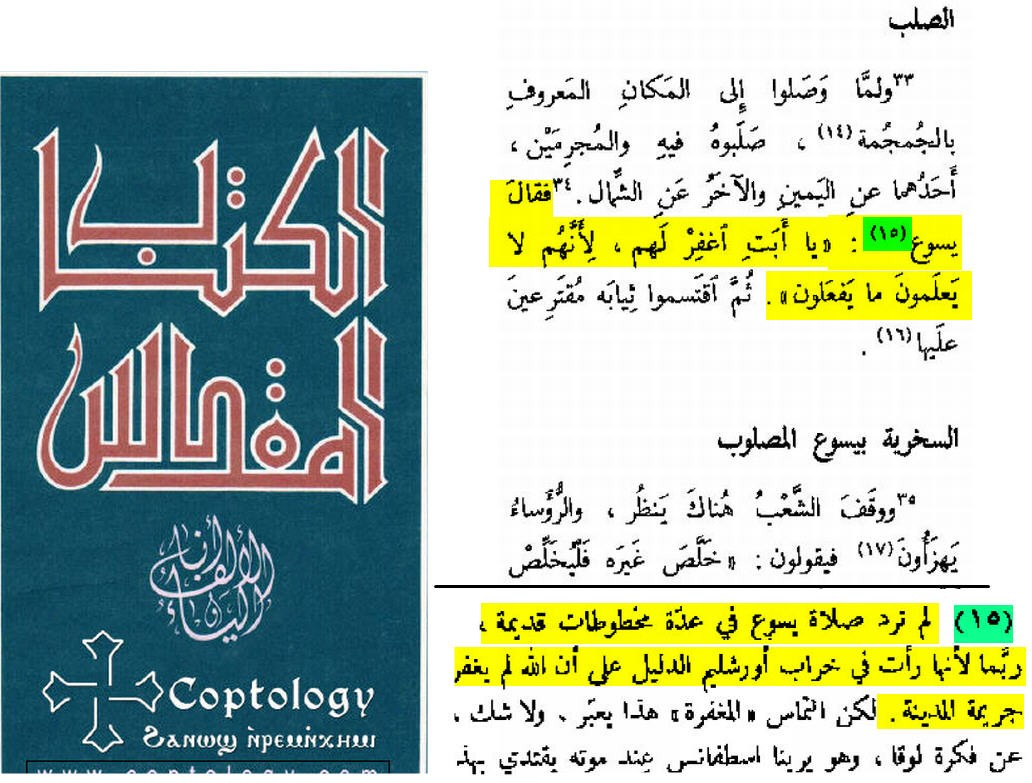
The translation of the Jesuit Fathers (p. 274) contains one of the most candid internal admissions about why this text was deleted from the manuscripts:
This is Christianity’s own scholarly apparatus acknowledging the theological crisis that led copyists to delete the text. The Jesuit translators — Catholic scholars working within the Christian tradition — state plainly that the scribal deletion was motivated by the theological impossibility of reconciling the prayer with the destruction of Jerusalem.
The Contradiction with Matthew 23
The problem is compounded by what Jesus says elsewhere. In Matthew 23, Jesus does not pray for forgiveness for the Jews — he threatens them with destruction:
History confirms that this destruction occurred: the Temple was destroyed by the Romans on 10 August 70 CE — which according to Jewish tradition falls on the same day that Nebuchadnezzar destroyed the first Temple.
This creates a direct textual contradiction:
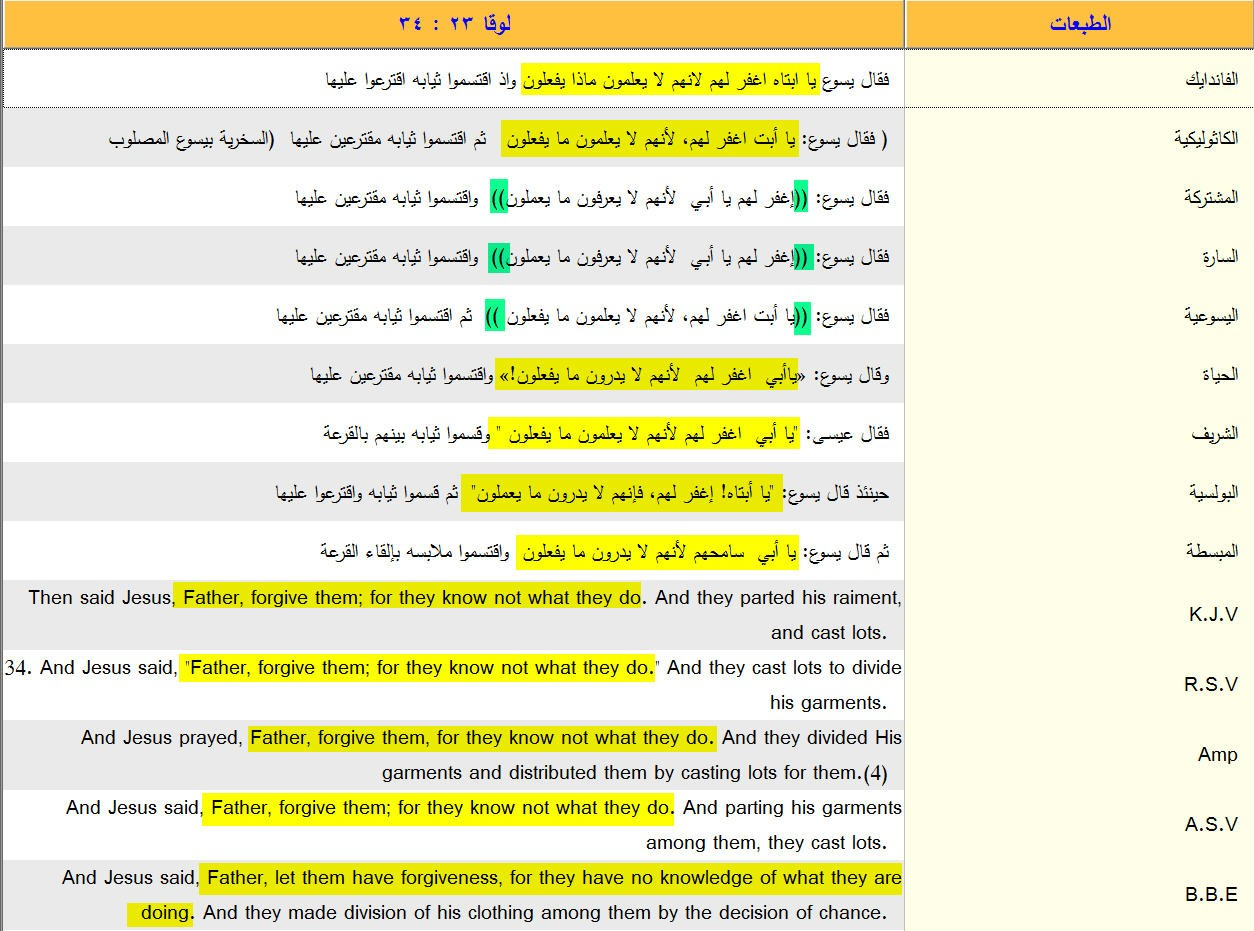
| ||Luke 23:34| |Matthew 23:38| |---|---|---| | Jesus says | “Father, forgive them, for they do not know what they do.” | “Behold, your house is left to you desolate.” | | What happened | Jerusalem destroyed — punishment, not forgiveness | Jerusalem destroyed — confirms the threat | | Implication | God did not answer the Son’s prayer | God fulfilled the Son’s warning |
The Three Options for Christians
Based on this difference between ancient manuscripts and the theological contradiction with Matthew, the Christian is left with only three options:
Option 2 — The text is original, but God the Father did not respond: Jesus prayed for forgiveness for the Jews, but God the Father refused and destroyed Jerusalem anyway. This means the Father and the Son are not in agreement — contradicting the doctrine of Trinitarian unity — and it means that the Son’s prayer goes unanswered, contradicting John 11:41–42.
Option 3 — There is a contradiction between Luke and Matthew: The forgiveness text in Luke was not fulfilled; the destruction threat in Matthew was fulfilled. There is an irresolvable contradiction between two texts in the same Bible, destroying the doctrine of biblical infallibility.
All three options are unacceptable from within Christian theology. There is no fourth option that preserves both the text and the theology.
Conclusion
Whether this prayer was original and deleted by scribes who found it theologically embarrassing, or whether it was never original and was added later to create a model of martyrly forgiveness — either conclusion demonstrates that the text of the Gospel of Luke has been subject to human interference, motivated by human theological concerns, at the hands of human copyists.
The Quran’s statement is confirmed:
So woe to those who write the scripture with their own hands, then say, “This is from Allah,” in order to exchange it for a small price. Woe to them for what their hands have written and woe to them for what they earn.
سُبْحَانَ الَّذِي لَمْ يَتَّخِذْ وَلَدًا وَلَمْ يَكُن لَّهُ شَرِيكٌ فِي الْمُلْكِ وَلَمْ يَكُن لَّهُ وَلِيٌّ مِّنَ الذُّلِّ وَكَبِّرْهُ تَكْبِيرًا
وَآخِرُ دَعْوَانَا أَنِ الْحَمْدُ لِلَّهِ رَبِّ الْعَالَمِينَ
...blem|Distortion of the Text of Luke 2345 From the Eclipse of the Sun Until the Sun Was Darkened]]