

Men and Women in Islam: Equality, Qiwamah, and the Alleged Quranic Contradiction
The alleged contradiction is built on confusing equality in human worth with identical roles in every legal and social function. The Quran affirms that men and women share one human origin, spiritual accountability, moral dignity, and religious obligation. At the same time, it assigns different responsibilities where the difference in nature, family structure, financial duty, and social function requires it. This is not contradiction; it is distinction with justice.
Their aim is to attack the Quran and its rulings by pretending that equality and differentiated responsibility cannot coexist.
There is no contradiction. The Quran equates men and women in humanity, dignity, faith, legal responsibility, reward, punishment, moral accountability, education, contracts, and the right to inherit. However, it does not erase natural, social, and family-based differences. Men and women are equal in human worth before Allah, but they are not identical in function. Qiwamah is not a claim that every individual man is superior to every individual woman; it is a structured responsibility placed on men because of financial obligation, family leadership, and the normal distribution of physical and social burdens.
Women Are From the Same Human Origin
“O mankind, fear your Lord, who created you from one soul and created from it its mate, and dispersed from both of them many men and women. And fear Allah, through whom you ask one another, and the wombs. Indeed, Allah is ever watching over you.”
This verse establishes the shared human origin of men and women. Eve was created from Adam, and this shared origin is a basis for harmony, affection, and familiarity between them. The point is not rivalry between two competing species, but companionship between two halves of one human family.
“And among His signs is that He created for you from yourselves spouses that you may find tranquility in them, and He placed between you affection and mercy. Indeed, in that are signs for people who reflect.”
The Quran repeats this meaning elsewhere by describing spouses as being made “from yourselves.” This wording strengthens the argument that marriage in Islam is rooted in nearness, shared origin, and mercy, not hostility or degradation.
“And Allah has made for you spouses from yourselves and has made for you from your spouses sons and grandchildren, and has provided for you from the good things. Then in falsehood do they believe, and in the favor of Allah do they disbelieve?”
Eve, the wife of Adam عليه السلام, was created from him so that he would find peace with her and be comforted by her. Ibn Mas‘ud and Ibn Abbas رضي الله عنهم are reported to have said that when Adam was placed in Paradise, he walked through it alone, and when he slept, Eve was created from his short rib on his left side so that he would find tranquility with her. When he awoke and saw her, he asked who she was, and she replied that she was a woman created from his rib so that he might live in peace with her.
[!scholar] Al-Qurtubi — Al-Jami‘ li Ahkam al-Quran
The meaning of Allah’s statement that He created from the one soul its mate is that Allah created Eve from Adam’s nature, making this more conducive to harmony, cohesion, and familiarity between them.
The Quran’s language therefore does not degrade women. It connects men and women at the root of human creation and makes marriage a sign of Allah through tranquility, affection, mercy, and family continuity.
Equality in Humanity
Islam establishes complete equality between men and women in humanity. Both descend from the same human origin, and neither is a separate or inferior species.
Aisha رضي الله عنها narrated that the Prophet ﷺ said: “Women are the twin halves of men.”
Grade: Sahih · Narrated by Ahmad and Abu Dawud; authenticated by Al-Albani in Sahih al-Jami‘
This hadith destroys the crude claim that Islam treats women as outside the human moral order. Men and women are connected in origin, dignity, and responsibility. All men are born of women and men, and all women are born of men and women.
Abu Hurayrah رضي الله عنه narrated that the Messenger of Allah ﷺ said: “Every newborn is born upon the fitrah; then his parents make him a Jew, a Christian, or a Magian.”
Grade: Sahih · Narrated by Al-Bukhari and Muslim
Every human being is born upon the fitrah. The moral and spiritual foundation is not male-only. Women and men alike are born with the capacity for guidance, faith, and righteousness.
Equality in the Soul and Moral Accountability
“And by the soul and He who proportioned it, and inspired it with its wickedness and its righteousness. He has succeeded who purifies it, and he has failed who corrupts it.”
Islam establishes that the soul of a man and the soul of a woman are equal in moral significance. The soul is elevated by faith and good character, and it is degraded by disbelief, corruption, and deviation. Physical differences between men and women do not alter this single moral origin.
As the poet said:
Approach the soul and complete its virtues,
for you are a human being by spirit, not by body.
The Quranic view of the human being is not crude materialism. A person is not honored merely by bodily strength, wealth, or outward form, but by the purification of the soul and obedience to Allah.
Equality in Human Dignity
Islam came to establish equality between men and women in human dignity. It forbade burying girls alive out of shame and forbade killing children out of fear of poverty.
“And when the girl buried alive is asked: for what sin was she killed?”
The Prophet ﷺ also condemned killing children out of fear of poverty, placing it among the gravest sins after shirk.
Ibn Mas‘ud رضي الله عنه narrated that the Messenger of Allah ﷺ was asked which sin is greatest. He said: “That you make a rival to Allah while He created you.” He was asked: “Then what?” He said: “That you kill your child out of fear that he will eat with you.” He was asked: “Then what?” He said: “That you commit adultery with your neighbor’s wife.”
Grade: Sahih · Narrated by Al-Bukhari and Muslim
The jurists also stated that a man is killed for intentionally killing a woman without legal doubt, just as he is killed for intentionally killing a man. This shows that the woman’s life has sanctity and legal protection.
Equality in Faith, Worship, and Reward
“Indeed, the Muslim men and Muslim women, the believing men and believing women, the obedient men and obedient women, the truthful men and truthful women, the patient men and patient women, the humble men and humble women, the charitable men and charitable women, the fasting men and fasting women, the men who guard their private parts and the women who do so, and the men who remember Allah often and the women who do so — Allah has prepared for them forgiveness and a great reward.”
This verse is explicit. Men and women are addressed together in Islam, iman, obedience, truthfulness, patience, humility, charity, fasting, chastity, remembrance, forgiveness, and reward. A woman is an independent moral agent, just as a man is. She is responsible for her own actions and rewarded for her obedience.
“So whoever does an atom’s weight of good will see it, and whoever does an atom’s weight of evil will see it.”
The Quran does not double the reward of one sex merely because of sex, nor does it place the sin of one sex upon the other. Each soul stands before Allah with its own deeds.
Equality in Knowledge
Islam urges the education of women and men alike. Women are charged with believing in Allah and obeying Him, and this cannot be done properly without knowledge.
Abu Musa رضي الله عنه narrated that the Prophet ﷺ said that any man who has a slave woman, teaches her well, disciplines her well, frees her, and then marries her will have two rewards.
Grade: Sahih · Narrated by Al-Bukhari
Women attended prayers with the Prophet ﷺ while covered and without adornment. They attended his lessons and sermons and listened to his khutbahs on Fridays and the two Eids. The wives of the Prophet ﷺ learned from him much of the Quran, its rulings, his hadith, his speech, and his actions.
The Prophet ﷺ also assigned Umm al-Shifa’ to teach some of his wives writing. Muslim women were eager to learn from the earliest period of Islam. Many hadiths were narrated by the Mothers of the Believers, and many statements in tafsir, fiqh, and hadith are transmitted from them. Many women memorized the Book of Allah or much of it, memorized hadith, and narrated to men from behind a veil.
Equality in Upbringing and Discipline
Islam encourages raising and disciplining girls just as it encourages raising and disciplining boys.
“O you who believe, protect yourselves and your families from a Fire.”
The Sunnah gives special encouragement for kindness to daughters and caring for them properly.
The Prophet ﷺ said that whoever cares for two daughters and treats them well until they grow up will come on the Day of Resurrection close to him.
Grade: Hasan · Narrated by Ibn Majah and Ibn Hibban; authenticated by Al-Albani
The original point is clear: Islam does not treat daughters as worthless burdens. It attaches reward and religious merit to raising them well.
Equality in Morals and Accountability of the Tongue
Islam commands women to perfect their morals just as it commands men. Society consists of both men and women, and corruption in either corrupts the social body.
Aisha رضي الله عنها said something about Safiyyah رضي الله عنها, meaning that she was short. The Prophet ﷺ said: “You have said a word which, if mixed with the water of the sea, would pollute it.”
Grade: Sahih · Narrated by Abu Dawud and Al-Tirmidhi; authenticated by Al-Albani
A woman is responsible, like a man, for her heart in matters of faith, hypocrisy, sincerity, and ostentation. She is responsible for her tongue in truthfulness, lying, guarding speech, or attacking people’s honor. She is responsible for obedience, disobedience, stopping at Allah’s limits, or transgressing them.
Equality in Punishments and Legal Responsibility
Since women are legally accountable like men, they bear responsibility for belief, speech, and action. Islam preserves five general principles: religion, life, intellect, honor, and wealth. The specified punishments and discretionary punishments protect these principles.
Women and men are both subject to legal accountability where the law applies to them. The distinction between male and female does not erase responsibility for fraud, false testimony, theft, murder, or other crimes. The law protects rights and restrains aggression.
Equality in Practicing and Supporting Islam
Women are charged with believing in Islam, preserving it, practicing it, and calling to it according to their creation and role in life. The first person to accept Islam was Khadijah رضي الله عنها, who supported the Prophet ﷺ when he received revelation. She worked to preserve Islam at its earliest and most vulnerable moment.
The first people killed in Islam included Yasir and his wife Sumayyah رضي الله عنهم. The books of seerah contain many examples showing Muslim women struggling to preserve Islam in their hearts, live by it, and convey it to others. Islam is the religion of Allah, and men and women are servants of Allah.
Equality in Contracts, Acknowledgements, and Transactions
Islam establishes equality between men and women in acknowledgements, verbal actions, financial actions, donations, charity, debt, endowment, buying and selling, agency, sponsorship, theft, murder, and other legal matters. There is no general cancellation of a woman’s legal personality.
Abu Hurayrah رضي الله عنه narrated that the Messenger of Allah ﷺ said: “O Allah, I declare sinful the neglect of the rights of the two weak ones: the orphan and the woman.”
Grade: Hasan · Narrated by Ahmad and Ibn Majah; authenticated by Al-Albani
The meaning is that one who wastes their rights falls into sin. This confirms that Islam did not merely speak about women abstractly; it imposed legal and moral consequences for violating their rights.
Women’s Inheritance Is Justice, Not Contradiction
Women’s participation with men in inheritance is itself justice and equality, especially when compared to systems that deprived women entirely. Islam did not deprive women of inheritance, whether they are from the deceased’s ancestors, descendants, relatives, or connected through marriage.
The wisdom behind male distinction in some inheritance cases is that the man bears family financial responsibilities. Even if a wife is wealthy, her maintenance remains upon her husband. However, it is false to imagine that women always receive half of men in every case. There are cases where women equal men in inheritance and cases where a woman receives more than some men.
For example, a daughter with paternal uncles may receive half of the estate, while all the paternal uncles share the other half. Men are not distinguished over women in every inheritance scenario. The well-known “male receives the share of two females” applies in specific cases, such as when a brother and sister inherit together by agnatic relation.
“If a man has two wives, one beloved and the other hated, and they have borne him children, both the beloved and the hated, and if the firstborn son belongs to the hated, then on the day when he assigns his possessions as an inheritance to his sons, he may not treat the son of the beloved as the firstborn in preference to the son of the hated, who is the firstborn. But he shall acknowledge the firstborn, the son of the hated, by giving him a double portion of all that he has, for he is the firstfruits of his strength. The right of the firstborn is his.”
Women in Christianity
[[posts/status-of-women-final-part
The comparison is important. Among the Jews, the male child had inheritance priority, and the firstborn male received a double portion. In other systems, women were deprived or inheritance followed family leadership and war capacity. Islam took a just path: it gave women inheritance rights while also considering financial duties placed on men.
Equal dignity does not require identical inheritance shares in every scenario. Islamic inheritance distributes shares according to kinship, financial responsibility, and family structure — not according to a simplistic male-versus-female formula.
Qiwamah Is Functional Responsibility, Not Absolute Human Superiority
“Men are maintainers over women because Allah has given some of them an advantage over others and because they spend from their wealth.”
The weak reading of this verse is to treat qiwamah as raw male domination. That is not what the word means. The verse itself ties qiwamah to responsibility, protection, maintenance, and financial spending.
Source: Al-Tafsir al-Muharrar, Vol. 3, p. 191.
The following scan documents the lexical and tafsir-based meaning of qawwamun as care, protection, and responsibility — not arbitrary superiority.
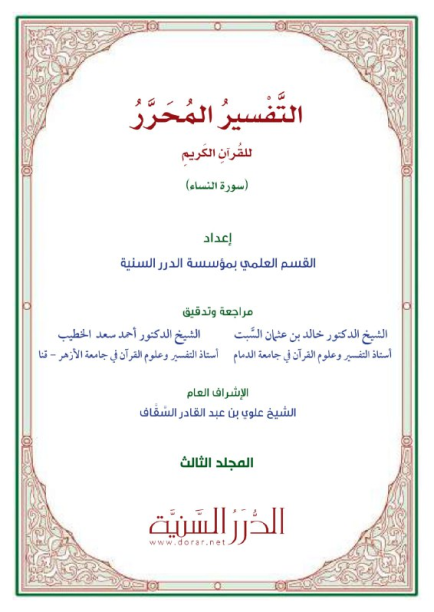
This scan explains the meaning ofqawwamun from its linguistic root. The word comes from qiyam, meaning to stand over something by maintaining, protecting, managing, and fulfilling its needs. This directly supports the article’s argument that qiwamah is a duty of responsibility and care, not a declaration that men are absolutely superior to women in human worth.
Qiwamah is therefore a functional responsibility within the family structure. It does not mean that every individual man is spiritually, intellectually, or morally superior to every individual woman. The verse gives the reason clearly: men are charged with spending from their wealth and carrying the outward responsibility of protection and maintenance.
[!scholar] Ibn Ashur — Al-Tahrir wa al-Tanwir, Vol. 5, p. 38
The guardianship of men over women is the guardianship of protection and defense, and the guardianship of earning and financial production. That is why Allah said: “because of what Allah has favored some of them over others and because of what they spend from their wealth.”
The next scan shows Ibn Ashur’s explanation that qiwamah is tied to protection, defense, earning, and financial provision.
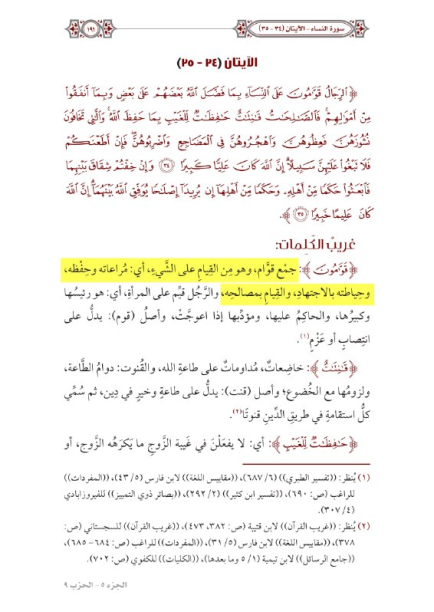
This scan from Ibn Ashur explains that men’s qiwamah over women is not a licence for oppression. It is connected to two core responsibilities: protection and defense on one side, and earning and financial production on the other. Ibn Ashur links this directly to the wording of the verse: “because of what Allah has favored some of them over others” and “because of what they spend from their wealth.” This means the preference mentioned in the verse is tied to function and obligation, not unrestricted personal superiority.
This also explains why Islam does not place the financial burden of earning upon women in the same way it places it upon men. A woman may work and earn, but she is not addressed with the same obligation of financial maintenance that the man carries.
[!scholar] Abdul Aziz al-Tarifi — Al-Tafsir wa al-Bayan li-Ahkam al-Qur’an, Vol. 2, p. 827
If a woman has no guardian, she is given from the public treasury and from zakat funds, even if she is capable of working, because she is not addressed with the obligation to earn a living and work, nor is she commanded to do so like a man.
The following scan supports this point by showing that the financial obligation remains upon the male guardian or, in his absence, upon public support mechanisms such as the treasury and zakat.
This scan explains that if a woman does not have a guardian, she may be supported from the public treasury and zakat funds, even if she is physically capable of working. The reason given is that she is not addressed with the obligation to earn and provide in the same way a man is. This reinforces the central point: qiwamah is tied to financial duty and protection. The man’s authority is not detached privilege; it comes with compulsory responsibility.
Imam Muhammad Abduh explained that qiwamah means leadership in which the subordinate still acts with will and choice. It does not mean that the subordinate is enslaved, stripped of will, or unable to act except by command. Rather, it means guidance, supervision, and responsibility in managing family affairs.
“And do not wish for that by which Allah has made some of you exceed others. For men is a share of what they have earned, and for women is a share of what they have earned. And ask Allah of His bounty. Indeed, Allah is ever Knowing of all things.”
The wisdom in this wording is that the man and woman are like limbs of one body. Each has a place and a function, and the preference given in one respect does not erase the need, dignity, or value of the other. The man is entrusted with outward maintenance, protection, and financial responsibility, while the woman is not burdened with identical financial obligation.
The husband is compared by some writers to the captain of a ship sailing through the waves of married life, with its problems and surprises. If the sea is calm, the ship advances with ease. If the waves are fierce, the captain must remain steady, focused, and responsible. The point is that every partnership requires accountable leadership, otherwise chaos spreads.
Qiwamah is not a blank cheque for male ego. It is responsibility before it is authority: protection, provision, maintenance, management, and accountability. Any reading that turns it into oppression has already left the meaning of the verse.
Difference in Function Follows Difference in Nature
The function of men differs from the function of women according to the nature of each. Some people imagine that this contradicts equality, but this is weak thinking. Equality in humanity is reasonable and necessary, because men and women are two halves of humanity and come from one soul. But equality in humanity does not require that men and women perform every function identically.
Muhammad Qutb explains that no one can change the nature of things by making men participate with women in pregnancy, childbirth, and breastfeeding. The specialization of one sex in pregnancy and breastfeeding requires a psychological, emotional, nervous, and intellectual preparation suited to motherhood.
Motherhood includes noble feelings, delicate work, patience in continuous effort, and precision in observation and performance. The tenderness of emotion, quick responsiveness of conscience, and strong movement of feeling are connected to this function. These qualities serve the demands of motherhood, which often require immediate emotional response and constant care.
The man, on the other hand, is charged with the struggle of life outside the home: seeking sustenance, confronting hardship, protecting himself, his wife, and his children, and dealing with external systems of conflict, work, law, and economy. This function requires thought to dominate emotion and requires deliberation in decisions.
This does not mean a rigid and absolute separation between the sexes. A woman may be fit for rule, judgment, heavy labor, war, or other difficult tasks. A man may be fit for cooking, household management, close supervision of children, or tenderness. These examples exist because the sexes share human qualities. But exceptions do not erase the general structure upon which law, family responsibility, and social function are built.
Conclusion
Islam establishes equality between men and women in humanity, origin, dignity, faith, worship, moral responsibility, reward, punishment, education, upbringing, contracts, transactions, and legal accountability.
At the same time, Islam recognizes real differences in nature, responsibility, financial obligation, family leadership, pregnancy, childbirth, breastfeeding, and social function. These differences do not negate human equality; they organize family and society according to justice.
Women’s inheritance is not deprivation, but a major recognition of their financial right compared to systems that denied it completely. Men’s qiwamah is not arbitrary domination, but responsibility tied to provision, protection, management, and family leadership.
The objection fails because it assumes that equality must mean sameness in every legal and social role. The Quran’s position is more precise: men and women are equal in human worth before Allah, while differing in certain responsibilities according to wisdom, nature, and justice.
Sources: (1) Al-Qurtubi, Al-Jami‘ li Ahkam al-Quran, Dar Ihya’ al-Turath al-Arabi, Beirut, 1405 AH / 1985 CE, Vol. 1, p. 301. (2) Atiyyah Saqr, Encyclopedia of the Family Under the Care of Islam, Wahba Library, Cairo, 1st ed., 2003, Vol. 2, p. 7; Vol. 2, pp. 491–493; Vol. 3, p. 24, with modification. (3) Wahbi Suleiman Ghawji, The Muslim Woman, Dar Al-Qalam, Damascus, 8th ed., 1999, p. 32 and following. (4) Muhammad Qutb, Doubts About Islam, Dar Al-Shorouk, Cairo, 23rd ed., 1422 AH / 2001 CE, pp. 116 and following. (5) Al-Tafsir al-Muharrar, Vol. 3, p. 191. (6) Ibn Ashur, Al-Tahrir wa al-Tanwir, Vol. 5, p. 38. (7) Abdul Aziz al-Tarifi, Al-Tafsir wa al-Bayan li-Ahkam al-Qur’an, Vol. 2, p. 827. Hadith references include Ahmad, Abu Dawud, Al-Bukhari, Muslim, Ibn Majah, Ibn Hibban, Al-Tirmidhi, and Al-Albani’s gradings as cited in the original source material.