Mirza Ghulam's Character
Roohani Khazain vol.10 s.63
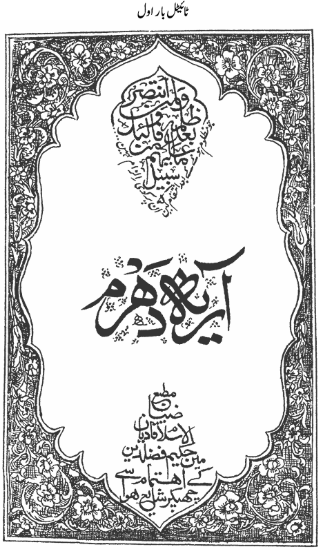
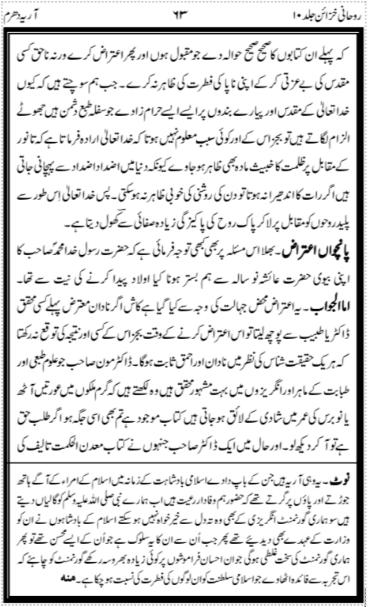
In one of Mirza Ghulam’s writings he uses the term ‘haram-zade’ to insult Arya Samaj, a hindu reform movement. Here the translation:
“First, provide exact and accurate references from those books that are considered reliable, and then raise objections. Otherwise, by unjustly disrespecting a sacred figure, do not expose your vile and debased nature. When we reflect on why such vile illegitimate offspring (haramzade) who are base-natured enemies falsely accuse the holy and beloved servants of God Almighty, no reason comes to mind except that God Almighty intends to manifest the impure essence of darkness in contrast to the light. This is because opposites in the world are recognized through contrast—if there were no darkness of night, the excellence of daylight would not be revealed. Thus, God Almighty exposes these impure souls to highlight the purity of the pure ones more clearly.”
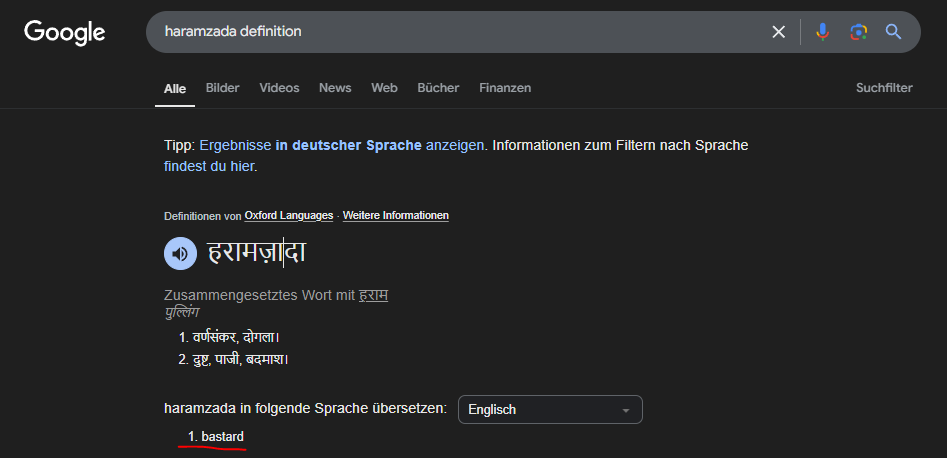
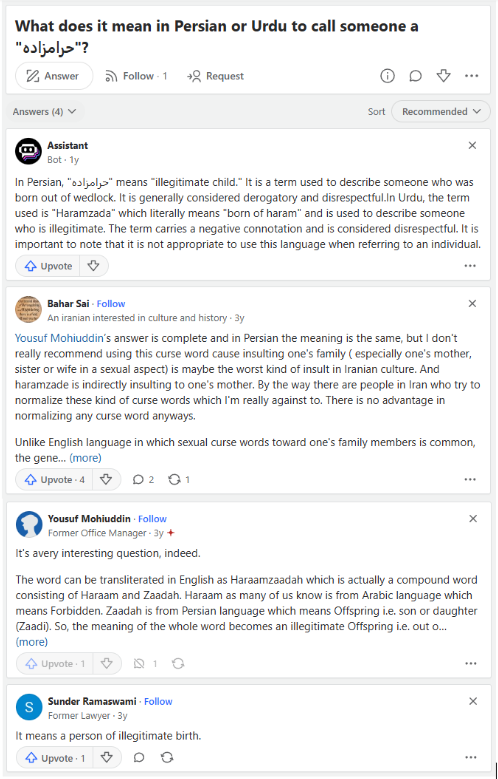
Now lets see how this word is understood, both by definition and by other people.
The following excerpt is a poem of Mirza Ghulam Qadiani, also directed to the Ayra Samaj, i.e the hindu reform movement.
Roohani Khazain vol. 10 s.76
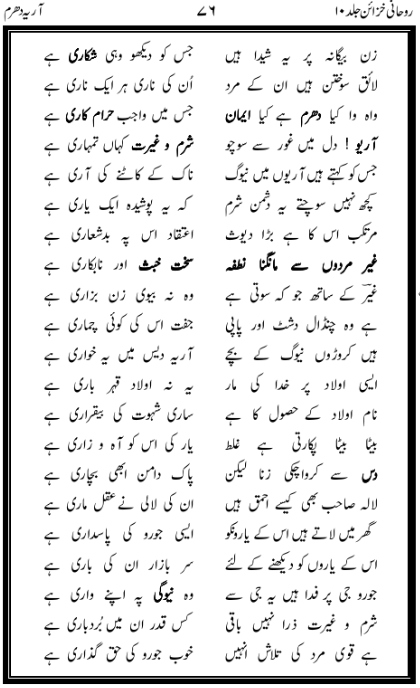
“They are infatuated with foreign women,
their husbands deserve to be burned.
Whoever you see, he is a hunter,
every one of their women is a pr0stitute.
To beg for sperm from foreign men,
what a wonderful religion, what a faith,
in which adultery is obligatory.
Aryas! Think deeply in your hearts,
where is your shame and honor?
What is called ‘Niyog’ among the Aryas,
is a saw that cuts off the nose.
These shameless enemies think nothing,
that this is a hidden friendship.
The one who engages in it is a great pimp,
believing in it is bad conduct.
It is great love and malice,
when one sleeps with a stranger,
she is not a wife, but a pr0stitute.
She is a Chandal, despicable and sinful,
her partner is a Chamari.
There are millions of ‘Niyog’ children,
this humiliation exists in the land of the Aryas.
**God’s curse on such children, **
they are not children, but punishments from God.
It is done in the name of childbearing; the entire disturbance is s3xual desire.”
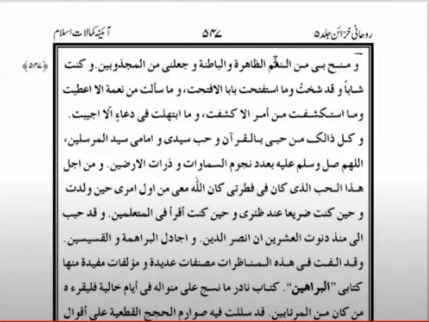
1893 Aina-e-Kamalat-e-Islam, Roohani Khazain vol.5 p.547
At-tabligh, the first ever Arabic book by MGA and his team.
“Every Muslim will accept me and will confirm my claim except the zurrayatul baghaya (offspring of prostitutes) whose hearts will have been sealed up by God Almighty.”
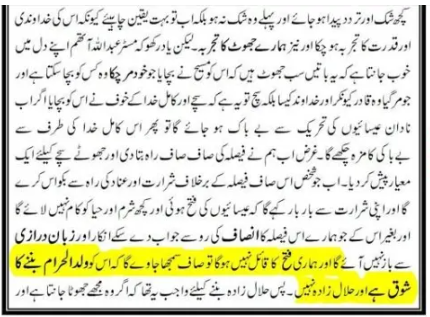
Roohani Khazain vol.9 p.31
“Whoever comes and does not acknowledge our victory, it will be clearly understood that he has the desire to become the offspring of an illegitimate relationship and is not of lawful descent.”
- https://ahmadiyyafactcheckblog.com/2017/09/26/mirza-ghulam-ahmad-wrote-that-the-quran-used-harsh-words-thus-its-ok-to-do-so/
- https://ahmadiyyafactcheckblog.com/2019/05/26/mirza-ghulam-ahmad-wrote-vulgarities-in-arabic-also-new-research-from-arab-ex-ahmadis/
many more quotes of mirza ghulam and his foul usage of words can be found here
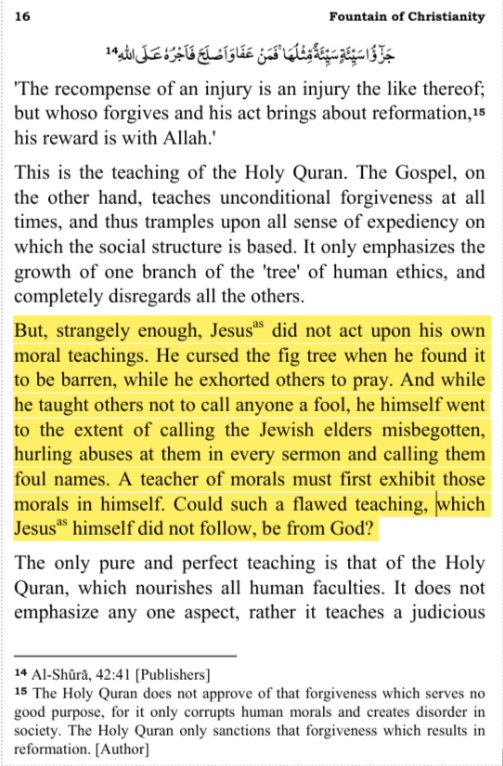
Now in the present text, Mirza Ghulam Qadiani criticizes the biblical Jesus for not acting according to his own moral teachings.
He points out that Jesus cursed the fig tree when he found it barren, even though he urged others to pray. Furthermore, he points out that Jesus taught others not to call anyone a fool, while he himself referred to the Jewish elders as illegitimate children and insulted them in every sermon, calling them offensive names. Mirza Ghulam Ahmad argues that a teacher of morality must first show that morality in himself. He poses the rhetorical question of whether such a flawed teaching, which Jesus himself did not follow, could be from God.
- It is a clear contradiction in the argument when Mirza Ghulam Ahmad criticizes the biblical Jesus for his behavior, while he himself uses similar and even worse expressions to insult others, yet claims to be a prophet and even the Messiah who receives his teachings from God.
If a moral teacher, like Mirza himself, fails to live up to the very principles he advocates — using language and actions that contradict his moral teachings — it not only undermines the authenticity of his message but also discredits his claim that his teachings could be from God.