

Quran 4:82 and the Ten Readings: Is There a Contradiction
==A Christian objection occasionally raised against the Qur’an claims that the verse promising the Qur’an’s internal consistency — Surah An-Nisa 4:82 — is itself refuted by the existence of the ten readings (qira’at), which allegedly introduce variation and therefore contradiction.== This objection rests on a failure to distinguish between two fundamentally different types of difference: ikhtilaf al-tanaqudArabic: اختلاف التناقض — contradiction of opposition, where one statement invalidates another and ikhtilaf al-tanawwuArabic: اختلاف التنوع — difference of diversity, where two valid variations coexist without conflict. The classical mufassirun addressed this distinction with precision centuries before the objection was formulated in its modern Christian apologetic form. What follows is a full compilation of their responses, drawn from primary tafsir sources.
The Verse Under Discussion
Do they not then reflect upon the Qur’an? Had it been from other than Allah, they would have certainly found therein much inconsistency.
This verse presents a falsifiability test: if the Qur’an were of human origin, internal contradiction would be detectable. The objection attempts to claim the test has been failed by pointing to the variant readings. The classical scholars demonstrate why this reading of the verse is linguistically and theologically illiterate.
Al-Tabari’s Commentary: Harmony of Rulings as Proof of Divine Origin
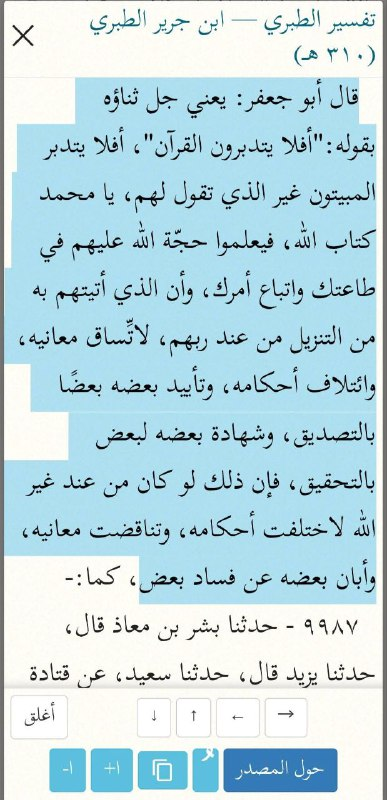
Imam al-Tabari is the foundational classical authority on this verse. Writing in his Tafsir al-Tabari (d. 310 AH), he explains what God means by commanding reflection on the Qur’an:
The following image reproduces the relevant passage from Imam al-Tabari’s Tafsir:
Summary of the Excerpt
This passage features Imam Abu Ja’far al-Tabari explaining the divine statement: “Do they not then reflect upon the Qur’an?” (أفلا يتدبرون القرآن).
-
The Core Message: Al-Tabari explains that God is addressing those who secretly plot or disagree with the Prophet (the hypocrites/plotters mentioned in the context of the verse). He urges them to deeply contemplate and study the Book of Allah.
-
The Proof of Divine Origin: By reflecting on the Qur’an, they would realize Allah’s ultimate proof against them. They would see that the revelations brought by Prophet Muhammad are truly from their Lord because the meanings are perfectly consistent, the rulings are harmonious, and different parts of the text validate, support, and confirm one another.
-
The Counterfactual Argument: He concludes by stating that if this Book had been from anyone other than Allah, its rulings would conflict, its meanings would contradict, and certain parts would expose the flaws and corruption of others.
-
Chain of Narration (Isnad): The text transitions at the bottom to a supporting narration (No. 9987) from Bishr bin Mu’adh, who narrates from Yazid, from Sa’id, from Qatadah to provide further classical commentary on this meaning.
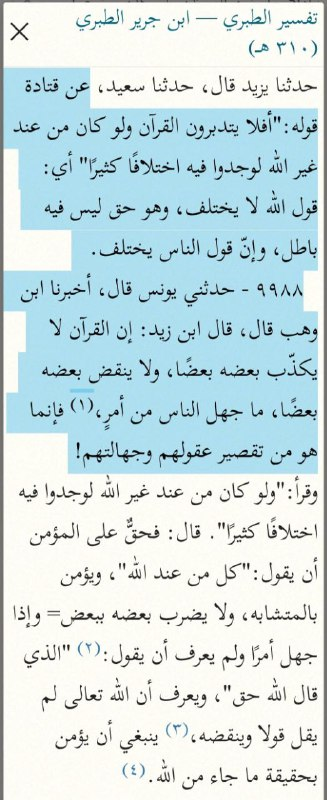
Al-Tabari then transmits the positions of the Tabi’in commentators. Qatadah clarifies the contrast between divine speech and human speech:
Abd al-Rahman ibn Zayd adds that any perception of conflict in the Qur’an originates not in the text but in the limitation of the reader’s intellect:
The following image reproduces the continuation of this passage in al-Tabari, including the narrations of Qatadah and Ibn Zayd:
Summary of the Highlighted Text
This excerpt continues the classical commentary on Surah An-Nisa, Verse 82: “Do they not then reflect upon the Qur’an? Had it been from other than Allah, they would surely have found therein much contradiction.”
-
Qatadah’s Commentary: The narration from Qatadah clarifies that the Word of Allah is entirely consistent, completely true, and contains zero falsehood. In stark contrast, the speech and words of human beings are inherently prone to inconsistency, contradictions, and variation.
-
Ibn Zayd: Ibn Zayd emphasizes that different parts of the Qur’an never contradict or invalidate one another. He explains that if human beings perceive any conflict or are ignorant of how parts of the text align, the flaw lies entirely within their own limited intellect, understanding, and ignorance, not within the divine text itself.
Ibn Taymiyyah and Ibn al-Jazari: The Seven Letters Are Diversity, Not Opposition
^^The distinction between difference of diversity and difference of contradiction is unanimous among the scholars of qira’at and usul al-tafsir.^^ Ibn Taymiyyah states this as a position beyond dispute among Muslims:
Ibn al-Jazari, the foremost authority in the science of qira’at, confirms this and provides the definitive taxonomy of how variant readings actually function:
We have examined all the variant readings and found that they fall into one of three categories:
One: A difference in wording and meaning that is the same.
Two: A difference in both wording and meaning, with the possibility of their coexistence — in one aspect their complete difference, with the impossibility of their coexistence in one thing; rather, they agree in another way that does not necessitate contradiction.
Three: Their complete difference, with the impossibility of their coexistence in one thing. Rather, they agree in another way that does not necessitate contradiction.
Al-Jassas: Three Categories of Ikhtilaf — and Which Ones the Qur’an Is Free Of
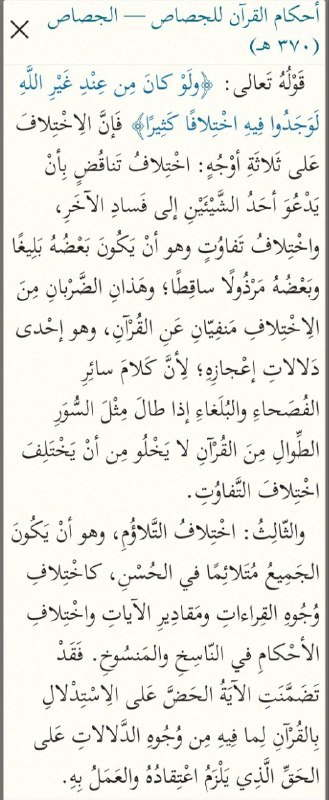
Al-Jassas (d. 370 AH), in his Ahkam al-Qur’an, provides the most systematic breakdown of the different types of ikhtilaf and explicitly maps which types are absent from the Qur’an and which are present as a positive feature:
First — Inconsistency of Contradiction (اختلاف تناقض): Where one of the two things calls for the corruption of the other.
Second — Inconsistency of Disparity (اختلاف تفاوت): Where some of it is eloquent and some of it is reprehensible and worthless.
These two kinds of inconsistency are negated from the Qur’an, and this is one of the indications of its miraculous nature. Because the speech of all eloquent speakers, if it is as long as the long chapters of the Qur’an, is not free from differences of variation.
Third — Difference of Harmony (اختلاف التلاؤم): A positive form of variation where everything remains harmonious, such as the difference of the ways of readings, the lengths of the verses, and the difference of the rulings in abrogation and the abrogated.
The verse includes an encouragement to use the Qur’an as evidence, due to the various indications it contains regarding the truth that must be believed and acted upon.
The image below reproduces the passage from al-Jassas’ Ahkam al-Qur’an:
Summary of the Excerpt
The text provides a theological and linguistic breakdown of the verse: “Had it been from other than Allah, they would surely have found therein much contradiction (اختلافًا كثيرًا).” Al-Jassas categorizes “contradiction/difference” (Ikhtilaf) into three distinct types to explain the miraculous nature of the Qur’an:
-
1. Contradiction of Incompatibility (اختلاف تناقض): Where one statement directly negates or proves the corruption of another.
-
2. Contradiction of Disparity/Quality (اختلاف تفاوت): Where some parts of a text are highly eloquent and powerful, while other parts are weak, degraded, or substandard.
Note: Al-Jassas states that these first two types of contradictions are completely non-existent in the Qur’an. This absolute consistency across such a massive text is one of the primary proofs of its miraculous nature (I’jaz), as the lengthy works of even the most eloquent human poets and speakers inevitably suffer from dips in quality or logical inconsistencies.
-
3. Variation of Harmony (اختلاف التلاؤم): A positive form of variation where everything remains beautifully harmonious. This manifests in the different authentic modes of recitation (Qira’at), the varying lengths of verses, and structural changes in rulings like abrogation (Al-Nasikh wal-Mansukh).
-
Conclusion: The verse ultimately serves as an active encouragement to contemplate and use the Qur’an as textual evidence, because its perfectly unified and multi-faceted guidance inevitably points to the absolute Truth that must be believed and acted upon.
Al-Dani: The Same Three-Part Taxonomy Confirmed
Imam al-Dani, in his Jami’ al-Bayan, independently reaches the same three-part classification of ikhtilaf as al-Jassas, confirming that this is not an isolated position but a settled framework within classical tafsir and qira’at scholarship:
First: The difference of the word and the meaning is one.
Second: The difference of both the word and the meaning, with the possibility of their coexistence in one thing, since their coexistence in it is not contradictory.
Third: The difference of the word and the meaning, with the impossibility of their coexistence in one thing, due to the impossibility of their coexistence in it.
Ibn Qutaybah: The Prophet’s Own Statement Resolves the Objection
Ibn Qutaybah engages the objection head-on, stating that those who raise the variant readings as a contradiction of 4:82 are directly answered by the Prophet ﷺ himself:
All these modes are the word of God Almighty, revealed by the Trustworthy Spirit to His Messenger, peace be upon him. This is because the Spirit would review with him every month of Ramadan what had been gathered from the Quran, and God would reveal to him from it what He willed, abrogate what He willed, and make things easy for His servants as He willed. Part of His making things easy was that He commanded him to recite to each people in their own language and according to their custom.
Ibn Qutaybah then addresses the follow-up question of whether variation in meaning is permissible between readings:
Ibn Uthaymeen: “Much” Does Not Imply “A Little” — A Linguistic Clarification
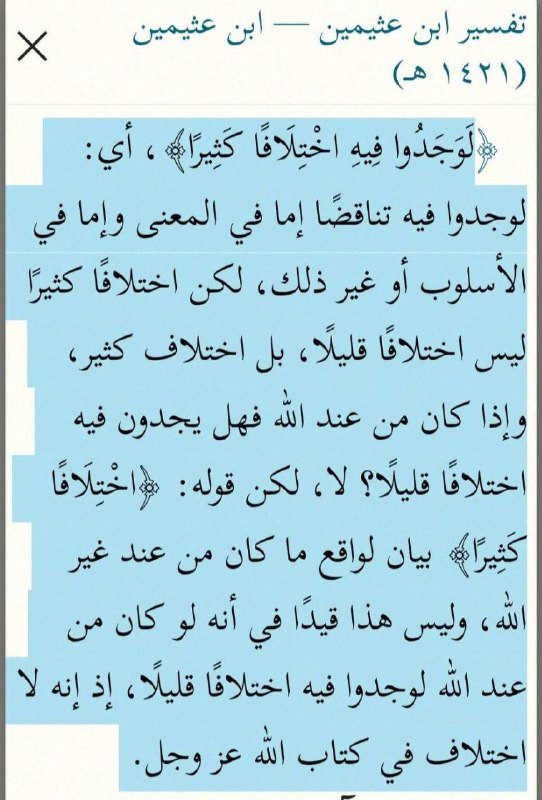
A subtle but important linguistic question arises from the phrasing of 4:82: does specifying “much” inconsistency (اختلافًا كثيرًا) imply by negation that a divine book might still contain a little inconsistency? Sheikh Ibn Uthaymeen addresses this directly:
The image below reproduces the relevant passage from Ibn Uthaymeen’s tafsir:
Summary of the Excerpt
This passage provides an analytical linguistic and theological commentary on the phrase: “…they would surely have found therein much contradiction (اختلافًا كثيرًا).”
-
Definition of Contradiction: Ibn Uthaymeen notes that if the Qur’an were from a human source, it would suffer from contradictions in its core meanings, its linguistic style, or other structural facets.
-
The Use of “Much” (Kathiran): He tackles an important linguistic nuance: Does the phrase “much contradiction” imply that a text from other than Allah might still contain a small amount of contradiction?
-
The Verdict: He explicitly states no. The description of contradiction as being “much” is not a restrictive qualification (Qayd) — meaning it doesn’t imply that a divine book could have minor inconsistencies. Rather, it is a statement describing the inevitable reality (Bayan lil-Waqi’) of any lengthy human endeavor.
-
Conclusion: Anything originating from other than Allah is bound to be filled with massive inconsistencies, whereas the Book of Allah contains absolutely no contradiction or discrepancy whatsoever, whether small or large.
Al-Qurtubi: What the Verse Excludes and What It Condemns
Al-Qurtubi (d. 671 AH) provides the most comprehensive summary position, citing Ibn Abbas, Qatadah, and Ibn Zayd to define ikhtilaf in this verse, and explicitly listing what does not fall under the condemned category:
It has also been said that the meaning is: if what you are reporting were from other than God, it would be different. It was said: There is no speaker who speaks a lot of words except that there is a lot of difference in his speech, either in the description and the wording, or in the quality of the meaning, or in the contradiction, or in the lie. So God, the Exalted, revealed the Qur’an and commanded them to ponder it, for they would find no inconsistency in its description, no refutation of its meaning, no contradiction, and no falsehood in what it conveys of the unseen and what they conceal.
The image below reproduces the relevant passage from al-Qurtubi’s Tafsir:
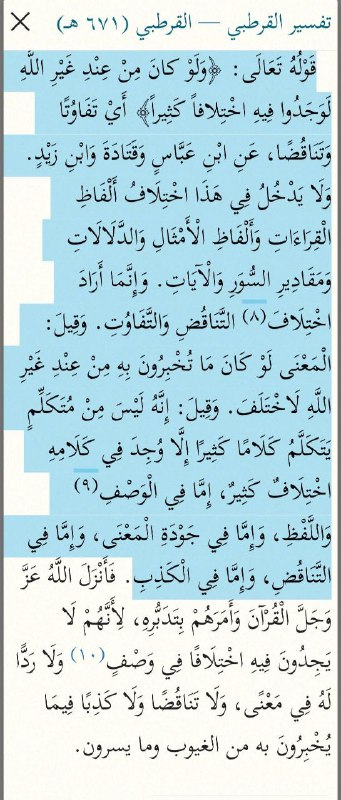
Summary of the Excerpt
This passage presents classical exegesis and commentary on the verse: “Had it been from other than Allah, they would surely have found therein much contradiction (اختلافًا كثيرًا).”
-
Defining the Contradiction: Citing early authorities like Ibn Abbas, Qatadah, and Ibn Zayd, the text establishes that “contradiction” here means structural disparity (Tafawut) and logical contradiction (Tanaqud).
-
What Does Not Count As Contradiction: The text explicitly clarifies that certain textual variations are excluded from this definition. These non-contradictory variations include:
- Different modes of recitation (Qira’at).
- Variations in linguistic phrasing, parables, and indicators (Dallalat).
- Differences in the lengths of chapters (Suwar) and verses.
-
The Human vs. Divine Reality: A profound observation is quoted regarding human speech: There is no human speaker who speaks at great length except that you will inevitably find extensive inconsistencies in their words. Human flaws surface as variations in descriptive precision, fluctuating quality of meaning, internal contradictions, or falsehood.
-
Conclusion: Allah revealed the Qur’an and commanded mankind to reflect upon it precisely because they will find it completely free from description flaws, rejection of meaning, logical contradictions, or errors in the unseen matters (Ghayb) it uncovers.
Al-Qurtubi further draws out the jurisprudential implication of this verse, noting that it directly refutes those who restrict Qur’anic interpretation to prophetically transmitted reports alone:
Zakariyya al-Ansari: The Rhetorical Logic of “Much” — Hyperbolic Proof
Shaykh al-Islam Zakariyya al-Ansari (d. 926 AH), in Fath al-Rahman, addresses the same linguistic question as Ibn Uthaymeen — does “much” (كثيرًا) imply a small residue of contradiction in the divine text? — and resolves it through the theory of mubalaghaArabic: مبالغة — rhetorical exaggeration or intensification used to establish the logical connection with maximum force:
The answer given is that the restriction to abundance is to exaggerate in proving the connection, meaning that if it were from other than God, they would have found much inconsistency in it, let alone little — but it is from God, so there is no much or little inconsistency in it.
The image below reproduces the relevant passage from Zakariyya al-Ansari’s Fath al-Rahman:
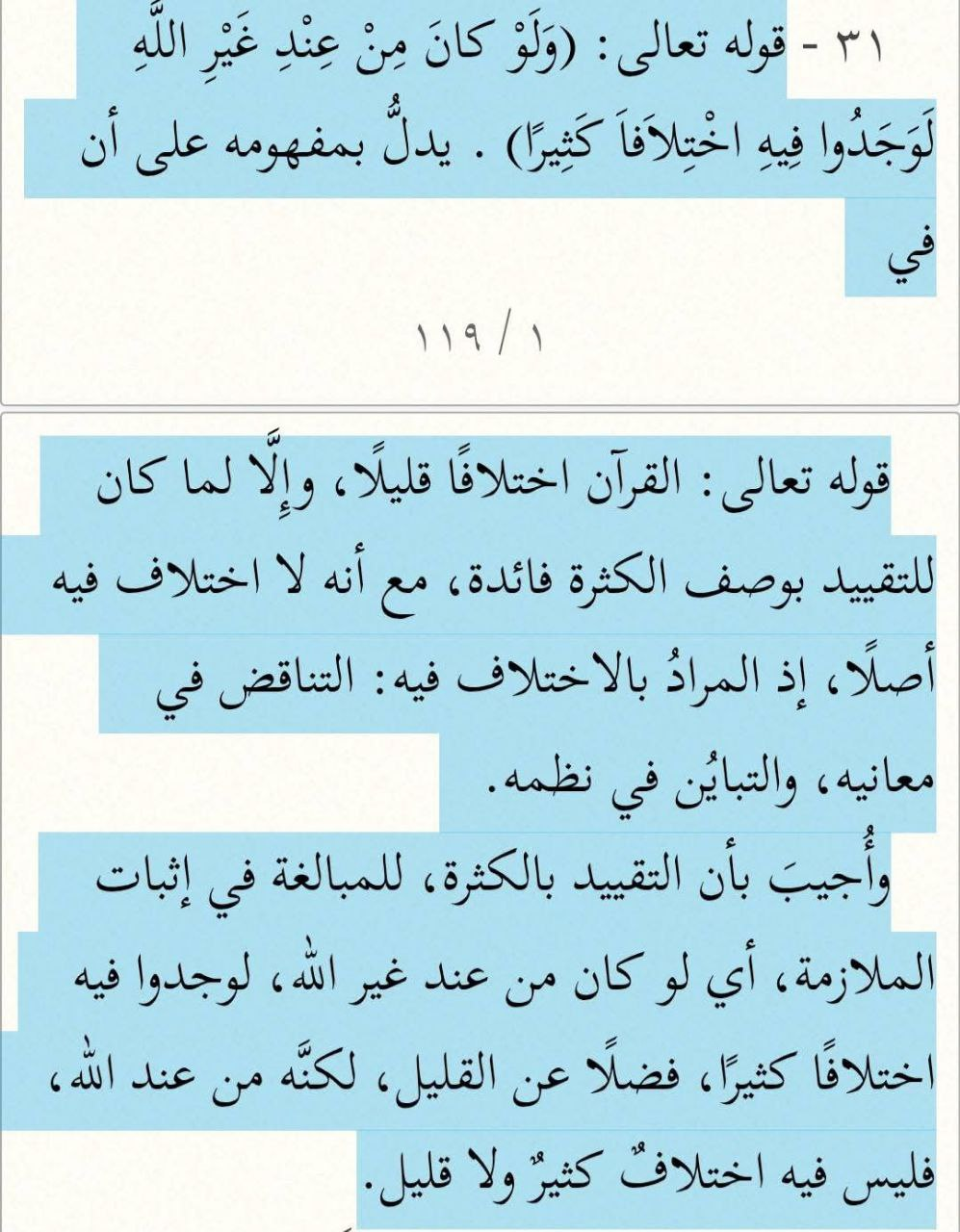
Summary of the Excerpt
This selection addresses a nuanced linguistic query regarding Surah An-Nisa, Verse 82: “Had it been from other than Allah, they would surely have found therein much contradiction.”
-
The Core Problematic Question: By specifying that they would have found much contradiction, does the text imply by its inverse meaning (Mafhum) that if the Qur’an were from a human source, it would only have a small amount of contradiction?
-
Defining Contradiction: The text reiterates that contradiction here refers to outright logical inconsistencies in meaning or disparities and structural imbalance in its composition (Nazm).
-
The Solution & Linguistic Purpose: The author resolves this by explaining that the qualification of contradiction being “much” (Kathira) serves a deeper rhetorical purpose:
- Hyperbolic Correlative Proof (Mubalagha): It emphasizes the absolute certainty of the correlation. If it were from an earthly source, it would be teeming with massive contradictions, let alone minor ones.
- The Reality: Because it is from Allah, it transcends human error completely. The final verdict is absolute: the text contains neither much nor a small amount of contradiction. It is entirely flawless.
Zayn al-Din al-Razi: The Conditional Logic Fully Unpacked
Zayn al-Din al-Razi, the linguist, reaches the same conclusion through a strictly conditional logical analysis:
We say: The answer is that the qualification of “many” is for emphasis in establishing the necessary connection, as if to say: If it were from other than God, they would have found in it much inconsistency, let alone a little. But there is neither much nor little inconsistency in it, so how could it be from other than God? This is the intended meaning of the qualification of “many” — not that the Qur’an contains minor discrepancies.
Ibn Ashur: Two Interpretations of Ikhtilaf and the Absolute Final Verdict
Al-Tahir ibn Ashur (d. 1393 AH), in Al-Tahrir wa-al-Tanwir, offers the most comprehensive rhetorical and grammatical analysis of the verse among modern-era classical scholars. He identifies two possible interpretations of what ikhtilaf means in this verse and then resolves the “much” qualifier definitively through conditional logic:
First: It most likely means textual discrepancy or logical disorder (Idtirab) within the text itself.
Second: Alternatively, it could mean a contradiction between what the Qur’an exposes about the hypocrites’ hidden states and actual reality. Since the Qur’an accurately exposed what was hidden deep in their hearts, it proved to them it could only come from the All-Knower of the Unseen (Al-Ghayb).
Ibn Ashur describes this scriptural proof as both concise and wondrous (Istidlal wajiz wa ‘ajib), specifically designed to completely sever any excuses they might have for remaining in disbelief.
Regarding the conditional logic of “much” (Kathiran): describing the contradiction as “much” applies only to the hypothetical scenario where the book is not from Allah (the impossible premise). Therefore, the word “much” is not a valid constraint (Qayd) for the actual state of the text. It should not be interpreted to mean “It is from Allah, so it only has a little contradiction.”
The true meaning is absolute: because it is from Allah, there is fundamentally no contradiction in it whatsoever (فلا اختلاف فيه أصلاً).
The image below reproduces the relevant passage from Ibn Ashur’s Al-Tahrir wa-al-Tanwir:
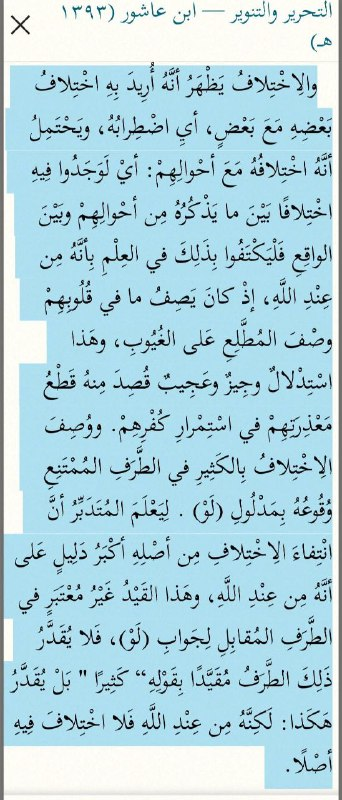
Summary of the Excerpt
This passage presents a deep grammatical, psychological, and rhetorical analysis of the verse by the Tunisian scholar Ibn Ashur.
-
Two Interpretations of “Contradiction” (Ikhtilaf):
- Internal Inconsistency: It most likely means textual discrepancy or logical disorder (Idtirab) within the text itself.
- Discrepancy with Reality: Alternatively, it could mean a contradiction between what the Qur’an exposes about the hypocrites’ hidden states and actual reality. Since the Qur’an accurately exposed what was hidden deep in their hearts, it proved to them it could only come from the All-Knower of the Unseen (Al-Ghayb).
-
The Rhetorical Argument: Ibn Ashur describes this scriptural proof as both concise and wondrous (Istidlal wajiz wa ‘ajib), specifically designed to completely sever any excuses they might have for remaining in disbelief.
-
The Conditional Logic of “Much” (Kathiran): He breaks down the usage of the conditional tool “If” (Law). Describing the contradiction as “much” applies only to the hypothetical scenario where the book is not from Allah (the impossible premise).
- Therefore, the word “much” is not a valid constraint (Qayd) for the actual state of the text. It should not be interpreted to mean “It is from Allah, so it only has a little contradiction.”
-
Conclusion: The true meaning is absolute: Because it is from Allah, there is fundamentally no contradiction in it whatsoever (فلا اختلاف فيه أصلاً).
Additional Classical Benefit: Al-Kirmani’s Refutation of the Rafidi Claim
Al-Kirmani notes in his Aja’ib that this verse has a second polemical application beyond the Christian objection — it also refutes those among the Rafidites who claim that the meaning of the Qur’an cannot be understood except through the interpretation of the Prophet or the Imam:
On the meaning of ikhtilaf: Ibn Abbas, Qatadah, Ibn Zayd, al-Tabari, al-Qurtubi, and all major mufassirun agree that the ikhtilaf condemned in 4:82 means contradiction of opposition — where one part invalidates another. Variant readings are explicitly excluded from this category by al-Qurtubi and others.
On the nature of the readings: Ibn Taymiyyah, Ibn al-Jazari, al-Dani, and Ibn Qutaybah all confirm that the seven letters and ten readings are a difference of diversity — they coexist without conflict, and all are revelation from God.
On the “much” qualifier: Ibn Uthaymeen, Zakariyya al-Ansari, Zayn al-Din al-Razi, and Ibn Ashur all converge on the same answer — “much” is a rhetorical device of mubalagha that intensifies the conditional proof. It does not imply any residual inconsistency in divine speech. Because the Qur’an is from God, it contains no contradiction — not much, not little, none at all.
See also: