Seven Ahruf Explained: Why the Qur’an Was Revealed in Multiple Arab Dialects
The Seven Aḥruf and Arab Dialects
The Qur’an was revealed in a way that accommodated the linguistic reality of the Arabs, especially those tribes who were not accustomed to the dialect of Quraysh. This is part of the wisdom behind the revelation of the Qur’an upon seven aḥruf.
Table of Contents
- Arab Dialects and “Languages”
- Al-Farahidi on the Languages of the Arabs
- The Qur’an and Dialectal Accommodation
- The Seven Aḥruf as Facilitation
- The Hadith of Umar and Hisham Ibn Hakeem
- What This Shows
- Final Conclusion
Arab Dialects and “Languages”
Arab tribes had dialects that differed slightly in some grammatical rules — which grammarians refer to as “languages” — لغات.
It can mean a tribal dialect, pronunciation pattern, grammatical usage, or known linguistic habit among a particular Arab tribe.
Al-Farahidi on the Languages of the Arabs
✅ The great scholar Al-Farahidi said in Al-Jumal fi an-Nahw:
‘Indeed, Allah Almighty revealed the Qur’an in the language of every clan (living group) among the Arabs…’
This refers to the fact that the Qur’an was revealed in a way that accommodated the linguistic variations of the different Arab tribes at the time, while still maintaining its miraculous eloquence and unity in meaning.
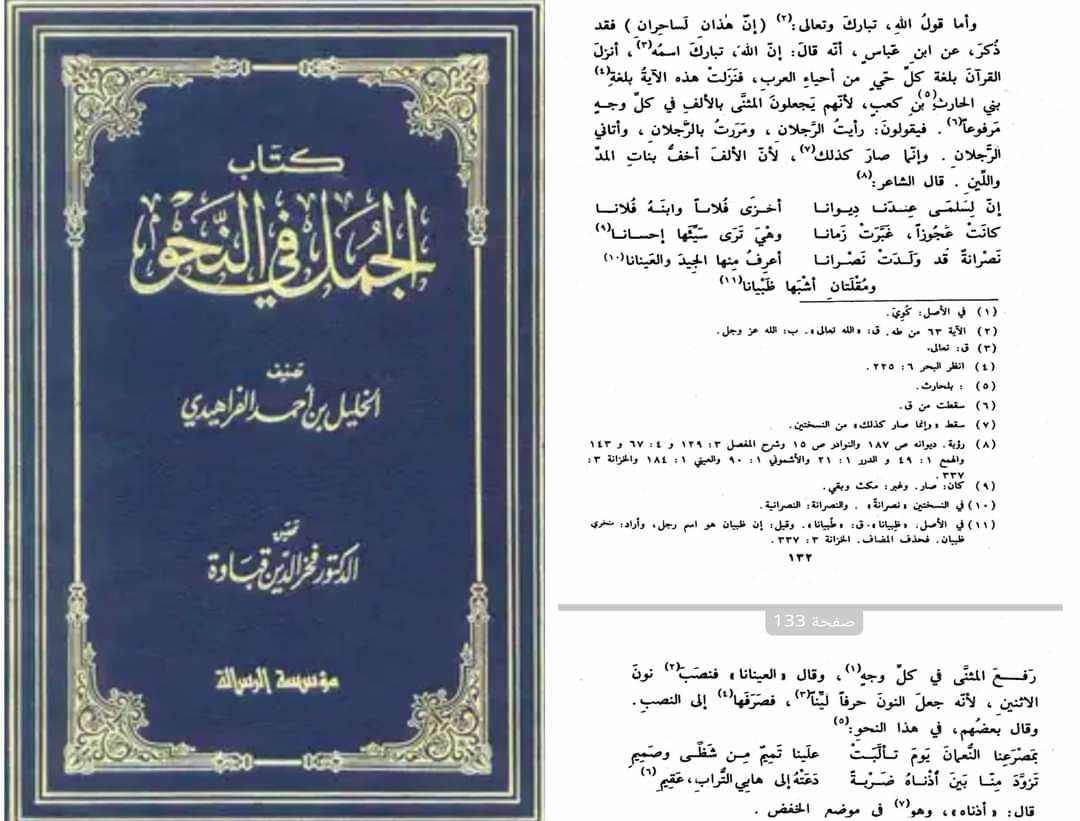
The highlighted discussion mentions a report from Ibn ʿAbbās رضي الله عنهما stating that Allah revealed the Qur’an in the language of every clan among the Arabs.
The point being made is that the Qur’an’s revelation took into account the recognized linguistic diversity of Arab tribes.
The Qur’an and Dialectal Accommodation
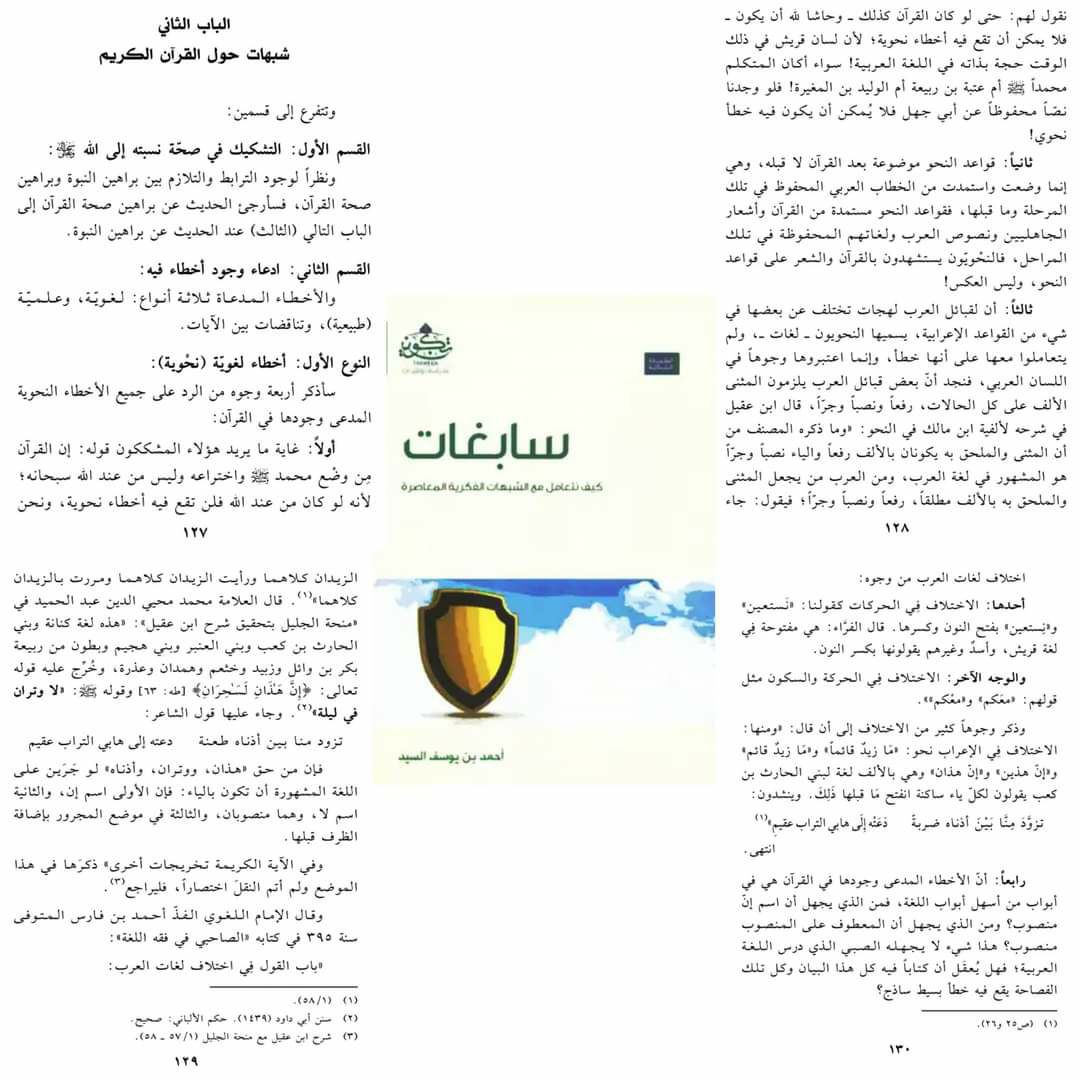
The scan argues that some expressions which may look unusual to later readers were actually valid usages among recognized Arab tribes.
It also notes that rules of Arabic grammar were later derived from the Qur’an, Arabic speech, and Arabic poetry — so it is backwards to judge the Qur’an by later simplified grammar rules while ignoring the broader linguistic reality of the Arabs.
This is why knowledge of lugāt al-ʿArab — the dialects/usages of the Arabs — is essential when discussing Qur’anic Arabic.
The Seven Aḥruf as Facilitation
So indeed, Allah Almighty revealed His Book to His Messenger ﷺ in seven aḥruf as a facilitation for His Ummah — especially those tribes who were not accustomed to the dialect of Quraysh ✅
The aḥruf include linguistic facilitation, but classical scholars differed over their exact nature. The safest wording is that they were revealed modes of recitation given as ease for the Arabs, including recognized linguistic variation.
The Hadith of Umar and Hisham Ibn Hakeem
There is a well-known story mentioned in Al-Muwatta’ by Imam Malik about Umar ibn al-Khattab رضي الله عنه and Hisham ibn Hakeem ibn Huzaym, where they differed in the recitation of Surah Al-Furqan.
Umar explained the issue to the Prophet ﷺ, and he clarified the matter and its purpose:
Hadith – No. 472
I heard Umar ibn al-Khattab say:
“I once heard Hisham ibn Hakeem ibn Huzaym reciting Surah Al-Furqan in a way different from how I used to recite it, and I was the one whom the Prophet ﷺ himself taught. I almost rushed at him (in anger), but I held myself back until he finished his prayer. Then I caught him by his robe and brought him to the Messenger of Allah ﷺ.
I said: ‘O Messenger of Allah, I heard this man reciting Surah Al-Furqan differently than you taught me.’
The Prophet said: ‘Let him go.’ Then he said to Hisham: ‘Recite.’
So Hisham recited in the way I had heard him, and the Messenger of Allah said: ‘It was revealed like this.’
Then he said to me: ‘Recite.’
So I recited, and he said: ‘It was revealed like this. Indeed, the Quran was revealed in seven ahruf. So recite what is easy from it.’” ✅
This hadith is recorded in nearly all the major collections, including Sahih al-Bukhari, Sahih Muslim, Sunan al-Nasa’i, and others.
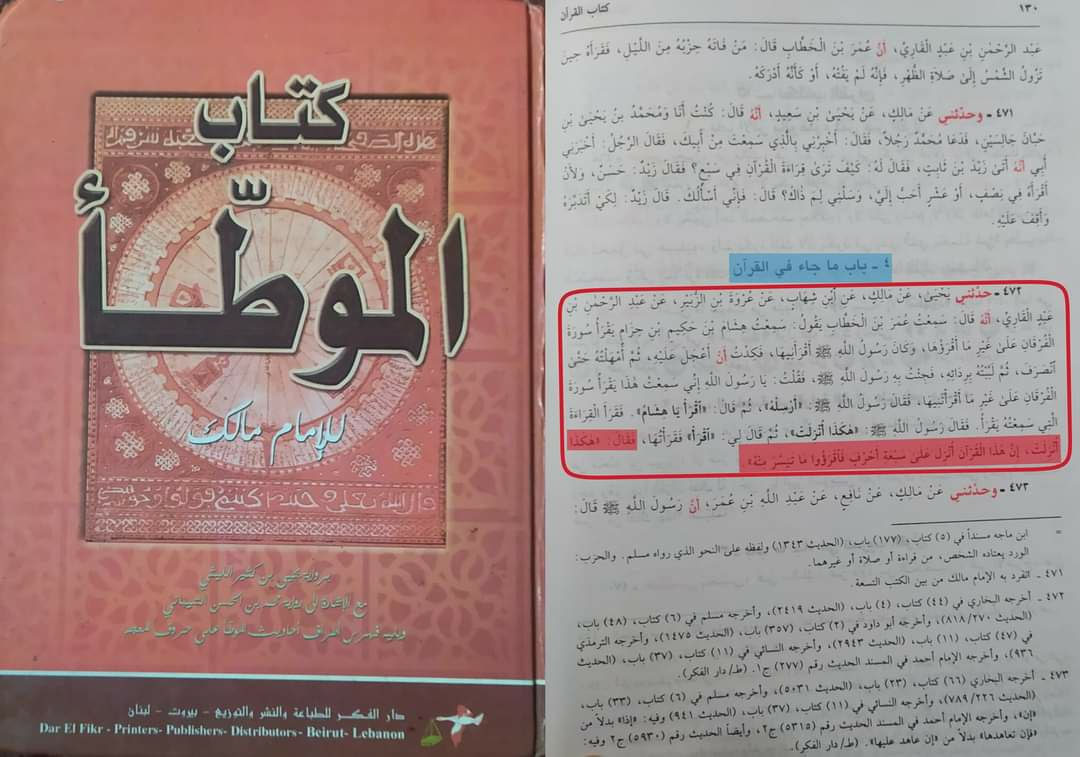
It records the famous narration of Umar ibn al-Khattab رضي الله عنه hearing Hisham ibn Hakeem رضي الله عنه recite Surah Al-Furqan differently from how Umar had learned it.
When both recited before the Prophet ﷺ, he confirmed both recitations and said that the Qur’an was revealed upon seven aḥruf, and that people should recite what is easy from it.
The Same Report in Sahih al-Bukhari
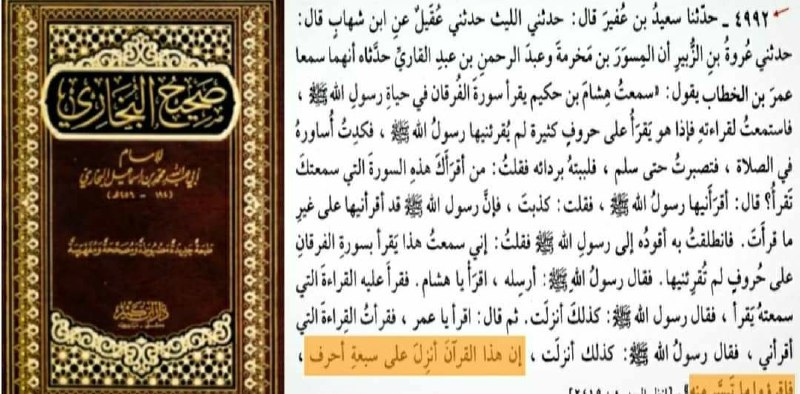
It highlights the Prophet’s ﷺ statement:
“Indeed, this Qur’an was revealed upon seven aḥruf.”
This proves that the different authorized modes were not later inventions, but were taught and approved by the Prophet ﷺ himself.
Explanation of the Seven Aḥruf
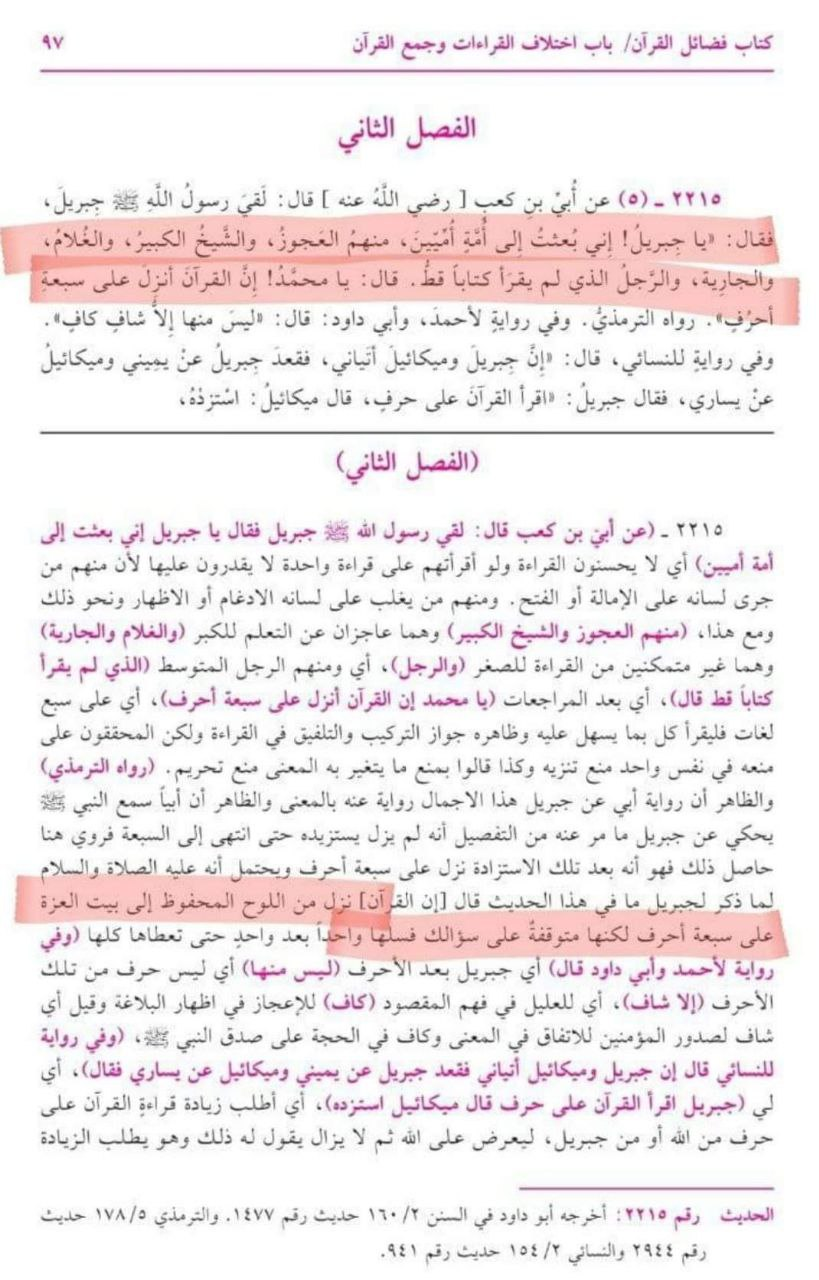
The explanation emphasizes that the seven aḥruf were a mercy and facilitation, not contradiction or corruption.
The purpose was to make recitation easier for the Arab tribes while preserving the meaning and divine origin of the Qur’an.
What This Shows
Rather, it is evidence of divinely authorized flexibility during revelation, confirmed by the Prophet ﷺ himself.
Final Conclusion
The Qur’an was revealed in a way that accommodated the linguistic diversity of the Arabs. This is part of the wisdom behind the revelation of the Qur’an upon seven aḥruf.
The hadith of Umar ibn al-Khattab and Hisham ibn Hakeem proves that different authorized recitations were confirmed by the Prophet ﷺ, not invented later.
Therefore, the seven aḥruf were a form of ease and mercy for the Ummah, especially for tribes unfamiliar with the dialect of Quraysh.
They show that the Qur’an was revealed with divine allowance for Arab linguistic variation, while remaining one preserved revelation.