

Tacitus on the Crucifixion of Christ — Why the Annals 15:44 Is Not Historical Evidence
Tacitus wrote his account of Christ’s execution approximately 80 years after the event, made a demonstrable factual error about Pontius Pilate’s administrative title, was known by scholars of his own works to repeat unverified rumors in moral-critique contexts, and — according to multiple Christian scholars — got his information about Christians from Christians themselves. This is not historical evidence for the crucifixion.
Our Christian friends cite the words of the Roman historian Tacitus to prove the crucifixion of Christ historically, as though they had brought conclusive, indisputable evidence. The following analysis refutes this claim scientifically, demonstrating that Tacitus’s passage in the Annals fails as independent historical evidence on every methodological criterion.
Who Is Tacitus — Biography and the Annals
The following image is from the biographical material on Cornelius Tacitus, the Roman historian whose words Christians cite regarding Christ.
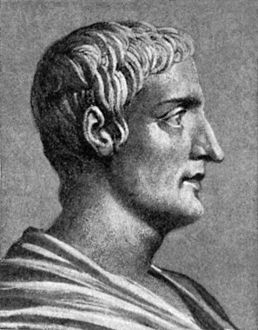
Cornelius Tacitus (55–120 AD) was a historian and chief magistrate of a province of the Roman Empire. Much of his writing has been lost, the most important of which are parts of the Annals and the Histories — his greatest historical works. The two books focus on the reign of the Roman emperors Tiberius, Claudius, and Nero, the rulers of the so-called Year of the Four Emperors, covering the period from the death of Augustus (AD 14) to the death of Domitian (AD 96). There are large gaps in the text of his surviving works, including one that is four books long in the Annals.
The Passage Cited by Christians — What Tacitus Actually Said
Father Abdel-Masih Basit presents the passage that Christians typically rely on:
Father Abdel-Masih Basit also cites the scholar F.F. Bruce arguing that Tacitus, by virtue of his relationship with the Roman government, was familiar with the reports of the governors of the provinces of the empire and with the official records of the state.
The questions that this passage raises as historical evidence are the following.
First Problem — The 80-Year Gap Between the Event and the Writing
Tacitus was not a witness to the crucifixion. He was not alive during it. He was born approximately 28 years after the alleged crucifixion, and the book in which he wrote these words — the Annals — was composed around 115 AD.
The crucifixion, according to the Christian tradition, occurred around 30–33 AD. Tacitus wrote his account around 115 AD. The gap between the event and the writing is approximately 80 to 85 years. This is not a minor methodological issue. In the study of ancient history, a source written 80 years after the event it describes — with no citation of contemporaneous records, no named witnesses, and no chain of transmission — cannot be treated as independent historical evidence for that event.
Second Problem — Where Did Tacitus Get His Information?
Christians argue that the source of Tacitus’s information is Roman official records. There is no evidence for this claim. More decisively, there are four specific reasons why Tacitus could not have obtained his information from Roman records.
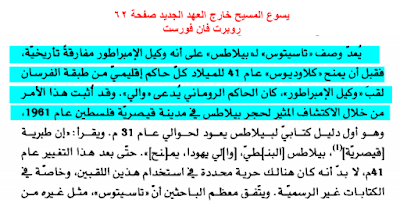
Reason One — Tacitus Made a Factual Error About Pontius Pilate’s Title
The following image is from the work of scholar Robert Van Voorst, who notes the error in Tacitus’s description of Pontius Pilate’s administrative position.
Reason Two — Tacitus Uses the Title “Christus,” Not the Name Jesus
If Tacitus was quoting from official Roman records, he would have referred to the person by his actual name — Jesus — not by the title “Christus,” which is a Greek rendering of the Hebrew “Messiah.” Roman official records would not have used the title by which the followers of a religion referred to their founder. The use of “Christus” is the vocabulary of Christians speaking about their own tradition, not the vocabulary of Roman administrative records.
Reason Three — The Roman Records No Longer Existed
It is unlikely that the Roman records Tacitus supposedly consulted were available to him at all. The records were apparently burned in 64 AD when Rome was destroyed by fire, and again in 80 AD when the libraries of Rome were destroyed. By the time Tacitus composed the Annals around 115 AD, the original records from the time of Tiberius — more than 80 years earlier — had been lost twice over.
Reason Four — Tacitus Had No Motivation to Search for This Information
It is ironic that Tacitus would have spent hours or days searching through Roman archives to verify information about a religion and people that he did not care about and explicitly despised — calling Christianity a “pernicious superstition” in the very passage Christians cite as evidence. A historian who regarded a group as practitioners of a “pernicious superstition” would not have subjected their claims about their founder to careful archival verification.
Tacitus Was Not a Reliable Transmitter of Historical Facts About Religions He Despised
Christians object by arguing that Tacitus was an accurate and historically reliable historian who transmitted only documented information. The response is that this claim is contradicted by the work of the leading specialist in Tacitus’s writings.
The following image is the first screenshot from Ronald Mellor‘s scholarly assessment of Tacitus’s methodology, showing his documented practice of repeating unverified information in moral-critique contexts.
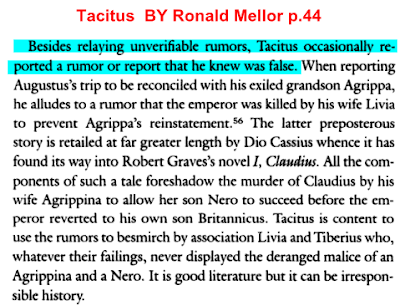
The context of the speech about Christians was simply to explain the origin of the term “Christians,” which was done in the context of documenting Nero’s actions. Tacitus refers to “Christus” in the context of a moral attack on Nero. This is precisely the kind of passage in which Tacitus might be willing to repeat non-historical information. If Tacitus was willing to repeat non-historical information in such a context, he would certainly be willing to repeat uncontroversial, incidental information — such as the history of Jesus — without directly verifying it. Furthermore, in the context of the passage, it is unclear that Tacitus was even considering whether “Christ” actually existed, especially given that Tacitus described Christianity as a “pernicious superstition.”
The following image is the second screenshot from Ronald Mellor’s work, containing his assessment that Tacitus’s information about Jews and Christians is “confused.”
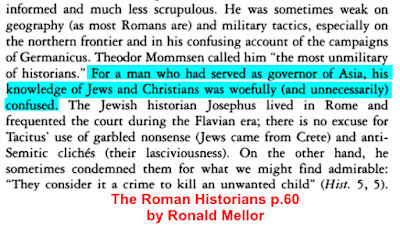
The leading specialist on Tacitus’s works — not a Muslim scholar, not an Islamic apologist, but a scholar whose career was dedicated to studying Tacitus — describes his information about Jews and Christians as “confused” and documents his practice of repeating false or unverified information in exactly the type of moral-narrative context that the Christ passage represents.
Christian and Secular Scholars Confirm — Tacitus Got His Information from Christians
Multiple scholars — including some of the most respected names in New Testament studies and historical Jesus research — confirm that Tacitus’s information about Christ came not from Roman official records but from Christians themselves.
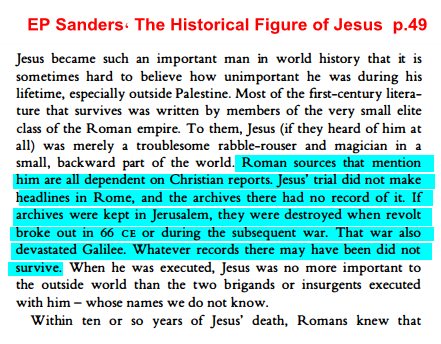
The following image is from the work of E.P. Sanders, described by John Meier as “the most distinguished scholar of historical Jesus research,” showing his conclusion about the source of Tacitus’s information.
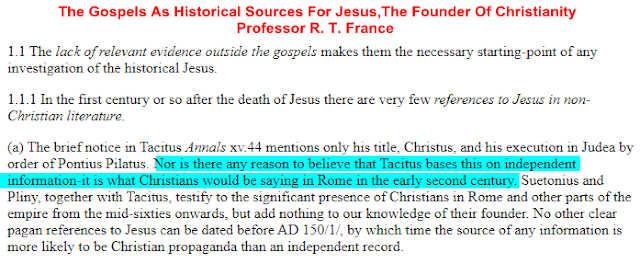
The following image is from the work of Professor R.T. France, a distinguished Christian scholar, confirming the same conclusion.
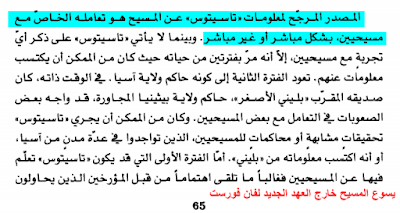
The following image is from Robert Van Voorst’s work, where he favors Christians as the source of Tacitus’s information.
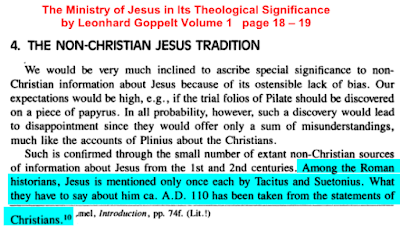
The following image is from the work of scholar and theologian Leonard Gobelt, confirming the same conclusion.
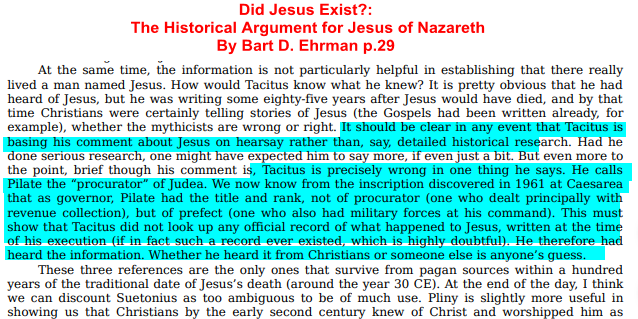
The following image is from the work of Bart Ehrman, who — although he believes in the historical existence of Christ and his crucifixion — confirms that Tacitus’s information came not from Roman records but from Christians or hearsay.
And finally, the Christian scholar William Lane Craig — one of the most prominent Christian philosophers and apologists — confirmed that Tacitus’s information came from Christians:
Source: William Lane Craig, “John Dominic Crossan and the Resurrection,” in The Resurrection: An Interdisciplinary Symposium on the Resurrection of Jesus, ed. Stephen T. Davis, Daniel Kendall, Gerald O’Collins (Oxford: Oxford University Press, 1997), p. 252, n. 4.
This is the state of the evidence: six scholars — including Christian scholars who themselves believe in the crucifixion — all confirm that Tacitus’s information came from Christians. A source whose information came from the very community whose claim it is supposed to independently verify is not independent evidence. It is circular.