TARAWEEH
.
Taraweeh Prayer is Sunnah of Prophet(saws) Not (Shara’i) Bidah of Umar(ra)
Introduction.
In The Name of Allah, The Beneficent, The Merciful.
One of the oft-repeated allegation of Shias against Umar(RA) is that he innovated Taraweeh prayer, which Sunnis pray during the month of Ramadan. While the fact is that, all what Umar(RA) did was he combined all the small groups of people who were already praying in the Mosque during Ramadan, into one large group so that they could pray behind one Imam rather than several different Imams, and it is this administrative decision which he called “a good innovation”(lingually). Umar(RA) wasn’t referring to the prayer as an innovation, because the prayer had been going on since the time of the Prophet(SAWS), rather he called his administrative decision to combine all the different Jamaats into one uniform Jamaat behind a single Imam a good innovation.
Shia in their blind hatred became so blind that they could not even properly see what Umar(RA) actually did in the first place. He did not convert Qiyaam from an individual act of worship to a congregational act of worship, nor did he transform it from act of worship done privately at home to an act of worship done publicly in the Masjid, because he didn’t need to do so, since people were already praying it in small Jamaat in public. The congregational aspect of Qiyaam was already well-established and in practice even before Umar(RA) came into the picture.
In this thread we will be answering the most common arguments that are levelled against Umar(RA) by the Shias in regards to Taraweeh
I. Evidence of Taraweeh Prayer after Isha in Ramadan from Reliable Reports
Argument I(a)
Shia Website[Shiapen] stated:
The reality: The Prophet (s) offered Tahajjud during those three nights and not Tarawih
It is important to note that:
Tarawih is 20 or 8 Rakah prayer after Isha عشاء Prayer
At no point did Rasool (saww) pray 20 or 8 Rakah Salah after Isha prayers.
What Rasool (saww) offered for 3 nights, was only and only TAHAJJUD Prayer (which starts after Midnight).
Our stance is backed up by the following hadith, wherein the Prophet prayed after the “Middle of Night”.
Narrated ‘Urwa: That he was informed by ‘Aisha, “Allah’s Apostle went out in the MIDDLE OF NIGHT(i.e. For Tahajjud) and prayed in the mosque and some men prayed behind him. In the morning, the people spoke about it and then a large number of them gathered and prayed behind him (on the second night). In the next morning the people again talked about it and on the third night the mosque was full with a large number of people. Allah’s Apostle came out and the people prayed behind him. On the fourth night the Mosque was overwhelmed with people and could not accommodate them, but the Prophet came out (only) for the Morning Prayer. Sahih Bukhari, Volume 3, Book 32, Number 229
In light of this tradition we deem it imperative that people stop falsely suggesting that the Sunnah is evidenced by the fact the Prophet (s) prayed 8 or 20 Rakah Salah after Isha Prayer. The fact is no such evidence exists and we challenge our opponents to negate our assertion.
Answer
Shias should avoid making bold challenges out of ignorance just to impress their fellow Shias. They have no proper knowledge about Sunni practices.
Firstly, as per the correct view, the time of Taraweeh prayer in Ramadan starts after Isha and it remains until the Adhan(call to prayer) of Fajr is announced.
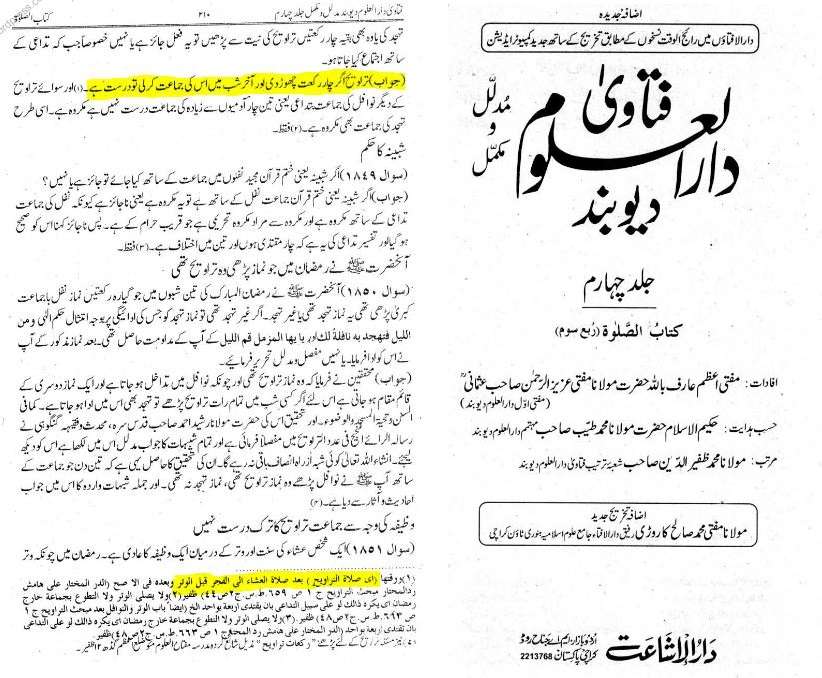
Mufti Azeez ur-Rahman Usmani al-Hanafi stated: If Taraweeh is prayed in the last part of the night then it is correct. [Fatawa Darul Uloom Deoband, vol 4 page 210].
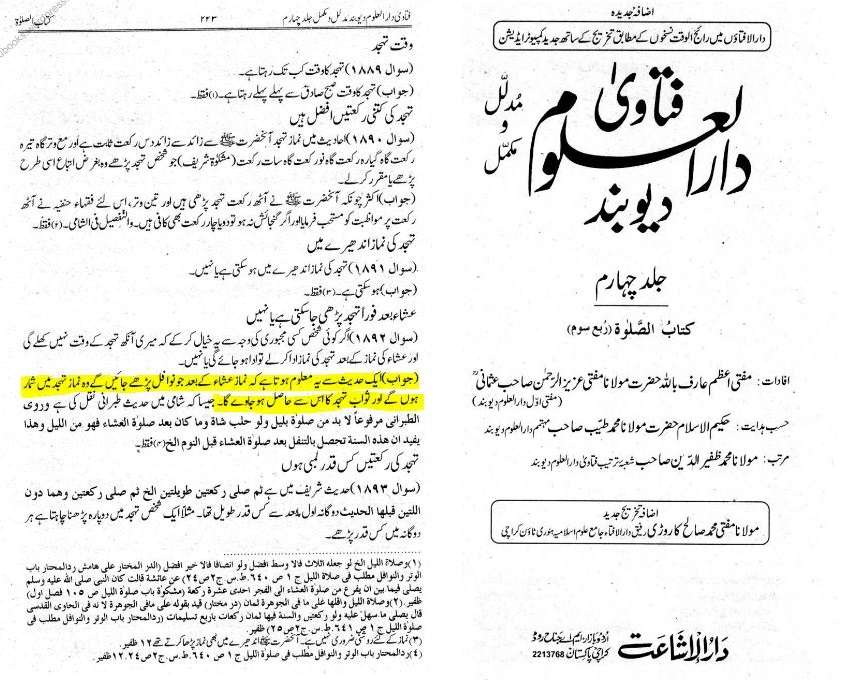
Mufti Azeez ur-Rahman Usmani al-Hanafi also stated: From one hadeeth we came to know that, after Isha prayer any voluntary(Nafil) prayer is counted as Tahajjud, and one would receive the reward of Tahajjud from it, as mentioned in Shaami from the hadeeth of Tabarani. [Fatawa Darul Uloom Deoband, vol 4 page 223].
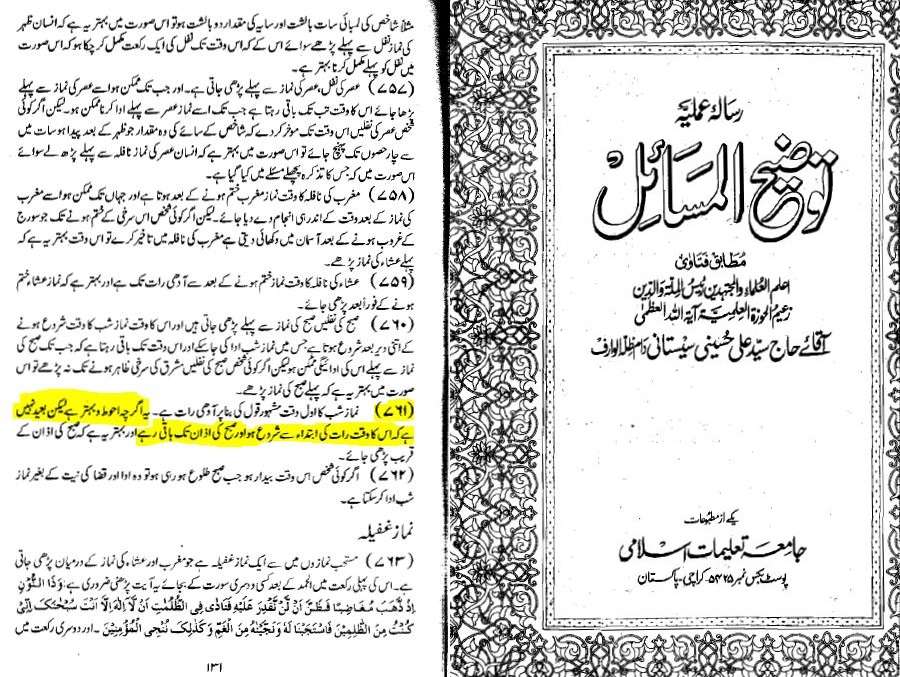
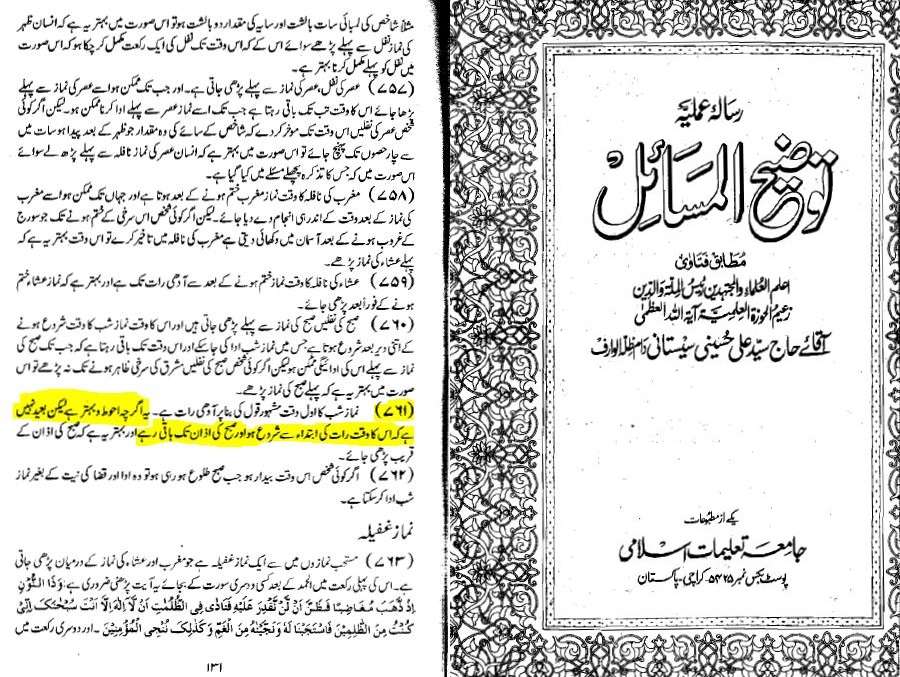
Shia Ayatullah Sayyid Ali Hussein Sistani stated: The time for Salat al-Layl starts from middle part of night as per the famous opinion. Even though it is better, but It’s not unlikely (i.e. it’s possible) that the time of Salat al-Layl starts after Isha prayers and remains till the Adhan of Fajr. However, it is better to pray near the time of Fajr prayer. [Tauzeeh al-Masail, page 131].
Secondly, Prophet Muhammad(saws) didn’t just lead prayer only those days mentioned in the hadeeth which was mentioned by Shias, rather Prophet(saws) lead the Taraweeh prayer on other occasion as well, and it was TILL one-third of the night. Suppose the duration between Isha and Fajr prayer was Nine hours, then one-third of the night would means until three hours after Isha.
Prophet Muhammad(saws) praying Taraweeh after Isha is proven from other reliable reports which mentions ANOTHER Occasion where Prophet(saws) led people in Taraweeh. And contrary to Shia claim, that the time of Tahajud starts AFTER midnight, we find that Prophet(saws) led Sahaba in Qiyam al-Layl TILL one-third of night. These are clear evidences of Prophet Muhammad(saws) leading Taraweeh prayer in congregation after Isha. Hence undoubtedly it is the Sunnah of Prophet Muhammad(saws).
As per Reliable Reports Prophet(SAWS) Prayed Taraweeh from after Isha till Suhoor/Sehri(The Meal before daybreak)
(a)
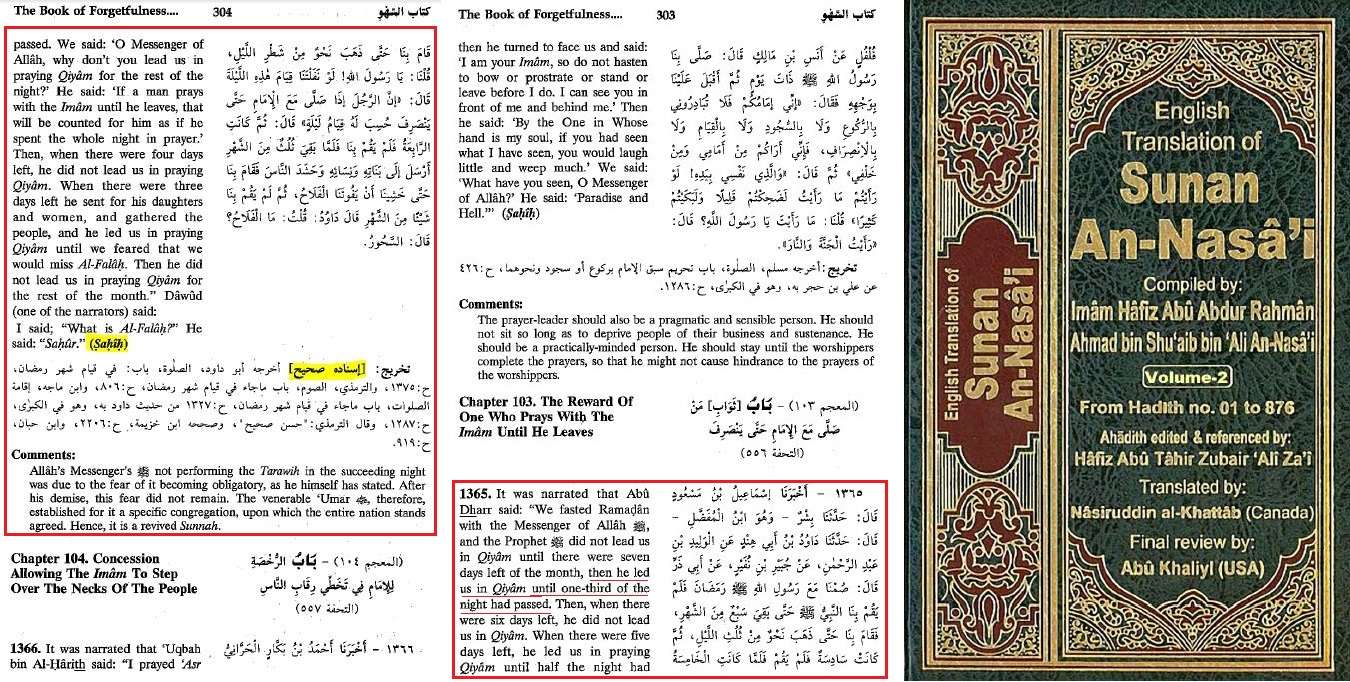
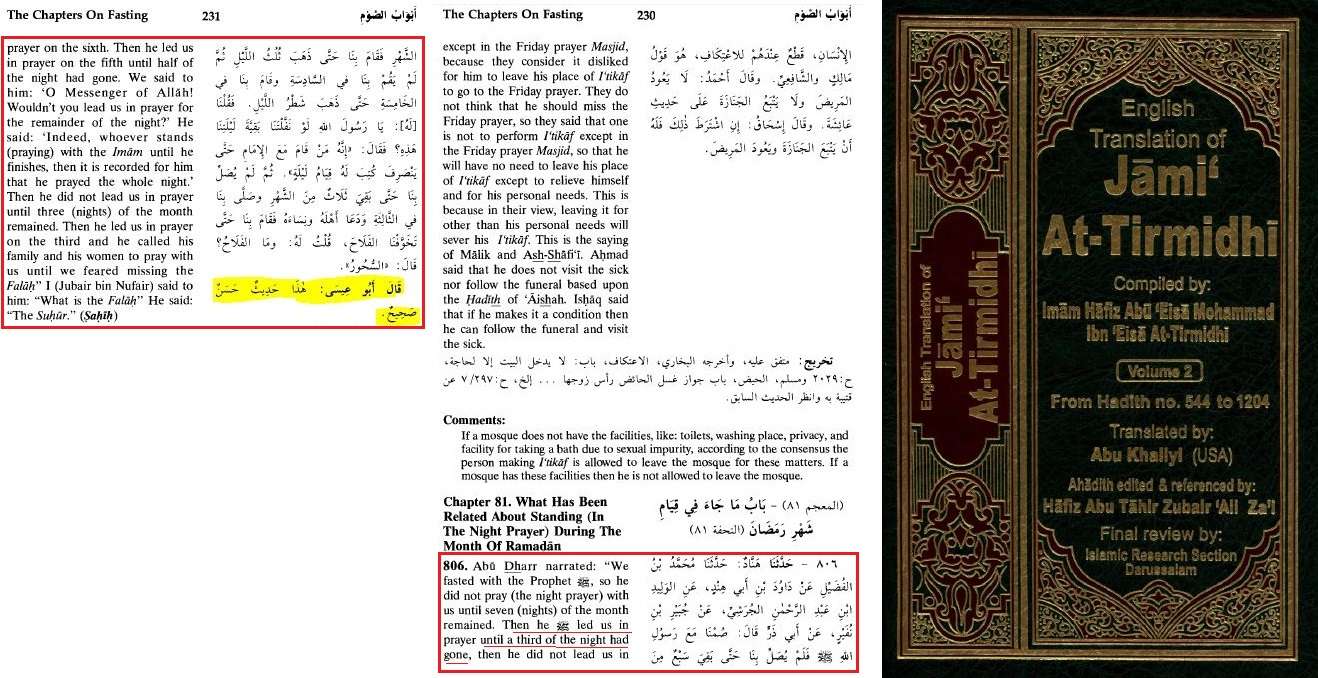
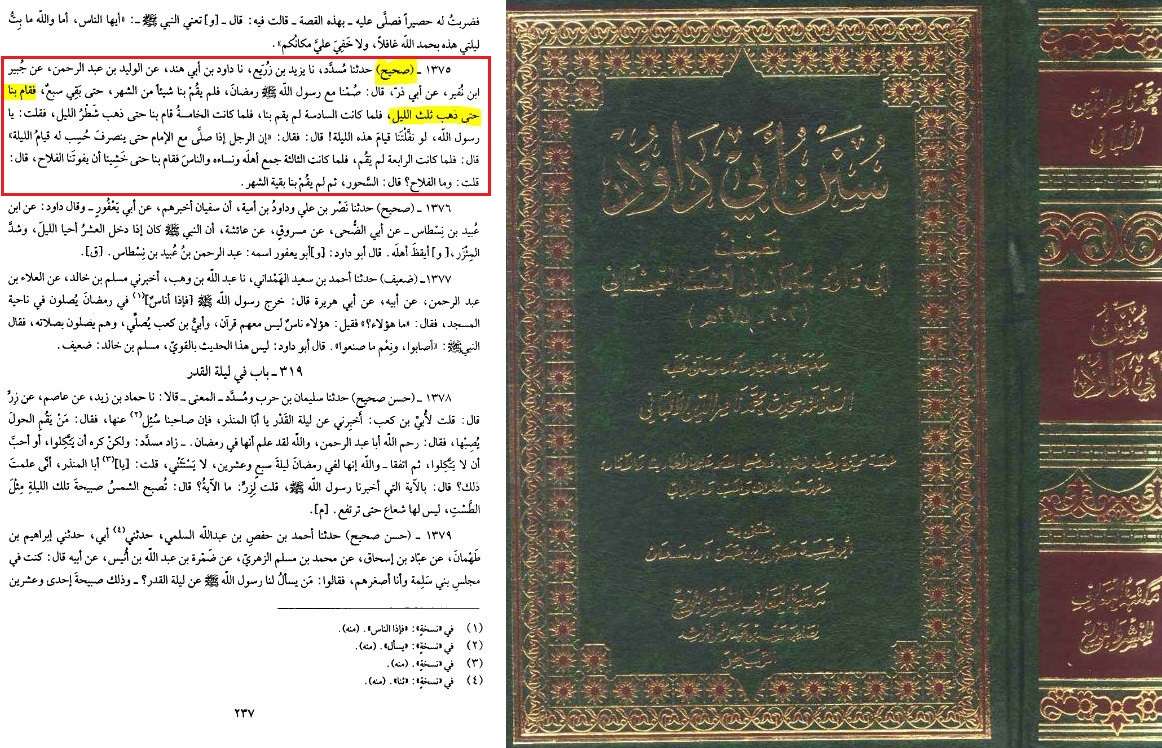
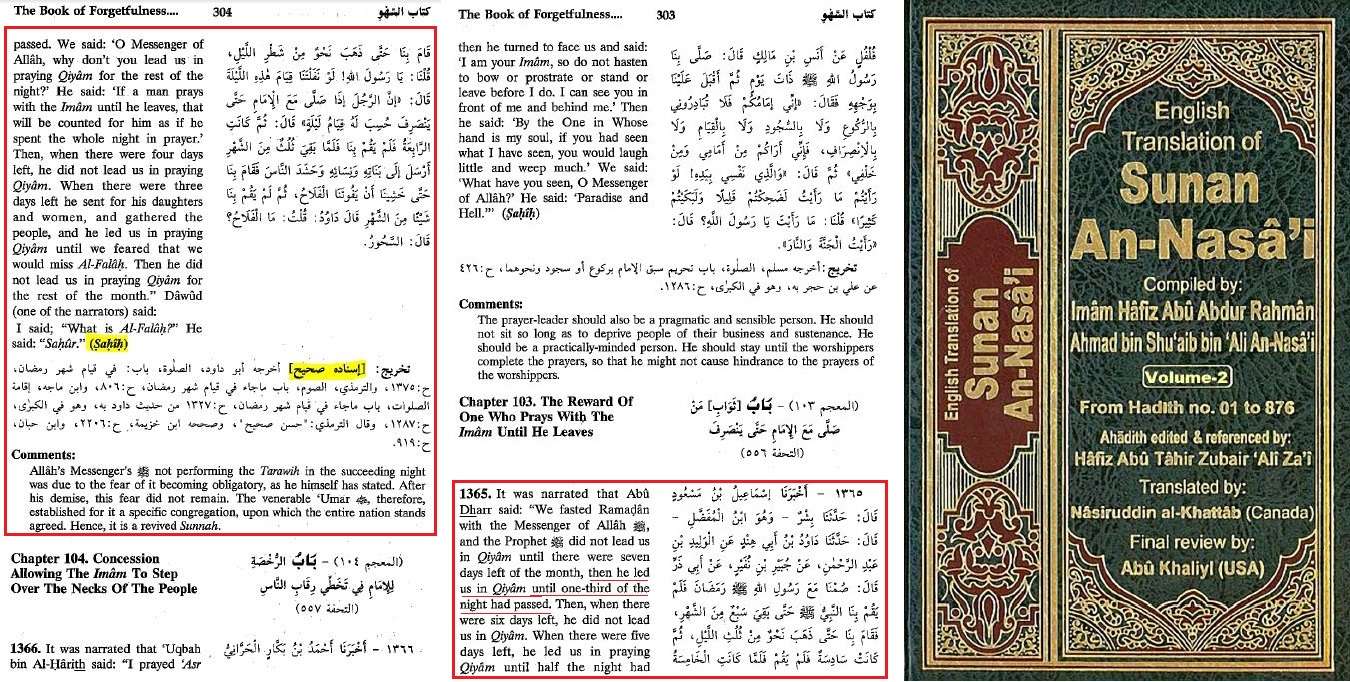
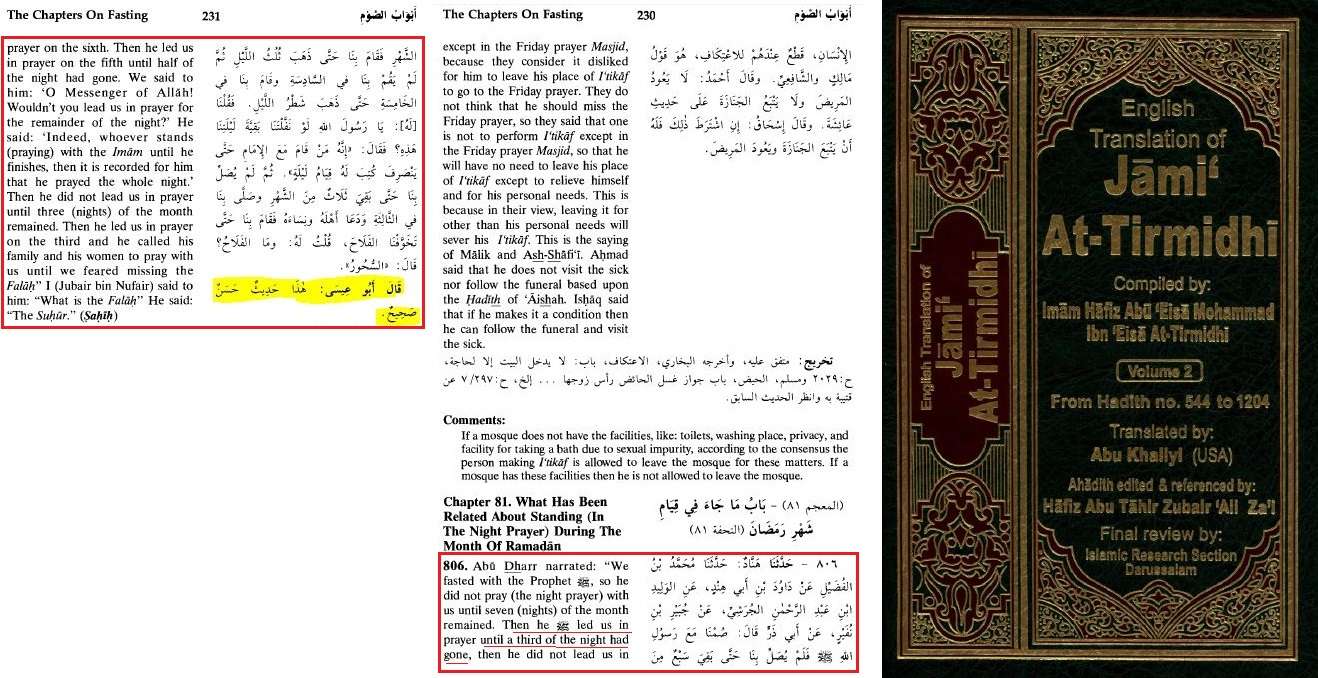
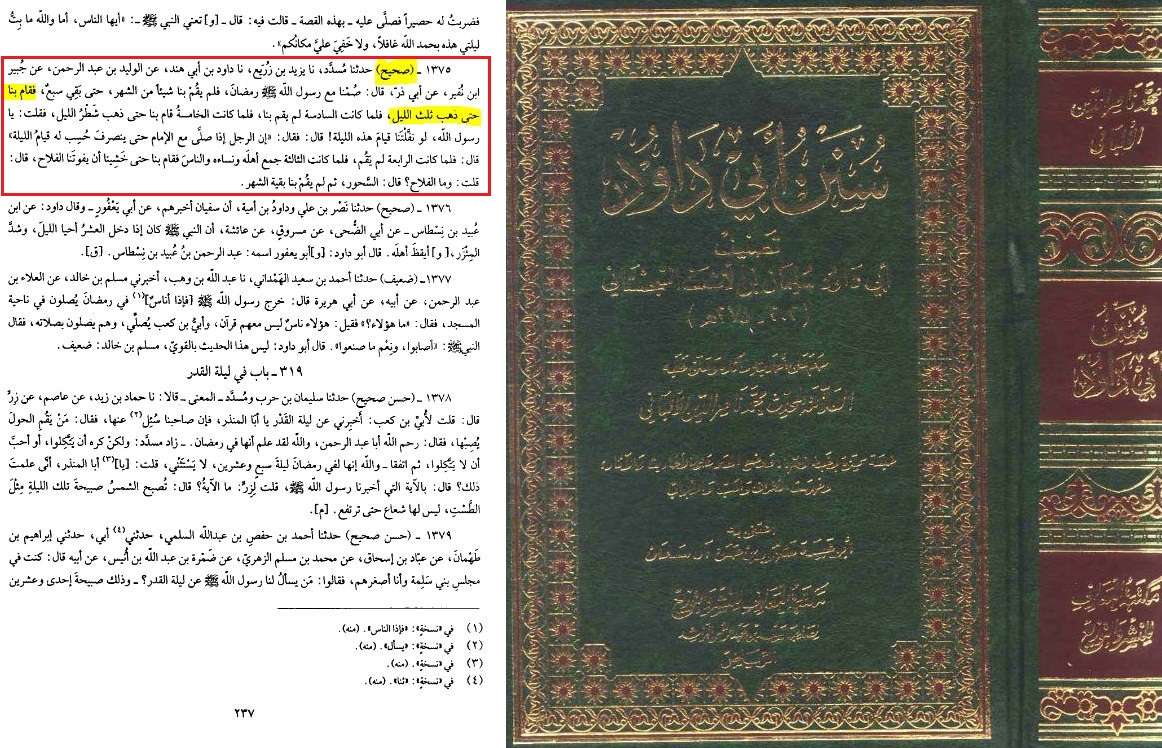
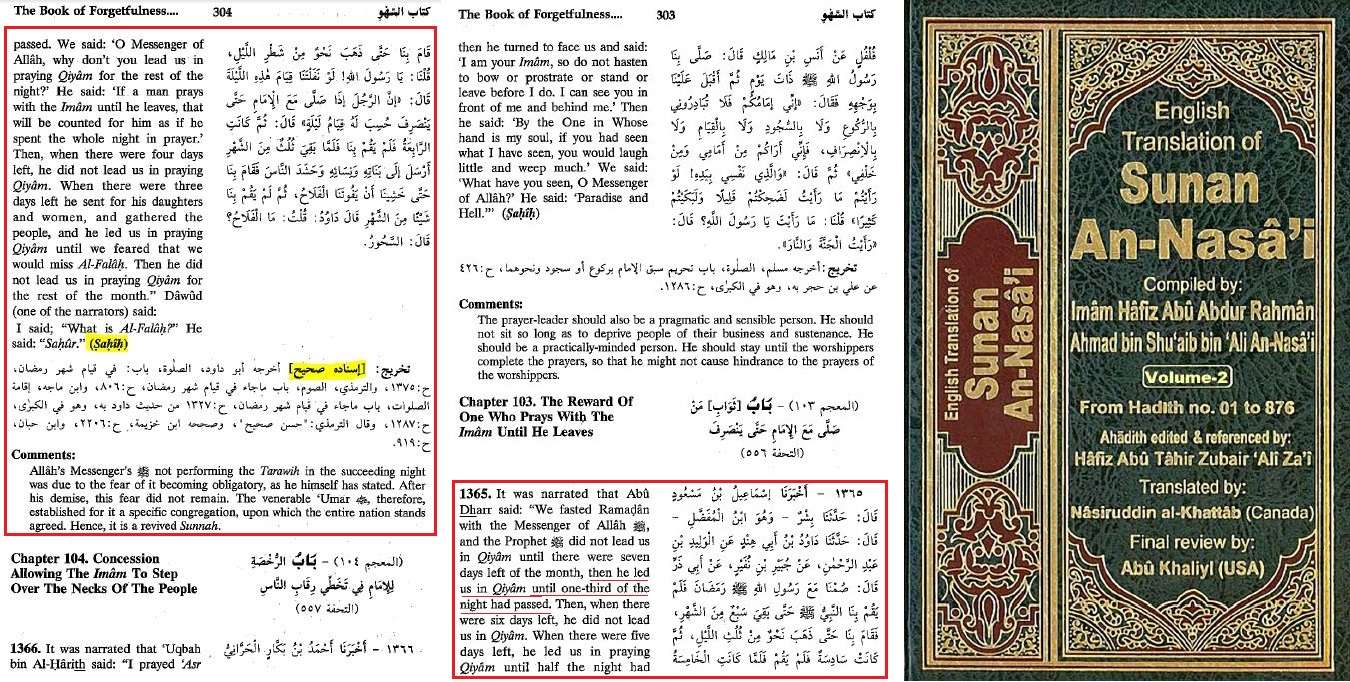
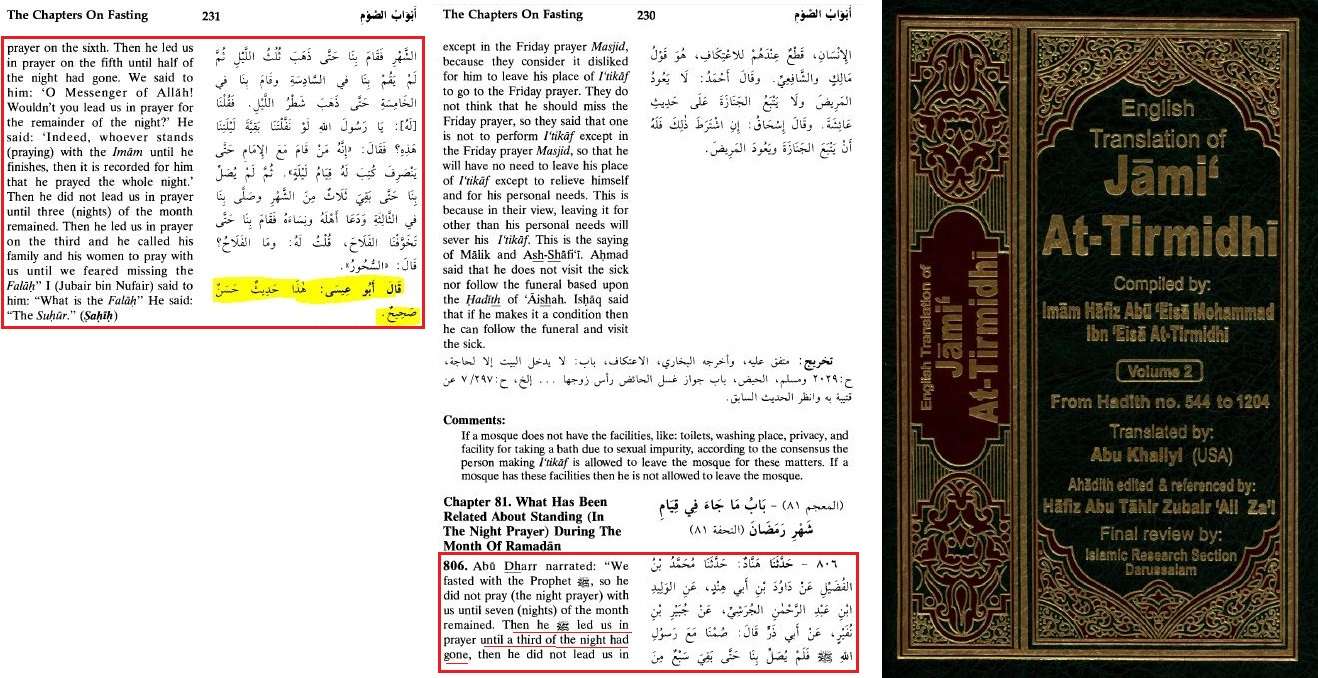
It was narrated that Abu Dhar(ra) said: “We fasted Ramadan with the Messenger of Allah(SAWS), and the Prophet(SAWS) did not lead us in Qiyam until there were seven days left of the month, then he led us in Qiyam until one-third of the night had passed. Then, when there were six days left, he did not lead us in Qiyam. When there were five days left, he led us in praying Qiyam until half the night had passed. We said: ‘O Messenger of Allah(SAW), why don’t you lead us in praying Qiyam for the rest of the night?’ He said: ‘If a man prays with the Imam until he leaves, that will be continued for him as if he spent the whole night in prayer.’ Then, when there were four days left, he did not lead us in praying Qiyam. When there were three days left he sent for his daughters and women, and gathered the people, and he(SAWS) led us in praying Qiyam until we feared that we would miss Al-Falah. Then he did not lead us in praying Qiyam for the rest of the month.” Dawud (one of the narrators) said: “I said: ’ What is falah?’ He said: ‘Suhur(The meal before daybreak).’ [Sunan al-Nasai, vol 2, page 303-304, #1365 ; Sahih as Zubair Ali Za’ee] ; [Jami al-Tirmidhi, vol 2, page 230-231, #806 ; Hasan Sahih as per al-Tirmidhi] ; [Sunan Abu Dawood, page 237, #1375 ; Sahih as per Albani] ; [Sunan ibn Majah ,Vol. 1, Book 5, Hadith 1327].
(b)
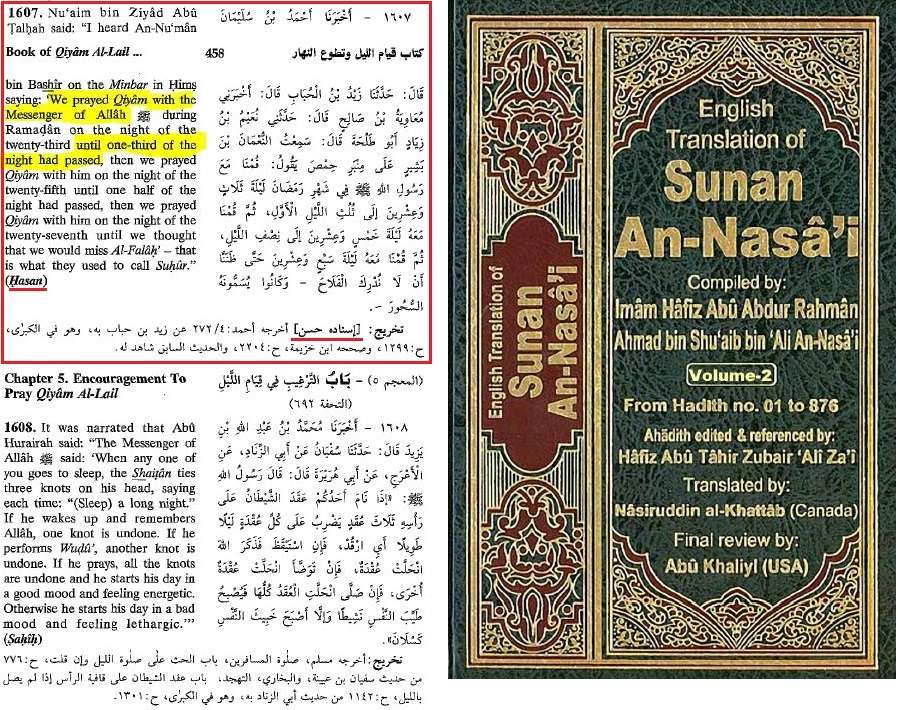
Nu’aim bin Ziyad Abu Talhah said: “I heard An-Nu’man bin Bashir on the minbar in Hims saying: “We prayed Qiyam with the Messenger of Allah(SAWS) during Ramadan on the night of the twenty-third until one-third of the night had passed, then we prayed Qiyam with him on the night of the twenty-fifth until one-half of the night had passed, then we prayed Qiyam with him(SAWS) on the night of the twenty-seventh until we thought that we would miss Al-Falah– that is what they used to call suhur.[Sunan al-Nasai, vol 2, page 458, #1607 ; Hasan as per Zubair Ali Za’ee] ; [Salat al-Taraweeh, page 9-10 : Isnad Sahih as per Albani].
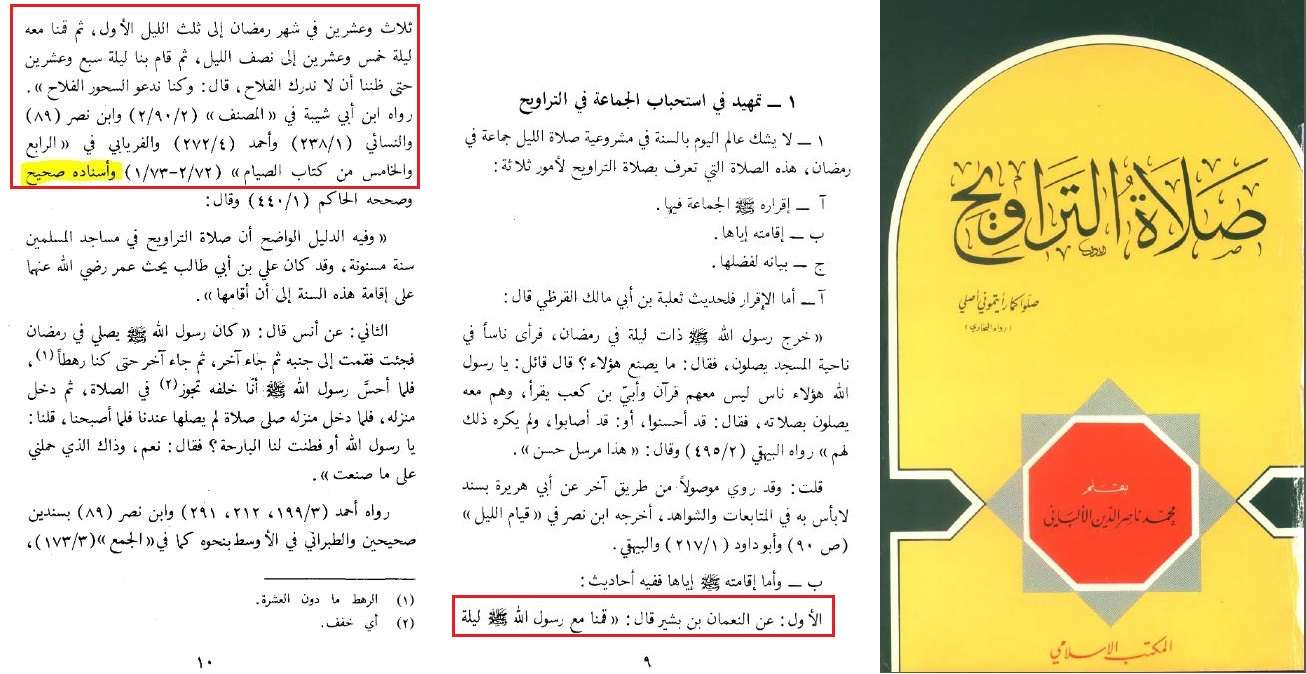
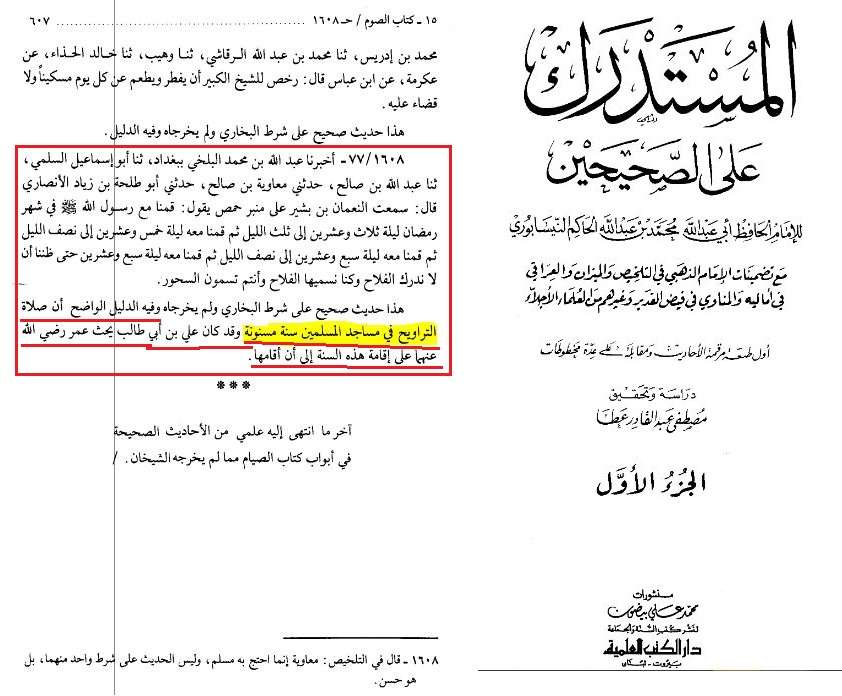
Imam al-Hakim after quoting this hadeeth stated:
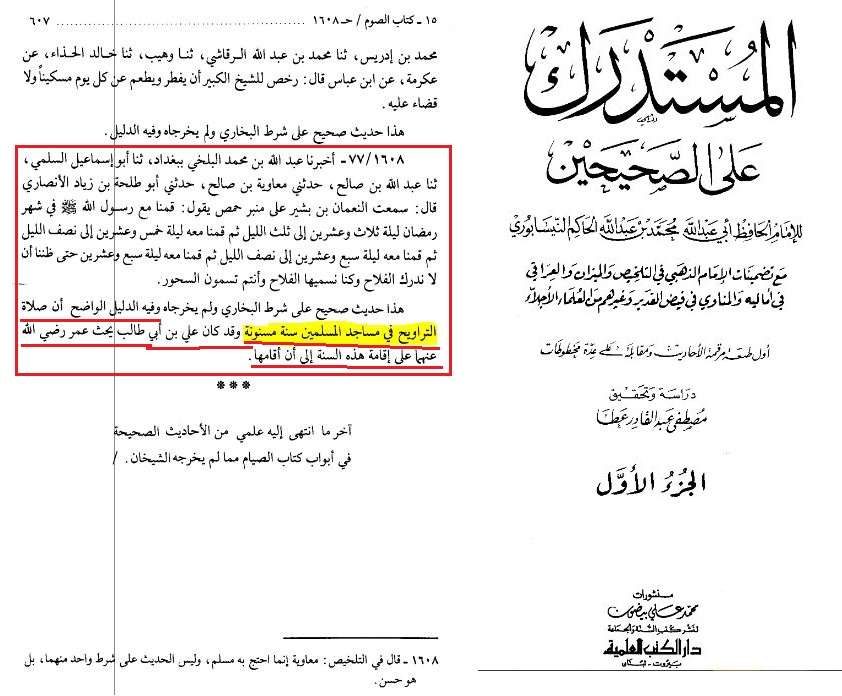
وفيه الدليل الواضح أن صلاة التراويح في مساجد المسلمين سنة مسنونة وقد كان علي بن أبي طالب يحث عمر رضي الله عنهما على إقامة هذه السنة إلى أن أقامها
A clear evidence is present in this report that, Muslims praying Taraweeh in the Mosques is Masnoon Sunnah. Ali ibn Abi Talib(ra) used to urge Umar(ra) to establish this Sunnah, until he eventually established it. [Mustadrak al Hakim, vol 1, page 607, #1608].
Taraweeh from Shia Reports
(c)
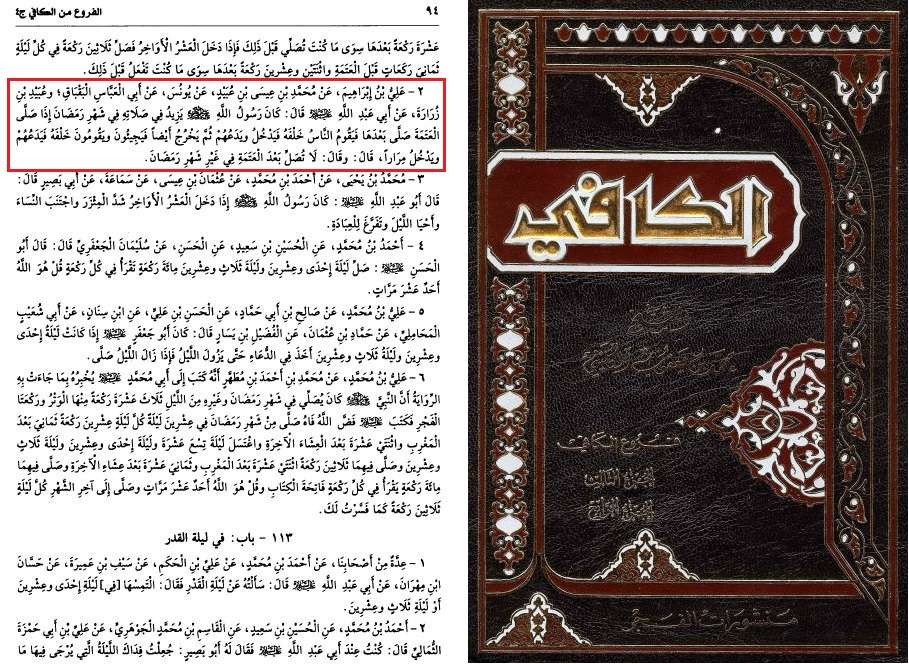
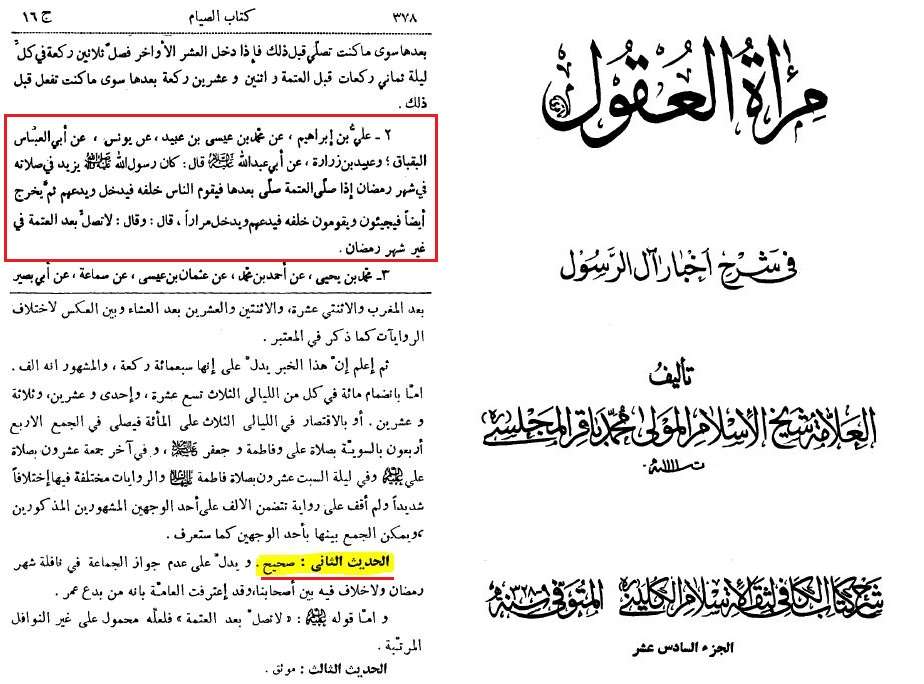
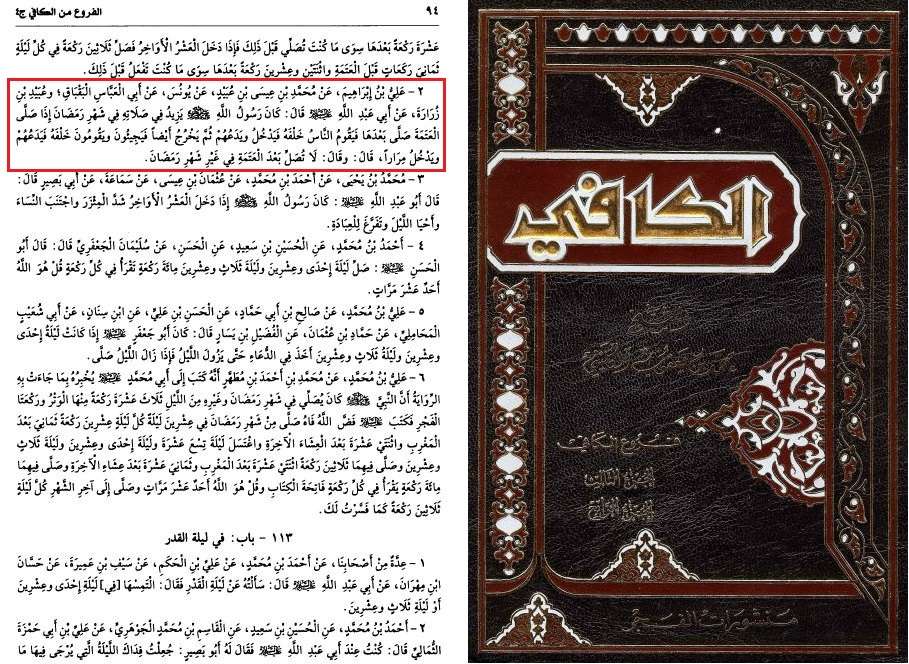
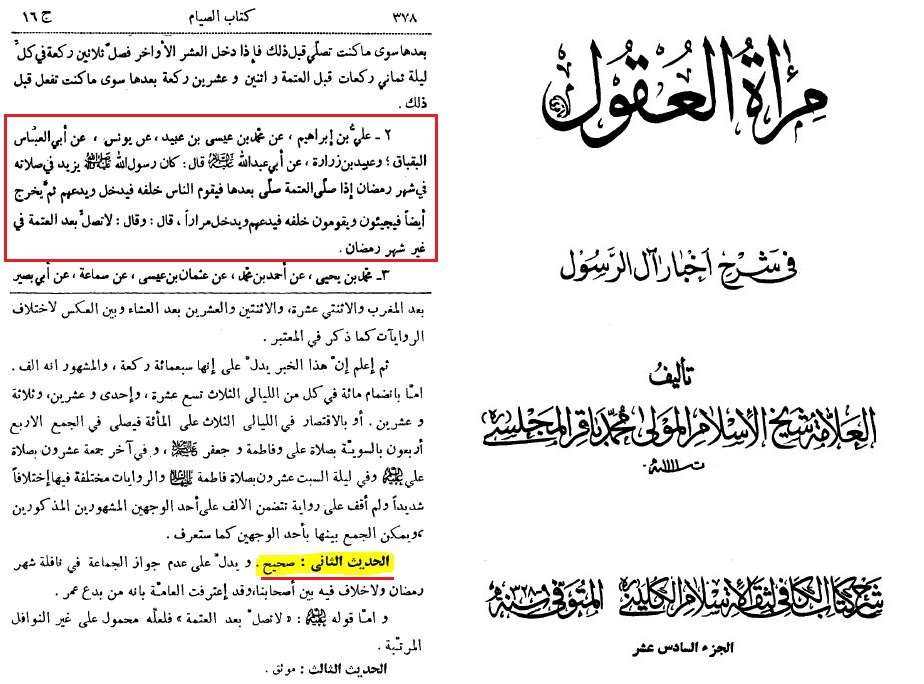
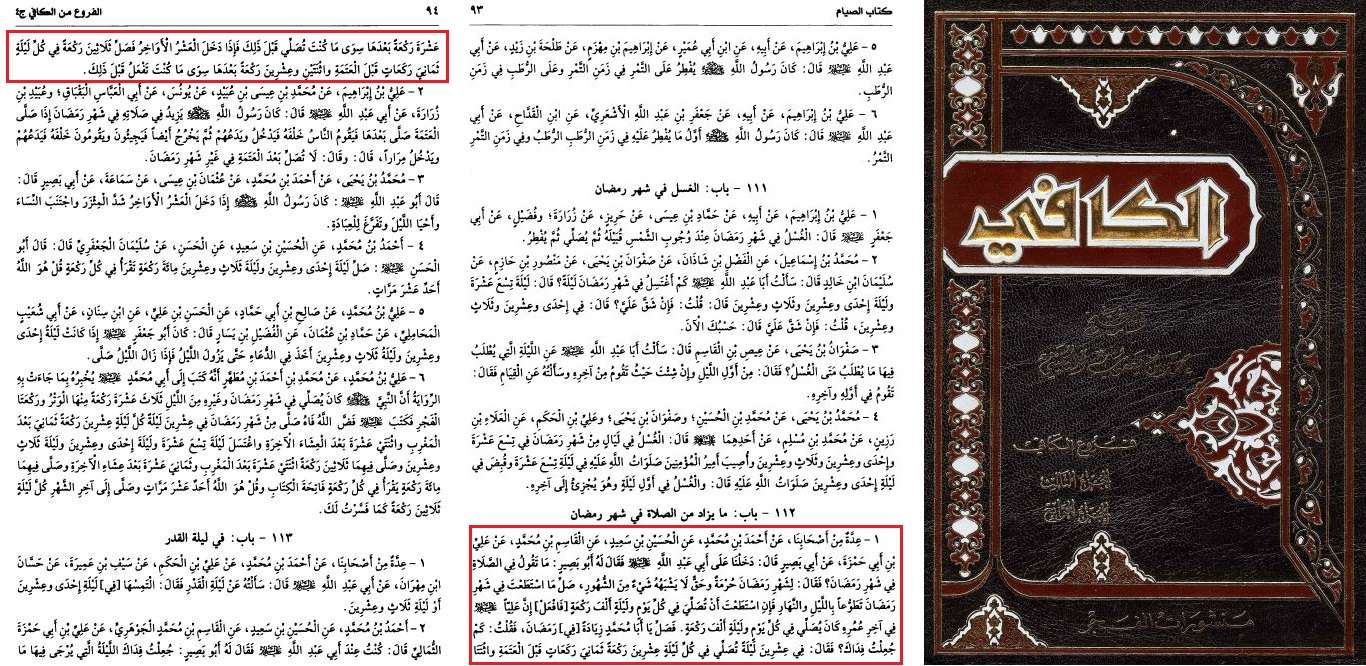
Ali ibn Ibrahim has narrated from Muhammad ibn ‘Isa ibn ‘Ubayd from Yunus from abu al-‘Abbas al-Baqbaq and ‘Ubayd ibn Zurarah who has said the following: “Abu Abd Allah(as), has said that the Messenger of Allah(saws), would increase his salat (prayer) during the month of Ramadan. After al-Atmah(Isha prayer), he would perform more prayers. People behind would stand up (for prayer), but he would go inside and leave them. Then, after he came out, they would come and stand up behind him (for prayer), but he would leave them and go inside several times.’ He (the narrator) has said that the Imam then said, ‘You must not perform salat (prayer) after al-Atmah(Isha prayer), during the times other than the month of Ramadan.’ [Al-Kafi, vol. 4, page 94] [Majlisi declared the hadeeth as Sahih in Miraat al-Uqool, vol 16, page 378].
(d)
Ali ibn Al-Hassan ibn Fadhal has narrated from Isma’il ibn Mehran from Al-Hassan ibn Al-Hassan Al-Marwazi from Younus ibn Abdur-Rahman from Muhammad ibn Yahya who has said the following: I was with Abu Abdullah(as), when he was asked if one should increase his optional prayer during the month of Ramadan. He said: “Yes, the Messenger of Allah(saws), would increase his prayer during the month of Ramadan, after Al-‘Atmah(Isha prayer), he would perform more prayers in his mosque. People would gather behind him for prayer, but when their numbers increased, he would go inside his house and leave them. When the people dispersed, he came back to the mosque and prayed as he did before, and when the number of people increased behind him, he left them and entered his house again, he did this several times’. [Tahdhib Al-Ahkam, vol 3, page 68].
Note: Isha prayer was called al-Atmah prayer by the people. [See Sahih al-Bukhari, vol 1, page 337, #564].
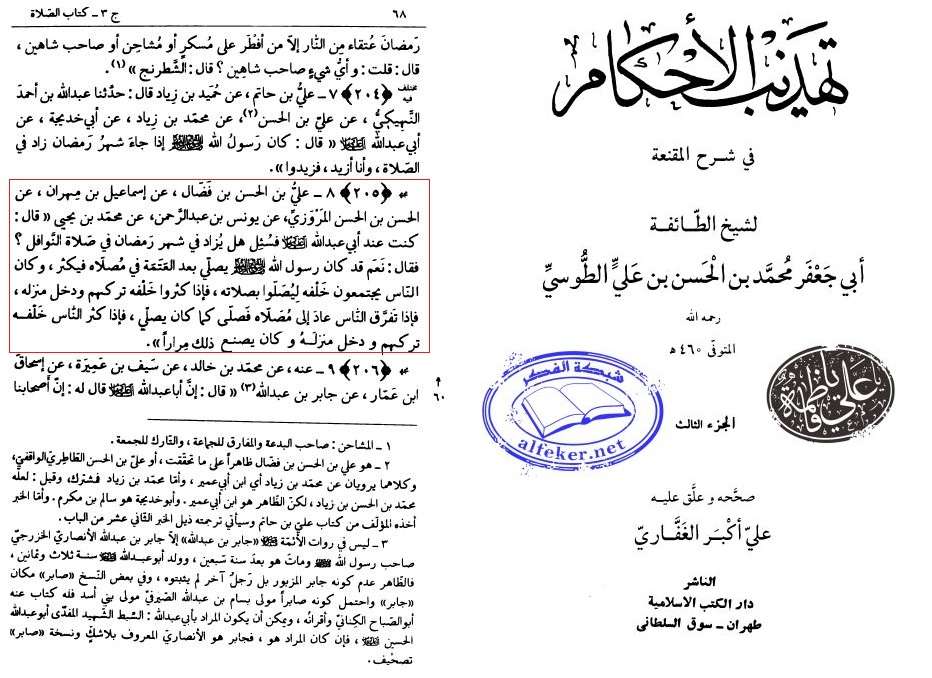
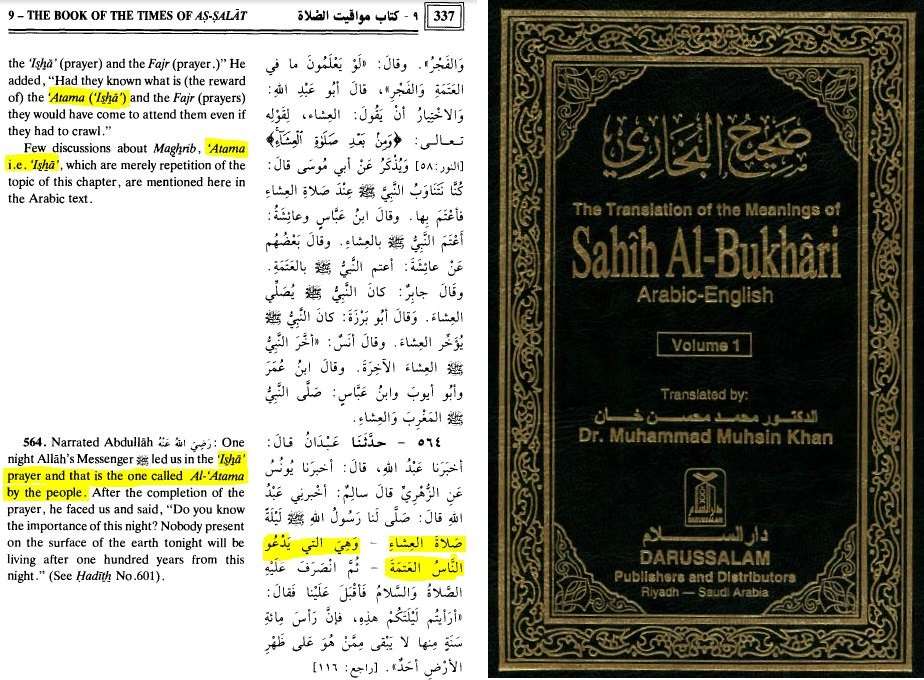
Comment: The above Shia narrations clearly prove that Prophet(SAWS) would pray AFTER the Isha prayer in the mosque and – (just like in Sunni books) – that the Prophet(SAWS) would come to the mosque and when the crowd would increase, he would go to his home, and AGAIN come back to mosque when the crowed had decreased, and unlike Sunni hadiths, these narrations do NOT limit this practice of the Prophet(SAWS) to 3-4 days i.e. we have Shia narrations asserting that the Prophet(SAWS) consistently and repeatedly performed his Ramadan night prayer (Qiyam) in the mosque, with a congregation behind him. The narration (in Tahdhib) uses the term ‘miraaran’, i.e. several times, to indicate that he didn’t just lead congregational night prayers in Ramadan (i.e. Tarawih) once or twice, but rather many times. A point worth noting is that, If prayer after Isha in congregation was prohibited as Shias claim, then why didn’t Prophet(SAWS) stop on the very first time. Another point worth noting is that, the action of Prophet(S) leaving them and entering the house was related to the INCREASE in number of people gathered to pray behind him, which shows that if the number of people behind were few, then it wouldn’t have been an issue for the Prophet(S) to continue the prayer, hence from this the legality of praying in congregation with Prophet(S) during Ramadan after Isha during optional(Nafil) prayer, is proven. This point action of the Prophet(S) indicates to the fact, that the reason for stopping this prayer in congregation was NOT not because there is something wrong with this prayer, or something wrong in the congregation rather the problem was related to its popularity, and the fear that it might be made obligatory on the people.
Argument I(b)
A Shia website stated:
Sunnies present this Tradition of Abu Dhar, and then claim it to be authentic too. But what they don’t realize that they are big fools if they are authenticating this tradition, while it is CONTRADICTING much more Authentic Traditions of Sahih Bukhari and others, they are in Tawattur as compared to this lone tradition of Abu Dhar.
Answer
Due to their bias, Shias have failed to understand a simple matter. The reason Hadeeth of Abu Dhar(RA) differs(not contradicts) from the Hadeeth of Ayesha(RA) in Bukhari, is because it is about a different occasion. Shias themselves try to list out the multiple ways the Hadeeth of Abu Dhar(RA) differs(or contradicts as per Shia) from the Hadeeth of Ayesha(RA) and Zaid bin Thabit(RA) in order to cast doubts on it, but they don’t realize that all those differences are a clear proof of it being a different occasion. Moreover, Abu Dhar(RA) wasn’t alone in narrating it, rather a similar report was narrated by Nu’man bin Bashir(RA).
Argument I(c)
Shia Website[Shiapen] stated:
Narrated Zaid bin Thabit:
Allah’s Apostle made a small room (with a palm leaf mat). Allah’s Apostle came out (of his house) and prayed in it. Some men came and joined him in his prayer. Then again the next night they came for the prayer, but Allah’s Apostle delayed and did not come out to them. So they raised their voices and knocked the door with small stones (to draw his attention). He came out to them in a state of ANGER, saying, “You are still insisting (on your deed, i.e. Tarawih prayer in the mosque) that I thought that this prayer (Tarawih) might become obligatory on you. So you people, offer this prayer (i.e. Tahajjud or the so called Tarawih) at your homes, for the best prayer of a person is the one which he offers at home, except the compulsory (congregational) prayer.”
Sahih Bukhari, Volume 8, Book 73, Number 134
We can see that Rasool (saw) cited this Tahajjud (or the so called Tarawih) Prayer, and stated:
Offer this Tahajjud (or so called Tarawih) prayer at your homes.
Conduct the said prayer individually not in congregation at home.
These individual Nawafil exceed those offered in a Mosque until Qiyammah whether or not the Prophet (s) is alive is an irrelevant consideration)
Answer
Answer to these arguments is in the hadeeth itself, which unfortunately Shias failed to understand. The reason that the Prophet(SAWS) gave for discontinuing the night prayer in congregation was that, he(SAWS) feared that this prayer might become obligatory and then the people would not be able to do it. The point worth reflecting over is that the Prophet(SAWS), even after knowing that people were joining behind him in congregation, went on to continue this prayer in the Mosque in congregation for 3-4 days, and it was only after the crowd increased, that the Prophet(SAWS) stopped. Why didn’t he stop on the very first day when he noticed the small crowd? This point indicates to the fact, that the reason for stopping this prayer in congregation was NOT not because there is something wrong with this prayer, or something wrong in the congregation rather the problem was related to its popularity, because if praying the night prayer in congregation (Taraweeh) was haram, the Prophet(SAWS) would not continue for 3-4 days, rather he would formally inform the people on the very first day that this prayer should not be performed in congregation in the mosque.
Esteemed Sunni Scholars Answered This Argument in Similar Manner
(i). Imam Ibn Rajab al-Hanbali said:
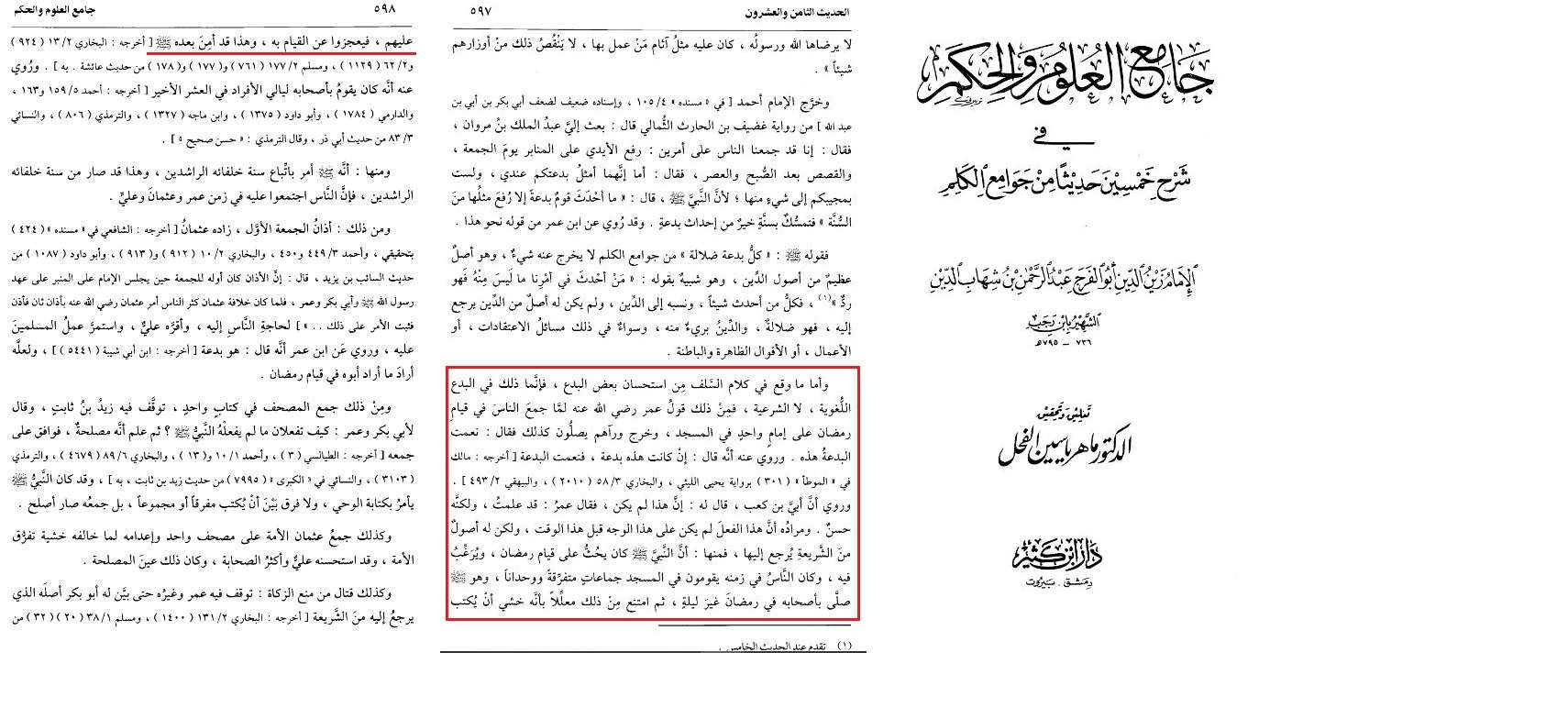
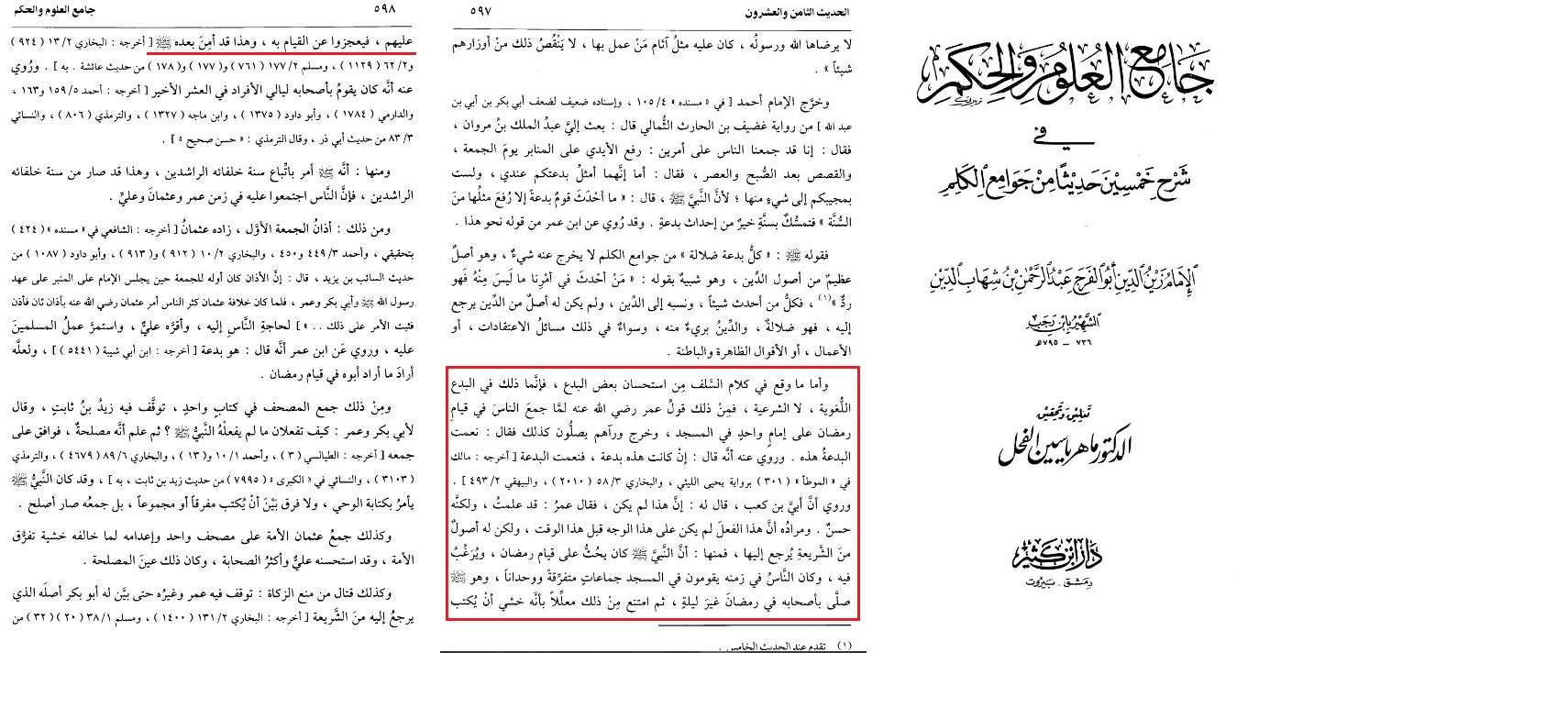
The Prophet(saws) used to encourage and urge people to pray qiyaam in Ramadan. At his time, the people used to pray qiyaam in the mosque, in scattered groups and individually, and he(saws) led his companions in praying qiyaam in Ramadan for several nights. Then he stopped doing that, on the basis that he feared that it might be made obligatory for them, then they would be unable to do it, but there was no fear of that after he(saws) died. [Jaami’ al-‘Uloom wa’l-Hikam, page 597-598, hadeeth #28].
(ii). Shaykh al-Islam Ahmad Ibn Taymiyah stated:
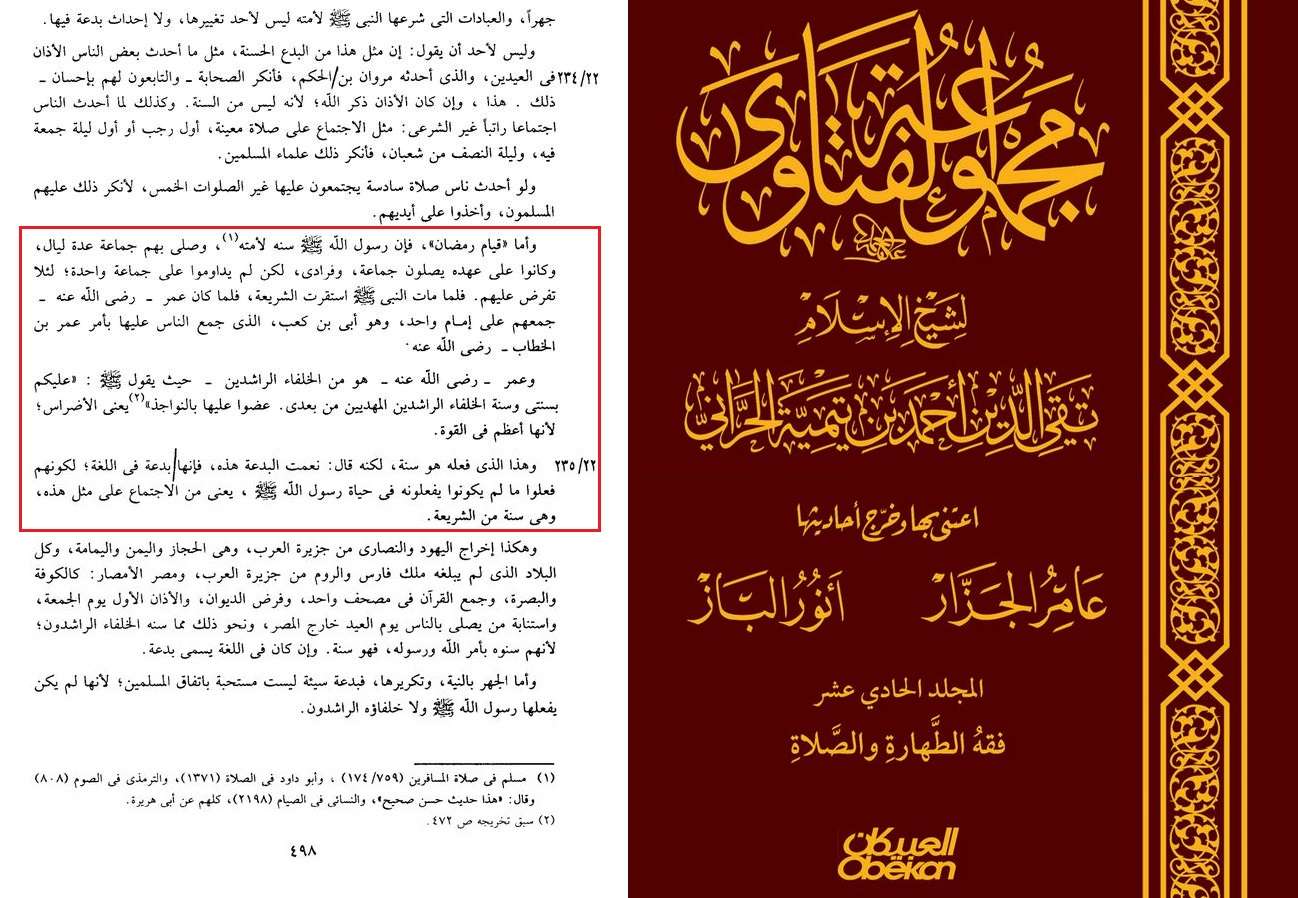
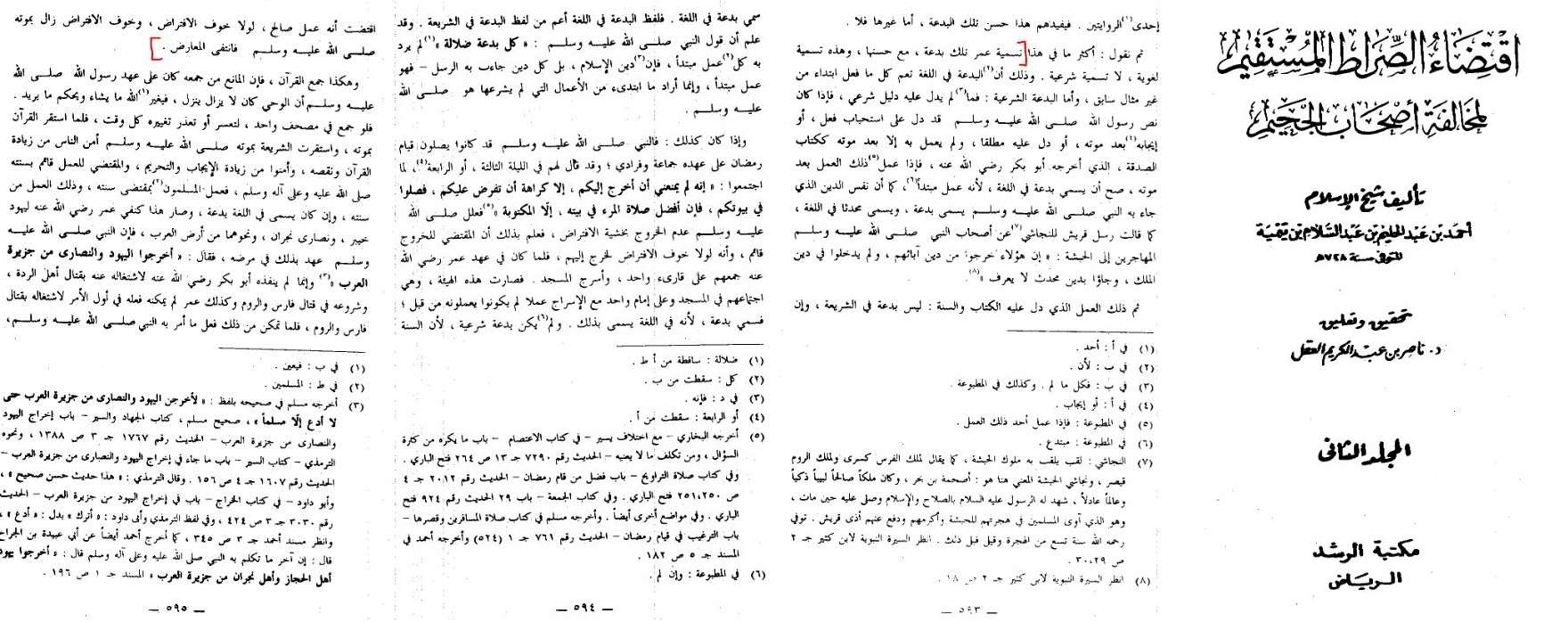
With regard to qiyaam in Ramadaan, the Messenger of Allaah(SAWS) introduced this to his ummah, and he led them in prayer for a number of nights, because at his time they used to pray in congregation and individually. But he did not persist in leading them in one congregation, lest that be made obligatory for them. When the Prophet(saws) died, sharee’ah was established (and would not change after that). When ‘Umar(ra) became caliph, he united them behind one imam, Ubayy ibn Ka’b, who united the people in one congregation on the orders of ‘Umar ibn al-Khattaab(ra). ‘Umar(RA) was one of the Rightly-Guided Caliphs, of whom the Prophet(SAWS) said: “I urge you to adhere to my Sunnah and the way of the Rightly-Guided Caliphs after me; cling tightly to it.” So what he did was Sunnah. [Majmu al-Fatawa li Shaykh al-Islam Ibn Taymiyyah, vol 11, page 498].
(iii). Imam Ibn ‘Abd al-Barr stated:
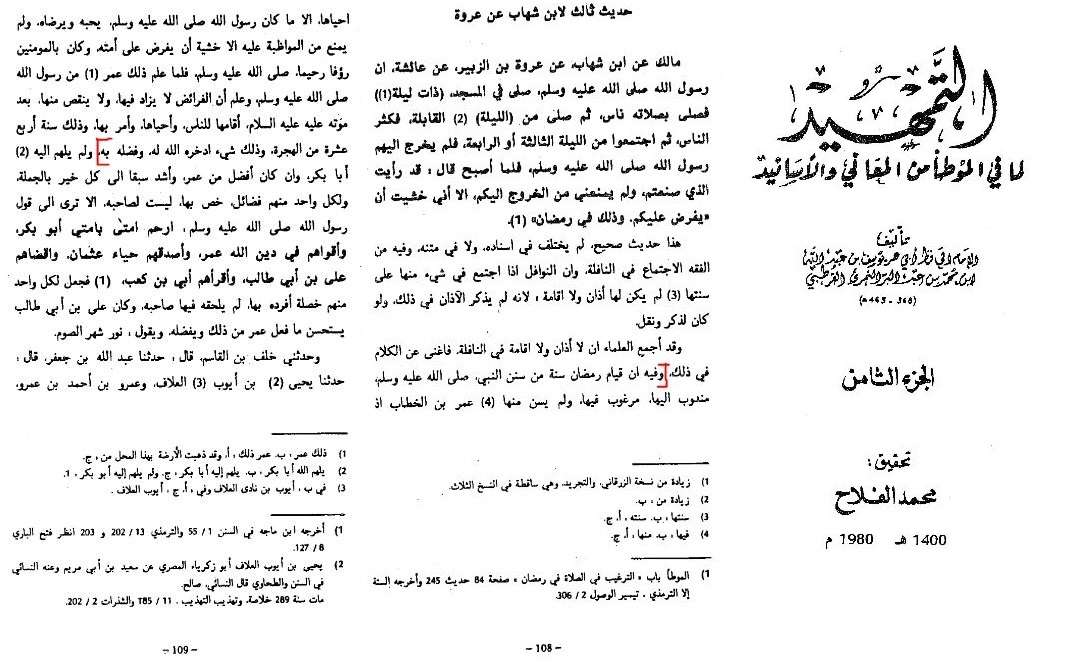
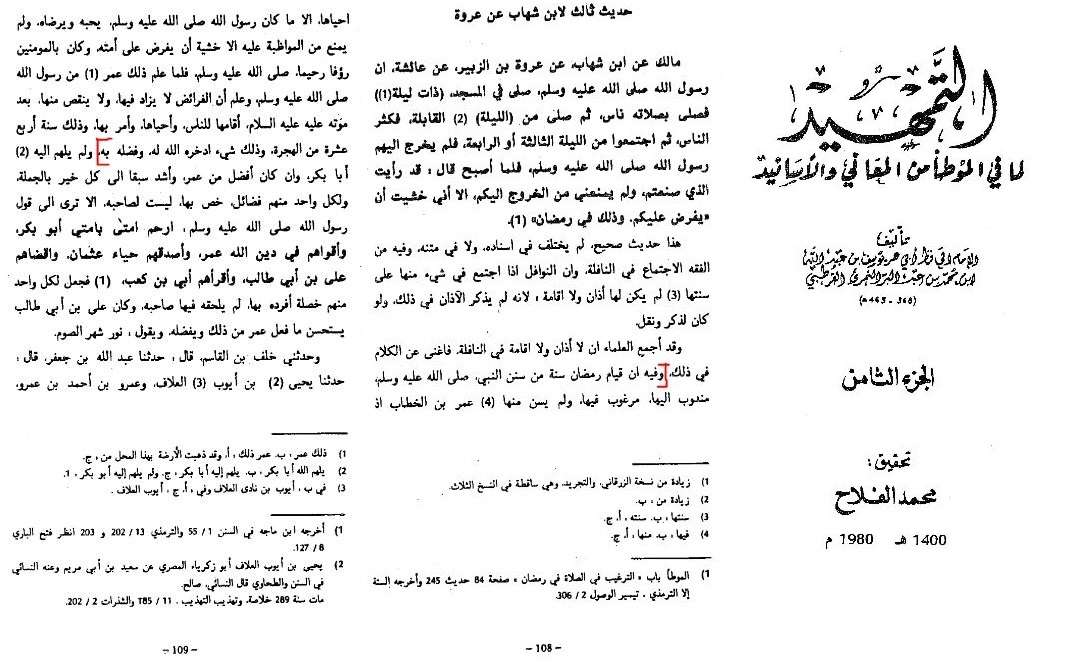
This indicates that praying qiyaam in Ramadan is one of the Sunnahs of the Prophet(saws) and is recommended and encouraged. It was not introduced by ‘Umar ibn al-Khattaab, rather he revived something that the Messenger of Allaah(saws) loved and approved of. Nothing stopped Prophet(saws) from doing it regularly except the fear that it might be made obligatory upon his ummah. He(saws) was kind and compassionate towards his ummah. ‘Umar knew from the Messenger of Allaah(saws) that the obligatory duties would not be increased or decreased after his death(saws), so he revived this practice and enjoined it upon the people. That happened in 14 AH, and ‘Umar has the honour of being the one who revived this Sunnah. [Al-Tamheed, vol 8, page 108-109].
As for the claim that praying voluntary prayer(Nafil) at home is better, then that doesn’t make praying voluntary prayer at mosque as prohibited or unlawful. Even Shias pray voluntary prayers after obligatory prayer in mosque. The only thing that can be argued based on this report is that, praying voluntary prayer at home is better and more virtuous. For example, reciting long Surah in night prayers(Qiyaam) is better but that doesn’t make recitation of short Surah as prohibited. To understand this point in a more proper manner, let’s see the below report.
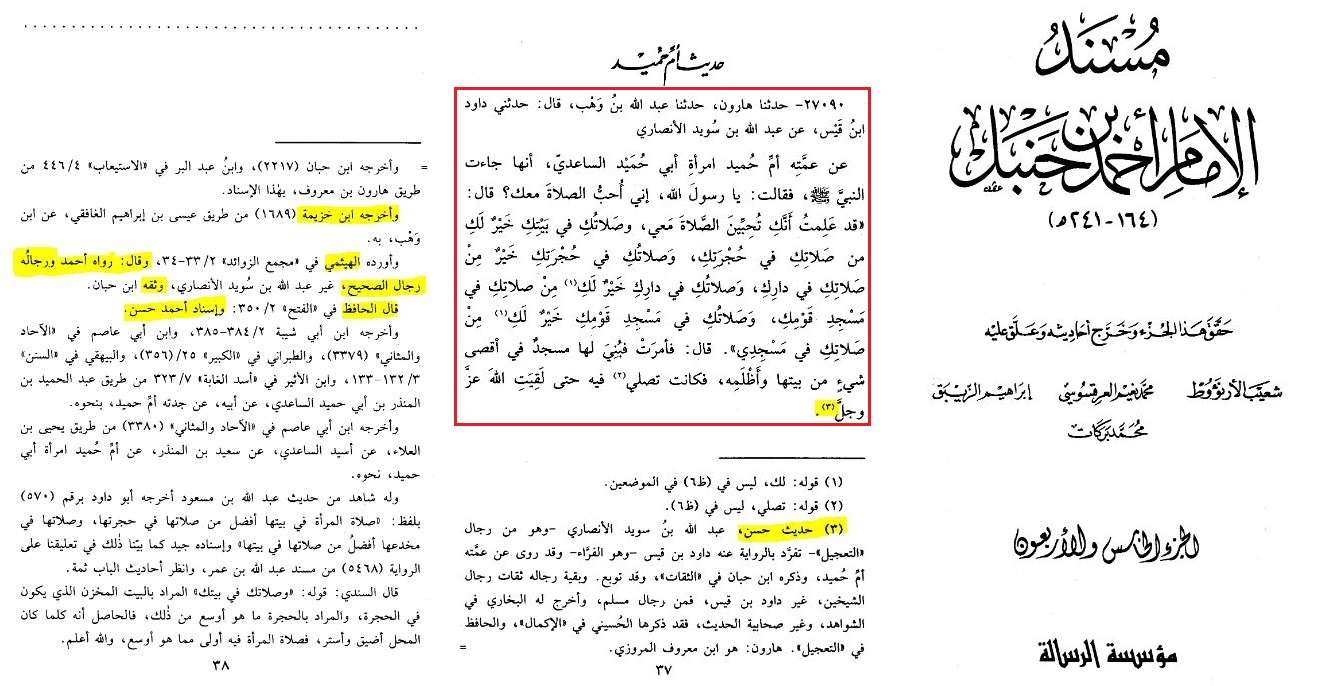
It was narrated that Umm Humayd the wife of Abu Humayd al-Saa’idi came to the Prophet(saws) and said, “O Messenger of Allaah, I like to pray with you.” He said, “I know that you like to pray with me, but your prayer in your room is better for you than your prayer in your courtyard and your prayer in your courtyard is better for you than your praying in your house, and your prayer in your house is better for you than your prayer in the mosque of your people, and your prayer in the mosque of your people is better for you than your prayer in my mosque.” So she issued orders that a prayer-place be prepared for her in the furthest and darkest part of her house, and she used to pray there until she met Allaah (i.e., died).” [Musnad Ahmad, vol 45, page 37-38, #27090 : Hasan as per Shuaib Arnaut ; This hadeeth was classed as Sahih by Ibn Khuzaymah in his Saheeh #1689; al-Albani in Sahih al-Targheeb wa’l-Tarheeb, 1/135 ; al-Hafidh ibn Hajar in al-Fath 2/350 said Isnad Hasan].
In fact, as per Shia reports we cited before, Prophet(SAWS) himself prayed voluntary prayer during Ramadan in the Mosque.
II. Evidence for Offering Voluntary Prayer in Congregation
Argument
Shia Website[Shiapen] stated:
Side Comment: Nawafil (optional) prayers cannot be offered in Congregation (Jammah).
This is an undeniable fact and but the advocates of Tarawih will argue why Rasool (saww) offered the Nawafil of Tahajjud (which is also known as Qiyam-ul-Lail) in congregation over three nights?
The answer is, Rasool (saw) didn’t offer any optional prayers during those three nights, he offered the compulsory prayers, which is why others were permitted to pray behind him (s) in congregation.
Qiyyam-ul-Lail was made compulsory for Rasool (saw) by Allah (swt) who states:
وَمِنَ اللَّيْلِ فَتَهَجَّدْ بِهِ نَافِلَةً لَّكَ عَسَى أَن يَبْعَثَكَ رَبُّكَ مَقَامًا مّحمُودًا
[Shakir 17:79] And during a part of the night, pray Tahajjud beyond what is incumbent on you; maybe your Lord will raise you to a position of great glory.
Rasool (saw) was only offering the Compulsory Prayer with the Niyyah (intention) of “Fardh” فرض , when others behind him, they only followed the Niyyah of Imam.
It is wrong to suggest that Rasool (saw) ever offered optional prayers behind a congregation made the Jamma’ah for any Nafl Prayer during his whole life. That is why he stressed that the Tahajjud (or so called Tarawih) prayers be offered at home.
Answer
Again, this claim by Shias is based on their lack of knowledge and ignorance. Night prayer on Prophet(SAWS), was made obligatory in Makkah when Surah Muzammil(Makki Surah) was revealed and this command was abrogated after an year, after that Night prayer became supererogatory.
Sa’d bin Hisham asked to Ayesha(RA) : Inform me about the observance (of the night prayer) of the Messenger of Allah (SAWS). Ayesha(RA) said: Did you not recite:” O thou wrapped up”? He said: Yes. She said: Allah, the Exalted and the Glorious, made the observance of the night prayer at the beginning of this Surah obligatory. So the Messenger of Allah(SAWS) and his Companions around him observed this (night prayer) for one year. Allah held back the concluding portion of this Surah for twelve months in the Heaven till (at the end of this period) Allah revealed the concluding verses of this Surah which lightened (the burden of this prayer), and the night prayer became a supererogatory prayer after being an obligatory one. [Sahih Muslim, vol 2, page 259, #746].
Secondly, We have already proven from reliable traditions of Abu Dhar(ra) AND An-Nu’man bin Bashir(ra) that Prophet Muhammad(SAWS) prayed Taraweeh(Nafil prayer) in congregation and it wasn’t the Tahajjud prayer as per Shiapen’s definition.
However, to educate Shias of their utter ignorance, we would like to quote several other reports where in we find that either Prophet Muhammad(SAWS) himself led Nafil prayer in congregation or approved those who prayed Nafil in congregation, which makes the Shia claim null and void.
(a)
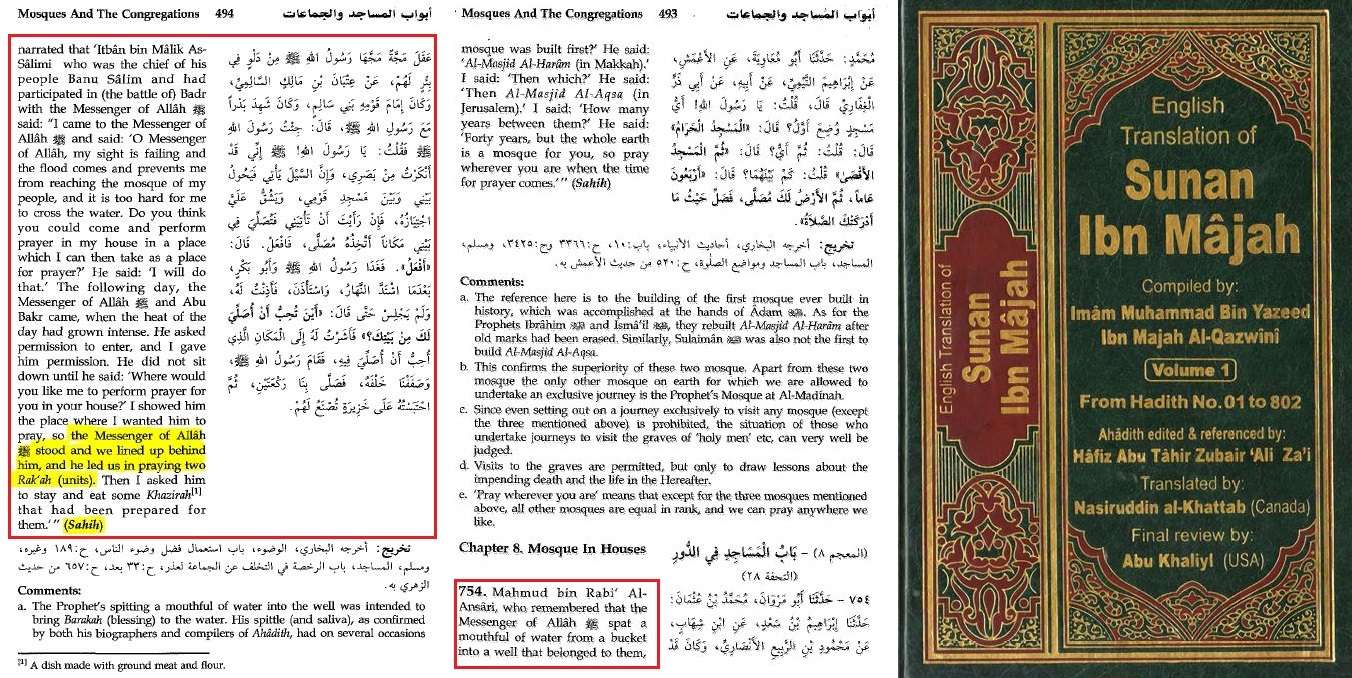
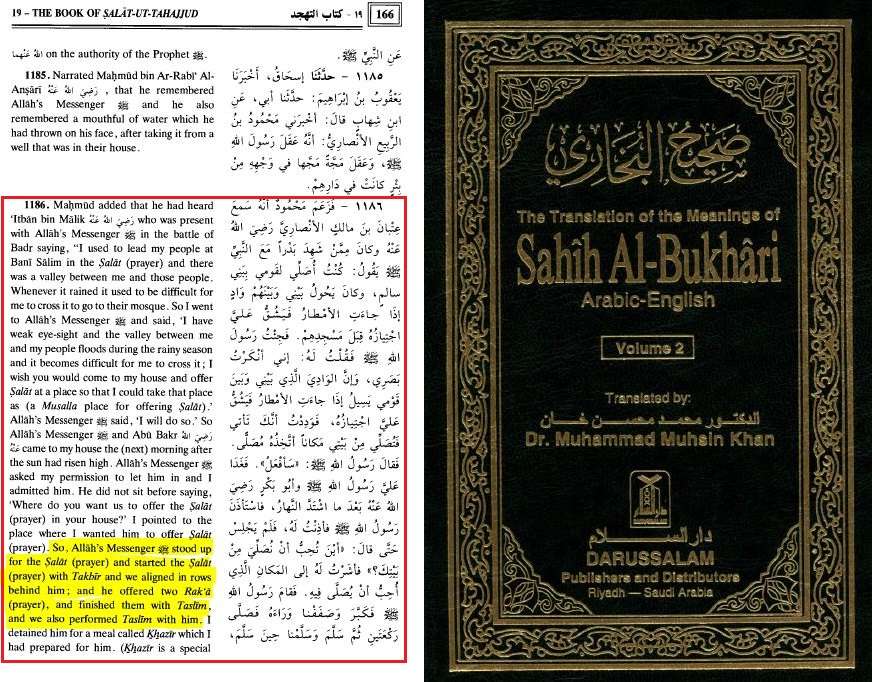
Mahmud bin Rabi’ Al-Ansari, who remembered that the Messenger of Allah(saws) spat a mouthful of water from a bucket into a well that belonged to them, narrated that : ‘Itban bin Malik As-Salimi who was the chief of his people Banu Salim and had participated in (the battle of) Badr with the Messenger of Allah(saws) said: “I came to the Messenger of Allah(saws) and said: ‘O Messenger of Allah, my sight is failing and the flood comes and prevents me from reaching the mosque of my people, and it is too hard for me to cross the water. Do you think you could come and perform prayer in my house in a place which I can then take as a place of prayer?’ He said: ‘I will do that.’ The following day, the Messenger of Allah(saws) and Abu Bakr(ra) came, when the heat of the day had grown intense. He asked permission to enter, and I gave him permission. He did not sit down until he said: ‘Where would you like me to perform prayer for you in your house?’ I showed him the place where I wanted him to pray, so the Messenger of Allah stood and we lined up behind him, and he led us in praying two Rak’ah (units). Then I asked him to stay and eat some Khazirah that had been prepared for them.’” [Sunan ibn Majah, vol 1, page 493-494, #754 : Sahih as per Zubair Ali Za’ee] ; [Sahih al-Bukhari vol 2, page 166, #1186].
(b)
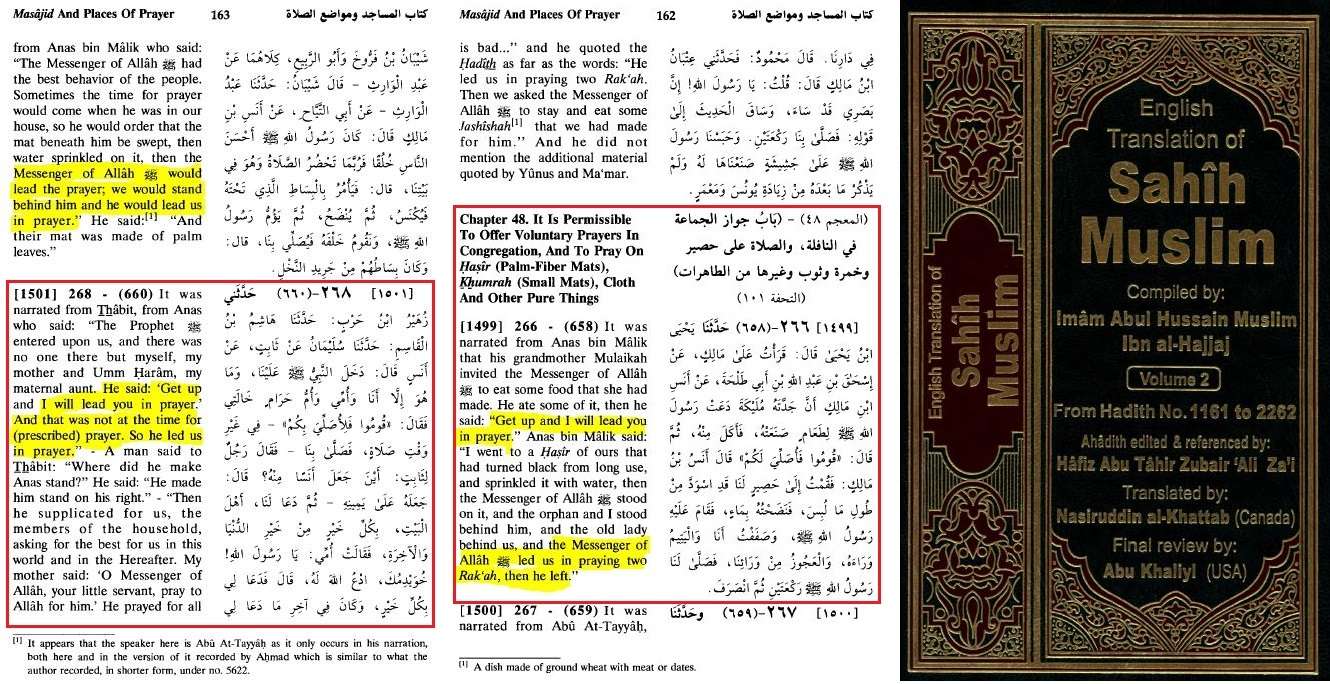
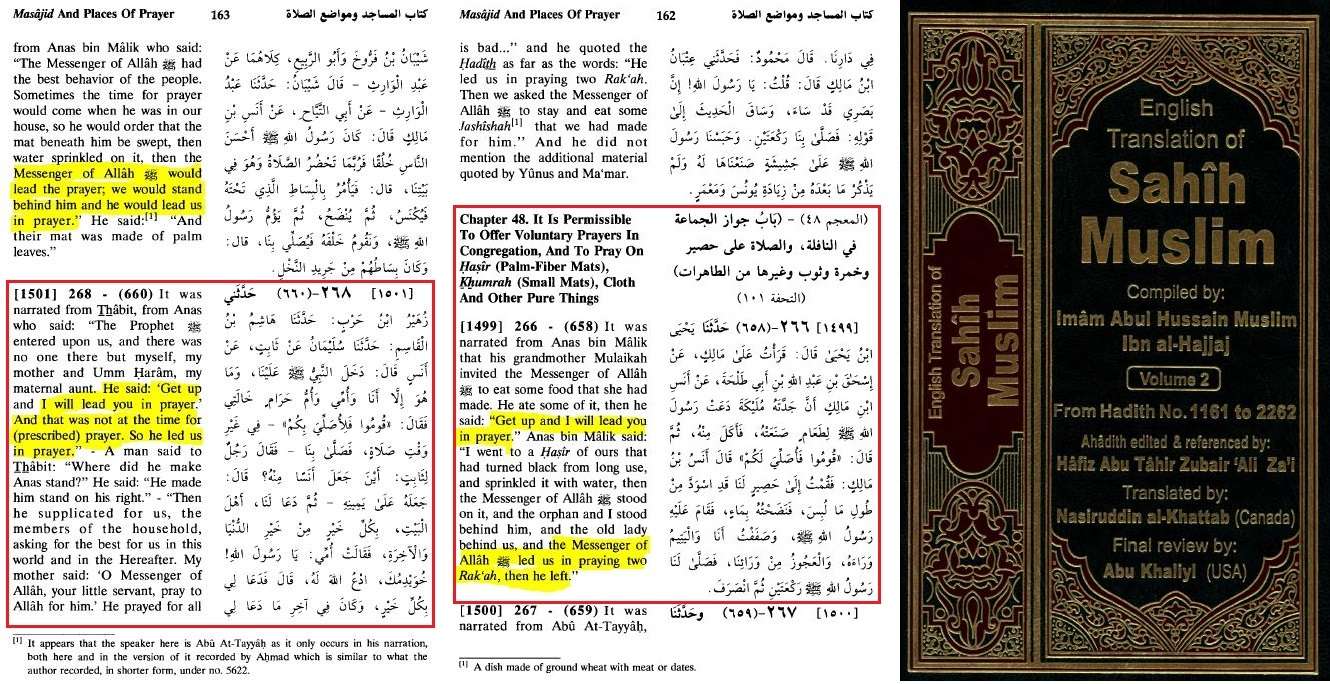
Narrated Anas: The Apostle of Allah(saws) came to us and there was none in our house but I, my mother and my aunt Umm Haram. He (the Holy Prophet) said: Stand up so that I may lead you in prayer (and there was no time for prescribed prayer). He led us in prayer. A person said to Thabit: Where stood Anas with him (the Holy Prophet)? He replied: He was on the right side. He then blessed us, the members of the household with every good of this world and of the Hereafter. My mother said: Messenger of Allah (and then, pointing towards Anas, said), here is your little servant, invoke the blessing of Allah upon him too. He then blessed me with every good, and he concluded his blessings for me (with these words): Allah! increase his wealth, and his children and make (them the source of) blessing for him. [Sahih Muslim, vol 2, page 163, #1501 ; Chapter: It is permissible to offer voluntary prayers in congregation….].
(c)
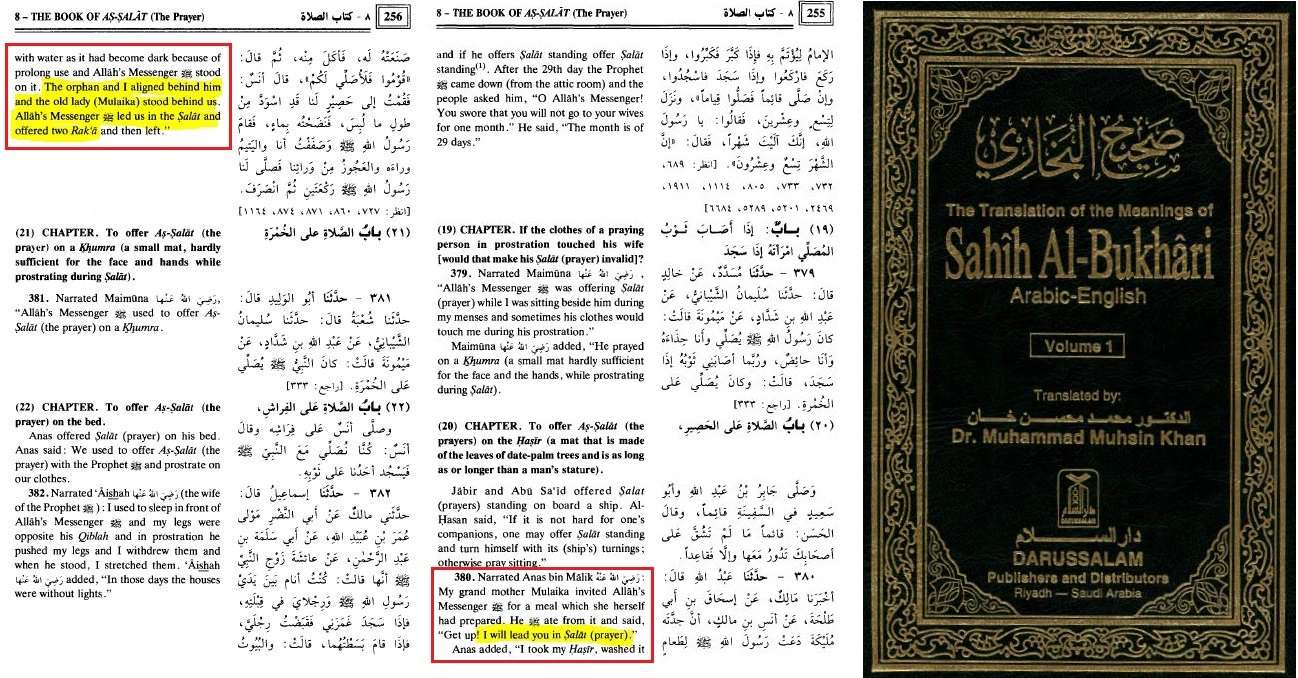
Narrated ‘Ishaq: Anas bin Malik said, “My grandmother Mulaika invited Allah’s Messenger(SAWS) for a meal which she herself had prepared. He ate from it and said, ‘Get up! I will lead you in the prayer.’ ” Anas added, “I took my Hasir, washed it with water as it had become dark because of long use and Allah’s Messenger (SAWS) stood on it. The orphan (Damira or Ruh) and I aligned behind him and the old lady (Mulaika) stood behind us. Allah’s Messenger (SAWS) led us in the prayer and offered two rak’at and then left.” [Sahih al-Bukhari vol 1, page 255-256, #380] ; [Sahih Muslim, vol 2, page 162, #1499].
(d)
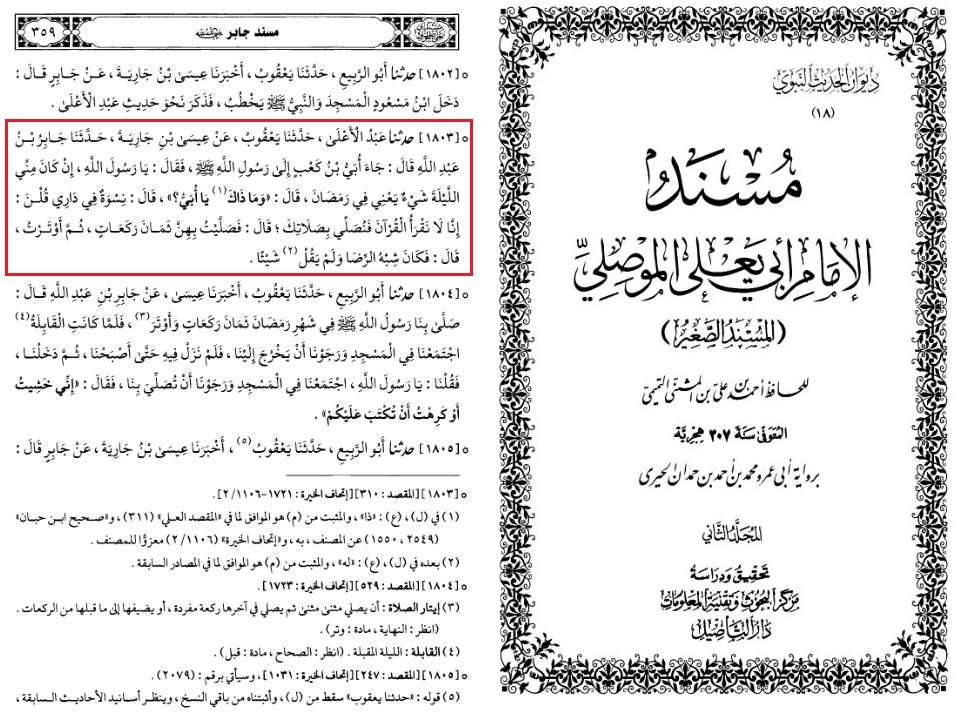
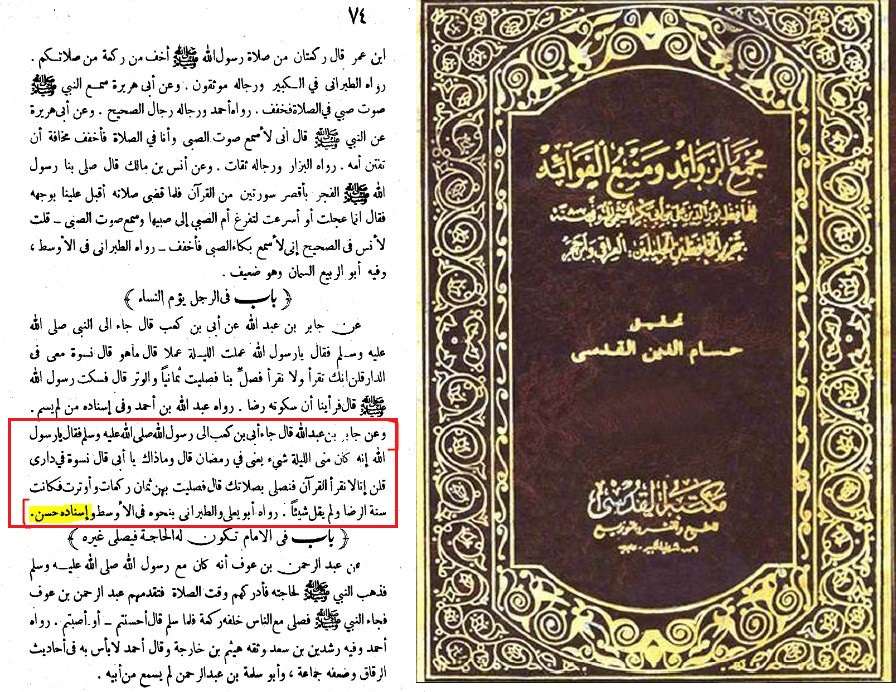
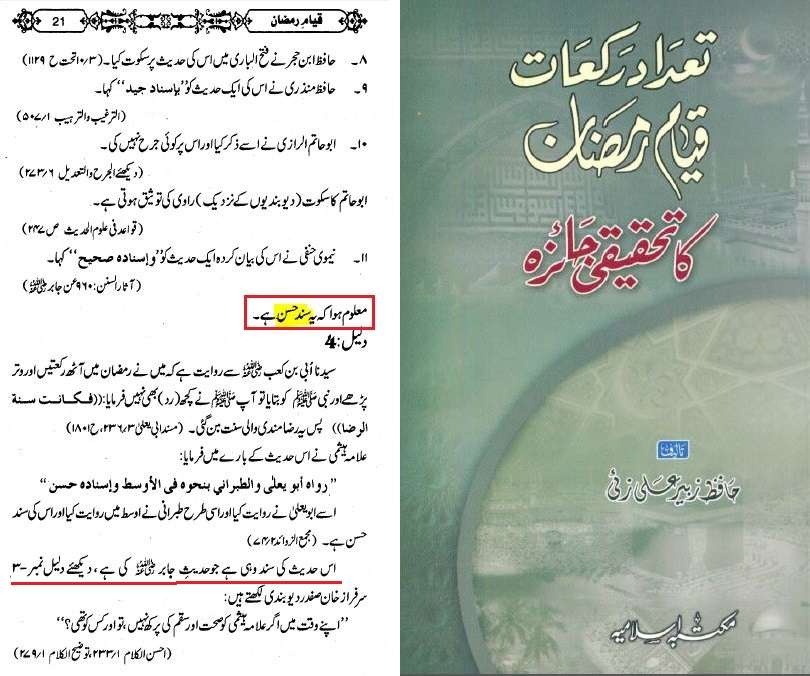
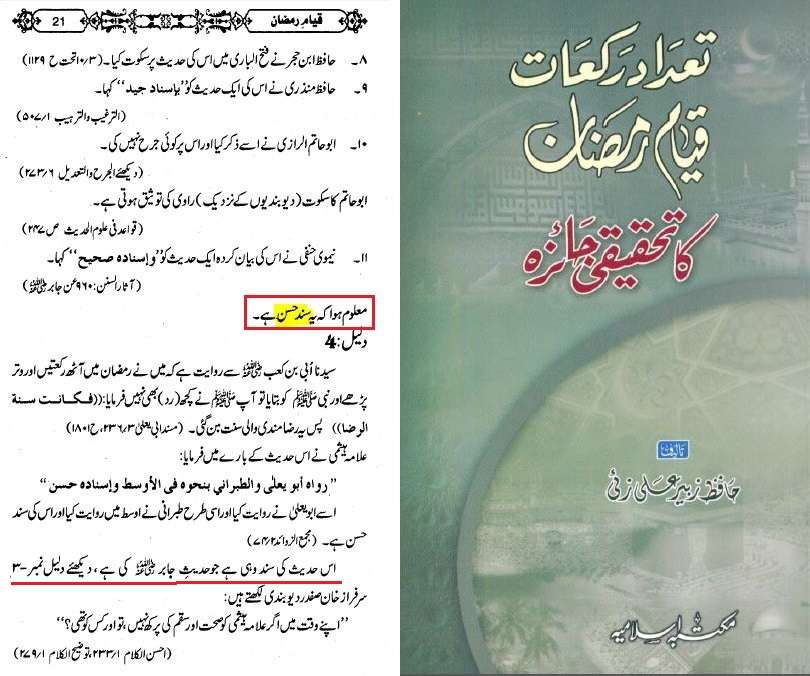
Narrated Jaabir(RA) that Ubayy Ibn Ka’ab(RA) came to the Messenger of Allaah(SAWS) and said, “I did something yesterday night(of Ramadan)” the Messenger of Allaah said, “What did you do?” he said, “Some women came to my house and said we don’t know much Qur’aan so we shall pray behind you and will listen to the Qur’aan.” So I led them in 8 raka’hs of prayer and offered the Witr prayer.” The Messenger of Allaah(SAWS) remained silent and as if he approved it.” [Musnad Abu Ya’la, vol 2, page 359, #1803] ; [Majma al-Zawaid, vol 2, page 74 ; Isnad Hasan as per al-Haythami] ; [Zubair Ali Za’ee declared the chain as Hasan in Tadad Rakat Qayam-e-Ramzan ka Tahqeeqi Jaiza, page 21].
(e)
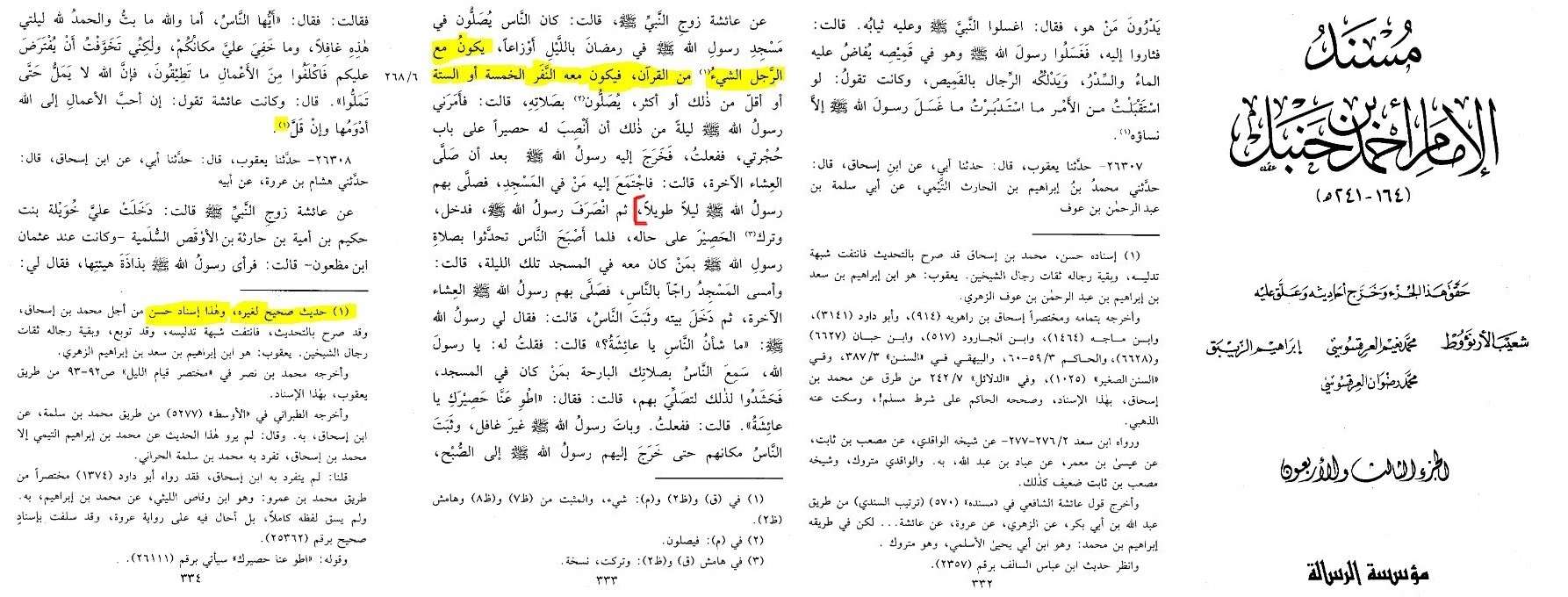
A’ishah(RA) said: During Ramadan, the people used to pray at night inside the mosque of the Prophet (saw) and they’d be in random groups. If a man has memorized some Qur’an, he’d lead a party of five or six in these prayers. In one of these nights the Prophet (saw) ordered me to prepare for him a prayer mat outside my room and after he prayed the last Isha he left. Upon his arrival at the mosque, people gathered around him so he led them in long prayers during the night. [Musnad Ahmad, vol 43, page 332-334, #26307 ; Grade: Sahih liGhayrihi].
(f)
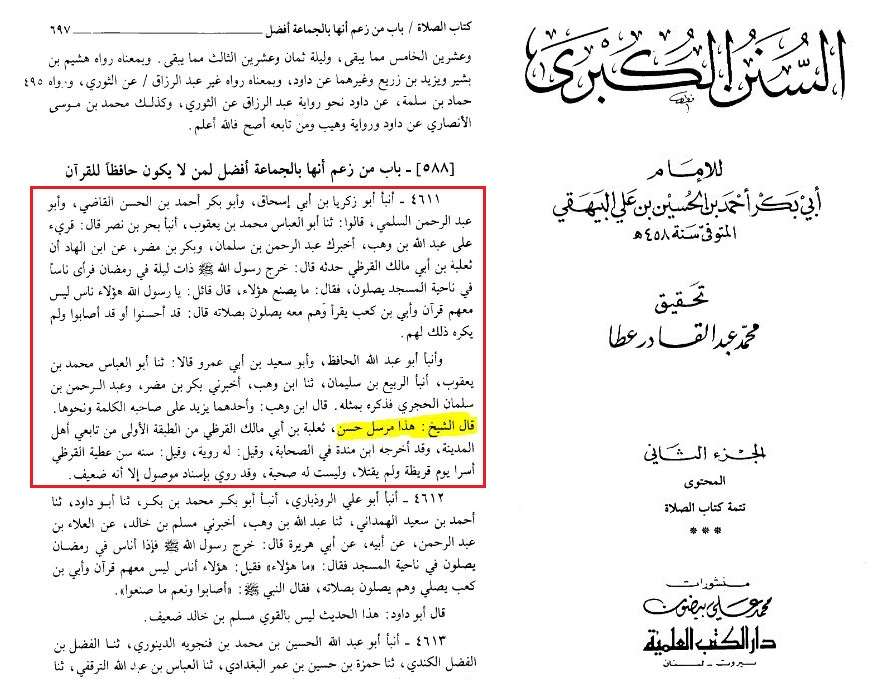
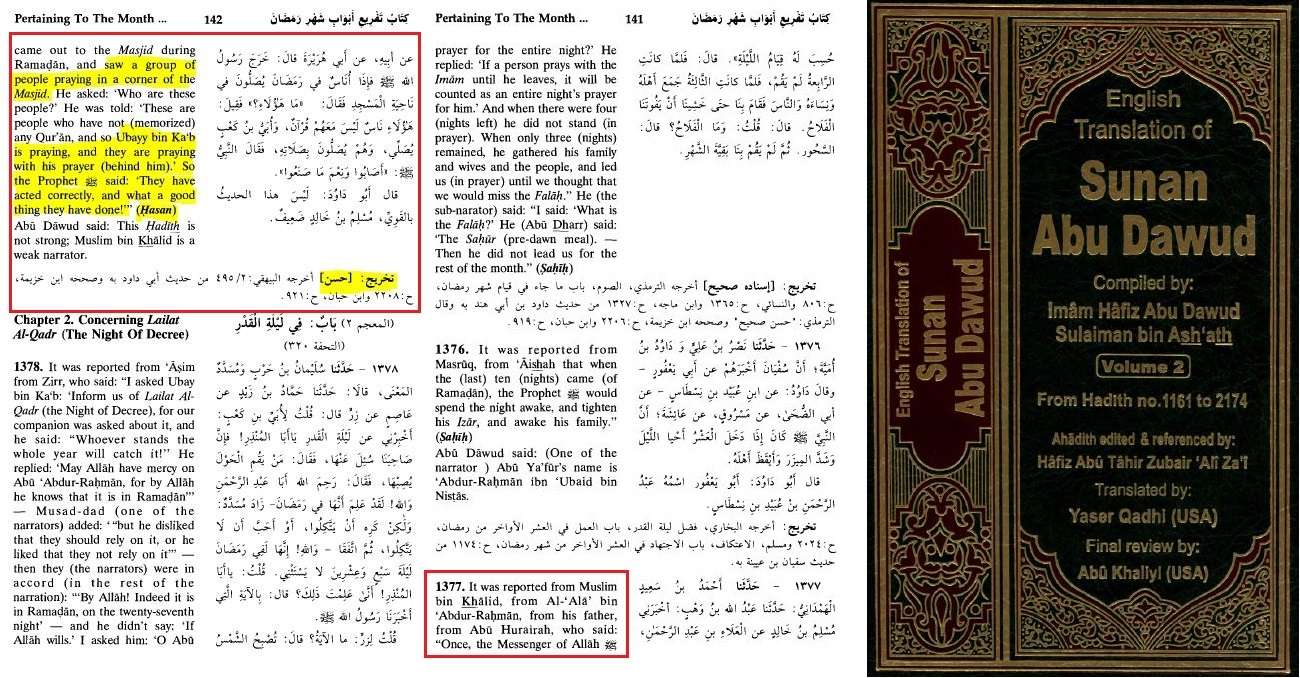
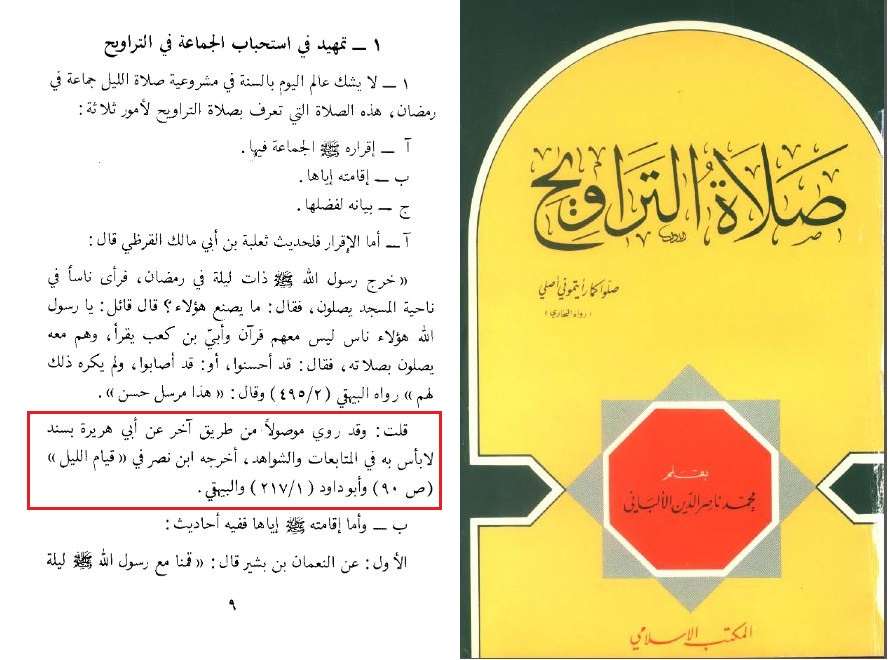
Narrated Thalaba bin Abi Malik al-Qurdhai(Taba’ee) AND Abu Huraira(Sahabi) : The Messenger of Allah(SAWS) came out and saw that the people were praying during (the night of) Ramadan in the corner of the mosque. He asked: Who are these people ? It was said to him that those were people who had not learnt Quran. But Ubayy bin Ka’b is praying and they would pray behind him. The Prophet(SAWS) said: They did right and it is good what they did. [Sunan al-Kubra by al-Bayhaqi, vol 2, page 697, #4611 : Bayhaqi said Mursal Hasan] ; [Sunan Abu Dawood, vol 2, page 141-142, #1377 : Hasan as per Zubair Ali Za’ee] ; [al-Albani said: There is Mawsool(connected) report in Sunan Abu Dawud 1377 which isn’t problematic to be used in Mutabiat(support) and Shawahid. Salat al-Taraweeh, page 9].
Shaykh al-Islam Ahmad ibn Taymiyah said:
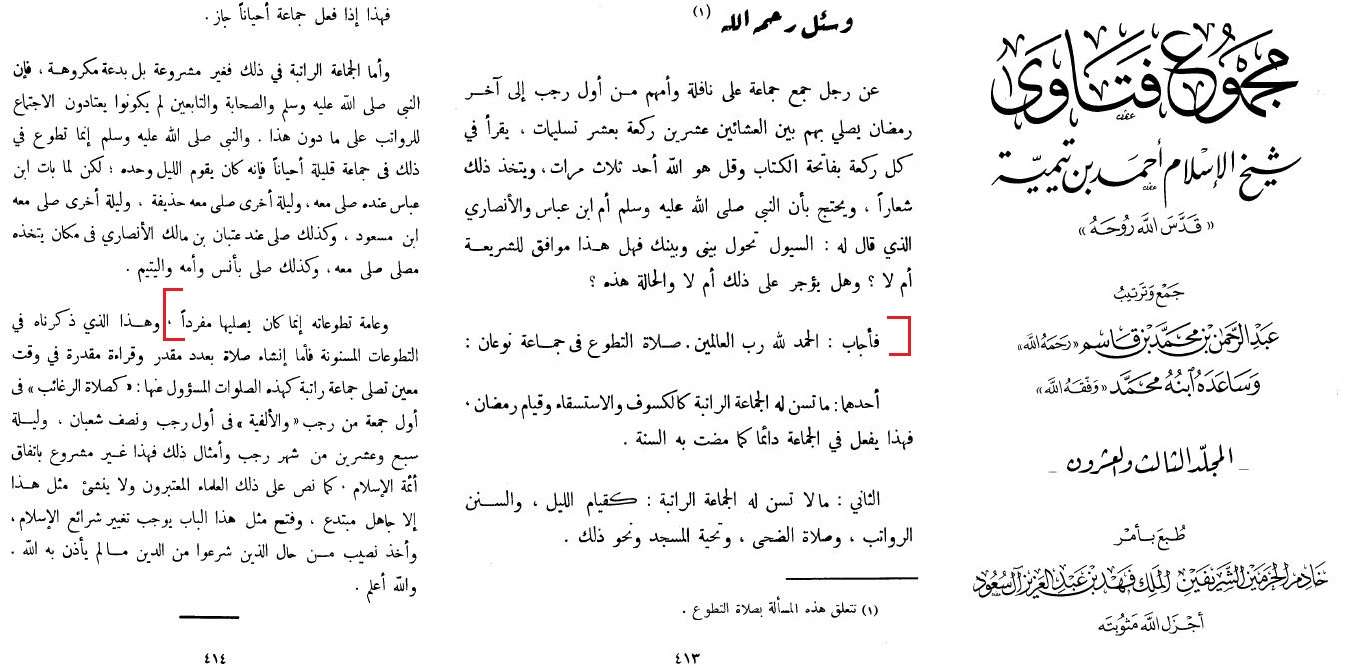
Voluntary prayers done in congregation are of two types, one of which it is Sunnah to do in congregation, such as the eclipse prayer, prayers for rain, and qiyaam during Ramadaan (Taraweeh). These are always done in congregation as is the Sunnah. The second type are not done in congregation, such as qiyaam al-layl, the regular Sunnah prayers, Duha prayer, tahiyyat al-masjid (greeting the mosque) and so on. But if they are done in congregation occasionally, that is permissible. As for doing them in congregation on an ongoing basis, that is not prescribed, rather it is a reprehensible innovation. The Prophet(SAWS) and the Sahabaah and Taabi’een were not accustomed to offering naafil prayers in congregation. The Prophet(SAWS) only rarely offered voluntary prayers in congregation. He used to pray qiyaam al-layl on his own, but when Ibn ‘Abbaas stayed overnight with him, he prayed with him. On another occasion, Hudhayfah prayed with him, and on another occasion Ibn Mas’ood prayed with him. Similarly he also prayed at the house of ‘Utbaan ibn Maalik al-Ansaari, in a place that he (‘Utbaan) took as a prayer place for himself, so he prayed with him, and he also led Anas and his mother and the orphan in prayer, but in general his voluntary prayers were offered alone. [Majmu al-Fatawa li Shaykh al-Islam Ibn Taymiyyah, vol 23, page 413-414].
Shias Made Exception for Certain Non-obligatory Prayer in Congregation
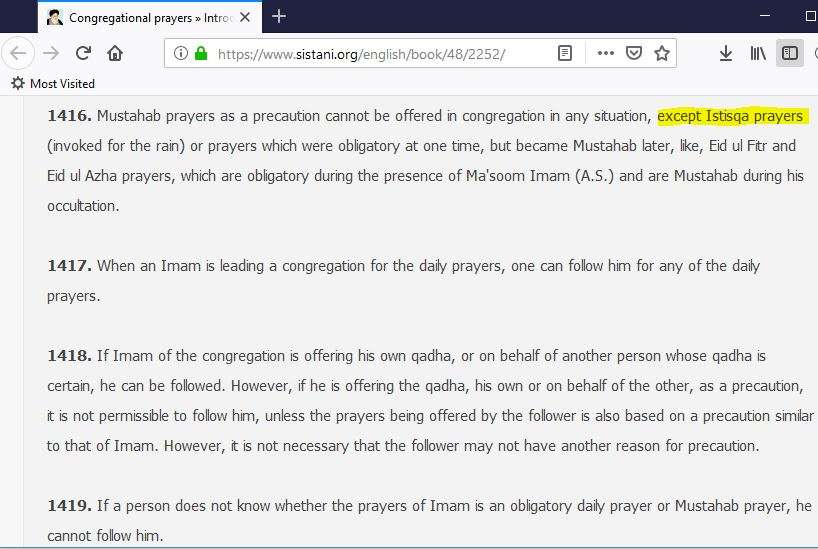
Aside of the evidences from Sunni sources, we find that even Shias made exception for praying certain voluntary prayer in congregation, they view that “Salat al-Istisqa(prayer for rain)” which is non-obligatory prayer and an optional prayer, can be offered in congregation. Hence they shouldn’t have a problem if Sunnis following the Sunnah of Prophet(SAWS) pray Taraweeh in congregation during Ramadan only, as an exception.
Shia Ayatullah Sayyid Ali al-Husseini al-Sistani stated:
Mustahab prayers as a precaution cannot be offered in congregation in any situation, except Istisqa prayers (invoked for the rain) or prayers which were obligatory at one time, but became Mustahab later, like, Eid ul Fitr and Eid ul Azha prayers, which are obligatory during the presence of Ma’soom Imam (A.S.) and are Mustahab during his occultation.
III. Umar(RA) Used the Term “Good Bidah” in Linguistic Sense Not Shara’i Sense
Argument III(a)
Shia Website[Shiapen] stated:
Narrated Abu Huraira: Ibn Shihab (a sub-narrator) said, “Allah’s Apostle died and the people continued observing that (i.e. Nawafil offered individually, not in congregation), and it remained as it was during the Caliphate of Abu Bakr and in the early days of ‘Umar’s Caliphate.” ‘Abdur Rahman bin ‘Abdul Qari said, “I went out in the company of ‘Umar bin Al-Khattab one night in Ramadan to the mosque and found the people praying in different groups. A man praying alone or a man praying with a little group behind him. So, ‘Umar said, ‘in my opinion I would better collect these (people) under the leadership of one Qari (Reciter) (i.e. let them pray in congregation!)’. So, he made up his mind to congregate them behind Ubai bin Ka’b. Then on another night I went again in his company and the people were praying behind their reciter. On that, ‘Umar remarked, ‘what an excellent Bid’a (i.e. innovation in religion) this is; but the prayer which they do not perform, but sleep at its time is better than the one they are offering.’ He meant the prayer in the last part of the night(Tahajjut). Sahih Bukhari, Volume 3, Book 32, Number 227
Maulana Waheed uz Zaman Khan in his commentary of Bukhari wrote the following relating to this hadith:
“From the words of Hadhrat Umar (i.e. what a good Innovation), it becomes clear that he did not personally join that prayer. Perhaps Hadhrat Umar thought that Nafl prayers are better at home and during the latter part of the night. Muhammad bin Nasr Marozi narrated that Ibn Abbas said that he was with Umar that people started making noises. Upon this Hadhrat Umar inquired what was that. Others told him that people are going back after offering Tarawih. Hearing this, Hadhrt Umar said: “The night that has been left, is better that what has passed away”
Ahle Sunnah as well as Nawasib/Wahabies claim that:
One can pray Nawafil in a mosque congregation (as the Sahaba were praying in small congregations in above mentioned hadith)
Umar didn’t start an entirely new Innovation, but he merely formalised a practice wherein those Sahaba that had hitherto prayed in small group congregations could now do so in a single large congregation
And our reply is as follows:
Umar had merely replaced a Bidah of the Sahaba playing Nawafil in congregations with another Biddah, namely them all praying in a single congregation. Replacing one Bidah, with another Biddah does not make that Bidah a halal act!
As Caliph, it was obligatory upon Umar Ibn Khattab to stop those people (who were praying in small congregations) from this Biddah. Unfortunately rather than cutail such a Bidah, he placed his support behind it, by formalising it and publicising it!
Answer
As we have proven from reliable reports that Prophet Muhammad(SAWS) himself prayed Taraweeh in congregation and he even prayed other Nafil prayers in congregation, this refutes the Shia allegation that Sahaba who were praying Taraweeh in congregation BEFORE Umar(RA) united them behind one Imam, was a (Shara’i) Bidah. Sahaba were praying in congregation because unlike Shias, they knew & understood the Sunnah of Prophet Muhammad(saws) very well, they knew that Prophet(saws) himself led people in Taraweeh.
As for Umar’s(RA) usage of the word Bidah for Taraweeh then that wasn’t used in a Shara’i manner, rather he used it in a Lughwi(linguistic) manner. The only new thing Umar(RA) did was to congregate people in one large group behind one Imam, whereas before they were praying in different small groups, and it is this act which he called “Bidah”, and that too in the lingual sense, not in the Sharia sense, because “Bidah” means “something new” in the lingual sense, whereas in the religious sense, it means adding something new to the religion and that is haram(prohibited), but in the lingual sense it is not haram otherwise cars and refrigerators would be haram because these are all modern inventions and innovations. Thus what needs to be understood is that people were already praying behind different Imams in small groups. According to this narration, all Umar did was he combined all the small groups into one large group so that they could pray behind one Imam rather than several different Imams, and it is this administrative decision which he called “a good innovation”, and Indeed, it was a good innovation (lingually). Thus, he wasn’t referring to the prayer as an innovation, because the prayer had been going on since the time of the Prophet(SAWS), rather he called his administrative decision to combine all the different Jamaats into one uniform Jamaat behind a single Imam a good innovation.
The Statement of Umar(ra) Was Explained by Scholars in the following Manner
(a). Imam Ibn ‘Abd al-Barr said:
This indicates that praying qiyaam in Ramadaan is one of the Sunnahs of the Prophet(SAWS) and is recommended and encouraged. It was not introduced by ‘Umar ibn al-Khattaab, rather he revived something that the Messenger of Allaah(SAWS) loved and approved of. Nothing stopped him from doing it regularly except the fear that it might be made obligatory upon his ummah. He(SAWS) was kind and compassionate towards his ummah. ‘Umar knew from the Messenger of Allaah(SAWS) that the obligatory duties would not be increased or decreased after his death(SAWS), so he revived this practice and enjoined it upon the people. That happened in 14 AH, and ‘Umar has the honour of being the one who revived this Sunnah. [Al-Tamheed, vol 8, page 108-109].
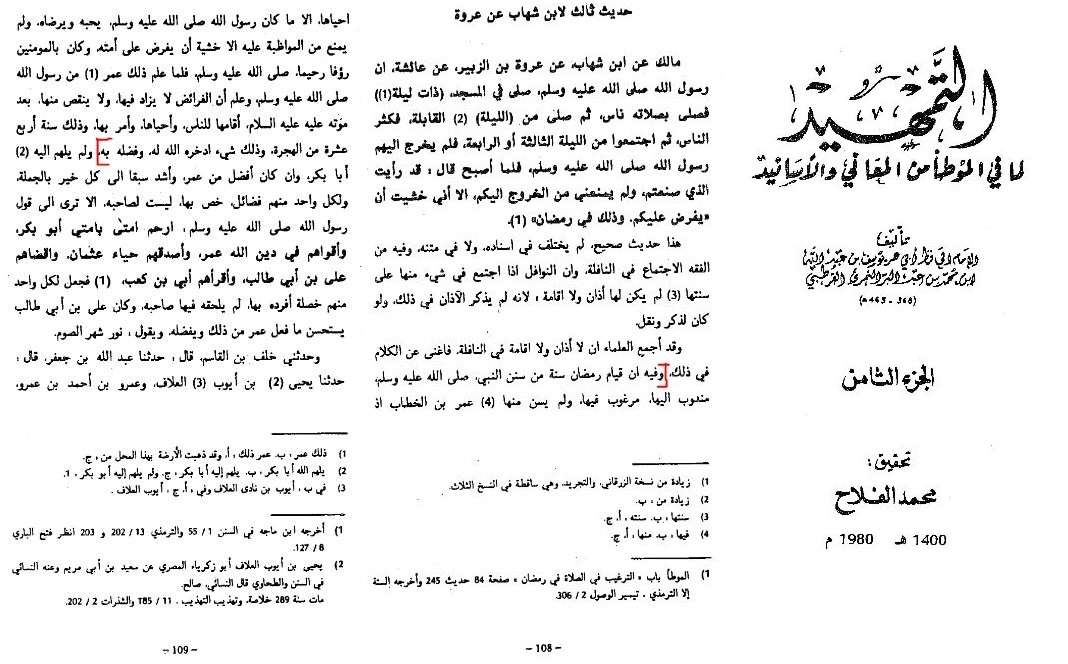
(b). Imam Ibn Rajab al-Hanbali said:
With regard to what was said by some of the Salaf(earlier generations) about regarding some innovations as good, that refers to innovation in the linguistic sense, not in the technical shar’i sense. An example of that is what ‘Umar(RA) said, when he united the people in praying qiyaam in Ramadan behind a single imam in the mosque; when he came out and saw the people praying in that manner, he said: What a good innovation this is. And it was narrated from him that he said: If this is an innovation, then what a good innovation. What he meant was that this deed had not been done in this manner before this time, but it had a basis in Islamic teaching that may be referred to, such as the fact that the Prophet(SAWS) used to encourage and urge people to pray qiyaam in Ramadan. At his time, the people used to pray qiyaam in the mosque, in scattered groups and individually, and he(SAWS) led his companions in praying qiyaam in Ramadan for several nights. Then he stopped doing that, on the basis that he feared that it might be made obligatory for them, then they would be unable to do it, but there was no fear of that after he(SAWS) died. [Jaami’ al-‘Uloom wa’l-Hikam, page 597-598, hadeeth #28].
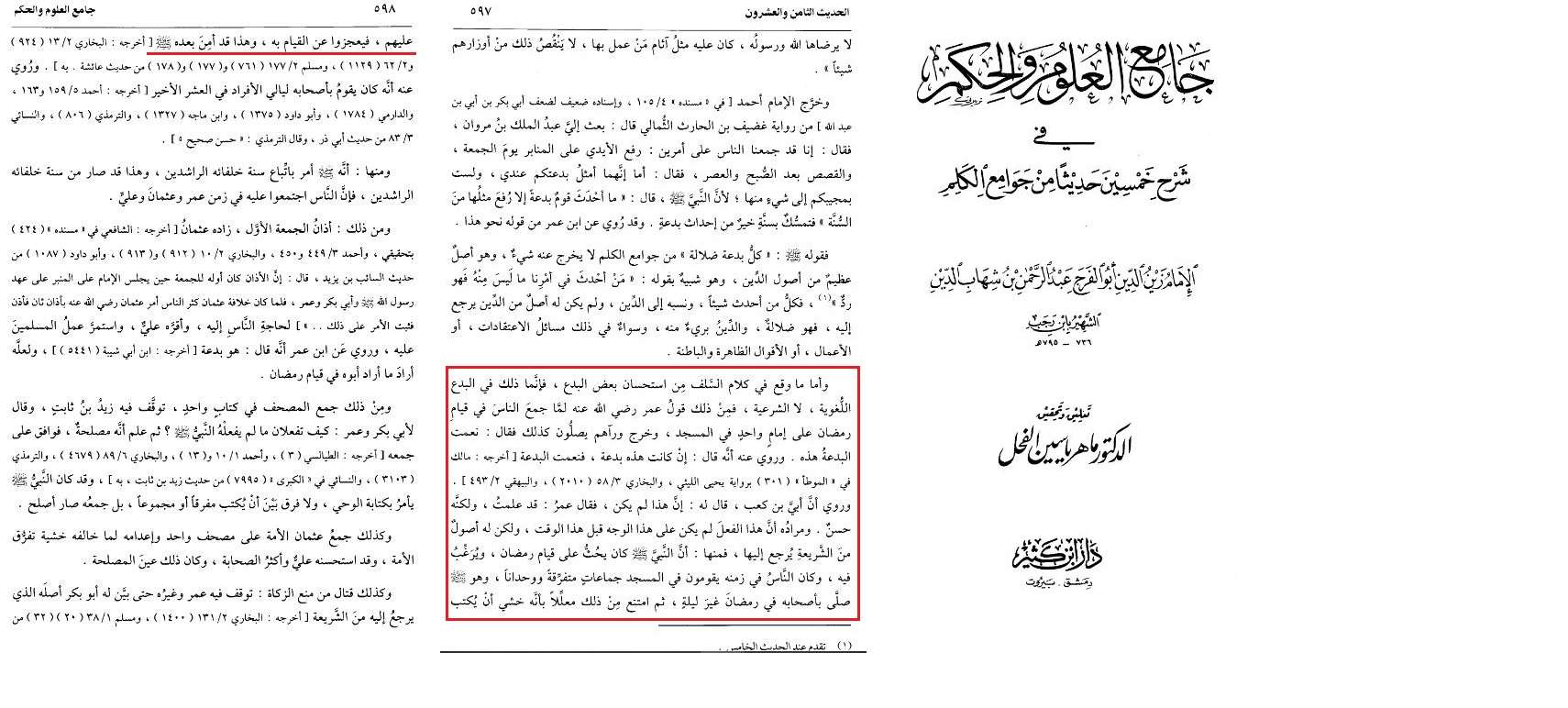
(c). Imam Ibn Kathir said:
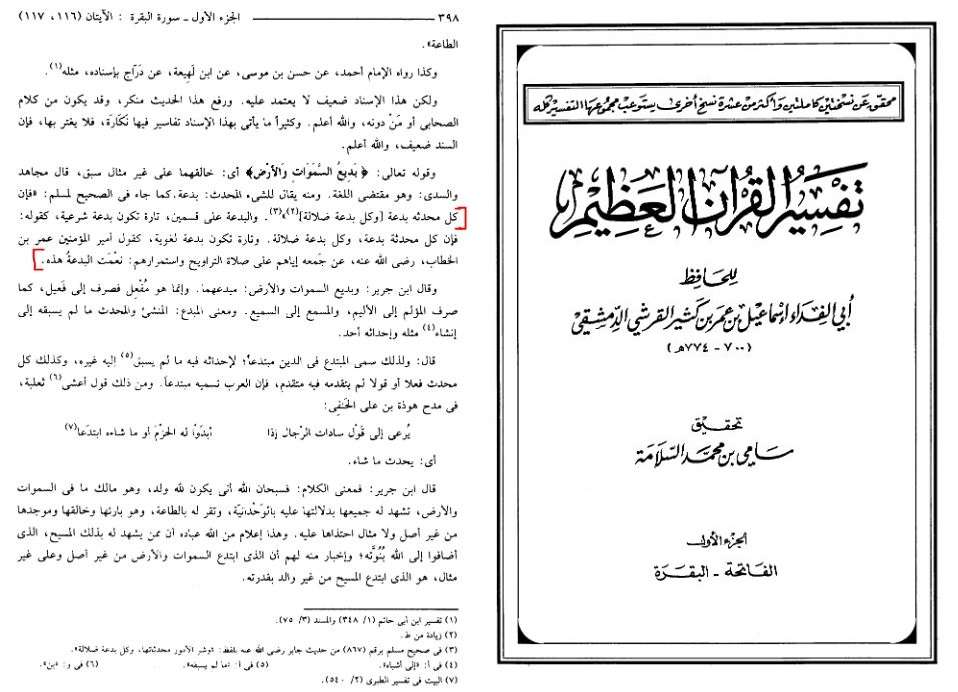
Every newly-invented matter is an innovation [and every innovation is misguidance]. And bidah is of two types. Sometimes it is a bidah shar’iyyah (with its Shariah meaning), such as his saying, “For every newly-invented matter is an innovation and every innovation is misguidance…” and sometimes it is a bidah lughawiyyah (with its linguistic meaning), such as the saying of Amir al-Mu’minin Umar bin al-Khattab regarding his uniting them together for the Tarawih prayer and making them maintain this practice, “What an excellent innovation this is…” [Tafseer al-Quran al-Adheem, vol 1, page 398].
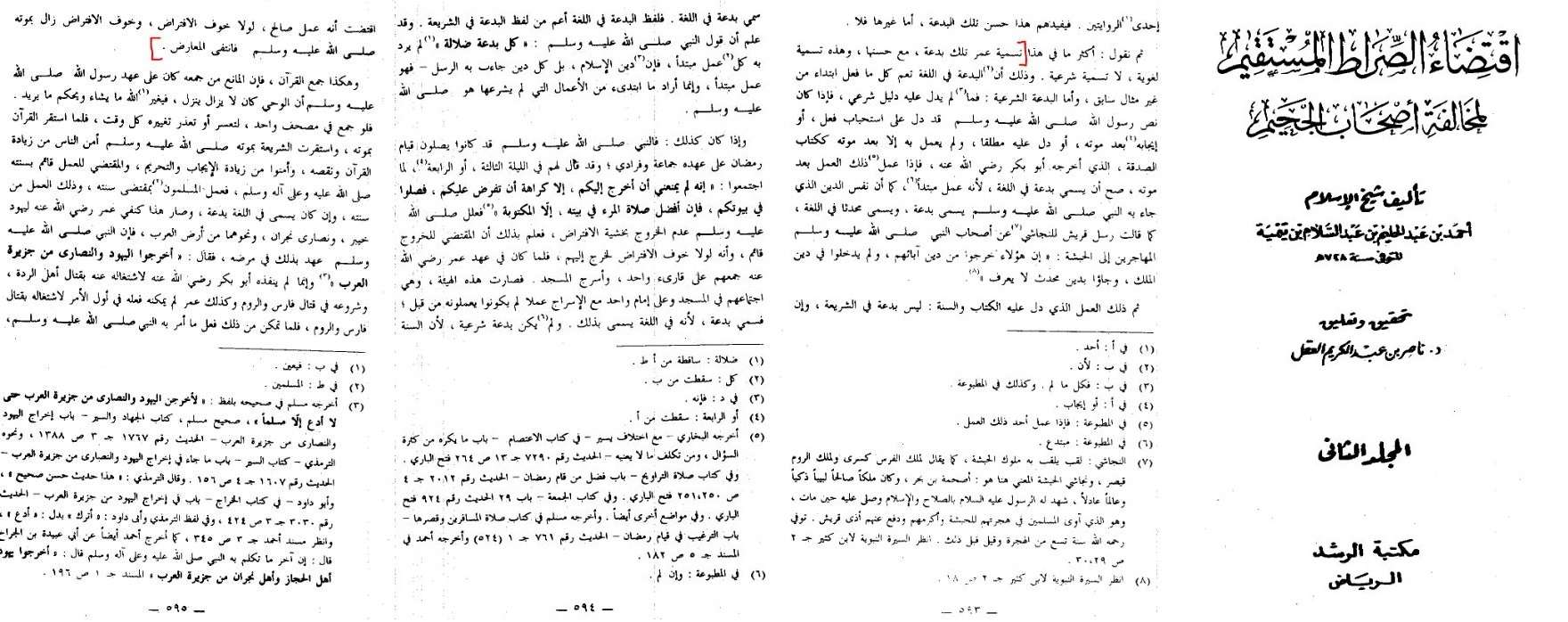
Also Ibn tayymiah
(e). Allama Ibn ‘Abideen said:
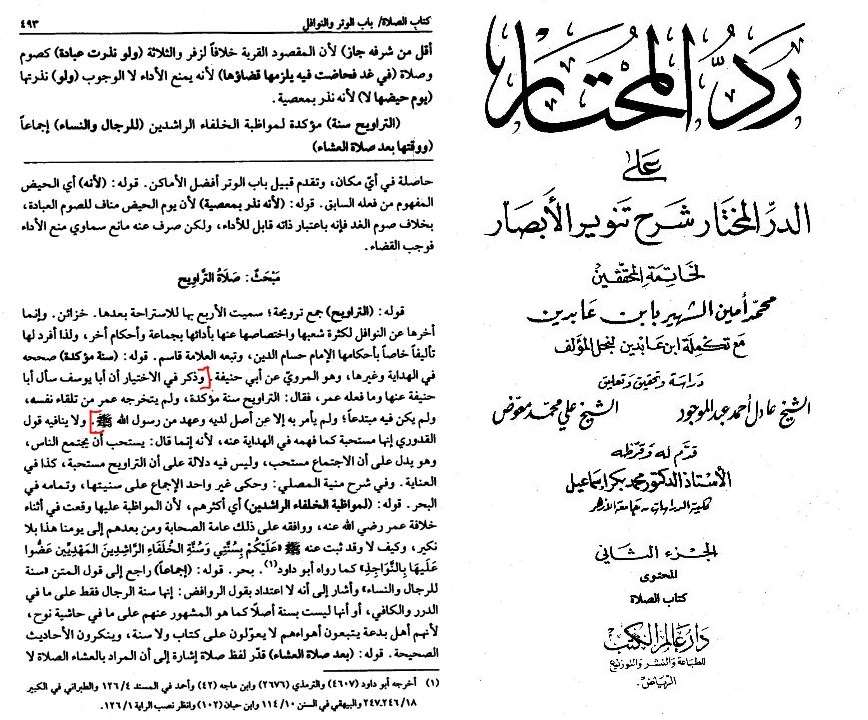
It was mentioned in al-Ikhtiyaar (a Hanafi book of fiqh) that Abu Yusuf asked Abu Hanifah about Umar’s action and Abu Hanifah responded back by saying that Taraaweeh is a Sunnah Mu’akkadah and that Umar didn’t do it from his own self as an innovator, for the foundation of his action is from the Prophet(SAWS). [Radd al-Muhtaar ‘ala al-Durr al-Mukhtaar , vol 2, page 493].
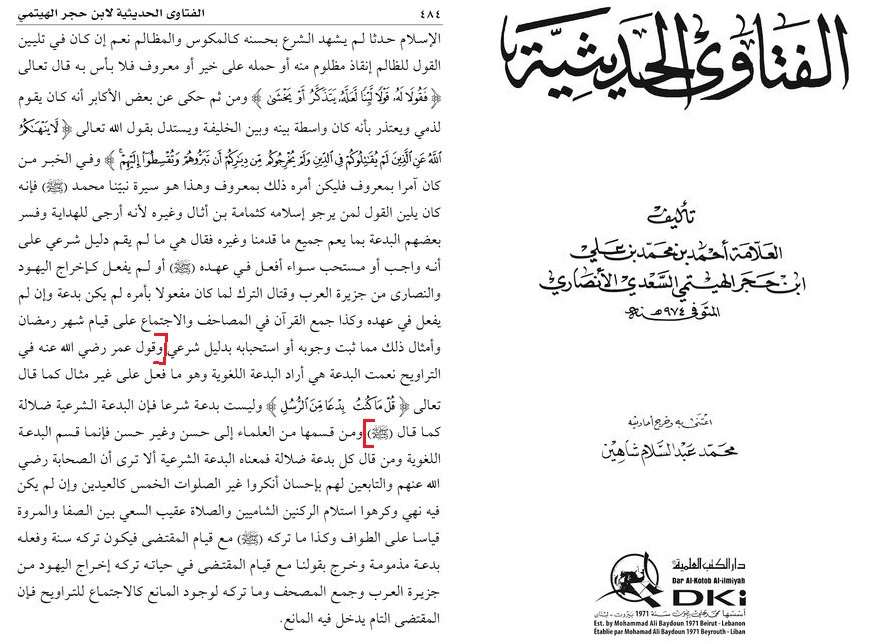
(f). Ibn Hajar al-Haytami said the same thing (i.e. that it’s only a bid’ah in the linguistic sense) and that it is not a bid’ah in the sense of Shariah. [al-Fataawah al-Hadeetheeyah, page 484].
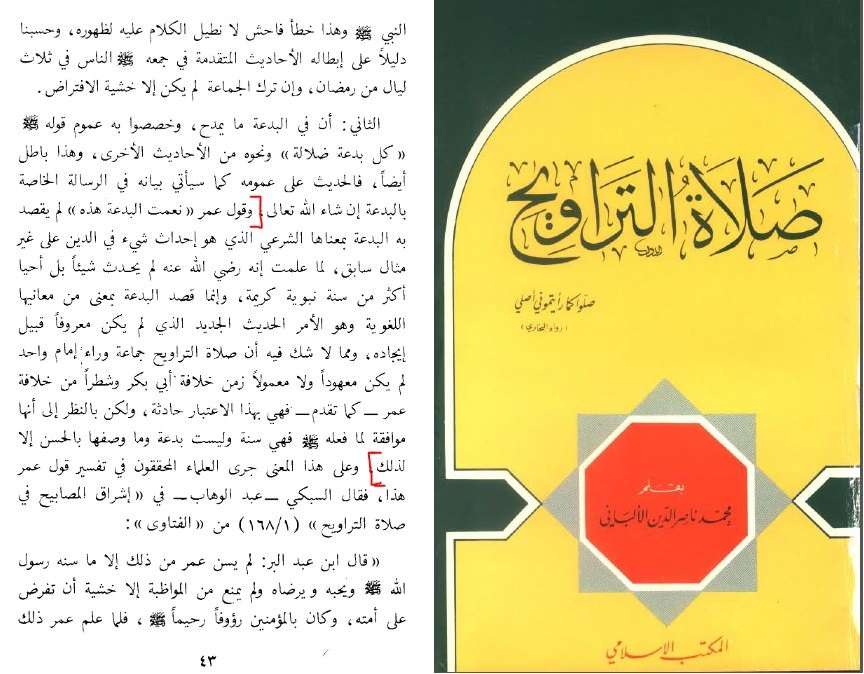
(g). Shaykh al-Albani stated:
The words of ‘Umar, “What a good innovation this is”, do not refer to innovation in the technical shar’i sense, which means introducing something into the religion with no precedent. Rather he was referring to innovation in a linguistic sense, which is something new that was not known before he introduced it. There can be no doubt that offering Taraweeh prayer in congregation behind a single imam was not known or practised during the caliphate of Abu Bakr and the first half of ‘Umar’s caliphate, so in that sense it was something new. But because it was in accordance with what the Prophet(SAWS) did, it is Sunnah and is not an innovation, and he only described it is good because of that. [Salat al-Taraweeh, page 43].
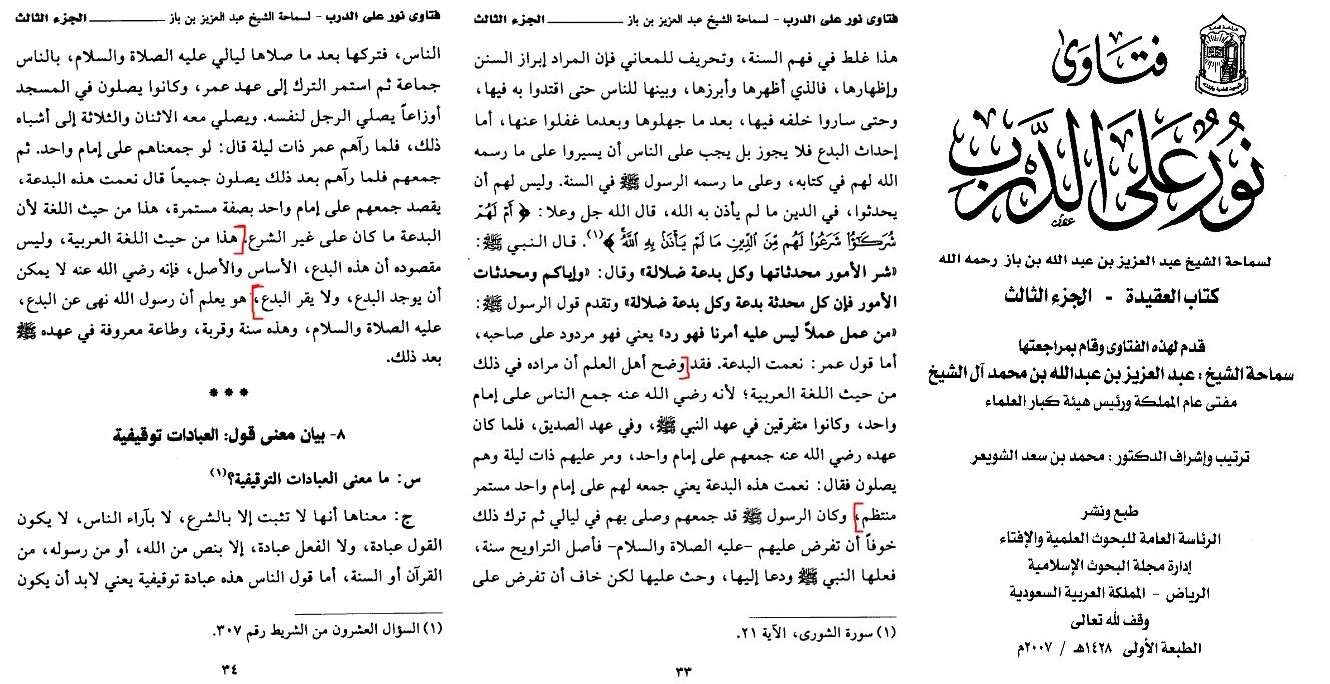
(h). Shaykh Ibn Baaz said:
The scholars have explained that what ‘Umar meant by that was the linguistic sense, according to Arabic usage, because he(ra) united the people behind a single imam, whereas at the time of the Prophet(SAWS) and Abu Bakr as-Siddeeq they used to pray in scattered groups. During his(RA) time, he united them behind a single imam; he passed by them one night as they were praying and said: What a good innovation this is, i.e., uniting them behind a single imam in an ongoing and organised fashion. This has to do with the linguistic meaning according to Arabic usage; he did not mean that it was an innovations in the technical, shar’i sense. It is not possible that he(RA) could have introduced or approved of (reprehensible) innovations. [Fataawa Noor ‘ala ad-Darb vol 3, page 33-34].
(i). Imam al-Bayhaqi said:
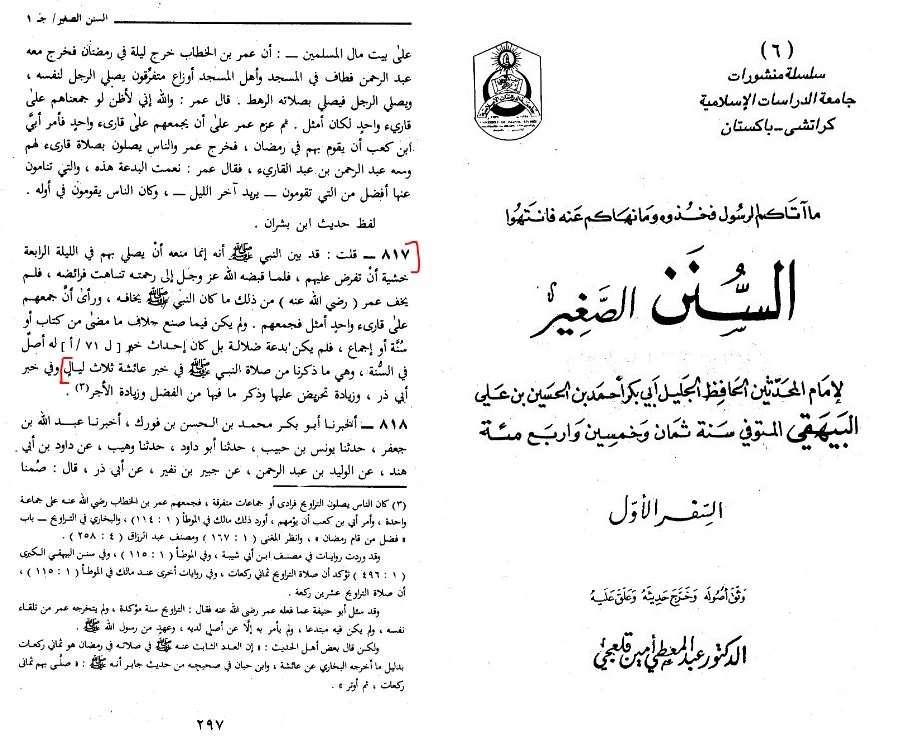
Prophet(SAWS) left it due to the fear that it would become an obligation to the Ummah , and Umar(RA) did not fear this as what Prophet(SAWS) feared and he saw that to make them pray the Taraweeh under one Imaam is not against Quran , Sunnah , Ijma and hence it’s not Bidah of misguidance(Bidah Shariah), rather it’s a new matter which has foundation in Deen from the report of Ayesha(RA) regarding the prayer of the Prophet(SAWS). [Sunan al-Sagheer, vol 1 page 297, #817].
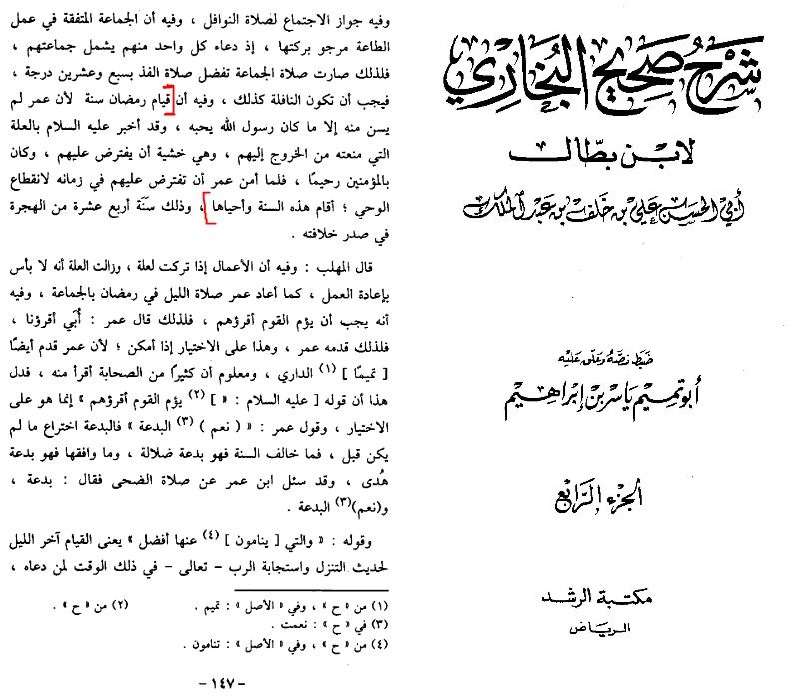
(j). Abul Hassan ibn Battal said that the reason why Umar revived the Prophet’s Sunnah of Taraweeh was because the reason for the Prophet’s discouragement (i.e. that it would become compulsory on the ummah) disappeared. [Sharh Sahih al-Bukhari li Ibn Battal, vol 4, page 147]
(k). Imam al-Hakim after quoting a hadeeth stated:
وفيه الدليل الواضح أن صلاة التراويح في مساجد المسلمين سنة مسنونة وقد كان علي بن أبي طالب يحث عمر رضي الله عنهما على إقامة هذه السنة إلى أن أقامها
A clear evidence is present in this report that, Muslims praying Taraweeh in the Mosques is Masnoon Sunnah. Ali ibn Abi Talib(ra) used to urge Umar(ra) to establish this Sunnah, until he eventually established it. [Mustadrak al Hakim, vol 1, page 607, #1608].
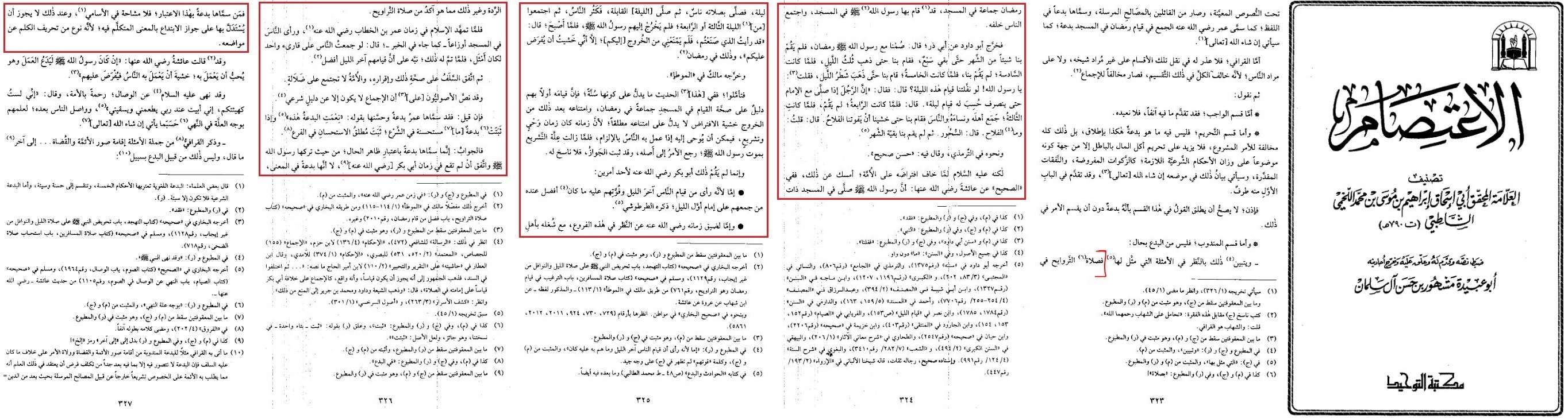
Imam shattiba also explained
Even “Zaidi Shia” Regarded Taraweeh as Sunnah
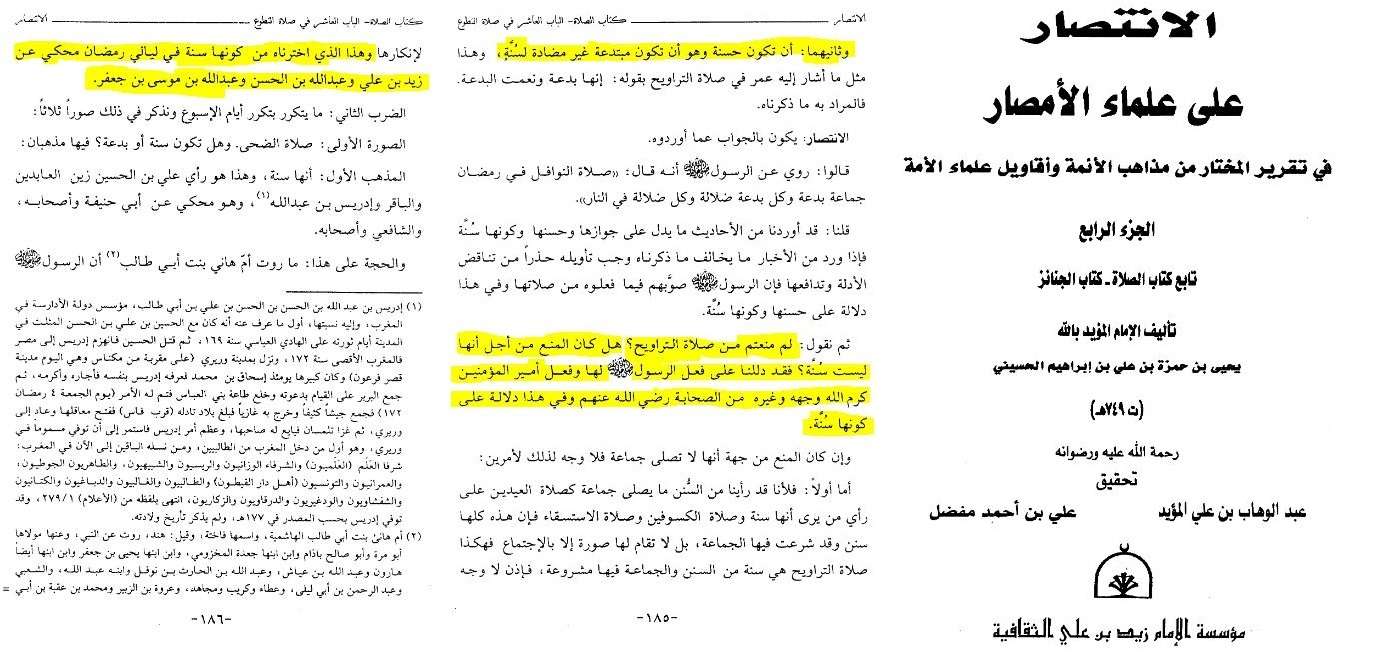
On page 185, The great Zaidi Shia Imam Yahya bin Hamzah bin Ali bin Ibrahim al-Hussaini(died 749 AH) strongly criticises fellow Zaidis for their rejection of Tarawih. He argues that it is an established Sunnah, prayed by the Prophet(SAWS), ‘Ali ibn Abi Talib(RA) and other Sahabah.
On page 186, The great Zaidi Shia Imam Yahya bin Hamzah bin Ali bin Ibrahim al-Hussaini emphasises the legality of Tarawih and that it is an established Sunnah according to great Imams and jurists of Ahl Al-Bayt such as: Imam Zaid ibn ‘Ali, ‘Abdullah ibn Al-Hassan and ‘Abdullah ibn Musa ibn Ja’far (i.e. Al-Sadiq). [Al-Intisar ‘ala ‘Ulama Al-Amsar, vol 4, page 185-186].
Argument III(b)
Shia Website[Shiapen] stated:
Umar’s advocates claim that he started Tarawih in order to revive the Sunnah of our Rasool (saw), who had offered Tahajjud prayers for three nights in his mosque. This is again conjecture, at no point did Umar insist that he was merely reinstituting the Sunnah of the Prophet (s) who had offered congregational Tahajjud prayers in the mosque for three nights.
Contrary to this, when Umar Ibn Khattab introduced Tarawih (after Isha Prayers) he said: “A good New Innovation”. If today’s Salafis insist that Umar’s usage of the words ‘Good New Innovation’ that merely meant reviving the Sunnah of the Prophet (s), they are again adopting conjecture that has no basis in the eyes of Allah (swt).
Answer
Shia in their blind hatred became so blind that they could not even properly see what Umar(RA) actually did in the first place. He did not convert Qiyaam from an individual act of worship to a congregational act of worship, nor did he transform it from act of worship done privately at home to an act of worship done publicly in the Masjid, because he didn’t need to do so, since people were already praying it in small Jamaat in public in the Masjid even before Umar(RA) entered the Masjid on that fateful night.
‘Abdur Rahman bin ‘Abdul Qari said, “I went out in the company of ‘Umar bin Al-Khattab one night in Ramadan to the mosque and found the people praying in different groups. A man praying alone or a man praying with a little group behind him. [Sahih Bukhari, Volume 3, Book 32, Number 227].
Therefore, the congregational aspect of Qiyaam was already well-established and in practice even before Umar(RA) came into the picture, since Sahaba were well aware of the Sunnah and teachings of Prophet(SAWS).
(IV). The Evidence of Praying Taraweeh for Whole Month of Ramadan
Argument
Shia Website[Shiapen] stated:
Why do Wahabies pray Tarawih for 30 Nights of Ramadhan in congregation?
Our Rasool (saw) offered Tahajjud congregational prayers (or so called Tarawih) for just three nights during Ramadhan. Why have you extended this Sunnah of three nights to an entire thirty nights during Ramadhan?
Moreover, why have you restricted it to the thirty nights of Ramadhan and not three hundred and sixty five nights a year? (i.e. Did Rasool ever tell you that this Congregational Tarawih prayer can only be offered during Ramadhan and would be Haram and would be rendered haram if replicated during other times of the year?)
Answer
Reply to Point #1.
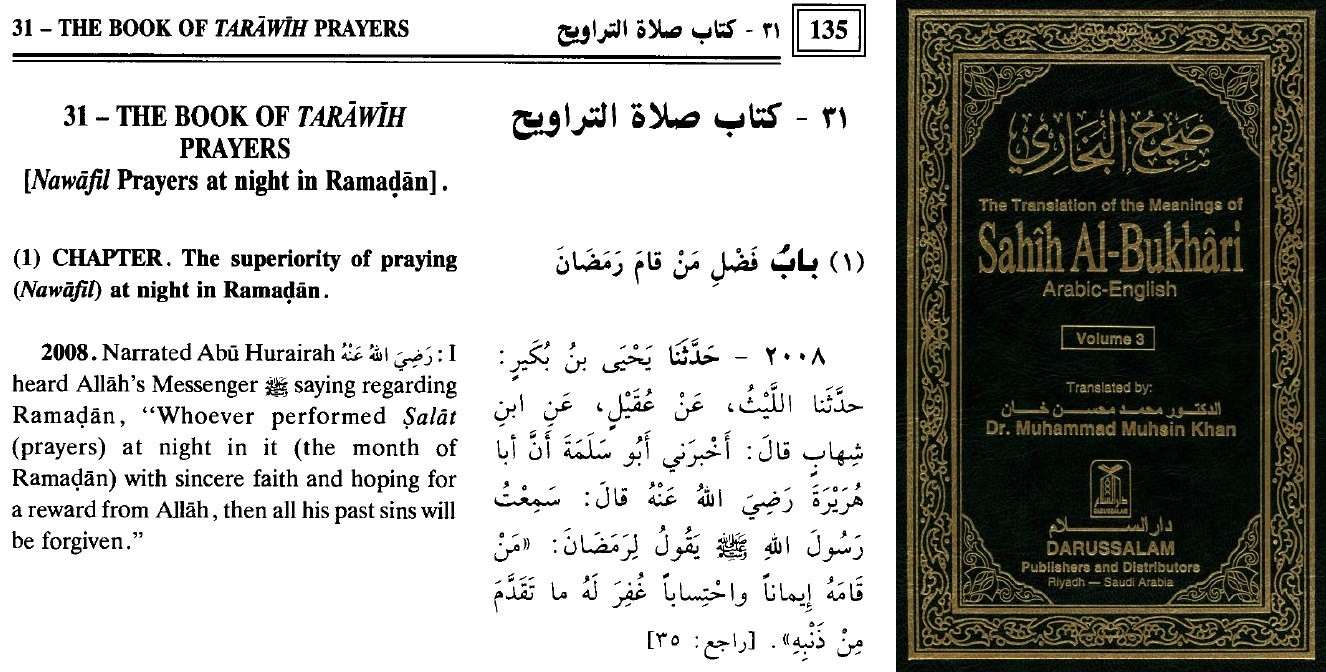
(a). Narrated Abu Huraira: I heard Allah’s Messenger(SAWS) saying regarding Ramadan, “Whoever prayed at night in it (the month of Ramadan) out of sincere Faith and hoping for a reward from Allah, then all his previous sins will be forgiven.”[Sahih al-Bukhari, vol 3, page 135, #2008].
(b). It was narrated that Abu Dhar(ra) said: “We fasted Ramadan with the Messenger of Allah(SAWS), and the Prophet(SAWS) did not lead us in Qiyam until there were seven days left of the month, then he led us in Qiyam until one-third of the night had passed. Then, when there were six days left, he did not lead us in Qiyam. When there were five days left, he led us in praying Qiyam until half the night had passed. We said: ‘O Messenger of Allah(SAW), why don’t you lead us in praying Qiyam for the rest of the night?’ He(SAWS) said: ‘If a man prays with the Imam until he leaves, that will be continued for him as if he spent the whole night in prayer.’ [Sunan al-Nasai, vol 2, page 303-304, #1365 ; Sahih as Zubair Ali Za’ee] ; [Jami al-Tirmidhi, vol 2, page 230-231, #806 ; Hasan Sahih as per al-Tirmidhi] ; [Sunan Abu Dawood, page 237, #1375 ; Sahih as per Albani].
(c). Imam Ibn ‘Abd al-Barr said:
Praying qiyaam in Ramadaan is one of the Sunnahs of the Prophet(SAWS) and is recommended and encouraged. It was not introduced by ‘Umar ibn al-Khattaab, rather he revived something that the Messenger of Allaah(SAWS) loved and approved of. Nothing stopped him from doing it regularly except the fear that it might be made obligatory upon his ummah. He(SAWS) was kind and compassionate towards his ummah. ‘Umar knew from the Messenger of Allaah(SAWS) that the obligatory duties would not be increased or decreased after his death(SAWS), so he revived this practice and enjoined it upon the people. That happened in 14 AH, and ‘Umar has the honour of being the one who revived this Sunnah. [Al-Tamheed, vol 8, page 108-109].
(d). Imam Ibn Rajab al-Hanbali said:
The Prophet(SAWS) used to encourage and urge people to pray qiyaam in Ramadan. At his time, the people used to pray qiyaam in the mosque, in scattered groups and individually, and he(SAWS) led his companions in praying qiyaam in Ramadan for several nights. Then he stopped doing that, on the basis that he feared that it might be made obligatory for them, then they would be unable to do it, but there was no fear of that after he(SAWS) died. [Jaami’ al-‘Uloom wa’l-Hikam, page 597-598, hadeeth #28].
(already gave the scans previously as well)
(e). Shaykh al-Islam Ahmad ibn Taymiyah said:
As that is the case, they(Sahaba) used to pray the qiyaam of Ramadan (i.e., Taraweeh) at the time of the Prophet(SAWS) both in congregation and individually. He said to them on the third or fourth night, when they gathered: “Nothing prevented me from coming out to join you except the fact that I would not like it to be made obligatory for you. So pray in your houses, for the best prayer a man can offer is in his house, except the prescribed obligatory prayers.” So he(SAWS) explained the reason why he did not come out (to lead them in Taraweeh prayers), which was the fear that it might be made obligatory. Thus it is known that the reason for his coming out to join them was still valid, and that were it not for the fear of it being made obligatory, he would have come out to join them.… Fear that it might be made obligatory ceased with the death of the Prophet(SAWS), so there was no longer any reason not to do it. [Iqtida’ as-Siraat al-Mustaqeem, page 593-595].
Reply to Point #2:
The simple answer to the question that why Taraweeh is not performed in a Mosque outside the month of Ramadan is that, such a practise isn’t proven from the Sunnah of Prophet(saws). If Shias don’t find this simple response to be satisfactory then we would like to respond them from their own Shia hadeeth, where we find that the Imam ordered not to perform prayer after Isha in other than the month of Ramadan. Which implies that after Isha there is a prayer specifically in Ramadan.
Ali ibn Ibrahim has narrated from Muhammad ibn ‘Isa ibn ‘Ubayd from Yunus from abu al-‘Abbas al-Baqbaq and ‘Ubayd ibn Zurarah who has said the following: “Abu Abd Allah(as), has said that the Messenger of Allah(saws), would increase his salat (prayer) during the month of Ramadan. After al-Atmah(Isha prayer), he would perform more prayers. People behind would stand up (for prayer), but he would go inside and leave them. Then, after he came out, they would come and stand up behind him (for prayer), but he would leave them and go inside several times.’ He (the narrator) has said that the Imam then said, ‘You must not perform salat (prayer) after al-Atmah(Isha prayer), during the times other than the month of Ramadan.’ [Al-Kafi, vol. 4, page 94] [Majlisi declared the hadeeth as Sahih in Miraat al-Uqool, vol 16, page 378].
(V). Taraweeh and Tahajjud Are Same Prayer with Different Characteristics
Argument
Shia Website[Shiapen] stated:
Some blind ignorant people (including the Mufties of Saudia) allege that “Qiyamul Lail قیام الیل “(i.e. Tahajjud) and Tarawih after Isha Prayer are the same thing.
Answer
Strong and Solid proofs suggest that Tahajjud and Taraweeh are a same thing. We would like to give few evidences to prove this fact.
(a). It was narrated that Abu Dhar(ra) said: “We fasted Ramadan with the Messenger of Allah(SAWS), and the Prophet(SAWS) did not lead us in Qiyam until there were seven days left of the month, then he led us in Qiyam until one-third of the night had passed. Then, when there were six days left, he did not lead us in Qiyam. When there were five days left, he led us in praying Qiyam until half the night had passed. We said: ‘O Messenger of Allah(SAW), why don’t you lead us in praying Qiyam for the rest of the night?’ He said: ‘If a man prays with the Imam until he leaves, that will be continued for him as if he spent the whole night in prayer.’ Then, when there were four days left, he did not lead us in praying Qiyam. When there were three days left he sent for his daughters and women, and gathered the people, and he led us in praying Qiyam until we feared that we would miss Al-Falah. Then he did not lead us in praying Qiyam for the rest of the month.” Dawud (one of the narrators) said: “I said: ’ What is falah?’ He said: ‘Suhur(The meal before daybreak).’ [Sunan al-Nasai, vol 2, page 303-304, #1365 ; Sahih as Zubair Ali Za’ee] ; [Jami al-Tirmidhi, vol 2, page 230-231, #806 ; Hasan Sahih as per al-Tirmidhi] ; [Sunan Abu Dawood, page 237, #1375 ; Sahih as per Albani].
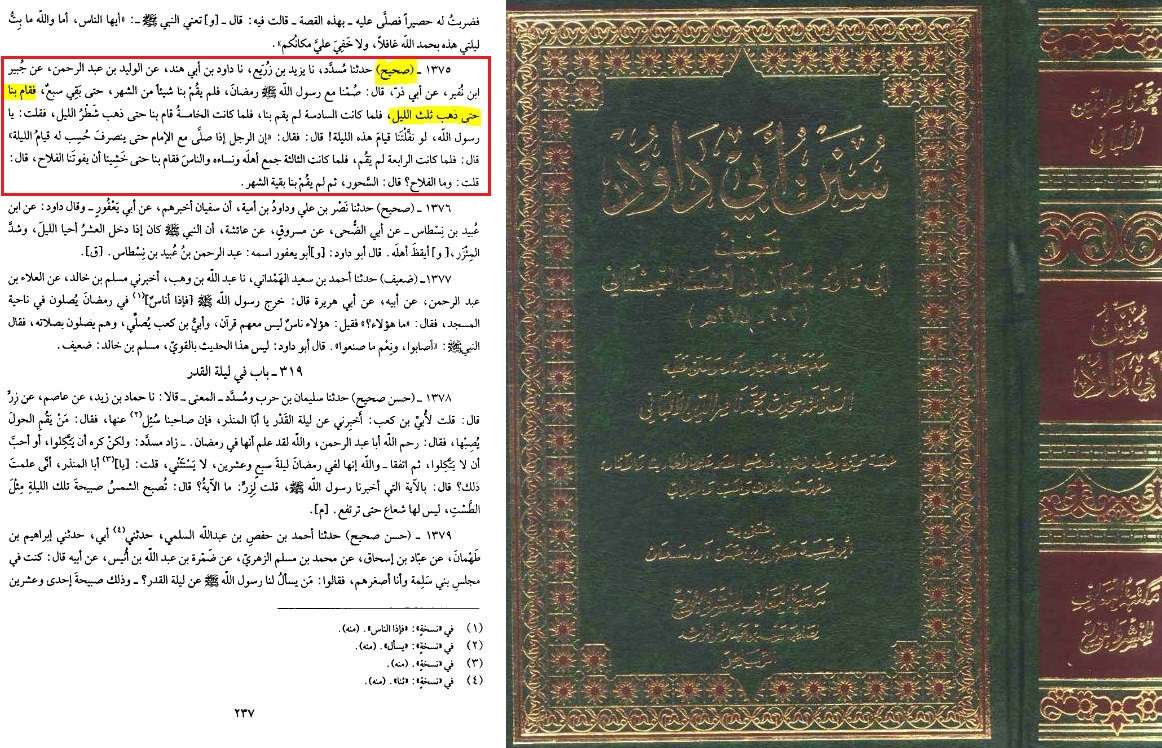
Comment: It is clear from this narration that the Messenger of Allah(SAWS) led the Taraweeh prayer in three parts of the night and by praying it after Isha until the end of the night he informed us of its time. It is likely that no time would have remained for Tahajjud(as taraweeh on the 27th night was prayed till so late in the night that there were fears of missing the dawn meal), therefore no doubt remains about Taraweeh and Tahajjud being one prayer. Shias can’t make the excuse that Prophet(saws) might have skipped Tahajjud prayer on this night, because they believe that Tahajjud prayer was obligatory on Prophet(saws).
Allamah Muhammad Anwar Shah Kashmiri while commenting on above hadeeth stated:
“There is no way out or alternative in accepting that the Taraweeh of the Messenger of Allaah(SAWS) was eight rak’ahs, and it is not established by any narration that he(SAWS) prayed Taraweeh and Tahajjud separately. [al-Urf al-Shadhee, vol 2, page 208].
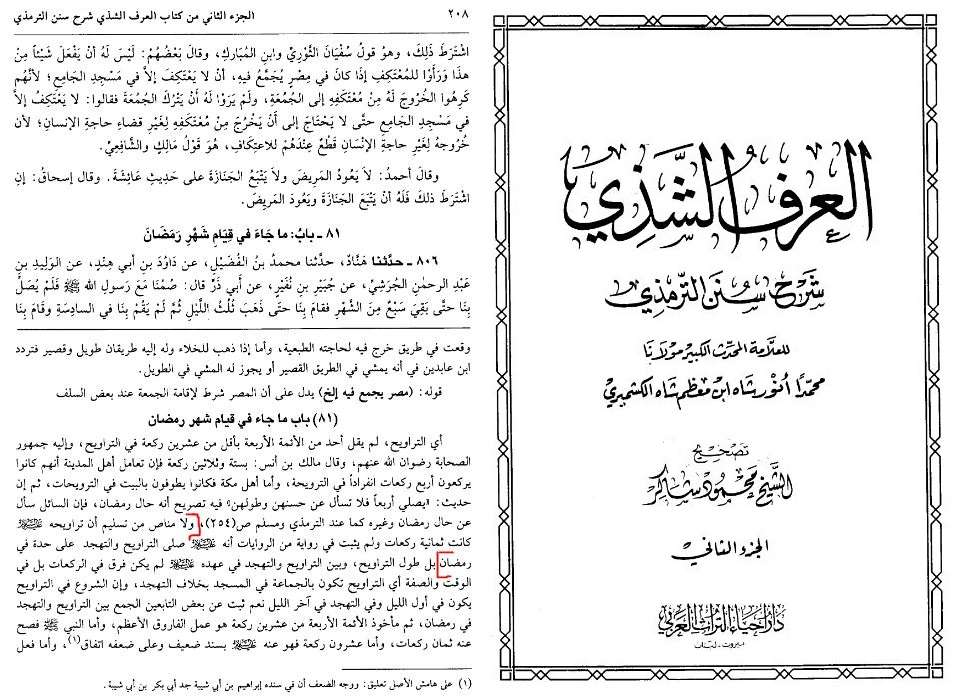
(b). Allamah Muhammad Anwar Shah Kashmiri al-Hanafi stated:
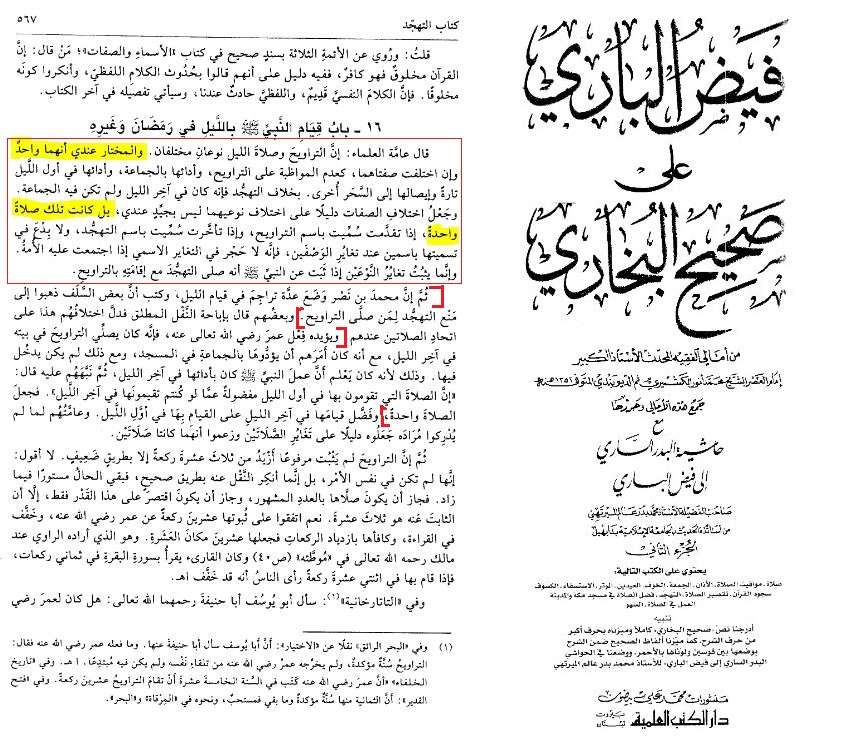
In General (Hanafi)Scholars stated that Taraweeh and Tahajjud are two different prayers, but in my view both of these are one and same prayer, even though they have different characteristics. For example Taraweeh is regularly performed, it is prayed in congregation, It is prayed in the beginning portion of the night, sometimes its prayed until Sahr, but on the other hand Tahajjud is prayed in last portion of the night, its not prayed in congregation. And deeming them different prayers due their different characteristics is not correct in my view. In fact, Taraweeh and Tahajjud are one and same prayer; When its prayed in the beginning of the night then its called Taraweeh, and when its prayed in the last portion of night its called Tahajjud. And due to their different characteristics giving them different name for each, is not an innovation, because as per the agreement of the Ummah there is no problem in giving different names. However, they would have been proven to be two different prayers when it would have been proven that Prophet(SAWS) prayed Taraweeh and Tahajjud in the same night. [Faydh al-Bari, vol 2, page 567].
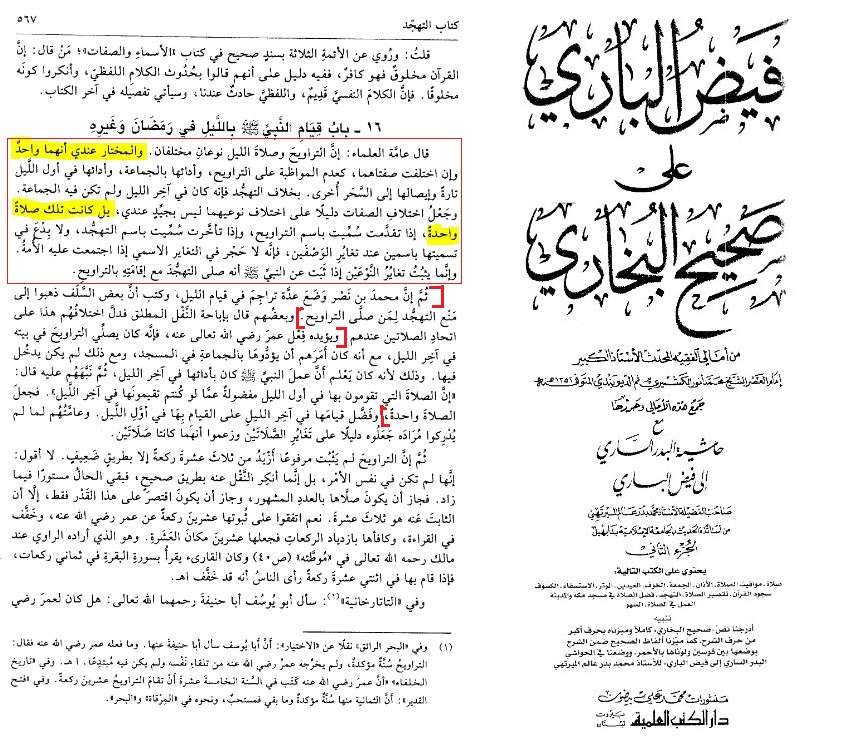
Comment: To understand this issue, we give the example of Zuhr prayer in general, as it is obligatory to offer it in four Rakah(units) in congregation. But while travelling it is not obligatory to offer it in congregation and it is also reduced to two Rakah. Therefore, due to their different characteristics we cannot declare that the general Zuhr prayer is different than the Zuhr prayer while travelling.
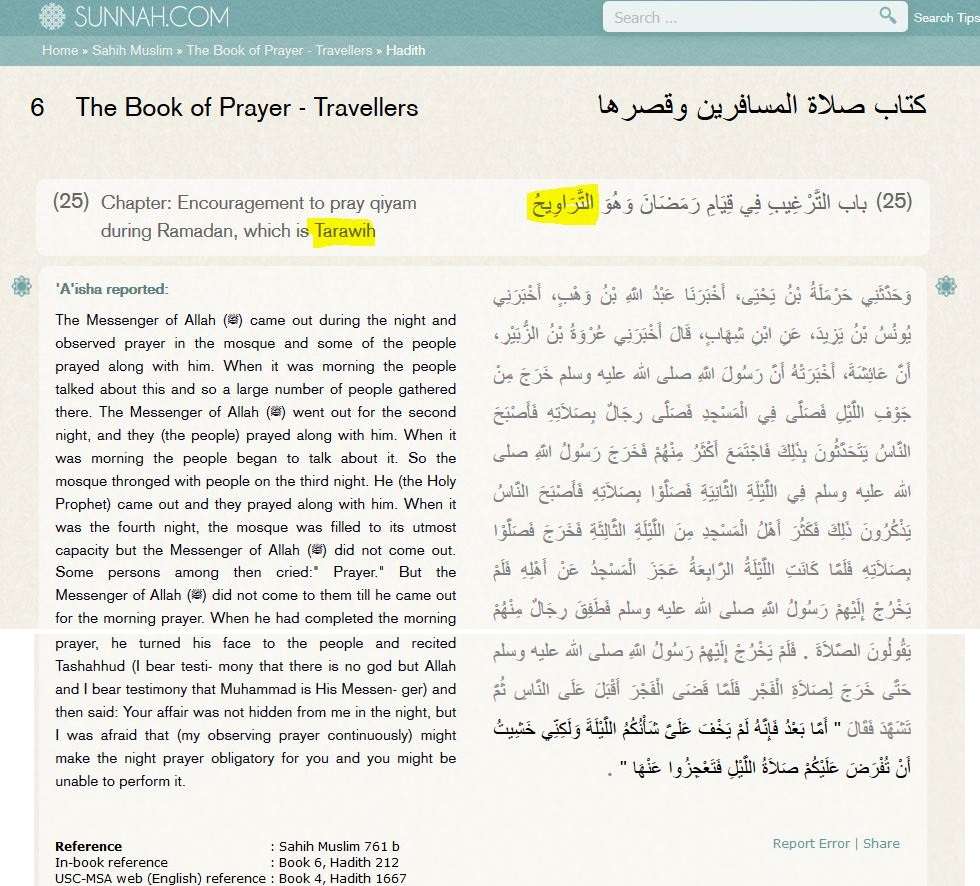
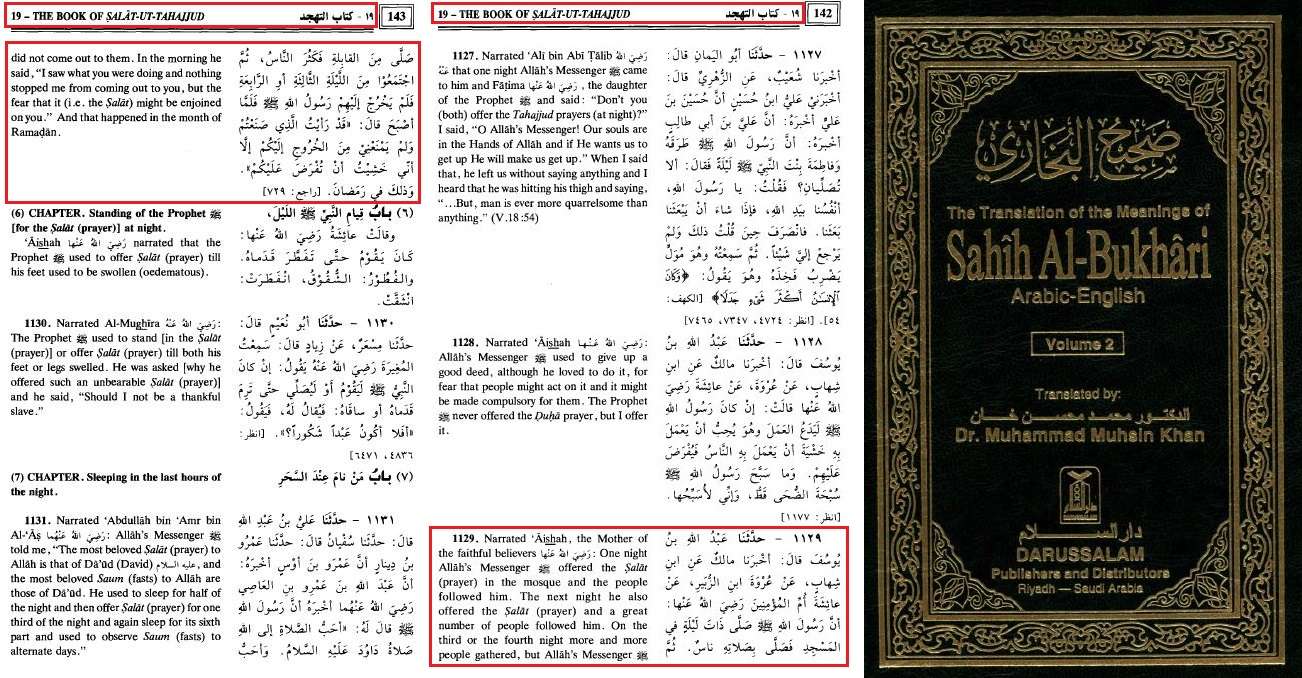
(c). The Muhadditheen and Imams have mentioned the hadeeth of Ayesha(ra) about Prophet(saws) leading people in the nights of Ramadan under the Chapters of Taraweeh and Qiyaam (Tahajjud), In other words, Same hadeeth was mentioned under chapters of Taraweeh and Tahajjud, which proves that Taraweeh and Tahajjud were same prayer in the view of Muhadditheen and Imams. For example: In Sahih al-Bukhari, Imam Bukhari has mentioned this hadeeth in “The book of Taraweeh”(See Sahih al-Bukhari vol 3, page 136-137) and as well as in “The book of Tahajjud”(See Sahih al-Bukhari vol 2, page 142-143). Also See [Sahih muslim Book 4, Hadith #1667 ; Chapter: Encouragement to pray qiyam during Ramadan, which is Tarawih].
(
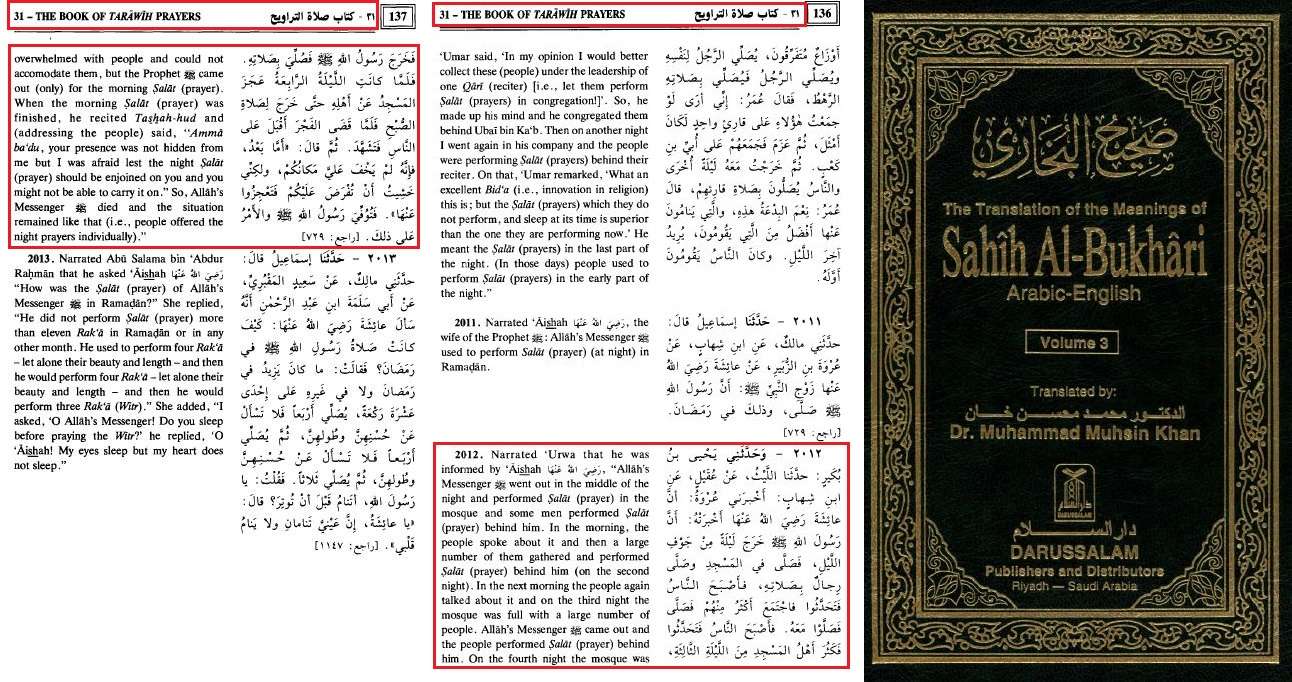
(d). Allamah Anwar shah Kashmiri al-Hanafi stated:
Mohammad bin Nasr have formed several chapters about Qiyaam al-Layl(night prayer)and stated that some of the Salaf have disallowed the person who already prayed Taraweeh to pray Tahajjud. [Faydh al-Bari, vol 2, page 567].
This is also a clear evidence that the Salaf considered Tahajjud and Taraweeh to be same prayer.
(scan given previously as well)
Argument V(b)
Shia Website[Shiapen] stated:
Tahajjud Time starts only after the middle of the night (i.e. praying any Nafl after Isha doesn’t count in Tahajjud)
Answer
This is the misconception of Shias, Tahajjud time starts after Isha and it remains until the Adhan(call to prayer) of Fajr is announced.
Mufti Azeez ur Rahman Usmani al-Hanafi stated:
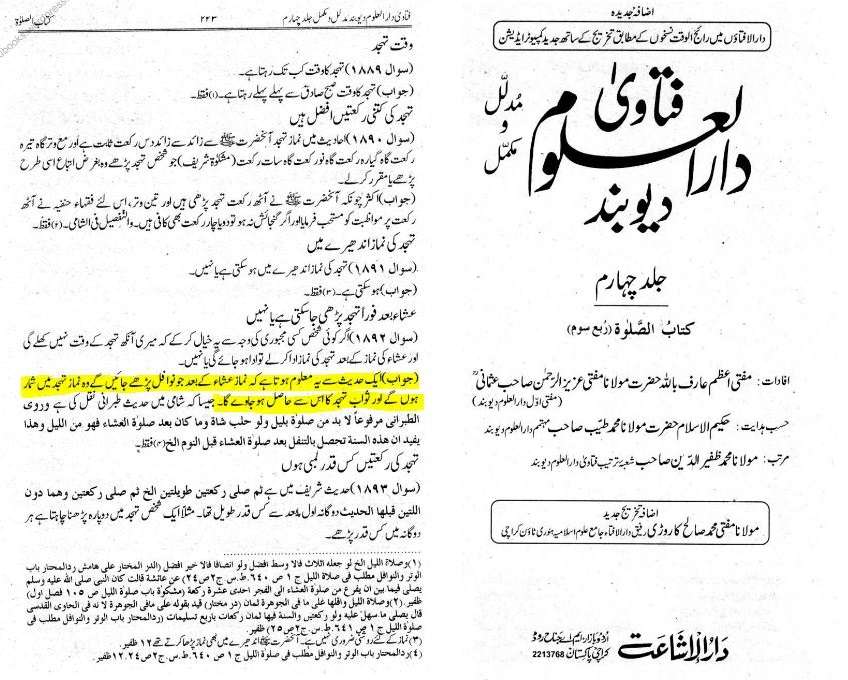
From one hadeeth we came to know that, after Isha prayer any voluntary(Nafil) prayer is counted as Tahajjud, and one would receive the reward of Tahajjud from it, as mentioned in Shaami from the hadeeth of Tabarani. [Fatawa Darul Uloom Deoband, vol 4 page 223].
Shia Ayatullah Sayyid Ali Hussein Sistani stated:
The time for Salat al-Layl starts from middle part of night as per the famous opinion. Even though it is better, but It’s not unlikely (i.e. it’s possible) that the time of Salat al-Layl starts after Isha prayers and remains till the Adhan of Fajr. However, it is better to pray near the time of Fajr prayer. [Tauzeeh al-Masail, page 131].
Argument V(c)
A Shia Website stated:
Prolonged Congregational Prayer are disliked and makes Rasool (saw) Furious.
Narrated Abu Mas’ud: A man came and said, “O Allah’s Apostle! I keep away from the morning prayer because so-and-so (Imam) prolongs it too much.” Allah’s Apostle became furious and I had never seen him more furious than he was on that day. The Prophet said, “O people! Some of you make others dislike the prayer, so whoever becomes an Imam he should shorten the prayer, as behind him are the weak, the old and the needy.” [Sahih Bukhari, Volume 1, Book 11, Number 672]
Answer
The Shia have spoken half-truth. In fact, prolonged OBLIGATORY congregational prayers are disliked, whereas this isn’t the case for optional/voluntary prayers. As per reliable reports, Prophet Muhammad(saws) himself prolonged night prayer, even when he prayed it in congregation.
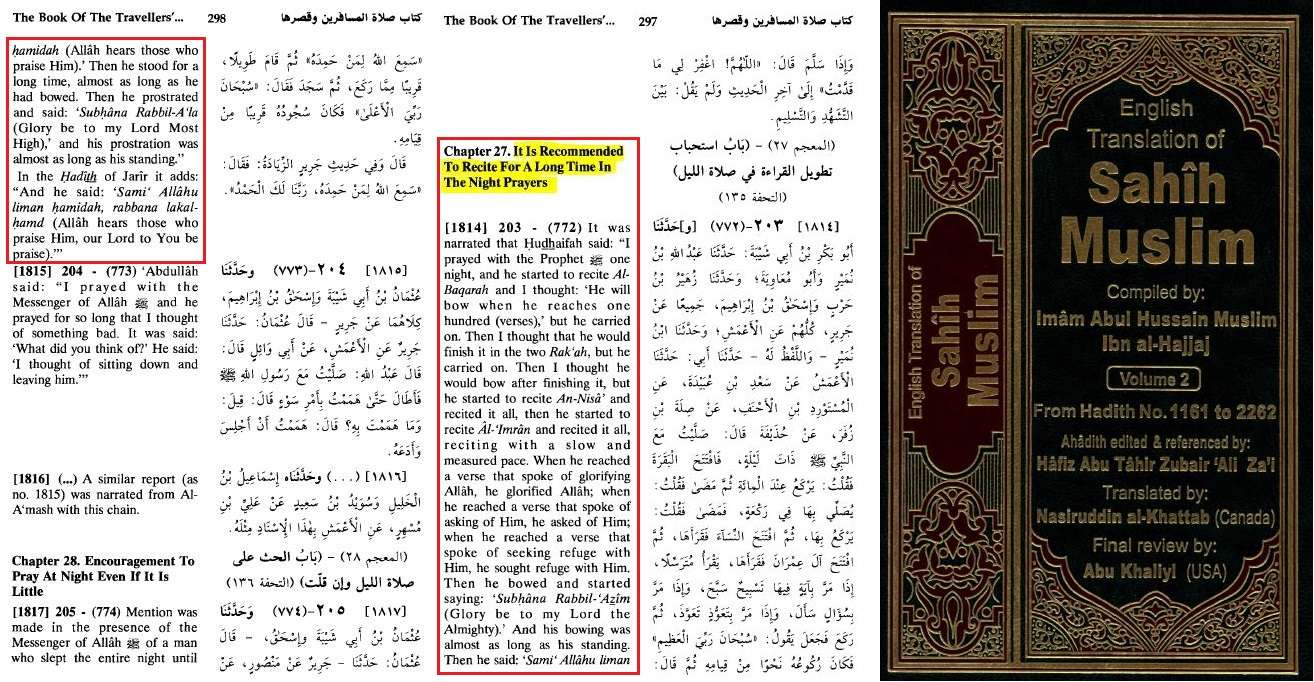
(a). Abdullah ibn Masood reported: I prayed with the Messenger of Allah (saws) and he lengthened it till I entertained an evil thought. It was said to him what that thought was. He said: I thought that I should sit down and forsake him. [Sahih Muslim, vol 2, page 298, #773 ; Chapter: It is recommended to recite for a long time in the night prayers].
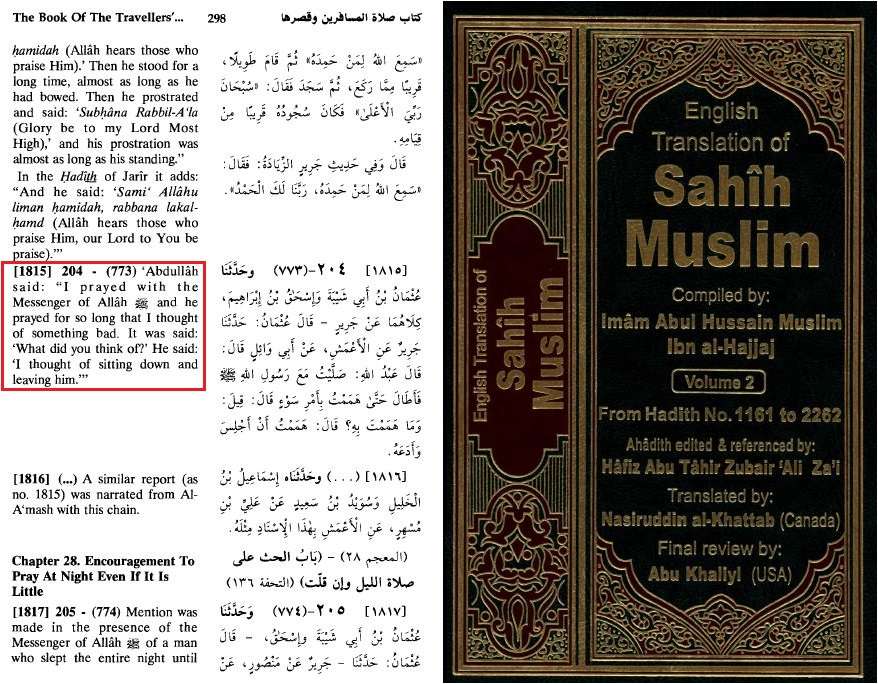
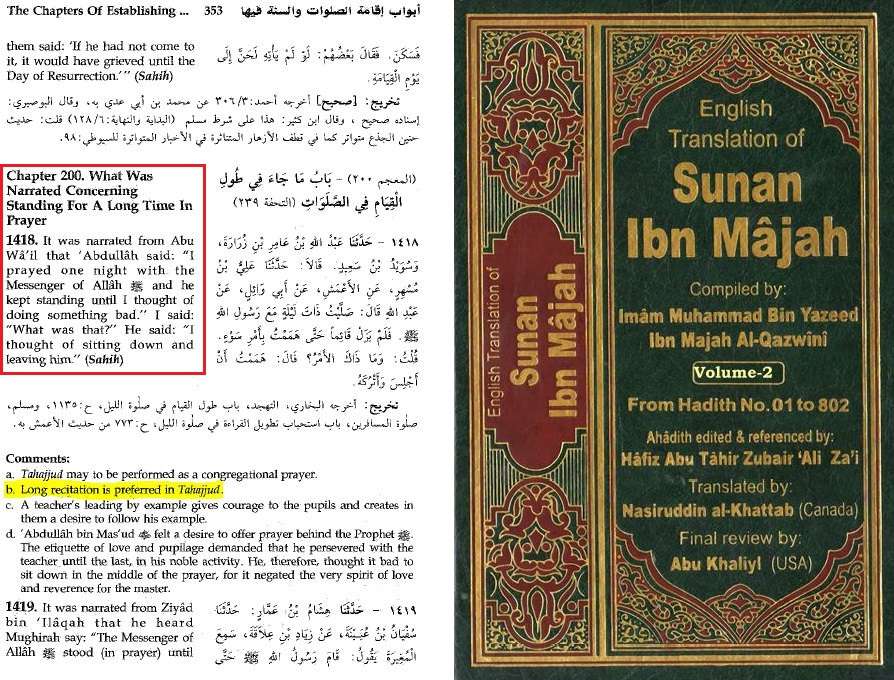
Abdullah said: “I prayed one night with the Messenger of Allah (saws) and he kept standing until I thought of doing something bad.” I said: “What was that?”He said: “I thought of sitting down and leaving him. [Sunan ibn Majah, vol 2, page 353, #1418 : Sahih as per Zubair Ali Za’ee]
(b). Hudhaifa reported: I prayed with the Messenger of Allah(SAWS) one night and he started reciting al-Baqara. I thought that he would bow at the end of one hundred verses, but he proceeded on; I then thought that he would perhaps recite the whole (surah) in a rak’ah, but he proceeded and I thought he would perhaps bow on completing (this surah). He then started al-Nisa’, and recited it; he then started Al-i-‘Imran and recited leisurely. And when he recited the verses which referred to the Glory of Allah, he glorified (by saying Subhan Allah-Glory to my Lord the Great), and when he recited the verses which tell (how the Lord) is to be begged, he (the Holy Prophet) would then beg (from Him), and when he recited the verses dealing with protection from the Lord, he sought (His) protection and would then bow and say: Glory be to my Mighty Lord; his bowing lasted about the same length of time as his standing (and then on returning to the standing posture after ruku’) he would say: Allah listened to him who praised Him, and he would then stand about the same length of time as he had spent in bowing. He would then prostrate himself and say: Glory be to my Lord most High, and his prostration lasted nearly the same length of time as his standing. In the hadith transmitted by Jarir the words are:” He (the Holy Prophet) would say:” Allah listened to him who praised Him, our Lord, to Thee is the praise.” [Sahih Muslim, vol 2, page 297-298, #772 : Chapter: It is recommended to recite for a long time in the night prayers].
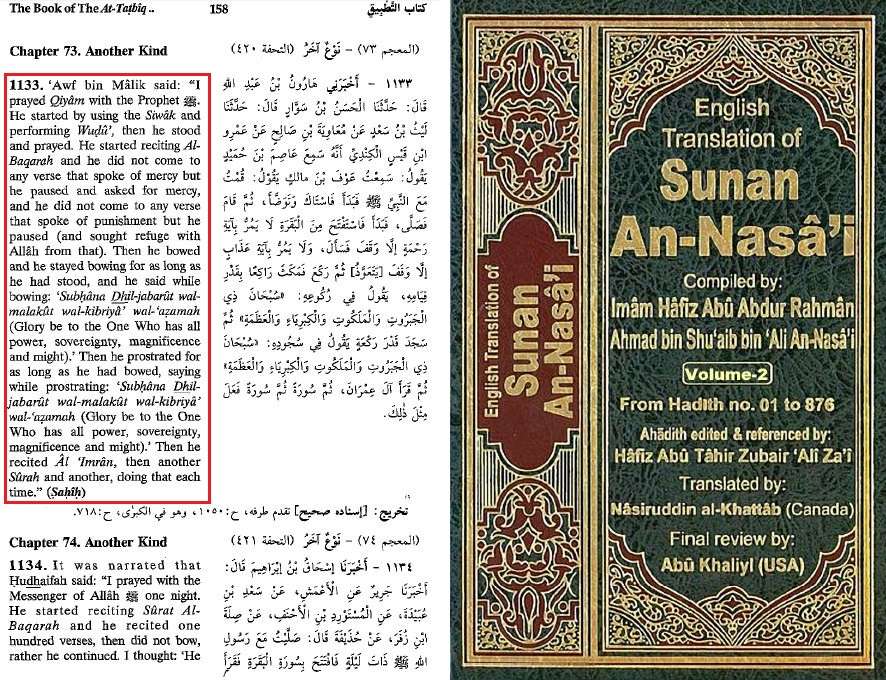
(c). Awf bin Malik said: “I prayed Qiyam with the Prophet (saws). He started by using the Siwak and performing wudu, then he stood and prayed. He started reciting Al-Baqarah and he did not come to any verse that spoke of mercy but he paused and asked for mercy, and he did not come to any verse that spoke of punishment but he paused (and sought refuge with Allah from that). Then he bowed and he stayed bowing for as long as he had stood, and he said while bowing: ‘Subhanaka Dhil-jabaraut wal-malakut wal-kibriya’ wal-‘azamah (Glory be to the One Who has all power, sovereignty, magnificence and might.)’ Then he prostrated for as long as he had bowed, saying while prostrating: ‘Subhana Dhil-jabarut wal-malakut wal-kibriya’ wal-‘azamah (Glory be to the One Who has all power, sovereignty, magnificence and might.)’ Then he recited Al Imran, then another surah and another, doing that each time.” [Sunan Nasai, vol 2, page 158, #1133 ; Sahih as per Zubair Ali Za’ee].
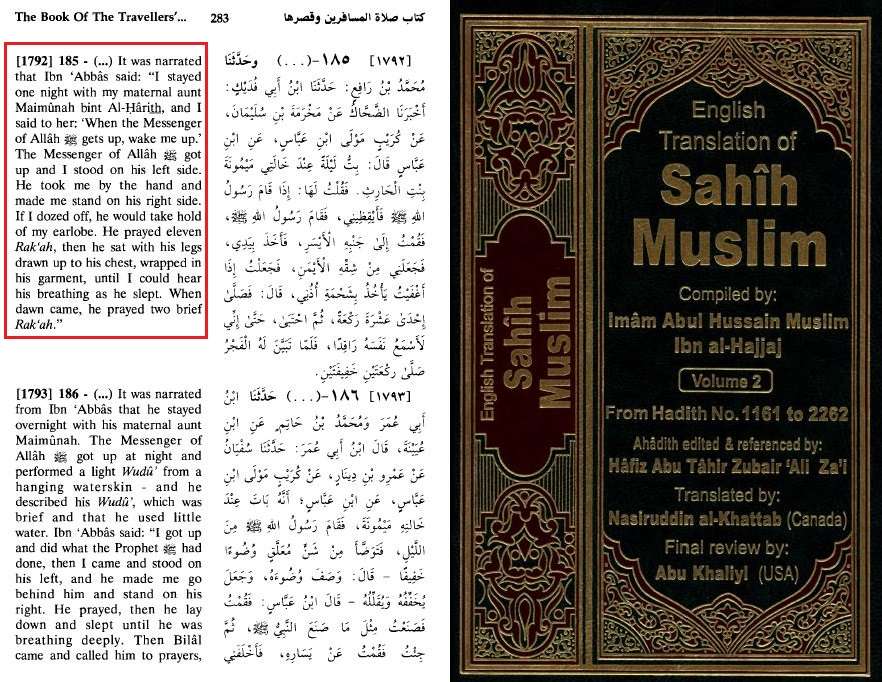
(d). Ibn Abbas reported: I spent one night in the house of my mother’s sister Maimuna, daughter of Al-Harith, and said to her: Awake me when the Messenger of Allah(SAWS) stands to pray (at night). (She woke me up when) the Messenger of Allah(SAWS) stood up for prayer. I stood on his left side. He took hold of my hand and made me stand on his right side, and whenever I dozed off he took hold of my earlobe (and made me alert). He (the narrator) said: He (the Holy Prophet) observed eleven rakahs. He then sat with his legs drawn and wrapped in his garment and slept so that I could hear his breathing while asleep. And when the dawn appeared, he observed two short rakahs of (Sunnah) prayer. [Sahih Muslim, vol 2, page 283, #1792].
Therefore, those who prolong the voluntary night prayer, are actually following the Sunnah of Prophet Muhammad(SAWS).
VI. Did Umar(RA) Change Sunnah of Prophet(SAWS) from 8 Rakah to 20 Rakah ?
Argument
Shia Website[Shiapen] stated:
Umar Ibn Khattab prayed 20 Rakah during Tarawih while Rasool (saw) offered 8 Rakah in Tahajjud
One of the biggest differences between Tahajjud and Tarawih is the fact that the established Sunnah of our Rasool (saw) was to offer 8 Rakah during Tahajjud whereas Umar Ibn Khattab initiated Tarawih, with a 20 Rakah Salah.
This also proves that when Umar Ibn Khattab started Tarawih, he had no intention of reviving the Sunnah of Rasool (saw) who offered Tahajjud for 3 nights in a mosque congregation.
Answer
It is true that Sunnah of Prophet(saws) is to pray Eleven Rakah(8 Rakah + 3 Rakah witr) in Qiyaam.
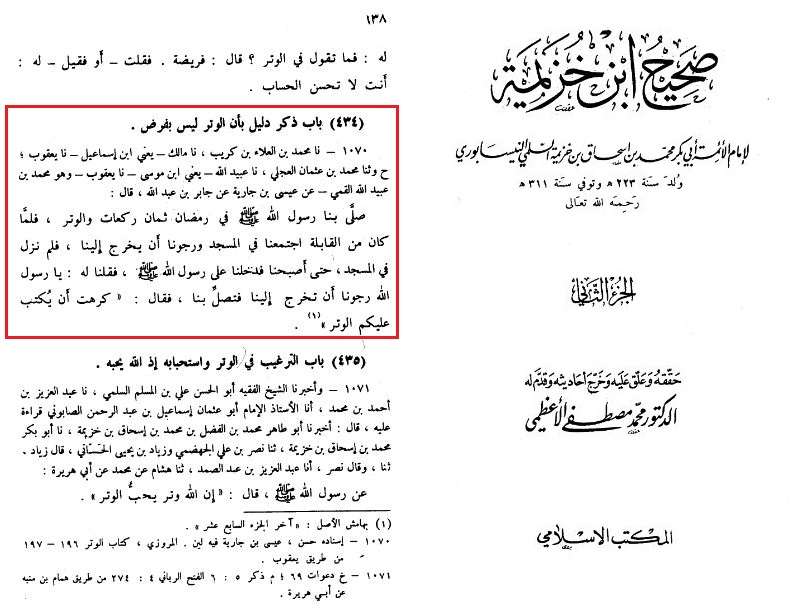
Narrated Jabir bin Abdullah(ra) that the Prophet(SAWS) led us in prayer for eight rakah and witr in the month of Ramadan. Then next time, we gathered in the mosque and waited that Prophet(saws) would come out until it was morning. So when Prophet(saws) came to us, we said to him: O Messenger of Allah(saws), we expected that you would come and lead us in prayer. He said: I feared that Witr(prayer) might be made obligatory upon you. [Sahih ibn Khuzaymah, vol 2, page 138, #1070] ; [Zubair Ali Za’ee declared the Chain as Hasan in Tadad Rakat Qayam-e-Ramzan ka Tahqeeqi Jaiza, page 21] ; [Mullah Ali Qari al-Hanafi stated: It is proven authetically that Prophet(saws) led his companions in prayer for Eight Rakah with Witr (Mirqat al-Mafatih Sharh Mishkat al-Masabih, vol 3, page 343)].
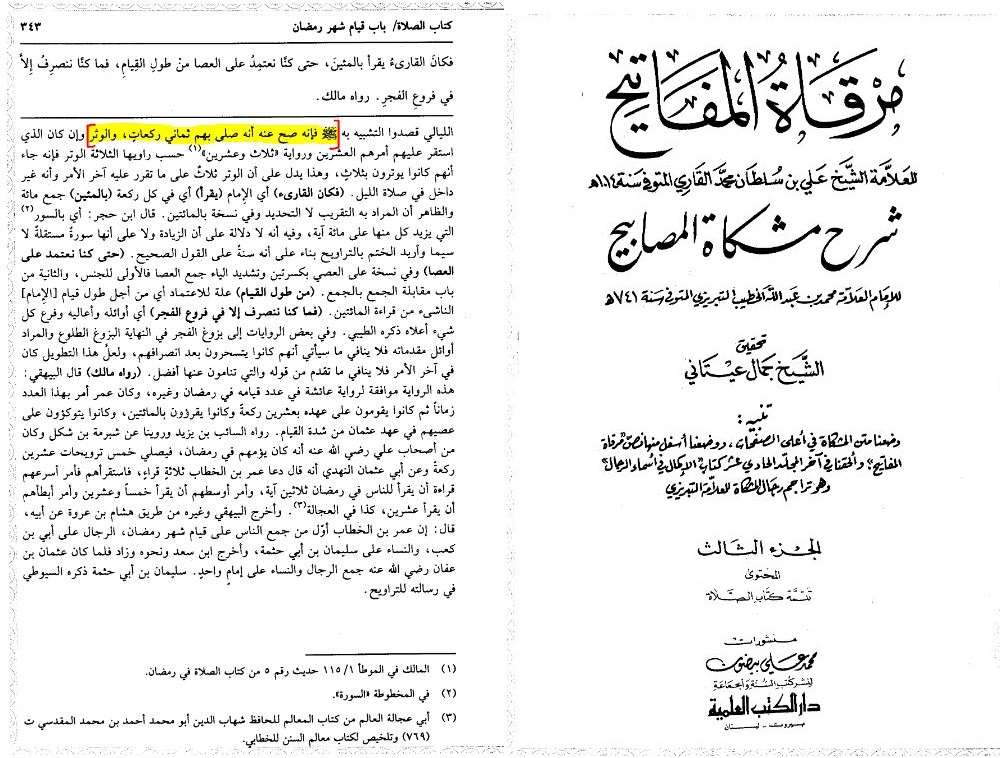
Ibn Hammam al-Hanafi stated: “And the conclusion for all this is that the Sunnah Qiyaam of Ramadan(Tarawih) is 11 Rakaat with witr in congregation. Prophet(saws) did this, but he left it due to a reason. [Fath al-Qadeer Sharh al-Hidaya, vol 1, Page 485-486].
However, it is not true that Umar(ra) initiated Taraweeh prayer with 20 Rakah. Shaykh Zubair Ali Zaee stated that Twenty Rakah isn’t proven from Umar(ra) from a Sahih connected chain. [Tadad Rakat Qayam-e-Ramzan ka Tahqeeqi Jaiza, page 26].
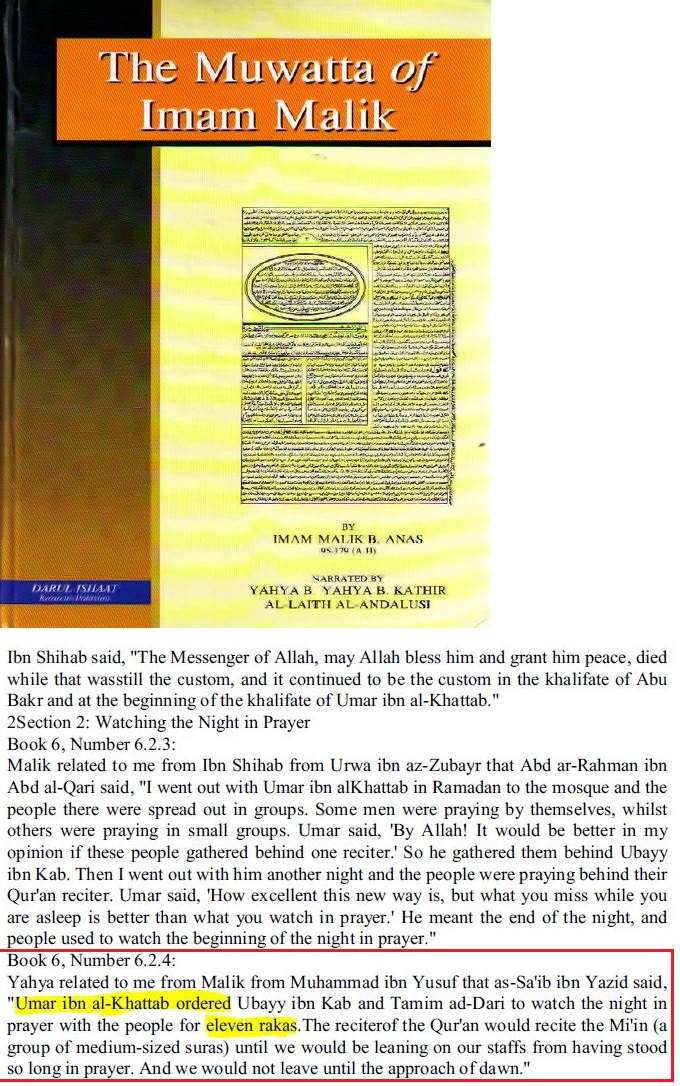
On the contrary, what is proven from AUTHENTIC and reliable reports is that Umar(ra) ordered Ubay ibn Ka’b and Tamim al-Dari to lead people in night for Eleven Rakah, based on the Sunnah of Prophet Muhammad(saws).
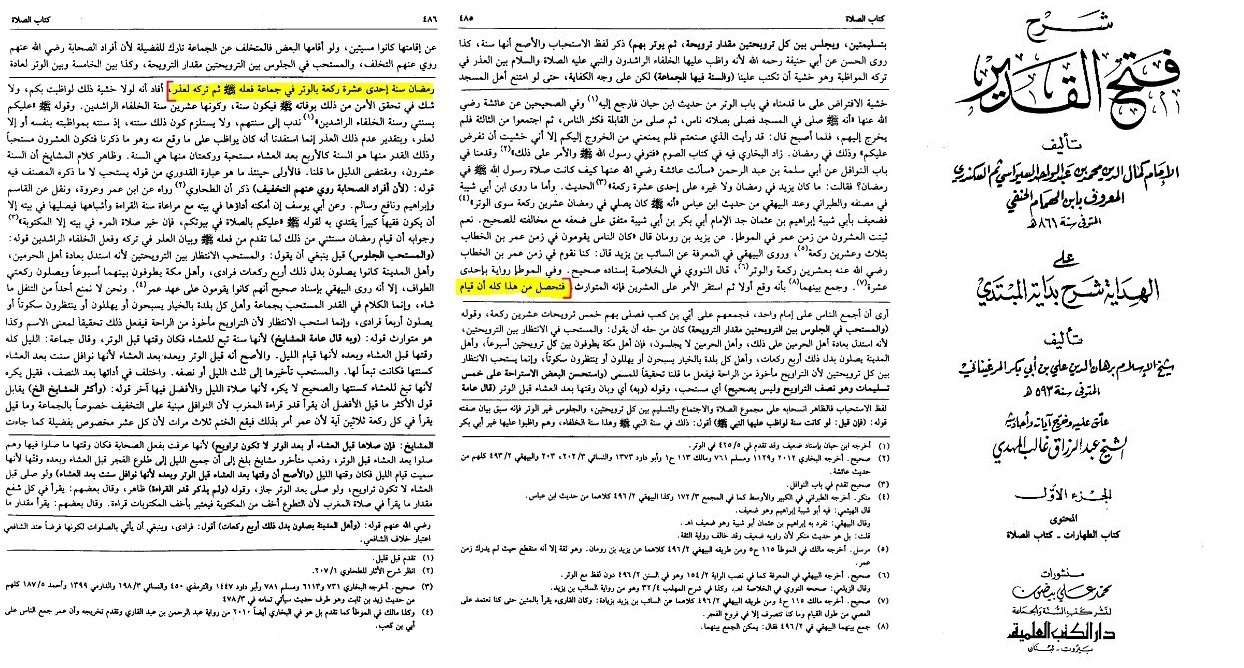
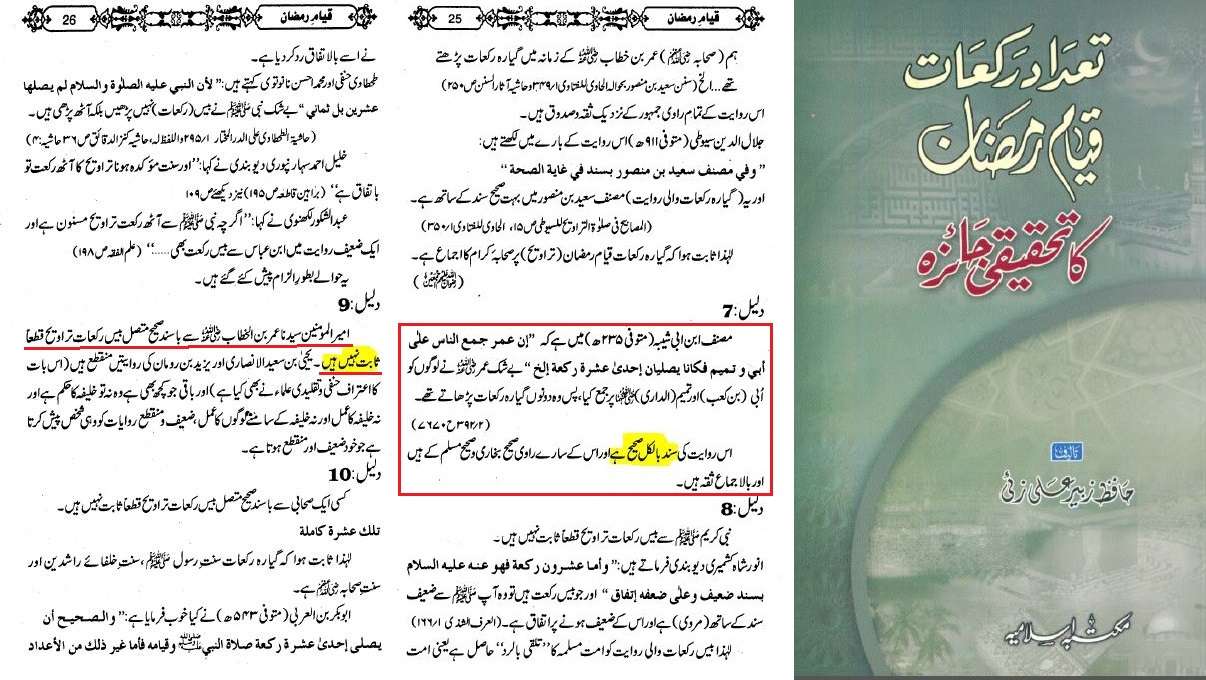
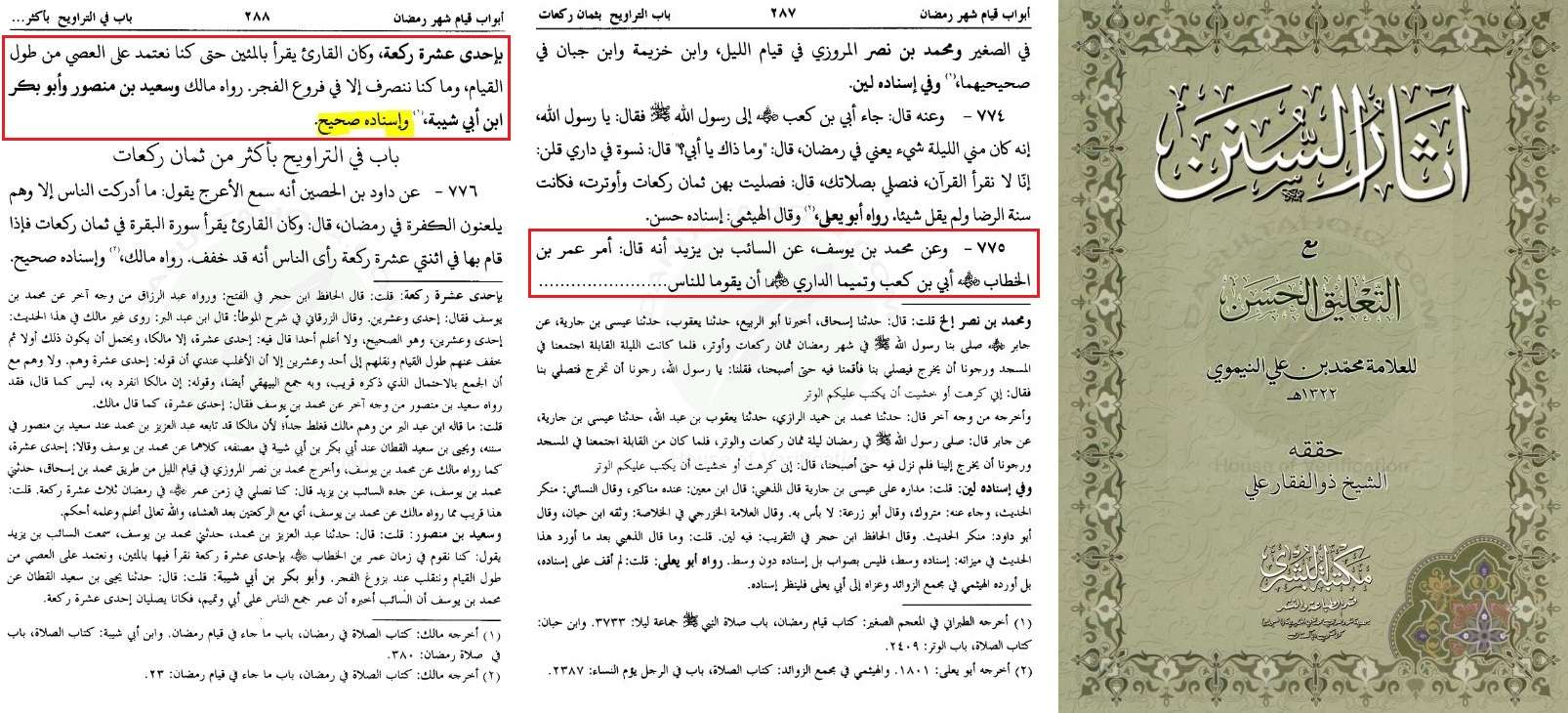
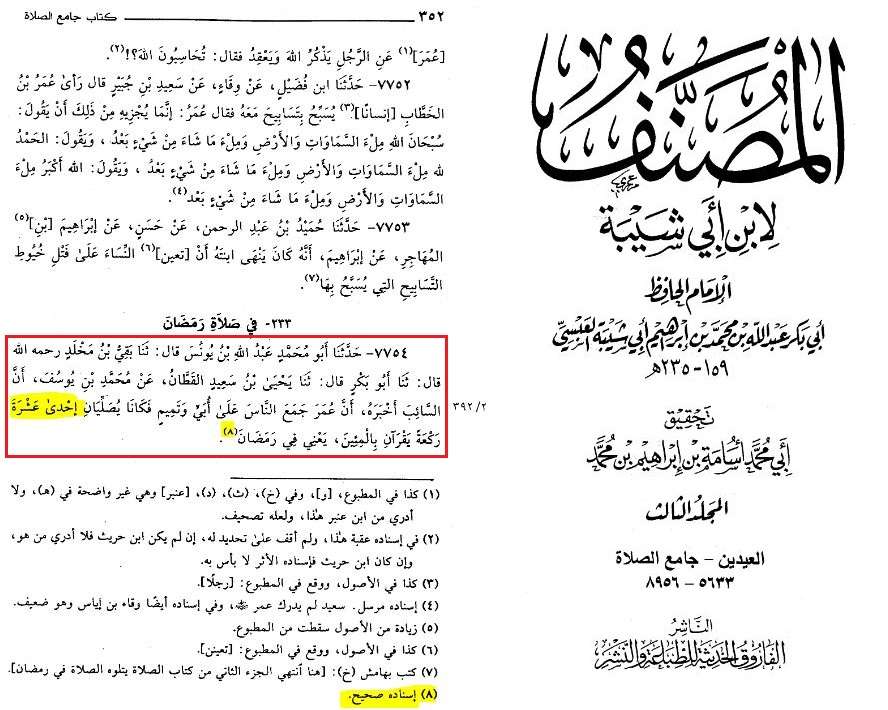
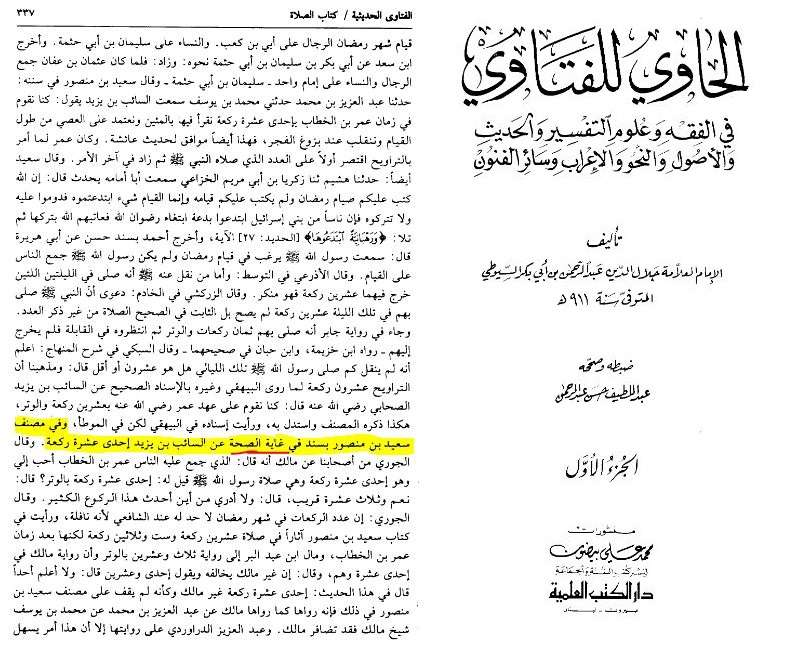
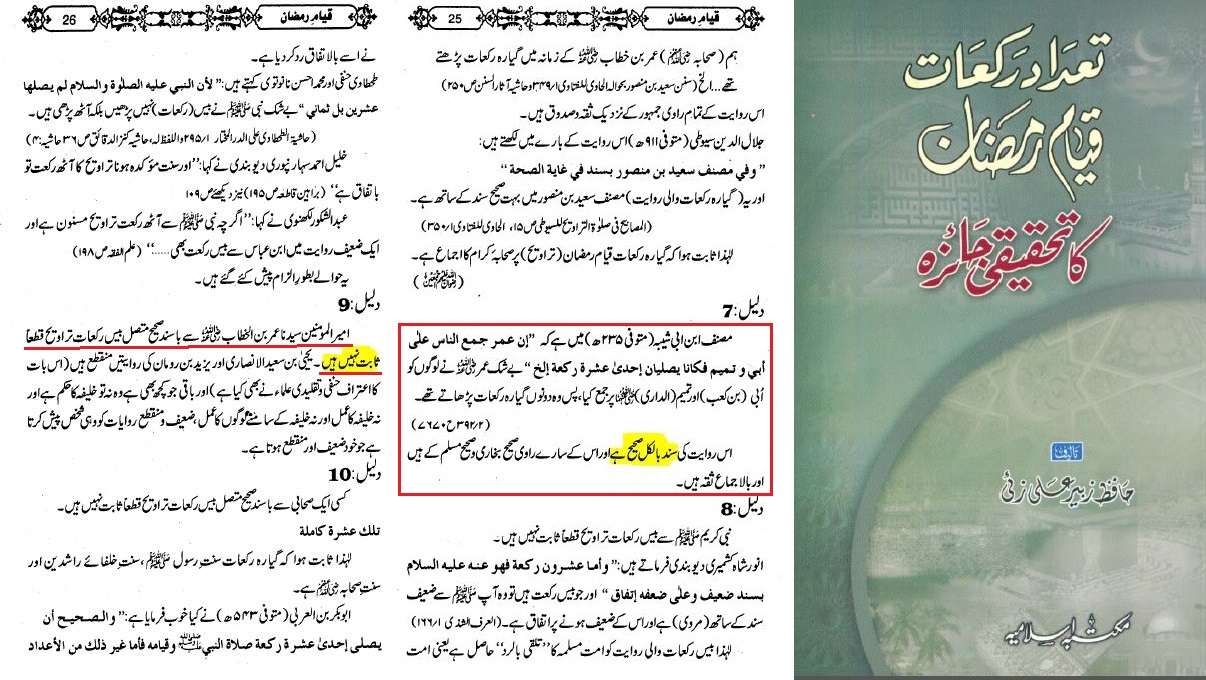
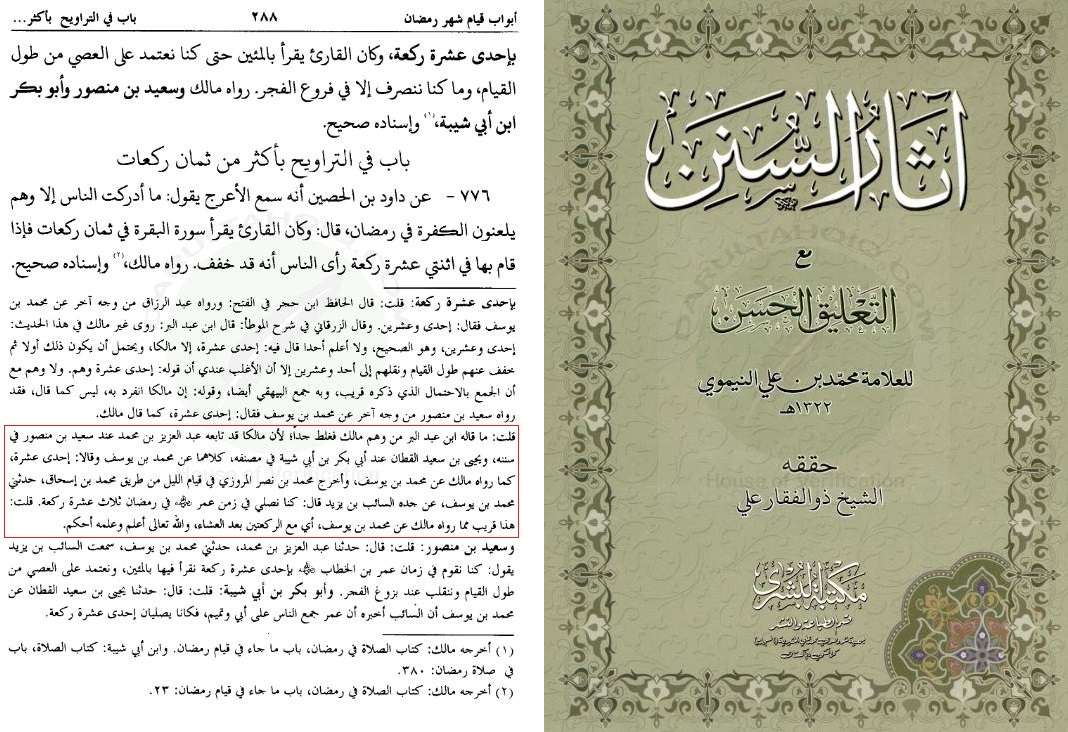
Yahya related to me from Malik from Muhammad ibn Yusuf that al-Sa’ib ibn Yazid said, “Umar ibn al-Khattab ordered Ubayy ibn Kab and Tamim ad-Dari to watch the night in prayer with the people for Eleven Rakah. The reciterof the Qur’an would recite the Mi’in (a group of medium-sized suras) until we would be leaning on our staffs from having stood so long in prayer. And we would not leave until the approach of dawn.” [Muwatta Malik, Book 6, Number 6.2.4] ; [Allamah Muhammad al-Nimawi al-Hanafi deemed the Chain as Sahih in Athaar al-Sunan, page 287-288, #775] ; [Musannaf ibn Abi Shayba, vol 3, page 352, #7754 : Isnad sahih as per Shaykh Usamah bin Ibrahim] ; [The chain was Authenticated by Allamah Subki, as quoted by al-Suyuti in Al-Hawi lil-Fatawi, vol 1, page 337] ; [Shaykh Zubair Ali Za’ee authenticated the chain in Tadad Rakat Qayam-e-Ramzan ka Tahqeeqi Jaiza, page 25] ; Allamah Muhammad al-Nimawi al-Hanafi stated this report has got other Mutabiat(supportive chains) as well in Athaar al-Sunan, page 288].
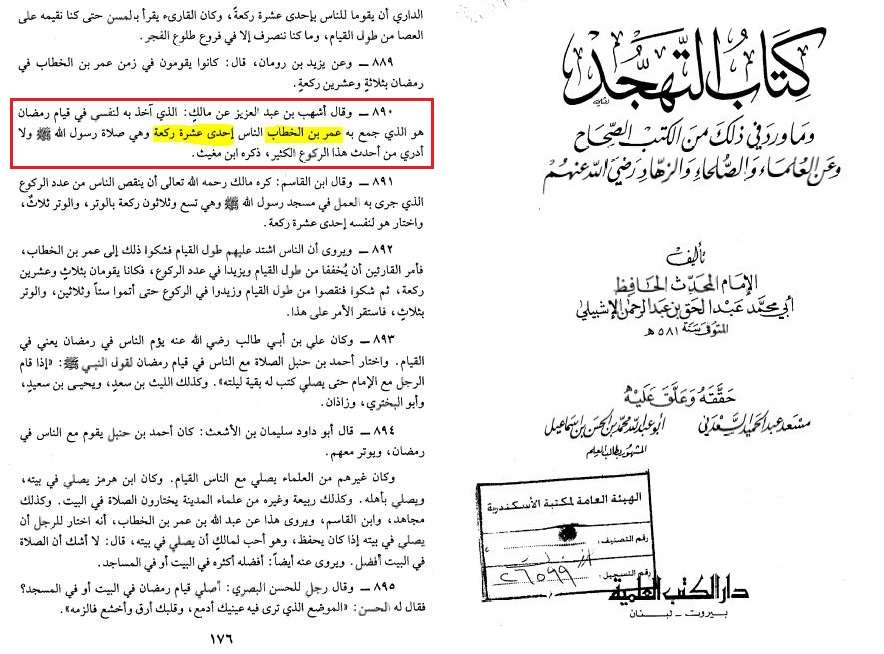
Imam Malik said:
I chose Eleven Rakah of Qiyam al-Ramadan and even Umar bin al-Khattab Gathered people on this and this is the Prayer of Messenger of Allah(SAWS), and I don’t know from where people introduced so many more Rak`ah [Kitab al-Tahajjud, page 176, #890].
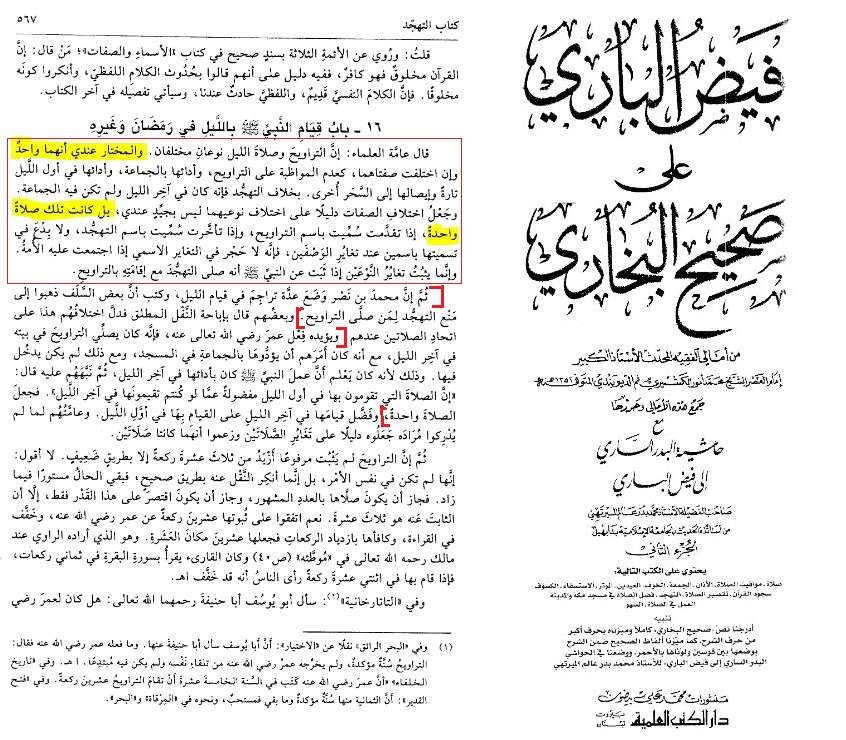
Allamah Muhammad Anwar Shah Kashmiri al-Hanafi stated:
Taraweeh and Tahajjud being one is supported from the action of Umar(ra), because he used to offer Taraweeh at his home in the last part of the night, while he ordered people to pray in congregation in the Mosque, even then he would not join them. The reason behind it is that, he knew that Prophet(saws) used to pray this prayer in the last part of the night. He even remarked on those people stating: the prayer which you people perform in the initial part of the night is lesser in reward in comparison to praying it in the last part of the night. Thus, here Umar(ra) considered Taraweeh and Tahajjud as the same. [Faydh al-Bari, vol 2, page 567].
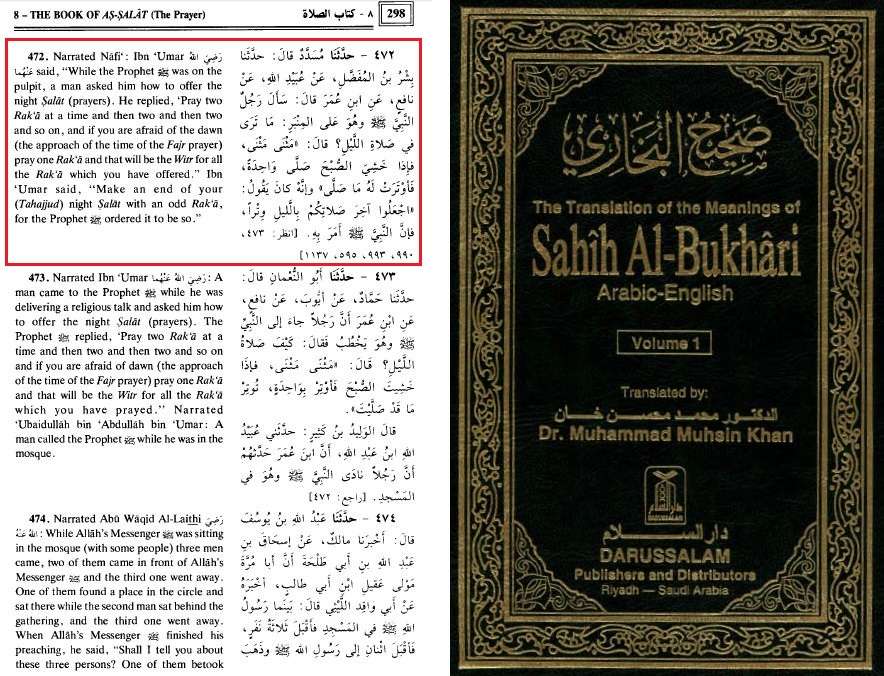
Offering twenty rakah is also allowed due to the following narration
Ibn Umar said: “While the Prophet(SAWS) was on the pulpit, a man asked him how to offer the night prayers. He replied, ‘Pray two rakat at a time and then two and then two and so on, and if you are afraid of the dawn (the approach of the time of the Fajr prayer) pray one rak’at and that will be the witr for all the rakat which you have offered.” Ibn Umar said, “The last rak`at of the night prayer should be odd, for the Prophet(SAWS) ordered it to be so. [Sahih al-Bukhari vol 1, page 298, #472]
Also we read in a Shia report:
Narrated Abu Basir that: “Once we visited Abu Abd Allah(as), and abu Basir asked, ‘What do you say about alsalat(prayer) during the month of Ramadan?’ He (the Imam) replied, ‘The month of Ramadan has a special respect and right, unlike the other months. You should perform salat (prayer) as much as you can in optional forms during the nights and days. If you can, perform a thousand Rak’at salat (prayer) every twenty-four hours you can. Imam Ali(as), toward the end of his life would say one thousand Rak’at salat (prayer) in twenty-four hours. O abu Muhammad, you should perform more salat (prayer) during the month of Ramadan.’ I then asked, ‘I pray to Allah to keep my soul in service for your cause, how many Rak’ats (should one perform)?’ He said, ‘During the first twenty nights, say twenty Rak’ats each night; eight Rak’ats before al-‘Atmah and twelve Rak’ats thereafter, besides the prayers you would say before. During the last ten days, you should say thirty Rak’at every night; eight Rak’at before al-Atmah, and twenty-two Rak’ats thereafter besides what you had been saying before these nights. [al-Kafi, vol 4, page 93-94].
Hence we find a lot of Authentic evidences of variant number of Rakaats in taraweeh. When we read the practice of the Salaf us-Saliheen which include the Sahaba, Taba’een and Taba Taba’een, we find that some of them prayed 11 Rakaat , some prayed 13 rakaat, some prayed 19 rakaat, some prayed 23, some prayed 36 and some even prayed 39 rakaat.
Imam Shafe’i stated:
There is no problem in this (prayer of Taraweeh/qiyam al-Ramadan) and there is no limit in (number of rakah) because this is nafil prayer, If prostration is less and Qiyam is long then it is good and I like this view, and If there are more bowing and prostration, even it is good. [Kitab Qiyaam Ramadan, page 57, #63].