

Textual Variants in the New Testament: Matthew 6:13, 9:13, and 16:3
Matthew 6:13 — The Doxology of the Lord’s Prayer
The verse reads across different translations as follows:
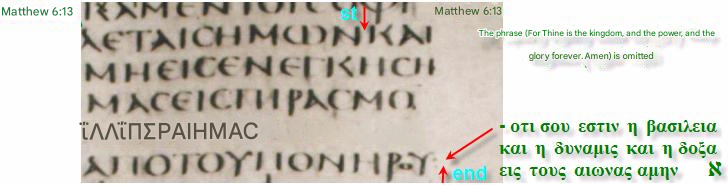
SVD: “And lead us not into temptation, but deliver us from evil. For thine is the kingdom, and the power, and the glory forever. Amen.”
ALAB: “And lead us not into temptation, but deliver us from evil. For thine is the kingdom, and the power, and the glory forever. Amen.”
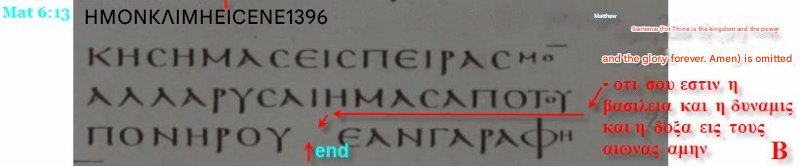
GNA: “And lead us not into temptation, but deliver us from evil.”
JAB: “And do not let us be tempted, but deliver us from evil.”
KJV+: “And lead us not into temptation, but deliver us from evil: For thine is the kingdom, and the power, and the glory, forever. Amen.”
The Greek text (GNT-WH+):
καὶ μὴ εἰσενέγκῃς ἡμᾶς εἰς πειρασμόν, ἀλλὰ ῥῦσαι ἡμᾶς ἀπὸ τοῦ πονηροῦ
The Greek text (GNT-BYZ+):
εἰς πειρασμὸν ἀλλὰ ῥῦσαι ἡμᾶς ἀπὸ τοῦ πονηροῦ ὅτι σοῦ ἐστιν ἡ βασιλεία καὶ ἡ δύναμις καὶ ἡ δόξα εἰς τοὺς αἰῶνας ἀμήν
HNT: Please don’t worry about it.
FDB: “And none of us enter the tent, but we deliver it to you.”
Vulgate: “et ne nos inducas in tentationem sed libera nos a malo”
The Sinaiticus Manuscript
The Vatican Manuscript
The Alexandrian manuscript also omits this passage.
The Doctrinal Importance of the Text
Here, if this sentence — “For thine is the kingdom, and the power, and the glory forever. Amen” — is not deleted, and it speaks of the Father, then it means that the kingdom forever belongs to the Father, the power forever belongs to the Father, and the glory forever belongs to the Father. So what will be for the Son? If the Lord’s Prayer gives everything to the Father, this casts doubt on what will be given to the Son — and it would be better to delete it.

Matthew 9:13 — “To Repentance”
The verse reads across different translations as follows:
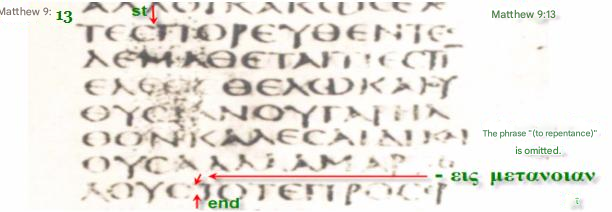
SVD: “Go and learn what this means: ‘I desire mercy, not sacrifice; for I have not come to call the righteous, but sinners to repentance.’”
ALAB: “Go and learn what this means: ‘I desire mercy, not sacrifice; for I have not come to call the righteous, but sinners.’”
GNA: “Go and learn what this means: ‘I desire mercy, not sacrifice; for I have not come to call the righteous, but sinners.’”
JAB: “Why don’t you learn what this means: ‘I desire mercy, not sacrifice; for I have not come to call the righteous, but sinners’?”
KJV+: “But go ye and learn what that meaneth, I will have mercy, and not sacrifice: for I am not come to call the righteous, but sinners to repentance.”
The Greek text (GNT-BYZ+):
πορευθέντες δὲ μάθετε τί ἐστιν ἔλεον θέλω καὶ οὐ θυσίαν οὐ γὰρ ἦλθον καλέσαι δικαίους ἀλλὰ ἁμαρτωλοὺς εἰς μετάνοιαν
The Greek text (GNT-WH+):
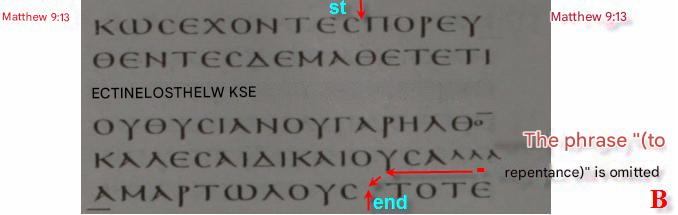
οὐ γὰρ ἦλθον καλέσαι δικαίους ἀλλὰ ἁμαρτωλούς
HNT: אֶת־הַצַּדִּיקִים כִּי אִם־אֶת־הַחַטָּאִים (לִתְשׁוּבָה)׃
FDB: “I am happy and appreciative of what this is: ‘I love you and do not sacrifice’; the car doesn’t come to the right place, but the pictures are there.”
Vulgate: “Euntes autem discite quid est misericordiam volo et non sacrificium non enim veni vocare iustos sed peccatores”
The Sinaiticus Manuscript
The Vatican Manuscript
The Doctrinal Importance of the Text
Here, the expression “to repentance” completely reverses the meaning and puts the doctrine of the crucifixion and redemption to the test. Let us frame this as a series of questions whose importance is understood by the discerning:
Why did Jesus come into the world? Was it to call people to believe in the crucifixion and redemption, and thus salvation? Or was it to call them to repent of their sins and return to God? Doesn’t the call to repentance render redemption unnecessary for getting rid of sin, thus settling the matter? Isn’t this the call of all the prophets, and isn’t it closer to reason and logic?
Answer these questions, and you will find the truth. The key lies in the presence or absence of the expression “to repentance.”

Matthew 16:3 — “You Hypocrites”
The verse reads across different translations as follows:
SVD: “And in the morning: ‘It is winter, for the sky is red and gloomy.’ You hypocrites! You know how to interpret the appearance of the sky, but you cannot interpret the signs of the times.”
ALAB: “And when the sky is red and gloomy in the morning, you say: ‘It will rain today.’ You know how to interpret the weather from the appearance of the sky, but you cannot interpret the signs of the times.”
GNA: “And at dawn you say: ‘It will rain today, for the sky is red and black.’ You know how to interpret the appearance of the sky, but you cannot interpret the signs of the times.”
JAB: “And at dawn: ‘It will rain today, for the sky is red and dusty.’ You know how to interpret the appearance of the sky, but you cannot interpret the signs of the times.”
KJV+: “And in the morning, It will be foul weather today: for the sky is red and lowering. O ye hypocrites, ye can discern the face of the sky; but can ye not recognize the signs of the times?”
The Greek text (GNT-BYZ+):
καὶ πρωΐ σήμερον χειμών πυρράζει γὰρ στυγνάζων ὁ οὐρανός τὸ μὲν πρόσωπον τοῦ οὐρανοῦ γινώσκετε διακρίνειν τὰ δὲ σημεῖα τῶν καιρῶν οὐ δύνασθε
The Greek text (GNT-WH+):
καὶ πρωΐ σήμερον χειμών πυρράζει γὰρ στυγνάζων ὁ οὐρανός τὸ μὲν πρόσωπον τοῦ οὐρανοῦ γινώσκετε διακρίνειν τὰ δὲ σημεῖα τῶν καιρῶν οὐ δύνασθε
HNT: Please don’t worry about it.
FDB: “et le matin: ‘Il fera aujourd’hui de l’orage, car le ciel est rouge et sombre.’ Vous savez discerner l’aspect du ciel; et vous ne pouvez pas discerner les signes des temps?”
Vulgate: “et mane hodie tempestas rutilat enim triste caelum faciem ergo caeli iudicatis discernere signa autem temporum non potestis”
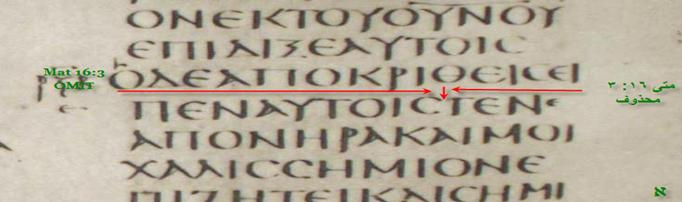
The Sinaiticus Manuscript
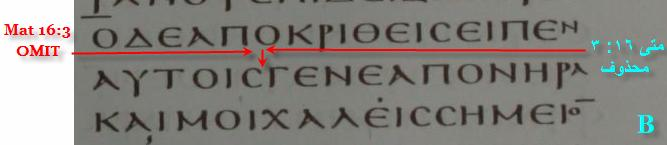
The Vatican Manuscript
The Doctrinal Importance of the Text
The expression “You hypocrites!” does not fit the meaning the text is conveying, because the situation is that they are asking for a miracle from heaven, and Jesus responds to them that they know signs in life that indicate the weather of the next day, and he rebukes them for not knowing the signs of the truth of the prophecy. Does this mean that they are hypocrites? Or that they are liars, or fools, or any other description — but not hypocrites, since that would mean that they should prolong the prayer, for example, so that people would see it? But because Luke 12:56 says: “You hypocrites! You know how to interpret the appearance of the earth and the heavens, but how is it that you do not interpret this time?” — the same word is mentioned there — so why is it not added here?

Three significant textual variants in the Gospel of Matthew reveal how doctrinally consequential additions and omissions are. The doxology in Matthew 6:13 — absent from the Sinaiticus, Vaticanus, and Alexandrian manuscripts — undermines Trinitarian equality by attributing the kingdom, power, and glory exclusively to the Father in perpetuity. The phrase “to repentance” in Matthew 9:13 — absent from the oldest manuscripts — directly contradicts the doctrine of vicarious atonement, since a call to personal repentance renders redemption through the cross unnecessary. And the word “hypocrites” in Matthew 16:3 — absent from the oldest manuscripts — appears inconsistent with the context of the passage itself, yet is present in a parallel passage in Luke 12:56, raising the question of why it was inserted or omitted unevenly. These are not trivial scribal slips — they are theologically loaded variants that alter the meaning of the text at its most fundamental doctrinal points.