

The Gender of the Fetus_ a Doubt or a Miracle
title: Fetal Sex Determination in the Hadith: Scientific Miracle or Error?
category: Atheism
tags:
- hadith
- science
- prophethood
- quran
Atheist critics have claimed that the hadith describing fetal sex determination after forty days contradicts modern science, and that the Prophet ﷺ merely copied the figure from Hippocrates. Both claims collapse entirely under scrutiny — and remarkably, what was intended as a doubt becomes one of the clearest scientific miracles in the prophetic tradition.
The Hadith
Grade: Sahih · Muslim
Grade: Sahih · Muslim
The Atheist Objections
The hadith contradicts science. Doctors say the sex of the fetus is determined at the moment of fertilization, when the sperm carrying (X) or (Y) meets the egg. The Prophet ﷺ is therefore wrong to place sex determination after forty days.
The number 42 appears in Hippocrates. The Prophet ﷺ transmitted this from Hippocrates, the father of medicine, and presented it as revelation.
All authentic hadiths say the sperm remains in the uterus for forty nights. But science says sperm cells can live for up to only three days inside the female reproductive system. This is a clear scientific contradiction.
Response 1 — What Do “Male” and “Female” Actually Mean?
The hadith addresses the differentiation of the fetus into male and female — meaning the formation of the reproductive anatomy that physically distinguishes the two sexes. This is not a statement about chromosomes.
Gender: The sex of an individual, male or female, based on reproductive anatomy. Female: an individual organism of the sex that bears young or produces ova or eggs.
— Standard medical definition
The Arabic language carries the same meaning. When the Prophet ﷺ addressed the companions, his words carried the meaning familiar to the Arabs: masculinity and femininity as the differentiation of reproductive organs — not the chromosomal blueprint invisible to any observer, human or angelic, before the organs exist.
The critics have confused two distinct realities: the genetic blueprint set at fertilization, and the physical formation of sex that the hadith is actually describing. Demanding that the hadith speak about chromosomes is like insisting that the word “palm tree” refers to a palm seed before it has grown.
Response 2 — The Doubt Became the Miracle
Until the ninth week of fetal development, the embryonic reproductive apparatus is identical in both sexes. This is not a fringe claim — it is established embryological fact documented across multiple independent scientific sources.
Source: University of Hawaii — Biological Foundations of Human Sexuality (1976)
https://www.hawaii.edu/PCSS/biblio/articles/1961to1999/1976-biological-foundations.html
Source: Sexual Differentiation: From Genes to Gender
Source: https://www.endotext.org/
Some may wonder whether the sex of the fetus can be chosen in advance. The answer is yes — but all such methods operate on probabilistic estimates, not absolute certainty: natural rate without intervention is 51% male; food, vaginal douche, and intercourse timing: 70%; artificial insemination with special food and Chinese table: 80%; basic vaginal douche: 56%; basic dietary change of vaginal environment: 55%; Chinese programme: 60%; sperm screening with artificial insemination without diet/timing: 55%; embryo separation: 99% — the most advanced method currently available.
The question the hadith says the angel asks — “O Lord, male or female?” — is asked at forty-two nights. Modern embryology confirms that this is precisely the stage at which no reproductive distinction yet exists. The angel’s question occurs directly before the organs begin to form in the following week.
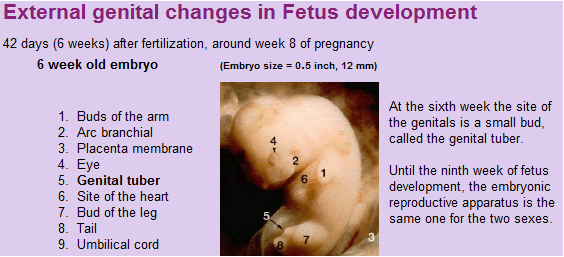
The fallopian tube dissection method for sex determination cannot be used before the seventh week — because before this point the reproductive glands (testicles in the male, ovaries in the female) are completely identical and indistinguishable. Source: Human Embryology, 4th edition, pp. 338, 400.
Other sex-determination methods confirm the same boundary:
The amniotic fluid examination (amniocentesis) is performed between weeks 18 and 20. Ultrasound (sonar) determination is possible only from week 14 to week 20 depending on the device used. The fallopian tube dissection method requires at minimum the seventh week.
All methods of determining fetal sex operate after the fetus is formed — because before formation, there is nothing to determine.
Response 3 — The XX-Male Syndrome: Chromosomes Do Not Decide Alone
The critics assume that the sex chromosome (XX or XY) alone fully and finally determines the sex of the organism. This is medically false.
Source: Healthline — http://www.healthline.com/
This is not a rare theoretical edge case — it is a recognized clinical syndrome demonstrating that the chromosome level has an essential role but does not decide the matter alone. A person can carry XX chromosomes and develop entirely male anatomy. The physical formation of sex involves pathways beyond the initial chromosome assignment.
This is precisely why the hadith’s framing is scientifically precise: the angel asks about sex at the point of physical formation — not at the point of fertilization — because that is when sex as a physical reality is actually determined.
Response 4 — The Historical Record of Embryology Confirms the Miracle
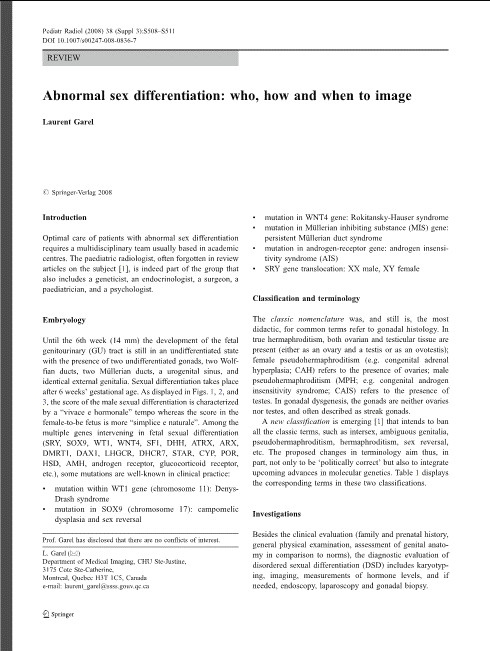
The knowledge that reproductive organs do not differentiate before six weeks was not known to any physician even a century ago. The following is from Skandalakis’ Surgical Anatomy — one of the most authoritative anatomical references in medicine — tracing the history of discoveries about the male reproductive system:
Source: Skandalakis’ Surgical Anatomy — John E. Skandalakis et al.
Fourteen centuries ago, the Prophet ﷺ stated that after forty-two nights, the angel shapes the fetus, creates its hearing, sight, skin, flesh, and bones — and only then asks about its sex. The complete scientific understanding of gonadal differentiation was not established until the twentieth century.
The fetus at week seven, from Medscape — confirming that internal reproductive organs begin development at week nine (seven weeks after conception), while external genitalia form into a recognizable penis or clitoris and labia majora only at the end of week eleven. Both occur after day forty — making the angel’s question about sex, placed by the hadith precisely before this formation, a confirmed scientific statement.

An atheist interlocutor attempted to refute the sources by claiming he did not read English, and brought a French-language source as his counter-evidence. That source confirmed the opposite of his intent: it stated that at seven weeks’ gestation the fetus first takes on human form — the neck, face, and fingers take shape, the ears form, the eyelids appear, the lower jaw becomes visible, the nipples appear on the chest, and it measures 25mm. The same French source showed images of the fetus in the fifth week with no human features, and in the sixth week with features still unclear — with human form appearing only after 40 days. Note: 6 weeks × 7 days = 42 days — the precise figure the Prophet ﷺ gave.
Response 5 — Refuting the Hippocrates Claim
Hippocrates mentioned the number 42 in his second article. The Prophet ﷺ transmitted this from him.
This claim fails on two independent grounds.
First — the content is completely different:
Hippocrates speaks about the formation of limbs (hands and feet) — stating that this takes 42 days in females and 30 days in males. He differentiates between male and female before six weeks, making them distinguishable from early on. The Prophet ﷺ says nothing about limbs. The Prophet ﷺ states that sex differentiation does not occur until after six weeks. Hippocrates’ claim that there is a female and a male distinguishable before six weeks is the exact opposite of what modern embryology confirms — while the hadith is confirmed by it. Both use the number 42, but they are describing entirely different phenomena with opposite conclusions about sex differentiation.
Second — no translation existed in the Prophet’s era:
The Arabic-Greek translation movement did not begin until the second half of the eighth century CE.
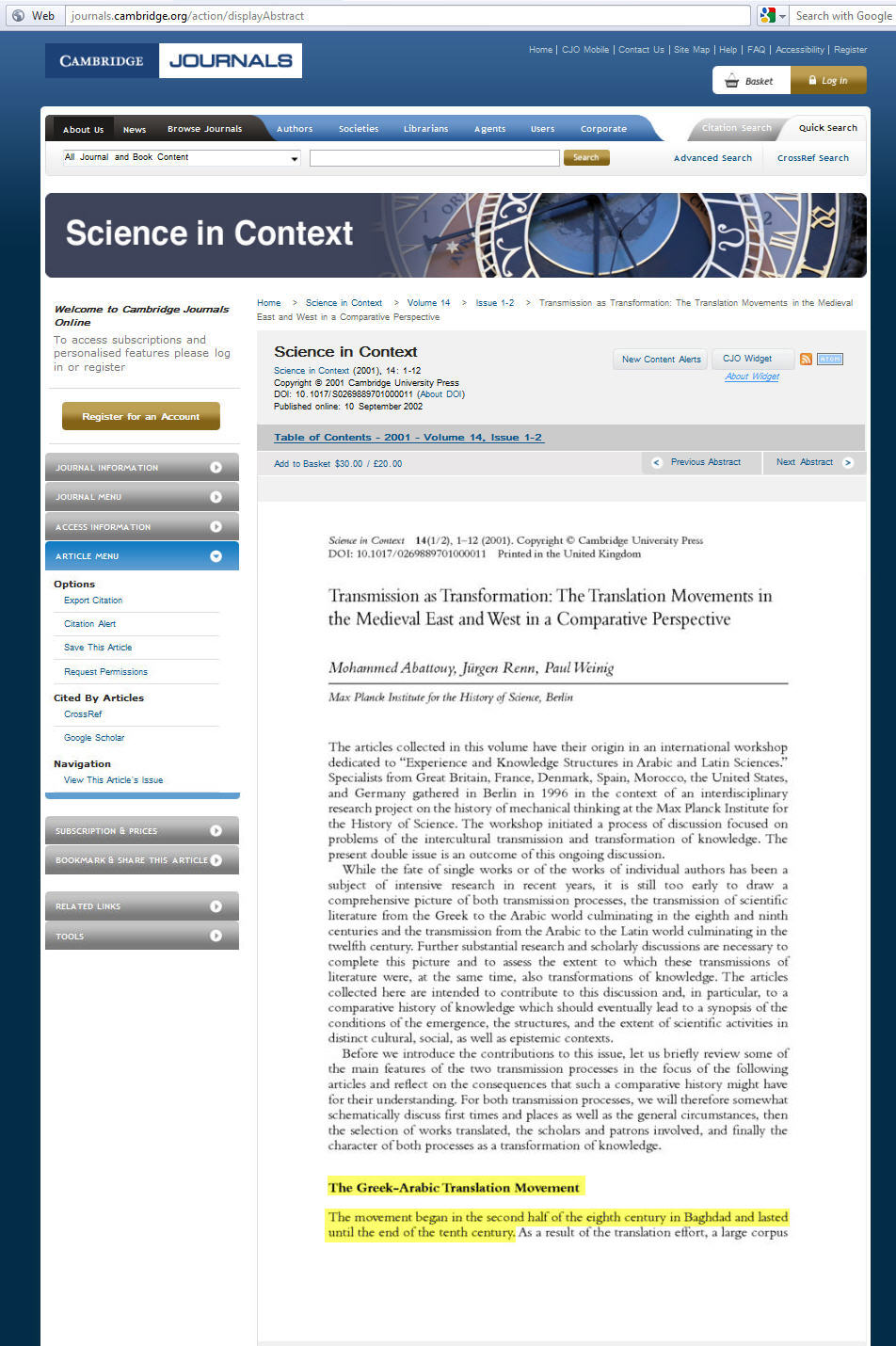
The Prophet ﷺ died in 632 CE. The translation movement began after 750 CE — more than a century later. There is no evidence that any of Hippocrates’ books were translated into Arabic during the Prophet’s lifetime, nor that he ﷺ had access to them in any language.
As for Ibn al-Qayyim al-JawziyyahBorn 691 AH / 1292 CE in Syria — six centuries after the Prophet ﷺ, and well within the era of translation and cross-civilizational scholarship. His citing of Hippocrates is therefore unremarkable and proves nothing about the Prophet’s sources. citing Hippocrates to corroborate prophetic statements: Ibn al-Qayyim was born in 1292 CE, five centuries into the translation era. That a thirteenth-century scholar referenced Greek sources to illustrate a hadith is entirely expected — it says nothing about the Prophet’s knowledge sources in seventh-century Arabia.
Response 6 — The Sperm Lifespan Objection
Wikipedia states: “Mammalian sperm cells can live for up to 3 days inside the female reproductive system.” The hadiths say the sperm remains for 40 nights. This is a contradiction.
The hadith never states that the sperm persists for 40 days without penetrating the egg. This is a fabricated reading that the text does not support.
If someone says: “If this grain of wheat rests in the ground for forty nights, it becomes a large ear of wheat” — does that mean the grain remains unchanged for forty nights without sprouting? The forty nights describes the developmental period of what was the sperm after fertilization — not the survival time of unfertilized sperm. The critics have invented a claim the hadith does not make, then refuted that invented claim.
The Linguistic Miracle in the Quran
“Nor does he speak from [his own] inclination. It is not but a revelation revealed.”
[!scholar] Ibn al-Qayyim al-Jawziyyah — Bada’i’ al-Tafsir (4/672)
“He did not say: ‘And he does not speak from inclination’ — because denying that he speaks from inclination is more eloquent; it implies that his speech does not come from inclination. And if it does not come from inclination, how does he speak? So it implies the denial of two matters: denying inclination as the source of speech, and its negation of itself. So its utterance is the truth, and its source is guidance and right direction — not error and misguidance.”
The Quran also points to the moment of sex assignment at fertilization with precise linguistic care:
“And He made from it the two mates, the male and the female.”
The Arabic letter fa (فَ) in “fa ja’ala” (فَجَعَلَ) indicates speed and immediate sequence — not delay. The moment the sperm meets the egg, the divine decree assigns the genetic sex. Yet no creature — angel, jinn, or human — can distinguish that sex until after forty to forty-five days, when the organs are formed by divine command.
The hadith is therefore not contradicting the genetic determination of sex — it is describing the observable, physical formation that even the angel entrusted with the fetus cannot perceive before that appointed time.
Summary
The hadith places the angel’s question about sex at forty-two nights — precisely the threshold before which embryology confirms no reproductive differentiation exists. The critics’ claim that “sex is determined at fertilization” confuses genetic blueprint with physical formation — a distinction the hadith captures correctly. Hippocrates used the number 42 for an entirely different and scientifically wrong claim. No Arabic translation of Hippocrates existed in the Prophet’s lifetime. The XX-Male syndrome alone proves chromosomes do not exclusively determine physical sex. The Prophet ﷺ stated, fourteen centuries ago, what science only confirmed in the twentieth century — that sex as a physical reality is undifferentiated before the sixth week. This is not transmission from any human source. It is revelation.
“Nor does he speak from [his own] inclination. It is not but a revelation revealed.”
How Did the Prophet ﷺ Know? Embryology, Genetics, and the Hadith of the Nutfah