The Day of Adornment in the Quran: The Pharaonic Festival That Confirms Divine Revelation
المعجزة في قوله تعالى — The Miracle in the Almighty’s Saying: “Your Appointment is the Day of Adornment”
Table of Contents
- The Qur’anic Verse
- Tafsir — Interpretation
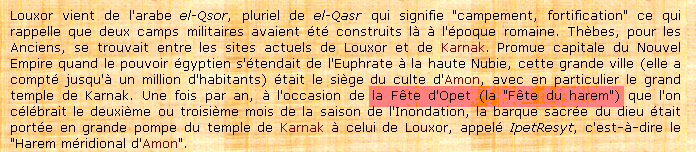
- Pharaonic Evidence — The Opet Festival
- Objections and Responses
- Objection 1 — The Festival Lasted Many Days, Not One
- Response — The Most Important Day Was One Specific Day
- Objection 2 — The Holiday in the Verse May Be a Different One
- Response — The Opet Is Also Called the “Harem Festival” (Women’s Day)
- Objection 3 — Ramses May Not Be the Pharaoh of Moses
- Response — Evidence Ramses II Is the Pharaoh of Moses
- Objection 4 — Linguistic Expression Beyond Literal Definition
- Response — The Linguistic Evidence Fits
- Objection 5 — Another King May Have Celebrated It for One Day
- The Word “Adornment” — Linguistic Analysis
- Ramses II — Physical Descriptions Matching Islamic Narrations
- Conclusion
- Sources and Links
The Qur’anic Verse
بسم الله الرحمن الرحيم — Praise be to God and prayers and peace be upon the Messenger of God and upon his family and companions, all of them.
Tafsir — Interpretation
Pharaonic Evidence — The Opet Festival
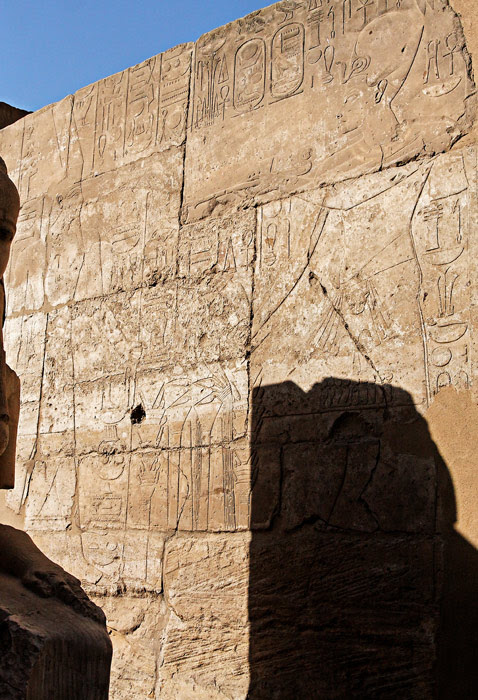
The duration of the celebration varied from one ruling Pharaonic family to another:
- Under the rule of Queen Hatshepsut: the duration was 11 days
- During the reign of Ramses III: the duration was 27 days
Objections and Responses
Objection 1 — The Festival Lasted Many Days, Not One
- The holiday intended in the verse (the Adornment) is not this holiday mentioned here.
- This Pharaoh is not Ramses, but rather another Pharaoh who celebrates this holiday on one day only.
- If Ramses celebrates this holiday on one day only despite its continuation for 27 days, then this is acceptable, but it is something that lacks evidence.
The precision of the Qur’anic expression — if God wanted to express this holiday — requires that He say: ‘Your appointment is on one of the days of Adornment’, because it is 27 days or because it is more than one day.”*
Response — The Most Important Day Was One Specific Day
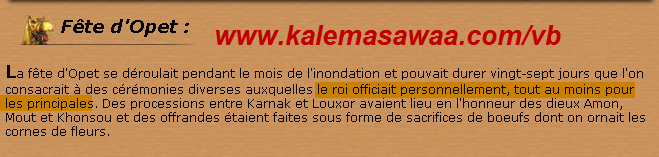
The following scene explains the matter further:
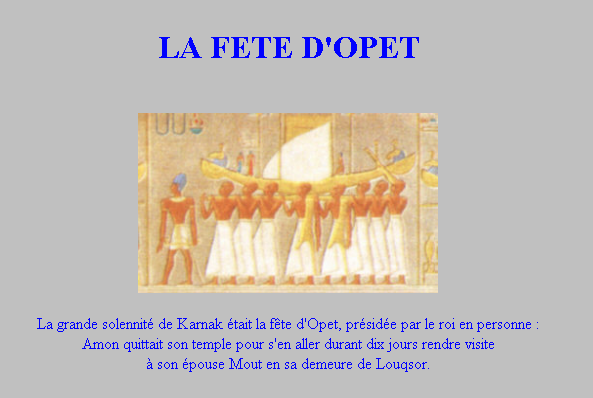
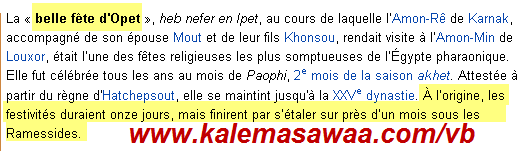
And the following document indicates that the Ramsesids (including Ramses II) extended the celebration to nearly a month:
Objection 2 — The Holiday in the Verse May Be a Different One
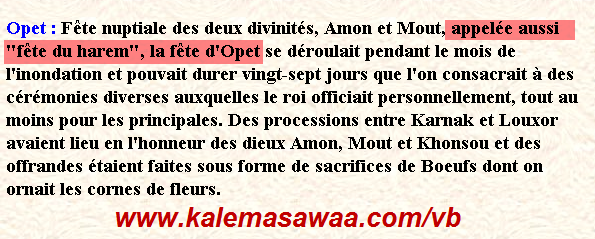
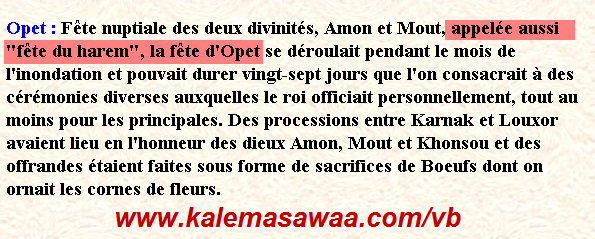
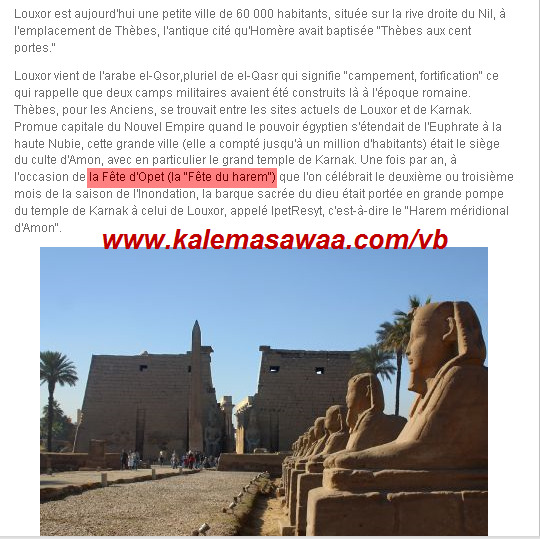
Response — The Opet Is Also Called the “Harem Festival” (Women’s Day)
Here are some sources, for example but not limited to:
First source: http://membres.multimania.fr/egyptedan/dico-o.html
Second source:
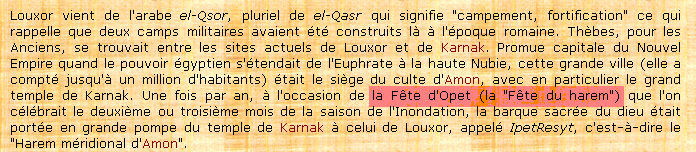
Source: http://khemet.online.fr/monuments/temples/louxor.html
Third source:
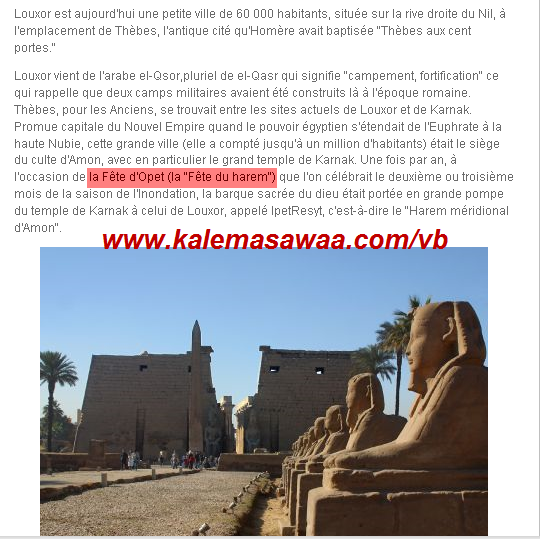
Source: http://pharaons.free.fr/index.php?tag/Temple
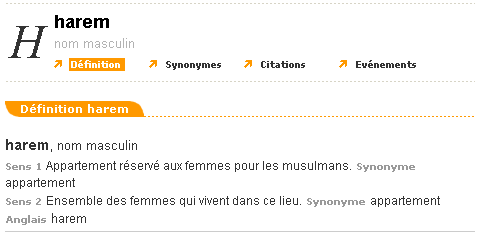
Here is the definition of the French word harem, which means a place designated for women:
Objection 3 — Ramses May Not Be the Pharaoh of Moses
Response — Evidence Ramses II Is the Pharaoh of Moses
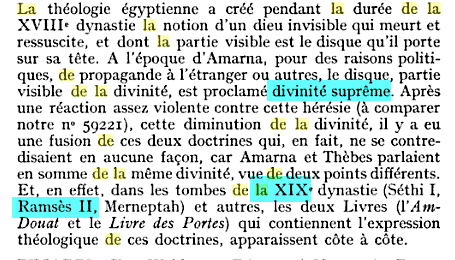
Translation: The greatest pharaoh in history is Ramses II, who was considered the embodiment of the supreme divinity — émanation de la divinité suprême (embodiment or expression of the supreme divinity).
Source: https://books.google.co.ma/books?id=jcUUAAAAIAAJ&pg=PA152
Al-Tabari says: “God Almighty says to Pharaoh: So today We will carry you on the earth with your body… For those who come after you among the people, a lesson to learn from you, so that they may be deterred from disobeying God, disbelieving in Him, and striving to spread corruption on His earth.”
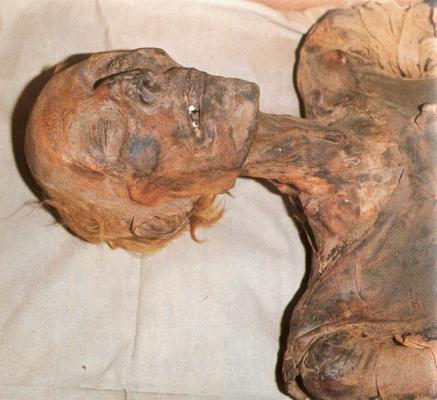
On the narration of the Children of Israel: “When the first army of Pharaoh reached the sea, the horses were afraid of the flames… So when the last army of Pharaoh was finished in the sea and the last of the Children of Israel came out, the sea was ordered to close in on them. So the Children of Israel said: Pharaoh did not die, and he would never die! So God threw him on the shore as if he were a red bull that the Children of Israel could see.”
And this is a picture of Ramses II with his red hair:
However, the information that the Book of Exodus asserts Ramses II was the Pharaoh of forced labour — and that according to historical sequence, the Pharaoh of the Exodus would be none other than Merneptah — has already been discussed in the Christianity catalogues.
Objection 4 — Linguistic Expression Beyond Literal Definition
Response — The Linguistic Evidence Fits
The word “the greatest” is stronger and more significant than the word “the great.” Ramses II was not only a god — he considered himself above all the gods of the Pharaohs. He considered himself the lord of all gods — the only supreme deity.
Objection 5 — Another King May Have Celebrated It for One Day
The Word “Adornment” — Linguistic Analysis
The Pharaonic Word “Opet” and Its Meanings
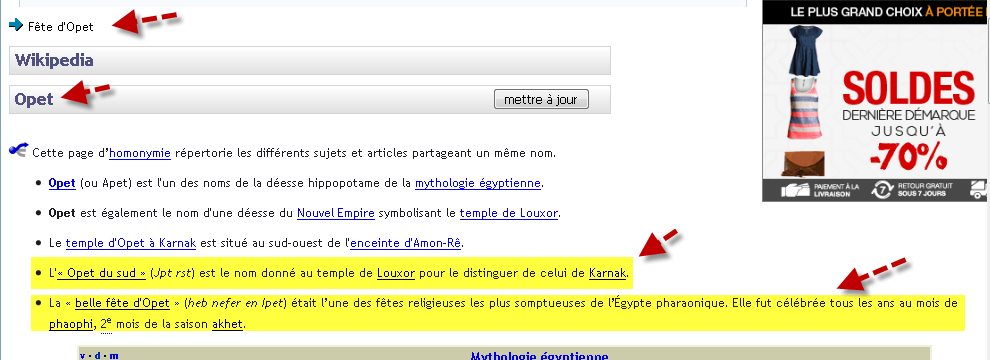
The word opet carries multiple meanings:
- The name of one of the Egyptian gods — the Hippopotame (hippopotamus goddess)
- The name of one of the gods of the New Kingdom that symbolises the Luxor Temple
- The name of a temple in Karnak
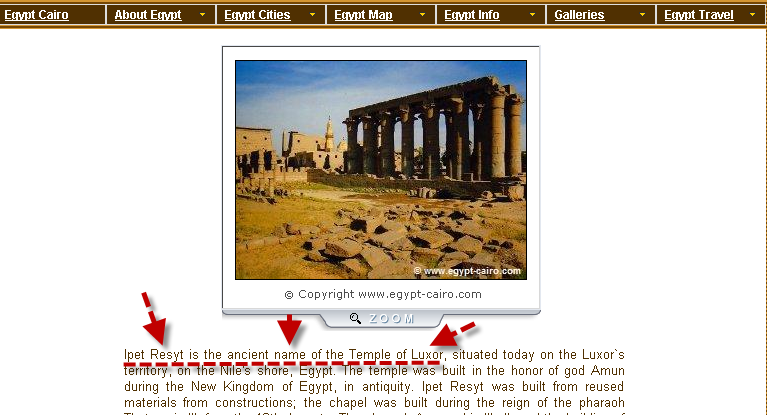
- The name of a temple in Luxor — also called ipet resyt = Harem of the South
- The name of a Pharaonic festival / party / holiday
The Connection Between Opet and Adornment/Decoration
Breaking down the Pharaonic name:
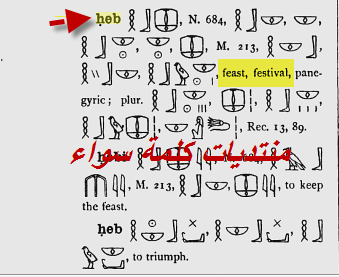
- heb = festival / celebration
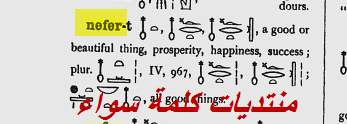
- nefer = beautiful
- ipet / opet = name of the temple in Luxor, also called ipet resyt = Harem of the South
Thus the full meaning is: The Beautiful Harem Festival / Ipet Festival


The Harem Connection
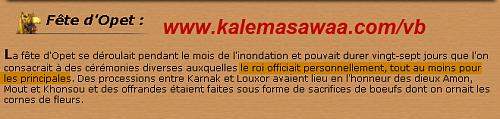
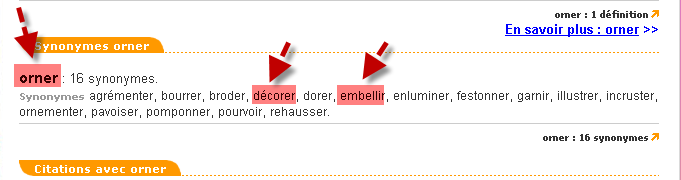
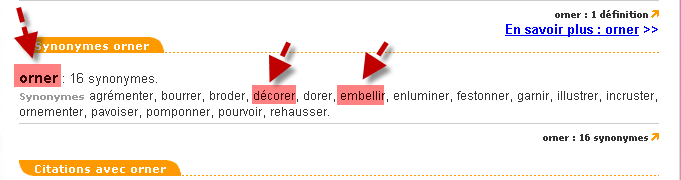
Source: http://www.linternaute.com/dictionnaire/definition/orner/
“Opet” was indeed a day of celebration and decoration.
Ramses II — Physical Descriptions Matching Islamic Narrations
Descriptions of Moses’s Pharaoh from Islamic Sources
There are many other narrations that described Pharaoh when they saw him after he drowned:
- He was bald
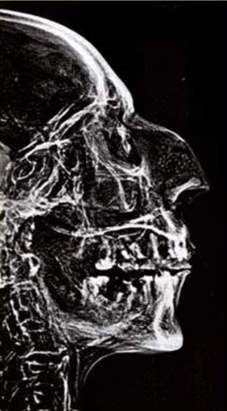
- He was Akhens (diminutive of Akhnas) — meaning: Al-Khans = the nose is set back from the face with a slight rise in the bridge of the nose
- There is a narration by Abu Bakr that he said: “I was told that Pharaoh was afflicted with a broken tooth” — (Affliction: the breaking of a tooth from its root, or a tooth from the incisors or canines, or specific to the incisor)
Thus we can gather the characteristics of the Pharaoh of Moses as described by the companions of the Messenger of God ﷺ: He was short, bald, and had a prominent/long nose.
And the Messenger of God ﷺ said: “I saw Abraham, Moses, and Jesus, may God’s prayers be upon them. As for Moses, he was a tall man, tall, and of straight line, resembling the men of the Zutt and the men of the people of Shabwa.”
And al-Tha’labi said: Ka’b al-Ahbar said: “Aaron bin Imran, the Prophet of God, was a man of eloquent tongue and clear speech, and when he spoke, he spoke slowly and knowledgeably. He was taller than Moses, and on his forehead was a mole.”
Descriptions of Ramses II from the Mummy Examination
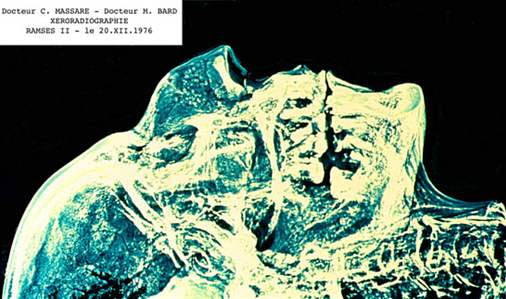
- His head is bald with some hair on the sides and back of his head
- His nose is slightly prominent and slightly raised above the mouth, protruding at the top
- Medical examinations conducted on the mummy of Ramses II in France in the late seventies showed: Dr. Smith mentioned that there were fractures in his teeth and abscesses, especially in the teeth of the front of the mouth
- X-ray examination of the jaw and teeth showed foci of bone infection in an old man of about 90 years of age with advanced loss of the molar area
Thus, we find that all the characteristics mentioned in the stories about the drowned Pharaoh Moses almost match the mummy of Ramses II, except for one characteristic — his height. The stories mentioned that he was short, while the height of the mummy of Ramses II was 173 cm, meaning that he was of average height.
However, if the description of height is relative — then perhaps this was considered short if attributed to the majority of the men of his time, or to the Children of Israel who described him when they saw his body, given that Moses and Aaron were described as tall men.
The Sea Sand Discovery
- Sand of desert origin stuck to the body
- Sand of marine origin (sable marin = marine sand) stuck to the body of Pharaoh Ramses II

Conclusion
The convergence of evidence:
- The Qur’an mentions “the Day of Adornment” as a Pharaonic festival — confirmed by Pharaonic archaeology as the famous Opet Festival (Heb-Nefer-Unepet)
- The Opet Festival was also independently called Fête du Harem (Women’s Festival / Day of Women’s Adornment) — a name that fits perfectly with the Qur’anic expression
- The French word ornait (to decorate/adorn) directly appears in historical descriptions of this very festival — without any insertion from Islamic sources
- The most important single day of the festival was the opening day presided over by the king — making the Qur’anic expression “the Day of Adornment” linguistically precise
- The physical descriptions of Moses’s Pharaoh from Islamic narrations almost entirely match the mummy of Ramses II
- The presence of marine sand on the mummy of Ramses II remains unexplained by secular scholarship
All of this points to one conclusion: the Qur’an’s knowledge of Pharaonic history was not humanly possible at the time of its revelation.
Sources and Links
Tafsir:
- Tafsir al-Tabari on Surah Taha 20:59: https://www.islamweb.net/ar/library/index.php?page=bookcontents&ID=3268&idfrom=3247&idto=3247&flag=0&bk_no=50&ayano=0&surano=0&bookhad=0#docu
Opet Festival:
- https://www.egyptos.net/egyptos/dico/mot-Fete-Opet.php
- http://pantheonegyptien.free.fr/la_fete_d_opet_598.htm
- http://en.wikipedia.org/wiki/Opet_Festival
- http://yp.voyages.free.fr/Egypte/Pharaon/opet.html
- http://www.britannica.com/EBchecked/topic/429983/Opet
Opet / Ipet — Temple and Name:
- http://www.egyptologie.com/karnak.htm
- http://www.egypt-cairo.com/luxor/ipet_resyt.html
- http://egyptopedia.fr/entree.php?lettre=A&entree=Amon
- https://dictionnaire.sensagent.com/opet/fr-fr/
Harem / Women’s Day Connection:
- http://membres.multimania.fr/egyptedan/dico-o.html
- http://khemet.online.fr/monuments/temples/louxor.html
- http://pharaons.free.fr/index.php?tag/Temple
Ramses II as Supreme Deity:
- http://en.wikipedia.org/wiki/Ramesses_II
- https://conseils-astuces.over-blog.com/article-ramses-ii-et-nefertari-71874808.html
- https://books.google.co.ma/books?id=jcUUAAAAIAAJ&pg=PA152
French Language References:
- https://www.linternaute.fr/dictionnaire/fr/definition/se-prosterner/
- http://www.linternaute.com/dictionnaire/definition/orner/
Related Articles: