The GULO Pseudogene Claim
The GULO Pseudogene Claim
“The GULO Pseudogene Claim: Part 1”
🪫 Introduction
The GULO gene is responsible for producing the final enzyme — L-gulonolactone oxidase — in a four-step biochemical pathway that results in the production of vitamin C (ascorbic acid) in mammals. Most mammals can synthesize vitamin C from glucose, but certain species — including humans, apes, guinea pigs, some bats, and some birds — cannot complete this process due to the lack of functional GULO genes.
Pseudogenes are defined as DNA sequences that structurally resemble functional genes but are considered nonfunctional due to mutations such as insertions, deletions, or exon loss. The evolutionary claim is that these mutations are shared among species like humans and chimpanzees, suggesting common ancestry .
However, if we demonstrate that the GULO gene in humans is more similar to gorillas (which are evolutionarily distant) than to chimpanzees (evolutionarily close), then one of three possibilities must be true:
Humans evolved from gorillas — which contradicts evolutionary theory.
The GULO gene was independently inactivated in humans, gorillas, and chimpanzees.
The GULO region is not actually a pseudogene, but rather has a function yet to be discovered — supporting intentional design.
Any of these conclusions would undermine the claim that the GULO pseudogene is strong evidence for common descent.
🧬 What Does the Data Show?
A study published at Answers Research Journal provides key insights into the genetic comparison of the GULO region across humans, chimpanzees, and gorillas.
“Compared to chimpanzee and gorilla, the 28,800-base GULO region in humans is only 84% and 87% identical , respectively.”
This percentage drops even further when looking at specific upstream regions associated with missing exons:
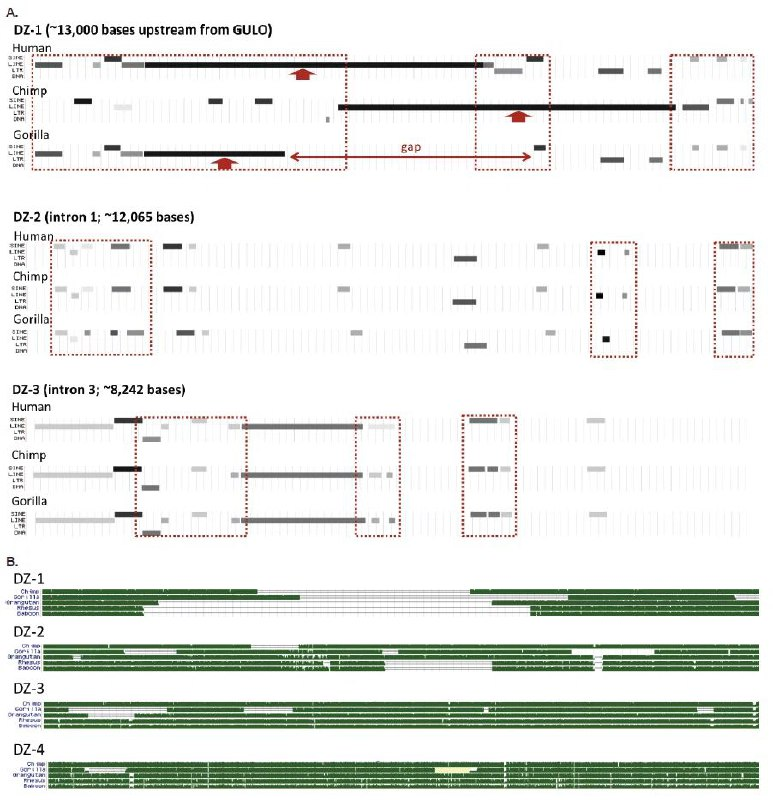
“The 13,000 bases upstream of the human GULO region, corresponding to the putative area of loss for at least two major exons, is only 68% and 73% identical to chimpanzee and gorilla, respectively.”
Moreover, the six individual exon regions — though generally similar between humans and apes — show independent and discordant phylogenetic similarity patterns , meaning they do not follow a consistent evolutionary tree pattern.
“The overall lack of single-nucleotide polymorphisms in humans in these exons suggests that incomplete lineage sorting based on alleged ancestral polymorphisms is not a likely explanation.”
This implies that the differences observed are not simply due to random variation inherited from a common ancestor.
🔁 Transposable Elements and Mutation Patterns
The transposable element (TE) content within the GULO gene region shows significant divergence:
“The transposable element (TE) content of each of the putative exon loss regions is taxonomically constrained and evolutionarily inconsistent between humans and each ape taxon.”
These TE patterns suggest that deletion events were caused by unequal recombination associated with transposable elements , and these events occurred independently in different species.
This undermines the idea of a shared mutation inherited from a common ancestor.
🛑 The 98% Similarity Myth
Evolutionary proponents often cite an 8–98% similarity between human and chimpanzee DNA, including the GULO region. However, this figure is misleading:
“Contrary to Fairbank’s claims of 98% human-chimp GULO similarity based on the comparison of a very small, highly similar DNA fragment of 564 bases, the entire 28,800-base GULO region in human (hg19; chr8:27417791-27446590)… is only 84% identical compared to chimpanzee using BLASTN algorithm.”
In other words, the high similarity cited by evolutionists comes from comparing less than 2% of the total sequence , not the full gene region.
🛑 Peer Review and Scientific Integrity Issues
Some may object by saying, “You’re citing creationist journals,” implying bias. However, the same criticisms can be applied to many mainstream journals:
“Hundreds of scientific papers show signs of reviewers using templates to quickly prepare reports for personal gain.”
“Unethical behavior was not uncommon, and experienced editors and reviewers encountered it frequently.”
“Elsevier has retracted dozens of papers for ‘fictitious’ reviews.”
Source 1 - Peer review manipulation
Source 2 - Wiley Online Library
Source 3 - Science Magazine
This raises serious concerns about the reliability of peer-reviewed studies that support evolutionary claims, especially those that rely on limited data or biased assumptions.
📌 Conclusion
The GULO pseudogene is often cited as strong evidence for evolution due to the supposed shared mutations between humans and apes. However, detailed genomic comparisons reveal:
The overall similarity between the human and chimp GULO region is only 84% , not 98%.
The human GULO region is more similar to gorilla than to chimpanzee in some areas.
Mutation patterns differ significantly between species, indicating independent events , not inheritance from a common ancestor.
Transposable element content does not align with evolutionary expectations.
Peer review issues raise doubts about the integrity of evolutionary claims made in mainstream journals.
All of this strongly suggests that the GULO pseudogene does not provide solid evidence for evolution , and instead supports the idea of taxonomically restricted degradation , consistent with genetic entropy and design discontinuity .
Thus, the GULO pseudogene argument falls short and belongs in the dustbin of history. 🗑️🧬
📎 References
https://answersresearchjournal.org/human-gulo-pseudogene-discontinuity/
https://www.science.org/content/article/suspicious-phrases-peer-reviews-point-referees-gaming-system
https://onlinelibrary.wiley.com/doi/10.1002/leap.1637
{Embed}
https://answersresearchjournal.org/human-gulo-pseudogene-discontinuity/
Human GULO Pseudogene: Discontinuity Genetic Entropy
Modern genomics provides the ability to screen the DNA of a wide variety of organisms to scrutinize broken metabolic pathways. This data has revealed wide-spread genetic entropy in human genomes.

By the way, the author of the study has conducted several genomic comparisons published in international journals. But when it comes to evolution, noooo this guy is not reliable, and a creationist journal 🤡
https://scholar.google.com/citations?user=JedieG0AAAAJ&hl=en
Criticizing the GULO Pseudogene Claim: The Second Argument 🧠🪫
I won’t elaborate much, as requested by the brothers. But before we begin:
We believe that this gene has a function yet to be discovered — and therefore it may not be a pseudogene at all. However, what follows is simply an argument against the evolutionary interpretation , aimed at exposing their intellectual contradictions.
The Darwinist Claim 📉
They argue that the mutations inactivating the GULO gene are similar among primates , and since the gene is nonfunctional in them, these mutations must have been inherited from a common ancestor .
They say it’s impossible for the Creator to have created the same broken gene independently in humans, apes, and other primates. Therefore, they conclude, the similarity in inactivation must mean shared ancestry .
But here’s where the contradiction begins.
🔁 Reactivation of the GULO Gene
The very same Darwinists who reject the possibility of independent inactivation of the GULO gene in different species, believe that in some bats and certain birds (Passeriformes), the gene was reactivated after being inactivated!
“Some GLO pseudogenes (GULOs ) found in bat species have been shown to be reactivated during evolution. The same phenomenon is thought to have occurred in some Passeriformes bird species.”
https://www.eurekaselect.com/article/19645
Imagine that: entire exons were supposedly lost due to mutation, then restored again in the same location — not once, but multiple times across unrelated species — without further damage to the gene.
That’s like saying a shattered window repaired itself exactly as it was — not just once, but repeatedly in completely different houses — all by chance. Abracadabra-style evolution. 🎩🐇
🔁 Convergent Evolution?
They also believe in convergent evolution , where unrelated organisms evolve nearly identical complex traits — not once, but multiple times independently .
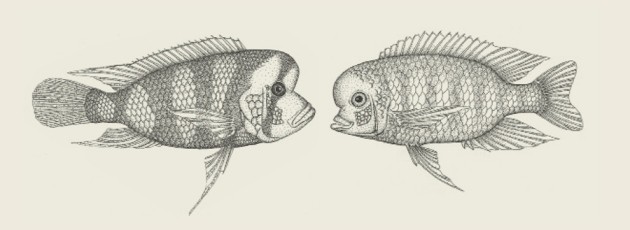
For example, they claim that two unrelated species of fish evolved nearly identical body structures independently in separate lakes.
As stated in Nature , which they trust:
“This account requires extraordinary coincidence to explain the multiple parallel forms that evolved independently in each lake.”
https://www.nature.com/articles/514161a
So now we’re supposed to believe that:
Complex systems can arise more than once by chance , even without common ancestry.
Broken genes can be repaired by random mutations , even after complete exon loss.
And yet, when it comes to the GULO gene, independent inactivation is impossible ?
Hold on… isn’t that selective reasoning ?
🎲 Parallel Evolution & Chance
They also accept parallel evolution , where similar traits appear in species with a common ancestor — and yet the development of those traits is said to have happened independently and by chance .
{Embed}
https://www.nature.com/articles/514161a
Does evolutionary theory need a rethink?
Nature - Researchers are divided over what processes should be considered fundamental.
If they accept that identical complex features can arise independently through random processes , why do they reject the idea that similar mutations could occur independently in the GULO gene?
And let’s not forget — many of them believe that life itself arose by chance .
So if life began randomly, and complex systems evolved randomly, and broken genes can repair themselves randomly — then why is it so hard to believe that similar mutations could happen independently in the GULO gene?
It seems that whenever something supports evolution, chance is the hero .
But when something contradicts it, chance becomes impossible .
📌 Conclusion
The Darwinists argue that the similarity in GULO gene inactivation proves common ancestry , while rejecting the possibility of independent inactivation .
Yet, they simultaneously believe that:
Inactivated GULO genes were reactivated in bats and birds.
Identical complex traits evolved independently in unrelated species.
Life itself originated by random processes .
This is not science — it’s storytelling with selective logic .
When chance supports their view, it’s miraculous.
When it doesn’t, it’s impossible.
Let’s not forget: If you accept evolution, you’ve already accepted far greater improbabilities .
When comparing the conserved exons of the GULO gene between humans and great apes, no exon other than exon 5 gave the hypothesized model of the evolutionary tree, meaning they were cherry-picking specific sequences and then claiming them as evidence. So the solution was to compare the entire gene sequence, which concluded that gorillas are the great ape most similar to humans in this gene.
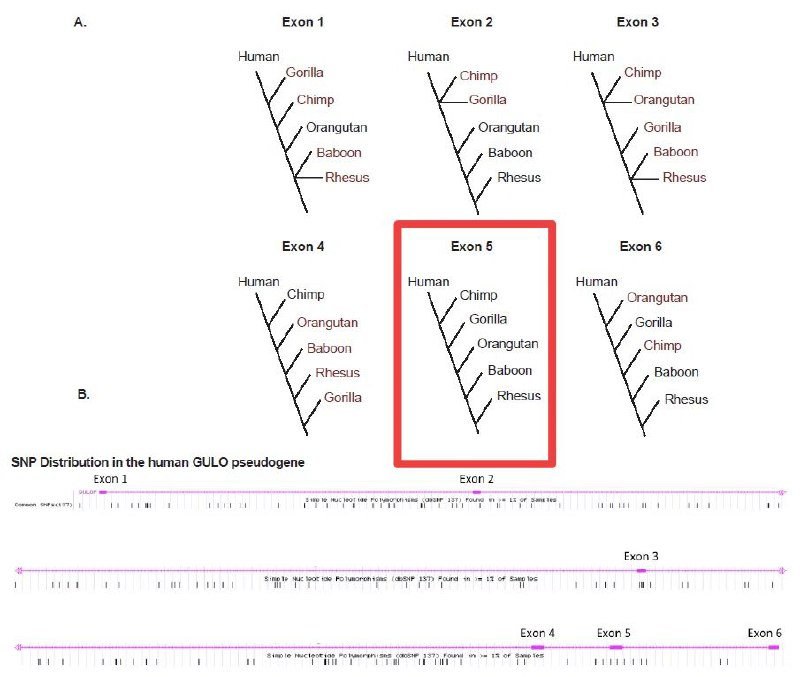
Briefly explaining: The claim that the GULO gene is inactivated in general is that primates share the same alleged inactivation mutations, such as two nucleotide deletions, one 3-nucleotide deletion, one nucleotide insertion mutation, and the deletion of six of the 12 exons. Specifically, there is an “alleged” mutation in exon 5 and its similarity to chimpanzees. This exon “only”, when compared to humans, appears more closely related in the sequence in chimpanzees. In contrast, we find other mutations that occurred in the remaining exons, which showed conflicting similarities to the evolutionary tree, and show that gorillas are more closely related to humans in this gene when compared to the entire gene. If Darwinism says that the similarity in the remaining exons occurred by chance, then the similarity in this exon must also have occurred by chance, since they are all random mutations. This statement is only to establish evidence for what they believe. However, we believe that this gene in this form has not been damaged or affected by mutations that have disabled it, but rather has a function that has not yet been discovered.