

The Nutfa Hadith and Embryology: The 42-Day Miracle
The authentic hadith in Ṣaḥīḥ Muslim states that once forty-two nights pass over the nuṭfa (the early embryo), Allah sends an angel who forms it and creates its hearing, sight, skin, flesh, and bones, then determines whether it is male or female. This post compiles the embryological evidence that the two most testable claims in that hadith — the onset of bone ossification and the determination of the embryo’s sex — both occur at almost exactly day 42, the end of the sixth week and the start of the seventh.
The Hadith Under Discussion
The lead narration comes through Ḥudhayfa ibn Asīd al-Ghifārī (RA), recorded by Imām Muslim. It is one of the strongest formulations of the embryological hadith because it fixes the moment of formation at forty-two nights.
“When forty-two nights have passed over the nuṭfa, Allah sends an angel to it who forms it and creates its hearing, its sight, its skin, its flesh, and its bones. Then he says: ‘O Lord, male or female?’ and your Lord decrees what He wills and the angel records it. Then he says: ‘O Lord, his lifespan?’ and your Lord says what He wills and the angel records it. Then he says: ‘O Lord, his provision?’ and your Lord decrees what He wills and the angel records it. Then the angel departs with the sheet in his hand, neither adding to what he was commanded nor subtracting from it.”
Grade: Ṣaḥīḥ · Muslim (8/45)
The wording is reproduced from the printed text of Ṣaḥīḥ Muslim below.
The hadith therefore states that hearing, sight, flesh, bone, and the embryo’s sex are formed at the close of the sixth week and the beginning of the seventh — at forty-two nights (six weeks) from fertilisation.
We will see roughly fifty references confirming that ossification begins in the embryo around day 42; roughly sixty references that the embryo’s sex is not chromosomally settled at 100% until day 42 (end of the sixth week, start of the seventh); and dozens more establishing the timing of gonadal sex (the determination of sex according to the genital organs). Flesh, the eye, and the ear are deliberately left out of the argument, so that no one can claim the Prophet ﷺ simply observed them with the naked eye in miscarried fetuses — the eye and ear are in fact visible to the naked eye in a fetus miscarried from the second month, unlike the embryo’s sex and the onset of bone ossification, which could not be known except under the electron microscope.
So that it is not said that Islam borrowed this from the Greeks, the author refers the reader to his research titled Greek Embryology Compared with the Noble Qur’an and the Sunnah (here).
If it is objected that the Prophet ﷺ mentioned the number by coincidence, we reply: a coincidence in the embryo’s sex — but is it also coincidence in the bones? And even if both of these examples were granted as coincidence, what about the rest of the examples that can be presented? An opponent has only a limited budget of “coincidence” to spend, but he cannot say “coincidence” every single time — if that is his argument, it collapses once ten further examples like these are produced.
After the scientific evidence, a dedicated ḥadīth-methodology section will follow on the chains (ṭuruq) of the nuṭfa hadith, demonstrating that the correct formulation is the one cited above, narrated in Ṣaḥīḥ Muslim from Ḥudhayfa ibn Asīd.
It has also been circulated that there is a consensus (ijmāʿ) among the Muslim scholars that the bones, flesh, hearing, sight, and sex of the embryo are formed on day 120 (three forties). This will be shown to be incorrect: most scholars hold that these organs and the sex of the embryo take shape at the start of the second forty (forty-something nights), and the consensus regarding day 120 is in fact the consensus that the ensoulment (nafkh al-rūḥ) occurs on day 120 from fertilisation.
Bone Formation Begins Around Day 42
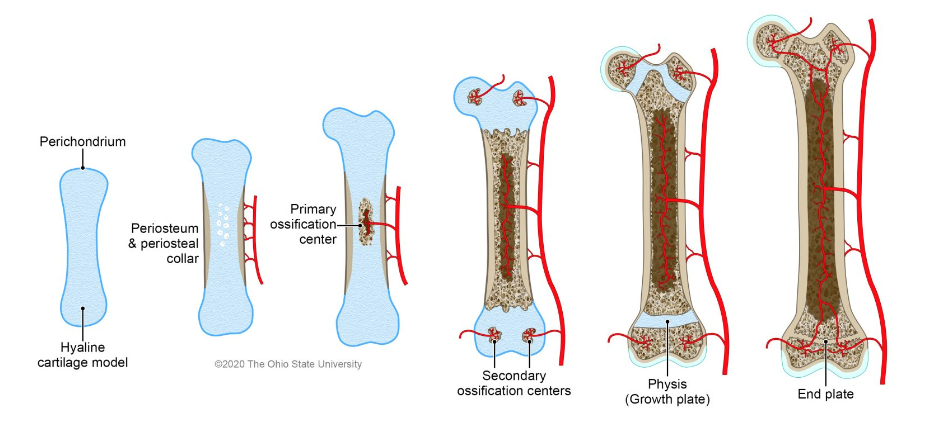
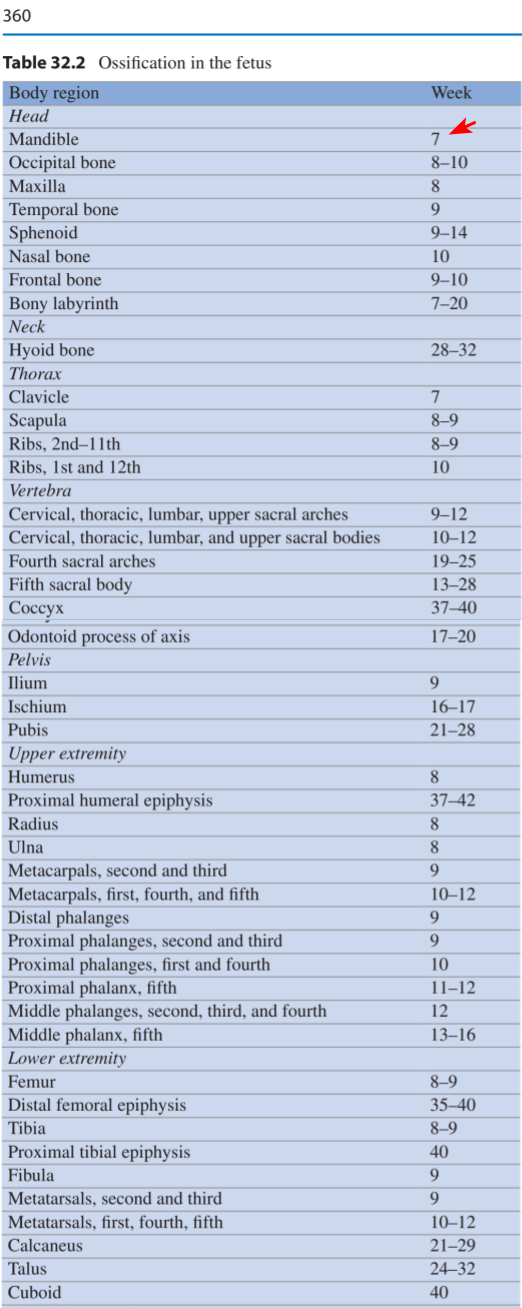
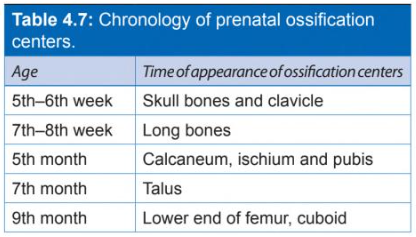
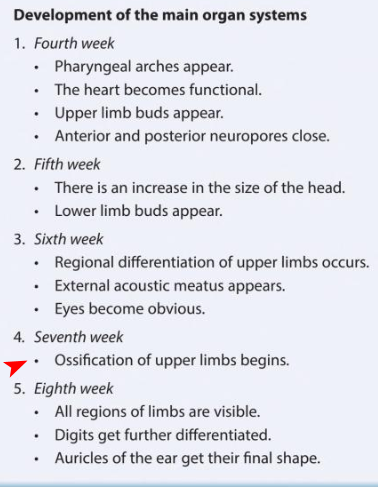
All bones in the body originate from ossification centres,1 and the clavicle is the first bone to begin its formation (osteogenesis) through ossification in the embryo;2 we will see that this ossification takes place at the end of the sixth week and the start of the seventh. Ossification of the upper limbs likewise begins in the seventh week, as does that of the lower limbs, the vertebrae of the spinal column, the skull, the ribs, the scapula, the humerus, the femur, the tibia, the maxilla, and the palate. Most of the bones, as the sources below show, begin ossifying at the end of the sixth week.
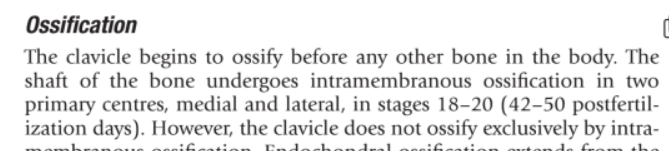
Gray’s Anatomy states that the clavicle begins to ossify before any other bone in the body, in stages 18–20 — that is, 42 to 50 days post-fertilisation:3
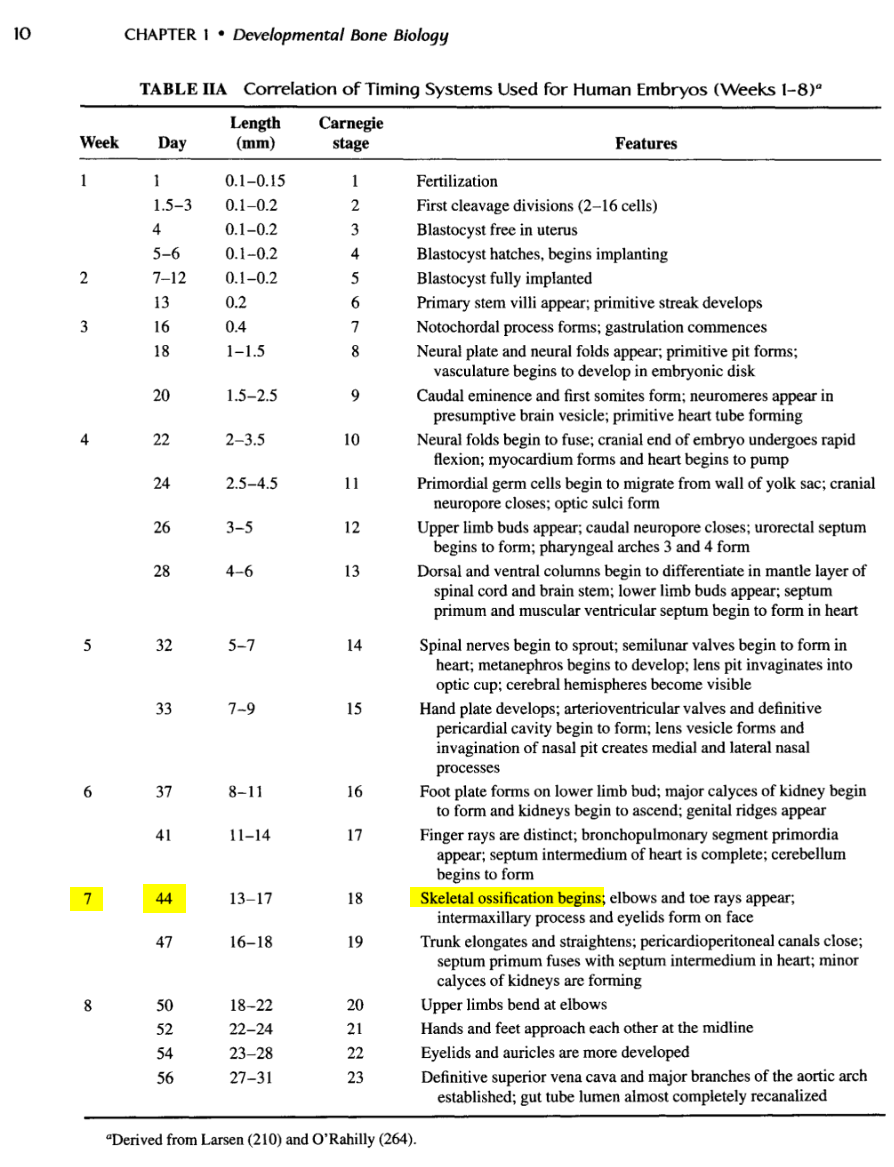
In Pediatric Orthopedic Deformities, Dr. Frederic Shapiro places the onset of skeletal ossification in the seventh week, on day 44.4
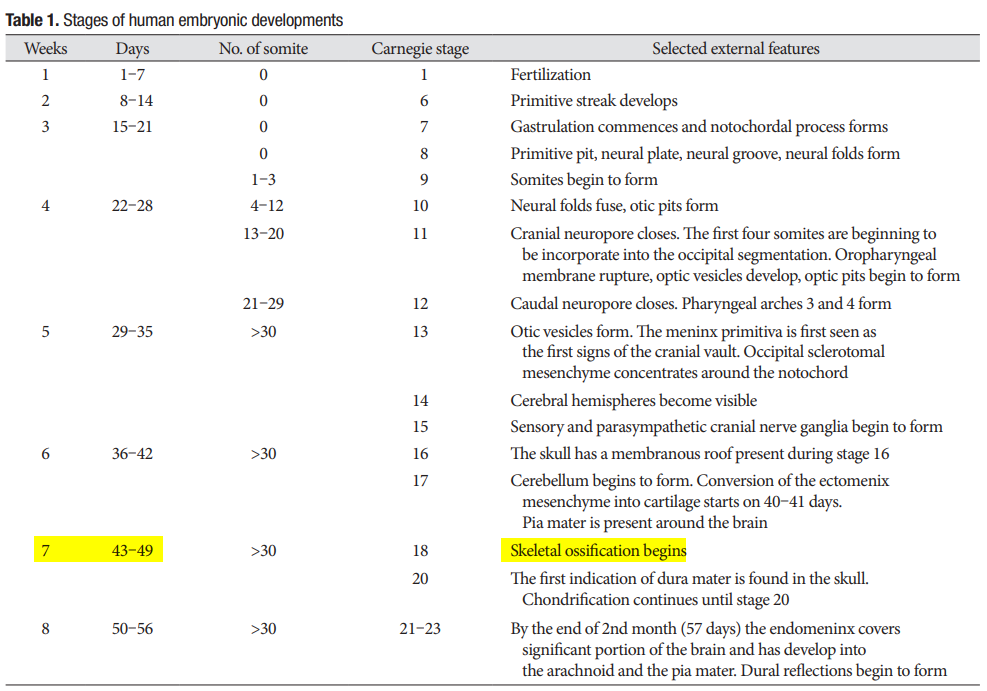
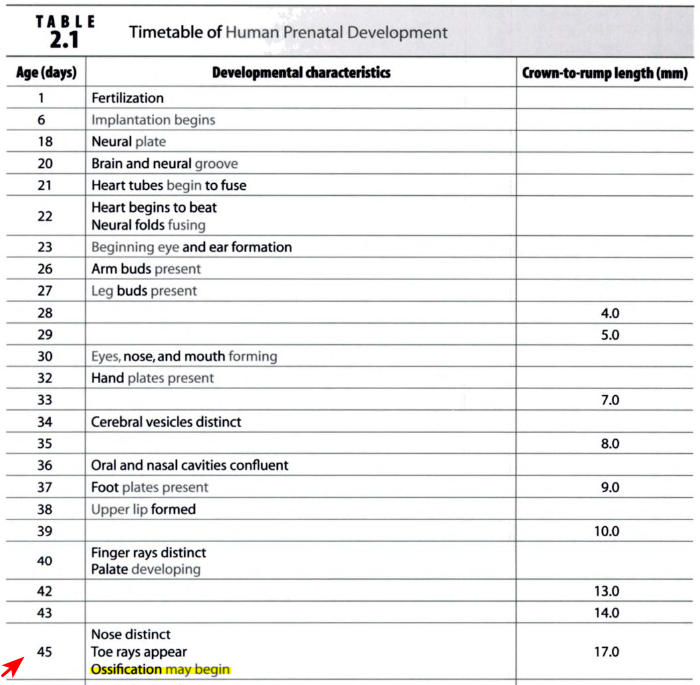
The study Development and Growth of the Normal Cranial Vault: An Embryologic Review presented a table of embryonic development in which ossification begins on day 43.5
The reference article Embryology, Bone Ossification dates the onset of the process to between the sixth and seventh weeks:6
The article Bone Formation and Development, published by Oregon State University, agrees:7
An ossification table compiled by the embryologist Franklin P. Mall shows ossification beginning around day 39.8
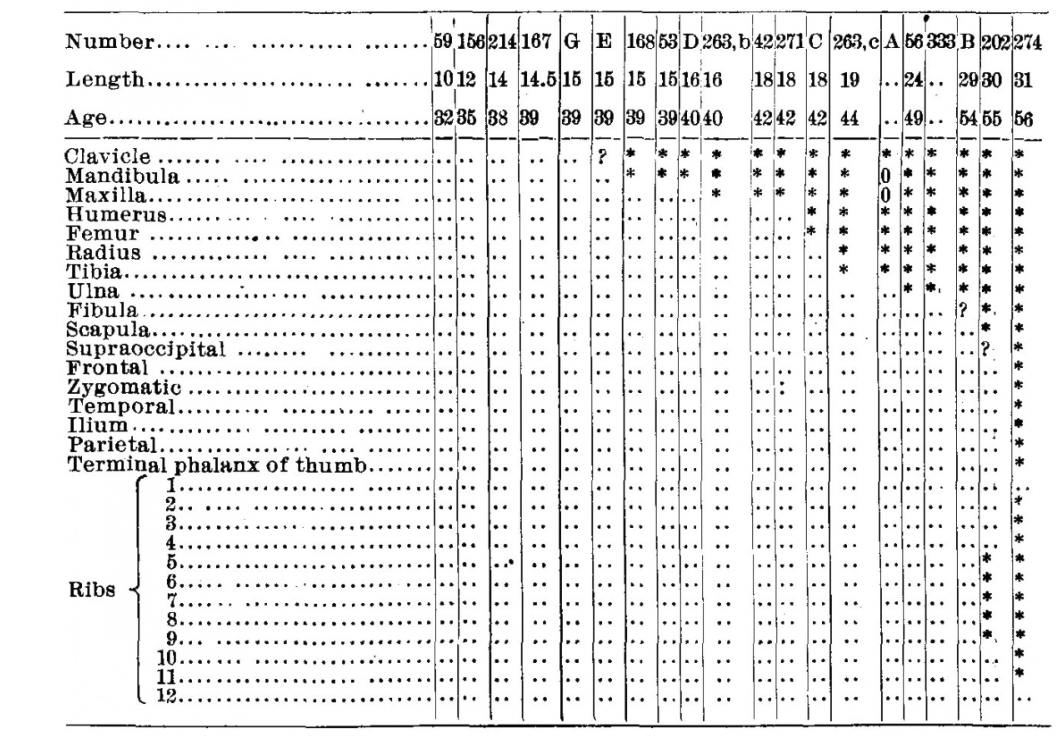
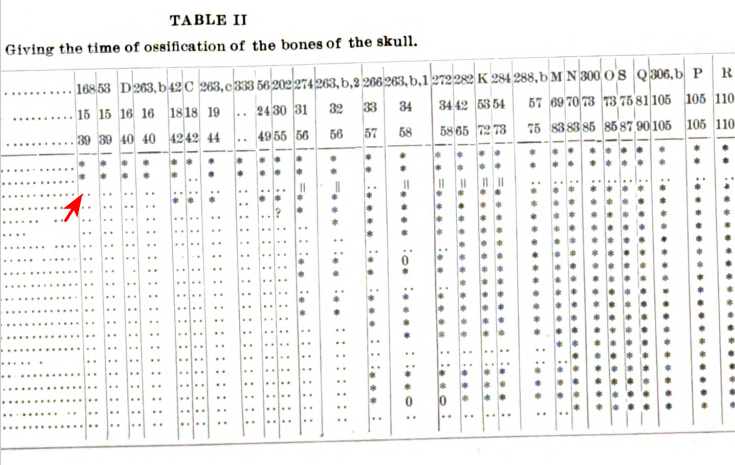
His table for ossification of the arm begins at day 39,9 as does his table for the skull.10
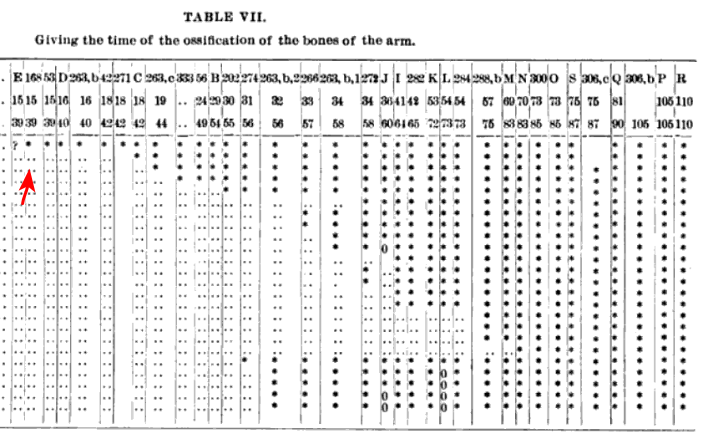
The skull ossification table likewise opens at day 39.
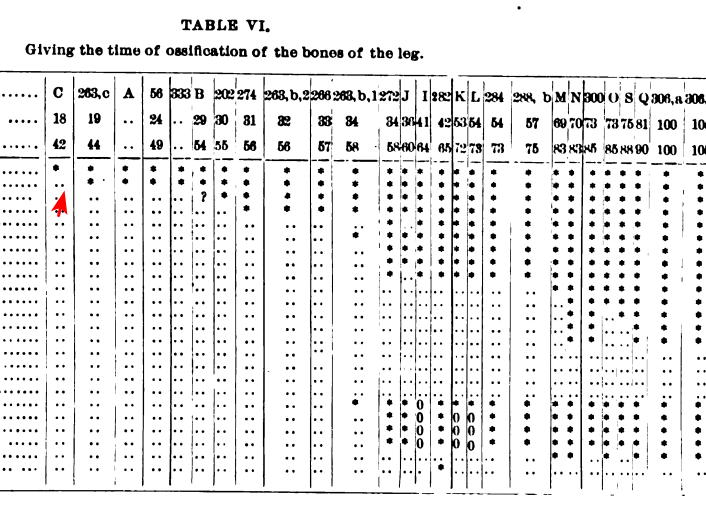
His table for the legs begins at day 42.11
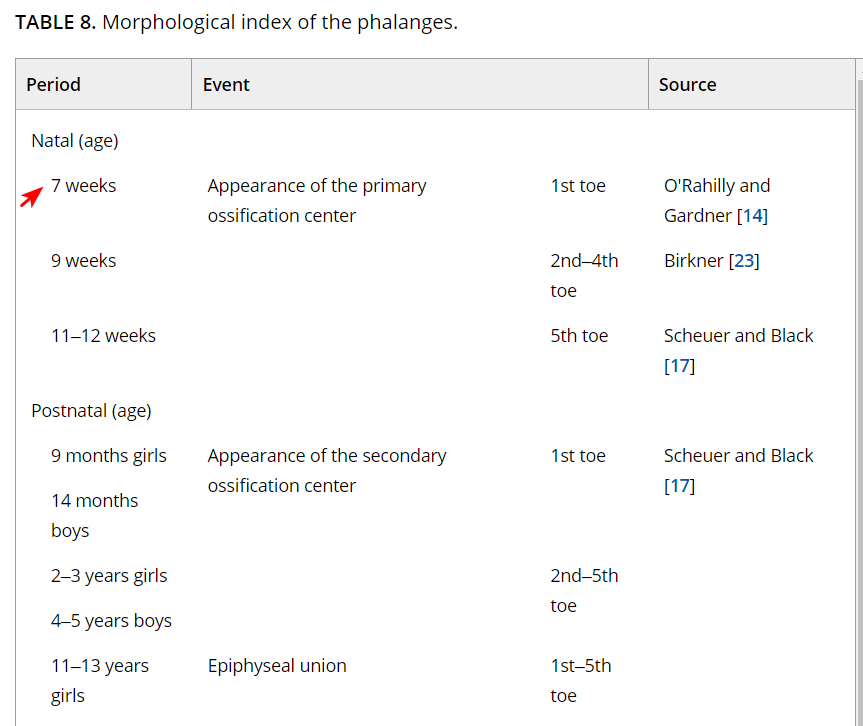
The study Resources for innovative learning of anatomy and foot ossification: Graphic design and virtual reality12 presented eight tables on the ossification of the foot bones; according to the eighth table, the first to ossify were the phalanges, in the seventh week.
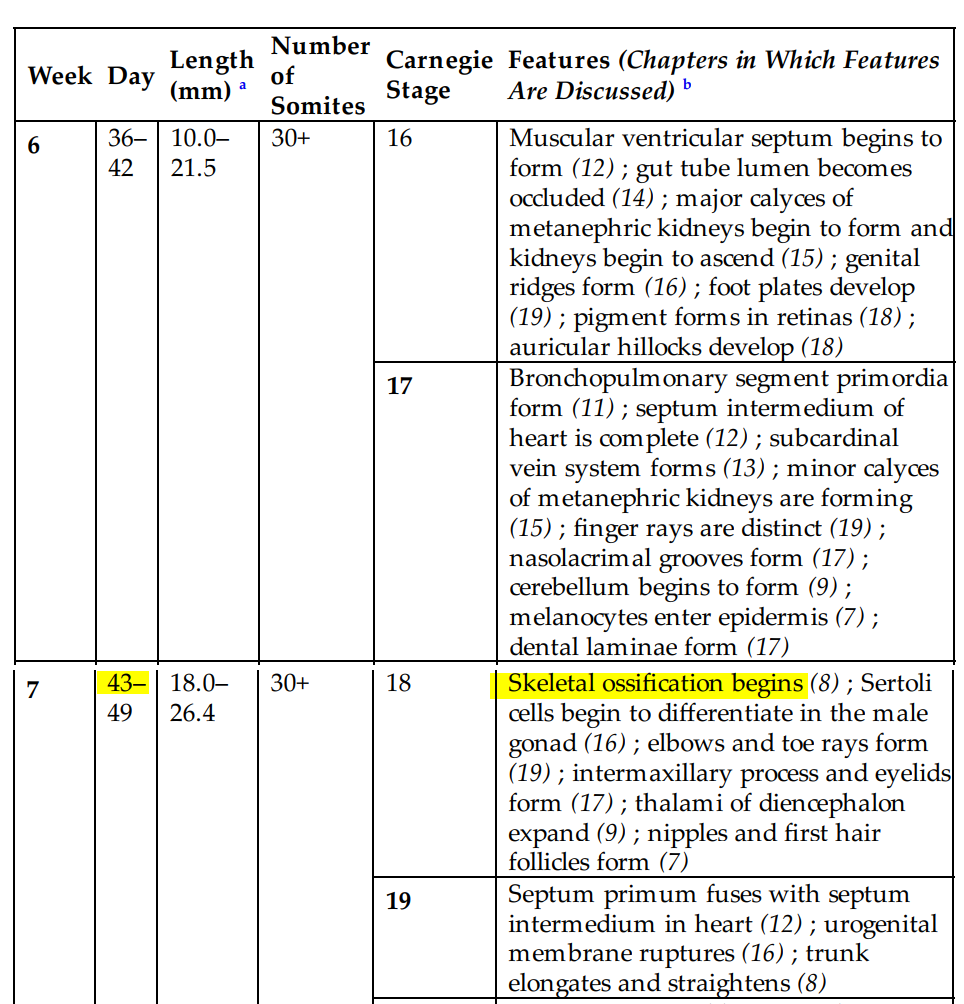
One of the most important embryology textbooks in the world, Larsen’s Human Embryology, notes that skeletal ossification begins on day 43:13
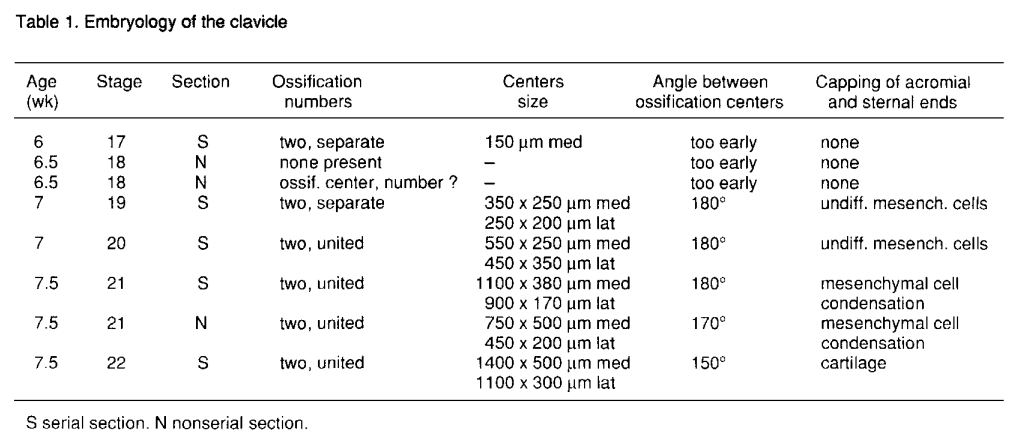
The study The early development and ossification of the human clavicle — an embryologic study states plainly that the clavicle is the first bone to ossify in the developing embryo:14
The same study fixes the timing of that ossification to the sixth week:15
It then presented a table of the stages of clavicular ossification beginning in the sixth week.16
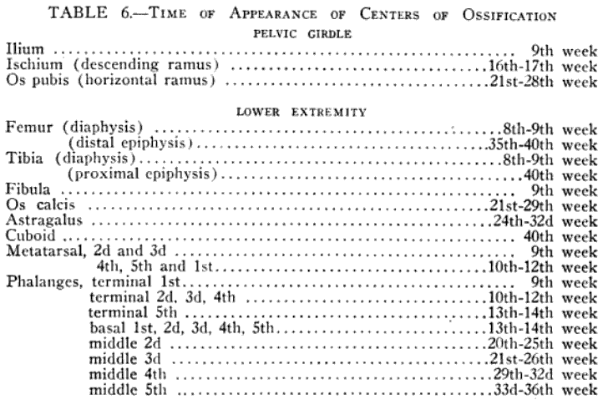
The medical journal American Journal of Diseases of Children presented tables for the ossification of all the embryo’s bones, appendicular and axial, and the first to ossify were the jaw and the clavicle in the seventh week.17
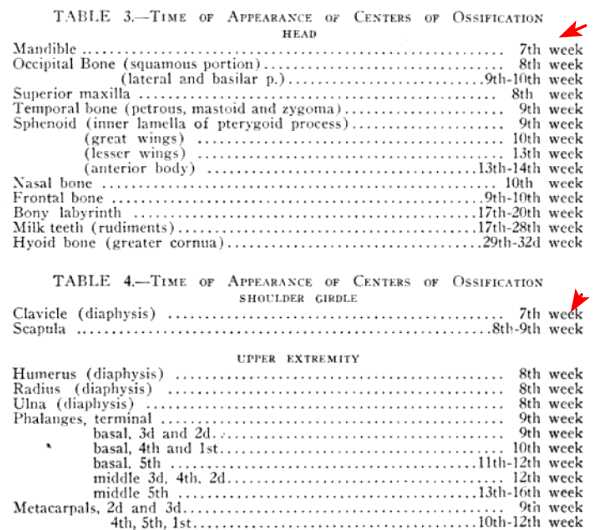
The tables continue across the axial and appendicular skeleton.
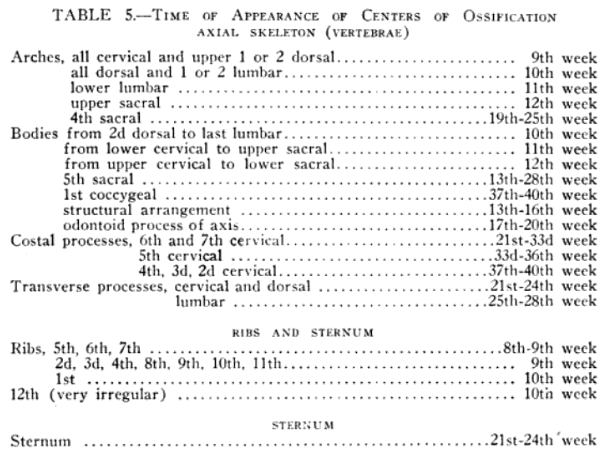
The series concludes with the remaining skeletal elements.
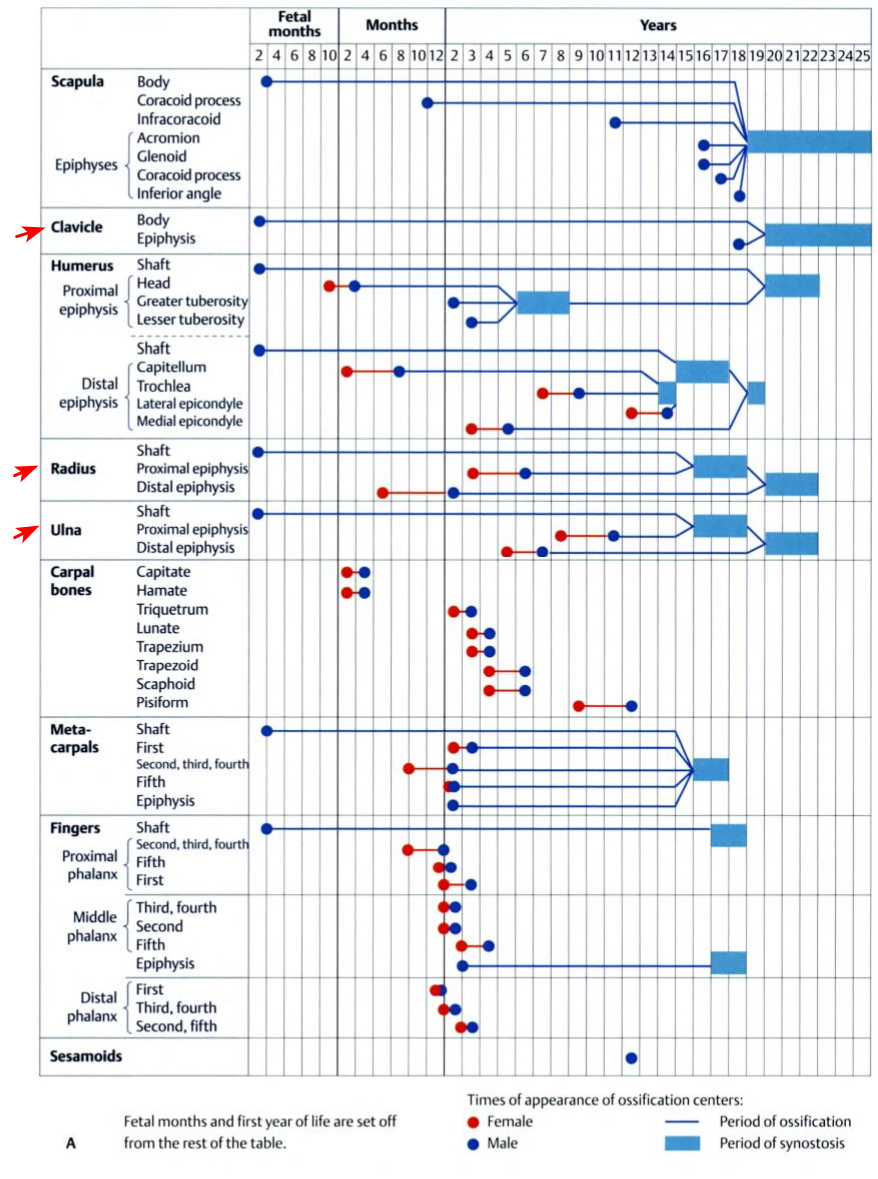
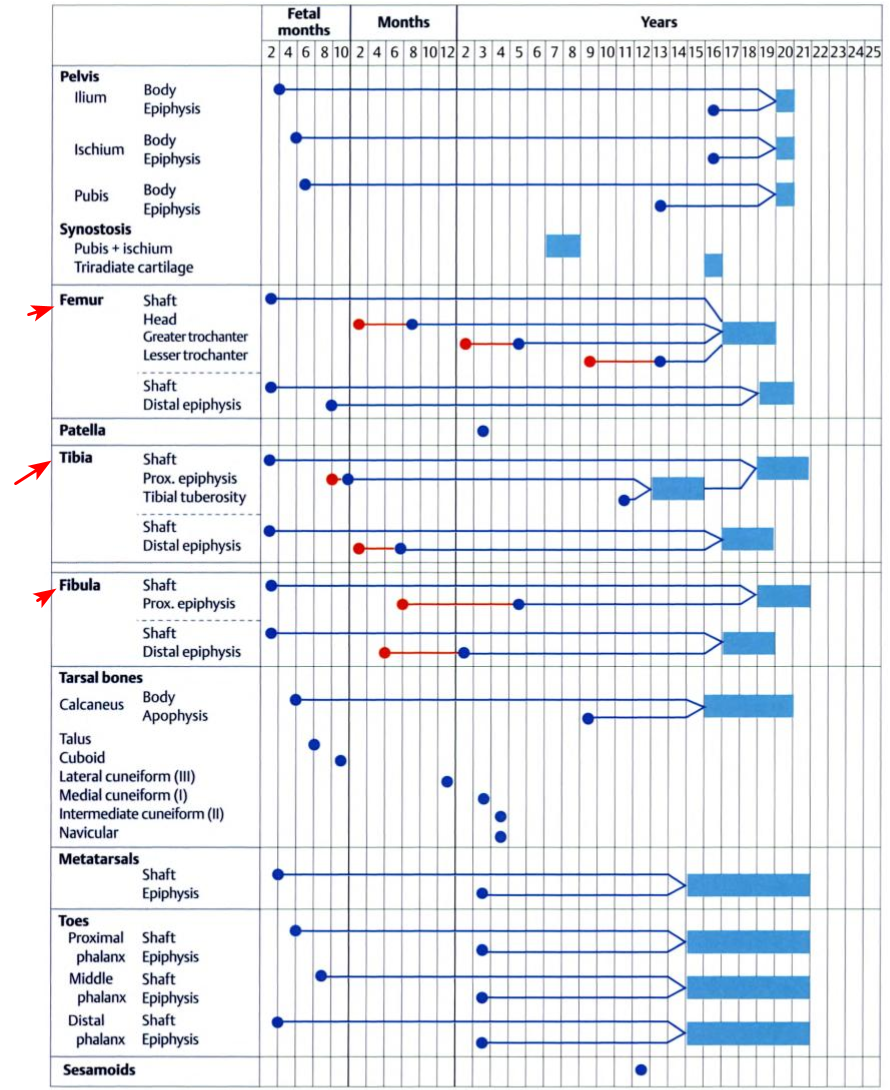
The Thieme Atlas of Anatomy gives a table of embryonic bone ossification in which the first ossification begins in the middle of the second month (roughly six weeks) — for the clavicle, ulna, radius, tibia, fibula, and femur.
A further table from the same atlas details the sequence.
Pediatric Bone, Biology and Diseases states that nearly all primary ossification centres appear between weeks 7 and 12:18
In Imaging of the Sternocostoclavicular Region, Professor of Radiology at Aarhus University Dr. Anne Grethe Jurik writes that the clavicle’s two membranous primary centres appear in the sixth week:19
Disorders of the Shoulder, Diagnosis & Management places the onset of fetal ossification in the clavicle at around eight weeks’ gestation:20
Here a recurring conversion must be noted: “8 weeks’ gestation” — counted from the last menstrual period — equals 6 weeks of embryonic age, counted from fertilisation.^22
Human Anatomy, A Complete Systematic Treatise (Sir Henry Morris, 1895) places the appearance of the primary clavicular nucleus in the sixth week of embryonic life:21
The International Record of Medicine and General Practice Clinics dates the earliest ossification to the end of the sixth week:22
Post Mortem Imaging of the Fetus & Child (2025) states that fetal skeletal ossification commences at 8 weeks’ gestation23 — again equivalent to 6 weeks of embryonic age:^26
Principles of Anatomy and Physiology (Tortora & Derrickson, 2020) places cartilage formation and ossification in the sixth week of embryonic development:24
The Textbook of Craniofacial Growth states that almost all bones begin ossification around the eighth week of intrauterine life (IUL):25
The eighth week of intrauterine life — i.e. gestational age, counted from the last menstrual period — equals the sixth week of embryonic age, counted from fertilisation.^29
The Color Atlas of Human Fetal and Neonatal Histology (2019) gives an ossification timeline beginning in the seventh week.26
The Sobotta Atlas of Anatomy (17th ed.) notes the clavicle as the exception that emerges from week 7 without a cartilaginous precursor:27
Charles Sedgwick Minot’s Human Embryology records the clavicle as the first bone formed in the human embryo, ossifying during the seventh week:28
The journal Colorado Medicine (1911) describes the clavicle as the first bone in the body to show signs of ossification, appearing around the sixth week:29
Upper extremity, back of neck, shoulder, trunk, cranium, scalp, face (John Blair Deaver) repeats the same point, dating the shaft’s ossification to about the sixth week of fetal life:30
A Manual of Human Physiology (Leonard Landois) names the clavicle as the first bone to ossify, in the seventh week:31
Dr. Mark Hill’s embryology navigator records the clavicle as the very first bone to ossify, in the sixth week, with the remaining upper-limb bones — humerus, ulna, and radius — beginning in late week six and early week seven.32
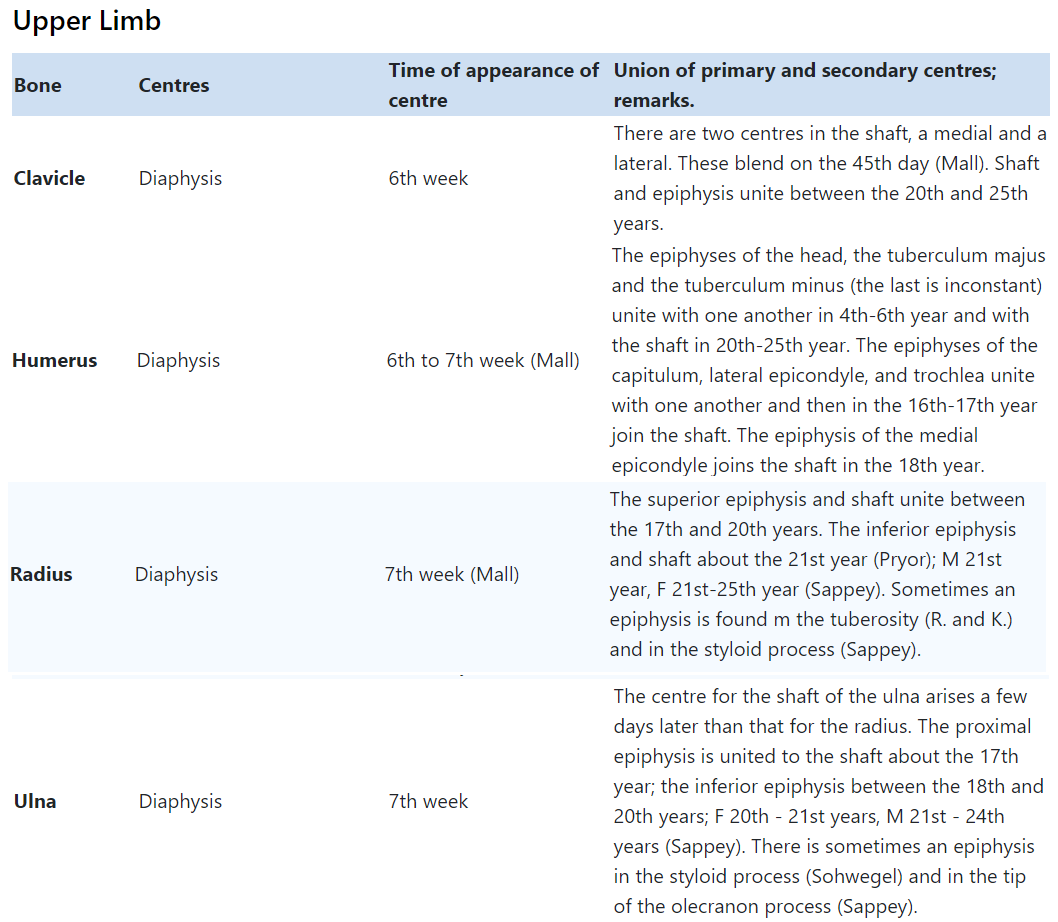
The same source’s table continues for the rest of the upper limb.
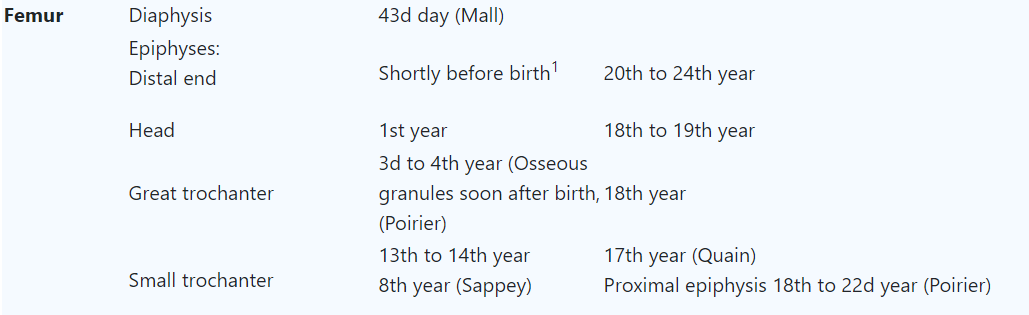
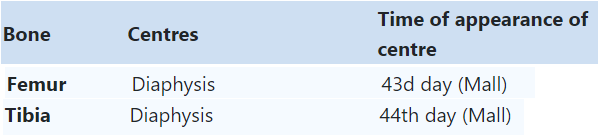
For the lower limb, the femur ossifies on day 43 and the tibia on day 43.33
And the jaw ossifies in the sixth week.34
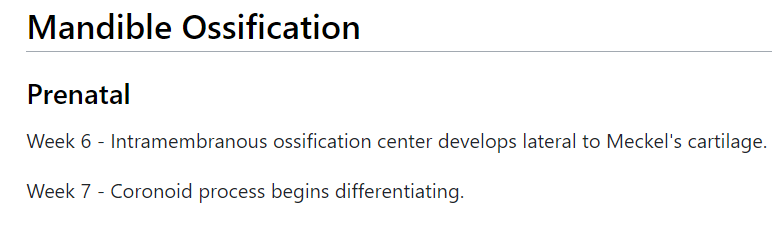
The ASSH Manual of Hand Surgery describes ossified bone becoming apparent by the seventh week:35
The Textbook of General Anatomy with Systemic Anatomy, Radiological Anatomy, Medical Genetics (V. Subhadra Devi) records the first ossification — in the clavicle and skull — at around the fifth or sixth week.36
Henry Gray’s Anatomy of the Human Body lists the seventh-week appearance of ossification points for the ribs, scapula, humerus, femur, tibia, intermaxillary bone, and palate:37
Franz Keibel’s Manual of Human Embryology records the upper-limb bones — clavicle, humerus, ulna, radius — as the first to ossify, beginning in the sixth week for the clavicle and the seventh for the rest.38
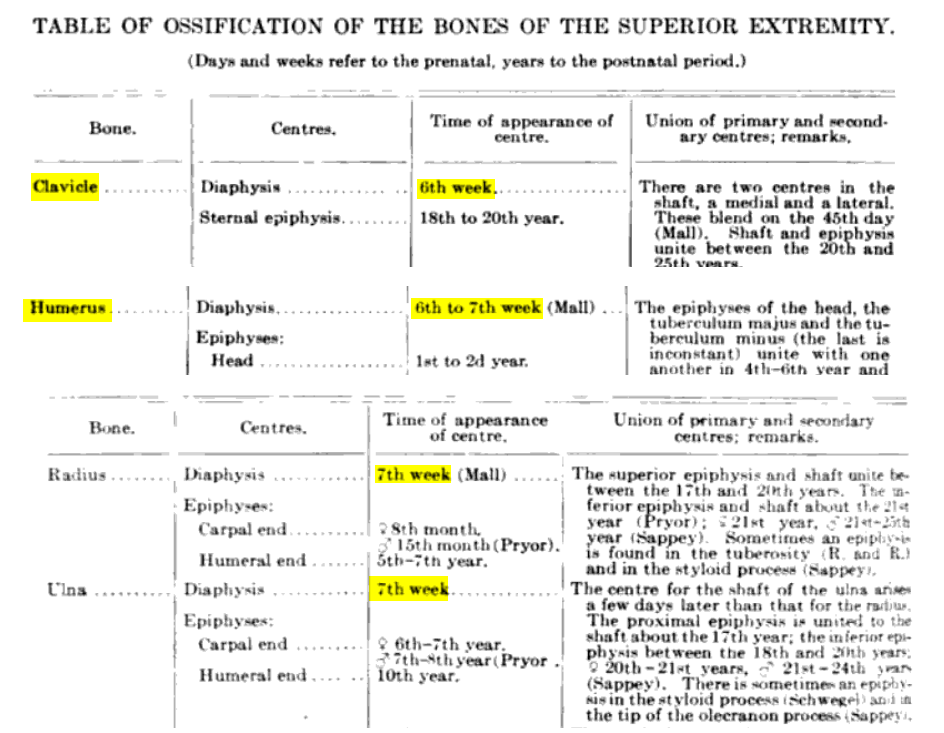
Another source confirms that the radius and ulna begin ossifying in the seventh week:39
Essentials of Anatomy for Dentistry Students (D. R. Singh) shows upper-limb ossification beginning in the seventh week.40
The ASSH Manual of Hand Surgery dates the appearance of the vertebral ossification centres to eight weeks’ gestation:41
Eight weeks’ gestation again equals six weeks of embryonic age from fertilisation.^46
The Textbook of Clinical Embryology (Vishram Singh, 2020) notes that most limb ossification centres appear between the seventh and twelfth weeks:42
Ronald Dudek’s Embryology places the primary ossification centres of the clavicle, humerus, radius, and ulna at weeks 7–9, again naming the clavicle as the first bone in the body to ossify:43
The Elements of Anatomy gives a list of the first appearances of ossification: the clavicle first, in the sixth week, then the scapula, humerus, ulna, and tibia in the seventh.44
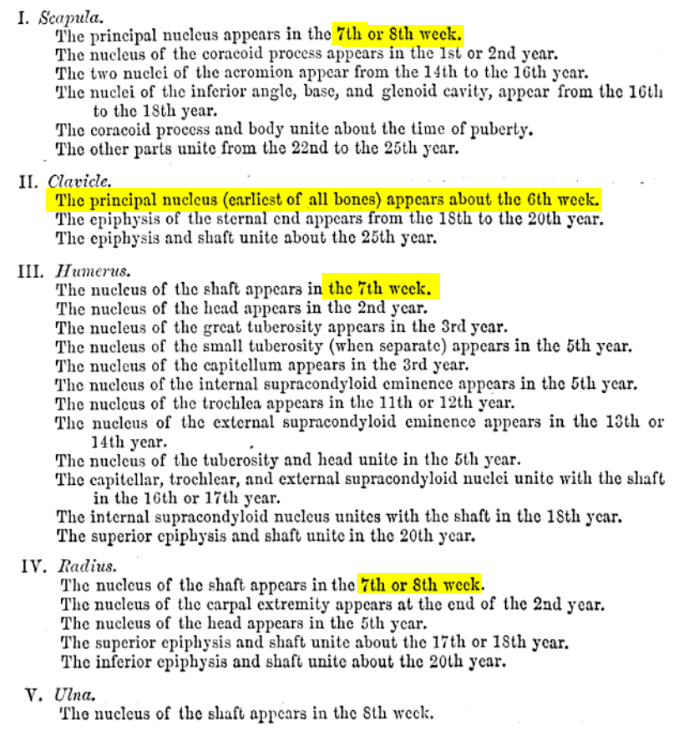
The list continues for the remaining bones.
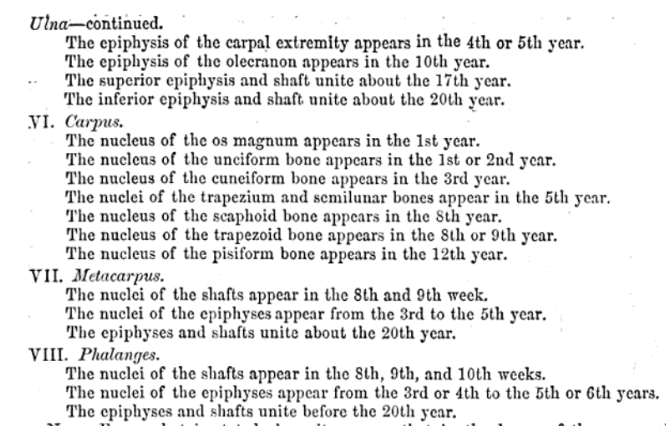
Developmental Anatomy and Physiology of Children (Carol A. Chamley, 2005) names the clavicle as the first bone in the appendicular skeleton to ossify, in the sixth week:45
Anatomy and Human Movement (Palastanga & Soames) places the appearance of the primary shaft centre in the eighth week in utero46 — equal to the sixth week of embryonic age:
Cunningham’s Manual of Practical Anatomy dates the primary centres in the long bones to about eight weeks of intrauterine life:47
Eight weeks of intrauterine life — gestational age from the last menstrual period — equals six weeks of embryonic age from fertilisation.
A table from Growth, Maturation, and Physical Activity closes the main catalogue.
Other Sources
A range of further educational and clinical sources state the same conclusion in plainer terms. The Cleveland Clinic places the replacement of soft cartilage by bone — and the start of genital formation — in the seventh week:^53
BabyCenter notes the outline of the entire skeleton is established by seven weeks:^54
Lumen Learning dates the start of ossification to the sixth or seventh week of embryonic life:^55
Creative Diagnostics places it after seven weeks of embryonic development,^56 and OpenStax repeats the sixth-to-seventh-week window while detailing the two osteogenic pathways:^57
CUNY OpenEd places it at approximately six weeks after fertilisation,^58 as does Bartleby (“about six weeks after fertilization”),^59 and the BC Open Textbook collection, which adds that ossification is distinct from calcification:^60
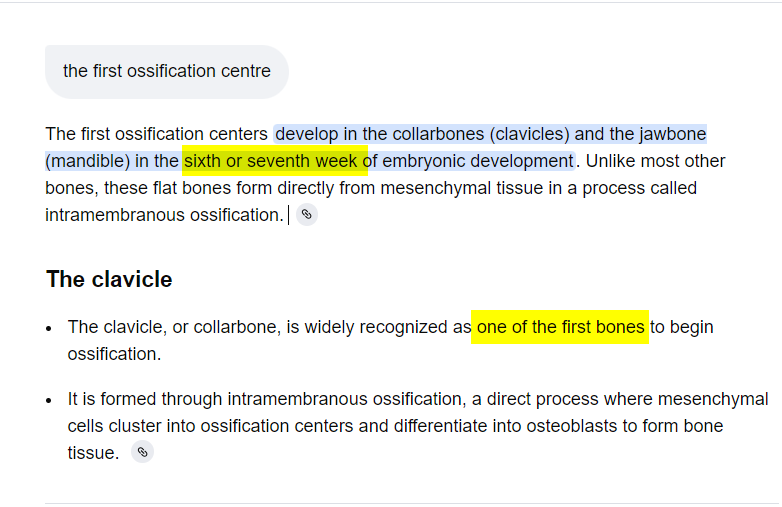
This matches the noble hadith precisely, which places the formation of the bones at day 42:
“When forty-two nights have passed over the nuṭfa, Allah sends an angel to it who forms it and creates its hearing, its sight, its skin, its flesh, and its bones…”
Grade: Ṣaḥīḥ · Muslim (8/45)
The Sex of the Fetus
Sex determination in vertebrates is not, as was first believed, the result of a simple hierarchical cascade of gene actions; it is rather the product of a complex network of positive and negative regulatory interactions.48
The notion that a Y sperm fertilising an X egg yields a male, and an X sperm fertilising an X egg yields a female, is an old idea more than a hundred years old. We have recently discovered that there are numerous genes on the X and Y chromosomes that act as the overseers of the chromosome’s work in forming the embryo’s sex. Among them are six genes whose malfunction causes sex reversal — so that the embryo emerges female despite being chromosomally XY, or male despite being chromosomally XX. These six genes operate only at the end of the sixth week and the start of the seventh, the most important of them being SRY and RSPO1. This means it is not enough for a Y sperm to fertilise an X egg for the embryo to become 100% male; the chromosomal pattern must continue correctly to the end of the sixth week (42 nights), which is decided only by the operation of these six genes. The start of the seventh week is the moment when the possibility of sex reversal closes.
We then found that the gonadal sex of the embryo is not determined until day 42 — that is, the embryo remains bipotential, capable of becoming either male or female, until day 42; only at day 42 do the germ cells begin to differentiate and divide into either male or female.
It is thus established that both chromosomal sex and gonadal sex are not determined until the end of the sixth week and the start of the seventh.
Chromosomal Sex
A note on the dating used by the sources: we will sometimes read “gestational age” (counted from the last menstrual period, i.e. roughly post-conception), which is two weeks longer than the “embryonic age” (counted from fertilisation). So the eighth week of gestation equals the sixth week from fertilisation, and the eighth week from the last menstrual period equals the sixth week of embryonic age.49

A Y sperm fertilising an X egg does not always make the embryo male, nor is XX always female: there are six genes, operating only at the end of the sixth week, capable of reversing the embryo’s sex from male to female and from female to male. If this window passes safely (end of the sixth week, start of the seventh), the embryo’s sex will not reverse. It is therefore not enough for a Y sperm to fertilise an X egg for the embryo to become male; the chromosomal pattern must remain sound until the end of the sixth week — something that will occur only if these six genes operate at the end of the sixth week. Day 42 (end of the sixth, start of the seventh) thus has a pivotal role in determining the embryo’s sex, for it is the period in which the phenomenon of sex reversal closes 100%.
Sex Reversal
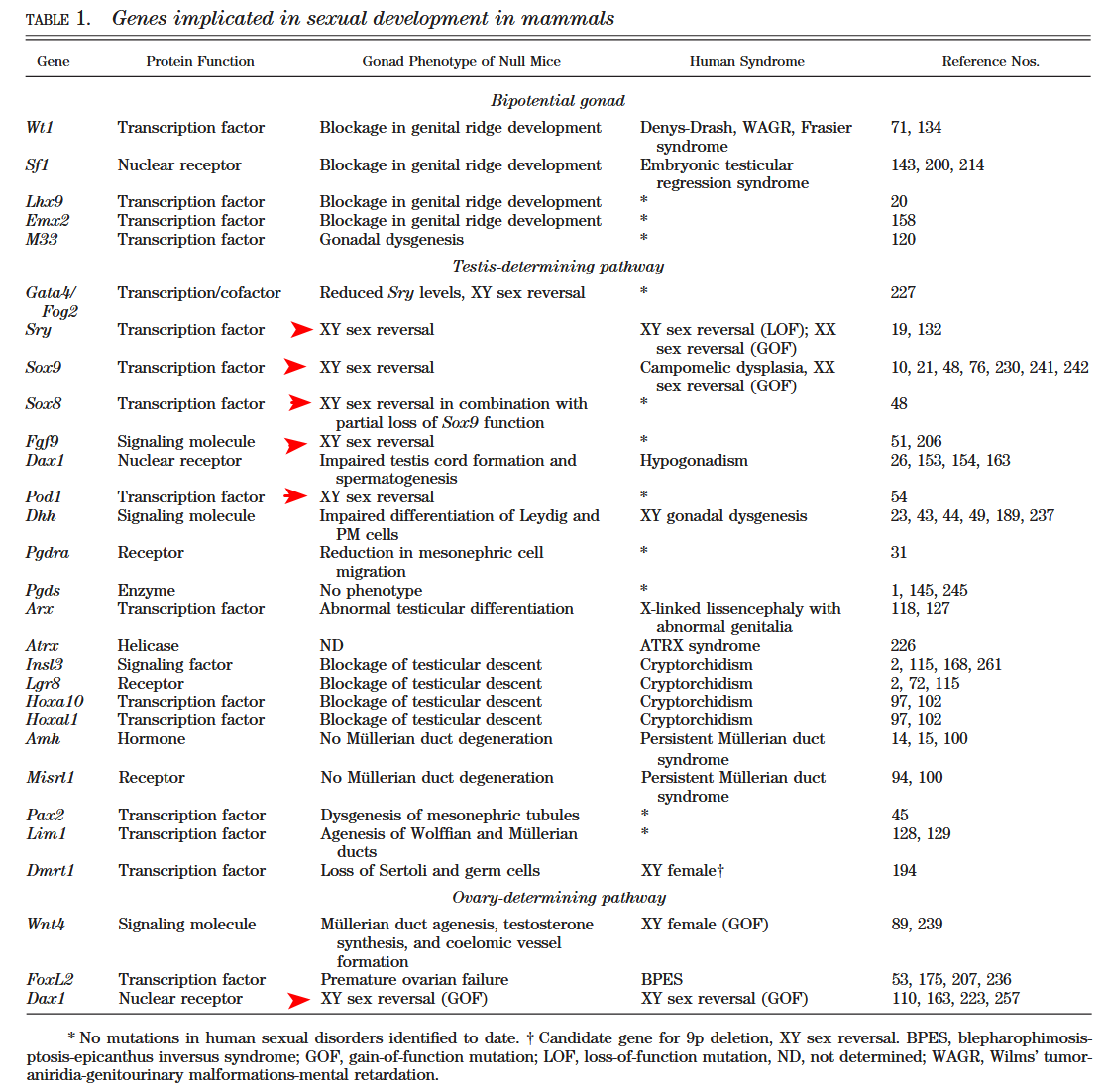
There are seven genes that govern the embryo’s sex, a malfunction in any of which leads to sex reversal:50 SRY, SOX9, SOX8, FGF9, DAX1, RSPO1, and WNT4. All of them, however, are governed by SRY in the male and RSPO1 in the female, as a study on the genetics of disorders of sexual development explains:51
SRY itself, for instance, was discovered when the DNA of four XX males was analysed: all were positive for Y-specific markers in the 35-kilobase region immediately adjacent to the pseudoautosomal boundary. That region was searched for conserved Y-linked sequences, an open reading frame was found, and the corresponding gene was named SRY (sex-determining region Y).52
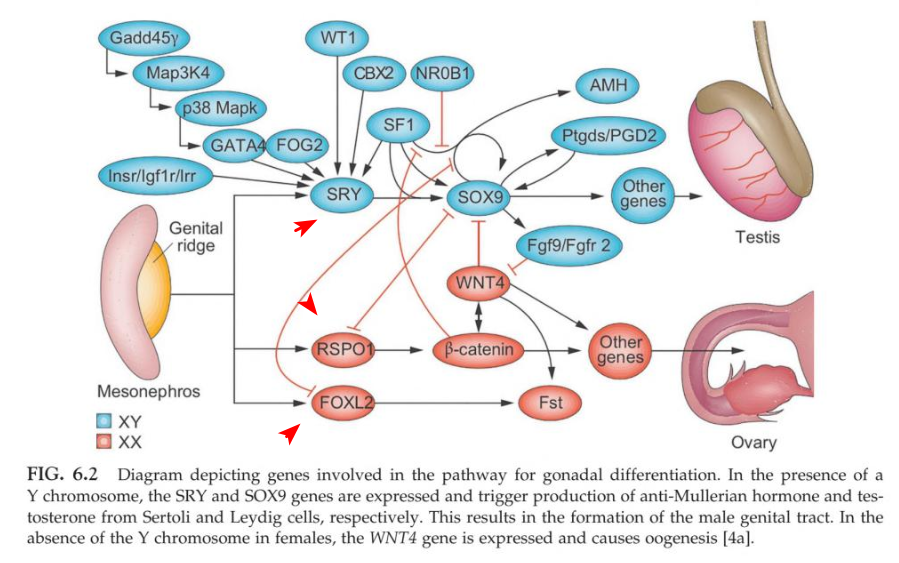
The reference BGDB Sexual Differentiation — Sex Determination presents the same genetic framework.53
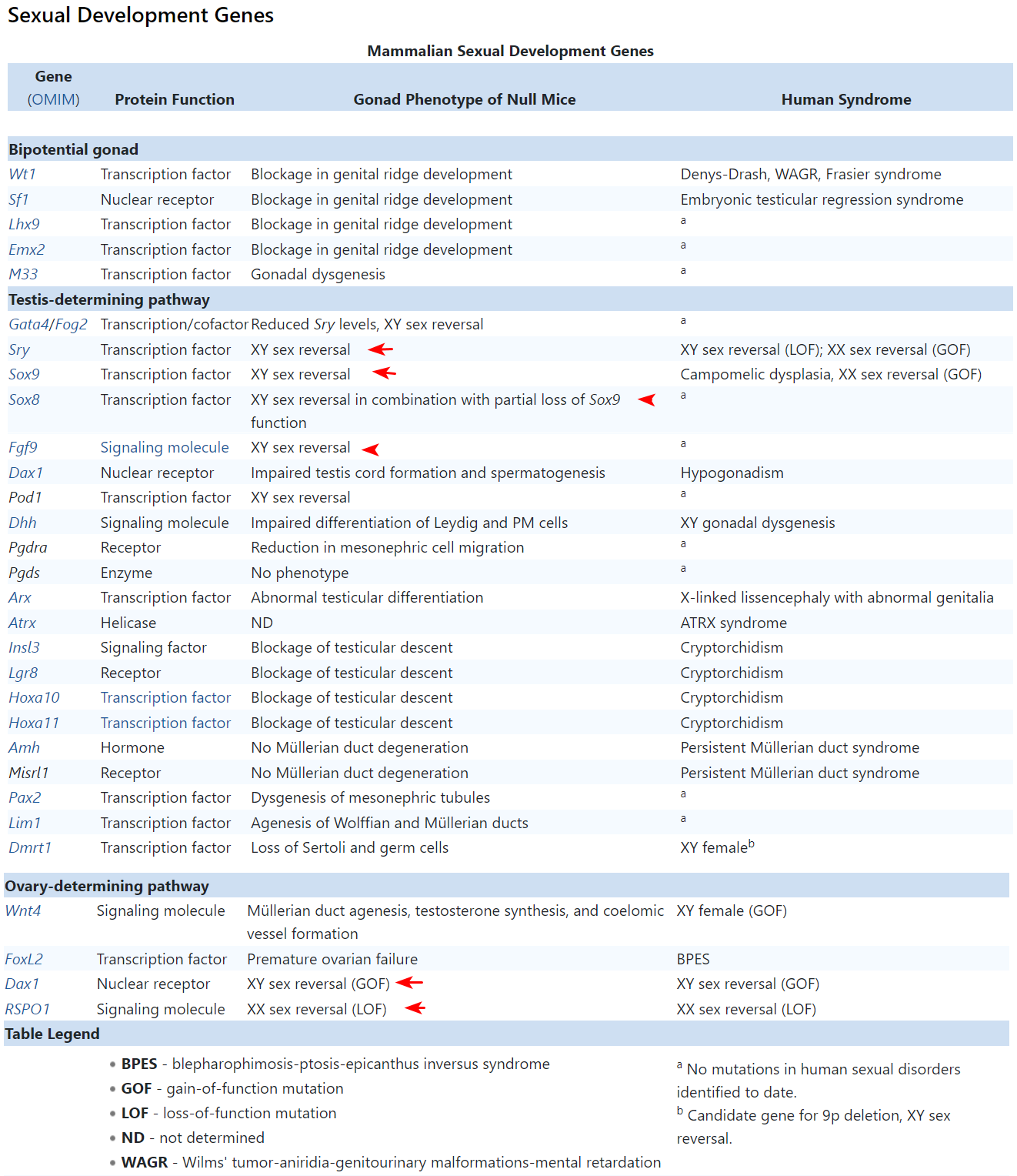
So too does the study Sex Determination and Gonadal Development in Mammals, which tabulates the genes implicated in sexual development.54
The book The Genetics and Biology of Sex Determination distinguishes the male-promoting genes from those that oppose them:55
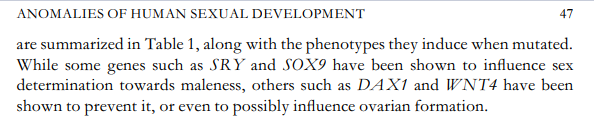
The work Anomalies of Human Sexual Development: Clinical Aspects and Genetic Analysis spells out how disorders of these genes produce sexual ambiguity and full sex reversal, and that the system is dosage-sensitive:56
The dedicated study Sex Reversal frames the process as three phases, during the first two of which the gonad remains plastic and its fate can still be switched:57
Sertoli Cell Biology confirms experimentally that introducing Sry into an XX gonad produces a testis:58
The timing of this divergence is fixed at the end of the sixth week, as Exploring the Dirty Side of Women’s Health states:59
Effective Management of Bladder and Bowel Problems in Children describes the same switch — SRY present yields testes, SRY absent yields ovaries:60
The study SRY — Sex Reversal sets out the gene’s history and its decisive role:61
A clinical case study, XY Sex Reversal Associated with a Nonsense Mutation in SRY, documents an XY individual who developed as female because of a defective SRY:62
Finally, The Genetics and Biology of Sex Determination summarises how the dosage of these very genes can reverse sex in either direction:63
The SRY Gene
Role of SRY
SRY is the testis-determining factor (TDF) — the master switch for the sexual differentiation of the gonad:64
When SRY is expressed in the bipotential gonad during a critical developmental window, it activates SOX9 and the whole male-promoting network, producing a testis; otherwise the female-promoting network prevails and an ovary forms:65
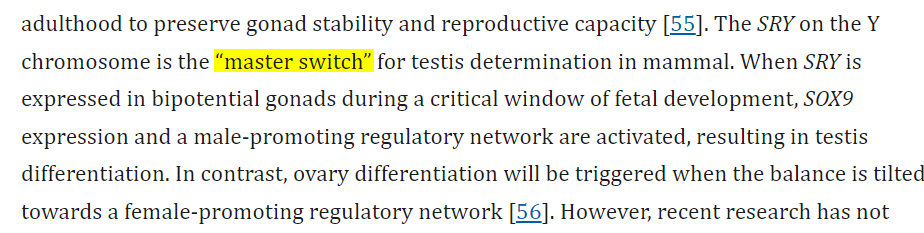
A paper carrying that very description in its title — Sry: the master switch in mammalian sex determination — makes the same point.66
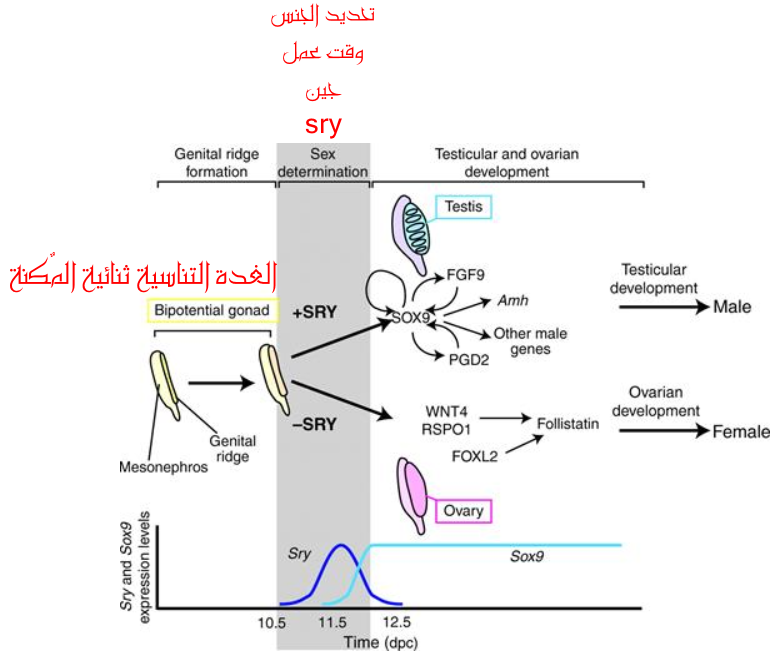
An ontogenic and morphological study of gonadal formation in genetically modified, sex-reversed XYPOS mice frames the whole question in terms of SRY’s presence or absence:67
A gene-editing study in pigs confirms that disrupting SRY drives male-to-female reversal:68
Maternal, Fetal, & Neonatal Physiology names SRY and Wnt4 as the key genes controlling the gonadal ridge’s fate:69
When SRY Activates
This is the decisive question, and the sources converge with striking consistency: SRY switches on in the human embryo at about day 42. The reference Hormones states it directly:70

The Hidden Relay fixes both the onset and the decline of human SRY expression:71
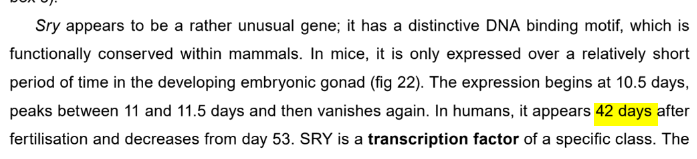
Principles for Evaluating Health Risks in Children gives the same window with a peak at day 44:72
Obstetrics & Gynaecology: An Evidence-based Text for MRCOG places activation at the end of the sixth week:73
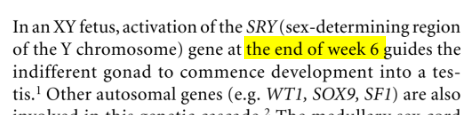
The study The molecular pathways underlying early gonadal development gives the figure of 41–42 days:74
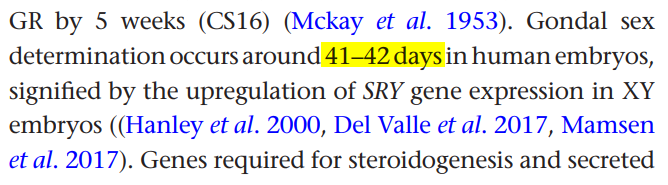
The same Principles for Evaluating Health Risks in Children notes that steroidogenic-cell expression follows testis determination from around day 42 onward:75
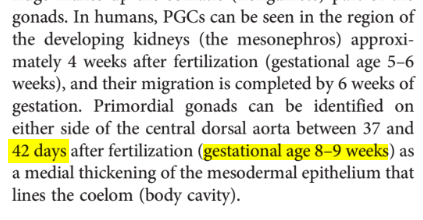
The textbook In-Vitro Fertilization dates the identification of the primordial gonads to 37–42 days after fertilisation:76
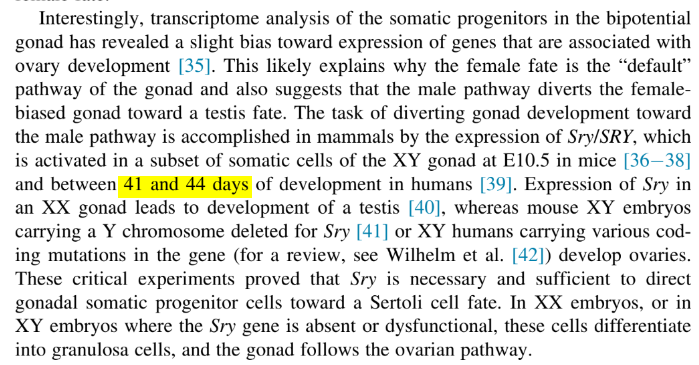
Sertoli Cell Biology gives the human window as 41–44 days:77
The Color Atlas of Human Fetal and Neonatal Histology places the first step of testicular differentiation toward the end of the sixth post-fertilisation week:78
Basics of Gynecology for Examinees presents the same timing in tabular form.79
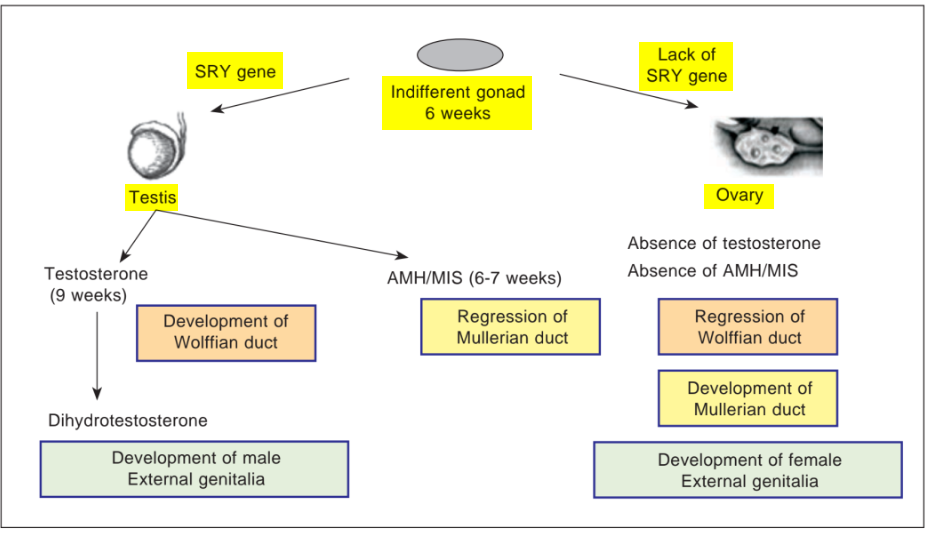
So too does Comprehensive Gynecology.80
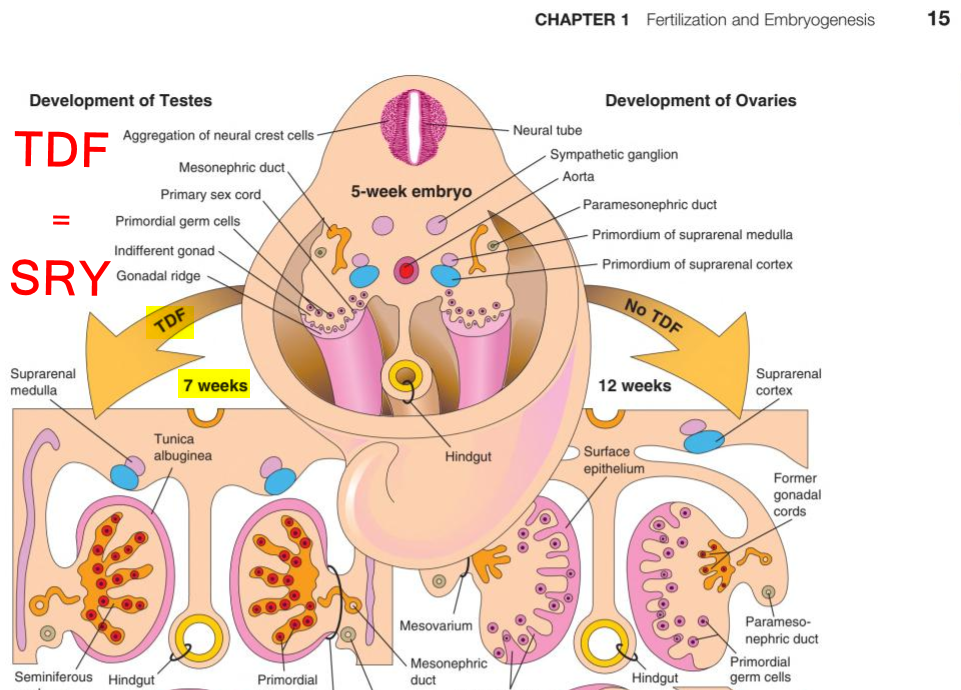
The Nature paper Human sex reversal is caused by duplication or deletion of core enhancers upstream of SOX9 states the human onset at six weeks post-ovulation:81
Essentials of Human Embryology likewise places the start at the end of the sixth week:82

Human Reproductive and Prenatal Genetics describes the divergence of the gonads at about eight weeks’ gestation, with SRY triggering AMH synthesis between weeks eight and nine:83
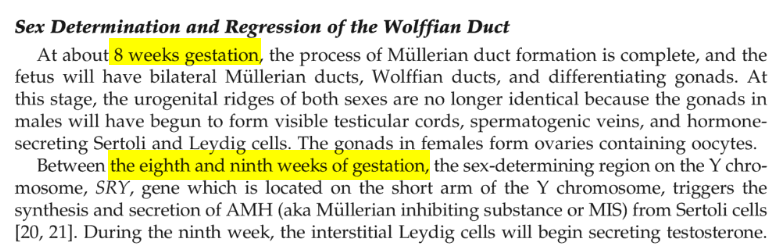
Here again the eighth week of gestation equals the sixth week of embryonic age from fertilisation, and the ninth equals the seventh.
The Encyclopedia of Reproduction dates the formation of the testis to week 7 through the expression of SRY together with SOX9, GATA4, and DAX1:84

SRY’s Effect on the Female Fetus
SRY can be transferred by error during meiosis onto the X chromosome, producing XY females and XX males. Such a female carries an X bearing the SRY gene; if her X is then fertilised by an X sperm, the embryo emerges male despite being XX. The literature documents both directions of this anomaly.
The mechanism is described identically in Sex Determination and Gonadal Development in Mammals:85
There is, conversely, a documented case of complete masculinisation without SRY at all — a study titled SRY-negative 46,XX male with normal genitals, complete masculinization and infertility86 — showing that the network, not the single gene, ultimately governs the outcome.
The WNT4 Gene
Role and Sex Reversal
The same Maternal, Fetal, & Neonatal Physiology passage that lists the key sex-determining genes names Wnt4 alongside SRY:87
WNT4 works in the opposite direction to SRY — it promotes the female pathway, so disrupting it can masculinise a female and overexpressing it can feminise a male:88

The study Sex Reversal explains how the balance tips in either direction, with Wnt4 as the female-side counterweight to Sox9:89
The same dosage sensitivity is summarised by the Genetics of Disorders of Sexual Development:90
When WNT4 Activates
Yen & Jaffe’s Reproductive Endocrinology sets out the timing of the WNT/β-catenin pathway in tabular form.91
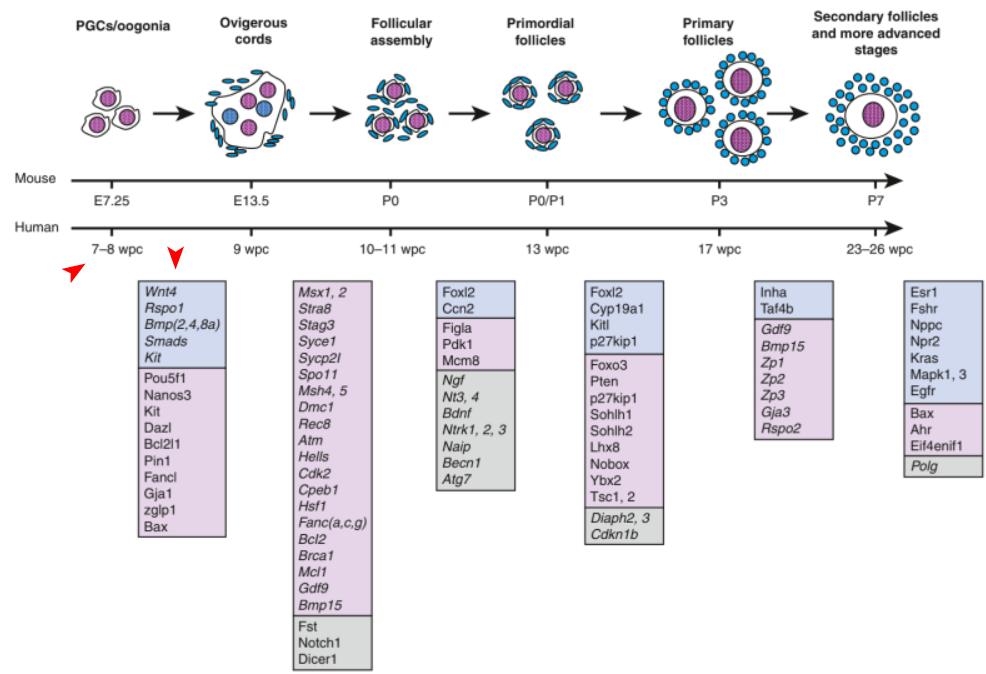
In this source the abbreviation “wpc” means weeks post-conception; the eighth week post-conception equals the sixth week of embryonic age from fertilisation. A study on the same signalling pathway dates its onset to the seventh week:92
The DAX1 Gene
Genes and Mechanisms in Vertebrate Sex Determination identifies DAX1 as an X-linked, ovary-determining gene whose duplication reverses male to female:93
A clinical reproductive text records the same association with adrenal hypoplasia and XY sex reversal:94
The Encyclopedia of Reproduction lists DAX1 among the genes whose expression at week 7 forms the testis:95
The WT1 Gene
Genes and Mechanisms in Vertebrate Sex Determination shows that suppressing WT1 impairs genitourinary development, the most severe defects causing gonadal dysgenesis and sex reversal:96
The SOX9 Gene
SOX9 is downstream of SRY but powerful enough on its own to build a testis: introducing it into an XX mouse, or simply increasing its dosage, produces sex reversal toward maleness.97
The duplication effect is documented directly:98
When SOX9 Activates
The Encyclopedia of Reproduction again dates testis formation — driven by SRY together with SOX9 — to week 7:99
Human Reproductive and Prenatal Genetics shows SOX9 driving AMH secretion between the eighth and ninth gestational weeks:100
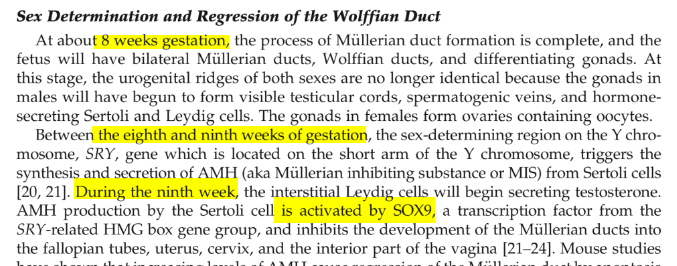
Here again the eighth week of gestation equals the sixth week from fertilisation, and the ninth equals the seventh. Once SRY switches on, it immediately drives SOX9:101
Genetics of Male Infertility describes SOX9 as both necessary and sufficient for testis determination:102
Pediatric Endocrinology repeats that SRY raises SOX9 expression.103
The DMRT1 Gene
The Genetics and Biology of Sex Determination lists the chromosomal region 9p24 — deleted in some XY females — which carries the transcription factors DMRT1 and DMRT2:104
When DMRT1 Activates
Pediatric Endocrinology places the sexually dimorphic expression of DMRT1 in human fetuses of six and seven weeks:105

The RSPO1 Gene
When RSPO1 Activates
By the seventh week from fertilisation (the ninth gestational week), RSPO1 — the master female-side gene — has reached its peak. Pediatric Endocrinology records its rise in the developing ovary in the absence of SRY:106

Yen & Jaffe’s Reproductive Endocrinology tabulates the same timing.107
Eight weeks post-conception (i.e. from the last menstrual period) equals six weeks from fertilisation.
Gonadal Sex
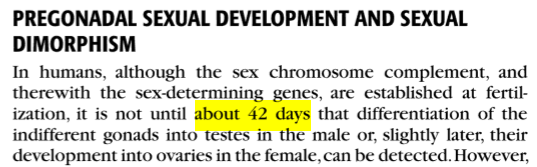
The studies are unanimous that, in terms of its genitalia, the embryo is neither male nor female until day 42: it remains bipotential — capable of becoming either — and the male embryo cannot be distinguished from the female by its genitalia until day 42. This is what scientists call the embryo’s gonadal sex. The germ cells begin to form early, but they do not begin differentiating into male or female genital organs until day 42.
Dr. Albert Singer, a pioneer of colposcopy, dates the indifferent gonad to about day 42 (Carnegie stage 17):108
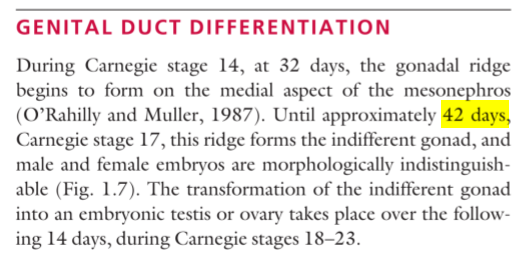
The Textbook for MRCOG-1 fixes the same point — the primitive gonad looks identical in both sexes until day 42:109
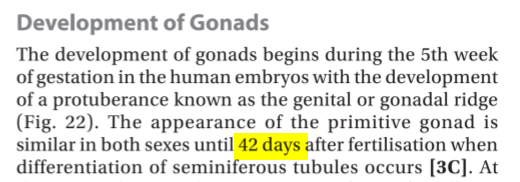
Fetal and Neonatal Physiology stresses that although the sex chromosomes are set at fertilisation, gonadal differentiation cannot be detected until about day 42:110
A multiple-choice text in obstetrics and gynaecology gives the 12-mm (42-day) embryo as the cutoff:111

A Comprehensive Textbook of Obstetrics and Gynecology says the same plainly:112
Essential Endocrinology places the start of differentiation around the fortieth day:113

The MRCOG evidence-based text repeats that the indifferent gonad begins testis development at the end of week 6:114
Dr. Rodolfo Rey’s Sexual Differentiation states that no sexual difference is visible until the sixth week:115

The same source adds that six weeks elapse before the first signs appear:116

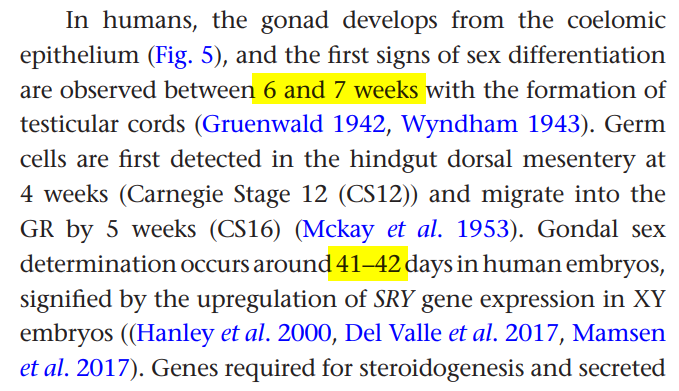
The study Early Gonadal Development and Sex Determination in Mammals puts the first appearance of testis cords at 6–7 weeks:117

The molecular pathways underlying early gonadal development gives both the 6–7-week window and the 41–42-day figure:118
Women’s Healthcare in Advanced Practice Nursing keeps the sexes indistinguishable until about week 7:119
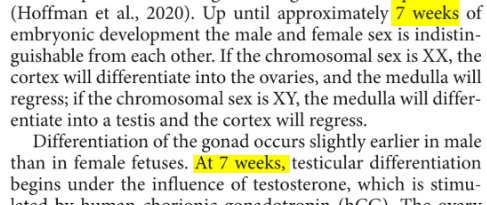
A study on Sertoli-cell hormones places Sry expression in pre-Sertoli cells at week 7:120

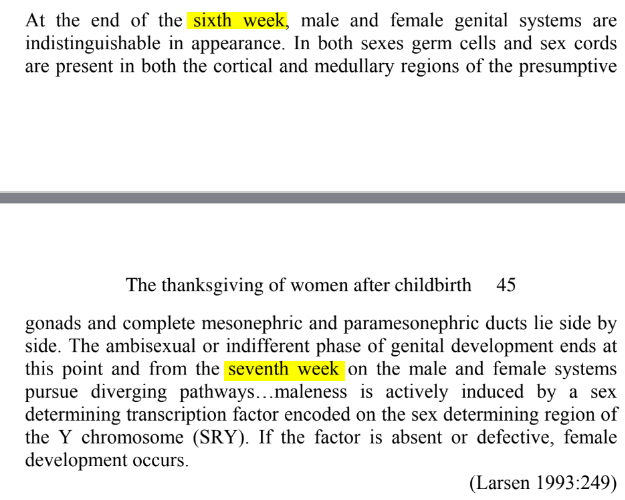
Exploring the Dirty Side of Women’s Health again marks the end of the sixth week as the point at which the systems diverge:121
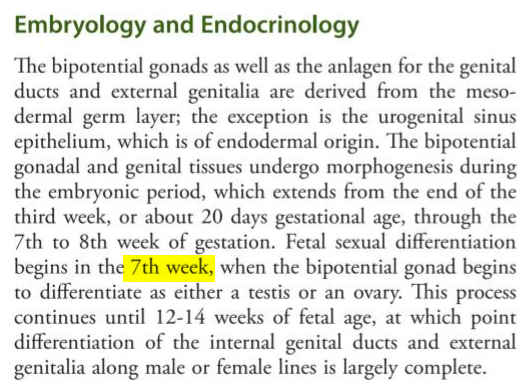
Effective Management of Bladder and Bowel Problems in Children describes the seventh-week embryo as still able to develop either way:122
The Color Atlas of Human Fetal and Neonatal Histology dates the first step of testicular differentiation to the end of the sixth post-fertilisation week:123
Scott Gilbert’s Developmental Biology keeps the gonad sexually indifferent until week 7:124
Fanaroff and Martin’s Neonatal-Perinatal Medicine places the onset of differentiation in the seventh week:125
Human Reproductive and Prenatal Genetics describes the gonads becoming distinguishable around the eighth gestational week:126
Here the eighth gestational week equals the sixth week from fertilisation, and the ninth equals the seventh. Diagnosis and Management of Ovarian Disorders gives the embryonic-ovary stage explicitly at day 42:127
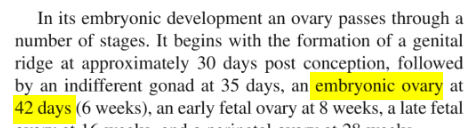
Ovarian Aging makes the same contrast between fertilisation and differentiation:128
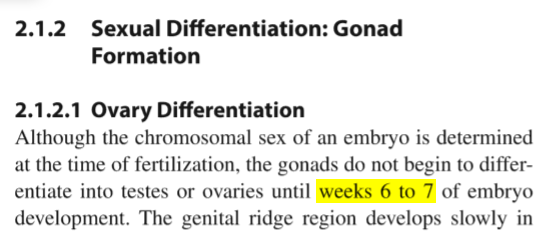
The Core Curriculum for Neonatal Intensive Care Nursing puts gonadal determination at week 7 and notes the fetus is undifferentiated until week 8 gestation:129
A pediatric-gynaecology text adds that the fetus carries both Wolffian and Müllerian ducts until that point:130
Campbell-Walsh-Wein Urology states that the urogenital tract is identical in both sexes before the eighth gestational week:131

The same work describes the first six weeks as bipotential for all the relevant tissues:132
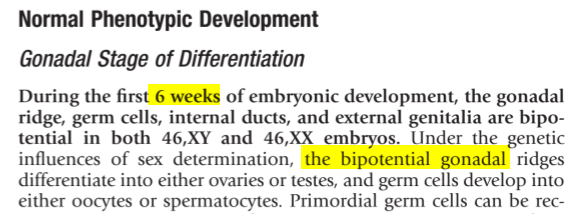
The accompanying figure illustrates this bipotential-to-differentiated transition.133
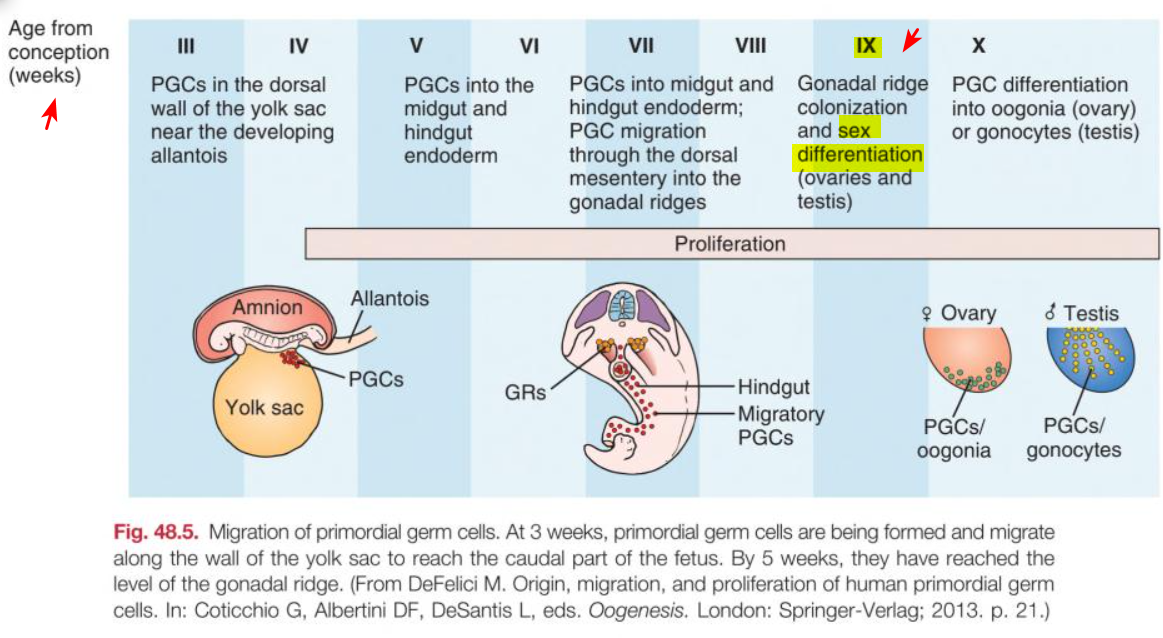
Nine weeks counted from conception equals seven weeks of embryonic age from fertilisation. Finally, Genetic Steroid Disorders dates the initiation of ovarian and testicular differentiation to six weeks:134

A chart of disorders of sex development summarises how these pathways can go awry.
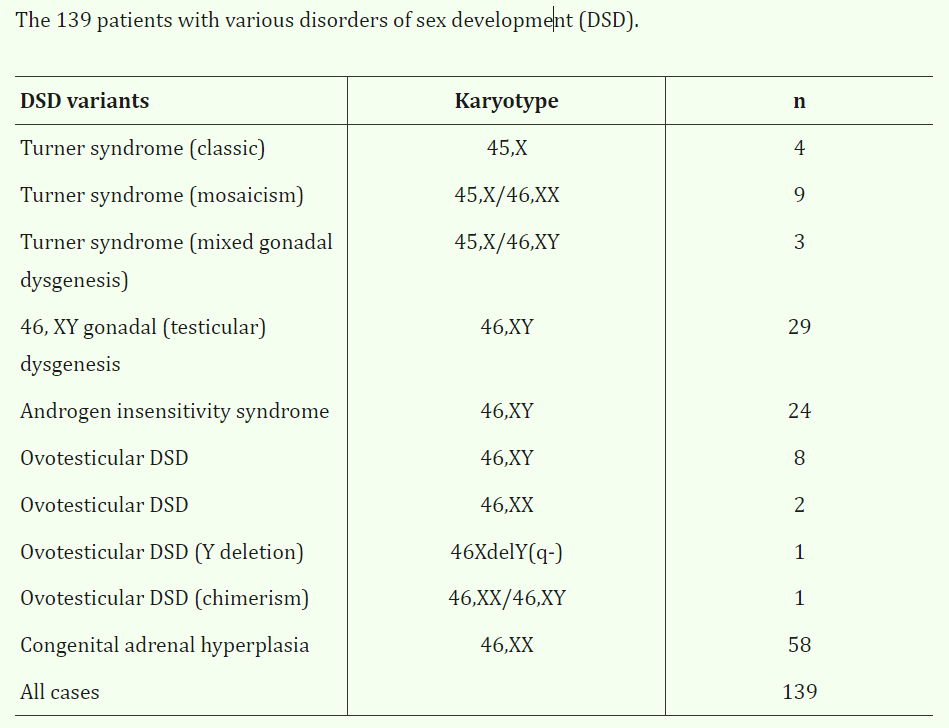
It is thus established that both the chromosomal sex and the gonadal sex of the embryo are decided only at the end of the sixth week and the start of the seventh — exactly the moment the hadith names.
Key Genes in Sex Determination
The whole network can be summarised in a single figure of the genes that determine the embryo’s sex.135
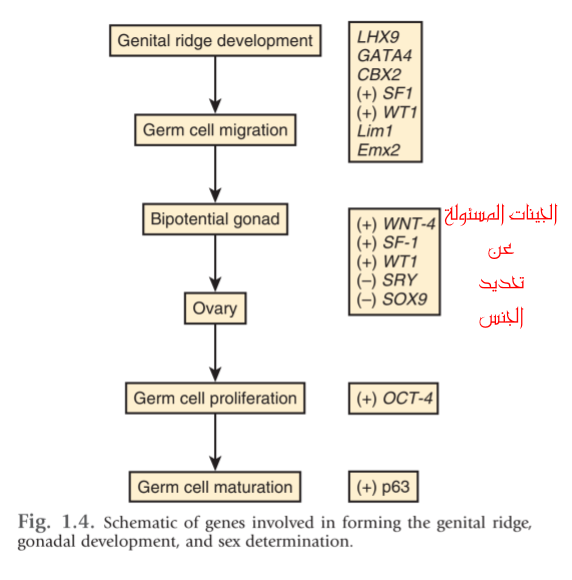
Many genes are necessary for determining the embryo’s sex, but all of them are ultimately governed by SRY in the male and RSPO1 in the female:136
Beyond the testis-promoting SRY and SOX9, other critical genes fall into two groups:137 the X-linked genes such as DAX-1, and the autosomal genes involved in gonad formation such as SF-1 and WT-1.
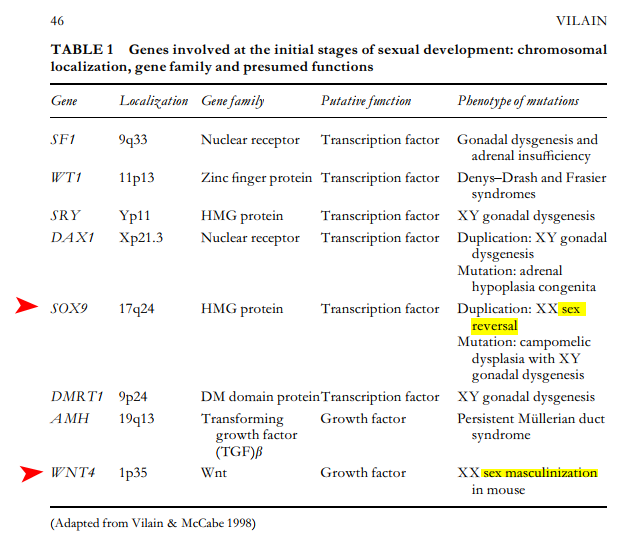
A table of the most important genes affecting the embryo’s sex sets them out in full,138 as does a second table flagging specifically those whose malfunction causes sex reversal.139
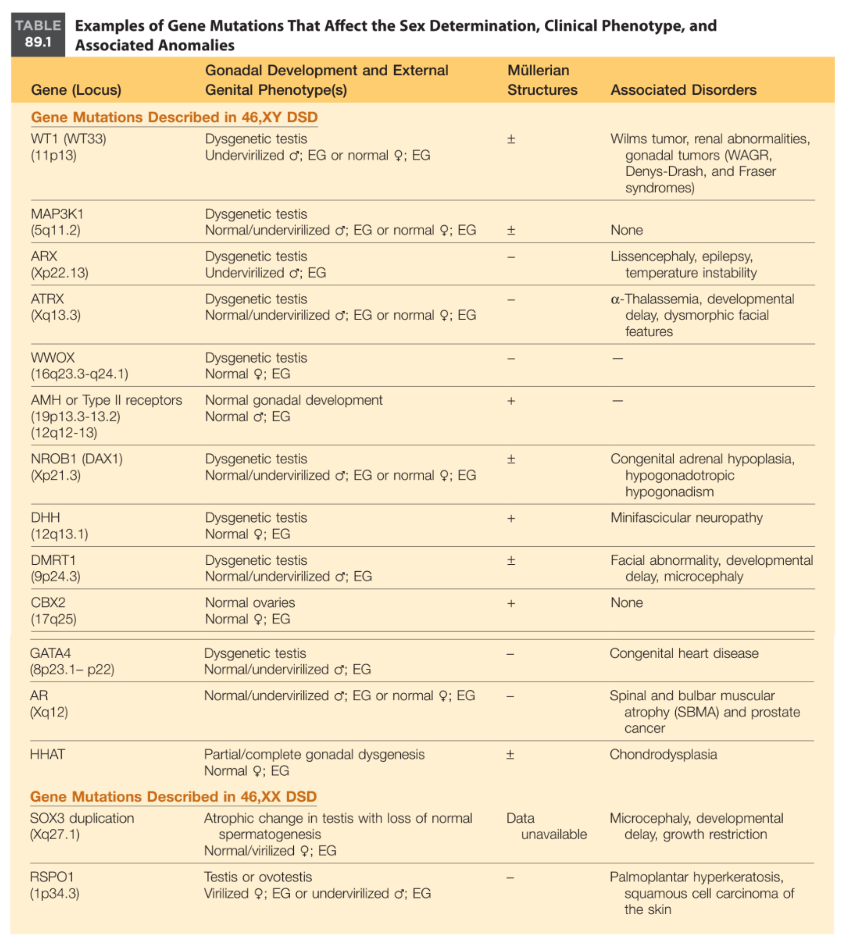
The second table marks the reversal-causing genes among them.
The Chains of the Nuṭfa Hadith — A Ḥadīth-Methodology Study
Having established the scientific case, the author turns to the chains of transmission (ṭuruq) of the nuṭfa hadith. The aim is to demonstrate that the correct, authentic wording is the forty-two-nights formulation cited at the outset from Ṣaḥīḥ Muslim, and to clear away the confusion surrounding the various wordings — in particular the claim that the bones, flesh, hearing, sight, and sex form only on day 120. What follows is a summary map of the entire transmission.
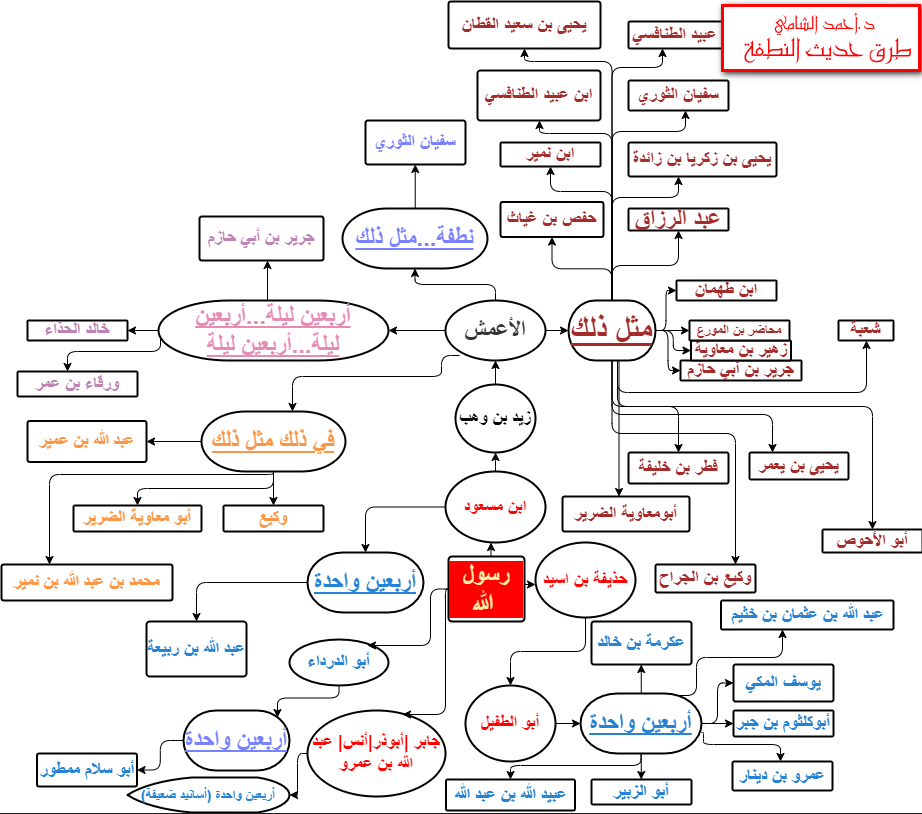
The Companions Who Narrated It
Three Companions narrated the hadith from the Messenger of Allah ﷺ with an authentic chain: Ibn Masʿūd, Ḥudhayfa ibn Asīd, and Abū al-Dardāʾ — in addition to Anas ibn Mālik, though his narration did not mention the time periods.
Four Companions narrated it with weak chains: Jābir ibn ʿAbdillāh, Abū Dharr, ʿAbdullāh ibn ʿAmr, and Anas ibn Mālik (in a wording other than the well-known authentic one that is free of any timing).
Only one Companion — Ibn Masʿūd — is reported as narrating it in all three of the “forties” wordings.
The “single forty” wording, by contrast, is reported from seven individuals: Ibn Masʿūd (authentic chain), Ḥudhayfa ibn Asīd (authentic chain), and Abū al-Dardāʾ (authentic chain); and Jābir ibn ʿAbdillāh, ʿAbdullāh ibn ʿAmr, Abū Dharr, and Anas ibn Mālik (all with weak chains, Anas’s being a wording other than the well-known time-free one).
The Main Wordings of the Hadith
There are four principal wordings:
The first wording — “the like of that” (mithl dhālik). The second wording — “in that, the like of that” (fī dhālik mithl dhālik). The third wording — “a single forty” (arbaʿīn wāḥida). The fourth wording — “forty days… and forty days… and forty days.”
| First wording — “the like of that” | Second wording — “in that, the like of that” | Third wording — “a single forty” | Fourth wording — “forty days ×3” | |
|---|---|---|---|---|
| The chains | All from al-Aʿmash, from Zayd ibn Wahb, from Ibn Masʿūd | All from al-Aʿmash, from Zayd ibn Wahb, from Ibn Masʿūd | Established from the Companions Ḥudhayfa ibn Asīd, Abū al-Dardāʾ, and Ibn Masʿūd; and narrated through weak chains that strengthen one another from four Companions (Jābir, Abū Dharr, ʿAbdullāh ibn ʿAmr), in addition to Anas ibn Mālik (a different wording containing the timing, not the authentic time-free one) | All from Zayd ibn Wahb, from Ibn Masʿūd. (Note): there are two other chains from Ibn Masʿūd — (1) Abū Wāʾil via ʿĀṣim, and (2) the chain of al-Mukhāriq ibn Sulaym from Ibn Masʿūd — neither of which is authentic; their texts differ so severely from the authentic text that they cannot be authenticated by the combined chains |
| The text | ”…then a clot the like of that, then it becomes a morsel of flesh the like of that" | "…then in that it becomes a clot the like of that" | "The nuṭfa falls into the womb for forty nights" | "Forty nights as a nuṭfa, forty nights as a clot, and forty nights as a morsel of flesh” |
The Weak Narrators
The following narrators in the various weak chains are the points of failure.
Al-Haytham ibn Jahm — none authenticated him except Ibn Ḥibbān, who is lenient in authenticating unknown narrators, and al-Dāraquṭnī, who often authenticates and lifts the unknown status of a narrator merely on the strength of two or more reliable narrators transmitting from someone whom no one has disparaged — on condition that there is no objectionable matter (nakāra) in the text. (For al-Dāraquṭnī’s and Ibn Ḥibbān’s method in authenticating unknown narrators, see the author’s study The Method of the Ḥadīth Critics in Authenticating the Unknown Narrator, here.) This kind of authentication requires a sound text; here the text is objectionable because it mentions four forties.
Mūsā ibn Masʿūd — weak, poor in memory, not strong, “next to nothing,” prone to misreading; one who has insight into hadith does not narrate from him. Thirteen scholars of jarḥ and taʿdīl declared him weak:
ʿUbaydullāh ibn ʿAbdillāh ibn Masʿūd — did not hear from his father.
ʿAlī ibn Zayd ibn Judʿān — weak.
Aḥmad ibn ʿUbayd ibn Ismāʿīl — unknown (majhūl).
Ḥammād ibn Salama — reliable, but his memory became confused (ikhtilāṭ).
Al-Mukhāriq ibn Sulaym — his companionship is not established, and none authenticated him except Ibn Ḥibbān, who is well known for authenticating weak narrators; the authors of Taḥrīr Taqrīb al-Tahdhīb said he is “unknown — for how can his companionship be established by a hadith with a disturbed chain, over which there is so much disagreement that nothing is settled?”
ʿAbdullāh ibn al-Mukhāriq — unknown (majhūl).
ʿAbd al-Raḥmān ibn ʿAbdillāh al-Masʿūdī — reliable, but his memory became confused and changed at the end of his life; disturbed in hadith, abandoned in hadith; even Ibn Ḥibbān, who is strict in disparagement, disparaged him.
ʿĀṣim ibn ʿAlī — disputed over.
ʿĀṣim ibn Abī al-Najūd — truthful, but poor and bad in memory, disturbed in hadith, given to errors of memory, his memory became confused at the end, frequently mistaken:
The Tābiʿūn Who Narrated the Three-Forties Wording from Ibn Masʿūd
Three followers narrated this wording from Ibn Masʿūd: Zayd ibn Wahb (authentic chain), al-Mukhāriq ibn Sulaym (not authentic), and Abū Wāʾil Shaqīq ibn Salama (not authentic).
The two chains that are not authentic from Ibn Masʿūd are as follows.
The first, from al-Sunna by al-Khallāl, runs through al-Haytham ibn Jahm and Mūsā ibn Masʿūd:
“When the nuṭfa settles in the womb it reaches every hair and skin; then it is a nuṭfa for forty nights, then a clot for forty nights, then a morsel of flesh for forty nights, then bones for forty nights, then Allah clothes the bone with flesh…”
Grade: Weak — its chain turns on al-Haytham ibn Jahm and Mūsā ibn Masʿūd, and the text is objectionable because it mentions four forties.140
This chain also suffers from singularity (tafarrud). Al-Ṭabarānī notes that only al-Haytham ibn Jahm narrated it from ʿĀṣim, only Abū Ḥudhayfa narrated it from him, and al-Ḥasan ibn ʿArafa was alone in narrating it from Abū Ḥudhayfa.141 The editor of al-Khallāl’s al-Sunna, Dr. ʿAṭiyya al-Zahrānī, likewise declared it weak.142
The second, from al-Ṭabarānī’s al-Muʿjam al-Kabīr, runs through al-Masʿūdī, ʿAbdullāh ibn al-Mukhāriq, and his father al-Mukhāriq ibn Sulaym:
”…The nuṭfa is in the womb for forty, then a clot for forty, then a morsel of flesh for forty; and when Allah wishes to create the creation an angel descends…” Then ʿAbdullāh recited: {Indeed We created man from a sperm-drop mixture, that We may try him} [al-Insān 76:2], and said: “the ‘mixture’ (amshāj) is the veins.”
Grade: Weak — turning on al-Mukhāriq ibn Sulaym (companionship unestablished, unknown), ʿAbdullāh ibn al-Mukhāriq (unknown), ʿAbd al-Raḥmān al-Masʿūdī (confused memory), and ʿĀṣim ibn ʿAlī (disputed).143
Neither of these two can strengthen the other, because they share the same point of origin (ittiḥād al-makhraj) — both come from Ibn Masʿūd, yet with severe divergence in the text.
The Three-Forties Narrations: Enumeration of the Chains
The “three forties” material is now traced wording by wording. In what follows, every chain (silsila) shares the same upper stem — Ibn Masʿūd → Zayd ibn Wahb al-Juhanī → al-Aʿmash — unless otherwise noted; the tables list the transmitters below that stem and the collection in which each route is recorded.
Wording 1: “the like of that” (without the Word nuṭfa)
All twenty routes run from al-Aʿmash, from Zayd ibn Wahb, from Ibn Masʿūd:
| # | Below al-Aʿmash → … → Source |
|---|---|
| 1 | Mashyakha ibn Ṭahmān → Musnad Aḥmad |
| 2 | Jarīr ibn Abī Ḥāzim → al-Qadar by Ibn Wahb |
| 3 | Zuhayr ibn Muʿāwiya → Ibn Nufayl → Mustakhraj Abī ʿAwāna |
| 4 | Shuʿba → several narrators → Ṣaḥīḥ al-Bukhārī and others |
| 5 | Muḥāḍir ibn al-Muwarriʿ → al-ʿAbbās al-Dūrī → Mustakhraj Abī ʿAwāna |
| 6 | ʿAbd al-Razzāq → Jāmiʿ Maʿmar |
| 7 | Yaḥyā ibn Zakariyyā ibn Abī Zāʾida → ʿAlī ibn al-Madīnī → ʿAbd al-Raḥmān ibn Muḥammad al-Qurashī → al-Qadar by Ibn Wahb |
| 8 | Sufyān al-Thawrī → Muṣannaf ʿAbd al-Razzāq |
| 9 | Muḥammad ibn ʿUbayd al-Ṭanāfusī → Musnad al-Ḥumaydī |
| 10 | Abū Muʿāwiya al-Ḍarīr → Musnad Aḥmad |
| 11 | (via Salama ibn Kuhayl, not al-Aʿmash) Salama ibn Kuhayl → Fiṭr ibn Khalīfa → Ḥusayn ibn Muḥammad → Musnad Aḥmad |
| 12 | Yaḥyā ibn Yaʿmar → Musnad Aḥmad |
| 13 | Wakīʿ ibn al-Jarrāḥ → Musnad Aḥmad |
| 14 | Abū al-Aḥwaṣ → al-Ḥasan ibn al-Rabīʿ → Ṣaḥīḥ al-Bukhārī |
| 15 | Ḥafṣ ibn Ghiyāth → ʿUmar ibn Ḥafṣ ibn Ghiyāth → Ṣaḥīḥ al-Bukhārī |
| 16 | Muḥammad ibn ʿAbdillāh ibn Numayr → Abū Bakr ibn Abī Shayba → Ṣaḥīḥ Muslim |
| 17 | Muḥammad ibn ʿUbayd al-Ṭanāfusī → Abū Muʿāwiya al-Ḍarīr → ʿAlī ibn Maymūn al-Raqqī → Sunan Ibn Mājah |
| 18 | Yaḥyā ibn Saʿīd al-Qaṭṭān → Muḥammad ibn al-Muthannā → al-Sunna by Ibn Abī ʿĀṣim |
| 19 | Sharīk al-Nakhaʿī → Sunan al-Nasāʾī |
| 20 | al-Ḥimmānī → al-ʿAbbās al-Dūrī → al-Musnad by al-Shāshī |
A large company narrated this hadith from al-Aʿmash; Ibn Wahb names many of them:144
Ibn Ḥajar adds that he himself collected nearly forty routes from al-Aʿmash in a dedicated treatise.145
Wording 2: “the like of that” (with the Word nuṭfa)
A single route: Ibn Masʿūd → Zayd ibn Wahb al-Juhanī → al-Aʿmash → from the hadith of Sufyān.
Wording 3: “forty Nights, and Forty Nights, and Forty nights”
This wording comes through seven routes, several of which carry the weak narrators identified earlier:
| # | The chain |
|---|---|
| 1 | Ibn Masʿūd → Abū Wāʾil → ʿĀṣim ibn Bahdala → al-Haytham ibn Jahm → Mūsā ibn Masʿūd → al-Ḥasan ibn ʿArafa → al-Sunna by al-Khallāl |
| 2 | Zayd ibn Wahb → al-Aʿmash → Jarīr ibn Ḥāzim → Ibn Wahb → Yūnus → Sharḥ Mushkil al-Āthār |
| 3 | Zayd ibn Wahb → Salama ibn Kuhayl → Fiṭr ibn Khalīfa → Yaḥyā ibn Khallād → Bishr ibn Mūsā → Juzʾ min ḥadīth Abī ʿAlī |
| 4 | al-Mukhāriq ibn Sulaym → ʿAbdullāh ibn al-Mukhāriq → ʿAbd al-Raḥmān al-Masʿūdī → ʿĀṣim ibn ʿAlī → ʿUmar ibn Ḥafṣ al-Sadūsī → al-Muʿjam al-Kabīr / Muʿjam Shuyūkh Ibn al-Aʿrābī |
| 5 | Zayd ibn Wahb → al-Aʿmash → Khālid al-Ḥadhdhāʾ → Ḥammād ibn Salama → Muʾammal ibn Ismāʿīl → Aḥmad ibn ʿUbayd ibn Ismāʿīl |
| 6 | Zayd ibn Wahb → Salama ibn Kuhayl → Fiṭr ibn Khalīfa → ʿUbaydullāh ibn Mūsā → Isḥāq ibn Yasār → al-Qadar by al-Firyābī |
| 7 | Zayd ibn Wahb → al-Aʿmash → Warqāʾ ibn ʿUmar → Sallām ibn Sulaymān → Muḥammad ibn ʿĪsā → Khaythama ibn Sulaymān / Aḥādīth Abī al-Ḥusayn al-Kilābī |
The narrators that render these routes weak are as identified above: al-Mukhāriq ibn Sulaym (companionship unestablished, unknown), ʿAbdullāh ibn al-Mukhāriq (unknown), ʿAbd al-Raḥmān al-Masʿūdī (reliable but confused in memory, disturbed, abandoned in hadith — disparaged even by Ibn Ḥibbān), ʿĀṣim ibn ʿAlī (disputed over), and Mūsā ibn Masʿūd (weak, poor memory, “next to nothing,” declared weak by thirteen critics, as detailed in the weak-narrators section above).
Wording 4: “and when the Forty pass” (fa-idhā Maḍat al-arbaʿūn)
A single route: ʿAbdullāh ibn Masʿūd → ʿUbaydullāh ibn ʿAbdillāh ibn Masʿūd → ʿAlī ibn Zayd ibn Judʿān → Hushaym ibn Bashīr → Musnad Aḥmad. This route is weak: ʿUbaydullāh did not hear from his father, and ʿAlī ibn Zayd ibn Judʿān is weak.
Wording 5: “then in that it becomes… the like of that” (thumma Yakūnu Fī dhālik… Mithl dhālik)
From Ibn Masʿūd → Zayd ibn Wahb → al-Aʿmash, branching to four narrators — Wakīʿ, Abū Muʿāwiya, Muḥammad ibn ʿAbdillāh ibn Numayr, and ʿAbdullāh ibn Numayr — all recorded in Ṣaḥīḥ Muslim.
The Three-Forties Narrations: Index of Chains
Before the full narration texts, the author lays out an index of every chain (ṭarīq) for each wording, to show how the transmission is distributed. Unless otherwise noted, every chain shares the common stem: Ibn Masʿūd ← Zayd ibn Wahb al-Juhanī ← al-Aʿmash.
Wording “the like of that” (without the word nuṭfa) — twenty chains
| # | From al-Aʿmash (or from Zayd ibn Wahb) onward | Source |
|---|---|---|
| 1 | Mishyakha ibn Ṭahmān | — |
| 2 | Jarīr ibn Abī Ḥāzim → Ibn Wahb | al-Qadar by Ibn Wahb |
| 3 | Zuhayr ibn Muʿāwiya → Ibn Nufayl | Mustakhraj Abī ʿAwāna |
| 4 | Shuʿba → several narrators | Ṣaḥīḥ al-Bukhārī and others |
| 5 | Muḥāḍir ibn al-Muwarriʿ → ʿAbbās al-Dūrī | Mustakhraj Abī ʿAwāna |
| 6 | ʿAbd al-Razzāq (← Maʿmar) | al-Jāmiʿ of Maʿmar |
| 7 | Yaḥyā ibn Zakariyyā ibn Abī Zāʾida → ʿAlī ibn al-Madīnī → ʿAbd al-Raḥmān ibn Muḥammad al-Qurashī | al-Qadar by Ibn Wahb |
| 8 | Sufyān al-Thawrī | Muṣannaf ʿAbd al-Razzāq |
| 9 | Muḥammad ibn ʿUbayd al-Ṭanāfisī | Musnad al-Ḥumaydī |
| 10 | Abū Muʿāwiya al-Ḍarīr | Musnad Aḥmad |
| 11 | (via Zayd ibn Wahb ←) Salama ibn Kuhayl → Fiṭr ibn Khalīfa → Ḥusayn ibn Muḥammad | Musnad Aḥmad |
| 12 | Yaḥyā ibn Yaʿmar | Musnad Aḥmad |
| 13 | Wakīʿ ibn al-Jarrāḥ | Musnad Aḥmad |
| 14 | Abū al-Aḥwaṣ → al-Ḥasan ibn al-Rabīʿ | Ṣaḥīḥ al-Bukhārī |
| 15 | Ḥafṣ ibn Ghiyāth → ʿUmar ibn Ḥafṣ ibn Ghiyāth | Ṣaḥīḥ al-Bukhārī |
| 16 | Muḥammad ibn ʿAbdillāh ibn Numayr → Abū Bakr ibn Abī Shayba | Ṣaḥīḥ Muslim |
| 17 | Muḥammad ibn ʿUbayd al-Ṭanāfisī / Abū Muʿāwiya al-Ḍarīr → ʿAlī ibn Maymūn al-Raqqī | Sunan Ibn Mājah |
| 18 | Yaḥyā ibn Saʿīd al-Qaṭṭān → Muḥammad ibn al-Muthannā | al-Sunna by Ibn Abī ʿĀṣim |
| 19 | Sharīk al-Nakhaʿī | Sunan al-Nasāʾī |
| 20 | al-Ḥimmānī → ʿAbbās al-Dūrī | al-Musnad by al-Shāshī |
A great many narrators transmitted this hadith from al-Aʿmash. Ibn Wahb records:144
Ibn Ḥajar adds that he himself compiled the chains in a separate booklet: “I had documented it in a juzʾ comprising about forty separate chains from al-Aʿmash.”145
Wording “the like of that” (with the word nuṭfa)
This comes through the single line: Ibn Masʿūd ← Zayd ibn Wahb al-Juhanī ← al-Aʿmash, from the hadith of Sufyān.
Wording “forty nights… and forty nights… and forty nights” — seven chains
| # | Chain | Source |
|---|---|---|
| 1 | Abū Wāʾil ← ʿĀṣim ibn Bahdala ← al-Haytham ibn Jahm ← Mūsā ibn Masʿūd ← al-Ḥasan ibn ʿArafa | al-Sunna by al-Khallāl |
| 2 | Zayd ibn Wahb ← al-Aʿmash ← Jarīr ibn Ḥāzim ← Ibn Wahb ← Yūnus | Sharḥ Mushkil al-Āthār |
| 3 | Zayd ibn Wahb ← Salama ibn Kuhayl ← Fiṭr ibn Khalīfa ← Yaḥyā ibn Khallād ← Bishr ibn Mūsā | Juzʾ min ḥadīth Abī ʿAlī |
| 4 | al-Mukhāriq ibn Sulaym ← ʿAbdullāh ibn al-Mukhāriq ← ʿAbd al-Raḥmān al-Masʿūdī ← ʿĀṣim ibn ʿAlī ← ʿUmar ibn Ḥafṣ al-Sadūsī | al-Muʿjam al-Kabīr (al-Ṭabarānī); Muʿjam Shuyūkh Ibn al-Aʿrābī |
| 5 | Zayd ibn Wahb ← al-Aʿmash ← Khālid al-Ḥadhdhāʾ ← Ḥammād ibn Salama ← Muʾammal ibn Ismāʿīl | (collection of) Aḥmad ibn ʿUbayd ibn Ismāʿīl |
| 6 | Zayd ibn Wahb ← Salama ibn Kuhayl ← Fiṭr ibn Khalīfa ← ʿUbaydullāh ibn Mūsā ← Isḥāq ibn Yasār | al-Qadar by al-Firyābī |
| 7 | Zayd ibn Wahb ← al-Aʿmash ← Waraqāʾ ibn ʿUmar ← Sallām ibn Sulaymān ← Muḥammad ibn ʿĪsā | Khaythama ibn Sulaymān; Aḥādīth Abī al-Ḥusayn al-Kilābī |
These three-forties chains fail on the weak narrators detailed earlier: al-Mukhāriq ibn Sulaym (companionship unestablished, unknown), ʿAbdullāh ibn al-Mukhāriq (unknown), ʿAbd al-Raḥmān al-Masʿūdī (confused memory, disturbed and abandoned in hadith — disparaged even by the strict Ibn Ḥibbān), ʿĀṣim ibn ʿAlī (disputed over), and Mūsā ibn Masʿūd (weak, poor in memory — declared weak by thirteen critics, as set out above).
Wording “when the forty has passed”
A single chain: ʿAbdullāh ibn Masʿūd ← ʿUbaydullāh ibn ʿAbdillāh ibn Masʿūd ← ʿAlī ibn Zayd ibn Judʿān ← Hushaym ibn Bashīr, recorded in Musnad Aḥmad — and it fails on the weak ʿAlī ibn Zayd ibn Judʿān and the broken link of ʿUbaydullāh, who did not hear from his father.
Wording “then in that it becomes a clot the like of that”
Through the common stem Ibn Masʿūd ← Zayd ibn Wahb ← al-Aʿmash, narrated onward by Wakīʿ, Abū Muʿāwiya, Muḥammad ibn ʿAbdillāh ibn Numayr, and ʿAbdullāh ibn Numayr — recorded in Ṣaḥīḥ Muslim.
The Narrations
What follows are the narration texts themselves. The sheer number of chains — all converging on al-Aʿmash, from Zayd ibn Wahb, from Ibn Masʿūd, and spread across Bukhārī, Muslim, Aḥmad, al-Ḥumaydī, al-Ṭayālisī, ʿAbd al-Razzāq, Abū ʿAwāna, Ibn Abī ʿĀṣim, al-Nasāʾī, al-Shāshī, and more — establishes the wording beyond doubt.
The Ṣaḥīḥayn Wordings
The foundation is the version in Ṣaḥīḥ al-Bukhārī, through Shuʿba, from al-Aʿmash:
“Each of you is gathered in his mother’s womb for forty days, then a clot for the like of that, then he becomes a morsel of flesh for the like of that; then Allah sends an angel who is commanded with four matters: his provision, his lifespan, and whether wretched or blessed…”
Grade: Ṣaḥīḥ · al-Bukhārī (Shuʿba ← al-Aʿmash)146
Muslim records it through Abū Muʿāwiya, Wakīʿ, and Ibn Numayr — with the distinctive phrasing “in that” (fī dhālik):
“The creation of each of you is gathered in his mother’s womb for forty days, then in that he becomes a clot for the like of that, then in that a morsel of flesh for the like of that, then the angel is sent and breathes the spirit into him…”
Grade: Ṣaḥīḥ · Muslim147
The Explicit Three-Forties Wordings
Several authentic chains state the three forties outright — forty nights as a nuṭfa, forty as a clot, forty as a morsel of flesh. Ibn Wahb records, via Jarīr ibn Ḥāzim from al-Aʿmash:
“The nuṭfa is in the womb forty nights as a nuṭfa, forty nights as a clot, and forty nights as a morsel of flesh; then He sends to it an angel who is commanded with four matters: its provision, its lifespan, its deeds, and whether wretched or blessed…”
Grade: Ṣaḥīḥ chain (Jarīr ibn Ḥāzim ← al-Aʿmash ← Zayd ibn Wahb)148
Al-Ṭaḥāwī gives the same in Sharḥ Mushkil al-Āthār, through Ibn Wahb from Jarīr:
Grade: Ṣaḥīḥ chain149
Abū ʿAlī al-Ṣawwāf records it via Salama ibn Kuhayl, from Fiṭr:
Grade: Ṣaḥīḥ chain (Salama ibn Kuhayl ← Fiṭr ← Zayd ibn Wahb)150
Al-Firyābī’s al-Qadar, through ʿUbaydullāh ibn Mūsā from Fiṭr, has the three forties as days:
Grade: Ṣaḥīḥ chain151
Ibn al-Aʿrābī records it through Ḥammād ibn Salama, from Khālid al-Ḥadhdhāʾ, from al-Aʿmash:
Grade: Ḥasan chain152
And al-Kilābī (recorded by Khaythama), via Waraqāʾ from al-Aʿmash, adds the closing exhortation to act:
“…they said: ‘O Messenger of Allah, shall we not then rely on it and not act?’ He said: ‘Rather, act, for everyone is made easy for that which he was created.’”
Grade: Ṣaḥīḥ chain153
Further Corroborating Chains (Standard Wording)
The remaining chains carry the well-known “the like of that” wording and reinforce the same transmission. From the hadith of Sufyān, the nuṭfa is given as forty nights:154
Ibn al-Jaʿd, through Zuhayr from al-Aʿmash:155
The same wording recurs across the collections, each through al-Aʿmash from Zayd ibn Wahb (unless noted). Abū ʿAwāna records two routes (Wahb ibn Jarīr ← Shuʿba; and Muḥāḍir, giving “forty nights”);156157 Mishyakha Ibn Ṭahmān (no. 82) abridges it;158 Ibn Wahb’s al-Qadar (no. 39) gives ʿAlī ibn al-Madīnī’s wording via Yaḥyā ibn Zakariyyā;159 al-Ṭayālisī (no. 296) through Shuʿba;160 ʿAbd al-Razzāq (no. 21160, and again 20093) through al-Thawrī;161162 al-Ḥumaydī (no. 126) through Muḥammad ibn ʿUbayd al-Ṭanāfisī;163 and Aḥmad records it repeatedly — through Abū Muʿāwiya (3624), through Ḥusayn ibn Muḥammad from Fiṭr (3934), and through Yaḥyā and Wakīʿ (4091).164165166
Grade: Ṣaḥīḥ164
Al-Bukhārī himself records it again twice more — through Abū al-Aḥwaṣ (3208) and through ʿUmar ibn Ḥafṣ from his father (3332);167168 Ibn Abī ʿĀṣim in al-Sunna (no. 175) through Yaḥyā al-Qaṭṭān;169 al-Nasāʾī in al-Sunan al-Kubrā (11182) through Fiṭr and through Sharīk;170 al-Khallāl (no. 890) through Muḥammad ibn ʿUbayd al-Ṭanāfisī;171 al-Shāshī (no. 680) through al-Ḥimmānī;172 Maʿmar’s al-Jāmiʿ (20093);162 and Ibn Mājah (no. 76) through Wakīʿ, Ibn Fuḍayl, and Abū Muʿāwiya.173
Grade: Ṣaḥīḥ168
The “When the Forty Has Passed” Variant
One narration in Musnad Aḥmad, through the weak ʿAlī ibn Zayd from Abū ʿUbayda, carries a distinctive wording that explicitly lists the sex of the embryo among what the angel records:
“The nuṭfa remains in the womb forty days unchanged; when the forty has passed it becomes a clot, then a morsel of flesh likewise, then bones likewise; and when Allah wishes to fashion its form, He sends to it an angel who says: ‘O Lord, male or female? wretched or blessed?…’”
Grade: Weak (ʿAlī ibn Zayd ibn Judʿān; ʿUbaydullāh did not hear from his father)174
The Weak Chains
For completeness, two weak chains carry the four-forties wording with the explicit mention of bones. The first is the al-Khallāl narration through al-Haytham ibn Jahm and Mūsā ibn Masʿūd (no. 892), and the second is al-Ṭabarānī’s through al-Mukhāriq (no. 9146) — both detailed earlier among the weak narrators.175176 A further isolated weak chain runs through Sallām al-Ṭawīl, from Zayd al-ʿAmmī, from Ḥammād, from Abū Wāʾil:
Grade: Weak (Sallām al-Ṭawīl)
The Forty-Two-Night Narrations
These are the narrations carrying the single-forty wording — the forty-two-night formulation that is the basis of this entire study. It is reported from six Companions: Ḥudhayfa ibn Asīd, Ibn Masʿūd, Abū al-Dardāʾ, Jābir, Abū Dharr, and Anas.
Index of Chains
The narrations of Ḥudhayfa ibn Asīd al-Ghifārī all pass through Abū al-Ṭufayl (ʿĀmir ibn Wāthila):
| Chain (← Abū al-Ṭufayl ← Ḥudhayfa) | Source |
|---|---|
| ʿIkrima ibn Khālid ← ʿAbdullāh ibn ʿAṭāʾ ← Abū Khaythama Zuhayr ← Yaḥyā ibn Abī Bukayr | Ṣaḥīḥ Muslim |
| Abū Kulthūm ibn Jabr ← Rabīʿa ibn Kulthūm ← ʿAbd al-Ṣamad ibn ʿAbd al-Wārith | Ṣaḥīḥ Muslim |
| Yūsuf al-Makkī ← ʿAzra ibn Thābit al-Anṣārī ← Abū ʿAwāna ← Muʿtamir ibn Sulaymān | al-Sunna by Ibn Abī ʿĀṣim |
| ʿAmr ibn Dīnār ← Sufyān ibn ʿUyayna ← Ibn Kāsib | al-Sunna by Ibn Abī ʿĀṣim |
| (Abū al-Zubayr ← Ibn Jurayj ← Rawḥ ibn ʿUbāda) | al-Qadar by Ibn Wahb |
| ʿUbaydullāh ibn Abī Ṭalḥa al-Makkī ← Yazīd ibn Abī Ḥabīb ← Ibn Lahīʿa | al-Qadar by Ibn Wahb |
| ʿAbdullāh ibn ʿUthmān ibn Khuthaym ← Ibn ʿAyyāsh ← Marwān ibn Muḥammad al-Asadī | Fawāʾid Tammām |
The single-forty wording from the other five Companions is distributed as follows: Ibn Masʿūd through al-Aʿmash, from Mālik ibn al-Ḥārith, recorded in al-Bukhārī’s al-Adab al-Mufrad; Jābir through Abū al-Zubayr, recorded in Ibn Baṭṭa’s al-Ibāna al-Kubrā; Anas through ʿUbaydullāh ibn Abī Bakr, recorded in al-Firyābī’s al-Qadar; Abū Dharr through Abū Tamīm al-Jayshānī and Ibn Lahīʿa, recorded in al-Qadar by Ibn Wahb; Abū al-Dardāʾ through Abū Sallām, recorded in al-Ibāna al-Kubrā; and ʿAbdullāh ibn ʿAmr through ʿĪsā ibn Hilāl and Ibn Lahīʿa, recorded in al-ʿUluww by al-Dhahabī. Two narrators in these chains should be noted: Abū al-Zubayr al-Makkī (reliable, but a concealer of chains — mudallis), and Ibn Lahīʿa (weak).
The Narrations
The anchor of the whole study is the narration of Ḥudhayfa ibn Asīd in Ṣaḥīḥ Muslim, through Abū al-Zubayr from Abū al-Ṭufayl — the explicit forty-two-night wording naming hearing, sight, skin, flesh, and bones, and the question of sex:
“When forty-two nights have passed over the nuṭfa, Allah sends to it an angel who forms it and creates its hearing, its sight, its skin, its flesh, and its bones. Then he says: ‘O Lord, male or female?’ and your Lord decrees what He wills and the angel records it…”
Grade: Ṣaḥīḥ · Muslim177
Muslim also records two further wordings of Ḥudhayfa’s hadith — Zuhayr’s, which adds “well-formed or not well-formed,” and Rabīʿa’s, which gives the number as “forty-odd nights” (biḍʿin wa-arbaʿīn):
Grade: Ṣaḥīḥ · Muslim178
A second important narration of Ḥudhayfa’s, in Ibn Abī ʿĀṣim’s al-Sunna, lists what the angel forms — bone, flesh, blood, hair, skin, hearing, and sight — alongside the sex, and gives the number as forty or forty-five nights:
Grade: Ṣaḥīḥ chain179
Ibn Abī ʿĀṣim records it again through ʿAmr ibn Dīnār from Abū al-Ṭufayl, with the same “forty or forty-five” figure:
Grade: Ṣaḥīḥ chain180
The wording is corroborated from Ibn Masʿūd in al-Bukhārī’s al-Adab al-Mufrad — graded by al-Albānī as a sound chain in the suspended (mawqūf) form, though the portion beginning “Indeed the nuṭfa…” takes the ruling of the elevated (marfūʿ) and is authentically established as such:181
Grade: Sound chain (mawqūf, with marfūʿ ruling)181
From Abū al-Dardāʾ, in Ibn Baṭṭa’s al-Ibāna al-Kubrā, in the report of Kaʿb to Muʿāwiya:182
Grade: Ḥasan182
From Jābir ibn ʿAbdillāh, also in al-Ibāna al-Kubrā, giving “forty days or forty nights”:183
Grade: Weak (Ibn Lahīʿa)183
From Abū Dharr, in al-Qadar by Ibn Wahb:184
Grade: Weak (Ibn Lahīʿa)184
And from Anas, in al-Firyābī’s al-Qadar:185
Grade: Weak185
Statements of the Scholars
There is near-consensus among the scholars that the spirit is breathed in after 120 days (three forties).186 As for the time at which hearing, sight, flesh, and bone are created and the sex is determined, the majority of the scholars hold that this occurs after the first forty and at the start of the second (forty-odd nights).187
Ibn Ḥajar shows that he was unmoved by many of the reconciliation attempts produced by earlier scholars, remarking that most of them were assertions without evidence:
The author’s survey of scholars divides into two groups: those who place the organ-creation and sex-determination in the third forty (and whose reconciliations the author critiques), and those who place it at the end of the first forty and beginning of the second (his preferred reading).
Group One: Those Who Place Organ-Creation in the Third Forty
1 — al-Qāḍī ʿIyāḍ (544 AH)
Al-Qāḍī attempted to reconcile the Ḥudhayfa and Ibn Masʿūd hadiths by holding that the creation of hearing, sight, flesh, bone, and sex determination occurs at the start of the second forty — but that this is a recording (planning), with actual formation happening only at the end of the third forty. His argument was based on medical observation of miscarried fetuses, and on the scholarly consensus that ensoulment does not occur before four months. Ibn Ḥajar, however, records an objection to his position:
The author’s additional rebuttals: (a) the Arabic word khalaqa (created/formed) does not mean kataba (recorded/wrote) — no lexical basis supports that equivalence; (b) al-Qāḍī’s medical observation is overridden by what modern embryology has now established with certainty — that bone ossification and sex determination both begin at the end of the sixth week (42 nights); (c) the consensus cited (ensoulment after 120 days) is precisely that — consensus on ensoulment, not on the creation of the organs — the two things are distinct; (d) the thumma (then) in the hadith does not require a delay of a full 80 days; it could equally mean a delay of an hour or a day.
2 — Ibn al-Ṣalāḥ (643 AH)
He elsewhere acknowledges that some later commentators held that the creation and formation takes place in the latter part of the second forty in reality, and that there is nothing in Ibn Masʿūd’s hadith to contradict this.188
The author replies: no narration in any chain states that the angel came twice. Positing multiple descents is an assertion without evidence and does not in any case resolve the conflict — for if the first angel creates hearing and sight in the first forty (per Ḥudhayfa) while the second angel does the same in the third forty (per Ibn Masʿūd on this reading), the two hadiths remain in contradiction.
3 — Abū al-ʿAbbās al-Qurṭubī (656 AH)
The author notes that this gloss — reading “in that place” rather than “in that period of time” — adds nothing intelligible: everyone already knows the embryo is in the womb, whether as nuṭfa, ʿalaqa, or muḍgha. The natural and correct reading is that “in that” means “in that period,” and “the like of that” means the like of that gathering.
4 — Yaḥyā ibn Sharaf al-Nawawī (676 AH)
Al-Nawawī’s position is the fullest articulation of the third-forty view, and is worth setting out at length:
Al-Nawawī’s summary: (1) after the first forty the angel writes provision, lifespan, deeds, and bliss or wretchedness; (2) after the third forty hearing, sight, flesh, bone, and sex are formed, and the spirit breathed; (3) the phrase “forming it and creating its hearing” in Ḥudhayfa’s hadith means recording, not actual creation.
The author’s six rebuttals:
(1) Ḥudhayfa’s hadith and its cognates are explicit that the writing occurs after the first forty; Ibn Masʿūd’s hadith places it after the third forty. Construing the conjunction in Ibn Masʿūd as referring back to the beginning of the sentence (the distant antecedent rather than the near one) is a forced reading, permissible in language but without any contextual or rhetorical motivation here.
(2) The word khalaqa (created/formed) does not mean kataba (wrote/recorded) anywhere in standard Arabic usage — this equation has no lexical precedent.
(3) If recording is in one period and creation in another, that directly conflicts with Ḥudhayfa’s hadith, which places both recording and creation in a single event after one forty.
(4) The medical observation that formation is “not found” after the first forty has been decisively overturned by modern embryology — bone ossification begins precisely at the end of the sixth week.
(5) The scholarly consensus cited (ensoulment after 120 days) is a consensus about ensoulment, not about organ formation — the two are categorically distinct. Consensus is a proof in the absence of texts; it carries no weight when authentic narrations are present.
(6) If thumma (then) were to indicate an 80-day delay, what is the proof for exactly 80 days? It could equally indicate a delay of an hour, or twelve hours.
5 — Abū al-Rabīʿ al-Sarṣarī (716 AH)
The author replies: the wording of the hadith is unrestricted — “the nuṭfa” (al-nuṭfa) and “each of you” (aḥadukum) — there is nothing in either text to confine it to some embryos and not others.
6 — Ibn Rajab al-Ḥanbalī (795 AH)
He later adds that some recent commentators held the creation occurs at the start of the second forty, citing Ḥudhayfa’s hadith, and that nothing in Ibn Masʿūd’s hadith refutes this.189
The author’s four rebuttals: (a) khalaqa in the hadith — and in its other wordings (ṣawwaraha, fajaʿalahu) — means bringing into existence, not planning or dividing; this is the dominant usage throughout the Qurʾān and Sunna; (b) the claim that it applies to “some embryos” is negated by the universal wording; (c) the reading of thumma as indicating the order of narration rather than the order of events is an unusual device, and deploying it without a contextual signal misleads the reader without any rhetorical purpose; (d) his analogy with {And He began the creation of man from clay, then made his offspring from an extract of mean water, then He proportioned him and breathed into him of His spirit} (al-Sajda 32:7–9) does not bear the weight placed on it, since the Qurʾānic sentence is not of the same grammatical construction as the hadith.
7 — Ibn Ḥajar al-ʿAsqalānī (852 AH)
Then he adds:
The author’s two rebuttals: (a) multiple descents of the angel are an assertion without any chain to support them; (b) “forming it in word and writing” is not what the hadith says — it says khalaqa (created) and ṣawwaraha (formed it), not “wrote its creation.”
8 — Badr al-Dīn al-ʿAynī (855 AH)
This is the distant-antecedent argument, which the author rebuts as above under al-Nawawī.
9 — Ibn al-Mulaqqin (904 AH)
The author remarks: this repeats al-Nawawī and al-Qāḍī word for word, so the same rebuttals apply.
10 — Ibn Ḥajar al-Haythamī (974 AH)
His proposed hidden formation:
He also offers: perhaps this differs by individual — some are formed after the first forty, others not until the third.190
The author’s rebuttals: the qualifiers “hidden” and “apparent” are not in the hadith text and cannot be inserted without a contextual marker; the hadith says khalaqa and ṣawwaraha — it does not say “a hidden creation.” The unrestricted wording excludes the “some embryos / other embryos” reading.190
He adds two further reconciliation attempts reported in the source:
The author replies: this would make “clot” and “morsel” each double — a real one and a dominant-phase one — and this is not in the text.
The author: the universal language of the hadiths excludes any individual-based qualification.
11 — ʿAbd al-Ḥaqq al-Dihlawī (1052 AH)
The author: none of the chains of either hadith contain any such qualification; the argument rests on unwarranted assumptions.
12 — Dr. Muḥammad Shāhīn Lāshīn (1423 AH)
He repeats al-Qāḍī’s argument without addition.
13 — Muḥammad ibn ʿAlī al-Ithyūbī (1426 AH)
The universal language negates this.
Group Two: Those Who Place Organ-Creation at the Start of the Second Forty
These are the scholars who hold that the formation of hearing, sight, flesh, bone, and sex occurs at the end of the first forty and the start of the second (forty-odd nights) — which is the position the scientific evidence in the first half of this study fully confirms.
al-Qāḍī ʿIyāḍ — despite his well-known reconciliation argument above, al-Ithyūbī records that al-Qāḍī also acknowledged a second, simpler reading: that Ibn Masʿūd’s hadith does not specify that the organs form at the end of the third forty — it gives only “the forty” in an unrestricted sense, which is compatible with their forming at the start of the second.191 His interpretation of that as “recording” rather than “creating” is, as the author argues, a weakness, not a strength.
Ibn al-Athīr (630 AH) interprets “gathering” as the nuṭfa’s forty-day settling in the womb in preparation, after which it is created:192
Ibn al-Ṣalāḥ (642 AH) records, through Ibn Ḥajar, that some later commentators inclined to accepting Ḥudhayfa’s hadith at face value — that formation and creation occur in the latter part of the second forty — and that Ibn Masʿūd’s hadith contains nothing to refute this.193
Ibn Taymiyya (728 AH):
Ibn al-Qayyim (751 AH) gives the most detailed description of embryonic development in the first forty days — the three initial points (heart, brain, liver), the branching blood-lines, the separation of head from shoulder and limbs from ribs, completing at day 40 — citing this as the meaning of “gathering his creation in forty days.”194
Ibn al-Zamlakānī (727 AH) holds that “gathering” means the embryo’s perfection and consolidation, so that by the end of the forty days its form is already sound.195
Ibn Rajab al-Ḥanbalī (795 AH) states explicitly:
Ibn Ḥajar al-ʿAsqalānī (852 AH) notes in his own gloss (cited above) that the third-forty position “has been challenged, since formation has been observed in many fetuses in the second forty, as has the distinction of male from female,” and that the thumma in Ibn Masʿūd’s hadith may indicate sequence of narration rather than sequence of events.196
Ibn Ḥajar al-Haythamī (974 AH) arrives, after his many reconciliations, at the explicit acknowledgement:
ʿAbdullāh ibn Muḥammad al-Ghunaymān (1405 AH):
Al-Ithyūbī (1426 AH) himself, after all his alternative reconciliations, records Ibn al-Qayyim’s description of embryonic development culminating at day 40, and notes that the organs develop progressively, with hidden formation continuing through the second forty and apparent formation completing at the end of the third.197
Footnotes
-
[All bones in the body initiate from an ossification center which initially presents as a microscopic locus of bone deposition] — Joe Adserias-Garriga, Age Estimation: A Multidisciplinary Approach, p. 46. Here ↩
-
[Clavicle is the first bone in the body to ossify. It has membranocartilaginous ossification: most of the bone ossifies in membrane, except its medial end that ossifies in cartilage.] — Rohit Manglik, Human Anatomy with Color Atlas and Clinical Integration, Vol. 1 (Upper Limb) & 2 (Thorax), p. 9 (2024). Here | [the clavicle is the first bone to ossify] — Brian K. Hall, Bones and Cartilage: Developmental and Evolutionary Skeletal Biology, p. 274 (2014). Here ↩
-
Henry Gray & Peter Llewellyn Williams, Gray’s Anatomy, p. 893. Here ↩
-
Frederic Shapiro, Pediatric Orthopedic Deformities, p. 10 (2002). Here ↩
-
Sung-Won Jin, Ki-Bum Sim, Sang-Dae Kim, Development and Growth of the Normal Cranial Vault: An Embryologic Review, p. 193. Here ↩
-
Grant Breeland, Margaret A. Sinkler, Ritesh G. Menezes, Embryology, Bone Ossification. NIH ↩
-
Oregon State University, 6.4 Bone Formation and Development. Here ↩
-
Paper — On Ossification Centers in Human Embryos (Franklin P. Mall). Here ↩
-
The American Journal of Anatomy, Editorial Board, Charles R. Bardeen et al., p. 442. Here ↩
-
Ibid, p. 442. ↩
-
Ibid, p. 456. ↩
-
Ana Cristina Moreno-Marin et al., Resources for innovative learning of anatomy and foot ossification: Graphic design and virtual reality. Here ↩
-
Gary C. Schoenwolf, Steven B. Bleyl, Philip R. Brauer, Philippa H. Francis-West, Larsen’s Human Embryology, 6th ed., p. 47. ↩
-
Satoshi Ogata & Hans K. Uhthoff, The early development and ossification of the human clavicle — an embryologic study. Here ↩
-
Ibid, p. 330. ↩
-
Ibid, p. 332. ↩
-
American Journal of Diseases of Children, Frank Spooner Churchill, L. Emmett Holt, David M. Cowie, John Lovett Morse, Edwin E. Graham, John Howland, Vol. XIV, 1917, pp. 403–405. Here ↩
-
Francis H. Glorieux, John M. Pettifor, Pediatric Bone, Biology and Diseases, p. 41 (2011). Here ↩
-
Anne Grethe Jurik, Imaging of the Sternocostoclavicular Region, p. 8 (2007). ↩
-
Joseph P. Iannotti, Gerald R. Williams, Disorders of the Shoulder, Diagnosis & Management, p. 944. Here ↩
-
Sir Henry Morris, Human Anatomy, A Complete Systematic Treatise, 1895, p. 119. Here ↩
-
International Record of Medicine and General Practice Clinics, Vol. 108, p. 308. Here ↩
-
Owen Arthurs, Post Mortem Imaging of the Fetus & Child, A Comprehensive Guide, p. 23 (2025). Here ↩
-
Gerard J. Tortora, Bryan H. Derrickson, Principles of Anatomy and Physiology, p. 185 (2020). Here ↩
-
Sridhar Premkumar, Textbook of Craniofacial Growth, p. 43. Here ↩
-
Chrystalle Katte Carreon, Dale S. Huff, Eduardo D. Ruchelli, Linda M. Ernst, Color Atlas of Human Fetal and Neonatal Histology, p. 358 (2019). Here ↩
-
Friedrich Paulsen, Jens Waschke, Sobotta Atlas of Anatomy, Vol. 1, 17th ed., p. 203. Here ↩
-
Colorado Medicine, The Journal of the Colorado State Medical Society, Vol. VIII, 1911, p. 108. Here ↩
-
John Blair Deaver, Upper extremity, back of neck, shoulder, trunk, cranium, scalp, face, p. 266. Here ↩
-
Leonard Landois, A Manual of Human Physiology, Including Histology and Microscopical Anatomy, Vol. 2, p. 1145. Here ↩
-
Template: Upper limb ossification table (Mark Hill, UNSW Embryology). Here ↩
-
Template: Lower limb ossification table (UNSW Embryology). Here ↩
-
The American Journal of Anatomy, Vol. 5 (1906), p. 453. ↩
-
Warren C. Hammert, Martin I. Boyer, David J. Bozentka, Ryan Patrick Calfee, ASSH Manual of Hand Surgery, p. 5. Here ↩
-
V. Subhadra Devi, Textbook of General Anatomy with Systemic Anatomy, Radiological Anatomy, Medical Genetics, p. 69. Here ↩
-
Henry Gray, Anatomy of the Human Body, Vol. 8, p. 129. Here ↩
-
Clifford R. Wheeless III, Wheeless’ Textbook of Orthopaedics. Here ↩
-
D. R. Singh, Essentials of Anatomy for Dentistry Students, p. 111. Here ↩
-
Warren C. Hammert et al., ASSH Manual of Hand Surgery, p. 5. Here ↩
-
Vishram Singh, Textbook of Clinical Embryology, 2nd ed., p. 109 (2020). Here ↩
-
Jones Quain, John Cleland, William Sharpey, Allen Thomson, The Elements of Anatomy, 2nd ed., Vol. 1, pp. 90, 93. Here ↩
-
Carol A. Chamley, Developmental Anatomy and Physiology of Children, A Practical Approach, p. 74 (2005). Here ↩
-
Nigel Palastanga, Roger Soames, Anatomy and Human Movement, Structure and Function, p. 11. Here ↩
-
Rachel Koshi, Cunningham’s Manual of Practical Anatomy, Vol. 1: Upper and Lower Limbs, p. 16. Here ↩
-
G. Scherer and M. Schmid (eds.), Genes and Mechanisms in Vertebrate Sex Determination, preface, p. 11. Here ↩
-
Maria I. New, Joe Leigh Simpson, Hormonal and Genetic Basis of Sexual Differentiation Disorders and Hot Topics in Endocrinology: Proceedings of the 2nd World Conference, 2011, p. 37. Here ↩
-
BGDB Sexual Differentiation — Sex Determination (UNSW Embryology). Here ↩
-
Jia Jiunn Chew, Genetics of Disorders of Sexual Development, Monash Science Industry Student Placement Program, Prince Henry’s Institute (supervisor: Dr. Rowena Lavery), p. 4. Here ↩
-
G. Scherer and M. Schmid (eds.), Genes and Mechanisms in Vertebrate Sex Determination, p. 25. Here ↩
-
BGDB Sexual Differentiation — Sex Determination (UNSW Embryology). Here ↩
-
Dagmar Wilhelm, Stephen Palmer, Peter Koopman, Sex Determination and Gonadal Development in Mammals, p. 12. Here ↩
-
Roger V. Short, The Genetics and Biology of Sex Determination, p. 47. ↩
-
Eric Vilain, Anomalies of Human Sexual Development: Clinical Aspects and Genetic Analysis, UCLA Department of Human Genetics, p. 43. ↩
-
Mavis Kirkham, Exploring the Dirty Side of Women’s Health, p. 45 (2007). Here ↩
-
Mandy Wells, Liz Bonner, Effective Management of Bladder and Bowel Problems in Children, p. 48. Here ↩
-
Ken D. McElreavey, Eric Vilain, Chafika Boucekkine, Michel Vidaud, François Jaubert, François Richaud, Marc Fellous, XY Sex Reversal Associated with a Nonsense Mutation in SRY. Here ↩
-
Derek J. Chadwick, Jamie A. Goode, The Genetics and Biology of Sex Determination, p. 43. Here ↩
-
Alberto J. Solari, Sex Chromosomes and Sex Determination in Vertebrates, 2024, p. 226. Here ↩
-
Yanshe Xie, Changhua Wu, Zicong Li, Zhenfang Wu, Linjun Hong, Early Gonadal Development and Sex Determination in Mammals. Here ↩
-
Sry: the master switch in mammalian sex determination, Development. Here ↩
-
Yuria Umemura, Ryosuke Miyamoto, Rie Hashimoto et al., Ontogenic and morphological study of gonadal formation in genetically-modified sex reversal XYPOS mice. Here ↩
-
Stefanie Kurtz, Schlegelberger et al., Björn Petersen, Knockout of the HMG domain of the porcine SRY gene causes sex reversal in gene-edited pigs (PNAS). Here ↩
-
Susan Blackburn, Maternal, Fetal, & Neonatal Physiology — E-Book, 2017, p. 20. Here ↩
-
Peter de Boer, The Hidden Relay, How the Germline Connects Generations, p. 134. Here ↩
-
Germaine Buck Louis, UNEP, ILO, Principles for Evaluating Health Risks in Children Associated with Exposure to Chemicals, 2006, p. 42. Here ↩
-
Obstetrics & Gynaecology, An Evidence-based Text for MRCOG, 3rd ed., 2016, p. 526. Here ↩
-
Yisheng Yang, Stephanie Workman, Megan J. Wilson, The molecular pathways underlying early gonadal development, p. 57. Here ↩
-
Germaine Buck Louis, UNEP, ILO, Principles for Evaluating Health Risks in Children Associated with Exposure to Chemicals, 2006. Here ↩
-
Kay Elder, Brian Dale, In-Vitro Fertilization, p. 54 (2020). Here ↩
-
Chrystalle Katte Carreon, Dale S. Huff, Eduardo D. Ruchelli, Linda M. Ernst, Color Atlas of Human Fetal and Neonatal Histology, p. 129. Here ↩
-
Joydev Mukherji, Rajendra Prasad Ganguly, Subrata Lall Seal, Basics of Gynecology for Examinees, p. 905. Here ↩
-
David M. Gershenson, Gretchen M. Lentz, Rogerio A. Lobo, Comprehensive Gynecology, 2021, p. 15. Here ↩
-
Brittany Croft, Thomas Ohnesorg, Andrew Sinclair et al., Human sex reversal is caused by duplication or deletion of core enhancers upstream of SOX9 (Nature Communications). Here ↩
-
Rosemol Xaviour, Essentials of Human Embryology, 2nd ed. — E-Book, p. 243. Here ↩
-
Jie Qiao, Peter C. K. Leung, Human Reproductive and Prenatal Genetics, p. 135. Here ↩
-
Michael K. Skinner, Encyclopedia of Reproduction, p. 409. Here ↩
-
Dagmar Wilhelm, Stephen Palmer, Peter Koopman, Sex Determination and Gonadal Development in Mammals, p. 12. Here ↩
-
Singh Rajender, Vutukuri Rajani, Nalini J. Gupta, Baidyanath Chakravarty, Lalji Singh, Kumarasamy Thangaraj, SRY-negative 46,XX male with normal genitals, complete masculinization and infertility. Here ↩
-
Susan Blackburn, Maternal, Fetal, & Neonatal Physiology — E-Book, 2017, p. 20. Here ↩
-
Roger V. Short, The Genetics and Biology of Sex Determination, p. 50. ↩
-
Jia Jiunn Chew, Genetics of Disorders of Sexual Development, Monash / Prince Henry’s Institute, p. 8. Here ↩
-
Anuja Dokras, Carmen J. Williams, Jerome F. Strauss, Robert L. Barbieri, S. Zev Williams, Yen & Jaffe’s Reproductive Endocrinology — E-Book, p. 161. Here ↩
-
Defu Ma, Jia-Yi Dong, Li-Qiang Qin, Yuexin Yang, Breast Milk Composition and Infant Metabolism, p. 26. Here ↩
-
G. Scherer and M. Schmid (eds.), Genes and Mechanisms in Vertebrate Sex Determination, pp. 15, 37. Here ↩
-
Tommaso Falcone, William W. Hurd, Clinical Reproductive Medicine and Surgery, p. 97. Here ↩
-
Michael K. Skinner, Encyclopedia of Reproduction, p. 409. Here ↩
-
G. Scherer and M. Schmid (eds.), Genes and Mechanisms in Vertebrate Sex Determination, p. 14. Here ↩
-
Roger V. Short, The Genetics and Biology of Sex Determination, p. 26. ↩
-
Tommaso Falcone, William W. Hurd, Clinical Reproductive Medicine and Surgery, p. 97. Here ↩
-
Michael K. Skinner, Encyclopedia of Reproduction, p. 409. Here ↩
-
Jie Qiao, Peter C. K. Leung, Human Reproductive and Prenatal Genetics, p. 135. Here ↩
-
Jie Qiao, Peter C. K. Leung, Human Reproductive and Prenatal Genetics, p. 128. Here ↩
-
Genetics of Male Infertility, A Case-Based Guide for Clinicians, 2020, p. 8. Here ↩
-
Roger V. Short, The Genetics and Biology of Sex Determination, p. 49. ↩
-
Anuja Dokras et al., Yen & Jaffe’s Reproductive Endocrinology — E-Book, p. 161. Here ↩
-
Richa Saxena, Textbook for MRCOG-1, Basic Sciences in Obstetrics & Gynaecology, 2019, p. 274. Here ↩
-
Richard A. Polin, William W. Fox, Steven H. Abman, Fetal and Neonatal Physiology, p. 2015. Here ↩
-
David J. Hurry, David Charles, Obstetrics & Gynecology, 598 Multiple-choice Questions with Referenced, Explanatory Answers, p. 132. Here ↩
-
Sadhana Gupta, A Comprehensive Textbook of Obstetrics and Gynecology, p. 72. Here ↩
-
C. R. Kannan, Essential Endocrinology, A Primer for Nonspecialists, 2013, p. 358. Here ↩
-
Obstetrics & Gynaecology, An Evidence-based Text for MRCOG, 3rd ed., 2016, p. 526. Here ↩
-
Rodolfo Rey, Nathalie Josso, Chrystèle Racine, Sexual Differentiation, 2020, p. 1. Here ↩
-
Rodolfo Rey, Nathalie Josso, Chrystèle Racine, Sexual Differentiation, 2020, p. 1. Here ↩
-
Yanshe Xie, Changhua Wu, Zicong Li, Zhenfang Wu, Linjun Hong, Early Gonadal Development and Sex Determination in Mammals. Here ↩
-
Yisheng Yang, Stephanie Workman, Megan J. Wilson, The molecular pathways underlying early gonadal development, p. 57. Here ↩
-
Elizabeth Kostas-Polston, Heather S. Hubbard, Ivy M. Alexander, Joyce Cappiello, Versie Johnson-Mallard, Women’s Healthcare in Advanced Practice Nursing, p. 131. Here ↩
-
Angela K. Lucas-Herald, Rod T. Mitchell, Testicular Sertoli Cell Hormones in Differences in Sex Development. Here ↩
-
Mavis Kirkham, Exploring the Dirty Side of Women’s Health, p. 45 (2007). Here ↩
-
Mandy Wells, Liz Bonner, Effective Management of Bladder and Bowel Problems in Children, p. 48 (2007). Here ↩
-
Chrystalle Katte Carreon, Dale S. Huff, Eduardo D. Ruchelli, Linda M. Ernst, Color Atlas of Human Fetal and Neonatal Histology, p. 129. Here ↩
-
Scott F. Gilbert, Developmental Biology, 6th ed. (2000), Primary and Secondary Sex Determination. Here ↩
-
Richard J. Martin, Avroy A. Fanaroff, Michele C. Walsh, Fanaroff and Martin’s Neonatal-Perinatal Medicine — E-Book, 2019, p. 1666. Here ↩
-
Jie Qiao, Peter C. K. Leung, Human Reproductive and Prenatal Genetics, p. 135. Here ↩
-
Albert Altchek, Liane Deligdisch, Nathan Kase, Diagnosis and Management of Ovarian Disorders, p. 3. Here ↩
-
AWHONN, Core Curriculum for Neonatal Intensive Care Nursing — E-Book, 2020, p. 556. Here ↩
-
Anna Maria Fulghesu, Good Practice in Pediatric and Adolescent Gynecology, 2017, p. 37. Here ↩
-
Louis R. Kavoussi, Campbell-Walsh-Wein Urology — E-Book, 2020, p. 995. Here ↩
-
Louis R. Kavoussi, Campbell-Walsh-Wein Urology — E-Book, 2020, p. 993. Here ↩
-
Louis R. Kavoussi, Campbell-Walsh-Wein Urology — E-Book, 2020, p. 994. Here ↩
-
Maria I. New, Oksana Lekarev, Alan Asparas, Tony T. Yuen, Bert O’Malley, Gary D. Hammer (eds.), Genetic Steroid Disorders, 2013, p. 88. Here ↩
-
Diagnostic Gynecologic and Obstetric Pathology, p. 5. Here ↩
-
Jia Jiunn Chew, Genetics of Disorders of Sexual Development, Monash / Prince Henry’s Institute, p. 4. Here ↩
-
G. Scherer and M. Schmid (eds.), Genes and Mechanisms in Vertebrate Sex Determination, p. 17. Here ↩
-
Richard J. Martin, Avroy A. Fanaroff, Michele C. Walsh, Fanaroff and Martin’s Neonatal-Perinatal Medicine — E-Book, 2019, p. 1667. Here ↩
-
Roger V. Short, The Genetics and Biology of Sex Determination, p. 46. ↩
-
Al-Sunna by Abū Bakr ibn al-Khallāl (3/539). ↩
-
Al-Sunna by Abū Bakr Aḥmad ibn Muḥammad ibn Hārūn al-Khallāl (d. 311 AH), ed. Dr. ʿAṭiyya al-Zahrānī, Dār al-Rāya, vol. 1, p. 540. ↩
-
Al-Ṭabarānī, al-Muʿjam al-Kabīr (9/233). ↩
-
Ṣaḥīḥ al-Bukhārī (8/122). ↩
-
Ṣaḥīḥ Muslim (8/44). ↩
-
al-Qadar by Ibn Wahb (ed. al-ʿUthaym), p. 151. ↩
-
Sharḥ Mushkil al-Āthār (9/485). ↩
-
Juzʾ min ḥadīth Abī ʿAlī al-Ṣawwāf, p. 47 (Shāmila auto-numbering). ↩
-
al-Qadar by al-Firyābī, p. 101. ↩
-
Muʿjam Shuyūkh Ibn al-Aʿrābī (2/502, Ibn al-Jawzī ed.). ↩
-
Aḥādīth Abī al-Ḥusayn al-Kilābī, p. 65 (Shāmila auto-numbering). ↩
-
Min ḥadīth Sufyān al-Thawrī (ed. ʿĀmir Ṣabrī), p. 159. ↩
-
Musnad Ibn al-Jaʿd, p. 379. ↩
-
Mustakhraj Abī ʿAwāna (20/191). ↩
-
Mustakhraj Abī ʿAwāna (20/193). ↩
-
Mishyakha Ibn Ṭahmān, p. 139. ↩
-
al-Qadar by Ibn Wahb (ed. al-ʿUthaym), p. 153. ↩
-
Musnad Abī Dāwūd al-Ṭayālisī (1/238). ↩
-
Muṣannaf ʿAbd al-Razzāq (10/189, 2nd Taʾṣīl ed.). ↩
-
Musnad al-Ḥumaydī (1/221). ↩
-
Musnad Aḥmad (7/48, Risāla ed.). ↩
-
Musnad Aḥmad (7/169, Risāla ed.). ↩
-
Ṣaḥīḥ al-Bukhārī (4/111). ↩
-
al-Sunna by Ibn Abī ʿĀṣim (1/77). ↩
-
al-Sunan al-Kubrā by al-Nasāʾī (Risāla ed., 10/130). ↩
-
al-Sunna by Abū Bakr ibn al-Khallāl (3/538). ↩
-
al-Musnad by al-Shāshī (2/140). ↩
-
Sunan Ibn Mājah (1/54, ed. al-Arnaʾūṭ). ↩
-
Musnad Aḥmad (6/13, Risāla ed.). ↩
-
al-Sunna by Abū Bakr ibn al-Khallāl (3/539). ↩
-
al-Muʿjam al-Kabīr by al-Ṭabarānī (9/233). ↩
-
Ṣaḥīḥ Muslim (8/45). ↩
-
Ṣaḥīḥ Muslim (8/46). ↩
-
al-Sunna by Ibn Abī ʿĀṣim (1/79). ↩
-
al-Sunna by Ibn Abī ʿĀṣim (1/80). ↩
-
al-Fatḥ al-Mubīn bi-Sharḥ al-Arbaʿīn by Ibn Ḥajar al-Haythamī, p. 205; Fatḥ al-Qawī al-Matīn by ʿAbd al-Muḥsin al-ʿAbbād, p. 37; al-Baḥr al-Muḥīṭ al-Thajjāj by al-Ithyūbī (41/313). ↩
-
Al-ʿAynī, ʿUmdat al-Qārī (3/293). ↩
-
Fatḥ al-Bārī by Ibn Ḥajar (11/485, Salafiyya ed.). ↩
-
Jāmiʿ al-ʿUlūm wa-l-Ḥikam (p. 145, ed. al-Faḥl). ↩
-
al-Baḥr al-Muḥīṭ al-Thajjāj (41/311). ↩
-
al-Nihāya fī Gharīb al-Ḥadīth wa-l-Athar (1/297). ↩
-
Fatḥ al-Bārī by Ibn Ḥajar (11/485, Salafiyya ed.). ↩
-
Sharḥ Kitāb al-Tawḥīd min Ṣaḥīḥ al-Bukhārī by al-Ghunaymān (2/214). ↩
-
al-Burhān al-Kāshif ʿan Iʿjāz al-Qurʾān (cited in multiple sources with reference to p. 275). ↩
-
Mashāriq al-Anwār al-Wahhāja (2/428). ↩
-
al-Baḥr al-Muḥīṭ al-Thajjāj (41/313). ↩