The Theory of Evolution, Testability, and Karl Popper's Criterion
🛑 One of the most important criteria indicating the scientificity of a theory is its testability ,
as it provides foundations that can be verified by observation and repetition of the tangible (experiment).
The philosopher of science, Karl Popper , considered falsifiability (The Law of Falsifiability) to be the decisive criterion in determining the scientificity of a theory,
such that a reliable theory must provide methods for its falsification and disprovement.
We can consider it to contain testability,
since what can be falsified can necessarily be tested.
🛑 That is, for him, the negative criterion takes precedence over the positive ,
which is the methodology often adopted currently in determining the scientificity of a theory.
Karl Popper describes his approach:
🪫 “I will certainly not recognize an experimental or scientific system unless we are able to test it experimentally.”
These considerations indicate that we should consider (falsifiability) as an alternative to (confirmability) as a criterion for distinguishing science.
In other words:
I will not demand a scientific system that can be confirmed once and for all positively;
but I will demand that its logical form be distinguishable by experimental tests in the negative sense —
that is, it must be possible to refute the scientific system through experiment.
📎 (Figure 1) Karl Popper, Unended Quest , 2002, London: Routledge, originally published in 1976
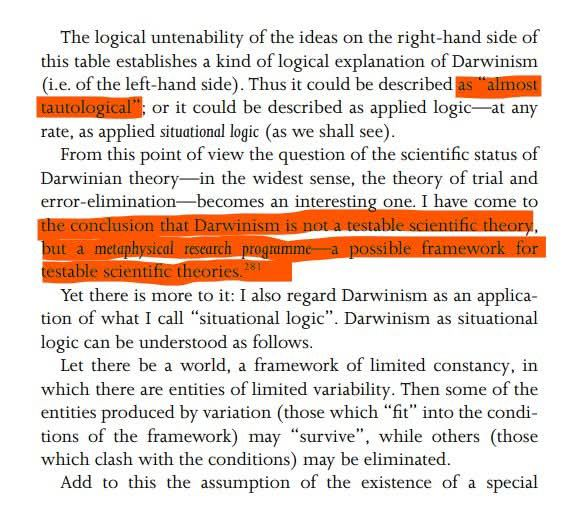
🛑 Karl Popper himself tested these criteria on the theory of evolution —
that is, he applied his method in relation to this theory —
and concluded that it is not a scientific theory but merely a metaphysical research program .
📎 (Figure 2) Karl Popper, Unended Quest , p. 195.
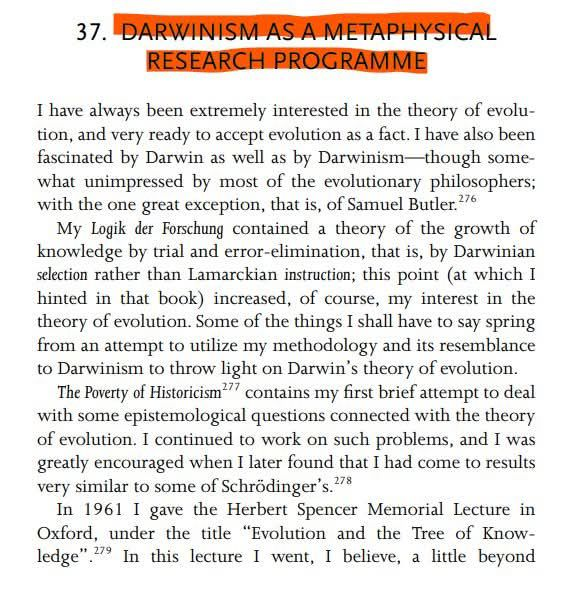
He included in his magnificent book entitled “Unended Quest” a section explaining this entitled:
📘 “DARWINISM AS A METAPHYSICAL RESEARCH PROGRAMME”
📎 (Figure 3)
But how did he reach this result?
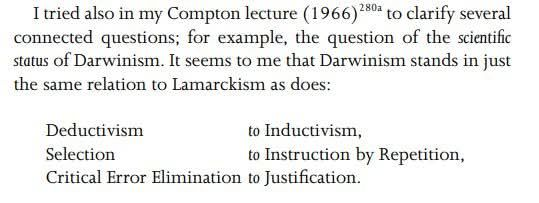
🛑 Karl Popper modeled the explanatory structure of evolution as follows (Figure 4) :
-
Deductive → Inductive Selection
-
Selection → Instructions by repetition
-
Elimination of errors → Justification
If we take this explanatory structure,
we have, based on the inability to logically justify the ideas on the right-hand side,
a tautological formulation of the theory in an approximate form —
i.e., mere tautology, confiscations, and repetitions.
If we take the broader understanding of the theory of trial and error,
it becomes a metaphysical research program .
This argument is interesting because it touches on the logical structure on which the theory itself is based,
and its epistemological construction.
🪫 What is more interesting is that Karl Popper was agreed upon in his argument by:
C. H. Waddington
John Haldane
George Gaylord Simpson
Their arguments simply boil down to the logical inability to justify the explanatory structures of evolution,
as we mentioned above.
For example, if we have natural selection in practice,
we say in the evolutionary model:
🪫 “Existing organisms are fit to survive because they were selected,
and they were selected because they are fit to survive.”
Any organism we find has survived because it was selected.
🪫 This is a tautological repetition —
a tautology that does not accept any logical justification.
The structure adopted by Karl Popper can be relied upon,
as it is sufficient to indicate the subject of our discussion.
🛑 Currently, the classic argument of evolutionists is that Karl Popper later changed his mind about evolution
and actually accepted it as a falsifiable premise.
This argument has two problems:
🪫 🛑 Our inference is not from Karl Popper himself ,
for that would be a fallacy of syllogism involving an appeal to authority.
Rather, our inference is from his statements,
which, if not countered by similar arguments,
cannot be negated by opinion or mere words of rejection or acceptance.
They stand until the arguments are proven.
🪫 🛑 Karl Popper himself, a year before his death,
wrote a book entitled:
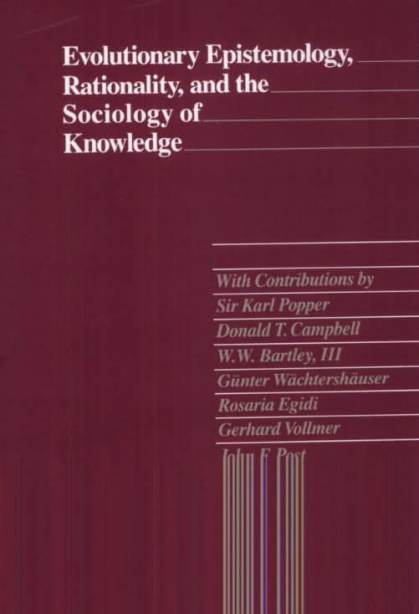
📘 “Evolutionary Epistemology, Rationality, and the Sociology of Knowledge, with Contributions by Sir Karl Popper”
📎 (Figure 5)
In it, he reaffirmed his position on evolution as a tautology,
and collected the statements of his supporters.
A technical paper reviewing Popper’s work is also worth reading.
After extensive study, it concludes that the essence of Karl Popper’s position on evolution has not changed at all.
It is just that the ignorant like to take Popper’s words out of context to mislead the audience.
📎 Elgin, Mehmet, and Elliott Sober. “Popper’s shifting appraisal of evolutionary theory.” HOPOS: The Journal of the International Society for the History of Philosophy of Science 7.1 (2017): 31–55.
📎 https://www.journals.uchicago.edu/doi/10.1086/691119
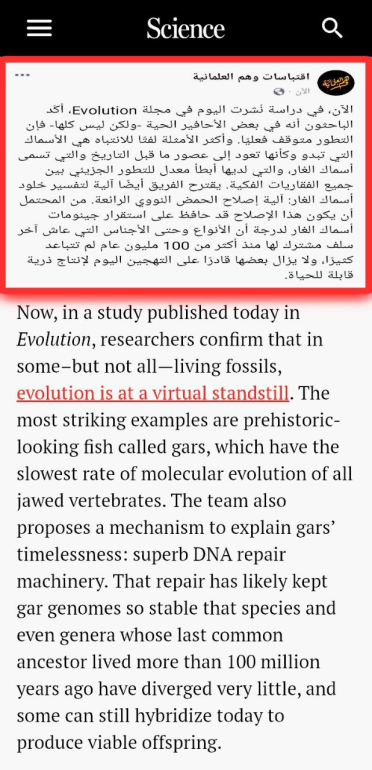
The gar fish has not changed for more than 100 million years, except for minor changes within the species’ gene pool… and it has an extraordinary ability to repair DNA mutations… Here’s the question: Did random mutations produce a remarkable mechanism to repair random mutation errors?!!
Do Mutations Lead to Evolution