Do Mutations Lead to Evolution
🧬 In this section, God willing , we will clarify some of the basics that the proponents of myth rely on in their miserable attempts to prove the validity of evolution, namely mutations .
We will:
-
Explain the meaning of mutations
-
Types of mutations
-
The effect of mutations
-
Prove deterioration, not evolution
-
Mutations do not add functional information
-
The effect of the accumulation of random mutations on removing meaning from the genetic tape
-
The number of mutations that occur per day and are repaired
-
Repetitive genes
-
Prove that mutations are not random
-
The time required for mutations to fix in one generation of mammals
-
Respond to the most famous examples that they thought were adding information
-
What is meant by mutations according to the Darwinian assumption?
A: Adding functional information, deleting information, or a neutral species.
- What is meant by mutations from an observational and practical point of view?
Mutations are changes in the genetic sequence due to physical or chemical changes, and sometimes as a result of a replication error — whether through deletion, subtraction, or addition.
However, this addition does not occur outside the genetic framework of the same species, but rather some modifications occur based on pre-existing information, and a chromosomal rearrangement may occur.
Mutations may be: harmful (the vast majority), useless, or beneficial.
- Are there types of mutations?
Yes, there are two types: point and replication .
And to date, these two types have never produced any new functional system, as we will see in this article, God willing.
- Did you know that scientists have not observed the emergence of a single new functional system, even from bacteria, which multiply very quickly and may produce millions of generations?
Read on to find out how, and I will respond to your objections, you atheist.
🪫 Now we begin:
❓ Do mutations really lead to evolution?
Imagine that you are riding in a car in an empty place, and this car is full of luggage and tools that you use. Suddenly you discover that the fuel is about to run out, and there is no one to help you, otherwise you will die.
So you throw away your luggage and tools, and even remove parts of the car itself to lighten the load on the engine so that it travels the greatest possible distance with the least amount of fuel, and then you reach your destination…
📌 Here is the question:
Can we say that what happened to the car was the addition of new features to it to reach its destination, or that you destroyed parts of it to get there?
The answer must be that you destroyed parts of it; the same is true for the genetic strand, as the vast majority of mutations are based on demolition, and the result of demolition may be a beneficial mutation, as we explained in the car example.
- For example, if there are only two sites in the genetic strand that are modifiable, and the rest are destructible sites, which is easier: to precisely modify only two sites of the entire strand, or to perform demolition?
Demolition is easier, of course, and may result in a beneficial mutation.
But here’s the surprise: the vast majority of random mutations are harmful. Not all, most, or even half of the demolition will be beneficial.
Destruction means destruction, as we explained in the cart example. It aims only for survival; but it deletes or reduces information from the genetic tape.
🪫 Even most silent mutations are harmful.
To their surprise, the researchers found that 75.9% of synonymous mutations were significantly deleterious , while 1.3% were significantly beneficial .
{Embed}
nrhoads
Study: Most ‘silent’ genetic mutations are harmful, not neutral, a …
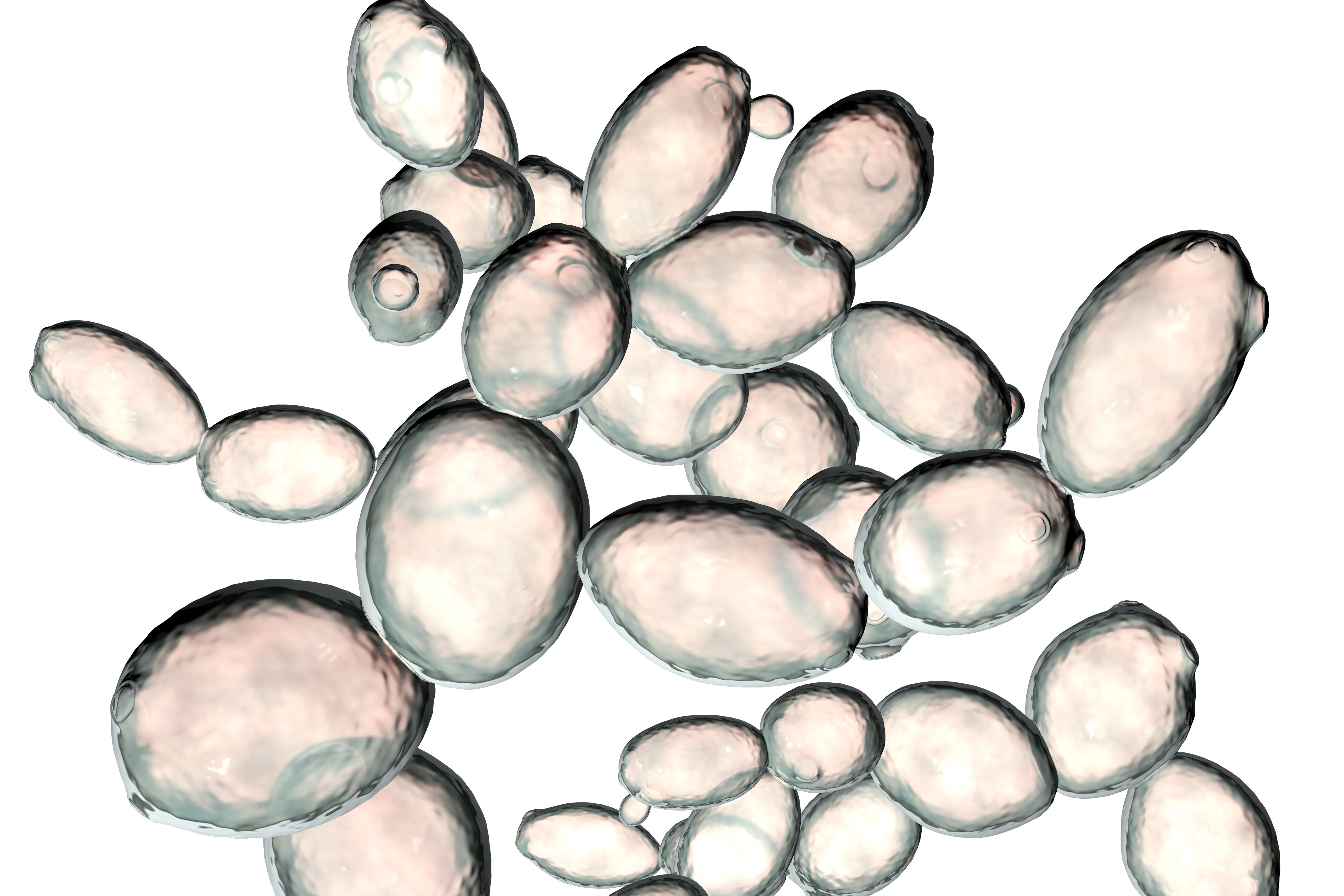
Saccharomyces cerevisiae yeast. Image credit: iStock
In the early 1960s, University of Michigan alumnus Marshall Nirenberg and a few other scientists deciphered the genetic code of life, determining the rules by which information in DNA molecules is translated into proteins, the working parts of
🐶 For example:
If you brought a group of long-haired dogs, and maintained this lineage, and we had many generations of long-haired dogs, could these dogs turn into short-haired dogs again?
Absolutely not, because the gene for short hair has already been destroyed.
However, an evolutionist might come and say:
“The accumulation of these changes leads to the emergence of a new being.”
But do these changes actually lead to the emergence of a new being?
In the dog example we explained a little while ago, did there occur a change in the species or a change in one of the dog’s traits?
Certainly, one of the traits has changed, but they remain dogs.
🧑🔬 Is a person with white skin evidence of evolution?
Absolutely not, he is still a human.
However, the apparent differences are differences in genetic traits within the genetic framework of a single species.
As epigenetic studies have shown, natural changes affect the way genetic traits are read, activating traits that were dormant or suppressing traits that were activated.
📎 https://www.nature.com/scitable/topicpage/environmental-influences-on-gene-expression-536/
📌 But here is the fundamental question:
❓ How did the addition of information occur through the accumulation of genetic information?!
Evolutionists do not have a logical answer to this question, then they start to put forward examples that it is the addition of information; but it is adaptation and not evolution as they claim.
And before I start responding to some of the examples they give as evidence of the myth;
{Embed}
https://www.nature.com/scitable/topicpage/environmental-influences-on-gene-expression-536/
Environmental Influences on Gene Expression
Internal and external environmental factors, like gender and temperature, influence gene expression.
🧬 Let us explain to you that all of this is nothing but a change within the genetic framework of a single species.
For example, the 2018 Nobel Prize in Chemistry was based on artificial selection (an experiment in the laboratory that involves mutational pressure that may extend for a million years or more) on a bacterial cell.
More simply, Frances Arnold , a 2018 Nobel Prize in Chemistry recipient, says:
🪫 “What they did is they accelerated evolution, which actually takes billions of years, to a few weeks or a single year.”
Evolutionists then said that this experiment is direct evidence of evolution;
📌 But here is the question:
❓ Did a single functional protein result within cells, rather than the entire cell evolving?
❌ The answer: No.
❓ Did a new species of bacteria result from mutational pressure over billions of years?
❌ The answer: No.
Thousands of different types of the enzyme subtilisin resulted.
For several years, she had tried to change an enzyme called subtilisin so that, rather than catalyzing chemical reactions in a water-based solution, it would work in an organic solvent, dimethylformamide (DMF) .
Now she created random changes — mutations — in the enzyme’s genetic code and then introduced these mutated genes into bacteria that produced thousands of different variants of subtilisin.
❓ Did the enzyme change?!
❌ No, it remained the same Subtilisin Enzyme , except that what happened was that the efficiency of the same enzyme increased.
📱 To illustrate:
You want to increase the efficiency of your phone’s battery so that it lasts until the end of the day. What would you do?
You would make some modifications (let’s call them mutations for clarity), such as turning off the GPS, turning off the Wi-Fi…
-
Is the phone still a phone? ✅ Yes.
-
Is the battery the same? ✅ Yes, exactly.
This is just like what happens in mutations that lead to increased efficiency.
In fact, repeated mutational pressure made the subtilisin enzyme weaker and its lifespan shorter;
but it became more efficient for human use in biofuel.
🪫 Modified enzymes are poor, weak things compared to natural enzymes, even with the best of protein engineers’ efforts. (Dr. Douglas Axe)
🪫 What happened here are destructive processes, as I explained, and as I explained in the car example.
Assuming that new information was added through experiments, this indicates that someone entered this information, and not through random evolution, which does not allow for the introduction of a single functional protein, let alone the construction of entire organisms.
🧬 Do mutations, from an evolutionary perspective, lead to complexity?!
We said that the vast majority of mutations are harmful, and most of them are based on destruction rather than construction.
❓ So how can complex organisms be produced when their ancestor was destroyed?!
Let’s talk about the elephant, for example, which is a mammal. According to evolution, the elephant evolved from a simple bacterial cell.
❓ If I were to ask you: Can you tell me the number of destructive mutations required for bacteria to transfer to an elephant?!
❌ Do you know that the question is inherently contradictory?!
Because mutations don’t just add a single functional protein (as proven in the 2018 Nobel Prize in Chemistry, where the same enzyme was produced with different efficiency), let alone transform a prokaryotic organism into a eukaryotic organism or even a mammal.
And all of this, and most of the mutations that must result are destructive and harmful mutations.
Do destructive processes produce complex structures?!
What makes the matter even more impossible are the mechanisms of repairing mutations in the DNA strand.
📌 Here are some examples that were thought to be evolution:
🐦 ★ The example of birds in the Galapagos Islands:
When Darwin found a change in the shapes of beaks, he said, “This is evidence of evolution.”
At that time, they knew almost nothing about the gene pool of a single species.
But is the change in the beaks of these birds really evidence of evolution?
It was discovered that two proteins are responsible for this:
-
Calmodulin , a protein responsible for controlling beak length.
-
Bone morphogenetic protein 4 (BMP4) , a protein responsible for controlling beak thickness.
This protein encodes all beak shapes depending on environmental conditions, as epigenetic studies have explained.
However, the species has not changed; it is the same bird, just as I explained in the example of dogs.
The difference in shape does not lead to a difference in species, and all of this is within the genetic framework of the same species.
📌 This is called adaptation .
📎 https://www.science.org/doi/10.1126/science.1098095
📎 https://pubmed.ncbi.nlm.nih.gov/15353802/
{Embed}
https://pubmed.ncbi.nlm.nih.gov/15353802/
Bmp4 and morphological variation of beaks in Darwin’s finches - PubMed
Darwin’s finches are a classic example of species diversification by natural selection. Their impressive variation in beak morphology is associated with the exploitation of a variety of ecological niches, but its developmental basis is unknown. We performed a comparative analysis of expression patte …

🪫 ★ Malaria and Chloroquine
Evolutionists consider drug resistance of parasites and bacteria to be one of the strongest evidences of evolution;
🪫 But in fact, when you look into the matter, you find that the pathogen did not build new protein folds from scratch,
but rather all that happened were simple modifications that changed its morphological or chemical characteristics,
without building three-dimensional protein folds.
Rather, it becomes clear that what happened has nothing to do with evolution, neither closely nor remotely.
The organism becomes disabled, and not as efficient as the original strain.
🧪 Example: Malaria resistance to the drug chloroquine
The wall of the digestive vesicle of the malaria parasite contains a protein that acts as a gate or pump called PfCRT .
When this parasite was exposed to mutations, it was able to grab the drug chloroquine and expel it from the digestive vesicle.
They said, “That’s it.” Conclusive evidence of evolution;
But in reality, what happened were just simple modifications to the PfCRT protein, and did not build a new protein fold.
Rather, what happened was a relapse for the malaria parasite,
as the organism became disabled and could not withstand the original strain that did not have mutations in the transport protein (PfCRT ).
Even its rate of division became slow.
https://www.cell.com/trends/parasitology/abstract/S1471-4922(08)00158-X
📎 https://pubmed.ncbi.nlm.nih.gov/15827277/
🪫 Rather, when the drug that kills the original strain is stopped, the original strain returns,
and the mutant (degenerated) malaria parasite that acquired the mutations disappears,
and it did not persist as the evolutionary myth predicts.
📎 https://www.ncbi.nlm.nih.gov/pmc/articles/PMC3380613/
Therefore, one of the ways to treat the original parasite is to stop the antibiotic.
Thus, the original strain returns and the disabled (drug-resistant) strain disappears.
{Embed}
https://pubmed.ncbi.nlm.nih.gov/15827277/
Decreased prevalence of the Plasmodium falciparum chloroquine resis…
The use of chloroquine treatment for Plasmodium falciparum malaria was abandoned in China in 1979 because of widespread drug resistance. Subsequent studies found decreases in the prevalence of chloroquine-resistant strains. To evaluate these decreases and assess the current status of chloroquine sen …
{Embed}
https://www.ncbi.nlm.nih.gov/pmc/articles/PMC3380613/
Return of Chloroquine-Susceptible Falciparum Malaria in Malawi Was …
The spread of drug-resistant Plasmodium falciparum malaria has been a major impediment to malaria control and threatens prospects for elimination. We recently demonstrated the return of chloroquine-susceptible malaria in Malawi after chloroquine use …

🔍 ★ The mutations that occurred in malaria challenged one of the most important foundations of evolution:
- The possibility of producing changes in a single step.
Because the mutation that occurred in the vesicle transport protein (PfCRT ) is a harmful mutation,
and for the parasite to coexist with it, another mutation must occur that somewhat compensates for its harmful effect.
Although this mutation is less efficient than the original strain that did not have mutations in the vesicle transport protein,
it can coexist with it.
In other words, two mutations must occur “simultaneously ” for the parasite to be able to persist:
-
A harmful mutation
-
And a mutation that somewhat compensates for the damage.
📎 https://www.ncbi.nlm.nih.gov/pmc/articles/PMC4035986/
❓ Ok, is it possible for evolution to make leaps and lead to a series of mutations?
Now pay close attention because we are going to talk about the calculations:
By roughly calculating the huge numbers of parasites exposed to chloroquine over 50 years
(the number of patients multiplied by the average number of parasites in the body),
we can calculate the rate of occurrence of this simultaneous mutation to be, at best, one in 10^20 ,
and the parasite needed the equivalent of hundreds of millions of years of human generations to do so.
To clarify more:
to reach two mutations that led to chloroquine resistance,
it required a very small mutation rate of 1 in 10^20 ,
and these are very fast-dividing organisms.
Resistance to chloroquine in P. falciparum has arisen spontaneously less than ten times in the past fifty years.
This suggests that the per-parasite probability of developing resistance de novo is on the order of 1 in 10^20 parasite multiplications.
{Embed}
https://www.ncbi.nlm.nih.gov/pmc/articles/PMC4035986/
Diverse mutational pathways converge on saturable chloroquine trans…
This study provides detailed insights into the workings of a protein that is a key determinant of drug resistance in the malaria parasite. We found that two main lineages of mutational routes lead to chloroquine transport via the chloroquine …
Translation: “Chloroquine resistance in Plasmodium falciparum has arisen spontaneously less than ten times over the past 50 years. This suggests that the probability of developing new resistance per parasite is about 1 in 10^20 parasite multiplications.”
📎 https://www.ncbi.nlm.nih.gov/pmc/articles/PMC385418/
{Embed}
https://www.ncbi.nlm.nih.gov/pmc/articles/PMC385418/
Antimalarial drug resistance
Malaria, the most prevalent and most pernicious parasitic disease of humans, is estimated to kill between one and two million people, mainly children, each year. Resistance has emerged to all classes of antimalarial drugs except the artemisinins and …
🧬 If we take this rate and apply it to large, multicellular, very slow-reproducing, and fewer organisms like humans or mammals,
to fix just two mutations (remember, they are destructive and lead to deterioration),
it would take millions of years and generations.
And don’t forget that we’re talking about just two mutations,
even two mutations that make the organism less efficient than the original strain.
Evolutionists cling to any strange mutation to claim evidence of evolution,
and every time it’s deterioration, as we explained in the car example earlier.
🧬 ★ Citrate-digesting bacteria (E. coli )
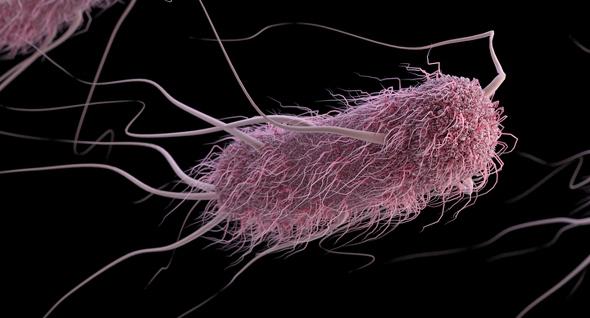
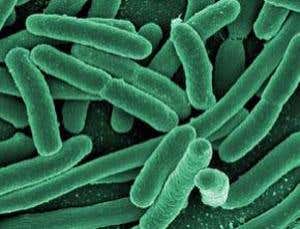
This experiment was conducted by Richard Lenski on intestinal bacteria (E. coli ).
He explained the experiment simply:
If the bacteria have glucose or citrate in front of them, which one will they use as food?
If the bacteria are in a place with oxygen, the bacteria feed on glucose and do not feed on citrate,
because they have the necessary carriers to bring glucose through their membrane,
and do not have the necessary carriers to bring citrate in.
Richard Lenski put these bacteria in laboratory tubes, supplied them with glucose and citrate,
and put them in an environment with oxygen,
so it is natural for them to feed on glucose only;
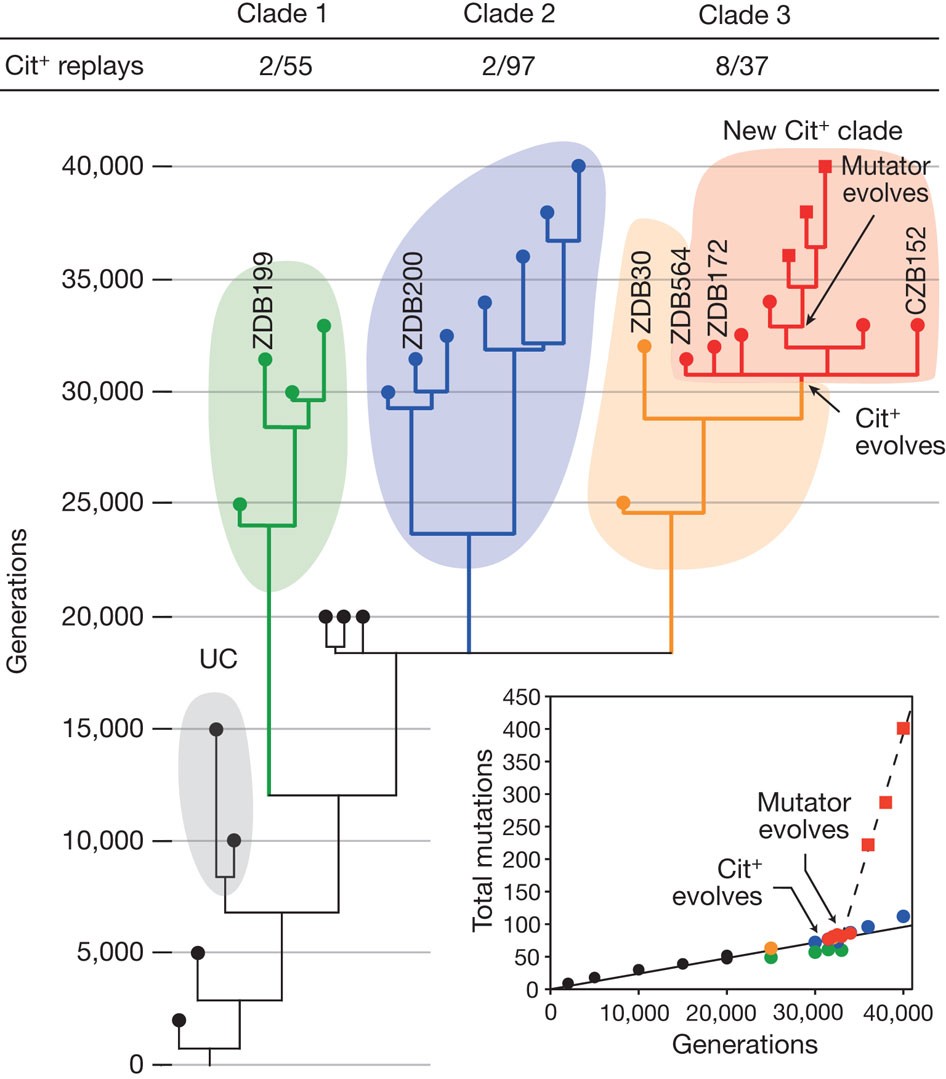
But the bacteria in one group after many years grew rapidly, faster than the rest of the other tubes, and it was found that the bacteria were able to digest citrate. Do you know what the evolutionists said? They said that these were new mutations that added information to digest citrate; and thus, after millions of years, they would evolve not only to be able to feed on citrate, but they would produce complete organisms. They went around wandering in every valley, and they published that it was direct evidence of evolution, and they published in several magazines that evolution is happening before our eyes, as was published in New Scientist magazine and others.
https://www.newscientist.com/article/dn14094-bacteria-make-major-evolutionary-shift-in-the-lab/
And after they were overjoyed, the experimenter himself published in Nature what happened to the bacteria:
https://www.nature.com/articles/nature11514
Tandem duplication that captured an aerobically expressed promoter for the expression of a previously silent citrate transporter. The gene duplication that hijacked a Promoter that is activated by oxygen to produce a citrate transporter that was already present but inactive. In short: the bacteria adapted and copied the citrate transporter gene between genes that are read in the presence of oxygen after the Promoter so that the citrate transporter gene is read in the absence of oxygen, and produced citrate transporters from it; Now that the bacteria have captured the citrate, will they act randomly? Absolutely not. All the enzymes needed to utilize the citrate are already present in the gut bacteria, as also demonstrated by epigenetic studies:
{Embed}
Dramatic Video Shows Bacteria Evolving Drug Resistance as You Watch
Scientists have created an amazingly dramatic (and slightly terrifying video) of bacteria evolving drug resistance right before your eyes.
{Embed}
https://www.newscientist.com/article/dn14094-bacteria-make-major-evolutionary-shift-in-the-lab/
Bacteria make major evolutionary shift in the lab
A major evolutionary innovation has unfurled right in front of researchers’ eyes. It’s the first time evolution has been caught in the act of making such a rare and complex new trait. And because the species in question is a bacterium, scientists have been able to replay history to show how this evolutionary novelty grew …
{Embed}
https://www.nature.com/articles/nature11514
Genomic analysis of a key innovation in an experimental Escherichia…
Nature - It has been suggested that small evolutionary steps pave the way for more major evolutionary leaps — in a combination of Darwinian gradualism and saltationism — but mechanistic…
https://www.ebi.ac.uk/ena/browser/view/PRJNA188723
{Embed}
https://www.ebi.ac.uk/ena/browser/view/PRJNA188723
ENA Browser
ENA Browser
🪫 In the end, it didn’t produce a single functional protein.
🧬 ★ Nylon-Digesting Bacteria:
Let’s first explain the story of nylon-digesting bacteria before we start responding to the evolutionists’ nonsense…
Researchers found a type of bacteria called Flavobacteria capable of digesting nylon 40 years after nylon was produced.
What’s so strange about that?!
The strange thing is that nylon wasn’t manufactured until 1935 , and it isn’t even a natural substance that bacteria can digest as is common.
They said, then, that these bacteria must have developed a new mechanism that enables them to digest nylon.
They concocted a story that would attract non-experts to present the myth on a golden platter.
They said that these bacteria had a frameshift mutation that led to the insertion of a nitrogenous base (T ) into the plasmid (pOAD2 ) within the R-llA sequence, leading to the emergence of the enzyme Nylonase , which enables bacteria to digest nylon…
📌 But before we respond, what are frameshift mutations ?
It is a type of mutation in which nitrogenous bases are added or deleted.
For example, the sequence of nitrogenous bases AGCTGGACT translates each three-letter codon into an amino acid linked to the translation of the next codon, and so on…
-
The codon AGC is translated into the amino acid Serine ,
-
followed by TGG which is translated into Tryptophan ,
-
followed by ACT which is translated into Threonine ,
meaning in this sequence we have Ser-Trp-Thr .
If an addition mutation occurs, for example, at the beginning of the sequence and the sequence becomes CAGCTGGACT , then different codons will be formed, and all of this is due to a displacement mutation…
Until now, you might think that this is blatant evidence of evolution, and that I have not responded to it;
but hold on… hold on…
🪫 This type of mutation has huge effects, and leads to protein distortion or the insertion of a premature stop codon that leads to the truncation and shortening of the protein;
but it does not even lead to the formation of a new enzyme…
❓ How?!
And isn’t the Nylonase enzyme evidence of the emergence of a completely new enzyme that was able to break down something that didn’t exist before?!!
Now we respond:
When you talk about laughter, give the example of the Arabs’ Darawneh.
They even cite studies from 2000 and 1984 , which were originally responded to in 2005 , yet they are determined to deceive;
🪫 Imagine how bankrupt they are, and then they say we are followers of science…
They don’t know that the enzyme that has a Beta Lactamase fold has undergone slight modifications that made it able to include nylon in bacterial metabolic sequences.
📎 https://pubmed.ncbi.nlm.nih.gov/16162506/
📌 And for those who don’t know what protein folds are — in short:
a protein only acquires a function when it undergoes a three-dimensional fold from specific sequences of amino acids.
🪫 This is against them originally… in all cases, against them…
If a frameshift mutation actually occurred, this indicates its inability to change the enzyme’s fold,
because displacement mutations lead to major changes, usually by placing an early stop codon that leads to cutting and shortening the protein,
and these mutations lead to protein distortion;
{Embed}
https://pubmed.ncbi.nlm.nih.gov/16162506/
X-ray crystallographic analysis of 6-aminohexanoate-dimer hydrolase…
6-Aminohexanoate-dimer hydrolase (EII), responsible for the degradation of nylon-6 industry by-products, and its analogous enzyme (EII’) that has only approximately 0.5% of the specific activity toward the 6-aminohexanoate-linear dimer, are encoded on plasmid pOAD2 of Arthrobacter sp. (formerly Flav …
https://www.sciencedirect.com/topics/neuroscience/frameshift-mutation
🪫 But the reality is that Nylonase has the same protein folding as Beta Lactamase found in Carboxylesterase enzymes ;
That is, no stop or start codons were added, but rather a change in an existing fold.
Incidentally, such changes are found in any organism.
So, to say that a frameshift mutation led to the appearance of a new enzyme by chance cannot be more than a comedy or bedtime story .
This enzyme is originally a promiscuity enzyme , which works in a wide range of decomposition of different materials.
As long as the chemical bond that the enzyme works on is the same as that found in another material, it can break this bond, even if this material was invented recently.
🧬 In short, what happened are improvements in the active site of the three-dimensional folding of Beta Lactamase found in the Carboxylesterase enzymes originally found in bacteria.
So, there was no addition of a new fold, but rather modifications to the first fold.
A new enzyme may result from a pre-existing fold.
These improvements occur in any organism and are evidence of diversity within the genetic diversity stock of the same SGV species , as we explained in the article on mutations, and not modifications that led to additions that were not present.
And the same trick is promoted in many examples as an addition from outside the framework of the genetic diversity stock of the same species SGV , and studies later show that they are changes within the same species.
We propose that amino acid replacements in the catalytic cleft of a preexisting esterase with the beta-lactamase fold resulted in the evolution of the nylon oligomer hydrolase.
📎 https://pubmed.ncbi.nlm.nih.gov/16162506/
🪫 But are these mutations random as Darwin’s myth predicts?
Nature magazine answers you, and gives examples of what followers of the myth call parallel evolution , which destroys the idea that random evolution leads to similarity with great divergence between organisms.
Rather, it is stark evidence that mutations are not random .
If they were random, they would not have produced organisms with the same form through the same specific sequence of mutations.
🪫 This is impossible.
📎 https://www.nature.com/articles/514161a
{Embed}
https://pubmed.ncbi.nlm.nih.gov/16162506/
X-ray crystallographic analysis of 6-aminohexanoate-dimer hydrolase…
6-Aminohexanoate-dimer hydrolase (EII), responsible for the degradation of nylon-6 industry by-products, and its analogous enzyme (EII’) that has only approximately 0.5% of the specific activity toward the 6-aminohexanoate-linear dimer, are encoded on plasmid pOAD2 of Arthrobacter sp. (formerly Flav …
{Embed}
https://www.nature.com/articles/514161a
Does evolutionary theory need a rethink?
Nature - Researchers are divided over what processes should be considered fundamental.
🪫 And in another article from 1988, it is somewhat old but agrees with the modern study:
📎 https://www.nature.com/articles/335142a0
📎 Here are other sources that prove that mutations are not random, which contradicts Darwin’s principle:
📎 https://www.livescience.com/non-random-dna-mutations
📎 https://www.i-sis.org.uk/Nonrandom_directed_mutations_confirmed.php
🪫 Do you know how they patched up the genetic framework of the same species?
Don’t laugh if I tell you that they changed the term adaptation to microevolution , just a play on words to give prestige to the myth.
🧬 ★ Does the accumulation of random mutations over time lead to evolution?
Imagine that the genome is a book, and the book contains words made up of a group of letters.
What happens if you make “random” changes to these letters?
The answer will definitely be that you have destroyed the book with this manipulation, because most of the changes you made “randomly” did not precisely add useful words, but rather deleted, substituted, and randomly added words that rendered the book meaningless.
Are the changes here useful?!!
But someone might come and say that there are letters that you can replace to produce a meaning, or not;
But is this the norm or an anomaly?
📌 The point is that the manipulation you performed was not only harmful, but also rendered the words meaningless.
The existence of a benefit is an exception to the rule.
The same applies to genes, where it has been proven that the accumulation of random mutations does not lead to the development of organs and systems, each of which has been proven beneficial.
{Embed}
https://www.nature.com/articles/335142a0
The origin of mutants
Nature - The origin of mutants
{Embed}
https://www.livescience.com/non-random-dna-mutations
New study provides first evidence of non-random mutations in DNA
This goes against one of the key assumptions of the theory of evolution.
Rather, it will render the genome meaningless, which is the opposite of what we see.
As this scientific paper mentions:
📎 https://www.sciencedirect.com/science/article/pii/S0079610723000111#bib82
“…a body of evidence indicates that the accumulation of mutations over time actually tends to disrupt the integrity of the information stored in genomes, with negative consequences for organisms, rather than providing new information of improved evolutionary value. This suggests that the occurrence of occasional beneficial mutations is the exception, not the rule.”
This conclusion is consistent with the results of large-scale projects evaluating the impact of artificially induced mutations in a variety of plants exposed to either radiation or mutagenic chemicals: rather than promoting the emergence of plants with improved characteristics, these experiments yielded disappointing results.
✅
🧬 ★ Did you know that there are identical copies of a single gene present in the same chromosome or in different chromosomes?
This prevents beneficial mutations from occurring (outside of the observed point and duplication mutations),
because you would need to place this mutation in every copy of the copies that make up your eye, for example,
and this is impossible.
But is it impossible for beneficial mutations to appear?
❌ Absolutely not;
But we are talking about mutations from the evolutionary perspective,
which aims to add information (outside of the observed point and duplication mutations).
As I explained, from an observational perspective, beneficial mutations have appeared as a result of demolition or modification (and I explained with examples);
but within the genetic framework of a single species.
However, according to evolution, it means adding information outside the genetic framework of a single species.
🪫 So I challenge any atheist to come up with an example of a beneficial mutation (adding information) that occurred spontaneously without human intervention, like what they did with the fruit fly.
The funny thing is that the fly that had two wings added to it, giving it four wings, could only fly a short distance because it was flying with only two wings.
They tried to add muscles to these new wings, but they failed.
They even tried to make it reproduce, but all the flies refused to reproduce with it.
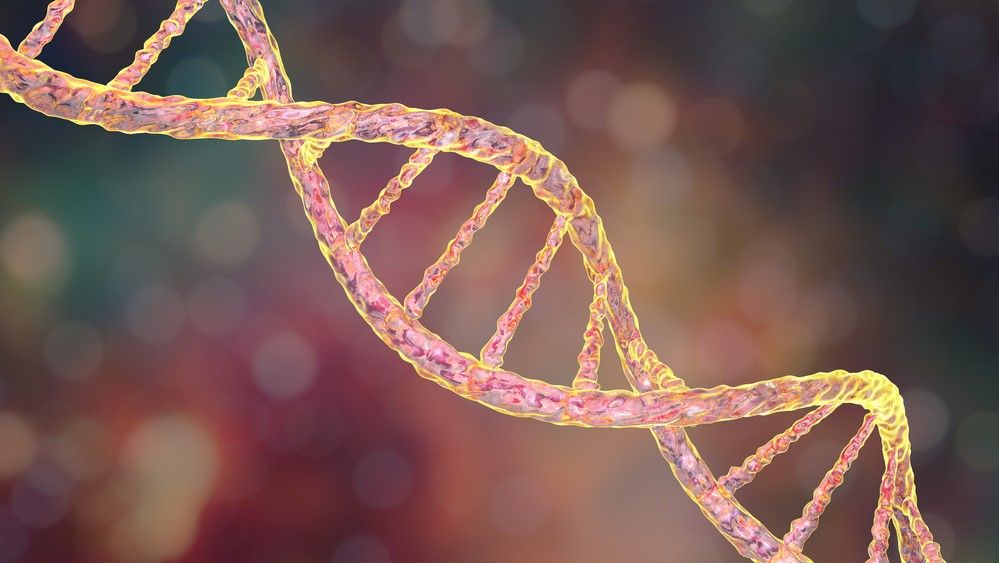
🧬 ★ DNA is a double helix
And being double makes mutations very difficult,
because when a defect occurs in one of the strands,
the complementary strand repairs this error.
- The number of mutations that occur in the human body ranges on average between 20,000 and 60,000 mutations per day ,
yet only a very small number of them remain throughout life compared to what happens every day.
Oxidative damage is increased in aging and in age-related degenerative diseases, including cancer.
Approximately 20,000–60,000 modifications of DNA occur per cell per day.
📚 Dinesh Puri, Textbook of Medical Biochemistry, Elsevier (4th Edition), p. 406
⏳ But before we end the article:
How long does it take for just two beneficial mutations to become established in humans?
🪫 I would like to shock you, atheist,
that there was a study that was designed to defend evolution
that proved that the time needed for just two beneficial mutations to become established in humans is 100 million years .
❓ Do you know what the problem is with that?
The problem is that the difference between humans and the alleged common ancestor
is that there are more than 60 million mutations needed
for the common ancestor to transform into humans.
So, for the common ancestor to evolve into humans,
it would take time many times longer than the age of the universe.
📎 https://www.ncbi.nlm.nih.gov/pmc/articles/PMC2581952/
{Embed}
https://www.ncbi.nlm.nih.gov/pmc/articles/PMC2581952/
Waiting for Two Mutations: With Applications to Regulatory Sequence…
Results of Nowak and collaborators concerning the onset of cancer due to the inactivation of tumor suppressor genes give the distribution of the time until some individual in a population has experienced two prespecified mutations and the time until …
TOP
✅ d_nlaugh emoji_50
🧬 Summary of the Most Important Points Regarding Mutations and Evolution:
🔻 The accumulation of random mutations leads to the removal of meaning from the genome, not evolution.
🚫 The vast majority of mutations are harmful; even 69.9% of “silent” mutations are harmful.
⚠️ Concomitant mutations must occur simultaneously to compensate for the damage; otherwise, the organism will not survive or may become disabled.
❌ There are no mutations that have added a single new functional protein through new protein folding, with new receptors, from outside the species’ genetic diversity pool.
Everything that has been claimed has been proven to have originated from within the species’ genetic diversity pool (SGV ).
🪫 Everything that has been said to be evolution has been proven to be deterioration, or originated from within the species’ genetic diversity pool.
TOP 🔬🔬🔭🔭🧪🧪🥼🥼👨🔬🧬🧬🧞♂️🧞♀️🧞🫵🏻🤏🏻🧠🙊🙈🙉🔎📈📉🧬🩻🦍🦍🚮🚮⛔️⛔️❌️
Pinned a message.
...mechanism to repair random mutation errors?!! ![[the theory of evolution testability and karl poppers criterion 5]]