The Two Sons of Adam
In this section, I will talk about the story of the two sons of Adam, Abel and Cain, and the details corresponding to this story and mentioned in the stories of the Haggadah from the Jewish heritage, which are mentioned in the Qur’an and not in the Torah.
It is stated in Surat Al-Ma’idah:
{And recite to them the story of the two sons of Adam in truth, when they offered an offering, and it was accepted from one of them but was not accepted from the other. He said, “I will surely kill you.” He said, “Allah only accepts from the righteous.” (27) If you were to stretch out your hand against me to kill me, I would not stretch out my hand against you to kill you. Indeed, I fear Allah.} Lord of the worlds (28) Indeed, I want you to bear my sin and your sin and be among the companions of the Fire. And that is the recompense of the wrongdoers. (29) But his soul prompted him to kill his brother, so he killed him and became among the losers. (30) Then God sent a raven scratching the ground to show him how to hide the shame of his brother. He said, “Woe to me! I am unable to be like this raven!” (31) For that reason We decreed upon the Children of Israel that whoever kills a soul unless for a soul or for corruption in the land - it is as if he had killed all of mankind, and whoever saves a life - it is as if he had saved all of mankind. And Our messengers had certainly come to them with clear proofs, but indeed many of them, after that, are transgressors upon the earth. (32)} Al-Ma’idah: 27-32
And Imam Al-Hafiz Muhammad bin Ismail Al-Bukhari narrated in his Sahih:
3335 - Umar bin Hafs bin Ghiyath narrated to us, my father narrated to us, Al-A’mash narrated to us, he said: Abdullah bin Murrah narrated to me, on the authority of Masruq, on the authority of Abdullah, may God be pleased with him, he said: The Messenger of God, may God bless him and grant him peace, said: No soul is killed unjustly except that the first son of Adam will bear a share of its blood, because he was the first to establish it. Killing.
Imam Al-Hafiz Ahmad bin Hanbal narrated:
1523 - Qutaybah bin Saeed narrated to us, Layth bin Saad narrated to us, on the authority of Ayyash bin Abbas, on the authority of Bukayr bin Abdullah, on the authority of Busr bin Saeed,
that Saad bin Abi Waqqas said, during the trial of Uthman bin Affan, I bear witness that the Messenger of Allah, may Allah bless him and grant him peace, said, “There will be a trial in which the one who sits is better than the one who stands.” And the one who stands is better than the one who walks, and the one who walks is better than the one who runs.
He said: What do you think if he enters my house and stretches out his hand towards me to kill me? He said: Be like the son of Adam. Abu Dawud narrated it in the Book of Trials, in the section on the prohibition of running in tribulation, in a similar manner. He said:
4259 - Musaddad narrated to us: Abd al-Warith ibn Said narrated to us, on the authority of Muhammad ibn Juhadah, on the authority of Abd al-Rahman ibn Tharwan, on the authority of Huzayl, on the authority of Abu Musa al-Ashari, who said:
The Messenger of Allah, may Allah bless him and grant him peace, said: “Indeed, before the Hour comes there will be tribulations like pieces of a dark night. A man will be a believer in the morning and an unbeliever in the evening, and a believer in the evening and an unbeliever in the morning. The one who sits in it is better than the one who stands, and the one who walks in it is better than the one who runs. So break your bows, cut your bowstrings, and strike your swords with stones. If he enters, meaning…” “Let any of you be like the better of the sons of Adam.” Two
authentic hadiths.
This reminds us of the words of the book “Mishnah Sanhedrin” (Chapter 4, paragraph 5). We saw this story mentioned in detail, and in the Qur’an it is incomplete and not complete. Thus the relationship between the above-mentioned verse and the story of the killing of Abel becomes clear, because the Jewish commentator in his interpretation of the verse ” What have you done? The voice of your brother’s blood (the word blood in the original Hebrew of the Torah is in the plural form) cries to me from the ground ” (Genesis 4:10) said: “We found that of Cain who killed his brother, it was said of him, ‘The voice of your brother’s blood cries to me.’ He did not say, ‘your brother’s blood,’ but, ‘your brother’s blood,’ meaning his blood and the blood of his descendants. For this reason, Adam alone was created to teach you that whoever destroys a soul from Israel, the Book considers him as if he had destroyed the entire world. And whoever saves a life, the Book considers it as if he had saved the whole world.
Verse 32 of Surat Al-Ma’idah has been translated almost literally from the words of this ancient Jewish commentator. But since the Qur’an only takes half of this passage, to understand its meaning it is necessary to refer to the original of this Qur’anic verse, as we have explained here, and its meaning will become clear to the reader.
The interpreter’s statement:
“Whoever destroys a soul from Israel, the Book considers him as if he destroyed the entire world.”
We understand from this that there is a verse that he had seen in the books of the Old Testament that carries the same meaning,
and that the verse does not exist now,
which we can use as evidence of the loss of verses from the Old Testament.
That is, we say
that the verse is actually present in the Holy Books and is from the true revelation
, but the verse was lost
, but the interpreter saw it in some way and knew that it was from the Book
or that it was present and known in his time and then was lost later,
as evidenced by the interpreter’s statement:
“The Book considers it.
” This is in the original Haggadic text and is found in the book (Sanhedrin) in the Talmud:
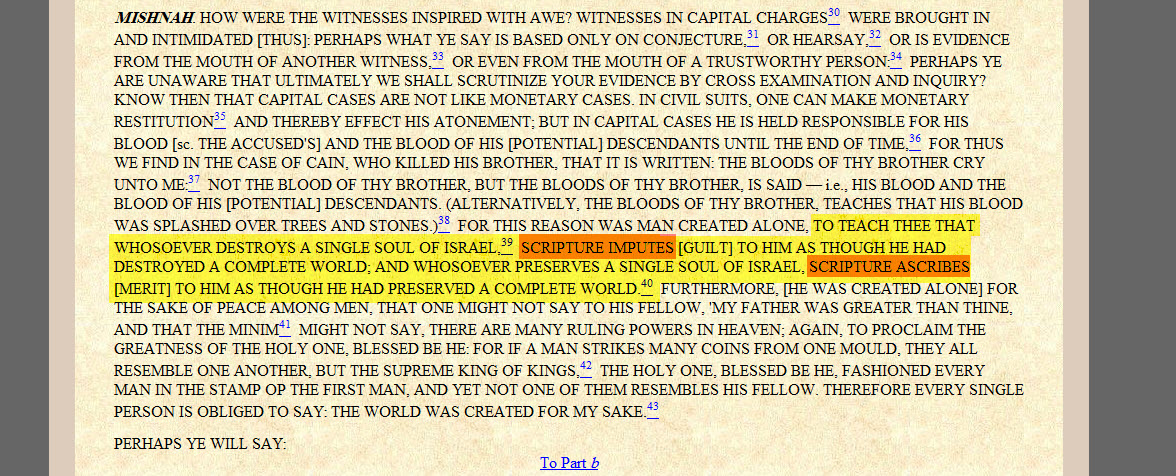
http://www.come-and-hear.com/sanhedrin/sanhedrin_37.html
{Embed}
http://www.come-and-hear.com/sanhedrin/sanhedrin_37.html
Babylonian Talmud: Sanhedrin 37
Talmud Online, zipped for download, searchable: Tohoroth, Niddah, Nazir, Horayoth, Sanhedrin, Sotah, Yebamoth, Shabbath, Kethuboth, Gittin, Berakoth, Baba Mezi’a, Baba Kamma, Baba Bathra, Nedarim, Abodah Zara
. We note from the words of the Jewish interpreter that he relies on a specific reference through the texts. The fact that the Jewish interpreter mentions that it is present in the texts confirms the deficiency of the Holy Book that we have now, unless there is an indirect text, and this is not possible, because if there was an indirect text, the Jewish interpreter would have interpreted it with this meaning. To mention it at least.
We notice that the verse of Surat Al-Ma’idah begins with ( For that reason We decreed upon the Children of Israel ) meaning that the principle of killing a soul is equal to killing all people, as well as reviving it based on the incident of Abel and Cain, is found in Jewish texts and this is also explicitly mentioned in the Qur’an…
🚨🚨🚨🚨🚨🚨🚨🚨🚨🚨🚨
The second doubt: The hadith of Cain to Abel:
What the Qur’an mentions about Abel noticing his evil brother Cain’s attempt to kill him, and that he was stronger than him, but he refrained from killing him, and let him kill him as the verse says, is taken from the Haggadah, and is not found in the Torah!
Let us look at what is stated in the Torah:
(1And Adam knew Eve his wife; and she conceived and bore Cain, and said, I have acquired a husband from the Lord. 2And she again bore his brother Abel. Now Abel was a keeper of sheep, and Cain was a tiller of the ground. 3And it came to pass in after days, that Cain brought of the fruit of the ground an offering unto the Lord. 4And Abel also brought of the firstborn of the And the LORD had respect for Abel and his offering, 5but for Cain and his offering he had no respect. And Cain was very angry, and his face fell. 6And the LORD said to Cain, “Why are you angry? And why is your face fallen? 7If you do well, will you not be accepted? But if you do not do well, sin crouches at the door; its desire is for you, and you rule over it.”
8And Cain spoke to Abel his brother. And it came to pass, when they were in the field, that Cain rose up against Abel his brother, and killed him. 9And the LORD said to Cain, “Where is your brother Abel?” And he said, “I do not know; am I my brother’s keeper?” 10And the LORD said, “What have you done? The voice of your brother’s blood cries to me from the ground. 11Now you are cursed from the ground, which opened its mouth to receive your brother’s blood from your hand. 12When you work the ground, it will no longer yield its strength to you; you will be a vagabond and a fugitive on the earth. 13Then Cain said to the LORD, “My sin is greater than I can bear. 14Behold, you have driven me out today from the face of the earth; and from your presence I shall be hidden; and I shall be a fugitive and a wanderer on the earth; and whoever finds me will kill me. 15Then the LORD said to him, “Therefore whoever kills Cain, vengeance will be taken on him sevenfold.” And the LORD set a mark on Cain, lest anyone who finds him kill him. 16So Cain went out from the presence of the Lord, and dwelt in the land of Nod, east of Eden. (Genesis 4:1-16)
The Messenger of Islam took the story from the Haggadah, and in the Haggadah legend it is as follows:
Under the title (The Killer of His Brother) in the chapter (The Ten Generations), we read:His enmity toward Abel had more than one cause. It began when the Lord turned to Abel’s offering, and accepted it by sending heavenly fire to consume it, while Cain’s offering was rejected. They brought their offerings on the fourteenth day of Nisan, in the presence of their father, who spoke to his sons: “This is the day that Israel shall bring offerings. Therefore, you also bring offerings to your Maker this day, that He may be pleased with you.” The place of offering they chose was the site on which the altar of the Temple in Jerusalem later stood. Abel chose the best of his flock for his offering, but Cain ate his meal first, and when he had satisfied his appetite, he offered to the Lord what was left, a few flax seeds. For his offense was great in offering to the Lord the fruit of the ground that had been cursed by the Lord! No wonder his offering was not well received! And punishment was inflicted upon him. His face turned black as smoke. Yet his inclination did not change, even when the Lord spoke to him thus: “If you amend your ways, God will forgive you your sin; otherwise, you will be delivered to the power of evil inclination. They will see your heart, yet it depends on you. Whether you will be its master, or it will be its master over you.”
Cain thought he was wronged, and a quarrel ensued between him and Abel. Cain said: “I believe that the world was created through goodness, but I see that good deeds do not bear fruit. God rules the world with unjust power; how could He not have regarded your offering, but not mine?” Abel opposed him, and said that God rewards good deeds, regardless of persons. If his offering was accepted by God’s grace, and Cain’s was not, it was because his deeds were good, and his brother’s were evil.
woman caused the crime. To ensure the procreation of the human race, the girl who had been born to one of them was destined to become his wife. Abel’s twin sister was of exquisite beauty, and Cain desired her. So he continually thought of ways and means to rid himself of his brother.
The opportunity presented itself before long. One day a sheep belonging to Abel stepped on a field that Cain had cultivated. In anger, the latter cried out to him: “What right have you to dwell on my land and leave your sheep to graze there?” Abel answered: “What right have you to use the products of my sheep, to make you clothes from their wool, if you take off the wool of my sheep that you wear, and pay me for the flesh of my sheep that I have eaten, then I will leave your land as you wish, and fly through the air, if I can do so as well.” Then Cain said: “If I kill you, who is here to demand your blood from me?” Abel replied: “The Lord, who brought us into the world, will avenge me. He will demand my blood from your hand, if you slay me. The Lord is the judge; kill me, and the Lord will know your secret, and will deal with you with punishment.”
These words only increased Cain’s anger, and he threw himself upon his brother. Abel was stronger than he, and would have suffered the worst consequences of his deed, but at the last moment he begged for mercy, and Abel dropped his grip on him. Hardly had he felt himself free, when he turned on his brother Abel again, and killed him, so it is true to say: “Do not do good to the wicked, lest evil come upon you
Under the title (The Punishment of Cain):
The method of killing Abel was the most brutal imaginable. It is not known which wound was fatal. Cain was stoned all over his body, until one hit his neck and he fell dead.
Then we read that when Cain fled from his parents, God rebuked Cain because Abel showed him mercy and refrained from killing him when he was in his grip. What a pity that he gave you the opportunity to kill him…etc.
A quick glance at the biblical story reveals the incompleteness of the story: ”
And it came to pass in the course of time, that Cain brought an offering to the Lord of the fruit of the ground, 4and Abel also brought of the firstborn of his flock and of their fat. And the Lord had respect for Abel and his offering, 5but for Cain and his offering he had no respect. And Cain was very angry, and his face fell. 6Then the Lord said to Cain, “Why are you angry? And why is your face downcast? 7If you do well, will you not be accepted? But if you do not do well, sin crouches at your door; its desire is for you, and you should rule over it.”
8And Cain spoke to Abel his brother. And it came to pass, while they were in the field, that Cain rose up against his brother Abel and killed him.
Let us read specifically:
8And Cain spoke to Abel his brother. And it came to pass, while they were in the field, that Cain rose up against his brother Abel, and killed him.
The sum of what we can extract from the text is that Cain spoke to Abel and then killed him !!!
What did we learn from the above?
Where is the dialogue between them?
We find it in the Holy Quran and the Haggadah .
Therefore, the Torah generally indicated the occurrence of the dialogue,
and the Haggadah explained the dialogue through what the Jewish scholars had of the remnants of revelation and the words of the apostles,
and what came in the Holy Quran came to confirm what the Jews had of knowledge.
In addition, the Quranic dialogue is not completely identical to the text of the Haggadah.
This point shows the deficiency of the Old Testament.
And not that the Holy Quran quotes from Jewish myths as they claim.
What confirms the deficiency of the Torah text is what Antonius Fikry mentioned in his interpretation
And Cain spoke to Abel his brother:
Some versions add “let us go out to the field.” So he spoke to him with false love to go out with him to the field as they were accustomed to every day, as Judas did with Christ, but this time he had harbored evil in order to kill him. This addition may be an addition for the explanation by one of the scribes.
Why would a scribe need to add this part unless the story is lacking in details and unclear? And by what right then does a Christian or an atheist object to the presence of details in the Quranic story if the writer of Genesis does not give us these details and leaves the text with this ambiguity and the scribes try to detail and explain it according to the words of Father Antonius Fikry? And what is the correct dialogue that took place between them?
As for the source of the dialogue, the Jewish Encyclopedia places it under the section of Islamic sources and mentions at the end of it the two groups of Eliazel to compare it with the Quranic story:

https://www.jewishencyclopedia.com/articles/216-abel#ixzz1BKJ549Ob
{Embed}
https://www.jewishencyclopedia.com/articles/216-abel
ABEL - JewishEncyclopedia.com
Complete contents the 1906 Jewish Encyclopedia.
:
We continue
to note: What God said to Cain about the evil inclination reminds us of the Essenes’ books, and is similar to the Qur’anic verses:
{ He said, “My Lord, then reprieve me until the Day they are resurrected.” (36) He said, “Then indeed, you are of those reprieved.” (37) Until the Day of the appointed time. (38) He said, “My Lord, because You have put me in error, I will surely make [disobedience] attractive to them on earth, and I will mislead them all.” (39) Except, among them, Your chosen servants. (40) He said, “This is a path straight for me.”} (41) Indeed, My servants - you have no authority over them, except those who follow you of the deviators. (42) And indeed, Hell is the promised place for them all. (43)} Al-Hijr: 36-43
And thus the expression of the Qur’an reminds us: { A rust has covered their hearts }
We can infer from the atheist’s mysterious style, which relies on us reading his thoughts to understand his intention, that he is trying to involve us in the issue of predestination and choice. He wants to say that if this was the result of Cain’s inclination towards evil, then why should he be punished for something he was created with? This is because he spoke about something similar to this in his book when he mentioned the Almighty’s saying (No, but the stain has covered their hearts because of what they were earning). Of course, this is old and rejected talk that has become obsolete, and atheists still repeat it to this day, and this is not its place
The third suspicion: Cain’s desire to marry Abel’s sister:
In the chapter (The Brother Killer), the Haggadah mentions that in addition to God not accepting Cain’s sacrifice, and several other problems between the two brothers. A problem occurred… In order to continue the human race, God made each brother a twin sister at birth, and each brother was supposed to marry the sister from the other womb. Abel’s sister was very beautiful, so Cain thought a lot about a way to get rid of his brother.
This issue is reminiscent of the reason given by Islamic mythology in the words of the companions of the Messenger of Islam, such as Ibn Abbas and Ibn Masoud, for the dispute between Abel and Cain… It is mentioned that Cain had a sister named Iqlim and Abel had a sister named Leotha, and Cain was greedy about marrying the more beautiful sister.
Of course, we are supposed to look into the Islamic interpretations to see the story of the two sisters
, but as long as everything mentioned in it is
transmitted from the noble companions, may God be pleased with them, then perhaps they narrated it from the Children of Israel and nothing more, and perhaps what was mentioned here was in the Israelite stories and perhaps not, then this is something that we remain silent about, so we neither believe it nor disbelieve it. However, the suspicion of quotation is rejected.
The fourth doubt: The crow teaches the human how to bury.
The atheist says:
Another similar detail is: The story of the raven, which is not mentioned in the Torah… but in the Talmudic story, Adam and his wife are the ones who saw the raven and learned the method of burial.
The book says under the topic (Cain’s punishment) what I translate as…): Nature also changed with the burial of Abel’s body. For a long time, the body remained exposed and lying on the ground, because Adam and Eve did not know what to do with it. They sat beside it and wept, and Abel’s faithful dog protected the body so that it would not be harmed by birds and beasts. Suddenly, the weeping parents noticed how a raven had dug up the ground in a certain spot. Then it buried a dead bird of its kind in the ground. Adam followed in the footsteps of the raven and buried Abel’s body. So the raven was rewarded by God. When the young ravens are born, their feathers are white, and because the parents do not recognize their offspring, they throw them to the snakes. Here God feeds them until their feathers turn black and their parents return to them. As a second reward, God responds to the ravens’ request when they pray for rain. (
Note: In the Jewish Encyclopedia, another version of the legend says turtledoves instead of ravens.
Sources with the help of the Jewish Encyclopedia/Abel entry
(The Midrash, Pirḳe R. Eliezer xxi, Pirḳe R. Eliezer, xxi.; Gen. R. xxii. 7, Epiphanius, “De Hæresi,” xl. 5, Gen. R. xxii. 18, Apocalypsis Mosis, xl, Tan., Bereshit, § 10; Pirḳe R. Eliezer, xxi., see also Gen. R. lc; compare “Denkschrift d. Wiener Akademie,” xx. 52, and Ginzberg, lc 295).
It is useful to point out the response of the Islamic-awareness website regarding the doubts regarding the subject of Abel and Cain at this link:
http://www.islamic-awareness.org/Quran/BBCandA.html
🔝
[To be continued
❓