The Well of Budha'ah Hadith — Does Islam Permit Ablution with Filthy Water?
The Well of Budha’ah Hadith — Does Islam Permit Ablution with Filthy Water?
`
بئر بُضاعة — Bir Buda’ah
- Ubayd Allah ibn Abdullah ibn Rafi’ (and it was said that his name is Abd al-Rahman ibn Rafi’) is a man of unknown status. This was stated by Ibn al-Qattan, Ibn Hajar, and Ibn Madh’ah. However, the narration was authenticated by Ahmad, Ibn Ma’in, and Ibn Hazm, and according to al-Tirmidhi it is hasan, so the hadith has some issues and questions, and Allah knows best.
- Assuming it is authentic, there is nothing wrong with it. According to scholars, a large amount of water that has changed does not become impure, but rather a small amount of stagnant water is what becomes impure due to one of the impurities. Bir Buda’ah has a large amount of water, sometimes multiples of two qullas.
The Camel Urine Hadith Explained: Context, Science, and Refutation
The Doubt
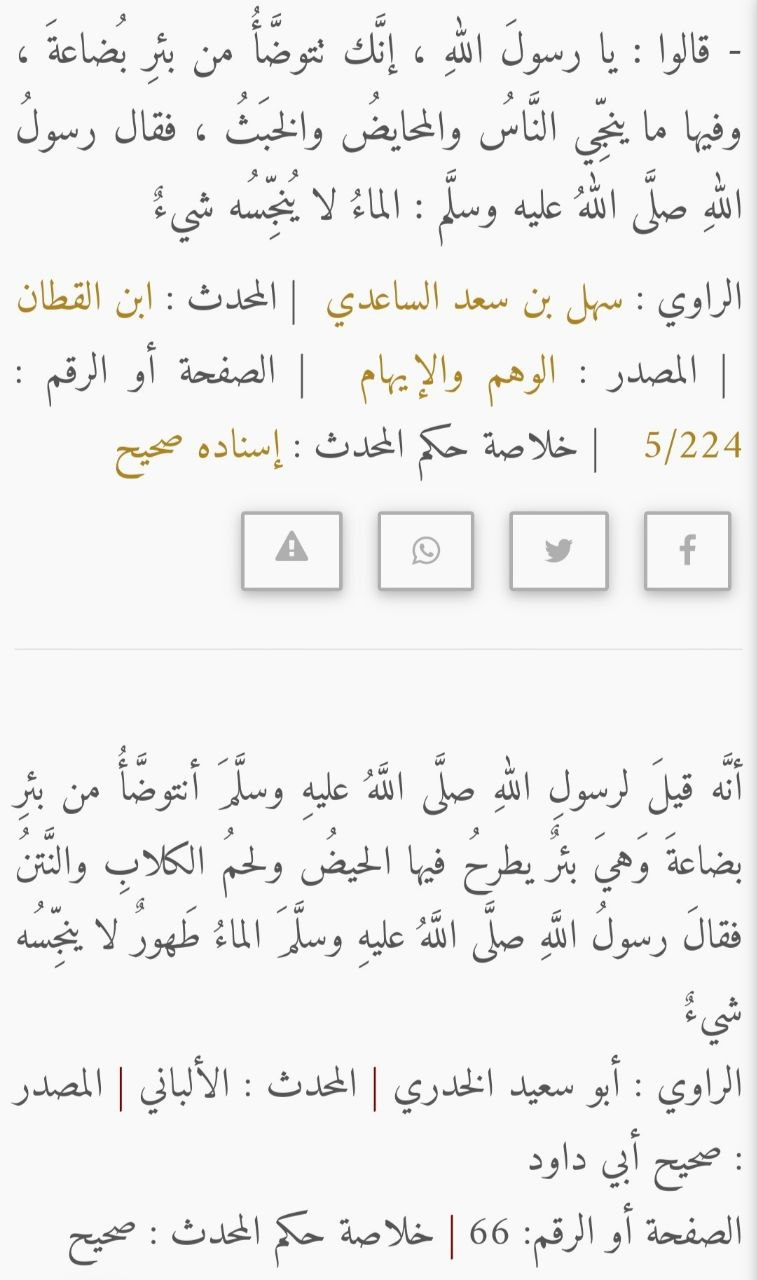
On the authority of Abu Sa’id Al-Khudri, it was said: “O Messenger of Allah, can we perform ablution from the well of Budha’ah?” He said: “It is a well into which menstrual fluid, dog meat, and filthy things are thrown.” The Messenger of Allah said: “Water is pure and nothing makes it impure.”
Part One — Chain of Transmission Analysis
The Six Variant Names of the Same Narrator
- Abd al-Rahman ibn Rafi’
- Abd al-Rahman ibn Abd al-Rahman ibn Rafi’
- Ubayd Allah ibn Abd al-Rahman ibn Rafi’
- Abdullah ibn Abd al-Rahman ibn Rafi’
- Ubayd Allah ibn Abdullah ibn Rafi’
- Abdullah ibn Abdullah ibn Rafi’
The chain is confused regarding the narrator’s name — yet across all variants, the narrator remains unknown (majhūl).
Chain-by-Chain Breakdown
- Abd al-Rahman ibn Rafi’ al-Ansari — trustworthiness not proven in the books of rijāl
- Salit ibn Ayyub — trustworthiness not proven in the books of rijāl → Hadith: WEAK
- Abdullah ibn Abd al-Rahman ibn Rafi’ — unknown status
- Salit ibn Ayyub — not authenticated in the books of jarh wa ta’dil → Hadith: WEAK
- Ubayd Allah ibn Abd al-Rahman al-Adawi — unknown
- The unnamed Ansari Tabi’i is also unknown according to this chain → Hadith: WEAK
- Khalid ibn Abi Nawf — not documented in the books of rijāl
- Salit ibn Ayyub — not documented in the books of rijāl → Hadith: WEAK
Al-Hafiz in Lisan al-Mizan (4/198): Ibn Hazm’s broad approach in authentication and disparagement led him to “heinous delusions, many of which were traced by al-Hafiz Qutb al-Din al-Halabi.”
— Also: Ibn Wadah only said “I met Ibn Abi Sakina in Aleppo” — he did not authenticate him. Qasim ibn Asbagh only said “This hadith is one of the best things about Bir Bada’a” — also not an explicit authentication.
→ Hadith: WEAK
- Tarif ibn Sufyan — weak narrator
- Qais — trustworthy, but his memory deteriorated in old age and his son introduced things into his hadith that were not from him
- Some chains also contain Sharik ibn Abdullah who has a poor memory → Hadith: WEAK
On the Weak Hadiths Mentioning the Prophet ﷺ Drinking from Bir Bada’ah
- Marwan ibn Abi Sa’id ibn al-Mu’alla — weak narrator
- Sa’id ibn Abi Zayd — unknown narrator
- Muhammad ibn Umar — weak narrator
- No mention of contamination at time of drinking → Hadith: WEAK and Mursal
- Muhammad ibn Umar — weak
- Ibrahim ibn Muhammad — abandoned (matrūk) narrator → Hadith: WEAK
- Muhammad ibn Umar — weak
- Ubayy ibn Abbas ibn Sahl ibn Sa’d — weak → Hadith: WEAK
- The mother of Muhammad ibn Abi Yahya — unknown, not authenticated by any hadith scholar
- al-Fudayl ibn Sulayman — trustworthy but has many mistakes
- No mention of contamination → Hadith: WEAK
- Ibrahim ibn Abi Yahya — abandoned (matrūk) narrator
- The woman — undocumented → Hadith: WEAK
Al-Daraqutni’s Assessment
Note: Even this chain does not mention the Prophet drinking from or making ablution with contaminated water.
On the Phrase “Water is Pure and Nothing Makes it Impure”
“An-Nadr informed us, Shu’bah told us, Yazid al-Rishk told us: I heard Mu’adhah al-‘Adawiyyah narrating, on the authority of ‘Aishah, she said: ‘Water is not made impure by anything, but a man should begin by washing his hands three times. I saw myself and the Messenger of Allah ﷺ performing ablution from one vessel.’”
The context here is shared ablution water between spouses — not contaminated well water.
Part Two — Jurisprudential Response
The Two Rulings on Water Mixed with Impurity
Second: If the impurity does not affect the water due to its abundance — it is not impure. The ruling turns on whether the water was changed, not merely whether something fell into it.
The Three Characteristics of Impure Water
| Characteristic | Changed by pure substance | Changed by impure substance |
|---|---|---|
| Colour | Water cannot be used for purification | Water is impure — cannot be used for anything |
| Taste | Water cannot be used for purification | Water is impure — cannot be used for anything |
| Smell | Water cannot be used for purification | Water is impure — cannot be used for anything |
In short: the ruling on changed water follows whatever changed it.
The Well of Buda’ah Was Abundant Water
It has always been the custom of people, both past and present, Muslims and disbelievers alike, to purify water and protect it from impurities. So how can one think of the people of that time — the highest class in religion and the best group of Muslims — that this is what they do with water? And the Messenger of Allah ﷺ cursed the one who defecates in water sources.
Rather, this well was located in a slope of the ground, and the floods would sweep away filth from the roads and courtyards and throw it in. Because of the well’s abundance, these things would not affect or change it. So they asked the Prophet ﷺ about its ruling. Such a suspicion [of deliberate contamination] is not permissible and is not appropriate for them.”
Statements of the Scholars
Ibn Rushd commented: “This is correct. There is no difference of opinion in the school of thought that abundant water is not rendered impure by impurity that has settled in it, unless one of its characteristics changes.”
The Companions Are Absolved
Summary
- On the chain: The hadith has iḍṭirāb (confusion) with an unknown narrator — multiple scholars of jarh wa ta’dil confirmed the narrator’s anonymity (jahālah). The hadith is at best questionable.
- On the content: Even if authentic, Islamic jurisprudence is clear — abundant water that does not change in taste, smell, or colour is pure. Bir Buda’ah was a large well with water exceeding two qullas. It did not change.
- On the Prophet ﷺ: He was the first to forbid urinating in water. He cursed those who contaminate water sources. The claim that he would command ablution with visibly filthy water contradicts everything established about him ﷺ.