

Was the Prophet Lustful Because Women Could Offer Themselves in Marriage?
Was the Prophet Lustful Because Women Could Offer Themselves in Marriage?
Some critics claim that Surah Al-Ahzab 33:50 portrays the Prophet ﷺ as lustful because it mentions a believing woman offering herself to the Prophet in marriage.
This is a dishonest reading.
The verse is not about lust, fornication, or unrestricted access to women. It is about lawful marriage, marital categories, mahr, and a Prophet-specific legal concession.
The Verse in Question
“Prophet, We have made lawful for you the wives whose bride gift you have paid, and any slaves God has assigned to you through war, and the daughters of your uncles and aunts on your father’s and mother’s sides, who migrated with you. Also any believing woman who has offered herself to the Prophet and whom the Prophet wishes to wed — this is only for you [Prophet] and not the rest of the believers: We know exactly what We have made obligatory for them concerning their wives and slave-girls, so you should not be blamed: God is most forgiving, most merciful.”
Translation: Abdul Haleem
Critics claim that because the verse permits a believing woman to offer herself in marriage to the Prophet ﷺ, this allegedly proves that the Prophet ﷺ was lustful or that the Qur’an was written to serve his desires.
This claim is nonsense. The verse is speaking about marriage, not sexual access outside marriage. It is also explicitly restricted to the Prophet ﷺ and framed as a legal ruling.
The Verse Is About Marriage, Not Lust
The verse says:
“If the Prophet wishes to marry her.”
The word is about nikāḥ, marriage. The verse does not say that any woman becomes sexually available merely by offering herself. It says that if a believing woman offers herself and the Prophet ﷺ wishes to marry her, then this is a lawful marriage category specific to him.
Does Nikāḥ Mean Sex in the Qur’an? Refuting the Claim With Arabic and Qur’anic Usage
The verse does not describe lust. It describes a lawful marriage concession. A woman offering herself is not the same as fornication, casual access, or unrestricted desire. It remains marriage.
The critic deliberately strips the verse of its legal context and then attacks the distortion.
The Ruling Is Prophet-Specific
The verse explicitly says:
“This is only for you, apart from the believers.”
This means the ruling was a specific concession for the Prophet ﷺ, not a general law for Muslim men.
The verse does not open the door for all men to marry without the normal requirements. It explicitly restricts this ruling to the Prophet ﷺ.
The restriction itself refutes the claim that this was some general lust-based permission. It is a controlled legal exception.
What Does This Mean Regarding Mahr?
The verse implies that in this specific case, a believing woman could offer herself in marriage to the Prophet ﷺ without requiring mahr.
Mahr is the bridal gift or marital due given by the husband to the wife. It is a woman’s right in marriage.
The normal rule for the believers remains that mahr is part of marriage. The verse itself says:
“We know what We have made obligatory for them concerning their wives.”
So the verse distinguishes between the Prophet-specific concession and the general obligations placed upon the believers.
The issue is not that mahr is meaningless. The issue is that Allah gave the Prophet ﷺ a specific concession if a believing woman voluntarily offered herself in marriage. That concession was not given to the rest of the believers.
This does not prove lust. It proves legal distinction.
Did the Prophet ﷺ Actually Use This Concession?
Here is the decisive point: according to the report cited in the source scan, the Prophet ﷺ did not have any wife who entered his household through this self-gift concession.
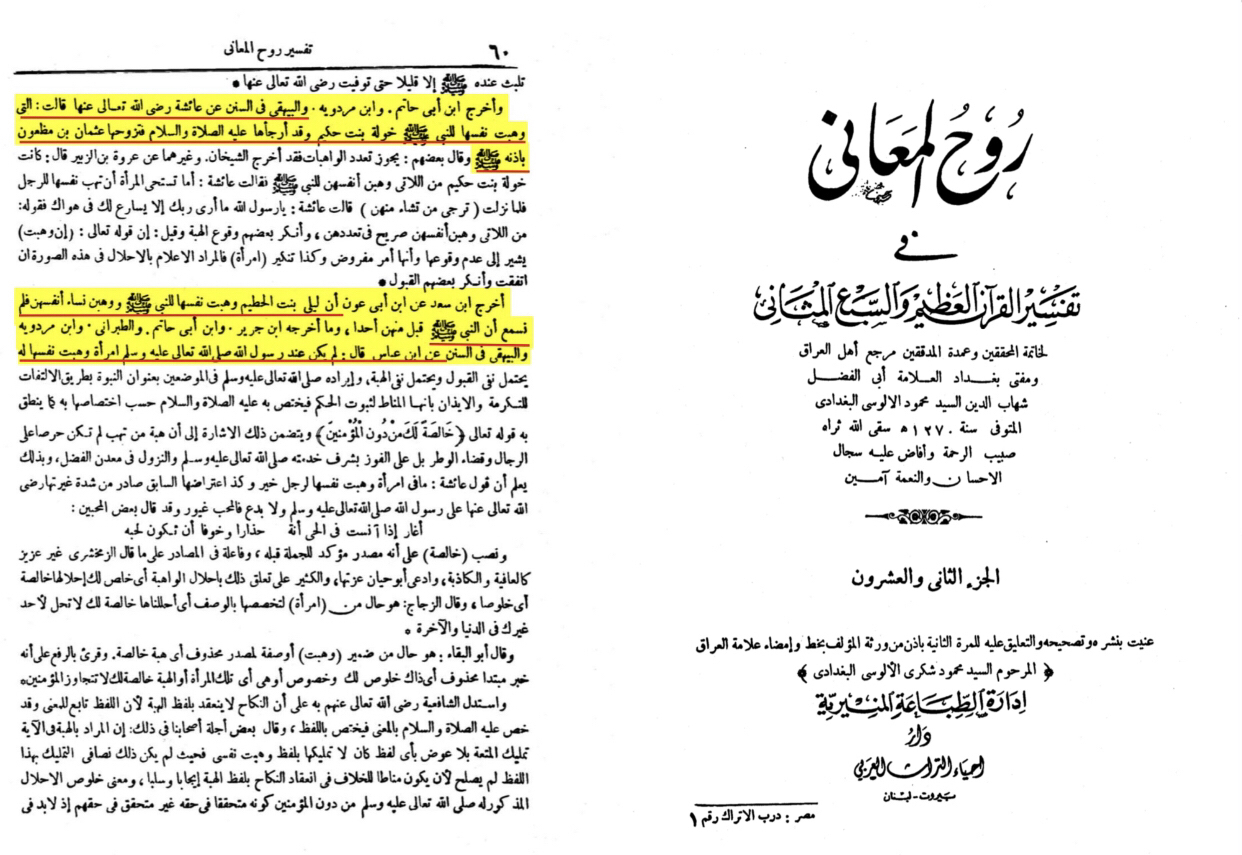
This scan is fromRūḥ al-Maʿānī under the discussion of Surah Al-Ahzab 33:50. The highlighted report cites al-Bayhaqī narrating from Ibn ʿAbbās that there was not with the Messenger of Allah ﷺ any woman who gifted herself to him. The relevance is clear: although the verse mentions a Prophet-specific legal concession for a believing woman who offered herself in marriage, the report states that the Prophet ﷺ did not actually keep a wife through this category. This directly weakens the polemical claim that the verse was created to satisfy lust.
Source: Rūḥ al-Maʿānī, vol. 22, p. 60.
This is devastating for the accusation.
If the Prophet ﷺ were inventing a verse to satisfy his desires, the critic would expect him to exploit the concession. Yet the cited report says he did not have any woman through that category.
Important Wording Correction
Do not phrase the argument as: “No woman ever offered herself to him.”
That wording is too broad and can backfire, because reports mention women offering themselves to the Prophet ﷺ. The stronger and safer wording is:
The Prophet ﷺ did not have a wife through the specific no-mahr self-gift concession mentioned in Al-Ahzab 33:50, according to the report cited from Ibn ʿAbbās.
That is the point needed for the refutation.
Why This Undermines the Authorship Accusation
The critic’s accusation depends on the idea that the Prophet ﷺ allegedly authored the Qur’an for personal desire.
But if that were the case, this verse becomes awkward for the critic.
The verse grants a specific concession, yet the cited report says he did not use it by keeping a wife through that category.
If the verse were invented for lust, one would expect the Prophet ﷺ to exploit it. But the report cited from Ibn ʿAbbās states that he did not have any woman through this self-gift category. The accusation therefore collapses.
A law existing is not proof of personal indulgence, especially when the person accused did not exploit the law in the way the critic imagines.
The Verse Also Removes Blame, Not Morality
The verse ends by saying:
“So that there should be no blame upon you. And Allah is Most Forgiving, Most Merciful.”
The purpose is to remove legal difficulty and clarify what is lawful for the Prophet ﷺ. It is not a statement of unrestricted desire.
The verse clarifies lawful categories and removes blame. It does not describe indulgence, immorality, or lust.
The critic reads a legal concession as moral corruption only because he has already decided to attack the Prophet ﷺ.
The Same Passage Is Not Unlimited Permission
The critic also ignores that this same Qur’anic passage places restrictions.
Allah says shortly after:
“Women are not lawful to you after this, nor may you exchange them for other wives, even if their beauty pleases you.”
This is fatal to the lust-based reading. The same Qur’anic section that critics try to weaponize also restricts the Prophet ﷺ from marrying further women or exchanging his wives, even if another woman’s beauty pleased him.
A text supposedly invented for lust would not immediately restrict further marriages and forbid exchanging wives even if their beauty was pleasing. The context points to legal regulation, not indulgence.
The critic cherry-picks one clause and ignores the wider passage.
No Evidence of Lust
The accusation also fails because the verse requires multiple conditions:
The woman must be believing.
She must voluntarily offer herself.
The Prophet ﷺ must wish to marry her.
The ruling is restricted to the Prophet ﷺ.
It remains marriage, not illicit access.
And according to the cited report, he did not have a wife through this concession.
This is not an open-ended sexual license. It is a restricted legal category within marriage, specific to the Prophet ﷺ, and not something he is reported here to have used.
The critic’s argument survives only by ignoring the text’s own conditions.
Final Refutation
The claim that Al-Ahzab 33:50 proves the Prophet ﷺ was lustful is baseless.
The verse is about lawful marriage, not illicit desire. It discusses women whom the Prophet ﷺ could marry, including a believing woman who voluntarily offered herself. This ruling was specific to him and not for the rest of the believers.
The key report cited from Rūḥ al-Maʿānī states that al-Bayhaqī narrated from Ibn ʿAbbās that the Prophet ﷺ did not have any woman with him who had gifted herself to him. That means the very concession critics weaponize was not used in the way they imagine.
The wider context also restricts the Prophet ﷺ from further marriages after this and from exchanging wives, even if beauty pleased him. That is the opposite of unrestricted lust.
Surah Al-Ahzab 33:50 does not portray the Prophet ﷺ as lustful. It establishes a restricted Prophet-specific marriage concession, while the cited report states that he did not keep a wife through that self-gift category. The accusation is not based on the verse; it is based on hostile misreading.
Source Notes
Al-Ālūsī,Rūḥ al-Maʿānī, vol. 22, p. 60, citing al-Bayhaqī from Ibn ʿAbbās regarding the Prophet ﷺ not having any woman who gifted herself to him.