Was the Trinity Spread by Proof or by Fire? The Story of Michael Servetus
Either Believe in the Trinity or Be Burned: Michael Servetus and the Church’s Enforcement of Doctrine
Table of Contents
- Michael Servetus and the Trinity
- Studying the Torah in Its Original Languages
- Servetus Rejected the Trinity
- The Trial and Execution
- The Problem for Christian Claims
- Scan Evidence
- Conclusion
Michael Servetus and the Trinity
The Spanish philosopher and theologian, Michael Servetus, studied Hebrew and Greek and studied the Torah in its original languages.
Studying the Torah in Its Original Languages
After studying the Torah in its original languages, Servetus concluded that there is no doctrine of the Trinity in the Torah and that the one God can only be one.
Servetus Rejected the Trinity
He denied the doctrine of the Trinity.
The Trial and Execution
A trial was held for him, and John Calvin was involved in the case against him. Servetus was condemned for heresy, especially for rejecting the doctrine of the Trinity.
The verdict was issued against him: death by burning.
The Problem for Christian Claims
If the doctrine of the Trinity is supposedly clear, obvious, and directly taught in the Torah and the Bible, then why did scholars who studied Hebrew, Greek, and the original biblical languages reject it?
And if the doctrine was truly based on clear proof, why was fire needed to defend it?
The issue is that a man who rejected the Trinity after studying the biblical languages was not simply refuted with evidence.
He was burned.
Scan Evidence
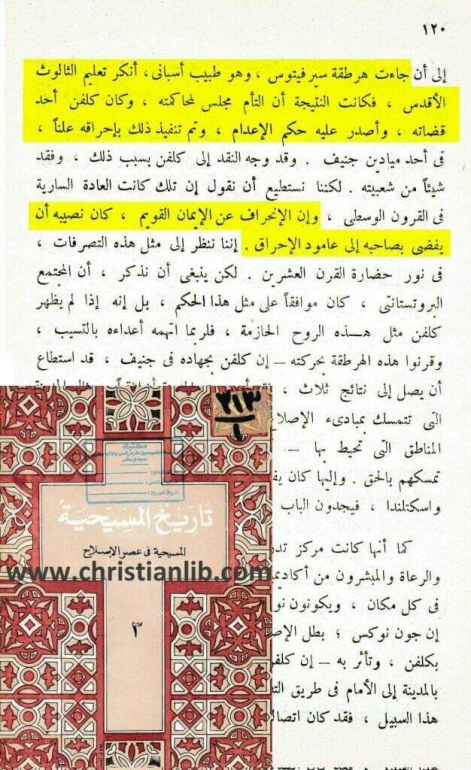
This scan presents the case of Michael Servetus as an example of how rejection of the Trinity was treated in Christian Europe. Servetus is described as a Spanish philosopher and theologian who studied Hebrew and Greek and investigated the Torah in its original languages. The key point highlighted is that Servetus concluded that the doctrine of the Trinity was not found in the Torah and that God is one. Because he denied the Trinity, he was put on trial and sentenced to death by burning. The scan is used to support the argument that the doctrine of the Trinity was not merely spread through biblical proof and theological persuasion, but also through coercion, fear, and punishment against those who rejected it.
Conclusion
Instead of defeating him through clear scriptural evidence, the Church condemned him as a heretic and he was burned.
This raises the obvious question:
If the Trinity is truly clear from the Bible, why did it need fire to defend it?