Refutations

What Is the Meaning of "Until He Tastes Her Honey" in the Halala Hadith?Refuting the Oral Sex Allegation Against the Prophet's Hadith

13 min read 2719 words

Taste His Honey — Refuting the Allegation of Sucking Genitals in the Hadith

download 3f5979bd52567eb0

Topics Covered
  • Response to the allegation: Taste his honey and he will taste your honey
  • The lie that the Prophet ordered the sucking of genitals in the hadith


Content of the Doubt The enemies of Islam claim that the Prophet Muhammad commanded men and women to lick each other’s genitals. They cite as evidence the Prophet’s statement, “Taste the sweetness of the sweetness” in the following hadith:
The Hadith in Question On the authority of Anas, that the Messenger of Allah, peace and blessings be upon him, was asked about a man who had a wife and divorced her three times, and she later married another man who divorced her before consummating the marriage. Is she permissible for her first husband? The Messenger of Allah, peace and blessings be upon him, said: “No, not until the second husband has tasted her honey and she has tasted his honey.”

Response to This Ridiculous Suspicion

Core Rebuttal The previous hadith does not contain any reference to sucking or licking the genitals. The hadith speaks indirectly about sexual intercourse only. If you collect the rest of the versions of this hadith and compare them to each other, you will find that the hadith only speaks indirectly about sexual intercourse.

Other Versions of the Hadith Confirm Sexual Intercourse

Encyclopedia of Traditional Interpretation — 4/206 On the authority of Ibn Umar, who said: The Messenger of Allah was asked about a man who divorces his wife three times, and then another man marries her, closing the door and lowering the curtain, then he divorces her before consummating the marriage with her. Is she permissible for the first man? He said: “No, until she tastes the honey.”

In another version: “Until the other man has intercourse with her.”

Ibn Abi Shaybah — Musannaf (Chapter: A Man Divorces His Wife Three Times) Ghandar told us on the authority of Shu’bah on the authority of Yahya ibn Yazid Al-Hana’i on the authority of Anas, who said: “She is not permissible for the first until the second has intercourse with her and consummated the marriage with her.”

Waki’ narrated to us, on the authority of Ali ibn Mubarak, on the authority of Yahya ibn Abi Katheer, on the authority of Abu Yahya, who said: Abu Hurayrah said: “She is not permissible for the first husband until the second husband has intercourse with her.”

The same content of this narration has been mentioned in Sunan Al-Nasa’i and others.
Conclusion The phrase “he tastes his honey and she tastes her honey” is a polite metaphor and an indirect allusion referring to sexual intercourse — not to sucking the genitals, as the lying enemies of Islam claim.

The Prophet Himself Explained the Meaning

Nur Al-Din Al-Haythami — The Sublime Objective in the Additions of Abu Ya’la al-Muwasli 2/358 Abdullah ibn Umar narrated to us, Yahya ibn Zakariya narrated to us, on the authority of Yahya ibn Sa’id, on the authority of Al-Qasim, on the authority of Aisha, that the Prophet, may God bless him and grant him peace, said: “Al-Usaylah means intercourse.”
Abu Nu’aym Al-Isfahani — Hilya Al-Awliya’ wa Tabaqat Al-Asfiya’ 9/226 Abu Bakr ibn Khallad and Ahmad ibn Ja’far ibn Hamdan narrated to us: Abdullah ibn Ahmad ibn Hanbal narrated to us: My father narrated to me: Marwan ibn Mu’awiyah narrated to us: Abu Abdullah al-Makki narrated to us: Abdullah ibn Abi Mulaykah narrated to us, on the authority of Aishah, that the Prophet, may God bless him and grant him peace, said: “Al-Usaylah means intercourse.”
The Prophet himself confirmed that what he meant by his words was not sucking the genitals, but rather intercourse.

What Arabic Linguists Say

Ibn Sidah — Al-Muhkam wa Al-Muhit Al-A’zam 1/485 “And in the hadith: ‘Regarding a man who divorces his wife and then marries another husband, if the second divorces her, she is not permissible for the first until he tastes her honey and she tastes his honey.’ Meaning: sexual intercourse, as an example.”
Al-Sagani — Al-Takmilah wa Al-Dhayl wa Al-Silah 5/59 “Tasting the honey: a metaphor for penetration. From this is the hadith of the Prophet, peace and blessings be upon him, to Tamimah bint Wahb, the wife of Rifa’ah al-Qurazi: No, until you taste his honey and he tastes your honey.”
Ibn Manzur — Lisan Al-Arab 11/445 “And in the hadith about a man who divorces his wife and then marries another husband, if the second divorces her, she is not permissible for the first until he tastes her honey and she tastes his honey, meaning intercourse in the same manner… He likened the pleasure of intercourse to the taste of honey, so he borrowed a taste for it. They said that everything they deemed sweet is honey and honeyed, on the basis that it is deemed sweet as honey is deemed sweet… Al-Azhari said: The word ‘Usaylah’ in this hadith is a metaphor for the sweetness of intercourse, which occurs when the glans penis is inserted into the woman’s vagina. The two ‘Usaylahs can only be tasted together by inserting the penis into the woman’s vagina, even if they do not ejaculate.”
Murtada Al-Zabidi — Taj Al-Arus min Jawahir Al-Qamus 25/328 “He tasted someone: he experienced him but did not praise his information. A matter that is tasted, i.e., tried and known. The taste of honey: a metaphor for penetration.”
Al-Azhari — Al-Zahir 1/216 “The hadith states: ‘Until you taste his honey and he tastes your honey.’ Honey is a metaphor for the pleasure of intercourse. Whoever has intercourse until the circumcised parts meet has tasted and made taste honey.”
There is no linguist or religious scholar who said that this phrase means sucking the genitals.

What Religious Scholars Say

Ibn Uthaymeen — Fath Dhi al-Jalal wal-Ikram bi Sharh Bulugh al-Maram 4/510 “And his saying: ‘From her honey’ — is the honey the ejaculation or just intercourse? The correct answer: It is just sexual intercourse.”
Abdul Raouf Al-Manawi — Fayd Al-Qadir 4/380 “Al-Usaylah: sexual intercourse — meaning that it is used as a euphemism for it, because honey has sweetness and one enjoys eating it, and sexual intercourse has sweetness and one enjoys it.”
Ibn Qutaybah — Gharib Al-Hadith 1/208 “Honey is a metaphor for the sweetness of intercourse.”
The same explanation is mentioned in more than 250 books, including:
  • The Supplement, the Appendix, and the Connection 5/59 — Al-Sagani
  • Explanation of Sahih Al-Bukhari 7/479 — Ibn Battel
  • The End in Explaining Al-Hidayah 8/147 — Al-Saghnaqi
  • Familiarity with the Hadiths of Rulings 1/505 — Ibn Daqiq al-Eid
  • Explanation of the Explanation of Sahih Al-Bukhari 25/489 — Ibn al-Mulaqqin
  • The Bride’s Crown from the Jewels of the Dictionary 25/328 — Murtada Al-Zabidi
  • The Ocean Ocean 25/442 — Muhammad ibn Ali ibn Adam Al-Athiubi
  • The Simplified Encyclopedia of Jurisprudence 5/55 — Hussein Al-Awaisheh

The Word “Tasted” Does Not Require the Mouth

The Enemies’ Error The foolish enemies of Islam looked at the word (yadhuq) mentioned in the hadith and thought that it meant sucking with the mouth. But the word “tasted” in the Arabic language also means: to sense, feel, test, and experiment. That is why the Arabs say:

tasted sleep — tasted pain — tasted fear — tasted bitterness — tasted sorrow — tasted joy — tasted ecstasy — tasted success — tasted pleasure

Al-Wasit Dictionary “It is said, ‘I have not tasted sleep.’ To taste something means to try it and examine it, so he is a taster and a taster, and to sense it. It is said, ‘My hand tasted it,’ meaning I sensed it. In the Noble Qur’an: ‘So they tasted the consequences of their deed.’ Someone tasted such-and-such; that is, he made him taste it. It is also said, ‘God made him taste fear’ and other things; that is, He sent it down on him. In the Noble Qur’an: ‘So God made her taste the garment of hunger and fear.’”
Ibn Manzur — Lisan Al-Arab (Chapter: Tasted) “And you say: I tasted so-and-so and I tasted what he had; meaning I experienced him. Similarly, whatever bad thing befalls a person, he has tasted it. In the hadith: ‘Indeed, Allah does not like tasters, male or female,’ meaning those who marry quickly and divorce quickly… and a matter that is tasted means that it is tried and known.”
Ibn Manzur — Lisan Al-Arab (Chapter: Tasted) “A man tastes a woman’s honey when he penetrates her thoroughly until he feels the pleasure of her intercourse, and she tastes his honey as well when he mingles with her.”
Abdullah Al-Bassam — Clarification of the Rulings from Reaching the Goal 5/304 “He said in Al-Muheet: The origin of taste is the recognition of flavor, then it became more common until it was made to refer to every experience, and from it is the meaning of the hadith.”
Even Christians Use “Tasted” in Their Book Without the Mouth
  • Psalm 34:8“Taste and see that the Lord is good!”
  • Wisdom 12:26“And when they did not learn from the discipline of mockery, they tasted the punishment that befitted God.”
  • 2 Maccabees 6:9“Whoever refused to adopt the Greek customs would be killed, and thus they tasted the bitterness of the ordeal.”
  • Hebrews 6:4“For those who have once been enlightened, have tasted the heavenly gift and have become partakers of the Holy Spirit.”
  • Hebrews 2:9“But we see Jesus, who was made a little lower than the angels, for the suffering of death, crowned with glory and honor, so that by the grace of God he might taste death for everyone.”

The Word “Usayla” Is Not Indecent

The Prophet’s High Morals in Language The Prophet (PBUH) was a man of high morals, therefore he did not mention the genitals explicitly so as not to embarrass the listener. Rather, the Prophet used an indirect metaphor for sexual intercourse. He used a polite word, “taste,” and two ordinary words — “taste” and “honey” — as a metaphor and indirect allusion for sexual intercourse.

The word (Usayla) is the diminutive of the word (Asla) — a piece of honey. Al-Usaylah is a metaphor and an indirect expression so that the Prophet would not offend the listeners.

Al-Jawhari — Al-Sahah Taj Al-Lughah wa Sahah Al-Arabiyyah 1/169 “You also say: So-and-so has no honeycomb, meaning he has no lineage or wealth. And I do not know of any honeycomb for him, meaning his lineage.”

The same was mentioned in several books including:

  • The Bride’s Crown 29/479 — Murtada Al-Zabidi
  • The Pioneer’s Migration and the Law 1/290 — Al-Yaziji
  • The Letter Jim 2/255 — Abu Amr Al-Shaibani
  • Al-Muheet in the Language 1/364 — Al-Sahib Ibn Abbad
  • Dictionary of the Language Text 4/105 — Ahmed Reda
  • Al-Muzhir in the Sciences of Language 2/154 — Al-Jalal Al-Suyuti
  • Correction of Logic 1/271 — Ibn Al-Sikkit
  • Al-Muhkam wa Al-Muhit Al-A’zam 8/191 — Ibn Sidah

The Arabs Used “Taste the Honey” for Pleasure Generally

Margin of Al-Ihsan fi Taqreeb Sahih Ibn Hibban — 9/428 “And Al-Usaylah: the diminutive of Al-Aslah, which is a metaphor for the pleasure of sexual intercourse. The Arabs call everything that you enjoy honey, likening its pleasure to the pleasure and sweetness of honey, so they used a metaphor for its taste.”
The phrase is neither heinous nor obscene. The word (Usayla) was used by Arabs in ancient times in popular proverbs, and it was not a bad or embarrassing word.

Why the Prophet Mentioned This Hadith

The Legal Context The Prophet informed us that if a man divorces his wife three times, she becomes forbidden to him. This woman is then allowed to marry someone else and live the rest of her life with the new husband, and the new husband may treat her as a husband treats his wife.

The Prophet forbade tampering with the law of marriage and divorce. Some men deceive themselves by divorcing their wives three times, then agree with a friend to marry the divorced wife and order him to divorce her immediately so she can return to her first husband.

But the Prophet forbade such tricks. He told the wife that she should live normally with her new husband and that there should be normal marital relations between them.


Response to Christians and Atheists Who Raise This Suspicion
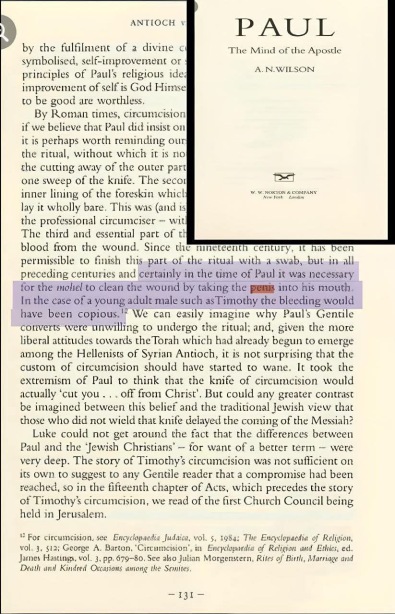
Response to Christians The Holy Bible does not prohibit sucking genitals, and Christian websites actually permit it. The Christian who raises this suspicion would do well to read the Song of Songs and Ezekiel in his own scripture first.
Response to Atheists and Secularists Atheists are the first to advocate for prostitution and homosexuality on their channels, pages, and websites. Western countries teach sex education in their schools. It is therefore surprising that atheists would object to a linguistic metaphor used by Prophet Muhammad.

the lie that the prophet ordered the sucking of genitals

the lie that the prophet ordered the sucking of genitals 1

the lie that the prophet ordered the sucking of genitals 2

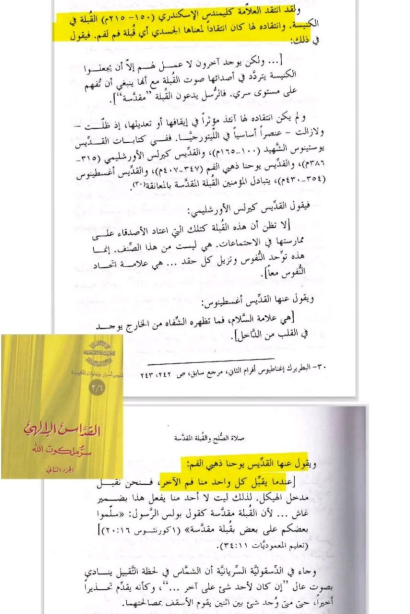
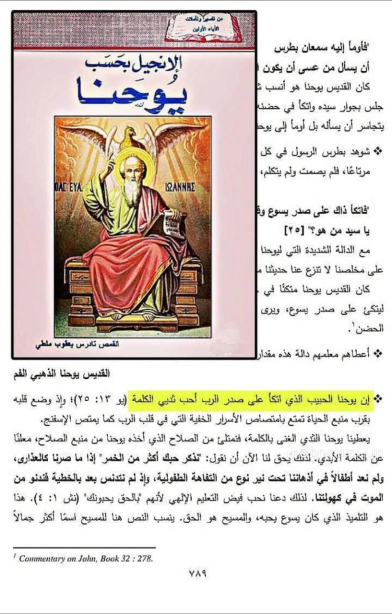
Early Church Testimony on the Holy Kiss

Source

The highlighted passages discuss the practice of the holy kiss in early Christian worship.


Summary for English Readers

Clement of Alexandria

Rather, it was understood as a mystical and sacred sign, because the apostles referred to it as a holy kiss.


Meaning of the Holy Kiss
  • Justin Martyr
  • Cyril of Jerusalem
  • John Chrysostom
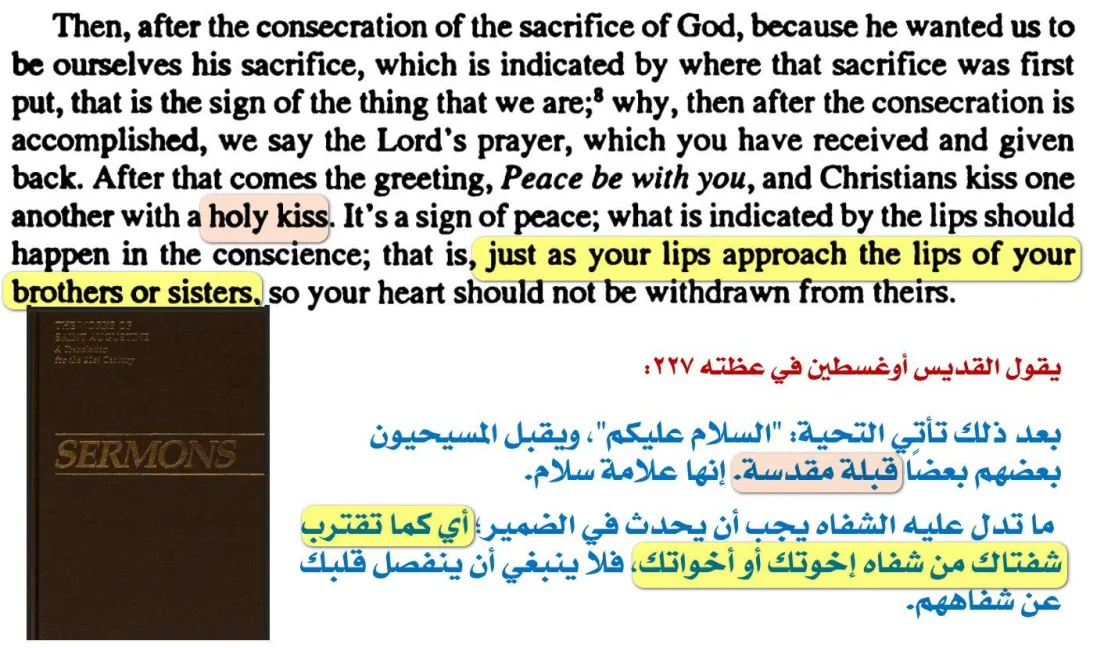
  • Augustine

Cyril of Jerusalem

Instead, it is meant to:

  • unite souls together
  • remove hatred
  • symbolize peace
  • show spiritual unity among believers

Augustine

what appears outwardly on the lips should also exist inwardly in the heart.
the lie that the prophet ordered the sucking of genitals 3


John Chrysostom

He warns that no one should perform it with a corrupt or impure intention, because the kiss is holy, as Paul said:

“Greet one another with a holy kiss.”


Main Point

Main Argument

It was understood by major Church Fathers as a symbol of peace, unity, purity, and spiritual brotherhood, not as a sensual or physical act.