

Who Really Destroyed the Library of Alexandria? The Myth Against Muslims Exposed
Some people repeat the lie that Amr ibn al-Aas burned the library on the orders of Omar ibn al-Khattab. Orientalists have responded and church historians have admitted that those who burned the library were Orthodox Christians during the period of their persecution of the pagans, where they killed them, destroyed and obliterated Pharaonic antiquities, smashed their gods, and burned their libraries.
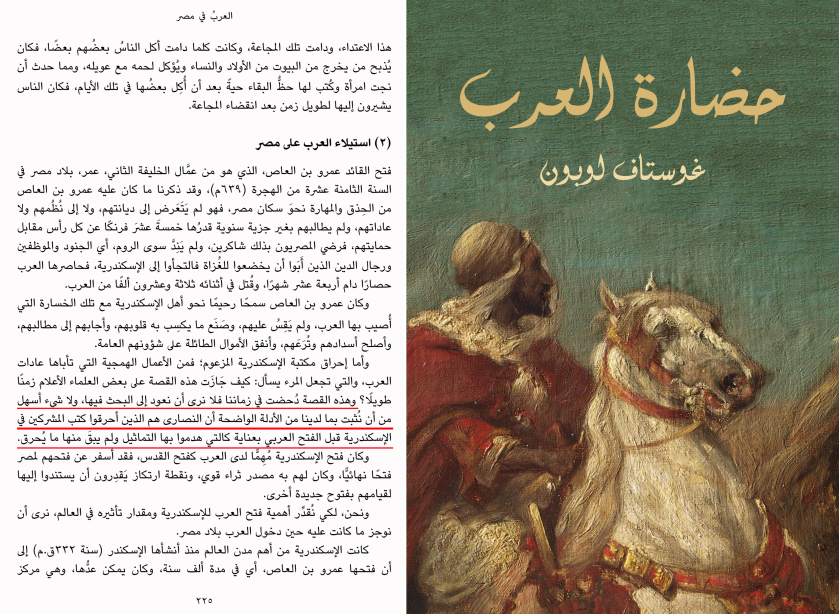
For your info: This scan is from Gustave Le Bon’s The Civilization of the Arabs. The highlighted passage argues that the accusation that Amr ibn al-Aas burned the Library of Alexandria is not supported by serious historical evidence. The page says this accusation only appears in unreliable later reports and that it is more reasonable to connect the destruction of libraries in Alexandria to earlier Christian actions, especially the priests who destroyed pagan temples, books, and institutions. For English readers, the important point is that the scan does not present the Muslim conquest as the cause of the library’s destruction; rather, it treats the anti-Muslim accusation as a later polemical claim.
The next source discusses the destruction of Egyptian antiquities under Christian rule and the role of Christian religious zeal in erasing pagan heritage.
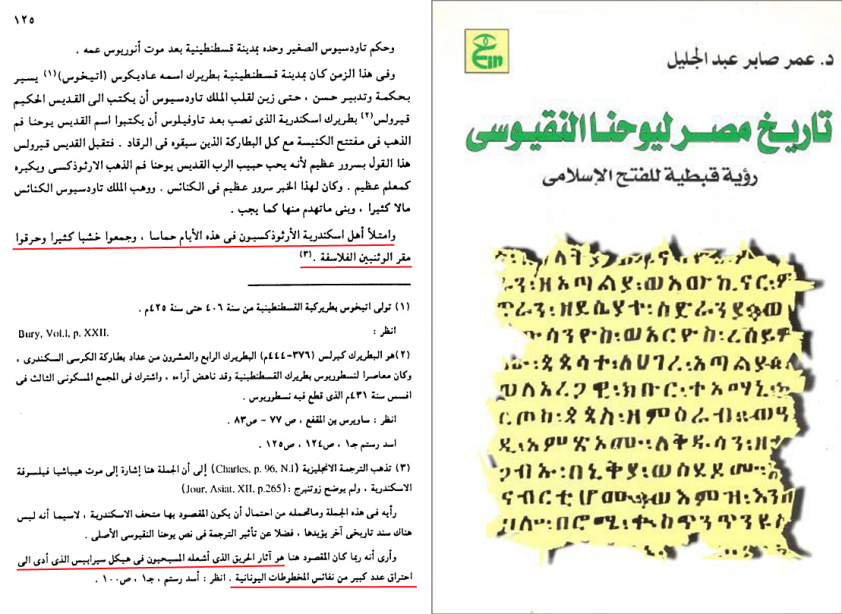
For your info: This scan is from History of Egyptian Coptic Christianity. The highlighted section states that the people of Alexandria attacked pagan temples, smashed many statues, and burned ancient Egyptian temples and libraries. The scan is being used to show that the destruction of pagan religious and intellectual heritage in Egypt was already taking place under Christian dominance before the Muslim conquest. This is important because it shifts the historical context away from the later accusation against Amr ibn al-Aas and places the destruction in the earlier period of Christian persecution of paganism.
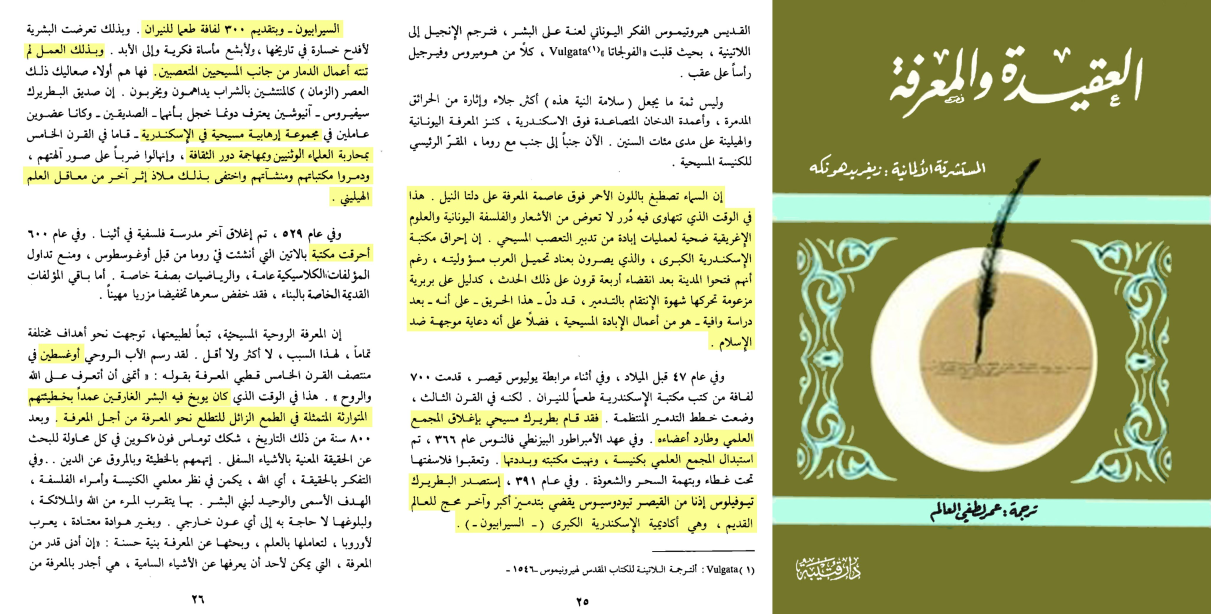
A further source on the formation of the modern world mentions the destruction caused by religious fanaticism against ancient institutions.
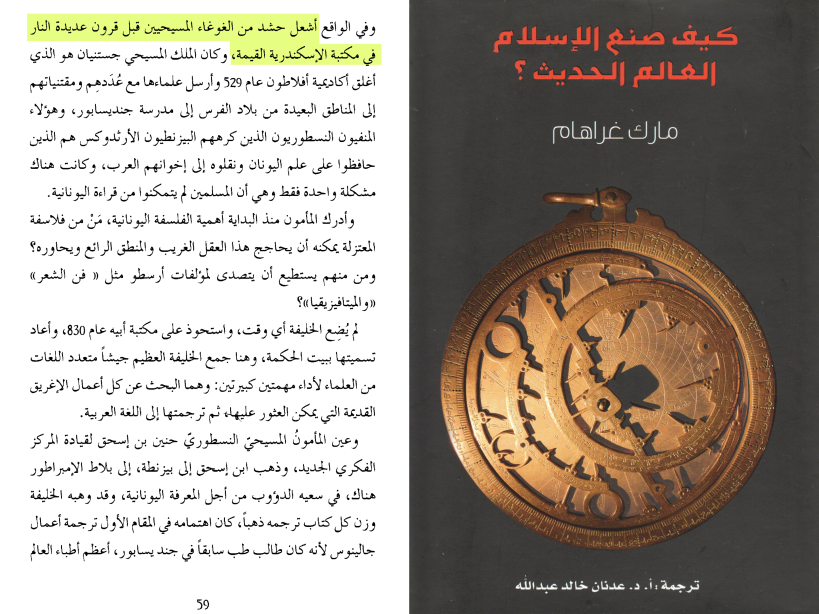
For your info: This scan discusses how Christian religious zeal affected the ancient intellectual world. The highlighted passage refers to the burning or destruction of major repositories of knowledge, including what remained of the Alexandrian intellectual heritage. It also mentions the closure of Plato’s Academy by Justinian in 529 CE and the departure of philosophers from Greek lands. For English readers, this page supports the broader argument that the decline of ancient libraries and pagan learning was tied to Christian imperial policy and religious persecution, not to the later Muslim conquest of Egypt.
The next scan gives another historical discussion of book destruction in Christian history.
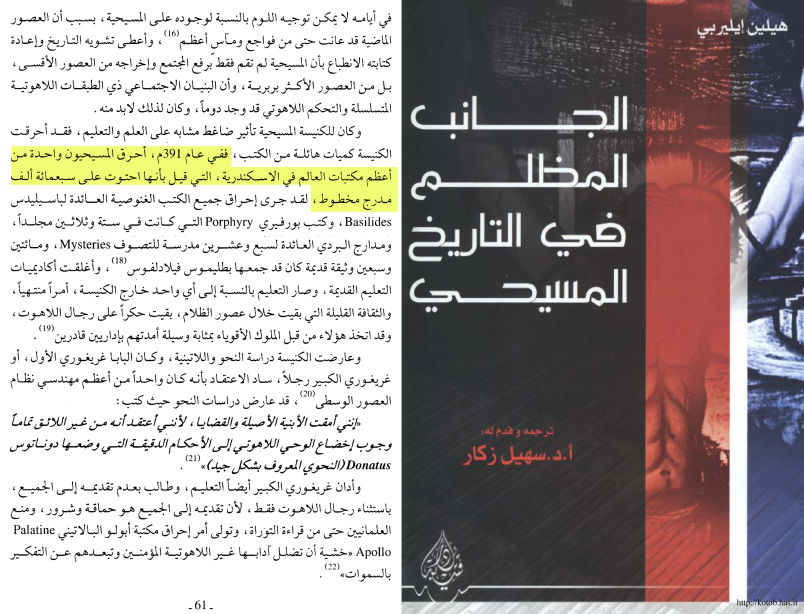
For your info: This scan discusses the Christian destruction of pagan books and institutions. The highlighted text states that in 391 CE, the Christians destroyed one of the greatest libraries of the ancient world in Alexandria, which contained around 400,000 manuscripts. The page presents this as part of a wider pattern of Christian hostility toward pagan learning, including the burning of books and the suppression of classical knowledge. This scan is central for English readers because it directly identifies the earlier Christian destruction of the Alexandrian library tradition.
The first to mention the accusation of Amr ibn al-Aas burning it was Abd al-Latif al-Baghdadi — 6 centuries after the alleged incident — in his book Al-Ifada wal-I’tibar, and several historians relied on his words, such as Jamal al-Din al-Qifti in his book Ikhbar al-Ulama bi-Akhbar al-Hukama, and Gregory Abu al-Faraj Ibn al-‘Ibri in his book Tarikh Mukhtasar al-Duwal.
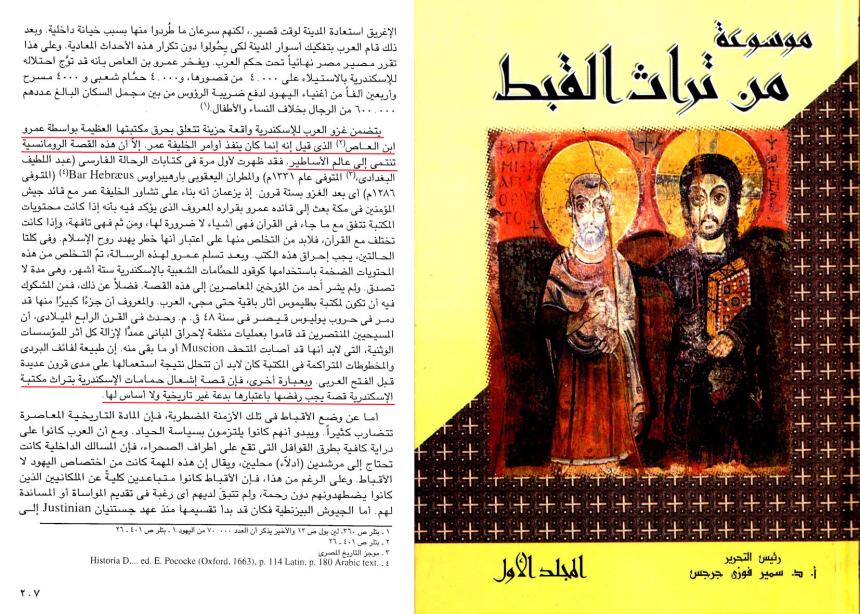
For your info: This scan explains that the accusation against Amr ibn al-Aas appears very late in the historical record. The highlighted passage says Abd al-Latif al-Baghdadi was among those who transmitted the story centuries after the conquest, and that later writers repeated it from him. The key point for English readers is chronological: a claim first appearing around six centuries after the alleged event is historically weak, especially when contemporary or near-contemporary sources do not mention it.
The next source gives a similar report about the late emergence of the story and the weakness of using it as historical proof.
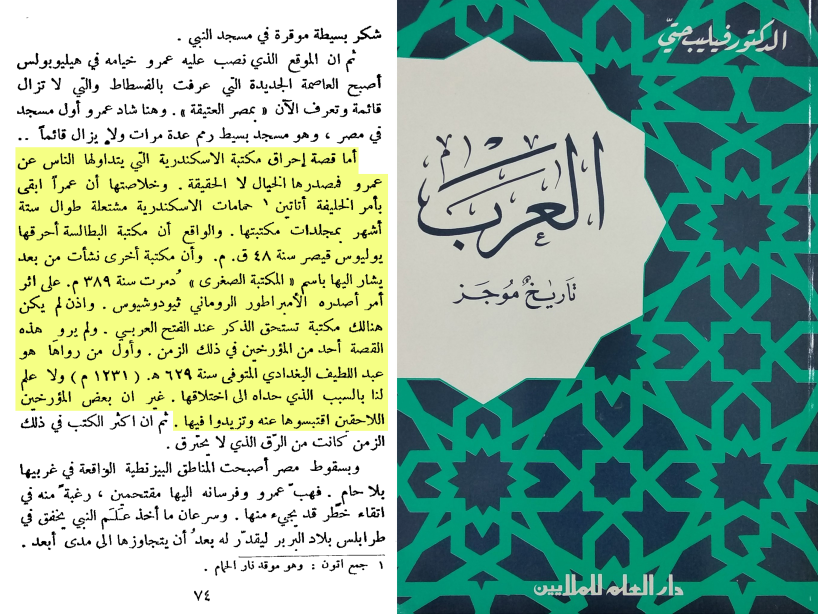
For your info: This scan discusses the story that Amr ibn al-Aas allegedly burned the Library of Alexandria by command of Umar ibn al-Khattab. The highlighted passage notes that this claim became popular in some later sources, but the report is not grounded in early historical testimony. For English readers, the scan is useful because it shows how the accusation spread through later historical literature rather than through reliable contemporary documentation.
A further historical scan discusses the same issue through the lens of the classical library and its alleged destruction.
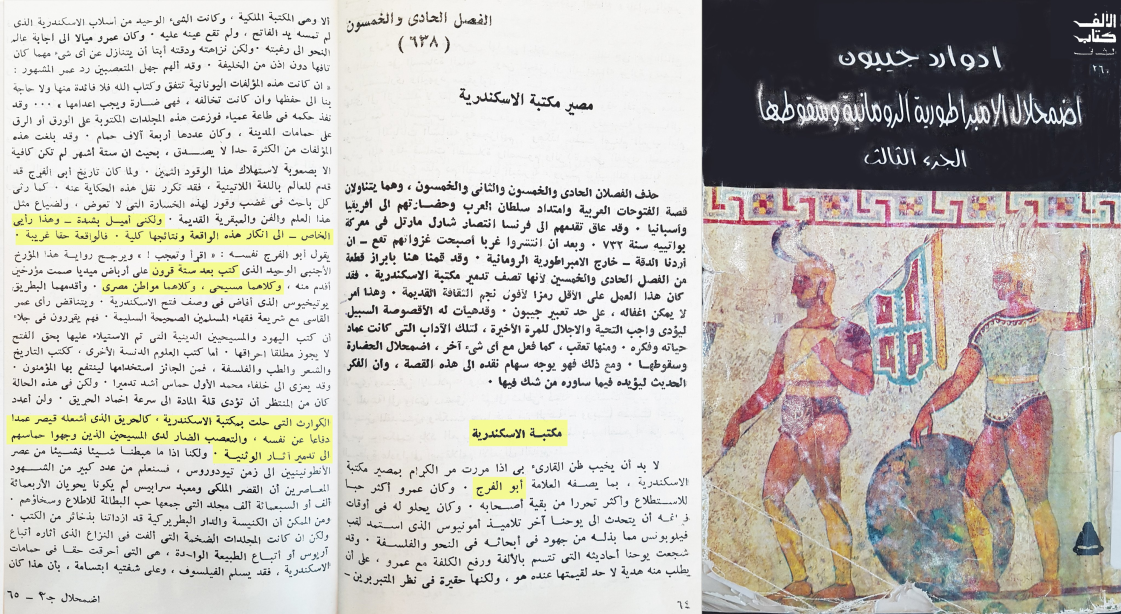
For your info: This scan presents a wider historical discussion of the Library of Alexandria and the reports about its destruction. The highlighted text indicates that the story of Amr burning the library is treated as historically doubtful and is connected to later narratives rather than early evidence. The scan also shows that the library’s history involved multiple stages of destruction and decline before the Muslim conquest. For English readers, the point is that the “Muslims burned the library” story oversimplifies a much older and more complex historical process.
The next scan continues the discussion of later historians and the weakness of the accusation.
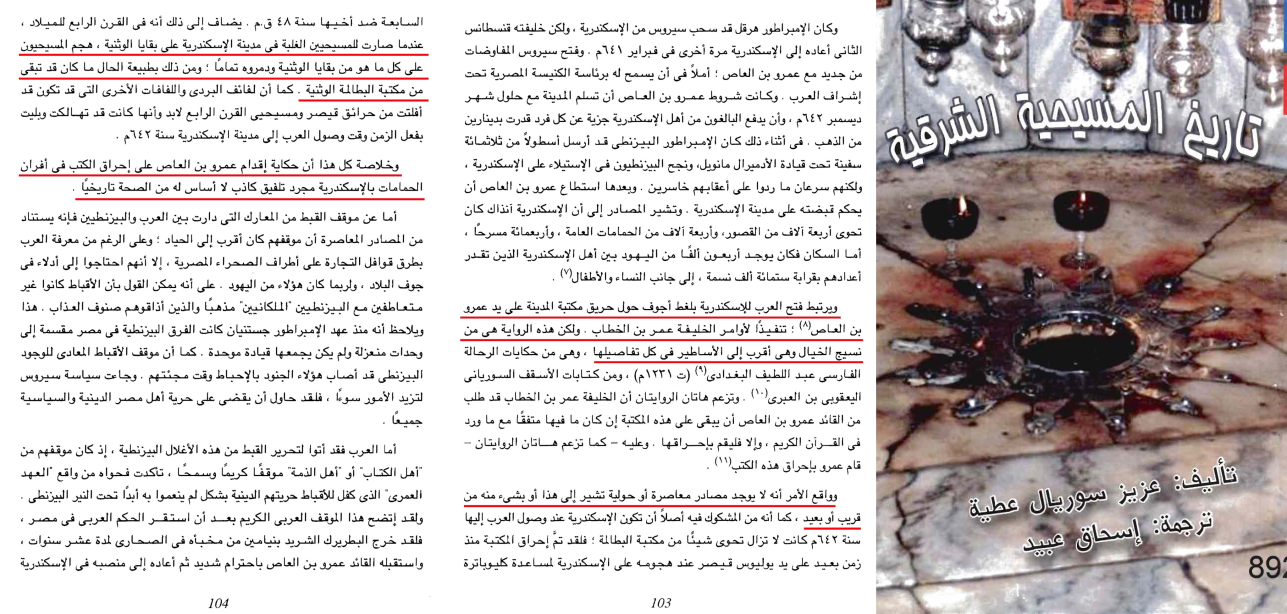
For your info: This scan addresses the late appearance of the story and notes that it was transmitted by later writers rather than early witnesses. The highlighted passage mentions Abd al-Latif and later authors such as Ibn al-Qifti and Ibn al-‘Ibri, who repeated the claim. The scan is important because it shows the accusation’s chain of popularity: it was not preserved by the historians closest to the conquest, but appears much later in works written centuries after the event.
All investigators rejected this lie, which was not mentioned by any contemporary historian of the conquest, as it first appeared nearly 6 centuries after the time of its alleged occurrence. There is no doubt that the culture of burning books, and even burning dissenters themselves, is an authentic Christian culture adopted by the Church since its first era, as Theophilus did.
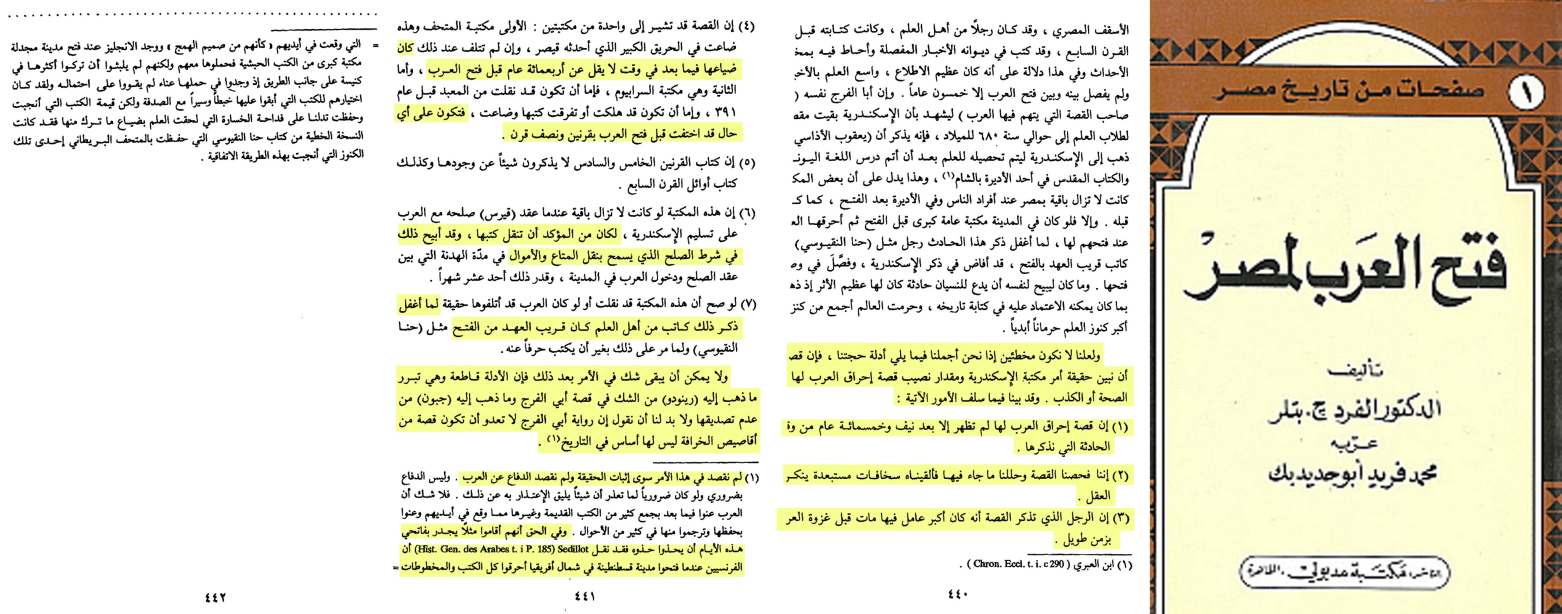
For your info: This scan is from a source discussing the Arab conquest of Egypt. The highlighted sections reject the story that Amr ibn al-Aas burned the Library of Alexandria and explain why the report is not reliable. The page emphasizes that the accusation is absent from early historians and appears only much later. For English readers, the scan supports the argument that serious historical investigation does not accept the story as credible.
The next scan gives a detailed treatment of the library accusation and the silence of early sources.
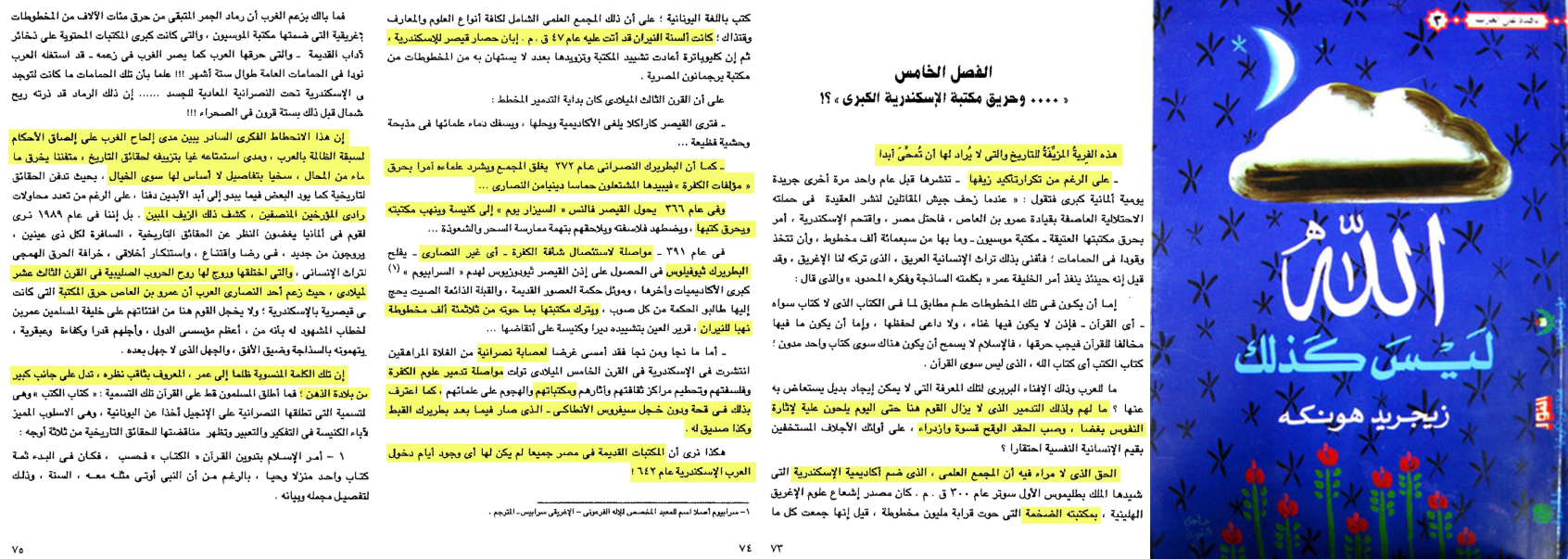
For your info: This scan argues that the claim about Amr burning the Library of Alexandria is historically baseless. The highlighted sections point out that early Muslim and non-Muslim historians who described the conquest of Egypt did not mention such a dramatic event. The page also argues that if the story were true, it would have been impossible for historians to ignore it. For English readers, the core point is that silence from early historical sources is devastating against a dramatic accusation that only appears centuries later.
Another source discusses the claim in relation to George Sarton and the history of ancient learning.
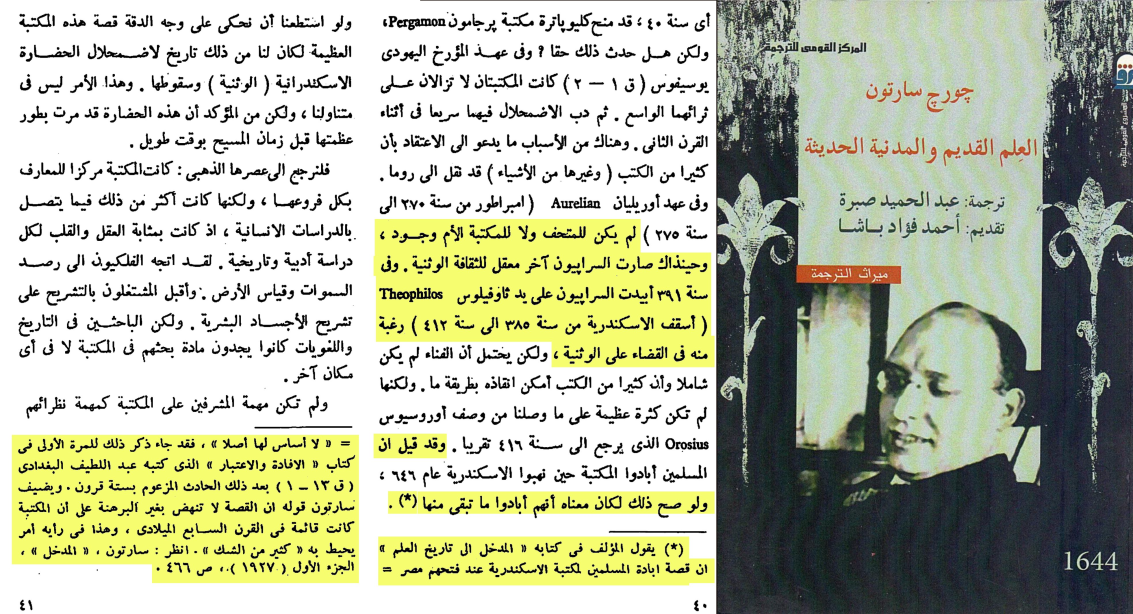
For your info: This scan cites George Sarton’s discussion of the Library of Alexandria. The highlighted passage explains that the library had already suffered earlier destruction and that by the time of the Muslim conquest, there was no great library left in the form imagined by the accusation. It also notes that the story of the Muslims burning the library lacks serious historical basis. For English readers, this page is important because it shows a historian of science rejecting the popular anti-Muslim legend.
The next scan discusses Arab civilization and the historical weakness of the claim.
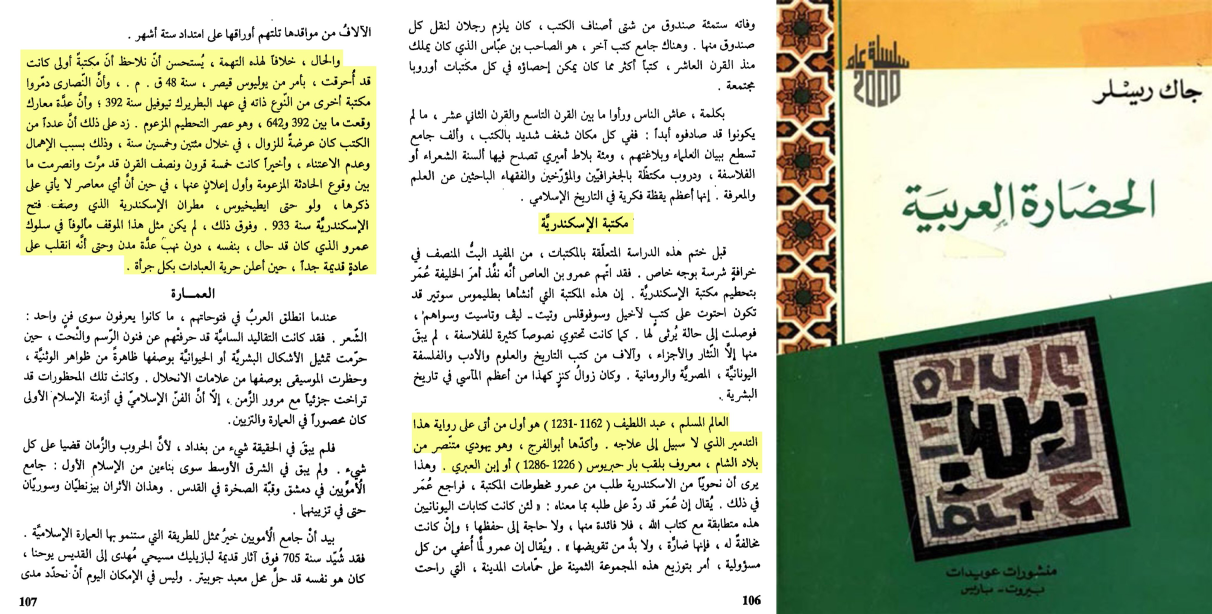
For your info: This scan is from Jack Riesler’s Arab Civilization. The highlighted text states that the accusation against the Arabs regarding the Library of Alexandria is a myth or unsupported claim. It says the library was not a major functioning institution by the time the Arabs entered Egypt and that earlier destruction had already taken place. For English readers, the scan supports the argument that the Muslim conquest cannot be blamed for a library whose destruction or decline had occurred long before.
A beautiful correction by Jean-Jacques Rousseau regarding the lie of Caliph Omar burning the Library of Alexandria, where he said that if the Pope were in the place of the Caliph, he would have burned the library and boasted about it. Indeed, the terrorist Theophilus, the 23rd Pope of Alexandria, boasted about burning the Serapeum Library and immortalized that event with a drawing on papyrus.
For your info: This scan discusses the accusation against Umar and contrasts it with Christian destruction of pagan institutions. The highlighted sections mention the destruction of the Serapeum and describe the role of Theophilus, the Pope of Alexandria, in attacking pagan religious and intellectual heritage. It also cites the correction attributed to Jean-Jacques Rousseau, stating that if the Pope had been in Umar’s place, he would have burned the library and boasted of it. For English readers, the scan is used to show that Christian authorities did openly destroy pagan sites, while the claim against Umar is historically weak.
The next scan gives a historical description of Theophilus and the destruction of the Serapeum.
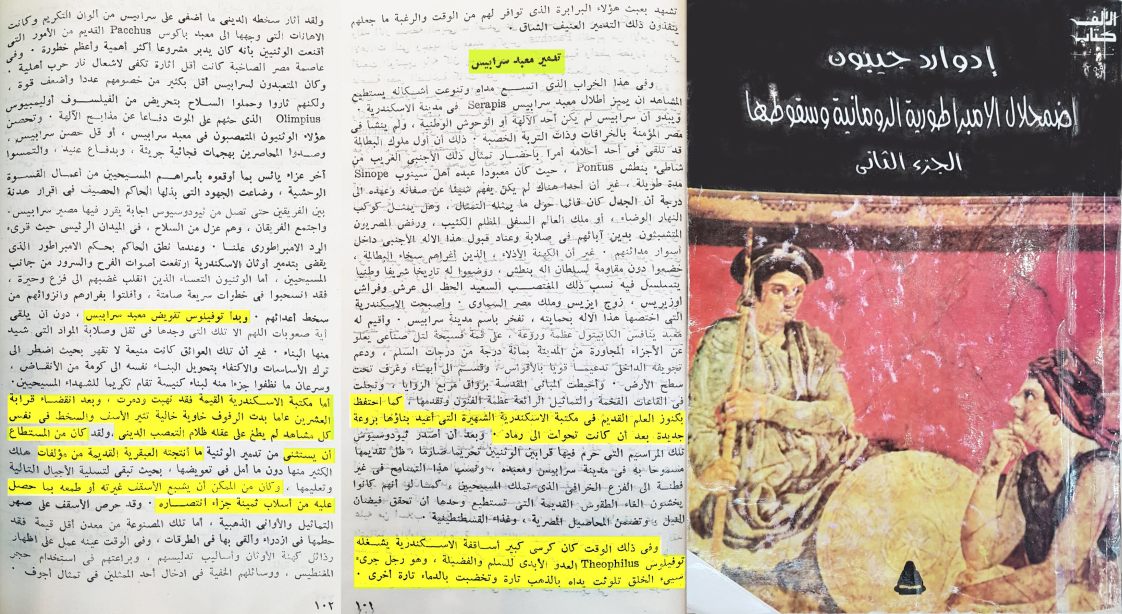
For your info: This scan discusses Theophilus, Bishop of Alexandria, and the Christian campaign against paganism. The highlighted passage says that during his time, pagan temples were destroyed, including the Serapeum, which was one of the most important religious and intellectual centers in Alexandria. The scan also notes the violence against pagan symbols and institutions. For English readers, this source directly supports the argument that the destruction of Alexandrian pagan heritage was connected to Christian anti-pagan policy before the Muslim conquest.
The next source quotes Rousseau’s correction on the accusation against Umar.
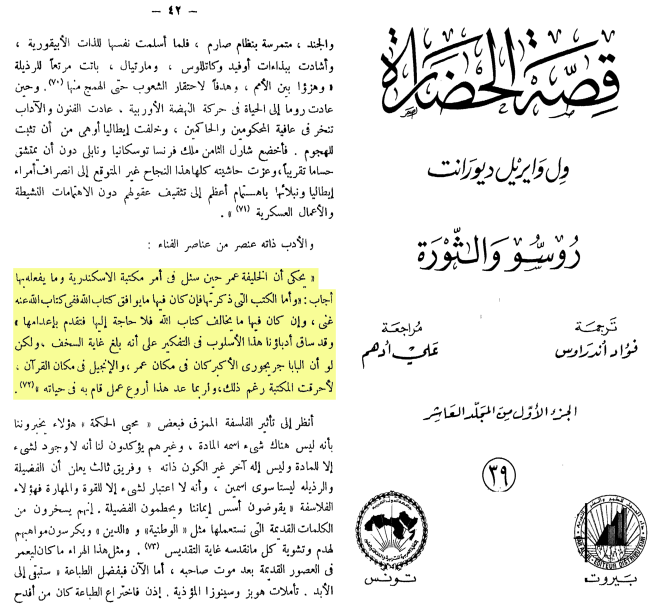
For your info: This scan contains the quotation attributed to Jean-Jacques Rousseau. The highlighted passage says that if Caliph Umar had asked the Pope what to do with the Library of Alexandria, the Pope would have answered in the same way attributed to Umar — but would have then boasted about the burning. The point of the quote is not to prove the story against Umar, but to expose the hypocrisy of blaming Islam while ignoring the documented Christian destruction of pagan institutions. For English readers, it functions as a rhetorical correction against the anti-Muslim legend.
The next image shows visual material connected to Theophilus and the Serapeum.
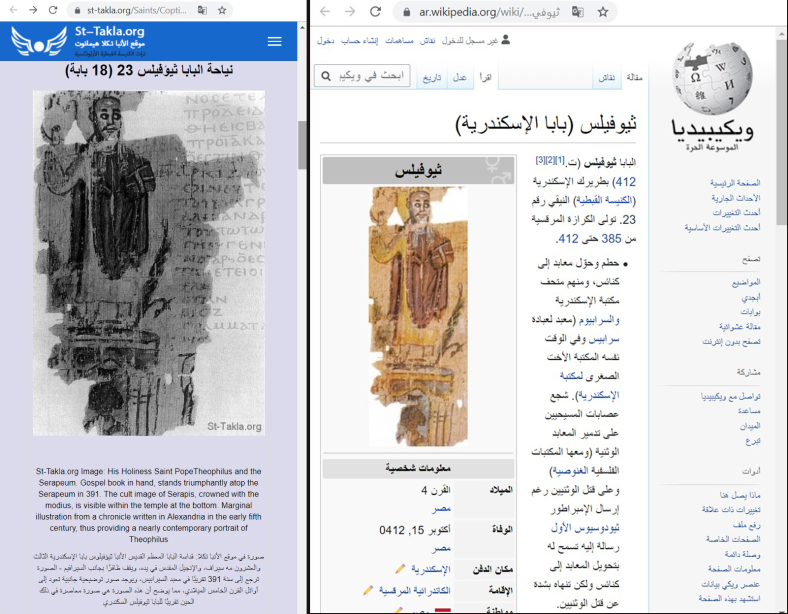
For your info: This image presents references to Theophilus of Alexandria and the Serapeum. One side shows an Arabic Wikipedia-style entry identifying Theophilus as Pope of Alexandria and mentioning his connection to the destruction of the Serapeum. The other side shows an image from St-Takla describing Theophilus standing triumphantly over the Serapeum. For English readers, the importance is that Christian sources themselves preserve Theophilus as a figure associated with the destruction of pagan religious heritage in Alexandria.
In this book, George Sarton refutes the story of Amr burning the library, and Will Durant responds to it in The Story of Civilization, then Bernard Lewis refutes it in his history, so that the Encyclopedia of the Church Fathers acknowledges the bitter truth.
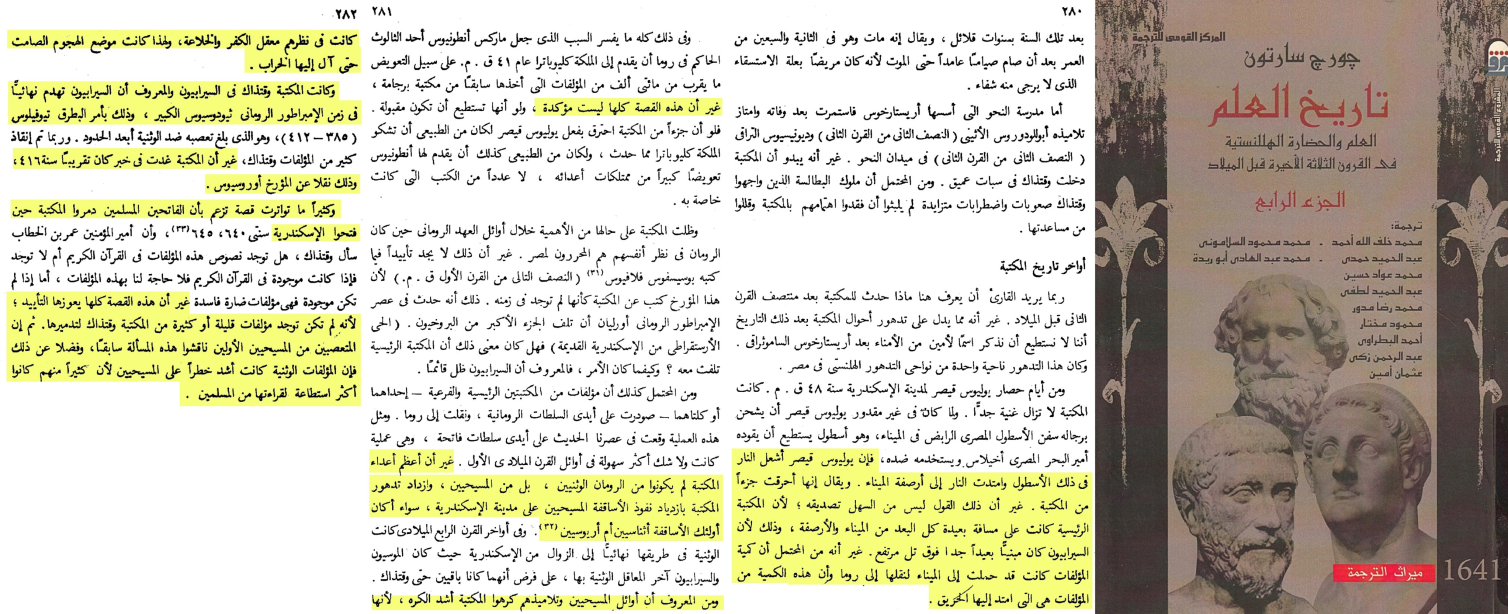
For your info: This scan is from George Sarton’s History of Science. The highlighted sections explain that the famous story of Amr ibn al-Aas burning the Library of Alexandria is not historically reliable. Sarton points out that the library had suffered earlier destruction and that the common anti-Muslim version rests on late and weak reporting. For English readers, the importance is that a major historian of science rejects the accusation and treats it as a legend rather than established fact.
The next scan continues the same historical line of argument.
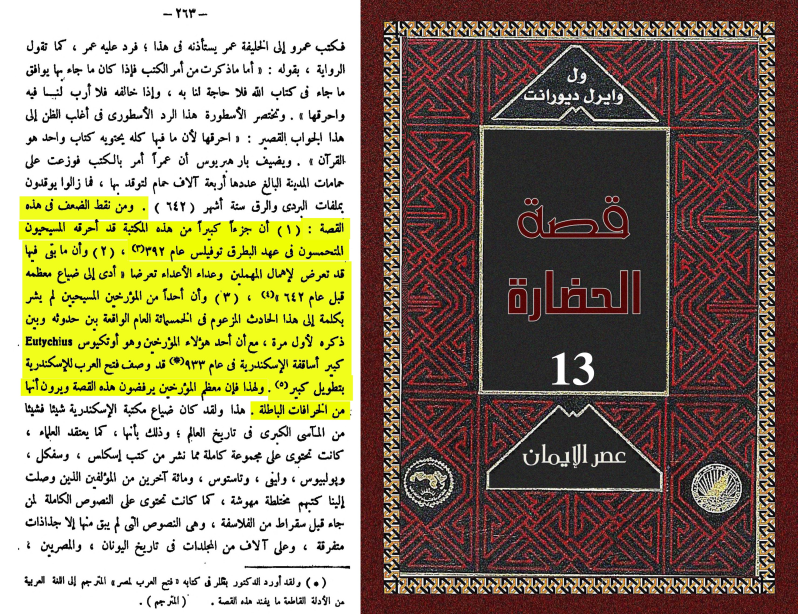
For your info: This scan is part of the same supporting material against the accusation that Muslims burned the Library of Alexandria. The page is used to show that serious historical writers did not accept the popular story as reliable. For English readers, its role in the article is to reinforce the repeated scholarly pattern: the accusation is late, poorly sourced, and contradicted by the wider history of the library’s earlier destruction.
The next source discusses the Arabs in history and directly addresses the accusation.
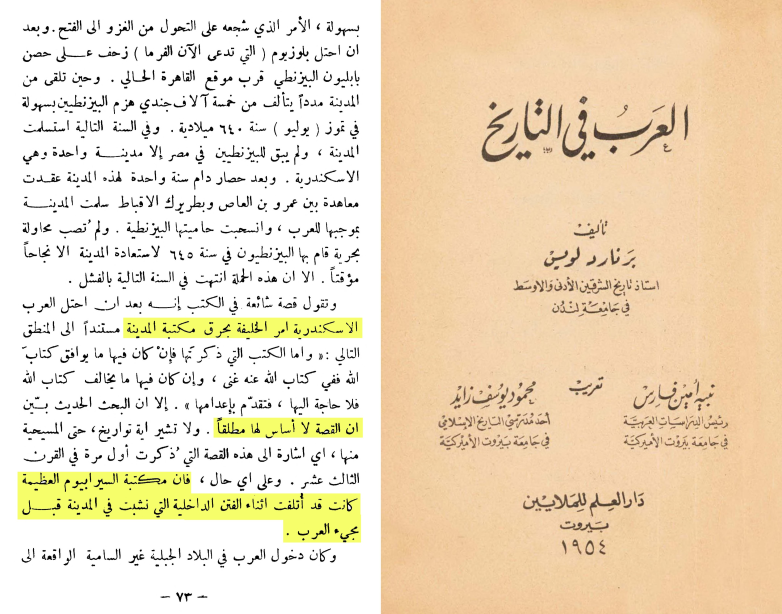
For your info: This scan is from Bernard Lewis’s The Arabs in History. The highlighted passage states that the story claiming the Muslims burned the Library of Alexandria is one of the strange reports attached to the conquest of Egypt. It says the story is baseless and that it only spread long after the event, especially after being mentioned by later writers such as Abd al-Latif. For English readers, this scan is powerful because Bernard Lewis was not writing as a Muslim apologist, yet he still rejects the accusation.
The final scan gives an admission from a church-related encyclopedic source.
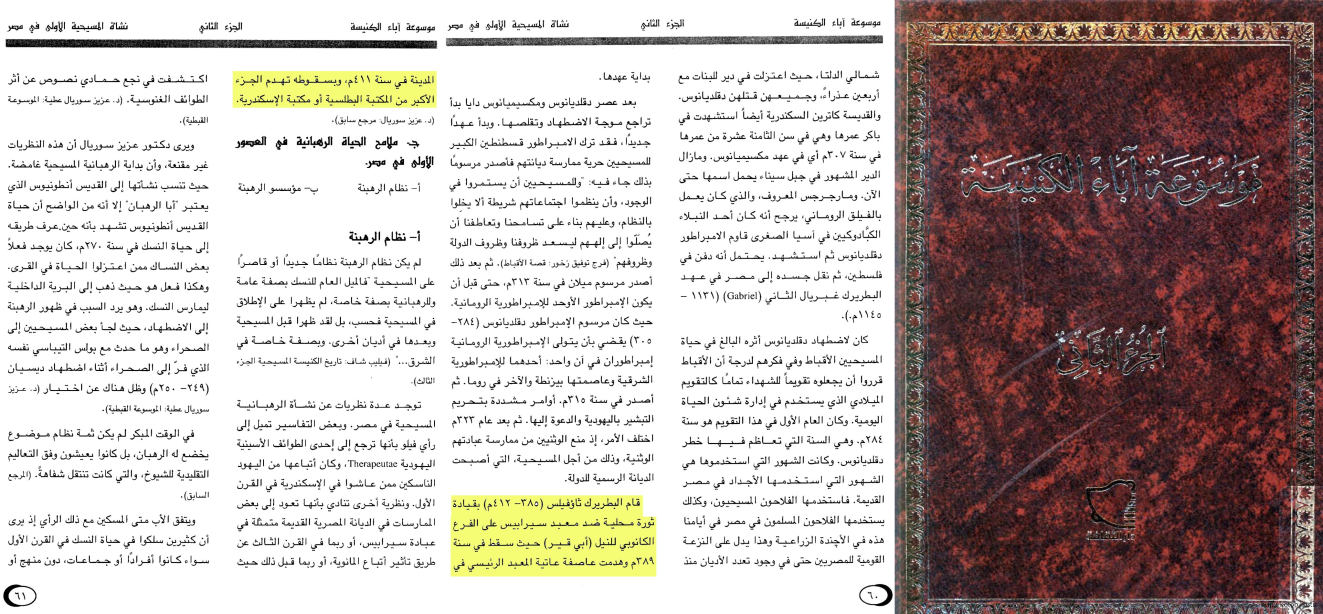
For your info: This scan is from the Encyclopedia of the Church Fathers. The highlighted passage discusses Theophilus, Pope of Alexandria, and states that he destroyed the Serapeum in Alexandria in 391 CE. This is an important admission because it comes from a church-related reference work, not from a Muslim polemical source. For English readers, the scan directly supports the article’s main argument: the documented destruction of Alexandrian pagan institutions is tied to Christian authorities before the Muslim conquest, while the accusation against Amr and Umar appears much later and lacks contemporary evidence.
...was the burning of the great Library, said to contain seven hundred thousand manuscripts. See also:...