

Who Was the First Muslim? Refuting the Quranic Contradiction Claim
The alleged contradiction collapses because the word “first” is being forced into one absolute meaning across different contexts. The Quran uses “first of the Muslims” and “first of the believers” in restricted senses: first of a specific nation, first in a specific theological affirmation, or first in a specific historical event. The mistake of the critic is simple: he treats every “first” as if it must mean “first human being in all history,” when neither the wording nor the context requires that.
Skeptics argue that the Quran creates a contradiction because Prophet Muhammad ﷺ is commanded to say, “I am the first of the Muslims,” while Abraham is also described as a Muslim before him, Moses says, “I am the first of the believers,” and the magicians of Pharaoh say they were “the first of the believers.” They claim that all of these figures cannot be “first” at the same time.
The objection is built on a false assumption. “First” does not always mean first in absolute human history. It can mean first of a nation, first in a particular law, first in a specific event, or first to affirm a particular truth after direct witness. Prophet Muhammad ﷺ was first of this Ummah in submission to the revelation sent to him. Moses was first to affirm the specific truth he had just witnessed concerning seeing Allah. The magicians were first among their people to believe in Moses after witnessing his sign. There is no overlap, and therefore no contradiction.
Prophet Muhammad ﷺ: First of This Ummah
“Say: Indeed, my prayer, my sacrifice, my life, and my death are for Allah, Lord of the worlds. He has no partner. And this I have been commanded, and I am the first of the Muslims.”
This verse is addressed to Prophet Muhammad ﷺ. The phrase “I am the first of the Muslims” does not mean the first Muslim in absolute human history, because the Quran itself affirms that prophets before him submitted to Allah. It means he is the first of this Ummah to submit to the revelation, law, and mission given to him.
“Abraham was neither a Jew nor a Christian, but he was upright, a Muslim, and he was not of the polytheists.”
The critic’s mistake is exposed here. Abraham being a Muslim before Prophet Muhammad ﷺ does not contradict Muhammad ﷺ being “the first of the Muslims” in his own Ummah. These are different categories: Abraham belongs to an earlier prophetic nation, while Muhammad ﷺ is the messenger sent to this final Ummah.
Al-Baghawi reports from Qatadah regarding the phrase: “And I am the first of the Muslims,” meaning: the first of the Muslims of this nation.
Al-Qurtubi addresses the objection that Abraham and the prophets before him were Muslims, explaining that the meaning is: the first of the Muslims from his own community. This is also the view attributed to Ibn al-Arabi, Qatadah, and others.
The principle is obvious: every prophet must first believe in the message he is sent with before he calls others to it. A messenger cannot convey what he himself does not first affirm. So the Prophet ﷺ believed in what was revealed to him, then his Ummah followed him in that belief.
“The Messenger has believed in what was revealed to him from his Lord, and so have the believers.”
This is why the expression “first” must be read according to its proper scope. When Muslims say Abu Bakr al-Siddiq was the first man to embrace Islam, nobody with basic comprehension imagines that he was the first human being in all history to submit to Allah. It means he was first in the context of the Ummah of Muhammad ﷺ.
The phrase “first of the Muslims” is not absolute across all humanity. It is restricted by context: Prophet Muhammad ﷺ was first in submission to the revelation, law, and mission sent to him and his Ummah.
One Religion, Different Laws
The raw objection also collapses once we distinguish between the shared religion of all prophets and the particular laws given to different nations. All prophets called to Islam in the general sense of submission to Allah, but each nation could receive its own law and method.
“For each of you We have appointed a law and a way.”
Abu Hurayrah narrated that Allah’s Messenger ﷺ said: “Both in this world and in the Hereafter, I am the nearest of all people to Jesus, son of Mary. The prophets are paternal brothers; their mothers are different, but their religion is one.”
Grade: Sahih · Sahih al-Bukhari 3443
This hadith directly explains the point: the prophets share one religion in its foundation, while their laws differ. Therefore, Abraham being Muslim and Muhammad ﷺ being the first Muslim of his Ummah are not contradictory. They are two different levels of discussion.
Moses: First in a Specific Theological Affirmation
“And when Moses came at Our appointed time and his Lord spoke to him, he said: ‘My Lord, show Yourself to me that I may look at You.’ He said: ‘You will not see Me, but look at the mountain; if it remains in place, then you will see Me.’ And when his Lord manifested Himself to the mountain, He made it crumble, and Moses fell unconscious. Then when he recovered, he said: ‘Glory be to You. I repent to You, and I am the first of the believers.’”
Moses’ statement came after a specific event: he had asked to see Allah, then witnessed the mountain crumble when Allah manifested Himself to it. His words “I am the first of the believers” refer to this specific realization and affirmation, not to being the first believer in absolute human history.
Moses fainted while his soul remained in his body. When he regained consciousness, he said: “Glory be to You,” declaring Allah free from being seen in that way. “I repent to You,” meaning he returned from the state he had been in. “And I am the first of the believers,” meaning the first to believe now that no one from Allah’s creation sees Him in this life until the Day of Resurrection, because Moses had witnessed that himself.
The context restricts the meaning. Moses is not saying that no believer existed before him. He is affirming a specific truth after direct experience.
The Magicians: First to Believe in Moses’ Sign
“Indeed, we hope that our Lord will forgive us our sins, because we were the first of the believers.”
The magicians of Pharaoh were not claiming to be the first believers in all human history. That would be absurd, since they were living long after earlier prophets. Their meaning is that they were the first among their people, in that event, to believe in Moses after witnessing his sign.
“He said: ‘Rather, you throw.’ Then suddenly their ropes and staffs appeared to him, from their magic, as though they were moving.”
The Quran describes the magicians’ own performance as illusion: their ropes and staffs appeared to move. Moses’ sign was different in category, and the magicians understood that better than anyone else because they were experts in the craft. Their recognition was immediate, and that is why they could describe themselves as the first believers in that context.
Classical Explanation from Imam Ahmad Ibn Hanbal
The following scan is presented from Al-Radd ‘ala al-Zanadiqa wal-Jahmiyyah, attributed to Imam Ahmad ibn Hanbal, discussing this exact objection about “the first of the believers” and “the first of the Muslims.”
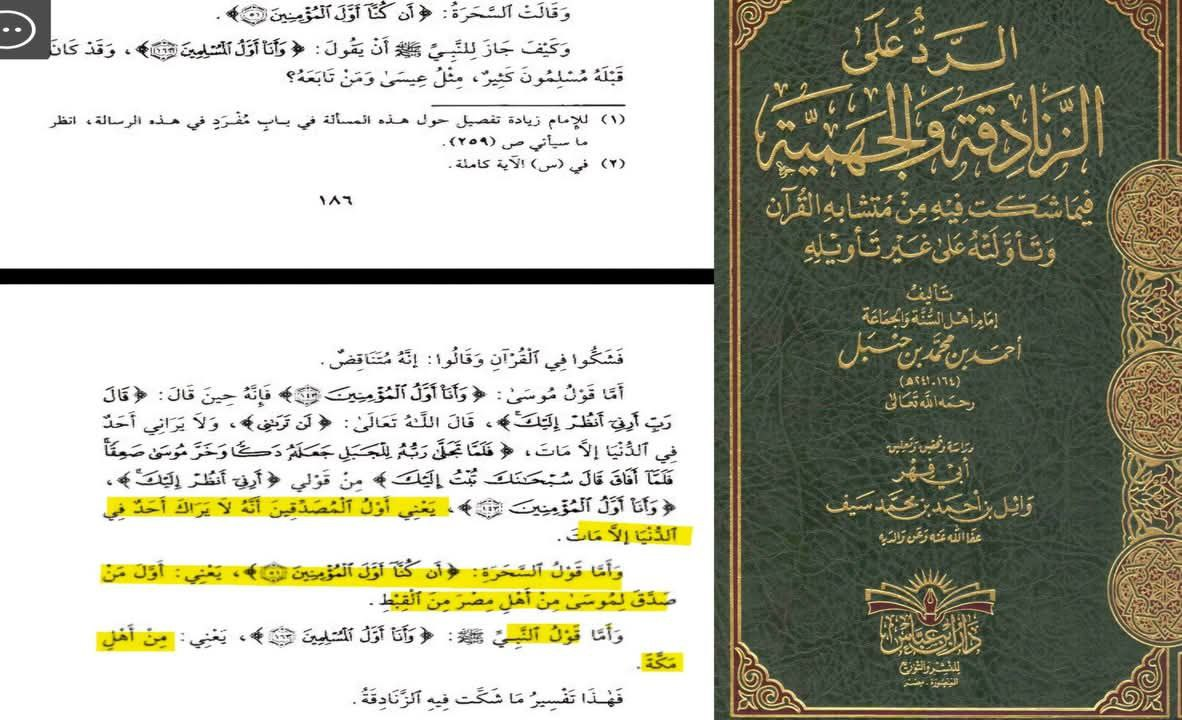
The scan then explains the magicians’ statement, “because we were the first of the believers,” as meaning they were the first to believe in Moses from the people of Egypt. Finally, it explains the Prophet’s ﷺ statement, “I am the first of the Muslims,” as meaning first from the people of Makkah, not first in absolute human history. The page directly supports the central argument of this article: every “first” is restricted by its context.
Conclusion
- Prophet Muhammad ﷺ was the first Muslim of this Ummah and the first to submit to the revelation and law sent to him.
- Abraham was a Muslim before him, but from an earlier prophetic nation, so there is no conflict.
- Moses was first in the specific affirmation produced by his direct encounter at the mountain.
- The magicians were first among their people to believe in Moses after witnessing the sign.
The objection survives only by flattening all contexts into one meaning. Once the verses are read properly, the contradiction disappears.
Further Reading
For a more exhaustive treatment of alleged Quranic contradictions, the following resources document and refute the full range of such claims:
Sources used in the original draft: Judge Abdul Jabbar, Tanzih al-Quran ‘an al-Mata’in; Ibn Ashur, Al-Tahrir wal-Tanwir; Al-Tabari, Tafsir al-Tabari; Al-Baghawi, Tafsir al-Baghawi; Al-Qurtubi, Al-Jami’ li-Ahkam al-Quran; and the scan attributed to Imam Ahmad ibn Hanbal, Al-Radd ‘ala al-Zanadiqa wal-Jahmiyyah.