

Did Christians Convert to Islam to Escape Jizya Tax
Christian historians who lived during the conquest record that Christians welcomed Muslim rule and converted willingly without coercion. Missionaries frequently claim that Christians in Egypt and the Levant embraced Islam merely to escape the jizya tax, but contemporary Christian chronicles refute this allegation entirely.
> [!objection] Christians in Egypt and the Levant converted to Islam to escape the jizya tax.
> One of the most frequent claims made by missionaries is that Christians in Egypt and the Levant converted to Islam to escape the jizya tax. This is a failed attempt to justify the people of the Levant and Egypt leaving Christianity and embracing Islam. But the question here is, is this claim true?
> [!response]
> The claim is demonstrably false. Christian historians who lived during the Islamic conquest have conveyed to us the attitude of the people of the land towards the Islamic conquest, clarifying that the Islamic conquest was welcomed and that the Christians left Christianity and embraced Islam willingly without coercion.
Christian Historians Record Willing Conversion
Christian historians who witnessed the conquest testify that Egyptians renounced Christianity and embraced Islam of their own accord. John of Nikiu, a contemporary of the Arab conquest of Egypt, recorded the attitude of the population with remarkable candor.
> [!admission] John of Nikiu — History of Egypt
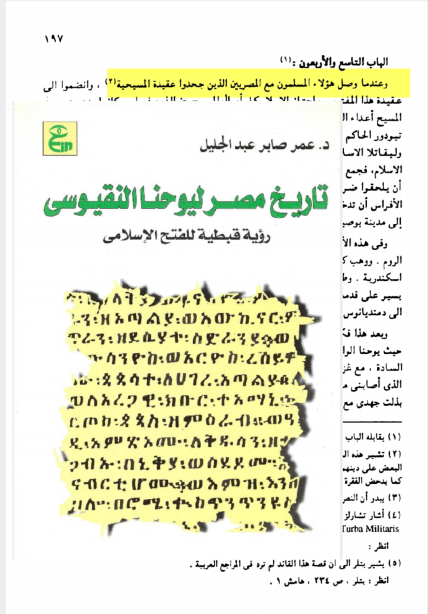
> “When these Muslims arrived with the Christians who had renounced the Christian faith.” (1)
He continues his chronicle with a direct observation on the scale of conversion:
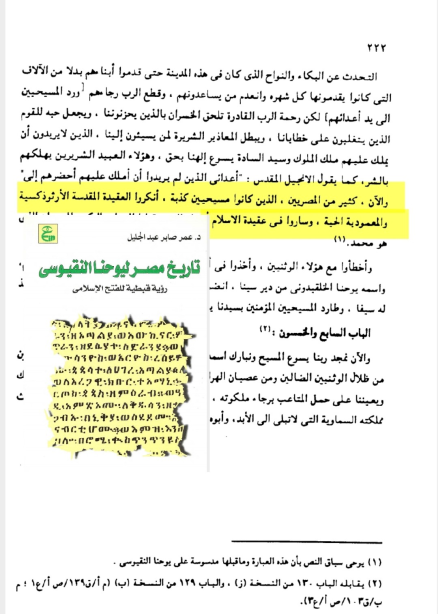
> [!admission] John of Nikiu — History of Egypt
> “And now many of the Egyptians who were false Christians have denied the holy Orthodox faith and the living baptism, and have embraced the faith of Islam.” (2)
Moreover, those who did not embrace Islam and remained Christian welcomed the Islamic conquest and cooperated with it. John of Nikiu described the political divisions among the populace:
> [!admission] John of Nikiu — History of Egypt
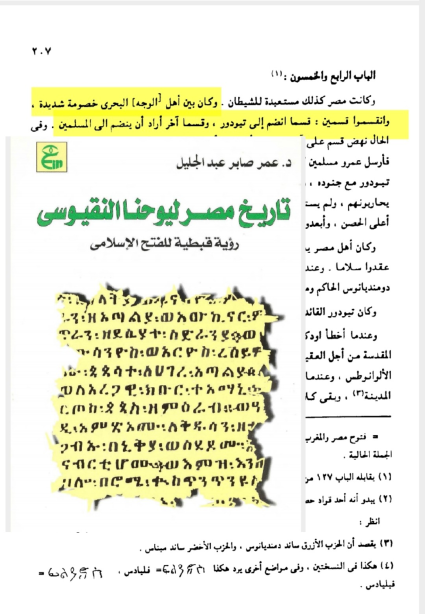
> “There was intense animosity among the people of Lower Egypt, and they were divided into two groups: one group joined Theodore, and the other joined the Muslims.” (3)
The peaceful entry into Alexandria underscores this cooperation. John of Nikiu records that on the twentieth of the month of Miskarm, Theodore departed with all the soldiers and leaders and marched to the island of Cyprus, leaving the city of Alexandria. Then Amr ibn al-As, the leader of the Muslims, entered the city of Alexandria without difficulty. The people of the city received him with great respect (4).
This was not only the position of the people, but Pope Benjamin himself welcomed the Arab conquest of Egypt because of the humiliation and persecution he suffered at the hands of the Romans. He remained a fugitive in the desert for 13 years until the Islamic conquest came, and he returned to his former position. John of Nikiu records the patriarch’s return:
> [!admission] John of Nikiu — History of Egypt
> “Anba Benjamin, Patriarch of the Egyptians, entered the city of Alexandria after fleeing from the Romans for 13 years, and he went to his churches and visited them all. And all the people were saying: This exile and the victory of Islam was the reason for the injustice of King Heraclius and the persecution of the Orthodox at the hands of Pope Cyril. The Romans perished for this reason, and the Muslims prevailed in Egypt.” (5)
The Coptic patriarch himself attributed the Muslim victory to Roman injustice and persecution of the Orthodox.
Muslim Conquerors Protected Churches and Permitted Free Worship
Muslim conquerors did not force Islam upon inhabitants or destroy churches, as confirmed by Christian patriarchs and monks. John of Nikiu also affirmed the tolerance of the Companion Amr ibn al-As:
> [!admission] John of Nikiu — History of Egypt
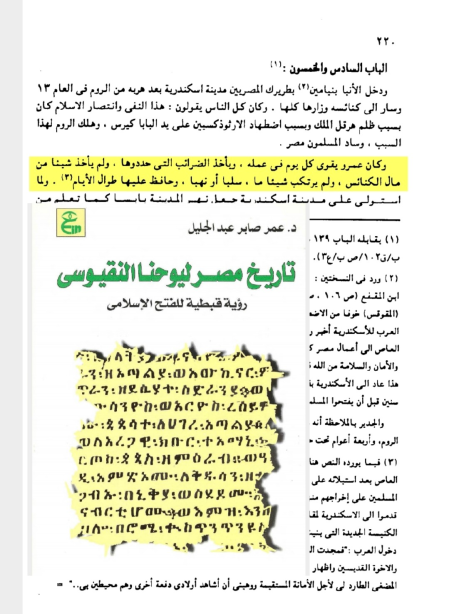
> “Amr grew stronger every day in his work, collecting the taxes they had set, and he took nothing from the churches’ money, nor did he commit any act of plunder or theft, and he preserved them throughout the days.” (6)
This was not only the case in Egypt, but also in all the lands that the Muslims entered. For example, when the Muslims entered the Levant and established their control over it, they did not impose Islam on its inhabitants by force, nor did they destroy a single church. The modern scholar Michael Philip Penn confirms this in his study When Christians First Met Muslims:
> [!admission] Michael Philip Penn — When Christians First Met Muslims
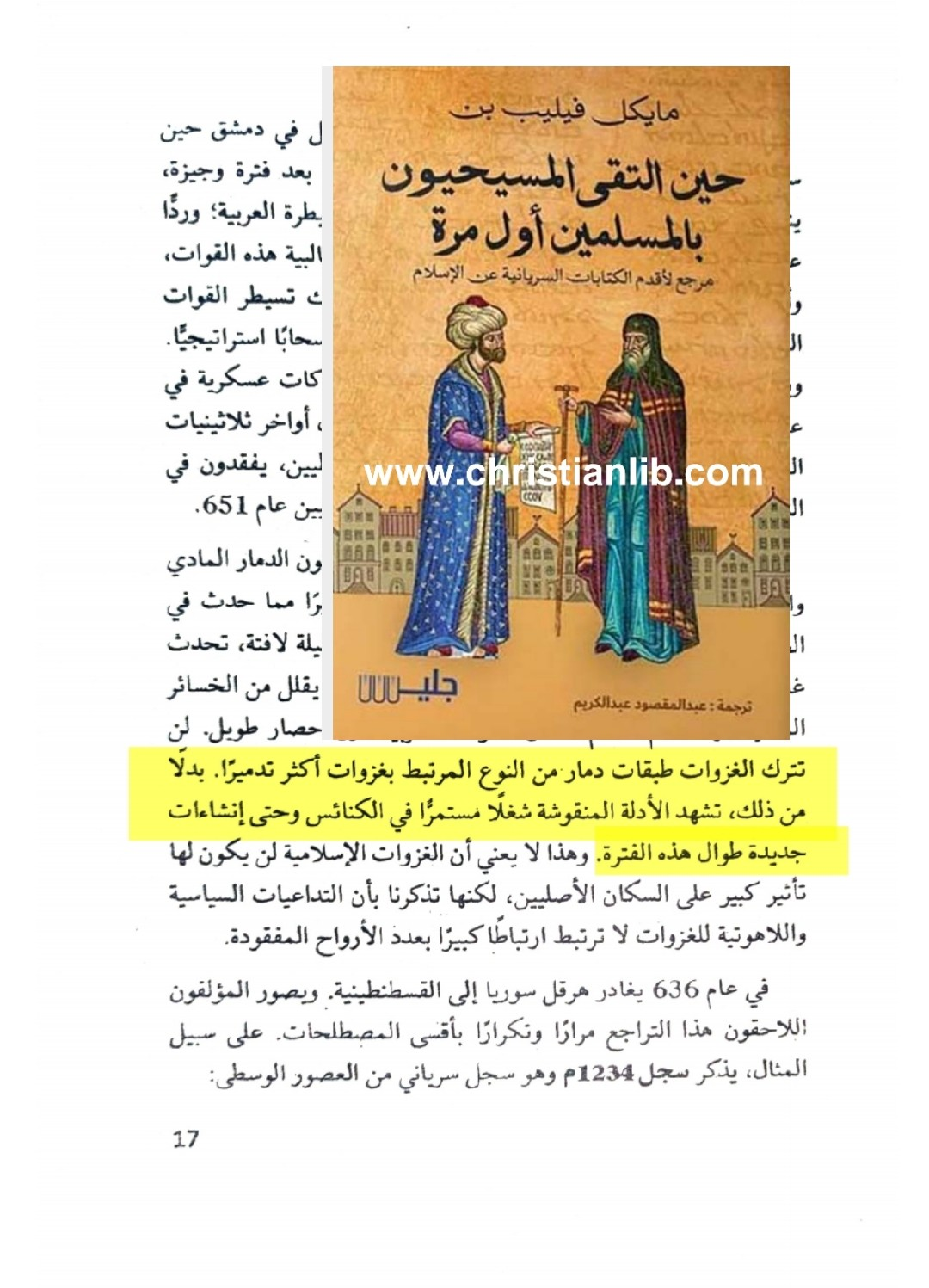
> “Conquests do not leave layers of destruction of the kind associated with more destructive invasions. Instead, the inscribed evidence testifies to continuous work on churches and even new constructions throughout this period.” (7)
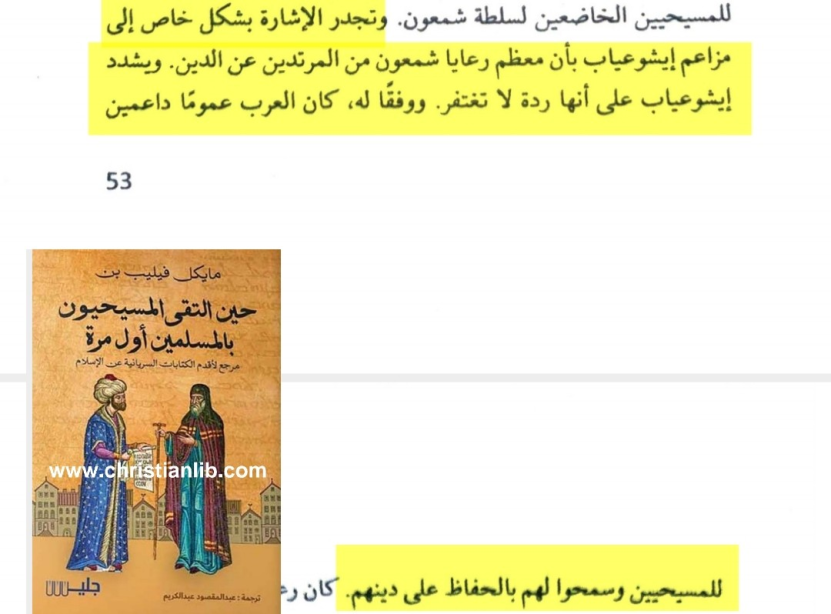
Furthermore, Patriarch Isho’yahb III, a contemporary of the Islamic conquest of the Levant, rebuked Bishop Simeon of Riwardescher because Bishop Simeon’s parishioners were converting to Islam despite the Muslims’ tolerance and permission for them to maintain their religion (8). The same matter was confirmed by the monk John the Phoenician, known as John Ibn al-Fanki, in his book The Main Points:
> [!admission] John Ibn al-Fanki — The Main Points
> “Every year their raiders would go to distant countries and islands and return with captives from every people under heaven, but they only demanded tribute from everyone and allowed everyone to remain on whatever religion they wished.” (9)
Thus it becomes clear to us that the Muslims did not impose Islam by force, but rather the Christians embraced Islam out of conviction and satisfaction, not out of fear or intimidation from the sword or anything else.
Christians Suffered Roman Persecution and Excessive Taxation
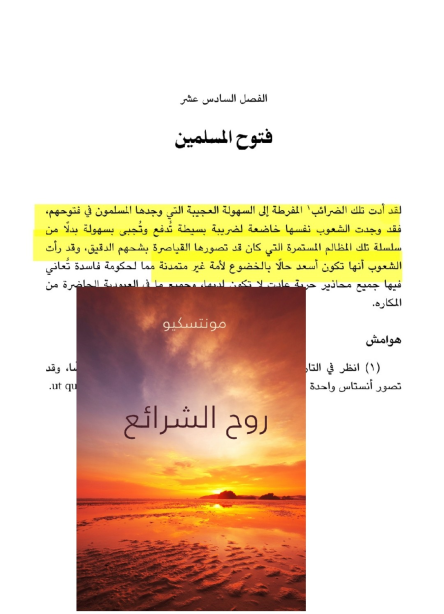
Christians under Roman rule suffered heavy taxation and doctrinal persecution, making them eager for any change of rulers. We also have the right to ask about the condition of the Christians before the conquest. Were they enjoying the riches of their countries and living in prosperity and bliss as some claim? The truth is that before the Islamic conquest, Christians were suffering under the yoke of Roman occupation, which imposed heavy taxes on them and, moreover, persecuted them due to doctrinal differences. The Romans believed in two natures of Christ, while the Egyptians believed in one nature. This explains the Roman persecution of the Orthodox Pope Benjamin.
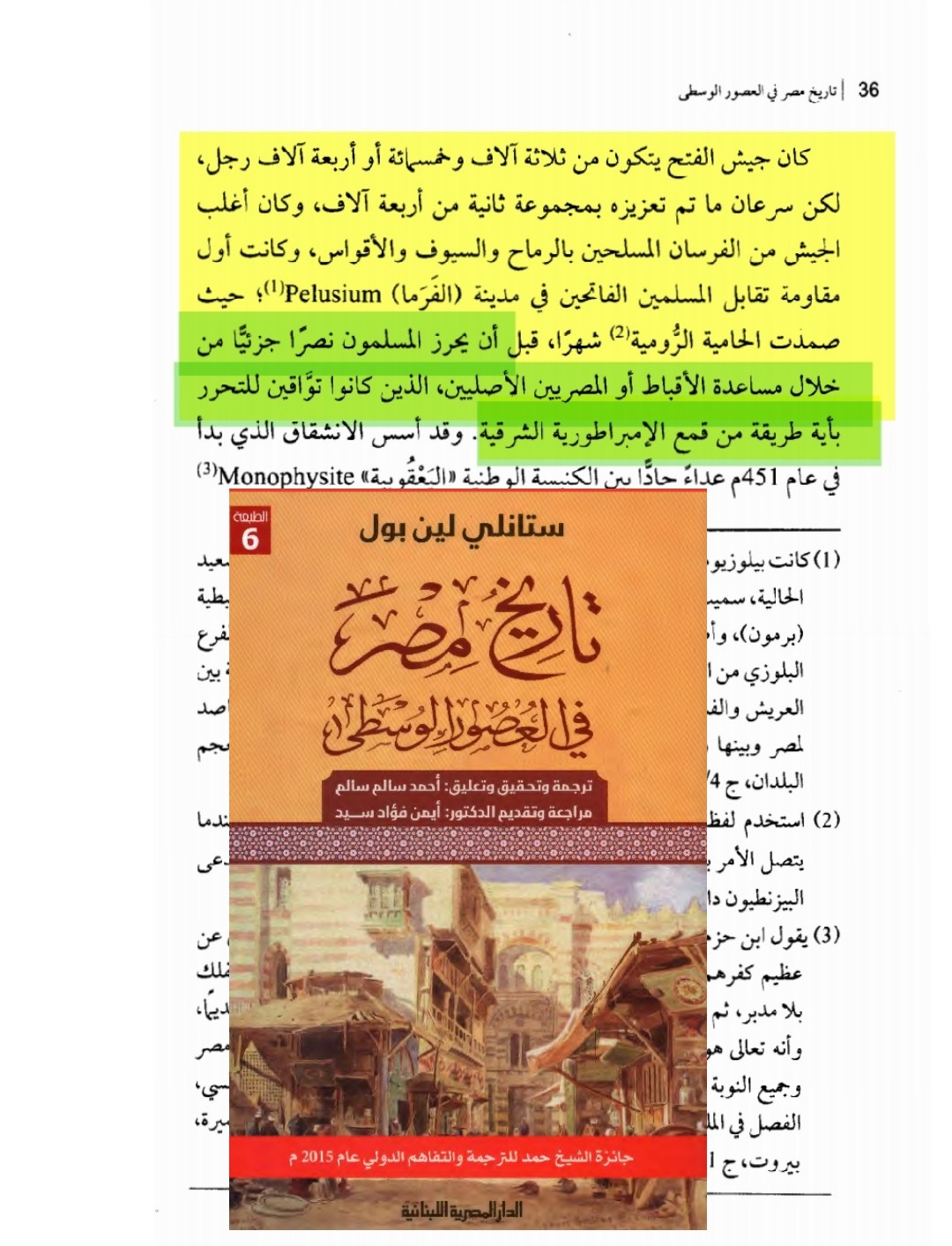
Historical accounts tell us that the Egyptians wanted to rid themselves of Roman occupation by any means. The Copts aided Amr ibn al-As’s army from the very first moment of its arrival in Egypt, without knowing anything about the Muslims’ beliefs, characteristics, or customs, because a change of rulers meant little to them. However, any change to Byzantine fanaticism was likely seen by them as a change for the better. This widespread discontent contributed to the Arabs’ easy victory. One of the first reactions to the Arab capture of the city of Pelusium was Patriarch Benjamin advising the Copts to support Amr ibn al-As and his army (10), and indeed, they did support the Muslims. They helped them with transportation and supplies because of what they saw of the conquerors’ morals and tolerance. The Muslims, as their religion commanded them, did not persecute the people of the conquered lands, nor did they destroy their churches and places of worship. This is what the Christian historians themselves said.
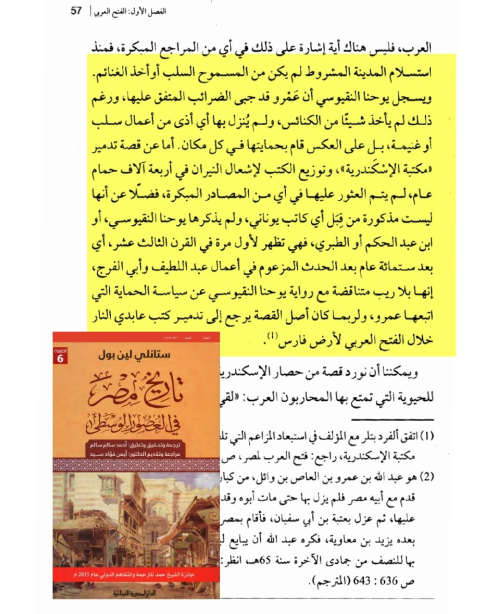
Edward Lane-Poole corroborates this protection in his history A History of Medieval Egypt:
> [!admission] Edward Lane-Poole — A History of Medieval Egypt
> “Since the city’s conditional surrender, looting or taking spoils was not permitted. John of Nikiu records that Amr collected the agreed taxes, yet he did not take anything from the churches, nor did he inflict any harm on them through acts of looting or plunder. On the contrary, he protected them everywhere.” (11)
The Library of Alexandria Myth
The story of Amr ibn al-As burning the Library of Alexandria is a legend originating six centuries after the alleged event. As for the subject of Amr ibn al-As burning the Library of Alexandria, it is merely a legend, as the only historian who lived during the Islamic conquest, John of Nikiu, did not mention this legend. Edward Lane-Poole says:
> [!admission] Edward Lane-Poole — A History of Medieval Egypt
> “As for the story of the destruction of the Library of Alexandria and the distribution of books to set fire to four thousand public baths, it was not found in any of the early sources.” Moreover, it is not mentioned by any Greek writer, nor by John of Nikiu, Ibn Abd al-Hakam, or al-Tabari.
It first appears in the thirteenth century, six hundred years after the alleged event in the works of Abd al-Mutif and Abu al-Faraj. It undoubtedly contradicts John of Nikiu’s account of the protection policy followed by Amr. Perhaps the origin of the story goes back to the destruction of the fire-worshippers’ books during the Arab conquest of Persia (12). Fair-minded Western scholars have rejected the idea that Amr ibn al-As destroyed the library, such as the orientalist and historian Alfred Butler, who refuted this myth and exposed its falsehood (13).
No contemporary source mentions the library’s destruction; the tale first surfaces 600 years later.
Jizya Was a Fraction of Roman Tax Burden
The jizya was a minor levy compared to the crushing Roman tax system that enslaved families for non-payment. We now come to a very important point: the difference between the jizya and the Roman taxes. What those zealots who repeatedly bring up the issue of the jizya and portray it as an enormous sum overlook is that Christians before the Arab conquest were already paying very heavy taxes to the Romans. Alfred Edersheim states in his work Images of Jewish Social Life in the Days of Christ:
> [!admission] Alfred Edersheim — Images of Jewish Social Life in the Days of Christ
> “The Roman tax system was a harsh, merciless, and uncompromising system. The provinces of the Roman Empire in general, and Palestine under their control, were subject to two major taxes: income taxes and land and property taxes. Income not subject to land tax was considered income tax. Income tax included a poll tax levied on all persons, slave or free, up to the age of sixty-five. Women were subject to it from the age of twelve, and men from the age of fourteen. The tax on agricultural land was one-tenth of the grain and one-fifth of the wine and fruit, half paid in kind and the other half in cash. In addition, there were taxes and duties on exports and imports levied on major roads and in ports. There were also tolls and road taxes, and taxes on everything bought and sold in the cities.” The taxes that were called regular taxes did not include compulsory donations and compulsory subsidies for the account of the Roman governor, his family, and his court in Caesarea (14).
He continues, saying:
> [!admission] Alfred Edersheim — Images of Jewish Social Life in the Days of Christ
> “(The value of the taxes) amounted to two and a half percent of the value of goods, or five percent, or up to 12.5 percent on luxuries” (15).
The Roman tax system is an extremely unjust system and differs from the jizya in several points. The jizya was a small amount, only two dinars annually, on every male who could bear arms. The jizya was not taken from children, women, or the elderly. As for the Roman taxes, they are taken from men and women alike, and their value differs greatly. The Romans only lacked to impose a tax on the air. They imposed taxes on roads, bridges, exports, imports, and everything that was bought and sold, including food and drink. And what is worse than that is that whoever does not find what to pay the Romans because of poverty and need, his fate was imprisonment, or his wife, daughters, and sons were taken as slaves and captives!
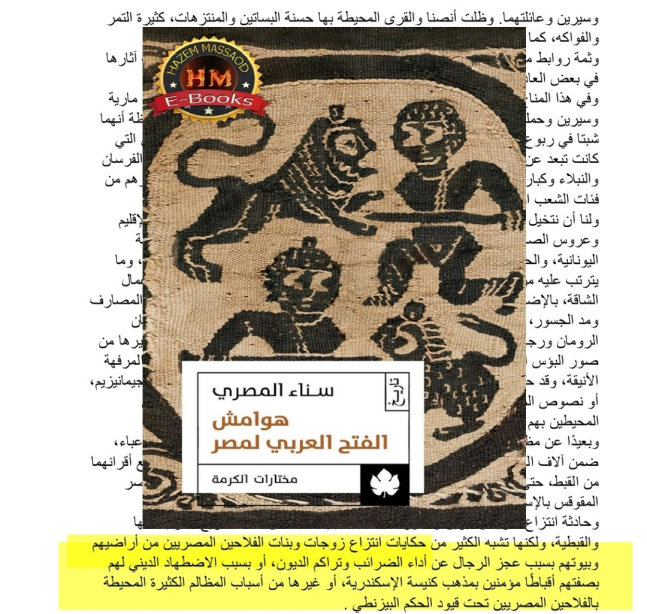
Sanaa al-Masri documents this brutality in Marginalia on the Arab Conquest of Egypt:
> [!admission] Sanaa al-Masri — Marginalia on the Arab Conquest of Egypt
> “The darkness of prison awaits those who do not pay.” She continues, “Many stories of wives and daughters of Egyptian peasants being expelled from their lands and homes because of the men’s inability to pay taxes and the accumulation of debt, or because of religious persecution as Copts adhering to the Alexandrian Church, or other reasons for the many injustices surrounding Egyptian peasants under the constraints of Byzantine rule.” (16)
The difference between the jizya and the Roman taxes is like the difference between earth and sky. Those who could not pay the jizya due to poverty were exempted from it, and it was a very small amount compared to Roman taxes. Montesquieu observes in The Spirit of the Laws:
> [!admission] Montesquieu — The Spirit of the Laws
> “These excessive taxes led to the astonishing ease that the Muslims found in their conquests. The peoples found themselves subject to a simple tax that was easily paid and collected, instead of the same series of injustices that the Caesars had imagined in their meticulous stinginess. The peoples saw that they would be happier to submit to an uncivilized nation than to a corrupt government under which they suffered all the restrictions of freedom of customs they did not possess. And all the hardships of present servitude” (17).
Roman taxes impoverished families and enslaved them for non-payment, while jizya exempted the poor entirely.
Conclusion
Thus, we have clarified that the ethics of the Muslim conquerors were among the important factors that led to the Christians’ conversion to Islam. The claim that Christians abandoned Christianity and embraced Islam to escape paying the jizya is merely a flimsy lie for which there is no conclusive evidence. The truth is that they left Christianity and embraced Islam without pressure or intimidation, as the Christian scholar Suleiman Shafiq confirmed in The Copts Between Ecclesiastical and National Deprivation:
> [!admission] Suleiman Shafiq — The Copts Between Ecclesiastical and National Deprivation
> “The Arab Muslim conquerors did not exert any significant pressure to convert the Copts to Islam.” (18)
Sources and Scans
- John of Nikiu, History of Egypt, p. 197
- John of Nikiu, History of Egypt, p. 222
- John of Nikiu, History of Egypt, p. 207
- John of Nikiu, History of Egypt, p. 219
- John of Nikiu, History of Egypt, p. 220
- John of Nikiu, History of Egypt, p. 220
- Michael Philip Penn, When Christians First Met Muslims, p. 17
- Michael Philip Penn, When Christians First Met Muslims, p. 53
- Michael Philip Penn, When Christians First Met Muslims, p. 122
- Stanley Lane-Poole, A History of Medieval Egypt, pp. 36–38
- Stanley Lane-Poole, A History of Medieval Egypt, p. 57
- Stanley Lane-Poole, A History of Medieval Egypt, p. 57
- Alfred Butler, The Arab Conquest of Egypt, pp. 418–442
- Alfred Edersheim, Images of Jewish Social Life in the Days of Christ, pp. 51–53
- Alfred Edersheim, Images of Jewish Social Life in the Days of Christ, p. 52
- Sanaa El-Masry, Marginalia on the Arab Conquest of Egypt, p. 11
- Montesquieu, The Spirit of the Laws, p. 400
- Suleiman Shafiq, The Copts Between Ecclesiastical and National Deprivation, p. 35
Contemporary Christian chronicles from the conquest period document these events:
Archaeological and textual evidence confirms continuous church activity under Muslim rule:
Primary sources record the protection of churches and religious freedom:
Historical documentation of the minimal tax burden under Islamic governance:
Manuscript evidence of Roman tax oppression before the conquest:
Source materials on the doctrinal persecution of Egyptian Christians:
Contemporary accounts refuting the Library of Alexandria destruction myth:
Western scholarly works confirming Muslim tolerance during the conquests:
Comparative studies of Roman and Islamic taxation systems:
Modern scholarly confirmation of willing conversion without coercion:
...| [[Jizya]] [[Jizya in Islam]] [[[did-christians-convert-to-islam-to-escape-jizya-tax|Did Christians in Egypt and the Levant Convert to Islam Because of the Jizya]]