

Did the Qur’an Copy the Story of Cain and Abel From Jewish Legends
Did the Qur’an Copy the Story of Cain and Abel From Jewish Legends?
Some critics claim that the Qur’anic account of the two sons of Adam — commonly identified as Cain and Abel — was copied from Jewish legends, Haggadic material, or the Talmud.
The claim is weak.
The Qur’an itself states that part of the ruling connected to the story was decreed upon the Children of Israel. Therefore, finding a related statement in Jewish material does not prove plagiarism. It can just as easily prove that some remnants of earlier revelation or Israelite teaching survived outside the current Torah text.
The real issue is not whether Jewish tradition contains parallels. The real issue is whether those parallels prove borrowing, or whether they expose the incompleteness of the surviving biblical narrative.
The Qur’anic Passage
“And recite to them the story of the two sons of Adam in truth, when they offered an offering, and it was accepted from one of them but was not accepted from the other. He said, ‘I will surely kill you.’ He said, ‘Allah only accepts from the righteous. If you were to stretch out your hand against me to kill me, I would not stretch out my hand against you to kill you. Indeed, I fear Allah, Lord of the worlds. Indeed, I want you to bear my sin and your sin and be among the companions of the Fire. And that is the recompense of the wrongdoers.’ But his soul prompted him to kill his brother, so he killed him and became among the losers. Then Allah sent a raven scratching the ground to show him how to hide the shame of his brother. He said, ‘Woe to me! Am I unable to be like this raven and hide the shame of my brother?’ So he became among the regretful. For that reason We decreed upon the Children of Israel that whoever kills a soul unless for a soul or for corruption in the land — it is as if he had killed all mankind, and whoever saves one — it is as if he had saved all mankind.”
The Qur’an gives the story with moral clarity: one brother’s offering is accepted, the other becomes envious, the righteous brother refuses to retaliate, the murderer follows his lower self, and then learns burial from a raven.
The Hadith About the First Murder
The Prophet ﷺ also connected the first murder to later unjust killings.
“No soul is killed unjustly except that the first son of Adam bears a share of its blood, because he was the first to establish killing.”
Grade: Sahih.
This hadith explains that the first murderer carries a share of the burden for opening the door to murder.
“Be Like the Better Son of Adam”
The story was also used as a model during tribulation: avoid entering bloodshed when Muslims are confused by fitan.
He was asked: “What if someone enters my house and stretches out his hand to kill me?”
He said: “Be like the son of Adam.”
Grade: Authentic in meaning.
The Qur’anic story is therefore not decorative storytelling. It becomes a legal and moral precedent for avoiding unjust bloodshed during tribulation.
Doubt One: “Whoever Kills One Soul” Is From the Mishnah
Critics claim that Al-Ma’idah 5:32 is copied from Mishnah Sanhedrin 4:5, where a similar idea appears: whoever destroys one soul is considered as if he destroyed an entire world, and whoever saves one soul is as if he saved an entire world.
The Jewish material is connected to Genesis 4:10:
“What have you done? The voice of your brother’s blood cries to Me from the ground.”
Jewish interpretation noticed that the Hebrew expression is plural — “bloods” — and explained it as referring to Abel’s blood and the blood of his descendants. From this, the moral principle is drawn: killing one soul is like destroying a world.
Scan Evidence: Sanhedrin 37
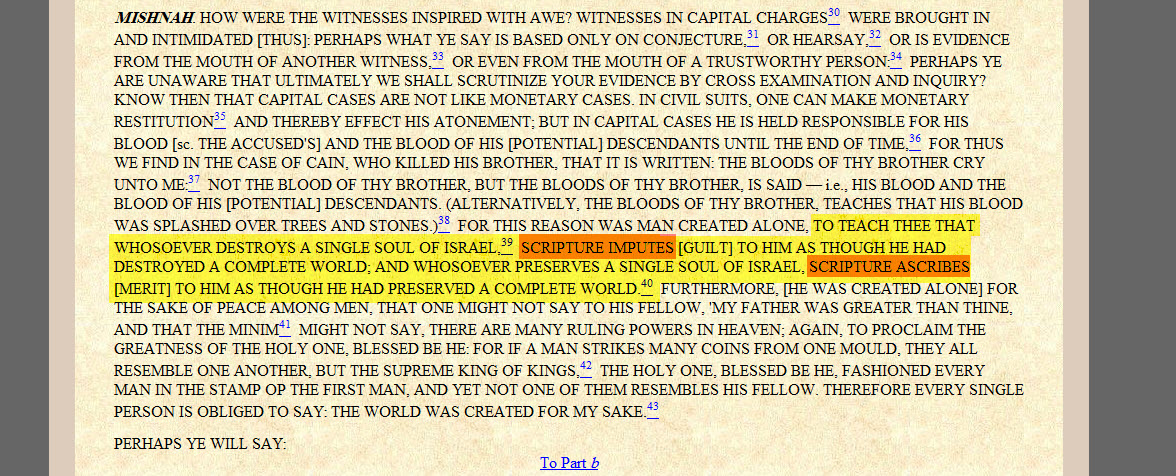
This scan shows the relevant Sanhedrin material connected to the statement that whoever destroys one life is regarded as if he destroyed an entire world, and whoever preserves one life is regarded as if he preserved an entire world. The significance is that the Qur’an itself says,“For that reason We decreed upon the Children of Israel…” meaning the Qur’an openly connects this moral ruling to Israelite legislation. Therefore, the existence of a parallel in Jewish material does not prove Qur’anic plagiarism. It confirms that this principle was known in Israelite tradition.
The critic’s mistake is obvious: the Qur’an does not pretend this ruling was unknown to the Children of Israel. It explicitly says it was decreed upon them.
Finding the statement in Jewish material does not refute the Qur’an. The Qur’an itself says the ruling was decreed upon the Children of Israel. The parallel is expected, not problematic.
Does This Show a Lost Biblical Verse?
The source material argues that the wording in Sanhedrin suggests the Jewish interpreter relied on some kind of scriptural or textual authority, because he says that “the Book considers” one who destroys a soul as if he destroyed the entire world.
If this statement is not present in the current Torah text, then one possible explanation is that the surviving Torah is missing material or that the Jewish interpreter preserved a tradition from earlier revelation not found in the current biblical wording.
If a Jewish interpreter says “the Book considers” this moral ruling, yet the exact ruling is absent from the current Torah, this can be used as evidence that the surviving biblical text is incomplete or that extra-biblical Jewish tradition preserved material not explicitly retained in the Torah.
This does not prove the Qur’an copied. It creates the opposite problem for the critic: why is the surviving Torah missing details that later Jewish tradition and the Qur’an preserve?
The Qur’an’s Own Wording Matters
Al-Ma’idah 5:32 begins:
“For that reason We decreed upon the Children of Israel…”
This phrase is fatal to the plagiarism claim.
The Qur’an is not hiding a source. It is explicitly saying this ruling was given to the Children of Israel.
The Qur’an already tells the reader that this principle was decreed upon the Children of Israel. So the presence of a related idea in Jewish sources is not an embarrassment. It is exactly what the Qur’an told us to expect.
Doubt Two: The Dialogue Between Cain and Abel
Critics also claim that the Qur’anic dialogue between the two sons of Adam was taken from the Haggadah because the dialogue is not present in the Torah.
The Torah says:
“And Cain spoke to Abel his brother. And it came to pass, when they were in the field, that Cain rose up against Abel his brother and killed him.”
The problem is obvious: the Torah says Cain spoke to Abel, but it does not preserve what was said.
So the surviving Torah itself points to a missing conversation.
Genesis says Cain spoke to Abel, then immediately moves to the murder. It does not record the dialogue. The Qur’an gives a meaningful dialogue; the Haggadah gives another expanded dialogue. The existence of later dialogue traditions suggests that Jewish tradition was aware something was missing in the bare Genesis account.
The critic assumes that if the Qur’an gives detail absent from Genesis, it must be copied from later Jewish legend. That is an assumption, not evidence.
The Haggadic Dialogue
The Haggadic material contains an expanded story in which Cain and Abel argue over the acceptance of the sacrifice, divine justice, land, sheep, clothing, and Cain’s intention to kill Abel.
In that version, Abel is stronger than Cain and initially overcomes him. Cain begs for mercy, and Abel releases him. Cain then attacks again and kills him.
The Qur’anic dialogue is not identical to this Haggadic version.
The Qur’an says:
“If you were to stretch out your hand against me to kill me, I would not stretch out my hand against you to kill you. Indeed, I fear Allah, Lord of the worlds.”
This Qur’anic wording is morally sharper and theologically clearer. It focuses on restraint, fear of Allah, and refusing to initiate murder.
The Qur’anic dialogue is not a copy-paste of the Haggadah. The Qur’an gives a distinct moral and theological formulation. The existence of extra-biblical Jewish dialogue traditions only shows that Jews recognized a dialogue existed behind Genesis 4:8.
The Missing Dialogue in Genesis
Genesis 4:8 is extremely brief:
Cain spoke to Abel.
Then Cain killed Abel.
That raises the obvious question: what did Cain say?
The Qur’an gives one answer. The Haggadah gives an expanded Jewish tradition. The surviving Torah gives almost nothing.
The critic treats Genesis’ silence as the standard, then accuses the Qur’an of borrowing because it gives detail. But Genesis itself indicates a conversation occurred. The absence of that dialogue from Genesis is a weakness in the surviving biblical account, not a weakness in the Qur’an.
Antonius Fikry and the Added Phrase
The source material mentions that Father Antonius Fikry notes some versions add the phrase:
“Let us go out to the field.”
This appears to fill the gap in Genesis 4:8 and explain how Cain brought Abel into the field.
The source material asks: why would a scribe need to add this unless the story is lacking detail or unclear?
If scribes or versions add explanatory words to Genesis 4:8, that shows readers recognized the text was terse and needed clarification. Therefore, it is unfair to attack the Qur’an for preserving details absent from the surviving Torah.
The critic cannot have it both ways. If the Genesis account is incomplete and later explanations fill the gap, then the Qur’an’s fuller account cannot be dismissed merely because Genesis is brief.
Jewish Encyclopedia on Abel
The Jewish Encyclopedia discusses Abel and includes material comparing Jewish traditions and Islamic sources.

This scan is from the Jewish Encyclopedia entry on Abel. It is used in the source material to show that Jewish reference works discuss the Abel traditions and compare them with Islamic material. The relevance is that Jewish tradition itself preserves expansions beyond the short Genesis account, while the Qur’an gives its own concise and morally focused version. This does not prove borrowing; it shows that the surviving Torah account is not the only ancient stream of material about the story.
The presence of comparisons in the Jewish Encyclopedia does not prove the Qur’an copied from Jewish legend. It proves that multiple traditions discuss details not preserved in the short Genesis account.
Doubt Three: Cain Wanted to Marry Abel’s Sister
The Haggadah contains a story that Cain desired Abel’s twin sister because she was beautiful, and this became one cause of his hatred.
Some Islamic tafsir material also mentions reports that Cain wanted to marry the more beautiful sister, often naming the sisters or discussing the marriage arrangement between Adam’s children.
This is not in the Qur’anic text.
The story of Cain wanting to marry Abel’s sister is not stated in the Qur’an. It appears in tafsir reports and Israelite-style narrations. Therefore, it cannot be used as proof that the Qur’an copied from the Haggadah.
This point is critical. Do not defend every tafsir report as Qur’anic revelation.
Some reports may come from the Companions. Some may be from Israelite material. Some are simply narrated without being affirmed as decisive. The correct approach is to neither affirm nor deny such details unless there is proof.
Even if similar material appears in Haggadic and tafsir reports, the Qur’an itself does not mention the sister dispute. Therefore, this cannot be used as an argument against the Qur’an.
The critic is smuggling tafsir material into the Qur’an and then accusing the Qur’an.
Doubt Four: The Raven Teaching Burial
The Qur’an says:
“Then Allah sent a raven scratching the ground to show him how to hide the shame of his brother.”
Critics claim this was copied from Talmudic or Midrashic material because Jewish tradition also contains a story where Adam and Eve see a raven burying another bird and learn burial.
But the details are different.
In the Qur’an, Cain himself sees the raven and learns how to bury his brother.
In the cited Jewish tradition, Adam and Eve see the raven and learn how to bury Abel.
Some Jewish versions also mention turtledoves instead of ravens.
Similarity in a motif is not proof of borrowing, especially when the details differ. The Qur’an’s version has Cain learn directly from the raven after the murder, while the Jewish version cited has Adam and Eve learn burial from a bird. These are not identical accounts.
The critic wants any parallel to equal plagiarism. That is not a serious standard.
Why the Raven Story Is Not a Problem
The Qur’anic story makes perfect moral sense.
The murderer, after committing the first murder, is humiliated by needing to learn burial from a bird. He realizes his ignorance and says:
“Woe to me! Am I unable to be like this raven?”
This is powerful. The killer is morally lower than a raven in that moment. The bird teaches him what he failed to know.
The raven episode humiliates the first murderer and teaches that even a bird can become a lesson for a human being who has fallen into sin, ignorance, and regret.
The Jewish parallels do not weaken this. They show the motif existed in broader ancient memory.
Evil Inclination and Cain’s Responsibility
The Haggadic material includes discussion of Cain’s evil inclination. The source material notes that this resembles broader Qur’anic themes about Satan, desire, and the stain upon the heart.
The Qur’an says:
“But his soul prompted him to kill his brother.”
This does not remove Cain’s responsibility.
His lower self prompted him, but he chose the act.
The Qur’an does not say Cain was forced to murder. It says his soul prompted him, and he obeyed that prompting. Therefore, he remains morally responsible.
The atheist may try to drag this into predestination and free will, but that is a different discussion. The verse itself clearly attributes the crime to Cain’s own soul and action.
Why Jewish Parallels Do Not Prove Plagiarism
The critical argument fails because it assumes only two options:
- The Qur’an copied Jewish legends.
- The Qur’an must have no overlap with Jewish material.
This is a false dilemma.
Islam teaches that previous revelation existed, that the Children of Israel had knowledge, and that some truths remained among them while other parts were forgotten, concealed, altered, or preserved outside the final surviving biblical text.
The Qur’an confirms truth, corrects distortion, and clarifies what was lost or disputed. Therefore, overlap with Jewish material is not automatically borrowing. It may be confirmation of surviving fragments of earlier revelation or correction of incomplete accounts.
The Qur’an does not need Genesis to preserve every detail before the Qur’an can mention it.
The Surviving Torah Account Is Terse
Genesis gives a very short account. It says Cain spoke to Abel, but does not preserve the dialogue. It gives the murder, but not the moral exchange found in the Qur’an. It mentions Abel’s blood crying out, but not the full principle stated in Al-Ma’idah 5:32.
This is not a problem for the Qur’an. It is a problem for those who assume the current Torah must contain every detail.
The Qur’an’s fuller moral account is not refuted by the shorter Genesis account. The more obvious conclusion is that Genesis is terse and incomplete regarding the details of the event.
The critic’s argument depends on treating biblical silence as proof against the Qur’an. That is invalid.
The Qur’an Is Not Identical to the Haggadah
The Qur’an differs from the Haggadah in wording, focus, and theology.
The Qur’an does not include the extended arguments over land, sheep, clothing, or Cain begging Abel for mercy and then attacking again.
The Qur’an does not mention Cain wanting to marry Abel’s sister.
The Qur’an makes the righteous brother’s refusal to retaliate a statement of fear of Allah.
The Qur’an has Cain learn burial directly from the raven.
The Qur’an connects the event to a legal-moral decree upon the Children of Israel.
If the Qur’an were merely copying the Haggadah, we would expect closer dependence. Instead, the Qur’an gives a distinct, concise, morally purified account.
The similarities show shared ancient memory. The differences show independent Qur’anic correction and selection.
External Resource
Final Refutation
The claim that the Qur’an copied the story of Cain and Abel from Jewish legends is weak.
Al-Ma’idah 5:32 explicitly says the ruling about killing one soul being like killing all mankind was decreed upon the Children of Israel. Therefore, a Jewish parallel is expected.
Genesis 4:8 itself indicates a dialogue occurred between Cain and Abel but does not preserve it. The Qur’an preserves a concise moral dialogue centered on fear of Allah and refusal to commit murder. The Haggadah gives a different expanded dialogue, proving only that Jewish tradition also recognized missing details behind the Genesis account.
The sister-marriage story is not in the Qur’an and therefore cannot be used as evidence against the Qur’an. The raven story has parallels in Jewish tradition, but the details differ: in the Qur’an, Cain learns burial from the raven, while in the cited Jewish version Adam and Eve learn it.
Jewish parallels do not prove Qur’anic plagiarism. They prove that Israelite tradition preserved material beyond the terse Genesis account. The Qur’an confirms, corrects, and morally purifies the story. The real problem is not that the Qur’an contains detail; the problem is that the surviving Torah account is incomplete and leaves major details unexplained.
Source Notes
Adapted from the provided material on the accusation that the Qur’anic account of the two sons of Adam was copied from Jewish Haggadic and Talmudic traditions.
Genesis 4:1–16.
- Sahih al-Bukhari 3335.
- Musnad Ahmad, report from Sa’d ibn Abi Waqqas regarding tribulation.
- Sunan Abi Dawud 4259.
- Mishnah / Talmud, Sanhedrin 37.
- Jewish Encyclopedia, entry on Abel.
- Haggadic material on Cain and Abel.
- Father Antonius Fikry’s commentary on Genesis 4:8.
- Islamic Awareness response on Cain and Abel parallels.