Does Islam Say That Women Are Menstruating Animals
Does Islam Say That Women Are Menstruating Animals?
A response to the doubt: Four animals menstruate: women, hyenas, rabbits, and bats.
Table of Contents
- Content of the Doubt
- Response to This Ridiculous Suspicion
- Firstly: The Statement Is Not Islamic
- Pages From Al-Jahiz’s Book Al-Hayawan
- Classical Scholars on Al-Jahiz
- Shams al-Din al-Dhahabi Said in His Book Mizan al-I’tidal 3/247
- Abu Mansour Al-Azhari Said
- Al-Hafiz Ibn Hajar Al-Asqalani Said
- Here It Is: Subat Ibn al-Jawzi Informing Us
- Secondly: Scholars Attributed This Statement to Al-Jahiz
- So, the One Who Said This Is Al-Jahiz
- Thirdly: The Word Animal in Arabic
- Even the Bible Uses Animal Language for Humans
- By the Way, Even the Holy Book That Christians Believe in Itself Says That Humans Have the Bodies of Animals
- Fourthly: Responding to the Quoted Suspicions
- The First Suspicion: Ibn Hajar al-Haytami
- The Second Suspicion: Al-Qastalani
- The Third Suspicion: Hassan Bin Ali Al-Fayoumi
- The Fourth Suspicion: Khalil Ahmad al-Saharanfuri
- The Fifth Suspicion: Al-Tahtawi
- The Sixth Suspicion: Al-Safarini
- The Seventh Suspicion: Ibn al-Imad and Al-Sakhawi
- The Eighth Suspicion: Al-Fattani and Al-Hasni
- The Ninth Suspicion: Al-Damiri
- Finally: The Quranic View of Men and Women
- Conclusion
Content of the Doubt
[There are four animals that menstruate: women, hyenas, rabbits, and bats.]
Response to This Ridiculous Suspicion
Firstly: The Statement Is Not Islamic
Rather, this statement is a statement attributed to its speaker Al-Jahiz in his book Al-Hayawan.
Al-Jahiz was neither a sheikh nor an Islamic jurist, but rather one of the writers of the Abbasid era. He lived in the second and third centuries AH. He belonged to the Mu’tazila sect and had innovations, including that the people of Hell would not remain there forever, but would transform into a fiery nature.
Among Al-Jahiz’s innovations was that he followed the approach of the Greek philosophers in denying divine attributes.
Al-Jahiz had faults, including that he would harass and mock passersby, and sometimes he would harass women or harass them with words and flirtatious speech.
Al-Jahiz would present arguments to prove that blacks were better than whites, just because Al-Jahiz was black!
Al-Khatib Al-Baghdadi mentioned on the authority of Ibn Abi Al-Dhayyal that he was at a banquet with Al-Jahiz, and the call to prayer for the noon prayer came, but Al-Jahiz did not rise for prayer. Then the call to prayer for the afternoon prayer came, but Al-Jahiz did not rise for prayer. The owner of the house denounced this heinous act of Al-Jahiz and said to him:
“You have no other way of praying except to abandon it.”
Al-Jahiz had contradictory views; sometimes he supported the Ottomans against the Rawafidh, and other times he supported the Zaidi Shiites against the Sunnis.
Al-Jahiz would mention some doubts in his books without providing an adequate response to them, as if he wanted to alert Christians so they could use them as an argument against Muslims.
Sometimes, Al-Jahiz would ridicule some of the Prophet’s hadiths, and at other times he would circulate fabricated Rafidi hadiths to support the Rawafidh against Muslims.
The book Al-Hayawan written by Al-Jahiz is not a religious book in general, but rather a scientific literary book. He composed it and collected some information about the nature of animals.
Pages From Al-Jahiz’s Book Al-Hayawan
These are pages from the book Al-Hayawan by Al-Jahiz 👇
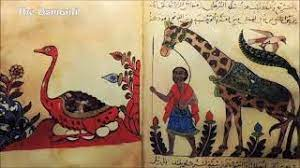
For your info:
This scan is presented as visual support for the article’s point that the statement about “four animals menstruating” is connected to Al-Jahiz’s Al-Hayawan, not to the Qur’an, not to a prophetic hadith, and not to Islamic creed or law. The purpose of placing the scan here is to show that the discussion belongs to a literary/scientific animal-compendium context, not a religious ruling.
Classical Scholars on Al-Jahiz
Shams al-Din al-Dhahabi Said in His Book Mizan al-I’tidal 3/247
[Amr ibn Bahr al-Jahiz, the author of many books. Abu Bakr ibn Abi Dawud narrated from him, it is said. Tha’lab said: Al-Jahiz is neither trustworthy nor reliable. I said: He was one of the leaders of innovations.]
The same words were said by Ibn Hajar al-Asqalani in the book Lisan al-Mizan 4/355.
Ibn Hazm said in the book Al-Milal wa Al-Nihl 4/139 the following:
[He was one of the crazy, misguided people who was mostly a joker. However, we did not see him deliberately cite a lie in his books to prove it, even though he often cited the lies of others.]
Ibn Qutaybah said in the book Interpretation of Various Hadiths 1/111 the following:
And he says the Messenger of God said and follows it with Al-Jamaaz said and Ismail bin Ghazwan said such and such of the obscenities!
He writes a book in which he mentions the arguments of the Christians against the Muslims, and when he comes to refuting them, he exaggerates in his argument as if he only wants to alert them to what they do not know and to raise doubts among the weak Muslims.
You will find him intending in his books to joke and play around, wanting thereby to attract the youth and wine drinkers.
He mocks the hadith with a mockery that is not hidden from the people of knowledge…
And with this, he is one of the most lying of the nation, the most fabricating of hadith, and the most supportive of falsehood.
Al-Jahiz used to mock some of the Prophet’s hadiths, and on the other hand, you will find him narrating funny things from the books of the People of the Book, and he is not ashamed to mention them!!
Abu Mansour Al-Azhari Said
In the introduction to the book Tahdhib Al-Lughah 1/26 the following:
He was given eloquence in speech, a sweet eloquence in discourse, and a scope in the arts.
However, the people of knowledge accused him of lying and rejected the truth.
Tha’lab said:
“He was a liar about God, His Messenger, and the people.”
Al-Hafiz Ibn Hajar Al-Asqalani Said
In his book Lisan Al-Mizan 4/355 the following:
[I said: By God, this is the description of all of Al-Jahiz’s books. Glory be to He who led him astray knowingly… Al-Khatib narrated with his chain of transmission that he did not pray. Ismail bin Muhammad Al-Saffar said: I heard Abu Al-Ayna’ say: “Al-Jahiz and I fabricated the hadith of Fadak and presented it to the sheikhs in Baghdad, and they accepted it except for Ibn Shaybah Al-Alawi, who rejected it and said: This is a lie that Al-Hakim heard from Abd Al-Aziz bin Abd Al-Malik Al-Awar.” I said: “I do not know what he meant by the hadith of Fadak.” Al-Khattabi said: “He was ignorant of his religion.” Abu Al-Faraj Al-Isfahani mentioned that he was accused of heresy and recited poetry about that.]
Subat bin Al-Jawzi says in his book Mirat Al-Zaman fi Tawarikh Al-A’yan 15/351 the following:
My grandfather said in Al-Muntazam: His grandfather was black, and he was one of the Mu’tazilite theologians, and a student of Abu Ishaq Al-Nazzam. He said: People are blind to his writings, exaggerating the limit, but that is not the case. Rather, he has good and bad works.
I said: This is a picture of what my grandfather mentioned about him, and he did not mention anything from his works, nor did he recount some of his articles, so I say: As for his works, they are three hundred and sixty works, and I came across most of them in the shrine of Imam Abu Hanifa in Baghdad, including the book (The Book of Animals), which is a book full of padding, little benefit, and in it he mentioned that the animals that menstruate are four: women, rabbits, hyenas, and bats.
Al-Jahiz was in the days of Al-Mu’tasim and Al-Mutawakkil, and he was unique from his companions on issues, including his statement: All knowledge is necessary, and none of that is from the actions of servants, and that the servants have no gain other than their will.
And among them is that the people of Hell will not remain eternal, but will become fiery in nature. And his doctrine is the doctrine of the philosophers in denying attributes and the like.]
Here It Is: Subat Ibn al-Jawzi Informing Us
Here it is☝ Subat Ibn al-Jawzi informing us that Al-Hayawan is a book by Al-Jahiz, and it is a book full of padding and little benefit, and it contains a statement that women are among the animals that menstruate.
These are the characteristics of the heretic Mu’tazilite Al-Jahiz, whom Christians use as evidence against us!!!
Secondly: Scholars Attributed This Statement to Al-Jahiz
The first person to tell us about Al-Jahiz’s words was Al-Mawardi, as Al-Mawardi says in his book Al-Hawi Al-Kabir the following:
The menstruation of hyenas and rabbits is well-known in Arab poetry.
The poet said about the hyena’s menstruation:
“The hyena laughs at the slain of Hudhayl… and you see the wolf wailing at it.”
So the above statement is not from the core of Islam nor from the words of the Prophet, but rather it is the words of Al-Jahiz himself.
Al-Nawawi mentioned the same words previously in his book Al-Majmu’ Sharh Al-Muhadhdhab 2/343, where he said the following:
[Al-Jahiz said in the Book of Animals: “The animals that menstruate are four: women, rabbits, hyenas, and bats. The menstruation of rabbits and hyenas is well-known in Arab poetry.]
Al-Khatib Al-Sharbini said in the book Mughni Al-Muhtaj ila Ma’rifat Ma’ani Alfad Al-Minhaaj 1/277 the following:
[Al-Jahiz said in the Book of Animals: There are four animals that menstruate: human beings, rabbits, hyenas, and bats.]
Abdullah Al-Maqdisi said in his book Explanation of the Student’s Guide 1/203 the following:
[Four animals menstruate: women, hyenas, bats, and rabbits. This was stated by Al-Jahiz.]
Al-Qalyubi said in Qalyubi and Umairah’s Commentaries 1/112 the following:
[And the animals that menstruate are eight, as Al-Jahiz mentioned, four by consensus, and they are the woman, the rabbit, the hyena, and the bat]
Many other scholars have indicated that Al-Jahiz is the one who said this phrase about women, and these scholars are as follows👇:
- Al-Nawawi in the book Tahdhib al-Asma’ wa al-Lughat 3/78
- Ibn Al-Raf’ah in the book Kifayat Al-Nabih fi Sharh Al-Tanbih 2/128
- Zakaria Al-Ansari in the book The Most Sublime Demands in Explaining Rawdat Al-Talib 1/99
- Sulayman al-Jamal in the book Futuhat al-Wahhab, explaining the explanation of the students’ approach 1/234
- Muhammad bin Ali bin Adam Al-Athiubi in the book Treasure of the Hereafter in Explanation of Al-Mujtaba 5/375
- Al-Bajuri in the book Tuhfat Al-Habib on Al-Khatib’s explanation 1/340
🔴 All the previous imams indicated that the statement is the statement of Al-Jahiz himself, and he is the one who said that women are among the animals that menstruate.
So, the One Who Said This Is Al-Jahiz
So, the one who said this is Al-Jahiz, not the Qur’an, the Prophet, or the scholars of Islam.
The sheikhs mentioned this matter only for the sake of knowledge, in order to inform people of what Al-Jahiz said.
This matter is not at the core of the Islamic religion and has no relation to Islam.
Therefore, in the book ‘Ujalat al-Muhtaj ila Tawjih al-Minhaj, Part One, Page 149 margin, the following is stated:
[In addition to humans, animals that menstruate include: the rabbit, the hyena, the bat, the female camel, the female dog, and the female horse. Its place is only in knowledge.]
Thirdly: The Word Animal in Arabic
The word animal in the Arabic language is taken from the linguistic root of the word life, and the word animal means every creature that has life.
The word animal is applied to every living creature, speaking or non-speaking.
Therefore, when we browse Al-Ghani Dictionary, page 1917, we will find him saying:
[Animal: any living thing, whether speaking or not]
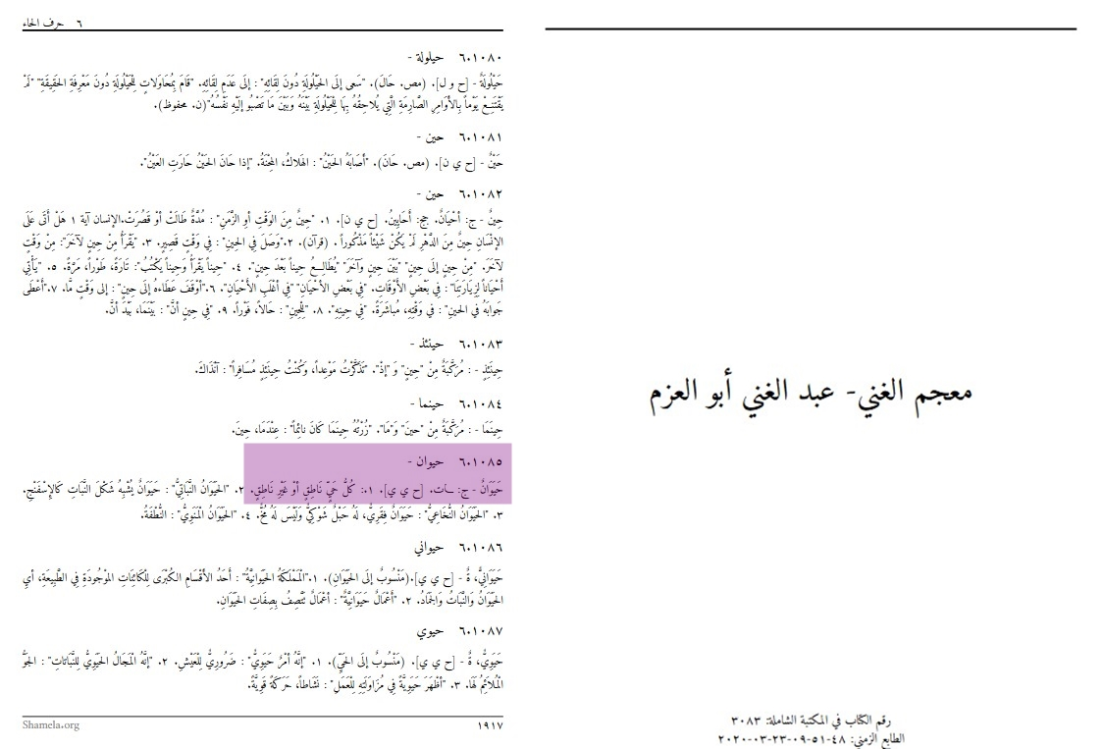
For your info:
This scan is used to show the lexical meaning of the Arabic word ḥayawān / animal. The highlighted point is that in Arabic linguistic usage, the term can mean any living being, whether speaking or non-speaking. Therefore, the mere use of the word “animal” in this kind of technical or linguistic context does not automatically mean insult, degradation, or calling women beasts.
Linguist Dr. Ahmed Mukhtar Omar says in Dictionary of Contemporary Arabic Language 3/2230 the following:
“Man is a talking animal.”
The linguist Al-Sakaki says in his book Key to the Sciences, page 447, the following:
[The result of these three is the establishment of some parts. An example of the first is that every human is an animal, and every speaking human requires some part of the speaking animal.]
The linguist Ibn al-Sayyid al-Batalyusi says in his book Letters on Language 1/265 the following:
[Among the issues that are not reflected is our saying: Every human being is an animal. This is a true issue.]
Abu Abdullah Al-Khwarizmi says in the book Keys to the Sciences 1/166 the following:
[Chapter: What distinguishes one species from another in and of itself. The definition is taken from the genus and the species. An example of this is: the definition of man is that he is a talking animal. So your saying: Animal is the genus.]
Diaa Al-Din Ibn Al-Athir says in the book The Common Proverb in the Literature of the Writer and Poet 3/51 the following:
It is said that every human is an animal, but not every animal is a human.
Al-Jurjani says in the book Al-Ta’rifat 1/138 the following:
[As for that in which the ruling is based on the necessity of proof, it is a necessary affirmation, such as our saying: Every human being is an animal by necessity.]
Al-Ahmad Nakri says in the book The Compendium of Sciences in the Terminology of the Arts 1/168 the following:
[The directed proposition whose meaning is either affirmative only, such as when we say, “Every human being is necessarily an animal.”]
He also said on page 135 the following:
It has been proven that man is an animal.
Abdul Raouf Al-Manawi says in the book Al-Tawqif ala Muhimmat Al-Ta’arif 1/273 the following:
[A simple proposition: whose truth or meaning is either affirmative only, such as: Every human being is necessarily an animal.]
So, the word animal in the Arabic language refers to a human being because he has life in him.
Even biologists today classify humans with mammals in the animal kingdom.
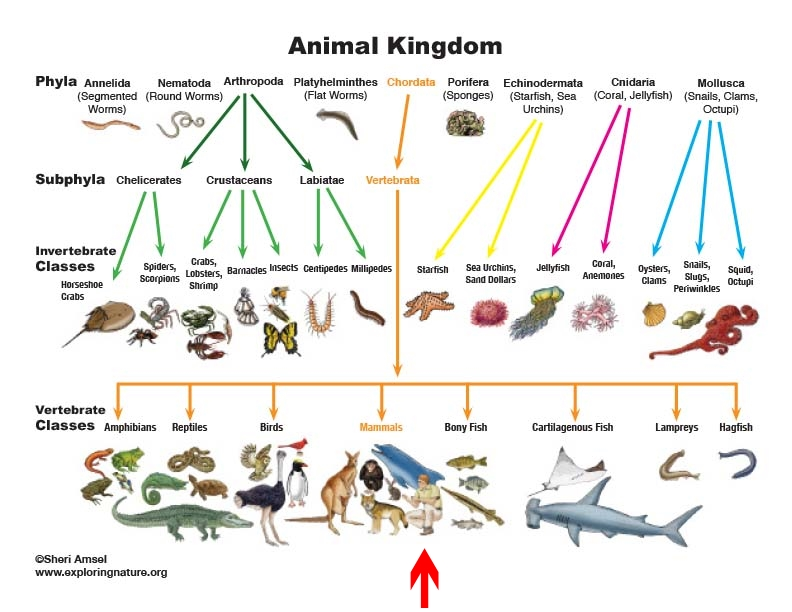
For your info:
This scan is used to support the broader point that modern biological classification also places human beings within the animal kingdom. The article uses this to show that the term “animal” can be descriptive or classificatory, not necessarily insulting. The argument is that opponents are exploiting the emotional English sense of the word while ignoring the Arabic linguistic and classificatory usage.
Even the Bible Uses Animal Language for Humans
By the Way, Even the Holy Book That Christians Believe in Itself Says That Humans Have the Bodies of Animals
For example, the Apostle of Christians, Paul, says in his First Letter to the Corinthians, Chapter 15:
45 Thus it is also written: “The first man, Adam, became a living soul; the last Adam became a life-giving spirit.”
46 But the spiritual is not first, but the natural, and after that the spiritual.
According to the words of Paul, the Apostle of Christians, man was created now in the body of an animal, and after the resurrection he will be transformed into another body!
Therefore, Father Antonios Fikry interprets the words of his apostle Paul, saying:
[The Apostle Paul refers to what is stated in (Genesis 7:2): Adam, then, was dust into which God breathed, and he became a living being. The soul gives life to the body in the present life. Therefore, Adam’s body is alive through the soul, and this is the animal or spiritual body controlled by the powers of the animal soul… If the first Adam gave us an animal body, could not Christ, the Lord, the Giver of Life, give us a spiritual body?]
Father Tadros Yacoub Malti says in his interpretation of Paul’s words the following:
[An animal body is grown, similar to the animal body in terms of its composition as a body with muscles, bones, nerves, veins, arteries, etc., which have the same functions and have a digestive system that converts food into blood and a respiratory system, etc.]
So, the Bible considers man as an animal being.
By the way, the Bible describes non-Christians as animals too.
For example, in the second letter of Peter 2:12 it is stated as follows:
“But these, like irrational beasts by nature, born to be caught and destroyed, speak evil of things they do not know and will perish in their corruption.”
And in the letter of Jude 1:10 it is stated as follows:
“But these speak evil of things they do not know, but like irrational beasts by nature they understand and in these things they will be corrupted.”
Even the ancient Church Fathers considered women worse than animals.
For example, the theologian Weinrich 1991:258 said that Origen described women as:
“worse than animals”
because of their constant state of lust.
Fourthly: Responding to the Quoted Suspicions
The First Suspicion: Ibn Hajar al-Haytami
Regarding what Ibn Hajar al-Haytami mentioned in the book Tuhfat al-Muhtaj, where he said:
Menstruating rabbits and women, a hyena and a bat for which there is medicine.
And four more were added to it, so it became eight. Some of them organized it in his saying:
A hyena, a woman, a rabbit, a female camel, a female dog, a bat, a gecko, and a stone menstruate from a living creature.
They came eight, and this is the reliable opinion.
These previous words ☝ are not the words of Ibn Hajar al-Haytami himself, but rather Ibn Hajar al-Haytami is telling us that some people are the ones who said the previous verses of poetry.
We do not know who this person is who said this poetry in the first place, and thus it is ridiculous for anyone to claim that this saying is from the core of Islam.
Then, the previous verses of poetry mean by the word animal: a being with a soul, and that is why the verses of poetry mentioned the phrase:
“with a soul”
The same previous quote was mentioned by Muhammad al-Amin al-Harari in his book Murshid Dhu al-Hijja wa al-Hajja ila Sunan Ibn Majah, and al-Harari quoted it verbatim from the previous book by Ibn Hajar al-Haytami.
But I responded to both quotes and said that those who said the previous verses of poetry were unknown people and that they meant: a being with a soul as mentioned in the verses of poetry.
The Second Suspicion: Al-Qastalani
Al-Qastalani mentioned in the book Irshad al-Sari for explaining Sahih al-Bukhari the following:
[The animals that menstruate are women, hyenas, bats, and rabbits. It is said that the female dog also menstruates.]
But the previous statement is not from the words of the Prophet, nor from the words of Al-Bukhari, nor from the words of Al-Qastalani.
Rather, these statements are from Al-Jahiz himself, as I established at the beginning of the article.
So the entire statement is quoted verbatim from the words of the heretic Al-Jahiz.
The Third Suspicion: Hassan Bin Ali Al-Fayoumi
As for what Hassan bin Ali Al-Fayoumi said in the book Fath Al-Qarib Al-Mujib Ala Al-Targhīb wa Al-Tarhīb, where he says:
[There are four animals that menstruate: the woman, the hyena, the bat, and the rabbit. It is said that the female dog is also like that.]
I respond to the previous quote and say:
The original manuscript of the book does not contain the phrase [the animals are four], but rather this addition is from the printing press itself.
Then, if we complete the previous quotation, we find Al-Fayyumi saying on the same page:
The rabbit is an animal that resembles a rabbit, with short arms and long legs, as big as a giraffe. This is stated in The Life of Animals.
The talk about menstruating animals is taken from Al-Jahiz’s book called The Life of Animals, and we said before that Al-Jahiz was an innovator.
The Fourth Suspicion: Khalil Ahmad al-Saharanfuri
As for what Khalil Ahmad al-Saharanfuri mentioned in his book Badhl al-Majhud fi Hall Sunan Abi Dawud, where he says:
[And the animals that menstruate include: women, hyenas, bats, rabbits, and it is also said: the female dog, and it is also said: the female camel and the gecko, as stated in “al-Qastalani” (12/284), and the author of “Hayat al-Hayawan” was satisfied with the first four. [See: “Hayat al-Hayawan” (1/29)]
I respond to the previous quote and say:
The words are taken from the words of Al-Jahiz, the author of The Book of Animals, and Al-Sahnafuri himself indicated that the quote is the words of Al-Jahiz himself.
The Fifth Suspicion: Al-Tahtawi
As for what Al-Tahtawi mentioned in Al-Tahtawi’s Commentary on Maraqi Al-Falah Sharh Nur Al-Idah, where he mentioned the following:
[Some of them gathered the ten menstruating animals by saying: Menstruation comes to women and nine. … They are the camels, their hyenas, the rabbit. The gecko, the bat, the female dog. … The weasel and the snakes are counted among them. Some added: thick and trembling. … So remember, for in remembering the equivalents there is desire.]
I respond to the quote and say:
The above statement is not from Al-Tahtawi himself, but from unknown people.
Therefore, Al-Tahtawi says:
[Some of them gathered the menstruating animals]
And we do not know who these people are.
The Sixth Suspicion: Al-Safarini
As for what Al-Safarini said in his book Food for the Minds in Explaining the System of Etiquette, where he said:
[There are eight animals that menstruate. Scholars have stated that there are eight animals that menstruate: women, hyenas, bats, rabbits, dogs, horses, female camels, and geckos.]
But Al-Safarini did not mean that religious scholars and jurisprudents said that, but rather that biologists were the ones who said that.
Knowing about animal menstruation is not part of Islamic jurisprudence and has no relation to Islamic jurisprudence at all.
If you look at Al-Safarini’s words in their entirety, you will find that he is talking about animals and giving vital information about them.
For example, he says:
They walk on the ground on the backs of their legs.
It is a generic name for both males and females.
The male is called khazaz, and its plural is khuzzan, like surd and sirdan.
The female is called ikrisha.
The khirnaq is the offspring of the rabbit. It is first a khirnaq, then a sakhla, then a hare.
The penis of the male of this species is like that of the male fox; one part is a bone and the other a nerve.
The female may mount the male during mating due to her natural heat, and she may mate while pregnant.
This is mentioned in the chapter on the life of animals.
It was mentioned that the rabbit is male one year and female the next. This is what he said, and God knows best.
Benefit: Rabbits menstruate, and from this is the poet’s saying:
And the laughter of rabbits on the rock… is like the blood of war on the day of encounter.
Eight menstruating animals.
Scholars have mentioned that eight menstruating animals are: women, hyenas, bats, rabbits, dogs, and horses. And the camel, and the gecko.
Here, Al-Safarini provides vital information about rabbits, and this information has nothing to do with Islamic jurisprudence.
Al-Safarini has mentioned what biologists have said about this.
So, what Al-Safarini said above has nothing to do with Islam, but rather it is the words of biologists, not religious scholars.
The Seventh Suspicion: Ibn al-Imad and Al-Sakhawi
Ibn Al-Imad Al-Hanbali said in the book Shudharat Al-Dhahab fi Akhbar Man Dhahab 9/21 the following:
the woman, the bat, then the rabbit… the fourth hyena, then the garage.
And in the book “Al-Hayawan” he mentions Al-Jahiz: I quote from him what is not denied.]
Shams al-Din al-Sakhawi said in the book The Shining Light of the People of the Ninth Century 4/324 the following:
(The woman is the bat, then the rabbit *** and the hyena is the fourth, then the fourth)
(and in the book of animals it is mentioned *** by al-Jahiz, quote from him what is not denied)]
But the previous words are not from the words of Ibn Al-Imad Al-Hanbali, nor from the words of Shams Al-Din Al-Sakhawi, nor from the words of Abdul Latif bin Ahmed Al-Sarraj, but from the words of Al-Jahiz himself.
Therefore, if you examine both previous quotations carefully, you will find Abdul Latif Al-Sarraj saying in the same verse of poetry the following:
[And in the Book of Animals it is mentioned by Al-Jahiz. Quote from him what is not denied.]
The same previous words were quoted verbatim by Ibn Taghri Birdi in his book Al-Manhal Al-Safi and Al-Mustawwaf Ba’d Al-Wafi.
I responded to the same point and proved that this is the speech of Al-Jahiz himself.
These words are the words of Al-Jahiz himself, as Abdul Latif bin Siraj indicated in the verse.
The Eighth Suspicion: Al-Fattani and Al-Hasni
As for what Al-Fattani said in his book Majma’ Bahr Al-Anwar, where he said:
[K: … and the animals that menstruate include women, hyenas, bats, and rabbits. It was also said: the female dog, the female camel, and the gecko.]
However, the previous statement is not from Al-Fattani himself, but rather he copied the statement from Al-Qastalani’s book.
Therefore, if you go back to Al-Fattani’s book and look at this paragraph, you will find that Al-Fattani wrote the letter K at the beginning of the paragraph.
This letter K means that the paragraph was taken either from Al-Kirmani’s book or Al-Qastalani’s.
The evidence for that is that if you look at the introduction to the book, you will find that the introduction says:
[K - Al-Karmani has his explanation, and it may be Al-Qastalani’s due to the mixing of their materials]
So, this is not the words of Al-Fattani himself, but he took it from Al-Qastalani’s book.
I have just proven that Al-Qastalani took this statement from Al-Jahiz, as Al-Jahiz the innovator is the one who originally said this statement.
As for what Taqi al-Din al-Hasni mentioned in the book Kifayat al-Akhbar fi Hall Ghayat al-Ikhtisar, where he said:
[And the animals that menstruate are four: the woman, the hyena, the rabbit, and the bat.]
But the previous quote is taken from the words of the innovator Al-Jahiz himself, as we proved at the beginning of the article.
The Ninth Suspicion: Al-Damiri
As for what Al-Damiri mentioned in his book The Great Life of Animals 1/37, where he said:
It is said that if it sees the sea, it dies, and that is why it is not found on the coasts. I do not believe this. The Arabs claim, in their lies, that the jinn flee from it because of the place where it menstruates: The poet said:
The laughter of rabbits on the rock … is like the blood of war on the day of encounter.
Benefit: Four animals menstruate: the woman, the hyena, the bat, and the rabbit. It is said that the dog is also like that.]
In response to the above quote, I say:
The above statement is exactly what Al-Jahiz said, and is not an invention of Al-Damri himself.
Furthermore, we cannot be certain that the above paragraph was mentioned by Al-Damri himself in his book, given that Al-Damri’s book is distorted and contains additions not found in all copies.
Professor Dr. Sheikh Ibrahim bin Abdullah Al-Madhesh says in his book Al-Damiry’s Method in his Book, The Life of Animals, page 194, the following:
Al-Sakhawi said in Al-Daw’ Al-Lami’: (He has additions to it that are not found in all the copies, and it was thought that it contains what is in it that is infiltrated by someone other than him, if not all of them, because of what it contains of anomalies, and some of them have stripped them away, rather Al-Taqi Al-Fasi abridged the original in the year 22, and pointed out important things that the original needs.)]
We cannot know whether Al-Damri actually quoted this paragraph or not.
As for what Al-San’ani mentioned in the book Subul Al-Salam, an explanation of Bulugh Al-Maram, he said:
Al-Damri mentioned in Hayat al-Hayawan that the animals that menstruate are women, hyenas, bats, and rabbits. It is said that the same applies to female dogs.
But I responded to the previous statement and said that Al-Damri’s book is distorted, and that someone may have inserted it into his book.
Even if we assume that Al-Damri mentioned this statement in his book, then it would be that Al-Damiry quoted this statement from Al-Jahiz himself.
The same quote was mentioned verbatim by Al-Hussein bin Muhammad Al-Maghribi and attributed to Al-Damri, but I respond to him in the same way as before and say:
Al-Damri’s book is distorted and we cannot be sure whether Al-Damri actually said that or not.
Finally: The Quranic View of Men and Women
The Holy Quran indicates that men and women are two beings linked to each other and have the same origin.
For example:
God Almighty says:
[Al-A’raf 189]
God Almighty said:
[Al Imran 3:195]
Males and females are equal before God in justice on the Day of Resurrection.
Therefore, God Almighty says:
[An-Nisa’ 124]
Conclusion
There I have completely refuted the doubt.
It is attributed to Al-Jahiz in Al-Hayawan, a literary/scientific animal book, and later scholars only quoted it as transmitted information, not as a religious ruling.