

Does Qur’an 9:31 Say Jesus Is God? Refuting the Grammar and ‘Most High’ Claim
Does Qur’an 9:31 Say Jesus Is God? Refuting the Grammar and “Most High” Claim
Some Christian polemicists claim that Qur’an 9:31 accidentally agrees with them that Jesus عليه السلام is divine or “the Most High.”
Their argument usually depends on misreading the verse as if it says that Christians took their scholars and monks as lords besides Allah, and also besides the Messiah, meaning that Allah and the Messiah are allegedly placed together as the true God.
This is bad Arabic.
The verse is not saying that Allah and Jesus are jointly God. It is saying that they took their scholars, monks, and the Messiah son of Mary as lords besides Allah.
The Verse in Question
“They have taken their scholars and monks as lords besides Allah, and also the Messiah, the son of Mary. And they were not commanded except to worship One God; there is no deity except Him. Exalted is He above whatever they associate with Him.”
Some Christians claim that the verse means they took their scholars and monks as lords besides Allahand besides the Messiah, allegedly implying that Allah and the Messiah are both the true God.
This reading collapses grammatically.
The Core Refutation
In the Arabic grammar of the verse,“the Messiah, son of Mary” is connected to “their scholars and monks” as part of the group wrongly taken as lords besides Allah. It is not connected to Allah as another true deity.
The verse is condemning Christians for elevating created beings into lords besides Allah.
The structure is:
They took their scholars, their monks, and the Messiah son of Mary as lords besides Allah.
It is not:
They took their scholars and monks as lords besides Allah and besides the Messiah.
That second reading is not supported by the Arabic grammar.
The Grammar of the Verse
The key phrase is:
أَحْبَارَهُمْ وَرُهْبَانَهُمْ أَرْبَابًا مِّن دُونِ اللَّهِ وَالْمَسِيحَ ابْنَ مَرْيَمَ
The words أَحْبَارَهُمْ, رُهْبَانَهُمْ, and الْمَسِيحَ are grammatically connected as the objects of اتَّخَذُوا.
They are the ones taken as lords.
The phrase مِّن دُونِ اللَّهِ means “besides Allah.”
So the verse means that they took their scholars, monks, and the Messiah as lords besides Allah.
الْمَسِيحَ ends with fatḥah because it is joined to the objects being taken as lords. It is not governed by مِن after دُونِ اللَّهِ. If the meaning were “besides Allah and the Messiah,” then the grammatical construction would differ.
The polemical reading depends on ignoring the case endings and the structure of the sentence.
Scan Evidence: Qur’an 9:31 Grammar
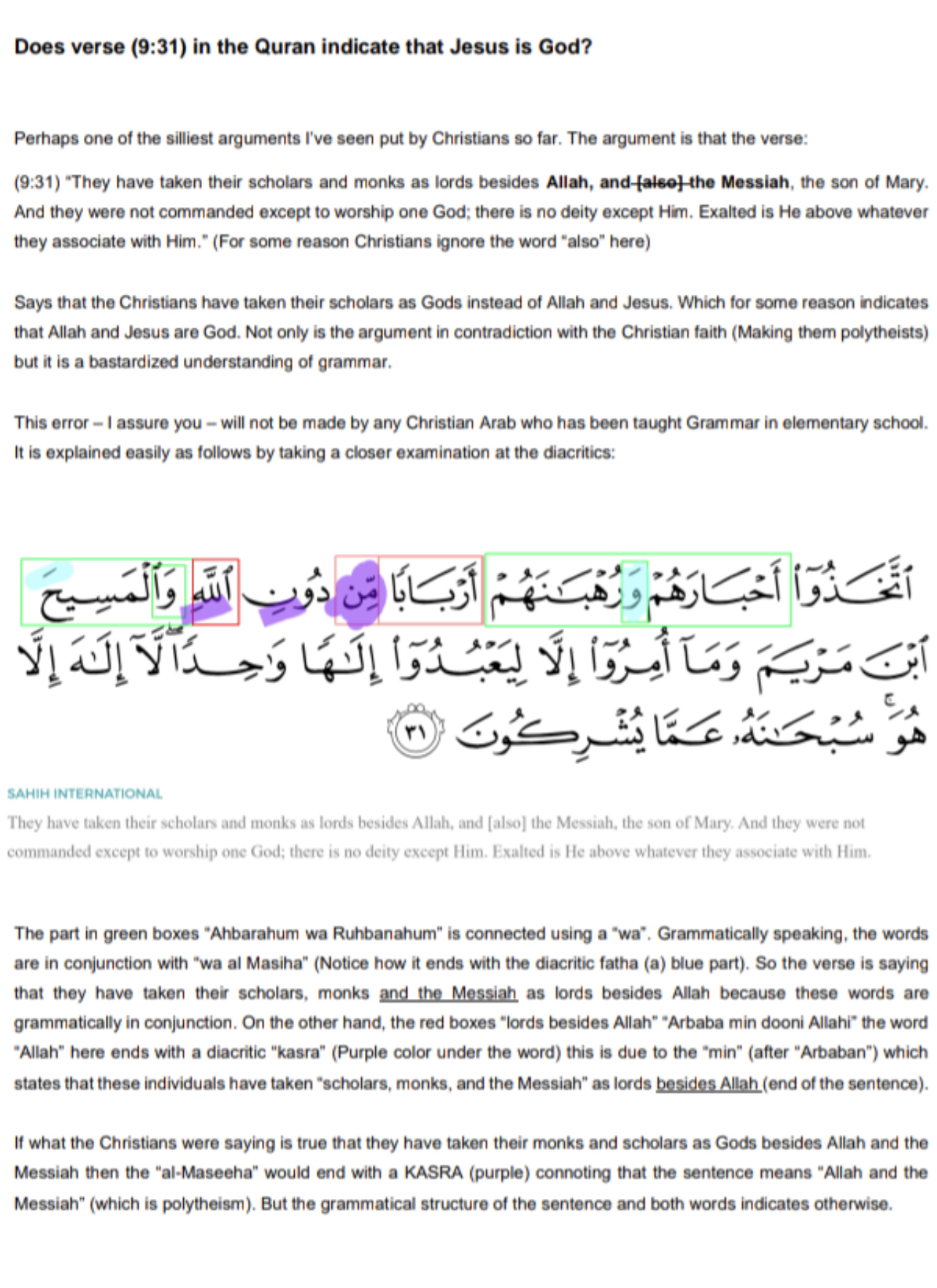
This scan explains the grammar of At-Tawbah 9:31. The green boxes highlightأَحْبَارَهُمْ وَرُهْبَانَهُمْ and وَالْمَسِيحَ, showing that “their scholars,” “their monks,” and “the Messiah” are connected together by conjunction. The purple marking under اللَّهِ shows the kasrah caused by مِن in the phrase مِّن دُونِ اللَّهِ. The point is that the Messiah is not grammatically joined to Allah as another divine being. Rather, he is listed among those whom Christians wrongly took as lords besides Allah.
The scan’s point is correct: a Christian Arab with basic grammar should not make this mistake. The verse is not placing Jesus عليه السلام beside Allah as God. It is listing Jesus among those wrongly elevated by people.
The Verse Itself Refutes Christian Deification
The verse continues:
“And they were not commanded except to worship One God.”
This kills the Christian reading.
The verse explicitly says that they were commanded to worship one God, not Allah plus Jesus.
Then it says:
“There is no deity except Him.”
And then:
“Exalted is He above whatever they associate with Him.”
The ending of the verse explicitly condemns shirk. So using this verse to prove Jesus’ divinity is self-destruction.
At-Tawbah 9:31 does not teach Jesus’ divinity. It condemns taking Jesus and religious authorities as lords besides Allah and commands worship of One God alone.
The “Also the Messiah” Phrase
Some translations say:
“They have taken their scholars and monks as lords besides Allah, and also the Messiah, son of Mary.”
This is accurate if understood correctly.
The word “also” means the Messiah is also included among those wrongly taken as lords. It does not mean he is being placed beside Allah as the true God.
“Also the Messiah” means Christians also took the Messiah as a lord besides Allah. It does not mean Allah and the Messiah are both the one God.
The polemicist abuses English punctuation and ignores Arabic grammar.
Does Jesus Being Raised to Heaven Make Him “Most High”?
Another argument claims that since Jesus عليه السلام was raised to heaven, he must be “most high” in divine rank.
This is weak.
Physical elevation does not automatically mean divine status.
Angels ascend to Allah. That does not make angels divine.
The Prophet Muhammad ﷺ ascended during the Miʿrāj. That does not make him divine.
Believers will enter Paradise. That does not make them divine.
Being raised physically or being located in heaven does not make someone God. Elevation in place is not the same as divinity in essence.
The argument confuses location with nature.
Angels Also Ascend
“The angels and the Spirit ascend to Him in a day whose measure is fifty thousand years.”
If ascending toward Allah made someone divine, then the angels would also be divine.
No Christian argues this.
So the argument is inconsistent.
Jesus Was Seen in the Second Heaven
The Miʿrāj reports mention that the Prophet ﷺ saw Jesus عليه السلام with Yahya عليه السلام in the second heaven.
Grade: Sahih.
This further weakens the claim that Jesus being in heaven proves he is divine or uniquely “most high.” He is not described as Allah. He is described as a prophet among prophets.
Jesus عليه السلام being raised by Allah is an honor and miracle. It does not make him Allah, nor does it make him divine.
The Qur’an Clearly Calls Jesus a Messenger
The Qur’an repeatedly identifies Jesus عليه السلام as a servant and messenger of Allah.
“The Messiah, Jesus son of Mary, was only a messenger of Allah, and His word which He directed to Mary, and a spirit from Him.”
“The Messiah, son of Mary, was only a messenger.”
So the Qur’an cannot be twisted into teaching that Jesus is God. Its doctrine is explicit: Jesus is the Messiah, a messenger, a servant of Allah, and a miraculous sign — not Allah.
Why the Christian Argument Fails
The argument fails for several reasons.
First, it misreads the Arabic grammar of At-Tawbah 9:31.
Second, it ignores the case ending of الْمَسِيحَ.
Third, it ignores that the verse ends by commanding worship of one God and condemning shirk.
Fourth, it confuses being raised to heaven with being divine.
Fifth, it ignores that angels and prophets also ascend or are placed in the heavens without becoming gods.
Sixth, it contradicts the Qur’an’s explicit teaching that Jesus is a messenger of Allah.
The critic commits two basic errors: a grammar error in At-Tawbah 9:31 and a theology error by confusing physical elevation with divine essence.
External Rebuttal
Final Refutation
At-Tawbah 9:31 does not say Jesus is God. It says Christians took their scholars, monks, and the Messiah son of Mary as lords besides Allah. The Arabic grammar places the Messiah among those wrongly taken as lords, not alongside Allah as deity.
The verse itself commands worship of one God and declares that there is no deity except Him. It ends by exalting Allah above what they associate with Him.
Likewise, Jesus being raised to heaven does not make him divine. Angels ascend, prophets ascend, and believers enter Paradise, yet none of that makes them God.
The claim that the Qur’an agrees Jesus is God or “the Most High” is false. It depends on bad Arabic grammar and bad theology. At-Tawbah 9:31 condemns the deification of Jesus; it does not support it.
Source Notes
Bassam Zawadi, “Rebuttal to Sam Shamoun’s Article, ‘The Quran Also Agrees: Jesus Is the Most High!’”