How Islam Liberated Persia from Sasanian Oppression and Built a Civilization
Conditions of the Peoples of the Sasanian Empire Before and After the Islamic Conquest
This article collects historical references regarding the condition of the peoples under the Sasanian Empire before the Islamic conquest, and the changes that occurred after the arrival of Islam and Muslim Arab rule.
Table of Contents
- 1. Hygiene, Bathing, and Water
- 2. Persian Revenue from Iraq
- 3. Oppression of Farmers Under Persian Rule
- 4. Restriction of Reading and Writing
- 5. Illiteracy and Education Under the Sasanians
- 6. Artisans and Craftsmen After Islam
- 7. Religious Oppression Under the Sasanian Dynasty
- 8. Peoples Welcoming the Islamic Conquest
- 9. Muslim Arabs as Builders, Not Destroyers
- 10. Writing, Literacy, and Education After Islam
- 11. Prosperity and Urban Development After the Conquest
- 12. Bukhara, Samarkand, and Khwarazm
- 13. Irrigation, Trade, and Economic Prosperity
- Conclusion
1. Hygiene, Bathing, and Water
The ancient Persians were known for their filthiness, bathing in cow urine, and did not know bathing with water, nor did they have bathhouses.
Their religious beliefs despised bathing, considering it a foreign habit.
It is narrated that they killed one of their kings because he bathed with water.
This did not change among them until the arrival of Islam and the rule of the Muslim Arabs over them.
[ The Nature and Function of Water, Baths, Bathing, and Hygiene from Antiquity through the Renaissance Edited by Cynthia Kosso pp 269 - 270 ]
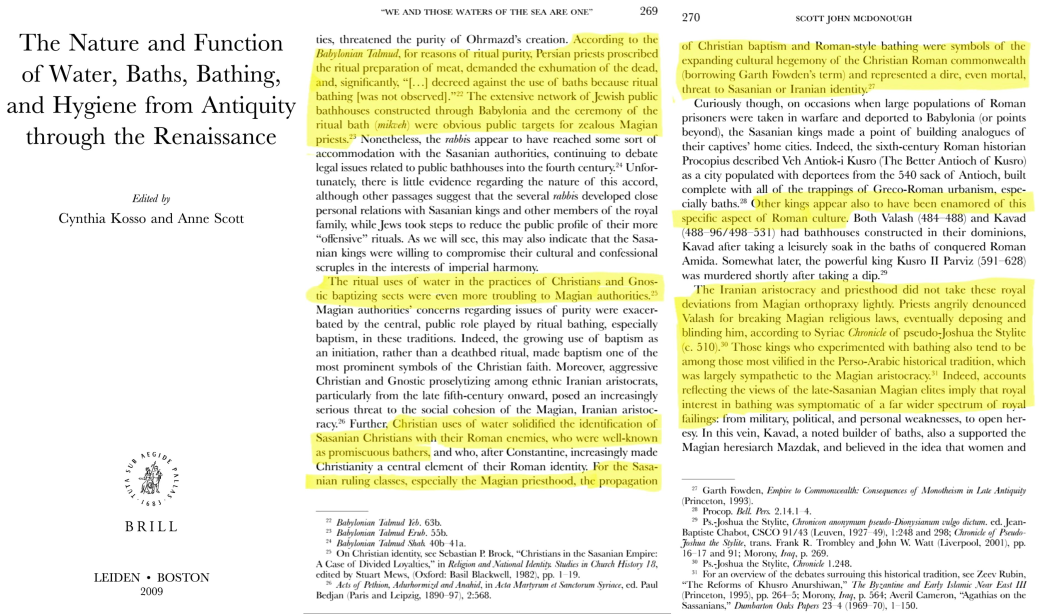
The scan is fromThe Nature and Function of Water, Baths, Bathing, and Hygiene from Antiquity through the Renaissance, edited by Cynthia Kosso and Anne Scott. The highlighted section explains that Magian/Zoroastrian concerns about ritual purity were worsened by contact with Christian and Gnostic baptismal practices, because these groups used water ritually. It also states that Christians’ use of water strengthened the Sasanian priesthood’s negative attitude toward public bathing, since Roman-style bathing was connected with Christianity and Roman identity. The highlighted passage further says that Christian baptism and Roman-style bathing were viewed as symbols of Christian Roman culture and therefore treated as threatening to Sasanian or Iranian identity. The right page also highlights that some Persian kings sponsored bathhouses, but priests denounced kings such as Kavad for breaking Magian religious rules when they bathed with water, even presenting his bathing as one of the reasons for opposition to him.
2. Persian Revenue from Iraq
Most of the Persians’ income throughout their rule over the peoples came from the lands of Iraq, where the farmers in Iraq, under the Persian state, lived in a system akin to slavery, with most of their produce going to the Persian rulers, nobles, and landowners.
[ THE GREAT ARAB CONQUESTS , HUGH KENNEDY P100 ]
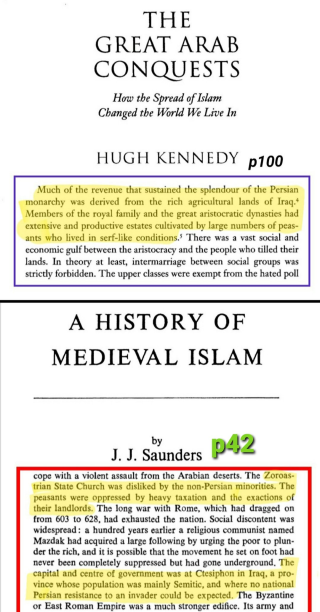
The scan contains a highlighted passage from Hugh Kennedy’sThe Great Arab Conquests, page 100. The highlighted text states that much of the revenue supporting the Persian monarchy came from the rich agricultural lands of Iraq. It describes Iraq as one of the most extensive and productive regions cultivated by peasants who lived in semi-servile conditions. The point of the passage is that the Sasanian state depended heavily on Iraqi agricultural production, while the actual farmers were placed under harsh social and economic conditions.
3. Oppression of Farmers Under Persian Rule
The farmers in all the lands ruled by the Persians were constantly subjected to provocation, extortion, and oppression by the Persians due to heavy taxes and the persistent mistreatment by Persian landowners.
[ A HISTORY OF MEDIEVAL ISLAM , J. J. Saunders P42 ]
The lower part of the same scan contains a highlighted passage from J. J. Saunders’A History of Medieval Islam, page 42. The passage says that the peasants were oppressed by taxation and the actions of landlords. It also states that the long war with Rome had exhausted the nation and that social discontent was widespread. The highlighted section explains that the oppressed peasantry had no strong national attachment to the Persian ruling system and could not be expected to defend the Byzantine or East Roman Empire either. The scan therefore presents the rural population as economically crushed and politically detached from the ruling powers over them.
4. Restriction of Reading and Writing
Reading and writing were forbidden for the common Persians and the peoples under Persian rule, as well as all classes under their governance, and were only available to the nobles.
[ THE SASANIAN ERA Edited by Vesta Sarkhosh Curtis p151 - 152 ]
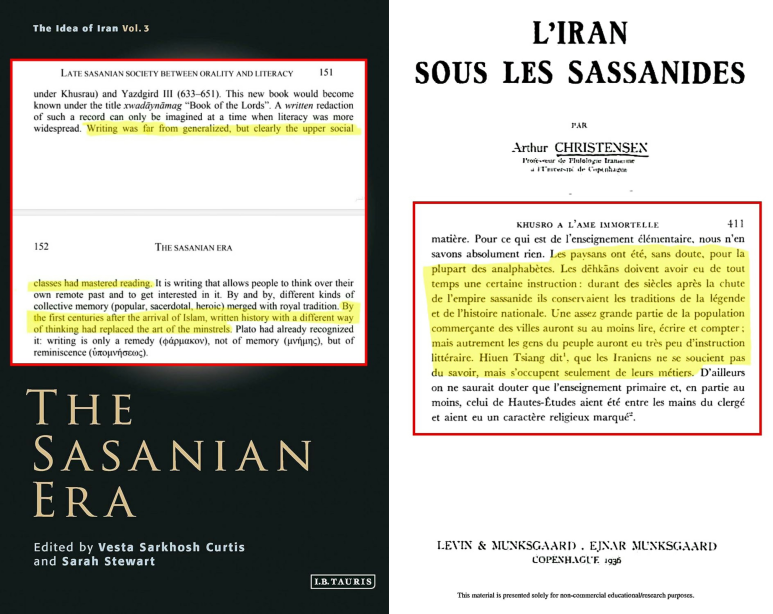
The scan shows pages fromThe Sasanian Era, edited by Vesta Sarkhosh Curtis and Sarah Stewart. The highlighted passage says that written reaction against a weak king could become widespread, but that writing was far from generalized. It then says that only the upper social classes had mastered reading. The highlighted text also explains that the act of writing changes how people think, because written information can be stored, reflected upon, and developed beyond oral memory. The point of the scan is that literacy in Sasanian society was not broadly available to the population but was concentrated among the elite.
5. Illiteracy and Education Under the Sasanians
Most farmers were illiterate and uneducated, and learning to read and write was only available to the dihqans (landowning elites) and urban merchants in the cities. Those below these elites—namely the nobles, merchants, and dihqans—had no education.
The Iranians did not care about learning to read, write, or acquire knowledge, focusing only on their trades, as writing was forbidden among them and considered a foreign custom.
[ L’IRAN SOUS LES SASSANIDES , PAR CHRISTENSEN , COPENHAGUE. 1936 p411 ]
The right side of the scan is from Arthur Christensen’sL’Iran sous les Sassanides, page 411. The highlighted French passage explains that most peasants were illiterate. It says that only the dihqans, who were the minor nobility and landholding class, had any relation to literary instruction, along with part of the commercial population in the cities. The highlighted lines also say that many Iranians did not concern themselves with anything beyond their trade or craft. The passage further indicates that primary instruction was partly in the hands of religious authorities, giving education a marked religious character.
6. Artisans and Craftsmen After Islam
With the arrival of Islam, everything changed.
Thomas Arnold and Arthur de Gobineau state that artisans and craftsmen in the Sasanian Empire were despised, scorned, and ostracized by the Persian government and treated with racism due to Zoroastrianism’s hostility toward industry and manual crafts. When the Muslim Arabs, with the creed of Islam, arrived and conquered the lands of the Sasanian Empire, including Iraq, Iran, and Khorasan, the artisans and craftsmen embraced Islam because it made them free men with status and importance. It also made them brothers in faith and creed, where preference of one over another was based on piety.
[ PREACHING OF ISLAM 1913 , BY T. W. ARNOLD p208 ]
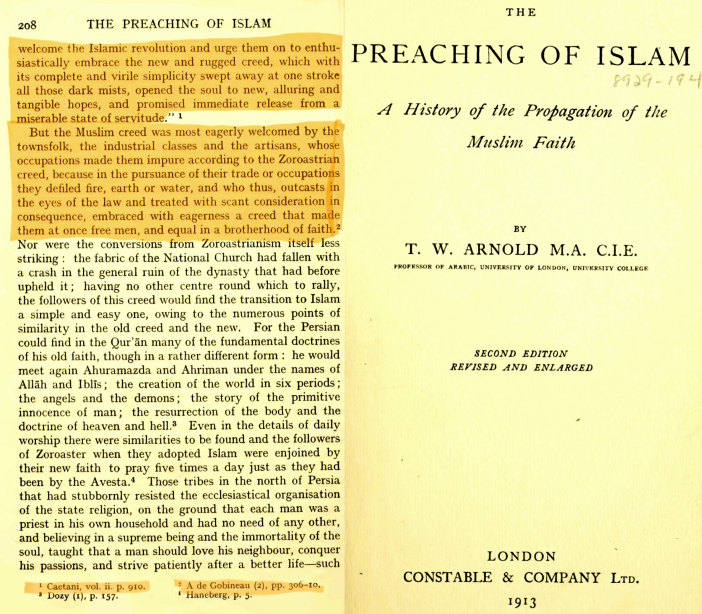
The scan is from T. W. Arnold’sThe Preaching of Islam, page 208. The highlighted passage says that the Muslim creed was eagerly welcomed by townsfolk, industrial classes, and artisans. It explains that these people had been treated as impure under Zoroastrianism because trade and many occupations were regarded as defiling. The scan then says they were excluded from many religious ceremonies and were treated with little consideration under the law. According to the highlighted passage, they embraced Islam eagerly because it made them free men and equal in the brotherhood of faith.
7. Religious Oppression Under the Sasanian Dynasty
The subjects of the Sasanian Empire, consisting of Iranians, followed various religions and sects, including Zoroastrianism, ancient Persian beliefs, Buddhism, Manichaeism, and others before the advent of Islam. The Arab and Semitic peoples adhered to Christianity, Judaism, and Sabianism.
All these sects followed by the Iranians and Arabs were brutally oppressed by the ruling Zoroastrian Sasanian dynasty because their religion and sect differed from all the peoples under their rule.
The Arab Islamic conquest was a sign of divine blessing for these peoples. The Persians, Iranians, Arabs, and Semites in the Sasanian state welcomed the Muslim Arab conqueror because he was the reason for their liberation from oppression and injustice and the cause of their happiness. Most of them converted to Islam thereafter.
[ PREACHING OF ISLAM 1913 , BY T. W. ARNOLD p206 ]
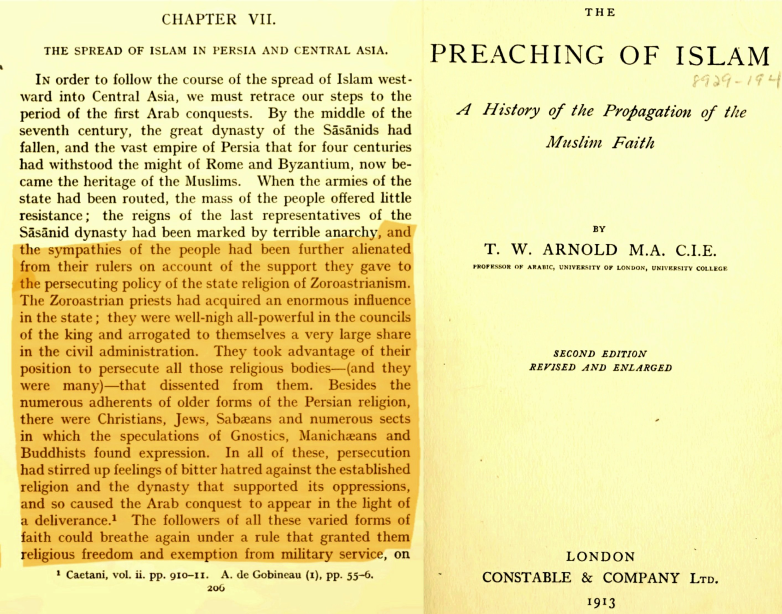
The scan is from T. W. Arnold’sThe Preaching of Islam, page 206. The highlighted passage explains that after the fall of the Sasanian dynasty, the people offered little resistance to the Arab conquest. It says the late Sasanian period had been marked by terrible anarchy, and that the people’s sympathy had been alienated from their rulers because the state enforced Zoroastrian religious policy. The Zoroastrian priests are described as extremely influential in the state, using their position to persecute religious bodies that dissented from them. The highlighted text then lists Christians, Jews, Sabaeans, Manichaeans, and Buddhists among the groups that suffered oppression. It concludes that this persecution created a large amount of bitter hatred against the established religion and dynasty, causing the Arab conquest to appear as deliverance.
8. Peoples Welcoming the Islamic Conquest
Leone Caetani also mentioned that most of the peoples of the Sasanian Empire welcomed the Islamic conquest because it was a salvation for them from the rule of tyrants and a cause for justice.
[ Leone Caetani , Annali dell’Islam , Millano, 1907, Vol II, Tomo II, page 911 ]
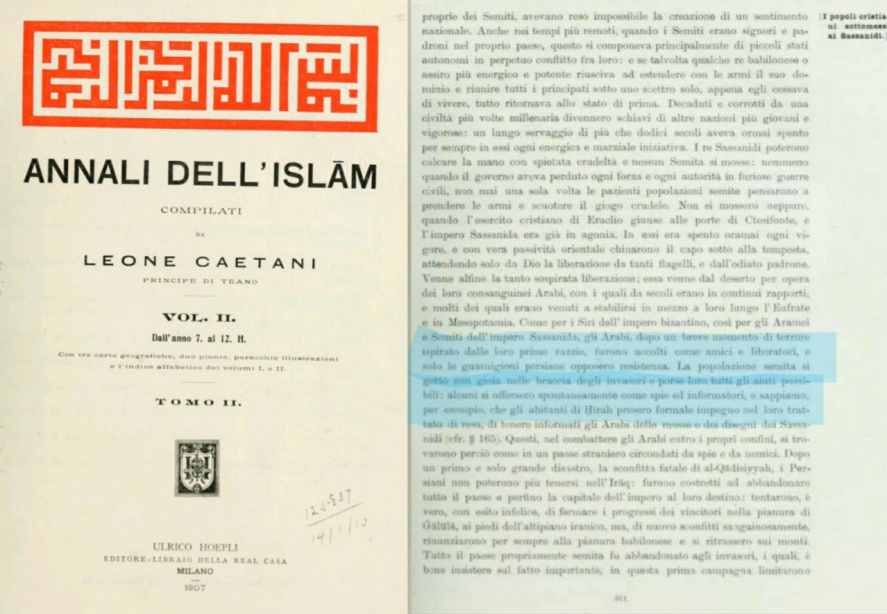
The scan is from Leone Caetani’sAnnali dell’Islam, volume II, page 911. The highlighted Italian passage says that the Semitic peoples of the Sasanian Empire, including Arabs, welcomed the movement of the Arabs as friends and liberators. It says they were encouraged by the harsh oppression of the Sasanian regime and that they hoped to be rescued from that oppression. The highlighted passage presents the Arab advance as being received favorably by many subjected populations, not merely as a military invasion.
9. Muslim Arabs as Builders, Not Destroyers
A Persian prince named Cyrus or Khosrow described the conquering Muslim Arabs as builders, and his exact words about them were: these victors do not come as destroyers.
By his words, he meant that they do not destroy countries, cities, or peoples but rather build and develop lands, cultivate them, and make them prosper, which explains the development of every land ruled by the Muslim Arabs.
[ شمس العرب تسطع على الغرب - زيجريد هونكه ص ٣٥٧ - بيروت ]
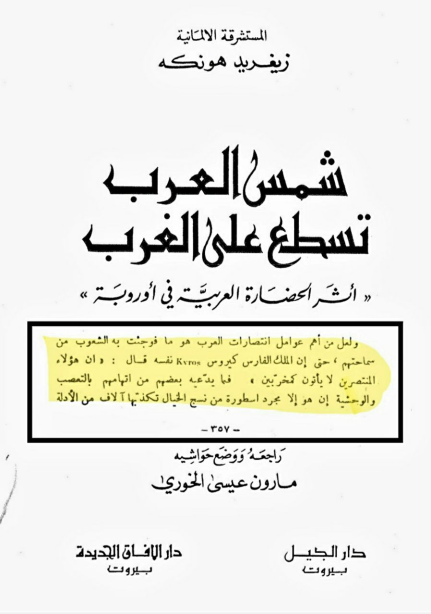
The scan is from the Arabic edition of Sigrid Hunke’sشمس العرب تسطع على الغرب, page 357. The highlighted Arabic passage says that among the factors behind the Arab victories in the East was that many people saw the Arabs as saviors. It quotes someone saying that these conquerors did not come as destroyers, but rather as builders. The highlighted section emphasizes that the Arab conquests were not understood by those populations only as devastation or ruin, but as a movement that brought construction, order, and deliverance from previous oppressive rule.
10. Writing, Literacy, and Education After Islam
The eradication of illiteracy and the knowledge of reading and writing in the lands conquered by the Muslim Arabs were extremely high. Writing inscriptions was a forbidden practice in the Sasanian Empire, but with the Arab conquest of Iran, writing inscriptions and writing in general became a common practice among Muslims, both Arabs and non-Arabs, in the Middle East. Education was available to all inhabitants of the Arab Islamic Middle East and was not restricted to the elite in any way.
[ POETICS AND POLITICS OF IRAN’S NATIONAL EPIC, THE SHAHNĀMEH , Mahmoud Omidsalar p24 - 25 ]
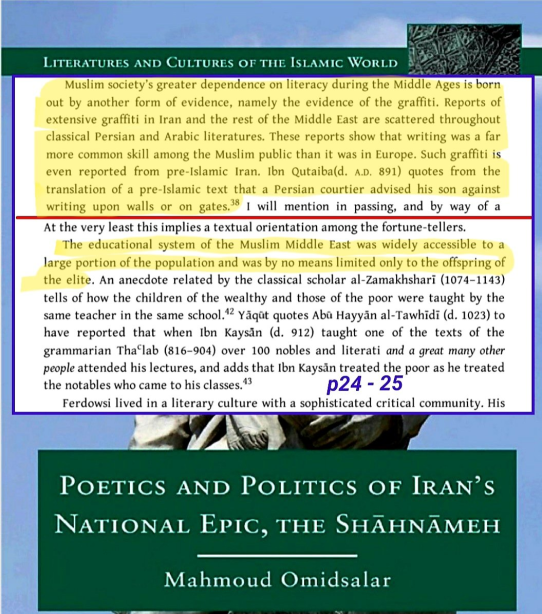
The scan is from Mahmoud Omidsalar’sPoetics and Politics of Iran’s National Epic, the Shahnameh, pages 24–25. The highlighted passage says that Muslim society’s dependence on literacy during the Middle Ages is supported by graffiti evidence. It states that reports of widespread graffiti in Iran and the Middle East are scattered throughout Persian and Arabic sources and show that writing was far more common among the general public than in Europe. It even mentions pre-Islamic Iran by way of contrast. The highlighted section then says that the educational system of the Muslim Middle East was widely accessible to a large portion of the population and was not limited only to elite children. It gives examples of wealthy and poor children being taught together by the same teacher.
11. Prosperity and Urban Development After the Conquest
The Arab Islamic conquest of Iran, along with Arab migrations to it, led to Iran’s prosperity and its agricultural and urban development, as well as the spread of security within it. The Arabs built mosques, irrigation channels, gardens, and palaces in Iran, spreading civilization there. Some neighborhoods and villages in Iran transformed from mere villages into large cities, such as Qom. The areas surrounding Samarkand and Bukhara flourished, and the region of Transoxiana and Khwarazm turned into an area full of cities, civilized, and with extensive irrigation works, after having been a region with only backward villages. The prosperity of these regions was also a reason for repelling the raids of the barbaric Turkish nomads on them.
[ A HISTORY OF ISLAMIC SOCIETIES , (2 ED) IRA M. LAPIDUS p39 ]
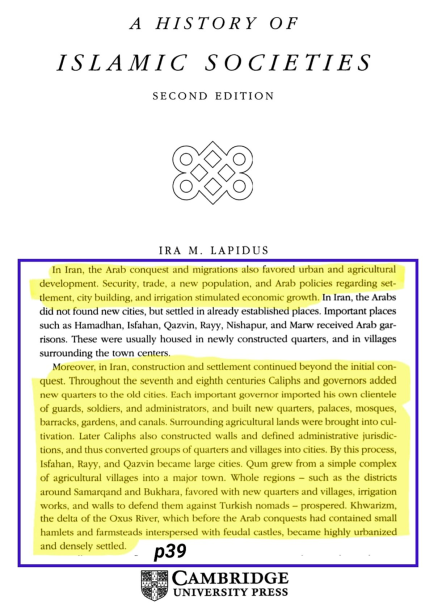
The scan is from Ira M. Lapidus’A History of Islamic Societies, second edition, page 39. The highlighted passage says that in Iran, Arab conquest and migration favored urban and agricultural development. It explains that security, trade, a new population, and Arab settlement policy encouraged economic growth. The scan also states that Arab settlers built mosques, gardens, and canals in Iran. It further explains that in Khurasan and beyond the Oxus, colonization continued after the first conquest; Arab governors imported their clienteles of guards, soldiers, and administrators, built palaces, mosques, barracks, gardens, and canals, and turned surrounding agricultural lands into cultivated areas. The highlighted section also says that Qum grew from a cluster of agricultural villages into a major town, and that Samarkand and Bukhara benefited from new quarters, villages, irrigation works, and walls against Turkish nomads.
12. Bukhara, Samarkand, and Khwarazm
The cities and regions of Bukhara, Samarkand, and Khwarazm were extremely backward during the Sassanian and Turkish eras. With the Islamic conquest and the rule of Muslim Arabs over these regions, these areas became great educational, cultural, and civilizational centers.
[ Richard N. Frye , THE HISTORY OF ANCIENT IRAN , INTRODUCTION ]
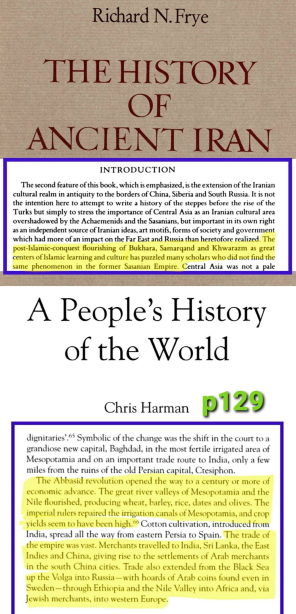
The upper scan is from Richard N. Frye’sThe History of Ancient Iran, introduction. The highlighted passage says that the second feature emphasized in the book is the extension of Iranian culture from antiquity to the borders of China, Siberia, and South Russia. It then says that the rise of the towns of Samarkand, Bukhara, and Khwarazm, and their fame as great centers of Islamic learning and culture, should not hide the fact that these areas once resembled “oases of backwardness.” The passage is highlighting the contrast between their later Islamic cultural greatness and their earlier condition.
13. Irrigation, Trade, and Economic Prosperity
Mesopotamia and the Nile Valley flourished after the Arab Islamic conquest, and irrigation channels were repaired in both, leading to abundant and high-priced crops.
Arab Islamic trade was so extensive that the Arabs had settlements in southern China, and their trade extended from Indonesia (the East Indies), Sri Lanka, and China to the Volga River, the Black Sea, the Nile, Ethiopia, and Africa.
The trade of the Jews of the Islamic Caliphate extended to Sweden and Western Europe.
[ A People’s History of the World , Chris Harman p129 ]
The lower scan is from Chris Harman’sA People’s History of the World, page 129. The highlighted passage says the Arab revolution opened the way to a century or more of economic advance. It states that Mesopotamia and the Nile flourished after the conquest, especially after the repair of irrigation canals, which produced high crop yields. The scan also says that urban trade expanded enormously. It mentions Arab settlements in southern China, trade reaching India, Sri Lanka, the East Indies, China, the Volga route, the Black Sea, the Nile, and Ethiopia. It also says that Jewish merchants from Arab lands traded as far as Western Europe.
Conclusion
The evidence presented here argues that many peoples under Sasanian rule suffered from class oppression, religious persecution, restricted literacy, harsh taxation, and social exclusion. After the Arab Islamic conquest, the article argues that these lands witnessed religious relief, broader literacy, urban construction, agricultural development, irrigation works, trade expansion, and the rise of major civilizational centers.
...vant|Condition of Peoples and Countries Under Roman and Persian Rule Before the Islamic Conquest]] [[[how-islam-liberated-persia-from-sasanian-oppression-and-built-a-civilization|Conditions of the Peoples of the Sasanian Empire Before and]]