Jñanaraja's Bhugola Argument
Introduction
As knowledge of Western scientific models of the Earth spread, the Puranic cosmological descriptions began to appear unreliable and illogical to many, leading some to question the credibility of the Puranas as authoritative Vedic texts. In an effort to preserve the perceived legitimacy of the Puranas, the scholar Jñānarāja argued that the term bhūgol—used in the Puranas—implies a spherical Earth, aligning it with the modern scientific understanding. This reinterpretation was likely intended to reconcile traditional scriptural language with contemporary cosmological models and defend the Puranas from charges of scientific inaccuracy.
__
Jñānarāja argues that the Purāņas contains three statements: bhūgola, sarvato meruh saumyadiśi and ādarśatalopamā or mukuratalanibhatvam. These statements, he argues, indicate the earth is a sphere. His antagonists, aware of these statements, cite ādarśatalopamā as evidence of the earth being flat. However, Jñānarāja argues they misinterpret the third statement.
Lets look deeply into his first argument bhūgola.
A comprehensive understanding of the Sanskrit word gola is necessary before one can properly analyze and critique Jñānarāja’s first argument.
__
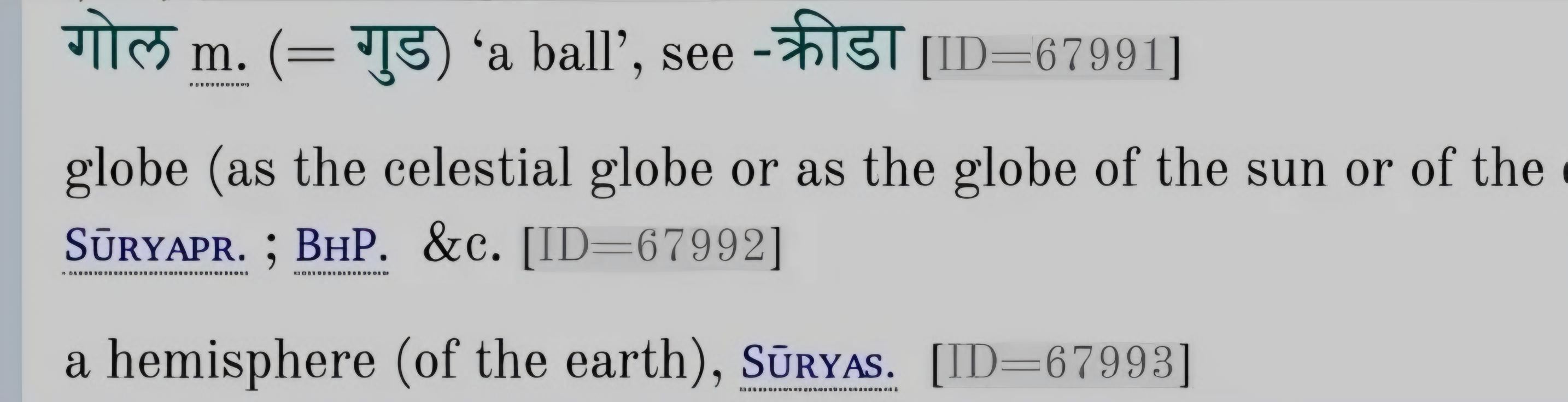
Monier-Williams’ A Sanskrit-English Dictionary from 1899 and Apte’s The Practical Sanskrit-English Dictionary from 1890 similarly both give “ball,globe” as the primary meaning of gola and golaka.

For the compound word bhūgola, Böhtlingk and Roth give the meaning “earth-ball,” and monier-williams gives “terrestrial globe”.

the scholarly dictionaries do not give any examples from Sanskrit literature of gola used in the sense of “circle,” but in SANSKRIT-SANSKRIT LEXICONS The Medinīkośa, which Vogel places between 1200 and 1275 CE,46 is the earliest lexicon to give mandala, “circle,” as a synonym of gola.

The word gola is a technical term in the Siddhāntic tradition. In the context of astronomy, the word gola and the equivalent word golaka mean either “sphere” or “hemisphere”.
In Vedāngajyotișa, the earliest Indian text on astronomy, does not mention gola or golaka. Gola is used as a conjunction of planets in the Yavanajātaka of Sphujidhvaja. The word golaka, meaning “hemisphere,” was first used by Pingree in the Paitāmahasiddhānta in the 5th century CE. Indian astronomers, including Brahmagupta, Varāhamihira, Lalla, Bhāskara I, and Bhāskara II, have consistently used gola and golaka to denote spheres or hemispheres.
__
The word bhūgola, appears five times in the Bhāgavatapurāna:-
-Bhagavatapurāna 3.23.43 (bhuvo golam)
-Bhāgavatapurāna 5.16.4 (bhūgolaka)
-Bhagavatapurāna 5.20.38 (bhūgolasya)
-Bhāgavatapurāna 5.25.12 (bhūgolam)
-Bhāgavatapurāna 10.8.37 (bhūgolam)
__

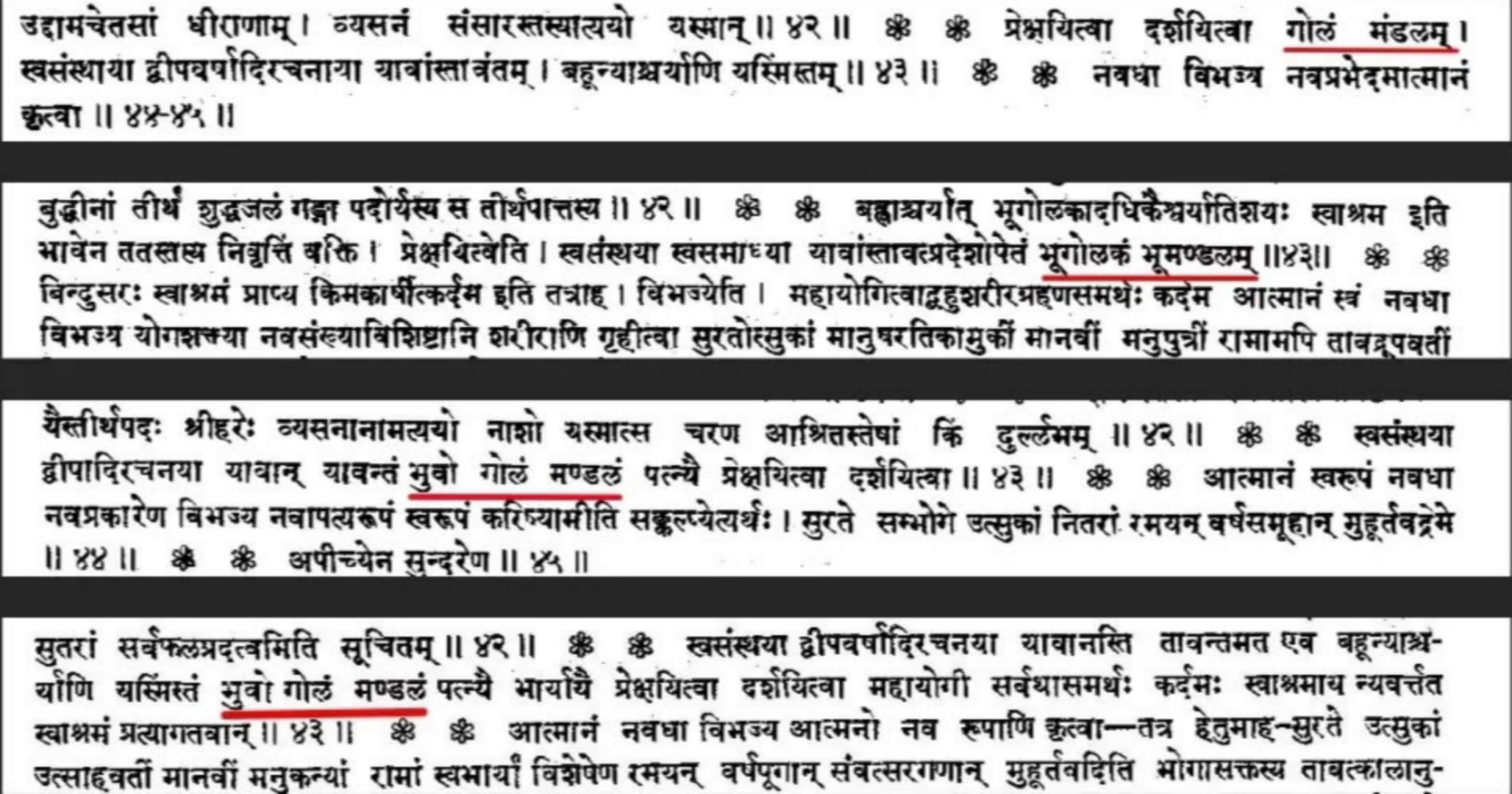
Translation:- After showing his wife the gola of the earth as far as [it extends] by its arrangement, which is abundant with wonders, the great sage returned to his hermitage.
Context:- Sage Kardama and wife Devahūti embark on an airborne voyage to Purāņic cosmography-known locations like Meru mountain and Mänasa lake.
__
The Bhagavatapurāna verse uses the word gola as evidence of the earth being a sphere, but commentators do not see it as warranting special discussion. Traditional commentators gloss gola as mandala, meaning “circle,” and the Šabdakalpadruma cites this verse as an example of this use. Śrīdharasvāmin, Vijayadhvaja Tirtha, Visvanātha Cakravartin, Sukadeva, and Giridhara all gloss gola as mandala, “circle”.

Classical commentaries in Sanskrit
__

O great king, no human being, not even one with a lifespan like that of the gods, can adequately understand by the mind or [express] by speech, the extent of the Lord’s mighty manifestation through māyā and the guņas. Therefore, we will mainly describe the characteristics of the bhūgolaka from its names, form, extent, and qualities.
Context:- King Parīkşit inquired about the earth’s details to sage Śuka, who responded with detailed information.
__
The Bhagavatapurāņa uses the term bhūmandala “earth-circle” in King Parīkşit’s request for knowledge see 5.16.1, and śuka uses “kuvalaya” twice see 5.16.5-7, meaning ku = “earth” and valaya = “bracelet,” making kuvalaya synonymous with bhūmandala. The commentators do not engage with the term bhūgolaka, as it is clearly used as a synonym of bhūmandala in the text.

Translation:- So far [that is, up to the Lokāloka mountains), the arrangement of the world with respect to its dimensions, characteristics, and manifistations has been considered by the sages. The Lokāloka mountain range [has a measurement of] a quarter of the bhūgola, which is calculated to be five hundred million yojanas.
The Böhtlingk and Roth’s Sanskrit-Wörterbuch suggests bhūgola means “ball” in this passage, but commentaries mostly remain silent. Viśvanātha Cakravartin, who completed his commentary on the Bhāgavatapurāņa in 1705, provides an explanation:

Translation:- “It” (sah) means the Lokāloka [mountains] and “of the bhūgolaka” means “of the hemisphere (gola) of the [universal] egg joined to the earth (bhū).”
Meaning: Like the sun, the earth (bhū) is also [located] between the two hemispheres (golaka) of the [universal] egg. For that reason, the bhūgola, like the khagola, measures five hundred million yojanas. [The Lokāloka mountain range] has a distance and height of one hundred twenty-five million yojanas, which is a quarter of that.
__
Viśvanātha Cakravartin’s interpretation of bhūgola refers to the Puranic conception of the universal egg (brahmanda). He identifies two golakas in his cosmography: bhugola, the lower half of the egg, and khagola, the upper half. Cakravartin argues that bhūgola does not mean the earth is a sphere or hemisphere, but rather exists within a sphere. In simple words Viśvanātha Cakravartin’s interpretation states that bhugola refers to the earth within a sphere, not the earth itself, as gola and golaka have a hemisphere sense. A spherical shape is not attributed to the earth.
__
Bhagavatapurāna 5.25.12:-
The commentators do not engage in a discussion on the word bhūgola, but Vīrarāghava and Jīva Gosvāmin use bhūmandala instead, suggesting that bhūgola is not used differently.
Bhagavatapurāņa 10.8.37:-
This verse in the Bhagavatapurāņa is the most popular episode, It describes Krsna’s childhood, where friends inform his mother Yaśodā that he has eaten dirt, and when she looks into Krsna’s mouth, she sees the entire universe.
The traditional commentators, including Śridharasvāmin, Vīrarāghava, Giridhara Lāla, and Bhagavatprasādācārya, gloss bhūgola as bhūrloka, meaning “earthly world,” and Vijayadhvaja and Satyadharma as bhūmandala.
__
***conclusion:- ***
The earliest attestations of the word gola in the sense of "sphere" come from the Indian astronomical tradition, as seen in the Bhagavatapurāņa. However, it is unclear whether the word means "sphere" in the Bhāgavatapurāņa or the Siddhāntic tradition. The Bhāgavatapurāņa uses the word "gola" to mean "round" in a general sense, serving as a synonym for "mandala," meaning circular, round, or circle. The Purāņas authors likely used the word "round" in a vague sense, as conveyed by the English word "round." In Sanskrit literature, it is common to avoid repetition of words in verses When a repetition of a word occurs in the same verse, the fault is referred to as kathitapada, so the authors of the Purāņas would need synonyms for the word mandala.