Malaria and Chloroquine
Malaria and Chloroquine
🪫 “Malaria and Chloroquine”
Evolutionists consider the resistance of parasites and bacteria to drugs as one of the strongest evidence of evolution;
But in fact, when you look into the matter, you find that the pathogen did not build new protein folds from scratch,
but rather simple modifications that changed its morphological or chemical characteristics,
without building three-dimensional protein folds.
Rather, it becomes clear that what happened has nothing to do with evolution, neither closely nor remotely.
The organism becomes disabled, and is not as efficient as the original strain.
🧪 ★ Malaria resistance to chloroquine:
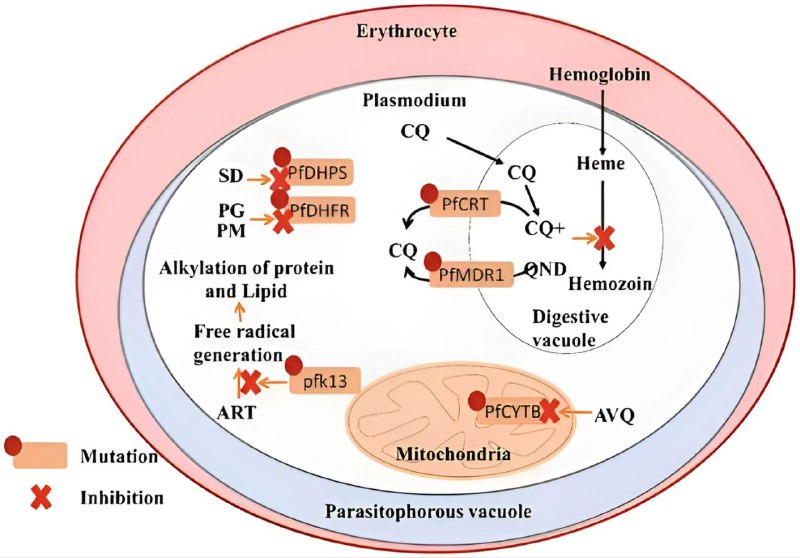
The wall of the digestive vesicle of the malaria parasite contains a protein that acts as a gate or pump called PfCRT .
When this parasite was exposed to mutations, it was able to grab the chloroquine drug and expel it from the digestive vesicle.
So they said, “That’s conclusive evidence of evolution.”
But in reality, what happened were just simple modifications to the PfCRT protein,
and did not build a new protein fold.
Rather, what happened was a relapse for the malaria parasite,
as the organism became disabled and could not withstand the original strain that did not have mutations in the transport protein (PfCRT ).
Even its rate of division became slow.
https://www.cell.com/trends/parasitology/abstract/S1471-4922(08)00158-X
📎 https://pubmed.ncbi.nlm.nih.gov/15827277/
🪫 Rather, when the drug that kills the original strain is stopped,
the original strain returns,
and the mutant (degenerated) malaria parasite that acquired the mutations disappears,
and it did not persist as the evolutionary myth predicts.
📎 https://www.ncbi.nlm.nih.gov/pmc/articles/PMC3380613/
{Embed}
https://pubmed.ncbi.nlm.nih.gov/15827277/
Decreased prevalence of the Plasmodium falciparum chloroquine resis…
The use of chloroquine treatment for Plasmodium falciparum malaria was abandoned in China in 1979 because of widespread drug resistance. Subsequent studies found decreases in the prevalence of chloroquine-resistant strains. To evaluate these decreases and assess the current status of chloroquine sen …

{Embed}
https://www.ncbi.nlm.nih.gov/pmc/articles/PMC3380613/
Return of Chloroquine-Susceptible Falciparum Malaria in Malawi Was …
The spread of drug-resistant Plasmodium falciparum malaria has been a major impediment to malaria control and threatens prospects for elimination. We recently demonstrated the return of chloroquine-susceptible malaria in Malawi after chloroquine use …

🪫 Rather, when the drug that kills the original strain is stopped,
the original strain returns,
and the mutant (degenerated) malaria parasite that acquired the mutations disappears,
and it did not persist as the evolutionary myth predicts.
📎 https://www.ncbi.nlm.nih.gov/pmc/articles/PMC3380613/
Therefore, one of the ways to treat the original parasite is to stop the antibiotic —
thus, the original strain returns and the disabled (drug-resistant) strain disappears.
🔍 ★ The mutations that occurred in malaria challenged one of the most important foundations of evolution:
- The possibility of producing changes in a single step.
Because the mutation that occurred in the vesicle transport protein (PfCRT ) is a harmful mutation,
and for the parasite to coexist with it, another mutation must occur that somewhat compensates for its harmful effect.
Although this mutation is less efficient than the original strain that did not have mutations in the vesicle transport protein,
it can coexist with it.
In other words, two mutations must occur “simultaneously ” for the parasite to be able to persist:
-
A harmful mutation
-
And a mutation that somewhat compensates for the damage.
📎 https://www.ncbi.nlm.nih.gov/pmc/articles/PMC4035986/
❓ Ok, is it possible for evolution to make leaps and lead to a series of mutations?
{Embed}
https://www.ncbi.nlm.nih.gov/pmc/articles/PMC3380613/
Return of Chloroquine-Susceptible Falciparum Malaria in Malawi Was …
The spread of drug-resistant Plasmodium falciparum malaria has been a major impediment to malaria control and threatens prospects for elimination. We recently demonstrated the return of chloroquine-susceptible malaria in Malawi after chloroquine use …
{Embed}
https://www.ncbi.nlm.nih.gov/pmc/articles/PMC4035986/
Diverse mutational pathways converge on saturable chloroquine trans…
This study provides detailed insights into the workings of a protein that is a key determinant of drug resistance in the malaria parasite. We found that two main lineages of mutational routes lead to chloroquine transport via the chloroquine …
Now pay close attention because we are going to talk about the calculations:
By roughly calculating the huge numbers of parasites exposed to chloroquine over 50 years
(the number of patients multiplied by the average number of parasites in the body),
we can calculate the rate of occurrence of this simultaneous mutation to be, at best, one in 10^20 ,
and the parasite needed the equivalent of hundreds of millions of years of human generations to do so.
To clarify more:
to reach two mutations that led to chloroquine resistance,
it required a very small mutation rate of 1 in 10^20 ,
and these are very fast-dividing organisms.
Resistance to chloroquine in P. falciparum has arisen spontaneously less than ten times in the past fifty years.
This suggests that the per-parasite probability of developing resistance de novo is on the order of 1 in 10^20 parasite multiplications.
🪫 Translation:
“Chloroquine resistance in Plasmodium falciparum has arisen spontaneously less than 10 times over the past 50 years. This suggests that the probability of developing new resistance per parasite is about 1 in 10^20 parasite multiplications.”
📎 https://www.ncbi.nlm.nih.gov/pmc/articles/PMC385418/
{Embed}
https://www.ncbi.nlm.nih.gov/pmc/articles/PMC385418/
Antimalarial drug resistance
Malaria, the most prevalent and most pernicious parasitic disease of humans, is estimated to kill between one and two million people, mainly children, each year. Resistance has emerged to all classes of antimalarial drugs except the artemisinins and …
🧬 If we take this rate and apply it to large, multicellular, very slow-reproducing, and fewer organisms like humans or mammals,
to fix just two mutations (remember, these are destructive and lead to deterioration),
it would take billions , if not trillions , of years of generations.
And don’t forget that we’re talking about just two mutations —
even two mutations that make the organism less efficient than the original strain.
Of course, evolutionists cling to any strange mutation to claim it’s evidence of evolution,
and every time it’s deterioration, as we explained in the car example earlier.