Mary's Age at Marriage to Joseph — Christian, Jewish, and Apocryphal Sources Confirm Twelve Years Old
Christians believe that the Virgin Mary was married when she was twelve years old to Joseph the Carpenter, who was approximately ninety-five years of age — and this is not an Islamic claim but the documented position of Christian scholars, Christian ecclesiastical books, the Catholic Encyclopedia, and multiple apocryphal gospels accepted as authoritative within various Christian traditions. The material compiled here draws entirely from Christian and Jewish primary sources, and serves as a response to those who, seeking to attack the Prophet’s marriage to Lady Aisha, deny facts that their own religious literature openly affirms.
The Meaning of Nikah in Christian Sources
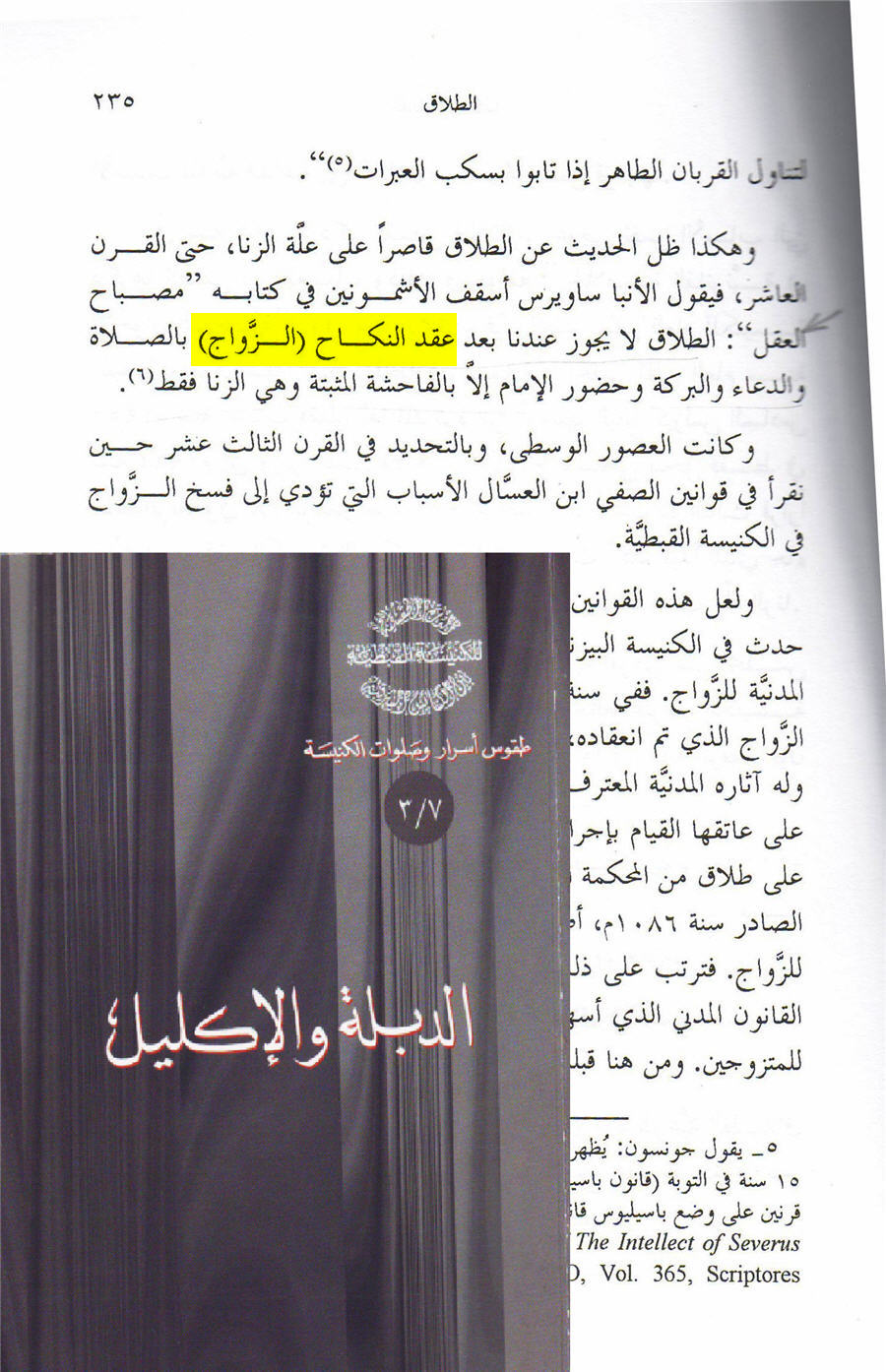
This meaning is further attested by Christian ecclesiastical sources. The monk Athanasius, in the series “The Ritual Pearl of the Coptic Church among the Eastern Churches,” quotes Anba Sawiris ibn al-Muqaffa, Bishop of Ashmunein, on this precise usage. The following image shows the relevant passage from that work (footnote 2: The Book of the Ring and the Crown, by Monk Athanasius of the Coptic Church, page 235, Deposit No. 10792/2004):
Five Christian Witnesses to Mary’s Marriage at Twelve
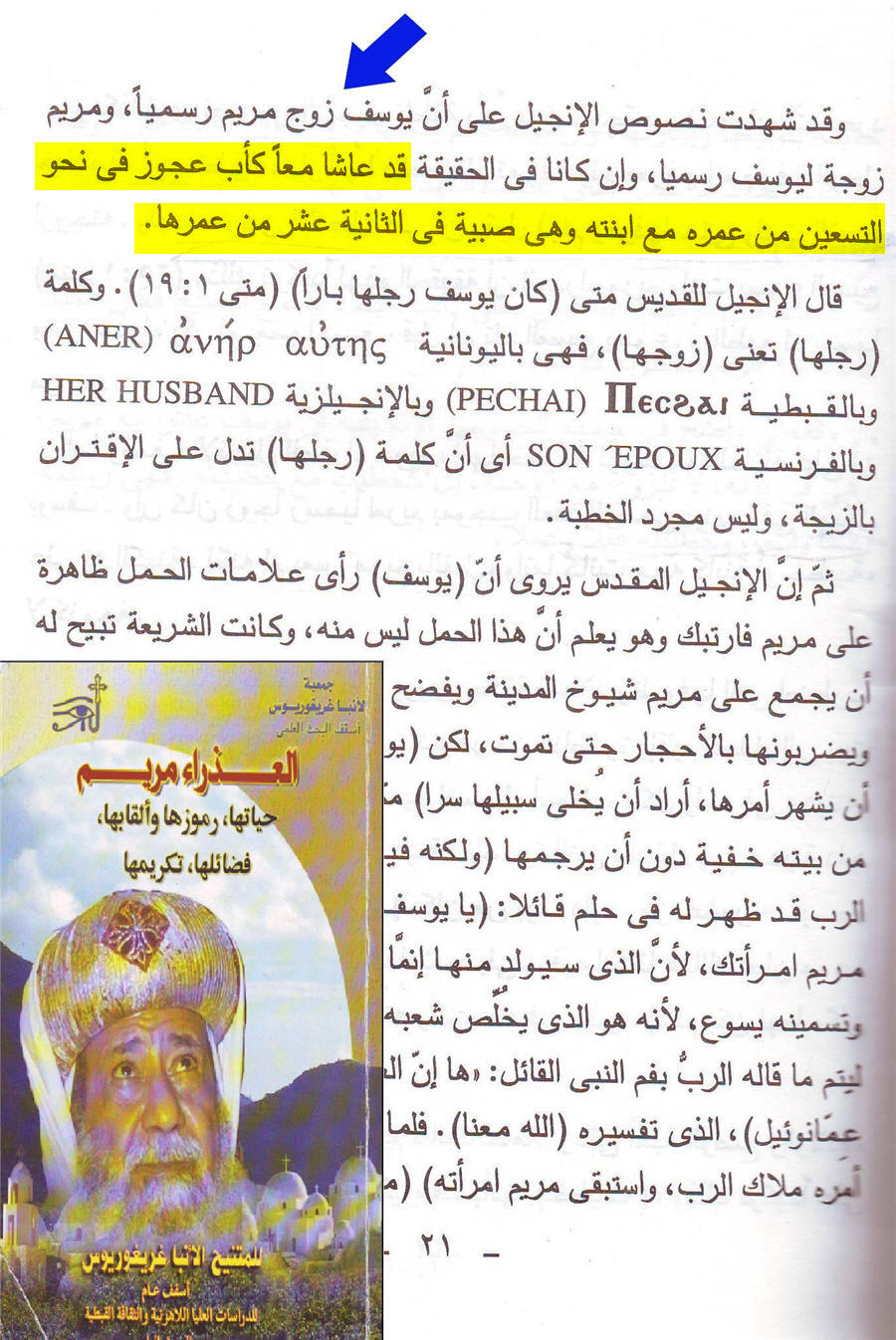
First Witness — Anba Gregorius, Bishop General of Higher Theological Studies
Among the most senior figures of the Egyptian Coptic Church, Anba Gregorius — Bishop General of Higher Theological Studies, Coptic Culture and Scientific Research — explicitly confirms that the Virgin Mary married Joseph at the age of twelve, and that Joseph was a very old man of about ninety years of age. The following image shows his words from The Book of the Virgin Mary: Her Life, Symbols, Titles, Virtues, and Honor, page 21, Deposit No. 14357/2005 (footnote 3):
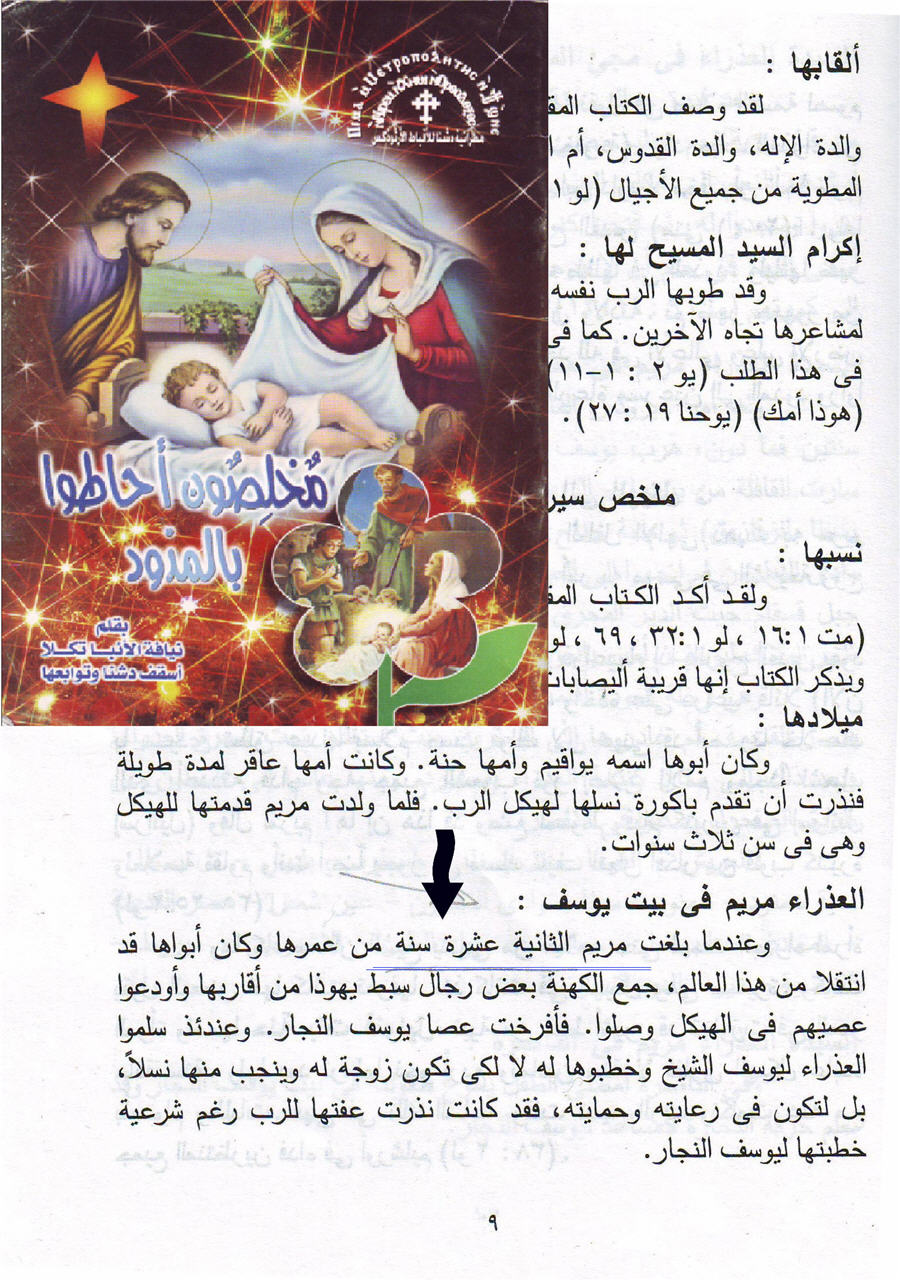
Second Witness — Anba Takla, Bishop of Dishna
Among those who confirmed this is Anba Takla, Bishop of Dishna and its dependencies. He states that this was an official marriage — not merely an engagement — and that one door was closed on them and they lived together under one roof. The following image shows his statement from The Faithful Surrounded the Manger, page 9, Deposit No. 1920/2000 (footnote 4):
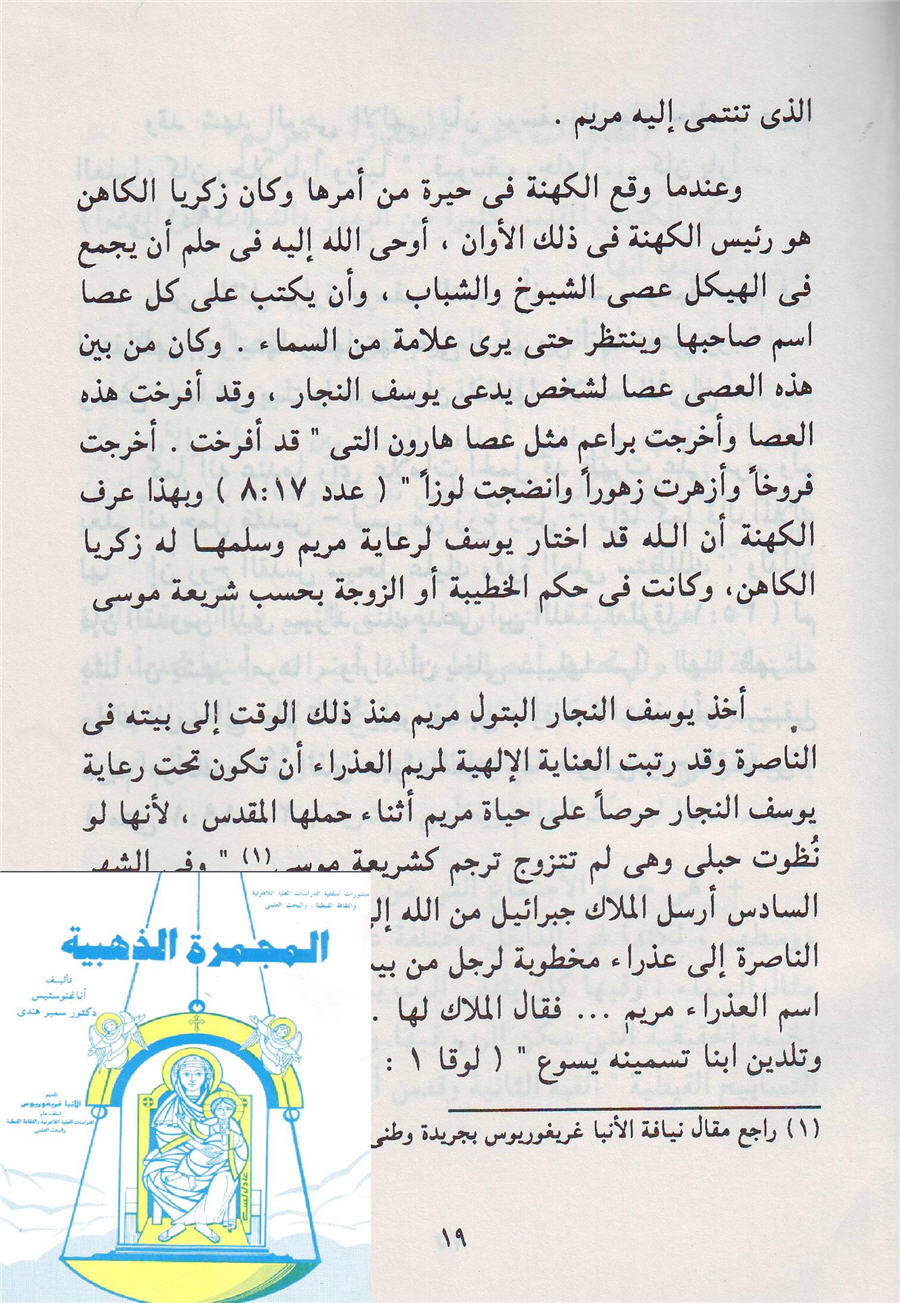
Third Witness — Dr. Samir Hindi, Presented by Anba Gregorius
Dr. Samir Hindi likewise confirmed this in a book presented by Anba Gregorius himself. He writes: “Mary remained in the temple until she reached the age of twelve years. They wanted to entrust her care to one of the elders of Judah, which is the tribe to which Mary belongs.” The following image shows the relevant passage from The Golden Brazier by Dr. Samir Hindi, page 19, Deposit No. 8644/1991 (footnote 5):
Fourth Witness — Deacon Nabil Emil Moawad
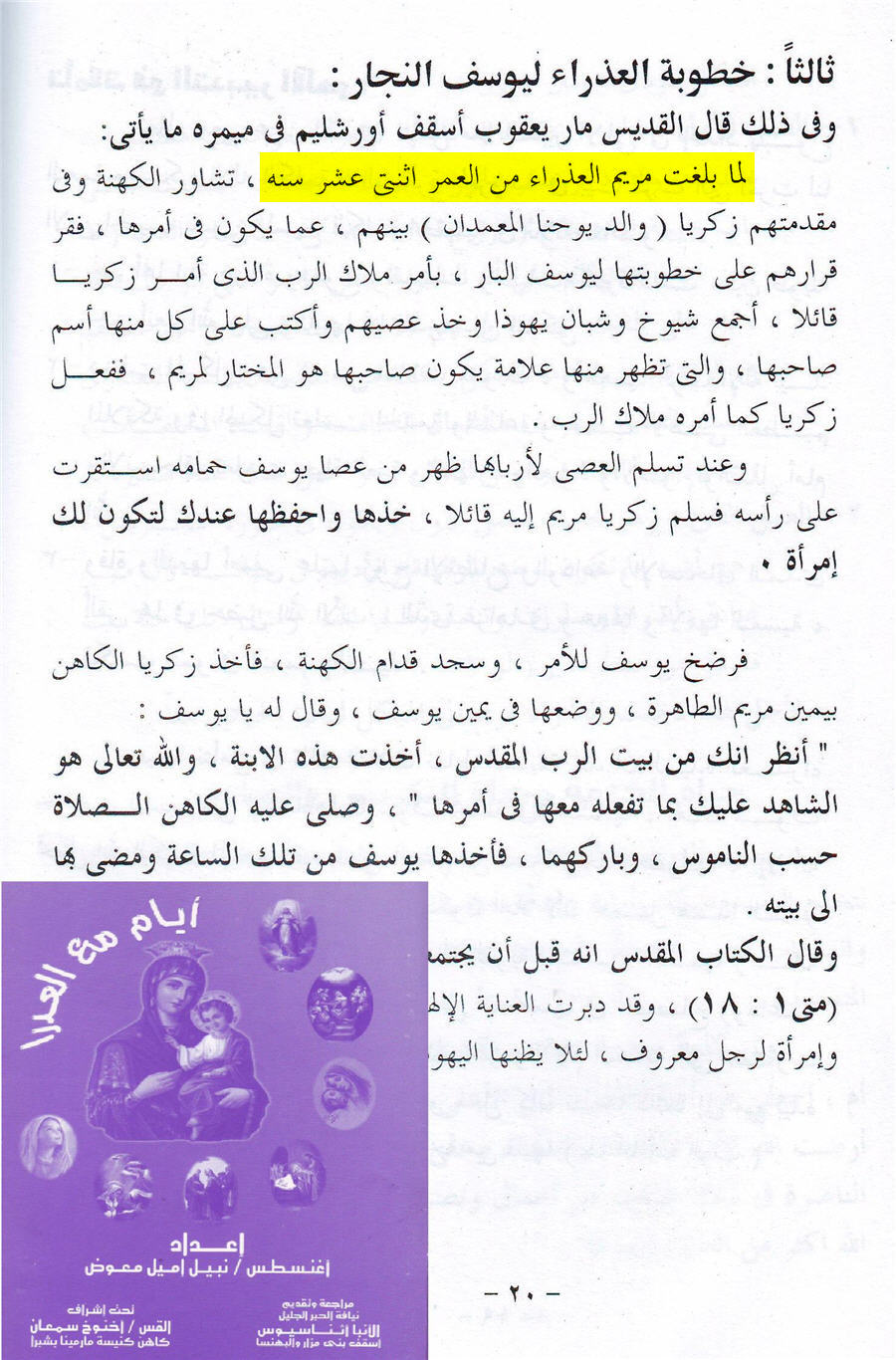
The deacon Nabil Emil Moawad, in a book presented by Bishop Athanasius, Bishop of Beni Mazar and Behnesa, and under the supervision of Father Akhnoukh Semaan, priest of the Church of Mar Mina in Shubra, confirms the marriage of the Virgin to Joseph at the same age. The following image shows the relevant passage from Days with the Virgin, page 20, Deposit No. 7227/2006 (footnote 6):
Fifth Witness — The Biblical Encyclopedia
The editors of the Biblical Encyclopedia likewise confirmed this. The following image shows the relevant entry from the Biblical Encyclopedia, Letter (M), the word “Mary, the Mother of Jesus,” Part Seven, page 125, Deposit No. 16756/1999 (footnote 7):
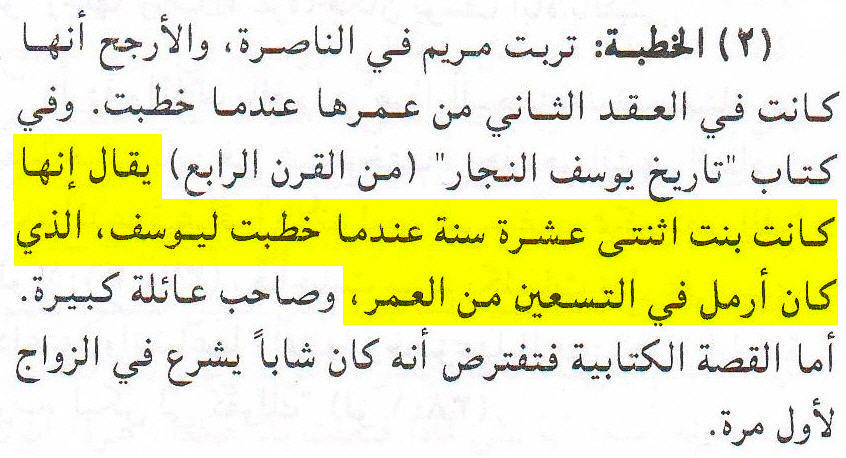
There are many further references confirming this belief — the marriage of a virgin at the age of twelve to a man over ninety-five years old. When some respond to this with denial, they do so not because the evidence is in doubt, but because they wish to attack the Prophet, may God bless him and grant him peace, in his marriage to Lady Aisha, may God be pleased with her. They deny the facts of their own tradition to spread a slander against Islam, while their own religious books openly contradict them.
From everything documented above from Coptic ecclesiastical sources alone, the following points are established:
- Mary married Joseph and lived with him in one house and under one roof, though he did not consummate the marriage with her.
- Mary married young, at the age of twelve, and her husband was approximately ninety-five years old.
- Claims — such as those of Father Abdul-Masih — that Mary married at the age of eighteen are refuted by the testimony of the church’s own scholars and books.
The Catholic Encyclopedia on Mary’s Age
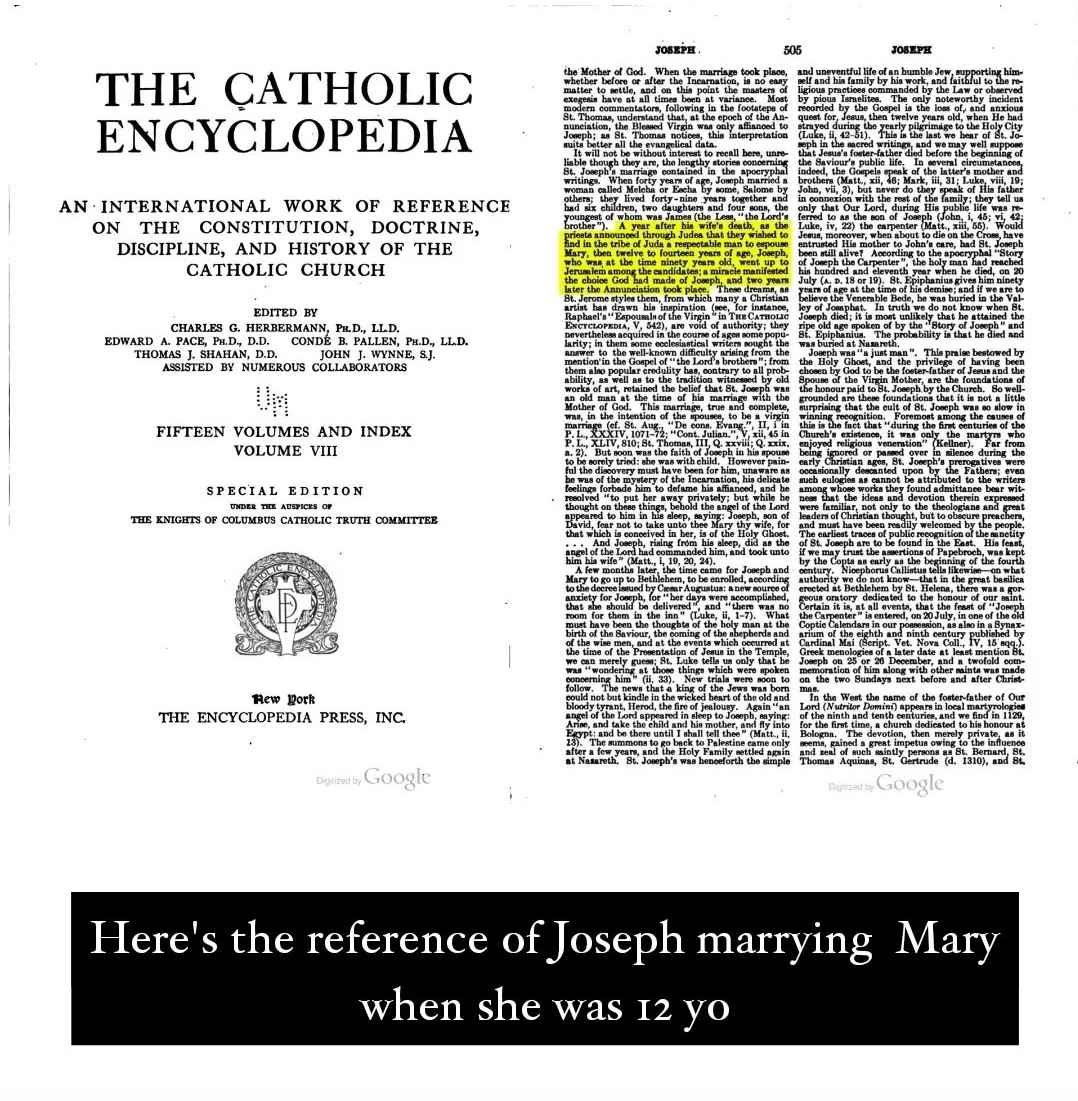
The following image shows a summary research excerpt from Christian sources on Mary’s age at marriage:
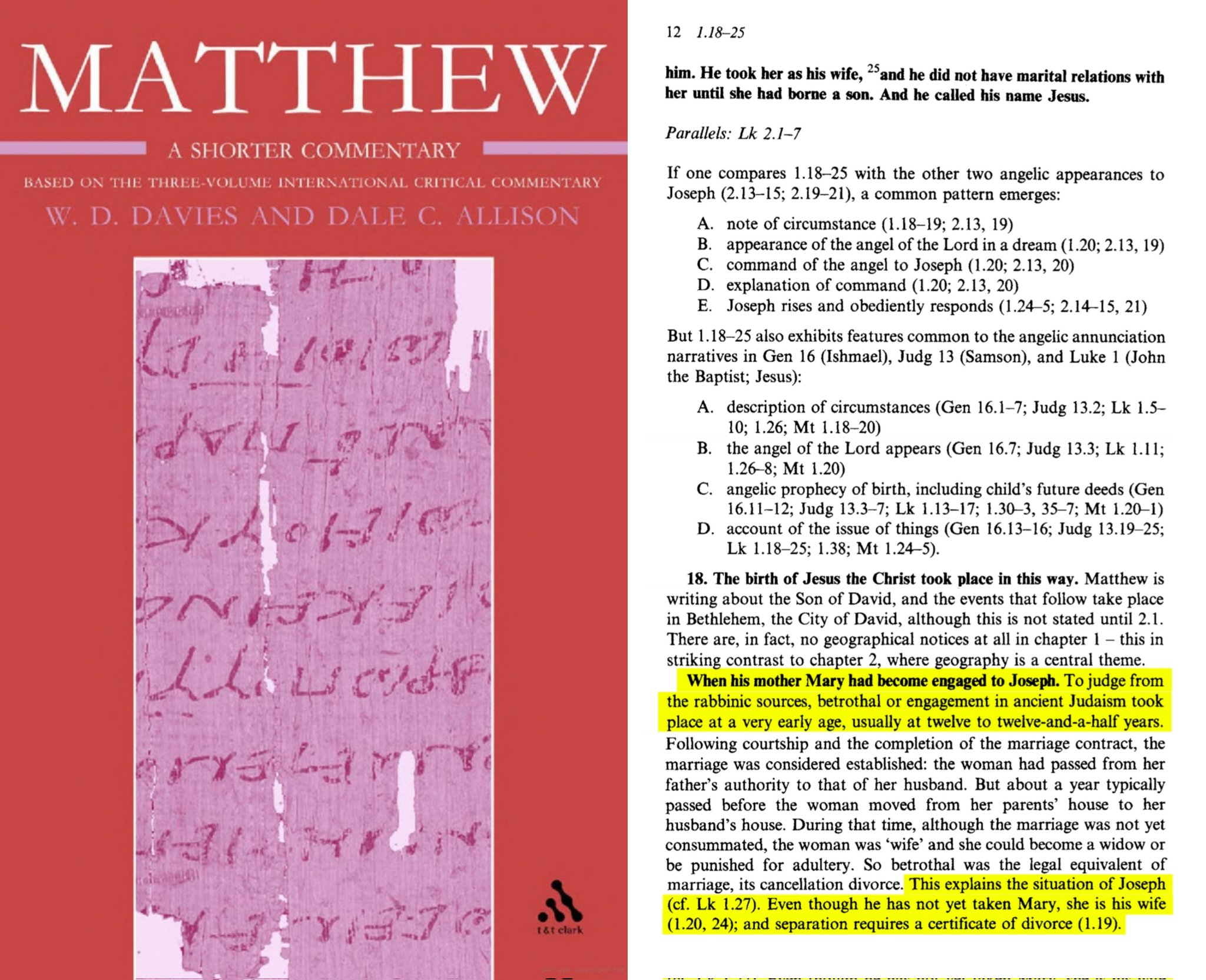
A further image provides a simple search from Christian sources on Mary’s age at marriage to Joseph, along with clarifications about Jewish engagement and marriage laws:
It is important to note that the legal books of Christianity did not explicitly record Mary’s age when Joseph the Carpenter married her. The information derives from apocryphal writings, from which Christian scholars extracted this detail. But the Catholic Encyclopedia — hardly a fringe source — explicitly addresses this:
Jewish maidens were considered marriageable at the age of twelve years and six months, with the engagement precedent and the bride not being able to live with her groom for a full year after the engagement, though the actual age of the bride varied with circumstances. The marriage was preceded by the betrothal, after which the bride legally belonged to the bridegroom, though she did not live with him till about a year later, when the marriage used to be celebrated.
Jewish Law on the Age of Marriage and Betrothal
Yet the Talmud itself, in the same context (Sanhedrin 76b), contains commentary that reveals a more complex picture. The footnote in that passage makes explicit: “This proves that it is meritorious to marry off one’s children whilst minors.” The Jewish Encyclopedia further acknowledges the legal framework for minors’ marriages:
The Apocryphal Gospels on Mary’s Age
The Gospel Attributed to Matthew (Pseudo-Matthew)
The apocryphal Gospel attributed to Matthew states that when Mary reached the age of twelve (or fourteen in some manuscripts), the priests decided she should leave the temple and marry. The lot fell to the tribe of Judah, and the unmarried men of that tribe gave their staffs to the priest, who placed them in the Holy of Holies. The next day he returned each person’s staff. When Joseph’s staff was returned to him, a dove appeared — the sign chosen by God — and Joseph was selected.
Among the words Joseph spoke in response to the priests’ blessing upon him was this refusal:
Now it came to pass, when she was fourteen (or, twelve) years old, and on this account there was occasion for the Pharisees’ saying that it was now a custom that no woman of that age should abide in the temple of God, they fell upon the plan of sending a herald through all the tribes of Israel, that on the third day all should come together into the temple of the Lord. And when all the people had come together, Abiathar the high priest rose, and mounted on a higher step, that he might be seen and heard by all the people. And when great silence had been obtained, he said: Hear me, O sons of Israel, and receive my words into your ears. Ever since this temple was built by Solomon, there have been in it virgins, the daughters of kings and the daughters of prophets, and of high priests and priests. And they were great, and worthy of admiration. But when they came to the proper age they were given in marriage, and followed the course of their mothers before them, and were pleasing to God. But a new order of life has been found out by Mary alone, who promises that she will remain a virgin to God. Wherefore it seems to me, that through our inquiry and the answer of God we should try to ascertain to whose keeping she ought to be trusted.
Then these words found favor with all the synagogue. And the lot was cast by the priests upon the twelve tribes, and the lot fell upon the tribe of Judah. And the priest said: To-morrow let every one who has no wife come, and bring his rod in his hand. Whence it happened that Joseph brought his rod along with the young men. And the rods having been handed over to the high priest, he offered a sacrifice to the Lord God, and inquired of the Lord. And the Lord said to him, Put all their rods into the holy of holies of God, and let them remain there, and command them to come to thee on the morrow to get back their rods; and the man from the point of whose rod a dove shall come forth, and fly towards heaven, and in whose hand the rod, when given back, shall exhibit this sign, to him let Mary be delivered to be kept.
Joseph began bashfully to address them, saying: I am an old man, and have children; why do you hand over to me this infant, who is younger than my grandsons?!
(Source: ccel.org/ccel/schaff/anf08, pages 371–372)
The Protevangelium of James (Apocryphal Gospel of James)
The Protevangelium of James describes a council of priests convened to discuss what to do with Mary when she was twelve or fourteen years old — in a Latin version, ten years old — since her remaining in the temple at that age would defile it. The high priest prayed for divine guidance, and the angel of the Lord directed him to gather the widowers of the people, that the Lord would show a sign indicating which man Mary was to be given to.
But Joseph refused, saying: I have children, and I am an old man, and she is a young girl. I am afraid lest I become a laughing-stock to the sons of Israel.
(Source: ccel.org/ccel/schaff/anf08.vii.iv.html)
The Gospel of the Nativity of Mary
The Gospel of the Nativity of Mary likewise states that when the virgins in the temple — including Mary, who was fourteen years old — reached marriageable age, the high priest publicly announced that they should return home and marry:
(Source: ccel.org/ccel/schaff/anf08.vii.vi.vii.html)
The History of Joseph the Carpenter
The History of Joseph the Carpenter states that the priests sent Mary to live in the house of Joseph the Carpenter at the age of twelve, where she stayed for two years. In the third year of her stay — when she was fifteen years old — she gave birth to Christ. This text therefore places her marriage at approximately fourteen years of age. The text reads:
It came to pass thereafter, when he returned to his own house in the city of Nazareth, that he was seized by disease, and had to keep his bed. And it was at this time that he died, according to the destiny of all mankind. Because this disease was very heavy upon him, and he had never been ill, as he now was, from the day of his birth. And thus assuredly it pleased Christ to order the destiny of righteous Joseph. He lived forty years unmarried; thereafter his wife remained under his care for forty-nine years, and then died. And a year after her death, my mother, the blessed Mary, was entrusted to him by the priests, that he should keep her until the time of her marriage. She spent two years in his house; and in the third year of her stay with Joseph, in the fifteenth year of her age, she brought me forth on earth by a mystery which no creature can penetrate or understand, except myself, and my Father and the Holy Spirit, constituting one essence with myself.
(Source: ccel.org/ccel/schaff/anf08.vii.vii.html)
The Coptic and Ethiopian Synaxaria
The Coptic Synaxarium
The Coptic Synaxarium (st-takla.org), recording the commemoration of the entry of the Virgin Mary into the temple, states that her mother Hannah raised her for three years and then brought her to the temple, where she stayed for twelve years. At that point the priests consulted about whom to entrust her to, since it was no longer permissible for them to keep her in the temple after that age. They gathered twelve pious men from the tribe of Judah, took their staffs into the temple, and a dove landed on Joseph the Carpenter’s staff, indicating the divine choice. According to this calculation, the engagement therefore took place when she was fifteen years of age.
The Ethiopian Synaxarium
The Ethiopian Synaxarium (stmichaeleoc.org/Synaxarium/Tir_21.htm) provides a precise accounting of Mary’s lifespan:
This arithmetic is decisive: 12 years in the temple + 33 years with Joseph + 15 years with John the Evangelist = 60 years total. This means that Mary entered Joseph’s house at the age of twelve, confirming the marriage at that age.
Betrothal and Marriage in Jewish Law
The Jewish Encyclopedia provides a detailed account of betrothal (erusin or kiddushin) in Jewish law, which is essential for understanding the Gospel accounts of Mary and Joseph. The key points are as follows.
Several Biblical passages refer to the negotiations requisite for the arranging of a marriage (Gen. xxiv.; Song of Songs viii. 8; Judges xiv. 2-7), which were conducted by members of the two families involved, or their deputies, and usually required the consent of the prospective bride (if of age); but when the agreement had been entered into, it was definite and binding upon both groom and bride, who were considered as man and wife in all legal and religious aspects, except that of actual cohabitation.
The root (“to betroth”), from which the Talmudic abstract (“betrothal”) is derived, must be taken in this sense; i.e., to contract an actual though incomplete marriage. In two of the passages in which it occurs the betrothed woman is directly designated as “wife” (II Sam. iii. 14, “my wife whom I have betrothed” (“erasti”), and Deut. xxii. 24, where the betrothed is designated as “the wife of his neighbor”). In strict accordance with this sense the rabbinical law declares that the betrothal is equivalent to an actual marriage and only to be dissolved by a formal divorce.
This is confirmed by the following biblical passages:
This framework confirms that in Luke’s Gospel, where Mary is described as Joseph’s “betrothed wife” while she is already in the sixth month of pregnancy, she was legally bound to Joseph — yet had not yet completed the home-taking ceremony. The Jewish Encyclopedia further clarifies the legal interval between betrothal and marriage:
This creates a significant difficulty for the Gospel narrative. The text of Luke explicitly states:
Mary was in the sixth month of pregnancy and had not yet been formally married. According to Jewish law as described above, a betrothed woman should not have been living with her husband before the marriage was completed by the home-taking ceremony — and a pregnancy in the sixth month could not have been concealed from anyone. The Gospel texts in all four major Arabic translations confirm this state of affairs:
The Catholic Encyclopedia itself, while affirming Jewish betrothal law, acknowledges that Mary’s pregnancy during betrothal was not considered unusual because “as among the Jews, betrothal was a real marriage.” Yet it simultaneously states that Mary was betrothed — not yet married by home-taking — when the pregnancy became known. The narrative lacks internal consistency on this point.
The Quranic Narrative Compared
The Quranic account of Mary’s astonishment at the annunciation is notably more coherent and precise than its Gospel equivalents. In the Gospel of Luke, Mary is described as a betrothed virgin who asks, upon being told she will conceive a son: “How can this be, since I am a virgin and do not know a man?” — yet the question is ambiguous, since even a virgin may expect to know a man after marriage. The text lacks the clarity that the situation demands.
The Quran resolves this precisely:
In the Quranic account, God gives the good news of a son named Jesus — and critically, no father is mentioned. Mary’s astonishment is therefore fully justified: she understood from the very announcement that her child would have no father, and this is why she replied in the way she did. The Christian writers of the Gospel accounts overlooked this logical precision, leaving Mary’s astonishment unexplained beyond the superficial fact of her virginity at the time of the announcement — a virginity she would not have maintained indefinitely in any case, being a betrothed woman.
First, the Virgin Mary was twelve years old (or between twelve and fourteen, depending on the source) when she was married to Joseph the Carpenter. Second, Joseph was approximately ninety to ninety-five years of age at the time. Third, the marriage was legal and formal according to Jewish law, constituting a binding covenant even before the home-taking ceremony. Fourth, these facts are drawn entirely from Christian and Jewish primary sources — not from Islamic tradition — and are confirmed by the church’s own scholars, bishops, and encyclopedias. Fifth, those who deny these facts while simultaneously attacking the Prophet’s marriage to Lady Aisha do so in direct contradiction of their own tradition’s documented record.
Child Marriage in Christianity
Aisha & Marriage Age: Historical Evidence, Scholarly Sources & Refutation
.... Age of Mary when She Got Pregnant [[Age of Mary When She Married Joseph]] Bethsheba when She Gave...