The Authenticity of Hadith: Orientalists Admit the Superiority of Islamic Isnad Science
The Authenticity of the Sunnah — From the Mouths of Orientalists Themselves
Table of Contents
- Introduction
- The Islamic Science of Hadith — What Makes It Unique
- Scholar 1 — Bernard Lewis Jewish Historian
- Scholar 2 — David Samuel Margoliouth
- Scholar 3 — Reginald Bosworth Smith
- Scholar 4 — Asad Rustum — The Christian Academic Lion
- Scholar 5 — Maroun Abboud
- Scholar 6 — John Davenport
- Scholar 7 — Carl Brockelmann
- Scholar 8 — George Zidan
- Scholar 9 — Jacques Risler
- Scholar 10 — A J Arberry
- Scholar 11 — A Kevin Reinhart
- Scholar 12 — Aloys Sprenger
- Scholar 13 — John Burton
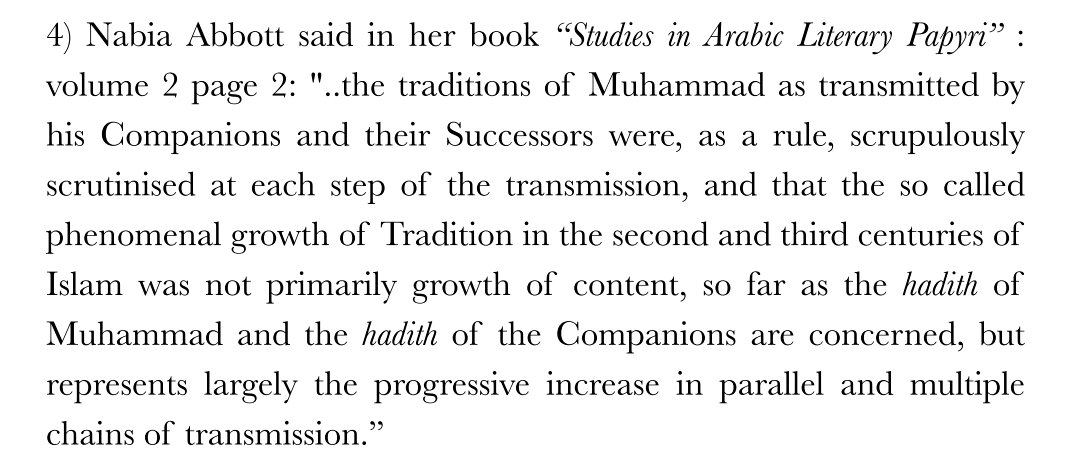
- Scholar 14 — Nabia Abbott
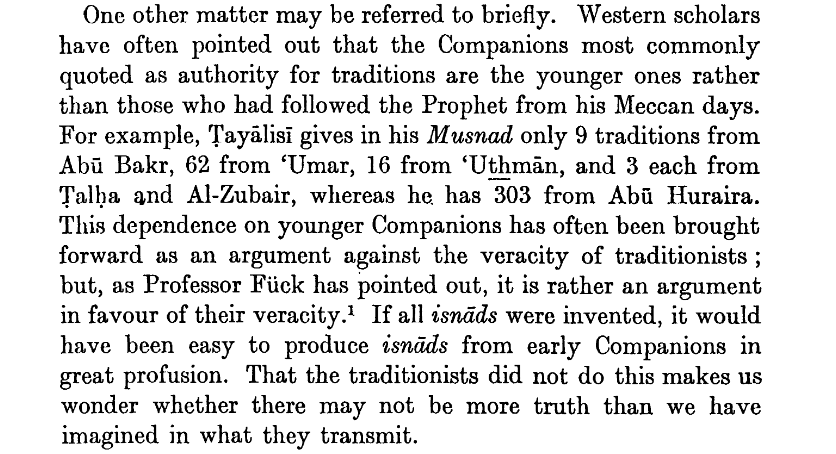
- Scholar 15 — Johann Fück
- Scholar 16 — Louis Schnitzer — Austrian Orientalist
- Scholar 17 — James Robinson — British Orientalist
- Scholar 18 — William A Graham — The Qur’an’s Oral Transmission
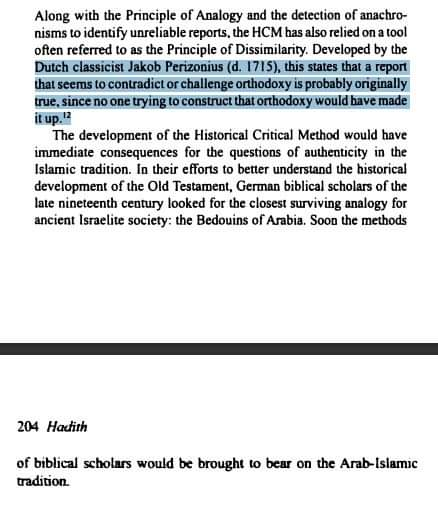
- Jonathan Brown — Hadith Science vs the Historical Critical Method
- Imam Muslim’s Critical Method — Making HCM Look Like Child’s Play
- The Words of the Muslims Themselves
- Conclusion — The Nation of the Chain of Narration
Introduction
The Muslims established and developed a detailed, complex, and precise science to preserve and verify narrations — the science ofHadith. What follows is a collection of testimonies from Western, Jewish, and Christian scholars — many of whom were hostile to Islam — acknowledging the unrivaled superiority of this science.
“Ilm al-isnad and narration is from what Allah has singled out for the nation of Muhammad ﷺ and made it a ladder to knowledge. For there is no isnad for the people of the Book that they might trace back traditions. Just like the innovators from this nation who are the people of misguidance. The isnad is only for the one upon whom Allah has given the greatest favor. By it, the people of Islam and the Sunnah differentiate between the right and the invalid, the crooked and the upright.”
The Islamic Science of Hadith — What Makes It Unique
Every figure who narrated even a few lines in Islamic history has a complete biography — their birth and death, their teachers and students, their scholarly journeys, and a clear scholarly ruling on the uprightness of that figure and the reliability of their narrations.
Dozens of specialized books in the field of al-Jarh wa al-Ta’dilThe science of narrator criticism and validation — literally “wounding and making upright.” It produced comprehensive encyclopaedias evaluating hundreds of thousands of transmitters. (critique and validation of narrators) contain hundreds of thousands of such biographies. No civilization before or after has produced anything comparable.
Scholar 1 — Bernard Lewis Jewish Historian
“The careful examination of the chains of transmission, their careful collection, and the preservation of the variants in the received narratives, give to the writing of medieval Arabic history a mastery and development which is unparalleled in the ancient West and unrivaled in the contemporary Western Middle Ages. By comparison, the writing of Latin Christian history appears poor and weak, and even the more sophisticated and complex Greek Christian history still falls short of the historical writings of Islam in terms of size, variety, and depth of analysis.”
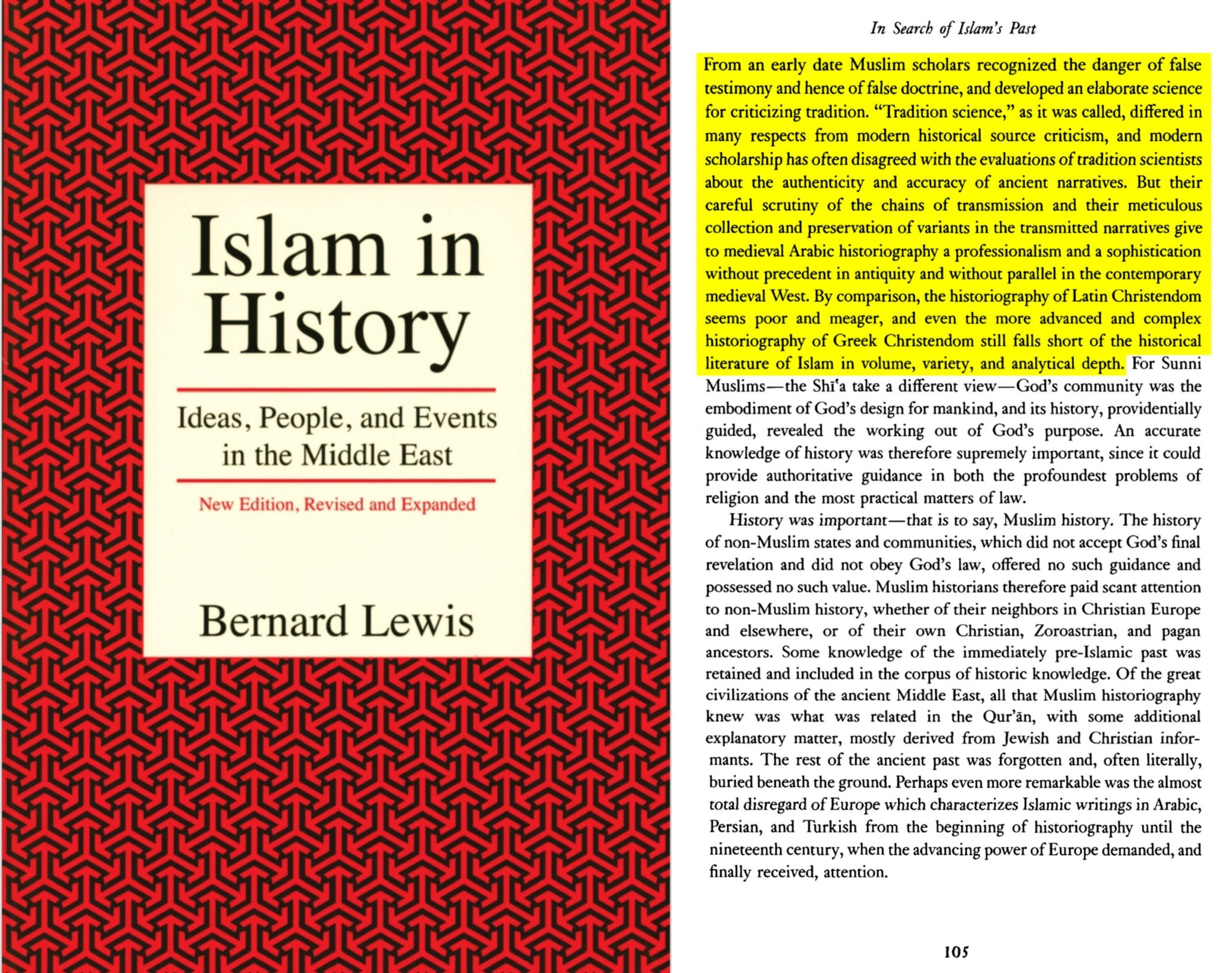
AZionist Jewish historian born in London in 1916. He studied Aramaic and Arabic, graduated from the School of Oriental Studies in London in 1936, and obtained a doctorate in the history of Islam. He became a towering figure at Princeton University and shaped American policy toward the Middle East — a man whose views primarily served the interests of Israel. Despite his hostility to Islam, he could not deny the superiority of Islamic historical methodology.Reference: Bernard Lewis, Islam In History, 1993, Open Court Publishing, pp. 104–105.
Scholar 2 — David Samuel Margoliouth
“Although the theory of isnad has caused much trouble because of what is required to investigate the trustworthiness of each narrator and because the fabrication of hadiths was a common thing and was sometimes easily tolerated, its value (the theory of isnad) in achieving accuracy cannot be doubted, and Muslims are right to be proud of their science of hadith.”
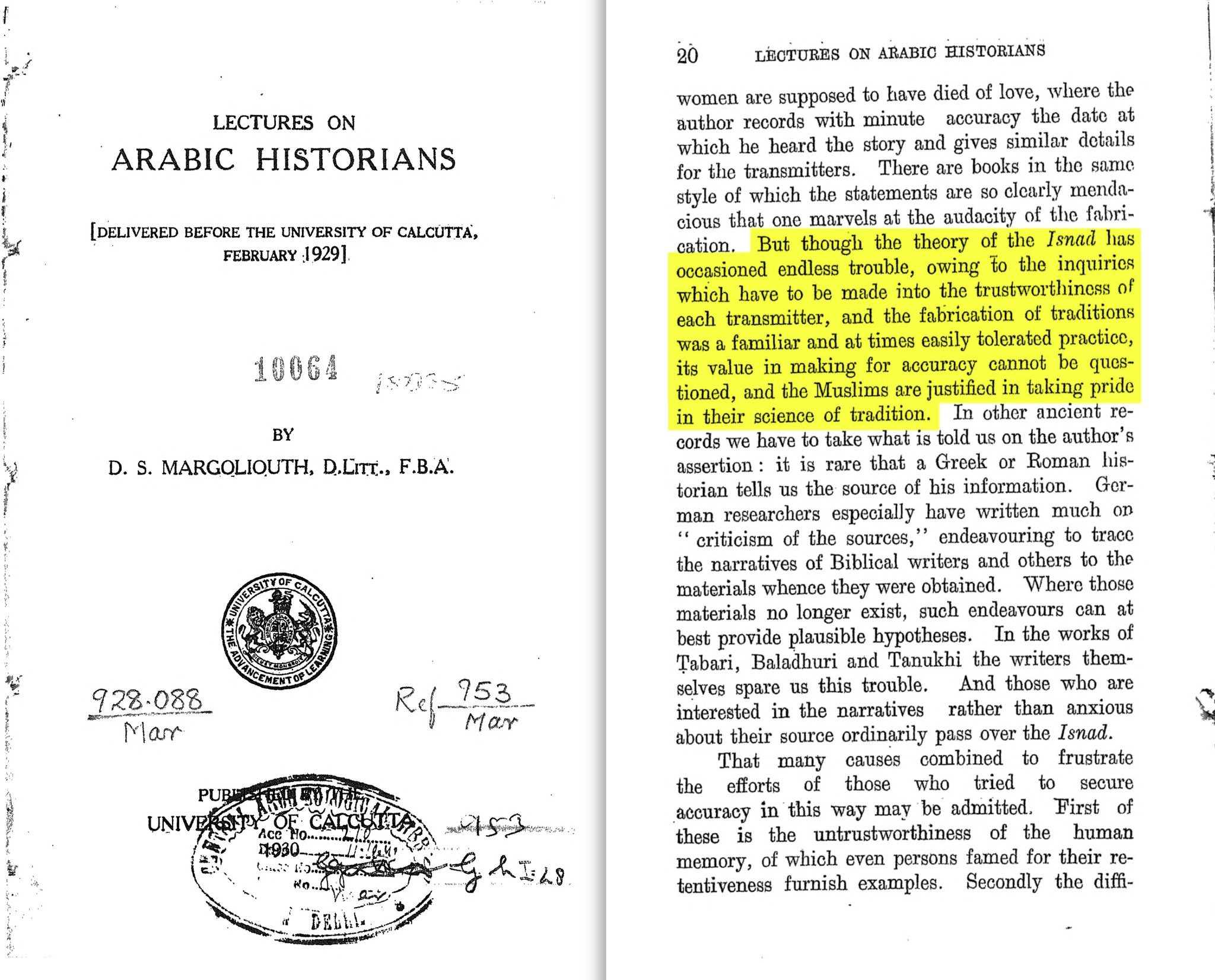
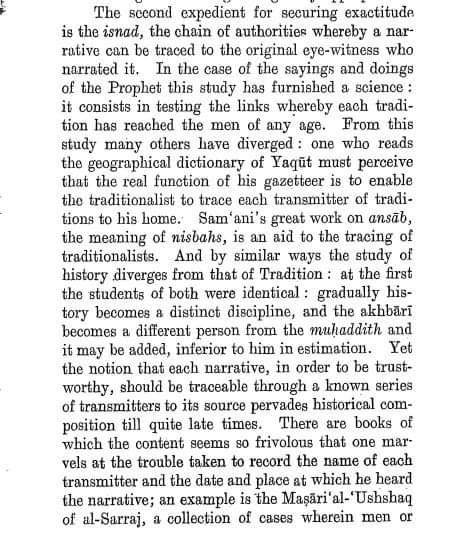
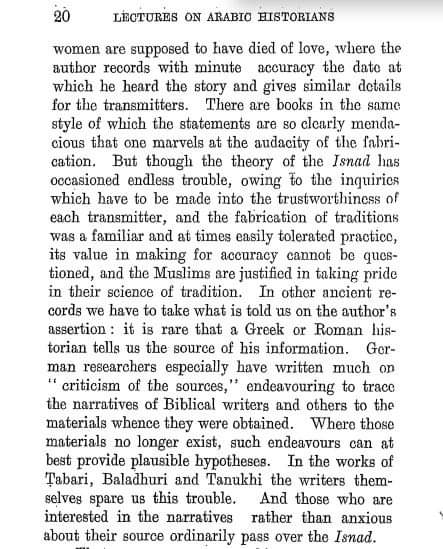
Margoliouth — who harbors enmity toward Islam down to the marrow — expresses his admiration for the method of transmitting the Prophetic Sunnah, then turns to the New Testament and concedes that what we have in terms of Christian sources does not give us more thanprobabilistic hypotheses that are inconclusive. The science of isnad is known only to Muslims.
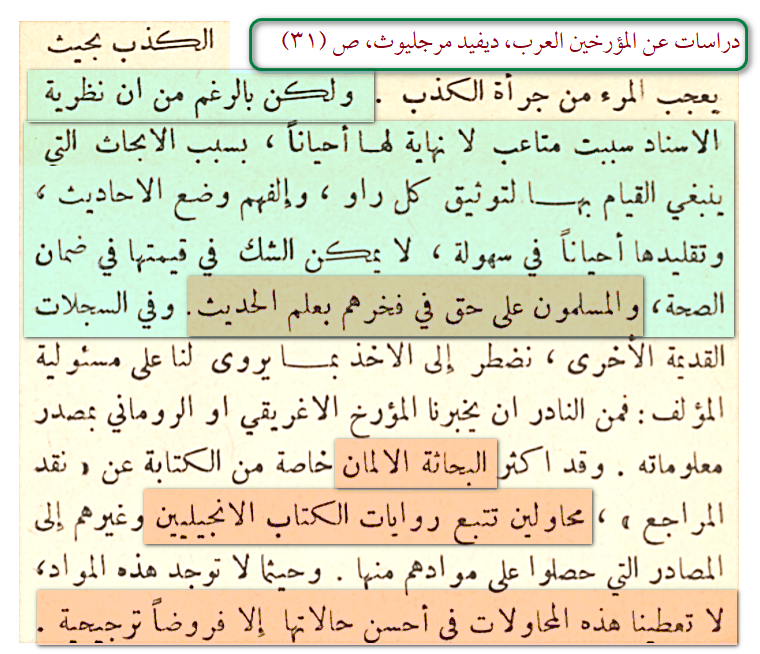
This Arabic scan is from the translated discussion of David Margoliouth. The highlighted section states that, despite the trouble caused by investigating every transmitter and despite the existence of fabricated reports, the isnad method still has unquestionable value for accuracy. It explicitly states that Muslims are justified in being proud of their science of tradition, because the chain system allowed reports to be traced and tested in a way absent from much older Greek, Roman, and Biblical historical material.
Scholar 3 — Reginald Bosworth Smith
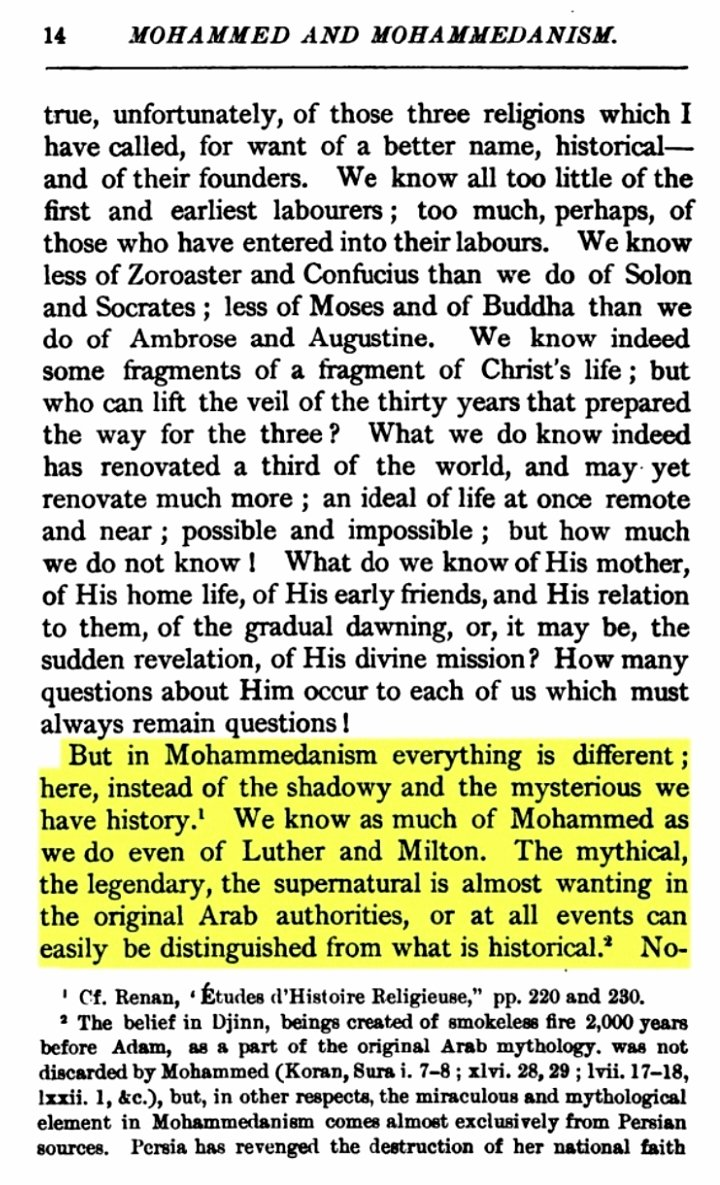
“In Muhammadanism (meaning Islam) everything is different. Instead of obscurity and ambiguity, we have history. We know as much about Muhammad as we do about Martin Luther and John Milton. The myths and impossibilities found in the original Arabic sources can be easily distinguished from the correct history.”
Scholar 4 — Asad Rustum — The Christian Academic Lion
A distinguished LebaneseChristian historian, renowned professor of Arab history at the American University of Beirut, and one of the pioneers of historical research in the modern era. He was the first to be awarded the title “Doctor of History” in the Arab world from the University of Chicago. He published more than 15 books related to the history of the Middle East.{{Wikipedia: <https://en.wikipedia.org/wiki/Asad_Rustum}}>
“The first to systematize the criticism of historical narratives and establish rules for it were Islamic religious scholars. They were compelled to take great care in dealing with the sayings and actions of the Prophet… to comprehend the Qur’an and administer justice. They asserted, ‘It is nothing but revelation revealed; what is recited from it is the Qur’an, and what is not recited is the Sunnah.’ They diligently engaged in collecting, studying, and scrutinizing the traditions…”
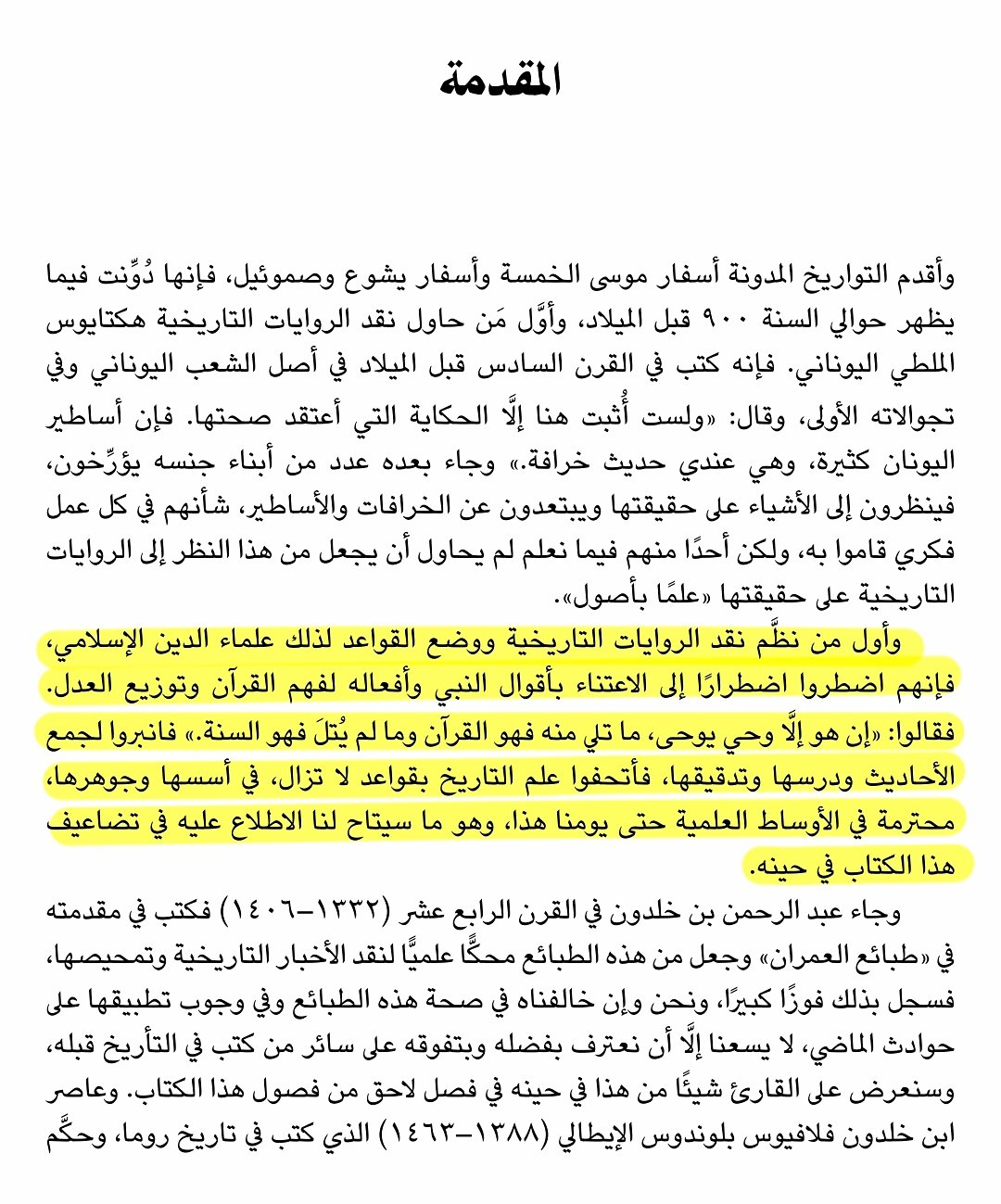
This Arabic scan is from the introduction of Asad Rustum’sMustalah al-Tarikh. The highlighted paragraph says that the first people to organize the criticism of historical reports and lay down rules for it were the scholars of Islam. They were forced to give special attention to the Prophet’s sayings and actions in order to understand the Qur’an and administer justice, so they gathered hadith, studied it, scrutinized it, and produced rules of historical criticism whose foundations remain respected in scholarly circles.
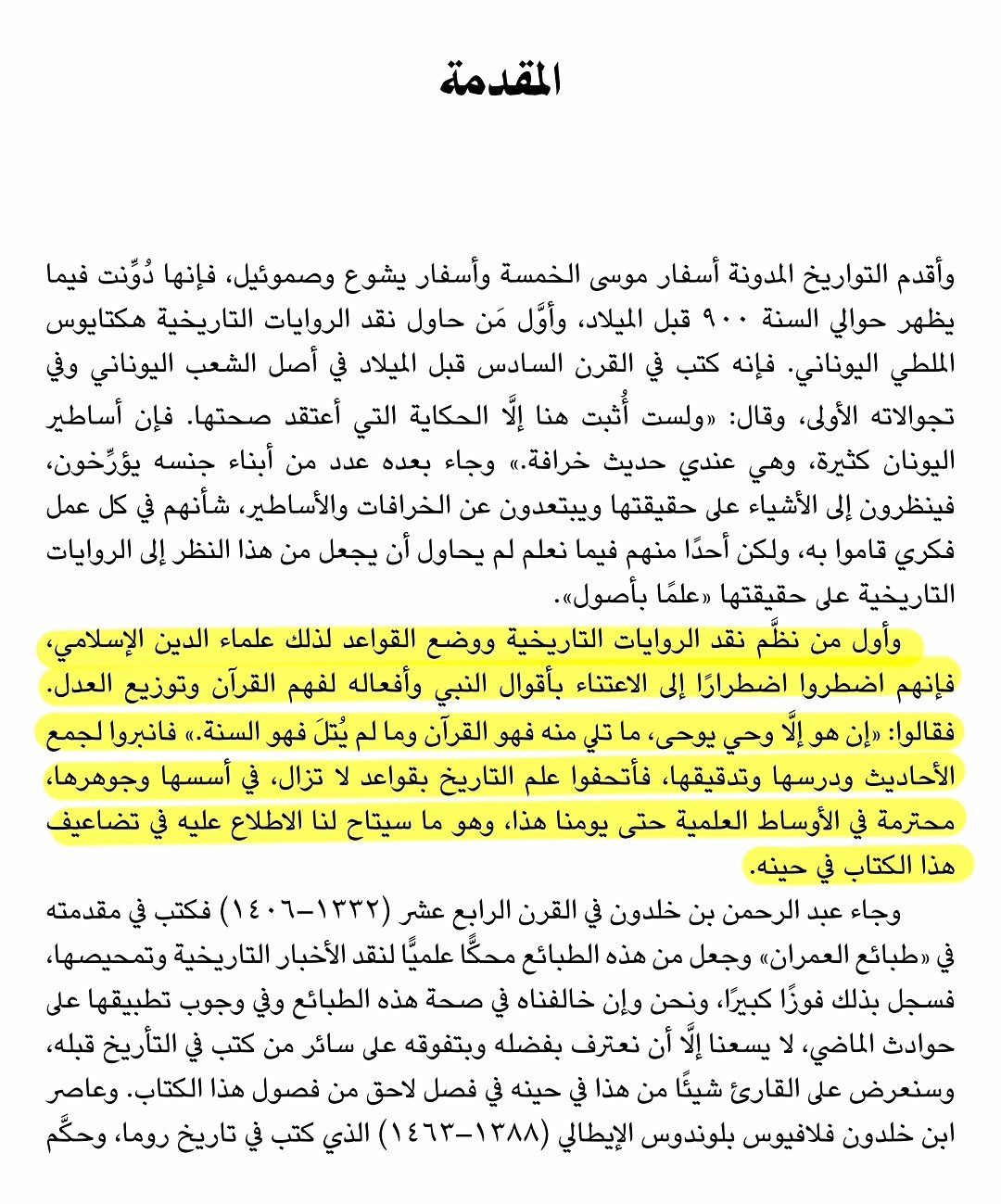
This Arabic scan repeats the same highlighted passage from Asad Rustum’s introduction. It states that Muslim scholars were the first to systematize criticism of historical narrations because of their need to verify the Sunnah. The highlighted text stresses that they collected, examined, and authenticated reports, thereby enriching the science of history with rules that did not disappear and still retain scholarly value.
“…enriching the field of history with enduring principles that remain in both their essence and foundation to be respected in scholarly circles to this day.”
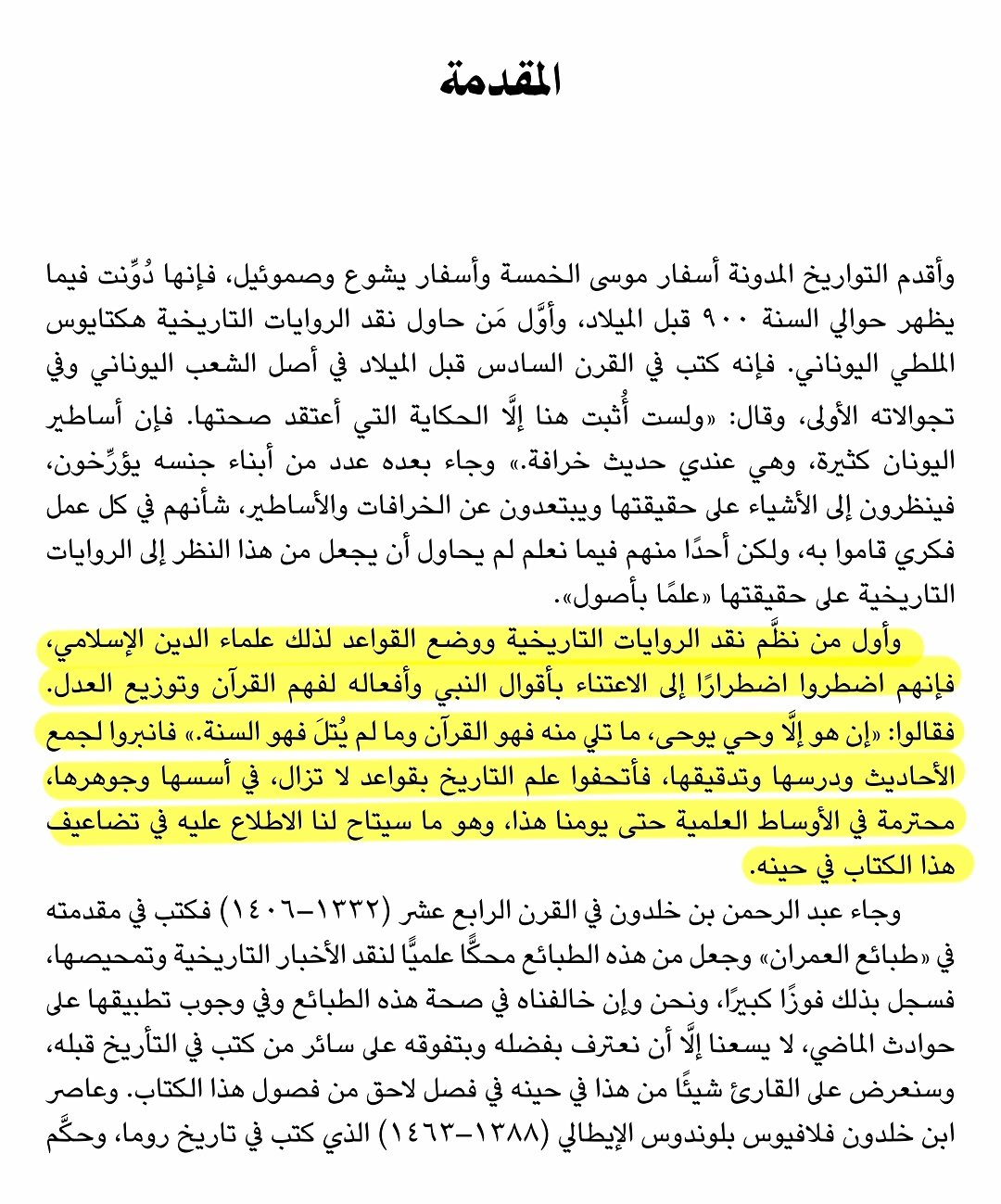
This Arabic scan again shows Asad Rustum’s statement that Muslim religious scholars were the earliest to organize the criticism of historical reports. The highlighted portion links this directly to hadith: since the Sunnah explains the Qur’an and has legal authority, Muslims had to collect reports, study them, test them, and develop respected rules of verification.
He praised the Maliki Muslim scholarAl-Qadi ‘IyadA 12th-century Andalusian Islamic scholar and jurist (d. 544 AH), best known for al-Shifa’ — his celebrated biography of the Prophet ﷺ. for his works in the field, saying there is nothing on its level even today.
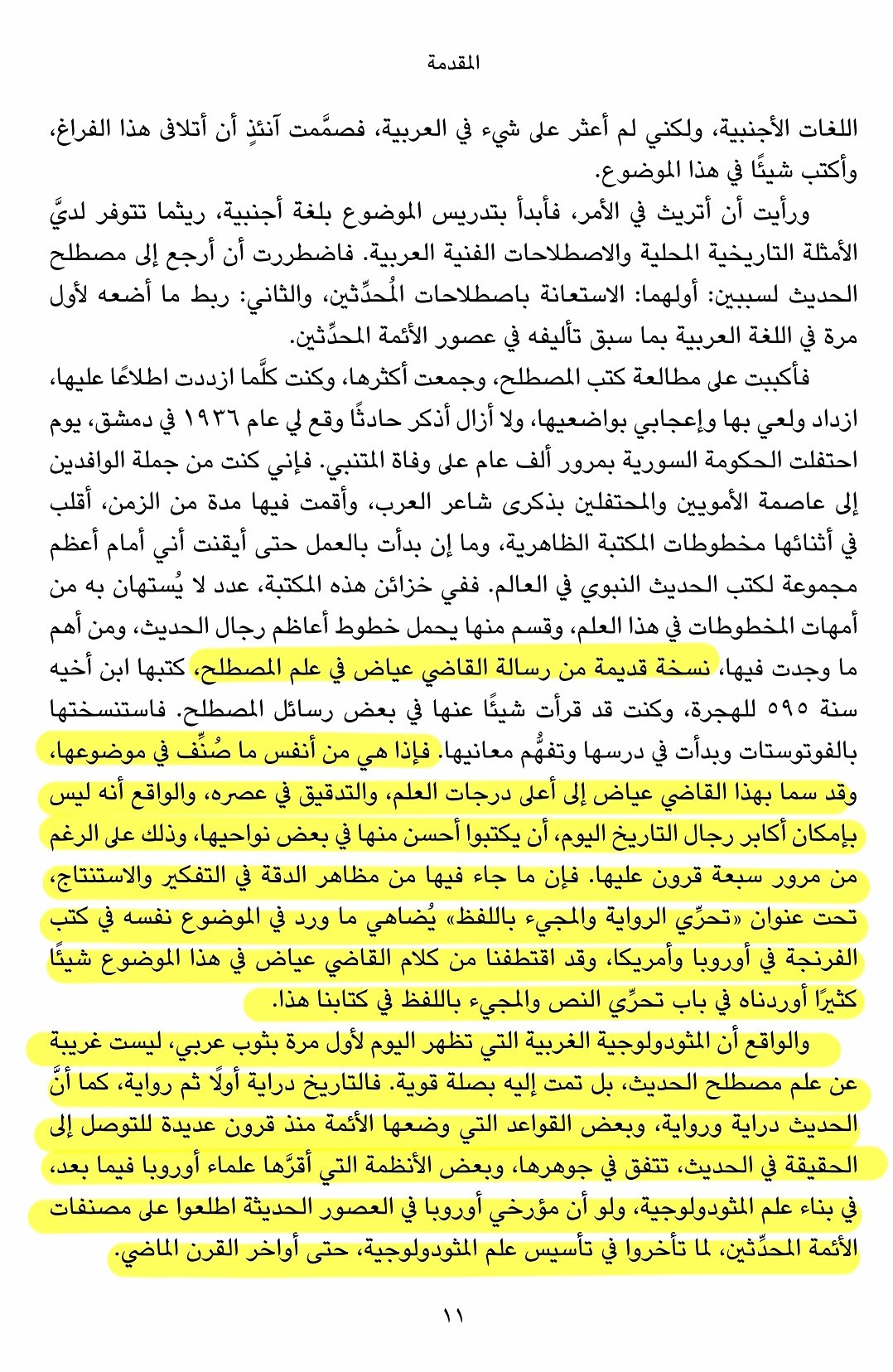
This Arabic scan is from Asad Rustum’s introduction. The highlighted section says that while researching Arabic terminology for historical criticism, Rustum found an old copy of al-Qadi ‘Iyad’s treatise on hadith methodology. He says that if parts of it were printed today under headings like narration, critique, documentation, and inference, major modern historians would think it was written by one of their own — even though al-Qadi ‘Iyad wrote it before them by seven centuries. Rustum then says that modern Western methodology in Arabic is not foreign to hadith science, but closely connected to it.
“And with more admiration and appreciation, it is noteworthy what the scholars of hadith have achieved over the centuries in this field. Here are some excerpts from their compilations… presented in their own words, acknowledging their meticulous scholarly precision and contribution to historiography.”
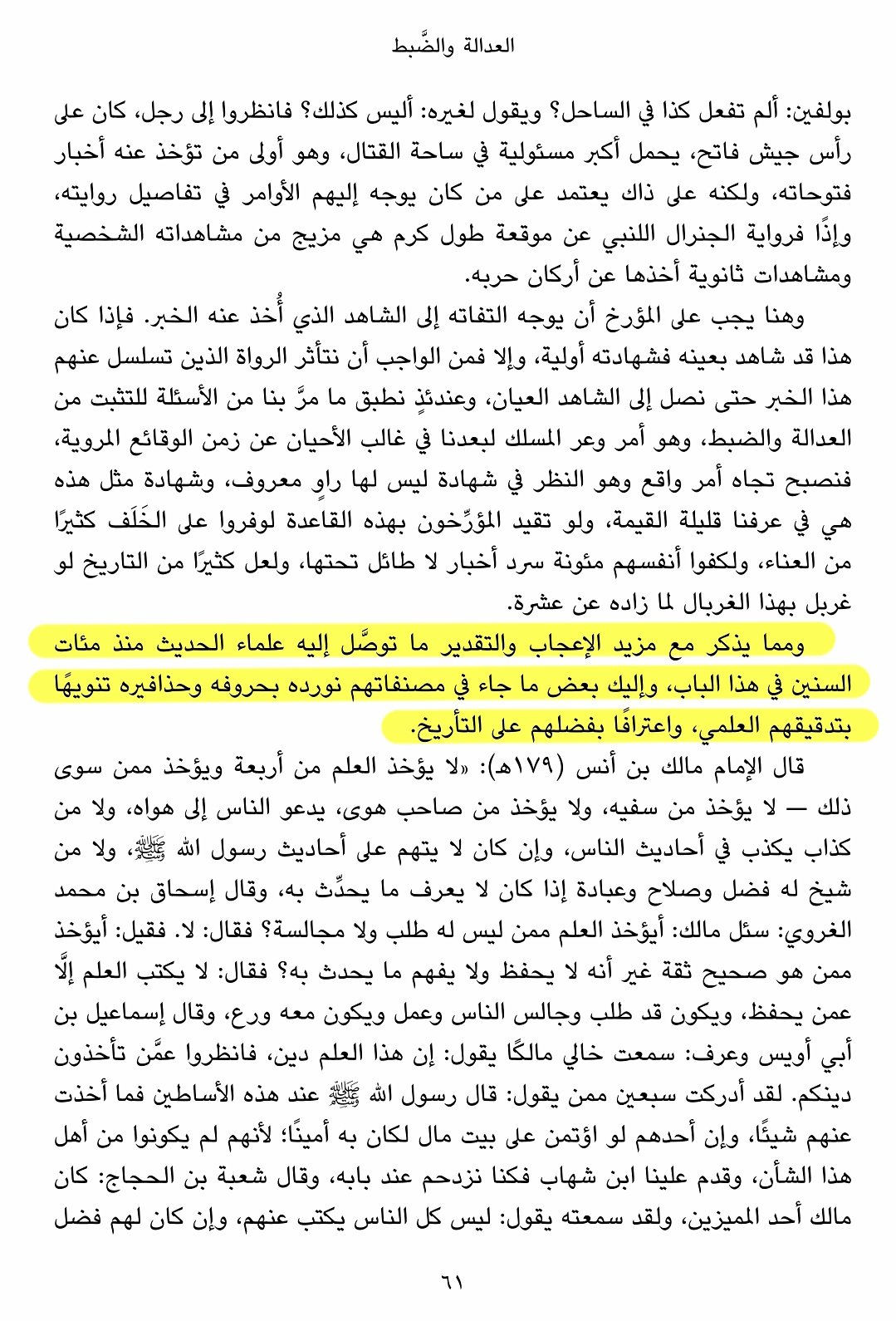
This Arabic scan is from Asad Rustum’s section on justice and precision in historical testimony. The highlighted passage says that what hadith scholars reached in this field centuries ago deserves admiration and appreciation, and that some of their exact terminology and warnings show how precise their scholarly criticism was and how deeply they understood the historian’s task.
Asad Rustum — the Christian academic —advised Westerners to learn from Muslims the Muslim approach to judging narrations. He called for subjecting the writing of history to the rules of Hadith.
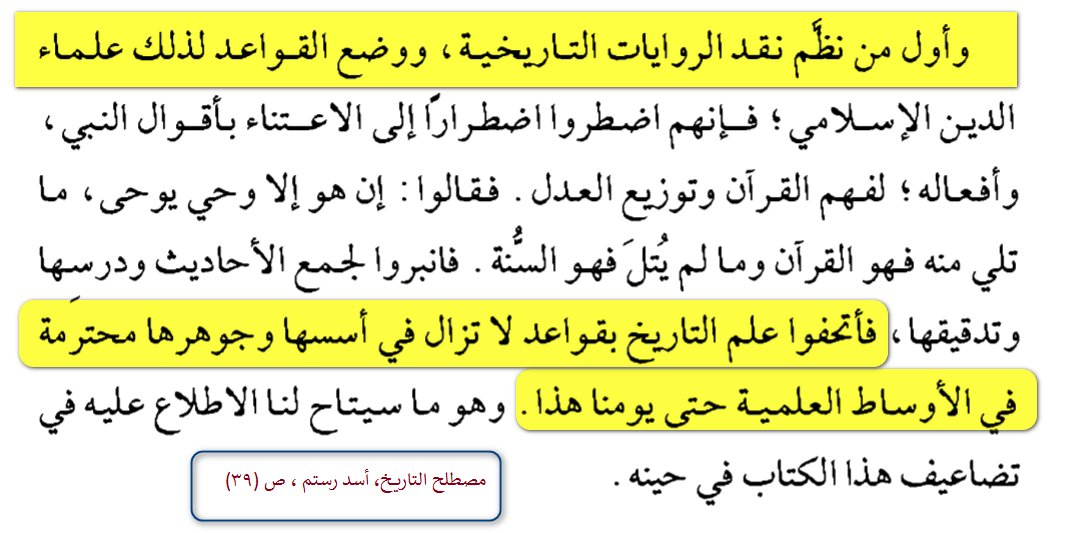
This Arabic scan is a cropped citation from Asad Rustum’sMustalah al-Tarikh. The highlighted text states that Muslim scholars were the first to organize the criticism of historical narrations and establish rules for it. Their work came from the need to verify the Prophet’s words and actions, so they collected, studied, and scrutinized hadith until historical criticism gained respected principles.
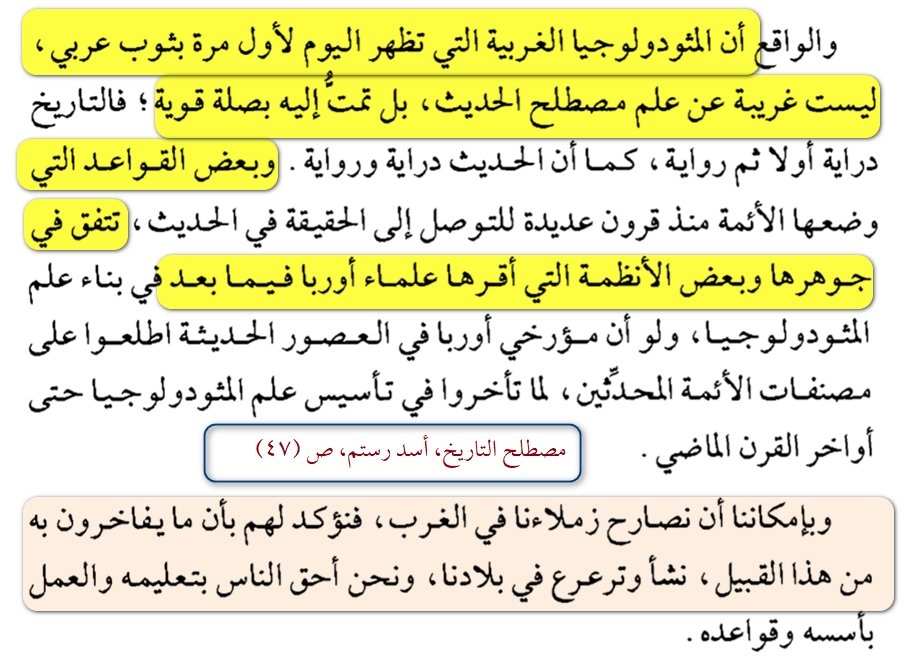
This Arabic scan is another cropped passage from Asad Rustum. The highlighted text says that modern Western methodology, which appears to Arab readers as something new, is not alien to the science of hadith. Rather, it is strongly connected to hadith because hadith is first narration and then scrutiny. Rustum says many of the rules used to reach historical truth correspond to rules set by Muslim scholars long before later European historians, and he urges Western scholars to recognize that this noble tradition grew in Muslim lands.
Scholar 5 — Maroun Abboud
A well-known Lebanese poet and writer.{{Wikipedia: <https://en.wikipedia.org/wiki/Maroun_Abboud}}>
In discussing Asad Rustum’s book on the science of Hadith, Maroun Abboudpraised it and agreed with its views — acknowledging the depth and rigor of the Islamic methodology of hadith criticism.
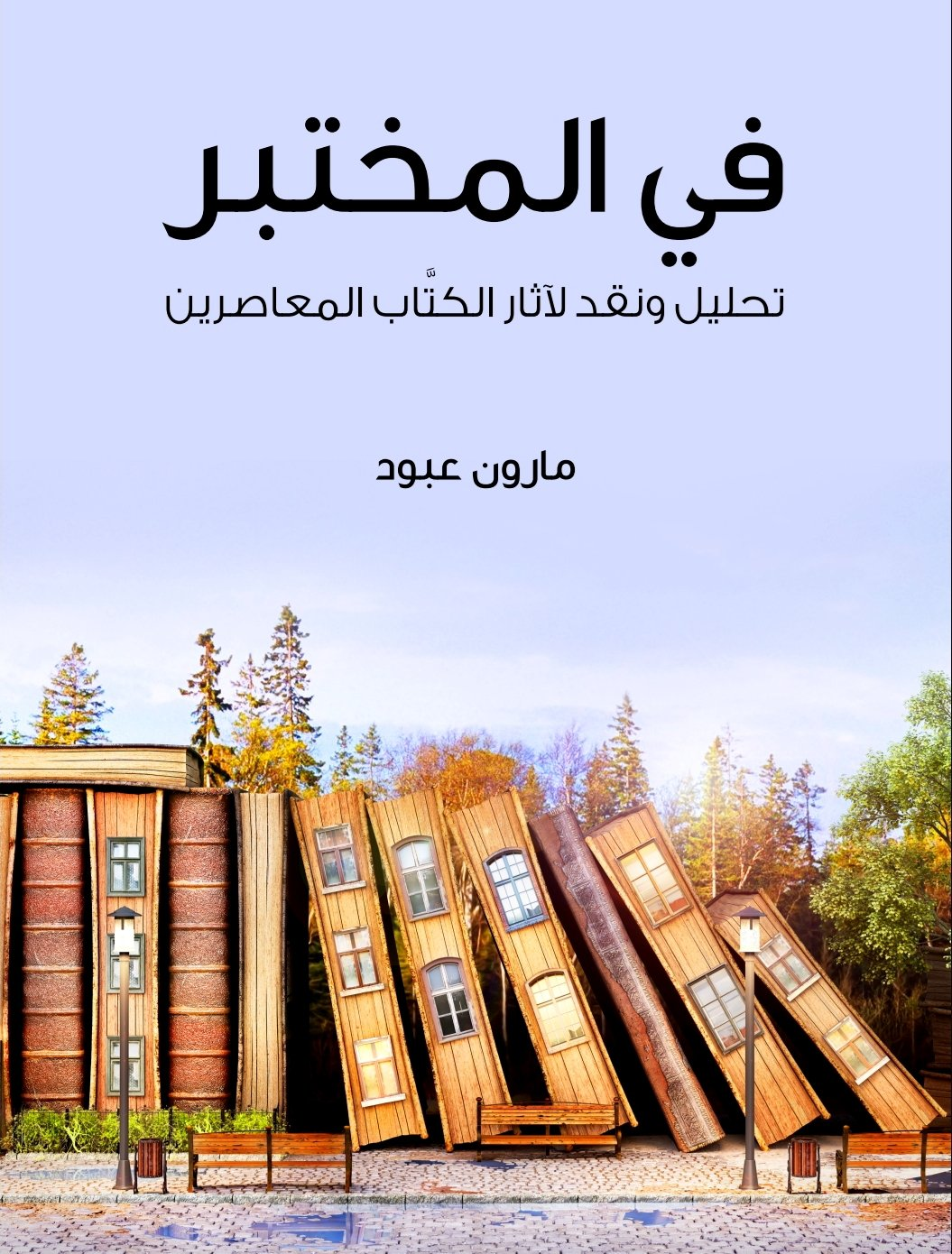
This Arabic scan is the cover of Maroun Abboud’sFi al-Mukhtabar: Tahlil wa Naqd li-Athar al-Kuttab al-Mu’asirin — a work of literary analysis and criticism of contemporary Arab writers. It identifies Maroun Abboud as the author and establishes the source being cited in the article.
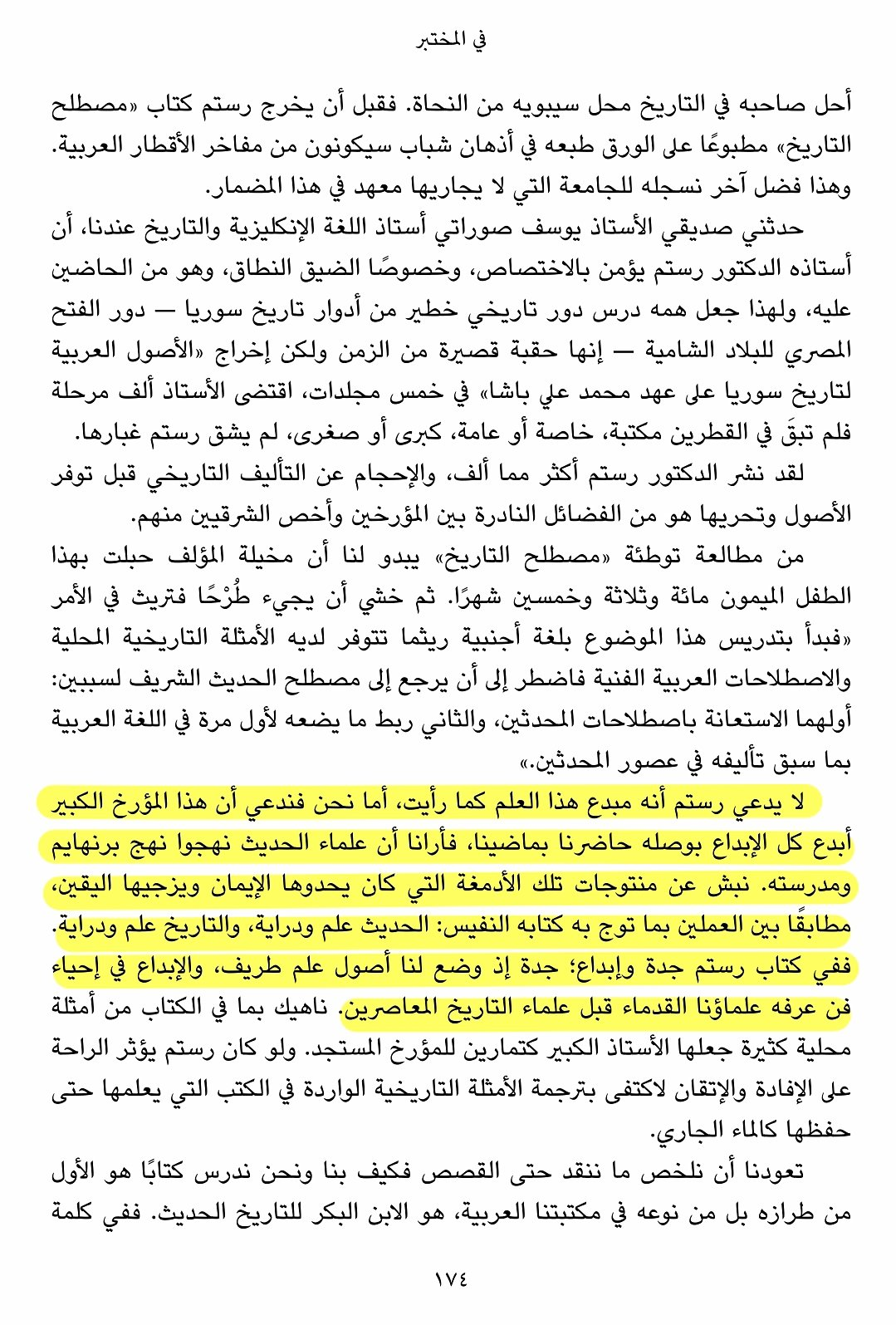
This Arabic scan is from Maroun Abboud’s discussion of Asad Rustum’sMustalah al-Tarikh. The highlighted passage praises Rustum’s book as a major work and says that Arab youth should be proud of it. Abboud says Rustum did not merely imitate older writers, but created a new scientific approach in Arabic historical writing by extracting principles from hadith scholarship and using them to organize historical criticism, source evaluation, and proper research method.
Scholar 6 — John Davenport
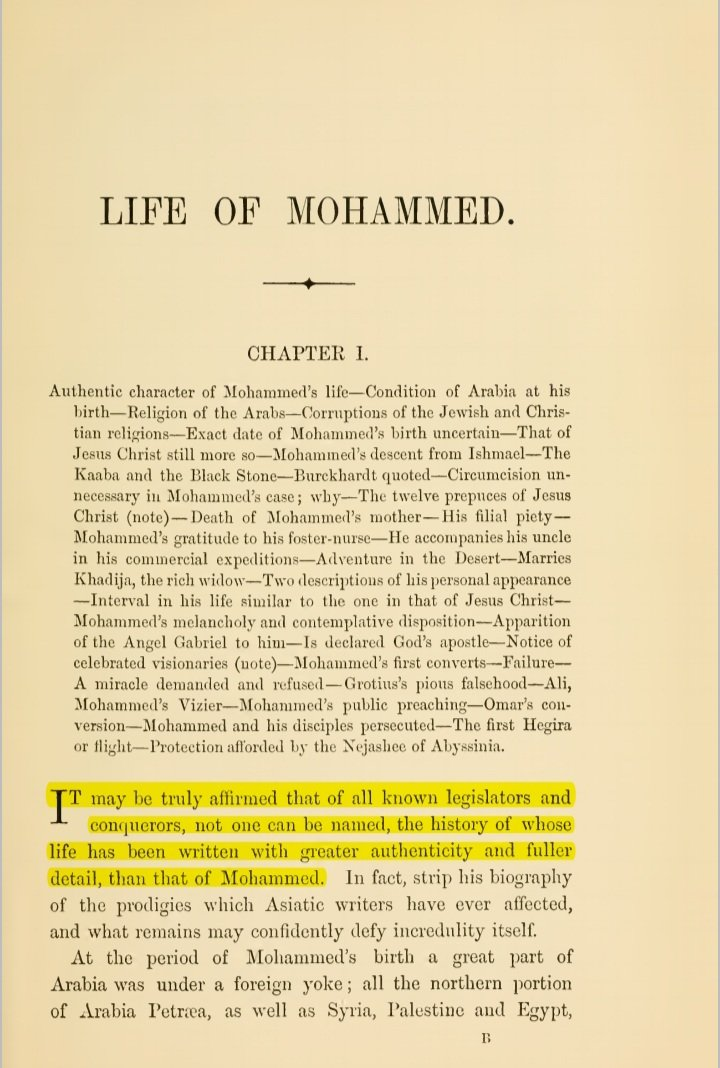
“It may be truly affirmed that of all known legislators and conquerors, not one can be named, the history of whose life has been written with greater authenticity and fuller detail, than that of Mohammed.”{{Wikipedia: <https://en.wikipedia.org/wiki/John_Davenport_(orientalist)}}>
Scholar 7 — Carl Brockelmann
[!quote] Carl Brockelmann — History of the Islamic Peoples (p. 66){{Wikipedia: <https://en.wikipedia.org/wiki/Carl_Brockelmann}}>
He states that the Muslims narrated the actions and sayings of the Prophet ﷺ **with accuracy and in detail.**
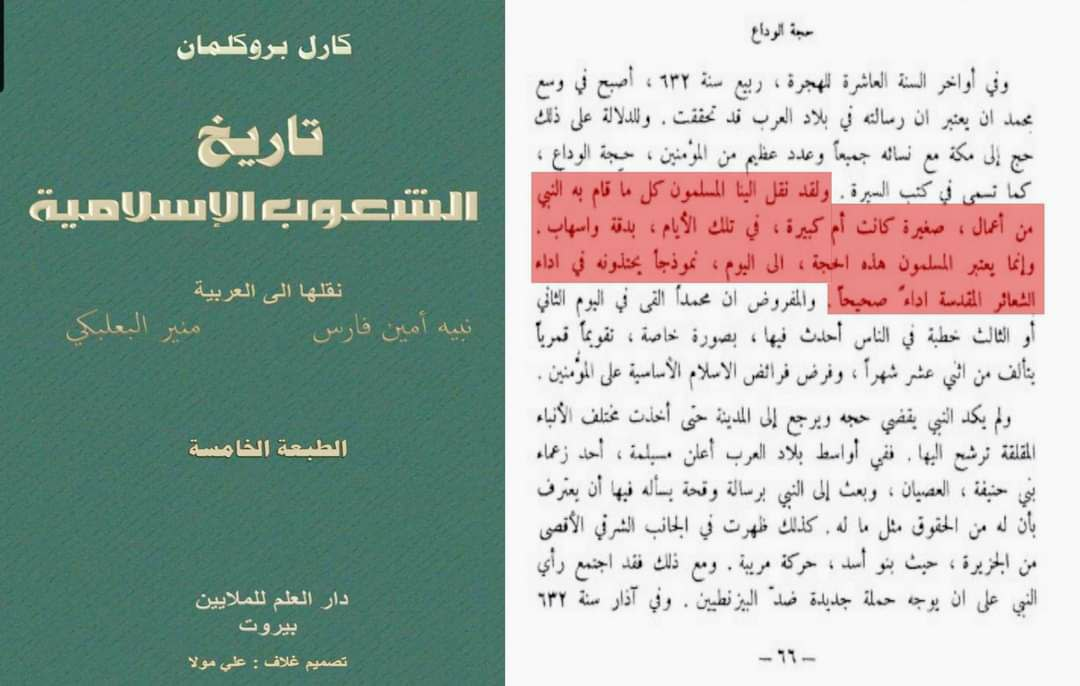
This Arabic scan is from the Arabic translation of Carl Brockelmann’sHistory of the Islamic Peoples. The highlighted passage says that Muslims transmitted everything the Prophet ﷺ did and said, whether small or great, with extreme seriousness and awe. It says they viewed this material as a sacred trust and preserved it in books of biography and tradition, showing the detail and seriousness of early Muslim transmission.
Scholar 8 — George Zidan
[!quote] George Zidan — Tarikh al-Tamadun al-Islami (Volume 3){{Wikipedia: <https://hindawi.org/contributors/40590249/}}>
Under the heading *al-Nassabun al-Arab*, he praised the **accuracy, scrutiny, and strong memorization** of Muslims in regards to their religious narrations.
This Arabic scan is the cover of George Zidan’sTarikh al-Tamaddun al-Islami — History of Islamic Civilization. It identifies the Arabic source being quoted in the section on George Zidan’s praise for Muslim accuracy in narration and preservation.
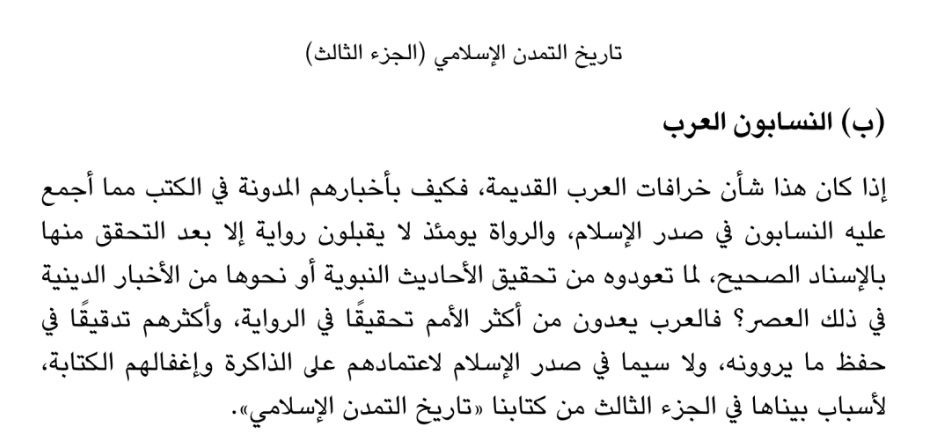
This Arabic scan is from George Zidan’sTarikh al-Tamaddun al-Islami, under the heading about Arab genealogists. The highlighted passage says that Arabs in early Islam did not accept a report until they had verified it with a sound chain of transmission, because they were accustomed to the methods used in authenticating prophetic hadith. Zidan adds that Arabs were among the most careful nations in narration and among the most precise in preserving what they transmitted.
Scholar 9 — Jacques Risler
He discusses how the ahadith of the Prophet ﷺ went throughmuch scrutiny to ensure accuracy.
This Arabic scan is the cover of Jacques Risler’sal-Hadarah al-‘Arabiyyah — The Arab Civilization. It identifies the translated Arabic edition used for the section discussing Risler’s statement on the scrutiny of hadith.
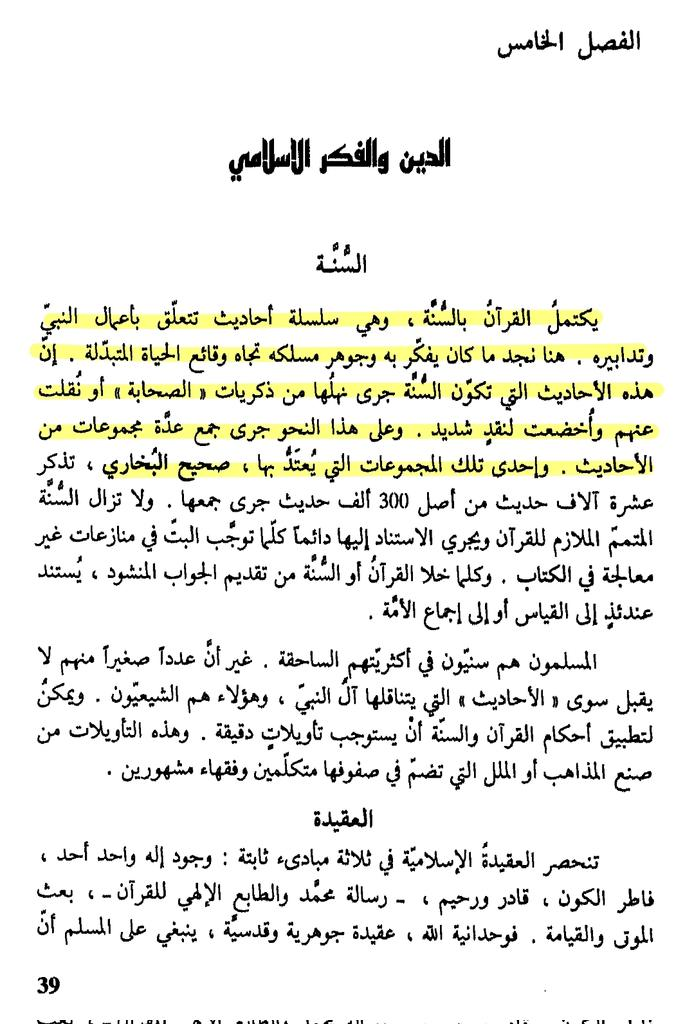
This Arabic scan is from Jacques Risler’s discussion of religion and Islamic rule. The highlighted section says that the Qur’an is complemented by the Sunnah, and that the Sunnah consists of hadiths related to the Prophet’s sayings and reports. It explains that these hadiths were gathered into collections, subjected to strict verification, and that al-Bukhari’s authentic collection represents a carefully selected body of narrations from a much larger mass of reports.
Scholar 10 — A J Arberry
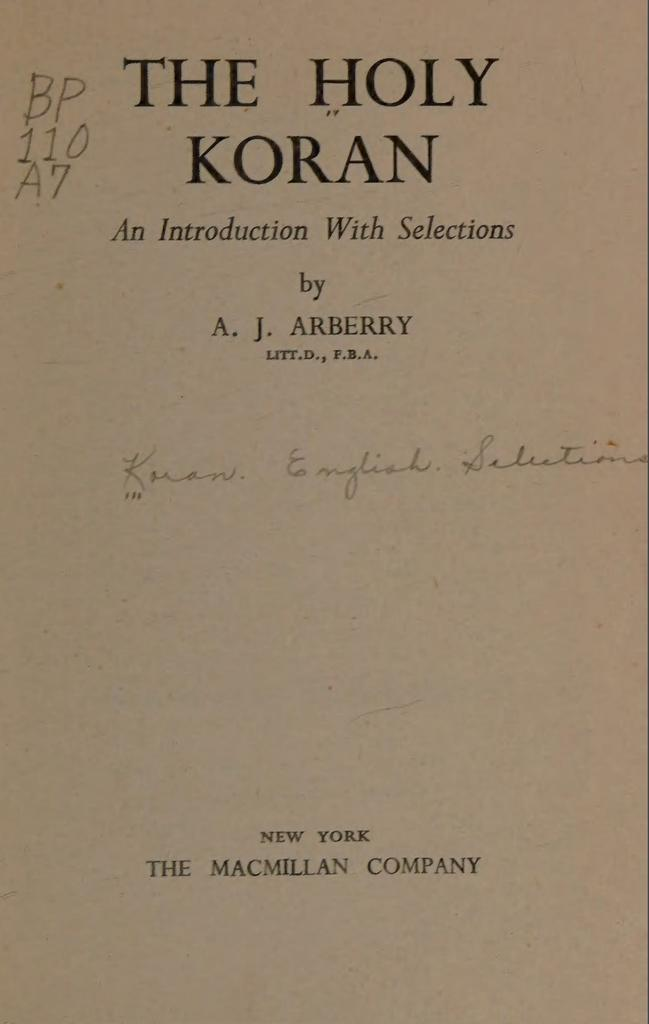
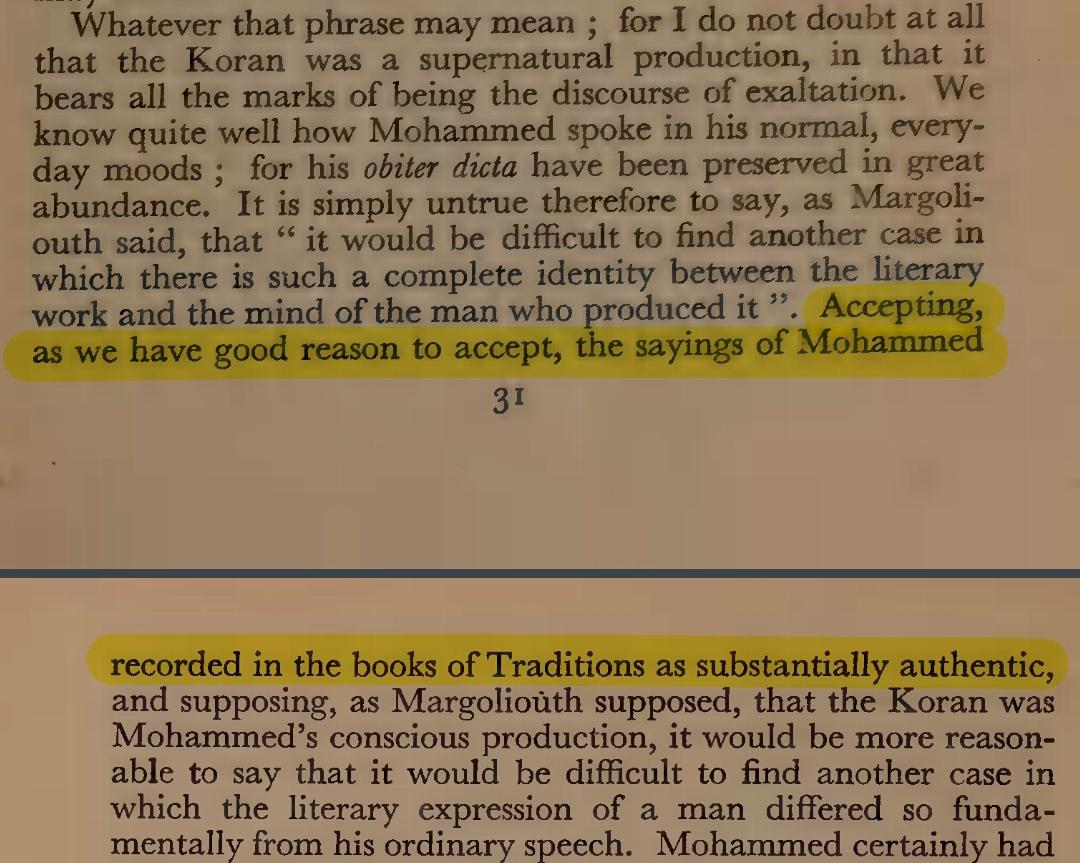
[!quote] A.J. Arberry — The Holy Koran: An Introduction with Selections (pp. 31–32){{Wikipedia: <https://en.wikipedia.org/wiki/Arthur_John_Arberry}}>
*“We have good reason to accept the sayings of Muhammad ﷺ recorded in the books of Traditions as substantially authentic.”*
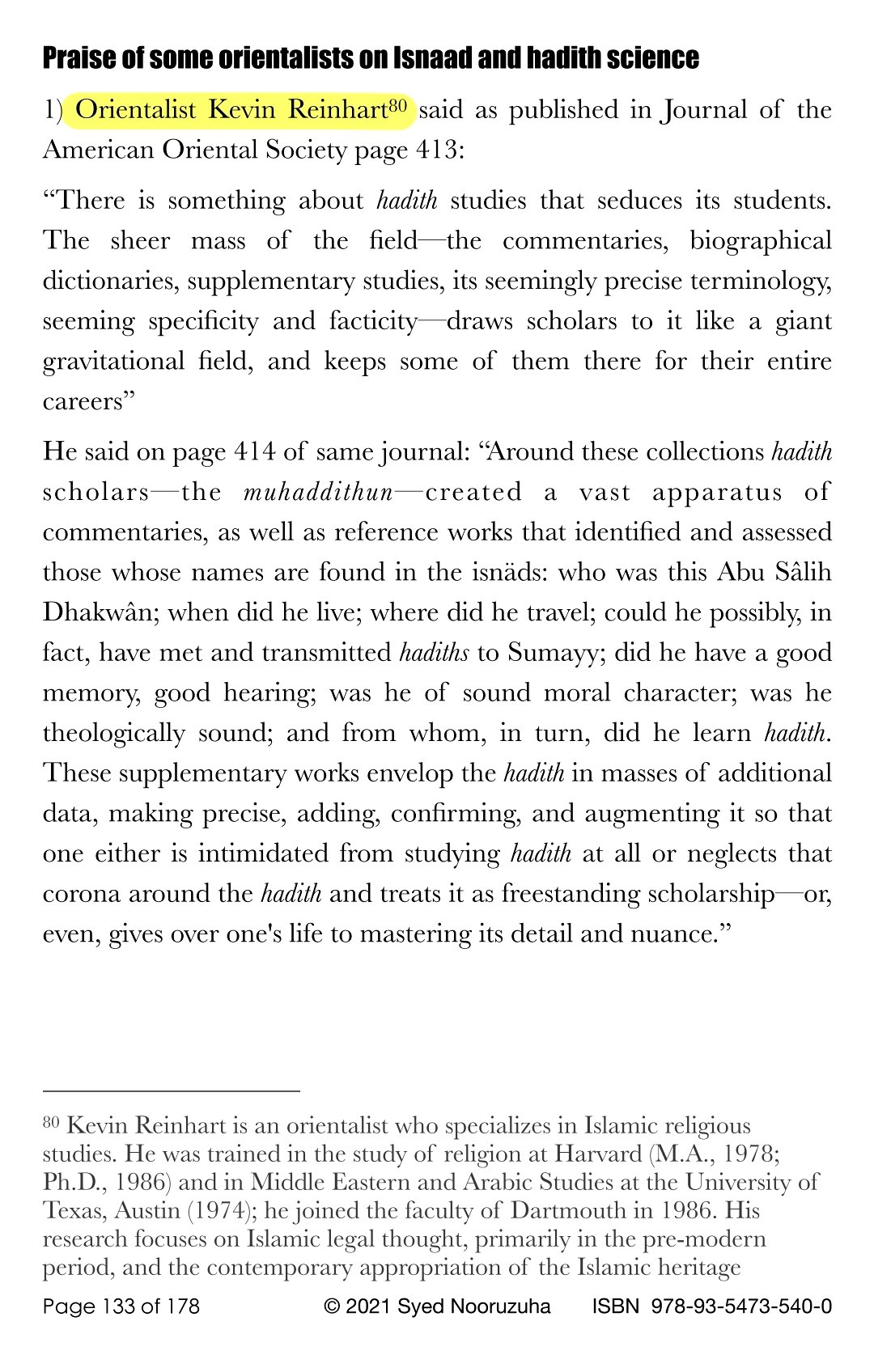
Scholar 11 — A Kevin Reinhart
Scholar 12 — Aloys Sprenger
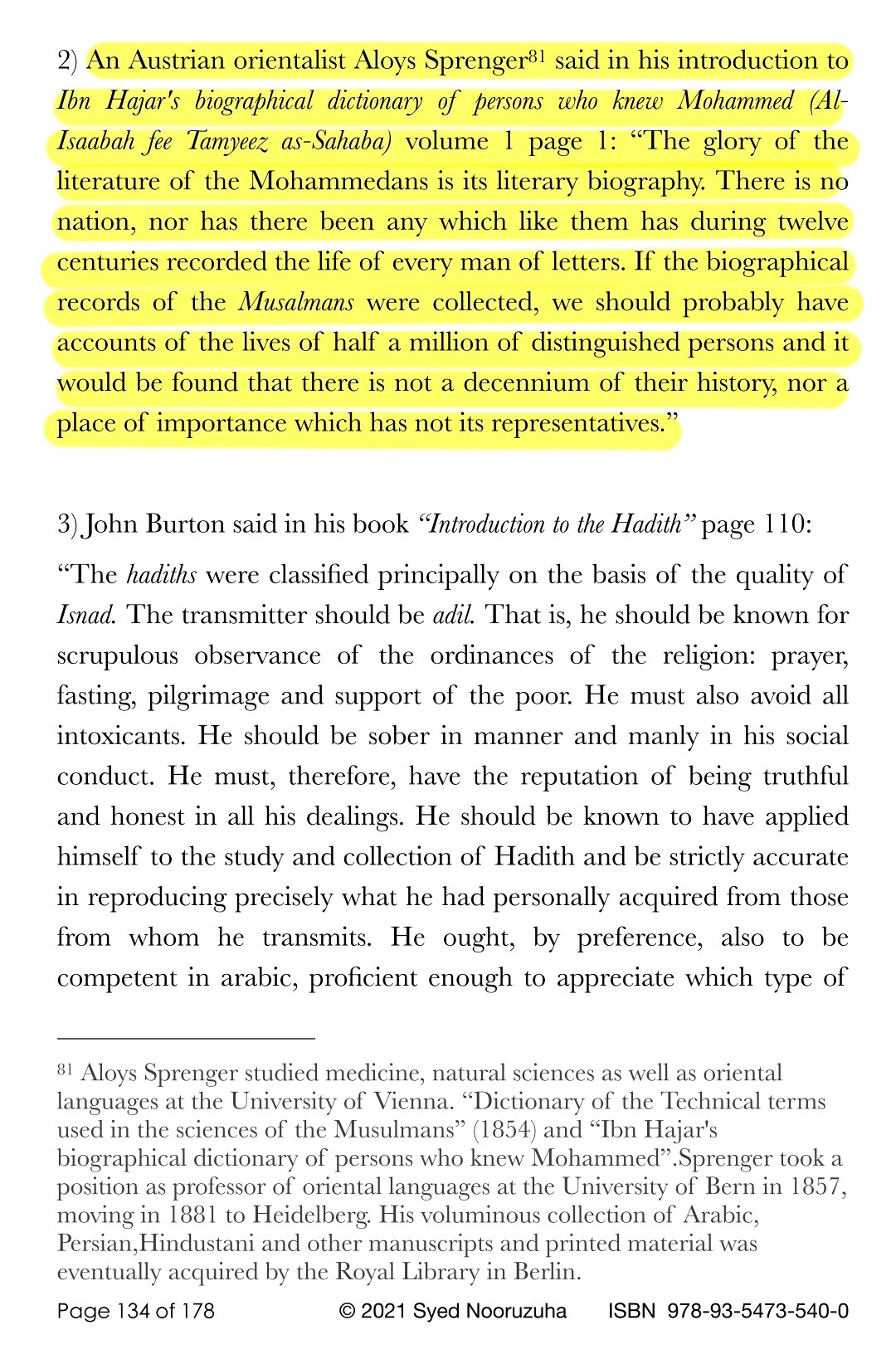
Wikipedia: https://en.wikipedia.org/wiki/Aloys_Sprenger — Source: On the origin of writing down historical records among the Musulmans.
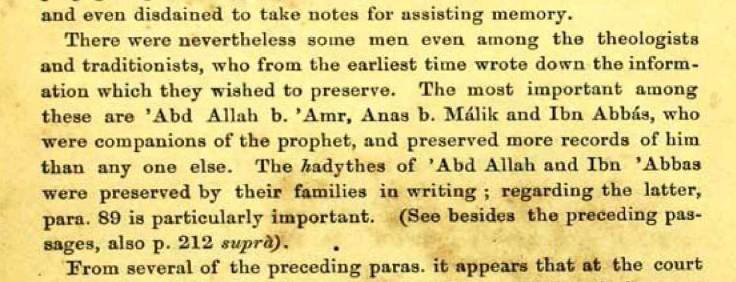
Orientalist Aloys Sprenger affirmed that hadiths were written down by the Companions of the Prophet ﷺ. Even GoldziherIgnaz Goldziher — the Hungarian Jewish orientalist most famous for his scepticism toward hadith — nonetheless agreed with Sprenger on the point of early written documentation. agreed with this.
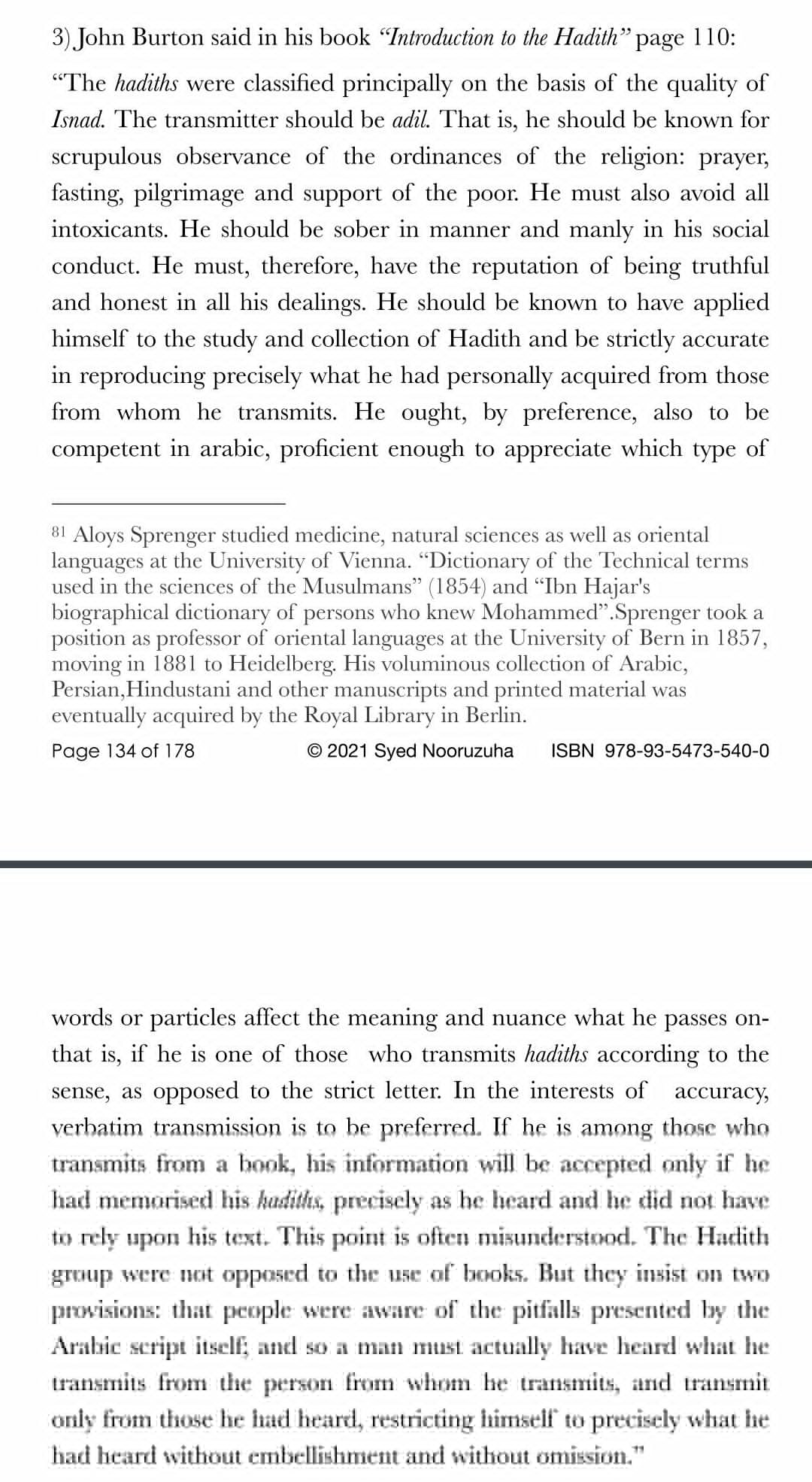
Scholar 13 — John Burton
Scholar 14 — Nabia Abbott
Scholar 15 — Johann Fück
In defense of theisnad in hadith — a powerful testimony from a German scholar acknowledging the unique rigor of Islamic chain-criticism.
Scholar 16 — Louis Schnitzer — Austrian Orientalist
He wasastonished by the science of al-Jarh wa al-Ta’dil. Every figure who narrated a few lines in Islamic history has a biography — we know their birth and death, their teachers and students, their travels — and we have a clear ruling on the uprightness of that figure and the reliability of their narrations. Dozens of specialized books in this field contain hundreds of thousands of biographies.
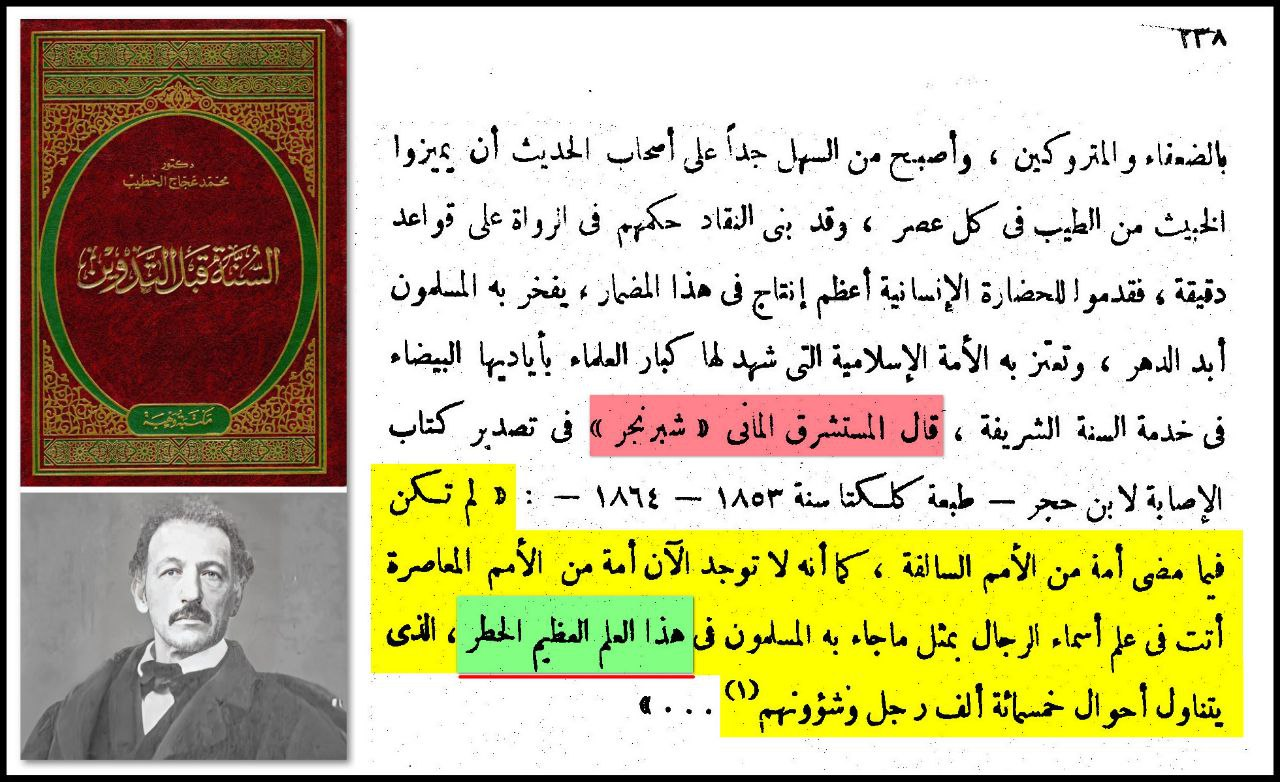
This Arabic scan quotes the Austrian orientalist Louis Sprenger on Muslim biographical criticism. The highlighted passage says that among all previous nations, and even among contemporary nations, there is no nation that produced anything like the Muslims in the science of the names and biographies of men. It says this great and serious science deals with the conditions and affairs of aroundhalf a million narrators — showing the unmatched scale of Muslim narrator criticism.
Scholar 17 — James Robinson — British Orientalist
He expressesadmiration for the Islamic method of documentation and its rigor — acknowledging that the thousands of men who transmitted the Sunnah each have a comprehensive and precise biography including their full name, teachers, students, scholarly journeys, and scholarly judgments on them.
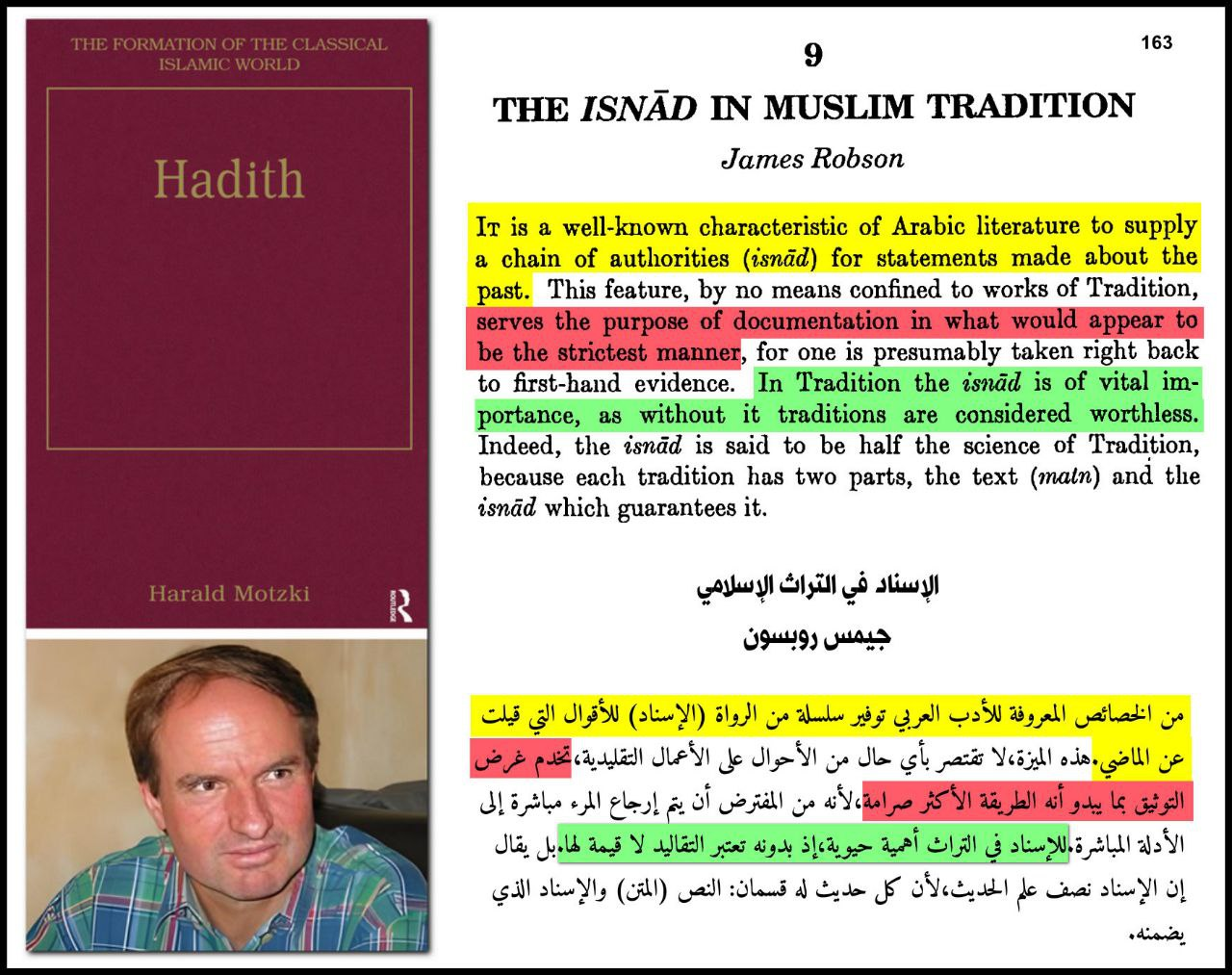
This mixed Arabic-English scan presents James Robson’s statement on isnad in Muslim tradition, with an Arabic translation beneath it. The highlighted Arabic section says that one of the well-known features of Arabic literature is giving a chain of authorities for statements about the past. It explains that this chain serves documentation in the strictest manner, ideally tracing the report back to direct evidence, and that in hadith the isnad is so vital that a tradition without it is considered worthless.
Scholar 18 — William A Graham — The Qur’an’s Oral Transmission
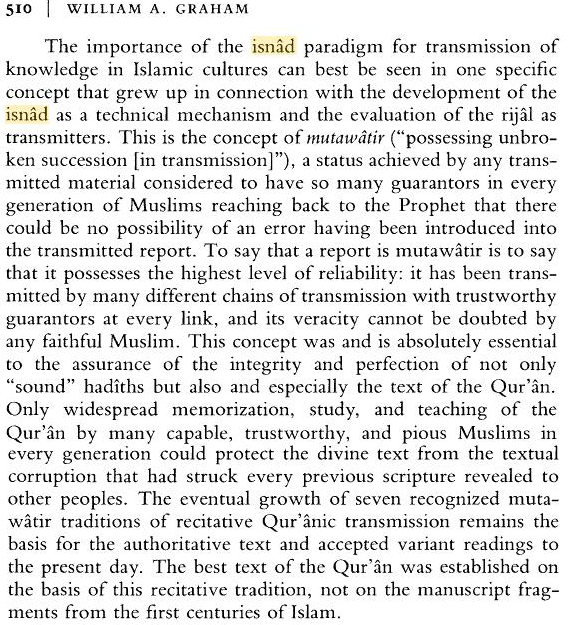
“The widespread memorization in the chests, and the learning and teaching of the Qur’an by a number of pious, devout, and trustworthy Muslims in every generation can protect the divine text from the distortion of texts which has affected all previous inspired books. The final development of the seven well-known and transmitted Qur’anic readings, which have been transmitted orally, remains the basis and origin of the Qur’anic text and the readings accepted to this day. The best text of the Holy Qur’an is based entirely on these readings transmitted orally by continuous transmission and does not depend on the manuscripts of the first centuries of Islam.”Source: The Journal of Interdisciplinary History, Vol. 23, No. 3, Religion and History (Winter, 1993), pp. 495–522.
Jonathan Brown — Hadith Science vs the Historical Critical Method
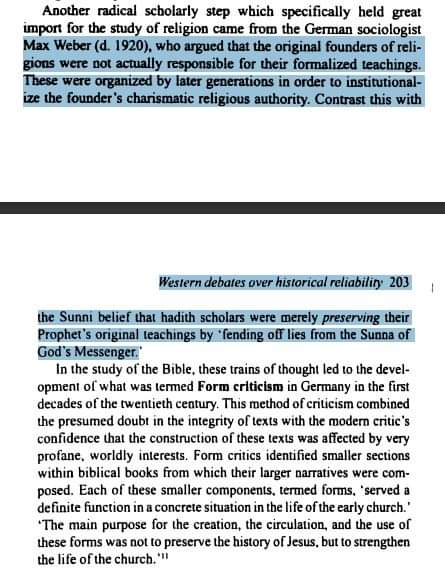
Jonathan Brown discusses thelimitations, biases, and substantial deficiencies of the Western humanistic and naturalistic framework of the Historical Critical Method (HCM)The HCM is the dominant Western academic approach to analysing ancient religious texts. It applies secular assumptions, treating miracles as impossible and relying on circumstantial textual analysis rather than verified chains of narration. — which stands in stark contrast to the transcendental theistic framework and traditional Sunni understanding of Hadith.
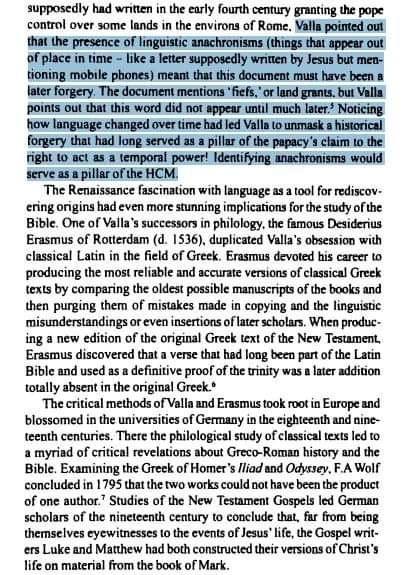
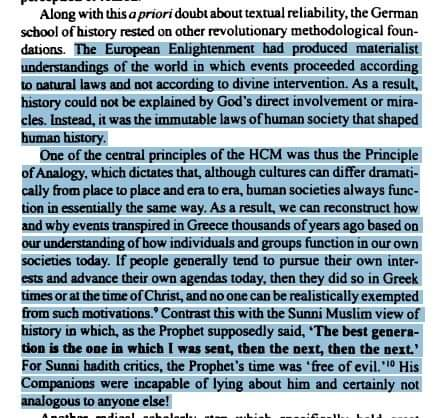
The Sunni understanding of Hadith surpasses HCM through its in-depth, systematic analysis: focusing on every single personality and chain, proper scrutiny of the gist (matn)The matn is the textual content of a hadith — what was actually said or done. Hadith critics evaluated both the chain (isnad) and the content (matn) independently, unlike HCM which has no equivalent narrator-verification mechanism. when establishing precise and coherent beliefs and rulings, and a systematic and testable critical method — not a naturalistic bias-laden framework.
Imam Muslim’s Critical Method — Making HCM Look Like Child’s Play
This is the depth of Islamic hadith criticism: not a loose scholarly opinion, but a rigorous, multi-layered evaluation of every chain and every narrator.
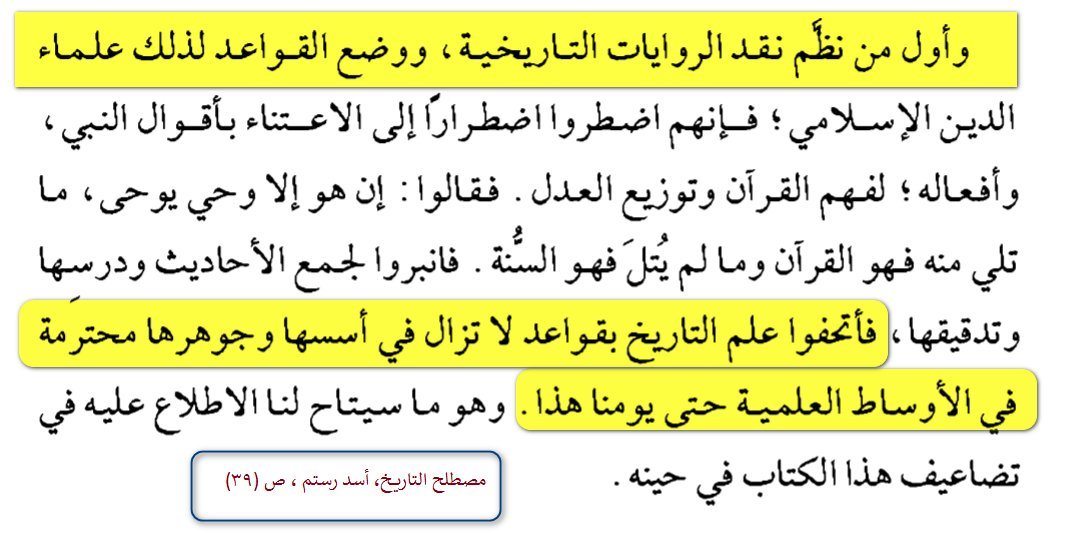
This Arabic scan repeats the cropped Asad Rustum citation. The highlighted text says that Muslim scholars were the first to organize the criticism of historical reports and establish its principles. Their work arose from the need to verify the Prophet’s sayings and actions, so they collected, studied, and scrutinized hadith until history gained respected critical rules.
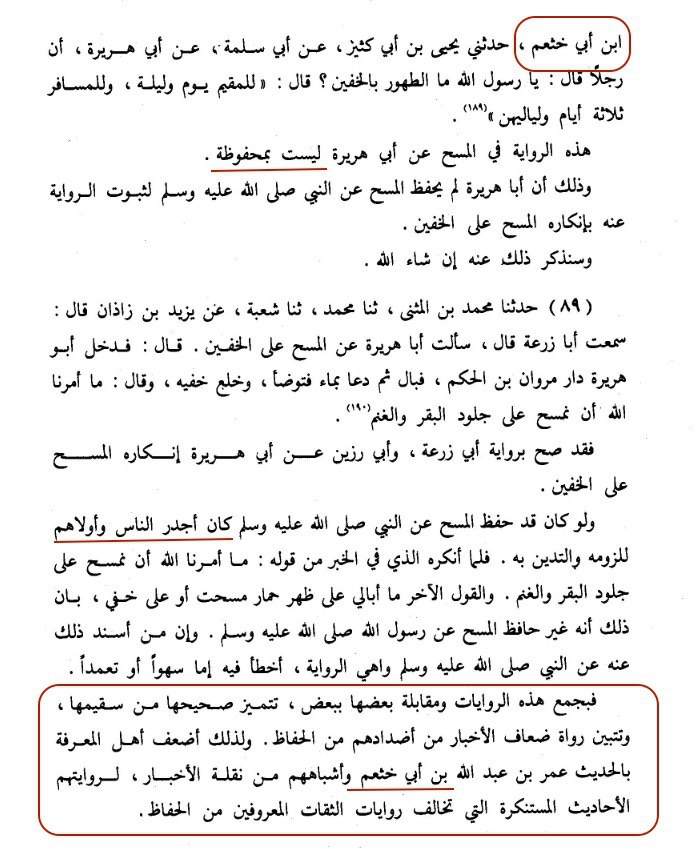
This Arabic scan is from Imam Muslim’s critical discussion. The underlined and boxed sections explain that the narration being examined is weak because Abu Hurayrah was not known to preserve the report about wiping over leather socks, and because the transmitted versions contradict each other. The boxed conclusion says these conflicting reports expose one another’s weakness, and that stronger reports from reliable memorizers are enough to show why hadith critics weakened such narrations and narrators.
The Words of the Muslims Themselves
“Between us and those people are the chains of standing.” — meaning: the chains of narration.
So praise be to God who has made us the nation of the chain of narration.
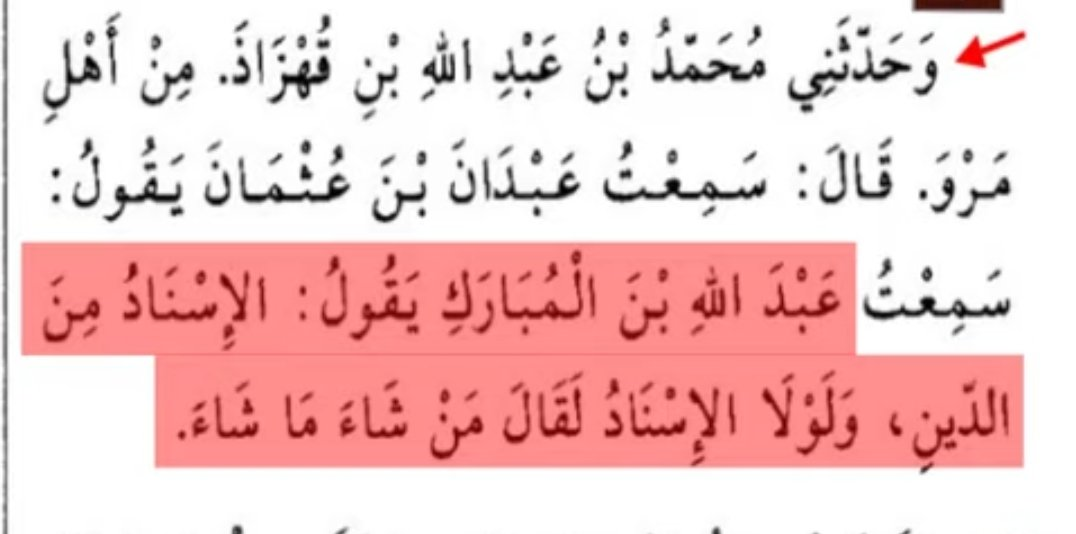
This Arabic scan quotes Abdullah ibn al-Mubarak. The highlighted statement says:‘The isnad is from the religion; were it not for the isnad, whoever wished would say whatever he wished.’ The meaning is that chains of transmission are not a decorative extra — they are the barrier that prevents people from inventing religious claims without proof.
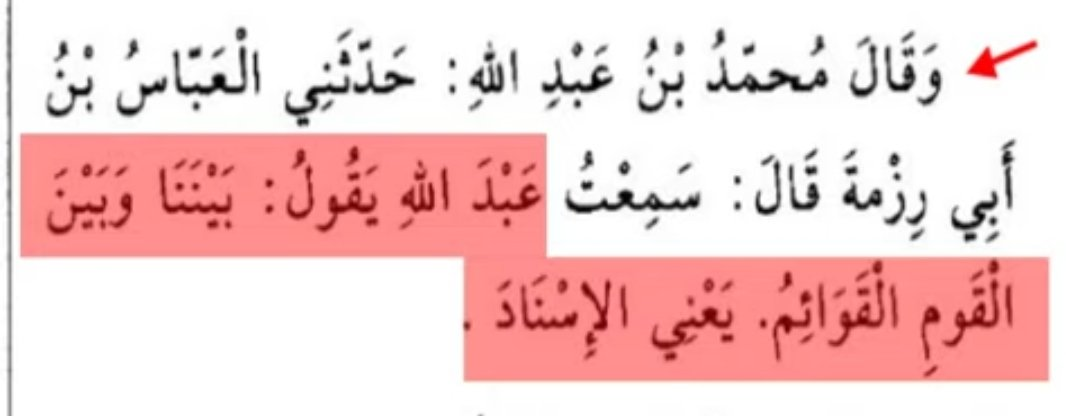
This Arabic scan quotes another statement from Abdullah ibn al-Mubarak. The highlighted text says that between the Muslims and others are the ‘supports’ or ‘pillars,’ and the scan explains that what he meant by those supports is the isnad. The point is that chains of narration are what distinguish verified religious transmission from unsupported claims.
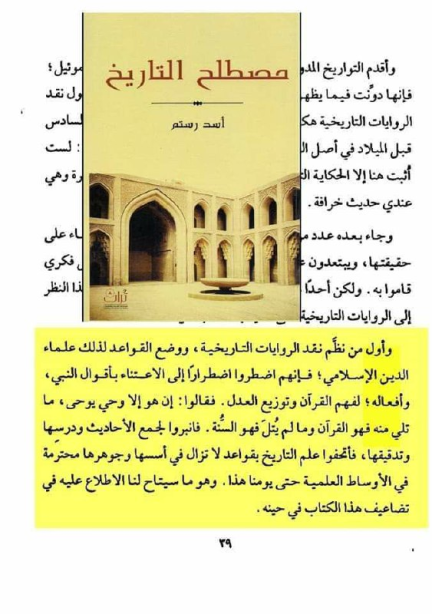
This Arabic scan shows Asad Rustum’sMustalah al-Tarikh alongside the same introductory passage. The highlighted text says that Muslim scholars were the first to organize the criticism of historical reports and set rules for it because they needed to verify the Sunnah. It emphasizes that they collected hadith, studied it, authenticated it, and produced principles of criticism that remained respected in scholarly circles.
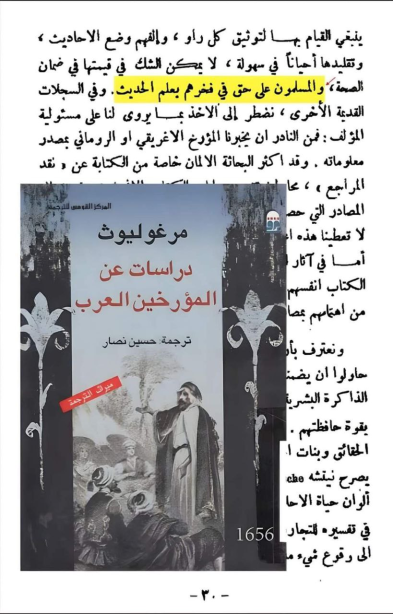
This Arabic scan shows the Arabic translation of Margoliouth’sStudies on Arab Historians. The highlighted passage says that, although the isnad method created difficulty because each transmitter had to be investigated and because fabricated reports existed, this does not remove the Muslims’ right to be proud of their concern for guaranteeing authenticity. The scan supports the point that even a hostile orientalist acknowledged the value of Muslim transmission criticism.
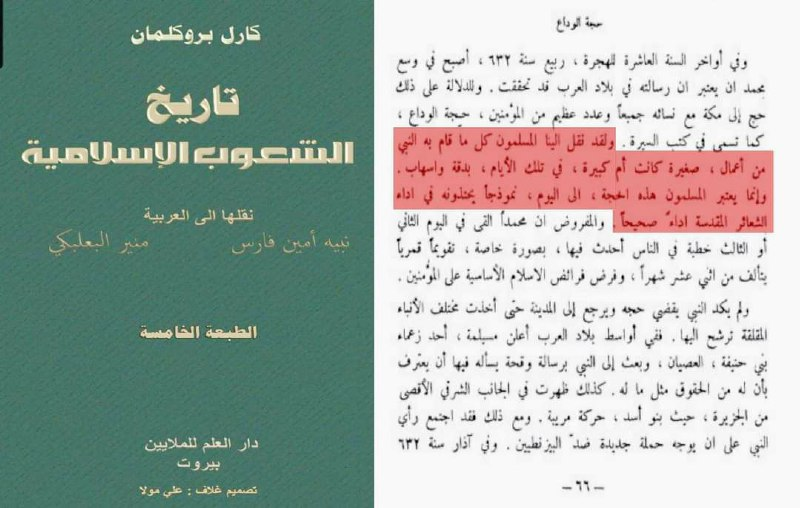
This Arabic scan repeats the Carl Brockelmann excerpt fromHistory of the Islamic Peoples. The highlighted passage says that Muslims transmitted every action and statement of the Prophet ﷺ, whether small or great, with seriousness and reverence, treating those reports as a sacred trust and preserving them in biographical and historical works.
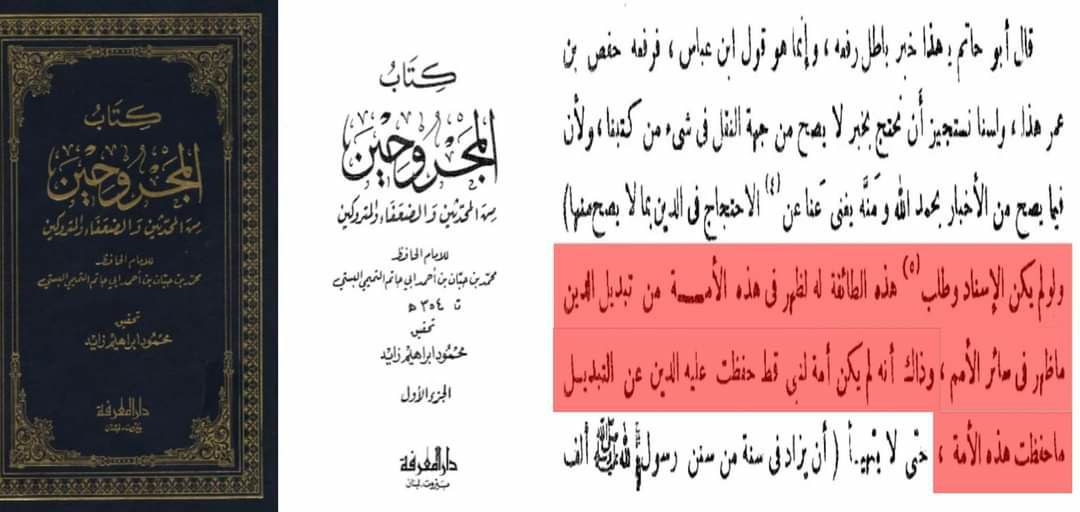
This Arabic scan is from Ibn Hibban’sal-Majruhin. The highlighted section discusses the scrutiny of narrators and the danger of accepting someone merely by outward appearance or reputation. It indicates that hadith critics examined what a narrator actually preserved and transmitted, especially when his reports conflicted with stronger evidence, rather than blindly accepting names without verification.
Conclusion — The Nation of the Chain of Narration
From Jewish historians to Christian academics, from German orientalists to British scholars — the unanimous testimony of those who studied Islamic hadith science is this:
| Scholar | Background | Verdict |
|---|---|---|
| Bernard Lewis | Jewish historian | Islamic historiography unrivaled in the West |
| David Margoliouth | Anti-Islam orientalist | Muslims right to be proud of hadith science |
| Reginald Bosworth Smith | British historian | We know Muhammad ﷺ as well as Luther or Milton |
| Asad Rustum | Lebanese Christian | Muslims first to systematize historical criticism |
| Maroun Abboud | Lebanese Christian writer | Agreed with Rustum’s full assessment |
| John Davenport | Orientalist | No figure’s history more authentic than Muhammad’s ﷺ |
| Carl Brockelmann | German orientalist | Muslims narrated with accuracy and detail |
| George Zidan | Arab Christian | Praised accuracy and strong memorization |
| Jacques Risler | French scholar | Hadiths went through much scrutiny |
| A.J. Arberry | British orientalist | Good reason to accept hadiths as substantially authentic |
| Aloys Sprenger | Austrian orientalist | Hadiths written by Companions themselves |
| William A. Graham | American scholar | Oral transmission protects Qur’an from distortion |
| Louis Schnitzer | Austrian orientalist | Astonished by al-Jarh wa al-Ta’dil |
| James Robinson | British orientalist | Admiration for Islamic documentation rigor |
The science of Isnad is a unique blessing Allah bestowed upon this nation — one of which every Muslim has every right to be proud.
“So praise be to God who has made us the nation of the chain of narration.”
This article is part of the OpenIslam Wiki — Defending the Sunnah series.
...te highlight. + Collapsible info (open by default) This is a collapsible info block, open by default. Click the chevron to collapse. - Collapsible tip (collapsed by default) This content is hidden...
...of current knowledge — not a proven refutation of a historical event. Islamic Evidence...