Thread About the Arab Identity of Iraq and the Euphrates Island
Chronologically Arranged Testimonies
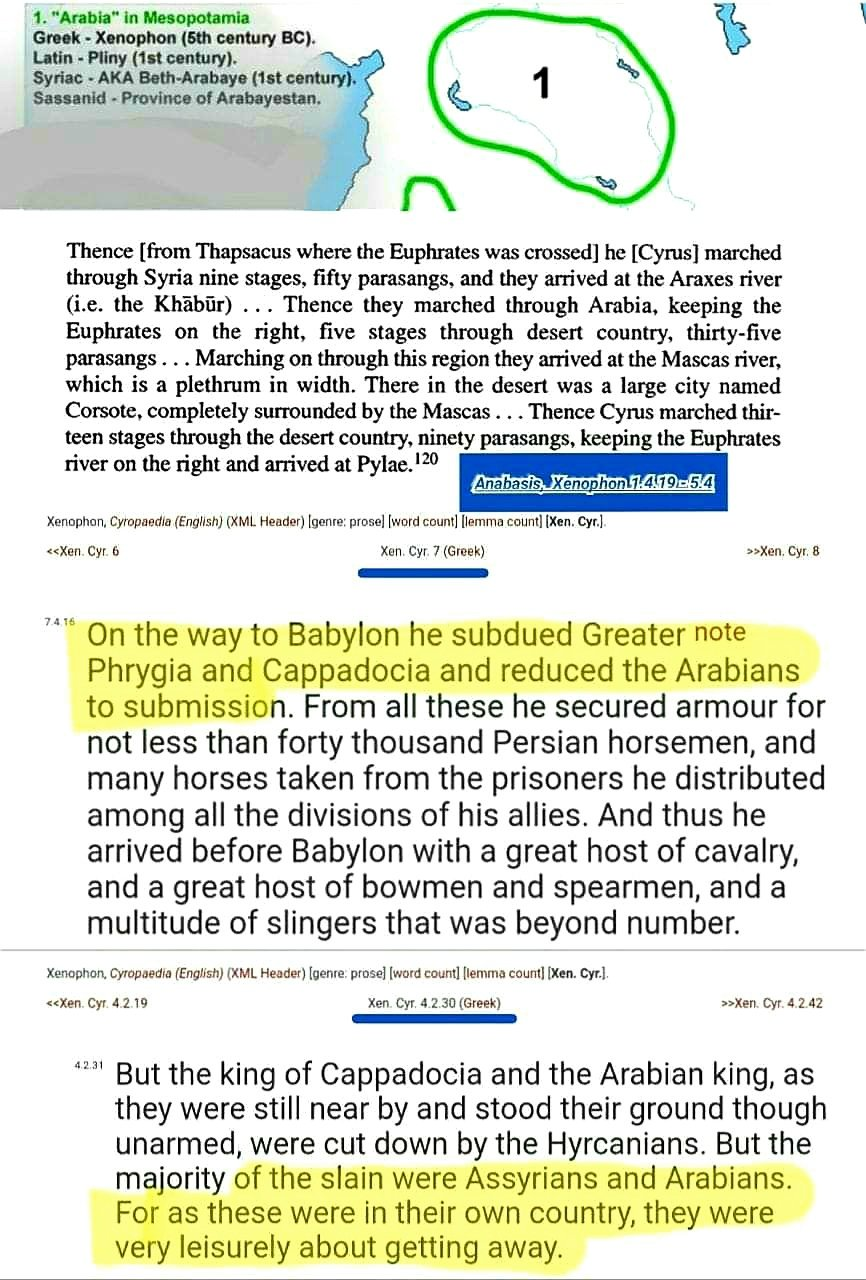
1 - Xenophon (from the 5th century BCE), historian of Cyrus the Younger’s campaigns, says about northern and central Iraq: that Cyrus the Younger subdued Cappadocia, then the Arabs, then Babylon, meaning that the Arabian region in Iraq separated Babylon from Cappadocia.
This implies that the land of the Arabs encompassed central and northern Iraq, as Xenophon’s division includes Cappadocia, then the Arabs, then Babylon, indicating the Arab identity of northern and central Iraq.
[ Chyropeadia 7.4.16 ]
Xenophon adds that Cyrus marched through Syria, then the Khabur (ancient Araxes), then through Arabia with the Euphrates on his right until he reached the city of Pylae (Hit today), then crossed into Babylon.
This means that the land of the Arabs ended at the city of Hit.
And that the land of the Arabs lies between the Khabur and Babylon.
[ Anabasis, Xenophon 1.4.19 - 5.4 - 7.1 ]
Xenophon further states that Cyrus fought the Cappadocians, Assyrians, and Arabs, and that most of the casualties were Arabs and Assyrians because the Arabs and Assyrians were on their own land.
[ Cyopaedia 4.2.31 ]
This means that northern and central Iraq were known as the Arabian Island, and most of their inhabitants were Arabs, whether non-Assyrian Arabs or Assyrian Arabs, with Arabs generally forming the majority of the population of northern and central Iraq.
And that the Arabs lived in the Euphrates Island, as evidenced by the Euphrates River bordering them on the right.
2 - Eratosthenes (from the 3rd century BCE) says about the Euphrates Island: that Arab tribes live on both sides of the Euphrates River (from northern to southern Iraq), and the leaders of these tribes enjoy independence and impose tributes on merchants.
This indicates that Arabs were the leaders and inhabitants of the Euphrates Island, which extends from Edessa and Nisibis to the borders of Babylon.
[ Strabo 16.1.27 ]
Eratosthenes adds that tent-dwelling Arabs spread across western Iraq, while others inhabit the Iraqi lands that extend southward and farther.
This land lies west of the Euphrates and forms western Iraq, including Anbar, Najaf, and Muthanna.
[ Strabo 16.1.26 ]
He also adds that the eastern side of the Euphrates marks the beginning of the Parthian state’s borders, while the western side of the Euphrates, extending to Babylon, marks the beginning of the borders of the Arab tribal leaders’ emirates and the Romans, with the Arabs being more inclined toward the Romans than the Parthians.
[ Strabo 16.1.28 ]
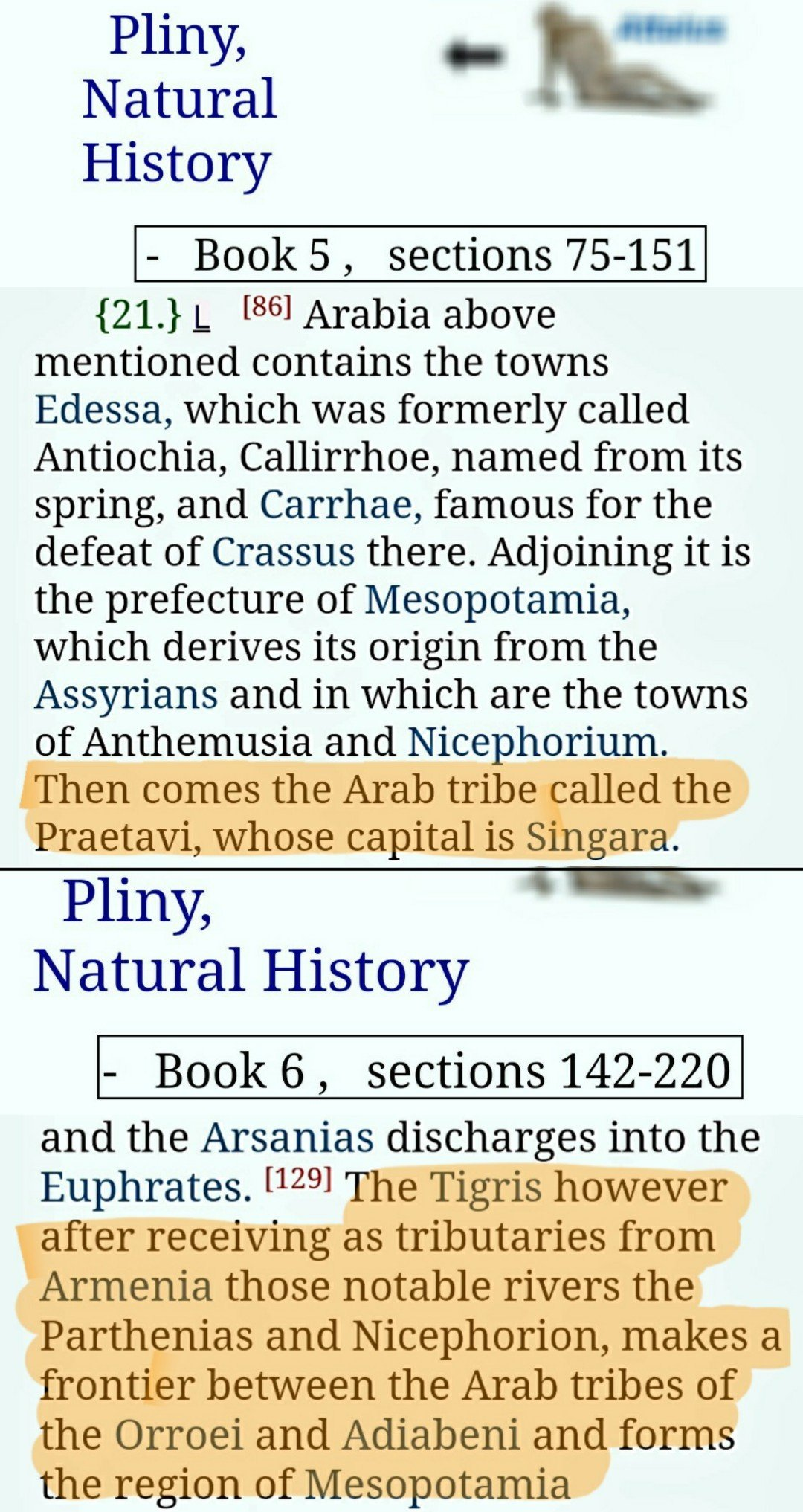
3 - Pliny mentions the existence of an Arab tribe in northern Iraq called the Pratavi, with their capital at Singara (Mosul), and Singara is located in the Euphrates Island, indicating a significant Arab presence in the Euphrates Island.
[ Pliny 5.86 ]
4 - The Roman emperor Claudius (1st century CE) wrote a book about the Tigris River and mentioned that eastern northern Syria and northern Iraq, or the Euphrates Island, are part of the lands of the Arabs.
This Roman emperor, who succeeded Caligula in the 1st century CE, states: that the Tigris River separated the Arab tribes of the Adiabene emirate from the Arabs of Edessa.
It can be understood from Claudius’s words that the western region of Adiabene was Arab land, with its boundary ending at the western bank of the Tigris River, which separated it from the land of the Edessan Arabs.
Meanwhile, the region inhabited by the Edessan Arabs extended from the eastern bank of the Tigris to the area of Harran and Edessa on the Euphrates in northern Syria, debunking the myth of the presence of Kurds in that region, i.e., northern Iraq and eastern northern Syria, at that time.
[ Pliny 5.86 / 6.129 ]
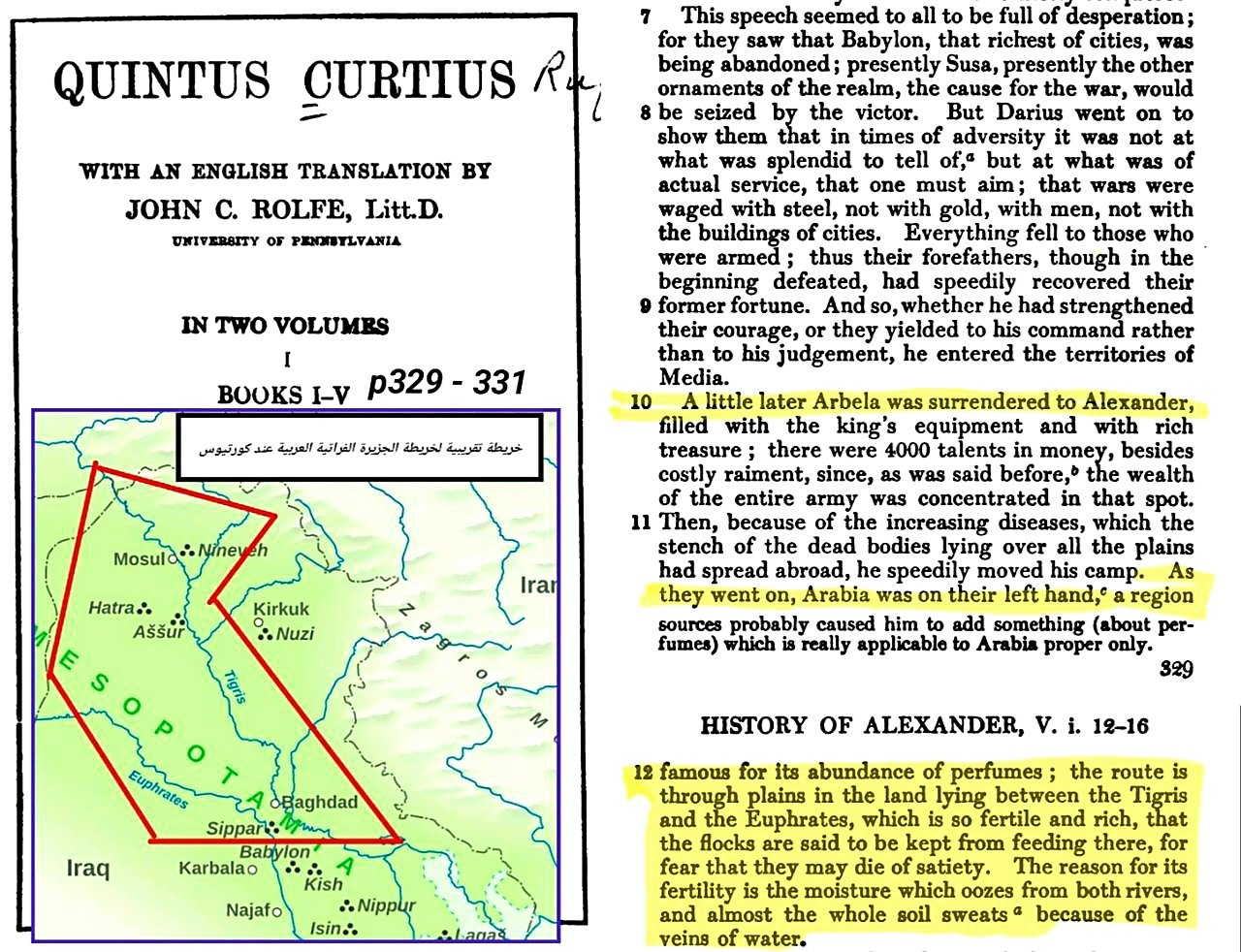
5 - Curtius says that after Alexander conquered the city of Erbil, the Arabian Euphrates Island was on his left, and the Euphrates Island, known as the land of the Arabs, lay between the Tigris and Euphrates Rivers. His exact words are:
As they advanced (after conquering Erbil), the Arabian Island was on their left, a region famous for its abundance of perfumes. The route was through the plains in the (Arabian) land between the Tigris and Euphrates, which is so fertile and rich that it is said the herds are prevented from grazing there for fear they might die of overfeeding. The reason for its fertility is the moisture exuded from both rivers. Then Alexander conquered Babylon. End.
Curtius’s text makes it clear that when Alexander left Erbil with his army, the Arabian Euphrates Island was on the left of the city of Erbil. Alexander then crossed a route through the Arabian Euphrates Island, located between the Euphrates and Tigris, to continue his conquest of the remaining regions, indicating that the land extending from northern Iraq to Ctesiphon or al-Madain, lying between the Euphrates and Tigris, was Arab land.
Thus, Curtius’s text clarifies that the land extending from the borders of Erbil in the east to the Euphrates in the west, and then to the borders of Babylon in the south, was called the land of the Arabs in Alexander’s time, according to Curtius’s text.
This is evidenced by the fact that when Alexander wanted to conquer Babylon, he went and occupied Erbil, and the Arabian Euphrates Island began from the left of Erbil’s borders, from the Tigris to the Euphrates. Then, when Alexander crossed Babylon and its borders and occupied it, he was no longer in the Arabian Euphrates Island but in the land of Babylon.
[ Quintus Curtius 5.1.11-12 / Quintus Curtius vol 1 p329 - 331, The Loeb Classical Library ]
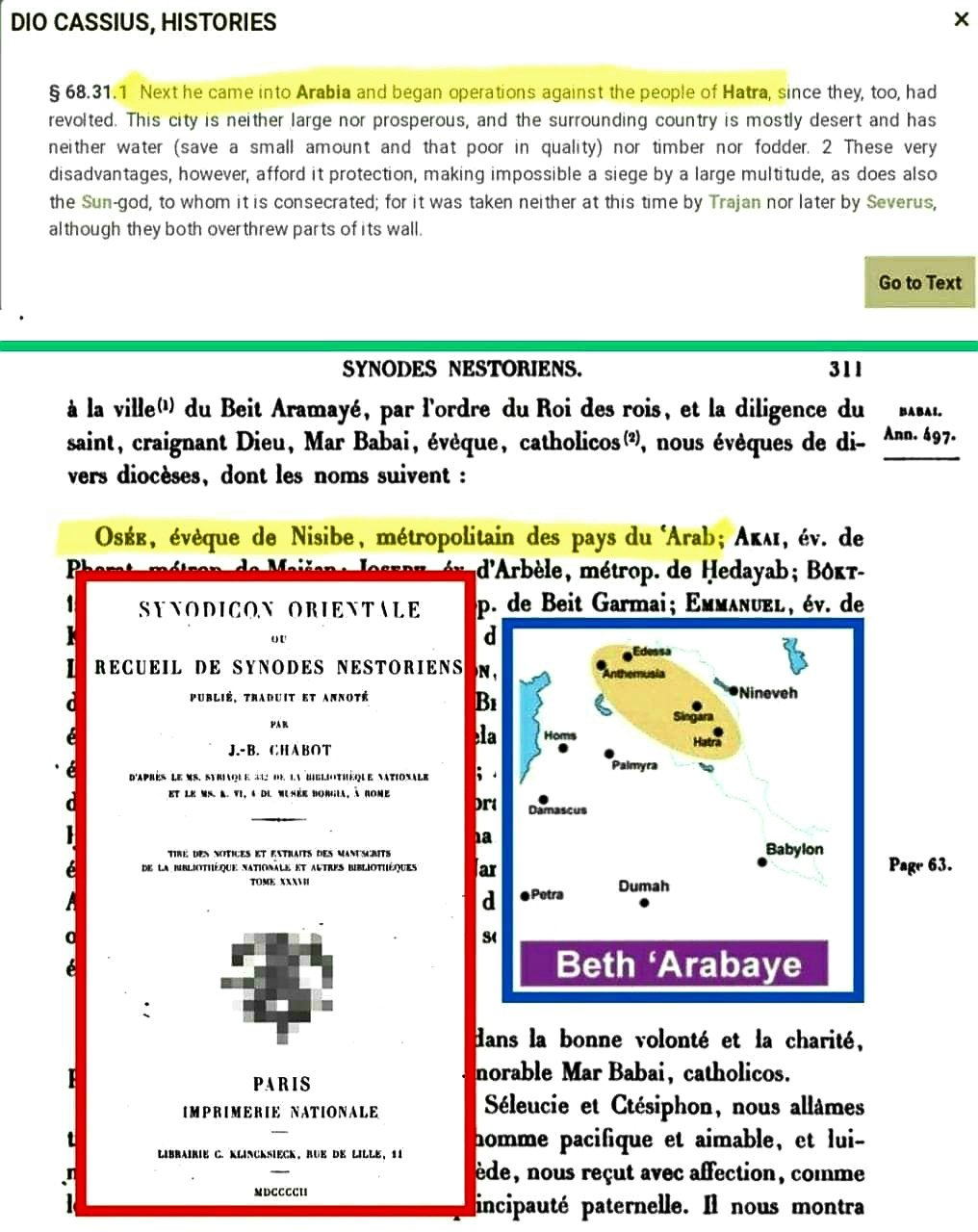
6 - Cassius Dio (3rd century CE) called northern Iraq the land of the Arabs, stating: He went to the Arabian Island and fought the people of Hatra.
Cassius’s words indicate that the Euphrates Island is Arab land.
[ Cassius Dio 68.31.1 ]
7 - In Syriac sources, Beth Arbaye, a ecclesiastical region encompassing most of northern Iraq and parts of southeastern Turkey, is described as having Arab inhabitants, with its people being Arabs, as is well-known, who settled there since the Assyrian era. This land was known as the land of the Tanukh after the advent of Christianity, forming northern Iraq.
[ Gorgias Encyclopedic Dictionary of the Syriac Heritage: Electronic Edition, Beth ʿArbaye ]
8 - In the Nestorian Synod of 497, the metropolitan of the lands of northern Iraq and southeastern Turkey, with its capital at Nisibis, was called the metropolitan of the land of the Arabs.
Nisibis is an ancient city located in Mardin Province, southern Turkey, and this testimony indicates the Arab identity of northern Iraq and parts of Turkey before Islam.
[ Synodicon orientale p311, Paris 1822 ]
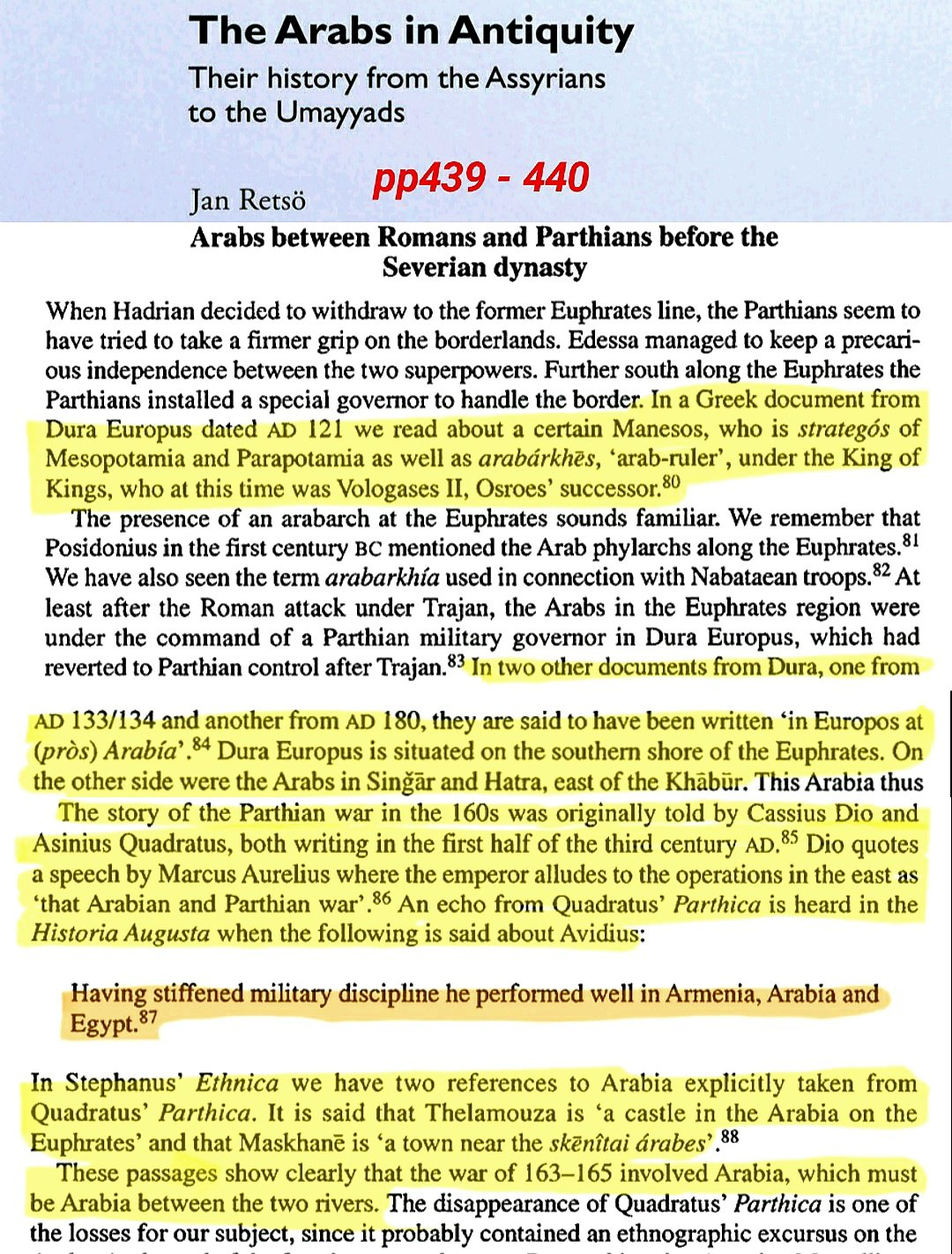
9 - A Greek document from the city of “Dura Europos” in the Syrian desert, dated to 121 CE, mentions the “ruler of the Arabs - Arabarches” in that region, stating that he was subject to the Parthian King of Kings “Vologases II.”
10 - In two Greek documents from “Dura Europos” in the Syrian desert, one written in 133 CE and the other in 180 CE:
Both documents state that they were written in the city of “Dura Arabus - Europos pros Arabia.” It is most likely that the word Arabus transformed into Europos.
This supports the notion that the Euphrates Island (Jazira) was called the land of the Arabs.
11 - Information about the Roman-Parthian War that took place between 161-166 CE has reached us primarily through the writings of the historian “Cassius Dio.” The Roman historian recorded a speech delivered by the Roman Emperor “Marcus Aurelius,” in which Aurelius described the Roman-Parthian wars as the “Arab-Parthian Wars.” By “Arab,” he meant the land located between the Tigris and Euphrates, i.e., the Euphrates Island, which was the main battlefield.
12 - The Greek historian “Asinius Quadratus” (in the 3rd century CE), another chronicler, wrote about the Roman-Parthian War that occurred between 161-166 CE. He mentioned the achievements of the main Roman general in this war, “Avidius Cassius.” While describing his accomplishments, he listed the regions where he fought as follows: After strengthening military discipline, he performed well in Armenia, Arabia (the Euphrates Island), and Egypt.
13 - The Byzantine historian “Stephanus of Byzantium” in the 6th century CE referred to the Euphrates Island twice in his book “Ethnica”:
In the first reference: “It is said that Thelamuza is a fortress in Arabia on the banks of the Euphrates.”
In the second reference: “Maskhane (Masqani?) is a city near the nomadic Arabs, Skenitai Arabes.”
[ The Arabs in Antiquity p439 - 440 ]
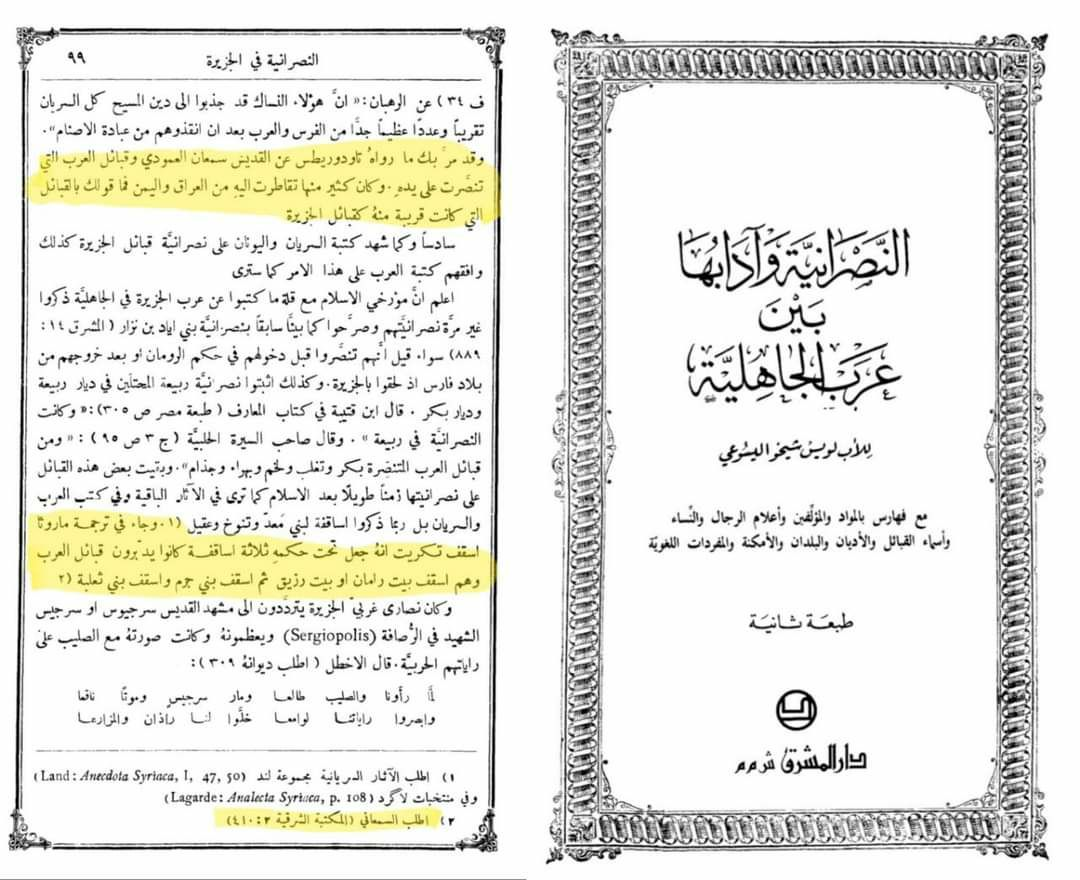
14 - The Christian historian known as Al-Sam’ani mentions that, according to the chronicles of Marutha, Bishop of Tikrit, the Arabs filled the Euphrates Island. He noted that Marutha appointed three Arab bishops over Arab tribes to oversee their affairs, indicating that the Euphrates Island was predominantly Arab and filled with Arabs.
Theodoret, Bishop of Cyrrhus, recounted that the Arab tribes filled Iraq and had converted to Christianity in the 4th century CE.
[ Christianity and Its Literature - Louis Cheikho, Vol. 1, p. 99 ]
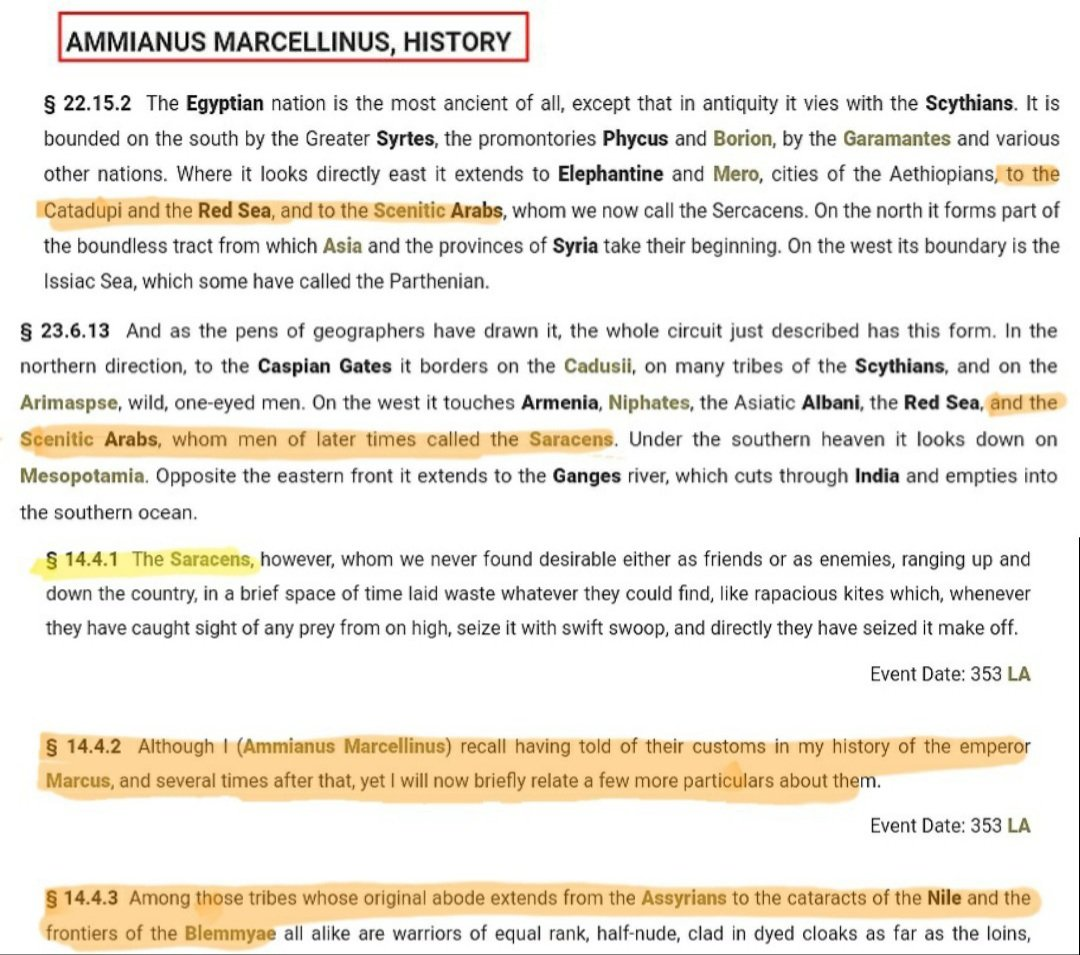
15 - The Roman historian Ammianus mentions that the tent-dwelling Arabs, whom people in later ages called Saracens,
[ AMMIANUS MARCELLINUS 22:15:2 / 23:6:13 ]
Ammianus also stated that the borders of the Saracen Arabs extended from the Assyrians, i.e., from the Tigris, to the Nile in Egypt,
meaning that their land encompassed all the territories west of the Tigris in Iraq, the Levant, and eastern Egypt up to the Nile, and that the Arabs were the indigenous inhabitants of the Levant and Iraq.
[ AMMIANUS MARCELLINUS 14.4.1-3 ]
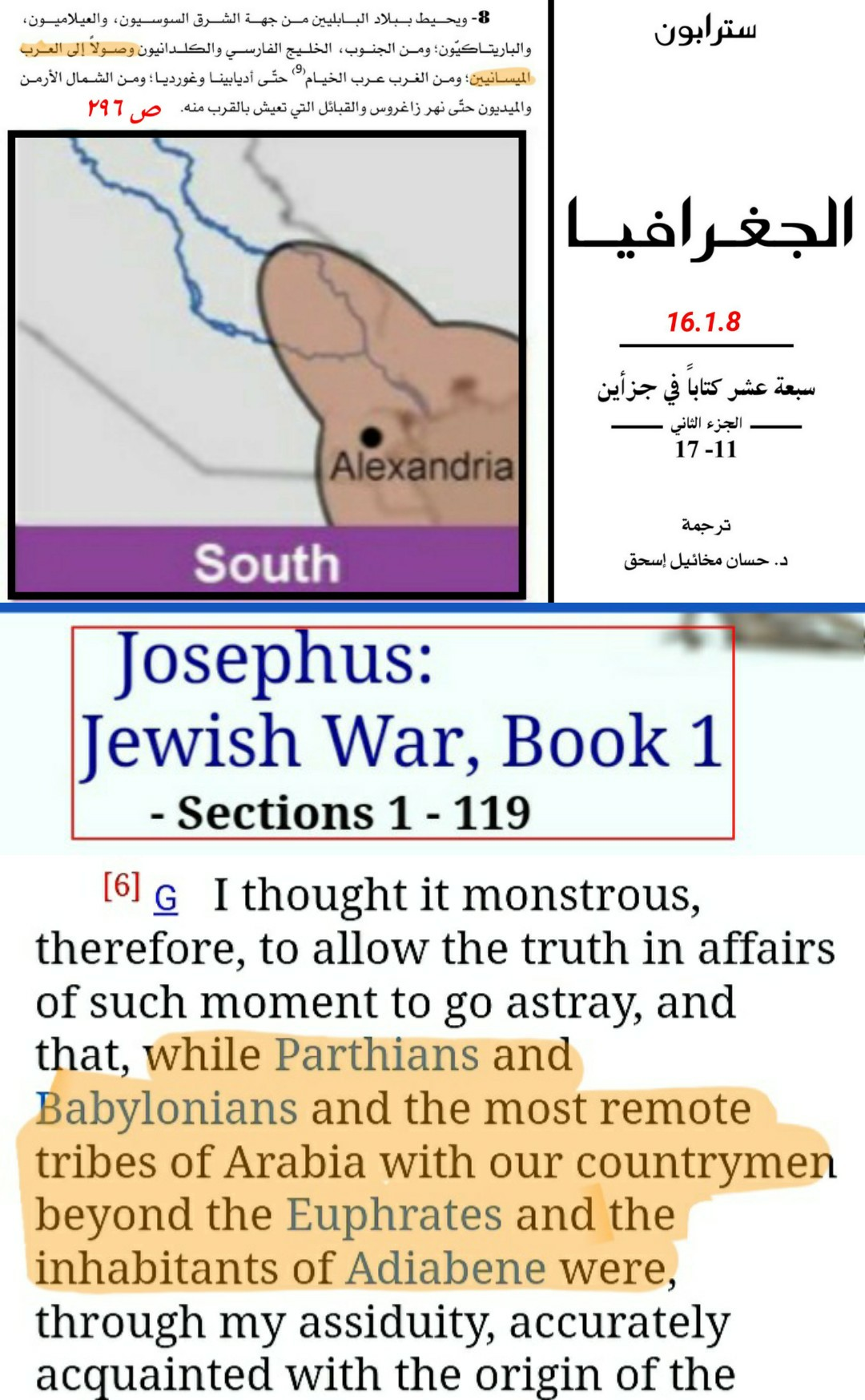
16 - The Jewish historian Josephus spoke about the inhabitants of Iraq during the Parthian era,
who were the Parthians, then the Babylonians in Babylon (a mix of Arab and non-Arab peoples), followed by Arab tribes and some Israelites in Adiabene and beyond the Euphrates, i.e., the regions of central and northern Iraq.
This confirms the Arab character of the lands of the Euphrates Island and Iraq.
[ Josephus the war 1.2 / the Loeb vol 2 p5 ]
17 - The historian Strabo, in his “Geography,” mentions that the people of Maysan, the inhabitants of the western and central regions of Babylonia, were Arabs. His exact words about them were “the Maysanian Arabs,” indicating that Arabs formed the vast majority in most of Babylonia, which supports the Arab character of Babylonia.
[ Strabo 16.1.8 ]
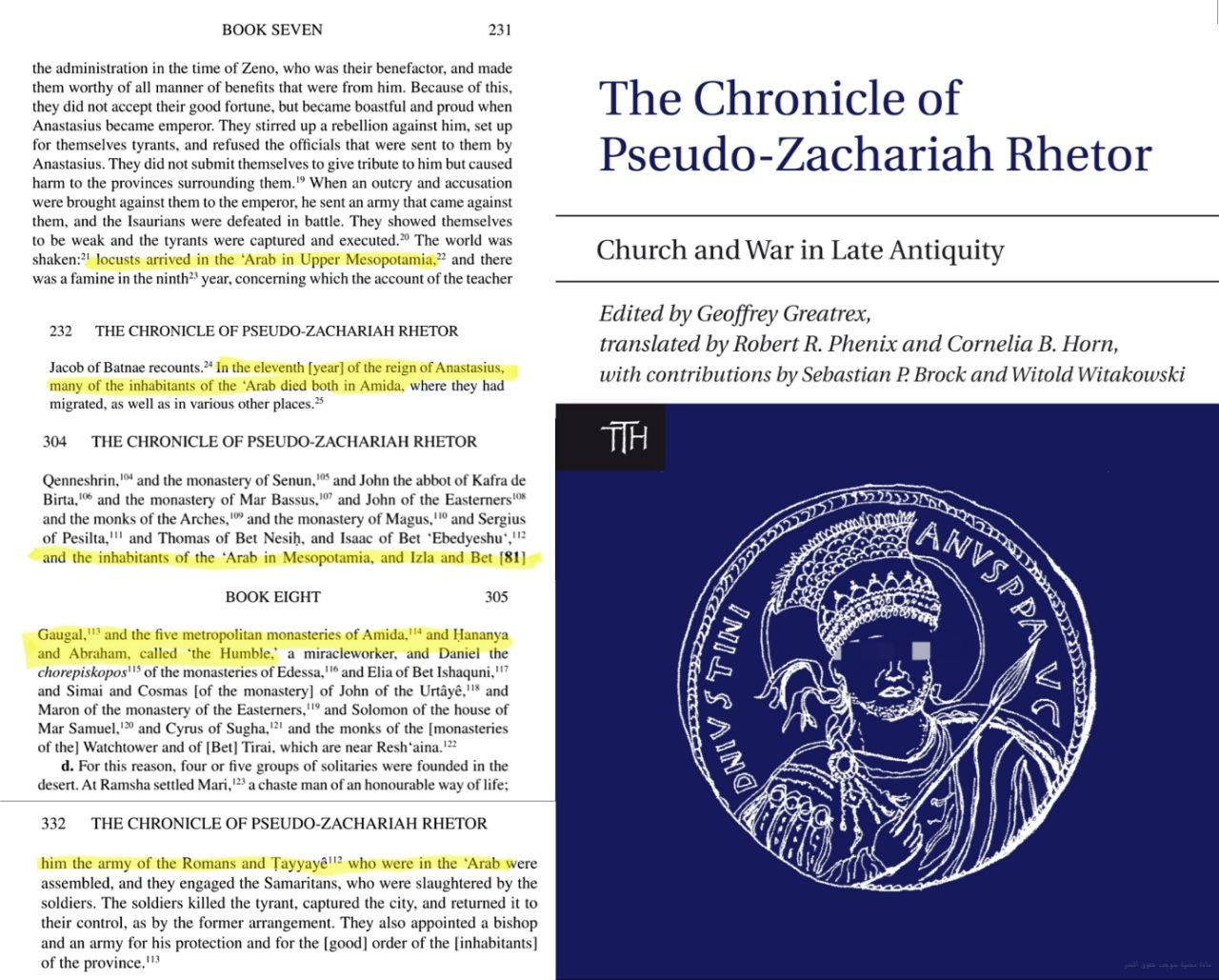
18 - The historian Zachariah al-Khatib, who was a bishop of Gaza, mentions that the Arabs are the inhabitants of Mesopotamia and Upper Euphrates Island.
Zachariah al-Khatib (6th century AD) states that the Arabs are the inhabitants of Mesopotamia and Upper Euphrates Island and its cities, from Amida and the mountains of Upper Euphrates Island, such as Tur Abdin (Mount Izla and Beit Ghujal).
This is an important reference indicating that the northern Syrian regions in Turkey were Arab, meaning that most of the people of Euphrates Island were Arabs, according to what Zachariah al-Khatib reported.
[ The Chronicle of Pseudo-Zachariah Rhetor , Church and War in Late Antiquity pp 231 - 232 - 304 - 305 - 332 ]
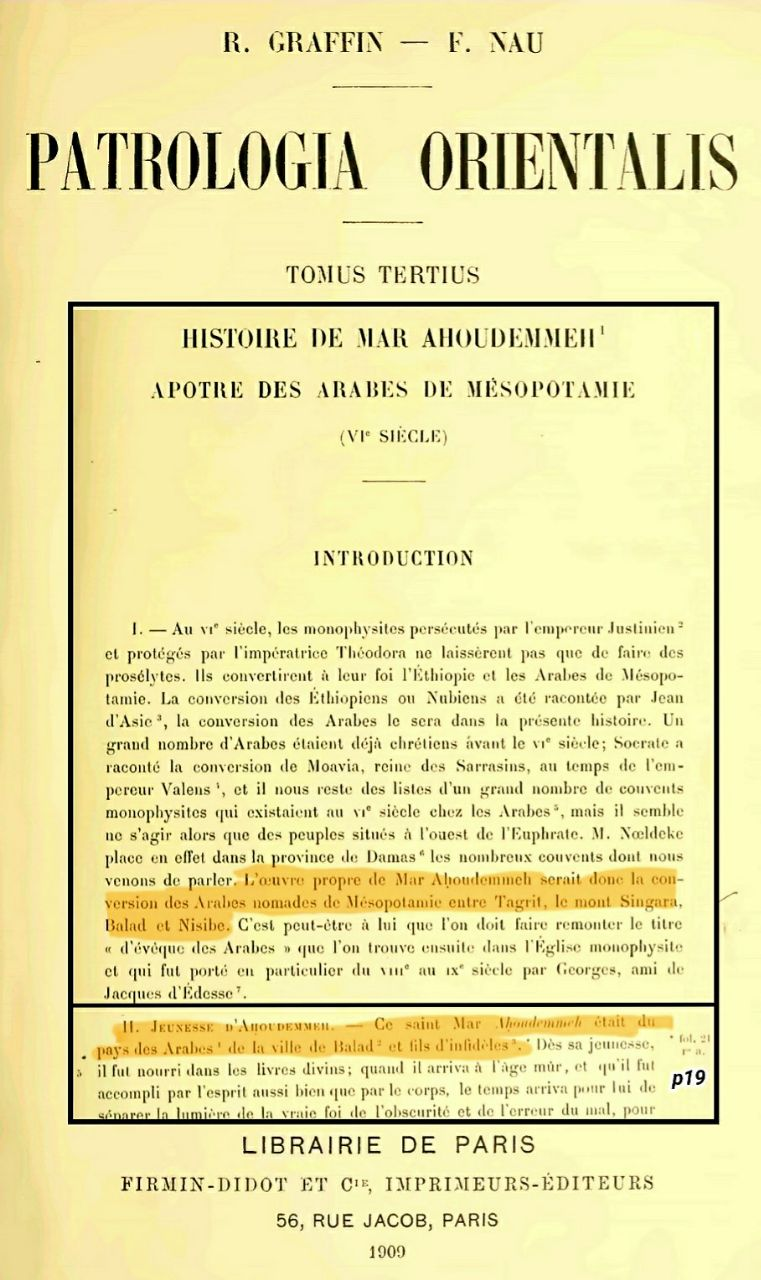
19 - Finally, another Syriac source mentions a biography of a man named Mar Ahudemmeh, a Christian Syriac Arab monk whose origin is Arab from the city of Balad in present-day Iraq. He belonged to the Syriac Christian Church and lived in the 6th century AD. The inhabitants of the lands of Balad, Tikrit, Mount Sinjar, and the lands of Nisibis or Arbayā were affiliated with the Arabs. Ahudemmeh called them to Christianity, and they converted.
Ahudemmeh’s words are an Arab testimony in the Syriac language about the abundance of Arabs in Euphrates Island.
[ Patrologia Orintalis vol 3 p 1 , p19 ]
The thread is complete, praise be to God.
ADDITION
The Arabs in Iraq and the Arab Identity of Iraq from Archaeological Inscriptions
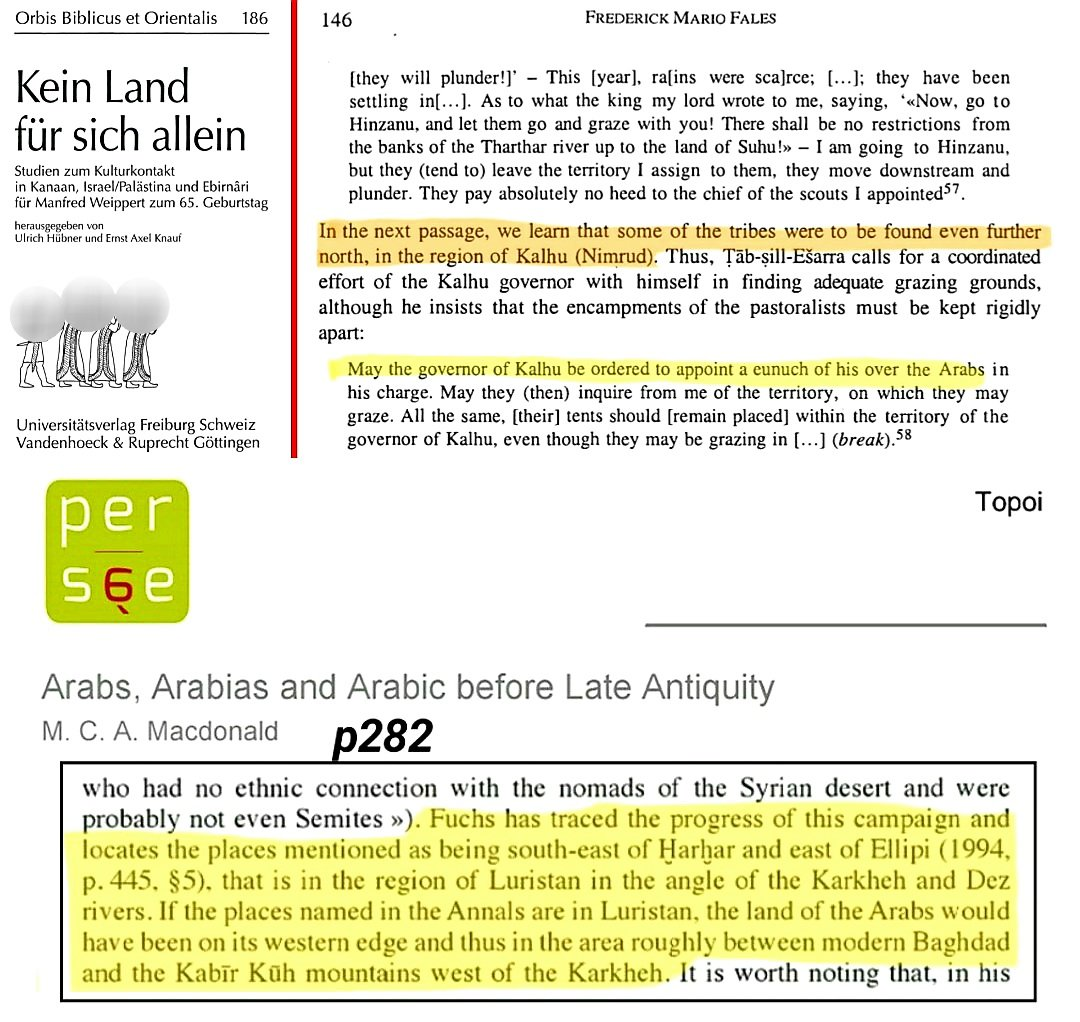
1 - The Arabs are mentioned in northern Iraq in an Assyrian text from the eighth century as inhabitants of the city of Kalhu / Nimrud, which is Al-Hamdaniya today
[ Kein Land für sich allein, herausgegeben von Ulrich Hübner und Ernst Axel Knauf p146 ]
2 - Central Iraq is described in Assyrian inscriptions as the land of the Arabs
The land of the Arabs in central Iraq during the Assyrian period extended from a large mountain in Iran to the city of Baghdad in Iraq
It is stated in the inscriptions of Sargon that in 713 BC, the Assyrian king Sargon II launched a campaign in the Zagros Mountains against the Median peoples located on the eastern borders of the land of the Arabs, according to the annals
[ The royal inscriptions of Sargon II king of Assyria (721-705 BC) p p93 ]
This is an indication of an Arab presence in the area currently located between Baghdad and a large mountain - in Persian: Kabirkuh - in Ilam province west of the Karkheh River, meaning that central Iraq as a whole was Arab during the Assyrian period
[ Arabs, Arabias and Arabic before Late Antiquity, M. C. A. Macdonald p282 ]
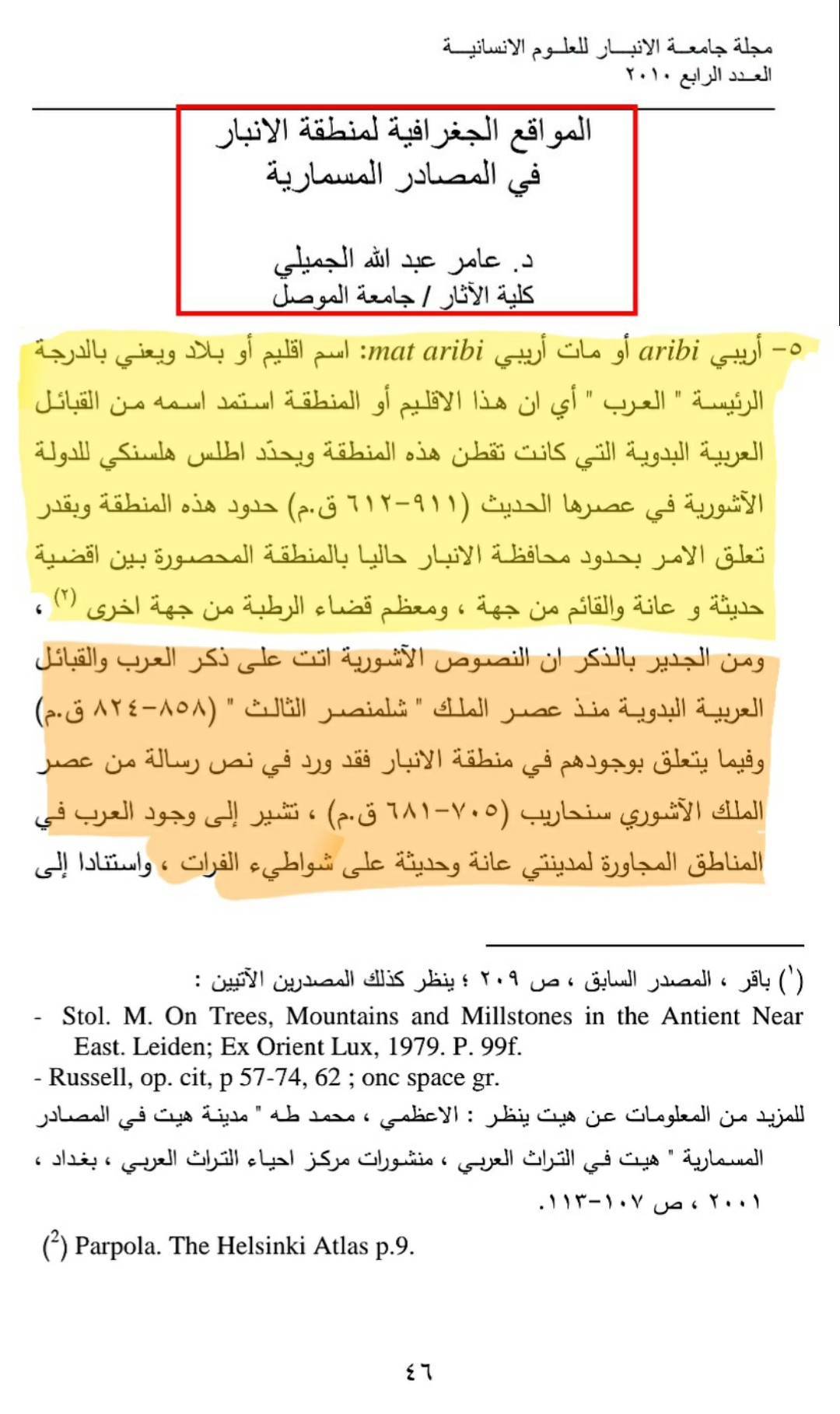
3 - In Assyrian inscriptions, most areas of Anbar are classified as lands inhabited by Arabs, where the lands of the Arabs in Anbar included the districts of Ana, Al-Qaim, Haditha, and Al-Rutba
[ The Geographical Sites of the Anbar Region in Cuneiform Sources, Dr. Amer Abdullah Al-Jumaili p 46 ]
4 - The letters of “Tab-sil Ishara,” an Assyrian official, indicate that the Arabs had a strong presence in the area extending from Sippar in the south (near Baghdad today) to the Tharthar River in the north (near the ancient city of Ashur itself)
This means that the Arabs were prominently spread in that area and in the vicinity of its cities
[ Early Assyrian Contacts with Arabs and the Impact on Levantine Vassal Tribute, RYAN BYRNE P14 ]