Was Pharaoh’s Divinity in the Qur’an Copied from the Midrash? A Chronological Refutation
Was Pharaoh’s Claim to Divinity in the Qur’an Taken from the Midrash?
- Introduction
- The Atheist Claim
- The Importance of 1905
- First The Verses of Exodus Rabbah
- Exodus Rabbah as a Late Redaction
- Brannon Wheeler’s Response
- Second The Tanhuma Literature
- The Preemptive Atheistic Patch
- Abraham Ophir Shemesh and the Medieval Interpretation
- Later Jewish Material and Islamic Influence
- The Problem With Rabbi Ishmael’s Mekhilta
- Ezekiel 29 3 Is Not About the Pharaoh of Moses
- Sources and Scan Evidence
- Conclusion
Introduction
We all know that the Quran is the first book to mention Pharaoh’s claim to divinity to Moses, despite the absence of any texts in the Quran’s time that mention this news.
This information is not even found in the Bible. The Quran makes Pharaoh’s claim to divinity the main focus of the Quranic story, while the Bible does not mention this; it only mentions Pharaoh’s torture of the Children of Israel.
This news confirms the truth of the prophecy and afflicts the hearts of mentally ill atheists with sleeplessness, especially after it was confirmed by evidence and inscriptions that were discovered in the twentieth century, specifically the beginning of 1905 AD.
They focused on this date 1905 because it is very important.
The Atheist Claim
The ignorant atheists quickly ran to say that this information is found in the Madras and that the Prophet ﷺ heard it from the following Madras:
“Why did Pharaoh go to the waters early in the morning? Because the wicked one boasted that since he was a god, he had no need to go to the water to relieve himself”.
“Why did he go out to the water in the morning? Because the wicked man was boasting of himself, for he had said that he was a god and did not go out to relieve himself. Therefore, he went out in the morning, in the hour when he Moses could surprise him Pharaoh while easing himself”.
“Pharaoh called himself a god, viz. Ezekiel 29:3 Mine is my river the Nile, and I have made it”.
The Aggadic Matrix are simply texts added as sermons and oral interpretations of the Old Testament written by commentators over different periods.
Fasten your seatbelts while we teach a lesson to the ignorant atheists who copied this from Christian pages and teach them exactly where they copied it from.
The Importance of 1905
We remind you of the previous date, which is the beginning of 1905 AD, when Egyptologists such as David B. Silverman, the Dutch Egyptologist and archaeologist Henry Frankfort, and others declared that Pharaoh had indeed established himself as a god and legislated for the Egyptians what other gods they worshipped.
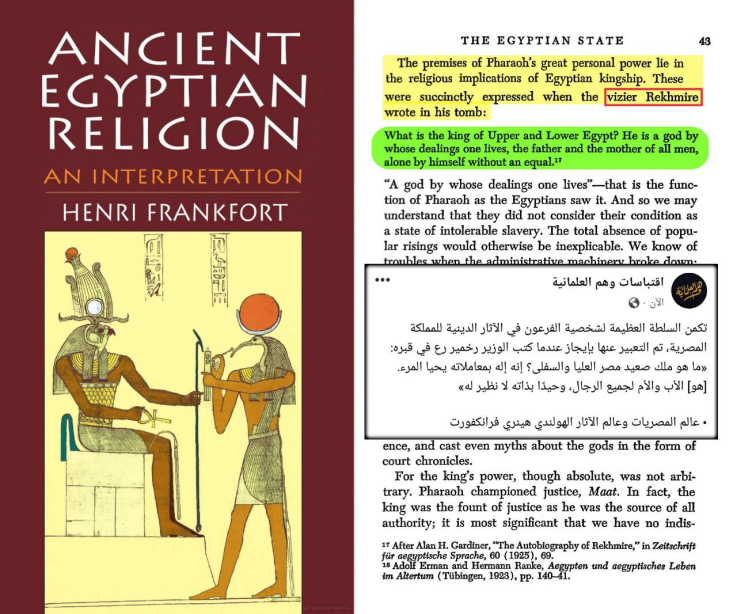
This scan showsHenri Frankfort’s Ancient Egyptian Religion: An Interpretation. The highlighted section says that Pharaoh’s great personal power had religious implications and cites the tomb of the vizier Rekhmire, where Pharaoh is described as a god by whose dealings one lives, the father and mother of all men, and one who exists alone without equal. The Arabic note explains that Egyptologists such as Henry Frankfort discussed the enormous religious status of Pharaoh in Egyptian thought. The point of the scan is that Pharaoh’s divine status was not merely a later Jewish or Christian legend; Egyptological material itself shows that the Egyptian king could be treated in divine terms.
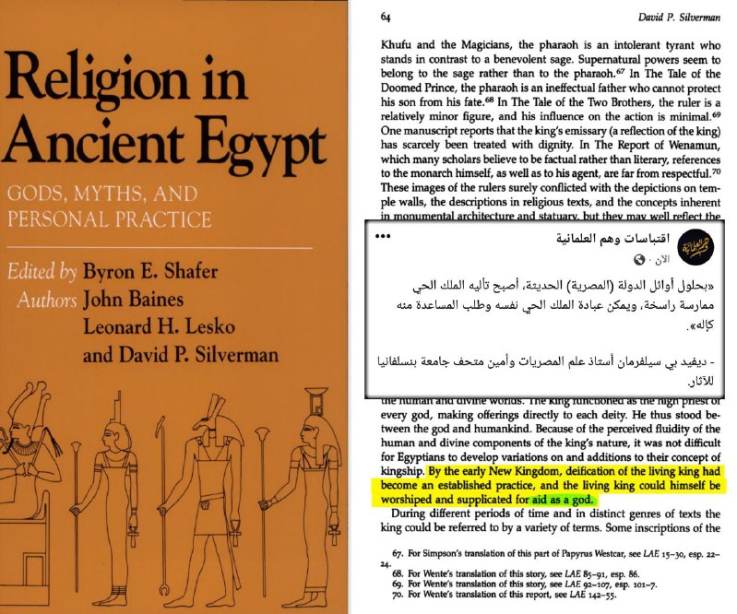
This scan showsReligion in Ancient Egypt: Gods, Myths, and Personal Practice, edited by Byron E. Shafer, with contributors including John Baines, Leonard H. Lesko, and David P. Silverman. The highlighted passage says that by the early New Kingdom, the deification of the living king had become an established practice, and that the living king himself could be worshipped and supplicated for aid as a god. The Arabic note summarizes that Pharaoh saw himself as the living divine king, practiced religious dominance, and could be treated as a source of aid. This directly supports the argument that Pharaoh’s claim to a divine status is historically plausible from Egyptian evidence.
After this shocking discovery, Frederick Charles Copleston, a source for the atheists, appeared to patch up this issue around 1960 AD in his book Jesus Christ or Mohammed, and stated that the Prophet ﷺ took it from the Matrix of Exodus from Raba, as in the image in his book.
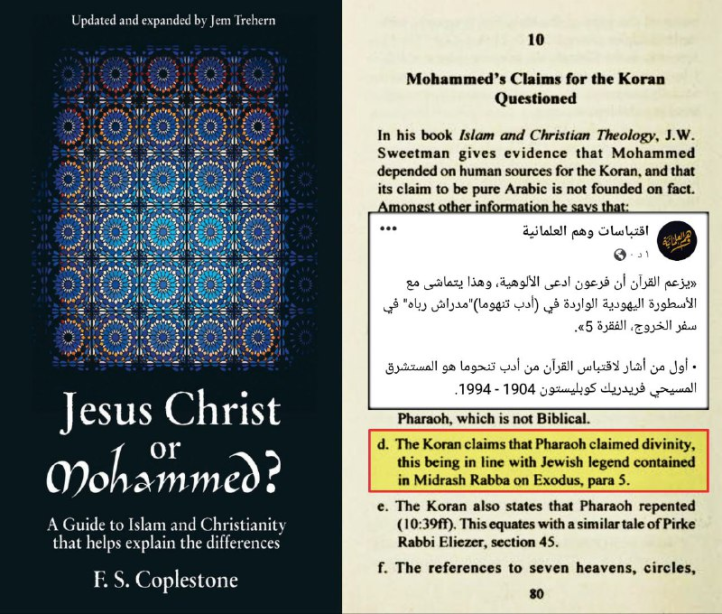
This scan showsF. S. Coplestone’s Jesus Christ or Mohammed?. The highlighted line states that the Qur’an’s claim that Pharaoh claimed divinity is not Biblical, and that it is supposedly in line with a Jewish legend contained in Midrash Rabbah on Exodus. The Arabic note says that the first person to claim that the Qur’an borrowed this idea from Jewish legend in Exodus Rabbah was the Christian orientalist Frederick Coplestone around 1960. This scan is important because it identifies the modern origin of the borrowing claim used by later Christian and atheist polemicists.
They emphasized here that the first to point out that the Qur’an quoted the divinity of Pharaoh “Midrash Exodus Rabbah” was the Christian orientalist Copleston, after the appearance of hieroglyphic inscriptions that prove this, as a patchwork attempt that no one before him had done.
Then the atheists took it from Christian pages and copied and pasted it to his claim, while the orientalists before his time, such as Abraham Geiger and Nöldeke, founders of the borrowing thesis, believed that Pharaoh’s claim to divinity was originally a mistake on the part of the Prophet ﷺ, and he confused the matter with Nimrod’s claim to divinity.
This was due to the information not being mentioned in the entire Bible.
Fasten your seatbelts now and let’s discuss the verses that they claimed the Qur’an copied from.
First The Verses of Exodus Rabbah
Consider with me carefully to learn why we call it shock.
In the sixteenth century and before the discovery of evidence of Pharaoh’s claim to divinity, specifically in the year 1225 AD, the likes of the great Jewish rabbi Nachmanides in the thirteenth century declared:
“The composition of these schools, from which they claim the Prophet took, was formed no later than the beginning of the thirteenth century.”
Then you find the Jewish Rabbi Leopold Sonz, an expert on Jewish midrash, in his book Die Gottesdienstlichen Vorträge der Juden, simply stating that the entire Midrash of Exodus Rabbah took its final form in the eleventh or twelfth century.
The Jewish rabbis, before the discovery of evidence of Pharaoh’s divinity before the twentieth century, originally acknowledged that these midrash date back to between the tenth and thirteenth centuries.
Then Copleston and other Orientalists came to us in the twentieth century and patched it up after the discovery of hieroglyphic inscriptions.
Exodus Rabbah as a Late Redaction
While the Exodus of Rabba’s midrash to which Copleston refers is originally a revision of the Tanhuma Yelammedenu literature, as the Oxford Encyclopedia of Judaism states in its entirety:
“The Midrash of Exodus Rabbah is a relatively late, tenth-century redaction of midrashic material often found in the Midrash Tanachoma to Exodus… This midrash was first cited by Spanish authors in the thirteenth century.”
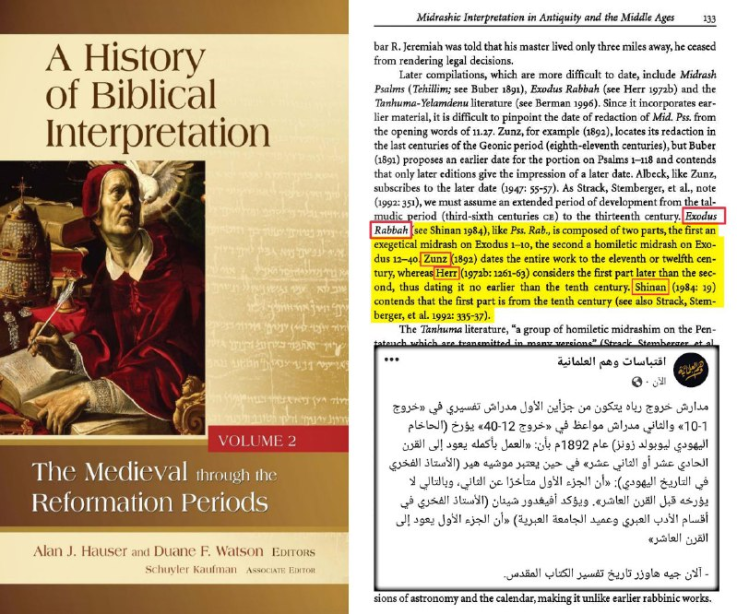
This scan is fromA History of Biblical Interpretation, Volume 2: The Medieval through the Reformation Periods. The highlighted text discusses the difficulty of dating later rabbinic compilations and states that Exodus Rabbah is composed of two parts. The first part is exegetical midrash on Exodus 1–10 and is dated to around the tenth century, while the second part is from the tenth century according to one scholarly view. It also says the first part is taken from the tenth-century work of Samuel ben Joseph. This supports the claim that Exodus Rabbah, in the form being appealed to, is not safely pre-Islamic and cannot simply be assumed to be a source for the Qur’an.
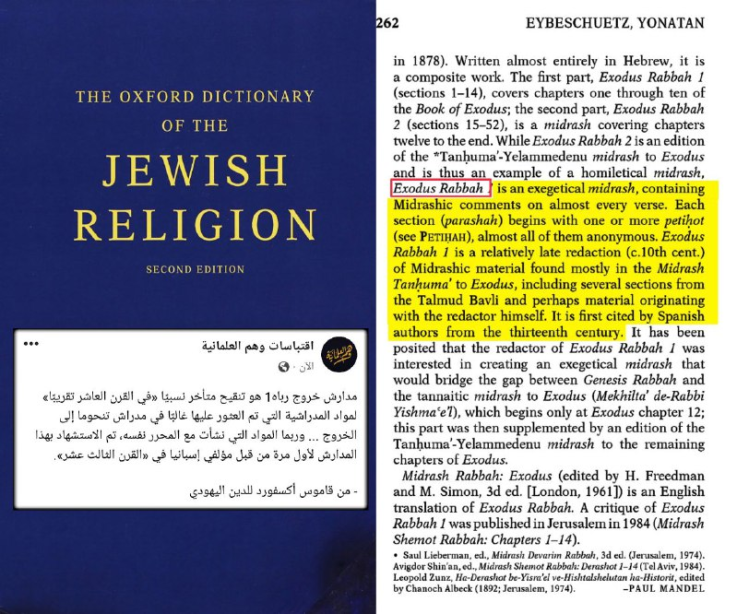
This scan showsThe Oxford Dictionary of the Jewish Religion entry on Exodus Rabbah. The highlighted section states that Exodus Rabbah is a relatively late redaction, dated to the tenth century, containing midrashic material mostly found in the Midrash Tanhuma to Exodus. It also states that Exodus Rabbah was first cited by Spanish authors in the thirteenth century. The Arabic note summarizes that Exodus Rabbah is late and that its dating makes it unsuitable as a direct pre-Islamic source unless independent evidence proves the specific material existed before Islam.
Brannon Wheeler’s Response
Rather, you find the Christian Orientalist Heinrich Speyer claiming that the Qur’an copied the story of the Prophet Moses going to Madyan and finding two women keeping back.
He said that the Qur’an copied it from the Exodus of Raba.
Then you find Brannon Wheeler, Professor of Religious Studies and Head of the Department of Comparative Religions at the University of Washington, responding to him by saying:
“If Heinrich Spyer claims that the Qur’an was directly based on the Midrash of Exodus Rabba, it would be necessary first to show that the material in the Midrash of Exodus Rabba is older than the Qur’an. It is clear from fragments of this Midrash that the interpretive traditions it preserves are closely related to a number of later works, including the Midrash Tanhuma, the Midrash of Genesis Rabba, all of which are difficult to date earlier than the seventh century. Scholars date the reduction of the Midrash of Exodus Rabba to the tenth century. Spyer also does not explain how this rabbinic reading came into the Qur’an.”
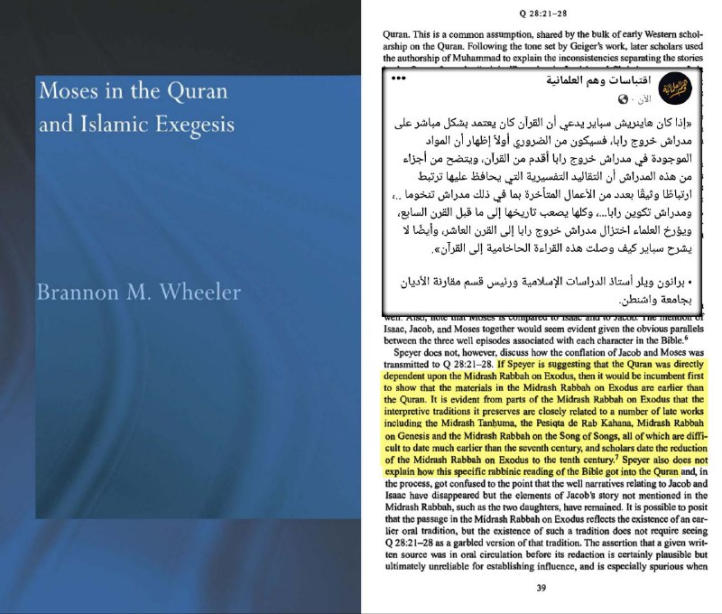
This scan showsBrannon M. Wheeler’s Moses in the Qur’an and Islamic Exegesis. The highlighted passage says that if Speyer wants to claim the Qur’an directly depended on Midrash Rabbah on Exodus, then he must first demonstrate that the material in that midrash is earlier than the Qur’an. Wheeler notes that the relevant materials are related to later works such as Tanhuma and Genesis Rabbah, that they are difficult to date earlier than the seventh century, and that scholars date the redaction of Exodus Rabbah to the tenth century. The scan therefore supports the argument that merely pointing to a later rabbinic parallel does not prove Qur’anic borrowing.
On the other hand, this patchwork has been completely invalidated.
Moshe David Herr, Professor Emeritus of Jewish History at the Hebrew University of Jerusalem, considers that the part of the Exodus of Rabbah, after conducting a linguistic analysis of it, which mentions the divinity of Pharaoh, does not date back to before the tenth century AD.
Likewise, his professor Hanoch Albeck, Professor of Rabbinic Talmud at the Hebrew University and the Rabbinic Academy, also believes that it dates back to the tenth century.
Professor Avigdor Shinan, Professor Emeritus of the Department of Hebrew Literature and Dean of the Hebrew University, also believes that:
“The Madarash Khuruj Rabbah, Part One, dates back to the tenth century AD.”
The Exodus of Rabba are essentially later texts that refined the Tanhuma literature more precisely, and it would be more correct for Copleston to refer to them as the Tanhuma literature.
Second The Tanhuma Literature
First, these materials, like their predecessors, are classified by many contemporary scholars as having been composed between the ninth and tenth centuries.
In general, the Tanhuma literature, as mentioned in the book A History of Biblical Interpretation, dates back at most to the beginning of the ninth century, that is, after the Islamic conquest.
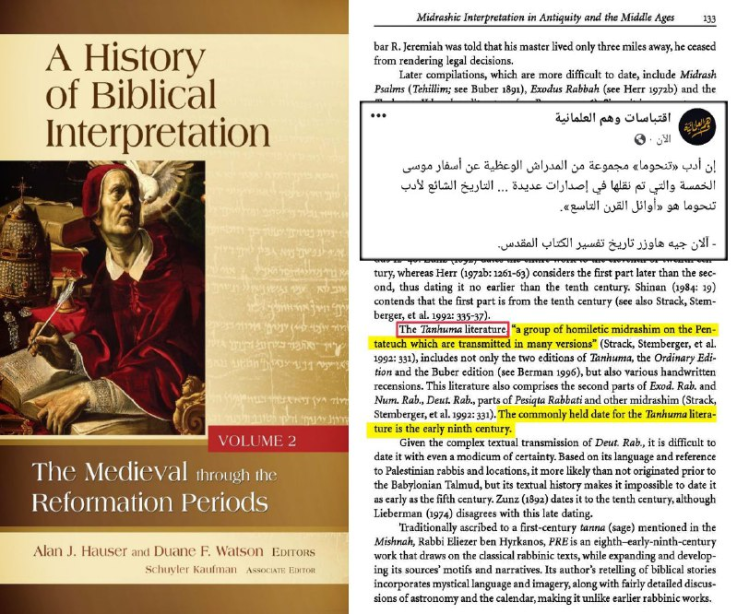
This scan again comes fromA History of Biblical Interpretation. The highlighted section defines Tanhuma literature as a group of homiletic midrashim on the Pentateuch and says the commonly held date for Tanhuma literature is the early ninth century. The Arabic note summarizes that Tanhuma is a collection of midrashic material and that modern scholars commonly date its redaction to the ninth century. This supports the argument that appealing to Tanhuma as a source for the Qur’an is chronologically weak unless the exact passage can be proven to predate Islam.
As Nellie Fox, Professor Emeritus of the Bible, says when speaking about the materials, including the Tanhuma:
Most scholars agree that the three madrasahs date back to after the arrival of Islam in Palestine, and that the oldest material probably dates back to the seventh or eighth century AD.
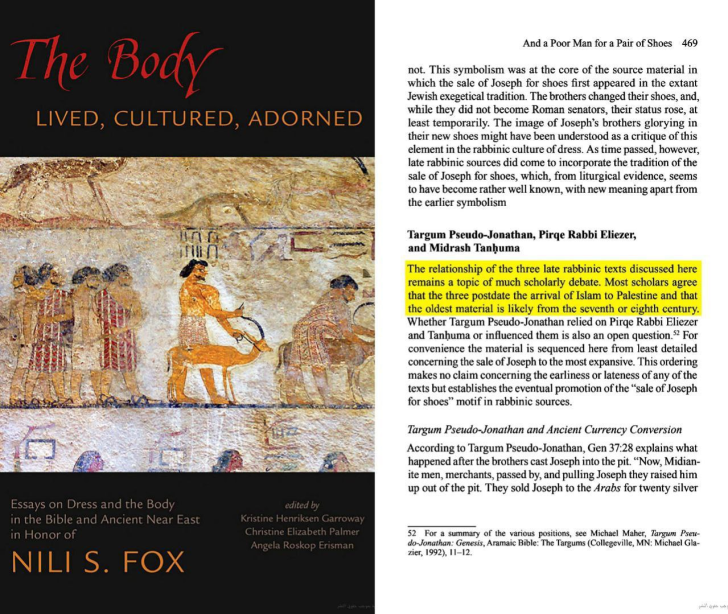
This scan shows a chapter fromThe Body: Lived, Cultured, Adorned, edited by Kristine Henriksen Garroway, Christopher B. Hays, and Angela Roskop Erisman. The highlighted section says that the relationship of three late rabbinic texts remains a scholarly topic, but most scholars agree that the three postdate the arrival of Islam in Palestine and that the oldest material is likely from the seventh or eighth century. The note is relevant because it weakens the assumption that every rabbinic parallel must be pre-Islamic or must have influenced the Qur’an.
The Preemptive Atheistic Patch
A preemptive atheistic patch:
Because this atheist knows that if his atheism reaches the specialists, he will be tied to the barn. He knows that the age of these schools is later than the Qur’an, so he says:
“The process of Midrash’s formation can take centuries and go through several stages: oral transmission, then compilation, then revision. That is, if references state that a particular Midrash took its final form in the ninth century, this does not mean that all the ideas and texts contained therein date back to the ninth century. The textual material could have been compiled and written down in the fifth century, for example, and then subjected to continuous revisions and additions until the ninth century. We should not rush to conclusions and say that the Midrash took it from Islam. Rather, the opposite is more likely, because this idea was often present in ancient versions of that Midrash before its revision.”
As you can see, we shouldn’t rush to say that the Madras were taken from Islam.
Rather, we should rush to say that the Quran was taken from the Madras 😁 and the burden of proof from whom is on you because we are rationalists whose job is only to cast doubt.
This poor heretic doesn’t know that today’s academic scholars of religious and Eastern studies deny the thesis that the Quran borrowed from these Madras and acknowledge their influence by Islam.
This is in contrast to older studies that the heretics unknowingly copied and pasted.
Abraham Ophir Shemesh and the Medieval Interpretation
Professor Abraham Ophir Shemesh, head of the Department of Israeli Heritage at Ariel University in Samaria, published an article discussing early and late interpretations of the Madras texts that mention Pharaoh’s going to the river and his claim to divinity.
He said that it is new material added in the Middle Ages with the common practices of Muslim rulers.
The introduction to this article states:
https://www.scielo.org.za/scielo.php?script=sci_arttext&pid=S1010-99192016000200006
This study discusses three main interpretations offered by medieval biblical commentators for Moses’ encounter with Pharaoh on the banks of the Nile in the early morning hours…etc.
Professor Abraham Ophir then listed the early interpretations in chronological order, then listed the interpretations that appeared in medieval manuscripts that mention Pharaoh’s claim to divinity, saying:
“Here, the interpreter retells the biblical story in an expanded form, with the new material expressing a new idea through an epic story that portrays Pharaoh as a god, one manifestation of which is that he was not obliged to relieve himself, a physical act that demonstrates the inferiority of human beings.”
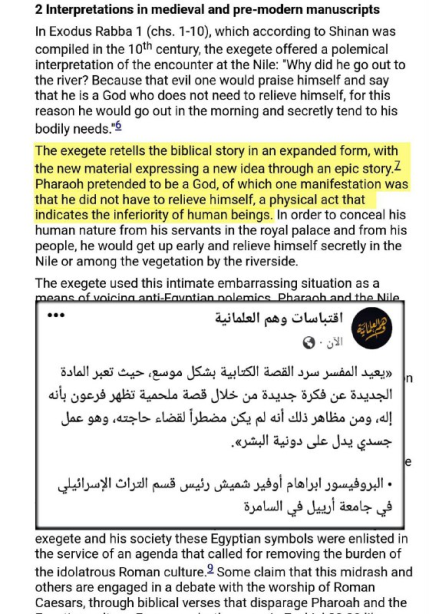
This scan is from Abraham Ophir Shemesh’s study on medieval interpretations of Moses meeting Pharaoh by the Nile. The highlighted section says that the exegete retells the biblical story in expanded form and introducesnew material through an epic story portraying Pharaoh as a god. One sign of this alleged divinity is that Pharaoh supposedly did not need to relieve himself, because bodily functions expose human weakness. The scan is significant because it presents the “Pharaoh as god who does not relieve himself” motif as an expanded medieval interpretation, not a straightforward biblical statement.
That is, the early texts did not mention the deification of Pharaoh, which is a new text that appeared in medieval manuscripts under Islamic rule.
He says in the final conclusion of his article:
“These interpretations of Pharaoh’s claim to be a god are not mentioned in the Talmud or in the early midrash, and they share a basis in the medieval reality of the period, namely the view that certain royal practices were common to the rulers of ancient Egypt and to medieval Muslim and Christian European rulers … The tendency to copy later contemporary circumstances in biblical interpretations is also evident in rabbinic literature that describes the nation’s ancestors and biblical figures based on their own realities.”
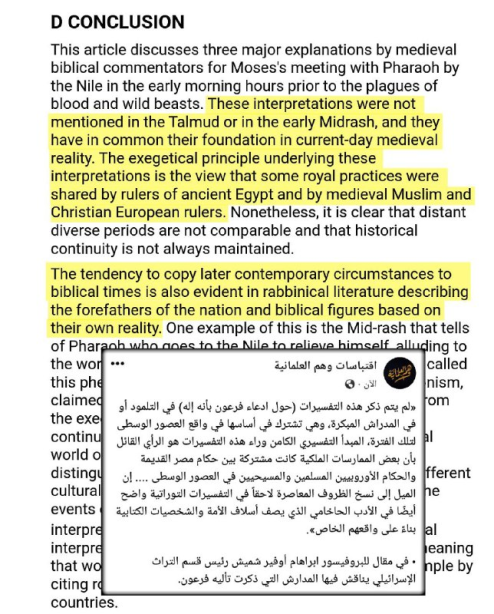
This scan shows the conclusion of Abraham Ophir Shemesh’s article. The highlighted text says that these interpretations arenot mentioned in the Talmud or in the early Midrash. It further says that they share a foundation in medieval reality, where practices of ancient Egyptian rulers were interpreted through the lens of medieval Muslim and Christian European rulers. The highlighted conclusion also explains that rabbinic literature often projected later contemporary circumstances back into biblical times. This strongly supports the argument that the specific Pharaoh-divinity interpretation in these midrashic texts is later and shaped by medieval context.
The Torah and the Bible did not mention the divinity of Pharaoh, while this information was mentioned in later texts written and compiled under the Islamic state.
Imagine with me that the ignorant, illiterate atheists are trying to convince us that these texts, which contemporary scholars say were influenced by Arabic poetry and the Quran, such as the story of The Women Who Cut Their Hands, which the German Jewish historian Shlomo Goitein mentioned as being influenced by the Quranic narrative and the story of Joseph عليه السلام, and the story of The Golden Calf in the Story of Moses.
These texts were written and compiled under the Islamic state and influenced by Islamic literature.
Later Jewish Material and Islamic Influence
Now the atheists are trying to convince you that they were not influenced by the Quranic text when mentioning the divinity of Pharaoh, a fact not mentioned in the entire Bible.
Abraham Ophir has explained that this is a new interpretation that emerged in the Middle Ages.
This atheist does not even know that Nicholas Sinai, a professor of Quranic studies at Oxford University, despite his skepticism regarding the Quranic text, frankly acknowledges the Islamic influence on the texts of Tanachoma, saying:
“In any case, since the idea of self-surrender is documented in liturgical poetry, there is no reason to doubt the Islamic influence on the formulation of the Midrash Tanhuma.”
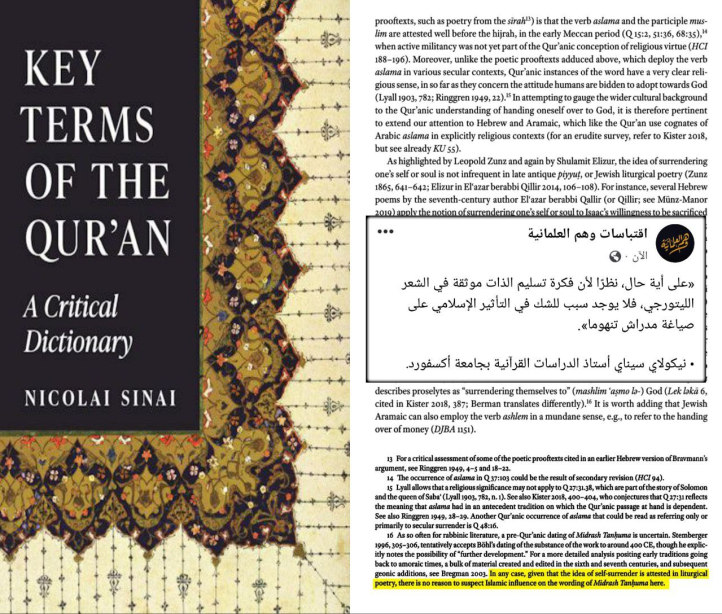
This scan showsNicolai Sinai’s Key Terms of the Qur’an. The highlighted English sentence appears to say that because the idea of self-surrender is richly attested in Jewish liturgical poetry, there is no reason to suspect Islamic influence on the wording of Midrash Tanhuma here. This is important: the scan, as visible, appears to say the opposite of the article’s paraphrase. If the argument depends on Sinai “acknowledging Islamic influence” in this exact place, the quote must be rechecked. Do not build the argument on this scan unless the original wording is verified.
Michael Brighill, professor of religious studies at Elon University, responds to this nonsense of atheism by saying:
“In the Madarash of Rabbi Eliezer, the Targum Jonathan, and the Madarash Tanchuma, regardless of whether these works contain genuine ancient material or are generally very early, the important point here is that they undoubtedly contain some material that is not only later than the rise of Islam, but which we can describe as actually ‘Islamic,’ that is, it reflects the general cultural influence of Islam on non-Muslim societies that were subject to Arab domination.”
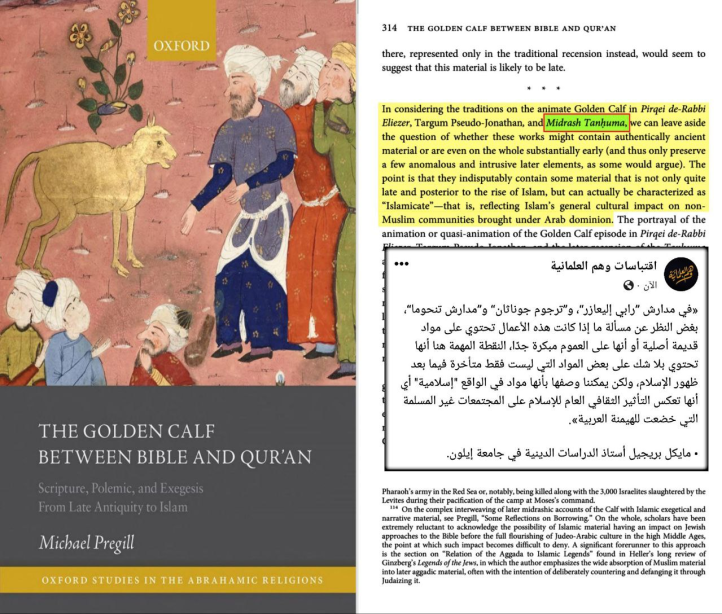
This scan is fromMichael Pregill’s The Golden Calf between Bible and Qur’an. The highlighted passage discusses traditions on the animated golden calf in Pirqe de-Rabbi Eliezer, Targum Pseudo-Jonathan, and Midrash Tanhuma. Pregill says these works contain material that may not be authentically ancient and that some intrusive elements can be characterized as Islamicate, reflecting Islam’s general cultural impact on non-Muslim communities under Arab rule. The Arabic note explains that these texts contain material added after the rise of Islam and shaped by the Islamic cultural environment.
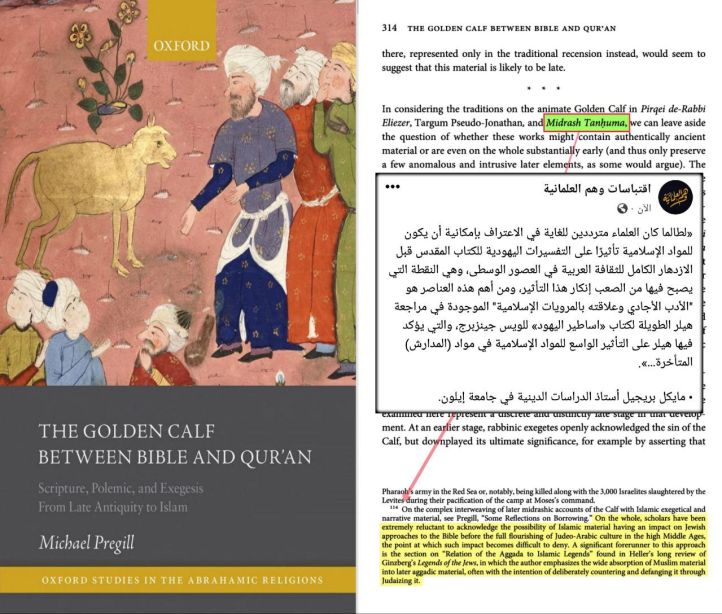
This scan continues fromMichael Pregill’s The Golden Calf between Bible and Qur’an. The highlighted passage says that scholars have been extremely reluctant to acknowledge the possibility of Islamic material influencing medieval Jewish interpretations of the Bible, but that this becomes difficult to deny. The Arabic note summarizes Pregill’s point: some later Jewish midrashic traditions may have absorbed Islamic narrative elements, especially in stories where the Qur’an contains details not found in the Bible. This supports the broader argument that later rabbinic parallels do not automatically prove Qur’anic borrowing.
Today, contemporary scholars openly admit that these stories, from which the Holy Quran is allegedly quoted, were originally clearly influenced by Islamic literature.
They mention later details not found in the Bible, such as the story of the golden calf, the story of Joseph and the wife of the Aziz, the story of the deification of Pharaoh, and the story of Moses and the two women who would not give water until he gave water to the rabble.
All of these stories, by today’s academic admission, have been drowned in the stories, including the Tanhuma stories, which were influenced by them.
An example of this is the book Legends of the Jews by its author Louis Ginzburg, in which he mentions the scattered Jewish legends in the stories and mentions Pharaoh’s claim to divinity, quoting Tanhuma’s stories, in which Pharaoh says:
https://judaism.stackexchange.com/questions/135617/what-s-the-source-for-this-midrash-about-pharaoh
“There is no God in all the world that can accomplish such works besides me, for I made myself.”
In a review of this book by Professor of Jewish Studies Bernard Heller, one of the most prominent Jewish scholars of the last century:
In it, Heller emphasizes the widespread influence of Islamic materials in the later Madarsh materials mentioned by Ginzburg in his book.
Michael Brighill, a professor of religious studies at Elon University, also mentions this, adding in the margin that these schools are influenced by Islam:
“Scholars have always been extremely reluctant to acknowledge the possibility that Islamic material influenced medieval Jewish interpretations of the Bible, a point at which it becomes difficult to deny. One of the most important of these elements is Agadian literature and its relationship to Islamic narratives.”
This admission by Michael Brighill is similar to the admission by American Orientalist Norman Arthur Stillman, Professor Emeritus of Jewish History at the University of Oklahoma, that most of the madrasahs and Agadian literature, which they previously believed were borrowed from the Qur’an, later found out that the opposite was true.
He says:
“Our current history of rabbinic literature is better than it was in the time of Abraham Geiger, and many Islamic, Jewish, and Christian texts have been published since his book, and in light of this, we now know that in some cases, what was thought to be a Jewish influence on an Islamic text was quite the opposite.”
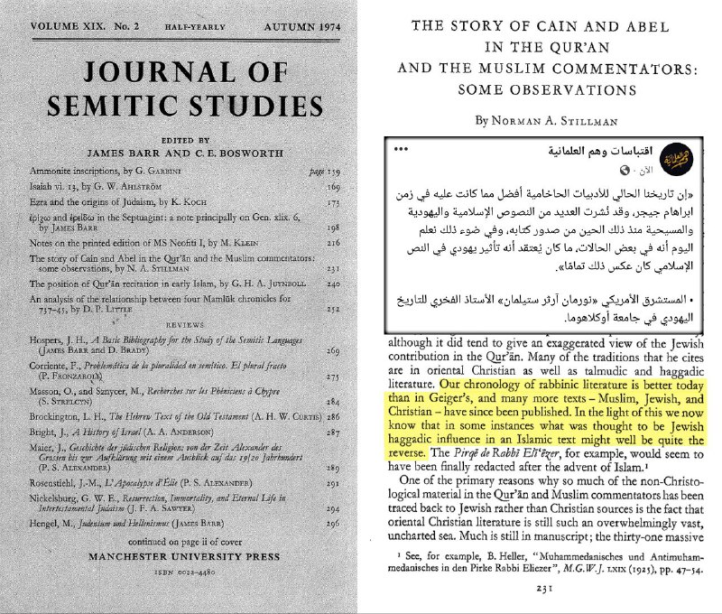
This scan showsNorman A. Stillman’s article, “The Story of Cain and Abel in the Qur’an and the Muslim Commentators: Some Observations,” in the Journal of Semitic Studies. The highlighted passage says that the chronology of rabbinic literature is better understood today than in Abraham Geiger’s time, and that in some cases what was once thought to be Jewish haggadic influence on an Islamic text may actually be the reverse. The Arabic note explains that newer scholarship has overturned some older assumptions about the Qur’an borrowing from Jewish materials.
That is why you find Michael Brighill publishing a study entitled The Torah and the Qur’an: The Problem of Jewish Influence on Islam, in which he explicitly states that the texts that they claim influenced the Qur’an actually emerged as a result of Jewish writers being influenced by Islamic sources, not the other way around.
He says:
“The Jewish and Midrashic traditions supposedly found in the Qur’an, and which are claimed to reflect Muhammad’s reliance on them, can in fact be found only in the commentary. Moreover, the similarities between the Qur’an and the commentary on the one hand, and the Bible and the Midrash on the other, ultimately stem from the fact that later Jewish authors used Islamic sources, not the other way around. This means that the supposed similarity of the Qur’an to its ‘influences’ was very well reflected in the transmission of elements of Islamic commentary to the Jewish community, which then led to the generation of those very traditions that were wrongly understood to have ‘influenced’ the Qur’an in the first place.”
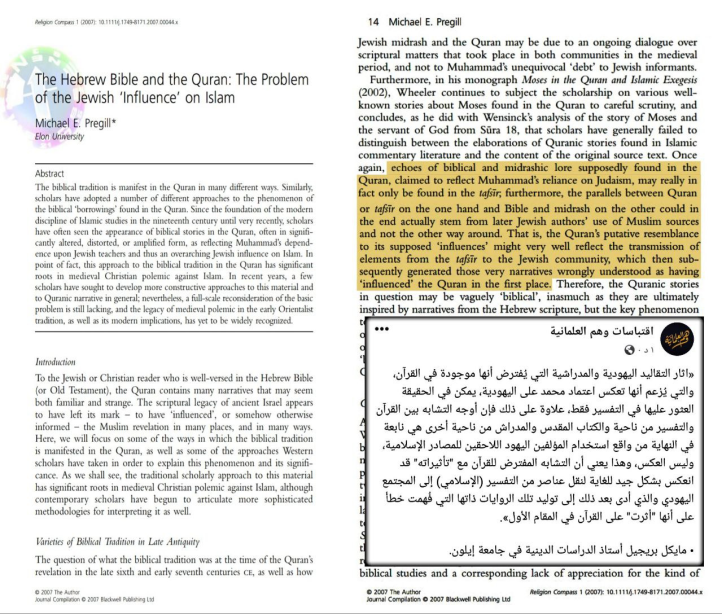
This scan showsMichael E. Pregill’s article “The Hebrew Bible and the Quran: The Problem of the Jewish ‘Influence’ on Islam.” The highlighted passage says that alleged Jewish and midrashic traditions supposedly found in the Qur’an can often be found only in later tafsir or commentary. It argues that similarities between the Qur’an, tafsir, Bible, and Midrash may stem from later Jewish authors using Islamic sources, not the other way around. The scan supports the argument that some traditions later assumed to have influenced the Qur’an may actually have been generated after exposure to Islamic narratives.
Rather, he explains that in many cases it appears that the sources claimed to be the source of the Qur’an were originally influenced by a later revision that appears to have been borrowed from Islamic commentaries, saying:
“In some cases, claims of borrowing by the Qur’an or the Prophet from the Jews are simply unjustified, and a careful analysis of particular narratives may show that, contrary to the assertions of previous generations of scholars, the Qur’an simply does not consistently reflect the direct derivation of biblical data from the Jews or the direct absorption of rabbinic Midrash. Rather, the opposite is the case, namely, that the Jews have ‘borrowed’ from the Qur’an, or even from later Islamic literature.”
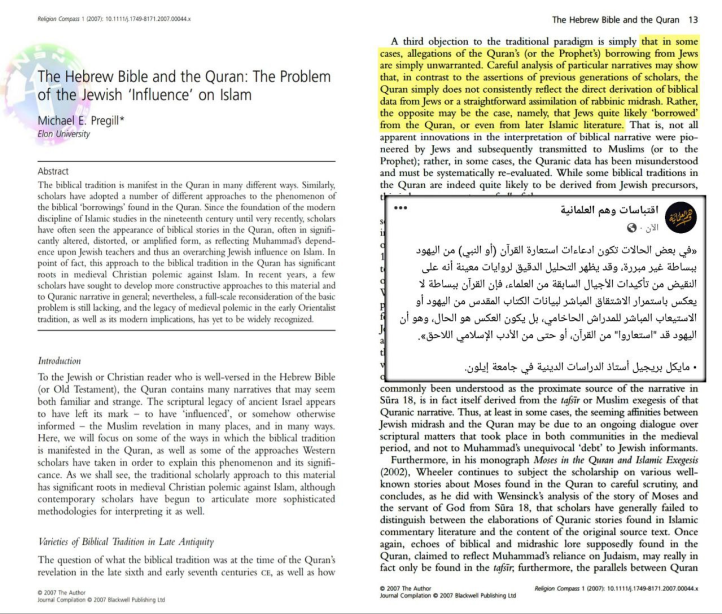
This scan is another page fromMichael Pregill’s article. The highlighted passage says that in some cases allegations of Qur’anic or prophetic borrowing from Jews are unwarranted. It explains that careful analysis may show the Qur’an does not simply reflect direct absorption of rabbinic midrash. Instead, later Jewish writers may have borrowed from the Qur’an or later Islamic literature and then transmitted those ideas into Jewish interpretive traditions. This scan reinforces the argument that the borrowing direction is not automatically from Judaism to Islam.
This is without mentioning to you the atheists’ attempt to patch up Abraham Ophir’s study about the deification of Pharaoh being a modern interpretation that appeared in the schools in the Middle Ages, by saying:
“Abraham Ophir’s quote is inaccurate.”
With this naivety, by God yes, a professor who specializes in a clear article and clear words has become inaccurately quoted?
By God, we do not know if these people have torn shoes in their skulls or what?
Up to here we can understand that the ignorant atheists are transferring their words from Christian pages. It’s okay, we will forgive them with hearts filled with compassion.
But they also mentioned a third verse claiming that the Qur’an quoted Pharaoh’s claim of divinity in the story of Moses. These verses were not mentioned by the Orientalists themselves.
Fasten your seatbelts. 😁
The Problem With Rabbi Ishmael’s Mekhilta
Rabbi Ishmael’s Mekhilta DeRabbi Yishmael
Fasten your laughter belts 😁 to show you the ignorance of the laughing atheists and the amount of nonsense here.
You will find that the atheist pages have added a new source that was absent from Abraham Ophir, Copleston, Louis Ginzburg, and Heinrich Spyer, mentioning Pharaoh’s claim of divinity before Moses, saying:
In the commentary on Ezekiel 29:3 by Rabbi Yishmael.
Before discussing this, we ask:
Why did the Christian Orientalist Frederick Copleston in 1960 AD, who was the first to point out that Muhammad quoted the divinity of Pharaoh from the Matriarchs, and then Christian writings transmitted this claim from him, not mention these Matriarchs and was satisfied with the literature of Tanuama?
Isn’t that strange?
Despite the fact that these Matriarchs are the oldest among the Jews?
And why did Louis Ginzburg, in his book Legends of the Jews, when mentioning Pharaoh’s claim to divinity, refer only to the literature of Tanuama?
Did he miss this Matriarch, which is centuries older than the literature of Tanuama?
And why did Professor Abraham Ophir, in his study of the Matriarchs that mentioned the deification of Pharaoh as newly added material, not mention the Matriarch of Rabbi Ishmael and say:
These interpretations are not mentioned in the Talmud or in the early Midrash.
Did you focus on the phrase “or in the early schools” while the schools of Rabbi Ishmael are considered the oldest early schools?
Did he also miss this information, as he is a specialist in Jewish theology?
Do you know why they did not mention these schools?
With your complete readiness to laugh? 😁
Ezekiel 29 3 Is Not About the Pharaoh of Moses
Simply because the Book of Ezekiel here does not talk about the Pharaoh who tortured the Children of Israel.
Rather, the Book of Ezekiel was originally written many centuries after Moses, after the Babylonian captivity, and it talks about a prophecy of another Pharaoh ruling Egypt, and the prophecy was written in the period 500 BC.
He is the one who said:
— Ezekiel 29:3
In the explanation of this issue on the website of Anba Takla Haymanot, he says:
“The Prophet Ezekiel places this prophecy in the tenth year of the captivity, when Pharaoh advanced with his armies toward Jerusalem to free it from the siege… It is said that he meant Pharaoh Khafre, who boasted of two things: that he had created with his own hands the strength and security that he possessed, and that this was for his own sake.”
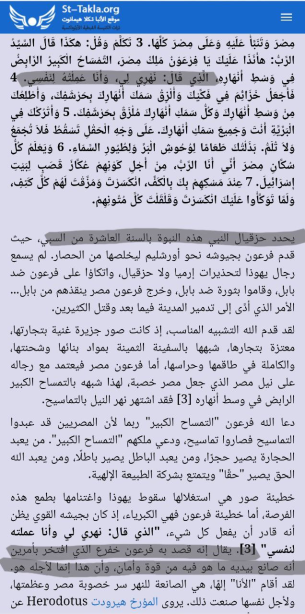
This Arabic scan is from theSt-Takla.org commentary on Ezekiel 29:3. It explains that Ezekiel’s prophecy concerns a Pharaoh connected to the later historical period of Jerusalem’s siege and Babylonian captivity, not the Pharaoh of Moses. The highlighted section explains the phrase “My river is mine, and I made it for myself” as arrogance connected to Egypt’s Nile, canals, and political power. It does not present this as a direct statement from the Pharaoh of Moses in the Exodus story. This supports the argument that using Ezekiel 29:3 as proof that the Qur’an borrowed Pharaoh’s claim to divinity is a category error.
Imagine this slip and deception by the ignorant and illiterate atheists, to the point that the Christian priest Benjamin Bosmann, minister of the German Reformed Church, said in his book in 1861 AD, explaining this:
“It seems that one of the pharaohs built canals to carry water in Egypt, and then withheld God’s due bounty of abundant crops, because the flood of fertile water had been carried to the plain by what he had done. So the Lord said, ‘Behold, I am against you, Pharaoh king of Egypt, which said, My river is mine, and I made it for myself’ Ezekiel 29:3.”
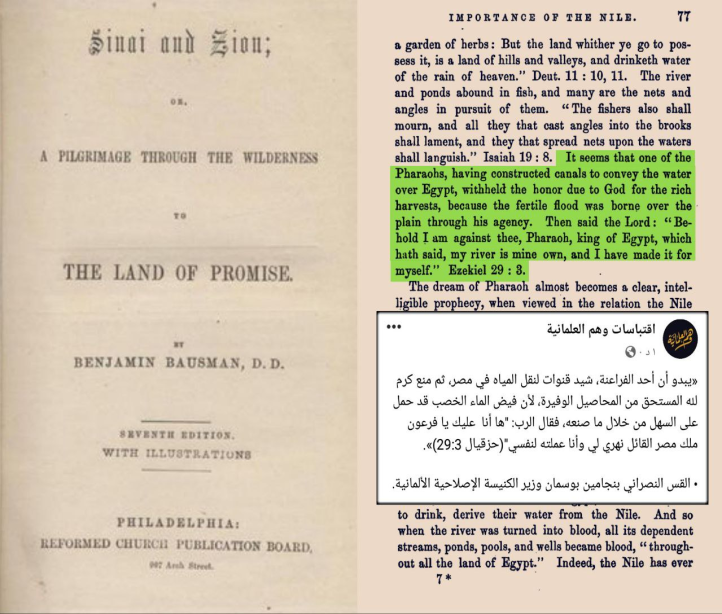
This scan showsBenjamin Bausman’s Sinai and Zion; or, A Pilgrimage through the Wilderness to the Land of Promise. The highlighted passage explains Ezekiel 29:3 by saying that Pharaoh may have constructed canals to carry Nile water over Egypt and then took credit for the fertility and crops that resulted. It quotes the verse: “My river is mine own, and I have made it for myself.” The Arabic note summarizes that this is about Pharaoh boasting over water-management works and agricultural prosperity, not a clear claim that he was the Pharaoh of Moses or that this verse narrates the Exodus Pharaoh’s divinity claim.
“My river is my own, and I made it for myself” is not understood from it as a claim of divinity, nor is this called a claim of divinity.
This is because the Orientalists themselves state explicitly that the Bible did not mention the divinity of Pharaoh.
Instead of Ezekiel originally not speaking here about the Pharaoh of Moses, with Father Benjamin mentioning that this Pharaoh dug canals to transport water in Egypt and because of this he boasted about what he made and said:
My river is mine, and I made it for myself.
For this reason, neither Copleston, Avraham Ophir, nor Ginzburg mentioned these passages and did not make this mistake, knowing that the passages in the Mekhilta DeRabbi Yishmael do not speak of Moses’ Pharaoh’s claim to divinity, but rather of a Pharaoh who came centuries later.
This deception could only have been committed by ignorant atheists quoting from Christian sources.
Sources and Scan Evidence
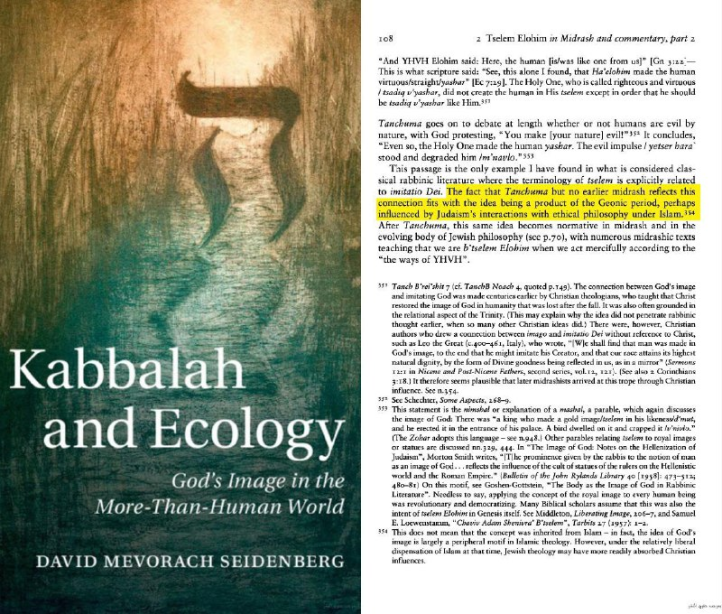
This scan showsDavid Mevorach Seidenberg’s Kabbalah and Ecology: God’s Image in the More-Than-Human World. The highlighted passage discusses material in Tanhuma and says that a connection reflected in Tanhuma, but not earlier midrash, fits with the idea that Tanhuma may have been influenced by the Hekhalot literature, Christian thought, or the Islamic milieu. The scan is relevant because it presents Tanhuma as a later rabbinic source that may reflect broader late antique and medieval religious environments, rather than a securely early source that automatically predates Islam.
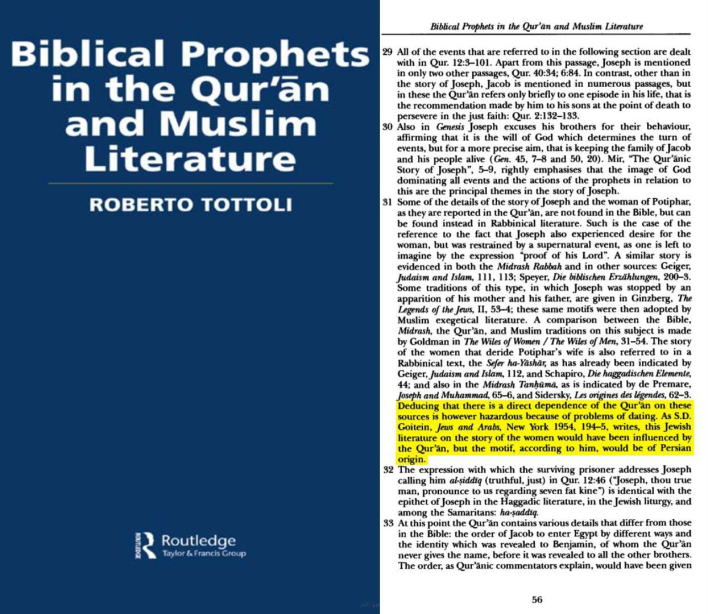
This scan showsRoberto Tottoli’s Biblical Prophets in the Qur’an and Muslim Literature. The highlighted section discusses the story of Joseph and the women cutting their hands. It notes that some Jewish traditions mention similar motifs, but also references scholarly disagreement about the origin and dating of such motifs. The scan is relevant because it shows how Qur’anic stories, Jewish legends, and later Muslim literature are often compared, but the direction of borrowing is not automatically obvious and depends on dating and transmission evidence.
Conclusion
The Qur’an’s mention of Pharaoh’s claim to divinity cannot be dismissed by simply pointing to later Midrashic material.
The central problems with the atheist claim are:
- The Bible does not mention Pharaoh’s claim to divinity in the story of Moses.
- Exodus Rabbah is late and commonly dated long after the Qur’an.
- Tanhuma literature is also late or at least difficult to prove pre-Islamic in the relevant form.
- Abraham Ophir Shemesh states that the Pharaoh-divinity interpretation is not in the Talmud or early Midrash.
- Later Jewish interpretive traditions may themselves reflect Islamic influence.
- Ezekiel 29:3 is not about the Pharaoh of Moses and does not establish the atheist claim.
Therefore, using these Midrashic passages to claim that the Qur’an copied Pharaoh’s divinity from Jewish sources is chronologically weak, textually confused, and academically careless.