

1 John 5:7 — The Johannine Comma: A Fabricated Addition to the Bible
The Johannine Comma is the only verse in the entire Bible that explicitly states the doctrine of the Trinity — and it is a fabrication. This series documents, from the testimony of Protestant scholars, Catholic scholars, biblical encyclopedias, manuscript specialists, and Church Fathers themselves, that 1 John 5:7 (“For there are three that bear witness in heaven: the Father, the Word, and the Holy Spirit. And these three are one”) does not appear in any Greek manuscript before the fifteenth century, is absent from all ancient translations, and was unknown to every Church Father who would have needed it most.
This is Part 1: the introduction, the Arabic translation survey, the English and Greek translation survey, and the first eight scholarly witnesses.
What Is the Johannine Comma?
The Johannine Comma is the text found in the First Epistle of John, Chapter 5, Verse 7. It says:
“For there are three that bear witness in heaven: the Father, the Word, and the Holy Spirit. And these three are one.”
The text is present in the Van Dyck Arabic translation, but the strange thing is not merely its presence in the Van Dyck translation alone — it is that some still cite it as if it were correct. Among them is Pope Shenouda, who says in his book Theology of Christ (at the beginning of the book, page 8):
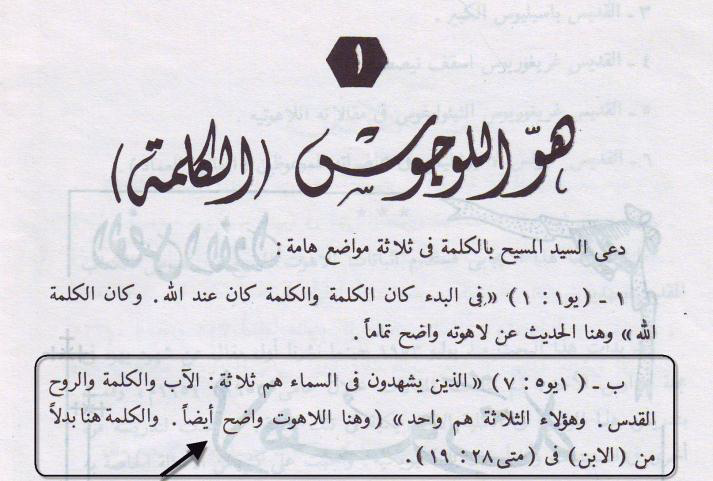
The passage above shows Pope Shenouda citing the Johannine Comma as evidence for the doctrine of the Trinity.
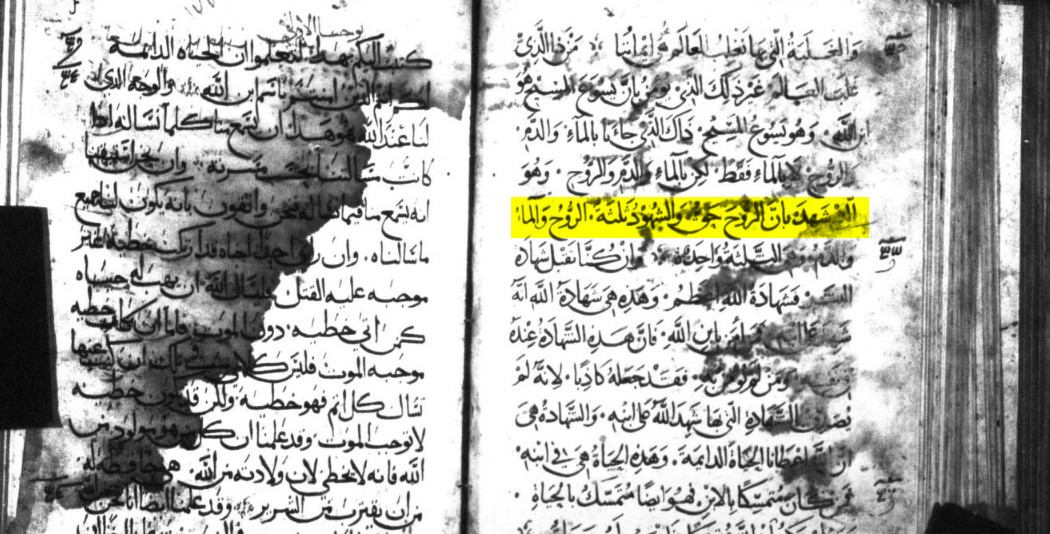
Catholic scholars confirm that this text has been distorted. Protestant scholars confirm that this text has been distorted. Except for some Orthodox scholars — they sometimes defend the text, some leave it out, and some point out that the text has been distorted.
The testimony of Protestant scholars carries particular weight, as the Van Dyck translation is originally a Protestant translation — and they confirm that the text has been distorted. At the forefront of them is the testimony of Rev. Dr. Samuel Habib, head of the Evangelical community (formerly), as well as the testimony of Rev. Dr. Munis Abdel Nour and others.
We will take a look at some Arabic translations, some English translations, and some Greek translations so that the reader — whether Muslim or Christian — is certain that this text has been added.
Three preliminary points to establish before examining the translations:
First — Let us not talk about the Greek manuscripts, as Christians claim the existence of hundreds of manuscripts, and this text is only found in eight manuscripts — and it is not found in any Greek manuscript dating back to before the fifteenth century.
Second — Let us not talk about the Church Fathers and the fact that they did not cite this text (1 John 5:7). None of the early Church Fathers knew it — not Origen, not Justin the Martyr, not Athanasius, not John Chrysostom. All the Church Fathers did not know the text, and no father referred to it except in very recent times.
Third — Even as internal criticism, the text does not hold, according to the confirmation of Christian scholars and commentators: the Father and the Word only met in this situation, and heaven does not need testimony — so how can the text say this? This is in addition to the confirmation of Christian scholars and commentators that the text is a later addition and has no connection to the Gospel, but is merely an addition in a late Latin manuscript.
The Reason for This Research
One of the most important reasons for my research is simply that I heard a Christian cite it and defend it — saying that if he had known what was in the text, by God, he would not have done it. At that time, my heart wept over such a thing. How can we have something that confirms the distortion of the text and not present it to the likes of these people? So I ask God to make this simple series a candle in the path of those who search for the truth and a thorn in the hearts of those who hate and deny the truth.
The Problem: No Trinity in the Bible
There is no text in the Holy Bible — whether in the Old Testament or the New Testament — that refers, even remotely, to what is called the Trinity (Father, Son, and Holy Spirit). When those who defend the doctrine realized the seriousness of this situation — the absence of at least one text that proves the Trinity — they turned to the Johannine Comma. What is even more strange is that we find that what Jesus said about himself is reduced to scattered records. For example:
Why didn’t the Bible preserve these teachings? These are Jesus’ teachings and what he said are, according to Christians, divine words. Yet the Bible instead preserves Paul’s greetings in his letters in exhaustive detail:
And the extended greeting register of Romans 16:1–27 preserves Phoebe, Priscilla, Aquila, Epaenetus, Mary, Andronicus, Junia, Amplias, Urbanus, Stachys, Apollos, those of Aristobulus’ household, Herodion, those of Narcissus’ household, Tryphaena, Tryphosa, Persis, Rufus, Asyncritus, Phlegon, Hermas, Patrobas, Hermes, Philologus, Julia, Nereus and his sister, Olympas, Tertius the scribe, Gaius, Erastus the city treasurer, and Quartus — and many more greetings that are not as important as the words of Jesus. We find the greetings of Paul but not the words of Jesus.
Moreover, the Bible does not contain one of the foundations of the Christian faith — which is the Trinity. Is that not strange?
All Arabic Translations Omit the Johannine Comma
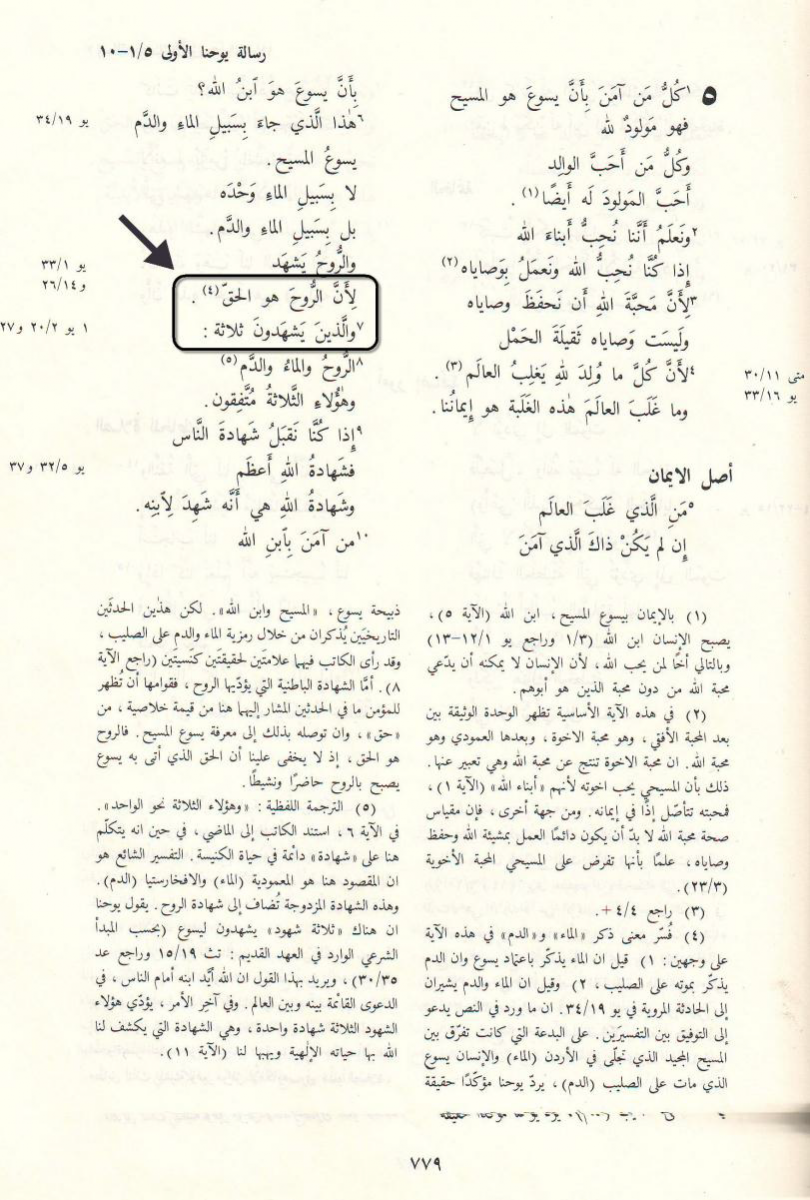
Joint Arabic Translation
The text states: “And those who bear witness are three” — and it was written in the margin: *(Three: the Father, the Word, and the Holy Spirit. These three are one, and those who bear witness on earth are three: This addition appeared in some ancient Latin manuscripts.)
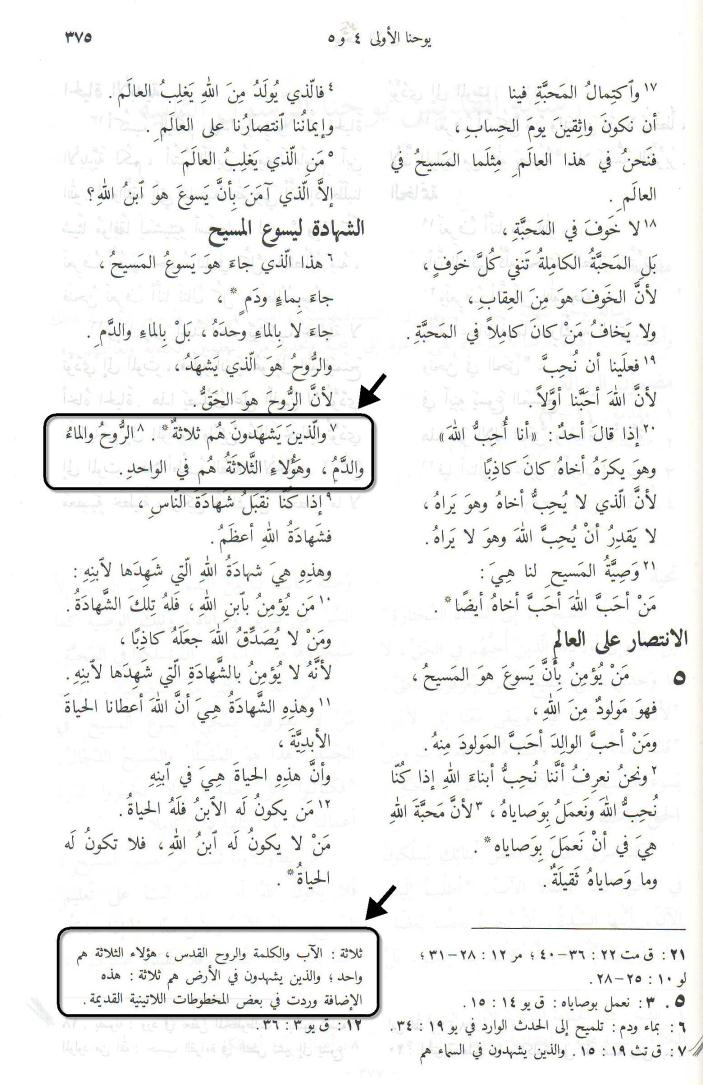
The image above shows the Joint Arabic Translation placing the Trinitarian formula only in the margin, not the body of the text.
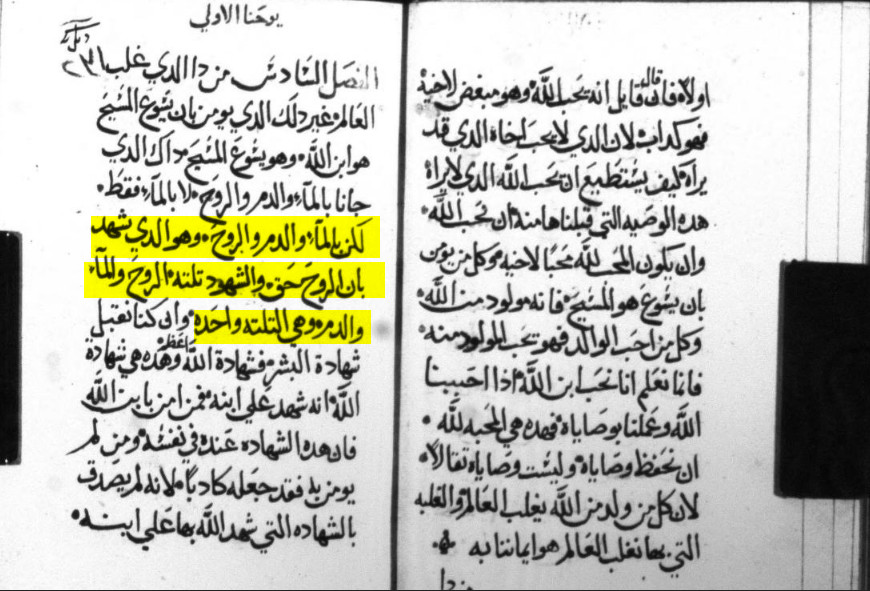
Translation of the Jesuit Fathers
This is a Catholic translation made by the Jesuit Fathers. They said in their translation of this text: “And those who bear witness three times” — with no Trinitarian formula.
Translation of Life (Al-Hayat)
This translation placed the text between brackets and wrote in the introduction to the translation: (What is between the brackets is an explanation of difficult-to-understand expressions or old measures and standards. We have placed their modern equivalents between the brackets.)
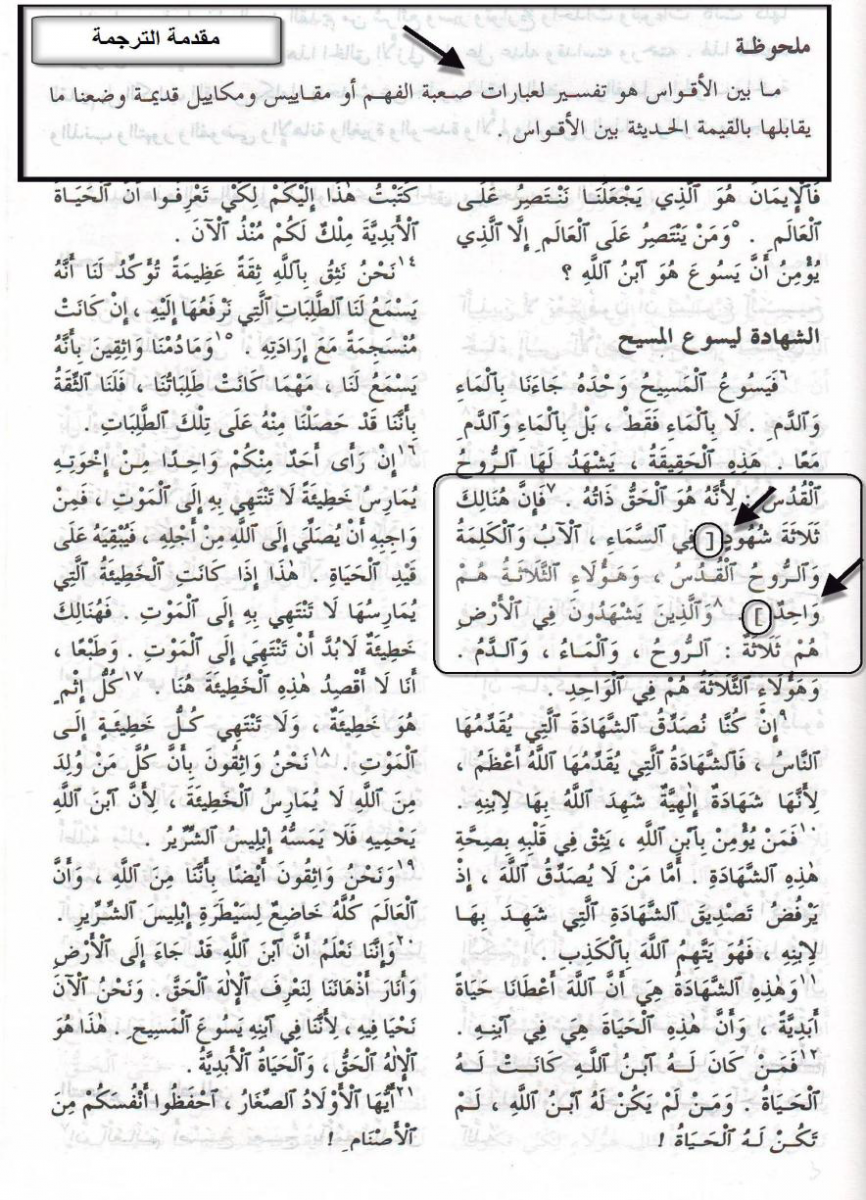
The image above shows the Al-Hayat (Life) translation placing the Comma in brackets, signalling its non-original status.
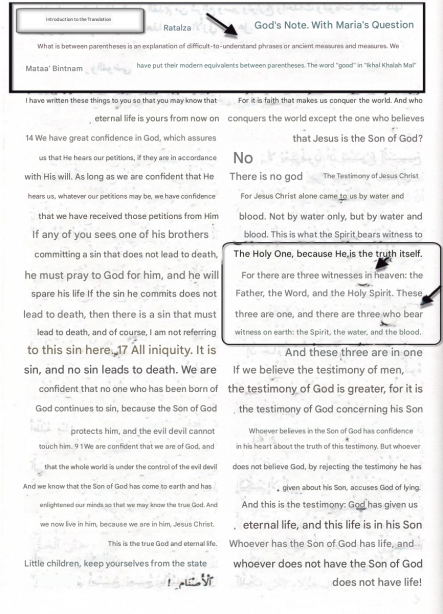
The Swedish edition (English-Arabic) of the same Al-Hayat translation deleted the text from the translation entirely and says only: “There are three witnesses.”
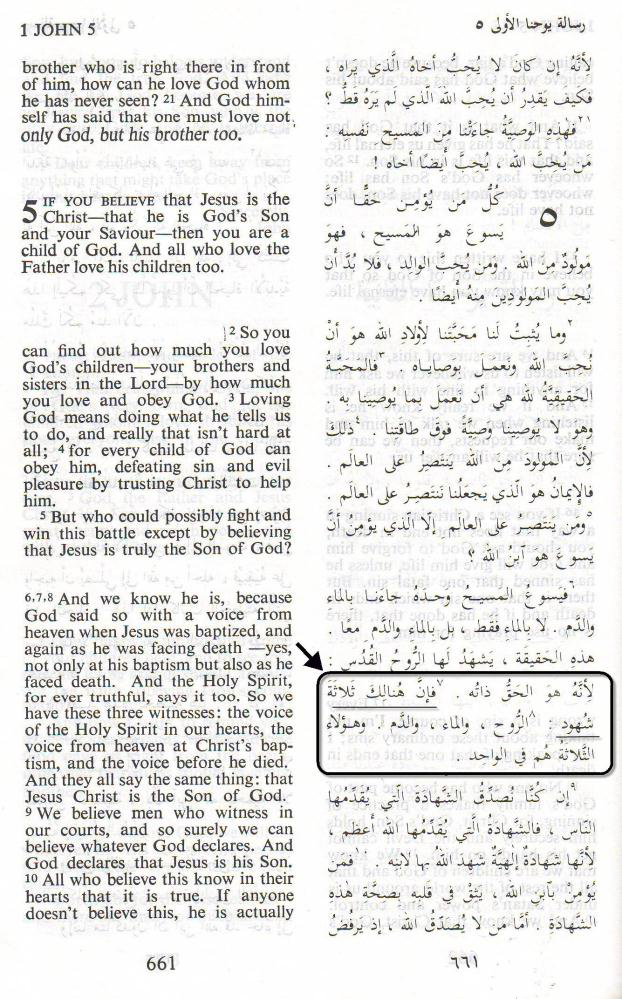
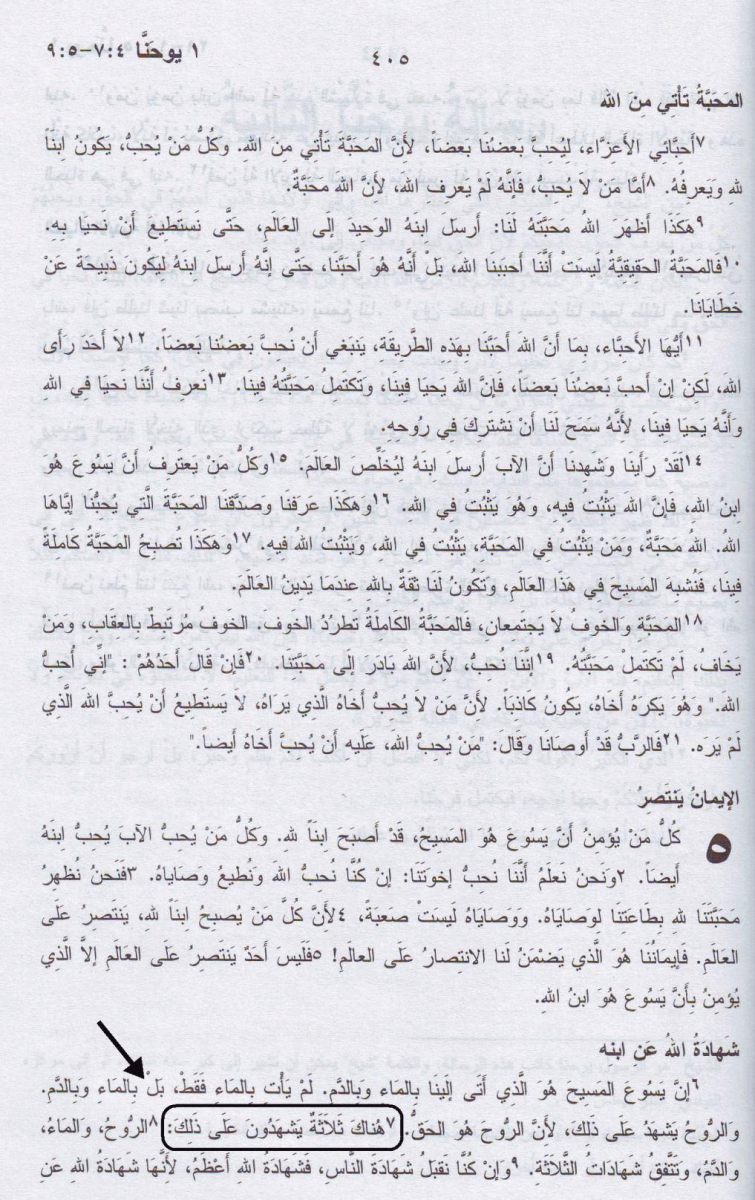
Simplified Arabic Translation
The Simplified Arabic translation did not mention the text of the Trinity either, but said: “There are three who bear witness to that.”
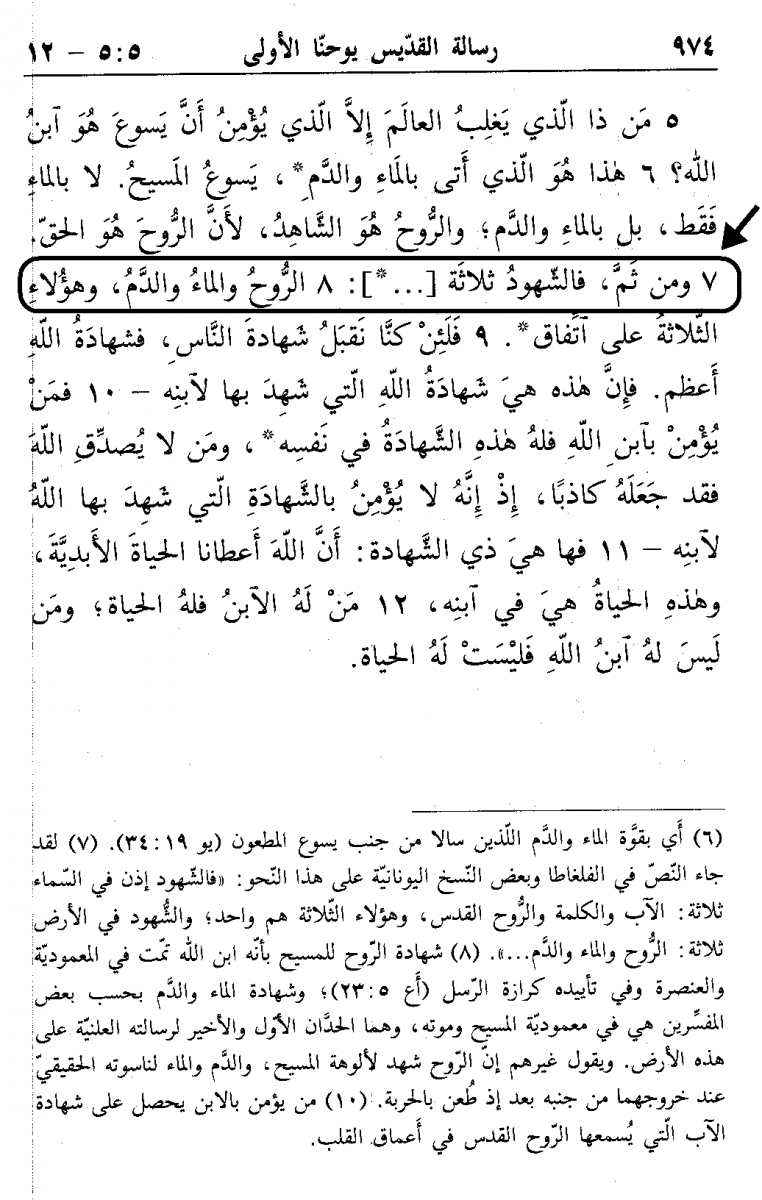
Police Translation
This translation mentioned the text as follows: “Therefore, the witnesses are three (…)”
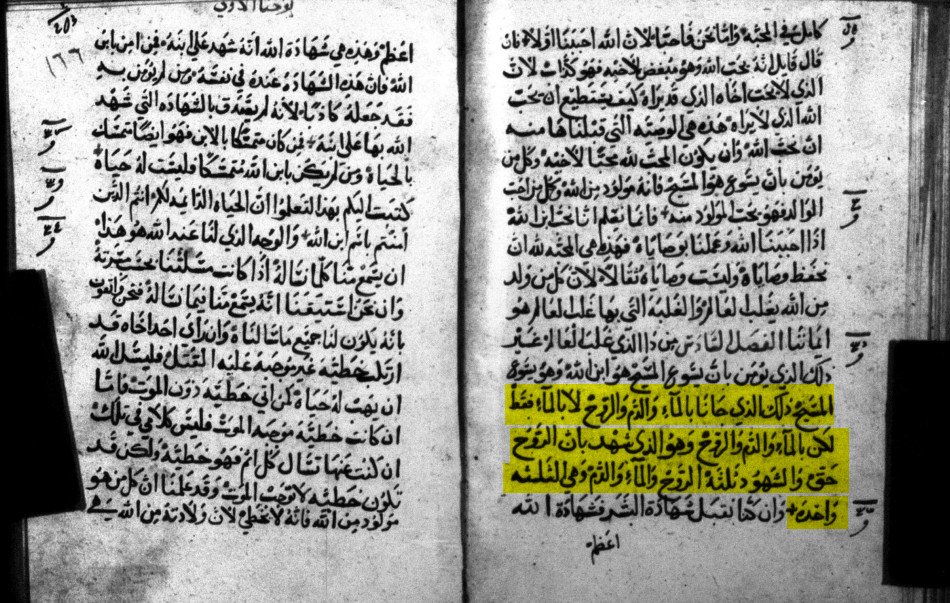
Translation of the Holy Bible
This translation stated the text as follows: “Therefore, there are three witnesses to Christ.”
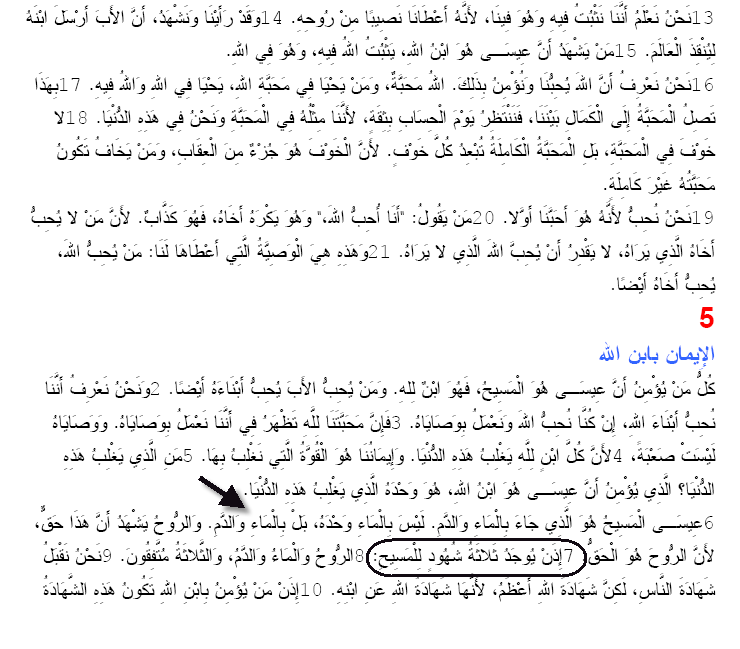
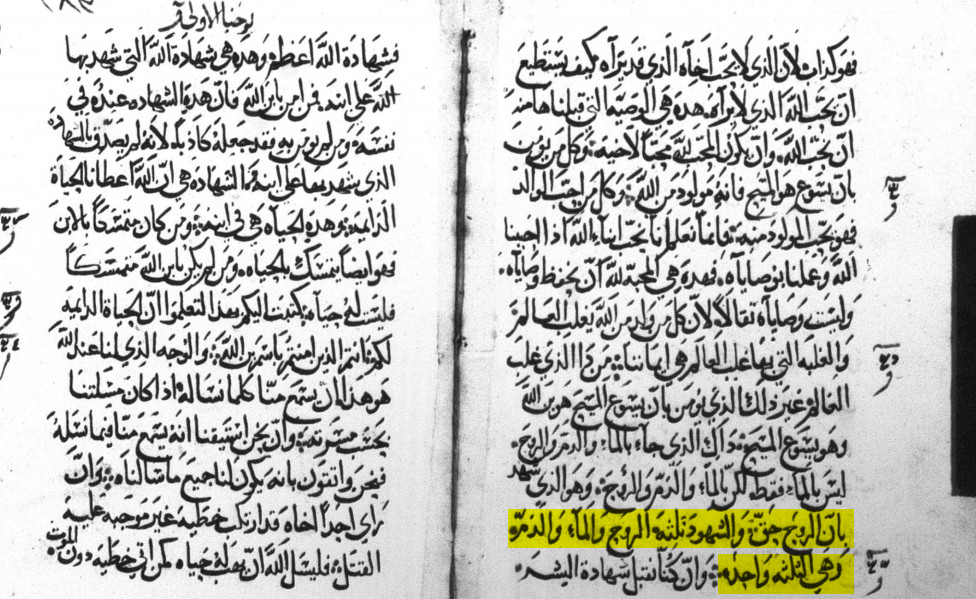
The Catholic Translation and Good News Translation
There are only two translations left — the Catholic translation and the Good News translation — and neither of them contains the text. The Catholic translation says: “And those who bear witness are three.” The Good News translation says: “And those who bear witness are three.”
The Johannine Comma is only present in the Van Dyck translation among nine Arabic translations. It is not present in the Catholic, the Jesuit, the Common Arabic, the Simplified Arabic, the Paulist, the Simplified, the Life, the Good News, or the Holy Gospel translations — because it is not present in all the Greek manuscripts.
The text is also not present in the Greek translation in which a number of biblical manuscript scholars participated:
English and Greek Translations that Omit the Text Entirely
The following English translations all render 1 John 5:7 without the Trinitarian formula:
- CJB (Complete Jewish Bible): “There are three witnesses—”
- CSB (Holman Christian Standard Bible): “For there are three that testify:”
- DBY (English Darby Bible): “For they that bear witness are three:”
- ESV (English Standard Version): “For there are three that testify:”
- GWN (God’s Word Translation): “There are three witnesses:”
- NAB (New American Bible): “So there are three that testify,”
- NET (The NET Bible, Version 1.0): “For there are three that testify,”
- NJB (New Jerusalem Bible): “So there are three witnesses,”
- NLT (New Living Translation, 2nd ed.): “So we have these three witnesses—”
- NRS (New Revised Standard Version): “There are three that testify:”
- Nestle-Aland (critical Greek edition): (omitted)
In confirmation, here is the New Testament, Greek to Arabic, translated between the lines (Paul Al-Feghali):
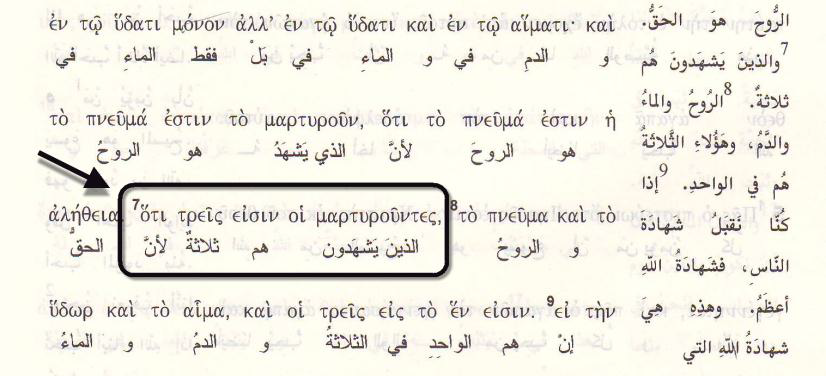
Summary of the Translation Evidence
- The Bible, despite its size, does not contain what Christians believe in terms of a clear Trinitarian proof text.
- The Bible preferred the greetings of Paul over the most important Christian beliefs such as the Trinity and the divinity of Christ.
- There is no text in the entire Bible that indicates the Trinity with the strength of the Johannine Comma.
- The Johannine Comma is not present in all Arabic translations except the Van Dyck translation.
- The Johannine Comma is not present in many English translations.
- The Johannine Comma is not present in the critical Greek translations made by scholars who reviewed the manuscripts before putting the text — this is in addition to what was mentioned above.
Scholarly Witnesses to the Distortion of 1 John 5:7
The First Witness: The Biblical Encyclopedia
The importance of this reference is not only that one of its editors is the former head of the Evangelical community, Dr. Samuel Habib, and one of its participants is Dr. Munis Abdel Nour — but also that it is among the references placed for students of the seminary and cited by seminary professors, including Father Bishoy Nathan. The Biblical Encyclopedia testified that this text was placed to support a theological thought and that it was not written by the author and is not found in any ancient Greek manuscripts:
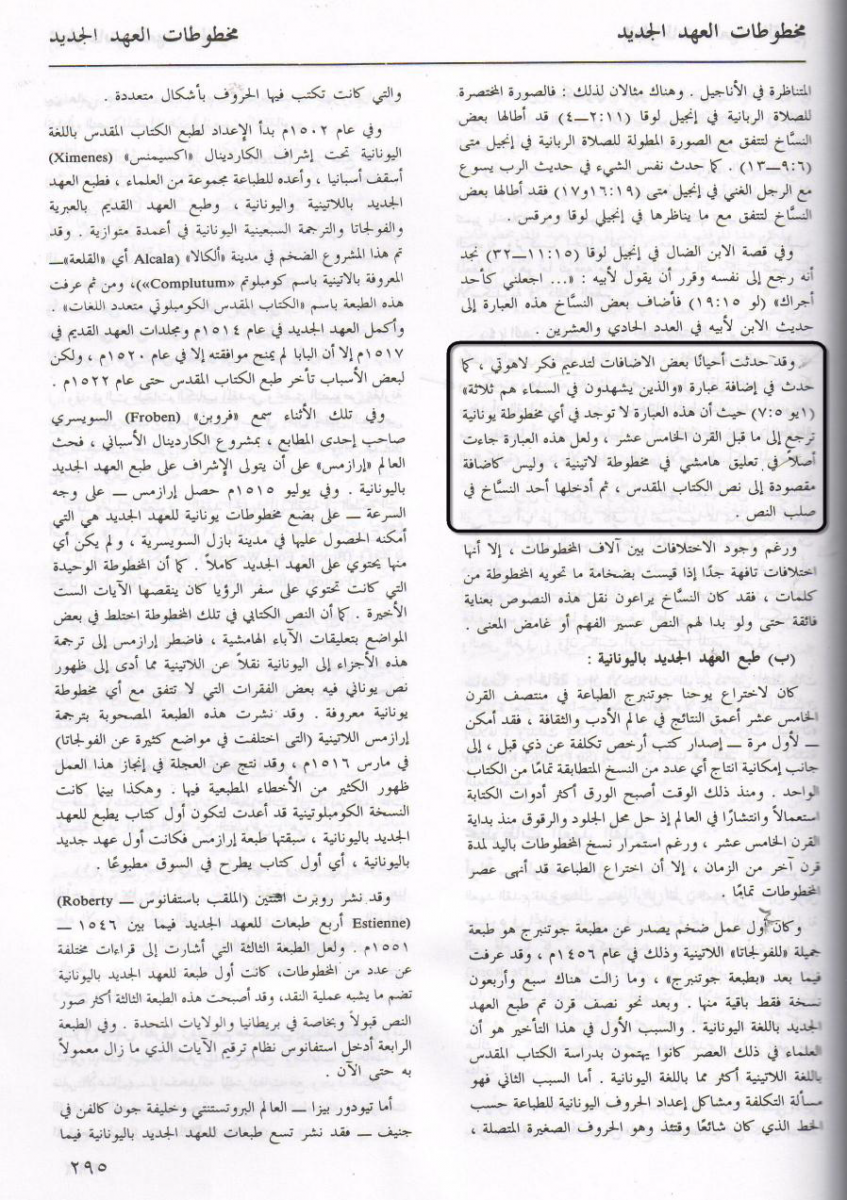
The passage above is from the Biblical Encyclopedia (Part Three, Page 295), attesting that the Comma was added to support a theological position and has no basis in the ancient manuscripts.
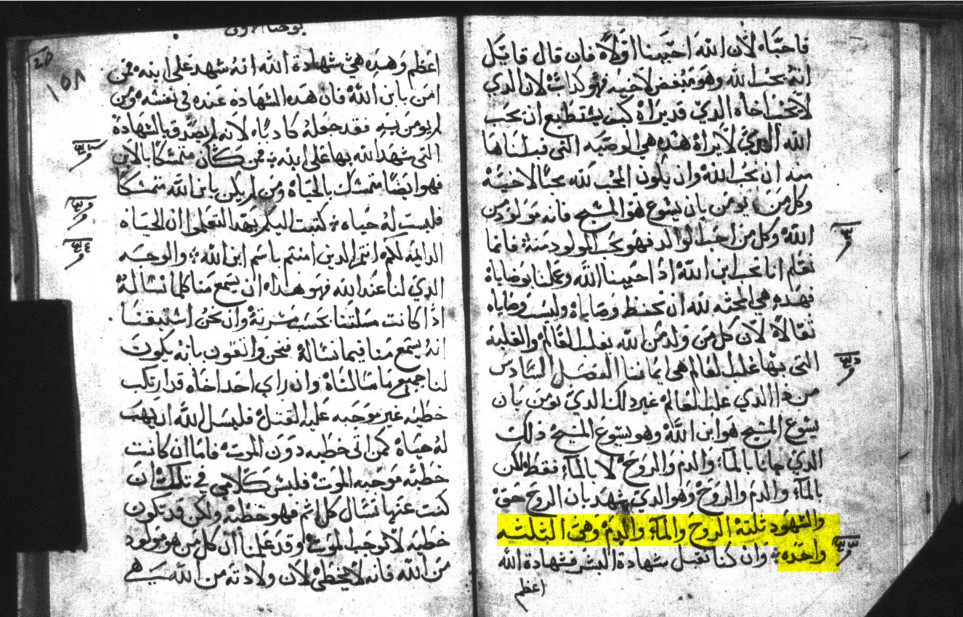
The Second Witness: Dr. William Kelly
Dr. William Kelly is one of the most prominent interpreters of the Holy Bible. His entire goal was to defend what he believed to be God’s revelation and to preach the book he believed to be God’s revelation. However, he confirms to us that this text has been distorted by internal and external criticism:
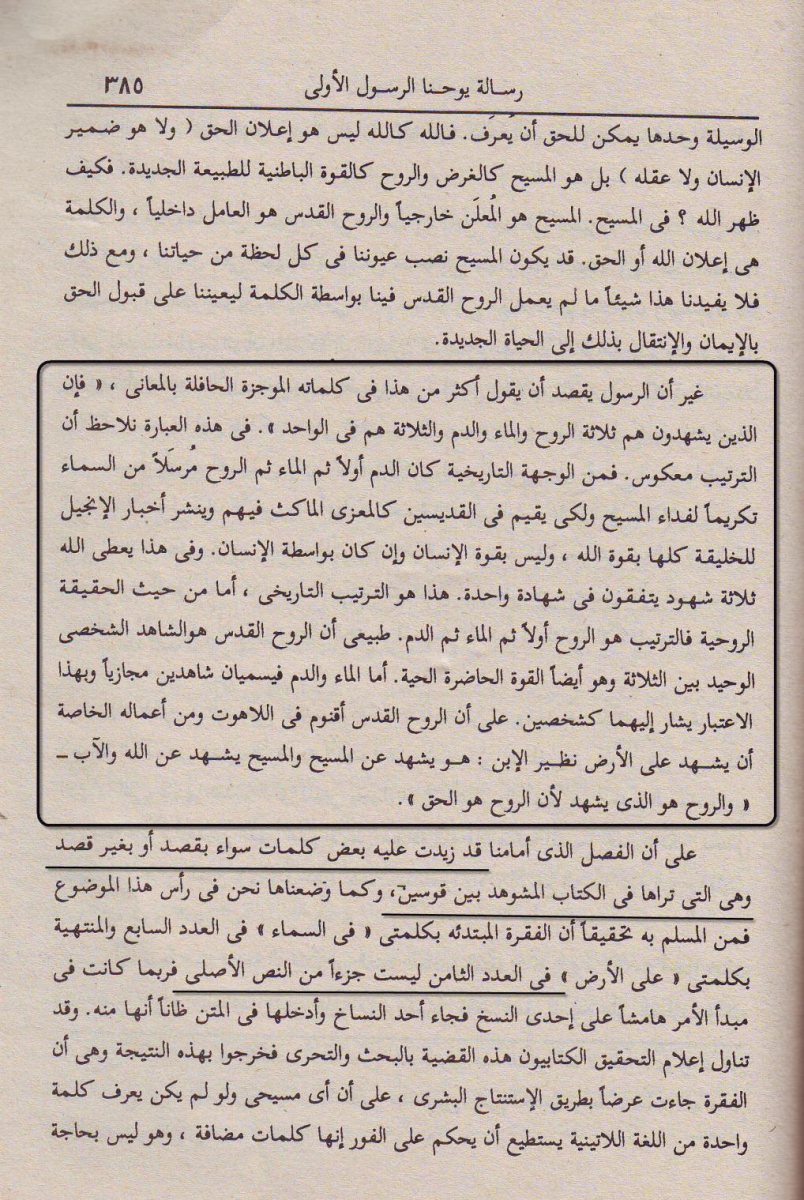
The passage above is from Twenty Lectures on the Commentary on the Epistles of John the Apostle by Commentator William Kelly, pages 385–386.
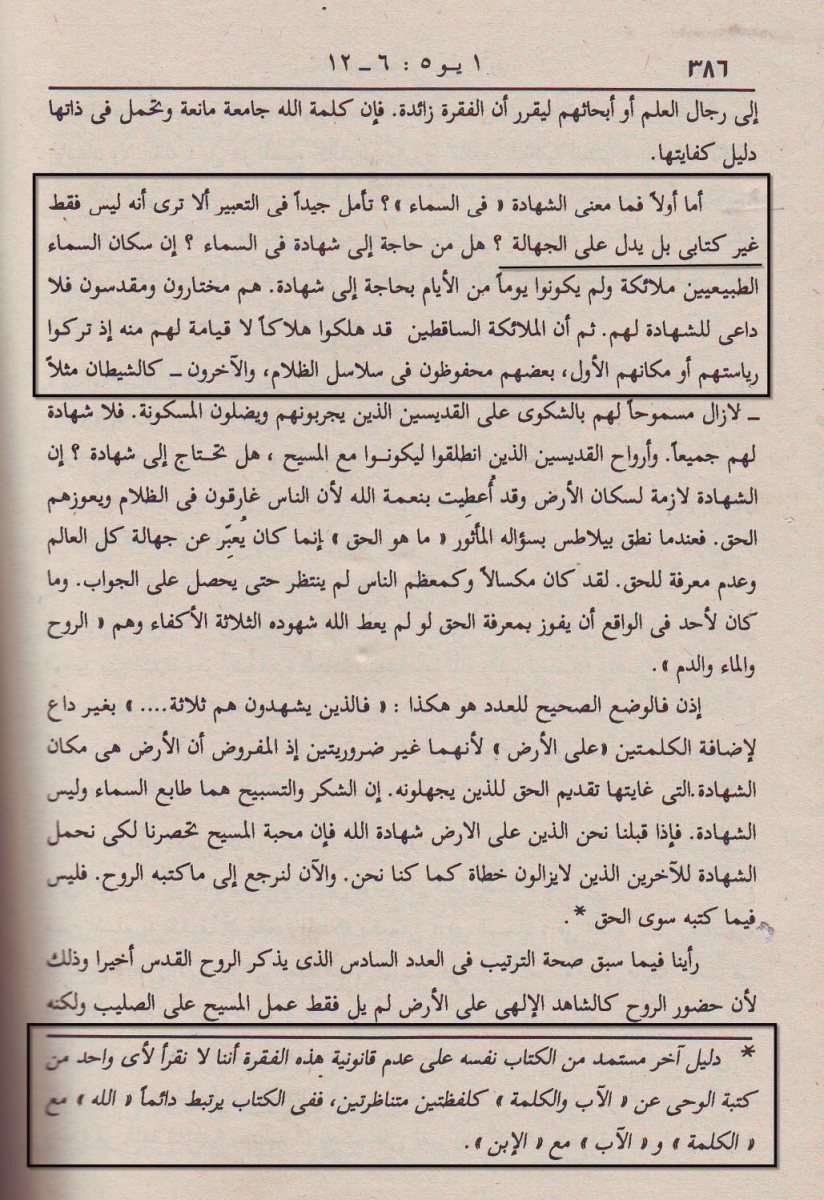
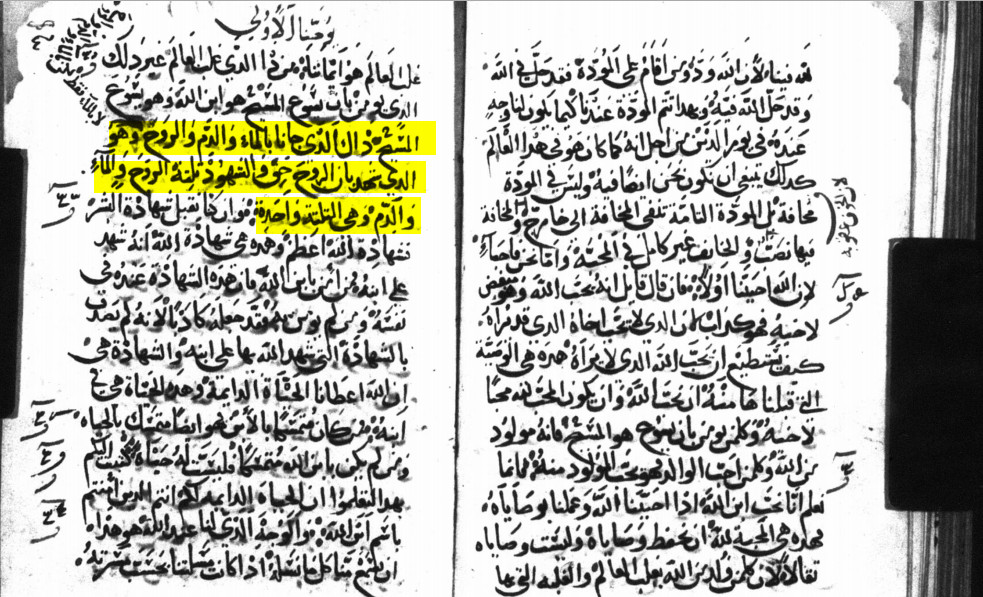
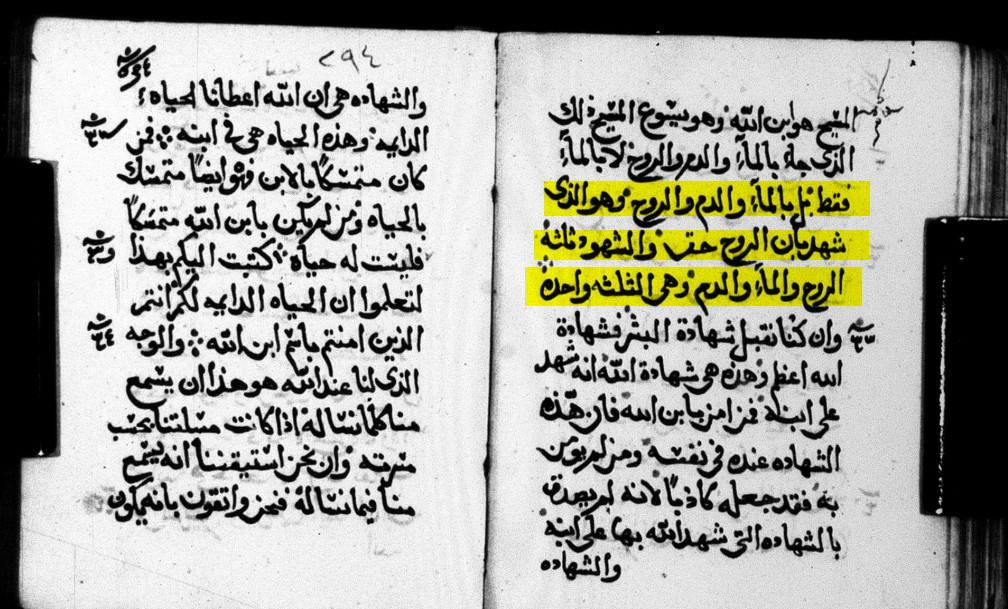
As we find in the explanation of Dr. William Kelly: he explains that this text was added by some ignorant people and that the placement of the text proves the ignorance of its author and distorter — because heaven does not need earthly testimony. He also explains that the word Father does not come with the word (Father and Word) because the word Father in the book comes with the Son, and the Word comes with God. Thus, the interpreter William Kelly explains to us that this text also does not exist in the ancient manuscripts that are relied upon, which indicates that it was added, distorted, and placed inside the book on purpose.
The Third Witness: Professor Hilal Amin
He is Professor Hilal Amin, one of the interpreters of the Holy Book, who also testified to the distortion of this text. He said:
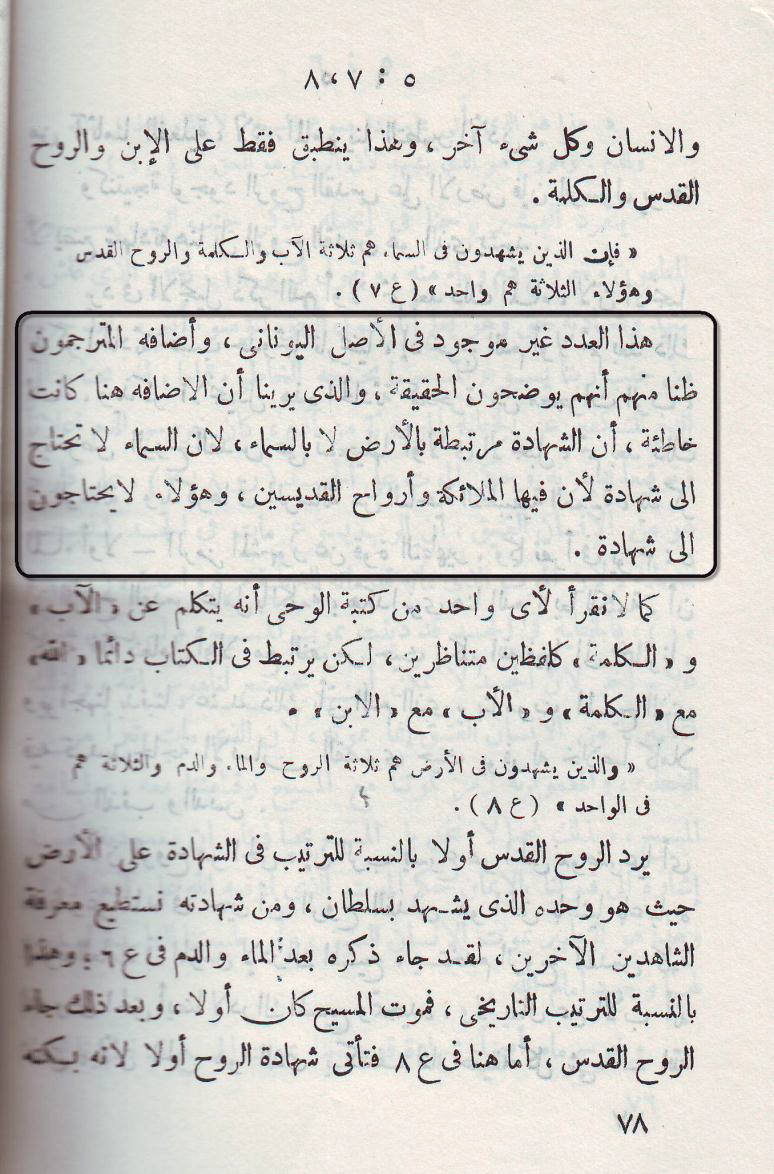
The passage above is from The Book of the Epistles of John by Hilal Amin Musa, page 78.
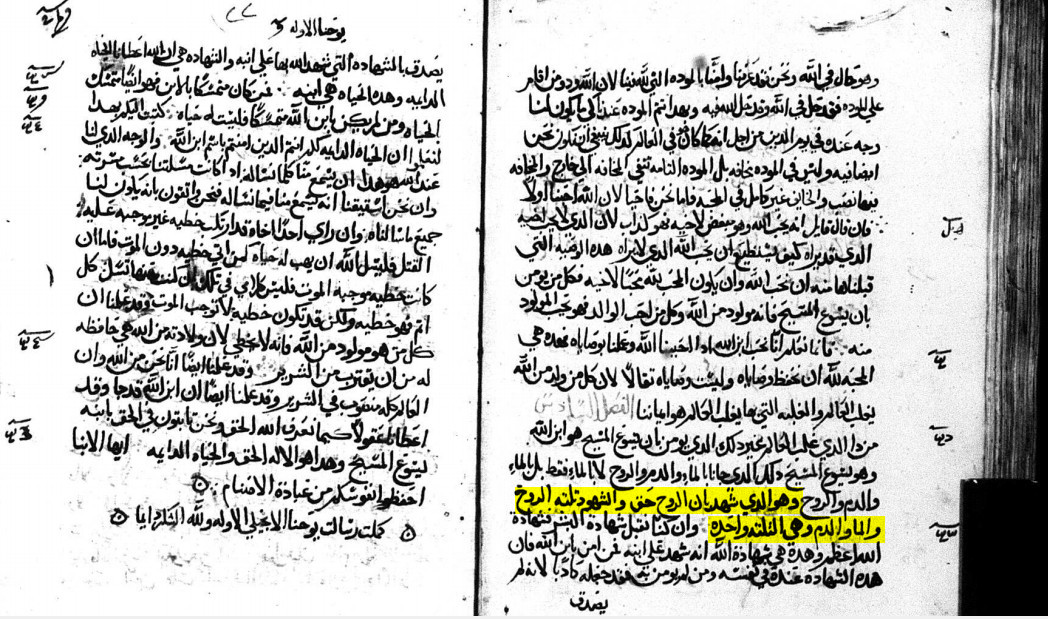
The Fourth Witness: William MacDonald
The interpreter William MacDonald speaks about this text as if saying that the text is added and not really found in all manuscripts — but we see that it is good and there is no problem with reading it and putting it in the book:
The passage above shows MacDonald admitting the Comma is only in a few manuscripts while defending its retention for doctrinal reasons.
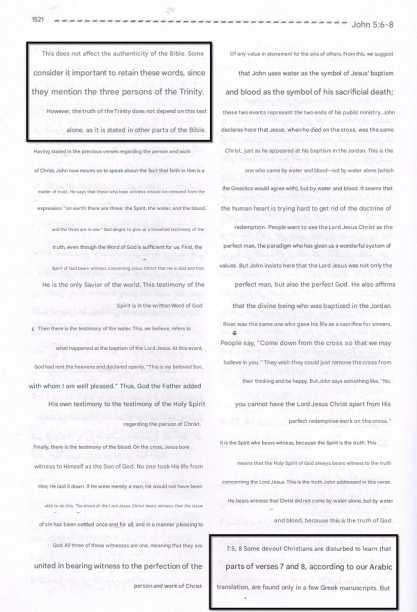
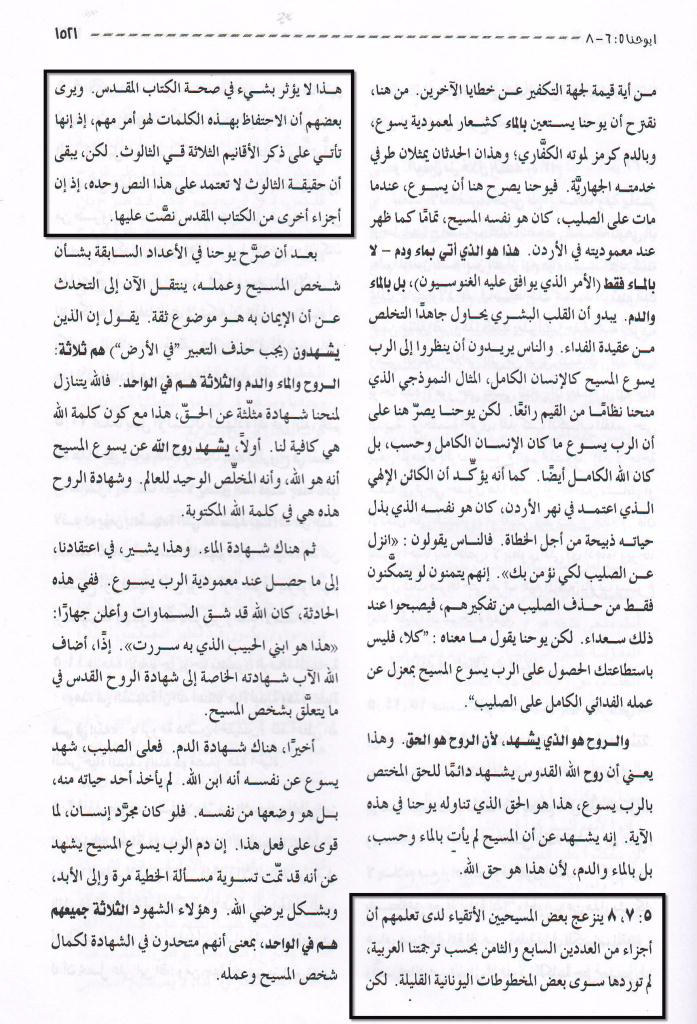
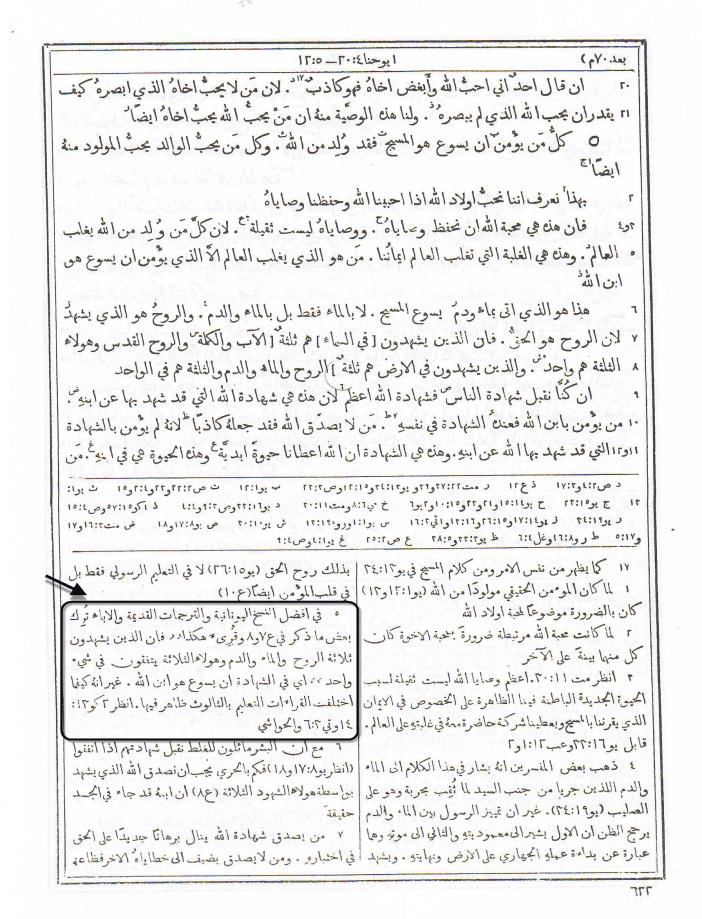
The Fifth Witness: The Bible Society Commentary
This interpretation was made by the Bible Society and it shows us that this text is not found in the best Greek manuscripts that are relied upon:
The Sixth Witness: Craig S. Keener
He is the interpreter Craig S. Keener, one of the interpreters of the Bible. He testified that this text is only found in three modern Greek manuscripts. He tells us the story of this text with the translator of the Van Dyck version:
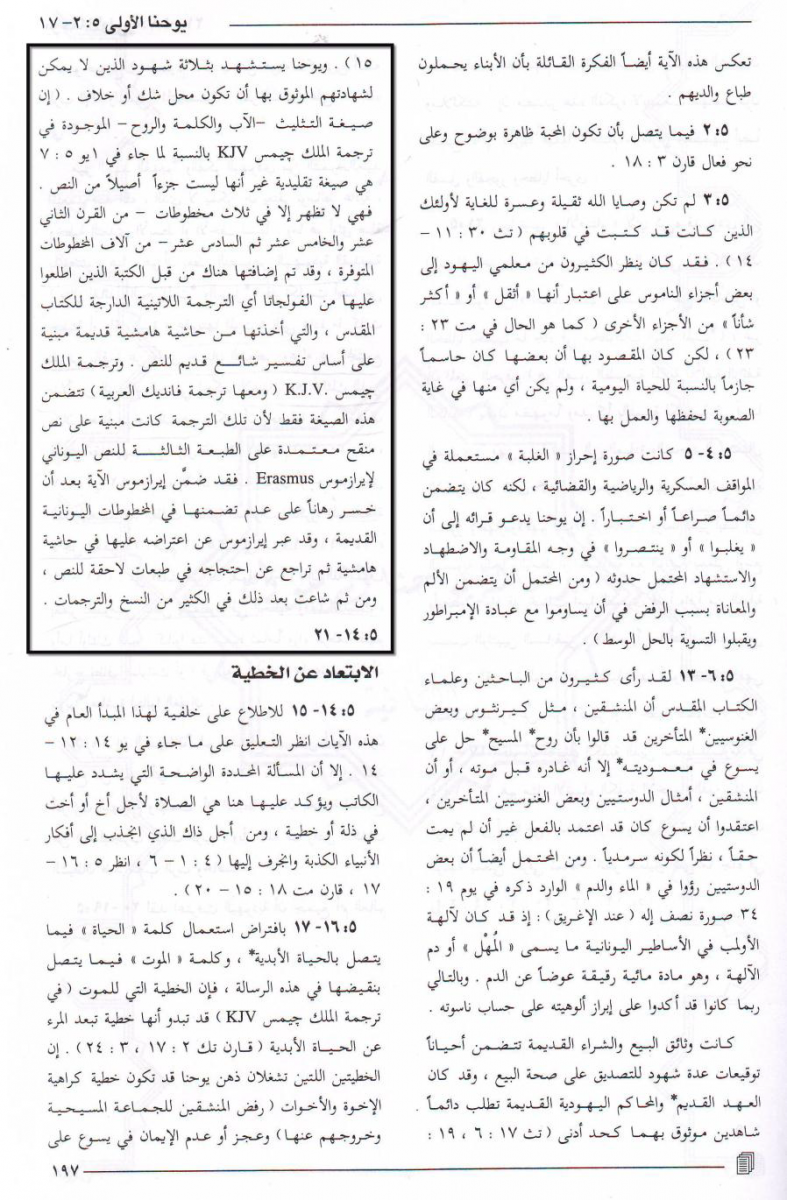
The passage above is from The Cultural Background of the Bible, The New Testament by Craig S. Keener, Part Three, Page 197.
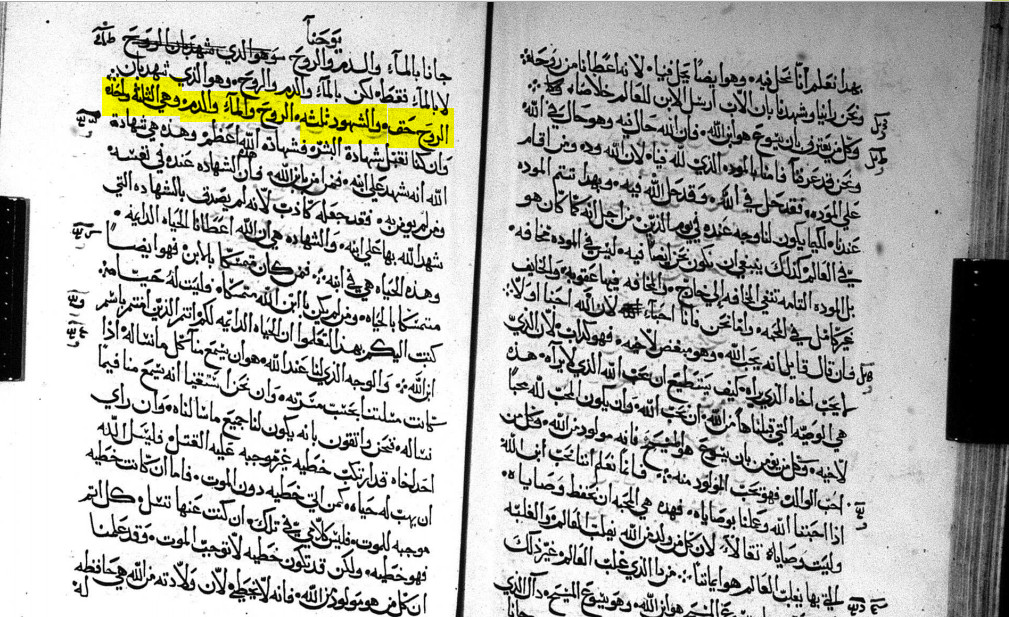
The Seventh Witness: Dr. Bart Ehrman
Dr. Bart Ehrman, a doctor of philosophy and theology at Princeton Theological Seminary, is a scholar specializing in early history. He studied under Bruce Metzger and is dean of the Department of Religious Studies at the University of North Carolina at Chapel Hill. Despite his extensive studies, he is now an atheist and no longer recognizes Christianity as a religion at all. However, even after his atheism, his testimony is of great importance in the field of manuscripts and fathers. Dr. Bart Ehrman wrote about this foreign text:
Erasmus did not find it in his Greek manuscripts, which instead simply read: ‘There are three that bear witness: the Spirit, the water, and the blood, and these three are one.’ Where did the ‘Father, Son, and Spirit’ go? There is no mention of them in Erasmus’s main manuscript, or in any of the other manuscripts he consulted, and so, naturally, he did not include them in his first Greek version.
They accused him of tampering with the text in an attempt to eliminate and degrade the doctrine of the Trinity. One of the principal editors of the Complutense Polyglot Bible, Stonica, published his slander against Erasmus and insisted that he restore the verse. Erasmus agreed — perhaps in a moment of weakness — to include this issue in future editions if his opponents could produce a Greek manuscript in which this verse could be found. And so a Greek manuscript came into being — indeed, it came into being on this occasion. It appears that someone had copied a Greek text containing the Epistles and translated the Latin text into Greek, thus producing the Johannine Comma in its familiar and theologically useful form. The manuscript presented to Erasmus dates from the 16th century — meaning it was made to order. Despite his skepticism, Erasmus kept his word and included the Johannine Comma in his edition. These editions became the basis for all subsequent reprints of the Greek New Testament. Passages familiar to readers of the English Bible — from the King James Version of 1611 onward — include the Johannine Comma, even though none of these passages are found in the older, more prestigious Greek manuscripts of the New Testament. These passages entered the English-speaking consciousness only by a historical accident, based on manuscripts that happened to be at Erasmus’s disposal and others made to assist him.”
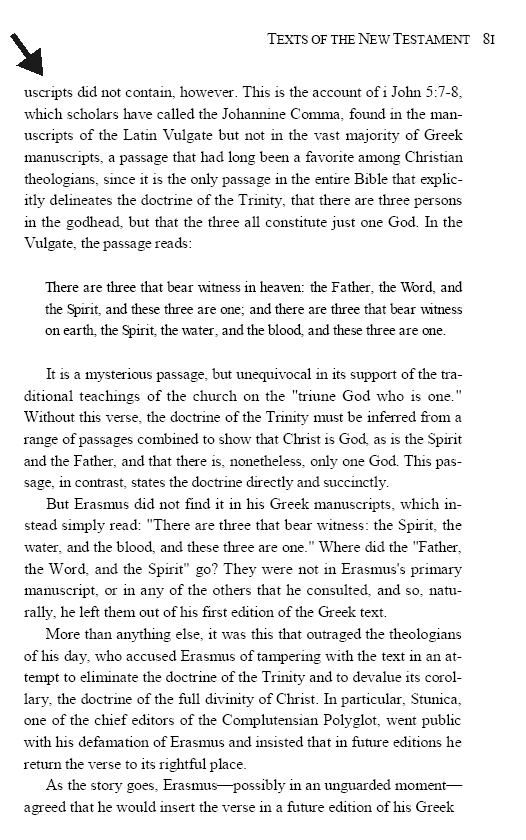
The passage above is from Misquoting Jesus by Dr. Bart Ehrman, pages 81–82.
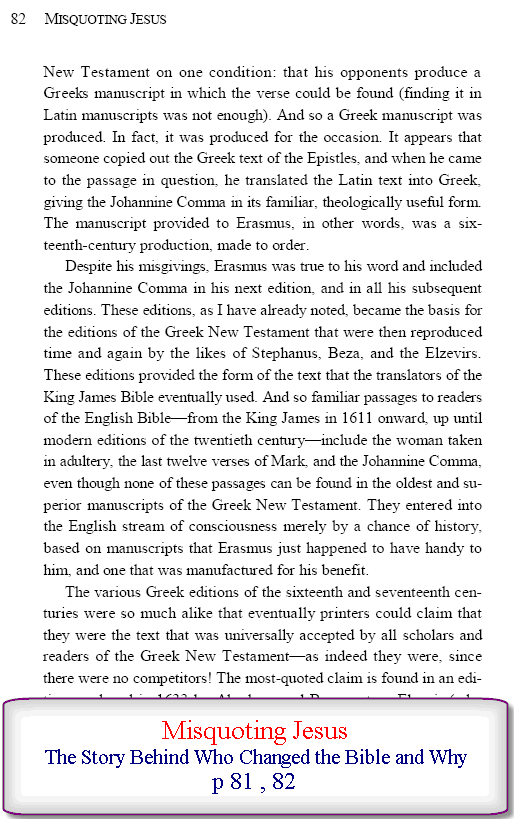
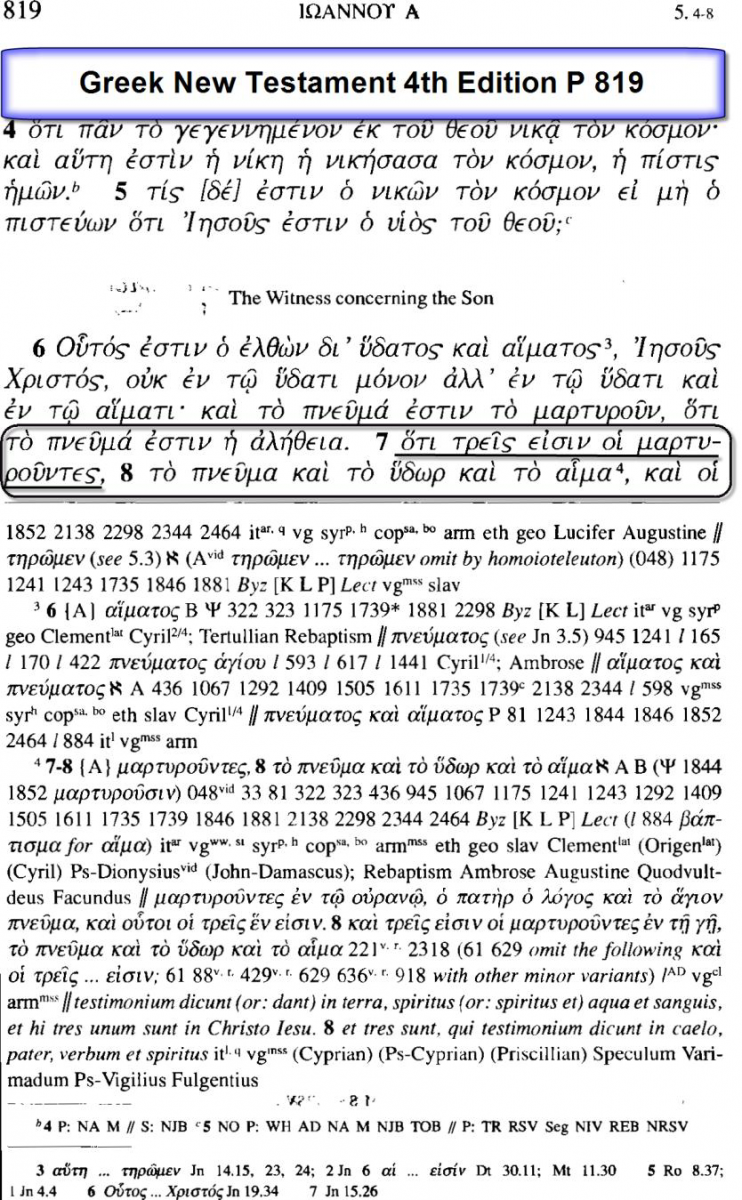
The Eighth Witness: Greek New Testament 4th Edition Committee
This book, considered the most important reference in the New Testament, was written by a group of scholars specializing in manuscripts and patristic studies: Bruce Metzger, Carlo Martini, Allen Wikgren, Matthew Black, Johannis Karavidopoulos, and Barbara Aland. All of these scholars agreed that this text is a later addition and not the original text, and that the correct text is “and those who bear witness three.” They said in a comment in the margin:
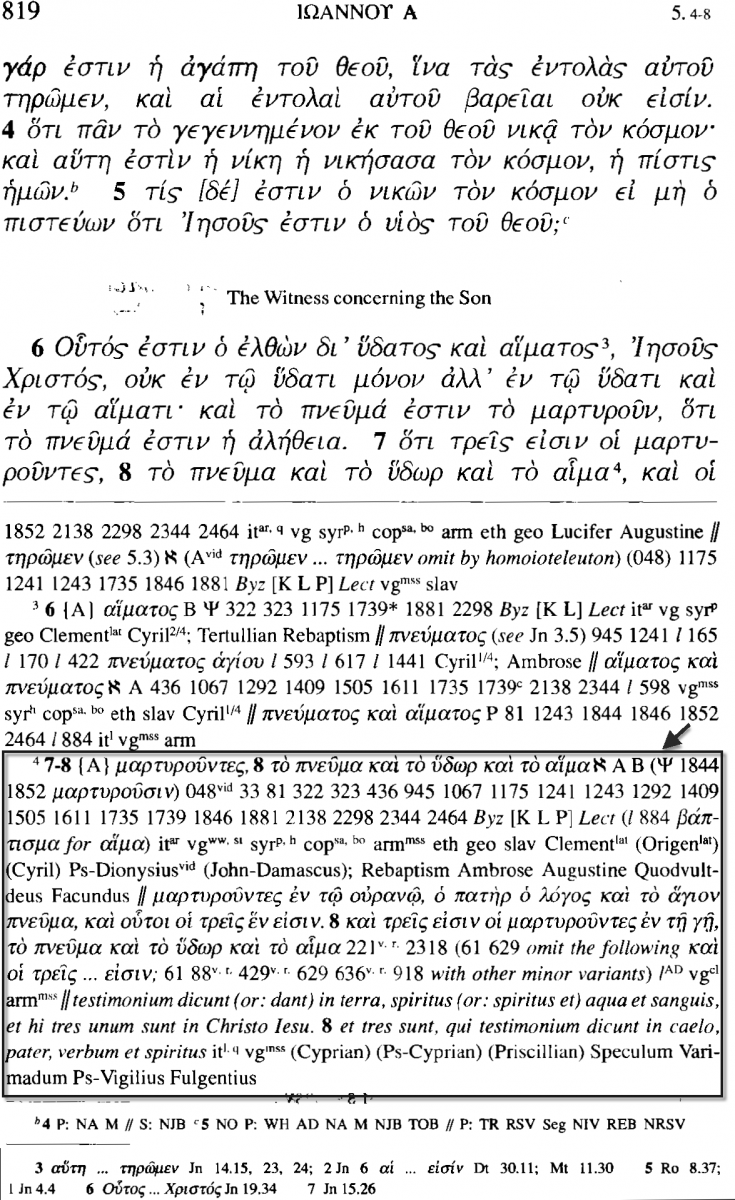
The important manuscripts that bear witness to the short reading (without the Comma):
Codex Sinaiticus (4th century) · Codex Alexandrianus (5th century) · Codex Vaticanus (4th century) · 048vid (5th century) · 33 (9th century) · 81 (1044 AD) · 322 (15th century) · 323 (12th century) · 436 (mid-11th century) · 945 (11th century) · 1067 (14th century) · 1175 (10th century) · 1241 (12th century) · 1243 (11th century) · 1292 (13th century) · 1409 (14th century) · 1505 (12th century) · 1611 (12th century) · 1735 (10th century) · 1739 (10th century) · 1846 (11th century) · 1881 (14th century) · 2138 (1072 AD) · 2344 (11th century) · 4464 (circa 14th century) · Byz (KLP) — Manuscript consensus Byzantine Text Family · L884 Canonical readings (8th century)
Old Bible translations attesting to the short reading:
Old Latin (4th century) · Vulgate (Wordsworth-White, 5th century; Stuttgart Vulgate, 5th century) · Old Syriac — Peshitta (mid-5th century) and Heracleanus version (616 AD) · Coptic (3rd century) — Sahidic and Boharic · Armenian (5th century) · Ethiopic (beginning of 6th century) · Georgian (5th century) · Slavonic (9th century)
Quotes from Greek Fathers attesting to the short reading:
Clement of Alexandria (before 215 AD) · Origen (253 AD) · Cyril of Alexandria (444 AD) · Dionysius (5th century) · John of Damascus (before 754 AD)
Quotes from Latin Fathers attesting to the short reading:
Rebaptism (c. 453 AD) · Ambrose (397 AD) · Augustine (430 AD) · Quodvultdeus (5th century) · Facundus (after 571 AD)
The Twelfth Witness: Dr. William Adey
This fact was also confirmed by Dr. William Adey in his famous interpretation The Great Treasure in the Interpretation of the Gospel, issued by the Council of Churches in the Near East, Volume 8, page 340:
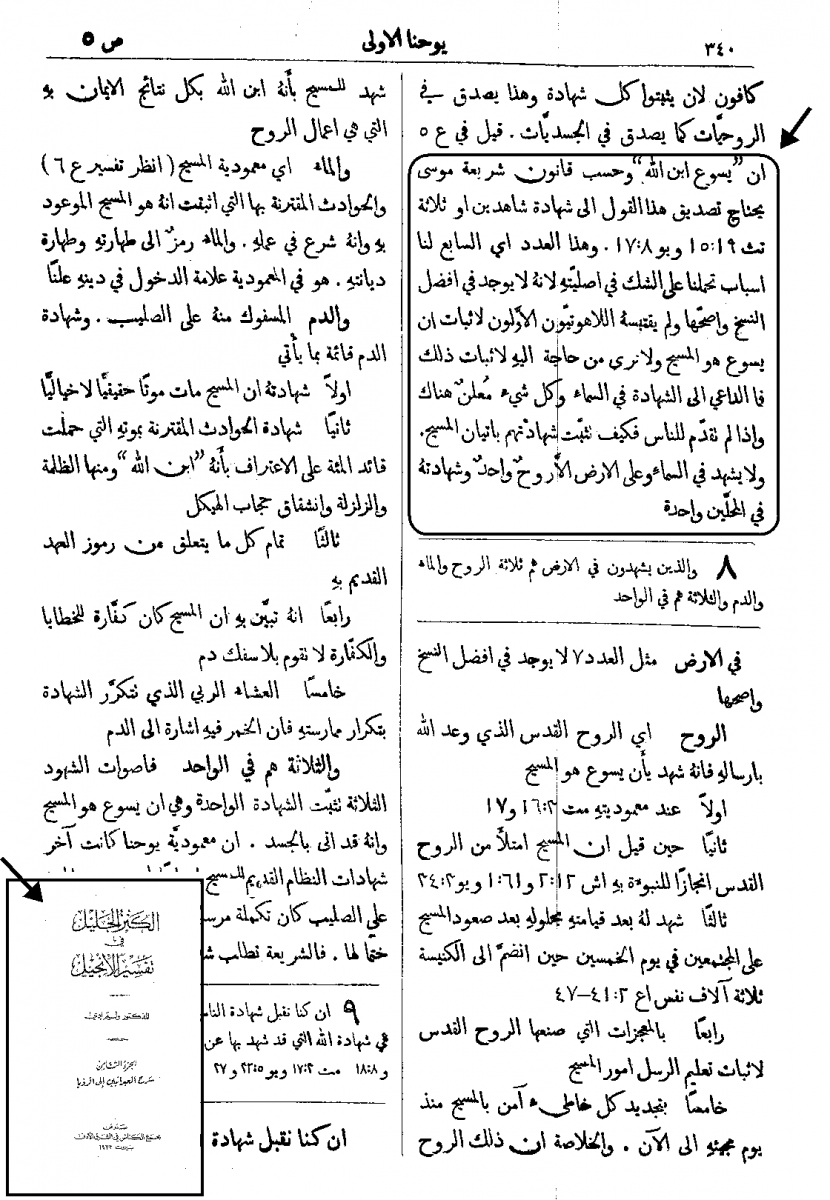
The passage above is from The Great Treasure in the Interpretation of the Bible by Dr. William Adey, Volume 8, page 340.
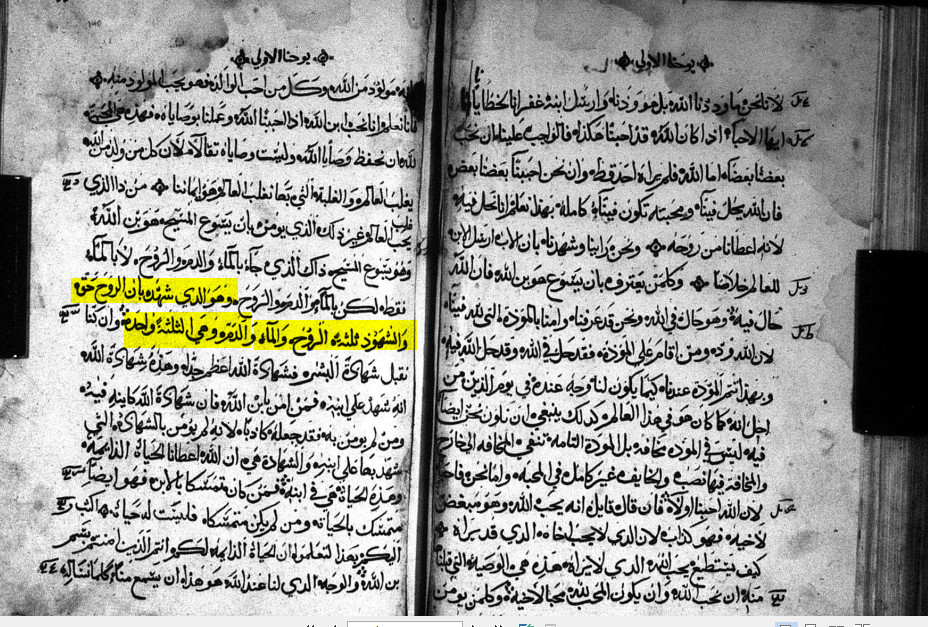
The Thirteenth Witness: The Catholic Translation Margin
The margin of the Catholic translation commented on this text:
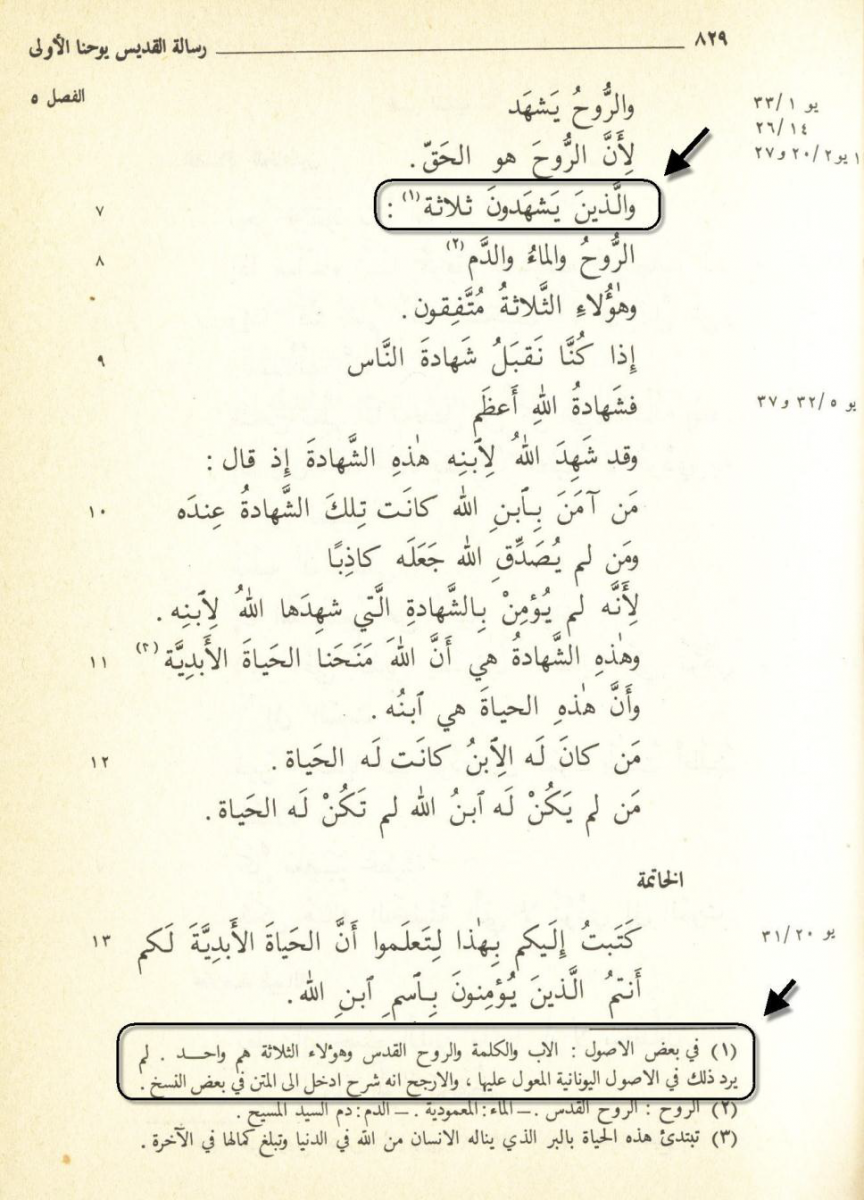
The passage above is from the Catholic Translation margin note on 1 John 5:7.
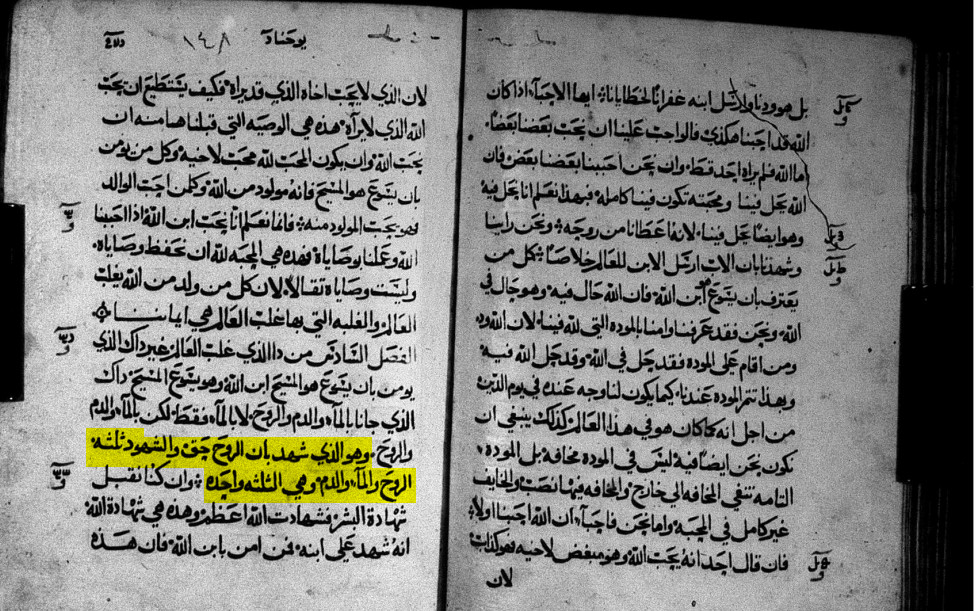
This testimony is also given by the authors of the Jesuit translation introduction, who have also pointed to the distortion of this text:
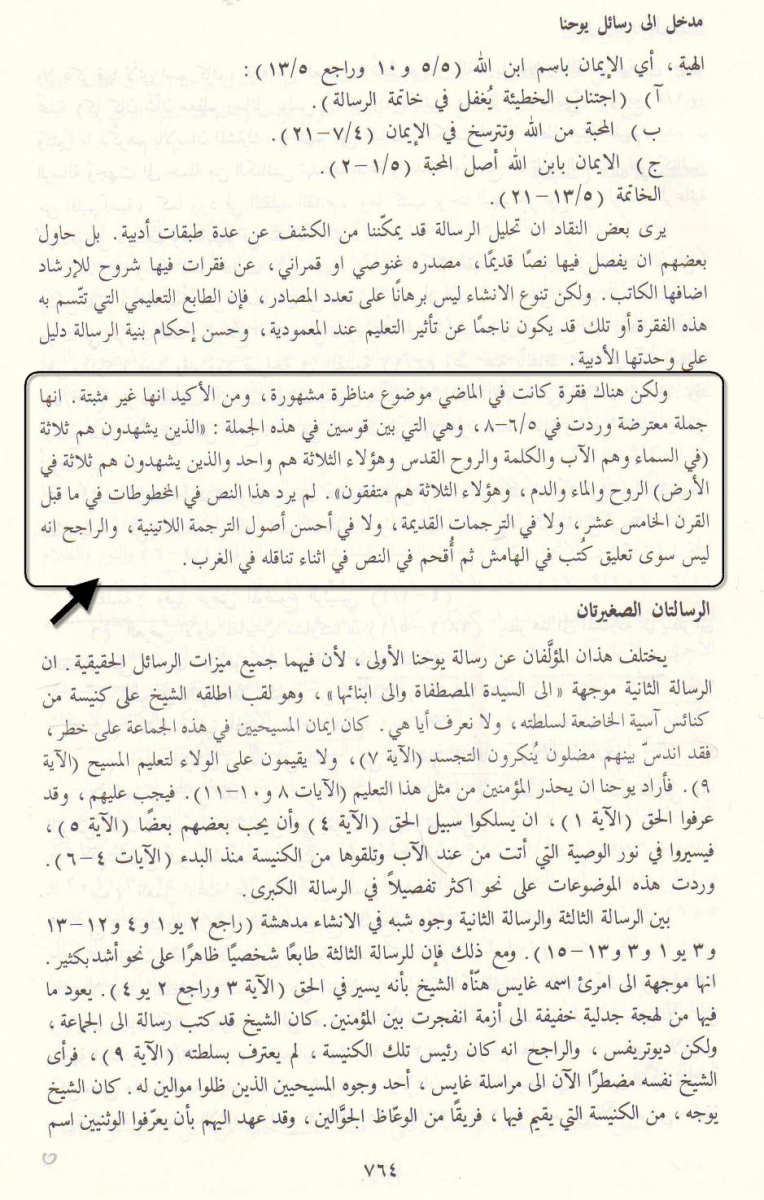
The passage above is from The Holy Bible — Translation of the Jesuit Fathers, Introduction to the Epistles of John, page 764.
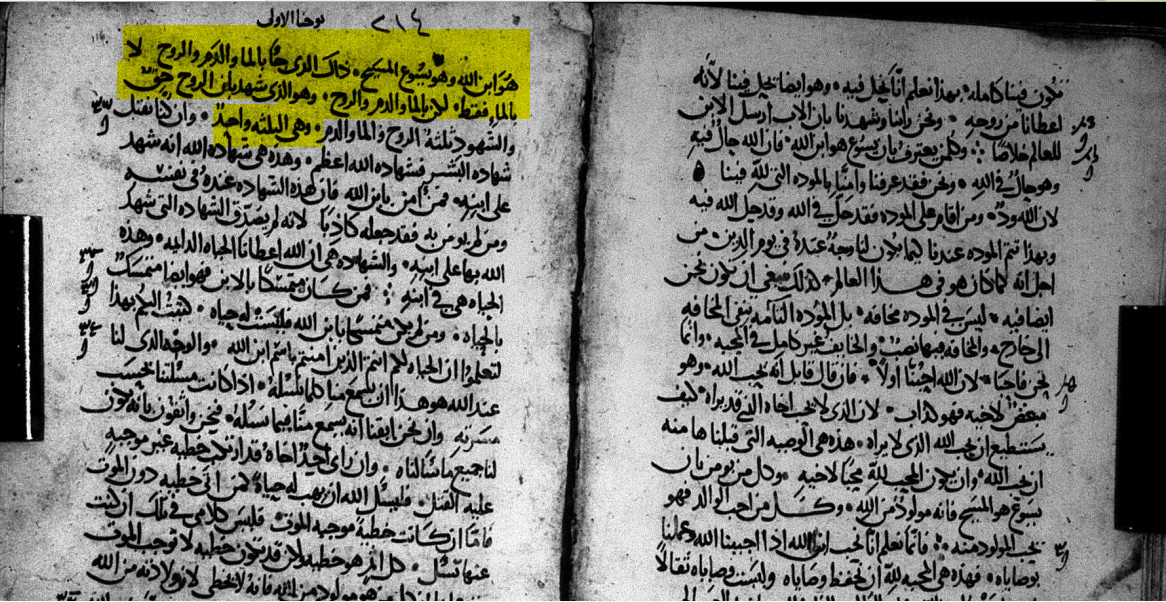
The Fifteenth Witness: Bruce Metzger and Bart Ehrman — The Text of the New Testament
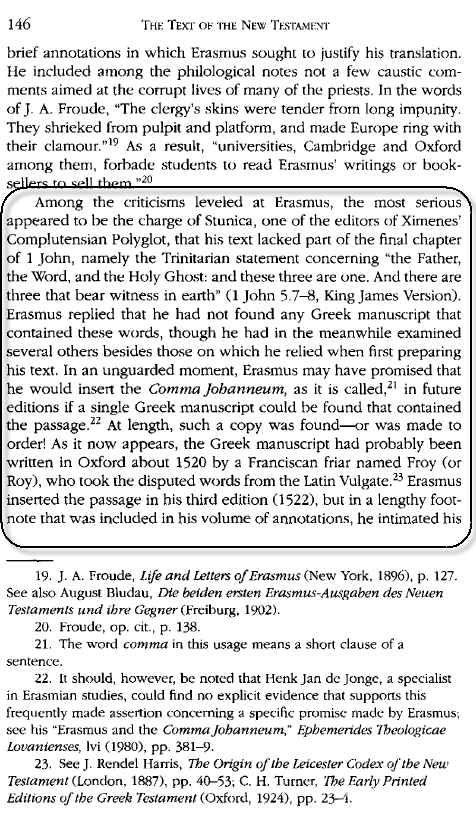
The passage above is from The Text of the New Testament by Bruce M. Metzger and Bart D. Ehrman, 4th Edition, pages 146–148.
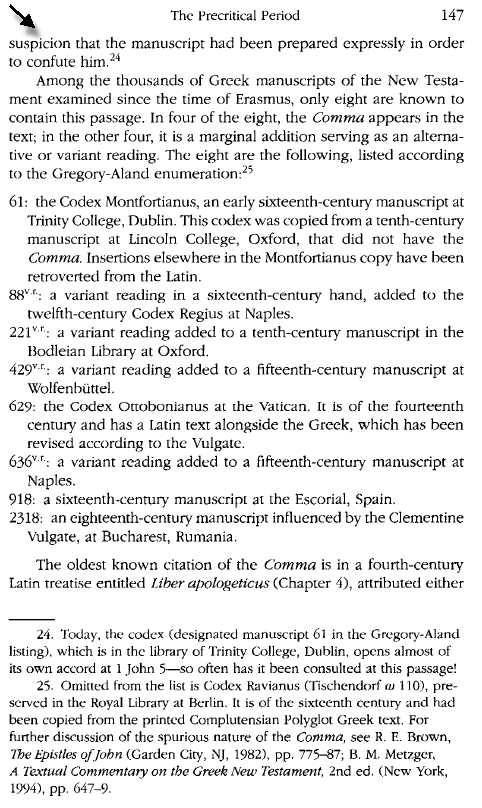
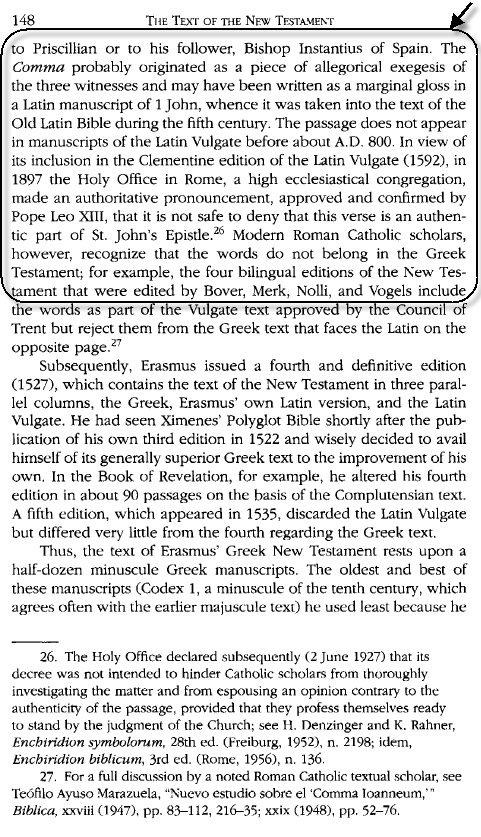
The Seventeenth Witness: Dr. Daniel B. Wallace — The Comma Johanneum and Cyprian
Dr. Daniel B. Wallace, Associate Professor of New Testament Studies at Dallas Theological Seminary, wrote a detailed analysis of the Johannine Comma and Cyprian’s alleged citation of it:
(2) The passage is quoted in none of the Greek Fathers, who, had they known it, would most certainly have employed it in the Trinitarian controversies (Sabellian and Arian). Its first appearance in Greek is in a Greek version of the (Latin) Acts of the Lateran Council in 1215.
(3) The passage is absent from the manuscripts of all ancient versions (Syriac, Coptic, Armenian, Ethiopic, Arabic, Slavonic), except the Latin; and it is not found (a) in the Old Latin in its early form (Tertullian, Cyprian, Augustine), or in the Vulgate (b) as issued by Jerome… or (c) as revised by Alcuin…
The earliest instance of the passage being quoted as a part of the actual text of the Epistle is in a fourth-century Latin treatise entitled Liber Apologeticus (chap. 4), attributed either to the Spanish heretic Priscillian (died about 385) or to his follower Bishop Instantius. Apparently the gloss arose when the original passage was understood to symbolize the Trinity (through the mention of three witnesses: the Spirit, the water, and the blood), an interpretation that may have been written first as a marginal note that afterwards found its way into the text.
Thus, a careful distinction needs to be made between the actual text used by Cyprian and his theological interpretations. That Cyprian interpreted 1 John 5:7-8 to refer to the Trinity is likely; but that he saw the Trinitarian formula in the text is rather unlikely.
One of the great historical problems of regarding the Comma as authentic is how it escaped all Greek witnesses for a millennium and a half. That it at first shows up in Latin, starting with Priscillian in c. 380, explains why it is not found in the early or even the majority of Greek witnesses. All the historical data point in one of two directions: (1) This reading was a gloss added by Latin patristic writers whose interpretive zeal caused them to insert these words into Holy Writ; or (2) this interpretation was a gloss, written in the margins of some Latin MSS, probably sometime between 250 and 350, that got incorporated into the text by a scribe who was not sure whether it was a comment on scripture or scripture itself.”
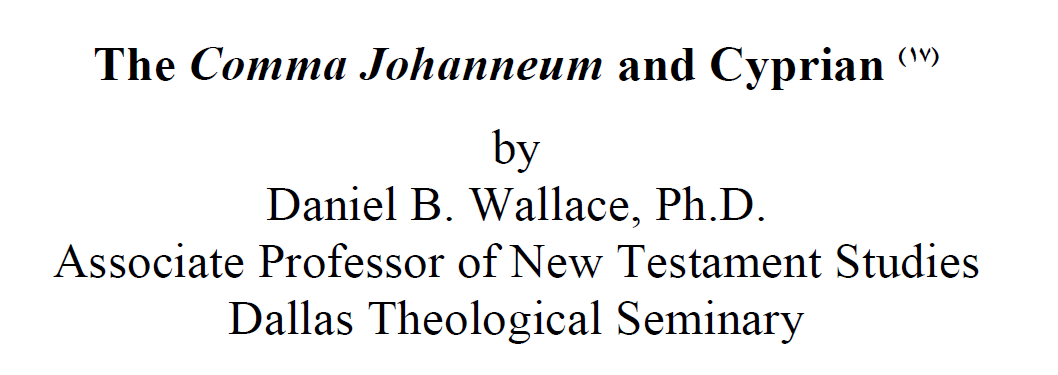
The image above is from Dr. Daniel B. Wallace’s full analysis of the Johannine Comma and Cyprian.

This is Part 2 of the Johannine Comma series. Part 1 covered the introduction, the Arabic and English/Greek translation survey, and the first eight scholarly witnesses. This part covers Episode 2: sixteen more scholars and references testifying to the distortion of 1 John 5:7.
Episode 2: 16 More Quotes of Scholars Testifying to the Distortion of 1 John 5:7
(Some may be repeated but are included with links for English speakers)
Reference 1: The Encyclopedia of the Bible
Reference 2: William Kelly — Twenty-Two Lectures on the Commentary on the Epistle of John the Apostle
Reference 3: Adam Clarke — Adam Clarke’s Bible Commentary on 1 John 5
The text is not found in the Syriac, Arabic, Ethiopian, Coptic, Armenian, and Slavonic manuscripts. In other words, it is not found in all ancient manuscripts except the Vulgate. Even in the Vulgate, many of the oldest and most authentic manuscripts do not contain this text. The text is also not found in all the quotations of the ancient Greek Fathers and is not found in most of the quotations of the Latin Fathers.
Reference 4: The Catholic Encyclopedia
The ancient Latin manuscripts (which some cite as evidence) only contain two manuscripts — one from the sixth or seventh century and the second from the eighth or ninth century — and even the Vulgate in its ancient manuscripts does not contain the text.
Reference 7: 1, 2, and 3 John by John Painter and Daniel J. Harrington — Page 301
Reference 8: Project Apostasy: The Development and Propagation of the Trinitarian Doctrine by Jesse Acuff — Page 210
Reference 9: The Letters of John by Colin G. Kruse — Page 180 (Footnote)
Reference 10: Handbook of Biblical Criticism by Richard N. Soulen and R. Kendall Soulen — Page 91 (2001)
People were carrying it as proof in the sixteenth and seventeenth centuries — then it was deleted in the twentieth and twenty-first centuries.
Reference 11 (The Catholic Encyclopedia — on Jerome)
The Catholic Encyclopedia says about Jerome — who wrote the Vulgate for the Catholics at the request of Pope Damasus: “St. Jerome (fourth century) does not seem to know the text.”
The oldest manuscripts of the Vulgate do not contain the Comma, including the Codex Fuldensis. The oldest Greek manuscripts do not contain the Comma, which made its way into writers during the eighth century. St. Bede, who died in 735, did not know the Comma — a saint in the eighth century did not know the Comma.
Reference 12: The King James Only Controversy: Can You Trust the Modern Translations? by James R. White — Page 102 (2009)
In an interesting attempt to defend the Comma, some pointed out the masculine gender of the three compared to the Spirit, water, and blood. This is not a big problem, because the reference to the three as masculine occurs almost always if it is used as an adjective — the only exception being 1 Corinthians 13:13.”
Continuing on page 103: Among the defenders of the Comma was the Burgon Society in the nineteenth century. However, if they looked closely, they would see that Burgon himself believed that the Comma was a later addition without proper evidence of its authenticity. Here are his words: “If these few manuscripts were used to prove the authenticity of the text, the text of the New Testament as a whole would be uncertain and doubtful.”
Reference 13: Johannine Perspectives on the Death of Jesus by Martinus Christianus Boer — Page 307 (footnote, 1996)
Reference 14: The Johannine Literature by Barnabas Lindars, R. Alan Culpepper, Ruth B. Edwards, and John M. Court — Page 16 (2000)
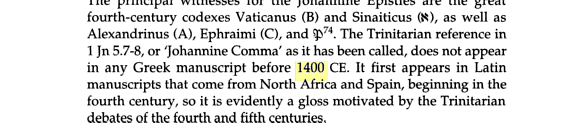
The image above provides additional scholarly documentation confirming the Comma’s late entry into the manuscript tradition.
Reference 15: Misquotes in Misquoting Jesus: Why You Can Still Believe by Dillon Burroughs — Pages 24–25
Reference 16: Interpreting the New Testament: A Practical Guide by Daniel J. Harrington — Page 23 (2003)
- The few Greek manuscripts that contain it.
- The realistic interpretation is that it came from the margin of a Latin manuscript.
- It makes the text that follows it more difficult.”
The Full Story of How the Comma Entered the Bible: Bruce Metzger’s Account
The entry of the Johannine Comma into the text of the New Testament and its global spread was through the Greek version of Erasmus — not in its first or even second edition, but in its third edition. This was stated by major textual critics including Samuel Tregelles, Stott, Hort, Frederic Kenyon, Caspar Gregory, Conybeare, Eberhard Nestle, Bart Ehrman, Hammond, Scrivener, Scott Porter, Bruce Metzger, and many others. Here is the account as Bruce Metzger stated it:
In a moment of indiscretion, Erasmus may have promised to add the Johannine Comma, as it is called, in future editions if he found a single Greek manuscript containing this phrase. After a while, this manuscript was found — or produced for this purpose. As it now seems, this Greek manuscript was probably written in Oxford in 1520 by a Franciscan father named ‘Froy’ or ‘Roy,’ who took this questionable phrase from the Vulgate. Erasmus inserted the text in the third edition (1522), but indicated in a long note his expectation that the manuscript was prepared to refute him.”
A doctoral researcher on Erasmus’s writings named Jung wrote an article published in a theological journal (Ephemerides Theologicae Lovanienses, Vol. 56, 1980, pp. 381–389) discussing the popular story among textual critics about the introduction of the Comma into Erasmus’s third edition. Dr. Jung quotes Erasmus in one of his letters explaining why he introduced the Comma into his third edition: “So that no one would have the opportunity to criticize me out of spite.”
This second reason is very shameful — as it shows beyond doubt that Erasmus knew the Comma was inauthentic, but for personal reasons he added it. Whether one accepts the first version (a 16th-century manuscript was produced to order to force Erasmus’s hand) or the second (Erasmus added it himself out of spite-avoidance), in both cases the result is the same: the Comma entered the New Testament text without any basis in the ancient manuscript tradition.
This is Part 3 of the Johannine Comma series. Part 1 covered the introduction and translation survey. Part 2 covered sixteen more scholarly witnesses and the Erasmus story. This part covers Episode 3: the testimony of the Church Fathers themselves — every father who quoted 1 John 5:7–8 quoted only the short reading, without the Trinitarian formula.
Episode 3: Writings of the Church Fathers Only
The following is a systematic examination of the Church Fathers who quoted from 1 John 5:7–8. In every single case, they quoted only the short reading — the Spirit, the water, and the blood — with no mention of the Trinitarian formula. This is the most devastating evidence against the Comma: the very fathers who were engaged in intense Trinitarian controversies and who desperately needed this text to defend the Trinity against the Arians and Sabellians did not know it existed.
St. Clement of Alexandria (c. 150–215 AD)
Many ancient sources where the Trinity text was expected to be found have found it omitted and without any basis at all. Clement of Alexandria emphasized the Trinity in his writings, yet his quotation of a passage from the First Epistle of John does not contain the Trinitarian formula.
It is worth noting that he wrote in his commentaries on the First Epistle of John a commentary on 1 John 5:6 and 1 John 5:8 — and completely omitted 1 John 5:7. Does this mean that it did not exist at all in Clement of Alexandria’s sources?
Translation: He says, “This is he who came by water and blood” (1 John 5:6) and again, “for there are three witnesses: the Spirit,” which is life, “the water,” which is spiritual rebirth and faith, and “the blood,” which is knowledge; “and these three are one,” since in the Savior are all these elements that save us, and life itself lives in his Son.
Thus, we do not see in Clement of Alexandria’s quote any reference to the Trinitarian text, despite its extreme importance in orthodox Christian belief and principles. Is there an explanation for this other than that Clement knows nothing about it at all?
St. Theophilus of Antioch (2nd century)
Saint Theophilus of Antioch is one of the second-century fathers. The question here is: Did Theophilus of Antioch have any knowledge or awareness of this passage?
In his explanation of the six days of creation and at the beginning of a conversation about the fourth day in his book Against Autolycus (Book 2, Chapter 15), Theophilus said:
This is Theophilus of Antioch’s definition of the Trinity — and wisdom here means the Holy Spirit according to his theology. However, wisdom in the New Testament and in Christian theology today is not the Holy Spirit — it is the Son. The question now: Does wisdom mean the Holy Spirit in Theophilus, or did Theophilus of Antioch worship a different understanding of the Trinity than what Christians profess today? Definitely the Holy Spirit is not wisdom. In light of the doctrine of the distinction between the hypostases, we must distinguish between the work of each hypostasis — the hypostases do not perform the same works, but each has its own work.
I do not see that this great father had any knowledge or awareness of the famous text of the Trinity — otherwise he would not have made this error in the most important principle of the true Christian faith.
Theologian Origen of Alexandria (c. 184–253 AD)
The famous and eminent scholar Origen — in his commentary on the Gospel of John — explicitly quoted the text of the First Epistle of John 5:8 and did not pay attention to the text of 1 John 5:7, as if it were written in his copy in transparent handwriting.
What is the interpretation of the so-called fundamentalist Christians for this action of the famous theologian Origen?
Saint Tertullian (c. 155–220 AD)
The great Saint Tertullian, in his book Against Praxeas — which he wrote around 210 AD — tries hard to prove the Trinity by quoting John 10:30 (“I and the Father are one”), and despite that he does not quote 1 John 5:7, which has a decisive meaning. He mentioned many proofs of the divinity of Jesus, including John 1:1, John 14:11, and others. So why did Tertullian not mention the Trinitarian text when he was in dire need of it here?
Tertullian quoted the text in John 10:30 many times in his explanations of the Trinity and the alleged unity between the hypostases. The puzzling question still remains: Why did Tertullian not use it as evidence?
For example, we find him in chapter 25 (ANF 3.01.60) saying:
As we can see, the misguided one did not mention anything — not even any reference to the text of the Trinity — which he is in dire need of. Why? Can one of the Christians explain this matter to us? Why do they rely on flimsy statements in the writings of Tertullian saying that he cites the passage as evidence, while he does not mention it at all, and rather cites the text “I and the Father are one” as evidence for his statement “These three are of one essence”?
Saint Cyprian (c. 210–258 AD)
The imposters claim that in the writings of Cyprian there is a direct quotation of the text of the forged Trinity. Is their claim true?
Cyprian, one of the fathers of the third century, wrote what appears to the reader to be a quotation from an existing text. However, this claim faces many obstacles. Dr. Daniel Wallace responded to those who said that what Cyprian wrote was a quotation from a biblical text. Here is the relevant passage from Cyprian:
The image above accompanies Dr. Wallace’s full analysis of the Cyprian claim.
It is clear from his words that he is explaining 1 John 5:8 — and that he means that the three witnesses refer to the Trinity. Dr. Wallace notes several key points:
First — Cyprian said “it is written of the Father, and of the Son, and of the Holy Spirit” — that is, written about them, written concerning them. Would he have said this if the quoted text explicitly mentioned them? Of course not.
Second — He says “the Son” and does not say the word ὁ Λόγος (Verbum) which we find in the late Latin text of the Vulgate or the Received Greek Text. So Cyprian quoted a text that refers to or symbolizes the Father, the Son, and the Holy Spirit — and this text is the short reading (1 John 5:8): “And there are three that bear witness: the Spirit, the water, and the blood; and these three are in one.”
This interpretation is famous among the Latin Fathers — Augustine himself interpreted the short reading in exactly this Trinitarian way:
This is exactly what Cyprian meant: the text (1 John 5:8) saying that the Spirit, water, and blood are one replaced the three symbols with what they symbolize. He said it is written about the Father, about the Son, and about the Holy Spirit (“and these three are one”) — not that he was quoting a text that explicitly named them.
Third — If Cyprian, who lived in the third century, knew the Comma, then why did the Latin Fathers who came after him — Leo the Great, Augustine, Ambrose — not know the Comma? This is a fatal question.
And there is also testimony from the same time as Cyprian that confirms once again that the Comma was not known at all in his time:
Letter on the Rebaptism of an Unknown Person (258 AD)
This letter is from the same time as Cyprian — the third century. The GNT4RE version placed Rebaptism among the list of Latin Fathers and dates it to 258 AD:
And in another quote from the same letter:
Both quotes from this third-century letter preserve only the short reading — no Trinitarian formula.
Saint Dionysius (3rd century)
In his explanation of the Trinity, Saint Dionysius cited texts from John 10:30 and John 14:10. He was talking about the Trinity, and was in dire need of this text. So why didn’t he mention it?
Here Dionysius talks very clearly about the Son’s relationship with the Father through the texts of John 10:30 and John 14:10 — as if he had not seen the Spirit in the first place, and he did not mention a single text that mentions the Trinity of Yahweh. Why did Dionysius not mention the text of 1 John 5:7 if he knew anything about it?
Some tried to respond to this fatal question — “Why do we not find a mention of this text in the dialogues related to the Trinity in the third and fourth centuries?” — by saying that these dialogues did not need to cite such a text since the Sabellians, for example, believe in the Trinity from the beginning but do not distinguish between the hypostases. This is a very weak reason, since establishing a belief requires citing what pertains to it. But we have seen in the writings of Dionysius against the Sabellians that he cited the text “I and the Father are one” — so why did he cite it then if they believed in the Trinity from the beginning? This citation of Dionysius destroys their statement and blows up their response completely.
Saint Hippolytus (c. 170–235 AD)
As was the custom of the fathers when he spoke about the unity between the hypostases, he never mentioned the text of 1 John 5:7 but rather cited John 10:30: “I and the Father are one.”
Here Hippolytus talks about the distinction between the hypostases with the unity in essence, citing John 10:30, which only mentions the Father and the Son. In a situation like this, why didn’t Hippolytus mention the famous text of the Trinity, 1 John 5:7 — or did he not have it?
This is the case with almost all the fathers. Although the text is crystal clear, we do not find anyone who has used it to prove their belief — which indicates the strength of the claim that this text is forged and unoriginal in any way. It is completely absent from all the writings of the fathers whom Christians boast about. So what talk do you have after that, Christians?
Saint Augustine, Bishop of Hippo (354–430 AD)
Saint Augustine is one of the most famous Latin Fathers. In his commentaries on the First Epistle of John, we find him quoting the texts of 1 John 5:7–8. The paragraph does not contain the Trinitarian formula:
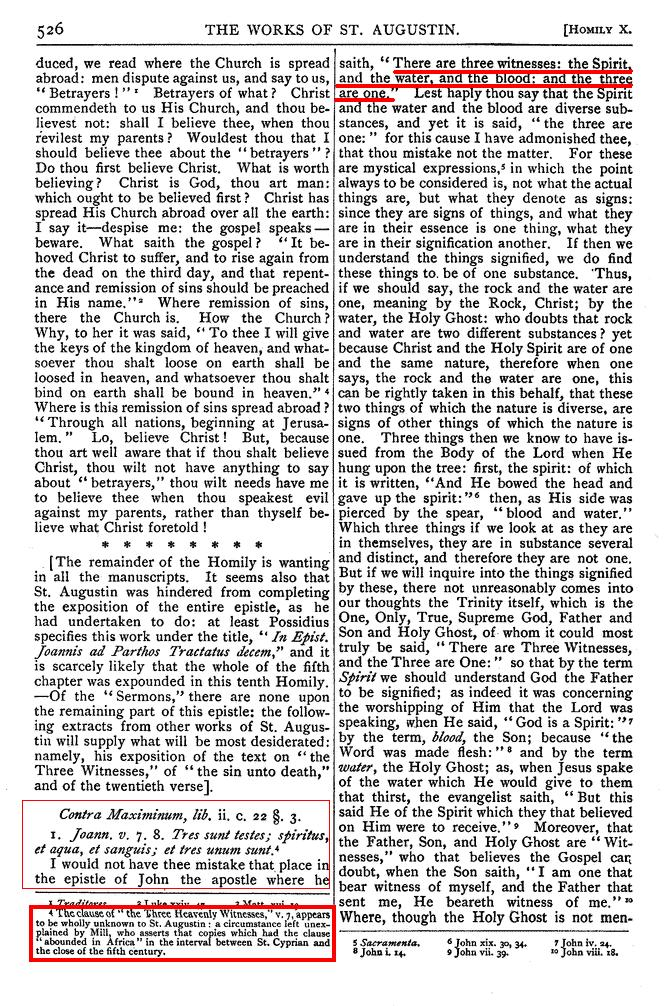
As we see in the translation, underlined in red: “There are three witnesses: the Spirit, the water, and the blood, and these three are one” — with no Trinitarian formula whatsoever.
Even the commentator on the translation says: “It seems that Saint Augustine knew nothing about the Trinitarian formula, which was not explained by Mill, who asserted that the copies circulating in Africa in the period between Saint Cyprian and the fifth century contained this formula. It is now certain that the Latin versions from which Augustine quotes did not contain the Trinitarian formula, and this proves the invalidity of its presence in the versions circulated by the Christian Fathers Cyprian, Tertullian, and others, since they were copied from them.”
Augustine is one of the most important Latin fathers who knew absolutely nothing about the Johannine Comma. We also know from Augustine’s words in the same letter that he interpreted the short reading to arrive at the Trinity — but he was completely unaware of the Comma itself because he did not have it. Also, Augustine explained the Trinity in detail in 15 parts and did not cite this text once.
Saint Ambrose, Bishop of Milan (c. 340–397 AD)
Saint Ambrose was one of the great Latin Fathers who also knew Greek and spoke it fluently. Despite all this — his knowledge of Latin and Greek — we find him knowing absolutely nothing about the Johannine Comma. He quotes entire verses from the First Epistle of John, starting from the sixth verse to the end of the eighth verse, and we do not find the Johannine Comma:
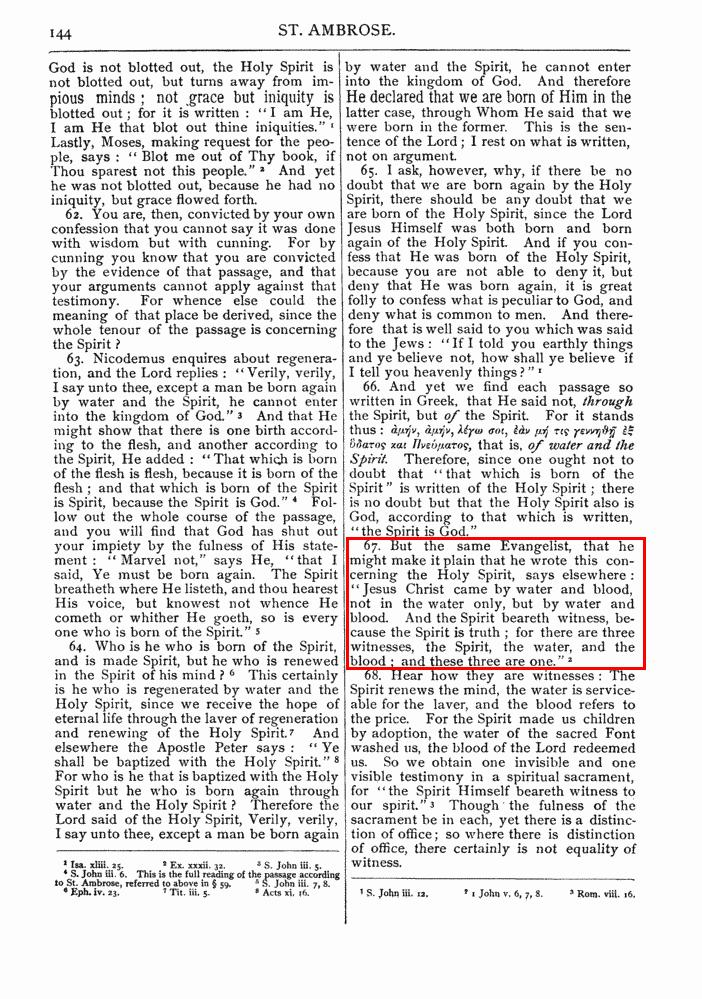
He says specifically in 3:10, v. 67:
So where is the Trinitarian formula in Ambrose? It seems that his situation is no different from that of Augustine.
Saint Pope Leo III (?–816 AD)
Pope Leo III also cited the text of the First Epistle of John in his letter to Flavian:
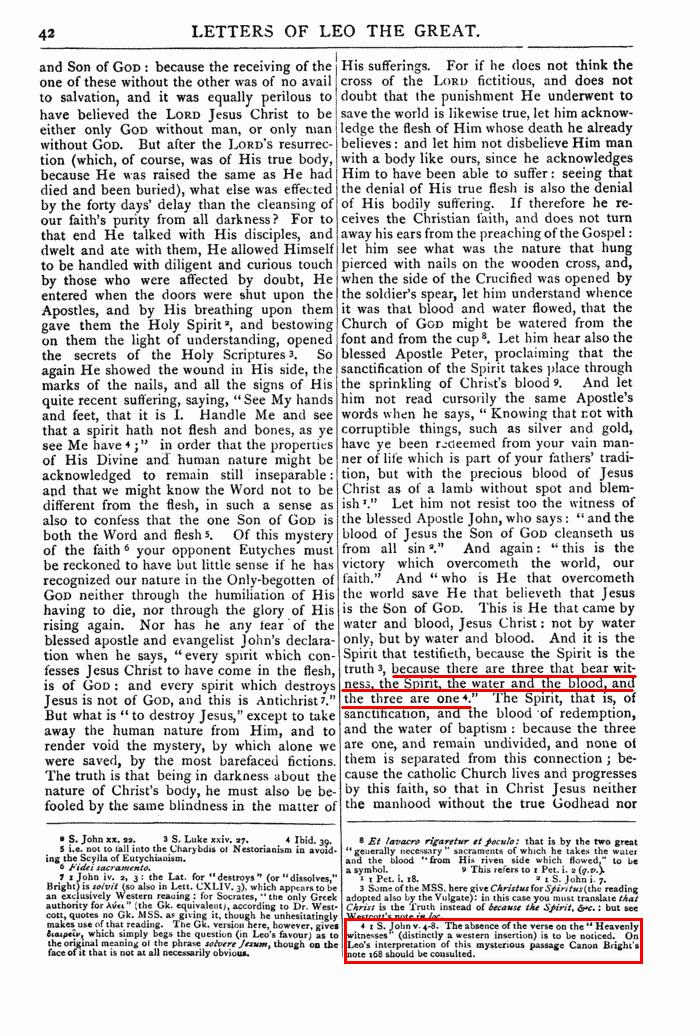
In front of you, in the shaded part on the right of the page, is Pope Leo III’s quotation of the text of the First Epistle of John, Chapter 5, Verses 7–8. He quotes it as follows:
It is clear from the quote of Saint Leo III in the ninth century AD that he knew nothing about the formula of heavenly witnesses or the Trinitarian formula. This is conclusive evidence that this formula was not widespread or entered into the Greek versions known to Pope Leo III until the ninth century AD. Who would come after that to say that this formula was known among the people but there was no need to quote it or talk about it?
This is also evidence that distortion entered the Greek versions in later eras — even after the emergence and spread of Islam.
Summary: The Church Fathers Against the Comma
These are the fathers whose quotations indicate their complete lack of knowledge of the Johannine Comma:
- Clement of Alexandria (before 215 AD) — quoted the short reading only
- Theophilus of Antioch (2nd century) — defined Trinity with no reference to the Comma
- Origen (253 AD) — quoted 1 John 5:8 with no mention of 1 John 5:7
- Tertullian (c. 210 AD) — cited John 10:30 instead when he needed the Trinity text
- Cyprian (3rd century) — interpreted the short reading symbolically, did not quote the Comma
- Anonymous letter on Re-Baptism (258 AD) — quoted only the short reading
- Dionysius (3rd century) — cited John 10:30 and 14:10 in Trinitarian debates, no Comma
- Hippolytus (c. 170–235 AD) — cited John 10:30 in Trinitarian debates, no Comma
- Augustine (430 AD) — quoted the short reading, explained Trinity by interpretation only
- Ambrose (397 AD) — quoted the short reading, no Trinitarian formula
- Pope Leo III (9th century) — still quoting the short reading with no Comma
Among the fathers who quoted the short reading are also: Origen (253 AD), Cyril of Alexandria (444 AD), John of Damascus (before 754 AD), and many others.
Not a single Greek Father quoted the Johannine Comma. Not one. And the Latin Fathers who most needed this text in their Trinitarian controversies — Tertullian, Cyprian, Augustine, Ambrose, Leo the Great — all quoted only the short reading.
Detailed Analysis: Cyprian and the “Half-Comma” Controversy
Because Christians cling to Cyprian’s words as the strongest patristic evidence for the Comma, a detailed examination is warranted.
Cyprian’s words: “The Lord says, ‘I and the Father are one;’ and again it is written of the Father, and of the Son, and of the Holy Spirit, ‘And these three are one.’”
When a Christian says through this statement that Cyprian has quoted the Comma — let us examine this carefully:
Point 1: Cyprian says “it is written of the Father, and of the Son, and of the Holy Spirit” — meaning written about them, concerning them. If the quoted text explicitly mentioned them by name, he would have quoted it directly, not said “it is written about them.”
Point 2: He says “the Son” — not “the Word” (ὁ Λόγος, Verbum) which appears in the Comma. If he was quoting the Comma, he would have used the exact wording.
Point 3: The phrase “and these three are one” appears at the end of 1 John 5:8 in the short reading — it is not exclusive to the Comma. All three Latin Fathers who quoted the short reading used “and these three are one” or “and the three are one.” Augustine quoted it. Leo the Great quoted it. Ambrose quoted it. All of them were using 1 John 5:8 — not 1 John 5:7.
Point 4: If Cyprian knew the Comma — with its crystal-clear explicit Trinitarian wording (“the Father, the Word, and the Holy Spirit”) — why did the three major Latin Fathers who came directly after him (Augustine, Ambrose, Leo) not know it? There is no answer to this question. The only conclusion is that Cyprian was giving a Trinitarian interpretation of the short reading of 1 John 5:8 — exactly as Augustine and others did explicitly.
This is Part 4 of the Johannine Comma series. Part 1 covered the introduction and translation survey. Part 2 covered sixteen scholarly witnesses. Part 3 covered the Church Fathers. This part covers the Final Review: the complete textual-critical analysis, the full manuscript count (494 against the Comma, 5 for it), every critical Greek edition, the Erasmus story in full, and the conclusion.
Final Review: The Complete Textual-Critical Case Against the Johannine Comma
The Johannine Comma is the best witness to the doctrine of the Trinity in the entire Bible — and it is a fabrication. Bart Ehrman confirmed this in Misquoting Jesus:
A Christian colleague, after admitting the inauthenticity of the Comma, said: “But my dear Christian believer, do not be intimidated by these statements that say that this text is the only one that indicates the Trinity, and with its fall the doctrine of the Trinity falls. You should know that every text that indicates the oneness of God is evidence of the oneness of the Trinity. Below, we will list 260 texts from the Bible that prove the doctrine of the Trinity!” — and he proceeded to list texts in 16 full pages.
His method was: collecting texts that speak of the divinity of the Father, texts that speak — according to his claim — of the divinity of the Son, texts that speak — according to his claim — of the divinity of the Holy Spirit, then texts that speak — according to his claim — of the equality of the hypostases, and finally texts that speak of the oneness of God. And thus he proved the Trinity, may God help him. How hard this work was, in order to prove a fundamental Christian doctrine. Now we know why a text was added that explicitly carries the doctrine. We respond to all texts that the Christian colleague believes speak of the divinity of the Son, the divinity of the Holy Spirit, or the equality of the hypostases — without exception — because they are also not explicit texts, and we are in a constant debate about these deductive theological topics.
This introduction is only for the Christian to know the extent of the problem he falls into in order to prove a basic doctrine — and for this we realize well why this text was and still is the most beloved to the hearts of Christians, and the first text that comes out of the mouth of the Christian when he tries to prove the doctrine of the Trinity from a biblical perspective. The Christian does not find anything easier or simpler than to say: “The evidence is in the first letter of John, 5:7…” We will prove — God willing — beyond any doubt that the text of the Johannine Comma is not an authentic text according to the rules of textual criticism, and we will leave them to fight with 260 verses in an attempt to deduce the doctrine of the Trinity, which does not exist in the Bible.
Beginning of the Textual Study: The Two Readings
When we begin to study any textual problem, we first determine the number of readings and then study the external evidence for each reading. In the case of our text under investigation, we find that there are two readings in the Greek manuscripts: a long reading which contains the Comma, and a short reading which does not contain it.
The Long Reading (contains the Comma — in blue)
“7 For there are three witnesses in heaven: the Father, the Word, and the Holy Spirit, and these three are one. 8 And there are three who bear witness on earth: the Spirit, the water, and the blood. And these three are one.” (Life Translation)
Greek (GNT of the Greek Orthodox Church):
7 ὅτι τρεῖς εἰσιν οἱ m Λόγος οὗτοι οι τρεῖς ἕν εἰσιν 8 τρεῖς εἰσιη αἷμα, καὶ οἱ τρεῖς εἰς τὸ ἕν εἰσιν.
The Short Reading (no Trinity — the Original text)
“7 And there are three who bear witness: 8 the Spirit, the water, and the blood, and these three are in one.” (English Common Translation)
Greek (Nestle-Aland 27th edition):
7 ὅτι τρεῖς εἰσιν οἱ μαρτυροῦντες, 8 τὸ πνεῦμα καὶ τὸ ὕδωρ καὶ τὸ αἷμα, καὶ οἱ τρεῖς εἰς τὸ ἕν εἰσιν.
The Short Reading: 494 Greek Manuscripts
The Greek manuscripts that attest to the short reading and do not contain the Johannine Comma number 494 — but the total number of manuscripts, including manuscripts of the ancient translations, exceeds 500. Here is the complete list of Greek manuscripts that do not contain the Comma:
א ABKLP Ψ 048 049 056 0142 0296 1 2 3 4 5 6 18 35 36 38 42 43 51 57 62 69 76 81 82 88* 90 93 94 97 102 103 104 105 110 131 133 141 142 149 172 175 177 180 181 189 201 203 204 205 206 209 216 218 221* 223 226 234 250 254 256 263 296 302 307 308 309 312 314 319 321 322 323 325 326 327 328 330 337 363 365 367 368 378 383 384 385 386 390 393 394 398 400 404 421 424 425 429* 431 432 436 440 442 444 450 451 452 453 454 456 457 458 459 460 462 464 465 466 467 468 469 479 483 489 491 496 498 506 517 522 547 582 592 601 602 603 604 605 606 607 608 614 615 616 617 618 619 620 621 622 623 624 625 627 628 630 631 632 633 634 635 636* 637 638 639 641 643 656 664 665 680 699 720 743 757 794 796 801 808 824 832 876 901 910 912 913 914 915 917 919 920 921 922 927 928 935 941 945 959 986 996 999 1003 1022 1040 1058 1066 1067 1069 1070 1072 1075 1094 1099 1100 1101 1102 1103 1104 1105 1106 1107 1115 1127 1149 1161 1162 1175 1241 1242 1243 1244 1245 1247 1248 1249 1250 1251 1270 1292 1297 1311 1315 1319 1352 1354 1351851 9 1360 1367 1384 1390 1398 1400 1404 1405 1409 1424 1448 1456 1482 1490 1495 1501 1503 1505 1508 1509 1521 1523 1524 1548 1563 1573 1594 1595 1597 1598 1599 1609 1610 1611 1618 1619 1622 1626 1628 1636 1637 1642 1643 1646 1649 1656 1661 1668 1673 1678 1702 1704 1717 1718 1719 1720 1721 1722 1723 1724 1725 1726 1727 1728 1729 1730 1731 1732 1733 1735 1736 1737 1738 1739 1740 1741 1742 1743 1744 1745 1746 1747 1748 1749 1750 1751 1752 1753 1754 1757 1758 1761 1762 1763 1765 1767 1768 1769 1780 1827 1828 1829 1830 1831 1832 1835 1836 1837 1838 1839 1840 1841 1842 1843 1844 1845 1846 1847 1849 1850 1852 1853 1854 1855 1856 1857 1858 1860 1861 1862 1863 1864 1865 1867 1868 1869 1870 1871 1872 1873 1874 1875 1876 1877 1880 1881 1882 1885 1886 1888 1889 1890 1891 1892 1893 1894 1895 1896 1897 1899 1902 1903 2080 2085 2086 2125 2127 2130 2131 2138 2143 2147 2180 2186 2191 2194 2197 2200 2218 2221 2242 2243 2255 2261 2279 2288 2289 2298 2344 2352 2356 2374 2378 2400 2401 2404 2412 2423 2431 2464 2466 2475 2483 2484 2492 2494 2495 2501 2502 2508 2511 2516 2523 2527 2541 2544 2554 2558 2587 2625 2626 2627 2652 2653 2674 2675 2691 2696 2704 2705 2712 2716 2718 2723 2736 2746 2774 2776 2777 2805
Details of the Important Manuscripts Set by the GNT4RE Version
The committee gave the first reading a rating of {A} — meaning that they are certain that it is the original reading:
Codex Sinaiticus — 4th century · Codex Alexandrianus — 5th century · Codex Vaticanus — 4th century · 048vid — 5th century · 33 — 9th century · 81 — 1044 AD · 322 — 15th century · 323 — 12th century · 436 — mid-11th century · 945 — 11th century · 1067 — 14th century · 1175 — 10th century · 1241 — 12th century · 1243 — 11th century · 1292 — 13th century · 1409 — 14th century · 1505 — 12th century · 1611 — 12th century · 1735 — 10th century · 1739 — 10th century · 1846 — 11th century · 1881 — 14th century · 2138 — 1072 AD · 2344 — 11th century · 4464 — circa 14th century · Byz (KLP) — Consensus of Byzantine Text Family manuscripts · L884 — Canonical readings — 8th century (reads βαπτισμα instead of αιμα)
Ancient Translations of the Bible Attesting to the Short Reading
Old Latin (9th century) · Vulgate — Wordsworth-White (5th century), Stuttgart Vulgate (5th century) · Old Syriac — Peshitta (mid-5th century), Heracleanus version (616 AD) · Coptic (3rd century) — Sahidic, Boharic · Armenian (5th century) · Ethiopic (early 6th century) · Georgian (5th century) · Slavonic (9th century)
Manuscripts Reading Μαρτυροῦσιν Instead of Μαρτυροῦντες
Athos Manuscript — mid-9th century · 1844 — c. 11th century · 1852 — 8th century
Quotes from the Greek Fathers Attesting to the Short Reading
Clement of Alexandria (before 215 AD) · Origen (253 AD) · Cyril of Alexandria (444 AD) · Dionysius (5th century) · John of Damascus (before 754 AD)
Quotes from the Latin Fathers Attesting to the Short Reading
Rebaptism (c. 453 AD) · Ambrose (397 AD) · Augustine (430 AD) · Quodvultdeus (5th century) · Facundus (after 571 AD)
Images of the Most Important Greek Manuscripts That Do Not Contain the Johannine Comma
Codex Sinaiticus (4th century)
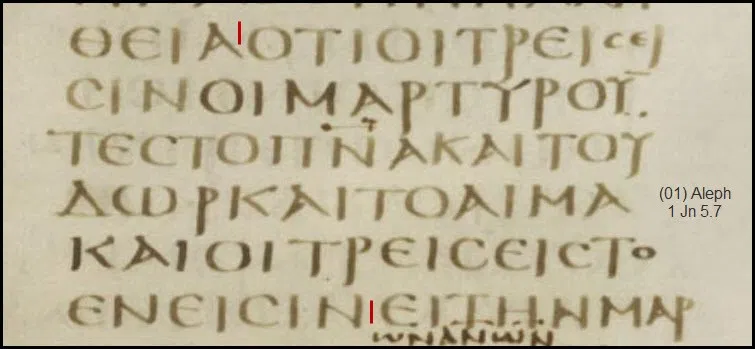
The image above is from Codex Sinaiticus — the fourth-century Greek manuscript — showing 1 John 5:7–8 without the Trinitarian formula.
Codex Vaticanus (4th century)
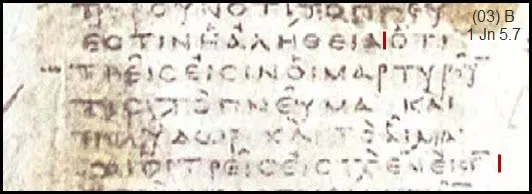
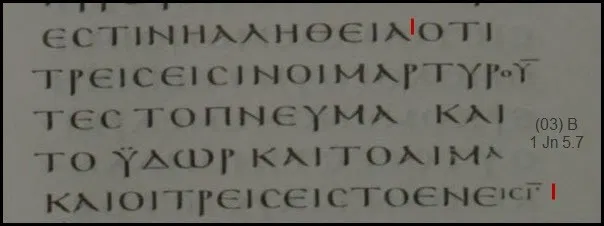
The image above is from Codex Vaticanus — another fourth-century Greek manuscript — showing 1 John 5:7–8 without the Trinitarian formula.
Codex Alexandrianus (5th century)
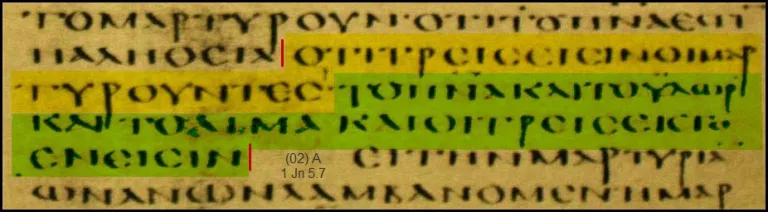
The image above is from Codex Alexandrianus — the fifth-century Greek manuscript — showing 1 John 5:7–8 without the Trinitarian formula.
Three of the four most important Greek codices — Sinaiticus, Vaticanus, and Alexandrianus, all dating from the fourth and fifth centuries — preserve only the short reading. Not one contains the Johannine Comma.
The Long Reading: Only 5 Greek Manuscripts
So there are 494 Greek manuscripts that attest to the short reading, in addition to Syriac, Coptic, Armenian, Georgian, Ethiopic, Slavonic translations, and some Vulgate and Old Latin manuscripts. How many Greek manuscripts attest to the long reading?
There are exactly 5 (five) manuscripts that contain the Comma text in the body of the manuscript itself. In addition to these five, there are four other manuscripts that contain the Comma in the margin — making a total of nine if we add the marginal manuscripts. Here is the analysis:
Text in the Manuscript Body
| Manuscript | Date | Location |
|---|---|---|
| 629 | 15th century | Vatican Library, Ottob |
| 61 | 16th century | Dublin, Trinity College |
| 918 | 16th century | Escorial |
| 2473 | 17th century | Athens, National Library |
| 2318 | 18th century | Bucharest, Romania |
Text in the Margin of the Manuscript
| Manuscript | Date | Location |
|---|---|---|
| 221 | 10th century | Oxford, Bodleian Library |
| 88 | 12th century | Naples, National Library |
| 429 | 14th century | Wolfenbuttel, Herzog August Bibliothek |
| 636 | 15th century | Naples, National Library |
Five manuscripts contain the text in the main body — the oldest dating back to the fifteenth century (manuscript no. 629). Four manuscripts contain the text in the margin — the oldest dating back to the tenth century, added by a later scribe.
As for the Latin manuscripts, the text does not appear in the Old Latin in its early form (Tertullian, Cyprian, Augustine), nor does it appear in the Vulgate as issued by St. Jerome (the Fuldensis version written in 546 AD or the Amiatinus version written before 716 AD), nor in the version revised by Alcuin in the ninth century. The Comma text never appeared in any Latin manuscript before the seventh century, even though we know that the text did not appear in any Greek manuscript within its text before the fifteenth century.
The Latin reading (Clement Latin Vulgate):
“7 Quoniam tres sunt, qui testimonium dant in caelo: Pater, Verbum, et Spiritus Sanctus: et hi tres unum sunt. 8 Et tres sunt, qui testimonium dant in terra: spiritus, et aqua, et sanguis: et hi tres unum sunt.”
Latin manuscripts containing the Comma: itl — 7th century · itr — 7th century · itq — 7th century
The Most Important Laws of Textual Criticism
Kurt Aland and his wife Barbara stated one of the most important laws of textual criticism:
Based on this law, the Comma text is not original in any way. The Comma is absent from the oldest Greek manuscripts and its first appearance was in the fifteenth century. It is also absent from the majority of Greek manuscripts — present in only five manuscripts in the text. How can any sane person claim this text is authentic?
Therefore, we find that even the Greek versions that rely on the majority of Byzantine manuscripts also omit the Comma:
Since the text is not authentic — neither by antiquity nor by majority — we find that all the critical Greek versions that rely on ancient manuscripts also delete the text without debate or discussion:
(Samuel Thomas placed the Comma between parentheses — signalling its inauthenticity. His version is specifically for theological readers, which is why he did not delete it outright.)
Not a single critical Greek edition contains the Comma without brackets or a disclaimer. This is the case of the Johannine Comma across the entire critical Greek tradition.
The Complete Picture: Fathers and the Comma
Fathers Who Did Not Know the Comma
Clement of Alexandria (150–215 AD) — One of the most important fathers of the Alexandrian School. He interpreted the entire First Epistle of John, quoting the short reading as we know it in all ancient Greek manuscripts and modern critical translations. He quoted 1 John 5:6 and 1 John 5:8 — completely skipping 1 John 5:7.
Saint Ambrose, Bishop of Milan (339–397 AD) — One of the great Latin Fathers who also knew Greek and spoke it fluently. He quotes entire verses from the First Epistle of John, starting from the sixth verse to the end of the eighth verse — no Johannine Comma:
Saint Augustine, Bishop of Hippo (354–430 AD) — He was ordained a bishop around 395–396 AD. He is from the Latin Fathers — which is very important, since all of Augustine’s sources for the New Testament were Latin manuscripts. Despite this, he did not know the Johannine Comma. He quoted from his book Moral Sermons from the First Epistle of John:
Augustine explained the Trinity in detail in 15 parts and did not cite this text once.
Leo the Great, Bishop of Rome (c. 400–461 AD) — The first Pope of the Roman Catholic Church to be called “The Great.” At the Second Council of Ephesus, representatives of Bishop Leo delivered his famous letter “The Tome” — written in Latin — to Flavian. This letter was a statement of the faith of the Roman Church. In this letter, Bishop Leo quoted from the First Epistle of John, verses 5–8, and in this quotation we do not find the Johannine Comma:
Bishop Leo was one of the Latin Fathers and his letter was in Latin — which greatly clarifies that the Johannine Comma was not widespread in the Latin tradition at all, as some claim.
These are the fathers whose quotations indicate their complete lack of knowledge of the Johannine Comma. Not a single Greek Father quoted the Comma. The Latin Fathers who quoted the short reading include: Origen (253 AD), Cyril of Alexandria (444 AD), John of Damascus (before 754 AD), and many others.
Cyprian and the Half-Comma
The martyred bishop of Carthage — born in Africa to a wealthy pagan family, elected bishop of Carthage at the end of 248 AD or beginning of 249 AD. Cyprian’s quotation is one of the most controversial among scholars.
Did Cyprian quote the Comma? Here is the text:
The analysis is straightforward: Cyprian said “it is written of the Father, and of the Son, and of the Holy Spirit” — meaning written about them. He did not quote a text that explicitly names them. He says “the Son” — not “the Word” (Verbum) which appears in the Comma. He was giving a Trinitarian interpretation of the short reading (1 John 5:8), exactly as Augustine and others did explicitly.
This interpretation is proven by Augustine’s own words — he interpreted 1 John 5:8 in exactly the same Trinitarian way, saying the Spirit symbolizes the Father, the blood symbolizes the Son, and the water symbolizes the Holy Spirit. If Cyprian, who lived in the third century, knew the Comma, then why did Augustine, Ambrose, and Leo the Great — who came directly after him — not know it?
The Letter on Re-Baptism (258 AD)
This letter dates from the same period as Cyprian — the third century. The GNT4RE places it among the Latin Fathers at 258 AD. It quotes twice from 1 John 5, and both times preserves only the short reading:
And: “Moreover, I think also that we have not unsuitably set in order the teaching of the Apostle John, who says that ‘three bear witness, the Spirit, and the water, and the blood; and these three are one.’”
At the end of our dialogue about the Fathers and the Comma: the testimony of the Fathers is against the Comma, since the oldest (Clement of Alexandria) and the majority — all the Greek Fathers in addition to many Latin Fathers — know nothing about the Comma. Cyprian did not quote the Comma. What hadith after him do they believe?
How Did the Comma Enter the New Testament? The Received Text and the Comma
We know for certain that the entry of the Johannine Comma into the text of the New Testament and its global spread was through the Greek version of Erasmus — not in its first or second edition, but in its third edition. This was said by major textual critics: Samuel Tregelles, Westcott, Hort, Frederic Kenyon, Caspar Gregory, Conybeare, Eberhard Nestle, Bart Ehrman, Hammond, Scrivener, Scott Porter, Bruce Metzger, and many others.
Here is the account as Bruce Metzger stated it:
After a while, this manuscript was found — or produced for this purpose. As it now seems, this Greek manuscript was probably written in Oxford in 1520 by a Franciscan father named ‘Froy’ or ‘Roy,’ who took this questionable phrase from the Vulgate. Erasmus inserted the text in the third edition (1522), but indicated in a long note his expectation that the manuscript was prepared to refute him.
These editions became the basis for all subsequent reprints of the Greek New Testament by people like Stephanus, Beza, and Elsevier. They provided a form of text on which the translators of the King James Version of the Bible eventually relied. Passages familiar to readers of the English Bible — from the King James Version of 1611 onward — include the Johannine Comma, even though none of these passages are found in the older, more prestigious Greek manuscripts of the New Testament. These passages entered the English-speaking consciousness only by a historical accident, based on manuscripts that happened to be at Erasmus’s disposal and others made to assist him.”
A doctoral researcher on Erasmus’s writings named Jung (De Jonge) wrote an article published in Ephemerides Theologicae Lovanienses, Vol. 56, 1980, pp. 381–389, in which he discusses the introduction of the Comma into Erasmus’s third edition. Dr. Jung quotes Erasmus in one of his letters explaining why he introduced the Comma: “So that no one would have the opportunity to criticize me out of spite” (Erasmus: First Apology Against Stunica, Ed. Clericus, Tom. IX, Col. 353 E).
Whether one accepts the first version — that a manuscript was produced to order to force Erasmus’s hand — or the second version — that Erasmus added it out of personal spite-avoidance — in both cases it shows beyond doubt that the Comma entered the New Testament text without any basis in the ancient manuscript tradition, and Erasmus himself knew it.
The Absence of the Comma from the Coptic Lectionary
The absence of the Johannine Comma from the Coptic liturgical tradition reveals a textual-ecclesiastical confusion that is significant. The text is used as evidence doctrinally in theological debates — yet it is absent from the devotional structure that is supposed to preserve the textual memory of the church. The Coptic lectionary, which represents the living liturgical tradition of one of the oldest Christian communities in the world, consistently preserves only the short reading across centuries of manuscript transmission. (See Part 5 for the complete documentation of 24 Coptic manuscripts.)
Conclusion
1. Manuscript evidence: 494 Greek manuscripts attest to the short reading. Only 5 manuscripts contain the Comma in their body text — the oldest dating to the 15th century. Not a single Greek codex before the 15th century contains it.
2. Ancient translations: The Comma is absent from all ancient versions — Syriac, Coptic, Armenian, Ethiopic, Arabic, Slavonic — and from the Vulgate before the 8th century, and from the Old Latin in its early form.
3. Church Fathers: Not a single Greek Father quoted this text. The Latin Fathers who most needed it in their Trinitarian controversies — Tertullian, Cyprian, Augustine, Ambrose, Leo the Great — all quoted only the short reading. Clement of Alexandria, Origen, Tertullian, Cyprian, Dionysius, Hippolytus, Augustine, Ambrose, and Pope Leo III all knew nothing about it.
4. Critical scholarship: The GNT4 committee assigned the short reading a grade of {A} — meaning certain authenticity. Every critical Greek edition — Nestle-Aland, Westcott-Hort, Tischendorf, Tregelles, Alford, Griesbach — omits the Comma without exception.
5. How it entered: Through a 16th-century manuscript almost certainly produced to order, inserted by Erasmus under pressure (or by his own admission out of spite-avoidance), inherited by the King James Version and the Van Dyck Arabic translation.
6. What its absence means: Bart Ehrman — and every serious scholar — confirmed that the Comma is the only passage in the entire Bible that directly and explicitly states the doctrine of the Trinity. Without it, the Trinity must be deduced from many passages combined. The doctrine of the Trinity does not have a single explicit proof text in the authentic Bible.
All praise is due to God, Lord of the Worlds. And may God’s prayers and peace be upon our master Muhammad ﷺ, his family, and his companions.
Sources for Episode 3
[1] MISQUOTING JESUS — Texts of the New Testament — Page 81
[2] Distortion of the sayings of Jesus… Who changed the Bible and why? — Dr. Bart Ehrman — Chapter Three
[3] List of manuscripts: David Robert Palmer, The First Epistle of John — A new translation from the Greek, February 2009 edition, Page 23
[4] Aland, K., Black, M., Martini, C.M., Metzger, B.M., Wikgren, A., Aland, B., Karavidopoulos, J., Deutsche Bibelgesellschaft, & United Bible Societies. (2000; 2006). The Greek New Testament, Fourth Revised Edition (with apparatus)
[5] David Robert Palmer study: http://www.bibletranslation.ws/trans/FirstJohnCh5v7.pdf — GNT4RE and NA27 mentioned four manuscripts in the body (2318, 61, 629, 918) and four in the margin (88, 429, 636, 221); oldest body manuscript is 629 (15th century)
[6] NA27: two Latin manuscripts l and r from the 7th century; agreement that first appearance in Latin versions was in the seventh century
[7] Metzger, B.M., & United Bible Societies. (1994). A textual commentary on the Greek New Testament, second edition, Page 648
[8] Kurt & Barbara Aland: The Text of The New Testament, Second Edition, p. 280
[9] Hodges, Z.C., Farstad, A.L., & Dunkin, W.C. (1985). The Greek New Testament according to the Majority Text (2nd ed.), Page 713
[10] Pierpont, W.G., & Robinson, M.A. (1995). The New Testament in the original Greek: According to the Byzantine/Majority textform
[11] Aland et al. (2000; 2006). The Greek New Testament, Fourth Revised Edition (with apparatus) (1 John 5:7–8)
[12] Nestle-Aland 27th edition
[13] Westcott, B.F., & Hort, F.J.A. (1996). 1881 Westcott-Hort Greek New Testament (1 John 5:7–8)
[14] Tischendorf: Novum Testamentum graece, 1869–94, 2:337–341
[15] Samuel Tregelles: The Greek New Testament, Edited from ancient authorities, Page 658
[16] H. Alford: The Greek Testament with various readings, Volume IV, Pages 503–504
[17] Griesbach: Novum Testamentum Graece, Volume 2, Page 564
[18] Bagster’s Critical New Testament Greek and English, Page 575
[19] Samuel Thomas: The Greek Testament, Volume II, Page 550 (comma in parentheses)
[20–26] Father Tadros Yacoub Malaty: A Comprehensive View of Patrology in the First Six Centuries — pp. 69, 258, 271, 269; Schaff NPNF Vol. VII, p. 526; NPNF2-10, p. 144
[27–29] NPNF2-14, The Seven Ecumenical Councils, The Tome of St. Leo, p. 258; http://www.newadvent.org/cathen/09154b.htm
[33–39] ANF Vol. V — Cyprian (p. 423), Augustine (p. 526), Re-Baptism (pp. 665, 675, 677)
[40–53] See sources list in Part 2 (Tregelles, Westcott, Hort, Kenyon, Gregory, Conybeare, Nestle, Ehrman, Hammond, Scrivener, Porter, Metzger; De Jonge: Ephemerides Theologicae Lovanienses Vol. 56, 1980, pp. 381–389; Erasmus: First Apology Against Stunica, Ed. Clericus, Tom. IX, Col. 353 E)
This is Part 5 — the final part of the Johannine Comma series. Parts 1–4 covered the introduction, translation survey, scholarly witnesses, Church Fathers, and the full textual-critical analysis. This part documents the complete Coptic manuscript evidence: 24 manuscripts from the Patriarchal Library collections COP_13 and COP_14, spanning 1259 AD to 1864 AD, every one of which preserves only the short reading of 1 John 5:7–8 — without the Johannine Comma.
This is Part 5 — the final part of the Johannine Comma series. Parts 1–4 covered the introduction, translation survey, scholarly witnesses, Church Fathers, and the full textual-critical analysis. This part documents the complete Coptic manuscript evidence: 24 manuscripts from the Patriarchal Library collections COP_13 and COP_14, spanning 1259 AD to 1864 AD, every one of which preserves only the short reading of 1 John 5:7–8 — without the Johannine Comma.
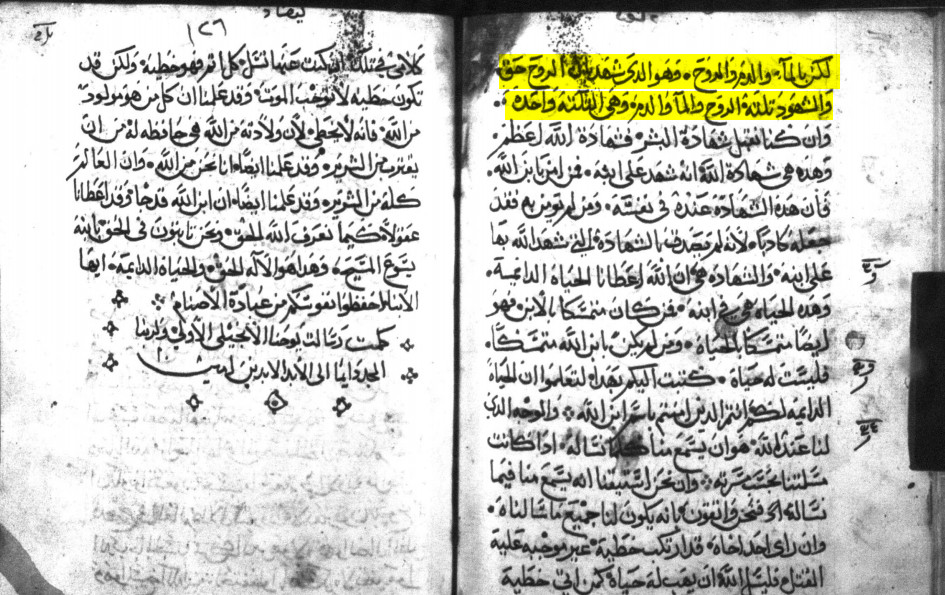
Coptic Manuscript Evidence — الفاصلة اليوحناوية
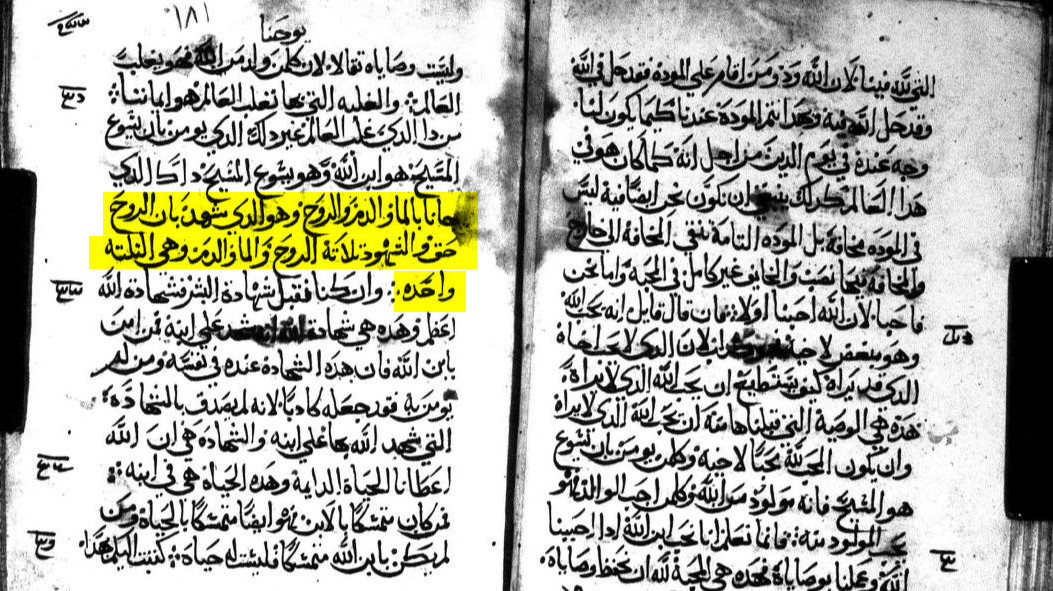
The following 24 Coptic manuscripts from the Patriarchal Library collections COP_13 and COP_14 all document 1 John 5:5–8 without the Trinitarian interpolation known as the Johannine Comma. They consistently preserve only the three earthly witnesses: the Spirit, the water, and the blood. Dates range from 1259 AD to 1864 AD.
The Coptic Church is one of the oldest Christian communities in the world — tracing its foundation to the Apostle Mark. Its manuscript tradition represents an unbroken liturgical and textual continuity from the earliest centuries of Christianity in Egypt. The absence of the Johannine Comma from every single one of these manuscripts — across six centuries of copying — confirms that the Comma was never part of the authentic Christian text.
Total Manuscripts: 24 · Collections: COP_13 & COP_14 · Passage: 1 John 5:5–8 · Date Range: 1259–1864 AD
Collection COP_13
1. COP_13-1
Date: 1486 AD · 15th century
📌 Oldest manuscript in Collection 13. Contains fuller context beginning from 1 John 5:4.
Archive.org: https://archive.org/details/COP13-1/page/n176/mode/1up
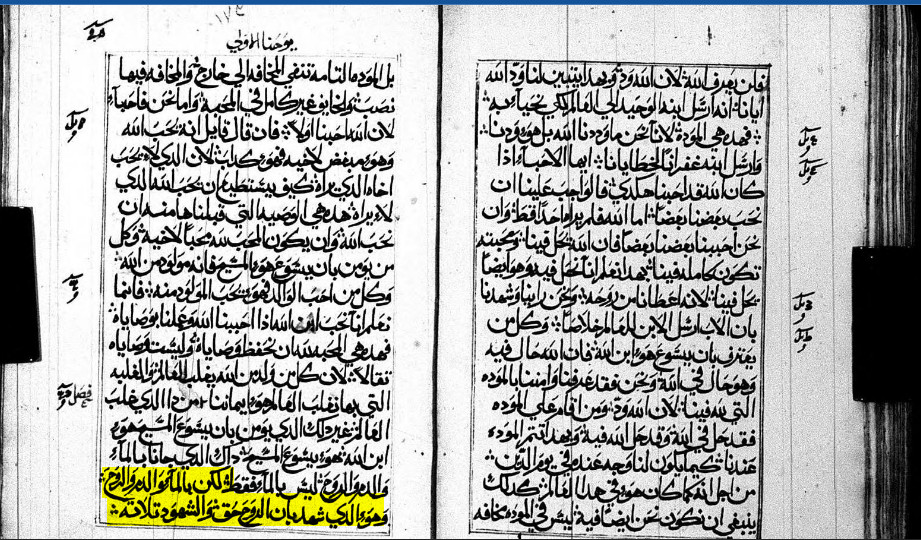
Arabic text (1 John 5:5–8):
لأن كل من ولد من الله يغلب العالم والغلبة التي بها نغلب العالم هو إيماننا. من ذا الذي غلب العالم غير ذلك الذي يؤمن بأن يسوع المسيح ابن الله هو يسوع المسيح ذاك الذي جاءنا بالماء والدم والروح ليس بالماء فقط لكن بالماء والدم والروح وهو الذي شهد بأن الروح حق والشهود تلاته:
English translation:
For everyone born of God overcomes the world. And this is the victory that has overcome the world — our faith. Who is it that overcomes the world except the one who believes that Jesus is the Son of God? This is he who came by water and blood and Spirit — Jesus Christ; not by the water only but by the water and the blood and the Spirit. And the Spirit is the one who testifies, because the Spirit is the truth. For there are three that testify:
2. COP_13-2
Date: 1691 AD · 17th century
Archive.org: https://archive.org/details/COP13-2/page/n113/mode/1up
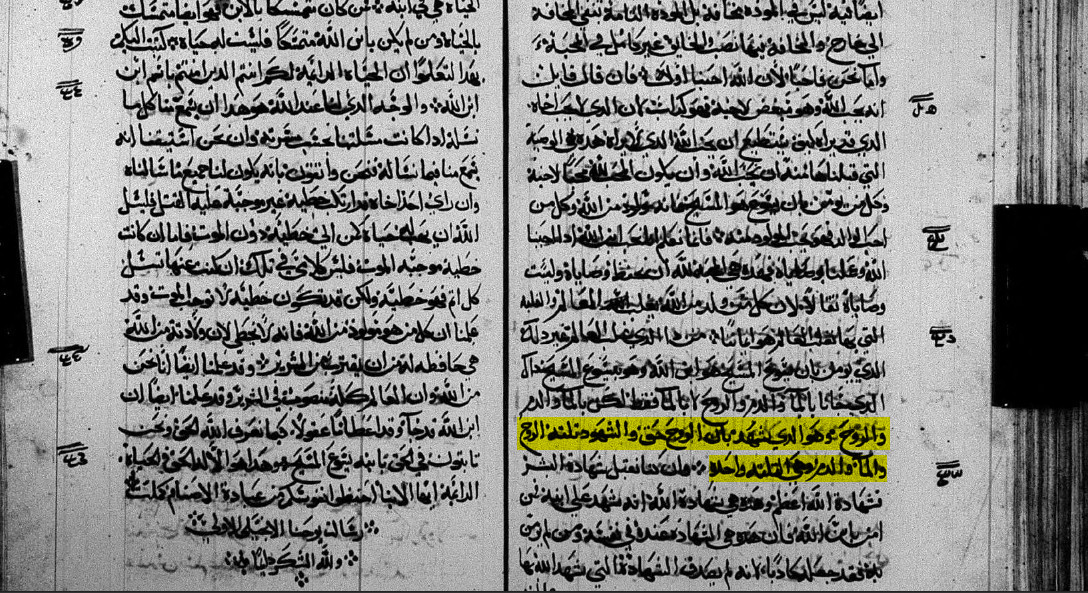
Arabic text (1 John 5:5–8):
لأن كل من ولد من الله يغلب العالم والغلبة التي بها غلب العالم هو إيماننا من ذا الذي غلب العالم غير ذلك يؤمن بأن يسوع المسيح ابن الله وهو بيسوع المسيح ذاك الذي جاءنا بالماء والدم والروح ليس بالماء فقط لكن بالماء والدم والروح وهو الذي شهد بأن الروح حق والشهود تلاته الروح والماء والدم وهي الثلاثة واحده.
English translation:
For everyone born of God overcomes the world. And this is the victory that overcomes the world — our faith. Who is it that overcomes the world except the one who believes that Jesus Christ is the Son of God — He who came by water and blood and Spirit, not by water only, but by water and blood and Spirit? And the Spirit testifies that the Spirit is the truth. And the witnesses are three: the Spirit, the water, and the blood; and these three are one.
3. COP_13-3
Date: Date unknown
Archive.org: https://archive.org/details/COP13-3/page/n200/mode/1up
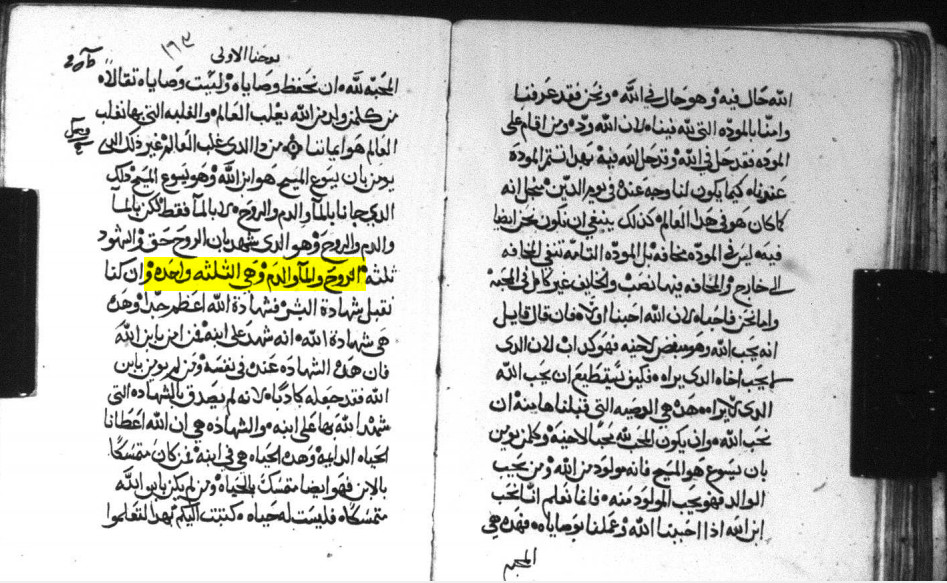
Arabic text (1 John 5:5–8):
من ذا الذي غلب العالم غير ذلك الذي يؤمن بأن يسوع المسيح ابن الله وهو يسوع المسيح ذاك الذي جاء بالماء والدم والروح ليس بالماء فقط لكن بالماء والدم والروح وهو الذي شهد بأن الروح حق والشهود ثلثة الروح والماء والدم وهي الثلثة واحده.
English translation:
Who is it that overcomes the world except the one who believes that Jesus Christ is the Son of God — He who came by water and blood and Spirit, not by water only, but by water and blood and Spirit? And the Spirit testifies that the Spirit is the truth. And the witnesses are three: the Spirit, the water, and the blood; and these three are one.
4. COP_13-4
Date: 1500 AD · 16th century
Archive.org: https://archive.org/details/COP13-4/page/n166/mode/1up
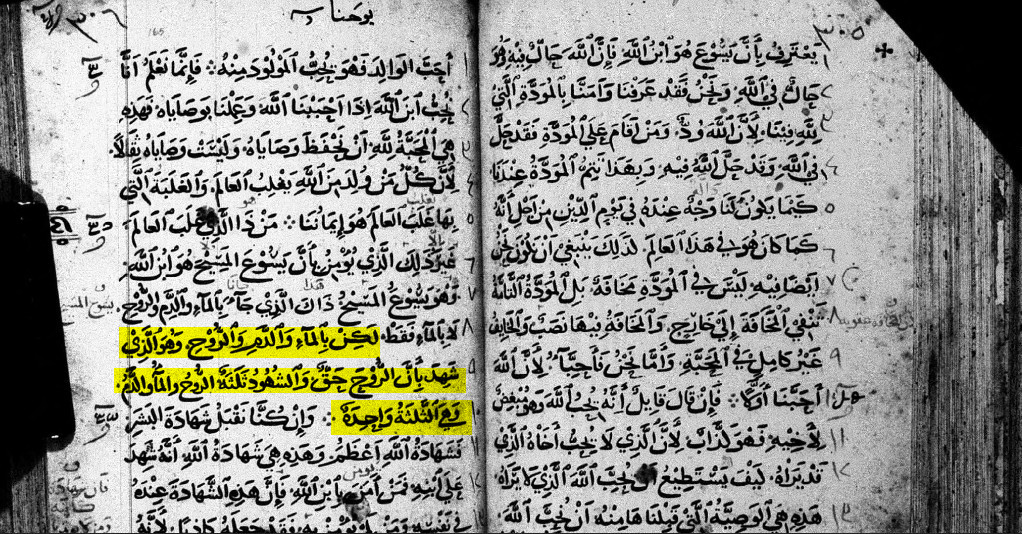
Arabic text (1 John 5:5–8):
لأن كل من ولد من الله يغلب العالم والغلبة التي بها غلب العالم هو إيماننا من ذا الذي غلب العالم غير ذلك الذي يؤمن بأن يسوع المسيح ابن الله وهو يسوع المسيح ذاك الذي جاء بالماء والدم والروح ليس بالماء فقط لكن بالماء والدم والروح وهو الذي شهد بأن الروح حق والشهود ثلثة الروح والماء والدم وهي الثلثة واحده.
English translation:
For everyone born of God overcomes the world. And this is the victory that overcomes the world — our faith. Who is it that overcomes the world except the one who believes that Jesus Christ is the Son of God — He who came by water and blood and Spirit, not by water only, but by water and blood and Spirit? And the Spirit testifies that the Spirit is the truth. And the witnesses are three: the Spirit, the water, and the blood; and these three are one.
5. COP_13-5
Date: 1464 AD · 15th century
Archive.org: https://archive.org/details/COP13-5/page/n110/mode/1up
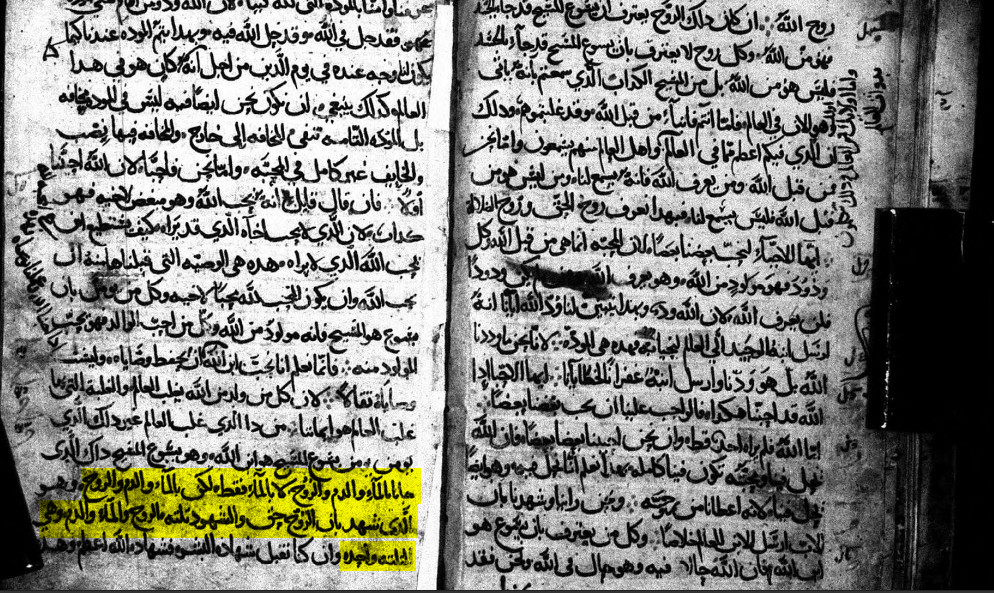
Arabic text (1 John 5:5–8):
لأن كل من ولد من الله يغلب العالم والغلبة التي بها غلب العالم هو إيماننا من ذا الذي غلب العالم غير ذلك يؤمن بأن يسوع المسيح ابن الله وهو يسوع المسيح ذاك الذي جاء بالماء والدم والروح ليس بالماء فقط لكن بالماء والدم والروح وهو الذي شهد بأن الروح حق والشهود ثلثة الروح والماء والدم وهي الثلثة واحده.
English translation:
For everyone born of God overcomes the world. And this is the victory that overcomes the world — our faith. Who is it that overcomes the world except the one who believes that Jesus Christ is the Son of God — He who came by water and blood and Spirit, not by water only, but by water and blood and Spirit? And the Spirit testifies. And the witnesses are three: the Spirit, the water, and the blood; and these three are one.
6. COP_13-6
Date: 1299 AD · 13th century
📌 One of the two oldest dated manuscripts in the collection.
Archive.org: https://archive.org/details/COP13-6/page/n171/mode/1up
Arabic text (1 John 5:5–8):
من ذا الذي غلب العالم غير ذلك الذي يؤمن بأن يسوع المسيح ابن الله وهو يسوع المسيح ذاك الذي جاء بالماء والدم والروح ليس بالماء فقط لكن بالماء والدم والروح وهو الذي شهد بأن الروح حق والشهود ثلثة الروح والماء والدم وهي الثلثة واحده.
English translation:
Who is it that overcomes the world except the one who believes that Jesus Christ is the Son of God — He who came by water and blood and Spirit, not by water only, but by water and blood and Spirit? And the Spirit testifies that the Spirit is the truth. And the witnesses are three: the Spirit, the water, and the blood; and these three are one.
7. COP_13-7
Date: 1259 AD · 13th century
📌 Oldest dated manuscript in the entire collection (975 AM). Unique reading: uses لا instead of ليس.
Archive.org: https://archive.org/details/COP13-7/page/n116/mode/1up
Arabic text (1 John 5:5–8):
هو ابن الله يسوع المسيح ذاك الذي جاء بالماء والدم والروح لا بالماء فقط لكن بالماء والدم والروح وهو الذي شهد بأن الروح حق والشهود تلاته الروح والماء والدم وهي الثلاثة واحده.
English translation:
He is the Son of God, Jesus Christ, who came by water and blood and Spirit — not by water only, but by water and blood and Spirit. And the Spirit testifies that the Spirit is the truth. And the witnesses are three: the Spirit, the water, and the blood; and these three are one.
8. COP_13-8
Date: 1805 AD · 19th century
Archive.org: https://archive.org/details/COP13-8/page/n147/mode/1up
Arabic text (1 John 5:5–8):
الذي يؤمن بأن يسوع المسيح ابن الله وهو بيسوع المسيح ذاك الذي جاءنا بالماء والدم والروح ليس بالماء فقط لكن بالماء والدم والروح وهو الذي شهد بأن الروح حق والشهود تلاته الروح والماء والدم وهي الثلاثة واحده.
English translation:
He who believes that Jesus Christ is the Son of God — He came to us by water and blood and Spirit, not by water only, but by water and blood and Spirit. And the Spirit testifies that the Spirit is the truth. And the witnesses are three: the Spirit, the water, and the blood; and these three are one.
9. COP_13-9
Date: 1800 AD · 19th century
Archive.org: https://archive.org/details/COP13-9/page/n140/mode/1up
Arabic text (1 John 5:5–8):
الذي يؤمن بأن يسوع المسيح ابن الله وهو بيسوع المسيح ذاك الذي جاءنا بالماء والدم والروح ليس بالماء فقط لكن بالماء والدم والروح وهو الذي شهد بأن الروح حق والشهود تلاته الروح والماء والدم وهي الثلاثة واحده.
English translation:
He who believes that Jesus Christ is the Son of God — He came to us by water and blood and Spirit, not by water only, but by water and blood and Spirit. And the Spirit testifies that the Spirit is the truth. And the witnesses are three: the Spirit, the water, and the blood; and these three are one.
10. COP_13-10
Date: 1864 AD · 19th century
Archive.org: https://archive.org/details/COP13-10/page/n118/mode/1up
Arabic text (1 John 5:5–8):
الذي يؤمن بأن يسوع المسيح ابن الله وهو بيسوع المسيح ذاك الذي جاءنا بالماء والدم والروح ليس بالماء فقط لكن بالماء والدم والروح وهو الذي شهد بأن الروح حق والشهود تلاته الروح والماء والدم وهي الثلاثة واحده.
English translation:
He who believes that Jesus Christ is the Son of God — He came to us by water and blood and Spirit, not by water only, but by water and blood and Spirit. And the Spirit testifies that the Spirit is the truth. And the witnesses are three: the Spirit, the water, and the blood; and these three are one.
11. COP_13-11
Date: 1778 AD · 18th century
Archive.org: https://archive.org/details/COP13-11/page/n87/mode/1up
Arabic text (1 John 5:5–8):
الذي يؤمن بأن يسوع المسيح ابن الله وهو بيسوع المسيح ذاك الذي جاءنا بالماء والدم والروح ليس بالماء فقط لكن بالماء والدم والروح وهو الذي شهد بأن الروح حق والشهود تلاته الروح والماء والدم وهي الثلاثة واحده.
English translation:
He who believes that Jesus Christ is the Son of God — He came to us by water and blood and Spirit, not by water only, but by water and blood and Spirit. And the Spirit testifies that the Spirit is the truth. And the witnesses are three: the Spirit, the water, and the blood; and these three are one.
12. COP_13-12
Date: 1422 AD · 15th century
📌 Text begins specifically from 1 John 5:5.
Archive.org: https://archive.org/details/COP13-12/page/n124/mode/1up
Arabic text (1 John 5:5–8):
الذي يؤمن بأن يسوع المسيح ابن الله وهو بيسوع المسيح ذاك الذي جاءنا بالماء والدم والروح ليس بالماء فقط لكن بالماء والدم والروح وهو الذي شهد بأن الروح حق والشهود تلاته الروح والماء والدم وهي الثلاثة واحده.
English translation:
He who believes that Jesus Christ is the Son of God — He came to us by water and blood and Spirit, not by water only, but by water and blood and Spirit. And the Spirit testifies that the Spirit is the truth. And the witnesses are three: the Spirit, the water, and the blood; and these three are one.
13. COP_13-14
Date: 1846 AD · 19th century
Archive.org: https://archive.org/details/COP13-14/page/n108/mode/1up
Arabic text (1 John 5:5–8):
من ذا الذي غلب العالم غير ذلك الذي يؤمن بأن يسوع المسيح ابن الله وهو بيسوع المسيح ذاك الذي جاءنا بالماء والدم والروح ليس بالماء فقط لكن بالماء والدم والروح وهو الذي شهد بأن الروح حق والشهود تلاته الروح والماء والدم وهي الثلاثة واحده.
English translation:
Who is it that overcomes the world except the one who believes that Jesus Christ is the Son of God — He came to us by water and blood and Spirit, not by water only, but by water and blood and Spirit. And the Spirit testifies that the Spirit is the truth. And the witnesses are three: the Spirit, the water, and the blood; and these three are one.
Collection COP_14
14. COP_14-1
Date: 1640 AD · 17th century
Archive.org: https://archive.org/details/COP14-1/page/n296/mode/1up
Arabic text (1 John 5:5–8):
المسيح ابن الله وهو يسوع المسيح ذاك الذي جاءنا بالماء والدم والروح ليس بالماء فقط لكن بالماء والدم والروح وهو الذي شهد بأن الروح حق والشهود ثلاثه الروح والماء والدم وهي الثلاثة واحد.
English translation:
Christ the Son of God — He came to us by water and blood and Spirit, not by water only, but by water and blood and Spirit. And the Spirit testifies that the Spirit is the truth. And the witnesses are three: the Spirit, the water, and the blood; and these three are one.
15. COP_14-2
Date: 1600 AD · 17th century
Archive.org: https://archive.org/details/COP14-2/page/n172/mode/1up
Arabic text (1 John 5:5–8):
من ذا الذي غلب العالم غير ذلك الذي يؤمن بأن يسوع المسيح ابن الله وهو يسوع المسيح ذاك الذي جاء بالماء والدم والروح ليس بالماء فقط لكن بالماء والدم والروح وهو الذي شهد بأن الروح حق والشهود ثلاثة الروح والماء والدم وهي الثلاثة واحده.
English translation:
Who is it that overcomes the world except the one who believes that Jesus Christ is the Son of God — He who came by water and blood and Spirit, not by water only, but by water and blood and Spirit? And the Spirit testifies that the Spirit is the truth. And the witnesses are three: the Spirit, the water, and the blood; and these three are one.
16. COP_14-3
Date: 1700 AD · 18th century
Archive.org: https://archive.org/details/COP14-3/page/n161/mode/1up
Arabic text (1 John 5:5–8):
من ذا الذي غلب العالم غير ذلك الذي يؤمن بأن يسوع المسيح ابن الله وهو يسوع المسيح ذاك الذي جاء بالماء والدم والروح ليس بالماء فقط لكن بالماء والدم والروح وهو الذي شهد بأن الروح حق والشهود ثلاثة الروح والماء والدم وهي الثلاثة واحده.
English translation:
Who is it that overcomes the world except the one who believes that Jesus Christ is the Son of God — He who came by water and blood and Spirit, not by water only, but by water and blood and Spirit? And the Spirit testifies that the Spirit is the truth. And the witnesses are three: the Spirit, the water, and the blood; and these three are one.
17. COP_14-4
Date: 1800 AD · 19th century
Archive.org: https://archive.org/details/COP14-4/page/n170/mode/1up
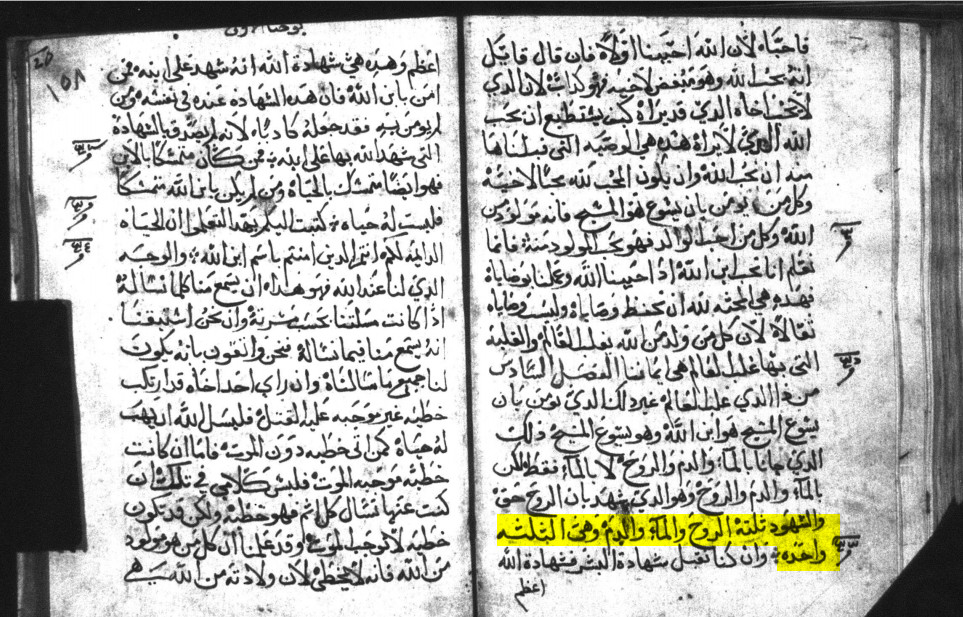
Arabic text (1 John 5:5–8):
من ذا الذي غلب العالم غير ذلك الذي يؤمن بأن يسوع المسيح ابن الله وهو يسوع المسيح ذاك الذي جاء بالماء والدم والروح ليس بالماء فقط لكن بالماء والدم والروح وهو الذي شهد بأن الروح حق والشهود ثلاثة الروح والماء والدم وهي الثلاثة واحده.
English translation:
Who is it that overcomes the world except the one who believes that Jesus Christ is the Son of God — He who came by water and blood and Spirit, not by water only, but by water and blood and Spirit? And the Spirit testifies that the Spirit is the truth. And the witnesses are three: the Spirit, the water, and the blood; and these three are one.
18. COP_14-5
Date: 1700 AD · 18th century
📌 Copy by Bishop Athanasius, Bishop of Abutig. Contains Coptic Library stamp.
Archive.org: https://archive.org/details/COP14-5/page/n189/mode/1up
Arabic text (1 John 5:5–8):
من ذا الذي غلب العالم غير ذلك الذي يؤمن بأن يسوع المسيح ابن الله وهو يسوع المسيح ذاك الذي جاء بالماء والدم والروح ليس بالماء فقط لكن بالماء والدم والروح وهو الذي شهد بأن الروح حق والشهود ثلاثة الروح والماء والدم وهي الثلاثة واحده.
English translation:
Who is it that overcomes the world except the one who believes that Jesus Christ is the Son of God — He who came by water and blood and Spirit, not by water only, but by water and blood and Spirit? And the Spirit testifies that the Spirit is the truth. And the witnesses are three: the Spirit, the water, and the blood; and these three are one.
(Copy by Bishop Athanasius, Bishop of Abutig.)
19. COP_14-6
Date: 1700 AD · 18th century
Archive.org: https://archive.org/details/COP14-6/page/n168/mode/1up
Arabic text (1 John 5:5–8):
من ذا الذي غلب العالم غير ذلك الذي يؤمن بأن يسوع المسيح ابن الله وهو يسوع المسيح ذاك الذي جاء بالماء والدم والروح ليس بالماء فقط لكن بالماء والدم والروح وهو الذي شهد بأن الروح حق والشهود ثلاثة الروح والماء والدم وهي الثلاثة واحده.
English translation:
Who is it that overcomes the world except the one who believes that Jesus Christ is the Son of God — He who came by water and blood and Spirit, not by water only, but by water and blood and Spirit? And the Spirit testifies that the Spirit is the truth. And the witnesses are three: the Spirit, the water, and the blood; and these three are one.
20. COP_14-7
Date: 1719 AD · 18th century
Archive.org: https://archive.org/details/COP14-7/page/n129/mode/1up
Arabic text (1 John 5:5–8):
من ذا الذي غلب العالم غير ذلك الذي يؤمن بأن يسوع المسيح ابن الله وهو يسوع المسيح ذاك الذي جاء بالماء والدم والروح ليس بالماء فقط لكن بالماء والدم والروح وهو الذي شهد بأن الروح حق والشهود ثلاثة الروح والماء والدم وهي الثلاثة واحده.
English translation:
Who is it that overcomes the world except the one who believes that Jesus Christ is the Son of God — He who came by water and blood and Spirit, not by water only, but by water and blood and Spirit? And the Spirit testifies that the Spirit is the truth. And the witnesses are three: the Spirit, the water, and the blood; and these three are one.
21. COP_14-8
Date: 1775 AD · 18th century
Archive.org: https://archive.org/details/COP14-8/page/n165/mode/1up
Arabic text (1 John 5:5–8):
من ذا الذي غلب العالم غير ذلك الذي يؤمن بأن يسوع المسيح ابن الله وهو يسوع المسيح ذاك الذي جاء بالماء والدم والروح ليس بالماء فقط لكن بالماء والدم والروح وهو الذي شهد بأن الروح حق والشهود ثلاثة الروح والماء والدم وهي الثلاثة واحده.
English translation:
Who is it that overcomes the world except the one who believes that Jesus Christ is the Son of God — He who came by water and blood and Spirit, not by water only, but by water and blood and Spirit? And the Spirit testifies that the Spirit is the truth. And the witnesses are three: the Spirit, the water, and the blood; and these three are one.
22. COP_14-9
Date: 1659 AD · 17th century
Archive.org: https://archive.org/details/COP14-9/page/n196/mode/1up
Arabic text (1 John 5:5–8):
من ذا الذي غلب العالم غير ذلك الذي يؤمن بأن يسوع المسيح ابن الله وهو يسوع المسيح ذاك الذي جاء بالماء والدم والروح ليس بالماء فقط لكن بالماء والدم والروح وهو الذي شهد بأن الروح حق والشهود ثلاثة الروح والماء والدم وهي الثلاثة واحده.
English translation:
Who is it that overcomes the world except the one who believes that Jesus Christ is the Son of God — He who came by water and blood and Spirit, not by water only, but by water and blood and Spirit? And the Spirit testifies that the Spirit is the truth. And the witnesses are three: the Spirit, the water, and the blood; and these three are one.
23. COP_14-10
Date: 1743 AD · 18th century
Archive.org: https://archive.org/details/COP14-10/page/n234/mode/1up
Arabic text (1 John 5:5–8):
من ذا الذي غلب العالم غير ذلك الذي يؤمن بأن يسوع المسيح ابن الله وهو يسوع المسيح ذاك الذي جاء بالماء والدم والروح ليس بالماء فقط لكن بالماء والدم والروح وهو الذي شهد بأن الروح حق والشهود ثلاثة الروح والماء والدم وهي الثلاثة واحده.
English translation:
Who is it that overcomes the world except the one who believes that Jesus Christ is the Son of God — He who came by water and blood and Spirit, not by water only, but by water and blood and Spirit? And the Spirit testifies that the Spirit is the truth. And the witnesses are three: the Spirit, the water, and the blood; and these three are one.
24. COP_14-11
Date: 1345 AD (1062 AM) · 14th century
📌 Copy attributed to Tuma ibn al-Safi al-Sa’igh. Dated 1062 AM (Martyrs’ Era) = 1345 AD.
Archive.org: https://archive.org/details/COP14-11/page/n184/mode/1up
Arabic text (1 John 5:5–8):
من ذا الذي غلب العالم غير ذلك الذي يؤمن بأن يسوع المسيح ابن الله وهو يسوع المسيح ذاك الذي جاء بالماء والدم والروح ليس بالماء فقط لكن بالماء والدم والروح وهو الذي شهد بأن الروح حق والشهود ثلاثة الروح والماء والدم وهي الثلاثة واحده.
English translation:
Who is it that overcomes the world except the one who believes that Jesus Christ is the Son of God — He who came by water and blood and Spirit, not by water only, but by water and blood and Spirit? And the Spirit testifies that the Spirit is the truth. And the witnesses are three: the Spirit, the water, and the blood; and these three are one.
(Dated 1062 AM = 1345 AD. Copy by Tuma ibn al-Safi al-Sa’igh.)
Summary of the Coptic Manuscript Evidence
| # | Manuscript | Date | Century | Note |
|---|---|---|---|---|
| 1 | COP_13-1 | 1486 AD | 15th | Oldest in COP_13; starts from 1 John 5:4 |
| 2 | COP_13-2 | 1691 AD | 17th | |
| 3 | COP_13-3 | Unknown | — | |
| 4 | COP_13-4 | 1500 AD | 16th | |
| 5 | COP_13-5 | 1464 AD | 15th | |
| 6 | COP_13-6 | 1299 AD | 13th | One of two oldest dated |
| 7 | COP_13-7 | 1259 AD | 13th | Oldest dated (975 AM); unique لا reading |
| 8 | COP_13-8 | 1805 AD | 19th | |
| 9 | COP_13-9 | 1800 AD | 19th | |
| 10 | COP_13-10 | 1864 AD | 19th | |
| 11 | COP_13-11 | 1778 AD | 18th | |
| 12 | COP_13-12 | 1422 AD | 15th | Starts from 1 John 5:5 |
| 13 | COP_13-14 | 1846 AD | 19th | |
| 14 | COP_14-1 | 1640 AD | 17th | |
| 15 | COP_14-2 | 1600 AD | 17th | |
| 16 | COP_14-3 | 1700 AD | 18th | |
| 17 | COP_14-4 | 1800 AD | 19th | |
| 18 | COP_14-5 | 1700 AD | 18th | Copy by Bishop Athanasius of Abutig |
| 19 | COP_14-6 | 1700 AD | 18th | |
| 20 | COP_14-7 | 1719 AD | 18th | |
| 21 | COP_14-8 | 1775 AD | 18th | |
| 22 | COP_14-9 | 1659 AD | 17th | |
| 23 | COP_14-10 | 1743 AD | 18th | |
| 24 | COP_14-11 | 1345 AD | 14th | Copy by Tuma ibn al-Safi al-Sa’igh |
Every single one of these 24 Coptic manuscripts — spanning six centuries of the Coptic Church’s living textual tradition, from 1259 AD to 1864 AD, copied by bishops, scribes, and church officials across Egypt — preserves only the short reading of 1 John 5:7–8. Not one contains the Johannine Comma. The Coptic Church, which traces its origin to the Apostle Mark himself, never received the Trinitarian formula as part of this text.
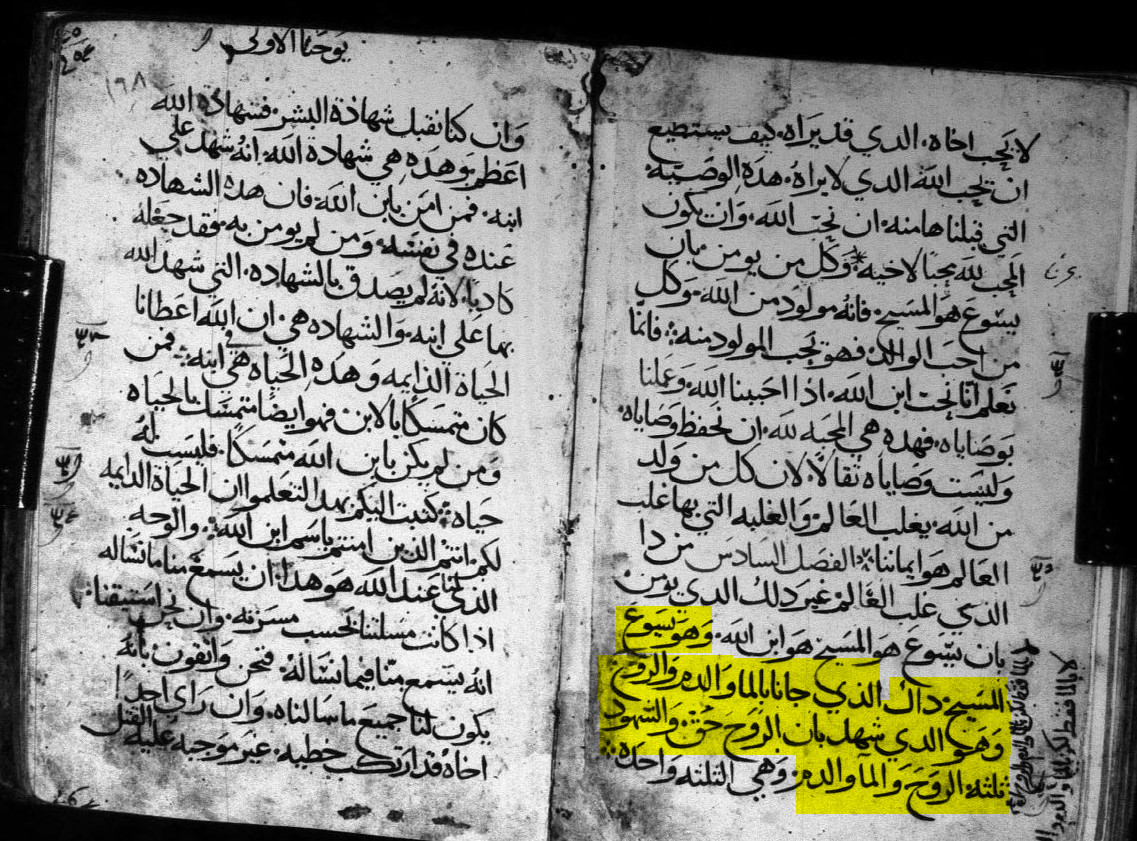
The absence of the Johannine Comma from the Coptic liturgical tradition reveals in this argument a textual-ecclesiastical confusion: the text is used as evidence doctrinally in the theological debate, yet it is absent from the devotional structure that is supposed to preserve the textual memory of the church.
Translations: 8 of 9 Arabic translations omit the Comma. All major English critical translations omit it. All critical Greek editions omit it.
Scholars: The Biblical Encyclopedia, William Kelly, Hilal Amin, William MacDonald, the Bible Society, Craig Keener, Bart Ehrman, the GNT4 committee (Bruce Metzger, Carlo Martini, Allen Wikgren, Matthew Black, Johannis Karavidopoulos, Barbara Aland), William Adey, the Catholic translation margin, the Jesuit Fathers, Metzger and Ehrman jointly, Daniel B. Wallace, Adam Clarke, the Catholic Encyclopedia, John Painter, Daniel Harrington, Colin Kruse, Soulen and Soulen, Jesse Acuff, Martinus Boer, Barnabas Lindars et al., Dillon Burroughs, James R. White — all testify to the inauthenticity of the Comma.
Church Fathers: Not a single Greek Father quoted the Comma. Clement of Alexandria, Origen, Tertullian, Cyprian, Dionysius, Hippolytus, Augustine, Ambrose, and Pope Leo III all quoted only the short reading.
Manuscripts: 494 Greek manuscripts against the Comma. 5 Greek manuscripts for it — the oldest from the 15th century. Three of the four greatest Greek codices (Sinaiticus, Vaticanus, Alexandrianus) are against it. 24 Coptic manuscripts from 1259–1864 AD are against it.
History: The Comma entered the New Testament through Erasmus’s third edition of 1522 — via a manuscript almost certainly produced to order, or by Erasmus’s own admission added to avoid criticism — and was inherited by the King James Version and the Van Dyck Arabic translation.
The conclusion is inescapable: The Johannine Comma is the only text in the entire Bible that explicitly states the doctrine of the Trinity — and it is a forgery. Without it, the Trinity must be deduced from many passages combined, none of which state it directly. The doctrine that defines Christianity has no authentic proof text in the Bible.
وآخر دعوانا أن الحمد لله رب العالمين، وصلى الله على سيدنا محمد وعلى آله وصحبه أجمعين.
...cal manuscripts when they felt the existing text did not provide enough support for later beliefs.
...orrections]] — how the Quran resolves each Biblical contradiction on divine attributes See also:...
...11 — Distortion to Support Theological Doctrine The Johannine Comma — 1 John 5:7 Detailed...