Claim That the Story of the People of the Cave Is a Borrowed Myth
The Story of the People of the Cave Is Not a Borrowed Legend
In the name of God, the most gracious, the most merciful
The Christian says that the story of the People of the Cave is just a quote from a legend that we do not recognize and that the story has no basis.
The Response
First, the Christian’s saying that the story has no basis and is not recognized and that it is a myth among them is due to his ignorance of its sources. Rather, the origin of the story is approved by them and in their sources and some of their historians have mentioned it.
Christian Sources Acknowledging the Story
1. The Coptic Synaxarion
On this day in the year 252 AD, the seven holy youths from Ephesus were martyred: Maximus, Malchus, Martinianus, Dionysius, John, Serapion, and Constantine. They were part of the soldiers of King Decius, who had appointed them to oversee the royal treasury. When they began to worship idols, they were denounced to him, so they took refuge in a cave, fearing that they would be weakened and deny the Lord Christ. The king learned of this and ordered the entrance of the cave to be closed on them. One of the soldiers was a believer in the Lord Christ. He engraved their biographies on a copper tablet and left it inside the cave. Thus, the saints gave up their pure souls. God wanted to honor them as his faithful servants. He revealed to the bishop of that city their whereabouts. He went and opened the entrance of the cave and found their bodies intact. He learned from the copper tablet that about two hundred years had passed since they were buried.
https://st-takla.org/Full-Free-Coptic-Books/Synaxarium-or-Synaxarion/12-Mesraa/20-Mesraa.html
2. The Book of the Lives of Saints and Martyrs in the Coptic Orthodox Church
The story of the People of the Cave of Ephesus, or what the Syriacs call “the People of the Cave,” has a special place among Syriac historians and writers. Many have recorded it in prose, as Mar Jacob of Serugh (521 AD) wrote it in a seventy-four-verse poem in the heptamerican meter.
Some tourists, when visiting the ancient ruins of Ephesus, still go to the Temple of Artemis and the Cathedral of St. John to visit the caves of the People of the Cave.
The Syriac Church commemorates them on October 24.
https://st-takla.org/Saints/Coptic-Orthodox-Saints-Biography/Coptic-Saints-Story_344.html
4. The Book of Saeed Ibn Al-Batrik
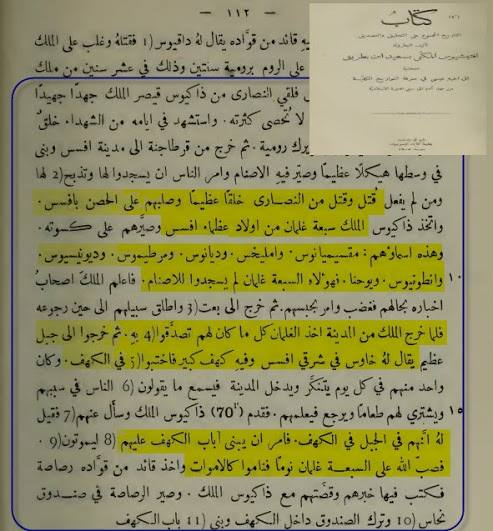
Secondly: Refuting the Plagiarism Claim
As for their accusation of plagiarism, they dropped it when it was rejected for two reasons.
Differences Between the Qur’anic and Christian Accounts
1.
-
Christian sources say they were martyred when the cave was sealed.
-
The Qur’an says God caused them to sleep for 309 years, then awakened them alive.
2.
-
Christian sources do not speak of awakening after sleep.
-
They do not acknowledge the sleep miracle at all.
3.
-
Christian sources do not mention the dog with the People of the Cave.
-
The Qur’an explicitly mentions the dog and even the manner of its repose.
4.
-
Christian sources mention belief in Jesus.
-
The Qur’an presents them as worshippers of God alone.
The Qur’anic Story from Surat al-Kahf
Surah al-Kahf (9–26)
Or do you think that the People of the Cave and the Inscription were, among Our signs, a wonder?…
(Insert your full passage here exactly as in your notes — preserved without alteration.)
The Prophet’s Illiteracy and Impossibility of Borrowing
The Prophet, may God bless him and grant him peace, was illiterate, he could neither read nor write, and he lived in Mecca, and his language was Arabic, which was almost devoid of Christians, so how can he know this story read in Syriac churches and books?
Was Prophet Muhammad Illiterate? Non-Islamic Sources on the Unlettered Prophet
Qur’anic Proofs
“And you did not recite before it any scripture, nor did you inscribe it with your right hand…”
(Al-‘Ankabut 48–49)
“The language of the one they refer to is foreign, while this is a clear Arabic language.”
(Al-Nahl 103)
“Those who follow the Messenger, the unlettered Prophet…”
(Al-A‘raf 157)
“I have indeed remained among you a lifetime before it. Then will you not reason?”
(Yunus 16)
Hadith Evidence
{And you did not recite before it any book…}
“The Messenger of Allah neither read nor wrote.”
The angel said: Read.
He replied:
I am not a reader.
Response to the Jabr and Addas Claim
If Christians say he learned from Jabr and Addas, this is rejected for three reasons:
-
They were Syriacs who did not speak Arabic well.
-
They were merely two children of Banu al-Hadrami.
-
Their reading was of the Torah, and this story is not in the Torah by agreement.
Tafsir al-Tabari
Quraysh claimed the Prophet learned from them.
Then Allah revealed:
“The tongue of the one they invoke is foreign, while this is a clear Arabic tongue.”
Tafsir Ibn Kathir
No one with even the slightest reason would say this.
Conclusion
- The story has an origin in Christian sources.
- It is not a fabricated myth.
- The Qur’anic account differs significantly.
- The plagiarism accusation is invalid.
- Borrowing was impossible given the Prophet’s condition and environment.
Addition
We read from the book:
A Brief History of the Salesian Church
written by:
Father Boutros Haddad
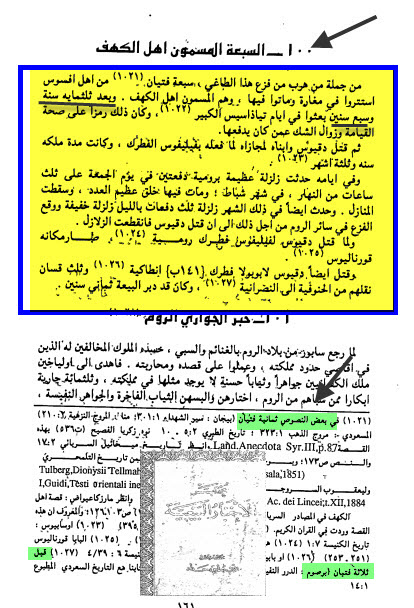
Did the Quran Copy Abraham’s Story from the Haggadah? A Complete Refutation with Historical Evidence