Did Jesus Prophesy "Ahmad" in John 16? The Greek-Arabic Connection Explained
The Paraclete Prophecy: Evidence for Prophet Muhammad ﷺ in the Gospel of John
Table of Contents
- Section 1: The Discourse Structure — John 14 as Separate from John 15–16
- Section 2: The Linguistic Connection — Parakletos / Perikletos = Ahmad
- Section 3: Medieval Latin Evidence — Ahmad Translated as “Gloriosus”
- Section 4: The Name Ahmad — Direct Equivalence
- Section 5: Christian Theologians Acknowledge Translation Issues
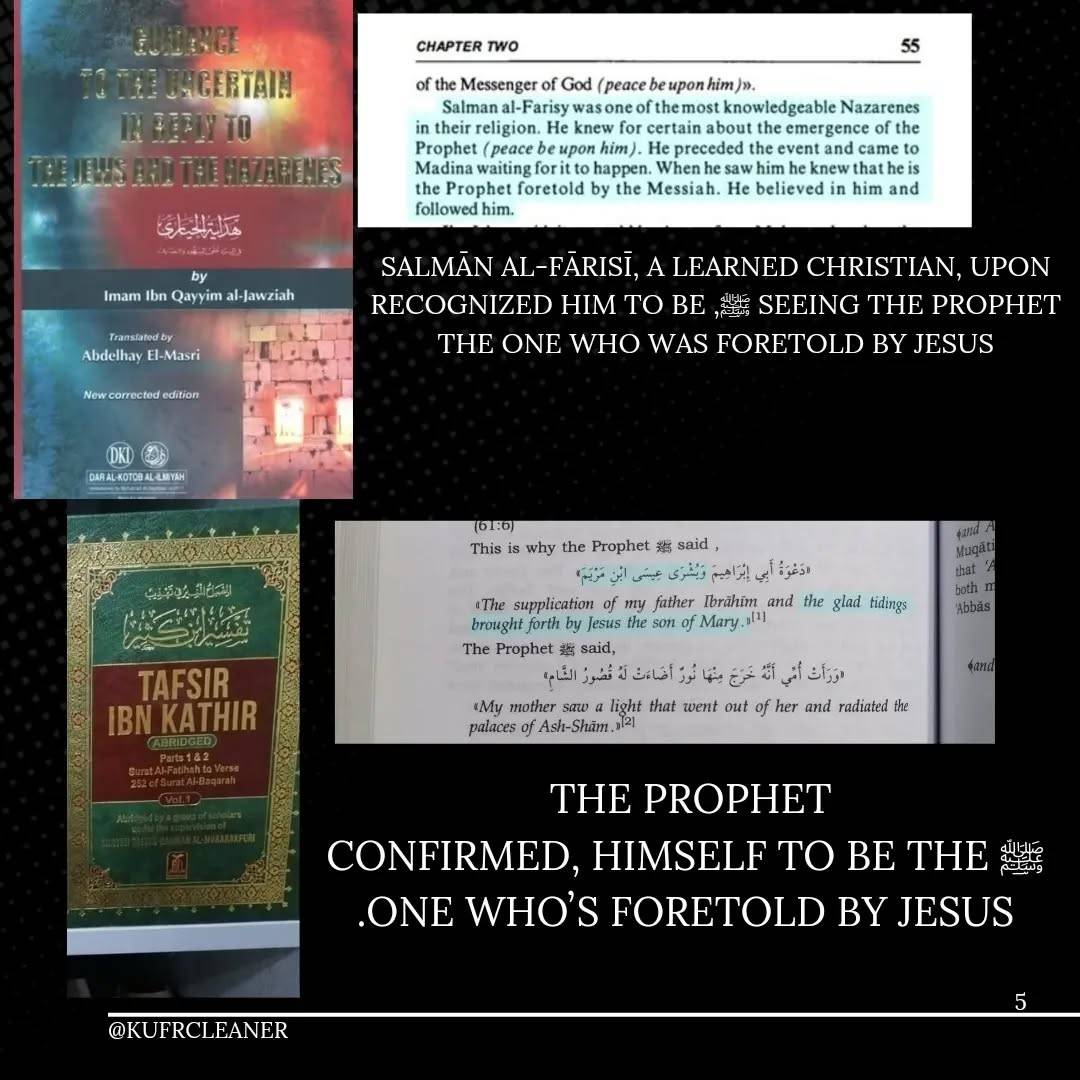
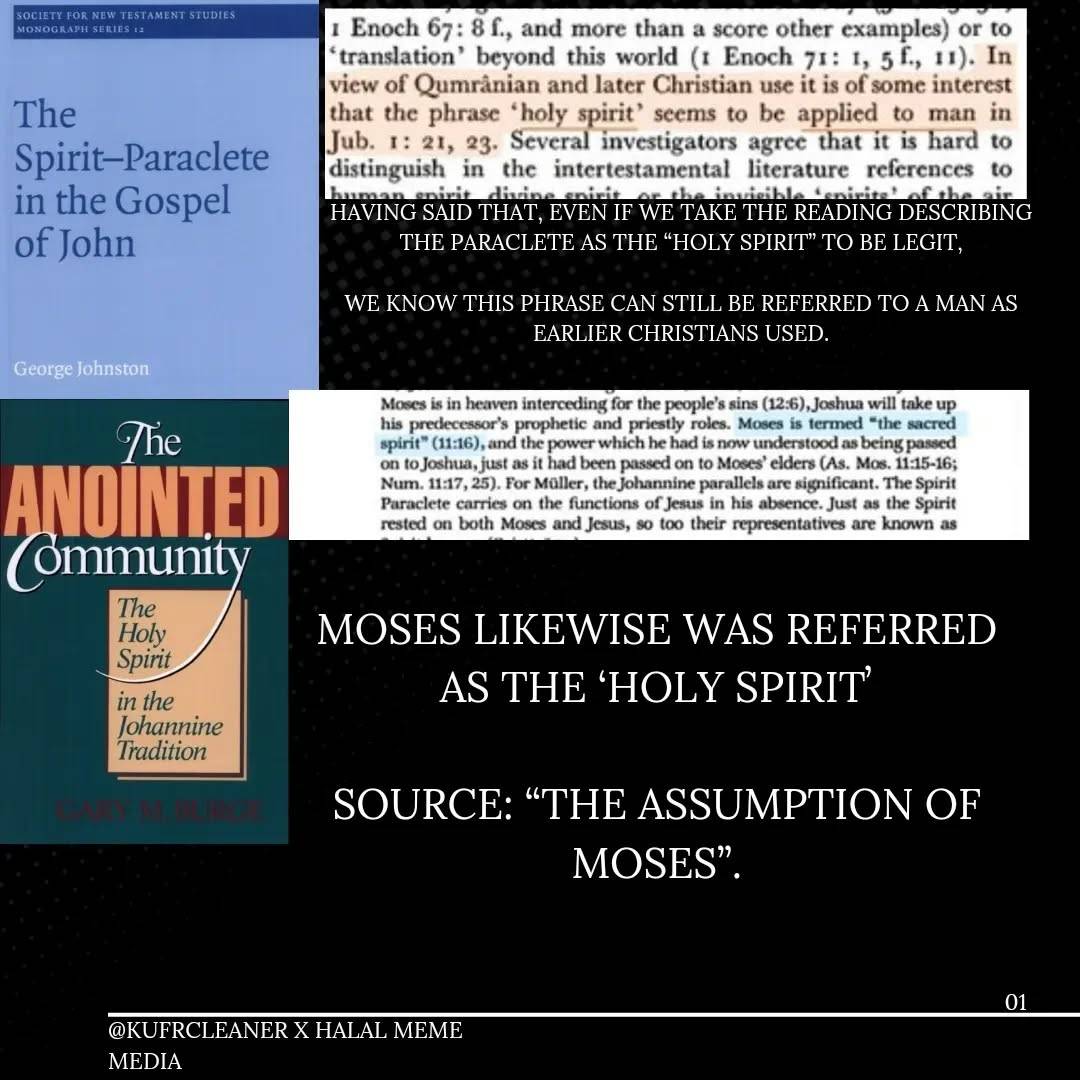
- Section 6: The Paraclete as Prophet — Not the Holy Spirit
- Section 7: The Paraclete Will Remind and Teach — Quranic Parallels
- Section 8: Professor Abdul-Ahad Dawud — Former Christian Priest
- Section 9: The Kingdom of God Prophecy
- Section 10: Contemporary Scholarly Recognition
- Section 11: Medieval Christian Dictionary Evidence
- Section 12: Jerome’s Latin Vulgate — Pre-Islamic Evidence
- Section 13: The Term Paraclete — Not a Divine Title But a Human Helper
- Section 14: Karen Armstrong’s Analysis
- Section 15: Contradictions in the Holy Spirit Interpretation
- Section 16: Early Christian Expectation of a Physical Paraclete
- Section 17: The Paraclete’s Mission — Convicting the World
- Section 18: Manuscript Corruption Admitted by Christian Scholars
- Section 19: Detailed Word Analysis — Parakletos Components
- Section 20: Christian Confusion in Interpreting Paraclete
- Section 21: The Paraclete Will Bear Witness About Jesus
- Section 22: Arguments Against the Holy Spirit Interpretation
- Section 23: Christian Monks Who Converted After Recognizing the Prophecy
- Section 24: The Name Ahmad in Christian Arabian Peninsula Usage
- Section 25: Jesus Glorified Muhammad ﷺ
- Section 26: Arabic and Coptic Christian Sources
- Section 27: Modern Christian Scholarly Admissions
- Section 28: Response to Christian Objections
- Section 29: The Two Greek Words — Detailed Comparison
- Section 30: The Hebrew Version Evidence
- Section 31: Transmission and Vocalization Ambiguity
- Section 32: Orientalist Admissions
- Section 33: Historical Confusion in Christian Interpretation
- Section 34: The Word “Another” — Ἄλλος
- Section 35: Tertullian and Montanism
- Section 36: Mani the Persian
- Section 37: Modern Christian Acknowledgments
- Section 38: The Linguistic Evidence — Greek Etymology
- Section 39: Manuscript Transmission Problems
- Section 40: The Quranic Precision — Why Ahmad and Not Muhammad
- Conclusion
- References and Resources
Section 1: The Discourse Structure — John 14 as Separate from John 15–16
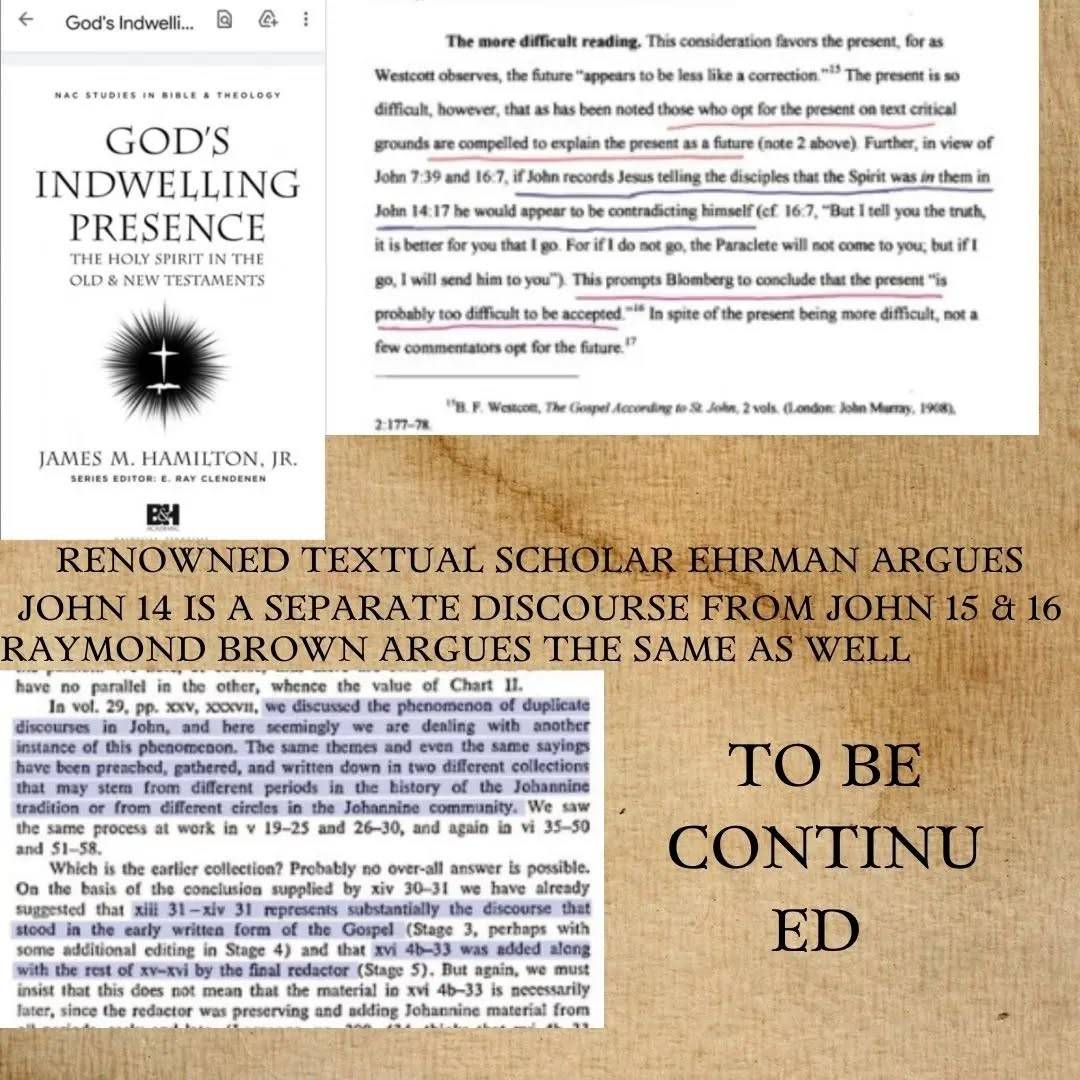
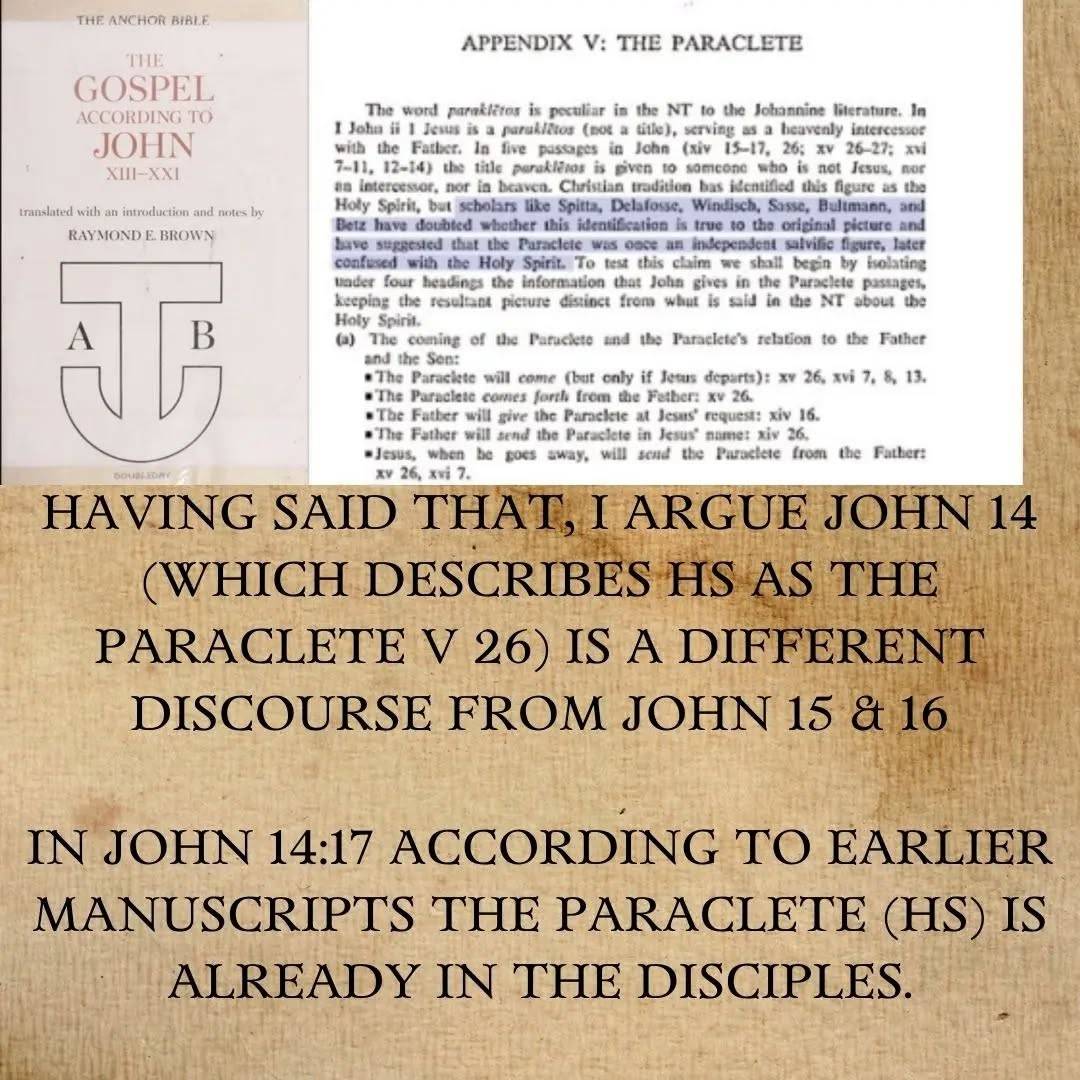
A critical but often-overlooked foundation of the Paraclete argument is thatJohn 14 is a textually and structurally separate discourse from John 15 and 16. If we choose the present-tense reading in John 14, it would directly contradict John 15 and 16 — supporting the position that these are distinct compositions and cannot be harmonised into a single unified promise about the same figure.
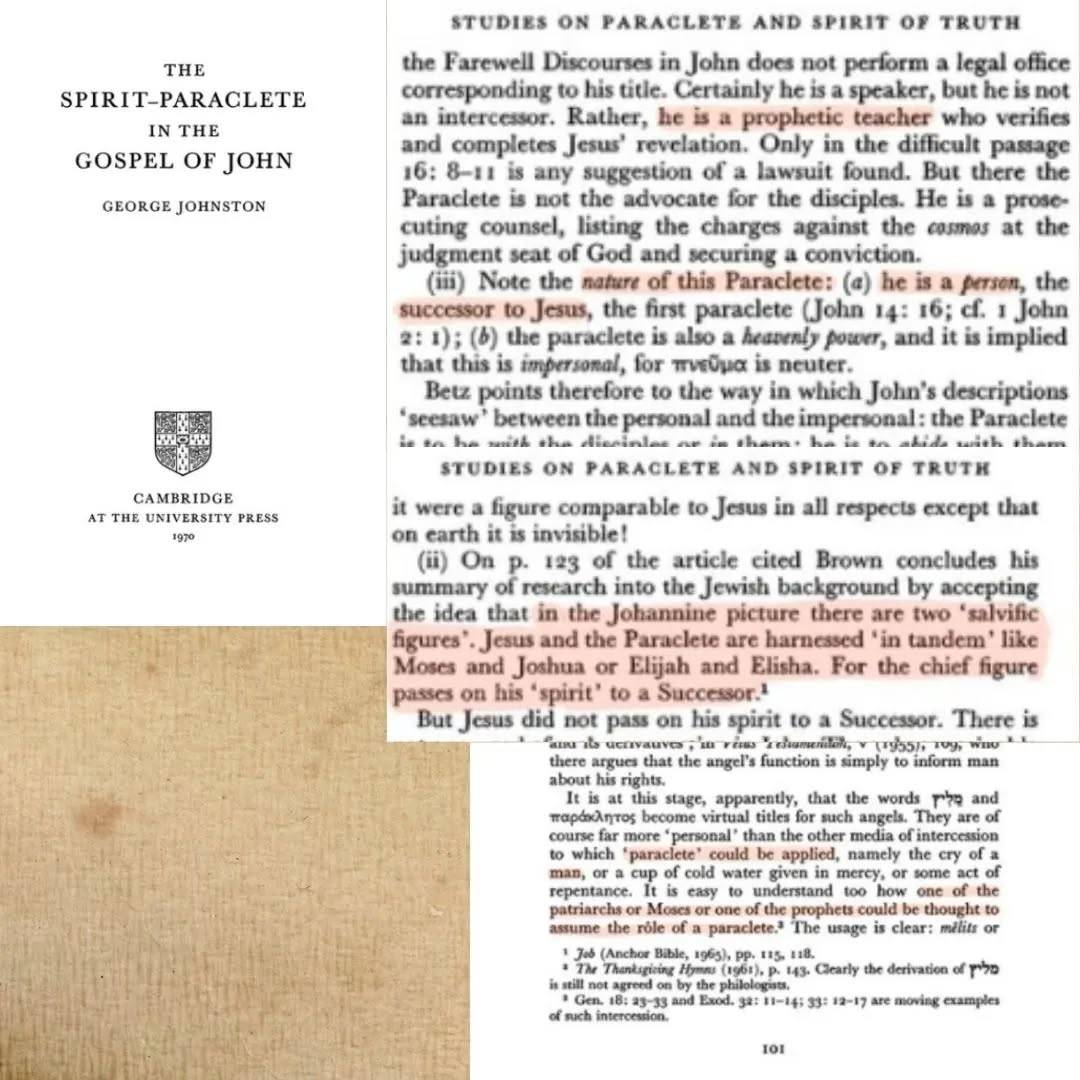
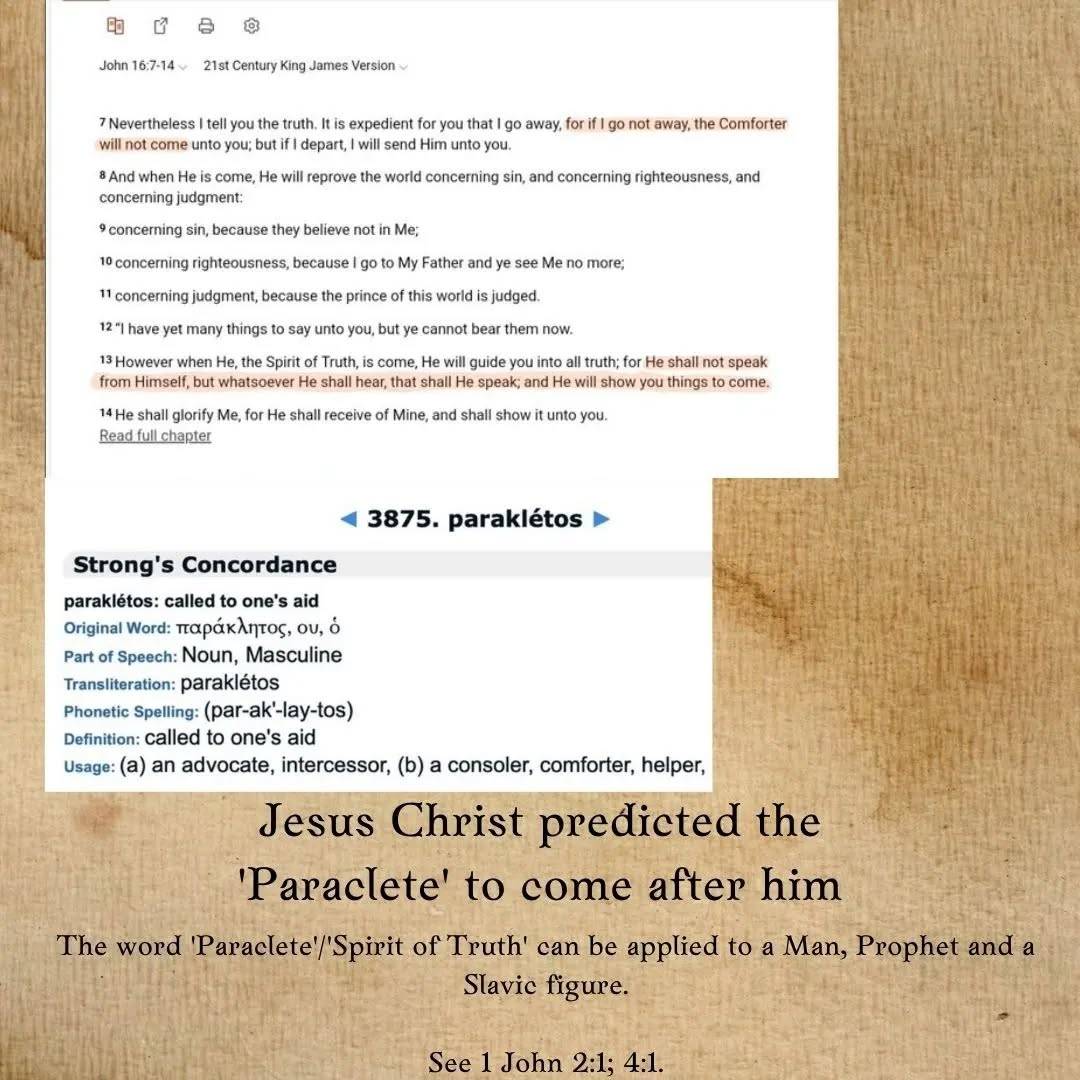
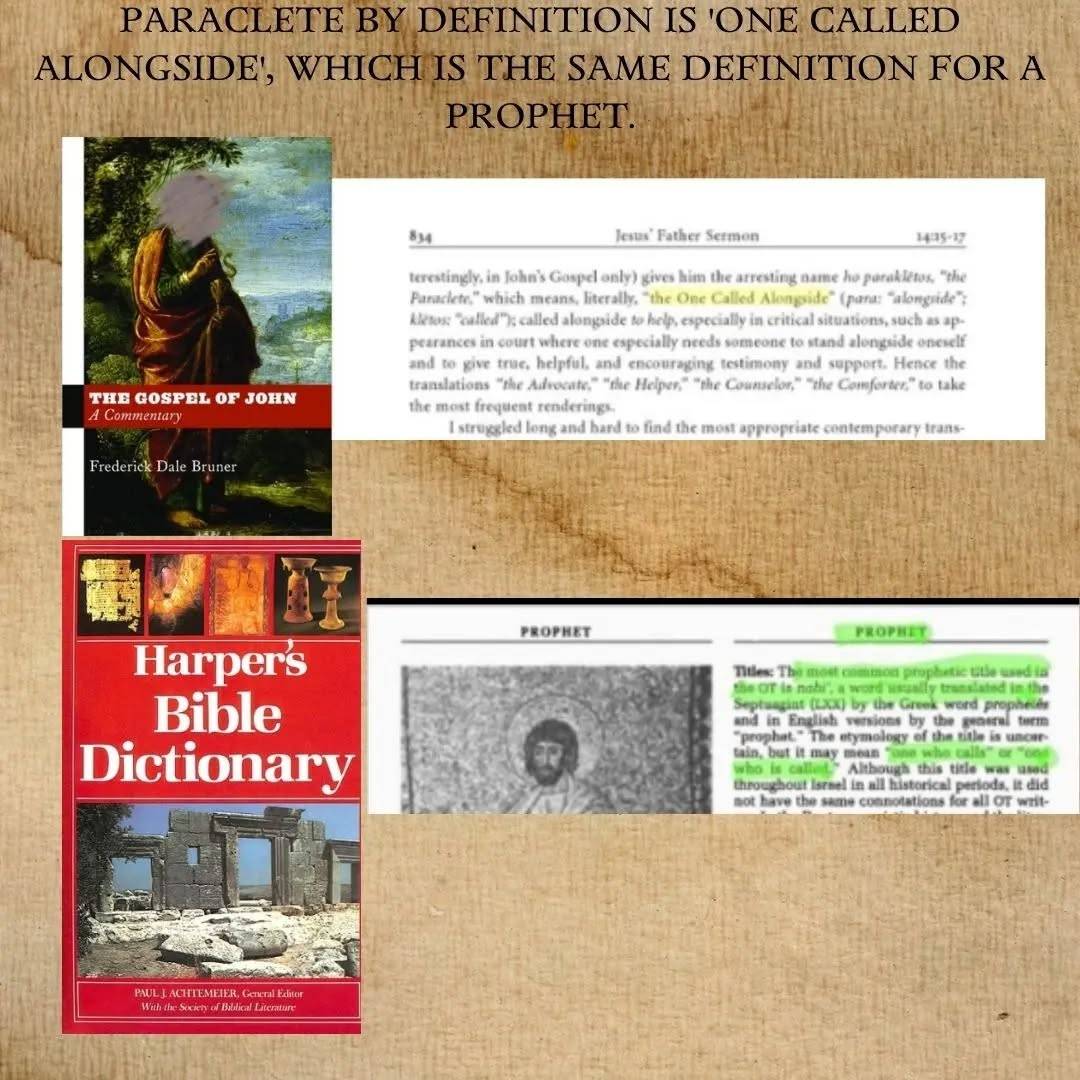
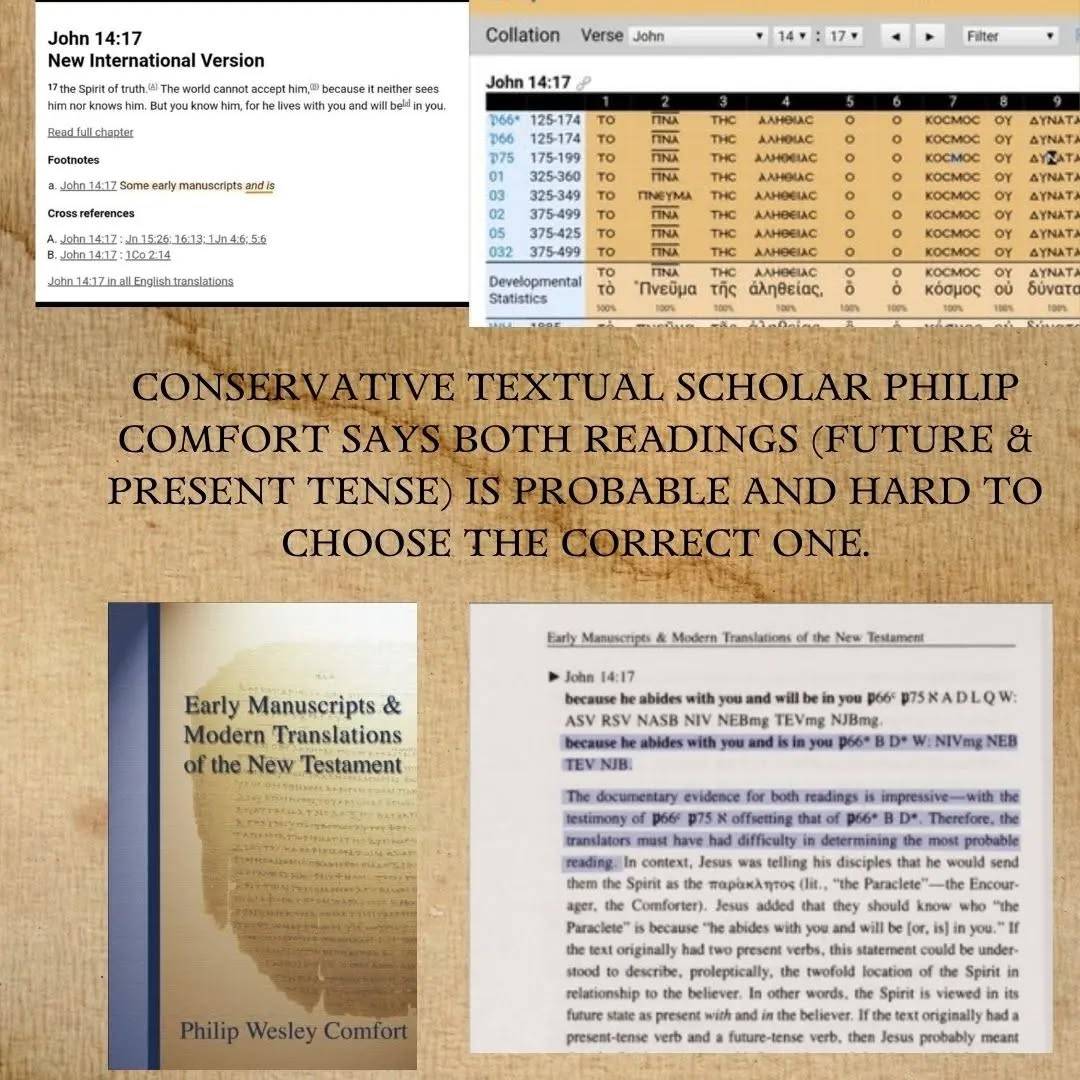
Bart Ehrman — the textual scholar — argues that John 14 is a separate discourse from John 15 and 16. Raymond Brown concurs with the same interpretation. This is not a Muslim-originated claim but an established position within Western New Testament scholarship, cited in the John 14:17 NET footnote.The NET Bible footnote on John 14:17 explicitly engages with this tension between the present and future tense readings across the Johannine discourses, acknowledging the structural discontinuity.
Section 2: The Linguistic Connection — Parakletos / Perikletos = Ahmad
At the heart of the argument lies the distinction between two Greek words that are visually and phonetically close but semantically distinct.
A. Parakletos (παρακλητος) — The Current Reading
The current Greek manuscripts readParakletos (παρακλητος), meaning Comforter, Advocate, Helper, or Consoler. In Latin it is rendered as Paraclitum and Advocatus; in Hebrew as מנחם (Menahem); and in Syriac as Manhaman.The Syriac rendering Manhaman is itself significant — some scholars have noted its phonetic proximity to Muhammad.
B. Perikletos / Pariklytos (Παρικλυτος) — The Islamic Claim
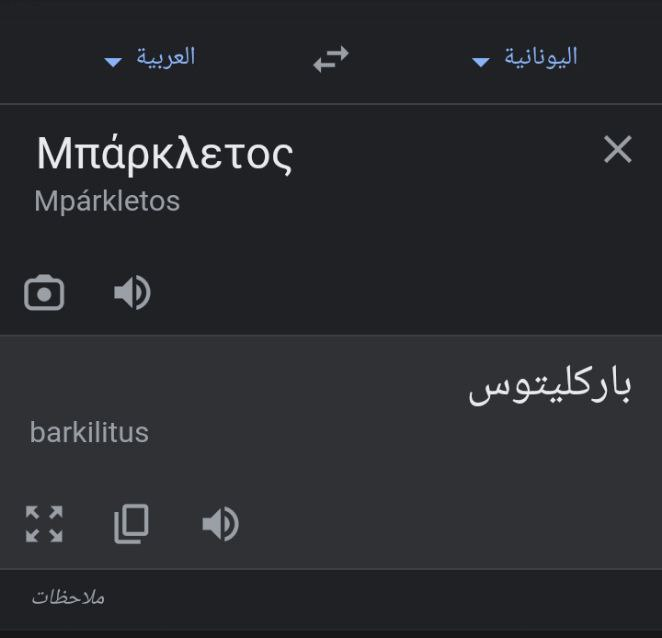
The wordPerikletos (Παρικλυτος) means the praised one, the glorious, the most celebrated. It appears in Homer’s Iliad and Odyssey with precisely the meaning “praised one” — and is the exact Greek equivalent of the Arabic name “Ahmad.”
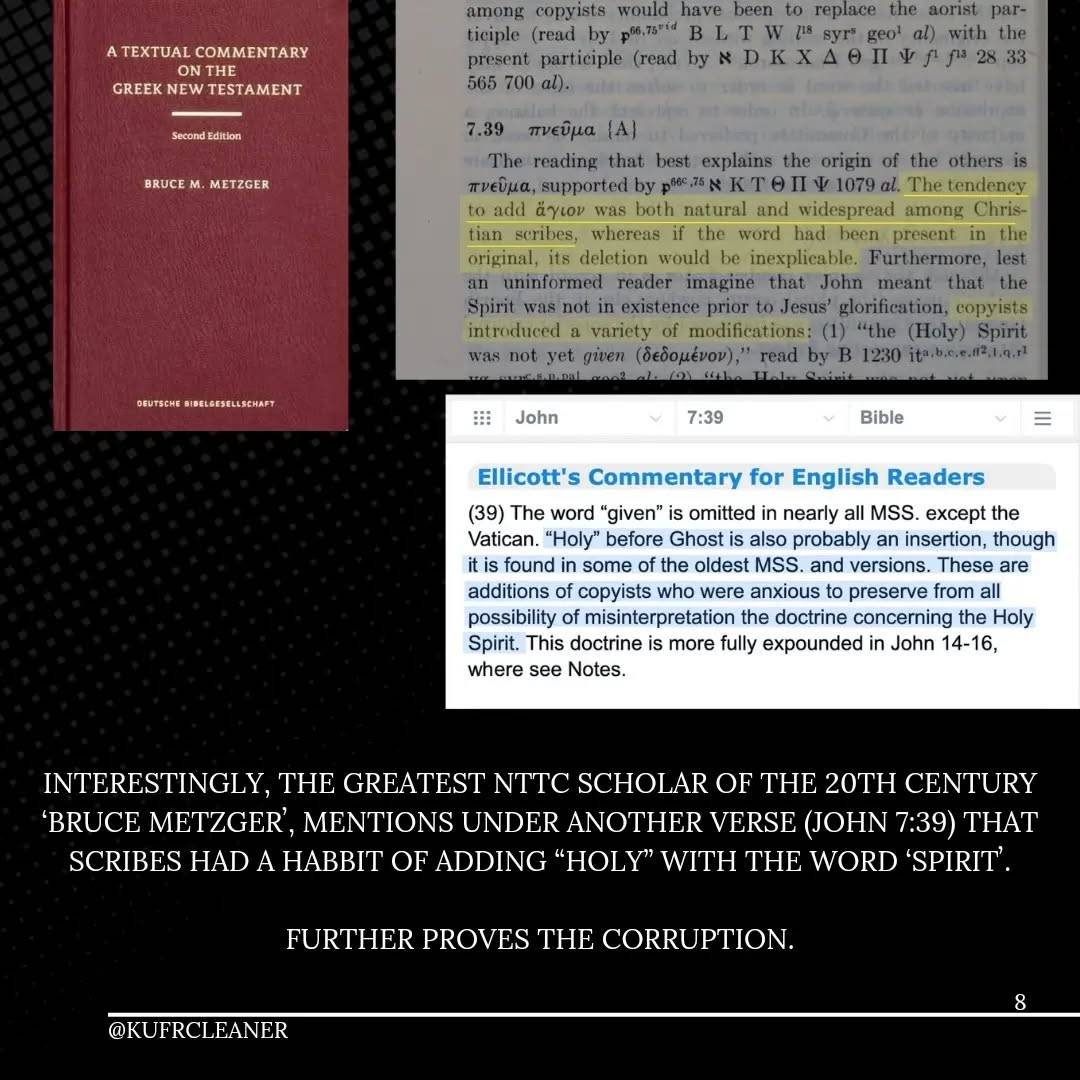
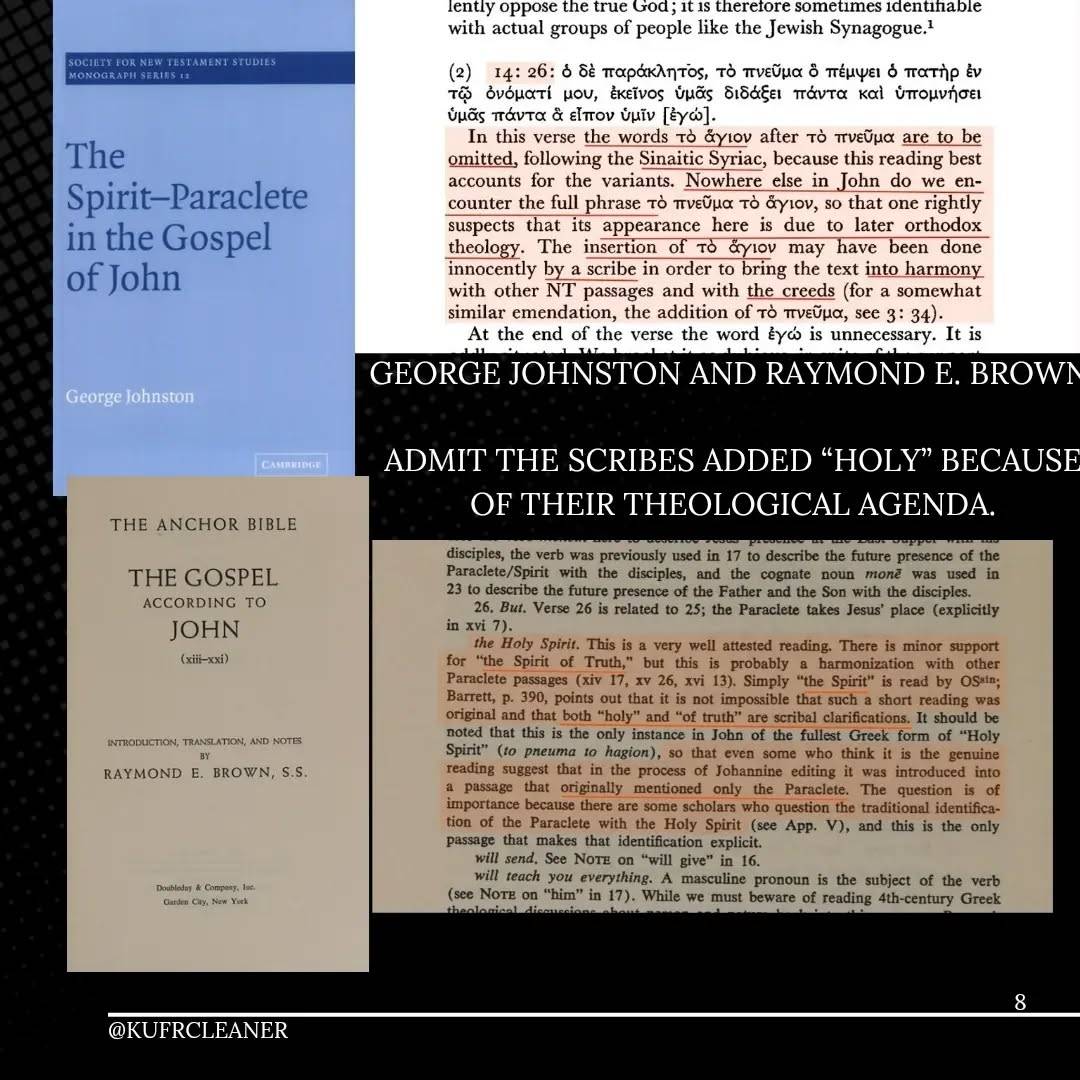
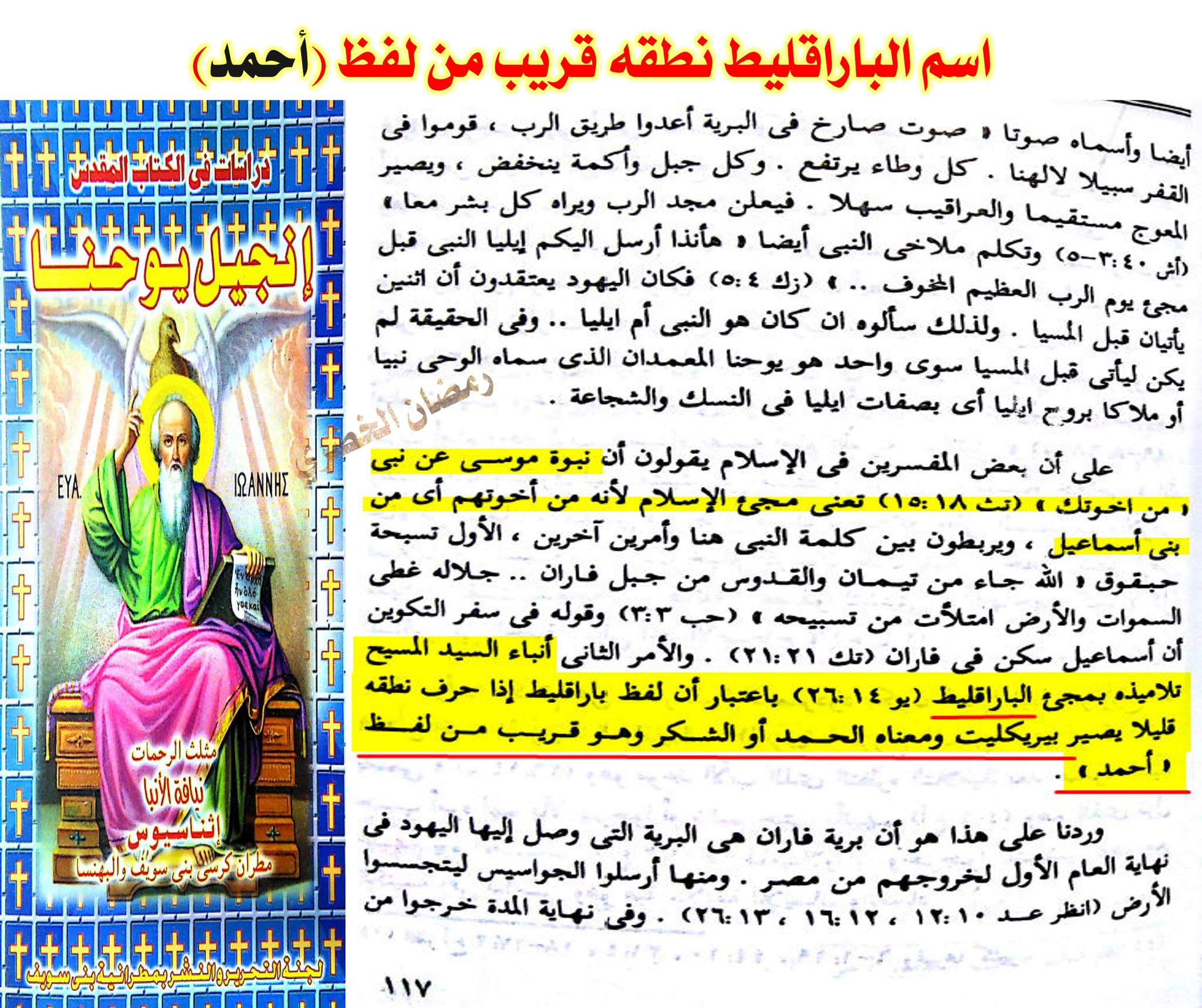
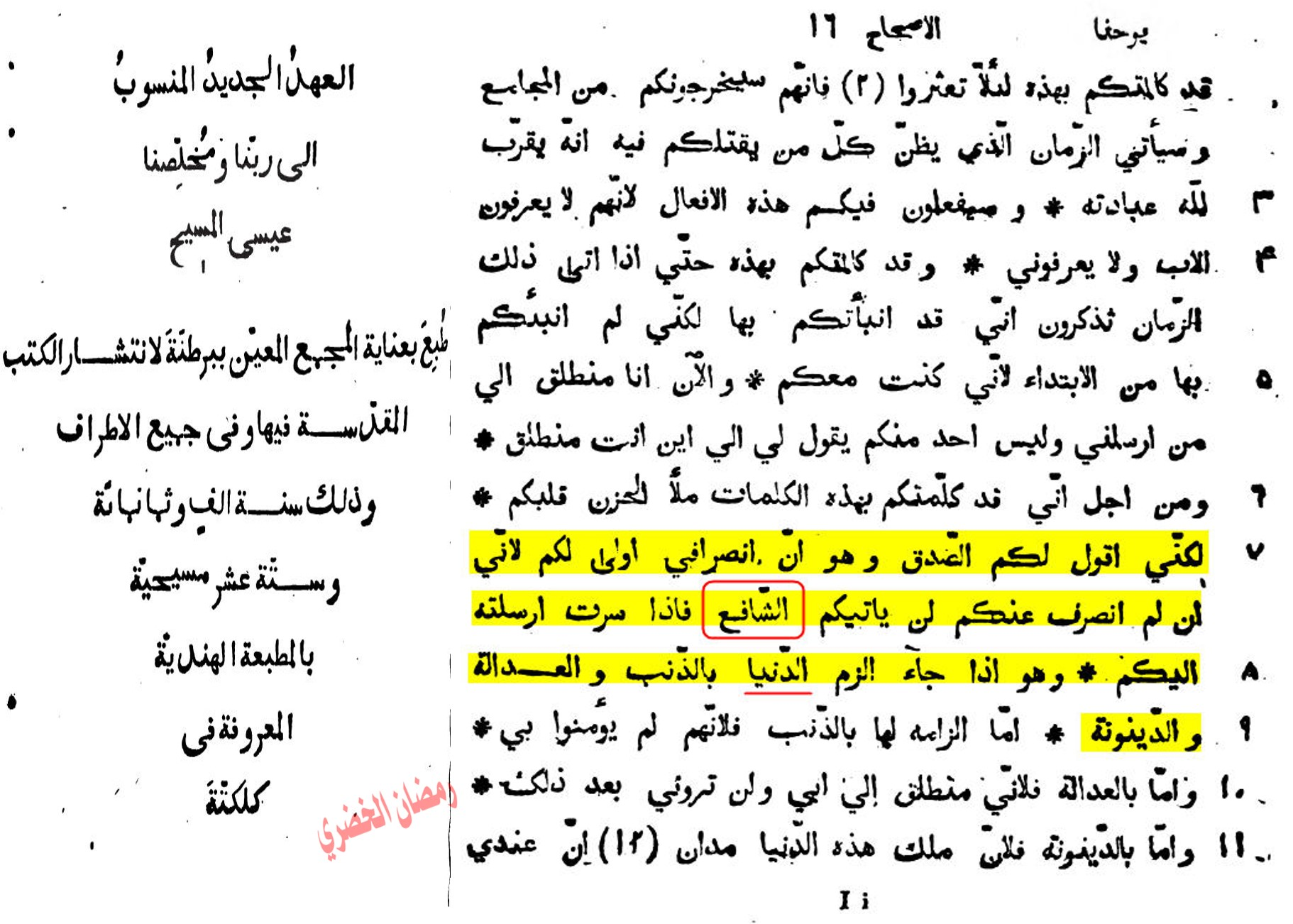
This Arabic scan argues that some Muslim interpreters understood the Paraclete prophecy in John as a reference to the coming of Islam. The highlighted paragraph says the word used in the Gospel can be read in a form close toPeriklet / Pariklet, whose meaning is connected with praise, glory, or being highly praised. The scan supports the Ahmad = praised/most praised linguistic argument, but should not be presented alone as decisive proof. Its value is that it shows the argument was being made through the pronunciation and meaning of the term, not merely through later theological imagination.
Section 3: Medieval Latin Evidence — Ahmad Translated as “Gloriosus”
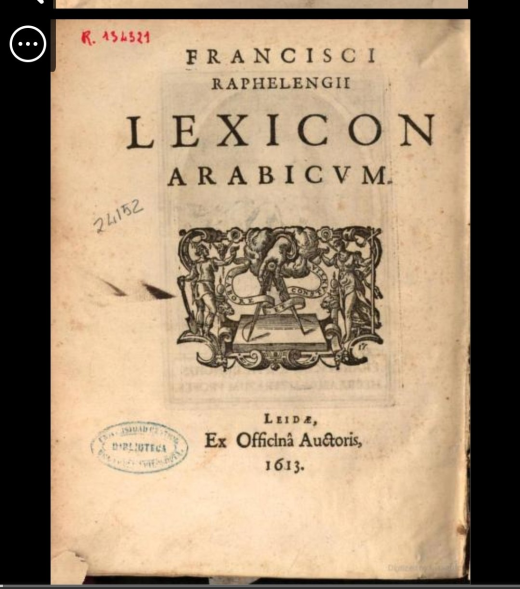
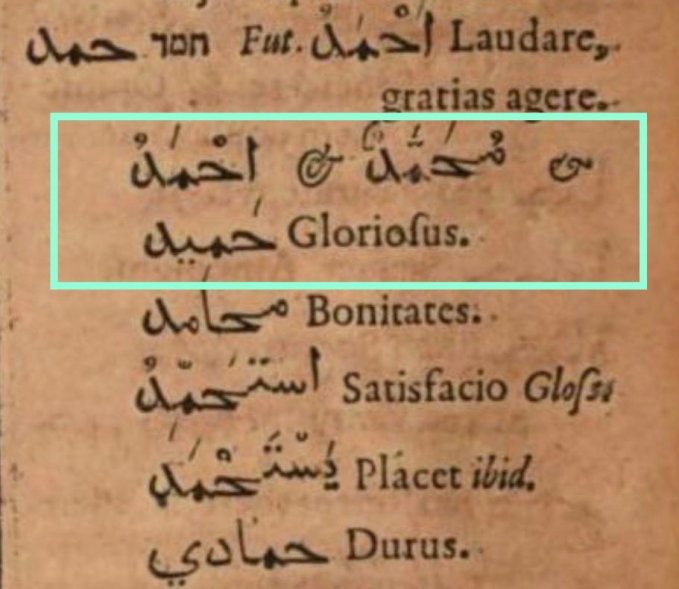
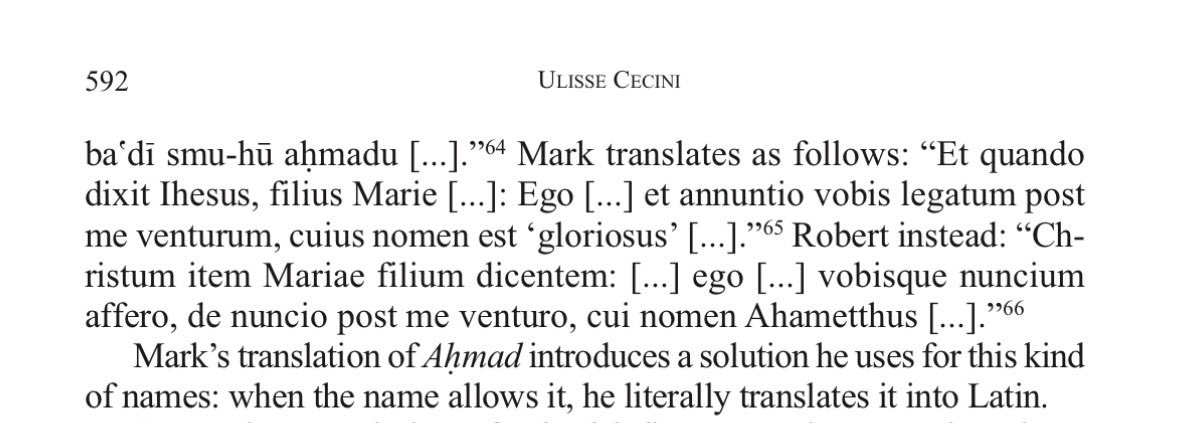
In the medieval Latin period,Mark of Toledo translated the name “Ahmad” as Gloriosus — “the Glorious One.” This is a landmark piece of evidence demonstrating that the connection between Paraclete and Ahmad was recognized in medieval Christian scholarship, not invented by Muslims.
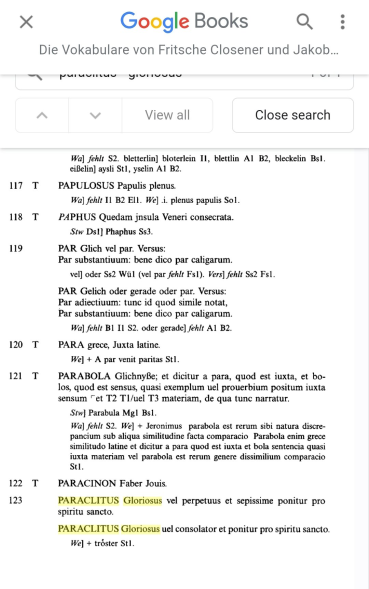
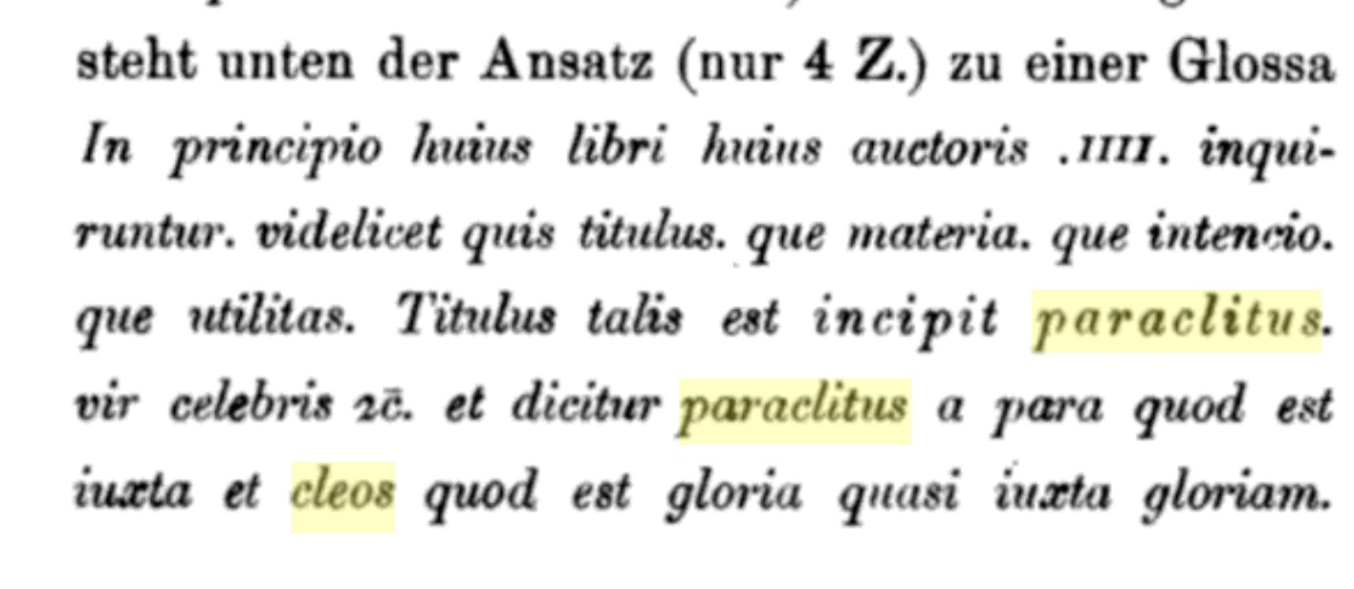
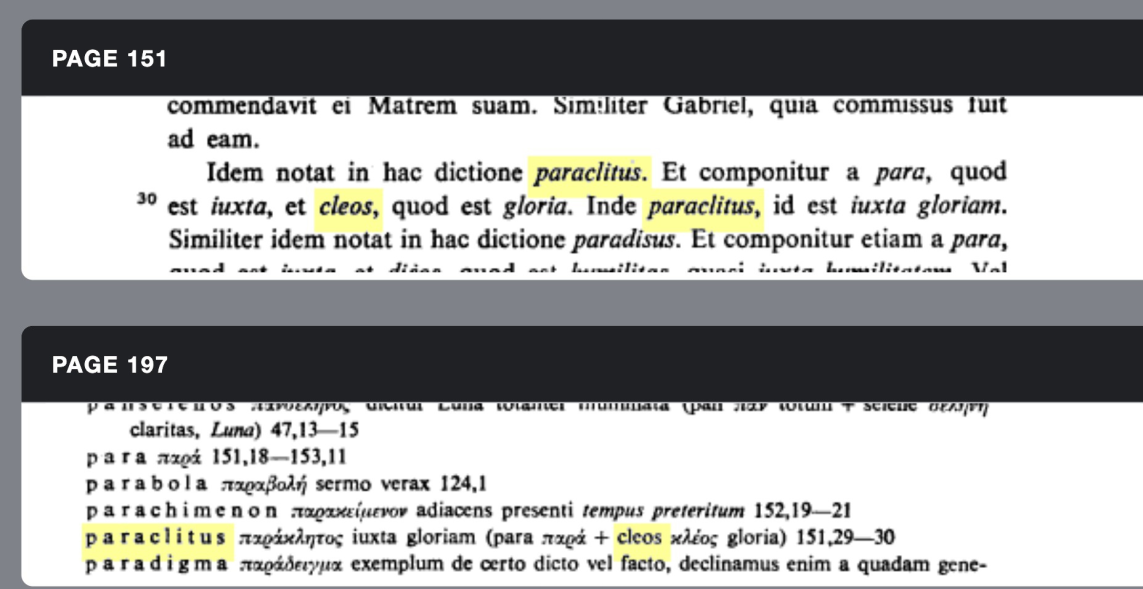
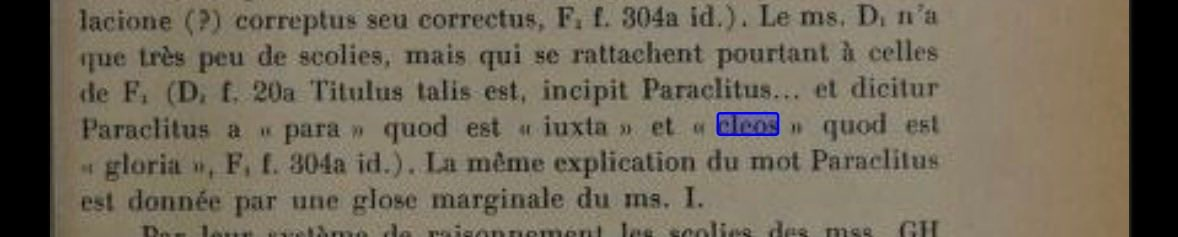
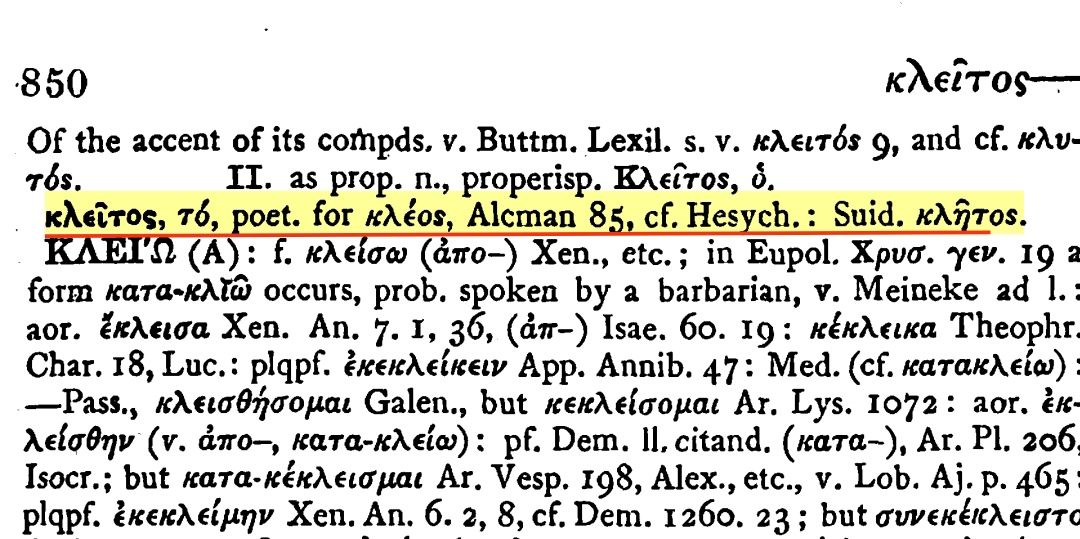
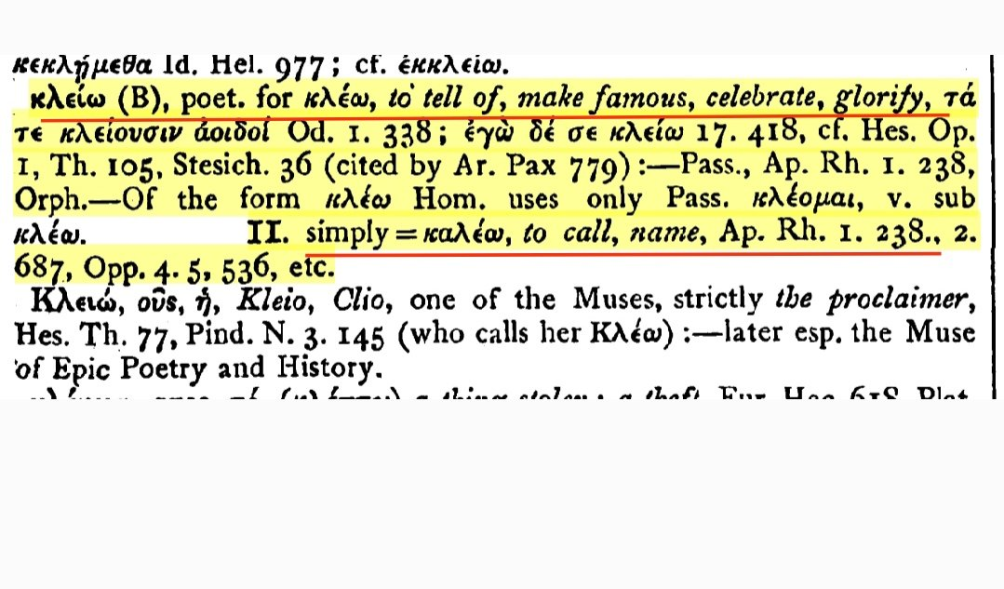
Medieval linguistic dictionaries confirm thatParaclete/Paraclitus through the component “para” + “cleos” is a legitimate reading in medieval Latin philology. The suffix ~kletos also carries a sense of glory in the academic tradition. This was not a misspelling — the writer of John did not err, as the form is a recognized variant in the manuscript tradition.
Section 4: The Name Ahmad — Direct Equivalence
Paraclitus (Parakletos) = Gloriosus
Ahmad = Gloriosus
∴ Parakletos = Ahmad

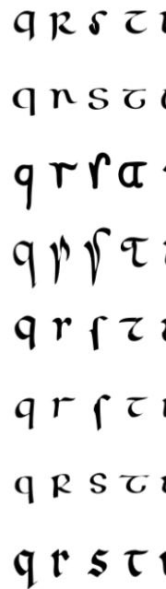
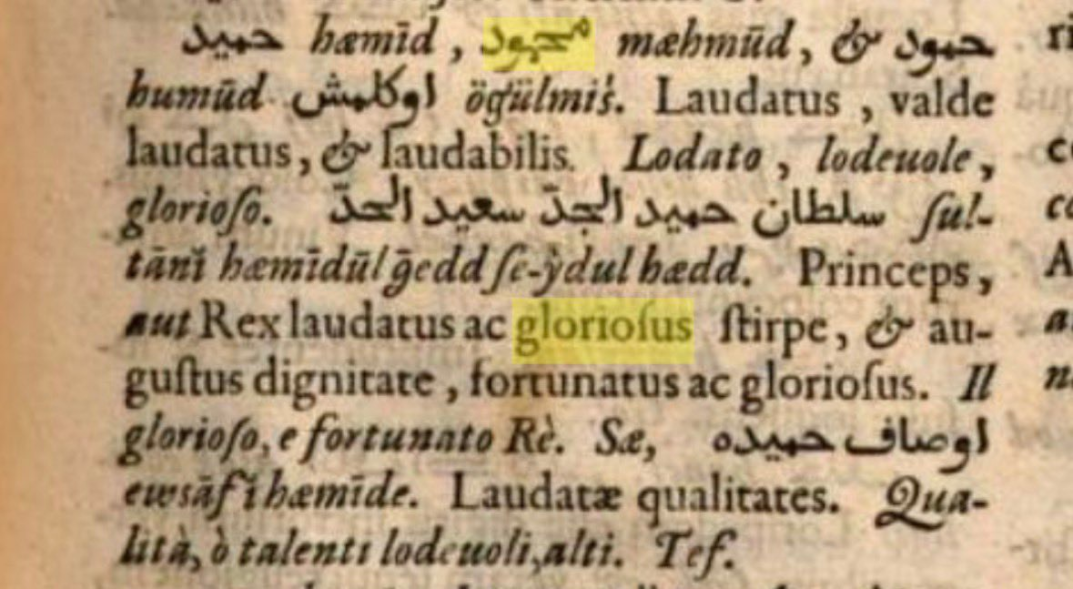
Greek Lexical Evidence
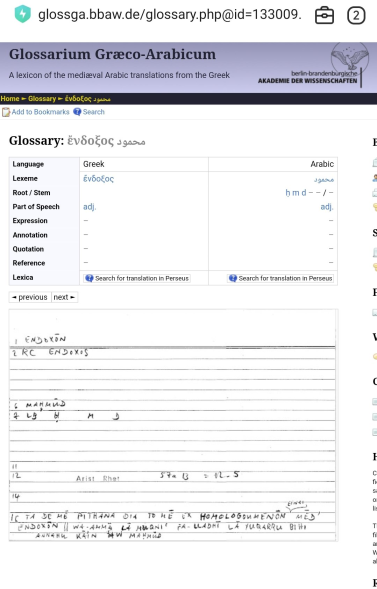
The chain of semantic equivalence is confirmed through Greek lexical sources:Kletos = doxa = endoxos (praised/glorious). Endoxos shares the root hmd with the Arabic Muhammad and Ahmad. This is not a phonetic trick — it is a documented semantic equivalence across Greek and Semitic language families.
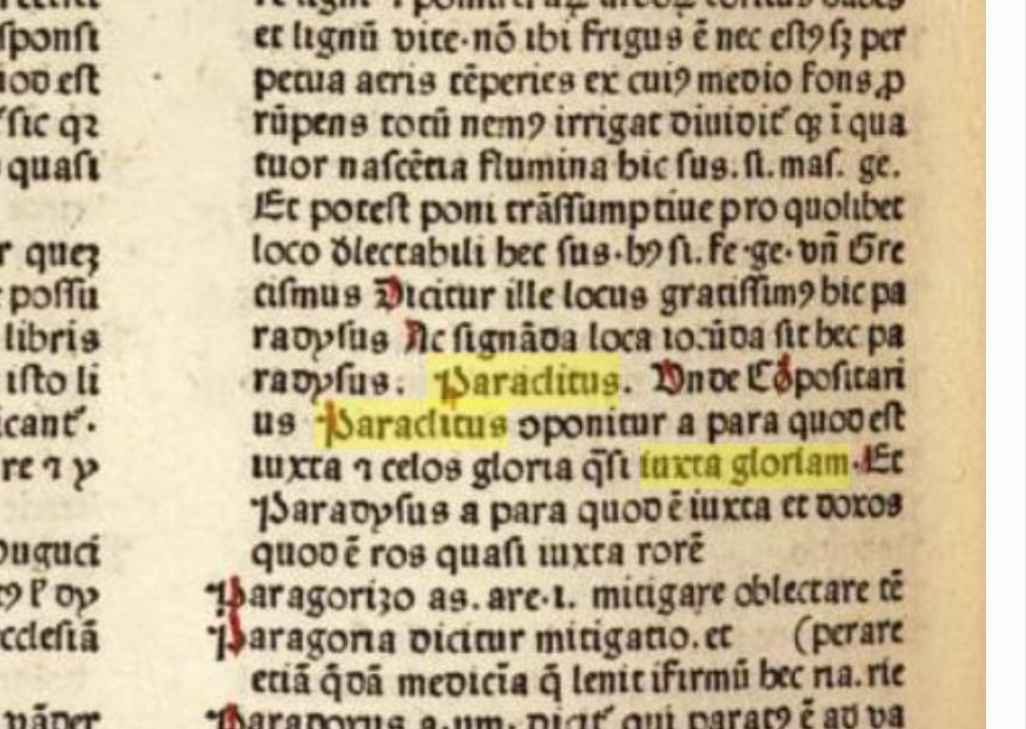
Section 5: Christian Theologians Acknowledge Translation Issues
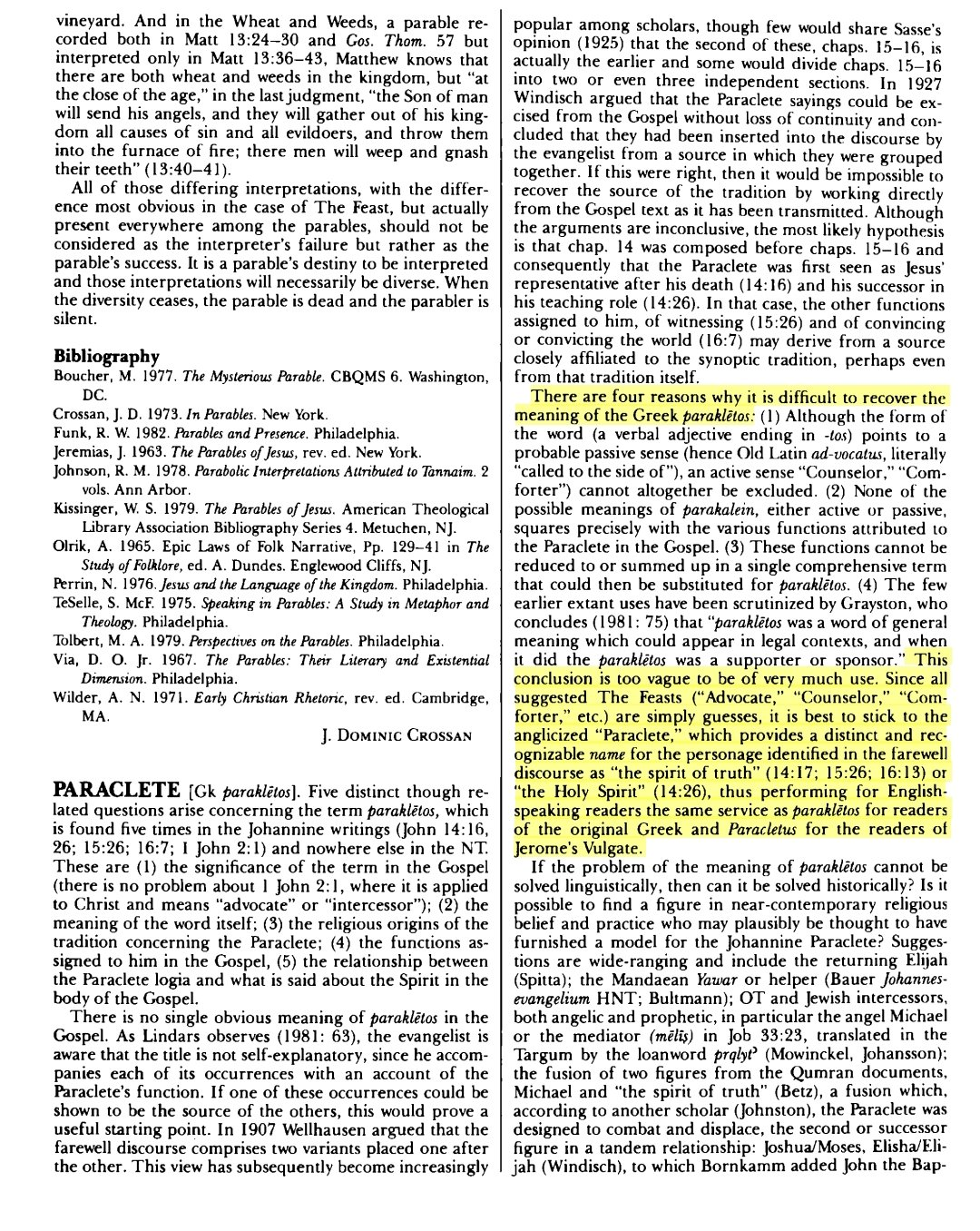
Christian scholars themselves have acknowledged that the traditional English renderings of “Paraclete” as “helper,” “comforter,” or “advocate” are essentially interpretive guesses — not accurate or settled translations of how the term functions within the Gospel of John.
Paraklutos = Ahmad
Old Arabic Gospel Translations Preserved the Term Rather Than Rendering It
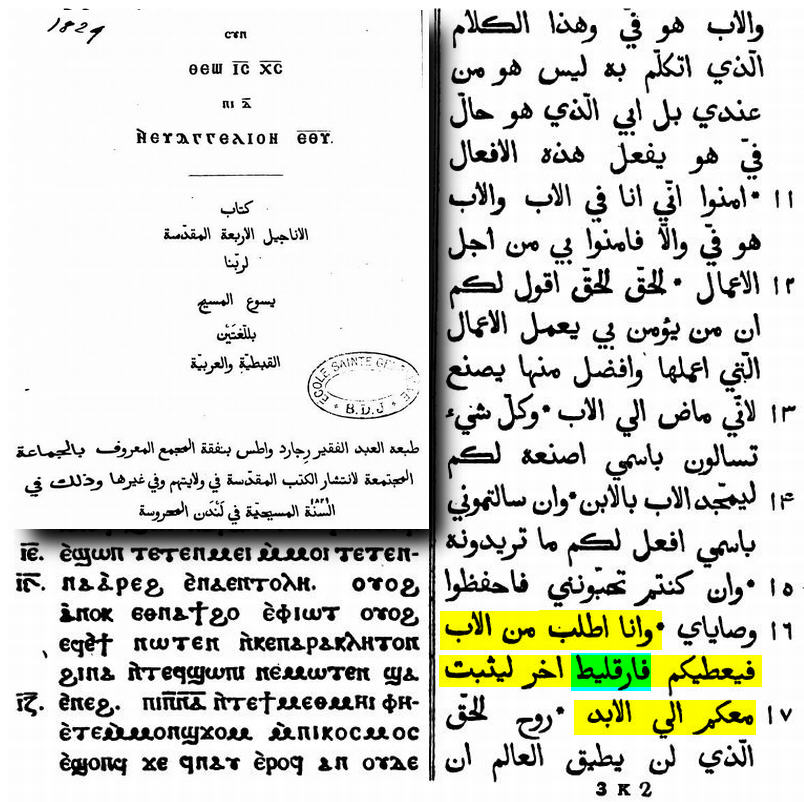
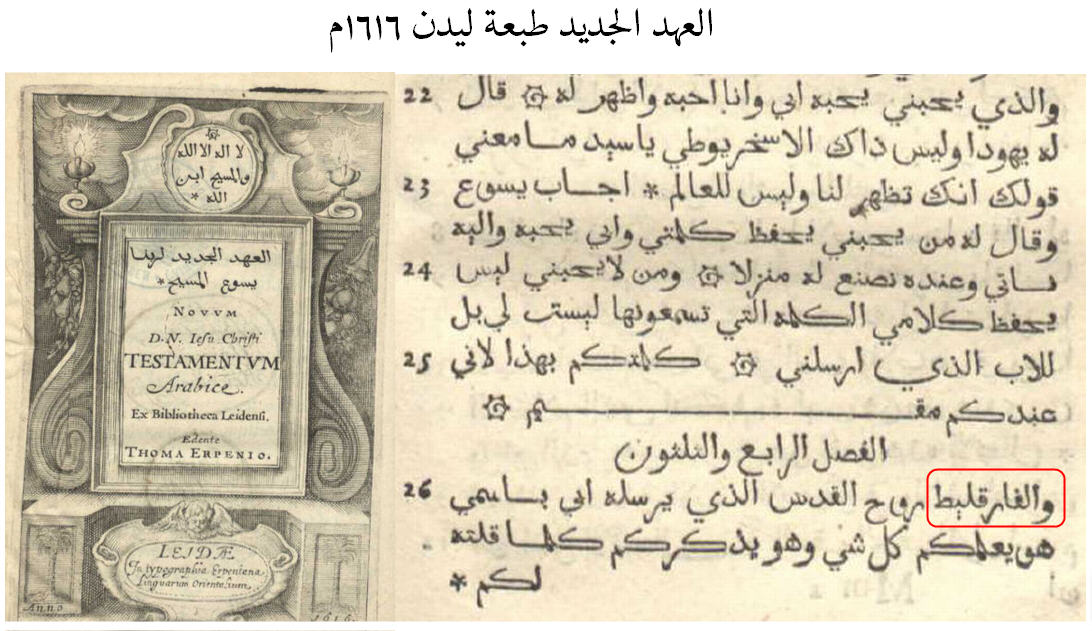
Several older Arabic Gospel and New Testament editions did not simply translate the Paraclete as “Comforter.” They preserved it asالفارقليط / البارقليط / فارقليط. This does not by itself prove the Islamic reading, but it strengthens a narrower and harder-to-attack point: Arabic Christian translators often treated the word as a technical term or proper name, not as an ordinary word with one settled rendering.
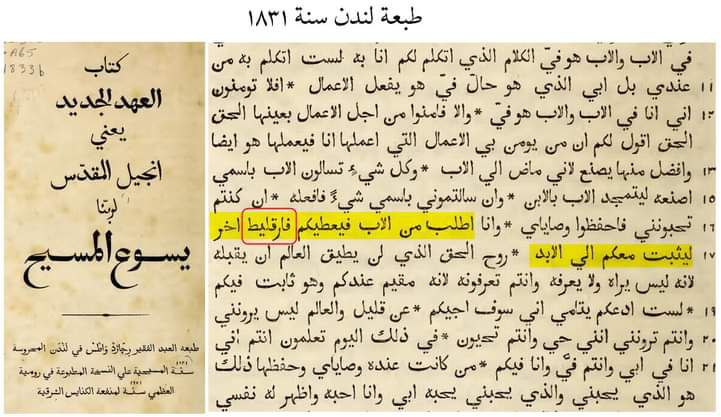
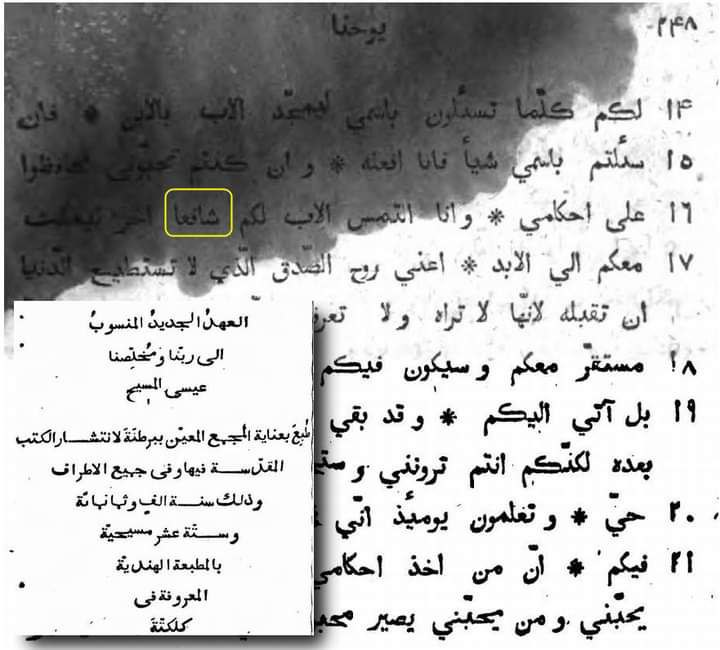
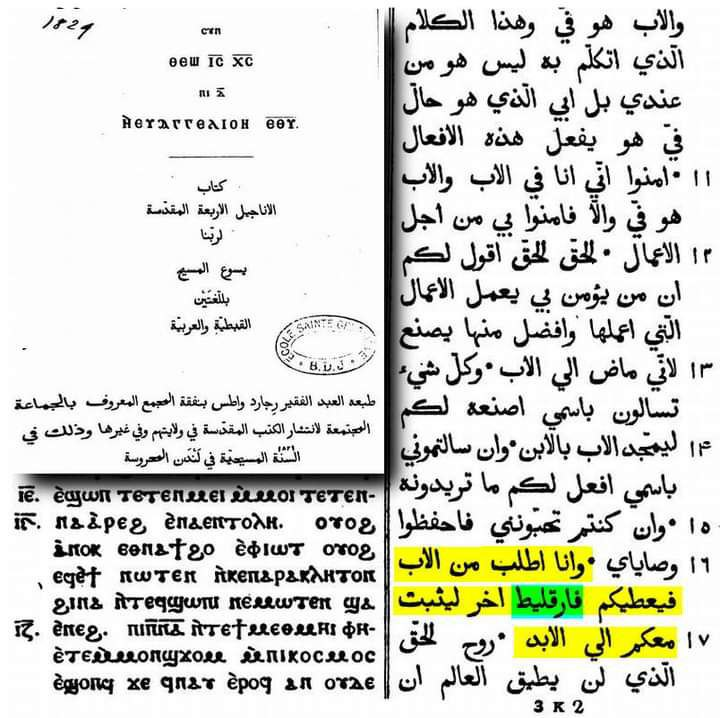
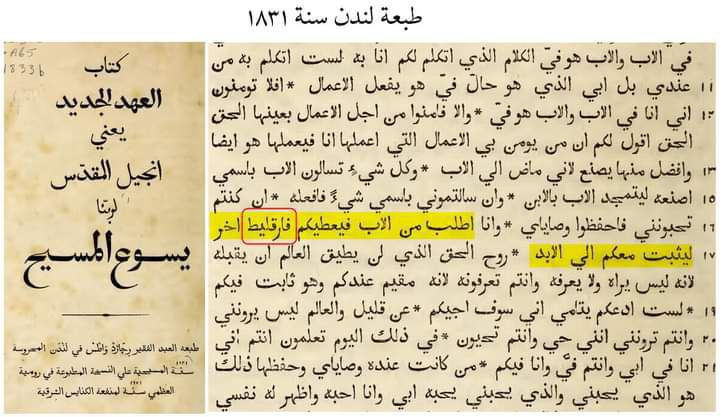
This old Arabic Gospel page preserves the promised figure in John 14:16 asفارقليط آخر — “another Paraclete.” The translator did not flatten the term into a normal Arabic equivalent such as “comforter” only. The scan supports the argument that the word was received as a special technical term, which is why it remained transliterated in Arabic Gospel tradition.
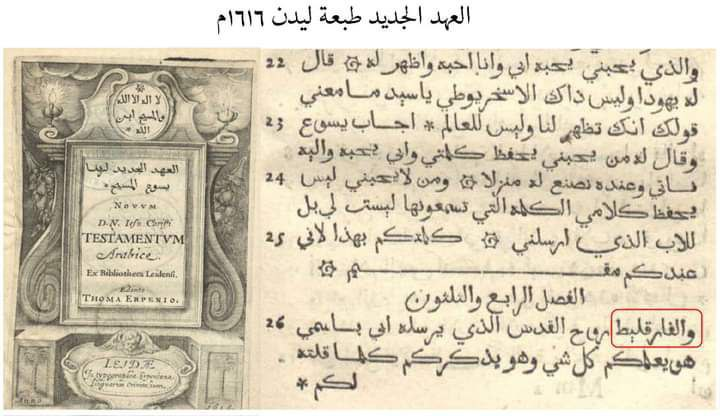
This scan is from the Leiden Arabic New Testament tradition, showing John 14:26 with the highlighted termالفارقليط. The surrounding verse identifies the one sent by the Father in Jesus’ name, saying he will teach and remind. The evidential value here is not that the scan proves “Ahmad” directly, but that an old Arabic Christian biblical text preserved the Greek loanword rather than replacing it with a single ordinary Arabic translation.
This 1666 Arabic New Testament scan again shows John 14:26 and preserves the term asالفارقليط. The verse says this Paraclete, sent by the Father in Jesus’ name, will teach the disciples all things. This supports the section’s claim that the old Arabic Christian transmission often retained the term in transliterated form.
This older Arabic Gospel scan preserves the same term in Arabic script asفارقليط. The highlighted line belongs to the Johannine promise passages and shows that the term was not always handled as a simple common noun, reinforcing the argument that the word carried a special identity in older Arabic Christian usage.
This scan shows another Arabic Gospel witness in the farewell-discourse context. The highlighted wording preserves the Paraclete language in a form close toفارقليط, in the passage where Jesus links the coming of the promised figure to his own departure. This is useful beside the argument that the Paraclete is expected after Jesus, not simultaneously with his earthly mission.
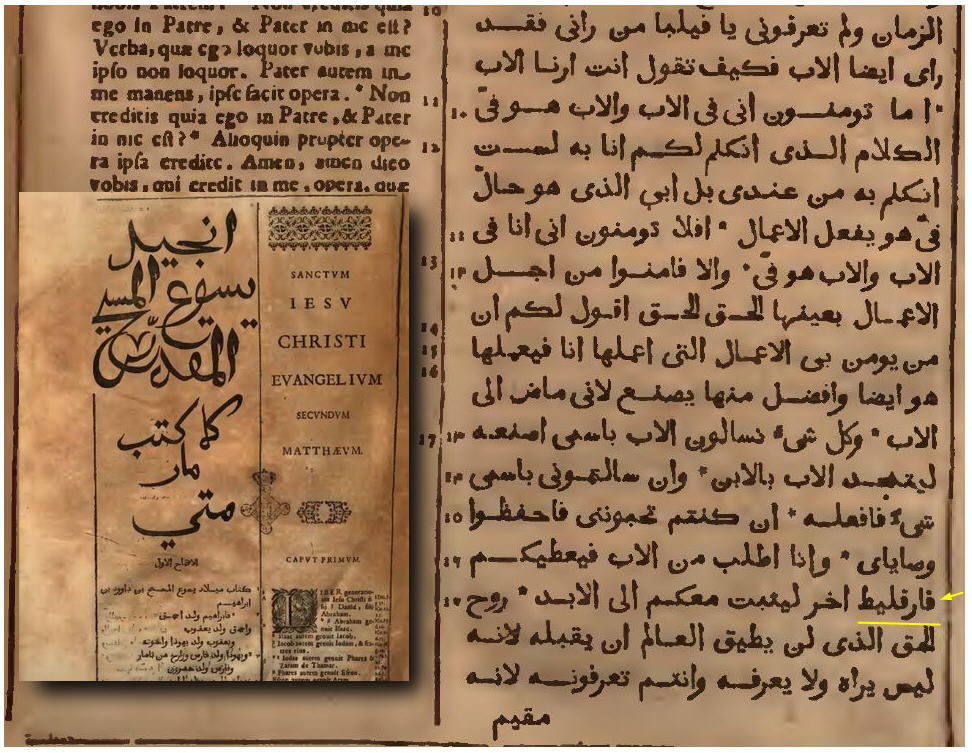
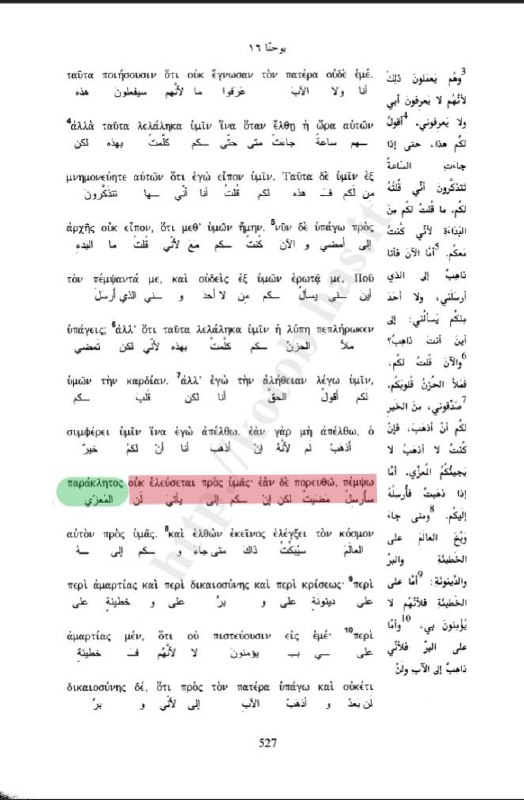
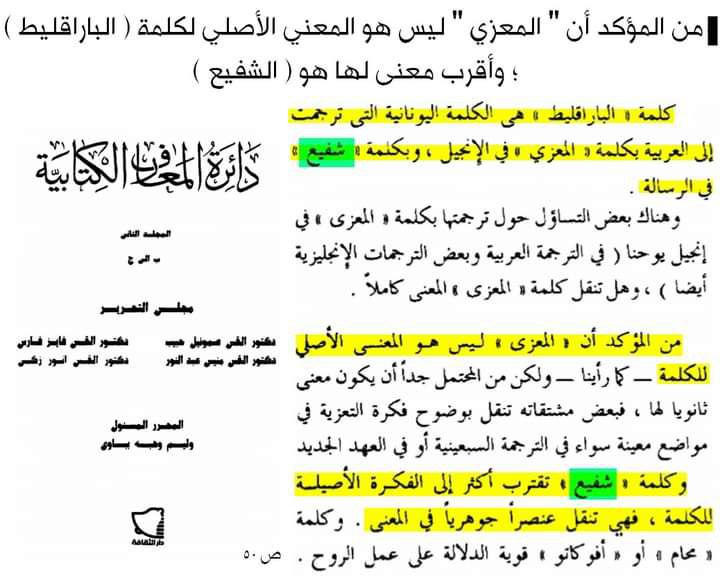
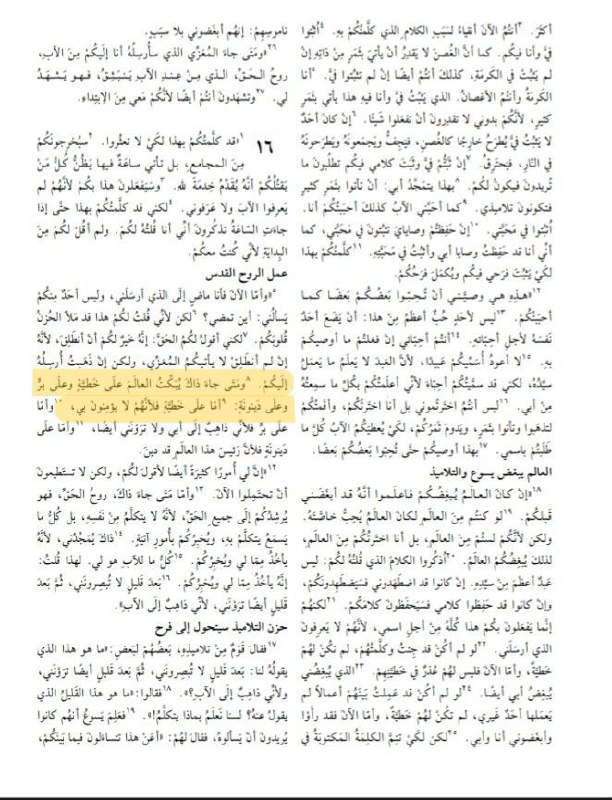
This Arabic New Testament scan renders the promised figure with language ofشفاعة / شفيع — intercessor or advocate — in the John 16 context. This does not support the Ahmad etymology directly, but it strengthens the semantic field of the word: the Paraclete is not merely “comfort” as emotion, but a personal advocate and intercessor. That fits the argument connecting the Paraclete with a prophetic figure who defends, testifies, teaches, and intercedes.
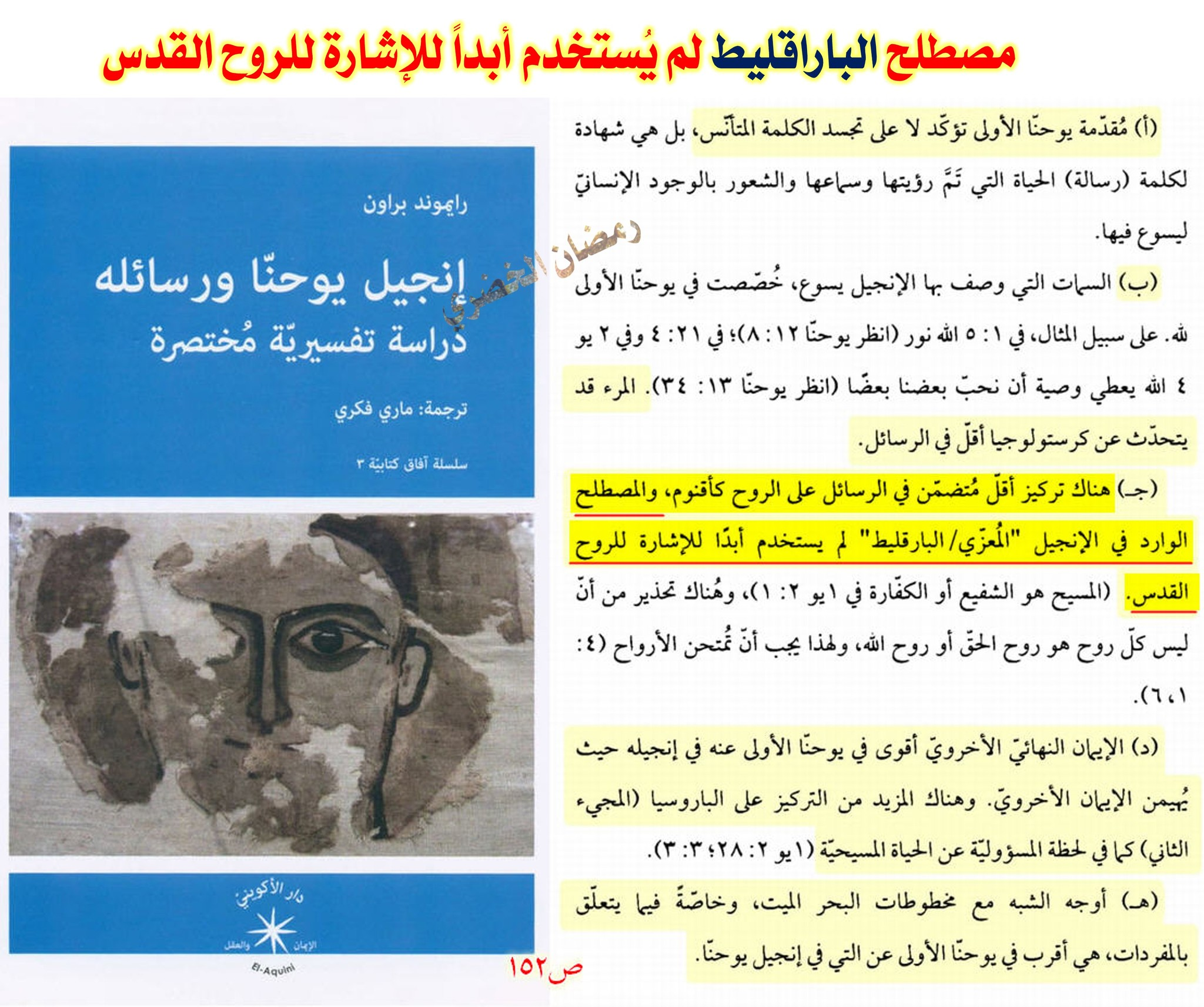
The strong claim is that old Arabic Christian translations often preservedParaclete/Farqleet as a technical term. The moderate claim is that this makes the later “Comforter” rendering look interpretive rather than neutral. What one must not do is overclaim: these scans alone do not prove that every manuscript originally read Periklytos.
“In recent times Christian apologists have mocked the Qur’an’s claim that Jesus foretold Muhammad, boldly declaring that the Qur’an is mistaken as he is nowhere to be found in their scripture. This video shows that not only is this very prophecy found within the pages of the New Testament, but that the Qur’an helps to solve a millennia old linguistic puzzle.”
Section 6: The Paraclete as Prophet — Not the Holy Spirit
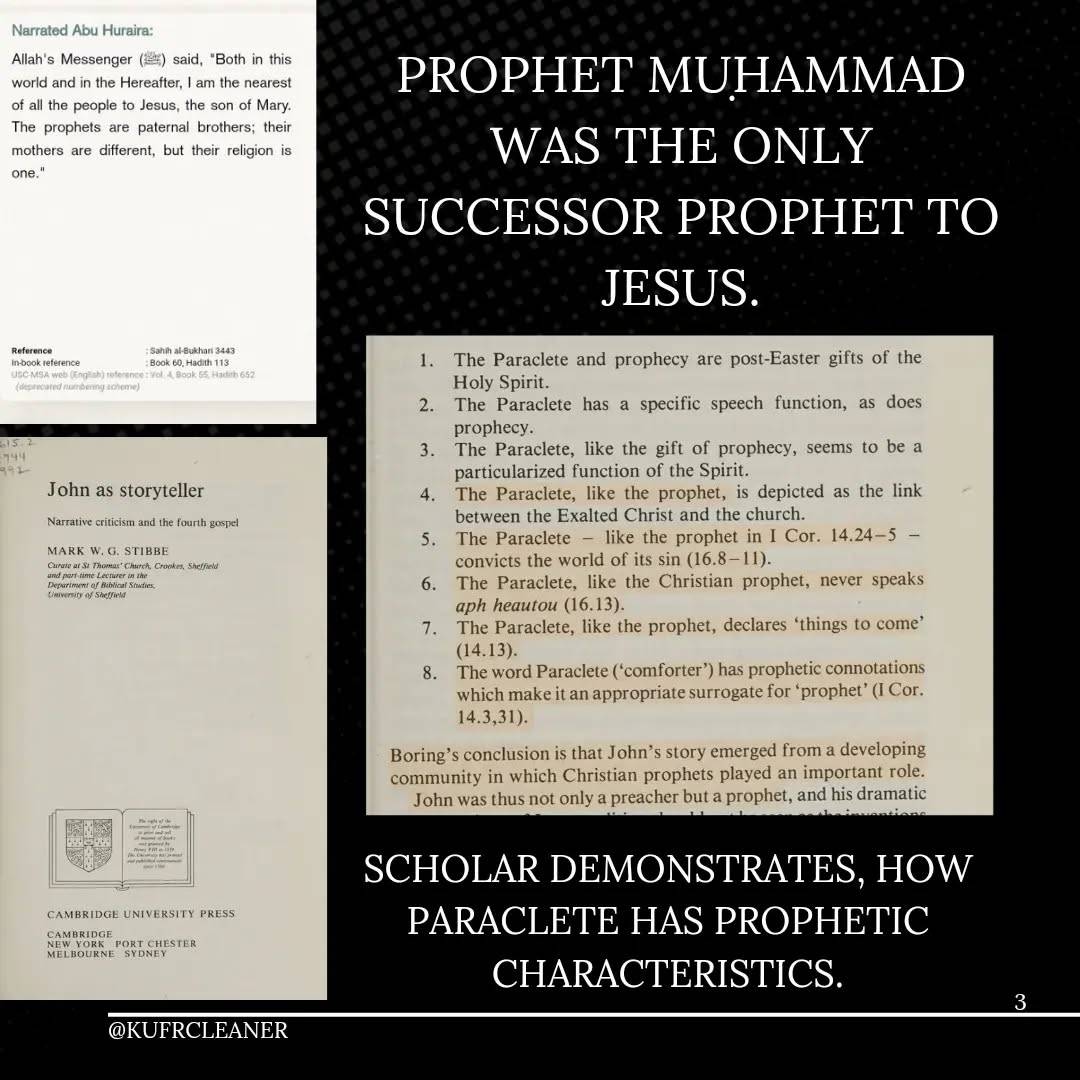
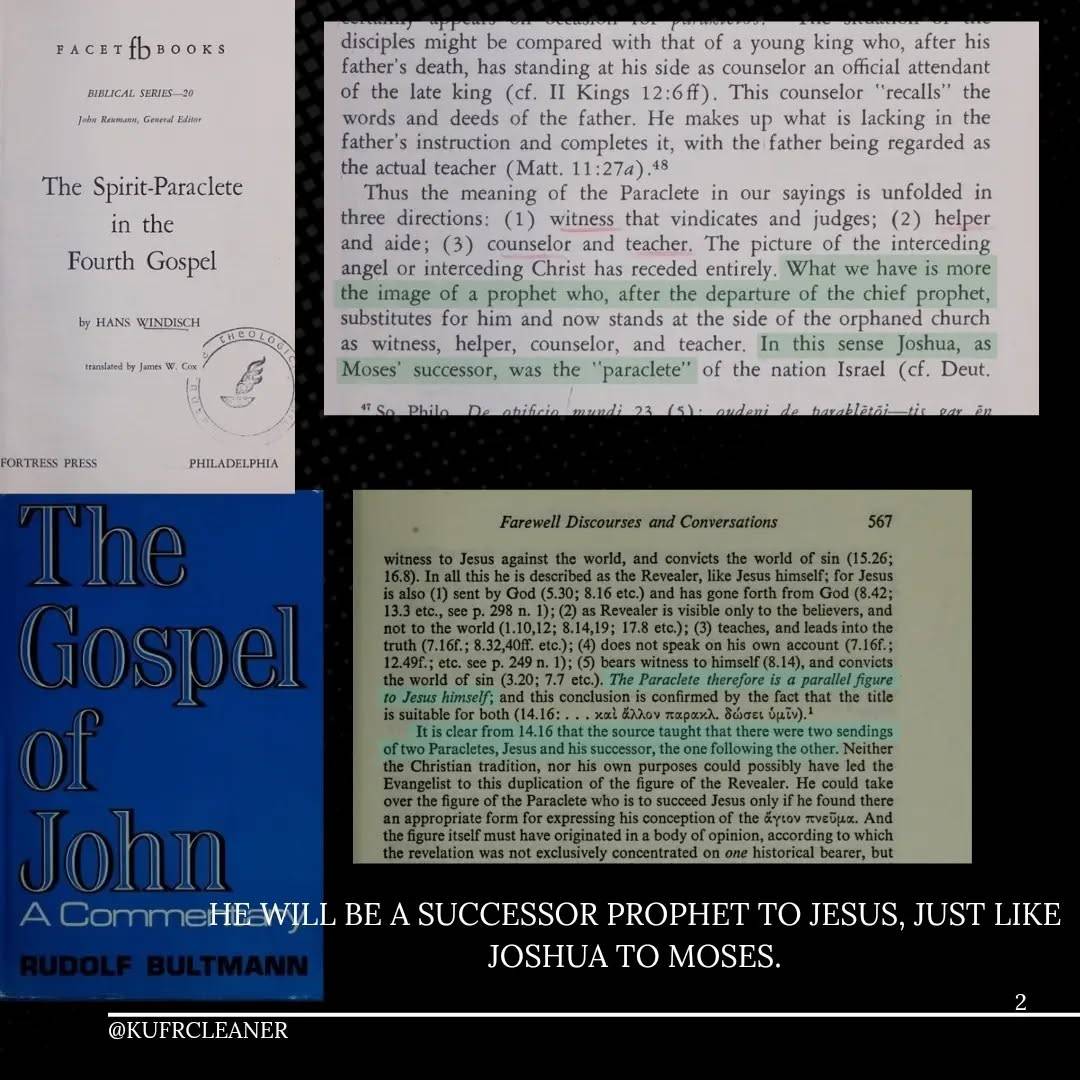
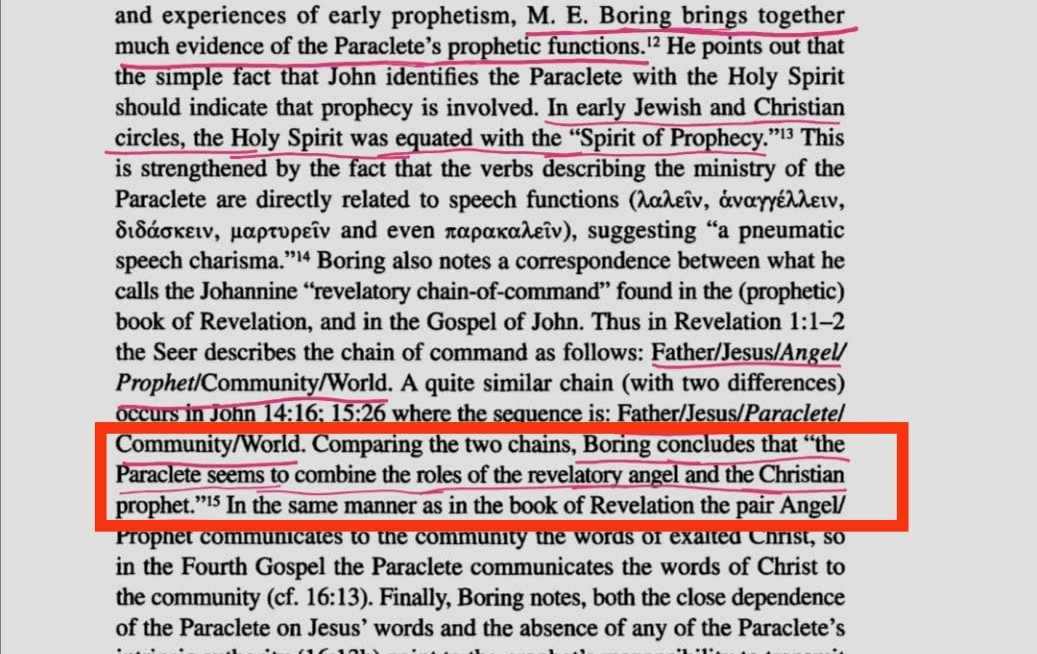
This indicates the Paraclete is the coming of prophecy, not merely a spiritual force. The structural formula is: God → Paraclete (angel → prophet) → human.
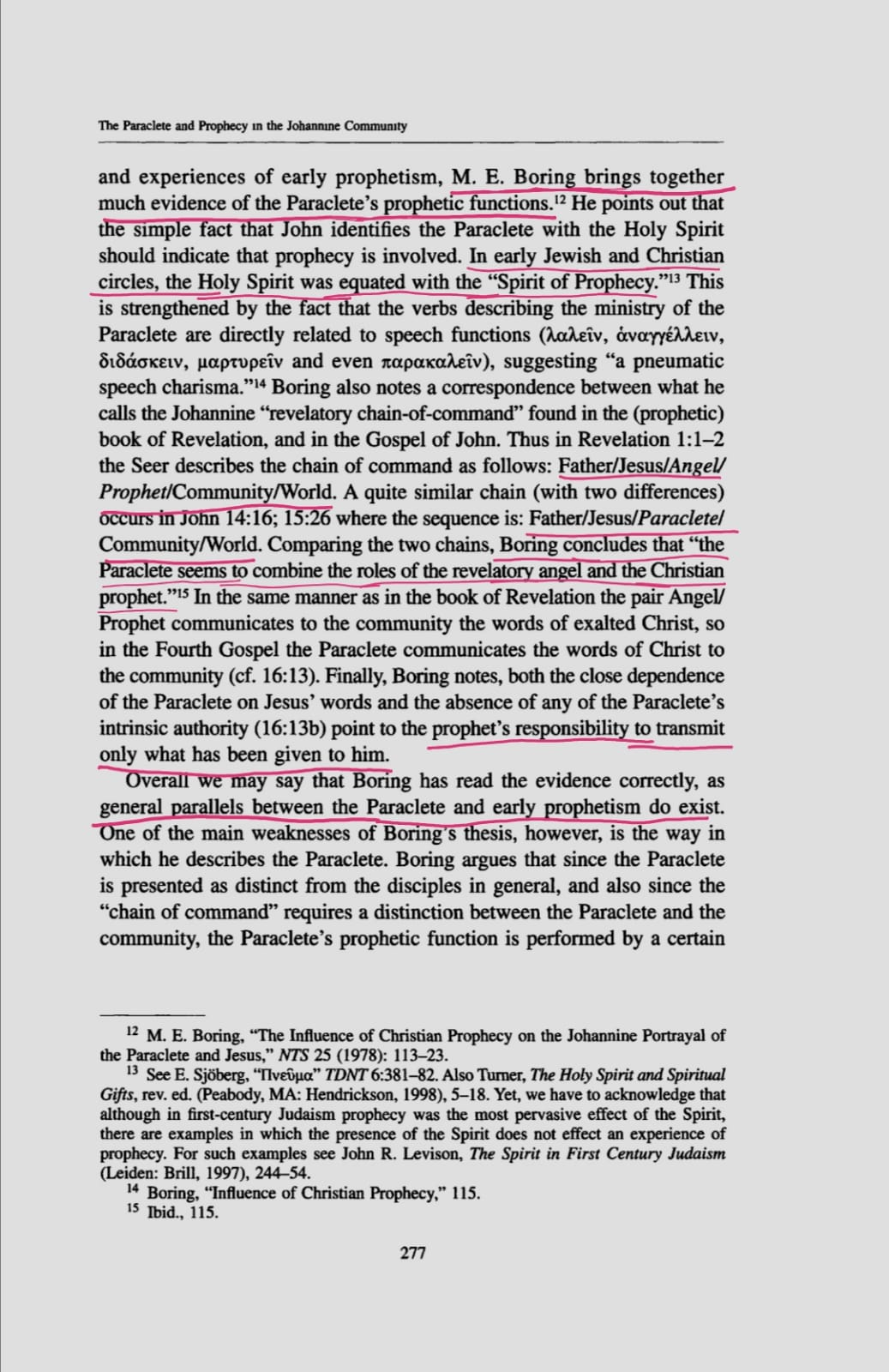
Early Church Father Tertullian
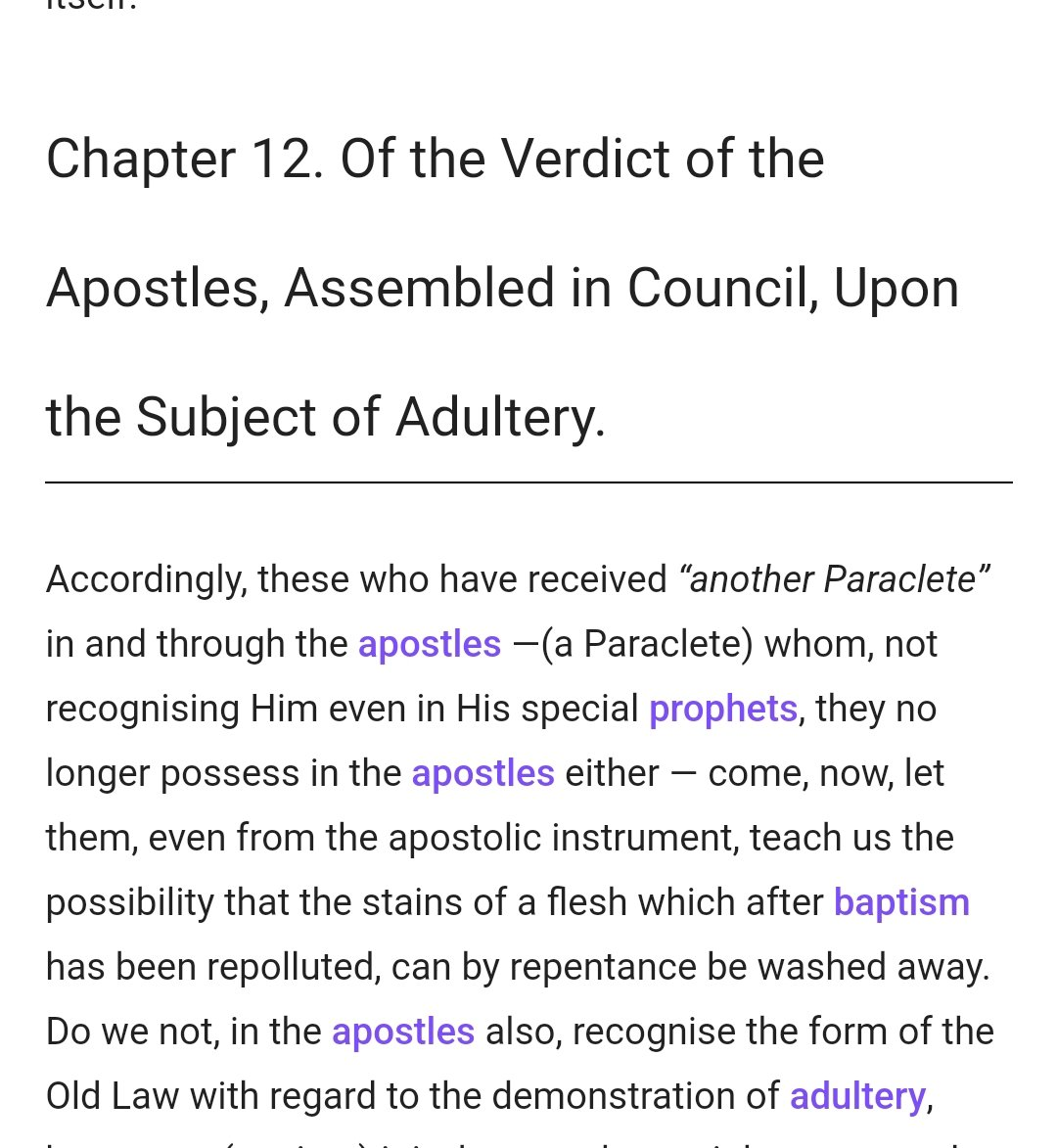
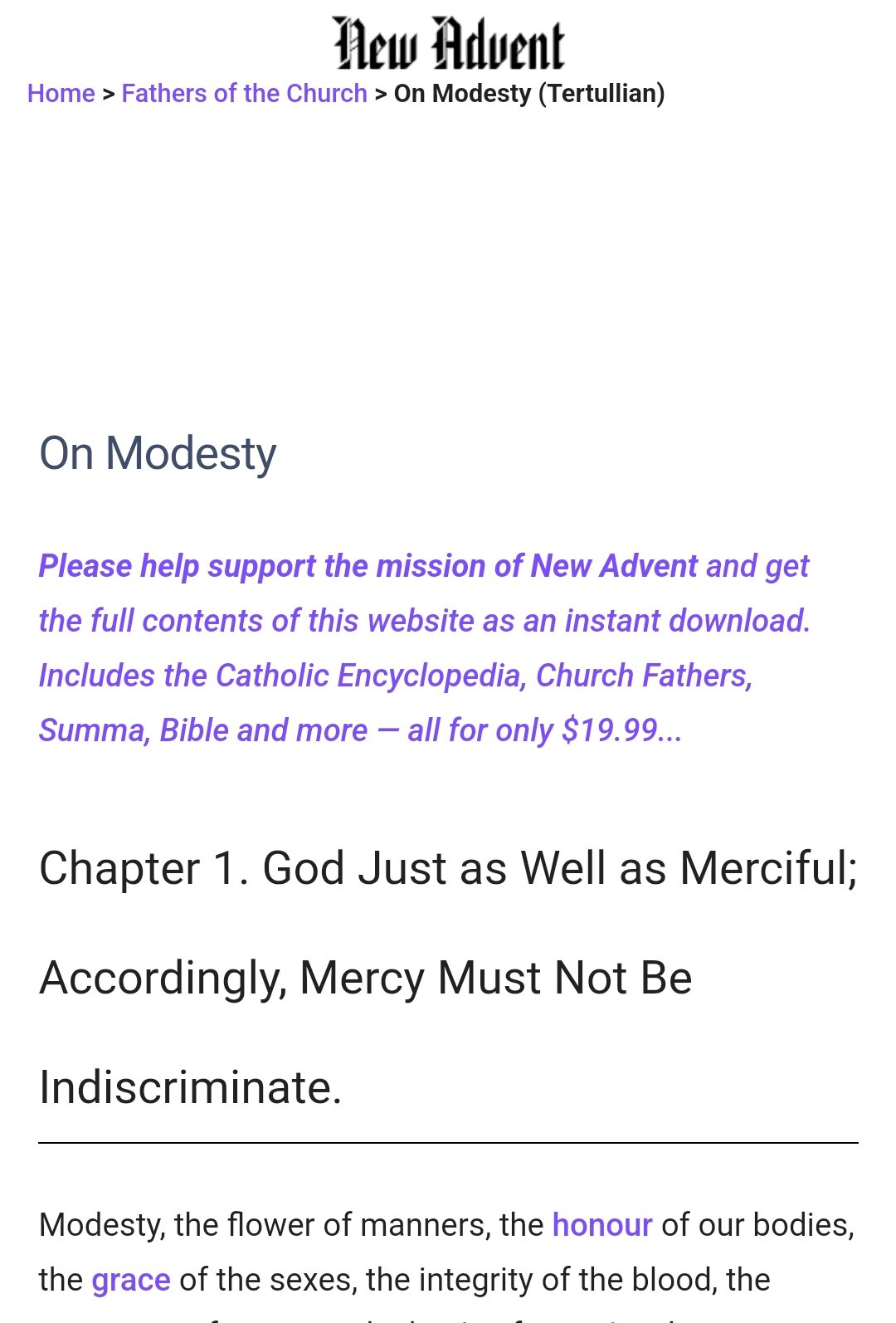
Tertullian believed in the existence of prophets after Jesus’s death. According to Professor Eugene Boring, the Paraclete represents the unity of the angel who brings revelation and the prophet — a personal, embodied prophetic figure, not an impersonal divine force.
Cross-Reference: Al-Shaafi’ (The Intercessor)
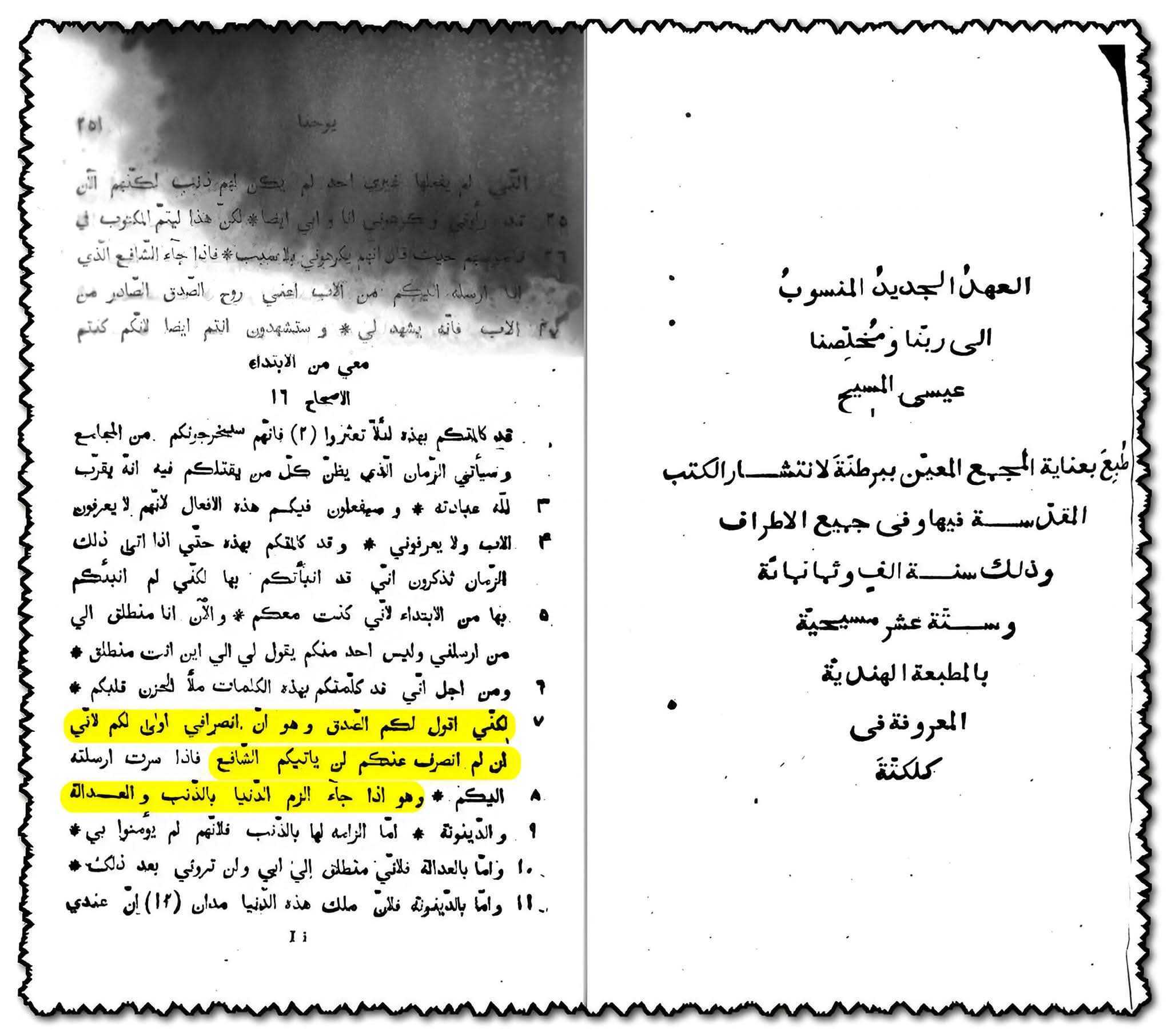
May Allah’s blessings and peace be upon Al-Shaafi’Al-Shaafi’ — “The Intercessor” — is one of the names of the Prophet Muhammad ﷺ, and its semantic proximity to the Paraclete’s described function in John 16 as advocate and intercessor is striking. (the Intercessor) — also a name of Prophet Muhammad ﷺ, referenced in the context of John 16.
Section 7: The Paraclete Will Remind and Teach — Quranic Parallels
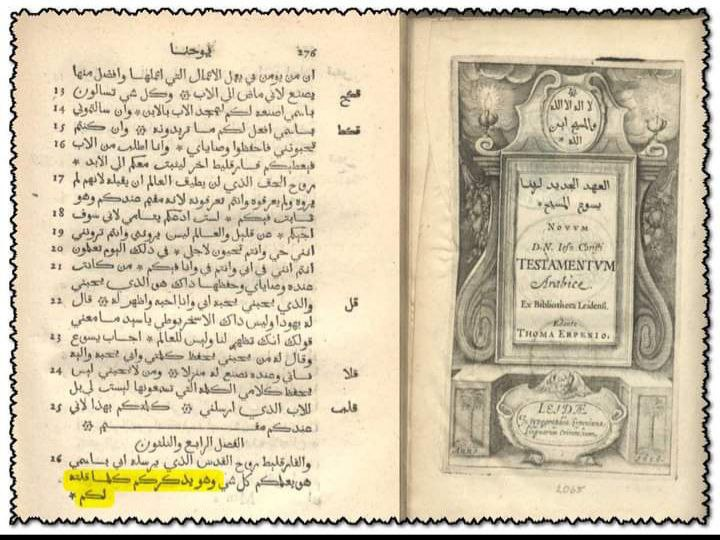
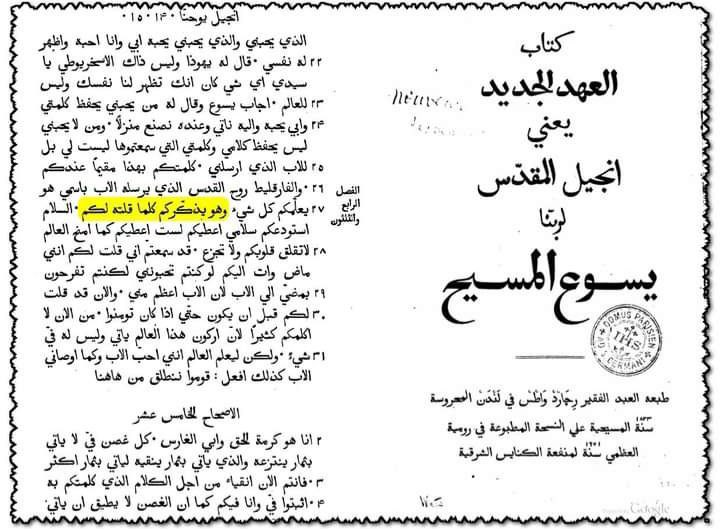
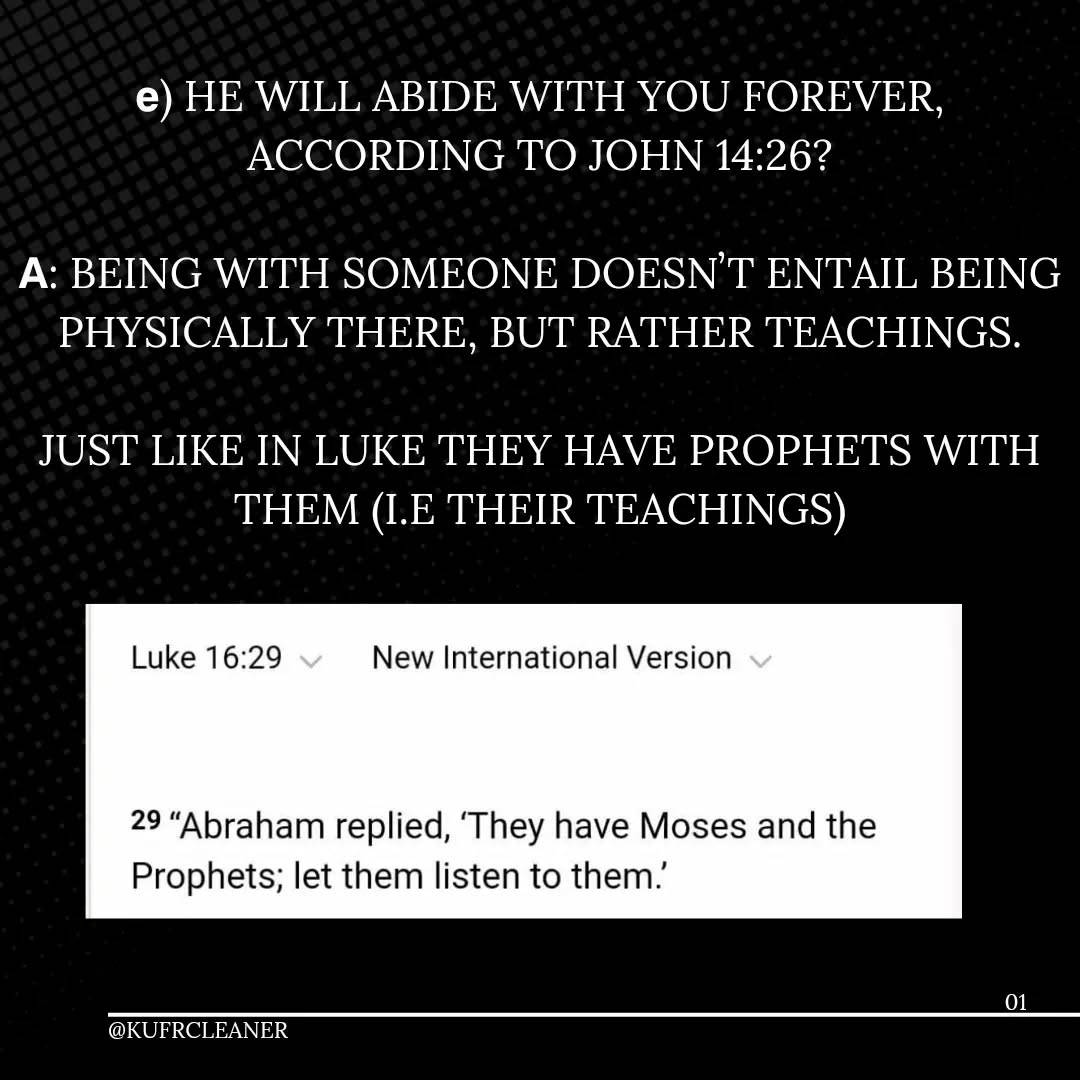
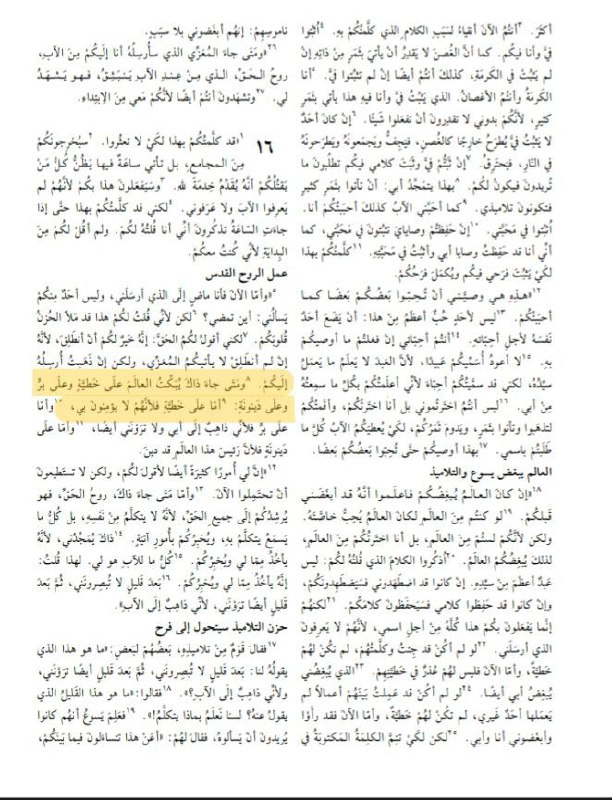
John’s Gospel states that when the Comforter comes, he will remind the disciples of all the words of Christ — implying that Christ’s followers would forget many of his sayings, and the promised one would restore them. This naturally raises a series of questions: Who recorded the texts attributed to Christ, Mary, and the apostles? Who recorded the complete story of the disciples? Who exonerated Mary and Christ from the accusation of adultery?
“And remind you of all that I have told you.”
“And purify you and teach you the Scripture and wisdom and teach you that which you did not know.”

Section 8: Professor Abdul-Ahad Dawud — Former Christian Priest
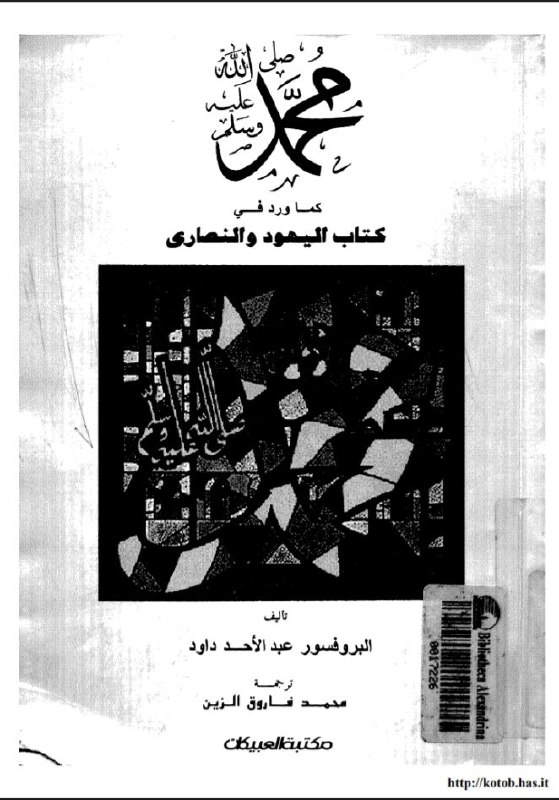
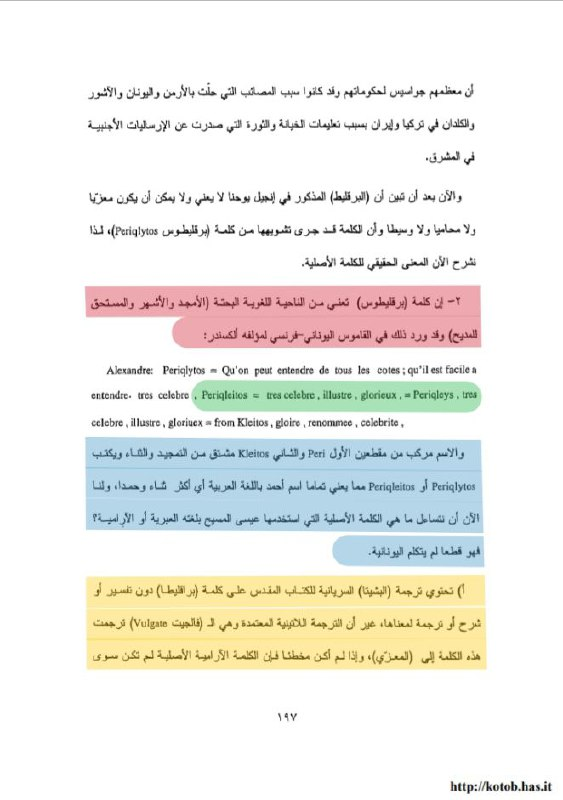
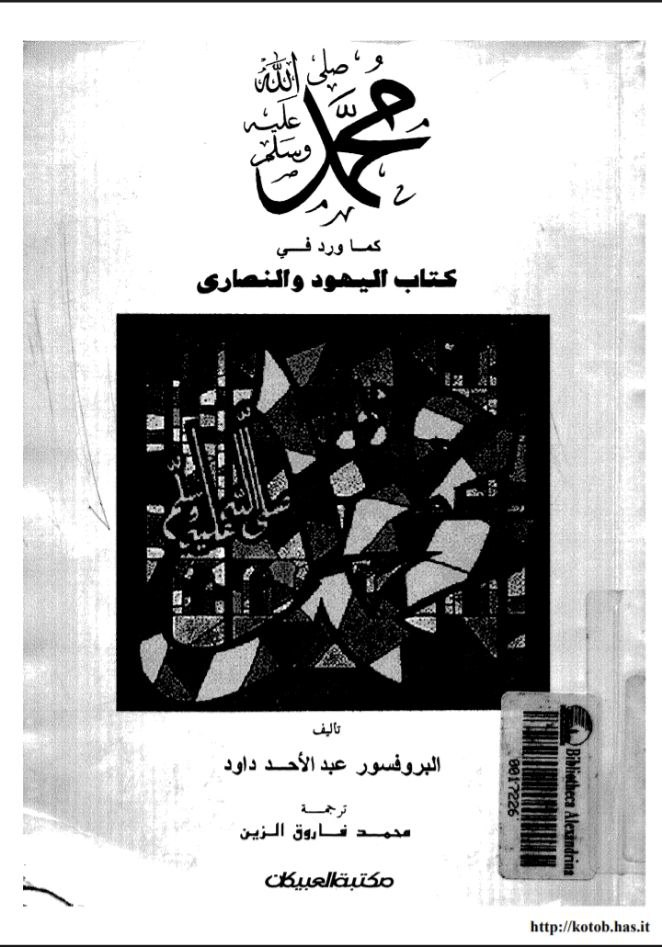
Abdul-Ahad Dawud (born David Benjamin Keldani){{Born 1867 in Urmia (now Iran), died 1940. Source: German National Library catalog — <https://portal.dnb.de/opac.htm?method=simpleSearch&cqlMode=true&query=nid%3D124465420}}> was the most influential Chaldean Catholic priest of his era, a Professor of Theology, and fluent in ancient Greek, Hebrew, and several other languages. He converted to Islam and wrote *Muhammad in the Book of the Jews and Christians.*
Citing Alexandre’s Greek-French Dictionary: peripleitos = très célèbre, illustre, glorieux
The name is composed of Peri (very, most) + Kleitos (derived from glorification and praise) — written as periplytos or peripleys, which means exactly Ahmad in Arabic: “most praised and thanked.”
The Miraculous Precision of the Quranic Reference
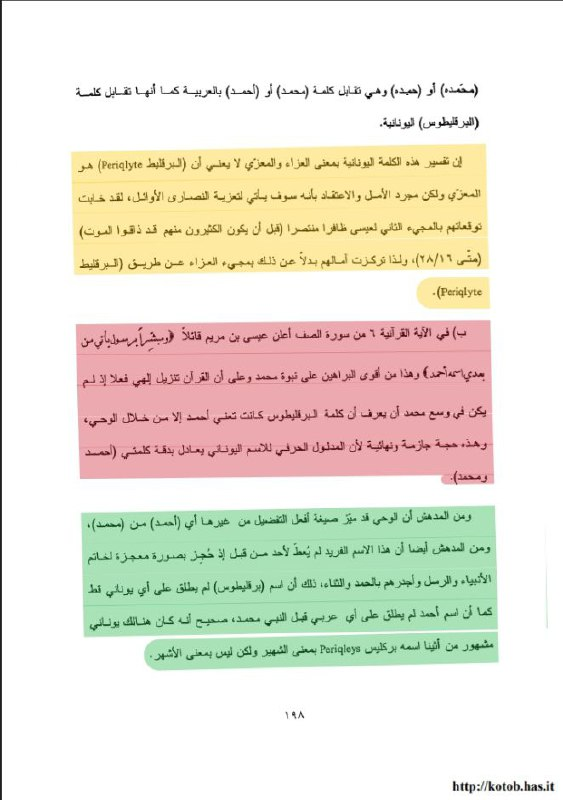
“This is one of the strongest proofs of the prophethood of Muhammad and that the Quran is indeed divine revelation, since Muhammad could not have known that the word ‘Paraclete’ meant ‘Ahmad’ except through revelation.”
There was a famous Greek named Pericles (meaning “famous”), but not “most famous.” Likewise, “Ahmad” was not a common Arab personal name before the Prophet ﷺ. The Qur’an preserved the superlative form with remarkable linguistic precision.
“I have five names: I am Muhammad, I am Ahmad, I am al-Mahi (the Eraser) through whom God erases disbelief, I am al-Hashir (the Gatherer) before whom people will be gathered…”
Section 9: The Kingdom of God Prophecy
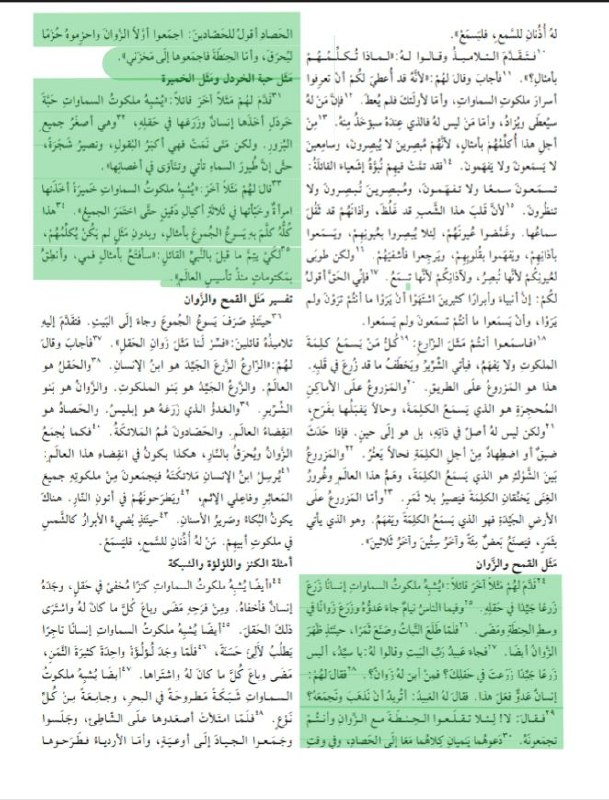
Christ and his disciples preached about the imminent arrival of the Kingdom of God across multiple Gospel passages (Matthew 3:2, 4:17, 4:23, 6:31–32, 20:1–16, 21:33–44; Luke 10:9, 11). He commanded Christians to pray for its coming and described its growth from something small to something that would fill the world — comparing it to good seed, yeast, and a mustard seed that becomes the largest of all vegetables.
“Their example in the Gospel is like a seed which puts forth its shoot…”
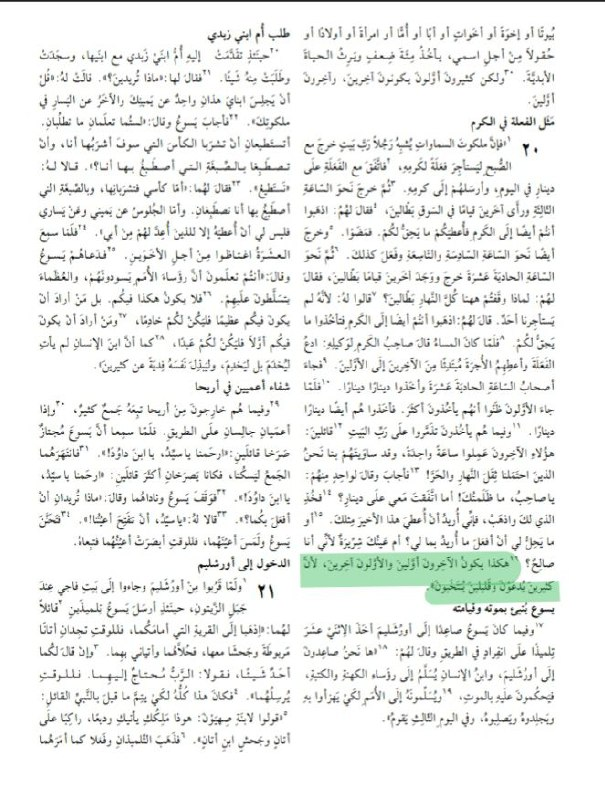
Matthew 20:16 states:“The last will be first, and the first will be last.” The Prophetic hadith states: “We are the last to come, but the first to come.” Additionally, Matthew 21:42 and Psalm 118:23 identify a cornerstone — the leader of the nation to whom the Kingdom of God has been given — described as the stone that, if it falls on someone, will crush them.
Section 10: Contemporary Scholarly Recognition
“Muhammad ibn Abdullah, the Arab Prophet and the Seal of the Prophets, came to give glad tidings to the Arabs and all people of a new religion, and called for belief in the One and Only God. The Sharia in his call was no different from creed or faith, enjoying binding divine authority, regulating not only religious matters but also worldly matters… When the Arab Prophet passed away in 632 AD, he had finished his call and established a social system far superior to the tribal system the Arabs had before Islam, uniting them into a strong unity. Thus, the Arabian Peninsula achieved a cohesive religious unity, the likes of which it had never known before.”
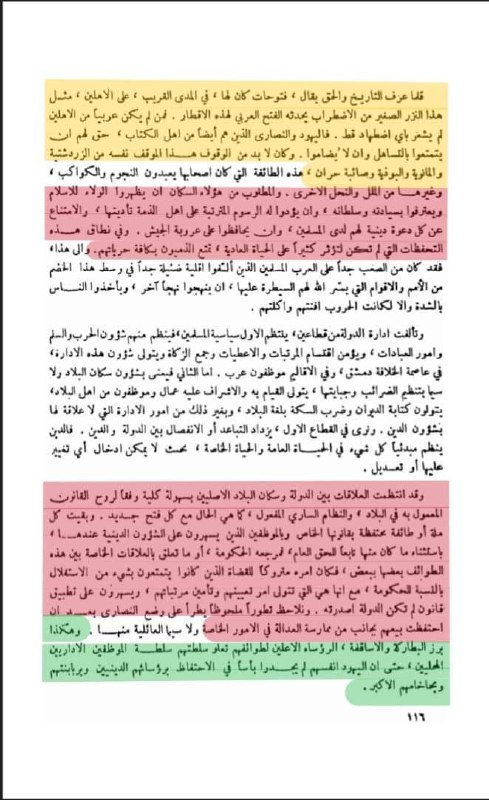
Section 11: Medieval Christian Dictionary Evidence
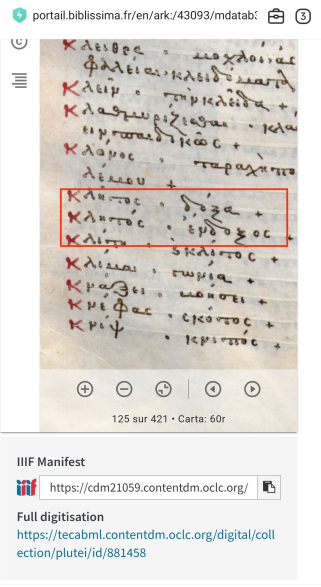
“The Comforter, the Teacher, the Revealer of Secrets.”
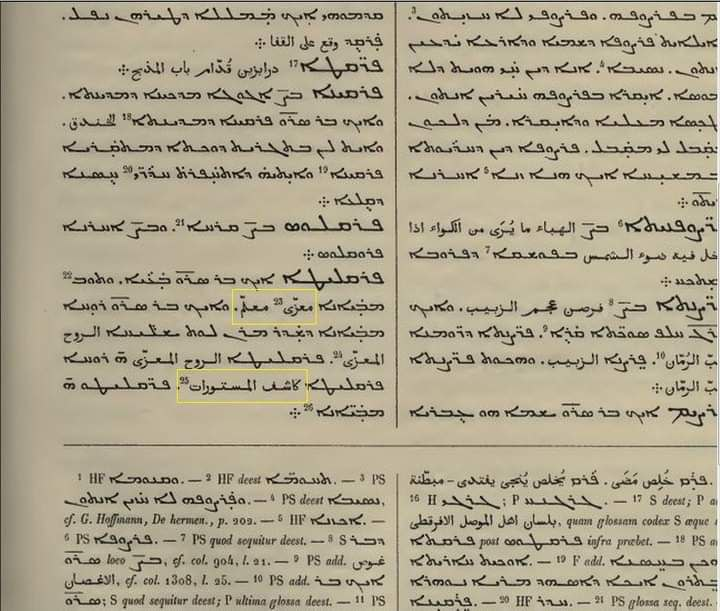
Section 12: Jerome’s Latin Vulgate — Pre-Islamic Evidence
Godfrey Higgins argued that the Muslim claim about the Paraclete had genuine contextual force. His position should be presented as his own argument, not a universally settled fact. The valuable point is that a non-Muslim writer saw the Johannine context as repeatedly pointing to a coming person — supporting the personal-prophetic reading of the Paraclete passages even before debating the exact Greek form.
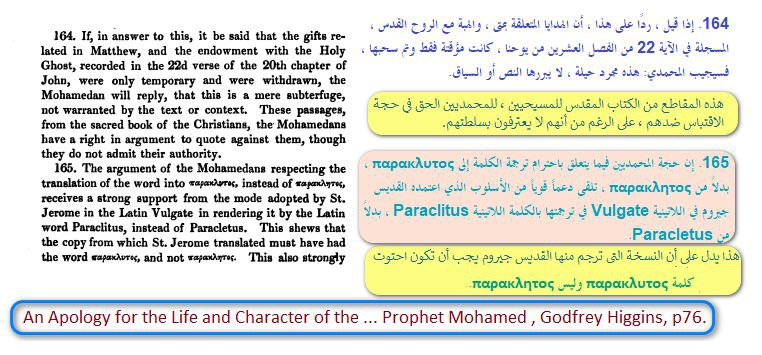
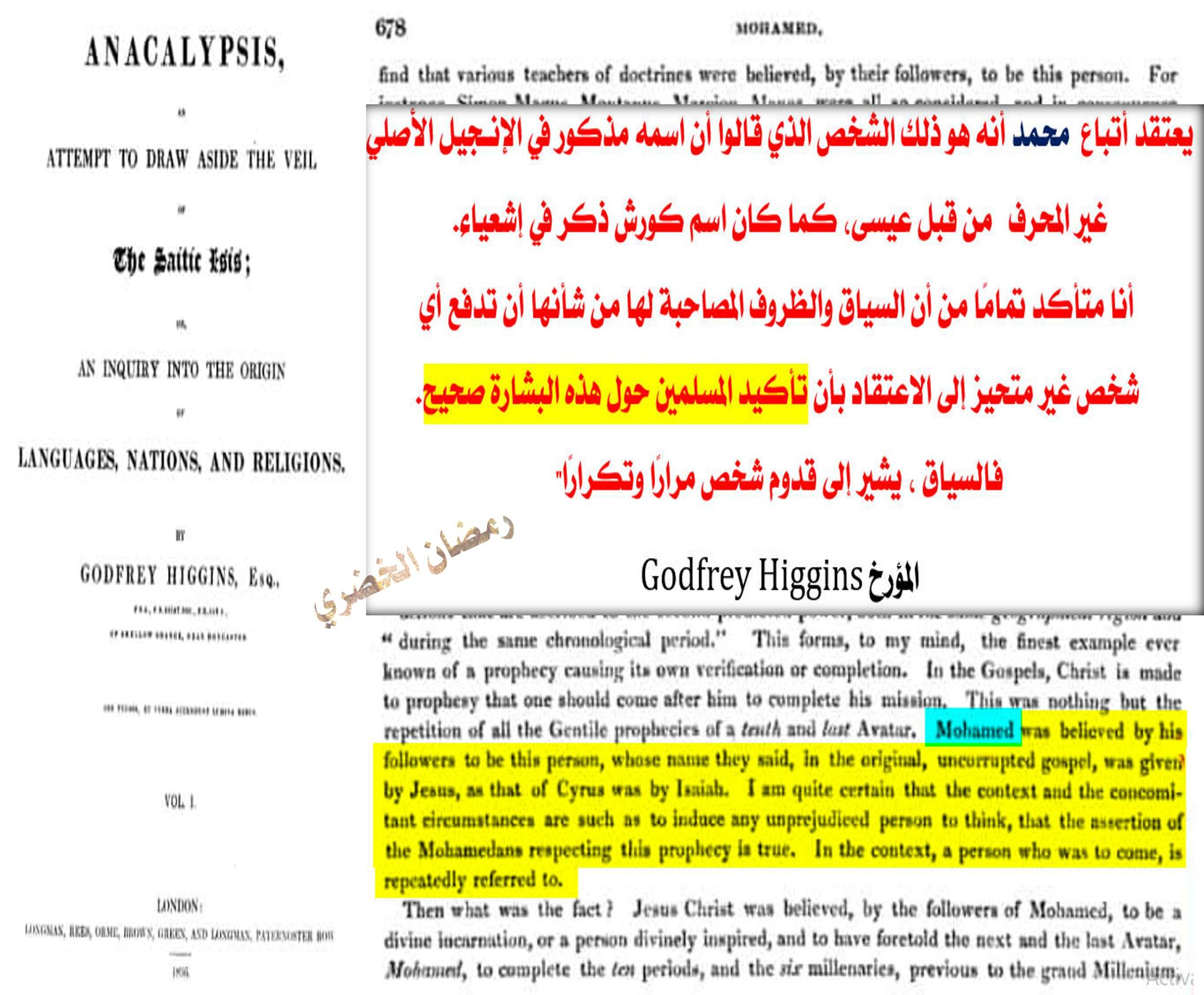
This scan from Godfrey Higgins’Anacalypsis highlights his statement that Muhammad’s followers believed he was the person whose name was given by Jesus in the original, uncorrupted Gospel. The most valuable line is his claim that the context and accompanying circumstances would lead an unbiased reader to think the Muslim assertion about this prophecy is true, because the context repeatedly points to a person who was to come. Use this as a contextual/personhood support, not as standalone manuscript proof.
Higgins is useful because he supports the argument that the passage reads like a personal expectation. His testimony is stronger when paired with John 14:16, John 15:26, John 16:7–14, and 1 John 2:1. Do not overstate him as proving a lost manuscript reading unless the exact primary evidence is separately established. His contextual argument stands independently of the Ahmad/Periklytos linguistic debate.
Section 13: The Term Paraclete — Not a Divine Title But a Human Helper
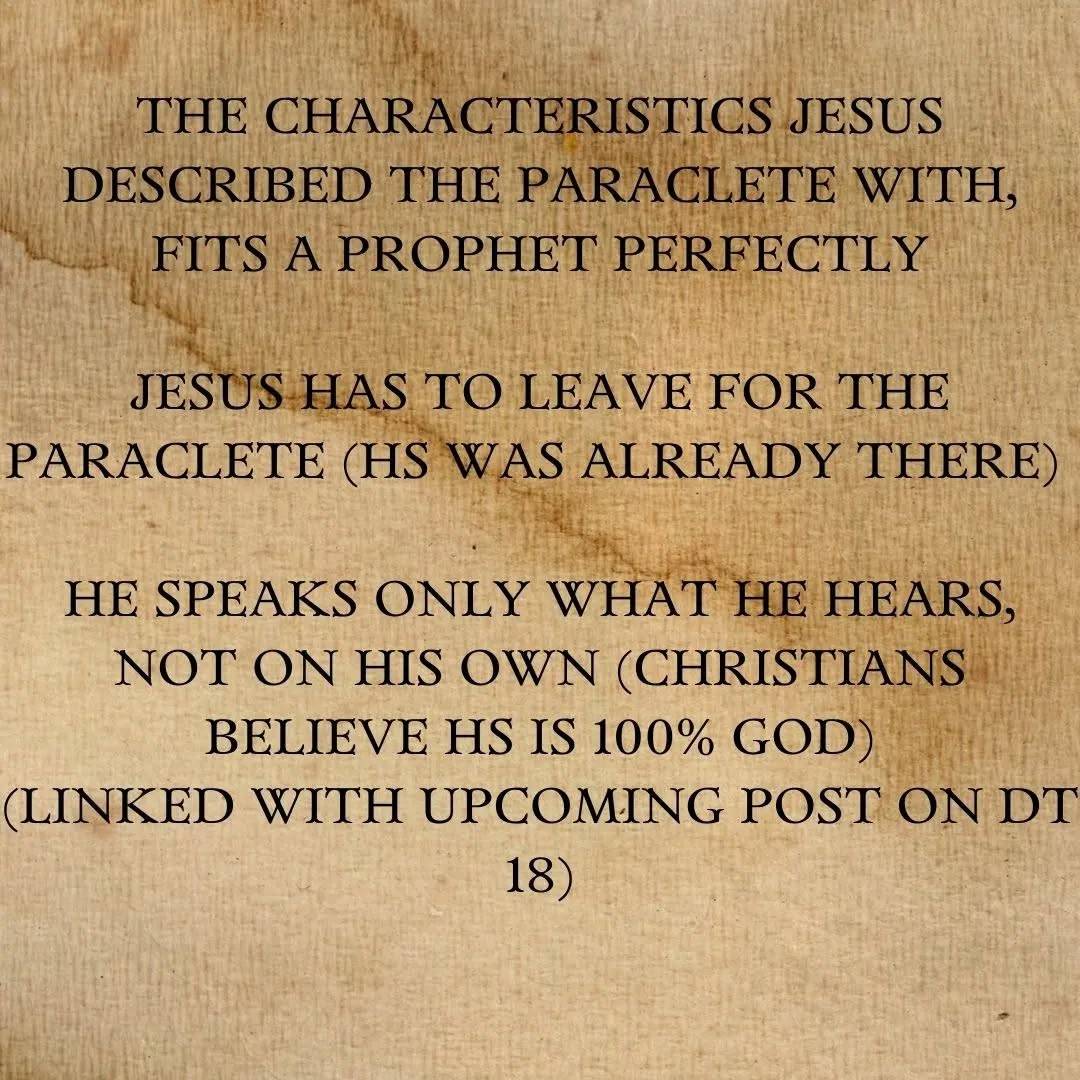
The word “Paraclete” in the Gospel of John is NOT an obscure divine name. It is a canonical term meaning helper, intercessor, and defender — specificallya human being who helps another human being. The text links the role to teaching, reminding, bearing witness — not to incarnation or independent divinity. The later transformation of this “helper” into a full Person of the Trinity was a development of post-Johannine theology, not the original weight of the term.

Section 14: Karen Armstrong’s Analysis
Orientalist Karen Armstrong — who does not believe in the prophethood of Muhammad ﷺ — nonetheless made three significant admissions: the term “Paraclete” was translated into Syriac asal-Munaḥmanna, a word semantically close to “Muhammad”; the word “Paraclete” could be translated as Ahmad; and she believes the Prophet’s knowledge of this prophecy led him to claim it was mentioned in Jesus’s book.
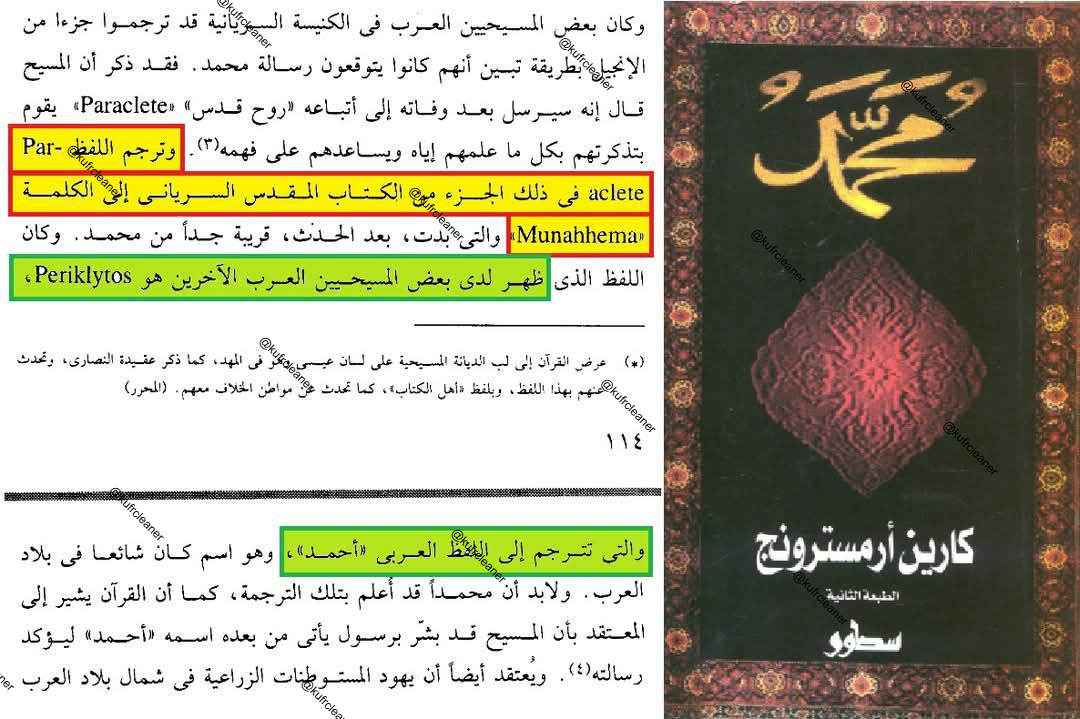
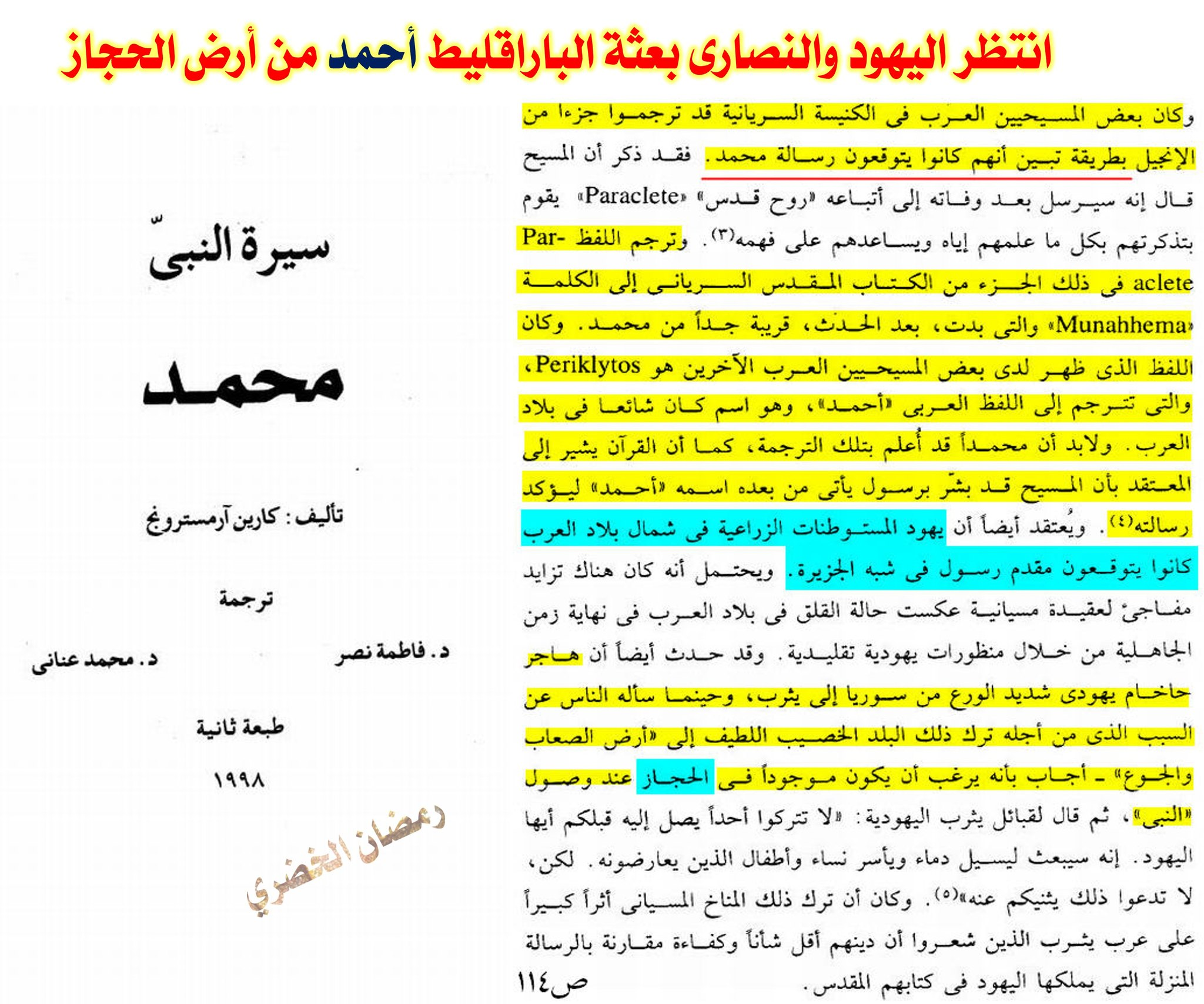
This Arabic translation scan of Karen Armstrong’sMuhammad says that some Arab Christians in the Syriac church translated the Gospel in a way showing they expected Muhammad’s message. The highlighted passage states that the Greek Paraclete was translated into Syriac as Munahhema/Munhamna, described as very close to Muhammad, and that another word used among some Arab Christians was Periklytos, translated into Arabic as Ahmad. Armstrong does not argue as a Muslim believer, so this is valuable as an outside historical observation about how some Syriac and Arab Christian circles understood the prophecy.
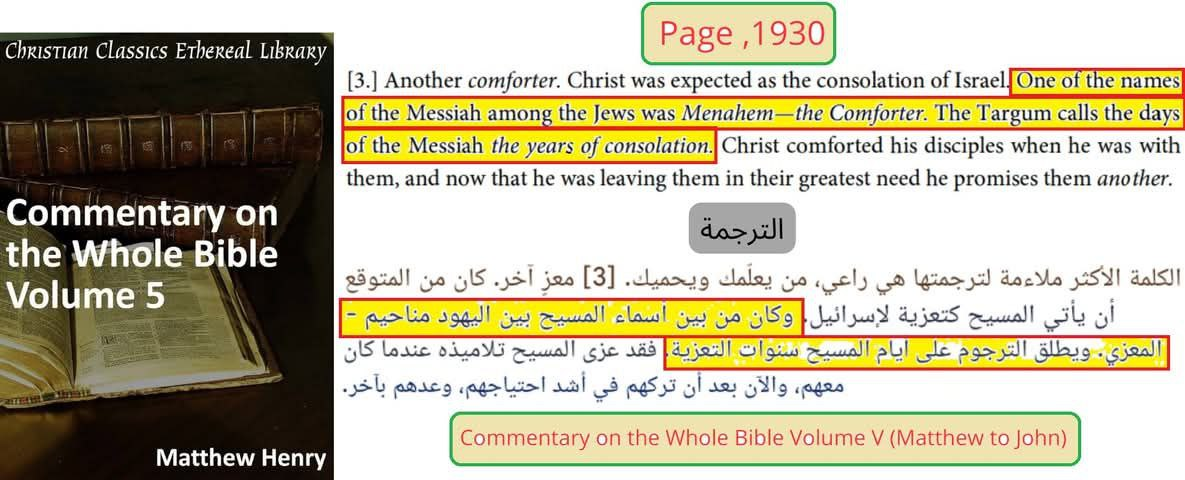
In his commentary on the Gospel of John, Father Matthew Henry states:“One of the names of the Messiah among the Jews was ‘Menachem,’ meaning ‘Comforter.’ The Jews called the Messiah’s time the ‘Years of Comfort,’ as mentioned in the Targum.” This refutes the myth that the awaited Comforter after Christ is the Holy Spirit — the evidence shows he was understood as a human being awaited by the Jews themselves.
Section 15: Contradictions in the Holy Spirit Interpretation
The Timing Contradiction
John 16:7 states:“Unless I go away, the Advocate (Paraclete) will not come to you; but if I go, I will send him to you.” Yet John 20:22 records that before his ascension, Jesus “breathed on them and said, ‘Receive the Holy Spirit.’” If the Holy Spirit was only to descend after Jesus’s departure, how could he have sent it to the disciples before his ascension? This is a direct internal contradiction that the Holy Spirit interpretation cannot resolve.
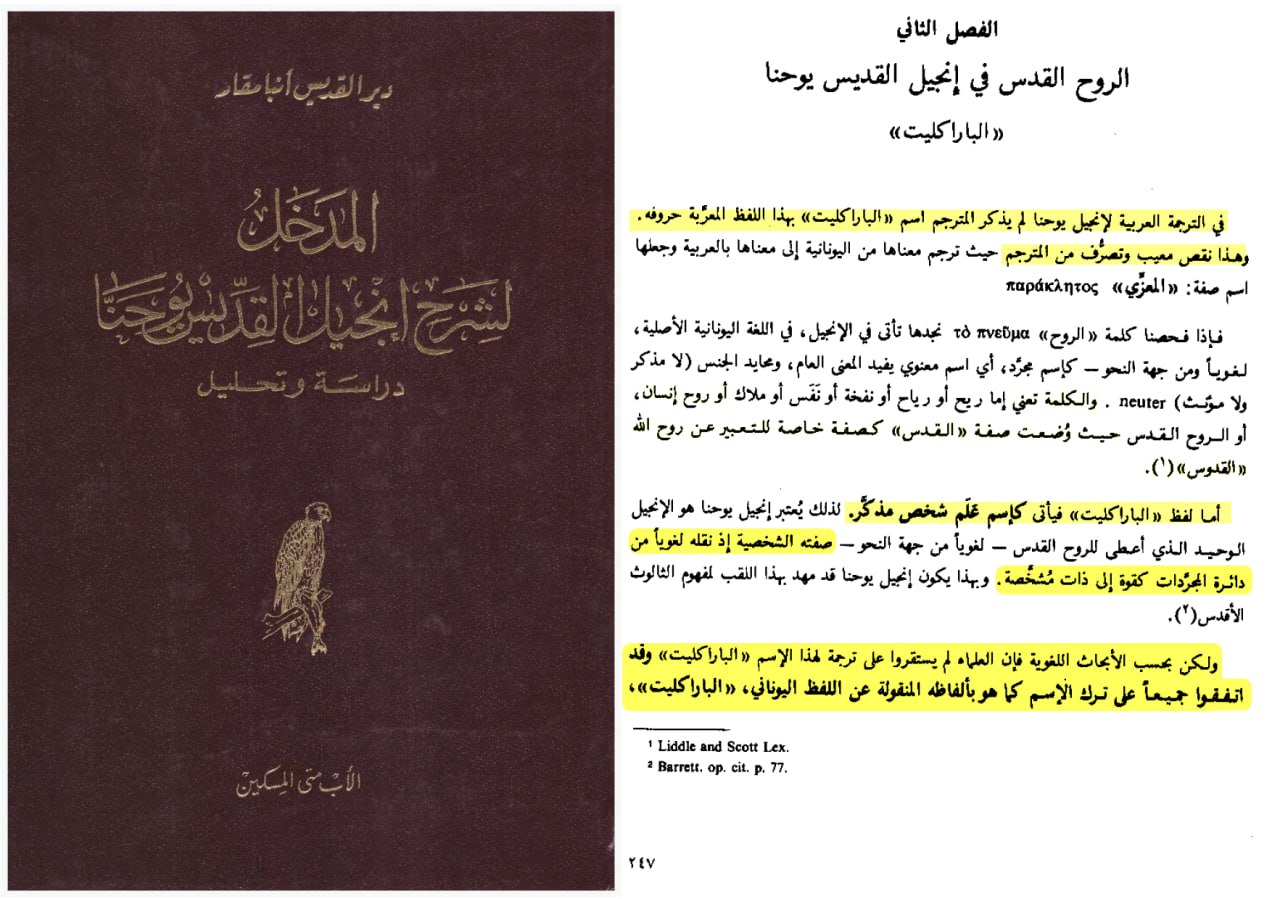
The Personhood Problem
The Holy Spirit does not appear as a distinct person elsewhere in the Bible — except in the Paraclete passages of the Gospel of John. This is a highly significant textual observation.
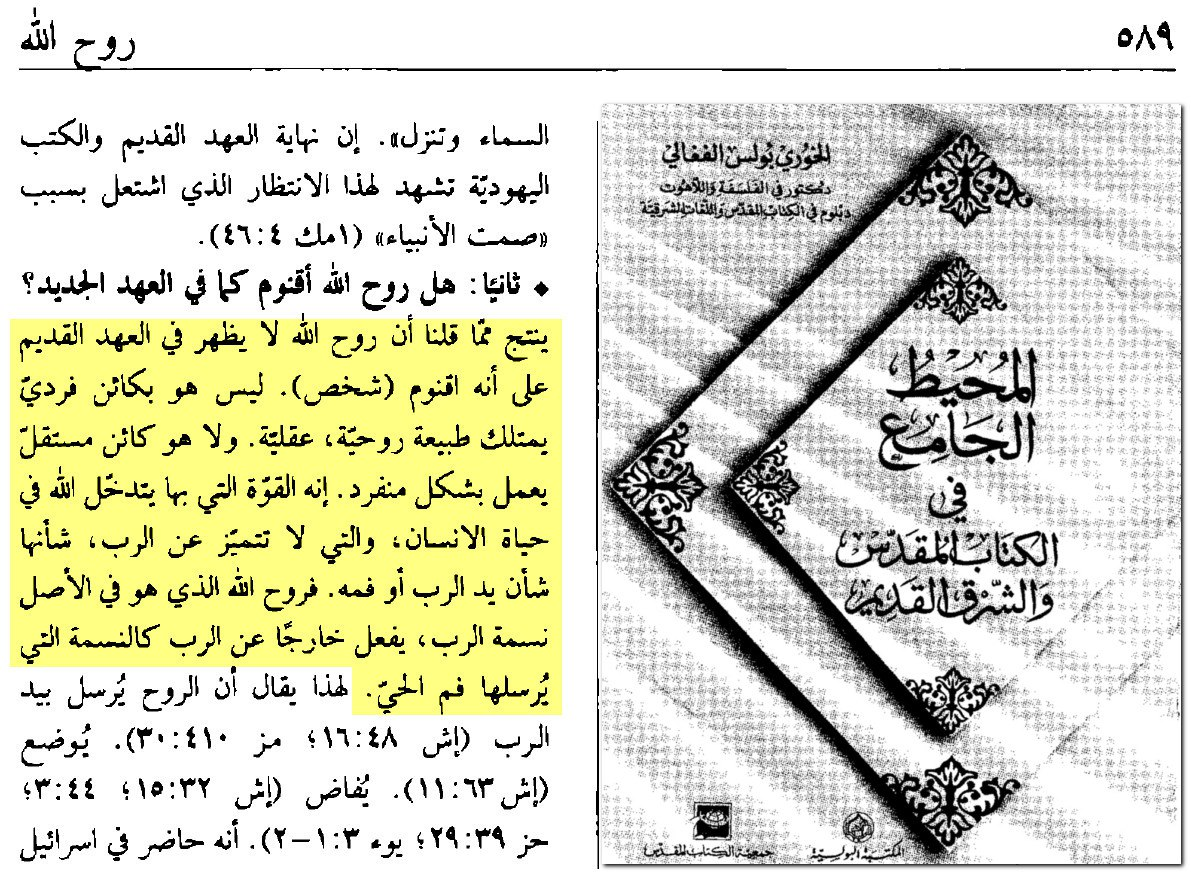
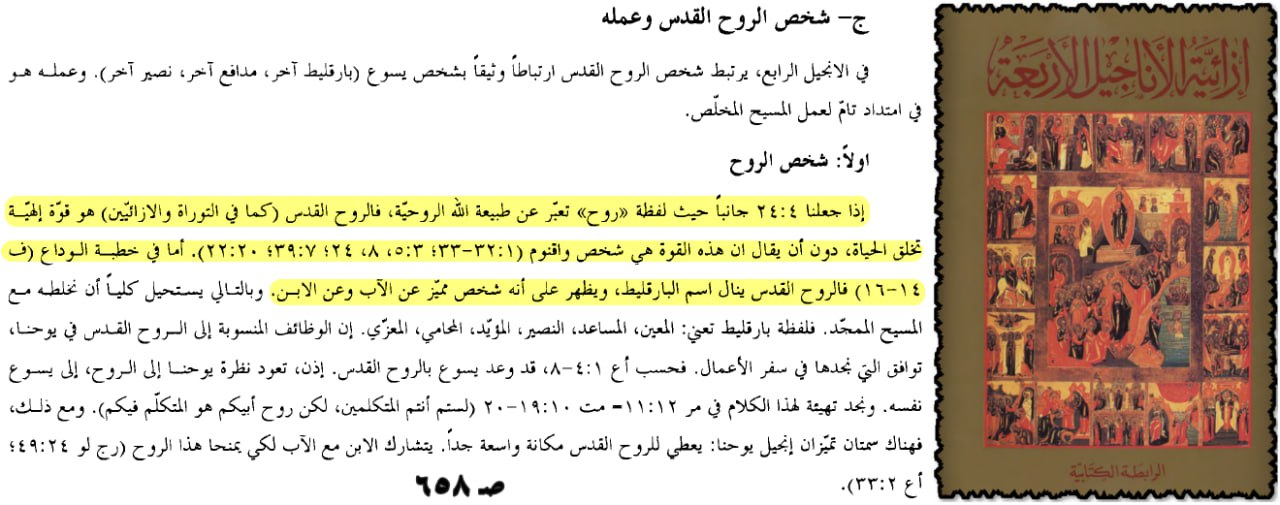
The Pentecost Limitation Problem
Christians commonly identify the Paraclete with the Holy Spirit at Pentecost. The difficulty is that John describes the Paraclete as one who will teach all things, remind the disciples of everything Jesus said, speak what he hears, declare things to come, convict the world, and glorify Jesus. If this is reduced only to the Pentecost event in Acts 2, the explanation becomes thin. Acts describes tongues, preaching, and empowerment — but it does not clearly show the Paraclete fulfilling the full Johannine profile as a distinct teacher who brings a complete message, gives future reports, and convicts the world of sin, righteousness, and judgement.
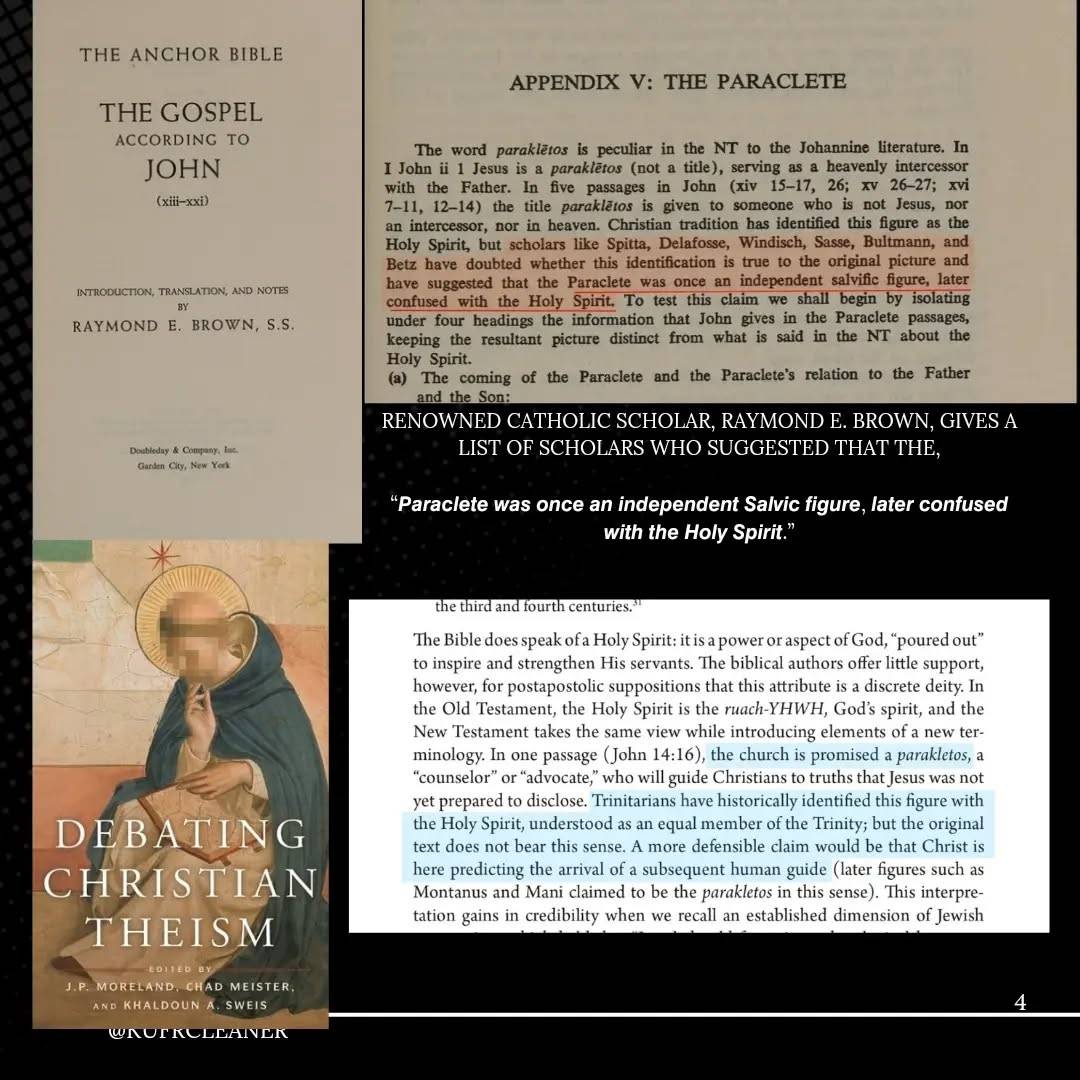
Raymond Brown — The Paraclete Term Was Not Initially a Standard Holy-Spirit Title
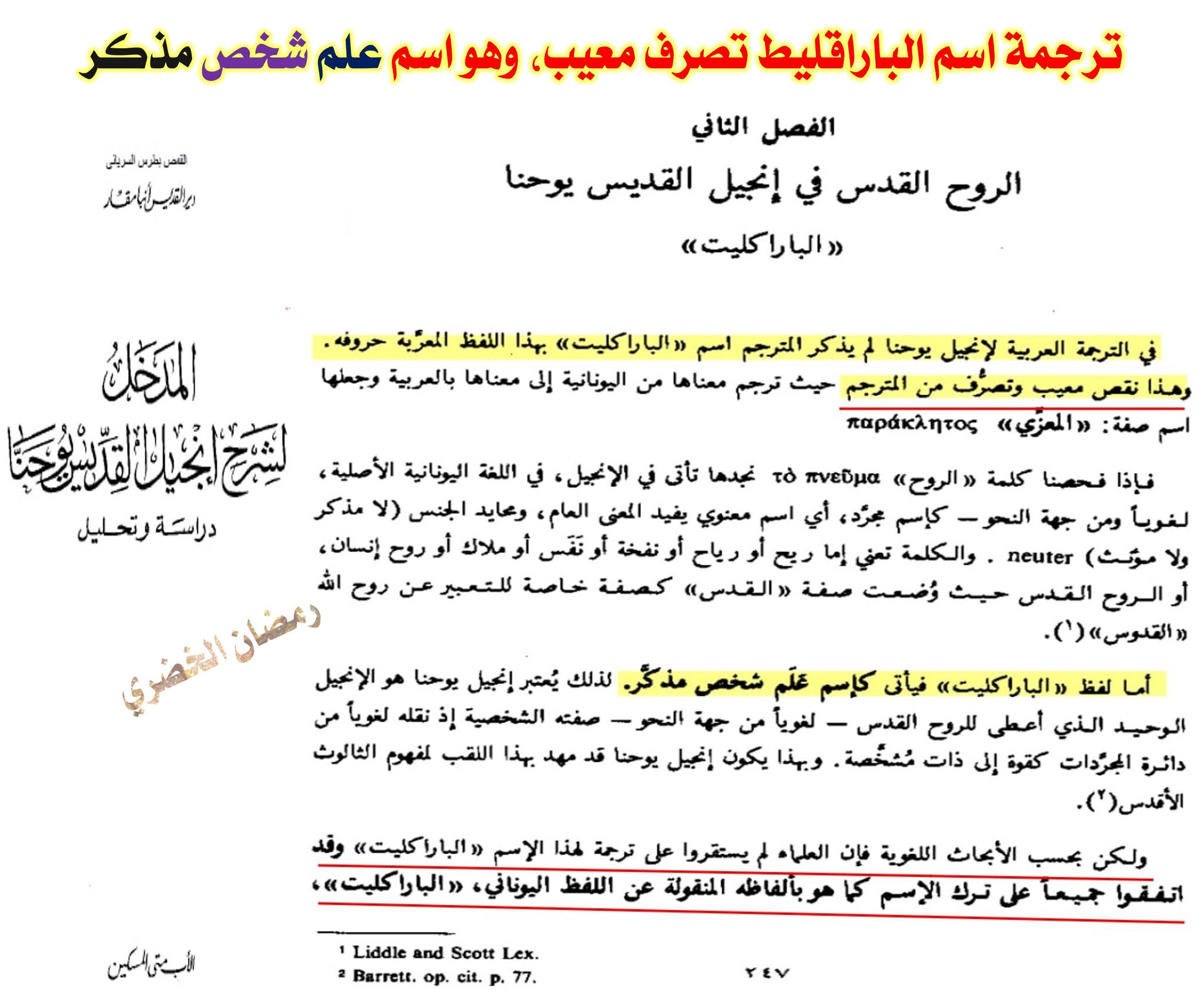
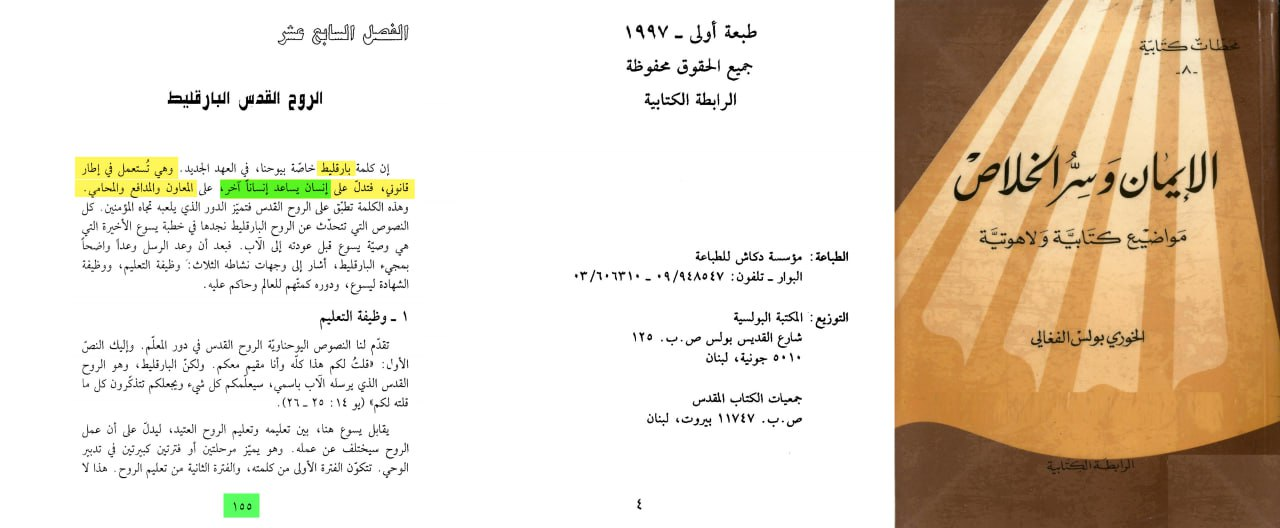
This Arabic scan from Raymond Brown’s study on the Gospel and Epistles of John highlights that the termParaclete was less prominent in the epistles and was not initially used as a title for the Holy Spirit in the same direct way later theology uses it. The scan is valuable because it weakens the assumption that “Paraclete” automatically equals the third person of the Trinity — supporting the argument that the Johannine term must be argued from the text itself, not imported from later doctrinal vocabulary.
Section 16: Early Christian Expectation of a Physical Paraclete
“In early times, many believed that the Paraclete would appear in person on Earth.”
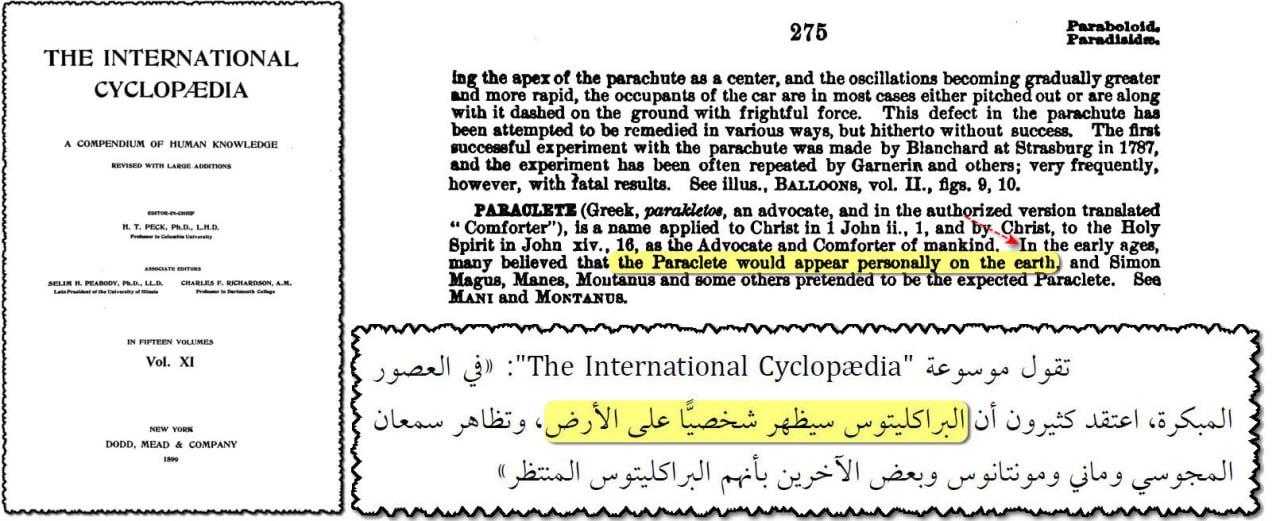
Early Christians understood the Paraclete as aphysical person — not merely a spiritual force. The expectation was for a prophetic figure. Godfrey Higgins is particularly useful here because his argument does not depend only on the Ahmad/Periklytos word connection: even if someone disputes the linguistic argument, the personal-prophetic reading still has independent contextual support from the passages themselves.
Section 17: The Paraclete’s Mission — Convicting the World
“When he comes, he will convict the world of sin and righteousness and judgment.” This refers to a specific, real person. The question is direct: did the Holy Spirit that allegedly descended on Pentecost actually “convict the world” in the sense described? The answer historically is no — it was the spread of the Qur’an and the message of the Prophet ﷺ that reached and challenged the world.
Section 18: Manuscript Corruption Admitted by Christian Scholars
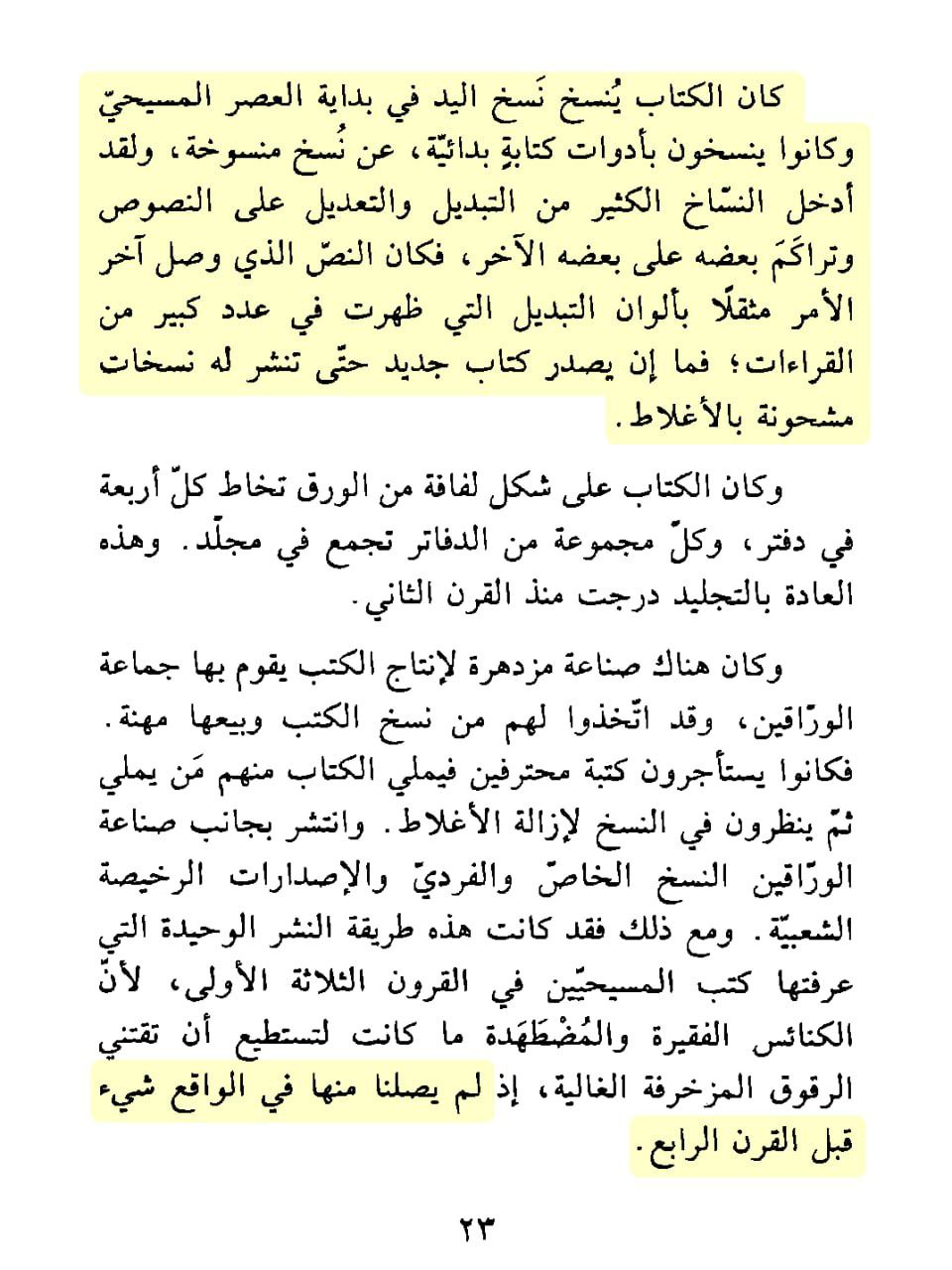
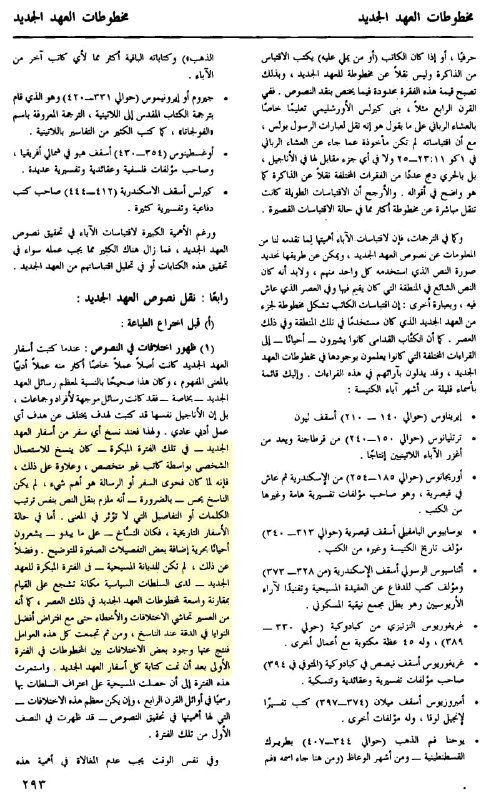
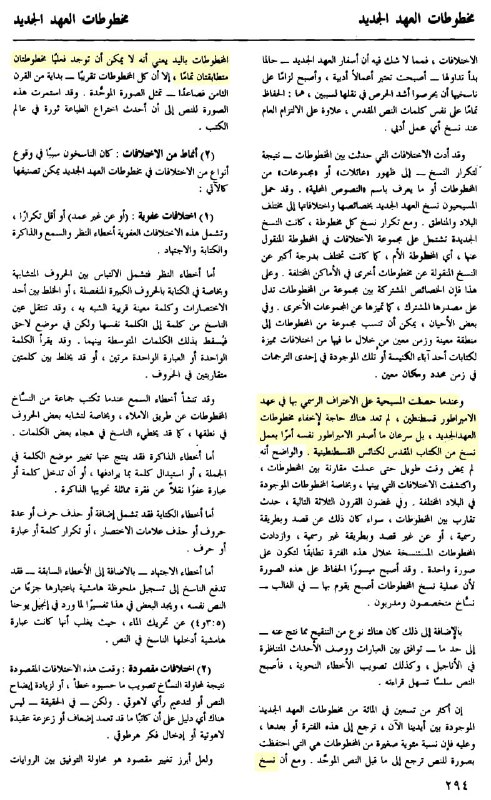
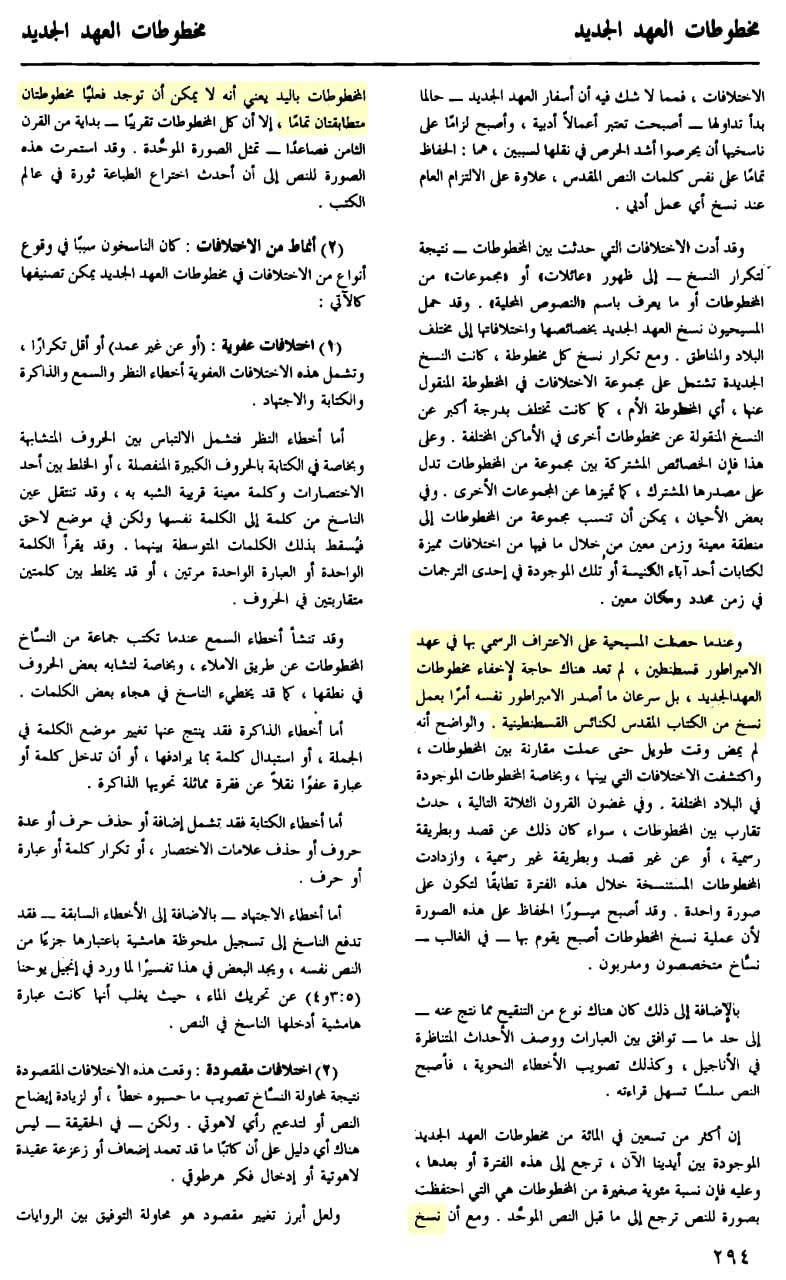
TheChristian Biblical Encyclopedia (Volumes 3, Letter R-Dh), edited by Rev. Dr. Samuel Habib and others, states on page 293 that in the early period, copying was done by non-specialist scribes who felt free to add small details for clarification and did not necessarily feel obligated to reproduce the text in exact word order. It states further on page 294 that when Emperor Constantine ordered mass copies for Constantinople’s churches, hand copying meant that no two manuscripts could be exactly identical.
“The scribes were copying by hand at the beginning of the Christian era with primitive tools, from copied copies. They introduced many changes and modifications that accumulated. The text that reached us was burdened with accumulated changes appearing in numerous readings. No manuscripts reached us before the fourth century, and much more besides…”
Section 19: Detailed Word Analysis — Parakletos Components
The wordParakletos consists of two components. First, παρα (Para) — meaning near, beside, from, in addition to. Second, κλητος (kletos) — derived from καλέω (Kaleo), meaning “I call, I hope, I ask, I summon.” Combined: “The one I call upon to be by my side” — frequently used in ancient Greek legal contexts to mean advocate or intercessor.
Philo of Alexandria (12 BC – 54 AD)
Philo of Alexandria, a Jewish scholar who wrote in Greek, used “Parakletos” many times in a legal context and also used it to meanintercessor — the person through whom people plead with God. This is significant: if John translated Jesus’s words into Greek, he would not necessarily have used the Greek legal term “advocate” but more likely “intercessor” — a concept well-known in Jewish and Aramaic culture.
The Syriac Origin Theory
Godfrey Higgins, quoting Monk Morris, argues:“The word ‘Paraclete’ is not a Greek word, but a Syriac word.” Bishop Marsh, quoted in Anacalypsis (p. 679), concurs: “The word ‘Paraclete’ (Paraklēt), the original word, must be of Syriac or Arabic origin (Prqlit/Peryclyte), translated into Greek.” Higgins then adds: “If the word Jesus spoke means Muhammad, then it is incorrect to translate this word as ‘Comforter.’”
Section 20: Christian Confusion in Interpreting Paraclete
Christians have historically offered three mutually contradictory interpretations of the Paraclete, none of which has achieved scholarly consensus.
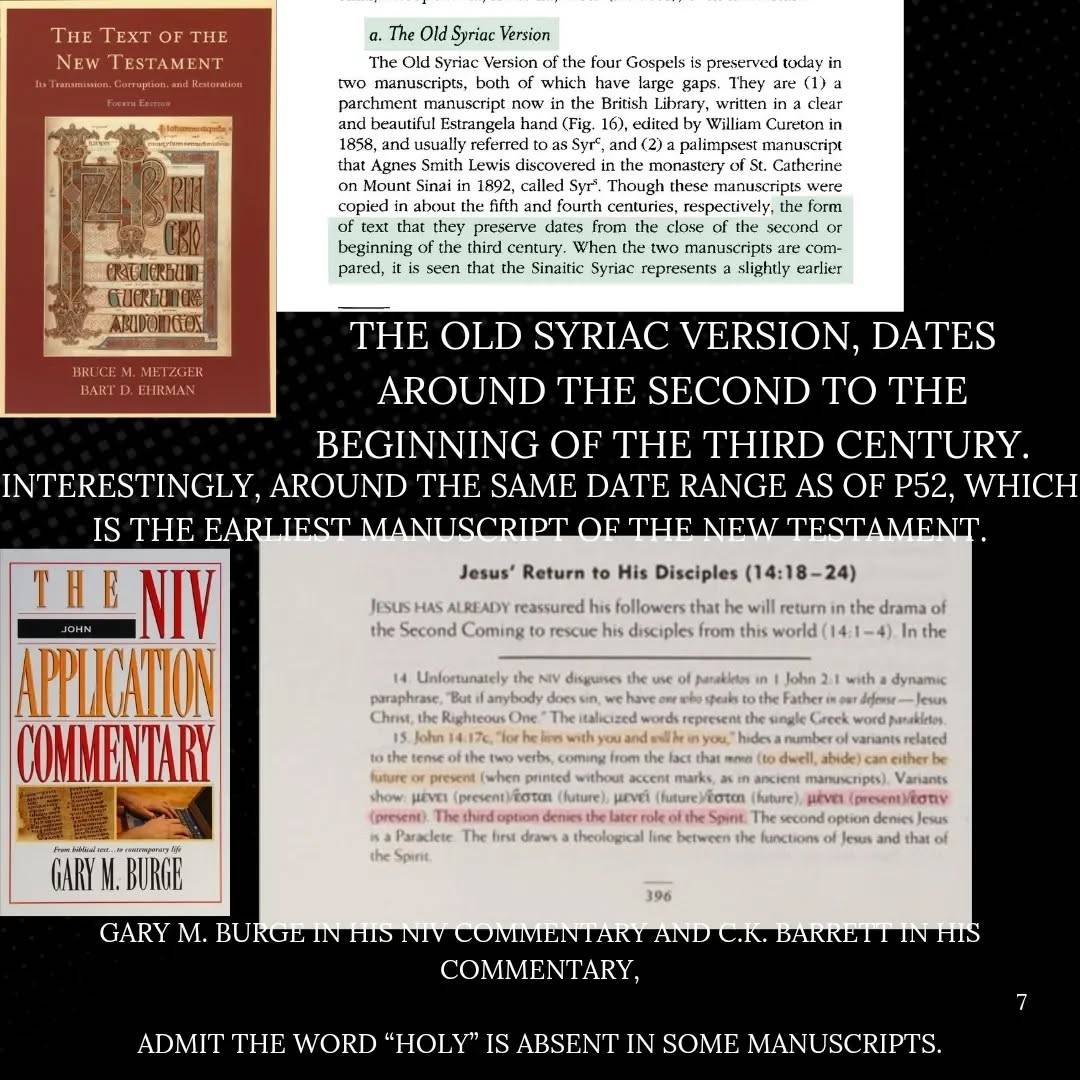
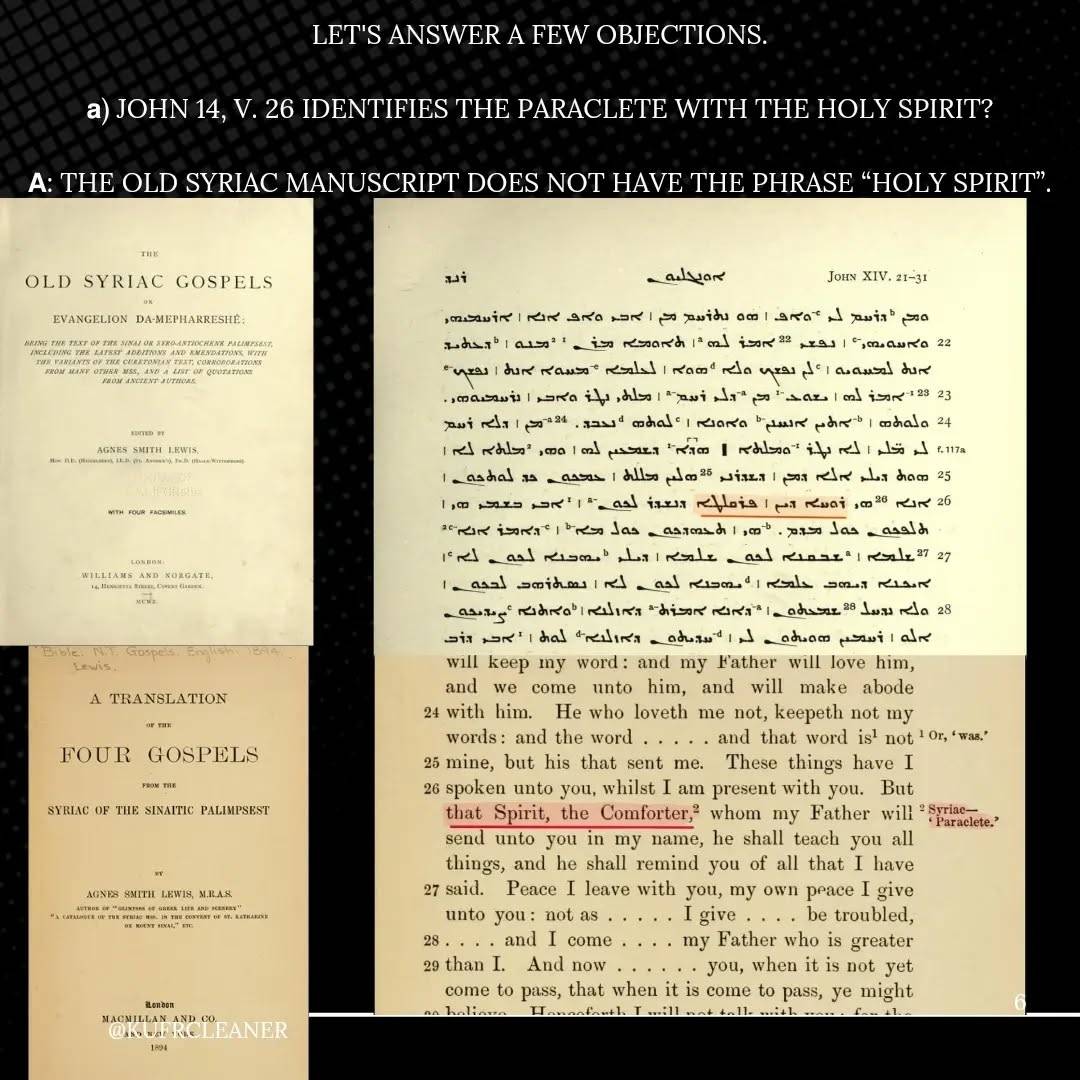
Christians promote John 14:26 as identifying the Paraclete as the Holy Spirit. However, this is theonly text in the Johannine farewell discourses that uses the phrase “Holy Spirit” alongside Paraclete. Furthermore, the 5th-century Codex Syriacus — discovered at Sinai Monastery — reads “Paraclete, the Spirit” — NOT “Paraclete, the Holy Spirit.” The New Testament itself uses “spirit” to refer to prophets in multiple places.
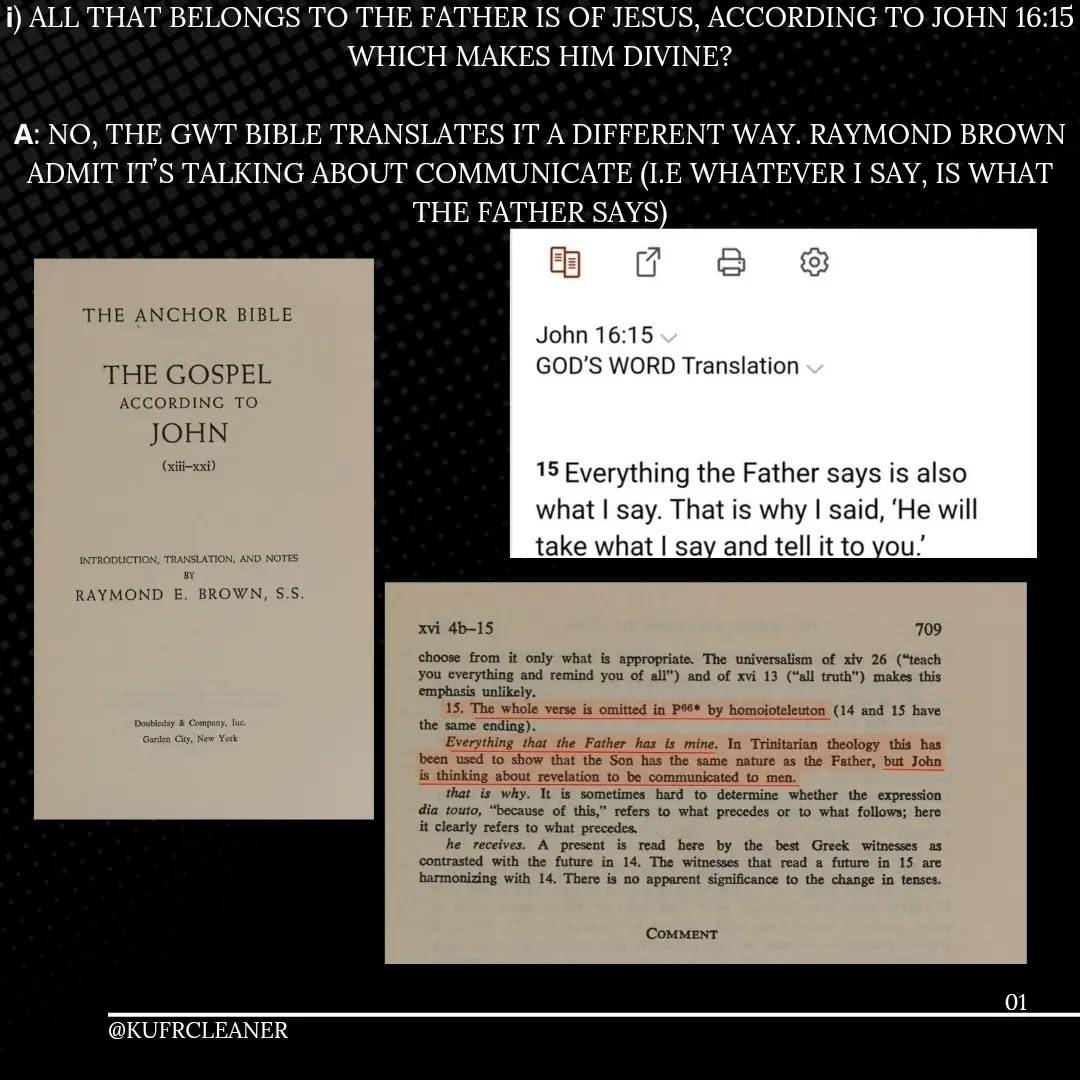
American New Testament specialist Raymond E. Brown, inThe Anchor Bible, Appendix V, states that the word “Paraclete” cannot be the Holy Spirit and that it is more likely referring to a human person.
Canadian researcher Albert Benjamin Simpson, inThe Holy Spirit, or Power from on High, states: “THE NAME, THE COMFORTER. This is not a very happy translation. The Greek word is Paraclete, and it literally means a God at hand, One by our side, One that we may call upon in every emergency.” He explicitly states that “Comforter” is not an accurate translation.
Section 21: The Paraclete Will Bear Witness About Jesus
The Prophet ﷺ came with the Qur’an containing a complete and truthful account of Christ — his conception, birth, mission, and miracles — much of which is not recorded in the known Gospels. The question is therefore decisive: where did the unlettered Prophet ﷺ obtain this information except through revelation?
Section 22: Arguments Against the Holy Spirit Interpretation
The Word “Another” (ἄλλος)
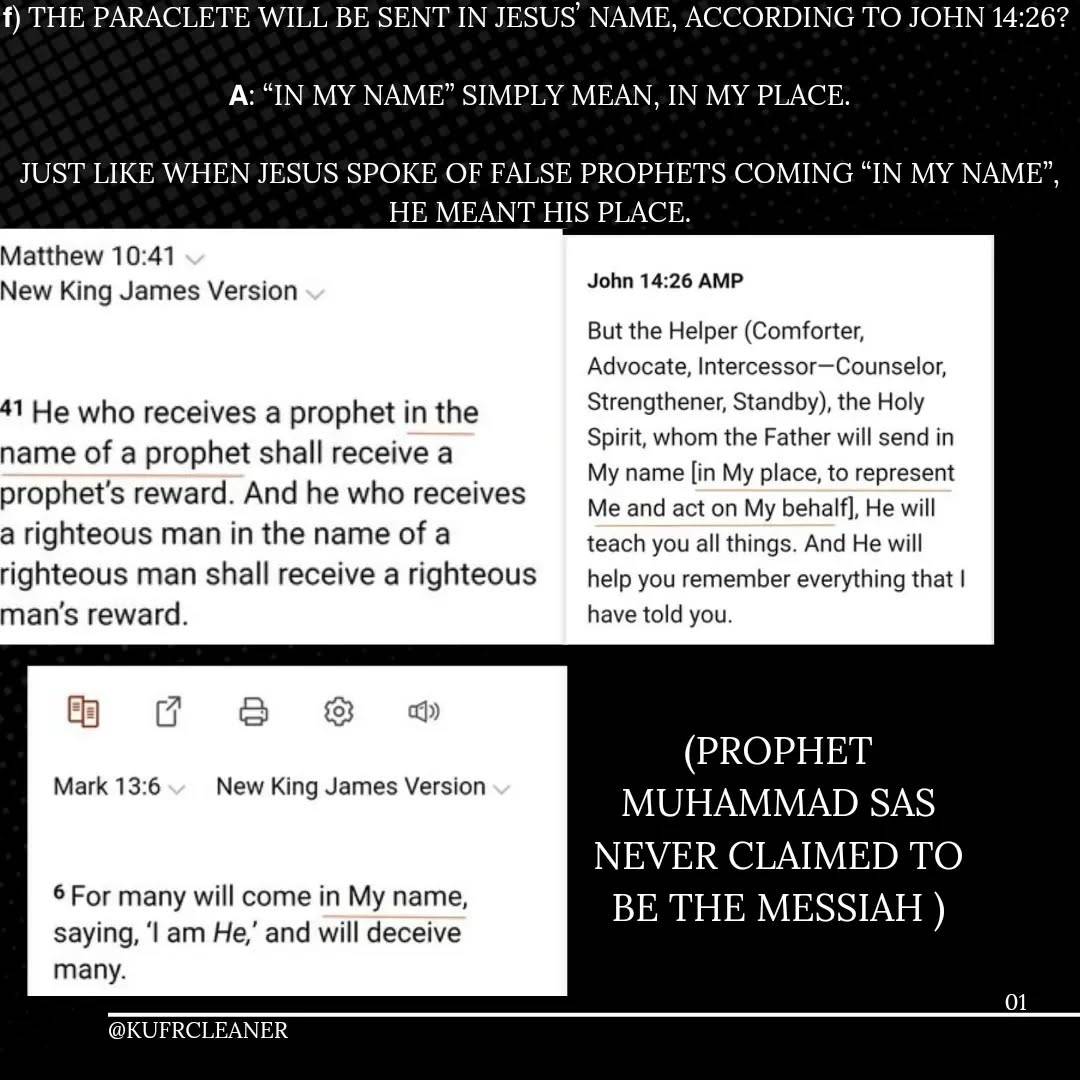
Jesus says:“And I will ask the Father, and he will give you ANOTHER Comforter.” The Greek word used is ἄλλος (allows) — meaning another of the same kind, not ἕτερος (heteros) which means another of a different kind. Since Jesus himself is called a Paraclete in 1 John 2:1 — a human prophet and messenger — “another Paraclete” of the same kind must also be a human prophetic figure, not an incorporeal spirit.
Historical Claims to Be the Paraclete
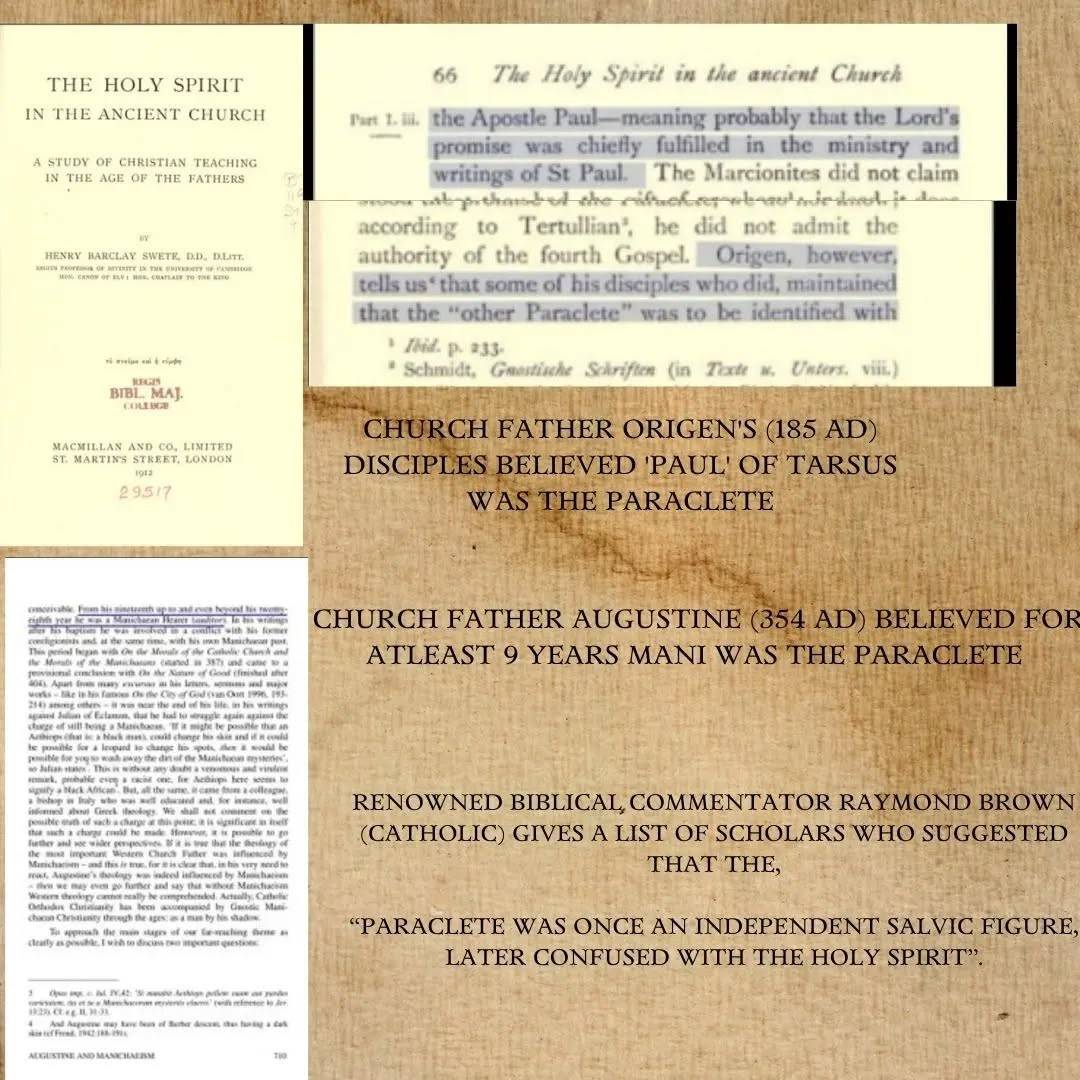
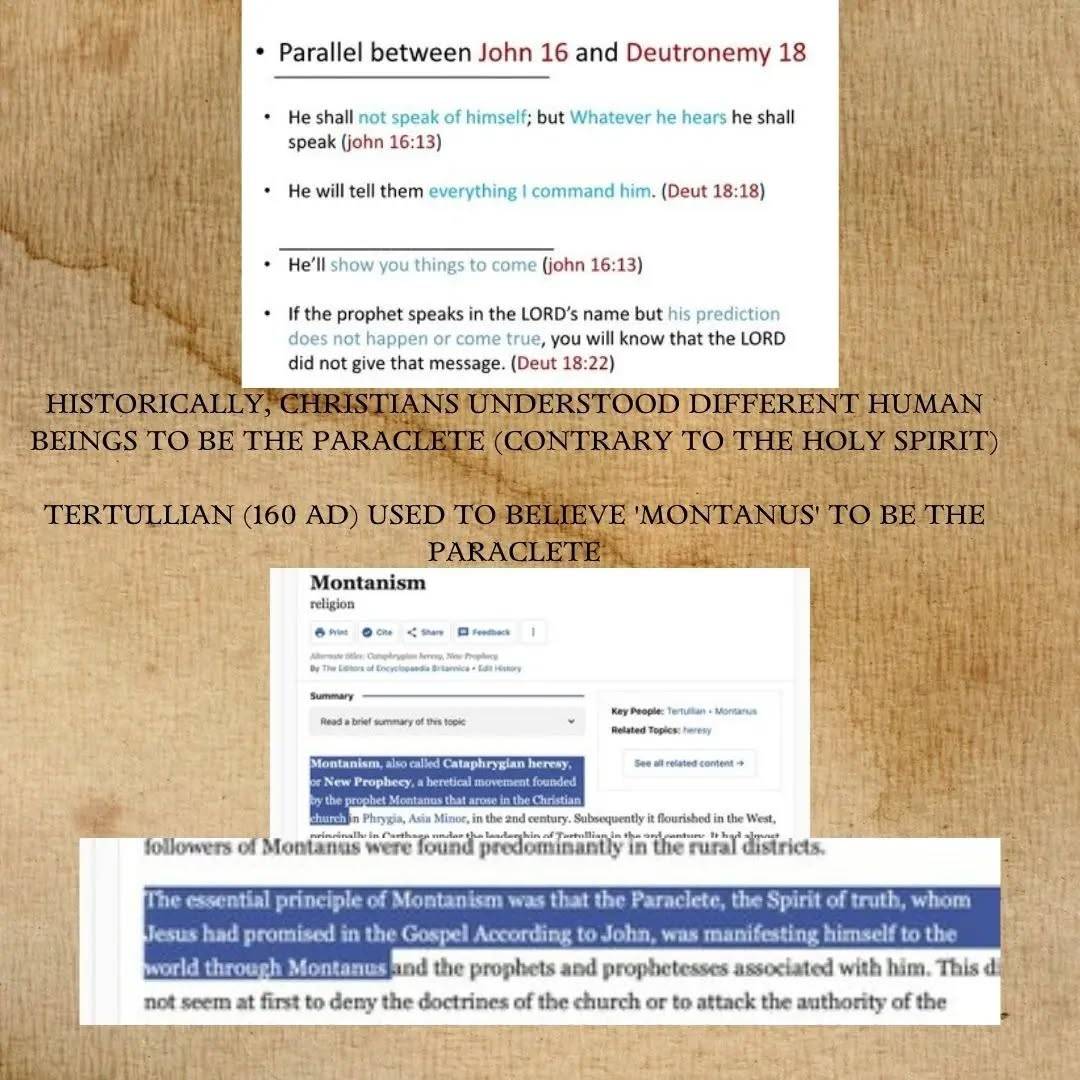
Montanus (2nd century CE) claimed to be the Paraclete foretold by Jesus. Mani the Persian (3rd century CE) also claimed to be the Paraclete. These claims indicate that the term referred to a human being — otherwise no person would have dared make such a claim. These individuals were rejected as false claimants, but their existence confirms that the early Christian community understood the Paraclete as a coming human prophetic figure.
”Spirit” Means “Prophet” in Scripture
“Beloved, do not believe every spirit, but test the spirits to see whether they are from God, because many false prophets have gone out into the world.”
Here “spirit” is used as a direct synonym for “prophet” — true spirit equals true prophet, false spirit equals false prophet. This linguistic usage within John’s own tradition supports reading the “Spirit of Truth” as a prophetic human figure.
Section 23: Christian Monks Who Converted After Recognizing the Prophecy
Originally named Ansim Turmida, he was a Christian monk who acknowledged the Paraclete was Prophet Muhammad ﷺ and converted to Islam. He documented his reasoning in his workTuhfat al-Arib fi al-Radd ‘ala Ahl al-Salib (The Masterpiece of the Intelligent in Response to the People of the Cross).{{Reference: <https://www.facebook.com/Early.History.Islam/posts/pfbid028shySJVRm8AhozBDRi1FkbiZqTZf7V2bu9kRUaEvmUDme8LnBuNVLTJT4FiDTJLSl}}>
Section 24: The Name Ahmad in Christian Arabian Peninsula Usage
It is not necessary for a written manuscript to prove this. Major Gospel manuscripts preserved in museums date more than a century after Jesus’s death, and the oral and liturgical tradition carried meanings that the surviving written tradition only partially preserves.
Section 25: Jesus Glorified Muhammad ﷺ
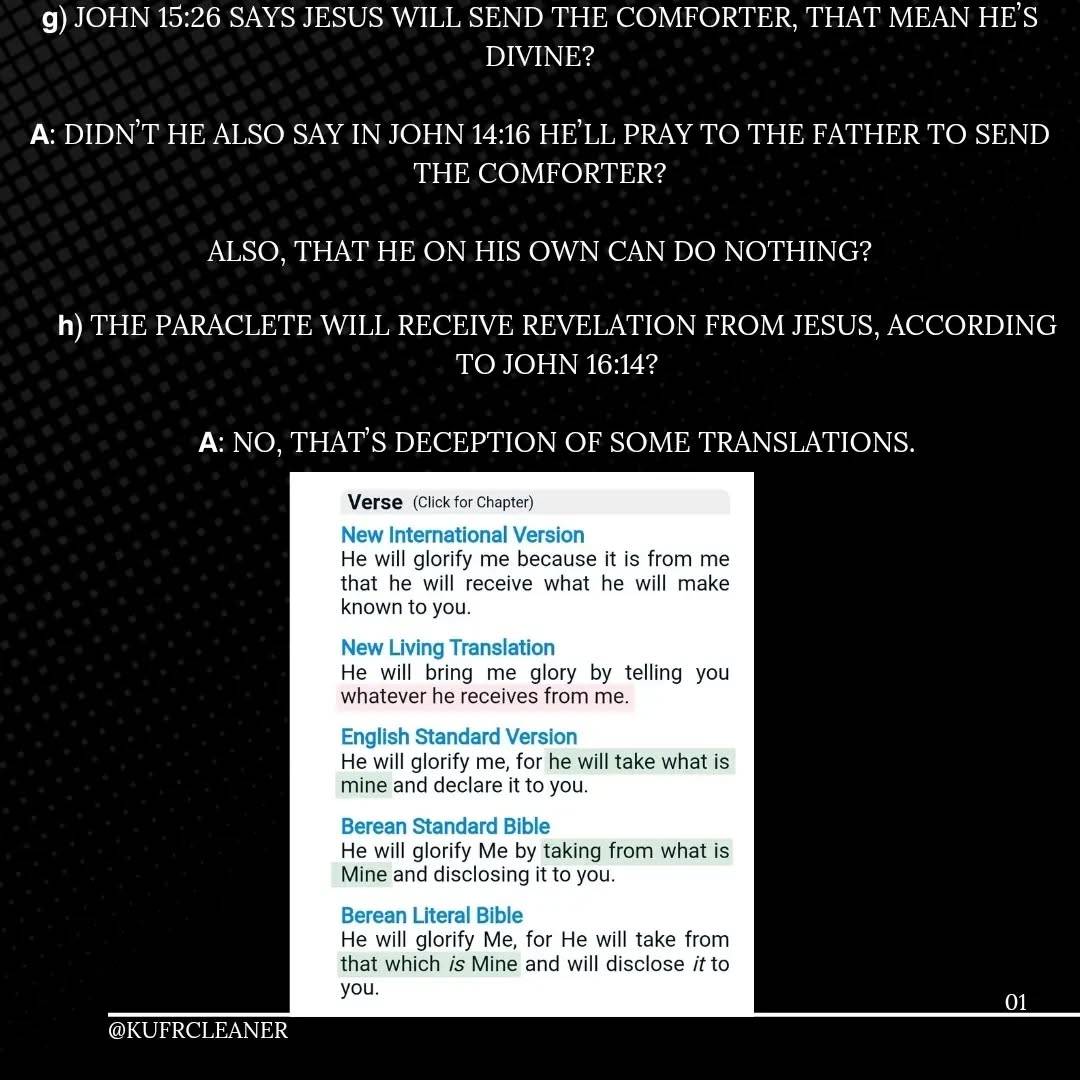
“He will glorify me because he will receive what is mine and declare it to you.” Christ did not glorify any prophet who appeared after him except Prophet Muhammad ﷺ. The Prophet ﷺ praised Jesus, explained his virtue and status among the prophets, extolled his high position, defended him against false accusations, clarified his true mission, and exonerated him and his mother Mary from the slanders directed against them. This fulfilment is unique in all of religious history.
Section 26: Arabic and Coptic Christian Sources

This source quotes John 16:13–14 and explains that Jesus promised “another helper/comforter” (Greek:parakletos), described as counselor, advocate, encourager, ally, protector, and helper. It acknowledges that Jesus was the first Paraclete and that another would come after his departure.

This source states that Jesus’ words about the Spirit are NOT merely about influence, power, or symbol — Jesus mentions the Spirit repeatedly withpersonal language: “another comforter” who teaches, reminds, hears, and speaks. The personal language is consistent throughout the farewell discourses.

This Coptic commentary states that the Coptic translation preserved the wordParaclete, and then notes another Greek form: Pariclite/Periklitos, meaning Mahmoud/praised. It explicitly acknowledges that some therefore said the Spirit of Truth refers to the Prophet of the Arabs.
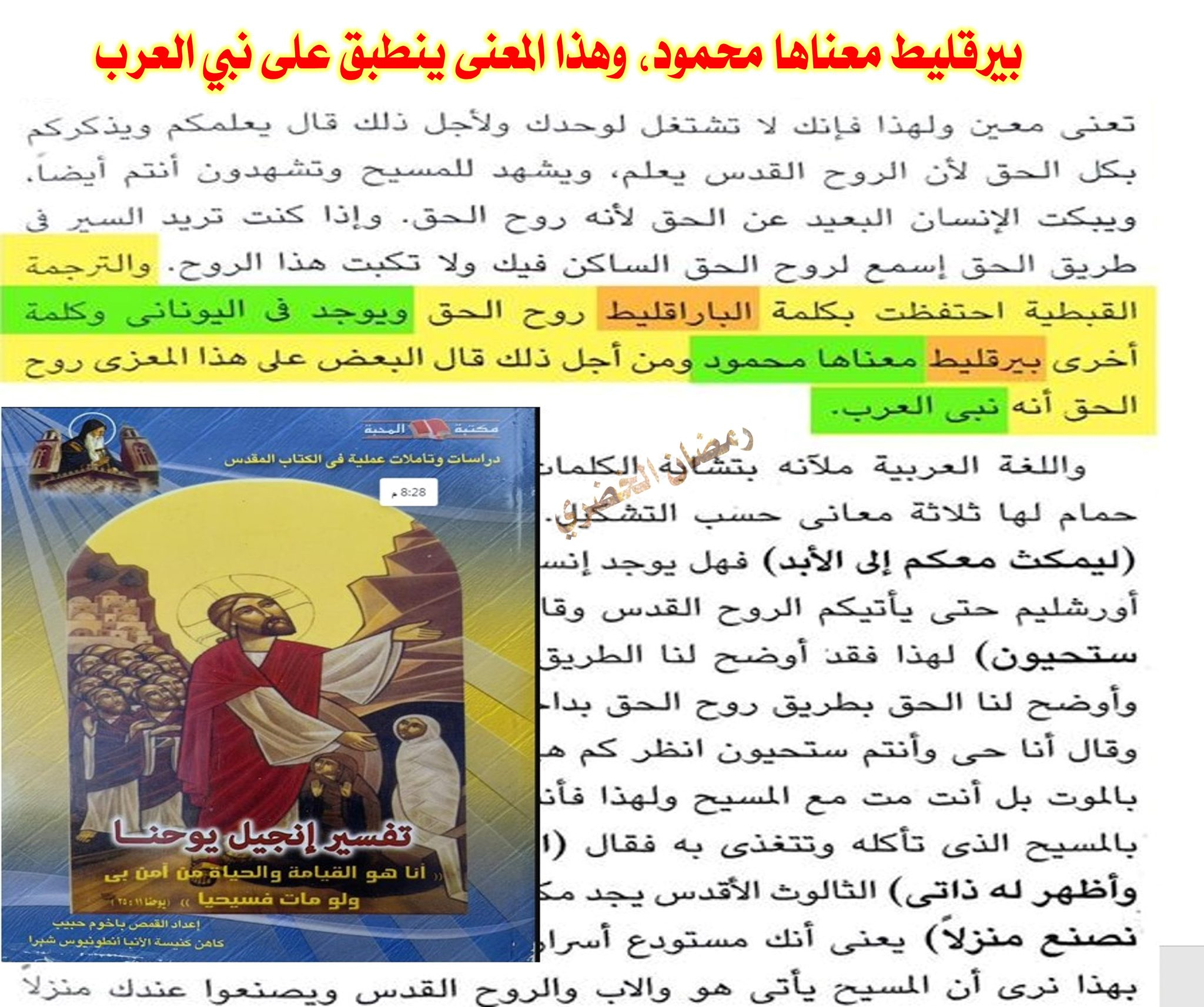
This Arabic Christian commentary scan states that the Coptic translation preserved the wordParaclete, and then notes another Greek form, Periklitos/Periclete, meaning Mahmoud / praised. The highlighted portion adds that because of this meaning, some said the “Spirit of Truth” refers to the Prophet of the Arabs. This scan is valuable because it shows the Ahmad/Periklytos argument being acknowledged inside Arabic Christian explanatory literature, even if the author does not accept the Islamic conclusion.

This source confirms that the word “Paraclete” isspecific to John’s Gospel and means a human helping another human in a legal context — as advocate, defender, and lawyer. This is consistent with the Islamic argument that the Paraclete is a human prophetic figure, not a divine person.

Some Arab Christians in the Syriac church translated the Gospel showing they expected Muhammad’s message. The Syriac/Arabic equivalentMunahhema/Munhamna was used for Paraclete, and the word some Arab Christians used was Periklytos.
Section 27: Modern Christian Scholarly Admissions

Multiple Arabic Christian theological texts acknowledge the word’s ambiguity in its original context, that alternative readings existed in early manuscripts, and that the legal/personal meaning (advocate, defender) is primary rather than a purely spiritual one. Some Arab Christians used “Munhamna” — semantically related to Muhammad. Syriac traditions preserved variant readings. These admissions come from Coptic Orthodox sources, Catholic theological references, and Protestant academic commentaries — none from Islamic sources.
Section 28: Response to Christian Objections
Objection: “No Manuscripts Show the Muslim Reading”
The Muslim argument does not require the claim that Greek had no vowels — that would be a weak and false position. The stronger claim is that Jesus’ original Semitic wording is lost, and the Greek text may preserve an interpreted rendering of that wording. The Gospel of John itself demonstrates this: in John 1:41–42,Messiah is explained as Christ, and Cephas is explained as Peter — showing that Semitic names and titles were translated or adapted into Greek. If Jesus spoke in Aramaic, the Greek Gospel may preserve a translated or adapted form of his original words, rather than their exact Semitic wording.
Objection: “The World Cannot See Him or Know Him” (John 14:17)
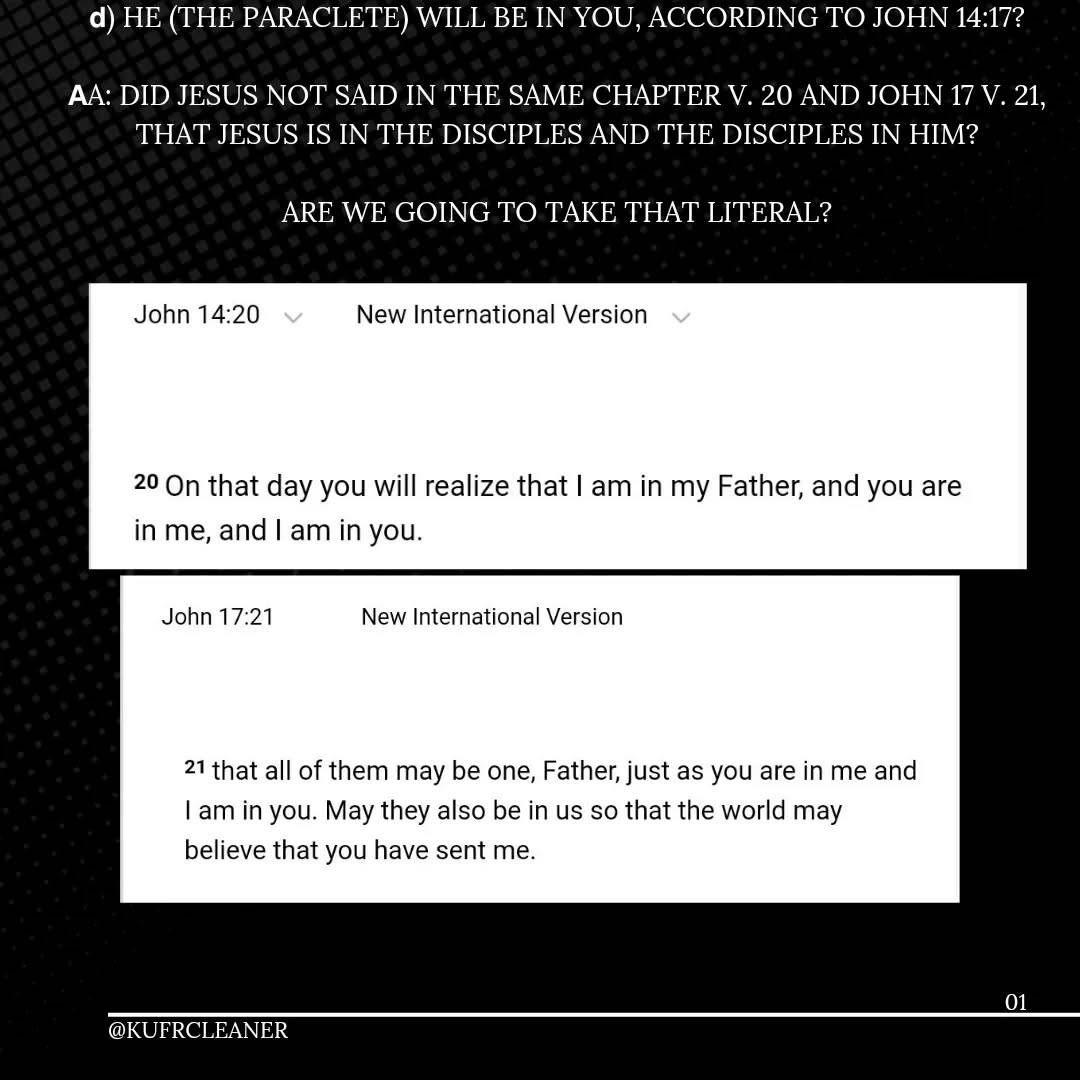
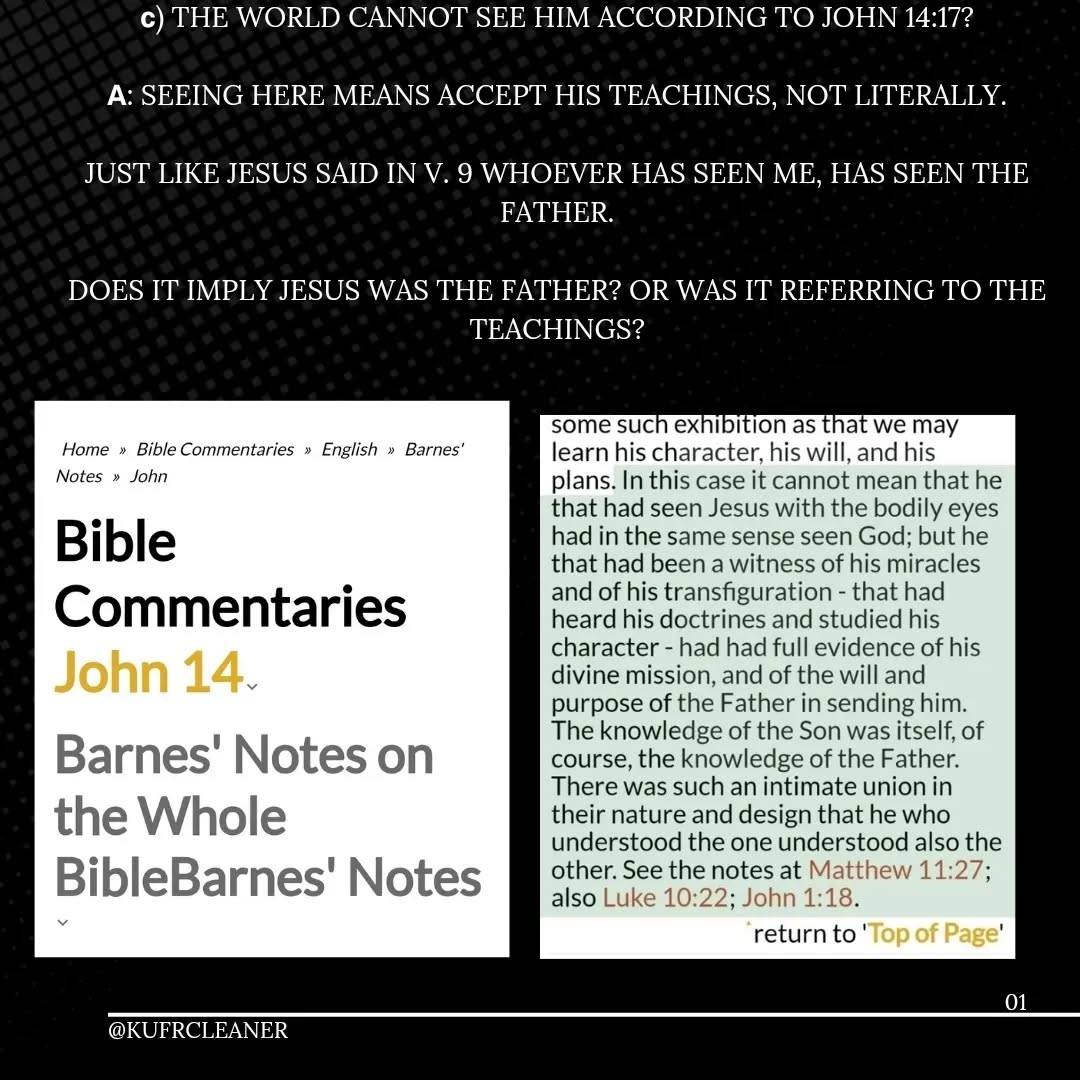
In Johannine and biblical language, “seeing” and “knowing” regularly mean spiritual recognition, not physical eyesight. Matthew 13:13 describes people who see but do not truly see. John 8:19 records Jesus telling his opponents that they do not know him despite physically seeing him. Matthew 11:27 states that no one truly knows the Son except the Father. Therefore, “the world cannot see him or know him” is a statement about rejection and lack of recognition — not physical invisibility. This fits the Islamic argument precisely: many people encountered the Prophet ﷺ in history, but the rejecting world did not recognise his true prophetic rank.
Section 29: The Two Greek Words — Detailed Comparison
| Component | Parakletos | Perikletos |
|---|---|---|
| Prefix | παρα (beside) | περι (most) |
| Root | κλητος (called) | κλυτος (praised) |
| Meaning | Called to one’s side | Most praised |
| Function | Advocate/Helper | Praised One |
| Arabic Equivalent | — | Ahmad |
Current Christian reading. Meanings include comforter, consoler, intercessor, advocate, helper. In Latin:Paraclitum, Advocatus, Consolator; in Hebrew: מנחם (Menahem) — from נחם (Nahm) meaning “comforter”; in Syriac: Manhaman. The name Menahem recurs in the Old Testament and was used in the Talmud to describe the awaited Messiah.
The Islamic claim. Meaning: good, praiseworthy, very praiseworthy, most praised. Appears in Homer’sIliad and Odyssey with the meaning “praised one.” Etymology: Peri (very, most) + Kletos (praised, glorious) = Most praised = Ahmad in Arabic. Greek lexicon reference: Logeion Dictionary — περικλυτός
Section 30: The Hebrew Version Evidence
From“Apology to Mohamed” (p. 718): “The argument of the Muhammadans that the Greek translation of the word is ‘Paracletetus’ instead of ‘Paracletus’ finds strong support in the method adopted by Saint Jerome in his translation of the Vulgate Bible into Latin, where he rendered the word as ‘Paracletus’ instead of ‘Paracletus.’ This shows that the version from which St. Jerome translated must contain the word ‘periklutos’, not ‘Paraclete.’”
Muslims also noted that Hebrew Gospel copies in circulation preserved a vocalization indicating Periklutos/Fraklitos rather than the standard Parakletos, suggesting the current Greek form may represent a change introduced at the end of the 3rd or beginning of the 4th century.
Section 31: Transmission and Vocalization Ambiguity
The possible readings discussed in the apologetic tradition are: Parakletos (advocate, helper, intercessor) and Periklytos / Periklutos (praised, illustrious, glorious). The argument should be framed around translation history, semantic overlap, and the lost Semitic original.
Section 32: Orientalist Admissions
“If the Paraclete pronunciation is fully formed, it is very different. The sign is at the heart of the grace, and it is proche (close) to the pronunciation of Ahmad.”
“Why is the translation ‘Paraclete’ written as Ahmed? There is a Greek language [variant] that does not have this translation of the Paraclete. It exists in the Greek language with the sign ‘loud’ or ‘celebration’ that is qualified by Ahmed.”
Section 33: Historical Confusion in Christian Interpretation
The three competing Christian interpretations of the Paraclete — the Holy Spirit, a human being, and the Comforter — are mutually contradictory and none has achieved definitive scholarly consensus. The Codex Syriacus reads“Paraclete, the Spirit” — not “Holy Spirit.” Raymond E. Brown concludes it cannot be the Holy Spirit and is more likely a human person. Albert Benjamin Simpson explicitly states “Comforter” is not an accurate translation. The internal incoherence of the Christian position strengthens the Islamic argument.
Section 34: The Word “Another” — Ἄλλος
John 14:16 usesἄλλος (allows) — not ἕτερος (heteros). The former means another of the same kind; the latter means another of a different kind. Since Jesus is himself called a Paraclete in 1 John 2:1 — a human messenger — the “another Paraclete” must also be a human messenger of the same prophetic kind. The Holy Spirit, understood as the third Person of the Trinity, would be an entity of an entirely different kind, requiring the use of ἕτερος.
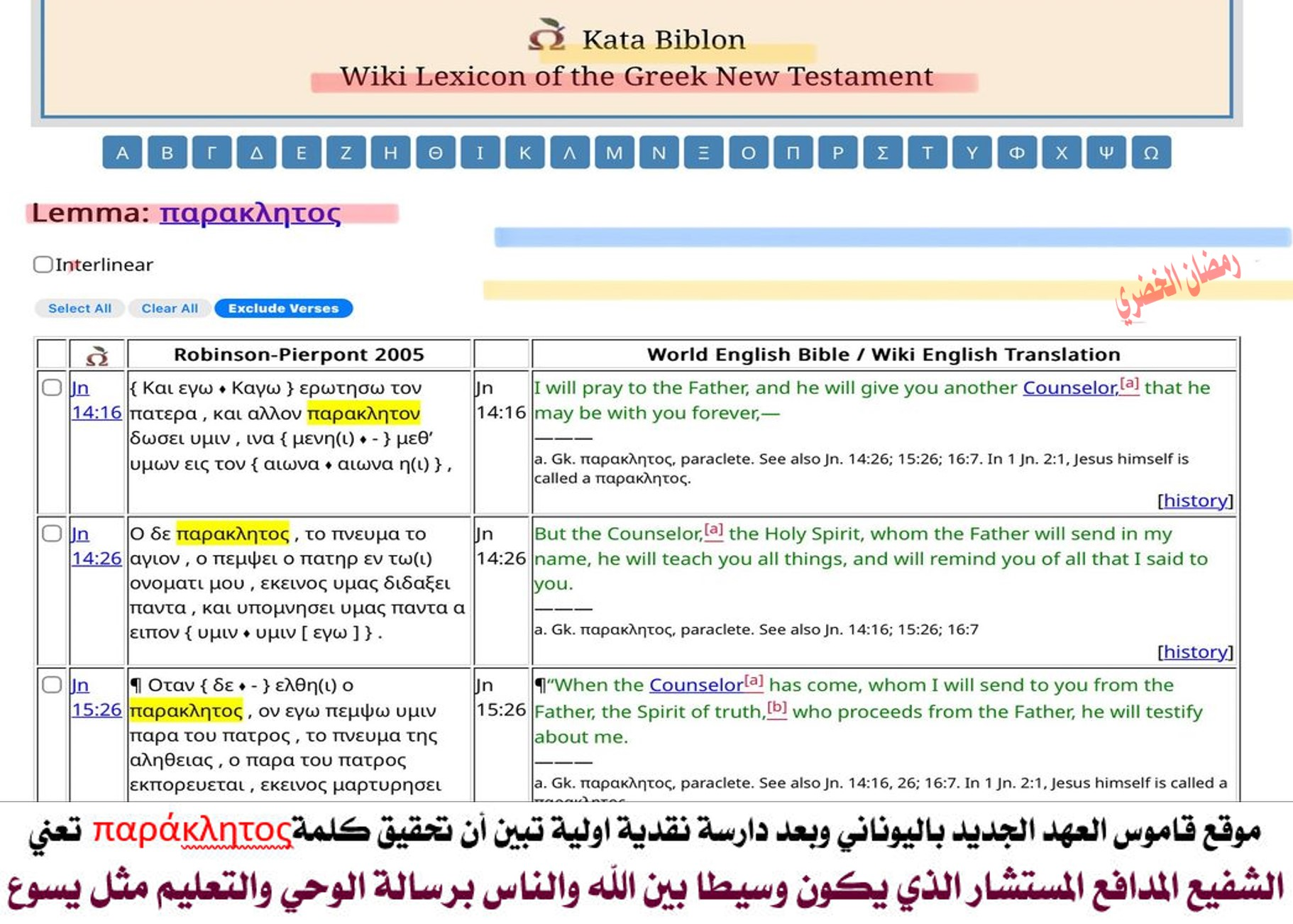
This Kata Biblon Greek New Testament lemma page lists the occurrences ofπαράκλητος / Parakletos in John 14:16, John 14:26, John 15:26, and related passages. The note also points to 1 John 2:1, where Jesus himself is called Parakletos. This is important because John 14:16 speaks of another Paraclete. If Jesus is the first Paraclete — a personal messenger and advocate — then “another Paraclete” naturally invites comparison with Jesus as a personal messenger, not merely an impersonal influence.
Section 35: Tertullian and Montanism

Montanus claimed to be the Paraclete foretold by Christ and gained a significant Christian following, including the influential Church Father Tertullian. This is not a trivial fringe claim — Tertullian was one of the most prolific and influential early Christian writers, and his joining the Montanist movement shows how seriously the personal-prophetic reading of the Paraclete was taken in early Christian history.
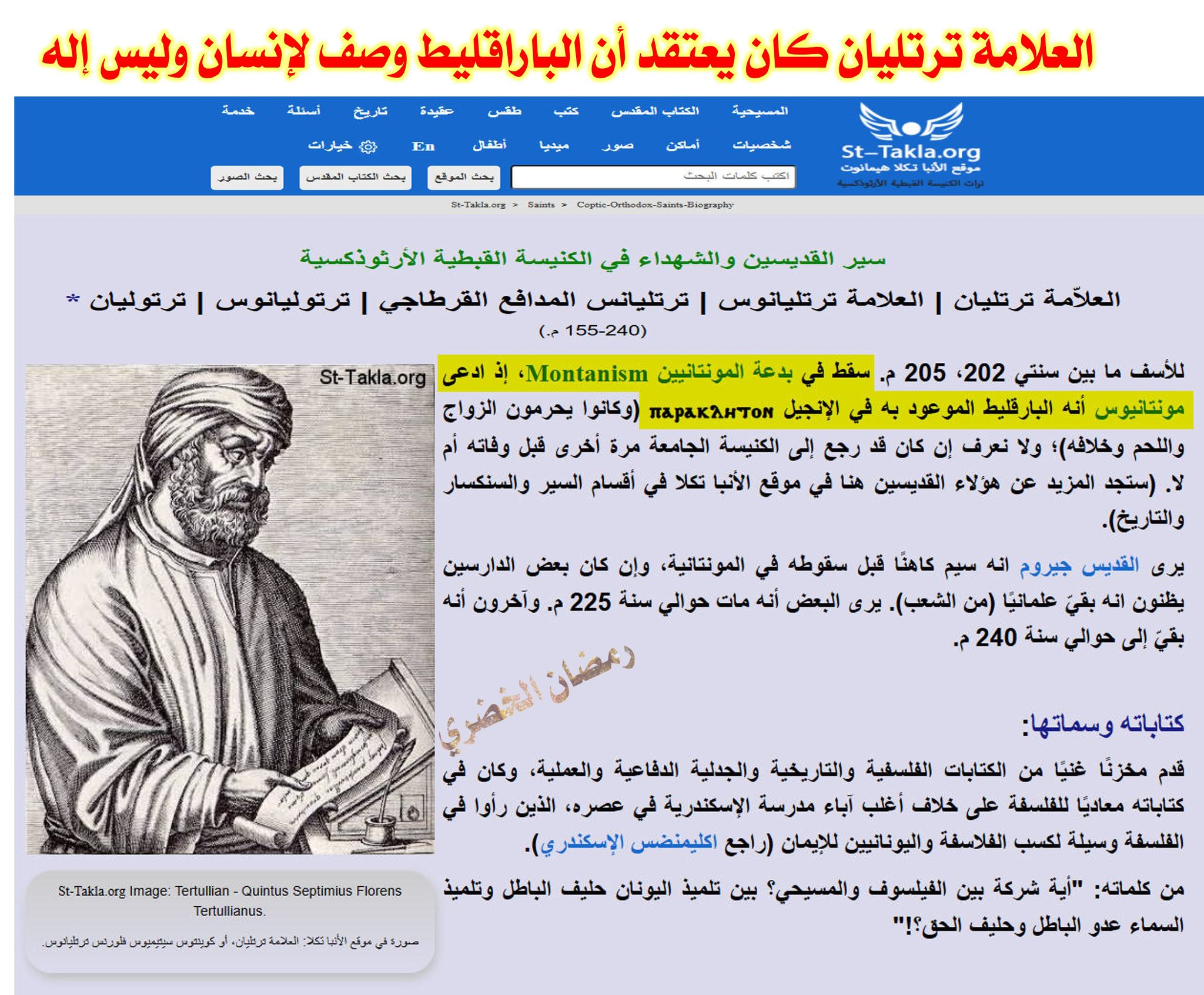
This Arabic St-Takla page on Tertullian says he fell into the Montanist movement around the early third century and that Montanus claimed to be theParaclete promised in the Gospel. The highlighted part is useful because it shows that the Paraclete promise was historically understood by some as a coming personal figure. Even though Montanus was rejected, the fact that such a claim could be made and attract followers — including a major theologian — supports the argument that the Paraclete was not always treated as an already-known impersonal force.
“Now, through the Paraclete, it is settling into maturity. He will be, after Christ, the only one to be called and revered as Master.”
Section 36: Mani the Persian

“Mani presented himself as the Paraclete promised by Christ, and many others did the same. He wrote many books in Persian and Syriac.”

Multiple individuals in the first three centuries of Christianity — Montanus, Mani, and others — claimed to bethe Paraclete. All of them understood it as referring to a human prophetic figure, not a spiritual force already present in the Church. They were all rejected as false claimants, but their existence across different centuries and geographies confirms a sustained early Christian understanding that the Paraclete was a coming human prophet. The only claimant in all of history who fits every Johannine criterion — teaching, reminding, bearing witness, convicting the world, glorifying Jesus — is Prophet Muhammad ﷺ.
Section 37: Modern Christian Acknowledgments
Across Coptic Orthodox sources, Catholic theological references, and Protestant academic commentaries — none of them Islamic — multiple Arabic Christian theological texts acknowledge the word’s ambiguity in its original context, that alternative readings existed in early manuscripts, that the legal/personal meaning (advocate, defender) is primary rather than spiritual, that some Arab Christians used “Munhamna” — semantically related to Muhammad — and that Syriac traditions preserved variant readings.
Section 38: The Linguistic Evidence — Greek Etymology
| Greek Particle | Meaning |
|---|---|
| παρα (Para) | Near, beside, from, in addition to |
| κλητος (Kletos) | Called — from καλέω (Kaleo): I call, I ask, I summon |
| Περι (Peri) | Very, around, most |
| κλυτος (Klytos) | Praised, famous, glorious, renowned |
The difference between Parakletos and Perikletos is not merely phonetic — it is a difference of meaning: called to one’s side versus the most praised one. The Qur’an’s precision in using the superlative form “Ahmad” corresponds exactly to the superlative Greek form “Perikletos.”
Section 39: Manuscript Transmission Problems
No original manuscripts of the Gospels exist. The earliest fragments date to the late 2nd and 3rd centuries; complete manuscripts begin in the 4th century. Copying was performed by non-specialist scribes for personal use, who were not obligated to preserve exact wording and sometimes added clarifications. During Constantine’s era, mass production was ordered — and hand copying meant no two manuscripts could be exactly identical. The surviving Greek manuscripts preserve a Greek form, but not the original Semitic wording spoken by Jesus. Translation and transliteration across languages can shift a proper term into a familiar equivalent word — and this is precisely where the dispute resides.
Section 40: The Quranic Precision — Why Ahmad and Not Muhammad
The Qur’an in Surah Al-Saff 61:6 records Jesus foretelling a messenger whose name is specificallyAhmad — not Muhammad. The distinction is linguistically precise and theologically significant. Muhammad is the simple participial form meaning “praised.” Ahmad is the superlative form meaning “most praised.” The Greek “Perikletos” is a superlative form. The Qur’an uses the superlative — and this precision demonstrates knowledge of Greek etymology that an unlettered 7th-century Arab could not have possessed except through divine revelation. This is among the strongest internal proofs of the Qur’an’s divine origin.
“This is one of the strongest proofs of the prophethood of Muhammad and that the Quran is indeed divine revelation, since Muhammad could not have known that the word ‘Paraclete’ meant ‘Ahmad’ except through revelation.”
Conclusion
The eight converging lines of evidence are: linguistic (Greek etymology supports the Ahmad/Perikletos connection); manuscript (early variations and acknowledged corruption in Christian sources themselves); historical (pre-Islamic scholars including Jerome engaged with the “Periklutos” reading); theological (early Christians expected a human prophetic Paraclete, as shown by Montanus, Mani, and Tertullian); contextual (the Gospel passages describe a human prophet with specific functions, not merely a spiritual force); scholarly (Christian and secular academics including Raymond Brown, Karen Armstrong, and A.F. Kirkpatrick acknowledge the translation difficulties); fulfillment (the Qur’an and the Prophet ﷺ fulfil the Johannine criteria completely and uniquely); and Arabic transmission (older Arabic Gospel witnesses consistently preserved the technical term الفارقليط / فارقليط rather than flattening it into a single ordinary translation).
References and Resources
Video Resources
Written Resources
Academic Sources
- International Cyclopedia Archive
- Greek Lexicon — Logeion: περικλυτός
- German National Library — Abdul-Ahad Dawud: https://portal.dnb.de/opac.htm?method=simpleSearch&cqlMode=true&query=nid%3D124465420
Is Muhammad (Ahmad) Named in Isaiah 42:1? The “Chosen One” Prophecy Explained
Is “The Desire of All Nations” in Haggai 2:7 a Prophecy About Muhammad? The Hebrew “Hmd” Explained